 |
|
[Page 28]
|
Industrial and social revolution – The replacement of handcraft by
machine-driven production – The heirs of Kramsta and Count Renard, Schön,
Dietel, and Lamprecht among the industrial magnates in the city – Cooperation
between the German and Jewish industrialists – Economic connection with Great
Russia and beyond the borders – The customs war between Russia and Germany in
1877 – French magnates of money (financiers) acquire companies and factories in
the city – In 1880, they acquired the Sosnowiec Coal and Foundry Company; there
were 11 factories in Sosnowiec in 1890 – In 1900, there were 23 large factories
in the city – Lighting of houses and streets with electricity – The Jews also
established a ramified small-scale industry – Merchants and peddlers, agents
and commercial representatives – The workers' strikes in 1905 in the city and
the vicinity – The German occupation in the years 1914-1918 – The
destruction in industry and the sending of workers to labor in Silesia – Proposals
for the annexation of Sosnowiec to Prussian Silesia.
|
A) Industry and Commerce from the Foundation of the City until 1914
The period of industrialization of Sosnowiec was in fact an industrial and social revolution; it influenced the course of the city's life and its economic and social development. As an industrial town, Sosnowiec rose in a lightning transition from village to city; its way of life changed completely. The village of Sosnowiec – which stood near the King's Highway at the crossroads of the capital cities of Breslau-Berlin (Breslau: today Wrocław, Poland) and Kraków-Vienna, and observed the wondrous events that took place in the world with the advancement of technology – was favored by fortune; its luck caused it to succeed more than others in reaching what it achieved with a minimum of difficulties and adventures.
The industrial revolution was, in essence, the replacement of handicraft with production by power-driven machinery. Before this, only small-scale industry existed; the work was performed by human power or horsepower alone. In its general lines, this revolution brought with it the extensive development of capitalist initiative; it led to changes in the status of the workers, population shifts and growth, and new social, economic, and political problems. In Sosnowiec itself, the industrial revolution caused no harm to “manpower and horsepower,” which did not even exist within its gates; this stood in contrast to other cities in Poland, such as Łódź, Warszawa, and Kalisz, which progressed “from the light to the heavy.” Sosnowiec made a leaping charge and immediately began establishing industrial plants driven by power and machinery, without first undergoing the process of light industry; consequently, it experienced no transition complications. It did not find itself in the situation of that coachman who looked with anxiety at the racing of the horseless railway cars, while the question began gnawing at his mind from where his bread would come, if there was no longer any use for a horse. The peasants of the village of Sosnowiec whose land was lean and
|
|
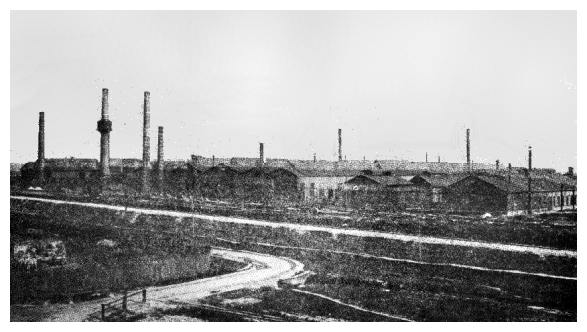
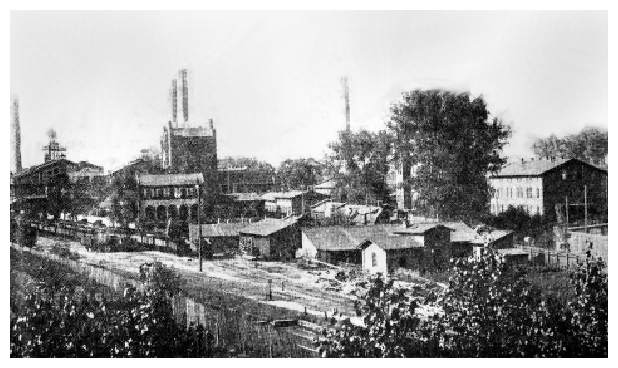
| View of the “Renard” coal mine in Sosnowiec |
[Page 29]
|
|
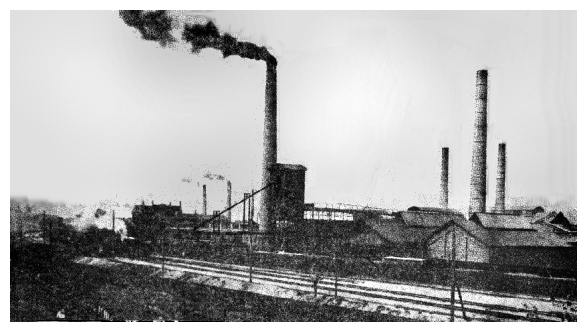
| The “Count Renard” rolling mill in Sosnowiec |
|
|
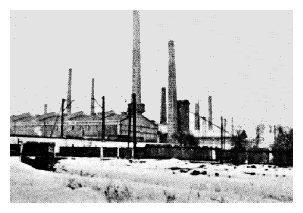
| The manufacturing plants belonging to the Jewish industrialist Holdszynski and his sons |
[Page 30]
unfertile, sold their estates to German nobles and industrial capitalists – among
them the heirs of Kramsta, Graf Renard, and others. They moved into the town,
where they became hired laborers. By the way, it is worth mentioning here that
heavy industry in Sosnowiec and in the entire Zagłębie region was
already in the hands of the great German industrial magnates during the period
of the Russian Tsar; it expanded mainly within the areas of the Silesian-Prussian
border. Until then, the Zagłębie region was almost an “unknown
land” from an industrial perspective; however, it now began to occupy its
proper place. The Jews had a significant share in its development; in many cases,
this share was larger than their relative number in the population. The German
owners of capital and industry worked hand in hand with the Jews, despite the
restrictive laws on the part of Prussia and the Tsarist regime. The progress and
development were very prominent in Sosnowiec and the vicinity. Educated and
energetic, the population turned to industry and handicraft, as well as to export and trade
inside Great Russia and even beyond the borders; thus, it continued to improve
its economic situation.
The industry in Sosnowiec and its vicinity began marching with powerful strides starting from the year 1879. Capitalist industry, even though it had already appeared in the region known as Zagłębie Dąbrowskie at the end of the 18th century, did not initially break a path for itself into Sosnowiec. The main center of productive output, in mines and quarries, was and remained for decades Dąbrowa Górnicza (the “Reden” mine, “Huta Bankowa”). The large industrial enterprises of Sosnowiec are mainly connected with the period of the Kingdom of Poland (except for the “Nadzieja Ludwika” coal mine, which was located in the vicinity of Czarna Street, and its exploitation had already begun in the year 1806). On the initiative of the state administration, they began extracting coal from pits, among which were found: “Pogoń” (from 1815), which was also called by the name “Wincent” (located near 3 Maja Street); “Ostra Górka” (which opened around 1822), located in the vicinity of Biała Street at its junction with Ostra Górka Street; “Feliks” and “Szarlota” in Radocha (from 1822–1823); and two mines in Milowice exploiting the upper layers of carbon.
Indeed, there were no great prospects for the development of the foundries because of the scarcity of the deposits. Likewise, the “Emma” zinc sheet rolling mill – which was founded in the year 1864 by the Kramsta company, which had purchased the Gzichów estates – suffered from a lack of material; “Emma” was established upon the ruins of the old “Pogoń” mine, along with a zinc smelting factory (zinc foundry). The output of “Emma” never exceeded 210,000 pood (a Russian unit of weight equal to about 16.38 kilograms) of sheets; and this was achieved with a workforce of 75 workers. Meanwhile, the zinc smelting factory, despite being the only one of its kind in the Kingdom, produced only 100,000 pood per year; while employing a workforce of 16 workers.
As the only industrial plant from before 1877 that was not connected with raw material deposits, a bone-burning (bone calcination) and chemical fertilizer factory was founded in Stary Sosnowiec (the old core of Sosnowiec) in the year 1853; it was known by the name “Kościarnia” (bone mill) and was counted among the first enterprises in the city. It was built by Ignacy Niewiadomski upon lands purchased from Count Stolberg-Wernigerode. In the year 1864, the plant was leased to Teodor Ludwik Scherner; after four years, it became his property. In 1870, its production rose to 81,550 rubles (it employed 46 workers). In 1875, Paul Lamprecht bought the bone factory and managed it until 1894; then, it was closed and the buildings were converted into residential houses, which stand to this day at 25, 22 Lipca Street.
The starting point for the large-scale industry of Sosnowiec was the year 1877; this was the beginning of the customs war between Russia and Germany. In the years 1878-1881, an impetus was given to the industry of Sosnowiec by capital that was entirely foreign; only at that time did the villages that grew amidst forests and swamps turn into a populous city full of life and a rhythm of work.
The demand for coal, which grew stronger and stronger, increased the output of the foundational raw material of Zagłębie. The heirs of Count Renard, the lords of the Sielce estates, built a large mine named “Renard” in place of the “Fanny” pit; in the year 1902, the mine passed, together with all of Sielce, into the possession of French capital of the industrial group “Huta Bankowa”, which was comprised of “Huta Bankowa”, “Reden”, the Count Renard Company, and the metallurgical plants in Radom. Already in the year 1890, the French financiers acquired the rights of the von Kramsta company from the heirs of Kramsta; they established the largest coal enterprise in the Kingdom – the Sosnowiec Coal and Foundry Company – with a share capital of approximately 10 million rubles. To this company belonged: the “Jerzy” coal mine in Niwka, which in the year 1900 employed 2,500 workers; “Ignacy” in Zagórze with 1,900 workers; “Wiktor” in Milowice with 800 workers; the galmei (calamine zinc ore) mine in Bolesławiec with 900 workers; the “Emma” zinc foundry (zinc casting works) in Sosnowiec with 50 workers; and the zinc smelting factory (zinc foundry) in Sosnowiec with 20 workers; altogether with the estates and the forests.
The mine output of the two Sosnowiec companies in the year 1900 was 50.5% (the Sosnowiec Company – 35.9%, the Count Renard Company – 14.6%) of all coal exploitation in Zagłębie. Concentration of capital and production in the hands of a few joint-stock companies was a characteristic phenomenon in the coal mines of Zagłębie during that period of time. In the year 1897, 19 coal mines belonged to 13 companies, which were, in fact, composed in fact of two groups. The one (the Sosnowiec Company, the Count Renard Company, the French-Italian Company, the Warszawa Company, the “Saturn” company, formerly Hohenlohe) produced 86% of the total output of coal, and the second (which was composed of eight firms) – only 14%.
The foundries and metal plants developed as a second large branch in the industry of Sosnowiec; and to this day, they employ the largest number of workers. The introduction of protective tariffs on raw materials and the locking of the border gates to the export of iron products from Silesia led the Silesian industrialists to a decision to establish branches for their plants in Sosnowiec; which accelerated their development in the locality.
[Page 31]
In the year 1880, a factory for steam boilers, machinery, and bridges was established in
Konstantynów. It was founded by the Silesian industrialist Fitzner and the Swiss
Gamper[1]. In the year 1910,
the enterprise employed 1,200 workers.
In the year 1881, the German industrialist from Zabrze, A. Deichsel[2], established a wire and rope factory in Dębowa Góra (near Modrzejów); it was the largest of its kind in the Kingdom of Poland. The production of the plant, which employed approximately 280-300 workers, gained a reputation for their quality.
Likewise, in that same year, the largest industrial enterprise of S. Huldschinsky and Sons (Jews from Silesia) arose in Sosnowiec as a branch of the factories of the Huldschinsky joint-stock company: a large iron rolling mill and a smelting plant with five furnaces. The enterprise engaged in the production of gas pipes and boilers, refractory bricks, merchant bars, hoop iron, nails, screws, and more. The factory employed 2,000 workers. In the year 1897, a change occurred in the name of the enterprise, which turned into the “Sosnowiec Joint-Stock Company for Pipes and Iron” with a share capital of 6 million rubles (out of this, 5 and a half million belonged to the parent company in Gliwice); the capital increased afterward to 16.6 million rubles. Among the workers were dozens of skilled laborers brought from abroad.
In the year 1883, the “Aleksandra” (“Milowice”) foundry was founded in Milowice by the German company Friedrichshütte; its output reached 825,000 pood, employing 370 workers, including 220 foreigners[3]). The initial capital, which was 1.3 million marks at the beginning, rose by the year 1914 to 5 million marks. In the year 1897, the enterprise employed approximately 800 workers; by the year 1910, it already employed 1,480 workers.
Donnersmarck in Dębowa Góra [established] the “Puszkin” foundry (later under the name “Staszic”); it produced round, square, flat, and bar iron. it produced round, square, flat, and bar iron with a capital of 550,000 rubles (the majority of the shares were in the hands of the founder of the plant, Count Donnersmarck). Its output was never large; and by 1900, it reached approximately 650,000 pood. It employed 350 workers. In the year 1911, the decisive share of the stock of this company passed into the hands of the joint-stock company of the iron plant in Milowice.
Characteristic of the ownership structure in the Sosnowiec foundries was the gradual takeover by the huge Upper
|
|
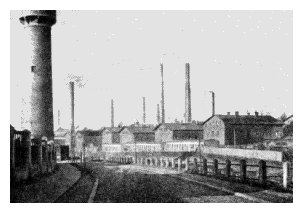
| Sosnowiec – Metallurgical factories |
Silesian concern: Oberschlesische Eisenbahn-Bedarfs A.G. (by the abbreviation – Oberbedarf) headquartered in Bytom. In the year 1908, “Oberbedarf” received into its possession the entire stock portfolio of the pipe and iron factory. Only the “Katarzyna” foundry remained without a change of ownership, belonging to one of the largest German mining and metallurgical concerns, headquartered in Berlin.
In 1901-1911, Przybylski served as the actual manager of these enterprises. In the year 1877, a third large industrial branch appeared in Sosnowiec, which was the wool yarn industry. While the mines and foundries based themselves on the raw material of Zagłębie, this branch – unlike the others – was attracted here mainly because of the cheap labor, especially of women and children.[4]
As stated above, the heirs of the Saxon industrialist C. G. Schön already built a cotton spinning mill and a dyehouse in the year 1878; in the year 1900, they processed raw material with 30,000 spindles. The enterprise employed 1,200 workers at that time. In the year 1904, the heirs established a large factory for knitwear (tricotage) and hosiery and employed more than 1,000 workers. During the period of the greatest development of the factories, a large fire consumed (in the year 1907) the vicuña spinning mill (vigogne)[5] and the tricotage factory. Before 1914, they rebuilt the vigogne spinning mill; meanwhile, they converted the tricotage factory into a plant producing hygroscopic wadding, a shoddy wool spinning mill, and similar products.
The production of worsted wool (combed wool) received special attention; until then, it had been unknown in the Kingdom of Poland, nor even in the Tsarist Empire. Its first manufacturer was not Schön, but rather the Saxon industrialist Heinrich Dietel; as early as the year 1878, he founded the first spinning mill of this type in Sosnowiec. Within a year of the factory starting operations, 4,800 spindles were already working inside it. Around 1904, 43,000 spindles were working in the plant, and it employed 2,000 workers; half of them were women.
|
|
| A workers' housing colony near Staszic Street in Sosnowiec |
[Page 32]
Initially, its output rose to 36,000-40,000 pood of wool by means of machinery driven by
the power of coal dust (pulverized coal). The number of workers later decreased
to 140, and they processed 225,000 pood of wool. The processed yarns –
valued at 2,105,000 rubles – were sold especially to Moskva and
łódź. Next to the factory, there was a clinic (infirmary), a
pharmacy, a bathhouse, a two-class school, a Realschule (modern
secondary school), and an Evangelical church.
In the course of time, as mentioned above, small industrial enterprises in various fields were added, among others: the paper factory of Paul Lamprecht in Sielce, which was founded in the year 1881 by C. G. Dietrich and in the year 1905 employed 100 workers; and the glass factory of Pringsheim and Schlesinger next to Targowa Street, which was founded in the year 1873 and employed 400 workers. Its output reached a value of 500,000 rubles, and in 1904 it employed 600 workers; there was also a textile factory belonging to Dietel[6]. Likewise, there were chemical factories: “Gzichów” in Środula – which was founded in the year 1865 with a capital of 3 million marks by a company from Mainz and produced sulfuric acid, hydrochloric acid, soda, and vinegar; its production reached 4 million rubles per year, and it employed approximately 95 workers – and the “Radocha” factory (founded in the year 1896 with a capital of 700,000 rubles), which produced approximately 300 carloads of paraffin, stearin candles, and more, and employed about 180 workers; there were also the lithography and stone-printing works of Jarmułowicz (a Jew), who supplied various printed matters to the value of 350,000 rubles per year. Furthermore, there existed in the city enterprises for embroidery goods, copper processing, zinc foundries, tar paper, a beer brewery, steam flour mills, and other smaller factories. In the year 1880, 11 factories were counted in Sosnowiec proper, excluding its suburbs; the value of their buildings and machinery amounted to 747,000 rubles, and their production reached 1,387,420 rubles. On the other hand, in 1886 – that is, after only six years – 36 factories were already counted; they employed 5,051 workers, and while the value of their buildings and machinery stood at 210,000 rubles, their output reached 12,082,267 rubles.[7]
By the year 1900, Sosnowiec counted 23 large industrial enterprises; furthermore, electric lighting for houses and streets was already operational in the city. All that is stated above pertains to the second half of the 19th century; that is to say, to the period when Sosnowiec had not yet been officially recognized as a city by the Russian authorities.
With the expansion of industry and manufacture in Sosnowiec and its vicinity, a capitalist economic system grew here; its main identifying characteristics were private ownership of property and of the means of production. These factories, whose owners mostly came from Western countries, indeed created work for tens of thousands of working hands; however, they demanded precise and highly skilled labor. Since skilled workers were not yet available in Poland, they brought professionals from Germany to supervise the production process; these individuals formed a colony of hundreds of Germans in Sosnowiec. The factory owners took care of erecting housing for the workers; they also established health insurance and benefit funds, hospitals, as well as vocational and general schools for the workers' children. In the initial period, there was not sufficient housing in Sosnowiec for the factory workers; consequently, many were forced after their work to return to their distant places of residence. The factory owners erected large-scale housing complexes with all the amenities; by this means, they expanded the housing capacity of the city, and the population continued to grow.
After the Germans, the turn of the Jews arrived; they too did great things for the development of the city. Apart from a certain share in large-scale industry, they established a small-scale industry in Sosnowiec that employed many workers; they were the ones who expanded the ranks of the self-employed “middle class” in the city, both in handicraft and in commerce and peddling, brokerage, agencies, and the like.
Among the various branches established by the Jews in the city and its vicinity, an important place was occupied by the electric flour mill sector. These mills produced flour in large quantities; a significant portion of which was destined for export to the remote districts of Russia. Among the owners of the mills, one should note the firm of Kalman Langer and Mordechaj Klajnberg. Furthermore, Mendel Klajner and Mosze Jakób Szarf operated in Modrzejów and later in Sosnowiec; Jicchak Majer Sztark, a man of Wolbrom, was also a prominent owner. Their bran was sold in German cities, including Breslau and Berlin, by the chief agent Reb Eliezer Brukner; he was the son-in-law of Reb Herszel Langer from Modrzejów. For the purpose of centralizing the shipping logistics, Reb Eliezer opened a branch office in Mysłowice, which lay directly opposite Modrzejów. From this branch, he established commercial ties with his customers in various cities throughout Germany. In later years competitors arose against him, such as Reb Nachum Hamburger from Modrzejów and others.
The industrial plants that developed in a dynamic manner naturally also needed commercial institutions. Sosnowiec fulfilled an important role from this perspective due to its geographic-political position; it served as a border station of the railway that united the Kingdom [of Poland] with Prussian Silesia. In a broader sense, this railway connected the [Russian] Empire with the German Empire. It was as if it were decreed from above upon Sosnowiec to fulfill the role of a connecting link in the commerce between these two realms. Great prospects for commerce appeared especially to the Jewish population, which arrived here in crowds. A large community of merchants and peddlers, agents and commercial representatives arose. Their field of activity was not restricted to the needs of the local market alone; instead, it expanded and reached great distances. At the end of the past century, approximately 300 grocery stores were found in Sosnowiec, including several of the first class. There were also dozens of restaurants, beer taverns, and confectionery shops; seven hotels; about eighty tailoring workshops; seven fashion houses; five bookstores; and two photography studios. Likewise, there were commercial houses and agents, technical offices, brokerage offices for sales, shipping firms, banks, loan funds, exchange bureaus, and insurance agencies. Alongside the overt and legal commerce, the smuggling of goods also flourished on a large scale.
The lion's share of commercial and service businesses was located in the vicinity of the train station. In this area, almost all the cultural and social institutions were also concentrated. Thus, a main center – a kind of “City” (business district) – arose here. This happened despite the anger and refusal of the narrow-minded Russian Tsarist administration. The commerce that constituted the “City”, was precisely what enabled the unification and blending of the city of Sosnowiec. Through the joint action of the elements of industry and commerce, the foundation was prepared for the growth of an organic entity as a city. Consequently, even an “evil angel” in the likeness of the Tsarist government was forced against its will to say amen[8] to the official recognition of Sosnowiec.
The granting of city rights to Sosnowiec came as a marker of its immense development.
[Page 33]
In the year 1904, Sosnowiec numbered 57,190 inhabitants, and in the year 1914,
it reached 118,475. This means that during the ten years preceding the First
World War, the number of its residents doubled. The new administrative rights
of Sosnowiec were in themselves a source of much relief. They provided an impetus
for the development of economic life and for the unceasing expansion of
industrial plants; in a parallel manner, they also boosted commercial positions
and other services. In the year 1886, the industrial plants in Sosnowiec
employed 5,051 workers. By contrast, in the year 1914, the number of people
employed in industry rose to 19,876 workers.
The organization of a large industrial working class in the locality could not have been realized without being influenced and guided by the socialist movement. This movement was developing rapidly in those days, despite being forbidden in Tsarist Russia, which was ruled by a regime of tyranny and coercion. As is well known, the Tsarist regime faced a severe trial from the beginning of the year 1905; this occurred in the face of workers' strikes and clashes (assassinations/attacks) with policemen and soldiers. The year 1905 cast its terror over the Zagłębie region as well[9]; and from that time on, quiet no longer prevailed among the workforce there. The socialist movement did not pass over the Jewish workers in Sosnowiec and Zaglebie either; however, this will be discussed further below.
B) The Influence of the German Occupation (1914-1918) on the Economic Situation of the City
The growth and development of industry and commerce in Sosnowiec was broken during the period of plunder under the German occupation in the years 1914-1918. In the industrial plants of Sosnowiec, nothing remained of all that was made of leather and ingot[10]. Not even a single motor or a single dynamo machine remained; furthermore, everything they did not manage to remove was completely destroyed. The metallurgical industrial plants and the spinning mills suffered in particular. Nothing remained of the factories of the heirs of Schön except ruins; within these ruins, only the skeletal remains of the machinery stood out. For six years, the factories lay abandoned in terrible destruction; it seemed as though they would never rise again. However, nothing stands in the way of a strong will; equipped with such a will, Wilhelm and Włodzimierz Schön threw themselves into the cauldron of work. After two years of toil and weariness, they placed the enterprise back on its feet.
The destruction in industry was carried out with precision in accordance with the general policy of the occupation authorities. A major role here was played, of course, by interested parties among the industrialists of Germany in Upper Silesia. During the first period of the war, the governmental bodies saw a need for themselves to to halt operations in the industrial plants in Zagłębie. They invited the workers who were displaced from work to the plants of Upper Silesia to take the place of those workers who had been drafted into the army. Already in the autumn of 1914, forced by lack of work, the high cost of living, and a lack of food supplies, approximately 15,000 workers migrated from the territory of occupied Zagłębie to Upper Silesia; they left their families behind them. The recruitment of workers by the occupation authorities – initially uncoordinated and indiscriminate – assumed over time a specific form; this was regulated in January 1918 by the “Supreme Command”. The districts of Będzin, Częstochowa, and Wieluń received permission to recruit workers for mine labor only in Upper Silesia. The Recruitment of workers for other parts of Germany – namely for the mines of the Rhine-Westphalia region (Rheinland-Westfalen) – was forbidden in these districts.
The policy of destruction as a whole did not touch the coal mines; this was especially true after the occupation of Warszawa and large areas in the East, since there was a need to supply fuel for heating. The mining office (Bergamt) – which was organized as early as August 1914 in Sosnowiec under the direction of Chief Mining Councillor (Oberbergrat) Kramer – was duty-bound to protect the coal interests of the German occupier in the territory of Zagłębie, in accordance with the conditions of the German mining administration. Within the framework of the regulation of the output and consumption of coal, a department for coal distribution (Kohlenverteilungsstelle) was opened in the year 1915 alongside the mining office.
Such was not the case in the industry connected to the mines; here, the influence of Upper Silesian industrialists was already felt. First of all, the large blast furnaces were shut down. After this came the confiscation of the stock of iron ore; this action harmed the Katarzyna, Huldschinsky, and Milowice foundries. The German administration apparently decided to liquidate the French companies: the Sosnowiec Company, “Renard”, and “Czeladź”; these companies had been under receivership since the beginning of the war. First in line for liquidation stood the company of Count Renard. Its 983 shares, which constituted the property of foreigners, were about to pass into the hands of German capitalists; meanwhile, due to Polish efforts, two hundred shares were about to be reserved for the temporary Polish government. For the acquisition of the company of Count Renard, a consortium emerged, headed by Williger from the “Hauptverwaltungsgesellschaft”; this consortium also announced its desire to acquire the Sosnowiec Company. However, the defeat of the Germans prevented the transfer of the industry of Zagłębie into the hands of German capitalists from Upper Silesia.
Furthermore, the plans of the German industrialists were not limited only to dominating the economy of Zagłębie; in a series of memoranda, they simply demanded to annex the Będzin district to Germany. In a memorandum from February 15, 1915, under the title “The Economic Relations Between Russian Poland and the Reich”, it was stated: “It is enough to look at the map to determine at first glance that the Będzin district is nothing but an extension of Upper Silesia; from a geological perspective, the coal and zinc deposits there are nothing but a branch and a part of the Silesian strata”. “Due to the geographical position, the geological and mining conditions, as well as the cultural state of the Będzin district, brisk transport and commercial relations had always and rightly existed between these two regions on the one hand, and the Katowice-Bytom-Gliwice-Tarnowskie Góry areas on the other.” And in subsequent memoranda from September 9 and 24, 1916, the Silesian industrialists already came forward with a demand to annex Zagłębie Dąbrowskie to Germany; they argued that this was an indispensable and vital territory for Upper Silesia, both from an economic and a strategic perspective.
Outside the borders of the city of Sosnowiec, there still remained several factories and industrial settlements that relied on the established municipal body and on the connections with it. These included the Milowice foundry and mine, the Deichsel factory, and also the Fitzner-Gamper plants. They were annexed to the city in the year 1915, when Sosnowiec was under German occupation. Likewise, the entire Zagórze estates and the community of Modrzejów were annexed to the city. The former were incorporated as reserve areas for industry; the latter was included taking into consideration the situation near the border, which prevented it from remaining administratively independent.
[Page 34]
During the year 1915, there were annexed one after another:
The aforementioned territorial changes were confirmed in section 2 of the decree of the Minister of the Interior Affairs from March 22, 1919, which was published in the “Monitor Polski”, issue 72.
Coordinator's footnotes:
|
The foundations for the population development in the city – Attraction of new
workers from the interior of the country – A tremendous increase of the
population in the city – A population of 98,748 in 1911 – 118,475 souls in
January 1914 – A huge decline in the population after the outbreak of the war
in the general census of 1921 – 86,197 souls – in 1939 – 129,610 souls – the
depletion of the population during the period of the Nazi occupation – 86,658
souls in September 1945 – 30,805 Jews in Sosnowiec in 1931 – The majority of
the population is Polish – The Jews are in second place – Composition of the
population: Catholics, Pravoslavs (Orthodox Christians), Evangelicals,
Mariavites, Jews, others.
|
A) Population Movement – Number of Inhabitants
The foundations for the population development of Sosnowiec were laid in the years 1878-1881; at that time, almost the entire industry of the future city of 100,000 inhabitants was brought to life. From that time on, the number of inhabitants grew rapidly:
| In the Year | |
| 1886 | 9,318 |
| 1897 | 36,286 |
| 1904 | 57,190 |
| 1905 | 61,000 |
| 1906 | 63,000 |
| 1907 | 67,000 |
| 1908 | 70,000 |
| 1909 | 80,710 |
| 1910 | 89,000 |
| 1911 | 98,748 |
| 1912 | 114,000 |
| 1914 | 118,475 |
This development, which was not carried out according to a predetermined plan,
later became a source of many difficulties for the city. The course of
development of Sosnowiec was different from that of its neighbor, Katowice, for
example, whose expansion and development were normal within the framework of a
unified community. Sosnowiec absorbed into itself with surprising speed the surrounding
industrial settlements, whose connections with the center were quite loose until the
process of merging was completed. The situation at the time when Sosnowiec was
still nothing but a loose collection of individual industrial settlements is described
by the results of the population census of February 9, 1897. In the tables of the
Piotrków Governorate (administrative region under Russian rule), all the
subsequent suburbs of Sosnowiec are presented as separate units.
One table shows that Sosnowiec-Village was the most populated among the suburban settlements from which the unified city was composed; its population at that time constituted a quarter of the entire surrounding mixture. Surprising here is the decisive number of men in relation to women (53.6% men, 46.4% women). This situation is typical of a pioneering lifestyle; however, here it appears in industrial centers that arose under conditions that had not yet been established. In Milowice, for example, a very large concentration of men was discovered in the mine without any accepted ratio: 167 men for every 100 women.
In contrast, in the Sielec spinning mill, the number of employed women exceeds the number of men: 118 women for every one hundred men.
This growth of the population of Sosnowiec came, of course, from within; it came mainly from the countryside. There are no statistical data regarding the internal migration movement during the period in which the development of Sosnowiec took place; however, certain conclusions can be drawn from the migration of the population in other governorates (administrative regions under Russian rule) of the Kingdom. Thus, in the period of 1870-1892, the migration movement in the villages reached 140,000. This rural migration mainly affected the Piotrków Governorate, whose villages showed a population growth of 92,000 from the migration stream; it must be remembered that at that time, all the rights of industrial settlements of Zagłębie were attributed to the villages. There is no doubt that a significant percentage of this migration reached Sosnowiec, which at that time was still a village from an administrative point of view.
The industrial enterprises of the new center, which were in a process of development, attracted new workers from the interior of the country.
[Page 35]
The increase of the population in Sosnowiec in the period of 1886-1914 as a
result of the influx from the outside is tremendous; it exceeded the population
of the city from the year 1886 by almost tenfold. The newcomers were in their
overwhelming majority from the villages of the closest agricultural areas:
Kielce, Piotrków, and Radomsko.
The character of the population influx in Sosnowiec is revealed clearly in light of the data on the situation in the year 1911. Surprising here is the multitude of the population from the outside, meaning those who were born outside the borders of the city; they constituted four-fifths of the total population. The increase in the number of men during this period deepened even further: 138 men for every one hundred women.
| Figures From Population Registries: | Figures for January 1911 | ||||
| Local residents | Newcomers | Total | Men | Women | Total |
| 20,028 | 79,437 | 99,465 | 99,465 | 41,406 | 98,748 |
In the years 1914-1918, a huge decline occurred in the population of Sosnowiec;
this was partly due to the departure of a large number of workers and their
exit to Germany (mainly to the industrial plants in Upper Silesia), and partly
as a consequence of the flight of the masses from hunger to the surrounding
villages.
And here are numbers describing the changes that occurred in the population of Sosnowiec during the first years of the war:
| Total | Men | Women | |
| January 1, 1914 | 118,475 | 71,934 | 46,541 |
| October 1, 1914 | 51,854 | 24,579 | 27,275 |
| September 1, 1915 | 56,876 | 25,647 | 31,229 |
| November 20, 1916 | 69,957 | 33,427 | 36,530 |
In the first months after the outbreak of the war, a mass departure of the
population occurred; this affected more than half of the city's inhabitants.
And although a large part of the refugees returned after a short time,
the number of inhabitants remained much lower than what it had been before
the war. The relative growth of the population in the years 1915-1916 was
caused mainly by the annexation to Sosnowiec (in the year 1915) of
several locations; these included Konstantynów with Pekin and Środula,
Zagórze, Modrzejów, and Milowice with a population of at
least approximately 10,000 souls.
The first data for the twentieth-century period are from the year 1921; a general census of the population was conducted in that year. The number of the population in Sosnowiec reached 86,497 at that time. From that year onward, the population of the city was on the rise; it reached 129,610 souls in the year 1939. The following table shows the population growth of Sosnowiec in the period of 1921-1939:
| Year | Population | Year | Population |
| 1921 | 86,497 | 1931 | 103,441 |
| 1922 | 87,079 | 1932 | 108,959 |
| 1923 | 88,305 | 1933 | 112,000 |
| 1924 | 95,296 | 1934 | 114,000 |
| 1925 | 95,833 | 1935 | 116,000 |
| 1926 | 100,445 | 1936 | 119,000 |
| 1927 | 101,997 | 1937 | 121,000 |
| 1928 | 102,805 | 1938 | 124,536 |
| 1929 | 102,920 | 1939 | 129,610 |
| 1930 | 102,000 |
The population growth of Sosnowiec during the 19 years (1921-1939) is therefore
over 43,000. The growth, which reached approximately 22,000 in the decade of
1922-1931, was more intensive in the years 1932-1939; it reached approximately
21,000 in those eight years. Due to the lack of absolute numbers regarding
natural increase, it is difficult to determine exactly how much of the total
number of population growth during the said period is attributed to the influx
into the city. In comparison, the population growth in the years 1923-1924
(6991) and 1925-1926 (4612) was surprising; this was undoubtedly connected to
natural increase.
| Place Name | Place Type | Number of Inhabitants | Included in These Figures | |||
| Men | Women | Total | Catholics | Jews | ||
| Konstantynów | Settlement | 1,837 | 1,295 | 3,132 | 2,701 | 316 |
| Kuźnica | Settlement | 963 | 685 | 1,378 | 1,275 | — |
| Milowice | Coal mine | 1,063 | 637 | 1,700 | 1,678 | — |
| Modrzejów | Settlement | 698 | 770 | 1,358 | 911 | 401 |
| Ostra Górka | Village | 759 | 728 | 1,487 | 1,263 | — |
| Pogoń (Pogonia) | Village | 2,143 | 2,031 | 4,174 | 3,943 | — |
| Sielec | Village | 1,943 | 1,148 | 2,641 | 2,433 | — |
| Sielec (Katarzyna) | Foundry | 869 | 853 | 1,722 | 1,618 | — |
| Sielec | Vigogne spinning mill | 257 | 304 | 561 | 487 | — |
| Sosnowiec | Village | 4,694 | 4,354 | 9,048 | 5,271 | 2,921 |
| Sosnowiec | Railway station | 588 | 501 | 1,089 | 988 | — |
| Stary Sosnowiec | Village | 788 | 679 | 1,467 | 1,408 | — |
| Wygwizdów | Village | 3,562 | 2,970 | 6,532 | 6,087 | — |
| Total | 19,444 | 16,845 | 36,289 | 30,063 | 3,802 | |
The Nazi occupation (1939–1945) caused profound demographic changes and
alterations in the composition of the population of Sosnowiec. The events of
the war – the extermination of the Jews and a part of the Poles, along with a
mass influx of Germans from Germany – completely changed the situation of the
three main ethnic groups: the Jewish, the Polish, and the German
populations in Sosnowiec. This situation is described in the table regarding
the population status in Sosnowiec during the occupation period according to
the composition of the ethnic groups:
| 1939 | 1940 | 1941 | 1942 | 1943 | 1944 | 1945 | 1946 | |
| Total population | 127,000 * | 114,630 | 118,131 | 109,792 | 90,041 | 93,225 | 86,658 | 83,418 |
| Poles | 98,000 | 87,032 | 85,315 | 78,452 | 77,229 | 77,074 | 82,674 | 80,666 |
| Germans | ** | 2,592 | 5,087 | 10,794 | 12,033 | 13,272 | 1,395 | 828 |
| Jews | 27,000 | 24,860 | 27,583 | 20,395 | — | — | 2,400 | 1,220 |
| Other nations | 2,000 | 146 | 146 | 151 | 779 | 2,879 | 189 | 704 |
| * | These data originate from other sources. |
| ** | A small group of Germans is included in the section “Other nations”. |
The population of Sosnowiec was reduced in the year 1940 by approximately
12,000. This was a result of the depletion of the Polish and Jewish populations;
it was not balanced by the increase in the German population. In the year
1941, we see an increase in the population of approximately 4,000; this was a
result of the concentration of the Jews of Zagłębie in Sosnowiec, the continued
growth of the German population, and a minor reduction of the Polish
population. The year 1942 shows a continued reduction of the population by
9,000; this was a consequence of the decrease in the Polish and Jewish groups.
A huge decline in the population occurred in the year 1943 by approximately
20,000. It came as a result of the murder of the entire Jewish
population; the growth of 3,000 in the year 1944 came as a result of an
increase in the number of “Other nations”: English prisoners of war,
French, and Italian workers. After the retreat of the German occupier from
Polish soil, a temporary census of the population was conducted on September
30, 1945; according to it, 86,658 souls remained in Sosnowiec.
B) Natural Population Movement
The following table shows the natural status of the Jews of Sosnowiec during the years of the German occupation:
| Details | 1939 | 1940 | 1941 | 1942 | 1943 | 1944 | 1945 | 1946 |
| Marriages | 236 | 407 | 283 | 72 | 1 | 3 | ||
| Births | 588 | 724 | 488 | 109 | 2 | 6 | ||
| Live births | 578 | 724 | 488 | 109 | 2 | 6 | ||
| Death cases | 242 | 256 | 599 | 297 | 32 | |||
| Death cases | 26 | 16 | 48 | 48 |
According to this, it emerges that in the year 1940, the birth rate still
greatly exceeded the mortality rate; however, in 1941, it began to decrease,
and in 1942, mortality exceeded the birth rate. In that same year, infant mortality
was extremely high in relation to live births (48 : 109 – 44%). The natural increase
in the years 1939-1942 in percentages was therefore as follows:
| Year | % |
| 1939 | 12.4 |
| 1940 | 18.8 |
| 1941 | 4.0 |
| 1942 | 9.2 |
| C) | Population Structure |
| Composition of the Population by Sex and Age |
Sosnowiec, which developed intensively, was distinguished before 1914 by a larger number of men than women. The city, which became an industrial center at a tremendous pace, attracted men in the first place; only after that did the women come. It was, apparently, already in the year 1897 that the ratio between women and men was 100 : 115; in the year 1904, it was 100 : 111. In the final years before the First War, this ratio increased significantly. Thus, in the year 1911, it reached 100 : 138; in the year 1914, it reached 100 : 154. During the war period, this ratio was reversed and the number of women was greater than the number of men; this was mainly due to the mobilization of the latter into the army, flight to the villages, and departure to Germany for the purpose of work: at the end of 1914 – 110 : 100; at the end of 1915 – 121 : 100; at the end of 1916 – 109 : 100. According to the census of 1921, there were 108 women for every one hundred men.
D) Composition of the Population by Nations
The only source for examining the numerical ratio of the nations in Sosnowiec in the period before 1918 is the statistics of the inhabitants according to their religion. There is no doubt that before 1914, the Polish-Christian population was Roman Catholic according to its religion; the Russians who streamed into Sosnowiec during the period of the Tsar's rule were Pravoslavs[1];
[Page 37]
the Germans were Evangelicals; and members of the Old Covenant (Starozakonniks) were
identical with the Jews.
In the year 1897, that is, before Sosnowiec received city rights, there were in it:
| Catholics | 30,063 |
| Jews | 3,802 |
| Others | 2,424 |
| Total | 36,289 |
And here is the numerical ratio of the members of the different religions in
the city in the year 1911:
| Catholics | 65,837 |
| Protestants | 2,137 |
| Evangelical‑Augsburg (Lutherans) | 10,752 |
| Reformed | 650 |
|
Mariavites[2] |
1,279 |
| Jews | 18,012 |
| Others | 81 |
| Total | 98,748 |
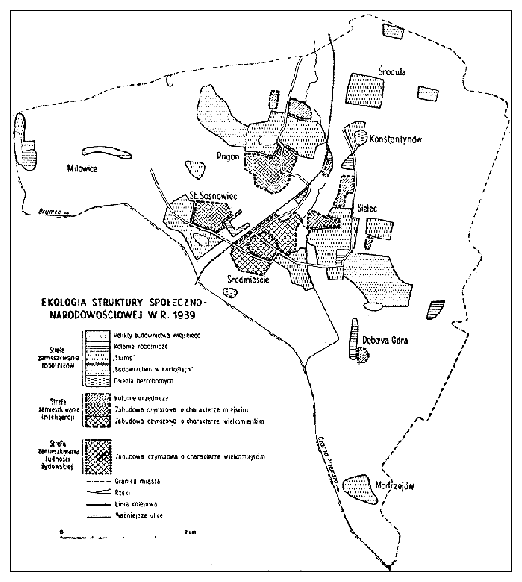
From the above table it is clear that the majority of the population was Polish
[Page 38]
(82.8%); the number of Jews was significant (10.4%). Other nations –
meaning Russians and Germans – constituted 6.8%.
The composition of the population of Sosnowiec according to religion changed fundamentally as a result of the First World War; this can be seen from the table of the year 1921:
Number of the population on the day of the census – October 30, 1921: 86,497, among them:
| Catholics | 71,485 |
| Jews | 13,646 |
| Evangelicals | 753 |
| Other religions | 613 |
The number of Poles therefore increased by approximately 6,000; this occurred because neighborhoods with around 10,000 Polish inhabitants were annexed to Sosnowiec during the war period. In relative terms, their number rose from 65.6% to 85.4%. The German group belonging to the Evangelical faith disappeared completely from the city; after 1918, only Polish Evangelicals remained in Sosnowiec. Similarly, the Russian Orthodox Christians vanished; remnants of them may have been absorbed into the category “Other religions”. The number of Jews also decreased; this was true both in absolute numbers (4,000) and in relative terms (2.2%). Ultimately, only the Poles and the Jews remained from the various religious groups that existed before 1914.
According to the second census of the population of Sosnowiec from December 9, 1931, no changes occurred in the composition of the population during the years 1921–1931: The Polish population came in first place, and the Jewish population came in second; its number increased relatively from 15.8% to 17.6%.
| Year | General Population |
Christian | Jews | ||
| Number | % | Number | % | ||
| 1931 | 108,959 | 88,154 | 80.9 | 30,805 | 19.1 |
| 1937 | 124,536 | 97,632 | 79.3 | 26,604 | 20.7 |
| 1938 | 129,610 | 100,717 | 77.7 | 28,893 | 22.3 |
From the above, it is clear that the percentage of Jews in Sosnowiec grew
steadily. The numbers of Christians and Jews are characteristic in their
growth. The growth of the Christian population in the years 1931-1937 reached
9,478 inhabitants; this represents 10.7%, or 1.8% according to the annual
ratio. The growth of the Jewish population in that same period reached 6,099
inhabitants; this represents 32.8%, or 5.4% according to the annual ratio.
Since the general growth of the population in Sosnowiec in the years 1931-1937
reached 15,575 inhabitants %#150; 14.3%, or 2.4% according to the annual ratio – it
is clear that the increase of Jews was decisive in the population growth of the
city. The data for the years 1937-1938 confirm that the same ratio in
population growth persisted; the growth of the Christian population reached
3,085, or 3.0%, and that of the Jewish population reached 1,909, or 6.6%. The
general growth reached 5,074, or 4.0%.
Coordinator's footnotes:
|
JewishGen, Inc. makes no representations regarding the accuracy of
the translation. The reader may wish to refer to the original material
for verification.
JewishGen is not responsible for inaccuracies or omissions in the original work and cannot rewrite or edit the text to correct inaccuracies and/or omissions.
Our mission is to produce a translation of the original work and we cannot verify the accuracy of statements or alter facts cited.
 Sosnowiec, Poland
 Yizkor Book Project
 JewishGen Home Page
Copyright © 1999-2026 by JewishGen, Inc.
Updated 15 Oct 2026 by OR