 |
with the Black Przemsza and the Brynica Rivers in its center
|
[Page 15]
Translated by Lance Ackerfeld
|
Annexation of areas in the proximity – Ostra Górka a miners
settlement – Radocha in the delta between the Brynica and Black Przemsza
Rivers – from “Pustkowie Radocha” (“Radocha
Wilderness”) to Radocha as a chemical industrial center –
Środula a collection of inns over the Przemsza – chemical industries
in Środula – the Środula Ghetto for Jews in the Nazi period
– Pogoń, pursuit after the Hungarian Legion – in the past a
village on the outskirts of Mysłowice – two Pogońs – one
[belonging to] Sielce and one [belonging to] Gzichów – a new
Sosnowiec suburb – Sielce as an ancient place – having privileges
from Kazimierz the Great – frequent exchanges of the masters of Sielce
– a palace and excursion garden in Sielce – Sielce as a “Little
Jerusalem” according to the Jews – the first Sosnowiec Jews from
Sielce.
|
Thanks to the proximity of the village of Sosnowiec to the industrial towns of
Katowice, Mysłowice, Bytom, Gliwice and others, the village became an
industrial and commercial settlement and an important road junction. The
industrial activities that took place in the region of the village caused the
place to begin annexing areas within its proximity, such as: Pogoń,
Środula, Radocha, Szczynice, and later on Sielce, Gzichów,
Miłowice and Małobądz. The area belonged to the heirs of
Kramsta, Graf [earl] Renard, and several factory owners from overseas, and only
a small portion of it was held by Polish farmers. We will hereby review the
villages and settlements that were engulfed by small and poor Sosnowiec and
constituted the beginnings of Greater Sosnowiec.
Ostra Górka. The origins of Ostra Górka begin at the end of the 18th century. It was a settlement of tar workers, that numbered no more than two shoddy huts, with a farm belonging to the Gzichów estate in the Będzin district.
[Page 16]
|
|
|
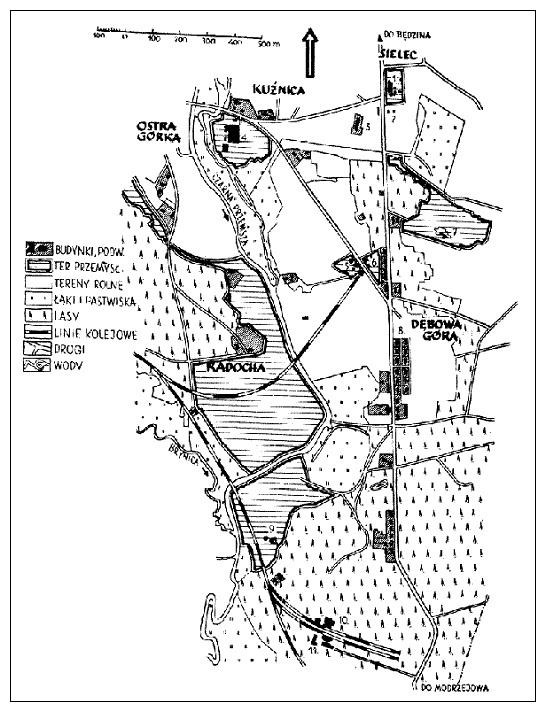
Map of Sosnowiec and its suburbs that were annexed to the city,
with the Black Przemsza and the Brynica Rivers in its center |
Radocha. This settlement sprouted in the forest on the banks of the Brynica River, on the road between Sosnowiec and Modrzejów, in the Będzin district. The place formerly belonged to Miłowice. In the list of properties of Miłowice there was information that in the delta between the Brynica and Przemsza Rivers there were two grasslands belonging to Pasternik and Riwarka. In 1646 there were only five huts on the north-west side of the settlement. In 1827 there were 4 houses and 22 residents in this settlement. By 1845 the place was called “Pustkowie Radocha” (“Radocha wilderness”). From the first half of the 17th century there is only one name as a resident of Radocha. At the beginning of the 19th century an inn stood here belonging to Jan Wolni.
[Page 17]
In 1896 the “Radocha” chemical plant was founded here with a stock
capital of 70,000 rubles, headed by a Jewish manager by the name of Zaks. The
output in 1900 reached 300 wagons of wax, paraffin, stearin and paraffin
candles, and also chemical products like: antichlor, wax products for floors,
wax for boot makers, anointing oil, wine and lemon vinegars, nitrate,
ozokerite, sugar oil, cleansing salts.
Środula. Środula had existed as early as 1645 as an inn settlement that was located on the left bank of the Przemsza [River] on the side of the road from Będzin over Sielce to Mysłowice. Apart from the inn there were two huts belonging to Albert Jancowa and Sebastian Pajcak. A farm that was later founded here existed till 1880. In the second half of the 19th century a settlement was founded that was purchased by the “von Kramsta Society of mountain coalmines”, which leased it to Majerhold. Near the settlement, on the banks of the Przemsza [River], a couple of huts stood called by the name of “Środula”. In 1667 there was information about the Migdlaka family that settled in Środulka.
In 1883 a chemical factory called “Gzichów” that was founded by the “Mainz Society for the chemical industry in Frankfurt on the River Main”. The factory employed 95 laborers and produced sulphuric acid, hydrochloric acid, acetic acid and calcium chloride. In the year 1900 there was still a chemical factory belonging to Gutman and associates. Środula was situated next to the Warsaw-Vienna railway line (about 3 kilometers from Sosnowiec) and there was a railway station for the loading of merchandise on this line, two lime furnaces, and a limestone quarry. In the past it was an inn settlement. During the Nazi-German regime, Sosnowiec Jews were placed in Środula, after they evacuated the Christian residents and transferred them to Jewish residential houses in the town.
Pogoń. In the past it was known by the name of Pogońia. Its origins were with the construction of the first wooden fortress on a hill in Będzin during the period of Boleslav the Shy, at the beginning of the 13th century. The place was the same kind of settlement, whose residents were obliged to carry out certain activities for the prince, master of the palace and they would only submit to him.
The Pogoń farmers carried out tasks of princely or royal envoys, who in earlier times were called Pogońia, and thus the settlement was called. The assumption, that the name Pogoń is related to obligation to pursue various kinds of criminals does not withstand scrutiny, since this obligation is called “szlad” (szlad – obligation to pursue after a criminal; the farmers of the settlement pursued a criminal calling out “szlades” till they reached the borders of a neighboring settlement, to whom they passed on the task of pursuit) and in the 12th century were related to the burden or public declaration to which all of the settlements were bound.
We find the first instance of the name of the settlement in 1345 with Naruszewicz, whose book on the history of the Polish people (volume 5, pages 138-139). He states: “…and these royal knights chasing after these dispersed robbers (Czechs), and destroyed them after two battles. Since one legion was comprised of Hungarians that went to Lviv and harmed the enemy in the village of Biala, and the second went and pursued after those who went in the direction of Olkusz, surrounded them in the village of Pogońia and dispersed them”.
At the end of the 14th century the village lost its adverse attributes, and by virtue of grants was transferred to the Kowacz family ruled by the Waz household. During the same period it was granted German rights with 7 tracts of farm land and one tract belonging to estate owners. The town head received the placement of two tracts with income from an inn. Thus the Polish historian J. Dlugosz speaks about this in his book, that Pogońia as a village in the periphery of Miłowice. It had 7 tracts; and also it leadership of the village was located there. In around1440 Stephen Kowacz of the Waz household was known to be the owner of the village. Following Kowacz someone from the Siminski family was the owner of the village, in about 1599. Whilst in the years 1636-1670 the supervision of Pogoń was by the large Jarocki family. We find proof of this in birth certificates from Będzin, which included the names of Barbara, Katrina, Jadwiga and Jan Jarocki from Pogoń. There is also a document (in the Mysłowice archives) affirming that members of the Jarocki were the owners of the Pogoń estates.
There is also proof that at the end of the 17th century and the beginning of the 18th century there were two Pogońias. Lists of the assets of Gzichów from the beginning of the 19th century also mention a Gzichów Pogońia in and also a Sielce Pogoń, each with special farms and courtyards. The first courtyard stood in the region of the present blocks of dormitories near Sucha Road, and the second – near the peripheral entrance of Pogoń. In 1875 Gzichów Pogoń numbered 29 houses, a farm and 331 residents, whilst that Sielce Pogoń numbered 49 homes, a farm and 1088 residents. Before World War II amongst the residents of Pogoń there were still those that remembered the two farms.
In the past two quite large pools existed in Pogoń, next to which a mill stood. It was still possible to see such a pool in 1858. The mill ceased to operate about 1830. There was even an old inn in Pogoń, and in 1839 a tenant still lived there. As mentioned previously Pogoń was part of the Mysłowice outskirts, and after 1819 was annexed to the Czeladź outskirts. In 1902 Pogoń was already an industrial settlement in the Będzin district, considered as a neighborhood of the new Mysłowice and numbered 1500 souls. Jews also settled in Pogoń, in the beginning a few, which expanded over time became a respectable society, and about this is described in the following.
Sielce. In the 14th century this settlement was known by the name of Sedlic and Siedlic, and in the 15th century by the names Siedlce and Siedlice. After various name changes the name Sielce remained. This ancient place on the lofty river banks, when there was a lack of other transport a number of roads were found in it, where Sielce had pegged itself of the left bank of the Black Przemsza River. Being that in the 16th century there was a fighters' settlement here, which was described in Dlugosz's book, one can conclude, that the settlement belonged to a type of senators' villages, which were settled in previous times by fighters or combat soldiers.
Up until 1361 Sielce was the property of Abram Maguszyc. He carried out an exchange with the famous Otton from Pielce with authorization of Kardos Sielce for 'Witanowicz' (achieving peace), and this change was approved by Kazimierz the Great. At the request of Otton, Kazimierz the Great granted Sielce Magdeburg Rights.
[Page 18]
However these rights did not receive, apparently, legal status, since in the
Royal Krakow archives the following information is found: “Elizabeth the
Eldest. Queen of Hungarian and Poland, approves a letter of the
Starosta of Krakow Sandiboginsza, according to which Otton from Pielce
exchanged with Piotr Szfaran, the Krakow agricultural minister, in the Sielce
and Klimontów estate and a fourth of the patronage of the church in
Mysłowice, in exchange for a half a field of 50 cubits in Pielgrzymowice
and 700 grivans [?]. Apart from this the queen transferred the aforementioned
villages from Polish law, to German law, Krakow, on the Holy Wiaczeslaw Day,
1379”.
From this document we conclude, that in 1379 Sielce was established as an acquisition of Piotr Szafran from Pieskowa Skała. On the same page of the document we find further information which says: “Jadwiga the Eldest, Queen of Poland approves the sale of Sielce and Klimontów in the Krakow district to Piotr Szafran, together with Pogoń in the Cieszyn district and so on. Krakow, year 1386”. After that Sielce was transferred in 1386 to the sons of the sister of Archbishop Bodzentyn, Wiesław and Piotr who were Mysłowice masters. In about 1440 was already find Sielce in the hands of Jarocki. At the end of the 16th century the master of the village was Valenti Minor. Following him members of the Przybyslawski family lived here, as testified by a marble plaque above the gate of the palace.
|
|
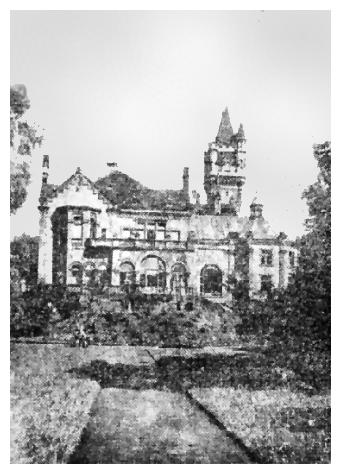
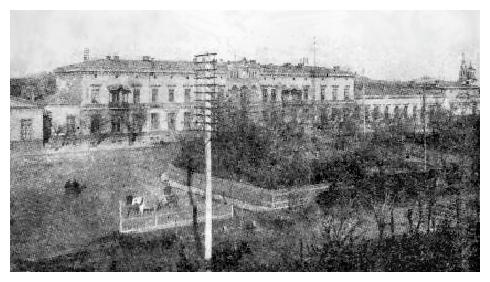
| The Schön Palace
on 1st of May Street – former location of the Sosnowiec District Court |
From the beginning of 1706 the masters of Siwelce were from the families of: Modrzejów, Zigoborski, Zilinski, Stojowski, Schimmelpfennig, Ludwig Anhalt von Peles, Graf Stolberg and Ernigroda, Graf Jan Renard: and from 1902 – the French mining and iron foundry companies. The village was settled on 15 tracts of land, and it had an inn with a field the income from which went to a certain pastor from Mysłowice.
From earliest times a palace stood here with the title “A chronicle for study and science” from the year 1835 as follows: “It is built in a square shape on deep marshy and muddy ground the access to it is difficult. Wild forest thickets and unusually high trees surround its circumference. Certainly it was once fortified, because water filled trenches and a bridge could not serve anything but a single purpose. In all corners of the palace and in its center towers rise up, and on the southern side there was also a prayer room with a quite high tower, in which a bell is still hanging. In the surrounding walls firing hatches are rent, and below the entire palace is a dry and exceptional basement, with many hiding places and tunnels for secretly escaping from the fortress. The effects of time, the attacks by enemies, and above all – fires, destroyed much of the palace. The ancient beautiful decoration, the sculpture and the other artistic works arouse amazement and wonder of its visitors. The older generation say that the fortress in Sielce was built by the German Templars, who founded their settlement here safe from attacks, and they carried out their worshiping in the prayer room. It is also assumed they left behind underground dungeons near the gate as a memento.
The palace was partially built by Ludwig Fürst von Anhalt-Köthen, who lived in it. The present palace does not at all resemble the ancient palace. The towers were taken down, the decorations disappeared, the prayer rooms haven't be in use for years, and instead of prayers that took place there for hundreds of years – now there is the scratching of clerks' pens.
In the direction of the Przemsza River there is an excursions garden. Years ago it fulfilled the task of a public excursions garden and on the entrance gate the inscription “Garden open to the public” is displayed (this was during the Tsarist regime). In the period of independent Poland the garden was locked with seven locks. On south-eastern side of the palace, on a hill of rocks a grave carved in rock was still prominent in 1858, in which General Schimmelpfennig, a Sielce lord together with his grandson. The hill also received the name of the grave “Schimmelpfennig Hill” which was retained till 1870.
The beginning of mines on Sielce land was from the year 1840. After Sielce was transferred in 1858 to Graf Renard, the “Fanny” mine was founded that was administered in the beginning in the quarry system. In 1884 a stocks company by the name of “Graf Renard” was founded. Instead of the old quarry mine a new quarry mine was founded known today by the name “Renard”. In 1902 Sielce was transferred together with the mine to French hands by the name of “The Huta Bankowa industrial group companies” belonging to Huta Bankowa, Reden, the Graf Renard company and Metallurgical plants in Radom.
In 1881 the Prussian company “The combined Kaniges Und Lora Huta” established an iron foundry in Sielce, today known by the name “Huta Katarina”. In the beginning the plant dealt only in rolling iron, and later built two large furnaces, a tempering factory with two furnaces of the “Martin” type, an iron factory with 14 smaller furnaces and three steam hammers, and began rolling flat iron, shaped and sheets, pipe rolling, iron casting, and they founded a factory for screws, nails and so forth.
[Page 19]
|
|
|||
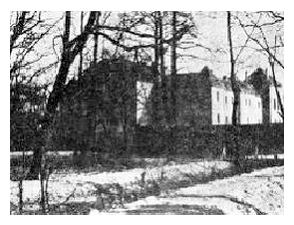
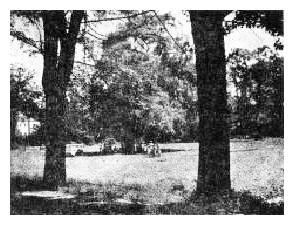
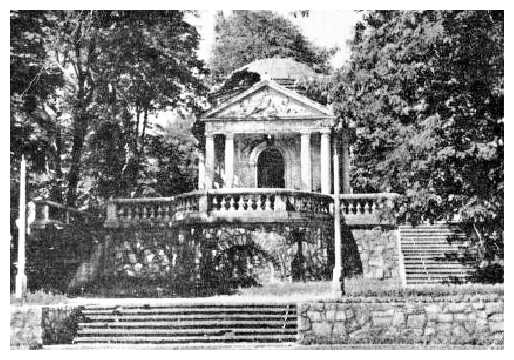
| The Sielecki Castel – a view from the park | The Sielecki Park in its new layout |
|
|
| The coffee shop in the garden near Zeromskiego Street
a meeting place for the Jewish political parties |
[Page 20]
In 1900 the output of the foundry reached 3,548,853 poods[1]. Later on Huta Katarina was transferred to a Modrzejów mining and foundry company.
In 1827 Sielce numbered 33 houses and 229 souls. In 1889 Sielce was a village with a farm located near the Black Przemsza [River], in which there were 29 houses, 365 souls, and the land was agricultural; in the farm there were 11 houses and 70 souls; in the mill there was a single house in which there were 18 souls; in the industrial settlement – two houses and 8 souls. In 1902 Sielce was already part of Sosnowiec and the population rose to 20,000 souls.
Jews settled in Sielce and they had stores. Siecle was known as “Little Jerusalem” by the Jews, since religious Jews settled there as early as 1870 and amongst them: Cwika Kalisz, Szmul Mosze Jungster, Ruwen Laudon (who was a homeowner in Sosnowiec and maintained a special teacher for his children), Michael Londner, Nachum Szarf, Hendel Jungster, Szmaja Szajer (bootmaker). The shochets [religious slaughterers) at the time were Motel Cwajgenhaft and Alter Wysznic, and members of the Chevrat Kaddisha [Burial society]: Lajbisz Rederman amongst the town leaders and Icchak Zaks. Berisz Szelzer (a man from Sielce) served as a prayer leader in “Tiferet Shlomo” in Radomsk during the High Holy days and Slichot [special prayers recited in the weeks preceding Yom Kippur], and in his lyrical voice and very emotional prayers caused all that heard him to tremble. Several Jews had family names according to where they lived and in various places in Zagłębie (Chaim Sielcer in Modrzejów) it was possible to meet up with Jews whose family name was “Sielcer”.
The population census in Poland of 1897 was carried out by the Russian authorities counted the Jews in various settlements in the Zagłębie region and even publicized their figures, but we couldn't find the number of Jews in Sielce and Pogoń.
Jewish families were already settled at the beginning of the 19th century in Pogoń, Wygwizdów, Old Sosnowiec, Ostra Górka, Miłowice, that were later annexed to the Sosnowiec town. Around the villages that were mentioned were coal mines, iron foundries and small factories that drew to them Jewish families looking for a livelihood and managed more or less comfortably in that place.
Original footnote:
|
Sosnowiec – an important geographical location for the state and its
neighbors – The Warsaw-Vienna railway line via Sosnowiec, the first in the
Russian Empire – Train connection with Berlin and Vienna – The
whistle of the first locomotive in 1859 in Sosnowiec – The first coal
mines and foundries in Sosnowiec – The competition between the railway and
the carters – threats against the landowner regarding the sale of land for
the railway – A huge increase in coal transport – from one million in
1858 to 94 million poods in 1890 – Inferior soil of the region gave way to
industry and coal – Huge growth in the coal industry and iron casting
– replacement of primitive furnaces with gigantic foundries.
|
Much of the rapid development of Sosnowiec is to be credited to its being an
important geographical transportation hub for the state and neighboring
countries. The construction of the Warsaw-Vienna railway line, which passed
through Sosnowiec, began in the year 1842. In those days, there was only one
single railway line in the entire vast Russian Empire – the
Moscow-Tsarskoye Selo line. Even this line was not a regular one, as it was
intended primarily for the needs of the Russian Czar's family. The
Warsaw-Vienna railway line was therefore rightly considered the first real line
in the Russian Kingdom.
Actually, the beginning of the city should be dated from the year 1858, when it arose as a result of an order issued on behalf of the Government Committee for Revenue and Treasury on May 7 of that year (No. 22923/10705) and an application by the Administrative Council of the Warsaw-Vienna Railway on May 13 of that year (No. 432). The economic commissioner Hilke purchased the area of the current city for the construction of the railway line from the Ząbkowice station to Katowice. The engineer Sokolski, together with the land surveyors Adolf Thomas and Aleksander Kulisz, began the construction of this railway through the joint-stock company of Epsztejn, from Ząbkowice to Sosnowiec with stations in Dąbrowa Górnicza and Będzin. Needless to say, the railway line caused the development of industry and the reduction of freight costs, especially for the border area of Zagłębie with the territories of Austria (Galicia) and Prussia (Upper Silesia).
It is worth noting why the construction of the railway line from Warszawa to Granica (Maczki in the vicinity of Sosnowiec) was prioritized. In Poland, the influential Prince Paskiewicz-Warszawski ruled at the time in the name of the Russian Czar. Poland was still obliged to pay high customs duties on goods from Russia, just as regarding other foreign countries, even though Poland had been annexed to the Russian Crown (only in the year 1850 was this duty abolished). The duty on imported goods from Prussia, Austria, and other foreign countries was lower than that of Russia, and consequently, Poland's commercial relations with Austria and Prussia were several times more intensive than with Russia. Poland yearned for a railway line up to the Austrian and Prussian border, and the minister-governor of Poland entered the thick of it and received a license from the Czar for laying this railway line. The negotiation lasted about a year, and only at the end of the year 1848 was the execution of the line handed over
[Page 21]
into the hands of a company in the form of a ninety-year concession (the
concession was scheduled to reach its end on the first of November 1932, but in
the meantime independent Poland arose in the year 1918). The company adapted
the width of the railroad tracks to the width of the trains of Austria and
Prussia, whereas the Russian trains that were built later were wider. As a
result of this, Prussian and Austrian trains could reach straight to Warszawa,
the capital of Poland, while Russian trains could not make their way even on
the Warszawa – Vienna line.
In the year 1858, another company received a concession for the construction of the Warszawa – Bydgoszcz (Bromberg) railway line. On January first, 1890, the two companies united into the Warszawa – Vienna line. The construction of this railway line was not carried out all at once. In the beginning, the Warszawa – Grodzisk – Skierniewice line was built (until the end of 1845); after that – the Skierniewice-Piotrków-Częstochowa line (until the end of 1846); Częstochowa-Ząbkowice-Granica (until April 1848). The railway line thus arrived first at Granica, which is on the Austrian border. There are those who believe that the continuation of the railway line to the Prussian border was delayed by one year due to the socialist revolution that broke out in Prussia in March 1848, and the Russian Czar was apparently afraid lest this revolution would spread into the territories of Russia as well, if the railway were to reach the Prussian border.
The first industrial enterprises that arose in the vicinity of Sosnowiec at the beginning of the 19th century did not alter the primitive character of the economy in these areas. The coal mines (Pogoń, Ostra Górka, Wiktor in Milowice), whose utilization materialized through the excavation method, meaning digging in shallow layers, did not reach production on a large scale. They employed a small number of workers, who were generally recruited from the local population under conditions of exploitation, and did not give a boost to population growth and the expansion of building in the place. Even the iron foundry Anna in Sosnowiec did not influence much the development of the surroundings.
Indeed, the railway, which brought the areas on the banks of the Czarna Przemsza into a modern transportation network, created the conditions for their industrialization and their turning into a benefit for the city. This breakthrough into the surface area of Zagłębie occurred in the year 1859, when the council supervising the Warszawa – Vienna railway line, while executing the decision from the year 1858, finished the construction of the railway line from the Ząbkowice station. They installed the line alongside the road leading from Sosnowiec to Pogoń and onward to Będzin; for the benefit of vehicular traffic, they transferred a new road.
With the first whistle of the train (in the year 1859), which echoed in the forests that covered the area of the current city, the quiet lives of the residents of old Sosnowiec – the peasants of Sielce, who until then felt themselves happy – were swept away. On that day, wonderful and devilish alike, as they called it, a group of people from Sosnowiec gathered in the tavern “Under the Stars” in order to soothe among themselves the vengeance of the devil, by whose devilish power he ran and pushed the carriages on the “iron way”. The tavern was full, and the commotion was great, and the quiet whispers were lost out the window into the forest that stood opposite the tavern (on the right side of Dęblińska Street). With the appearance of the “Pani” (Mrs.) (the judge Tomasz Gwoździk and his assistants), the noise broke out with greater force, and everyone began complaining, cursing, and demanding vengeance against the estate owner Szymiński for having, without notice to the group, permitted the “devilish track” to cross the road leading to Pogoń and onward to Będzin without allocating a place for the time being for the new road. After the din subsided, Gwoździk stood up and addressed the fathers of old Sosnowiec with the following words: “In vain are you plotting against the master of the manor Szymiński. He is no longer the owner of the estate, for he sold
|
|
| Sosnowiec – the large railway station, Warsaw – Vienna, built by the Russians |
[Page 22]
his estate to the noblewoman Mycielska. And as for the road – it is not
for you to worry, because the estate manager of Pogoń has now received an
order to designate a new road, and he has already gone out in a wagon loaded
with stakes and cutters to the muddy ground with the aim of drawing a line and
beginning to clear an area in the forest.” And indeed, a new road was
paved over winding paths and felled trees inside the forest, which later
received the names: Ulica 3 Maja (3rd of May Street) and Ulica Żeromskiego
(Żeromskiego Street).
The gathered people, after hearing the news from the mouth of Gwoździk with a sigh of relief, talked for a long time over cups of drinks on the shaky bridge over the Przemsza river near the mill in Ostra Górka, and about the swampy road leading to Milowice which it was necessary to cross every Sunday with much labor and hardship in order to visit the small church in Czeladź. The conversations ended with the election of a delegation to the estate owner with a request to repair the bridge and to make the road to Milowice fit for travel.
During the next three years, relative quiet prevailed in Sosnowiec. The fathers of the village cultivated their fields that were scattered inside the forests without showing any special interest in what the constructed railroad line brought with it. Even the groups of new people who arrived here from different corners of the country did not attract attention.
In the construction of the railway, 13.3 million rubles were invested – an enormous sum in those days. Its profits in the first twenty years came mainly from the transport of coal (more than half of all the cargo in those years was coal). In the year 1858, the railway transported only 946,000 poods of coal; in the year 1864, the cargo rose up to 6,643,000 poods; in the year 1870 – up to 17,714,000 poods; in 1875 – 25,365,000 poods; in 1880 – 77,701,000 poods; in 1885 – 88,323,000 poods; and in 1890 – 93,815,000 poods.
The coal industry in the region of Zagłębie, which also developed during the course of those same years, contributed to its prosperity and its salvation, after its soil had been lean and unfruitful, and the peasants of the villages in this district had toiled for generations in hard work on inferior soil.
And for the nobles and the magnates of money, soot-covered workers toiled hard in the great forests of Poręba: they melted iron ores in primitive furnaces heated with charcoal. At the disposal of the “Pritzim” (Prytzym / Polish landowners or masters), there were brown coals that were extracted from the ground only in the “Ostra Góra” (Sharp Hill) mines in the vicinity of Sławków near Żychcice. A bit later, they took control over the glittering coals they found in large quantities south of Zawiercie, near Sosnowiec, Dąbrowa, Sielce, Milowice.
With the construction of the Warszawa – Vienna railway line along the region of Zagłębie, the coal industry in the area developed with giant steps. In Dąbrowa, a large foundry was established, compared to which all the old furnaces of Poręba that were heated with charcoal lost their value. This foundry was called by the name “Huta Bankowa” (Bank Foundry), on account of its financing by the Polish Bank. After that, in the year 1859, operation began at the “Ciechanowski” mine, and in the year 1865 – the mines “Nowa” (its name was changed to “Paryż”), “Hieronim”, and “Łabędzki” – all in Dąbrowa.
|
At the beginning of the year 1863 – The revolt of the Poles against the
Russian Czar – Battalions of rebels in the surrounding forests –
Ferment and whispers among the residents – Polish railway officials rebel
– An “epidemic” of stomach illness among the Poles of the border
guards – The rebel battalion captured the station and the customs house
– A struggle between the rebels and the Russians over the barracks of the
border guard – The Russians fled across the border to Prussia –
Polish civil rule in Sosnowiec and the vicinity – A pause in train traffic
– The retreat of the rebels and the conquest of Sosnowiec by the Russians
– Dismissal of the Poles from the railway and the customs house –
Russification of the officialdom in the city – Russian as the official
language.
|
Suddenly, rumors of battles began to reach Sosnowiec, which was still a quiet
area, electrifying the air and disturbing the peace of the quiet and
industrious residents in this old settlement. The rumors told of the revolt of
the Poles against the Russian Czar, and that battalions of Polish rebels were
already roaming the surrounding forests. Railway officials who were residents
of the village were the first to bring these reports to the quiet village. This
was on January 26, 1863. Two days after this, several railway workers began
circulating among the houses of Sosnowiec, and in the evenings they shared
secrets with the younger homeowners. Whispers began. The residents walked
around agitated, incited, stood in separate groups, consulted each other, made
gestures. At night, lights flickered in the shacks – it was felt that
something was happening in the village.
On February 2, 1863, Maksymilian Zdanowicz, the customs house inspector, invited in a whisper the Polish officials under his command to the tavern “Under the Stars,” and explained something to them for an hour in one of the side rooms. What the conversation was about did not become known to anyone. After this meeting, on February 3 and 4, those who attended it, all or most of them, began to feign illness under wondrous circumstances, some in a mild form and some in a more severe form, and there were those who traveled “on duty.” On February 6, the border soldiers, who were of course Polish, also wanted to fall ill, and one of them appeared before his superior and said that he “wanted” to fall ill with a stomach illness. This sudden “epidemic” ended on February 7.
One of the battalions of Apolinary Kurowski, which was encamped at the camp in Ojców, under the leadership of Teodor Cieszkowski, attacked Sosnowiec at four in the morning, and with the assistance of the railway workers, the residents of the village, and the laborers,
[Page 23]
captured the station and took the customs house cash box and the station funds,
totaling 90,000 rubles. After this, he attacked the barracks of the border
guard. A stubborn battle developed between them, in which the battalion routed
the Russians across the Brynica river and captured a booty of several dozen
horses, rifles, and weapons.
After the battle, Cieszkowski sent a strong patrol toward Szopienice, and he himself took up quarters in the brick building of the station that had been burned. From here, he issued a manifesto concerning the transfer of government into the hands of the People's Government and the granting of estates to the peasants. Toward evening of that same day, he set out together with his battalion toward Dąbrowa. In memory of this day, two chapels were erected at the site of the battles: one near the streets Teatralna and Piłsudskiego (as they were later named) and the second at the edge of Pusta Street.
According to a German report, the course of the battle between the rebels and the soldiers of the Russian border guard in Sosnowiec, which lasted five hours, was as follows: At three twenty, the station master received an announcement from Dąbrowa that the train arriving there had departed according to plan. The border guard, consisting of two battalions of infantry and a company (literally: a hundred) of Cossacks who were stationed in the square of the railway station for its defense (after the attack of the rebels on April 4 [[an error in the original text; historically this attack occurred on February 4] against Maczki – Granica), were deep in slumber in the corners of the station, without thinking of or waiting for an attack. Among the soldiers, several railway workers circulated, who offered the non-commissioned officers cigarettes and “Yish” (schnapps / liquor), which they drank straight from the bottle.
A few moments before four in the morning, the railway workers slipped away. While the people of the Russian defense at the railway station began snoring beautifully in the corners of the hall, a train entered the station at high speed. From the carriages emerged, instead of regular passengers, 500 rebels, and among them scythe-bearers (peasant soldiers), and with fury they fell upon the station guard. A terrible battle unfolded, in which the peasant soldiers, chiefly, rampaged with their fearsome weapon, the scythes. Despite the sudden awakening, the Russian soldiers began to tip the battle in their favor, pressing hard against the rebels. At that very moment, the railway workers and the residents of Sosnowiec arrived to help, launching an assault from behind. After a short fight, the Russians fled from the station area toward the Brynica. The rebels, who pursued the enemy, encountered resistance again in the forest that covered the area along Piłsudskiego Street (as it was later named) from the river side.
Seeing that the Russians were determined to defend themselves, Cieszkowski divided the battalion into two groups: one he sent to attack the enemy from the front, and the second attacked on the run from the left side (at the location where Pusta Street was later situated). The railway workers and local residents hid in the thickets along the current Teatralna Street and waited for the right moment. And while the battle developed in the forest, and the shouts of the peasant soldiers mixed with the noise and clanking of the scythes and the cries: “Maryja” (Mary), to the left, upward, “As Częstochowa” (Our Lady of Częstochowa) help us, God is with us and more – the railway workers emerged from their hiding place along with the citizens and intensified the commotion by charging toward the Russians. The Russians thought that behold, an additional battalion had arrived with scythes, and they decided to flee for their lives in the direction of the Prussian border. Upon arriving in Szopienice, they were disarmed by two battalions of Prussian Uhlans (cavalrymen) who had arrived from Gliwice.
It was a day of a harvest of death in the place where the heroes of the scythes attacked; but no less fearsome was the place from which the population of old Sosnowiec went out with axes and pitchforks. In his book “Upper Silesia 55 Years Ago,” in the section “The Polish Revolt of 1863,” O. Klausmann writes, relying on the sight of the wounded Russians: “The appearance of one of these wounded men was terrible to such a degree that during the days of my life I could not forget him. He had received a blow to his face from the hand of one of the scythe-bearers, from top to bottom, and the skin of the forehead, the nose, and the upper lip were torn off the face.”
Kurowski, the commander of the rebel units in Zagłębie, came to Sosnowiec on February 7, 1863, after establishing civil rule on behalf of the National Government in Olkusz. In Sosnowiec, Russian soldiers were concentrated. The rebel unit was composed of 50 riders, 300 infantry soldiers, 50 sharpshooters, and 50 equipped with scythes. After they overcame the Russians and took much booty, they went out to Dąbrowa and there took 30 Russian soldiers prisoner, but released them later. In Sosnowiec itself, a unit of 100 men was organized in February under the command of Captain Brejner, which joined the rebels.
Thus did the Polish peasant reveal his love for his homeland, for the yoke of Poland… after the year 1831, for the death of the brothers in… How many rebels fell in the battle for Sosnowiec, what were the names of the heroes among the railway workers and residents of Sosnowiec who fell… in the war for the freedom of their homeland… is not known, nor is the place of their burial.
After the battle, Kurowski arrived in Sosnowiec with his staff. Among them was also the Polish female rebel Henryka Pustowójtówna. The staff quartered in one of the halls of the railway station. However, on the night of February 22, he left Sosnowiec because rumors arrived that Prussian army units concentrated along the border were about to attack the rebels.
For several days afterward, quiet prevailed in Sosnowiec. The trains did not run because of the damage to the track near Ząbkowice, and movement from the Katowice side was also invalidated, and all life was halted. Only around February 26 did the Russian border guards return, accompanied by several companies of infantry and a company (literally: a hundred) of rampaging Cossacks. Arrests began among the railway workers. Investigation, inquiry, and a search for rebels also took place among the civilian population. The echoes of the revolt were felt in the city for a long time afterward in the courts and in the prisons.
After the events, the Russian authorities removed or dismissed almost all the Poles who were employed in the railway offices and in the customs house, and in their place came Russian officials.
After the failure of the revolt, Sosnowce (old Sosnowiec) and Sosnowiec were for a long time two separate units attached to Pogoń, and together with it they entered the composition of the Gzichów community. The first village head of Sosnowce was, as we have already mentioned above, the Jew Abraham Blumental. After his resignation in the year 1890, Chodzicki served for a short time as village head. At that time, the number of voters did not exceed 150 men. After Chodzicki came Jan Macukow, and after him Józef Konieczny. A short time before the year 1902, the villages that served as the foundation for the beginning of the city of Sosnowiec and Pogoń received another authority, which was elected by this group of villages. This authority was an upper village council which fulfilled its duties with honor. The first and last upper village head (Nadsołtys / Chief Village Head) was Stefan Marukowski, to whom the last village heads of (old) Sosnowiec were subordinate
[Page 24]
Jan Musiał; of (new) Sosnowce – Jan Macukow; and of Pogoń –
Wodorski.
In the year 1902, the aforementioned villages merged together, and by virtue of a czarist decree, they were elevated to the status of a city, which afterward annexed the settlements of Ostra Górka (the last sołtys [village head] was Kawka), Sielce (the last sołtys [village head] was Antoni Dziedzic), Środula, Kuźnica, Radocha, and during the period of the Nazi occupation also Konstantynów, Milowice, and Modrzejów.
|
The railway station, the first building in the vicinity – Penetration of German
industrial capital into the city – Enormous industrialization in the city and
the vicinity – Multiplicity of suburbs and industrial settlements – Beautiful
and comfortable buildings – First telephones in Sosnowiec – Bypassing
regulations for granting estates to peasants – Building houses stealthily at
night – Vast dense population in Sosnowiec – Chaos of building in mud and
darkness in the streets – Economic factors of trade and industry, culture and
organization – Continual increase of the population – Official confirmation of
Sosnowiec as a non-future city – The first homeowners in the first streets •
German capitalists establish large industrial enterprises – Giant spinning
mills for woolen threads.
|
The railway station that was established in the village of Sosnowiec appeared
back then like a lone tree in the wilderness, because the entire vicinity was
still desolate and empty, and only around the railway station did the seed of
the future city begin to sprout. The first concentration of houses, which by
the way was without order, arose near Modrzejowska Street, which was later
intersected by Targowa Street; from here until the railway station stretched an
empty, muddy expanse full of pitfalls. According to the plan, building began
along Kolejowa Street – a section of the new road leading from the
railway station to Małachowskiego Street (later the street arose in place
of the cleared forest and received the name Iwangrodzka, and afterwards
Dęblińska). In that same season, Przejazdowa Street (which was
changed to Warszawska) grew out of the bosom of the landscape, and finally
Nikolajewska Street (afterwards Kołłątaja) emerged from the
forest, and alongside Modrzejowska Street – Targowa Street. These were not
streets in the full sense of the word today, but rather ordinary field paths,
strewn with trees uprooted by winds, ditches and swamps, in which horses would
often sink up to their bellies. The only one that was paved, so to speak, in
the year 1881 was Kolejowa Street.
The railway station that was established gave a push to the erection of buildings in the area closest to it, without affecting in any way the improvement of the appearance of the adjacent settlements: Milowice, Pogoń, Sielce, Ostra Górka, Dąbrowa Górna, or Radocha. Fundamental changes in the landscape of their space were carried out only at the end of the thirties of the last century, when following the penetration of German industrial capital, an enormous industrialization of Dąbrowa Zagłębie (Zagłębie Dąbrowskie) began. In Pogoń, Sielce, Milowice, and Dąbrowa Górna (near Modrzejów), mighty industrial enterprises appeared, and around them rose new suburbs and industrial settlements.
The development of these settlements was generally carried out according to a certain system: at first a mine or an industrial enterprise arose, and alongside it a row of buildings connected with the enterprise, whether in the neighborhood or at some distance from it. In the latter case, a transportation connection with the enterprise was installed. Along the enterprise, or around it, apartment buildings for the workers were erected in different parts of the city, such as on Strzelecka Street (near the Deichsel factory), Szpitalna Street, Narutowicza Street (the company of Count Renard[a]), Czerwonego Zagłębia Street (the Dietel factory[b]), as well as buildings that were more beautiful and more comfortable from a sanitary point of view for the officials (on Klimontowska Street, Piekarska, Kościuszko Square and others).
The industrial settlement reached, in the path of its development, building by building until it turned into a complete bloc. In the beginning, each unit lived its life on its own, with its focus constituting the industrial enterprise. The planners of the enterprise would decide on the size of the settlement and the character of the buildings, which were named after the enterprise. These settlements, for the most part, had their own hospitals, schools and bathhouses, clubs and cafeterias. Very interesting settlements arose around the mining company of Count Renard. The operations of this company were diverse, and besides coal mines, it also had a steam mill, a brewery, a yish (schnapps / liquor) distillery, and a stone quarry with two lime kilns. Its residential buildings stretched across the streets: Narutowicza, Szpitalna, Klimontowska, Szkolna, Piekarska, Browarna. It also had a bakery of its own, and the bread and flour were sold in special shops. On the initiative of the director of the company, L. Mauve, the first telephones were installed in Sosnowiec, which gave a push to the installation of telephones in other cities in Poland.
The matter of the ownership of the lands upon which industrial enterprises and residential houses were built requires explanation. Most of the areas of Sosnowiec during the period of the construction of the railway belonged to the Modrzejów-Sielce estates (which were at that time the property of Count Renard), or of the Gzichów lands (in the ownership of Kramsta[c])). The Modrzejów-Sielce property included, besides the lands of these two places, also Dąbrowa-Góra and Radocha, Kuźnica and Środula, and certain parts of Sosnowiec. Most of the lands in the center of the current city belonged to the Gzichów property, which included in the area of current Sosnowiec the villages: Sosnowiec, Ostra Górka and a part of Pogoń. With regard to ownership, the latter was divided between two landed giants who entrenched themselves under the names: Kramsta's Pogoń (also called by the name Pogoń Gzichów) and Renard's Pogoń (also called by the name Pogoń Sielce).
[Page 25]
We have already mentioned that the Modrzejów-Sielce lands, and in
particular Środula, had types of agricultural land. The peasants, the
tenants, and the residents sat mainly in the villages of Sosnowiec, Ostra
Górka, Pogoń, and Gzichów. In a czarist decree from the year
1864, which was issued for Poland, the government did not recognize the dynamic
development regarding the land status. Out of partisanship and a desire to
complicate matters for the landlords, it prohibited parsing and subdivision of
lands into plots smaller than 6 morgas (historical Polish land unit, roughly
5.6 hectares); and in subsequent years it further tightened the parsing
regulations in order to prevent any further reduction in the size of the
parcels, but it did not change the rule.
The demand in Sosnowiec for land plots after 1877 accelerated the search for loopholes in the special status of land ownership. To bypass the land regulations that prohibited the establishment of factories, they bypassed the regulations through tenant contracts: rent for dozens of years or for ninety-nine years. They carried out variations for land leases to look like private land plots by means of brokers. The lessees, operating as cronies of various kinds, purchased from the peasants the leasehold rights to “Hachatzerot” (courtyards / compounds) in the neighborhoods of Ostra Górka, Sielecka (Sielce), Antoni Dziedzic, Ciechanowski. Later, the landlords exchanged them for land plots of the factories, and in return gained ownership of land that was suitable for industrial development.
These exchanges were fictitious, because the lands of the “Hachatzerot” (the courtyards / compounds) were and remained until today in their hands. Indeed, the peasants who were “released” from their lands not only remained the owners of the courtyards, but also received sums of money for the land they handed over. They carried out the exchange by a goodwill agreement before the authorities, and after their approval, the industrialists purchased certain lands from the brokers in a notarized manner under their names.
Such exchange operations were mostly carried out in the period of 1878–1881 with the peasants of Pogoń for the purpose of establishing factories. Whereas in the years 1893–1902 (until the approval of the city rights of Sosnowiec), they would buy lands from peasants for the construction of residential houses. For this purpose, they divided the lands into building plots from 15 to 50 morgas (historical Polish land unit) per plot.
It is worth noting here that the residential houses, in contrast to the buildings erected by the industrial enterprises, were of an inferior type and were built without any particular order. Aside from reasons of cheap speculation that sought prey at the expense of the poverty of the residents for whom these houses were built and their limited demands, a natural legal-administrative factor entered into this complicated game. Sosnowiec was situated in a border strip upon which a prohibition on building and repairing houses applied, according to the Russian regulations, within a width of 675 sazhen[1]. This law was systematically bypassed, because the industry concentrated tens of thousands of people who sought a livelihood for themselves and their families. However, the prohibition caused people to build houses stealthily, at night, under the cover of high fences, without building plans and without technical supervision, and always on areas acquired illegally, thereby complicating the property relations which were already complicated anyway (60% of the houses in the years 1904-1914 were built illegally). It is no wonder, therefore, that these houses made a mockery of all architectural, technical, and sanitary demands. These were one-story mud houses, stuck and joined together from temporary material, without any conveniences. In the year 1921, 18% of the houses in Sosnowiec were still only one story high. Such residential dwellings were established in Pogoń, Sielce, old Sosnowiec, and Konstantynów.
Of course, the administrative body was missing that would introduce some order, and draw up a plan and coordination in this chaos of building and provide for water supply and sewage. For Sosnowiec and the settlements connected with it continued to be villages; and the streets drowned in mud and darkness.
The appearance of Sosnowiec in those times was not such as to encourage envy toward it, and the Polish activist Andrzej Niemojewski (an antisemite) who was active then in Sosnowiec, cried out: “People, will you not drown in the mud! Your children will die of infectious diseases. How are you erecting houses? How are you leveling streets? What kind of water are you drinking? What kind of air are you breathing? – People. Are you not bored at all? In what holes are you looking for entertainment and joy? Through what darkness are you walking to these holes… People”…
As a result of intensive industrialization, a vast and dense population concentrated in Sosnowiec and the neighboring villages, with conditions of large cities, trade, culture, and entertainment. Following the railway station, which served as a fine beginning for office buildings, the streets added in the years 1875-1895 were Policyjna (afterwards Dekerta), Dietlowska (Żeromskiego), Polna (Sienkiewicza), Cerkiewna (Kilińskiego), Kościelna (Bieruta), Towarzystwa Sosnowieckiego Street (Sosnowiec Company), Szynowa (1 Maja), and Ostrogórska. The railway station with its adjacent houses was surrounded by a large area of new Sosnowiec, and during that same period, the private settlements of the mines and industry grew outward from the center. And the number of their residents reached 50,000 souls.
In the sprawling settlement that arose during the late 19th and early 20th centuries, favorable economic factors operated toward the establishment of a municipal body. However, due to a lack of coordination among the settlements negotiating over village rights regarding a general legal administration, it remained difficult during that period to add Sosnowiec to the rank of existing cities.
And only in the year 1902 did the cumbersome machinery of the czarist administration, under pressure from the capital of the industrial tycoons of Sosnowiec, decide to settle the matters. In June 1902, a decree was issued on behalf of the czarist government stating that:
“The settlement of Sosnowiec, Będzin district, Piotrków governorate, along with the settlements belonging to it that were established on the lands of the Gzichów and Sielce estates, as well as the peasant settlements (włościańskie [Polish for peasant/yeomanry holdings]): Old Sosnowiec, Pogoń, Ostra Górka, Środula, the Radocha colony, and the Blumental-Niwka colony, combined with the parts of the lands belonging to the Warsawa – Vienna railway, shall constitute a non-district city under the name of Sosnowiec.”
The new city, which when formed encompassed 1875 hectares of land[2], was populated by 60,000 souls.
The first homeowners on Modrzejowska Street were: Chojnik, Rothschild, Szlezynger, Frühmorgen, Pławner, Kenigsberg, and Wajnreb,
[Page 26]
Pachter, Fiszhojf, Gradstein, Binder, Abramczyk, Englard, Manela, Federman, Planer.
On Kolejowa Street: Rajcher, Majerhold, Porębowicz, Feliks, Potok, Różycki,
Neufeld, Priwer, Oppenheim, Turski. On Przejazdowa Street: Marukowski, Jermołowicz,
Bergman, Zając, Konieczny, Strzelecki, Pampluch. On Policyjna Street: Podlewski,
Różycki. On Iwangrodzka (Dęblińska) Street: Koberski, Chełmy,
Kalga, Wiltos, Kampa, and Szefer.
After 1895, streets and houses sprouted in the city like mushrooms after the rain. Many new homeowners appeared, all of them industrialists, merchants, peddlers, and the like.
In the year 1898, when Sosnowiec was still a “village,” it already had six hotels: Victoria, Warszawski, Grand, Saski, Dorożyński, and Niemiecki; as well as two theaters: a winter one and a summer one.
The first industrial enterprises established on the territory of Sosnowiec were three coal mines: “Nadzieja Ludwika” (Ludwik's Hope) opened already in the year 1806 (in the vicinity of Czarna Street); “Pogoń,” which opened in the year 1815; and “Ostrogórka” with water-driven machinery, which opened around the year 1822 (in the vicinity of Biała and Ostrogórska streets). Afterwards, iron foundries were founded: “Anna” and “Ludwik” in the year 1822. In the year 1853, a chemical fertilizer factory was founded in Sosnowiec, called “Kościarnia”; it was established by Ignacy Niewiadomski on lands that were purchased from the Countess Stolberg of Wernigerode[d]. On April 6, 1875, Paul Lamprecht purchased the bone-grinding factory.
In the year 1881, Karol Gustaw Ditrich acquired from Countess Dietrichstein-Renard[e] and Countess Eugenie Eulenburg-Prassen the area near the (later) Sławkowska Street and established a paper factory on it. Another enterprise established in the city area was the glass factory, which existed since the year 1879. Its owners were Pringsheim and Szlesinger. In the year 1904, the factory employed 600 workers.
A tremendous push for the development of the city was given by the establishment of a woolen thread factory in its territory. In the year 1875, the heirs of the woolen thread factory owners from the German city of Werdau – belonging to Christian Gottlieb Schön[f] – began the construction of a spinning mill for vicuña wool near 1 Maja Street, the construction of which was completed in 1879. Next to the spinning mill, they also established a dyehouse. This enterprise employed 1,200 workers. After a few years, the heirs of Schön established a worsted wool spinning mill and equipped it with a mechanical wool-washing facility. The spinning mill began operations in the year 1886, immediately employing 2,000 workers. Within a short time, the Schön spinning mills occupied the first place among the spinning mills of the former Russian Empire, ranking not only among the largest enterprises in this branch but also among the oldest in the country of Poland.
Original footnotes:
Coordinator's footnotes:
|
Jews since the 13th century in neighboring Będzin – The Jews of
Będzin among the first in Sosnowiec – Isolated Jewish families in the
neighboring villages: Pogoń, Wygwizdów, Milowice,
Ostrogórka, Old Sosnowiec – Influx of Jews from the Kielce and
Piotrków governorates – Jewish settlement around the railway station
since 1860 – First Jewish homeowners in Sosnowiec – The aspiration
for expansion overcame the czarist laws – Overnight, streets and houses
popped up at the hands of the Jews – Sosnowiec the village hastily turned
into a city – Forwarding offices of the Gincburg brothers, Adolf
Oppenheim, Stanisław Rajcher – Quorums of Radomsk and Aleksander
Hasidim – The Dęblin train with a station in the city since 1885
– The city, a center of the large grain merchants in the country.
|
Jewish Sosnowiec was preceded by Jewish settlements in the adjacent villages
and estates. Prominent above all of them stood the large Jewish settlement in
ancient Będzin; this was considered the largest Jewish community in the
entire region of Zagłębie. Its beginnings were rooted as far back as
the period of the Polish King Bolesław Chrobry (Bolesław I the Brave).
This Jewish Będzin was an important and deeply rooted
community whose reputation spread far and wide. Its Jewish residents
occupied a distinguished place in the economic life of the whole region –
an area highly rich in coal, iron, and other natural
resources. Because of this unique character, it even won the title
“Jerusalem of Zagłębie”. This mirrored the title
“Jerusalem of Lithuania” which was given to the city of Wilno. The
exact time of the arrival of the Jews in this city is unknown. However, it is
well known that Jews were present there already in the 13th century. By the
14th century, their activity was clearly felt in the economic sphere; they were
also among the very first to open money-changing booths. The prominence of the
Jews in Będzin steadily grew from year to year; eventually, it transformed
into a Jewish city. However, Będzin could not sustain all of its Jews, whose
numbers steadily multiplied. Consequently, some of them began to seek their
livelihood outside of its walls – settling in various places in its immediate
vicinity. This living among the Poles was very difficult for the Jews; the local priests
constantly harassed them. Time and again, these priests incited the masses against them.
They even fabricated blood libels[1]
against them.
Even before Sosnowiec became a city – and during its previous incarnations as a settlement, a farm, and a village – isolated Jewish families already lived in the villages of Pogoń, Wygwizdów, Milowice, Ostrogórka, and recently also in Old Sosnowiec. These localities were later annexed into Sosnowiec. In the aforementioned villages, the search for coal and iron in the depths of the earth began; this led to the development of small or medium-sized mines. Iron foundries and small factories were built, which served as sources of livelihood for the Jews.
[Page 27]
However, as long as Sosnowiec was a village or a rural settlement, the aforementioned
places did not serve as a force of attraction for Jews from outside the Będzin region.
The Jews in the Kielce and Piotrków governorates (administrative regions in
Russian Poland), who lived in small towns and led a life of narrow means, sufficed
themselves with the little they had; they did not cast their eyes toward what lay beyond
them. The security situation in the area also had an effect in the sense of
“ashrei yoshvei veitekha” (happy are they that dwell in Your
house)[2] – namely, not
to wander to new places in search of a livelihood. This was because in the area
where greater Sosnowiec arose, there stood, as mentioned above, thick forests;
people from civilized settlements would not pass through them for fear of the
robbers and murderers from nearby Silesia who cast their dread upon the
surroundings. Once the Ząbkowice-Katowice train line was built, which
passed through Sosnowiec, the new and large station house also served as a
shelter for the entire surrounding area. This public building, which bustled
with passersby who traveled by train, struck fear into the robbers; they began
to distance themselves from it until they disappeared entirely. The population
did not immediately become accustomed to the security that the spacious
building provided them; however, they gradually grew used to it, and they began
to turn their attention toward populating the area.
Already in 1860, the Jewish settlement began around the railway station. As mentioned, the Jews were the first to acquire plots near the railway station; upon these plots, they erected the first large houses.
From the train station, a relatively straight path extended and intersected the entire city of Sosnowiec. It crossed Modrzejowska Street and continued until Ostra Górka; from there, it reached Radocha and went further toward Modrzejów. At that time, a forest stretched across Modrzejowska Street, containing small peasant houses; these small houses were later demolished, and large buildings were erected in their place. As stated above, the construction encountered obstacles from the Russian authorities. They did not look favorably upon the establishment of a city near the Prussian border, and they refused to grant permits for building houses in the “village” of Sosnowiec. This ill will of the authorities meant that, out of haste, people built in several places along Modrzejowska Street in a winding manner rather than a straight line; thus, sharp and obtuse angles were formed. Life and the urge to expand proved stronger than the Tsarist laws. Within a relatively short time, entire streets emerged with large and beautiful houses; most of these buildings were erected at night under the cover of darkness. The sole guardian of the law – the Russian policeman – pretended not to see; consequently, the work proceeded regularly without interruption, day and night, in length, breadth, and height. The village of Sosnowiec turned into a city despite the opposition of the Tsarist government; consequently, nothing remained for the government but to approve it in practice.
The first Jews who settled in Sosnowiec during the years 1860-1870 came mostly from the nearby vicinity: Będzin, Modrzejów, Olkusz, Wolbrom, Pilica, Szczekociny, and the like.
In the 1870s, the connection with Upper Silesia was strengthened by the opening of a customs house in Sosnowiec; consequently, large shipping offices were opened here by the Ginzburg brothers, Adolf Oppenheim, Stanisław Rajcher, and others[3]. In those days, a large stream of educated Jews also arrived from Częstochowa[4]; they began extensive activities for the benefit of the Jewish settlement.
In its beginning, the Jewish settlement in Sosnowiec was composed of several minyanim (quorums of ten Jewish adult men required for public prayer) of Radomsk and Aleksander Hasidim. It also included some people from the “amcha” (common folk) and dozens of wealthy families from Jewish assimilationist circles, who left their mark on social life.
Around 1885, the Ivangorod train line was constructed, which established the connection between Ivangorod (called Dęblin by the Poles) and the Zagłębie region; it featured a large and spacious train station in Sosnowiec. Sosnowiec became the transit point for the largest share of grain that Russia exported to Germany. This situation created employment opportunities for a larger number of people. Before this line was built, all goods sent from Russia to Silesia had to be unloaded and reloaded at the Warszawa station. Now, within a short time, Sosnowiec turned into one of the busiest commercial cities in Poland. Large grain merchants were drawn here, such as Wolfson, Kabak, Gerc, Lipszyc, and Orłowski; they occupied an important place in the commercial and social life of the Jews of Sosnowiec.
The city of Sosnowiec continued to develop rapidly and received the name “Polish America.” Day after day, crowds of people streamed here from remote towns in the Kielce Governorate: Chmielnik, Pińczów, Chęciny, Jędrzejów, Staszów, Działoszyce, Słomniki, Miechów, and others. Legally, however, the Jewish settlement in Sosnowiec was part of the Jewish community of Będzin; this community did not want to relinquish its hegemony over the communities subordinated to it. Through the initiative of influential askanim (communal activists), vigorous action was taken to establish an independent community in Sosnowiec until these efforts bore fruit.
Coordinator's footnotes:
|
JewishGen, Inc. makes no representations regarding the accuracy of
the translation. The reader may wish to refer to the original material
for verification.
JewishGen is not responsible for inaccuracies or omissions in the original work and cannot rewrite or edit the text to correct inaccuracies and/or omissions.
Our mission is to produce a translation of the original work and we cannot verify the accuracy of statements or alter facts cited.
 Sosnowiec, Poland
 Yizkor Book Project
 JewishGen Home Page
Copyright © 1999-2026 by JewishGen, Inc.
Updated 15 Oct 2026 by OR