 |
|
[Page 38]
|
Under the yoke of the Będzin community – In 1899, more than 350 Jews paid the community tax
(Mas-Amid) – Transportation of the deceased from Sosnowiec to Będzin – Due
to the cholera outbreak, a cemetery was established in Sosnowiec in 1893 – Rabbi Aryeh Leib
Gitler, Moreh Tzedek (teacher of righteousness / community rabbi) in Sosnowiec, was succeeded by his
son Rabbi Avraham Meir Gitler – There were 2,291 Jews in Sosnowiec in 1897 – The
government recognized an independent community in Sosnowiec in 1896 – The Great Synagogue
was established – The first community committee was formed from representatives of the
assimilationists – Rabbi Yitzhak Glickman served as the head of the Rabbinical Court
(Av Beit Din) – A plan was made to establish various institutions – A Gemilut
Chasadim (interest-free loan/charity) society, a help committee for women in childbirth, a
Talmud Torah school, and more.
|
Until the year 1899, the Jews of Sosnowiec belonged to the Jewish community in
Będzin; and even though the number of Jews in Sosnowiec was still small at that
time, there were already more than 350 payers of the community tax,
Mas-Amid,[1], in
the town. This indicates that the economic situation of the Jews in Sosnowiec was good.
This was a young Jewish community whose rapid growth came along with the growth of the city itself. The nucleus of the community already existed in small Jewish settlements, such as the village of Sosnowiec, Sielec, Pogoń, and others; however, this core did not yet possess any communal institution. Small minyanim (prayer quorums) began to organize, mainly for Shabbat and holidays; however, the lack of religious institutions was deeply felt. The pioneers of the community in Sosnowiec who came from Będzin, Miechów, and Olkusz, most of whom were craftsmen, founded the first minyan which was called “the Tailors Minyan.” As early as 1859, Jews also arrived from Częstochowa to work as brokers at the customs house in Sosnowiec, such as Henryk Rajcher and Samuel Ginsburg; in 1862, they were joined by Adolf Openhejm and Wilhelm Bergman. Once the development of mines, the establishment of factories, and commerce began here, Jews started flocking from all corners of the country. As soon as the rumor spread that “there is grain in Sosnowiec”[2], Jews in various towns awoke and departed for there; as a result, by 1898, Sosnowiec already numbered about two thousand Jewish families. These families belonged mostly to conservative and Hasidic circles. The progressive ones, or the assimilationists, formed a small minority in the city.
Because of the affiliation of the Sosnowiec community o the district Będzin community, the Jews of Sosnowiec were forced to transport their dead to burial to the cemetery in Będzin, which was about one mil (a biblical/talmudic unit of distance, ~ 1 km) away from the place;
[Page 39]
and this was bound with great difficulties. In the year 1893,
a severe cholera epidemic broke out; and then, for the first time,
the question of a separate cemetery, independent of Będzin, arose on
the agenda. Given the urgency of the hour, a temporary cemetery was established
in Sosnowiec on the initiative of Lajb Będziński and with the financial
support of the Rajcher family. The Rajcher family built a large, spacious building
(Beit Midot)[3]
at the cemetery at its own expense to handle all matters related to the
burial of the deceased. Adolf Openhejm built a wall-fence that surrounded the
cemetery area; and Adam Bergman took care of leveling the ground and also
installed a water well there at his own expense. Since the relationships that
prevailed then in the Chevra Kadisha (holy burial society) were far from
satisfactory and demanded reform – a special committee was elected for
this purpose in the year 1897, headed by Stanisław Rajcher and the members
Adolf Openhejm, Adam Bergman, Maurycy Ginsberg, Jarmułowicz, Planer, Leopold
Cohn, and S. Mimoz. The committee discussed the affairs of the society in its
meetings, but it was impossible for it to achieve the desired results and to
introduce the necessary reforms; this was mainly due to the lack of security
regarding the community's status and the expected struggle on behalf of the
Będzin community, which made every effort to close the gates of the temporary
cemetery in Sosnowiec. Indeed, the authorities, taking into account the health
condition of the residents, agreed that the deceased should continue to be
brought for burial in Sosnowiec in the future.
In practice, an unofficial community had existed in Sosnowiec for several years with Rabbi Avraham Majer Gitler; he was registered as the dayan (rabbinical judge) of the city with an annual salary that he received from the Będzin In the year 1880, Rabbi Aryeh Lajb Gitler was appointed as a Moreh Hora'ah (teacher of Jewish law) in Sosnowiec. Prior to that, he had served as the Av Beit Din (head of the rabbinical court) in Kraków; however, because he was a Russian subject, he was expelled from Kraków by the Austrian government and then settled in Będzin. After the Jewish settlement in Sosnowiec began to grow, he was invited there as the Av Beit Din (head of the rabbinical court); he served in this position until his passing in the year 1888. After his passing, the prominent householders in Sosnowiec, in agreement with the rabbi from Będzin, appointed his son Rabbi Avraham Majer Gitler as a Moreh Hora'ah (teacher of Jewish law); he had arrived here from Pińczów for his father's funeral. He served in this position for 37 years and passed away on Thursday, the 5th of Marcheshvan 5686 (23rd of October 1925).
After the recognition of the Sosnowiec community as independent and its release from all obligations toward the Będzin community, Miller, the governor of the Piotrków Governorate, demanded that the community elect a rabbi. Under pressure from the community council, whose members were enlightened assimilationist people, Rabbi David Sztajnzalc[4] was appointed in the year 1900 as a “Rav MiTa'am” (government-appointed rabbi)[5] and preacher with an annual salary of one thousand rubles. Rabbi Gitler, as the Av Beit Din (head of the rabbinical court), also handled all religious matters.
From a number of 120 Jews counted in Sosnowiec in the year 1880, the Jewish settlement grew and reached 2,291 souls in the year 1897 (out of a total population numbering 9,848); in the surrounding area where 3,098 souls lived, there were 271 Jews. The town's activists made great efforts to establish an independent community in the city. In the middle of the year 1898, an order was received from the governor of the Piotrków Governorate[6]; it required that the Jews of Sosnowiec and Będzin should gather together and express their position for or against a separate community for the Jews of Sosnowiec. From Sosnowiec came several dozen people, most of whom belonged to progressive circles. On the other hand, from Będzin, almost all the residents of the town came. The assembly took place in the synagogue in Będzin. The arguments for the opposition of the Będzin representatives were very weak; after a few days, the government's recognition of the Sosnowiec community was received as a separate, independent religious community, along with several of the surrounding settlements: Milowice, Dąbrowa Górnicza, Pogoń, Sielce, Ostrogórka, and Modrzejów. Together with the recognition, the directive was received to proceed, even before the end of the year, to the election of the community representatives, the rabbinate, and the Va'ad HaKehilah (community committee). This announcement was received with great satisfaction by the Jews of Sosnowiec, who immediately began preparing for the election of the necessary religious institutions. The elections were conducted in an exemplary manner, and to the first community committee were elected: Stanisław Rajcher, Dr. Jakub Neufeld, Adolf Openhejm, and Adam Bergman (treasurer). The results required the approval of the authorities; the community in Będzin hoped that the state of affairs would still change in its favor and that its efforts against severing the Sosnowiec community from it would succeed.
In the meantime, one of the best parnasim (community leaders) elected to the committee passed away; Adolf Openhejm, a local merchant and citizen who possessed a most gentle soul, had done much over the years for the development of the city and the community. The man died in the prime of his life when he was only 50 years old. His hand was always open to the needy; even in his will, he cared for local matters and left a large sum for the establishment of institutions for Jews.
After the separation of the new community was approved by Miller, the governor of the Piotrków Governorate, it began operating officially on the first of January 1899. The parnasim (community leaders) of Będzin, who saw this as a severe deprivation for themselves, were about to lodge an appeal. A Din Torah (rabbinical lawsuit) began between the two communities. However, under the influence of a circle of merchants who were interested in connections with Sosnowiec, the dispute ceased; and the anger of the Będzin parnasim subsided. On the order of the district chief, Rabbi Nachum Asz from Częstochowa was invited to swear in the first community committee of Sosnowiec according to the law. The swearing-in ceremony took place festively in the synagogue in Sosnowiec in the presence of senior officials with the city manager at their head; and with the participation of all Jewish residents. The city of Sosnowiec, which developed rapidly, earned the nickname “The Polish America.” Day after day, crowds of people flocked here from remote towns of the Kielce Governorate, from Chmielnik, Pińczów, Chęciny, Jędrzejów, Staszów, Działoszyce, Wolbróm, and more.
In the year 1896, the construction of the magnificent synagogue began on the initiative of several Jews who had become wealthy; for them, the space was too narrow in the Hasidic “shtieblech” (small prayer rooms) or in the rented premises of the “Synagogue for Ashkenazim” (Deitshe Shul) on Targowa Street. The leading activists of the synagogue were: Chaim Józef Zając, Jehoszua Pachter, Jakub Weinberg, and Józef Lidzberski. Because of the abundance in the city, there was no shortage of financial means; and the building of the synagogue reached completion quickly and without any delays.
The community marched toward its development safely. The community budget was approved by the government; and community life could proceed in an orderly fashion. It should be noted that the first community committee, which was composed of representatives of the enlightened assimilationists, showed dedication to the affairs of the community and handled them in a satisfactory manner. The religious Jews in the city were partly moderate and partly zealots. The former looked with a favorable eye upon the activities of the enlightened ones for the benefit of the public and stood by their side; on the other hand, the latter, the zealots, did not say amen after all the actions of the committee, and there were those among them who came out in criticism of certain activities and were even prepared for a struggle.
[Page 40]
Such was the situation when the matter reached the appointment of a rabbi for
the community. The progressive ones proposed David Zalcsztejn, who was mentioned
above, as a candidate for rabbi, and the zealots opposed him. In the end, the
progressive ones had the upper hand; and David Zalcsztajn was approved by the
government as a “Rav MiTa'am” (government-appointed rabbi).
In those days, Rabbi Yitzhak Glikman, who was a genius in Torah and proficient in Jewish law – the son-in-law of Rabbi Alter Rotenberg, the Admor (Hasidic rebbe) of Wolbróm – began interceding with the community activists to appoint him as a dayan (rabbinical judge). Since this intercession of his bypassed the Av Beit Din, Rabbi Gitler, the latter saw this as a personal insult and turned to him in writing, in which he informed him that the public is not permitted to appoint a Moreh Tzedek (teacher of righteousness / community rabbi) to assist the rabbi without his consent, and he forbade him to rule in the city. The matter turned into a dispute. The community chairman Rajcher supported Rabbi Gitler, who had many supporters among the middle class. However, a part of the city's Hasidim brought in Rabbi Yitzhak Glikman, who quickly gained sympathy among the public, until the community found it appropriate to approve him as equal in status to Rabbi Gitler. After the passing of Rabbi Gitler, Rabbi Glikman remained the de facto head of the Rabbinical Court until his passing on Tuesday, the 16th of Marcheshvan 5690 (19th of November 1929). He excelled in good qualities, honesty, and humility, and became very well-liked by all strata of the Jewish population.
|
|
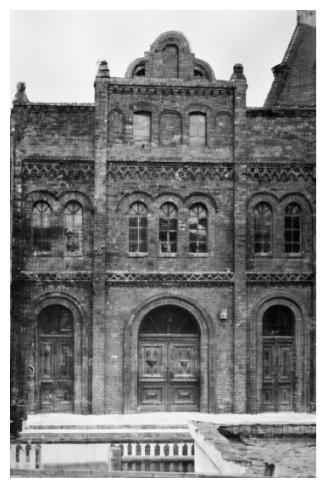
| Sosnowiec – The Great Synagogue on Dekerta Street |
|
|
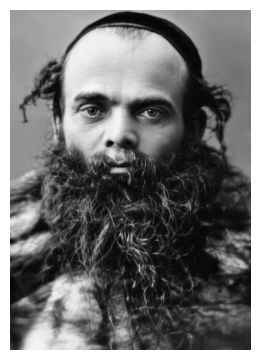
| Rabbi Itzhakel Glikman from Sosnowiec |
| Revenues | |
| Community tax | 6,450.00 rubles |
| Community fees | 50.00 rubles |
| Synagogue charity boxes | 2.75 rubles |
| Total Revenues | 6,502.75 rubles |
| Expenses: | |
| Salaries | |
| A) The Rabbi | 1,000.00 rubles |
| B) Two cantors | 400.00 rubles |
| C) Three beadles (shamashim) | 355.00 rubles |
| D) The community clerk | 300.00 rubles |
| E) Cashier | 325.00 rubles |
| F) Cemetery guard | 150.00 rubles |
| G) Choir | 100.00 rubles |
| H) Guards | 480.00 rubles |
| I) Miscellaneous | 175.00 rubles |
| Subtotal Salaries | 3,285.00 rubles |
| Synagogue Expenses | |
| A) Lighting | 250.00 rubles |
| B) Etrogs (citron used in the Sukkot ritual) | 25.00 rubles |
| C) Office supplies | 25.00 rubles |
| D) Repairs | 305.00 rubles |
| Subtotal Synagogue Expenses | 605.00 rubles |
| Support for the poor | 1,200.00 rubles |
| Talmud Torah school | 1,260.00 rubles |
| Total Expenses | 6,350.00 rubles |
[Page 41]
In the first years of its official existence, the community found itself in a
difficult financial situation. In the year 1901, its revenues decreased to 3049
rubles; and the budget suffered from a deficit of 2137 rubles. In the year
1902, its revenues were 945 rubles; and the deficit grew to 3153 rubles. Only
in the year 1903 did the financial situation begin to improve; this happened
after the municipality took over the collection of tax debts.
The action plan of the community was packed. The progressive members placed the construction of a modern synagogue on the agenda. They also planned a hospital, a vocational school, and more. In the first years of its official existence, the community established – in addition to the mentioned institutions – a mikveh (ritual bath) and a hygienic bathhouse; furthermore, thanks to the efforts of several individuals, a license was obtained to found a Gemilut Chasadim (interest-free loan / charity) society, through which a special women's committee was established to provide assistance to women in childbirth. Likewise, a Talmud Torah (traditional elementary school) was founded, as well as a fund to assist immigrants, support for the poor, medical aid, doctor visits for needy patients, and more.
The Gemilut Chasadim (interest-free loan / charity) society, in which its founders placed hopes thanks to the help of the progressive Jews, encountered mistrust on the part of the ultra-Orthodox (Charedim) already at the beginning of its existence; not a single one of them registered in it as a member, despite the fact that religious Jews were the main beneficiaries of charity and benevolence institutions. In addition to this, the difficult economic situation in those days weighed heavily upon the society's activities and the number of members decreased greatly; as a result of this, it was necessary to forgo providing medical assistance to poor patients. Despite the difficult financial situation, it was impossible to turn a blind eye to the “Talmud Torah” which swallowed 2400 rubles a year, while the society's revenues did not exceed 3,000 rubles. However, it was difficult to decide on closing the institution that had been established with great efforts to spread Torah and knowledge among poor children of the Jewish population.
The new elections that were held at the general assembly brought new and fresh forces into the management of the society; it appointed a council for educational needs, which was tasked with making efforts so that the education tax paid by the city's Jews in the amount of 5,000 rubles would be used for the establishment of a school for Jewish children, since not a single Jewish child attended the general schools in the city. The council endeavored to obtain approval from the authorities for its proposal; and to achieve through this a Jewish school for beginners. Likewise, the council decided to provide medical assistance to poor patients by means of an outpatient clinic. They also proposed that those in charge of the 15,000-ruble fund for the maintenance of the Talmud Torah, along with the designated building plot, change the designation and dedicate these resources to the establishment of a hospital. For this purpose, a sum of several thousand rubles that came from progressive circles was already in the possession of the community committee; and in the hope of receiving further donations for this, the committee also aspired to proceed as soon as possible to the establishment of a twenty-bed hospital.
The first community committee was a pioneer in arranging the practical affairs of the congregation; and its members, even though they belonged to assimilationist circles, did much for its development.
Coordinator's footnotes:
|
Eight years of activity for the first council – Hasidim on the second community
council – Community affairs in good hands – First school for Jewish children –
Lawsuit against the Chevra Kadisha (burial society) – Economic cooperation
during the German occupation in 1914 – Those devoid of work and livelihood – A
Jewish food supply committee – Jews elected to the city council in 1917 – New
Parnasim (community leaders) for the Jewish community – In 1924 elections for
the community – Dr. Abraham Perlman, chairman of the board – Dissolution of the
council in 1928 due to conflicts – Election of a new council in 1937 – The
community budget in 1938 was approximately two hundred thousand zehuvim
(złotys) – 35 officials in the community administration.
|
The first community council was active for eight years, and to its credit can be
recorded important activities for the benefit of the Jewish population. This
pioneering council had to begin building the community from the very
foundation. The treasury was empty and in need of funds; the council was tasked
with securing them in order to establish the first essential institutions.
Since no source of money had yet been found, the council members willingly bore
the financial burden; they covered various expenses out of their own private
pockets.
All members of the first community council were from the progressives, or as they were termed “Poles of the Mosaic Faith” – or in simpler and clearer language – “assimilated”. They were all well-to-do and engaged in industry and the trade of goods. [The details are taken from the “Almanac” of communities that appeared in Polish in Warsaw.] At the beginning of the Jewish settlement in Sosnowiec, no Hasidim were to be found among or the Mitnagdim (opponents of Hasidism) activists who would lend a shoulder for the common good; the assimilated Jews thus found it worthwhile to attend to the needs of the common folk and to help advance the rapidly growing Jewish population in the city, first and foremost by establishing the necessary institutions for the community. The council members, despite their engagement in their private affairs, found leisure time to act for the general good. They assembled for meetings from time to time and discussed the needs of the local Jewish population.
In the elections for the community council that took place on September 24, 1906, only 84 out of 500 eligible voters participated; among these, only a few were people of progress and freedom. The following men were elected to the new community council: Joszua (Jabsai) Sloczewski, Szmuel Rechnic, and Lajb Englander. The latter two were Hasidim; they were energetic men who nevertheless found a common language with the progressive members of the council. Indeed, in the first years, the situation of the community was not
[Page 42]
ideal; however, the reasons for this were a result of the general situation.
As is usual in such times, complaints and voices of
dissatisfaction were heard, especially against the method of distributing the
community taxes. The community council, taking the situation into account,
handed over the preparation of the community budget to a committee of 12
members who knew well the financial situation of each and every member of the
community; they endeavored to levy the taxes upon them in a just manner. The
people of progress expressed their opinion openly that the habitual critics of the
council's activities were precisely those who evaded every public burden –
the people belonging to the Orthodox camp. Nevertheless, despite everything,
the new council succeeded in gaining the trust of the entire population; it was
thus enabled to manage the community's affairs without disruptions.
The lack of schools for Jewish children was the great problem of Sosnowiec Jewry. Therefore, when the school for Jewish children opened, the “Gemilut Chasadim” (interest-free loan) society decided to close the “Talmud Torah” (traditional religious school) that existed alongside the society; they chose to use its endowment to establish a vocational school with workshops and evening classes for children. The society's management also entered into discussions with ICA (Jewish Colonization Association) regarding assistance on their part for the construction of a building for the school, the control of which was in the hands of the city's community authority.
Joszua Sloczewski, a member of the community council, also served in the role of a Gabai (trustee) in the Chevra Kadisha (burial society) together with Lajb Federman and Jakob Stachal. In the year 1907, a lawsuit was filed against them for extortion of money from Piszahof and Fejchter in connection with burial fees. In the indictment it was stated that since they held a monopoly on burial affairs, they extorted money from the relatives of the deceased. They demanded 1,200 Rubles as burial fees from the widow of Fejchter, whose sons refused to pay the money; therefore, they left the corpse of the deceased and did not bring it to burial. After two days, the trustees added to their demand and required 2,000 Rubles. The sons of the deceased secretly transferred the corpse for burial to a cemetery in Będzin. Sloczewski, the trustee, telephoned the Chevra Kadisha in Będzin so that they would not handle its burial. When the Chevra Kadisha in Będzin refused to handle the corpse, the sons transferred the corpse back to Sosnowiec; with great difficulty, they managed to arrange the burial in exchange for 1200 Rubles. The plaintiffs described the details of the negotiations in the indictment; they even supported their claim with a number of witnesses ready to appear and testify. The prosecutor at the court in Warsaw transferred the case file to the Governor-General in Warsaw; he tasked the Governor of the Piotrków Governorate with investigating the matter thoroughly. The investigation was carried out by the chief of the investigation department in Sosnowiec. Most of the witnesses confirmed the facts, but the trustees claimed that they were not obligated to satisfy all the wishes of the deceased's relatives; the accused Sloczewski, who was also a member of the supervisory committee, announced that he spent the money for the needs of the community. The Piszahof family also filed a lawsuit against the Chevra Kadisha in Sosnowiec for taking 500 Rubles in burial fees from them; this file was likewise transferred to the Governor in Piotrk&#oacute;w. On On September 2, 1908, it was decided to transfer the entire matter to the regional court (Okrug Court) in Piotrków and to hand the trustees over for trial for non-delivery of 1200 Rubles to the community treasury. The trustees appealed against
|
|
|
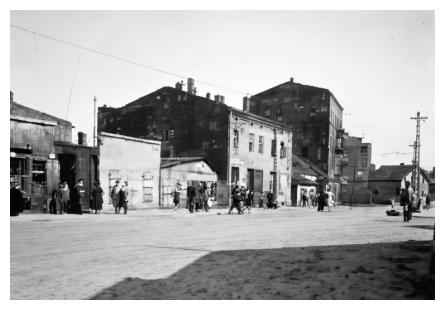
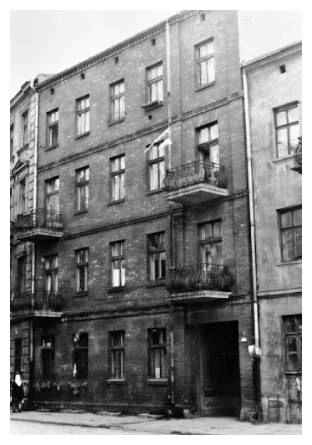
Sosnowiec – A house on Modrzejowska Street,
in which the
Admor (hasidic rabbi) of Radomsko, Rabbi Szloma Chanoch Rabinowicz, may God avenge his blood, lived |
[Page 43]
this decision before the Senate in St. Petersburg, where the matter was
dragged out until the outbreak of the First World War, when the sides reconciled.
In the elections for the third community council, the following men were
elected: Mosze Fiszal, Jehuszua Fechter, and Mosze Kingsberg; in the elections
for the fourth community council, the following men were elected: Mosze Fiszal,
Adam Branicki, and Gronem Sapir. These were the last elections during the
period of Russian rule.
During the Period of German Occupation
With the outbreak of the First World War in the year 1914, a standstill occurred in all aspects of life. The city, which had flourished since its founding and whose life had bustled, seemed to hold its breath in a sudden paralysis. All shipping offices and banks were locked. Grain, wood, and iron merchants, who had earned their livelihood in import and export businesses between Russia, Germany, and Austria, as well as craftsmen and professionals, wandered around the streets and searched for a livelihood. Social life froze, aside from committees for rendering urgent assistance. Upon the committees fell the primary duty to care for visitors who remained stuck in Sosnowiec due to the disruption of transportation. These were mostly merchants or agents from various points in the country who happened to be here, or “Russians” who had been expelled from Germany. Afterwards, when possibilities were found to send a portion of the people to their homes, the committees had to supply them with the means for travel expenses.
The German occupation authorities acted leniently in the city; at first, they established a citizens' committee in which the Jews participated in a proportional ratio, and their representatives were: Herc Lipszyc and Salomon Majmon. The Jewish population received special consideration from the committee even in matters of food supply. Afterwards, when two special supply committees were established – a Polish one and a Jewish one – complete harmony prevailed between them. The activists of the Jewish committee were: Zając, Wolfzon, Hamburger, Mamlok, Kohn, Stawski, Lipszyc, and Rothschild. Great interest in the committee's activities was also shown by the Parnasim (community leaders) Gronem Sapir and Adam Branicki.
In the year 1917, elections for the city council took place, in which the following Jews were elected: Bernard Openhejm, Maksymilian Rajner, Ignacy Landau (second curia[[1]]) Salomon Majmon, Szmuel Rechnic (third curia); Julian Kaner (fourth curia); Adolf Landau, Henryk Kwiatk (fifth curia); Mosze Judenherc, Herman Brinker (sixth curia).
In the same year, new Parnasim (community leaders) for the Jewish community were appointed by the occupation authorities: Chaim Józef Zając, Izrael Mosze Wajnryb, Mendel Szapira, and Herc Lipszyc. Lipszyc resigned, and in his place came Lajbisz Zandel, who was an extremely active leader. Thanks to his devotion and faithful activity for the benefit of the Jewish population, he deserved to be noted as one of the most important activists of Jewish Sosnowiec.
In the elections for the community in the year 1924, five Zionists and five Orthodox were elected. Dr. Abraham Perlman was elected as chairman of the board, and Lajbisz Zandel as chairman of the council. The chairman of the council was Dr. Tuwia Melodysta, and his deputy was Lajbisz Szwajcer. Upon the passing of Dr. Perlman in the year 1928, Lajbisz Zandel, who was active until the year 1935, took upon himself the role of chairman. In the same year, the council of the community board was dissolved due to the difficult financial situation and the sharp conflicts that broke out between the council and the community board in connection with the rabbinical elections. In its place, the government appointed an administration with Berysz Tencer at its head.
In September of that same year, elections for the community board took place again,
|
|
|
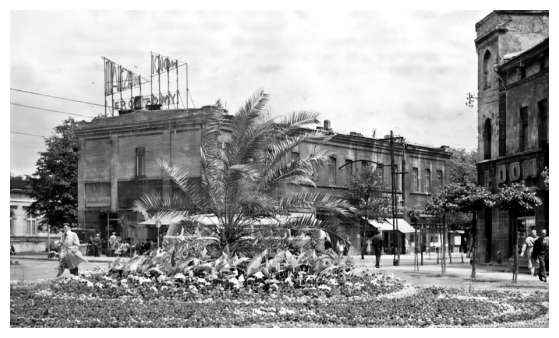
A garden near Czerwonego Zagłębie Street in Sosnowiec
(Street of Red Zagłębie) |
[Page 44]
and the newly elected community institutions began their operations on February 28, 1937.
The composition of the last community board management was as follows: Szloma Lajzonowicz, chairman (Zionist); Symcha Wilczyk, deputy chairman; Ruwen Czapnik, Ajzyk Lajb Fajerman, Szloma Chaim Wurman (Religious-Economic Bloc); Dawid Labartowski, Icchak Lajbisz Sztejnfeld (“Mizrachi”); Szalom Pilc (League for Working Palestine); Szloma Nachum Langer (artisans); Mosze Kajzer (“Aguda”).
The council was composed of the following members: Józef Majtlis, chairman (religious-economic bloc); Bernard Jasny, deputy chairman (Revisionists); Szloma Dalsman, Chaim Danciger, Dawid Lanczner, Abraham Liberman (religious-economic bloc); Dr. Tuwia Melodysta (Zionist); Józef Goldberg (League for Working Palestine); Dr. Hirsz Liberman (Poale Zion Left); Baruch Zakpowicz (“Mizrachi”); Baruch Saczemski (“Aguda”); Joel Diamant (artisans); Baruch Dawid Dudkiewicz (merchants and youth); Abraham Rotner (non-partisan religious Jews).
On December 5, 1938, Ruwen Czapnik left the community board, and in his place came Mendel Cichowski. On January 18, 1939, Icchak Sztejnfeld left the board, and in his place came Mosze Meryn (Zionist).
The regular annual budget of the community in the year 1938 reached approximately 200,000 zehuvim (złotys)[2]. At that time, there were 2628 taxpayers in Sosnowiec (paying from 5 to 1,000 zehuvim); the sources of income consisted of taxes, ritual slaughter, and the cemetery. The total expenditure for social aid and religious and cultural institutions reached 50,000 zehuvim, which is to say, 25% of the entire budget. The community employed 35 officials, five of whom worked in the office.
The community provided financial aid to the following institutions:
| 10,000 zehuvim (złoty) | – | The Jewish Hospital | |
| 15,000 zehuvim | – | The Orphanage | |
| 4,000 zehuvim | – | The Old Age Home | |
| 1,000 zehuvim | – | Poor Maternity Patients | |
| 2,000 zehuvim | – | “Gemilut Chesed” (interest-free loans) | |
| 2,000 zehuvim | – | “Linat Cholim” (overnight medical aid) | |
| 1,500 zehuvim | – | Mikvaot (ritual baths) | |
| 8,000 zehuvim | – | Matzah Flour for the Poor | |
| 6,000 zehuvim | – | Regular and Urgent Assistance | |
| 2,500 zehuvim | – | For Emigrants and Wayfarers | |
| 6,000 zehuvim | – | Medical Aid |
Likewise, it allocated 45,000 zehuvim for the needs of defense and
public assistance, and 8,000 zehuvim for the needs of culture and
education.
Coordinator's footnotes:
|
Under the rule of democratic Poland – The community has the character of a
religious congregation (Edah Datit) – In 1929, Rabbi Menachem Hager was elected
rabbi of the city – The struggle of parties and factions within the community
council – Assistance of the Polish government to “Aguda” (Agudat Yisrael, an
Orthodox Jewish movement) in the community elections – A community
committee appointed by the government – Complications in the operations of the
“appointee” – Searching for transgressions in the previous committee – New
elections in 1936 – 25 lists participated in the community elections – The
proposal to establish a unified representation of the Jews of Zagłębie for
internal peace and representation before the authorities – The intensification
of militant antisemitism – Dispossession of Jews and economic persecutions.
|
The historic day in the history of the new Poland was the day of the
proclamation of the constitution, 17 March 1921, in the first constituent
Sejm. Unlike all of Poland's previous constitutions, this
constitution was in theory liberal; it guaranteed equal rights to all citizens of
the state without distinction of origin, nationality, language, race, and
religion (Article 95). Article 111 promised every citizen the right to
cultivate their individuality and their national language. The minorities in
Poland based their civil and political existence on the Minorities Treaty,
which was signed by Poland together with the peace treaty. However, with the
growth and political consolidation of Poland, the liberal articles in the
constitution were increasingly nullified; along with them, all obligations
within the Minorities Treaty became void. Piłsudski did not follow a
distinctly antisemitic line; however, he also did not express an explicitly
positive stance on the Jewish question. The fate of the Jewish population in
independent Poland was abandoned to an anti-Jewish majority in the Sejm,
remaining dependent on the central and local administrative establishment. In
light of this reality, the Jewish representation in the Polish Sejm organized
itself into the Jewish “Koło” [1],
which stood guard over national interests. The activities of the “Koło”
were in practice limited to the struggle for the rights of Jews as citizens, alongside
the defense of the vital interests of the collective; and the degree of partial and
temporary success depended entirely on the political situation. At times the Jews
adopted methods of opportunism, and at times methods of defiance.
The community committee in Sosnowiec, which had been appointed by the German occupation authorities in the year 1917, remained in office even after the German oppressors left Poland at the end of the war and Poland became independent. Yet, by that time, the political background for organizing the public life of the Jews of Poland had changed compared to what existed at the time of the appointment of that committee. The relation of forces that had crystallized within the Jewish public, along with its general trends, had also changed. Even in terms of its personal composition, the community committee lost its capacity to act; several of its members died over the years or reached old age. The tenure of the committee appointed by the Germans therefore continued while awaiting the date of the community elections; the organization and scope of authority of the community had been established by a decree dated 7 February 1919.
This decree of the democratic Polish government, which gave the community the character of a religious congregation, disappointed some of the progressive circles of
[Page 45]
|
|
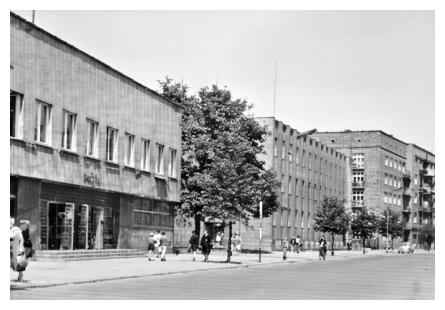
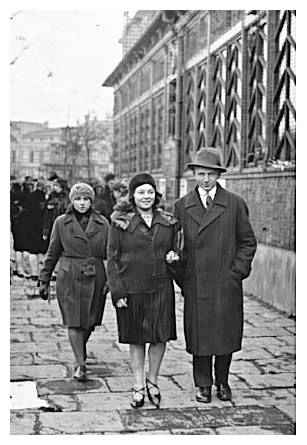
| Sosnowiec – Victory Boulevard |
the national and enlightened Jewry of Sosnowiec, who aspired to an organizational framework of national-communal autonomy. However, the government delayed the date of the community elections even according to its own format, and only in February 1924 did it finally announce new elections.
The election itself aroused great interest in the public; its results largely reflected the system of forces and party currents within the Jews of Sosnowiec. The elected community administration was composed of five Zionists and five Orthodox Jews (Charedim). Dr. Abraham Perlman (Zionist) was elected president of the administration; Dr. Tuwia Melodysta (Zionist) was elected president of the council.
No sooner had the new community council convened for its first session than a dispute broke out between it and the authorities, which was a dispute common to all Jewish communities in Poland. The Ministry of Religious Denominations and Public Enlightenment demanded that the language of debates in the council be the Polish language, and it refused to grant the opening ceremony an official character. All members of the community council expressed their
|
|
|
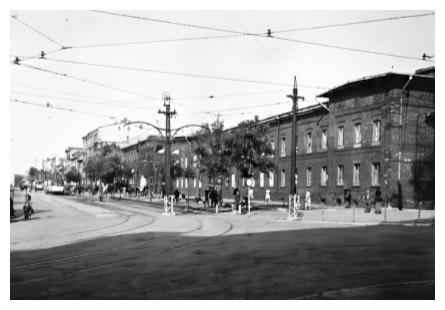
Entrance to the city center of Sosnowiec from the south side,
Czerwonego Zagłębia Street (Street of Red Zagłębie) |
|
|
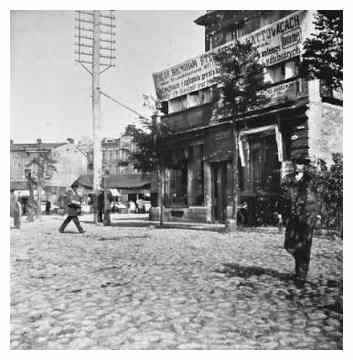
| Sosnowiec – Czerwonego Zagłębia Street (Street of Red Zagłębie) |
opposition to the government's stance, seeing in it an intention to harm the national and democratic character of the community institution and an attempt to diminish its prestige. The conflict worsened and lasted for more than a year and a half; it was finally settled by an order of the Minister of Religious Denominations and Public Enlightenment dated 24 January 1926, according to which the community council was permitted to conduct its meetings in Hebrew, Yiddish, or Polish, on the condition that the protocols would be recorded in Polish, so as to enable the authorities to inspect the community's activities[a].
In the year 1929, after a difficult struggle, Rabbi Menachem Mendel Hager (1889-1954) was elected rabbi of the city. The election caused a controversy within the community. The “Aguda” opposed Rabbi Hager because of his being a “Mizrachi” (member of the religious Zionist movement); and they elected a second rabbi, who was not a true Agudist, however,
|
|
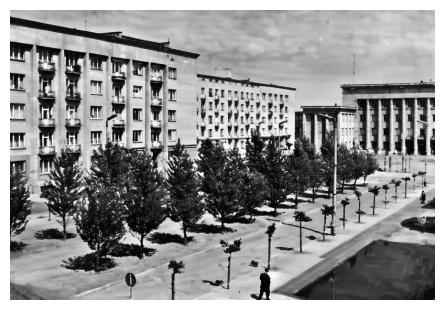
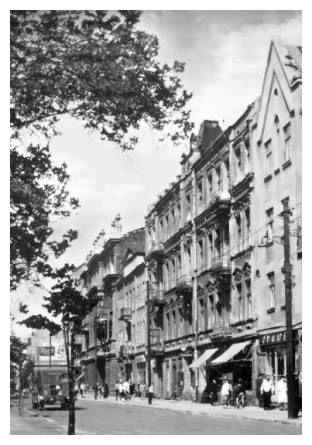
| Typical architecture of 1st of May Street in Sosnowiec |
[Page 46]
Rabbi Hager was elected by by a majority of votes. A dispute began that lasted for many
years. The members of the “Aguda” turned for help to the “Pritz”
(Polish landlord); they approached the Voivode (the provincial governor) to confirm
their candidate as rabbi of the Sosnowiec community. However, their demand was
rejected; Rabbi Hager received official confirmation as the rabbi of the city.
The government was interested in disputes among the national minorities in the
country. This interest aimed to weaken them in their struggle with the Polish
majority in the country. In general, the government looked with a jaundiced eye
upon the status of the Jews. They excelled over the other minorities in their
strength, as well as in their political and economic influence; the government
helped to sow division among them by means of decrees and regulations that
limited the “democratic” freedom of the Jews.
The war of factions and parties within the Jewish population in Sosnowiec made the discussions difficult. It harmed the functionality of the community council, which became an arena for unceasing party debates and frictions. Nevertheless, on matters that were of general Jewish importance – such as the struggle to abolish the compulsory Sunday rest law, the organization of a fund by the communities of Poland to send matzot to the Jews of Russia, the matter of assistance for the building of Eretz Yisrael (the Land of Israel), and the like – the community knew how to subdue party rivalries. The representatives of the Zionists endeavored from time to time to awaken the community committee to actions for the Land of Israel, whether in the form of allocations to the Zionist funds and for immigration [Aliyah] needs, or in resolutions of sympathy and demonstrations to express the living connection between Sosnowiec Jewry and the enterprise;
|
|
| Sosnowiec – Warszawska Street |
however, their efforts met with the opposition of the anti-Zionists on the council and the appointee for budget audit on behalf of the authorities, and only relatively few allocations were obtained to support the pioneer immigration. Upon the outbreak of the riots in the Land of Israel in the year 1929, a relief committee for the victims of the events was established at the initiative of the community council, which collected a decent sum in Sosnowiec and the surrounding area. To the credit of the community committee, its participation in organizing the protest movement in Poland against British policy in the Land of Israel after the publication of the White Paper in 1930[2] will also be noted.
After the rule of a government-appointed community committee for a number of months, community elections were held in May 1931 according to the regulations. The rapprochement of the “Aguda” with the Sanacja[3] government, which came to a prominent expression in the elections to the Sejm, was destined to reveal itself also in the elections to the communities. The government did everything in its power to assist the victory of its allies, the members of the “Aguda” and their Hasidic rebbes; the latter spared no effort to win… “by order of the Rebbe” and by the power of the authorities. The old trend to impart a religious character to the community received reinforcement from time to time from the government through various regulations of the Ministry of Enlightenment and Religious Denominations (from 1927, 1930, and 1931). According to one of these regulations, the right to vote in the communities was stripped from any Jew who openly violates the commandments of the religion,
|
|
| Sosnowiec – Kowalska Street |
[Page 47]
or who argued in public that one should not observe the commandments; this
regulation served in many towns as a means to disqualify voters and candidates
who were deemed undesirable by the "Aguda" and the authorities.
Even so, the combined efforts of the “Aguda” and the government
succeeded only partially. In Sosnowiec, the share of the “Aguda” in
the community committee was not large; the authorities endeavored to stand by
it always in times of distress, sabotaging the activities of the community
council in various ways, both overt and covert. Despite all its efforts, the
“Aguda” did not succeed in obtaining a deciding power, which remained
in the hands of the Zionists.
The composition of the community council in the elections held in May 1931 was not to the liking of the authorities, and the Voivode disqualified the elections. This state of alternating appointments and elections lasted during the years 1931-1934. In February 1934, elections for the community were held again; once more, the “Aguda” came out with lists of its own in the hope of winning the votes of many voters and a considerable number of administration members. However, this time too, the majority was won by the lists of the Zionists and “Mizrachi”. After the elections, the Zionists and “Mizrachi” reached an agreement with the lists of Rabbis Aryje Cwi Fromer from Koziegłowy and Icchak Glikman; according to it, Rabbi Hager was recognized as the rabbi of the city, and Rabbi Fromer as the head of the rabbinical court (Beit Din). The members of the “Aguda” made many efforts with the authorities to get them to disqualify the elections; the latter began investigations and a rigorous audit of account books and documents in the community offices. The main controversy that arose in the administration and its council always raged around the budget, which reached a large sum on average. The members of the “Aguda” took trouble to increase allocations only for religious institutions and Orthodox enterprises; the budget was generally approved after prolonged and exhausting bargaining. After its acceptance by the community council, the budget required
|
|
|
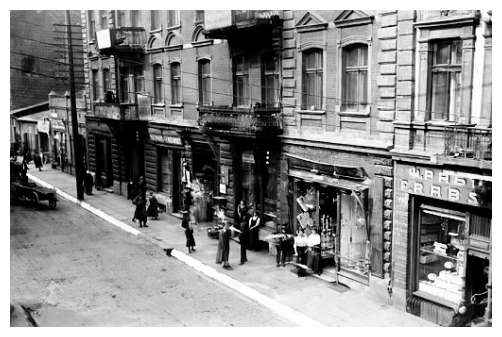
A section of Główna Street (Red Zagłębie)
and the corner of Modrzejowska Street, Sosnowiec |
approval from the authorities. The official appointed over community affairs on behalf of the Ministry of Religious Denominations and Public Enlightenment would erase and alter various expenditure clauses in it. In recent years, the government's opposition to allocations for the benefit of the Land of Israel and for immigration needs grew; at times, even small donations designated for the benefit of the Zionist funds, and the like, were erased.
In the elections of 1935, a new committee was elected; once again it was not to the liking of the authorities, and it was immediately dissolved. In its place came an appointed community committee under the leadership of Berysz Tancer, who had once been a good and respected Zionist and became a tool in the hands of the government to strike at the community.
The Appointed Community Committee
The composition of the appointed administration of the community included: Berysz Tancer – director, Dr. Julian Hercman – deputy director, and the members of the administration – Markusz Birman, Jakob Garfinkiel, Eng. Markusz Lipszyc, the manufacturer Ignacy Majtlis, Salo Wolfzon (who resigned from his mandate), Henryk Zingiel, as well as the official Moreh Tzedek (Teacher of Righteousness) of the community – Rabbi Menachem Szwarc.
To clarify the atmosphere and the complications of the period, we present herewith a translation of the original document regarding the official dissolution:
|
|
|
Sosnowiec – Café Warszawski
(Warsaw Café) |
[Page 48]
From the above, it emerged that:
The first task of the government-appointed committee was therefore to manage the financial affairs of the community and to rehabilitate it. On 11 February 1935, the appointed committee received into its possession all the property of the community and its institutions. However, this appointment was not received by the Jewish public with satisfaction; there was even found a group of Jews that from time to time came out with attacks against the Commissar Tancer in the Warsaw-based “Haynt” (Today) and in the pro-Aguda “Zagłębier Zeitung” (Zagłębie Newspaper).
Indeed, the lot of the appointed committee was not pleasant; it had to introduce order into the financial economy of the community, collect the community tax from the hands of delinquent payers in the amount of 45,920 zł, arrange the payments at the slaughterhouse, clear its debts totalling 92,331 zł, as well as debts to the social insurance institution totalling 20,000 zł. According to the report of the appointed community committee, the budget for this season shows the following:
1. Income:
Community tax from delinquent payers 56,453.28 złoty Community tax for the year 1935/36 93,453.25 " Sale of seats in the synagogue and vows 10,000.00 " Slaughter fees (Shechita) 44,781.00 " Sale of burial plots 80,000.00 " Fees for tombstone permits 50,000.00 " Miscellaneous income 002,488.04 " Total 337,175.57 złoty
[Page 49]
2. Expenses
Debt service 30,305.63 złoty Rabbinate 12,000.00 " Administration 17,920.00 " Slaughter (Shechita) 56,141.30 " Cemetery 14,800.00 " Synagogues and houses of prayer 20,360.00 " Social welfare 40,460.00 " Taxes to government and state institutions 1,400.00 " Maintenance and operations 7,500.00 " Maintenance and supplies for the ritual bathhouse (Mikveh) 12,000.00 " Miscellaneous expenses 002,533.17 " Total 215,480.10 złoty
In fact, the incomes brought in only 73,261.95zl; on account of the expenses, only 46,124.76 zł was paid. The community tax applied to 2,951 members of the community; thus, on average, each person paid 37 zł per year. To get an idea of the nature of the income and expenses, we present herewith excerpts from the report of the appointed community committee.
Income:
From the Synagogue
Apart from the vows of those called up to the Torah, the income came mainly
from payments for rented seats at the beginning of the Jewish New Year (Rosh
Hashanah). The appointed administration took deep care to ensure seat
locations in the synagogue for the broad masses of the population as well.
Cattle Slaughter
Slaughter within the community boundaries required a solution; this was
necessary both from a religious standpoint and from an administrative-budgetary
one. Constant struggles existed around the appointment of the rabbinical authority
to supervise the religious slaughter; finally, Rabbi Szwarc was tasked with visiting
the slaughterhouse every week to supervise the kosher status (kashrut).
In addition, excellent supervision by two supervisors over kosher meat was
introduced during the slaughter; likewise, an obligation was imposed on three
trustees – the rabbinical judges Glikman, Halbersztam, and Sztark – to
visit all Jewish butcher shops in their districts once a week for a halachic (proper)
audit of the meat. The leadership also supervised kosher cattle slaughter without
lungs inspection for meat intended for soup kitchens at a low price. Since this
slaughter had until then been carried out by the butchers on their own
initiative, the aforementioned actions done for the benefit of the observant
part of the Jewish population stood out. Various actions were carried out with
the goal of increasing the efficiency of the slaughter and its level of kashrut;
a rationalization was also introduced in the flawed inspection
system of cattle slaughter. Aside from this, a change occurred in the method of
payments for cattle slaughter; the sale of slaughter tickets was handed over to
the butchers' association, and thanks to this new arrangement, slaughter
payments began flowing into the community treasury regularly and in full
amounts.
In the report, the Commissar describes that thanks to the change in the tariff of payments for cattle slaughter, the butchers practically stopped slaughtering outside the city; they began operating within the municipal slaughterhouse area. Despite the restrictions and the tariff, the year 1935 showed a significant growth in income compared to previous years; this points to an increase in the extent of cattle slaughter.
Kosher Poultry Slaughter
Upon taking over the administration of the community – the Commissar notes
– the income from poultry slaughter payments was very small; this was due to
illegal poultry slaughter by unqualified slaughterers, as well as by several small-livestock
peddlers. Aside from this, they would inspect small livestock slaughtered in other
communities; this caused significant financial losses to the community and also
harmed the guarantee for the meat's kashrut (kosher status). The new
administration dedicated much effort to rehabilitating the situation. First, a
struggle began against the illegal slaughter; special rules were introduced
regarding payments for transportation and small-livestock crates, and a
responsible oversight was established for kosher poultry slaughter. Lead seals
were introduced, noting the designated days for the butchering of small
livestock within the local urban area. They resorted to appropriate punitive
measures against persons and peddlers of small livestock who evaded legal
slaughter. Notices were issued to the population; they even announced from the
synagogue pulpit that people should not buy slaughtered small livestock without
the lead seals of the community. The local rabbinate restricted itself from
dealing with halachic questions regarding slaughtered small livestock that did
not possess lead seals. Thanks to these measures, a scale of 46,427 small
livestock slaughters was achieved in 1935; this is compared to 9,650 in 1934
and 9,414 in 1933. As a result of the aforementioned measures, 10,348.90zl
entered the community treasury in the year 1935; that is to say, more than 300%
of the sum fixed in advance. This fact served as proof of the efficiency of a
rational management expressed in the budget; it also served to restore trust on
the part of the observant section of the Jewish population, which began
demanding local slaughter meat with full force.
Burial Plot Sales
The sale carried out by the administration in the year 1933 was done only
within the limits of payments permitted by law; this was in accordance with
Article 11 of the ministerial instruction of 9 September 1931 regarding the
financial management of Jewish communities. In the budget draft for these
burial fees, the figure went down from 13,000 zł in 1934 to
8,000 zł in 1935. Instead, an increase occurred in payments for tombstones,
rising from 2,000 zł in 1934 to 7,000 zł in 1935; not a single case of
“delayed burial” (Halanat HaMet) occurred, an event that was common in
previous years due to unpleasant bargaining regarding the price of the plot.
Payments for Permits to Erect Tombstones
Similar to the burial fees, the administration established for itself a
clear principle here too; this followed the article of the instruction cited above.
In 1935, payments for permits to erect tombstones reached the sum of
5,166.90 zł. Remarkably, even in this item of the budget there was a
relative increase that can be seen in comparison to previous years.
[Page 50]
Expenditures:
Rabbinate
This item contains the salary of a syndic rabbi, alongside benefits for two
widows of rabbis, amounting to 12,643 zł. The administration expanded
the rabbinate from the Moreh Tzedek (Teacher of Righteousness) Rabbi
Menachem Szwarc by adding three dayanim (rabbinical judges): Rabbi
Joszua Glikman, Rabbi Dawid Joszua Halbersztam, and Rabbi Jehonatan Sztark;
a special reception hours was established in the community premises, where
all religious matters were arranged, questions of kosher status were decided,
transfers to the rabbinical court were made, and the like.
Administration
The expenses of the community office rose to a certain extent. The office
was moved from a side alley into the center of the city; there, it occupies
five spacious rooms instead of the two previous ones. The Commissar fixed
reception hours for the public every day from 5 to 7 p.m., and on
Sundays from 10 a.m. to 2 p.m.
In the year 1935, the community office organized a card index of the Jewish population in Sosnowiec; this index contains the family cards of all members of the Jewish community. It is updated regularly on the basis of the registration Logs of the municipal offices. According to the results of the census carried out by the community, the number of the Jewish population in Sosnowiec reached 23,550 people as of 1 January 1935.
The amount designated in the 1935 budget for organizing the register of the Jewish population was 2,000zl, but in fact, 2,807.02zl was expended for this purpose; this sum included the investment in founding the index, the card-index desk, and the like.
Synagogues and Houses of Prayer
This item included the salaries of the officials of the synagogues on Będzińska
Street, and Józefa and Felicjanka; this sum rose to 10,408.55 zł. The
expenditures for the maintenance needs of the synagogues rose to 6,438.67 zł; a
large part of these expenditures was spent on the upkeep of the buildings of the
synagogues, alongside payments for sewerage and plumbing, various
sanitary arrangements, and the like.
Kosher Slaughter
The salaries of the slaughterers in 1935 were reduced to an appropriate extent,
reaching 32,000 zł; the amounts of pensions for the widows of slaughterers
reached 5,250 zł. The salaries of the supervisors of kosher meat reached
10,407.50 zł; the activities of the meat supervisors were aimed not only at
ensuring the kosher status, but also at preventing the smuggling of outside
meat into the city, which sabotaged the community's income.
For the needs of the oversight over the slaughter, the operating needs of the slaughterhouse the allowance for the sale of slaughter tickets through the butchers' association, printed matter, lead seals, and refunds for each carcass found to be non-kosher (differential payments between “kosher” and “treif” [non-kosher]) – a total of 10,814.90 zł was expended during 1935. Likewise, several works were carried out and certain investments were made in the building of the slaughterhouse. The poor condition of the slaughterhouse from an operational and sanitary standpoint demanded repairs; these were executed by the administration. The total amount of expenditures in the kosher slaughter item in the year 1935 reached 58,120.64 zł, whereas the income from the payments for cattle and poultry slaughter reached 70,269.30 zł.
Cemetery
Social Welfare
This item contains allocations for charitable and benevolent institutions,
alongside urgent aid for the poor population and medical needs for poor
patients. Worthy of special attention is the support for the Jewish hospital,
for the benefit of which a total of 4,908 zł was expended in 1935. For the
“medical treatment for the poor” (reimbursement of expenditures
for medicines), a total of 4,939 zł was spent. In contrast to this, a total of
500 zł was expended for a children's summer camp (convalescence travel
for poor children). For urgent and regular support for the poor – 4,386 zł.
Added to this item were: the society for safeguarding health TOZ, the society
for the promotion of vocational and agricultural labor among Jews
ORT,[4]
and the society “Tomchei Yoldot Aniyot”,[5]
which received certain sums.
It is also worth noting the innovation in the manner of distributing Kimcha D'Pischa.[6] In previous years, this activity was carried out from funds that the community collected among private donors. In the year 1935 – apart from the funds collected according to tradition by special gatherers from among the wealthy Jewish class for this purpose and distributed to the poor of the people through the community – a special sum was expended directly from the community treasury in the total of 518 zł. The total amount for current supports, assistance, and relief expended in 1935 reached the total of 19,628 zł.
[Page 51]
Education and Culture
In this item, a total of 5,025 zł was expended as follows:
Talmud Torah religious school 500.00 złoty Beit Yaakov 300.00 " Keter Torah (Radomsk Yeshiva) 200.00 " Yesodei HaTorah 400.00 " Religious and Hebrew studies at the Jewish orphanage 1,700.00 " Society of Jewish Secondary Schools 1,600.00 " The Jewish Academic Association “Ognisko”[7] 225.00 " The Jewish Sports Association “Maccabi” 100.00 "
State and National Trends
This item did not find a place in the community budgets of previous years,
apparently due to a lack of funds; in the fiscal year 1935, the following
amounts were expended:
Under the expenditures of a national trend, there should likewise be included the amounts that were given for immigration needs to the Land of Israel for all those who received certificates. This assistance, in the total of 75 zł per immigrant, was entered under the item “Social Support”, “for the support of poor emigrants”. This item, including the support for the immigration to the Land of Israel, was included in the community budget for the first time by the administration in the year 1935.
Air and Gas Defense League LOP[8] 100.00 złoty Maritime Defense Fund FOM[9] 110.00 " The Polish Red Cross 100.00 " Keren Hayesod 100.00 " Keren Kayemet Le-Israel 100.00 " The Hebrew University in Jerusalem 200.00 " Cekabe – Central Interest-Free Credit Association
for the dissemination of productive labor among the Jewish population in Poland100.60 "
Among the expenditures under the item “Maintenance and Operations” was also included the safeguarding of the Eruv boundaries (Eruv Techumin), and a total of 924.55 zł was expended on it.
In “A Few Words” as an introduction to the report, the Commissar says among other things that the radical change in the administration of the Jewish community of Sosnowiec was welcomed by the local Jewish population with a feeling of relief, under the assumption that “worse than it was, it cannot be”. At the same time he notes that the change met with a critical attitude precisely on the part of “a group of people who belonged to a fellow faction and were aided by the left wing of the members of the former council that was dissolved”; this group revealed from the very beginning a negative attitude toward the “Commissar”, engaging in an organized onslaught against the person of the Commissar. This “unfounded and unjustified” onslaught of the rivals was conducted with the help of the Będzin-based weekly “Zagłębier Zeitung” and the Warsaw daily newspaper “Haynt” in cooperation with the editor B. Yeuszson. The purpose of this onslaught was clear: to harm the honor of the one standing at the head of the government appointment, under the assumption that his colleagues, men of status in financial spheres who are unaccustomed to the gossip and slanders of the press intending to humiliate and attack, would quickly abandon their position and impair the integrity of the community administration. Yet – he testifies – the administration was not impaired in its integrity; he himself, out of recognition of his responsible role toward the population and toward the institutions, passed over the provocations in silence and dedicated himself, in cooperation with the administration, to the difficult work to which he was invited: a fundamental rehabilitation of the finances of the Jewish community, which was found in a poor state.
Indeed, this is one side of the coin; however, there was also a second side. The authorities admittedly noted in their reports an improvement in the situation and in the financial management of the community; however, the rule of the commissarial administration was received with resentment on the part of the Jewish public: public opinion, the local press, and the Jewish press in Warsaw came out sharply against the commissarial administration. And apparently in order to add fuel to the fire, an official was sent by the administration on a certain Sabbath day to the house of prayer of Rabbi Hager to execute a seizure due to non-payment of the community tax, even though the rabbis were exempt from paying this tax. This act aroused bitterness among the public. Public opinion was against the Commissar and his deputy, who sought to take control of the community and its institutions; finally, the authorities abolished the administration of the community, and in February 1936 new elections were held.
On Sabbath and on Sunday (17 and 18 Elul 5696 / 4 and 5 September 1936), Jewish Sosnowiec was caught in a whirlpool of elections and an abundance of meetings that were announced in notices and flyers. The masses went from one place to another, where meetings took place under the canopy of the heaven, and they listened to the speakers of the lists who accused their rivals of various sins: the National camp accused the “Aguda”, Poalei Zion Left accused Poalei Zion Right, and vice versa.
After the Single-Ruler Governance in the Community
In preparation for the community elections, three blocs were formed:
The results of the elections were:
List 5 (Poalei Zion Left) 251 votes List 7 (Rabbi Englard) 924 votes List 10 (Artisans) 320 votes List 11 (Small Traders) 200 votes List 13 (Revisionists) 220 votes List 16 (Torah VaAvodah) 121 votes
[Page 52]
List 17 (Mizrachi) 445 votes List 18 (Zionists) 258 votes List 19 (Radomsk Hasidim) 289 votes List 20 (Rabbi Fromer) 362 votes List 22 (Agudah) 316 votes List 15 (League) 230 votes
A festive moment. The table in the meeting hall of the community is covered with a green tablecloth, and upon it burn candles in Sabbath candlesticks that add solemnity to the occasion, wherein the outgoing Commissar stands in ready to hand over the keys of the community into the hands of the newly elected leaders. He opened the meeting with a short, practical speech that contained a financial report, the status of assets, and the like. Dr. Liberman, who was the first to receive the floor, said that the commissarial administration had been active in only one area: the satisfaction of religious needs, but it had done absolutely nothing to alleviate the situation of the masses of the poor Jews. He appealed to the newly elected members to work out a broad assistance plan for the benefit of the poor Jewish population. The representative of the local authority, Magister Kruszewski, replied to Dr. Liberman in a speech praising the work of the community administration, which had executed its primary task – the rehabilitation of the financial state of the community, and he expressed his gratitude to the outgoing administration.
The new chairman of the community committee, Mr. S. Luizowicz, who was requested to state what the financial situation of the community was, replied: We found 23 zł in cash in the treasury. Mr. Tancer acted with cunning, intentionally to make our situation difficult, by selling slaughter tickets to the butchers' association for 1,200 zł, and he left the community with liabilities totalling 35,299 zł. We shall issue an appeal to the taxpayers to come to our aid and clear their tax debts. Already in the very first days of our tenure, quite a few taxpayers came and paid their debts.
In the first meeting of the new community council, each faction came out with its own “Ani Maamin" (statement of faith / credo) regarding the tasks of the community – ideas beautiful in themselves; the leader Delisman, as a man with a “practical sense", declared that everything is vanity of vanities, and only the question of the rabbinate is central for the community… his group, which received the largest number of votes in the elections, sees the first task of the community in settling the question of the rabbinate; if the question of the rabbinate does not find its solution, the activity of the community is likely to remain at a standstill.
In view of the harsh inter-party quarrels and the endeavors of various activists to seize the helm in the communities of Zagłębie with the help of the authorities – and especially in those of Sosnowiec, Będzin, Dąbrowa, and others, not out of concern for the needs of the collective, but out of pure personal ambition – several activists with a national trend in Sosnowiec and in the surrounding towns proposed, and even took concrete steps in this direction, to establish a unified representation of the "Jews of Zagłębie" both for internal peace and for representation before the authorities; however, this appeal of theirs fell on deaf ears.
Meanwhile, a difficult period began in the life of Polish Jewry. Militant antisemitism grew and intensified, bringing with it economic coercion, the dispossession of Jews from most financial positions, and persecutions accompanied by clashes. The Zagłębie region was admittedly harmed less than other parts of Poland; however, the general atmosphere, which was saturated with the incitement of the local and general press – and especially the Endek press that championed German-Nazi ideas – was not only gloomy and terror-inducing, but pointed clearly to the future awaiting the Jews of Poland.
Original footnotes:
Coordinator's footnotes:
|
JewishGen, Inc. makes no representations regarding the accuracy of
the translation. The reader may wish to refer to the original material
for verification.
JewishGen is not responsible for inaccuracies or omissions in the original work and cannot rewrite or edit the text to correct inaccuracies and/or omissions.
Our mission is to produce a translation of the original work and we cannot verify the accuracy of statements or alter facts cited.
 Sosnowiec, Poland
 Yizkor Book Project
 JewishGen Home Page
Copyright © 1999-2026 by JewishGen, Inc.
Updated 15 Oct 2026 by OR