 |
|
|
[Page 64]
Translated by Alena Barysevich, Enrico Benella, Linda Motzkin,
Roger Noble, and Phyllis Press
11.
The Town Hall
On the western side of the marketplace stood the town hall. It was a large, beautiful building. As tall as the town hall was, it still had on top of it a small rectangular turret and on top of that there was a high pole jutting out which made that building taller than all the houses in town.
Once it was the seat of the town council, which was appointed by the tsarist authorities.
Since the liberation of Poland, the town councils have been elected by the residents. The burmistrz [Polish: mayor] and the ławnicy [Polish: city councilors] have been elected; among them, we had our Jewish representatives. The antisemitic city councilors who were members of the ND party often made anti-Jewish speeches, full of hatred and venom, demanding various restrictions on Jews. The Jewish city councilors, who were mostly Zionist-leaning property owners, defended Jewish interests with dignity and pride and more than once responded to the antisemitic council members in such a way that they brought tears to their eyes. The Jews in the town were proud of the dignified public appearance of their elected representatives. Every antisemitic attack that was repelled and every dignified speech from a Jewish councilor was greeted with joy as a Jewish victory.
Despite the considerable number of antisemites, which had grown especially in the last few years, in fact the relations between Jews and Christians were generally not so bad.
In the town hall were the registries in which new births had to be recorded and from which those who had departed on their last journey had to be removed. Yet these formalities were not accurately observed by Jews. This was in fact the responsibility of the shamosim Khayim, Hershele and Nosn-Yitskhok. They would, however, neglect their duty and this would cause a lot of headaches for the good-hearted and Jew-friendly Mrs. Sękowska, who was in charge of the registry. Jewish children would become registered only when they had to be enrolled for military service…and then they had to undergo the procedure of an evaluation committee which had to ascertain their age… When a married couple came to register their “akty ślubne” [Polish: marriage documents], it turned out that they hadn't ever been born…But all this wasn't so terrible for us. Because with a couple of złotys, the secretary Korbowski, the one with the whiskers and sideburns, easily took care of it. The dear Mrs. Sękowska, who
[Page 65]
was responsible for the registries and knew the whole Jewish population, did many favors for Jews, without taking a cent in return.
Also located in the town hall was the police, which was composed of a przodownik [Polish: sergeant] and a dozen policemen. All of them had connections and links with the Jewish population, from whom they supported themselves more than from their government salary… The worst łapownik [Polish: bribe-taker] was the policeman Czapski. He didn't care whether the matter was kosher or not, as long as he got his bribe…. He had to take some of every kind of merchandise, whether he could use it or not. When, on the morning of Hoyshane Rabe, he bumped into Hershele the shames carrying a small basket of willow branches for the community house of prayer, he asked him, “Co to jest takiego?” [Polish: what is that stuff?]
|
|
“Hoyshanes (willow branches), sir,” answered Hershele. “Daj szane! [Polish: Give me the ‘shane’]”, said Czapski. And for the rest of day, he walked around with the willows in his hand …
In the town hall there was also the “lock-up”, the jail for short-term arrests. For longer terms, there was a prison on Pszernik St., and for still longer terms, they would send people away to Warsaw to Pawiak prison.
The fire department, too, was located in the town hall. It was led by two eminent Christian citizens, Strokacz and Binder. Every Sunday, they would make a smotr [Russian: inspection] accompanied by the sound of their strażacka orkiestra [Polish: firemen's band]. The strażacy [Polish: firemen] would wear copper helmets and the officers – bronze ones. There was a certain number of Jews among the firefighters. In several
[Page 66]
points around the town, bells were hung which would ring when there was a fire to summon the firefighters. The bells could be rung by anyone – whoever had noticed the fire and was near a bell. When one bell was sounded, the other bells would be sounded in return. The bells resounded through the town and the firefighters quickly set off running to the town hall. There they grabbed the water barrel with the hose, ladders, iron crowbars and axes and set off for the fire. In fact, the greatest delight for cheder-boys was to ring the bells and be the first to announce a fire, and the fact that their ringing made all the firefighters run, as if by their command…
Every year, the firemen would organize a “firemen's ball” in the woods. Our town's strażacki bal [Polish: firemen's ball] was famous. A very good wind ensemble would play the dance music. The management would surprise everyone by distributing honorary awards, gifts and treats. The firefighters drank a decent amount. Instead of pouring liquid on a fire, this time they poured liquor down their throats. The woods were full of thousands of people. Dozens of fruit, beverage and candy vendors did business with gusto. Packs of cheder-boys would go there to look at the pozharnaya komanda [Russian: firemen's brigade] party and get a beating from antisemitic rascals.
Even the electric station was located in the town hall. The electric station was installed under the German occupation during the first World War. The directors were two Christians Bem and Rycerski. But almost all of the electrical engineers were Jews.
Yokheved's Mendl Lipshits and Shloyme Tsudkovitsh were the first Jewish electrical engineers in the city. At first, the electric station was only active in the evening hours, until about midnight. Later the station was enlarged and there was electric power twenty-four hours a day. This, indeed, made possible the development of small industry in Skierniewice.
Our shul
The shul…
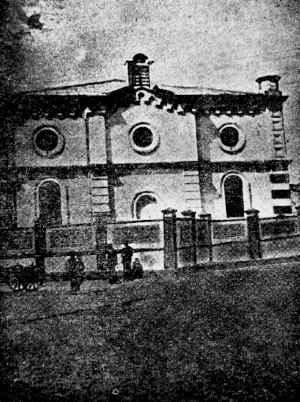
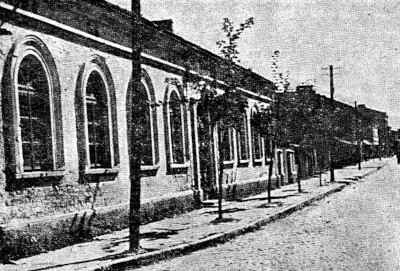
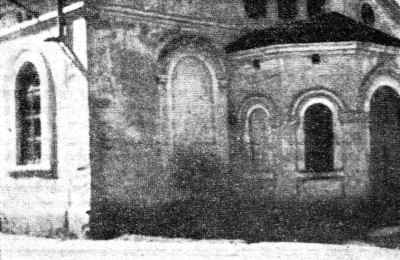
I can see now, before my eyes, the beautiful, imposing rectangular brick building with those high round-topped windows, with the colored windowpanes in the half-round transom windows, with the artistic cornices all around the building… On a corner of the roof, opposite the water pump, embedded into the building were the Ten Commandments, which looked down on everyone who had God in their heart.
[Page 67]
|
|
[Page 68]
The shul yard was encircled by a half-walled fence with embedded columns, between which were painted wooden posts. Two entrances led into the shul yard: from Mikveh Lane – for men, from Barracks Street – for women. The main entrance, obviously, for the men, had a beautiful, solid, large door. On one side was the anteroom, with a washstand for ritual handwashing, and on the other – a large room for early morning prayer services, and for latecomers to the service in the main shul.
The main shul was spacious, with rows of solid benches and shtenders[48] which were sold annually. For those who could not afford it, a substantial area on the western side was left without benches and shtenders – for standing… But not everybody there was standing. During the Days of Awe many people fixed the problem by bringing with them chairs from home… Of course, the rabbi, the dayonim[49], the gaboyim[50] and the rich householders didn't need to do that because they were seated comfortably near the Eastern wall.
You could reach the reading table by climbing six or seven steps. When the Ark was opened, three small doors above, which were mechanically connected to the main doors of the Ark, would simultaneously open. Through these three small, opened doors, one could see the biblical altar, showbread, priestly robe and breastplate. The automatic opening of these three small doors in such a mysterious manner made a mystical impression on the grown-ups and would cause great enthusiasm among the youngsters.
Over the whole width of the Eastern wall the representations of the twelve months of the year were painted, with the Zodiac signs and quotes from the Bible: “swift as a deer” with a running deer, “light as an eagle” with an eagle floating in the air, “strong as a lion” with the majestic king of the beasts, the lion… “bold as a leopard” with a frightening leopard, and so on. And also images of the musical instruments that the Levites used to play in the Temple in Jerusalem…
In recent years the synagogue hired an external paid cantor. But until he came, the prayer was led by our local, good-hearted Jews. [A line appears to be missing here.] There were iron balustrades with wooden handrails on both sides, on which two large, carved lions were lying, one facing the other. By the plush-covered table with the Torah scroll, Fishl the shamesh would stand and sell the aliyas.
On the pulpit, the burning lights in a row of candlesticks lit up the beautiful, artistically wrought shiviti[51]. The heavy plush curtain over the high, recessed Holy Ark, was hung with rings attached to a metal bar.
[Page 69]
[A line appears to be missing here.] prayer leaders. So, for example, for some time, Mussaf prayers were led by Sholem the Ritual Slaughterer[52], with whom the congregation was well satisfied.
At the time of the cholera epidemic, the authorities banned all prayer gatherings in study houses and shtibls.
|
|
Prayer services were only permitted in the main shul. It was indeed at that time that the best prayer leaders in town led the praying: the old Shimen-Yoysef, Tsodek Tsudovitsh, the rabbi reb Menakhem-Nokhem Rozenblum, etc.
[Page 70]
In normal times, the regular prayer leaders were Avrom Yitskhok Leyb's, Fishl the Shames, Dovid Holts and the famous cantor Hershl Bornshteyn, who, when appointed to the position of cantor and ritual slaughterer of the town, caused the eruption of such conflict that it was remembered for many years in Skierniewice. Hershl Bornshteyn prayed with a conductor and a choir standing behind him. The conductor was nicknamed “the little hunchback”. Yoysef Fas, the previous cantor, used to do something completely different. With him the singers were standing on the steps leading to the Holy Ark, on both sides of the pulpit,
|
|
the cantor and ritual slaughterer |
and he himself conducted them. The singers that could be heard with their beautiful soprano and alto voices were Moyshe Leyzer Yoyne's, Moyshe Buki, Mendl Zuka, Fayvl Raykhman, Leybl Rozenberg, Leyzer Herts and others. The cantor's songs resounded throughout town like theater hits – l'havdil [Hebrew: not to compare them]… They would be sung repeatedly on various occasions in every Jewish home. The master tailors and their tailor apprentices were particularly keen on cantorial singing in the workshops of Toyvye-Leybish, Adler, of Eliezer Freylekh, Moshke Toybn-Khaper, Kalmele, Shmekanovski, Motele. While running their sewing machines,
[Page 71]
or working with scissors and the iron press, they would let loose with the cantor's Vayekhadshehu from the blessings for the new month, or Unesane Tokef [from the High Holy Day liturgy] and other cantorial pieces. And so, too, would Zaynvele, Fistl, Fat Abo and Shimshele, sitting on their cobbler's benches, really putting their hearts into the cantorial melodies.
The regular Torah reader in shul was Shaye the Teacher. He would chant beautifully and sweetly. The gaboyim here were: Moyshe Leyb Moshkovits (who was also for many years a member of the Jewish community council), Shoyl Herman and Nosn Itskovitsh. They prayed in the Ashkenaz style.
The Ezres-noshim (women's gallery) above was spacious, with long benches and shtenders – which were sold annually. And here too, on the western side, was an empty standing area for the poorer women, who couldn't even pray from a prayerbook. Most of them repeated in chorus what the forzogerin[53] read from the prayerbook, whether the Hebrew prayers or the Yiddish translations. As a result, they cried, they cried with greater gusto, louder and shriller than all the other women…
|
|
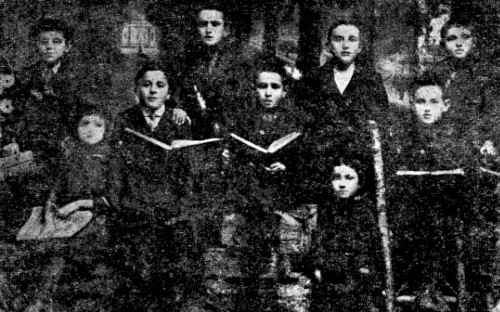
| Standing from the right: Zika Ventland, Perets Kirnberg, Leybl Renkovits, Moyshe Pintshevski Sitting from the right: Moyshe Lifshits, Moyshl Birnboym, Leyzer Lifshits and his little sister and Mendele Birnboym |
[Page 72]
|
|
On weekdays one wouldn't pray in shul. Yet, Jews would come together in shul for Polish national holidays (and for state holidays at the time of the Russian empire) in order to hear the rabbi's sermon and the speeches about current issues by the city notables, the cantor's Mishebeyrekh[54] and the national anthem, sung by the choir, who were trying their very best in the presence of the Christian government representatives…
For the Jewish national festivals and celebrations, the principal speakers were: Alter Tayblum, Fishl Bornshteyn, Yisroelke Shpikhler, Arn Rozenboym and Yekhiel Vaynakht. They also used to speak in times of harsh decrees against the Jews and in times of sad news from the Land of Israel. Then the Jews would sigh and groan, and tears, sobs and wailing would carry over from the women's section and often shrieks of “Water! She's fainting!” and men would rush up to the women's section.
The Skierniewice Jews were noted for their warm hearts and they felt connected to any event happening to Jews worldwide.
The shul was built in 1886. For the laying of the corner stone a celebratory ceremony was organized in the presence of state officials and representatives of the neighboring Jewish communities. The colonel of the second Ostrołęka regiment, which was stationed in Skierniewice, was honored with the laying of the first trowel of clay. Beneath the cornerstone an earthenware pot was placed
[Page 73]
with several golden coins and an inscription with the date and the circumstances of the founding, signed by all those present. It was sealed into the foundation at the corner of the building, between Barracks Street and Mikveh Lane. The construction of the shul took many years. Prayer services were already happening there while they were still building. Then Mendl Pintshevski took matters into his own hands and completed the shul in its full glory. Many Jews then started to call Barracks Street “Shul St”.
In shul, grooms and Bar-Mitzvah boys would receive the honor of being called to the Torah in front of many invited guests. The shtetl would rejoice during the ceremony of conducting a young bride into the shul. And, by contrast, a person on their final journey would be escorted through the shul. Distinguished Jews would be eulogized in the shul. In the shul yard, in a closed shed, there was the black funeral wagon with the ta'are-bret[55], which inspired fear in children. Even grown adults would avoid the corner with the shed…
|
|
[Page 74]
Even completely non-observant people, women, girls and modern men were connected in various ways to the shul. They would go to shul to hear the blowing of the shofar, or the prayers for the souls of deceased relatives, or to hear “an extraordinary cantor”. When there were controversies, they would be called into the shul, to swear on black candles, etc.
The majestic shul building could be seen from the entire length of Barracks Street, up to the “Dęby” [Oaks], and from the other half of Piotrkowska Street, as far as the market square. The shul also cut through Mikve Lane and on the other side – looked out on Rebbe's Lane. This means that the shul was positioned somewhat askew: the “Eastern wall”, they said, was not exactly facing east…
It was not unreasonable that a story was told in town about a certain Sone-Shloyme, who had taken his own life due to great distress over the fact that the synagogue was askew…
And from then on, there was an expression in town, a nickname for a stubborn or wrongheaded person: “Sone-Shloyme”…
The Community Study House
The community study house, which was located opposite the shul between Barracks Street and Rabbi's Lane, was an informal and intimate place for prayer. Previously, on the same spot, there was a wooden study house, which burned down. It wasn't known precisely when that wooden study house was built, but it's certain that it was one of the first study houses in town. It burned down because of a yortsayt candle. This happened on a Friday evening in 1890. Nine years later, in 1899, the new study house was rebuilt by Leybl Liberman, through the efforts of the whole community.
The community study house was a long brick building. On the first floor, there were several apartments, inhabited by the rabbi Reb Shmuel Mendl Bender, his son-in-law Moyshl Perkal, and Nosn-Yitskhok the shames; it was also the meeting place for the religious Zionist organization Tiferet Zion [“Glory of Zion”]. The entrance to the study house was through a brick gateway, from which a paved path extended along the yard up to the vestibule, where the ritual washstand was located.
In the community study house, they prayed according to the Sephardic liturgical style. Here everything was simple and down-to-earth. Those who prayed here felt very free. They chatted before praying, during praying and after praying. They chatted more than they prayed and
[Page 75]
|
|
studied. In general, people here were not so fastidious as in other study houses. The door was, apparently, never locked. There were always people here; especially during the winter, when it was warm, light and pleasant inside. At the first light of day, the first minyen was already praying – craftsmen, traders, and people hurrying to depart on their travels. After this, one minyen followed another until around ten-eleven o'clock. Many people then sat here until Minkhe [the afternoon prayers], studying, reciting psalms, or conversing about world affairs and politics… Minkhe began after noon, one minyen after another, until the time for Minkhe had passed and they were left waiting for the evening prayers. In the dimness of twilight, people smoked, chatted, took snuff, and told jokes. Meanwhile, mischievous, troublesome boys loitered around and played various tricks. The time between the afternoon and evening prayers was comfortable and happy here.
Often an itinerant preacher would come, pound on the reading desk and call out, “Gentlemen!” Whether they liked the sermon or not, a few members of the
[Page 76]
congregation would stand by the door with an outstretched kerchief and they would gather money for the preacher. The preacher did not depart with an empty belly, since it was our custom never to leave behind in a study house any visitor, whom one could bring along to the Shabbos or festival meal. This was also the case even on the very eve of Rosheshone when the soldiers were discharged and they didn't have time to travel home. There were then a good couple of hundred guests and the community provided for all of them. And even more than that: people fought over the guests… On that occasion, there were five or six guests in every home. In the community study house in particular, a shared festive meal was arranged for all the soldiers together. That's when the Jewish housewives of Skierniewice truly displayed their virtue of generous hospitality.
Half of the study house was occupied by the women's section, which was separated by a wall. In the wall there were windows, which used to be opened during the prayers.
For a long time, Toyvye-Leybish Shnayder served as the gabe[56] in the community study house. He was also the gabe of the Burial Society. He was a serious person, with a serious, white
|
|
[Page 77]
face, a fine white beard, good-mannered, and he truly did all this in the service of God.
The overall organization of the study house rested upon the shoulders of Nosn-Yitskhok, the shames with an impressive voice. He was also the constant companion of the rabbi in all public matters. He was a trusted community member, clear-headed about all community issues. When a prayer leader was absent, he would replace him. He had a special claim to leading the Mussaf prayers.
|
|
Here the regular Torah reader was Moyshe-Arn Volbarski.
Years ago, there was a yeshiva in the women's section where people studied day and night. The head of the yeshiva was from out of town and many of the young men were also from out of town and were regularly fed by local homeowners. For a long time, teachers also conducted their cheders here. Even the modern cheder of the Hebrew teacher Volman and his son-in-law Moyshe Roznblat (“Moshe the pioneer”) initially met in the women's section. Father-in-law and son-in-law together accomplished a lot for the Zionist movement in town. Moyshe Roznblat previously spent several years in the Land of Israel, and he had interesting stories from there to relate. His apartment (in Moyshe Ventland's house) thus became a bit of a Zionist center.
A few times a year, the “Happy Little Jew” drove up and he laid out, by the entrance to the study house, his daily and holiday prayerbooks, prayer shawls, tefillin, tsitses, and packs full of interesting storybooks, which boys bought to read, or to borrow for a few cents. Other boys would sneak a few storybooks under the table and eagerly read there. When the “Happy Little Jew” caught on to this, he cried out and threatened not to come here anymore. He would rather go and sell his Yiddish storybooks, his festival and daily prayerbooks to the goyim!…
On the eve of community elections, or elections to the town council, or even to the Polish Parliament, political meetings would take place in the study house. During campaigns for the Jewish National Fund and Keren Hayesod[57], the religious Zionist leaders would hold their solemn and fiery lectures here.
Sometimes a disheveled woman would burst in here, throw herself at the Holy Ark, pull it open and weep hysterically about a child or her husband who was dangerously ill. Often, respected people would go around with a handkerchief taking up a collection for a householder who had become impoverished, for a poor, sick family, for a blind
[Page 78]
orphan needing funds for a wedding, for a writer of some sort of religious book, or to ransom an out-of-town captive from goyishe hands. People sighed and shoved their hands into their pockets. “Oy-oy-oy, oy-oy-oy! God should only help!”
Notes:
|
|
JewishGen, Inc. makes no representations regarding the accuracy of
the translation. The reader may wish to refer to the original material
for verification.
JewishGen is not responsible for inaccuracies or omissions in the original work and cannot rewrite or edit the text to correct inaccuracies and/or omissions.
Our mission is to produce a translation of the original work and we cannot verify the accuracy of statements or alter facts cited.
 Skierniewice, Poland
 Yizkor Book Project
 JewishGen Home Page
Copyright © 1999-2026 by JewishGen, Inc.
Updated 15 Jun 2026 by LA