[Page 45]
Our City (cont.)
Translated by Alena Barysevich, Enrico Benella, Linda Motzkin,
Roger Noble, and Phyllis Press
7.
Gemara and Tosefos
[23]
Teachers
Older boys already studied Gemara and Tosefos with the teachers Yoysef-Mordkhe,
Berl Viskitker, Avrom-Yisroel Urshins and others. Twelve- and thirteen-year-old
boys already bore the entire yoke of Judaism. They studied with zeal, with a
melody, in earnest and in depth.
Others already followed all the quirks of the Chasidim, and they gestured with
their thumbs,
like their fathers and grandfathers did. They already studied Jewish ethics, as
if they were
plunged in sin over their heads. Such lads already began to study by
themselves. Often they would study all night, with feverish ecstasy. Others
would travel to various yeshivas, they would wander in unfamiliar places, where
they were fed as guests in wealthier homes[24],
and drank from the wellspring of Talmud.
But most of them started to vacillate. They snuck a peek at a secular book, or
at the page of a newspaper. They started reading non-kosher things (fiction and
science) and in fact they studied goyishe grammar, algebra and geometry…
This was, in essence, the age of Jewish
Enlightenment in Skierniewice. This led to great controversy. Pious zealots
were literally fighting. And since the Jews of Skierniewice had always been
hot-blooded, both factions, the religious fanatics and the heretics, were eager
to fight. Neither side held back from bloodshed and breaking each other's
bones. It was then that the “Fellowship of Unity” was established,
which finally overcame the fanatics. Afterwards, it was no longer necessary to
steal away to the outskirts of the town in order to take a look at HaTsfira
[“The Siren”] and HaMelitz [“The
advocate”][25],
and to read a book by Mendele Moykher Sforim, Sholem Aleichem, a poem by
Bialik, and an essay by Ahad Ha'am and Nahum Sokolow… For some of the
lads, the transition was slow and gradual and consequently without particular
repercussions. For many of them, however, the change was radical, quick and
drastic. This resulted in their having to run away from the town. Others even
left for foreign countries. So as not to be dependent on their fathers, they
began to learn a trade and became good craftsmen.
That is what the “Renaissance” looked like for the youth of
Skierniewice. From there, it was just one leap to the great, bubbling social
life into which our youth threw themselves with enthusiasm. Indeed,
proportionally, our activities in every area of social life exceeded by far the
number of Jews in town…The fanatics placed a herem [26]
on them. They persecuted not only young cultural activists but also their
amilies, which
[Page 46]
|
|
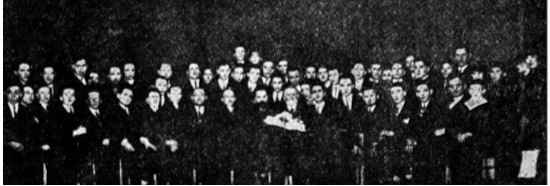
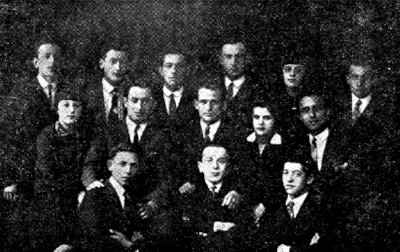
Yitskhok Grinboym and the Zionist activists of all parties in Skierniewice
Sitting from the right: Kalikshteyn, the Hebrew teacher Volman, Moyshe Rozenblat, Moyshe Rotblit,
Yitskhok Shvarts, Shaye Rozenblum, Mordkhe Nayman, Yisroelke Shpikhler,
Yitskhok Grinboym, Yekhiel Veynakht, Alter Levkovitsh, Leybl Tsudkovitsh,
Yekhezkiel Levkovitsh, Meylekh Levkovitsh, Meyer Sharfharts, Yenkl Shvaytser,
Dovid Himlfarb, Ben-Tsien Haus, Zelik Rotman.
Standing from the right:
the two heads from the door: Rozenblum and Rokhl Rozenblum, Shayele Bresler,
Mordkhe Zilberberg, Yirmiyohu Rozenberg, Yosl Lando, Moyshe Shenitser, Mendl
Gros, Ruvn Pintshevski, Moyshe Kurts, Tsalel Zeyler, Yitskhok Boymerder, Yenkl
Koyen, Yenkl Zeyde, Yiskher Dzhalovski, Shmuel-Leyzer Segal, Leybl Lifshits,
Yenkl Nayman, Moyshe Lando, Yoysef Firstnberg, Moyshe Zelman, Mendele Birnboym,
Fishl Shvaytser, Shloyme Zakon, Berish Zakon, unknown, Yenkl Nayman, Leybl
Sharfharts.
|
[Page 47]
were banned from shtibls and prayer houses. But time did its work: as soon as
the first idealistic cultural activists started their selfless activity, it
took hundreds of boys and girls by storm. The first swallows appeared so we
knew that a new spring is coming. Some speakers were brought in from Warsaw and
our own “reinforcements” also showed up. We organized conferences,
lectures, fundraisers, theatrical performances, recitations, concerts and many
other cultural events which were very well attended. Our youth so distinguished
themselves that Warsaw political leaders, writers and artists who we had
|
|
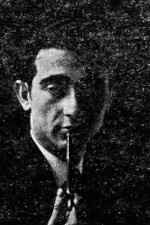
Founder and leader
of Brit Trumpeldor[27]
Yisroel Glovinski
|
brought in for our cultural events had on various occasions recognized and
praised Skierniewice's Jewish youth.
Yitshok Grinboym would always gladly accept the invitation to visit
Skierniewice and devoted special attention to our youth.
Dr. Shiper, after his visit to Skierniewice, spoke in the Writers' Union in
Warsaw with fondness and respect about our youth.
Avrom Hartsfeld visited Skierniewice, as a representative of the Jewish
National Fund commission from the Land of Israel. On that occasion, all the
Jewish youth came out to the railway station to welcome him. The “Brit
Trumpeldor”[27]
organization, with Yisroyelik Glovinsky at its head,
[Page 48]
received him in a military fashion, giving orders in Hebrew. When Avrom
Hartsfeld saw the huge crowd, as he alighted from the train, he refused to
travel in a droshky. He took a few young people by the arm and began to march
on foot into the city. All the young people followed him, singing songs from
the Land of Israel. This was a spontaneous demonstration along the train
station road, Pshernik, up to the meeting place of “Ahavas Tsion”
which was located in the home of Daytsher. Once there, they really started
dancing, singing and eagerly hearing the important news from the Land of Israel
until late at night. The next morning, he showed up with a report from the Land
of Israel in front of a fully packed hall in the “Oaza” cinema. Years
later, when I met Hartsfeld in Jerusalem, he still spoke enthusiastically about
the youth of Skierniewice.
Once, after a lecture by Meylekh Ravitsh in “Satyr” hall, which the
“Bund Organization”[28]
had arranged, he got into a big peasant cart, with a large group of youth from
the “Bund” and headed out on an excursion through the woods. There
they passed the time with storytelling, singing, and fun and games until late
in the night.
Segalovitsh was moved by our welcome and always spoke sentimentally about his
Skierniewice readers and audience.
Perets Markish used to enjoy visiting us and afterwards spoke enthusiastically
about our youth.
The same thing happened with actors, producers, political party leaders and
cultural activists.
8.
Zionist Activities
Each organization in town had its own meeting place and its own cultural
committee, which took care of classes, library books, lectures and theatrical
performances by visiting troupes and by their own drama club. The youth flocked
to these organizations, which were full of life, joyful learning, knowledge and
idealism. At the center of all these activities were the Zionist parties.
Together, they were the force that had the greatest influence on
[Page 49]
the intellectual development of almost all the young people. The representative
boards of both Christian and Jewish institutions were almost completely composed of
influential people who were Zionist sympathizers. The Zionist groups and the Bund
organization led all cultural activities. The other parties played an extremely limited
role, because the Folkists[29]),
the communists, the members of Agudat Yisrael and others were small in
number and weak in terms of cultural impact and consequently they had no access
to the youth.
For a certain period, the great movement of “Hibbat Zion” (“Love of
Zion”), which started with the Zionist congresses and with Dr. Herzl's
Judenstaat,[30]
attracted almost all the inhabitants of Skierniewice: Chasidim and their
opponents, observant Jews and free thinkers, rabbis and common people. Then it
seemed as if Messianic times had arrived…But later,
|
|
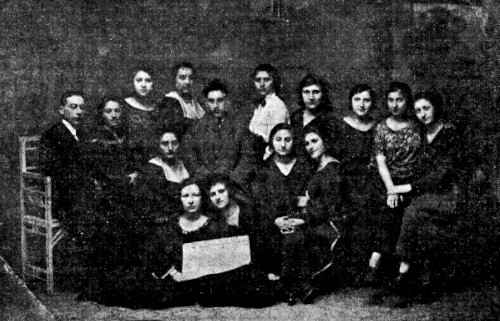
A group of Zionist girls study Hebrew with the teacher Halter under the
guidance of Yekhiel Lifshits and Shifre Bornshteyn
Upper row, from the right: Rivke-Leye Zinger, Rivke Zelmanovits, Royze
Holts, Miryem Leye Nayman, Khane Zhitelnitski, the teacher Halter, Rotman,
Blime Karp, Shifre Bornshteyn, Yekhiel Lifshits.
Second row, from the right:
Liza Frenkel, Khantshe Bresler, Khane Rotman.
With the sign: Frimet Grinboym, Sorele Shvitser.
|
[Page 50]
|
|
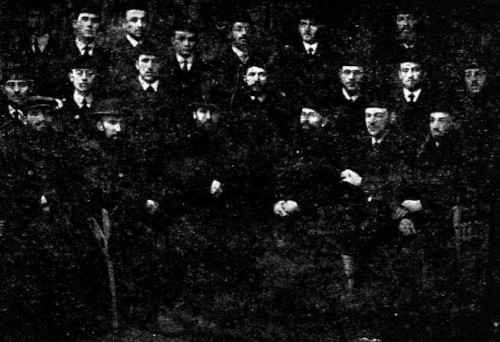
The first members of the Zionist organization Ahavas Zion
“Love of Zion”
First row, standing from the right:
Arn Shiglits, Khayiml Lifshits, Arn Rozenboym, Yitskhok Shevats, unknown,
Moyshele Lifshits, Yekhiel Muster.
Second row, from the right:
Leyzer Moshkovits, Bunem Tugetman, Khatskel Nayman, Yekhezkel Levkovits, Shmuel
Bak, Mordkhe Shtern, Yenkl Vudki.
Third row, from the right:
Zelik Shenitser, unknown, Betsalel Daytsher, Rabbi Melikovski, Lipman Karp,
Eliezer Freylekh.
|
when the Zionists undertook the concrete task of building the Land of Israel
with kronot [funds], hakhshara [training], the pioneer movement and aliyah,
the Chasidim, under the influence of their rebbes, started to pull back from
Zionist ideas. Their argument was that Zionism contradicts the hope for the
Messiah. Then the struggle between Chasidism and Zionism flared up. Yet, some
Chasidim remained good Zionists and often supported the kronot,
enduring criticism from their rabbis and persecution in their prayer houses.
Among the diehards were Yekhiel and Efroyim Liberman, Alter Teyblum (who later
became the founder of “Mizrakhi” in Skierniewice), Khayim-Alter
Lipshits, Bunem Tugentman, Arn Rozenboym, Zeyv Zeyde, Shepsl Kalikshteyn and
others. Those young and old people who left the prayer houses and were at a
crossroad started to join Zionism.
[Page 51]
In Zionism they found their remedy, a way to continue to survive spiritually.
Among the Zionist leadership in Skierniewice at that time were: Shmuel Bak,
Khayiml and Moyshele sons of Yokhebed Lifshits, Arn Roznboym, Yitskhok Shevats,
Yenkl Vurka (who had already started raising the kronot
[funds] and selling shares in the Jewish National Bank), Boyez Plotsker, Fishl
Bornshteyn, Yekhiel Vaynakht, Sore Neyman, Miryem Borenshteyn, Dovid Shtshupak,
Rivke Ventland and Rivke Karp. At that time, the idea of establishing Hebrew
schools emerged. Then fresh forces joined those activities, among them: Khaym
Bentshkovski, Yokhebed Vaynakht, Meylekh Liberman, Khayml Levkovitsh, Rozalye
Finkelshteyn, the teacher Hershkorn, Khayim-Lozer Yitskovitsh and others. The
Hebrew schools opened under the supervision of the good Hebrew educators: Osher
Bakalar with his father and the teacher Sokolovski. Bakalar's personality had a
strong influence on all the Zionist activities.
In our schools, Hebrew was taught in Hebrew. A strong love for the people and
for the land of Jewish yearnings was instilled in the children. The children
celebrated Lagboymer[31],
in the woods, together with their teachers. For the children, all the Jewish
holidays took on a whole new charm, a different color and taste. The taste of
the Land of Israel…
9.
Warm Cozy Corners
There were many romantic and intimate, cozy corners in Skierniewice.
On summer evenings and on snow-white winter nights, our youth would stroll by
the large bridge, which led to the Wole[32],
and in the Zwierzyniec forests. The area was quiet, with beautiful villas and well-tended
gardens, with flowers and greenery and with two beautiful rows of trees on both sides of the road.
Field and forest released their enchanting aromas in the feverish blue of the
bright moonlit nights, and every creature felt the urge to say a prayer and
sing. An unseen bird among the branches, the crickets in the grass and the
frogs in the marshes were all singing. Somewhere a shepherd drew out a haunting
melodious tune on a pipe. One could hear the whimper of a fiddle and the
wailing of a guitar coming from a villa. So the hearts of those who were
strolling also opened up and all their feelings and yearnings, dreams and
longings flowed together with the melodies of Zionist songs and workers' songs
about brotherliness, freedom, justice and the struggle for a better and more
beautiful future… about poverty and exile, about pioneers and martyrs for
universal ideals… Oh my dear comrades and friends, wherever fate has
carried you away, in whatever country you may be found, dear countrymen! Do you
remember it, when we used to stroll and sing together? Do you remember how much
heart and soul we put into the songs, such as Dort, vu di tseder [“There,
where the cedar trees…”, In kuzhnie, baym fayer [“In the forge,
by the fire”], El haTsiper [“To the bird”], Nisht zukh mikh
dort, vu di mirtn grinen [“Don't look for me there, where myrtles grow
green”]?… And whoever didn't sing, sighed and tears glistened upon
girls' cheeks…
|
“Upon the high mountain, upon the green grass, |
| In silence I dreamed as a child of my happiness |
| What did I want? I don't even know. |
| I only know that it won't ever come back” |
| (Ḥayim Naḥman Bialik) |
But our young people did know what they wanted. They aspired to great deeds,
yearning to go on far and wide paths. Our shtetl was too small for us, our
wings were clipped. And every one of us yearned to rise higher and higher…
There were no world problems that we didn't debate “upon the green
grass”. Who among us didn't dream of liberating the world and the entire
human race from sorrow and tears, from hatred and slavery?… Our hearts
were full of love and the conviction of youth. Singing Yehuda HaLevy's song Ikh
hob farlozn ale libste [“I have left all my beloved”], those with
national consciousness saw themselves in the land of our ancestors, on the
paths of the Bible, and in their feverish dreams they had already built a new
Jewish life under palm and fig trees… And those with social consciousness
ground their teeth and clenched their fists, singing Avrom Reyzen's Huliet,
huliet beyze vintn [“Howl, howl raging winds”]. Even the yeshiva
student who shut his Talmud found his fight song in May ko mashme lon? [“What
do we learn from this?”][33]
and turned his face towards progress… He trimmed his sidelocks, shortened
his coat and bought a fedora instead of the Jewish cap… It's true – many
wanted to avoid creating a scene at home and had two sets of clothing: at
home – the long coat traditionally worn by observant Jews with the
corresponding hat, and in the youth clubs – a jacket with a fedora…
And later, too, they came to the Wole on the outskirts of town, to commune with
nature, with all that puts forth leaves, grows and blossoms.
[Page 53]
On Shabbos mornings, and especially in the month of May, some groups would go
off to the Zwierzyniec forests and spend their time there till noon, devouring
the newest books and periodicals – whatever they could get. Everything was
debated, discussed and sung. But when the train passed by along the nearby
train tracks, everyone's hearts would start beating to the rhythm of the train
wheels. The whistle of the locomotive, cutting through the air, silenced all of
us. Field and forest, frogs and crickets, became still. And in the silence a
strange longing for something faraway started gnawing at our hearts… to
tear ourselves out of our cramped four walls and off into the wide world.
Well-to-do Jewish children aren't shkotskim and
shikses.[34]
In those years, a Jewish boy and a Jewish girl would not dare go out strolling in town together.
And yet, there were silent, low-key romances.
A group of active young Zionist leaders
|
|
|
From the right, standing: Yitskhok Boymerder, Rivke Fershtenberg, Leybl
Tsudkovitsh, Moyshe Rozenblat (Zionist pioneer), Meyer Rozental, Meyer Sharfharts
Sitting from the right: Mordkhe Nayman, Sheyndl Rubin, Yosl Blat, Leybl
Birnboym, Feyge Sharfharts In front: Kurts, Yenkl Shvaytser, Dovidtshe Shenitser
|
[Page 54]
The harbingers of the Skierniewice “Renaissance” in 1912
|
|
|
Standing, from the right: Mendl Grayek, Yekhiel Gutman, Yekhiel Nayman, Shoyel
Rozentsvayg
Sitting: Zalmen Holts, Mendele Kosher, Pinkhes Shvarts, Avrom Lifshits
|
Unmarried couples would meet near the Wole in the silent, gated Kozietulska
alley, or in the secret Mniszka alley, far from prying eyes. Here they would
sing Margaritkelekh [Daisies], Reyzele Dem Shoykhets [Reyzele the Shoykhet's
Daughter], Shvartse oygn hobn fayer [Black Eyes Have Fire] and Es drimlt dos
shtetl, di lodns farmakht [The town dozed, its shutters closed]…
Organizations and parties used to hold different events near the Wole, such as
assemblies, meetings, gatherings and lectures and that was one of the reasons
why the area was such a favorite of the youth. On the other hand, for
religiously observant Jews, simply going to the Wole smacked of heresy.
Years before, people would go strolling near the Dembes[35],
in the area of Rolinkski's mill. On both sides of the river there were small hills covered
with high grass. So, it was nice to go there with a “heretical” book
under one's long coat and lie down with it in the soft, fragrant grass. There
they read for the first time
[Page 55]
the classics of Yiddish literature, immersing themselves in historical
materialism; Bundists and Zionists led discussions, with Chassidic fervor and
in a Talmudic sing-song.
Years after the First World War, when Poland became independent, Skierniewice
too started to breathe easily. The palace, which had been closed off for years,
was freely opened to the civilian population. Until then, one could only see
the beautiful green treetops, surging and foaming like waves over the high,
forbidding fence. The palace emanated not only beauty and mysteriousness, but
also sadness – the sadness of empty alleys, without childish laughter,
without love songs, without muffled whispers, without joy, without passion.
People told stories and legends about the palace in different versions. One
thought was that the palace was much older than the town of Skierniewice and it
was already standing before the Russian rule over Poland. There were legends
related to the epoch of the kings of Poland. During the Tsarist period they
built in the palace a beautiful train station with a beautiful hall, to which
the civilian population never had access. Only after the palace was opened to
the public was the train station used for theatrical performances and as a
ballroom. At that time, young people began streaming through the tree-lined
paths of the palace park and filling them with laughter, joy and song. The park
was finally restored, and the youth got another romantic corner of paradise.
There were also houses for youth to come together. Houses with open doors. Warm
cozy corners.
One such house was Simcha the Lame's. He was a schoolteacher, but also a
clever, progressive person, well-read, very knowledgeable and steeped in
politics.
Chasidic youth, caught up in the Haskalah[36]
soaked up Torah at Simcha Lando's. At his place, they heard the proper
interpretation of a biblical verse in a difficult tractate. He made articles by Ahad Haam, Smolenskin, and
Pinsker clear and understandable. But only then did the arguments really flare
up between the young Chasidic men Chayim the Philosopher and Yakov-Yitzkhak the
Sharp-tongue, who was Reb Yosef the shamesh's son-in-law. The latter young man
was a Talmudic prodigy. He just quibbled and split hairs and gestured with his
thumb, or he became completely engrossed for hours in a game of chess. Zelig
Kolski the son of Reb Meyer-Ber, Kasriel-Moyshe the son of Simkhe and Yenkl
Berman used to debate in raised voices, eyes flashing and lips foaming. It
seemed as if the whole world would be in grave danger, if they didn't solve all
the world's problems. The whole universe was
[Page 56]
on trial and awaiting the verdict with pounding hearts. It was another miracle
that no definitive conclusion was ever reached and no debate was ever
finished… because one or the other faction would be joined by Shloyme
Lipshits, Leybl Lipshits, Yekhiel Mendl the butcher's son, Mordkhe Shtern,
Meylekh Tevye Leybish's son, Anshl Abramovitsh, Khayim Bintshkovski and Yenkl
Levkovitsh. The temperature rises; the passion flares up. Citations from
Spinoza, Kant, Marx, Engels, Dr. Herzl and Chaim Zshitlovski fly from one side
to the other, like stones at each other's heads. Passages from the Talmud,
verses of Bible and pages from Yiddish literature fly back and forth. Finally,
when all the cannons have already fired their shots, and the debaters have
knocked themselves out, they turn their gaze solely upon Simkhe Lando…
Simcha Lando is sitting the entire time at the head of the table. His
half-paralyzed body is wrapped and covered with a warm blanket. But his head is
clear and alert. His ears didn't miss a single word. The whole time he kept
silent and listened – and weighed and measured every word. When everyone
becomes quiet, he gives his opinion. He expresses it in a quiet, unhurried way,
word by word. Leisurely and without losing his temper, with authority and
certainty, and above all: without verbosity. With simple words. And for
everyone, everything becomes clear and understandable. They hear him out with
great respect and his point of view is adopted, like a law of Moses from Sinai.
One would rarely see Simcha the Lame in town. And when one did – he was on
a little cart, pushed by students and admirers. His children were Efroym,
Freydl and Yosl. Yosl was a social activist, in particular – in
“Hitachadut”[37].
He is the only survivor from his entire family and now lives in Israel.
Aryeh Oshern's was an entirely different place. Here horse dealers, butchers
and farm produce sellers would gather together. They would tell each other
stories about peasants, fights between farm produce sellers and thugs, about
robbers attacking and plundering along the way and how heroic butchers and
horse dealers faced off against them and drove away the assailants.
It was here, in the pub at Aryeh Oshern's, that they were the first to realize
that Nekhemte's Moyshe was lost. They whispered about it for a long time until
several butchers and horse dealers got together with some policemen and set off
into the woods, searching for the man who had disappeared, and they actually
found him. Bandits had fallen upon him in the forest, robbed, killed and buried
him among the trees. His body was found and they also discovered the murderers.
Many years later, the same fate befell his son,
[Page 57]
Nekhemte Moyshe's son. Like his father, he too was killed, robbed and buried in
the forest. And in this case too, with the help of the butchers and horse
dealers, the robbers were caught.
|
|
Meyer Leon,
a produce-seller from Skierniewice
|
The butchers and horse dealers were robust, fearless Jews, who tolerated no
wrongs. For them, justice wasn't stored in a vest pocket, but in their hearts
and in their fists… These were honest, warm and hearty
[Page 58]
Jews. With their rough speech, of few words, they knew well how to tell a tale,
keeping their listeners in suspense. It was for this very reason that one could
find in the pub at Aryeh-Oshern's, people from very different social classes,
who would come especially to hear stories told by produce sellers, butchers,
horse dealers and orchard owners.
A different circle of people would frequent each tavern, but at Zelig
Shenitser's, people from all social classes would come together: a Chasidic
young man and a craftsman, a Haskalah-youth and a yeshiva student. All
political parties and organizations. Here one could learn the news of the
entire town: which couple was romantically involved, which married couple could
find no peace at home; which householder was in good standing, and which
businessman was ruined and on the verge of bankruptcy. Here one could take a
chance at various games, but chess occupied the place of honor. The best chess
players battled here and whoever won was crowned the chess-king of
Skierniewice… The fiercest battles over that chessboard were fought by
Gavriel Zelman and Meylekh Greyek, and Laybl Sharfharts with Hershl Gotlib or
with Laybish Shteinfeld.
The small tables were besieged by meddlesome spectators, who would offer advice
about which moves to make: “Idiot! Blockhead!” Tell him “Check!”;
“He's going to fall through the roof!”
“If I go like this…” he sings under his breath in a Talmudic
sing-song – “then he'll go like that…” If I move my bishop,
I'll be in trouble. But if I jump with my knight and threaten the queen? She's
trapped. Like this! Where does the queen go?” Zelig Shenitser, the owner
of the tavern, was also among the noisy spectators. He was not one of the
greatest at chess, but he was a passionate player. “He's putting you in
“Check?” He pushes the king forward. “If you move there, you
have him in Loyvitsh!”… But this move is actually the worst. The
chess pieces are withdrawn and the players continue to study the board. And the
chant begins again: “Tshiribimbom-bom, tshiribimbombom, tshiri, biri,
bimbom! And they sip a small glass of beer along with a plate of spicy
peas…
Young people liked to spend time at Avremtshe Shvaytser's. Zionists, Bundists
and people from different social classes and organizations would come here.
They got a fresh-baked bun, a piece of good herring, a sour pickle and an
eyer-kikhl.[38]
There was, of course, no lack of glasses of beer. Yoshke Veter, Lozer
Tsudkovitsh and Mendl Kosher were frequent customers. So too Shaye
Rozenblum, the cultural organizer, and Leybele Libeskind the Bundist, Monesh
Amzel and Zelig Rotman, Elie Dzshialovsky and Shloyme Papirbukh. They
conversed, discussed, and bantered. Each one displayed his full oratorical
skill and shot off his entire set of arguments, but no one ever persuaded
another to change his mind…
[Page 59]
Zionists remained Zionists and Bundists remained Bundists. But all were good,
passionate, dear Jews.
Sorele, Avremtshe Shvaytser's daughter managed the business. She was friendly
to everyone and listened closely to each person with a smile. Because of
Sorele's smile, more than a few people debated with even more passion and tried
hard to show off their thorough knowledge, wisdom and talent… Avremtshe
Shvaytser himself was a widower, a Talmudic scholar and a truly observant Jew.
When he had only a bit of time, he pored over a religious text with a heartfelt
chant. And he had a heartfelt chant, because he himself was a big-hearted man.
He was also a big-hearted prayer leader. As a Jew, he was all heart. But when
he was at work he didn't show anybody his religious devotion. He had a joke, a
funny story or a quip for everybody, a man with a great sense of humor.
Everybody liked him. His patience and his tolerance for other people was
particularly admirable. Playing cards was definitely not his favorite thing,
but when a group of people sat at his place and played cards till late at
night, he didn't display his displeasure.
In our town we used to call Avremtshe Shvaytser's tavern “Swiss
Valley”[39]
and there our young people didn't feel inferior at all to the
Warsaw intellectuals in their famous cafes. Our “travelers” –
Hersh-Dovid Abramovitsh, who we would call “Ruskie”, Yitskhok the
little rebbe, Tsime the rebetsin's son and Max Neyman, Arn's son – would
all come here. And when they began to tell the wonderful stories of their
distant journeys, everyone would gather around them and hang on every word.
Hersh-Dovid “Fonye” was famous among us for his trips abroad, without
train tickets. He once even traveled to America, without a ship's ticket and without any
documents whatsoever. Only in Castle Garden[40]
did they catch him, the sly fellow, and immediately sent him back on the next ship…He
would outwit all the conductors and inspectors, playing tricks on them, and
making fools out of them.
There were other cozy corners in town at Ade Raykhenbakh's, after her marriage
to Getsl Hershkorn, at the dental technician Trokhe's, and others. The warm,
cozy corners where we spent our youth, how can they be forgotten?
[Page 60]
10.
Shabbos, Holidays…
On Friday mornings, one could already feel in the town the feverish anxiety of
preparing to bring Shabbos into one's home. Many housewives already began to
prepare for Shabbos on Thursday evenings. Even goyim, peasant men and women,
knew that it was Erev Shabbos and they helped supply the housewives with all
their needs. Christian townspeople, who would buy only in Jewish shops which
were closed on Shabbos, would also go shopping for their needs on Friday.
Craftsmen hurried to finish up their work and merchants on the roads hurried to
get home. In the marketplace, the price of fish, vegetables and fruit fell by
the hour. The women vendors in the market screamed until they were hoarse,
seeing the full open barrels of fish that they still had, and which could not,
God forbid, rot while still in their possession. So: “Young ladies! Buy
fresh fish, living fish, right from the water! In honor of Shabbos!”
By Friday afternoon, the noise and tumult and lively commotion had already
begun to calm down and become still. One by one the shops would begin to close
with metal bars, bolts and locks. In the marketplace, the stalls were taken
down, and the remaining pieces of merchandise were dragged home. Leybish the
droshky driver was the first to ride home. He was a religiously observant Jew.
For that reason, indeed, any rebbe, rabbi, rabbinic judge, Chassid or just good
observant Jew only rode with Leybish Smat's kosher droshky… And after
Leybish, all the other Jewish droshkies hurried home: Itshe the droshky driver,
Dovid the droshky driver, Hale Tate and others. With noise and commotion, the
coachmen drove home: Khayim and his son Noyekhele, Yisroel-Itshe, his oldest
son, who was already an independent coachman, Kezl the coachman and Henekh Kune
with his old nag.
The market porters standing by the large shops disperse quietly. Porters…
dear, honest, hardworking people! Where else could you find a porter like the
Chassid Avrom Khlodne Noykhovitsh? – A Jew – a learned man, with
beautiful Talmudic quotes. Walking with a heavy load on his shoulders and holding on with
one hand to his belt, so his acute hernia wouldn't burst open – he would crack jokes
and offer an ingenious commentary. A Jew who had more faith than troubles, he never
despaired nor lost his sense of humor. Mates-Leybele was a short little Jew, who was
able to load himself up with weight like a camel. Motl the porter, the elder Pashkevitsh,
was a decent, quiet man… It was interesting how the Jewish porter came to have the
illustrious name of the famous Russian general…[41]
[Page 61]
He served many years in the Russian military and traveled to the ends of the
earth. He was a good-natured youth and his officers used to love to entertain
themselves with him. Once they dressed him up in general's clothing and said,
“You are General Pashkevitsh. Go out and lead the company soldiers!”
And our Pashkevitsh, as he himself recounted, did not hold back, but went out
and shouted in Russian, “Attention!” – and all the soldiers
stood straight as arrows, and he began to give orders one after another. He
even began to give orders to his own officers and, for that very reason, his
career as a general ended… But the name Pashkevitsh stuck with him. Even
his wife was later called “the general's wife” and his son,
Khayim-Alter was also called Pashkevitsh. But was there anyone among us who
even remembered his real last name?… Yet, General is General and Shabbos
is Shabbos! The worn-out general abandons his position in the market and
hurries home, to prepare himself to receive the angels of peace and the
ministering angels of Shabbos…
Women with cholent hurry through the streets to the bakers. They carry their
pots and the little containers of kugel to Yerachmiel Pintshevski, Khayim-Volf
Kokhanek, to Yoynele, to Nisn, to Khayiml Pintshevski and, in another corner of
the town, to the baker of Lowicz. The Lowicz baker was known for his
exaggerated stories about Sevastopol, where he had performed his military
service and where he had a revolver, with which he often chased hooligans,
robbers and bandits… Everyone used to laugh at him and his tales, but
loved hearing his fantastic stories anyhow… Oh, no! We've been talking too
long here. The Shabbos candles need to be lit soon and…
“Dvoshe dear! We're going to – God Forbid! – violate Shabbos!
They are already putting the cholents into the oven!”
“They are already putting the cholents into the oven and Yente-Dvoyre
can't get through all the work in time!… She's still wearing her
apron!”
All of the shops are already locked up, doors and gates closed. Finished with
hustle and bustle, commerce and work, the burdens of the entire week.
Shabbos has arrived in the world.
In former years, Khayim Poper the shames would go around with a wooden hammer
and knock “Time to go to shul!”
Through the windows, one can see Shabbos candles burning on tables laid in
white. The men, fathers and sons, are all already away in shul, in shtibls, and
in study houses, welcoming Shabbos. It's quiet in the streets and alleyways,
lonely, dark and still. The handful of Christian shops are swallowed up in the
hushed darkness and gloom. The light of these few shops is so miserably pale
that it barely illuminates
[Page 62]
their workweek atmosphere. And it becomes still more pale and commonplace when
the Jews come back from praying. They walk slowly, step by step. Shabbos has,
after all, arrived in the world. No one is going to steal their business away.
They had, after all, cast off the entire yoke of the work week, freed
themselves from every burden. What's the hurry?
“Good Shabbos”!
“Good Shabbos…”, householders, neighbors and friends wish each
other.
“Good Shabbos…” They come into their homes and with the same melody soon begin to sing
“Shalom Aleichem”[42]
And everyone makes kiddush to the same tune their father sang, inherited in turn from his forefathers.
And Chassidim sing the tunes of their rebbe.
After the meal, the older people retire to bed and young people head out into
the street, some to the organizations and others to the dark tree-lined paths
of the palace park, or the quiet Mniszka alley.
On Shabbos mornings, everyone slept a little later. And when they opened their
eyes, it was such a delight to lie in bed, carefree and lazily stretching their
limbs, cracking their bones and listening to the sweet singsong of their father
reading over the weekly Torah portion, or reciting the first prayers of the
morning service.
A little later, when the fathers were in shul, the youngsters would stroll in
the sunny streets, dressed up in their Shabbos best. And if some sinful little
thought arose in their minds, a little heretical – it was overtaken by the
prayers from the study houses and shtibls, which carried out into the street
and made them feel guilty.
At the very same time, there are lectures by speakers from Warsaw or locals.
The lectures end at the same time as the prayers in the study houses and young
people hurry back home at the same time as their fathers. The fathers wear
velvet hats and long silk coats; and the most religiously observant wear prayer
shawls over themselves, because they can never be sure whether the
eruv[43]
is unbroken, which would allow them to carry throughout Shabbos.
One can hear the singing of the Shabbos table songs through the doors and
windows of all the Jewish homes. The last women hurry home from the bakers with
their cholents. The whole way, their hearts are pounding, wondering whether
their cholent is good… But when they come home and take off the cover with
the wax and there is a laugh at the sight of the rich, brown potatoes, the joy
is boundless. Knifes, spoons and forks clink; they gnaw on the marrow bone and
sing Shabbos songs…
After the meal, the elders lie down for a nap and enjoy the pleasure of Shabbos
rest. But the young people don't rest. The youngsters stream into the streets,
to the social organizations and all the places of amusement.
On Shabbos in the summertime, after a nap, the boys go to cheder to study
Pirke Oves[44].
Or the teachers visit the well-to-do households, to question the children and show
their elders how far the children have progressed… They are not always
successful because the
[Page 63]
children get confused and can't answer the questions. The teacher winks, pokes
with his elbow, nudges with his foot, gives signals with his finger and
whispers suggestions. It sometimes happens, however, that even this doesn't
help and the teacher is aggravated and embarrassed. It once happened, regarding
the Hebrew words “khotsi sheli” (meaning “my half”) that
the teacher pointed with one hand to half of the second hand, moving back and
forth and repeating “khotsi…khotsi…” The boy happily cried
out, “I know, Teacher!…It's a little fiddle!”
It is Shabbos in the shtetl. Even goyim know this. No peasant cart would show
up in town today. Even the country peasant knows the Jewish holidays well. He knows when to
bring chickens for kapores[45],
green branches for Succos, eggs, horseradish and parsley for Pesach, greenery
and dairy products for Shavuos, etc. Christian townsfolk come to their Jewish
acquaintances to enjoy a piece of Jewish-style fish with challah and a drink of vodka. Poor
goyim come to light fires in the kitchen, to warm up the Shabbos glasses of tea.
They do not put payment directly into his hand, he just knows to lift up a corner of the
tablecloth and take what has been prepared for him to compensate him for his
effort.
And who can forget the Shabbos evenings, at twilight, just before Havdole?
Before the holy Shabbos goes out and a difficult, grey week comes in? So much
melancholy and longing filled those hours!
Men wash their hands in order to eat a morsel of challah, fulfilling the
obligation of having a third ritual meal on Shabbos. And afterwards, they take
some of the Shabbos leftovers with them, so that they could finish their meal
together in the prayer house or shtibl. There they sit in the dimming light
around a long table, and they sing to the Shabbos Queen. They want to hold onto
Shabbos as long as possible. But the shames turns on the light and brings in
the week. The Jews heave a sigh and get up from the table.
Evening prayers
The wives remain at home and, in the dimming light, say “God of
Abraham”[46],
praying for a healthy week, a lucky week, a profitable week for themselves and for all Israel.
For many Jews, this still isn't the end of Shabbos. They usher out the Shabbos
Queen with a meal of sorrel borsht, fish and meat, which their industrious wives have set
aside from the daytime meal. They dance and they sing through Veyitn
Lekho.[47]
And the young people finish Shabbos with a bit of carousing, going to see a
film or a play, strolling around or enjoying other entertainments.
Notes:
-
Gemara is Talmud and Tosefos are medieval commentaries on the Talmud
Return
-
esn teg literally: eating “days” – the practice of eating meals at
different homes on different days Return
-
secular Hebrew language newspapers Return
-
herem: the strictest form of censure by rabbis on Jewish wrongdoers, i.e. the total
exclusion of a person from the Jewish community.
Return
-
a right-wing secular Zionist organization Return
-
Jewish Labor Bund, Jewish socialist party founded in 1897, very influential in
Russia and particularly in Poland until World War II
Return
-
members of the Yidishe Folkspartay – the Jewish People's
Party, founded after the 1905 pogroms in the Russian Empire and active in Poland
in the 1920s and 1930s Return
-
Judenstaat (“The State of the Jews”) German title of an important Zionist
pamphlet written by Theodor Herzl in 1896. Return
-
Lagboymer – Hebrew Lag BaOmer, spring holiday on the 33rd
day after Passover, celebrated with excursions to the countryside.
Return
-
Polish Wole (plural of singular Wola, “settlement”) is the
equivalent of Yiddish Voles in the text. In fact, there are no Wole in the
Polish map of the region, but it's likely that the author used Voles to refer
to a group of hamlets beyond the river to the northwest of the town.
Return
-
A Yiddish song by Avrom Reyzen, containing the monologue of an
impoverished yeshiva student. The title is a Talmudic phrase in Aramaic.
Return
-
shkotsim and shikses – non-Jews, but can be used disparagingly to
refer to Jews
Return
-
Polish Dęby [oaks] is the equivalent of Yiddish Dembes in the text.
In fact, there are no Dęby in the Polish map of the region, but Dembes was
the Yiddish way to refer to a wooded area to the south of the town.
Return
-
The rational approach to Judaism that began at the end of the 18th century
Return
-
In Hebrew, “the association”. It was the name of the Socialist-Zionist
party. Return
- eyer-kikhl – a twisted egg biscuit or cookie
party. Return
-
“Swiss Valley” is both a play on Avremtshe Shvaytser's last name
– Shvaytser means “Swiss” – and a reference to public
garden by that name (in Polish, Dolina Szwajcarska) in Warsaw where shows and
entertainment took place. Return
-
Castle Garden was the main immigration center of NYC before Ellis Island;
it was situated on the southern tip of Manhattan and processed immigrants from
1855 to 1890. Return
-
This is probably Ivan Fëdorovič Paskevič (1782-1856), a
military officer and administrator in the Russian government who suppressed the
Polish insurrection of 1830-31.
Return
-
Shalom Aleichem is the title and first words of a four-stanza hymn sung at
the beginning of the Friday night Sabbath meal.
Return
-
Wire border around a town to indicate its classification as a private
area, which allows the carrying of objects on the Sabbath.
Return
-
A section of the Mishnah containing ethical teachings.
Return
-
An atonement ceremony performed the day before Yom Kippur.
Return
-
A collection of biblical verses recited in Yiddish by women on Saturday
night to usher in the new week with blessings and good fortune.
Return
-
A section of scriptural verses of blessing added on Saturday nights to the
regular evening liturgy. Return
This material is made available by JewishGen, Inc.
and the Yizkor Book Project for the purpose of
fulfilling our
mission of disseminating information about the Holocaust and
destroyed Jewish communities.
This material may not be copied,
sold or bartered without JewishGen, Inc.'s permission. Rights may be
reserved by the copyright holder.
JewishGen, Inc. makes no representations regarding the accuracy of
the translation. The reader may wish to refer to the original material
for verification.
JewishGen is not responsible for inaccuracies or omissions in the original work and cannot rewrite or edit the text to correct inaccuracies and/or omissions.
Our mission is to produce a translation of the original work and we cannot verify the accuracy of statements or alter facts cited.
 Skierniewice, Poland
 Yizkor Book Project
 JewishGen Home Page
Yizkor Book Director, Lance Ackerfeld
This web page created by Jason Hallgarten
Copyright © 1999-2026 by JewishGen, Inc.
Updated 01 Oct 2026 by JH