 |
|
|
[Page 247]
Translated by Theodore Steinberg
Donated by Pamela Marre
[Page 248]
[Page 249]
|
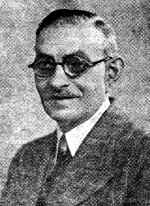
I was born in 1874, during Chol Ha-Moed Pesach. My father was a carpenter occupied with building houses. He bought trees in the woods and, with the help of Gentile carpenters, built a house to sell. He had no capital and, until the house was finished and sold, he had to buy everything on credit. We did not live high, you see…but no one on the street knew that…
When I was five, my mother took me to cheder.
In the cheder were the rabbi's and the rebbetzin's two beds, a table, a wardrobe, and a couple of benches. That was also their bedroom and their dining room. There was also a long bench by the door, and on the bench–a container of water and the slop pail where the rabbi kept the rod for whipping. The students sat in the dust and dirt from eight in the morning until seven or eight in the evening. Aside from the students, there were also the rabbi's two children and
[Page 250]
some hens. Near the wall was an oven for heat, and under the oven–a place for the chickens. But they walked around through the whole room. Actually, they laid few eggs for the rebbetzin, but still they created a lot of filth. People called the rabbi “Yitzchak-Fanya” [Yitzchak the Russian], because he had served in the army. He was tall, with a sharp beard and a flat nose. He was comfortable flogging, looking as he did so, like a child doing mischief. It was bad when he got angry. Then he would grab a student, lift him up by the ears, and let him drop. More than once, a child's ear was pulled off and bled. More than once, mothers came to speak to him about that. But the rabbi was not taken aback:
“Do you want to have a child, an ignorant kid?”
And the mother would stand there dumbfounded. She had no answer…
After that I learned with Duvid Katzap [Russian]. People had earlier called his father-in-law “Katzap,” although he was an upstanding Jew. He was a clerk in the forest. But once, because there was a fire in the middle of the night, instead of putting on his pants, he put on his wife's petticoat, people called him “Petticoat” or “Katzap”…
He was a strange teacher. He loved to paint and carve. Next o him on the table was a container for writing implements, cigarettes, tobacco, and other little things that were reserved for him. He had a secret button. When someone pushed it, it opened up…He had carved for the school a sign marking the eastern wall with people, violins, trumpets, drums, cymbals, flutes, and shofars. He worked at it fervently. We were amazed, and meanwhile–done with learning…
The rebbetzin, however, had a small shop with empty shelve, which she did not want to leave, so she warned the rabbi that he should not fool around and teach us…But on Thursday, she was in the market selling soap to the peasants. Then we really had a holiday…The rabbi watched his child and thought up a new invention: a machine to grate potatoes….Poor dear, he loved potato pasta [gnocchi]…
From all his inventions, he became a bookbinder. There were two bookbinders
[Page 251]
in town: Yankel and Chaim-Alter. But Duvid the teacher worked with his own invented tools and type, and his work was exceptional.
After him, I had as a teacher Moyshe-Simcha. A tall man, very poor–with many children. Things were not so good for us with him. The rebbetzin helped with their income. She made bonnets and caps for women. So on Fridays, the rabbi helped her prepare for Shabbos. On the table where we learned, he stuffed the fish, cut and chopped the onions. He did it all quietly, patiently, not rushing. We watched and breathed freely.
In winter, each student had to bring a kopeck for kerosene. At least, that it was called. Actually, we brought candles. As it turned out, when the candles burned down, we went home. So when the rabbi left the room, we would heat up a wire and cut through the candle so that it would burn down faster…
I was considered a good student. Every Shabbos I was questioned by the two Mendels, Yakov's Mendel and Yossel's Mendel–two sons-in-law who were waiting for ordination and later became rabbis.
When I was thirteen and the semester ended, the rabbi told my father that I no longer need cheder. I could study a page of Gemara and Tosafos by myself. I could learn with young men who “essen kest” [that is, young men who studied and then took meals with various members of the community]. I was also heard by the rabbi of Skierniewice, who later became the rabbi of Ostrowiec.
I was always afraid of my grandfather, Godel the Innkeeper. I thought of him as a bitter and stingy person. I do not remember that he ever gave me a groschen. Conversely, my grandmother, Golda's Sarah, was a woman of valor and had a good heart.
My grandfather's inn was in the marketplace. On my way to school from Pshernik, where we lived, near the little church, I would, you understand, go through the market and look into the inn. If my grandfather was there, I would run on. But if my grandmother was there, I went in, and she would honor me with a sliced roll covered with a red liqueur, but she did this quickly, because she was afraid of my grandfather.
I would often run into poor people there. My grandmother would give them
[Page 252]
Whiskey and a bit to eat for free, but always quickly, as she did with me. And they would then run away when they saw my grandfather.
My grandfather's house in the marketplace and his large orchard with various fruit trees was for me the nicest in the city. Aside from the inn, my grandfather dealt in grain. In the courtyard there was a large storehouse full of rye, wheat, oats, barley and tools for trimming trees. There were also stalls for horses and a big dog, Borek, that guarded against horse thieves. Yes, my grandfather also dealt in horses, and the nobles knew well that they could get good horses from “Gotten,” as they called him. And my grandfather would travel with the nicest team, with a green carriage and fiery steeds…
He had three daughters and six sons. People called them “the sons of Gad,” and they were big fellows. Gentiles in the city knew that they could not pick a fight with Gottl's kids…But if village peasants, “conscripts,” wanted to get in a slugging match with Jews, “the sons of Gad” would give them such an honor that they would long remember it!
Duvid the mailman became a kind of publicist. He bought the newspapers people had read in the houses of intelligent people and cut out advertisements for stores. Once when I came to him about advertisements for our food shop, I saw a couple of issues of “Ha-Tzefirah” that I had long wanted to read. For four groschen, I bought both copies from him, which worked out well for both of us: from “Ha-Tsefirah's” Hebrew he could make no advertisements, and I got a treasure!…I ran home with the papers, got ready, and tried to read, and…I sat there embarrassed and perplexed. I thought, “These are the same letters! The holy language! But all new words that I did not understand! Being stubborn, I tried again and again–with no success. I sighed and groaned from aggravation…Then I decided that I had to learn Hebrew. I had to!
As I said, my father was a master builder. He would get bricks from the overseer when I was young. I helped him get the bricks and give the receipts. A young man who read “Ha-Tzefirah” worked for the overseer. I became friendly with him and told him about my aggravation. My new friend became my teacher, and in a short time,
[Page 253]
As I easily read “Ha-Tzefirah,” I said in amazement, “How is it that I could jot understand these words before?”
The cholera epidemic raged in the city, and people were collapsing in the streets. The Angel of Death was not choosy and struck left and right. He struck healthy young men–and among them was Yerachmiel Liachman.
A person goes out into the street healthy, fresh, and hearty. Suddenly he is not so good and he falls. People run to him and try to revive him. More revivers come. They try various things, but they seldom help. The usual result is death. The police come and cover the corpse with lime and take it away.
There is lamentation, panic. Small groups gather around the beis-medresh and people seek help and advice from each other. Together they come up with the “best” solution–make a wedding in the cemetery. Said and done. First they found a disturbed young man and a half-witted young woman, led them to the cemetery, and set up a chuppah. If this ended the epidemic, I do not remember. But when I saw the bride I thought that the groom had really come down with cholera.
The city was consumed by funerals. They city was full of screaming and lamentation. I looked at people and could not be sure if I would see them the next day. But there was one person I could not believe death would take away. This was Yerachmiel Liachman, the innkeeper.
He was a little more than medium height. He was big, but not fat. He had a bright face: full, with rosy cheeks and a light brown, pointy beard. The yellow smock that he wore made him look nicer and brighter. Women would say that he was a good-looking fellow, and men knew that he was a strong, stubborn person. If he insisted on something, no matter what it cost him, he would stand by it. With his strength and obstinacy, he had a good head and a good smile. He was even sentimental–and often thoughtful. A clever man with a positive attitude toward people.
The last time I saw him was after one of the scores of funerals. Yerachmiel Liachman went to the side, separate from everyone as
[Page 254]
was his custom, deep in thought. No, I could not have believed that such a fine person manly, wise, and insistent, would be seized by the paws of the epidemic!
But the next day I heard that Yerachmiel had fallen. I went to see what was up, but Yerachmiel was no more.
In Skierniewice there were three slaughterers: Sholem Shochet, Yosef Yishayahu, and Hersh Chaim. The first, Sholem, was, aside from being a slaughterer, a beautiful prayer leader. He earned three rubles a week for leading prayers, because Sholem had three virtues: first, he was a good prayer leader. His praying was sweet, a pleasure to hear. Second, he was a Ger Chasid and prayed in the Sephardic tradition. In fact, he did not begin with the “Hodu” prayer but with “Mizmor shir chanukas,” which was the Ashkenazic tradition. But later he said “Va-yitzmach furkaniah” and omitted many piyyutim. This pleased the common folk. On the High Holidays, skipping piyyutim was a pleasure: it was kosher, no sin…
The claim to being a slaughterer was hereditary, without dispute. Sholem had his son-in-law, a slaughterer; and Yosef-Yishayahu had a son-in-law, a slaughter. Hersh Chaim made his son a slaughterer. And in the city, all was quiet and still. Peace upon Israel.
And suddenly this ideal was disturbed. The congregation began to demand a chazzan. A real chazzan, with real melodies. A new cantor-slaughterer.
There were three reasons for this:
Skierniewice was called a royal city. The czar had a palace and a forest there, where he would go to hunt. The czar was accompanied by his retinue, and some of them would visit the shul. On a Russian holiday, a secular holiday, people were supposed to say a fine “Mi she-berach” [prayer for well-being] for the ruler and sing “Ha-notein t'shua” [He who gives salvation]. Sholem the Slaughterer could do this, but to sing “Boszia Tzaris Khrani” [God bless the czar] in Russian–no…And when a government censor would come to the ceremony in shul, Sholem's “Ha-notein t'shuah” was good enough, but later, when a higher official would come, they needed a really good chazzan…
The second reason:
Fishl the sexton was also a prayer leader, and he once confused part of the service.
[Page 255]
Instead of saying the prayer for rain [said in the spring], he said the prayer for dew [said in the fall]…There was an outcry in the shul and people demanded a new chazzan.
The third reason:
It had been peaceful in the community for too long, and the community could not exist without a quarrel.
Soon there were two camps, two fighting camps: the general world was for the cantor-slaughterer and the Chasidim against. They brought in a fine young man with a good voice for an audition. He was a big hit, and the women would not have become weary at hearing him sing for a whole day. But not everyone wanted to eat from what he slaughtered. At first the rabbi did not mix into the controversy. Later on, he joined the Chasidim, and then the fire was ignited. People hit each other in the street with sticks. Gentiles watched all this and laughed: Let the Jews hit each other. And so they did, even on Shabbos, and people even hit a big shot like Mendel Luzers, who lived near the rabbi. They broke his shutter, and that dignified man ran out in his underwear in order to defend himself against the fleeing Chasidim. A patrol arrived–soldiers with rifles–and they dispersed the battling Chasidim.
This quarrel lasted a long time, and in-laws at simchas also became policemen…and those “policemen” were also divided for and against the cantor-slaughterer…It came down to who gave how much to whom…
I myself heard one of these “policemen” cry out, “Chazzan-shochet mushi bitsh,” which meant, “There must be a chazzan-shochet!”
This quarrel lasted about two years.
Chasidim and members of the general public came together and founded a “Shabbos Observers” Society. They worked together to cleanse the city of sin. In Moishe-Avraham's tavern, young men shared beer and herring, or even with goose. Afterwards they spread their hands, that is, they got to work: they cut the “manes” and beat the heretics. And this is who they called heretics: young men and women, Maskilim and working youth. Yeshaya-Ber ordered that no one should say “workers” but “craftsmen.” And as they drank, they sang a song: “We've
[Page 256]
killed all the strikers!”…Mendel Indyk and company ordered rooms where young men had
committed crimes with young women, and they beat up everyone. They even whipped young women. Only one young man wearing arba-confos escaped the blows.
People said that all of this came from the rabbi of Lodz, that he must have given the police some “genial” advice about how to locate Bundists: a young man without arba-confos is an opponent of God and the ruler…and woe to the arrested Jews on whom the czar's Okhrana found no arba-confos! How many young men there were who were tormented and tortured because of the Lodz rabbi's “advice”? People suspected that the Lodz rabbi worked hand-in-hand with the police. It is also a fact that he was cited and received a medal and a little sword.
Now the Skierniewice “Shabbos Observers,” with the help of young men, took their example from the Okhrana and looked for arba-confos on young men. Only tzitzis saved them from blows.
In this way the hooligans battered my friend, the Sofer's Yehuda. When I heard about it, I ran to him. The image that appeared before my eyes was horrible, and I stood there as if turned to stone. The room looked like there had been a pogrom. Everything was broken, ground up, ripped, shredded. Yehuda lay in bed. He was unrecognizable: his face was so swollen that his eyes could not be seen. His teeth were knocked out. He was covered in blood. The walls, too, and the bed linens–sprinkled and smeared with blood. His mother, the widow, sat in the corner, wringing her hands and sighing. She could not even cry. Yehuda hardly spoke. He told me who had beaten him and that one of them had persisted and surely wanted to break his leg and so smashed his leg on the sharp corner of the bed. He would have continued had a patrol not arrived. Then the hooligans fled.
I fetched the barber-surgeon. He washed off the blood and bandaged him. His leg was not broken, but it was swollen. He was all black and blue.
In my excitement, I went to Warsaw. I went to the editors of “Haynt,” told them what had happened, and demanded that they immediately send a reporter to Skierniewice. The reporter was “Tzivion”…I went with him to all the homes where the shameful killers had done their work. He spoke with the victims and with witnesses. His article soon appeared on the first page of the
[Page 257]
newspaper. It was a powerful article and made a strong impression throughout the country.
Soon after, things were overturned and the young people came into power. Revolutionaries [members of the “Unity” party] from the city and the towns organized themselves and beat up the Skierniewice authoritarians throughout Poland, wherever they could be seized. A Skierniewice big shot dared not leave the city. This was in the very middle of the “contractors'” big time. Merchants were selling boots and clothing for the army. People could rake in money! And there were our merchants sitting with crossed arms, gritting their teeth
|
|
Standing, from right to left: God'l Lefkovitch, Manele Leff, Yenkl Gutman; Seated: Lieberman, Vora Hertz, Chaim Zweigenhaft, Pinya Lieberman |
Whoever among them
[Page 258]
tried to leave the city was sent back with a smashed head and broken bones,
Leibl Lieberman was beaten up in Lodz, where he came to redeem some wagons of flour. Moishe Ventland received the same treatment in Szochlin. He was laid up for several weeks. Noach Garber was stabbed in Yezif and was laid up for months. Yossel Schwartz was beaten in Tomashov. Moishe Michoel was beaten in Warsaw. He died shortly thereafter. The Indyks, too, had their heads smashed in Warsaw, and the healthy young men of Skierniewice were no heroes…Nechamiah's Yitzchak was taken to the barber-surgeon Deutscher, stabbed with a dagger. It missed him by a hair…but his hand was cut. He was only barely rescued. The stabber was a tailor's boy at Avraham Itzik Leib's. He was called Nechamiah, and for that little job he got three months in jail. Later he became Mendel Becker's son-in-law.
During that period, Leibl Lieberman came to me and asked me to give him a pass to go travel to Lodz…He had been beaten, so he was already kosher…and he had to see to some wagons of merchandise, because he was paying a fine on them every day…But I had no influence in such matters and I could not give him a pass…
I myself traveled completely freely, because that group knew me. Standing at the Warsaw train station, for example, was Moishe Gross's son Menachem. With him were several young men from Warsaw with sturdy sticks. Menachem scrutinized each incoming passenger from Skierniewice to determine who could be attacked and who not. I was surprised then that the police looked on as blows were delivered to heads and bones were broken and neither intervened nor stopped them…
“Dondek” meant a milksop, a fool, who could not count to two and was slow in the head. So Yidl Lifshitz was called Yidl Dondek.
But Yidl was not a fool, and woe to anyone who started up with him. He would “drown” his victims in a flood of “pleasant talk”…
Yidl Dondek's food store, in the middle of the marketplace, was avoided by the poor. That miser would not give the slightest credit. He was stingy even toward himself. Summer
[Page 259]
and winter he went around in an old smock and slippers. A stranger would have thought that the old man with his grey beard was a pauper…
One time Yidl Dondek came to the tailor Anshel “Bismarck” (so called because he loved to talk about politics), and he asked him to mend a jacket. “Bismarck” was insulted. A job like that is for a seamstress, not for a fine craftsman like hi! But Dondek talked to him for so long that “Bismarck” forgot his pride. He had no better work to do, so he was satisfied. Doomed, he recognized that he was defeated, and he made an appointment for the jacket.
Later, when it came to paying, Dondek asked “Bismarck” to make the jacket a little longer. He liked a longer jacket…”Bismarck” agreed. But then Dondek asked that since winter was approaching, would he make the jacket go down to his ankles…Anshel “Bismarck” became livid:
“What!! You wanted a jacket and now for the same price you want a full coat?!”
But Yidl Dondek was not impressed.
“What do you mean? Just do a few stitches…”
And another time Yidl Dondek lost a large sum. This is what happened:
One time a nobleman came to him and said that he wanted to buy something. He needed to talk to him. Dondek was always interested in talking, especially with a nobleman about merchandise. So they went into a private room. What the nobleman wanted were copper coins. He wanted copper coins from 1870, and he was prepared to buy more. Dondek sowed him the few coins that he had.
“How much for a coin,” the nobleman asked.
Dondek considered: a copper coin! How much?… A crazy nobleman! But Dondek did not hesitate for long, and he said, “Twelve groschen.”
The nutsy nobleman did not hesitate. He paid. Even more, he laughed at Dondek, because he had fooled him. For copper coins he had been prepared to pay 50 groschen apiece!
And the nobleman told Donek his secret: In those old copper coins there was gold! People knew that when they made the coins, they made a fatal error. They had used gold instead of copper.
[Page 260]
“Do you want to see?” The “nobleman” took out a file and scraped the old copper coin until there was a golden sparkle.–“Look, pure gold!”
Dondek was surprised.
“But don't be upset,” said the nobleman. “I'm a respectable man. Here is a ruble for the coins I bought…”
In short, the “nobleman” ordered copper coins of 1870 from Dondek. Dondek should buy more, but secretly, so that people would not be suspicious, because that would spoil the whole business: then the government would find out and take everything! Be careful! Dondek could pay up to 25 kopecks apiece. And if someone had many, he could pay more, even as much as a half ruble. But mainly: pay attention that they are from 1870. Furthermore, this all had to be done carefully and quickly, before the government got involved. He should get his money and buy. In a week the nobleman would return and buy the lot. For now, he would hurry elsewhere to get others to buy coins.
Yidel Dondek got right to work, as the “nobleman” had told him: quickly and without making a big deal. He bought some coins in the city, traveled to Loivice and other nearby towns, but he only succeeded by paying from twelve to fifteen groschen apiece. The coins from 1870 were somewhat scarce and he could not find a lot of them. Finally he came to the attention of a peasant who had some sacks of coins. Yidel Dondek bought them, paying about 40 groschen apiece…He brought home his find and waited for the nobleman. And if Dondek were still alive, he would still be waiting…
People said that Dondek had invested all his money in this business and then ran around the city seeking loans. But he was left with sacks of coins in which people had “mistakenly” put gold…
That was really a “golden” business!…
They could be seen in every road and path leading to Jewish villages and settlements in Poland. There were individuals and there were whole camps. They would come to every shtetl a few days a year, sleep in the “poorhouses”
[Page 261]
or the beis-medresh, and go to the houses and businesses. The smallest coin was a groschen. But for the citizens, this was too much, so the kahal created its own coin of tin. The coin was stamped in Yiddish “p'rutah,” and it was worth a quarter of a groschen. Before leaving the town, the poor would have to exchange their collected “p'rutahs” at the kehilah and get “good” groschen…There were, however, donors who did not use the p'rutahs and gave, as they had done before, groschen.
I remember a story about one guest who had been a propertied householder. He had a clothing store in Rava, near Skierniewice. But he was a passionate card player, which ruined him. He gambled away everything and became a beggar. Once on a winter Friday he wandered through the woods and, because of a storm, could not come to an inhabited spot. He barely managed to get to a lumber agent, who took him in for Shabbos. There, too, were the forest owner's son and two sons-in-law. After Havdalah, they played cards, and as their guest looked on, they jokingly asked if he would play okeh [a card game]. This roused his old passion, and he played with them for half the night, but he had no luck and gambled away all his money, about ten rubles.
In the morning, after eating, he left. After he had gone about a mile, the forest guard caught him and brought him back to the agent. “How could you allow yourself to gamble away ten rubles?” the sons-in-law asked. So he told them who he was and how he came to his present situation thanks to his passion for playing cards. The sons-in-law to side to “spank” him. Having carried out the sentence, they shook hands that he would never again play cards. They sent the ten rubles to the rabbi of Rava for him to give to their guest's wife.
In Skierniewice there were various charitable societies, like those for visiting the ill, taking care of brides, raising the fallen, and others. I founded a society for welcoming guests.
Each society had a room for davening and for a minyan. To be a gabbai and lead the prayers for a little food became a weakness for many people. Chaim-Baruch the miller, Esther the turner's husband, was even caught in the sin of leading the prayers twice. There was a great fuss about this. Kochanek the baker also had such a weakness. He gave money and together we created the society for welcoming guests. We rented two rooms from Noach Garber on Kosher Street, installed beds and an
[Page 262]
ark with a Torah. For a while we helped visitors, but due to an argument over provisions it came to an end.
From that time I recall an episode of a theft: a poor man's tefillin bag was stolen. He fainted, cried, and lamented. He was not consoled by the tefillin that I lent him. Why? Because in the boxes of his tefillin, instead of the parchments, there were three hundred rubles.
They were his life savings.
He was a small man, but also a big butcher. He had little income, but he said a great many psalms…but more than anything, he went around in search of a calf or a lamb to buy. But because there was so much competition, he seldom succeeded. But if he located one, he was busy for a whole week and called himself Butcher…Shloymele the Butcher…His only son has a good head on his shoulders. But people said that he was a Torah scholar by virtue of his mother, an observant woman of valor. Twice Shloymele had been caught in sin; his woman of valor had extricated him from trouble.
One time he bought a calf that on Friday was seven days old. He could not wait for the eighth day, because the eighth day would be Shabbos. [A calf less than eight days old could not be slaughtered in a kosher fashion.]. And because people buy meat for Shabbos, Shloyele gave himself permission and slaughtered the seven-day-old calf on Friday. His competitors learned of this and informed the rabbi. The rabbi determined that Shloymele should no longer be a butcher. The humble mother came and took responsibility. She would uphold kashruth. On the basis of her merit, the rabbinical court pardoned him.
Another time it happened that after seeking in the villages for weeks, he prepared to buy a proper calf. But Shloymele did not have the whole amount that he had agreed to with the peasant. He left as collateral his tallis and tefillin that he had to redeem, because he could not live without them. He had to pray every day! Without saying his prayers, he dared not eat! Without his tallis and tefillin he would, God forbid, die of hunger. Nevertheless, the peasant took the collateral. One day passed, then a second and a third–a week! Shloymele did not come to redeem his pledge, and the peasant was surprised: the Jew should not die from hunger! So he came to the city, yelling that Shloymele was fasting and would die because he was not praying.
[Page 263]
But again, the humble woman came and assured him that Shloymele prayed every day, and the proof was: that he was eating…
Srulkel Ruch was a night janitor. In the towns, there was a law that at night, every homeowner had to care for the street. Instead of waking up themselves and doing it, people hired Srulik, the “janitor.” But when conscription time came, Srulik had other jobs. People would see him running around busy, bustling, sweating. For this reason, people called him “Ruch.” He brought the Jewish conscripts together. He paid close attention to who was a joker worthy of conscription–and the government paid him for this. Later on he would also be paid when he would bring to a Jewish home the news that the conscript had been released…In all these jobs, he would go around in pants that were so ripped, they would plead, “Renew our days as of old.” Once I wanted to give him a coat that would cover his torn pants. He thought about it and said, “No, I can't wear any long clothing. If I meet up with the “authorities,” what would happen?” I gave him a pair of pants, but that did not help. With short clothing, he also fell out of favor with the “authorities.”
At that time they made a law about recording new births. The city sexton was impossible. He took his fee and then forgot to record. People reported him to the rabbi. The rabbi's son got involved. He also did not forget to get paid, but things went lacking in the records. I myself paid him to record my son's birth. He brought me a copy from city hall, but it was not signed.
With such goings-on, it is understandable that one could not be sure about the birth dates in the records. I myself, with my pass and my “blue card,” am not sure about the details of my birth date. My mother, a”h, knew that I was born during chol ha-mo'ed Pesach. But she did not know in what year. So who was supposed to write it down. Certain families who were accustomed to writing would inscribe the births of their children on…the title page of a book.
Still, when someone died, people could observe the yahrzeit. Jews have more respect for the dead than for the living…A birthday
[Page 264]
is a big deal for me! But a yahrzeit stays in the memory! One fellow, Reuven Poyer, knew that he had a yahrzeit when…the huge icicles hung from the roof…
Under the influence of Dr. Herzl, the first Zionist union was formed in Skierniewice. This was part of the same battle of the Haskalah against fanaticism. The fanatics did everything, not even stopping short of being informers.
But we found a solution, and in the vanguard of the union stood a man who was a frequent visitor to the authorities. This was Shmerl Orlovsky, a military tailor who served higher officials and officers. We made him our leader. He was a hearty young man and received money from the officials and officers. He absorbed the expenses of Zionist activities.
The barber-surgeon Bezalel Deutsch was a heart-and-soul Zionist. The military kapellmeister, for whom Jews and Christians had great respect, thanks to his epaulets, golden buttons, and sword. We should also remember the tinsmith Lipman Lentshner: playing his trumpet in Yakov-Tuvia's band, he helped lead Zionist undertakings. Under his influence, the band played “Ha-tikvah” at almost all Jewish celebrations. He did so even at a Chasidic wedding…The whole wedding then broke up into small groups. If Lipman had not been a healthy man who could use his hands when he had to, he would not have escaped with a single bone unbroken.
All the members of the first Zionist union in Skierniewice had much to contend with. Into me, the secretary of the union, were shot the sharpest arrows.
My uncle Yitchak, the dairyman held a lease from a nobleman in Bogushitz, near Rava. He and Aunt Rivka were simple but honest, good-hearted people.
Once, one of their children was will. Uncle Yitzchak specially
[Page 265]
came to Skierniewice and gave me five rubles to give to the needy. Perhaps the merit of that charity would earn the child a complete recovery.
The needy were not scarce in Skierniewice. I decided to give the money to the coachman Avromele Hoiker, whose horse had fallen leaving him without an income. Perhaps it would be a contribution to the purchase of a new horse that would provide him an income. But I knew that Avromele Hoiker would take no charity. It would embarrass him. I went to his house when he was away. He lived by the courtyard of Hershel Becker. When I got there, I found his children in bed. Poverty dwelled in every corner. “Where is your mother?” I asked. “She went to find something to eat,” they answered. I gave each child five kopecks, and the five rubles I put under a pillow, saying, “Children, don't move until your mother returns. When she comes, you can show her.”
I left with the feeling that I had done well–carrying out my sacred mission.
The next morning, Shabbos–the street was abuzz. There was noise and confusion. Both in the street and in the beis-medresh people were exclaiming that Elijah the Prophet was there in town! He was at Avromele Hoiker's and left a lot of money under the pillow!
Curious men and women went right to Avromele's and questioned him, his wife, and even the children:
“How did he look, Elijah the Prophet? Handsome?”“Yes,” answered the children.
Amazed at their five kopecks and at the strange events, the children said “Yes” to everything.
“Was he tall?”“Yes.”
“Heavy?”
“Yes.”
“With a silver beard?”
“Yes, I think so. Yes.”
“With a rod in his hand?”
“Yes, sure.”
“With a sack?”
“Yes.”
“And gold coins came out of the sack?”
[Page 266]
“Yes, yes, yes. He had so many golden coins.”“And how did he speak? Softly? Nicely?”
“Oh, sure.”
“Nu, can there be any doubt that Elijah the Prophet was there?”
“And who knows who's next for those overflowing golden coins in his sack?
“Oh, sweet Father,” and each one raised his eyes to the heavens in pleading.
Many of them left the children in their beds and, leaving the door open, went out into the street. And in the street there was a tumult. The fantasy played out for each one. As news spread from ear to ear, the sum grew. Who knows what a treasure Avromele had received?
Later on, people said that Avromele did not buy a new horse, because he would no longer be a coachman…Why not? Because he had enough for his children and grandchildren.
When the story came to me, I tried to tell the whole truth. But because people thought I was a heretic, they did not want to believe me, so the story remained that Elijah the prophet was in Skierniewice, giving out gold coins…
In my time there were three doctors in town. All Christians. Dr. Kritotzky was an angry man. One dared not say much to him. He was a good doctor, but an atheist. Christians would say that he did not go to church on Sundays. When he heard someone say, “God will help,” he would respond, “Forget about God. Do what I say and help yourself.”
On the contrary, Dr. Rivitzky would take God as a partner, and in every difficult case he would call for prayer so that the One Above would help. The third, Dr. Osovsky, the poor man, needed help himself. He was the last to come to the city and had to find favor with patients. He was polite and talkative. But his friendly volubility had no limit, and the family of his patient could hardly get rid of him.
Along with the three doctors, there were four barber surgeons, of whom only one was a Christian. Hershel was an old-fashioned barber-surgeon, and city people
[Page 267]
did not use him much, but to the peasants he was an expert, and they paid him in flour, potatoes, kasha, eggs, peas, and, in summertime, fruit. On market days, when the peasants would come to the city, he would shave them. Fearing competition, he would gather thirty peasants at a time and let them wait. I would see them, like a line of soldiers, sitting there at the gutter, with lathered faces…And from Hershel's razor would emerge another peasant, as if in shock, his face damaged, cut up, scratched, as he wiped the blood with dirty rags.
Strassman was not a bad barber-surgeon, but an angry man, like Dr. Krisotsky. But his bitterness came when, after practicing in a Warsaw hospital for forty years, he was dismissed and replaced by a Christian.
The barber-surgeon Heller was a slave to drink. He was a Christian. On Sunday he would double his drinking. And since he could not master his weakness–how could those who were in pain trust him?
The most beloved of all the barber-surgeons in town was Bezalel Deutscher.
Translator's footnote:
|
|
JewishGen, Inc. makes no representations regarding the accuracy of
the translation. The reader may wish to refer to the original material
for verification.
JewishGen is not responsible for inaccuracies or omissions in the original work and cannot rewrite or edit the text to correct inaccuracies and/or omissions.
Our mission is to produce a translation of the original work and we cannot verify the accuracy of statements or alter facts cited.
 Skierniewice, Poland
 Yizkor Book Project
 JewishGen Home Page
Copyright © 1999-2026 by JewishGen, Inc.
Updated 31 May 2026 by JH
