|
|
[Page 223]
[Page 224]
[Page 225]
by Alter Bardicz, Baltimore
Translated by Gloria Berkenstat Freund
During the first years of the 20th century, two Jewish credit institutions existed in Lutsk: “Kraunsztajn's Bank” and the “Komerczeski Bank.” Both principally served the well-to-do class of the Jewish population.
The Pervoya Lutskoya Sberegatel'noya Tovarishtestvo [First Personal Savings Partnership], with a small Christian membership of around 25, was also located in Motya Kharak's building. It was only open two days a week and little known in the city. In any case, Jews were not admitted there.
After the Russo-Japanese War, the Jewish artisans and retailers of our city were very much in need of help during the very difficult years. Mostly [they were in need] of a loan fund from which they could receive small loans with which they would be able to continue [working] and draw a little income for their wives and children.
Salomon Chait, the well-known Lutsk lawyer, the son of the deceased former Lutsk district state-appointed official rabbi, a man with a warm Jewish heart, undertook to obtain permission for a Jewish Loan and Savings Fund in Lutsk from the Tsarist government to be able to ease the need of the artisans and retailers. He immediately received the cooperation and help of several community workers in the city. After a few years of intercession and difficult effort, he finally received permission along with partial support from the state bank.
Arranging and preparing required a long time. First of all, a managing committee, a council and auditing commission of all of the communal workers were created, which helped Salomon Chait achieve this. A recruitment campaign for members was carried out and, finally, the Jewish Vtoroye Lutskoye Ssudo-Sberegatel'nyy Tovarishchestvo [Second Lutsker Savings and Loan Partnership] (the Second Lutsker Loan and Savings Fund) officially opened in Kalman Goldberg's building, at Dominikonskaya, across from the sentry boxes at the market place.
Members or “shareholders,” as we called them, who paid the 10-ruble fee, immediately received all privileges that the Loan and Savings Fund could give. Loans were given of from 25 to 200 rubles with minimum interest and small weekly repayments, under two signatures, that of the borrowers and the guarantors or endorsers. In time, savings also began to come in from many who would save money for a dowry or for other purposes. The government also contributed its promised portion and the until then difficult situation for the artisans and retailers began to ease and improve.
|
|
| Employees of the Second Lutsker Loan and Savings Fund |
[Page 226]
There also was the feeling that everyone was a partner of the self-help institution.
In accord with the regulations of the government laws, an inspector from the state division in Rovno would come to inspect the books, the loans given, savings and all other transactions that were carried out in the course of the year and everything was always found to be in complete order.
In the Odeon theater, the general annual meeting, the election of officials would take place; reports would be given and plans would be made for the future work.
The fund was active every day but Shabbos [Sabbath], from 10 in the morning to two in the afternoon and from five to seven in the evening. Friday – from 10 in the morning until two in the afternoon. Every Tuesday in the evening, the managing committee and the officials came together to approve the applications for loans, the requests to extend the terms of those who had failed to make the payments in time. And so in such a manner, the broadest strata of the Lutsker Jewish population were served with care and devotion by the officials and the employees.
Here are the names of the builders and creators of the institution – the Second Lutsker Loan and Savings Fund – the refined and good people from all strata who dedicated themselves, their time and energy, without any reward, only on behalf of the community at large: Salomon Chait, Avraham Chicz, Yehiel Einbinder (a carpenter), Lipa Pinczuk, Avraham Lender, Pinkhas Astrkes (a bricklayer), Shmuel Yitzhak Isrson, Dr. Ilya Bronberg, Peysi Futer or Peysi Foygl [bird] (tailor) and so on.
Working as employees through all of the years were: cashier: M. Kuperman (after his death, his wife replaced him), chief bookkeeper and leader – Yehuda Yoal Fajersztajn, helpers – Avraham Diksztajn, a son of the teacher, Moshe Diksztajn, Alter Bardasz (the writer of these lines), a cousin of Fajersztajn, both grandsons of Dvoyra, the well-known Lutsk grandmother; Yudl and Dovid Pugacz from Vulka and Berl Finklsztajn.
With the outbreak of the First World War in the summer of 1914 and with the approach of the Russian-Austrian front, life became more difficult and critical from day to day. The situation also had an effect on the banks in the city; it was impossible to collect the debts and pay out the saving.
And finally, at the beginning of 1915, when the city was about to be occupied by the Austrian Army, all of the banks, including the Lutsker Loan and Savings Fund, closed and ceased to exist.
1960
by Yoal Charak
Translated by Gloria Berkenstat Freund
|
|
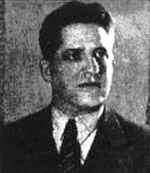
| Yoal Charak |
At the end of 1931, there began to be signs of an economic decline. The credit institutions, which the middle class found lacking [funds] during the emergency, shook.
The specter of an economic crisis began to float before our eyes, which would show an intensifying trend and make it more difficult for Jews to obtain their livelihood. However, we “consoled” ourselves that its arrival would signify a further weakening for the badly situated Jewish population. On the contrary, the middle-income groups, the majority of the Jewish population, would find a solution.
Therefore, they founded the Interest-Free Loan Fund. That means they founded an institution that we hoped would not be needed.
However, the crisis grew stronger and grew at a much greater tempo than had been expected.
They had not then thought about organizing widespread and well-planned work in order to prepare for every eventuality. The well-to-do strata, which could help with material support, had to be drawn in for this purpose. This needed much time and deliberation and the crisis that already reigned in the Jewish quarter did not permit this. The Interest-Free Loan Fund was opened with a sum of 625 zlotes.
They began the work on a small scale.
[Page 227]
However, time forced a situation on the Jewish settlement in Lutsk requiring the Interest-Free Loan Fund to evolve.
During its existence, the fund went through three periods. At the beginning, it distributed small, partial and unorganized help. This was a kind of small amount of help of which very few Jews could make use. They had to be satisfied with giving loans of very modest sums.
In the report of activity of the first year, a loan of five zlotes is listed. This was a
|
|
|
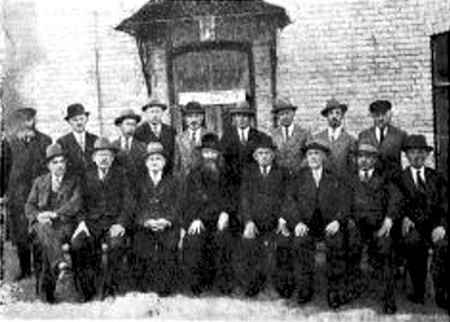
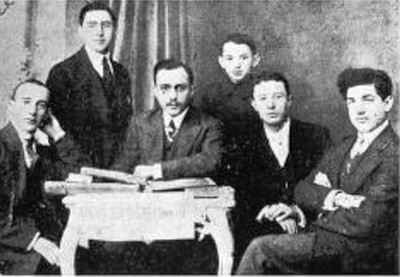
Sitting from the right:
Sziczik, Bak, Elkin, Chicz, the Rabbi Sorotszkin, Diment, Goldberg, Charak
Standing: Y. Sima, Hofman, Gecht, Shachnauk, Rane, Bursztajn, Goldfarb, the shamas [synagogue caretaker] for Rabbi Sorotszkin |
true sum! When in time the auditor came to audit the books of the society and carelessly skimmed the statistics of the loans given, noticing the above-mentioned sum, he looked at it with wonder. He could not grasp that such sums could bring about the bettering or worsening of the financial position of the applicant. The writer of these lines told him: the smaller the sum, the greater the importance of the loan given. The Jewish population of Lutsk also understood this.
The second impetus of activity came later. We had to establish contact with the American Joint Distribution Committee and also the American Lutsker Society.
This was a necessity because the need that arose because of the [financial] crisis grew greater and greater. Previously, we had discussed at a meeting of the managing committee whether the borrowers must be full members or not – not that we were discussing if members could become borrowers from the fund or not… From time to time, a request would arrive from a Jew to whom we had just considered turning, as a well-to-do merchant, about giving support to the Interest-Free Loan Fund…
The third phase of fund activity was when it had to take on several tasks that verged on the political – at a moment when, as a result of political shake-ups, all Jews were more pressed to the wall and they lost the financial ground under their feet. The interest-free loan movement in Lutsk, as in other cities and shtetlekh [towns] in Poland, had to take on several political functions. The task was a double one: on one hand, we could not permit a situation in which people would fall so low that they were forced to access hand-outs; on the other hand, we had to fulfill a first-class Jewish-national mission, in view of the heightened anti-Semitic wave.
The Interest-Loan Fund became the source of support for poor artisans and the support for retailers, shop-keepers and orchard workers.
Let us give several examples. The shoemaker, taking a loan from the Interest-Free Loan Fund of not more than even 50 zlotes, considers himself fortunate according to his concept that with ready cash of a 50-piece coin he can come boldly to a leather merchant. The shopkeeper on his part gives him more credit than the money he receives from the shoemaker. And thus the artisan buys his small amount of goods and he can then work with a calm head and somehow earn his income for the week.
A Jewish street-stall owner buys his little bit of goods from the wholesaler on Wednesday with the loan he receives in order to take in and earn his income at the fair on Thursday.
A Jew, an orchard worker, took a larger loan once a year. As a tradesman in the field of orchards and with a little cash money, he was accepted as an honored partner by a well-to-do Jew who rented orchards around Lutsk.
Understandably, the fund was not so popular with the rich Jewish men in Lutsk. They did not need to go to it… In contrast, it was very popular among the humble people. Necessarily, this institution was popular among the simple people.
Our institution, as weak as it was financially, without the help of our rich men and with small and modest means, still gave approximately 10,000 loans for a sum of a scant half million zlotes.
The number of Jews who made use of the loans reached the sum of 50,000 Jewish souls!
The attitude toward the debtor was not as a fallen, needy person, something of a small, inferior creation. As
[Page 228]
much as our modest means permit, we turn to our strong convictions and have an effect on each one that dares to take a loan. And, as is known, there were many Jews who not long before had been in a good financial position but in time became impoverished. They could not become accustomed to the idea that must decide to take a loan that would help them a tiny bit in their stressful economic situation.
The borrower felt our respect for him. He entered the premises of the Interest-Free Loan Fund as someone who belonged, to [find] brothers who would do everything possible for him.
Because of the fruitful activity of the fund, non-Jews who were familiar with it joined with great enthusiasm. They then began to understand our specific situation and the great help we distributed to the those in need.
Four or five years ago, the priest, Antoni Jaglonski, published an interesting work, printed at the Lutsker Biskup Kurier [Lustker Diocesan Courier], dedicated to the communal supervision (opieka społeczna – welfare) in Lutsk. In this book, the author dedicates several warm words to the Interest-Free Loan Fund, from which can be seen that he had a good grasp of the sense of the tasks of our institution, because [with its help it was responsible for the fact] that a large number of people would not have to seek communal help. Such testimony by an influential personality is very, very typical.
The principal concept of the fund consisted of taking under its wing one Jew and another one binding them together with an extraordinary feeling of unity that joined the communal worker, debtor and so on.
The fund drew the leaders who grasped that there existed another Jewish soul outside of one's “I” that is a part of one's own Jewish community, for which the leaders must do something. Just as the debtor feels his own significance, he comes not servile like a small one to a greater one. He comes as one comes to a brother who has more possibilities and better opportunities to help him in an emergency.
It is notable that the leaders of the Interest-Free Loan Fund did not feel a dissatisfaction when they learned that the Joint [Distribution Committee] had designated a certain sum for the Interest-Free Loan Fund in other cities, let us say: Rovna or Kovel. For them, for the Interest-Free Loan Fund leaders, no local matters existed, compared to the general Jewish matter that involved the Jewish people as a whole.
The activity and the fundamental matter of the Interest-Free Loan Fund earned us respect and esteem among the non-Jewish public. The government organs officially recognized the usefulness of the institution. They did this in the form of a certain subsidy, although not a large one, but this was a gesture meaning that they also were showing an understanding of our business. From time to time, we received a few hundred zlotes from the government institution, C.B.K. We received larger discounts [on interest] for a short term from the state bank for farming [loans].
Our institution was known by its Hebrew name in government circles. And it is a fact that often we received an answer from the Polish Finance Minister: “Gmiles-Khesed – to już inna zszec” [“Interest-Free Loan Fund – it is a different thing”] – Gmiles Khesed is another matter! For this, money was found in the government [treasury]!
Even the attack by the Gazeta Warszawska [Warsaw Gazette ] during the arranging of the Interest-Free Loan month in all of Poland in 1933 was a moral victory for Jews because it revealed to the Polish public what beautiful organizations we had created to support our economic position. This brought us much respect.
Right at the end of 1931, we could not foresee what kind of a road the fund would need to take and how it would have to change as a focal point for the Jewish people – thus we cannot now know what tasks await us in the future.
Lutsk, 1938
by Sh. Warkowicki
Translated by Helene Roumani
Edited by Gloria Berkenstat Freund
´
|
|
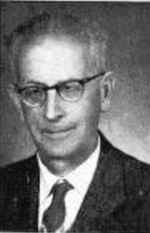
| Sh. Warkowicki |
Before WW1, there were two strong Jewish credit cooperatives in Lutsk – the Lutsker Loan and Savings Fund and the Lutsker Mutual Credit Society. The former served a wide sector of the community, mainly craftsmen and small business owners. While backed by IKA (Jewish Colonization Association), the Lutsker Loan and Savings Fund functioned mainly on the basis of its own assets. Nearly all credit claims were successfully met. In addition, the Fund always had large capital reserves in the national bank.
The Lutsker Commercial Society for Mutual Credit served merchants. Their credit needs were successfully met to a great extent as well due to the existence of financial clearing facilities in the country that allowed large scale transfer operations on credit. The Society also had its own substantial capital and significant assets.
During the turbulent war years, both institutions were evacuated and effectively ceased to exist. As a result, they could not pay off their debts or cash deposits.
In 1921, when the JOINT began its benevolent aide activity in financial credit cooperation,
[Page 230]
|
|
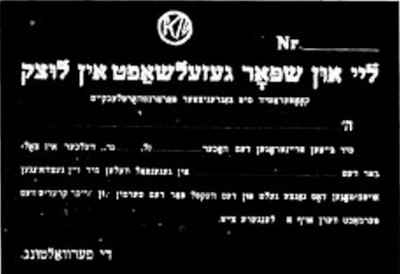
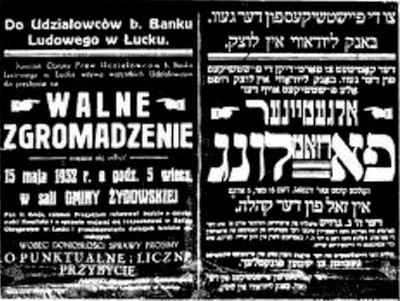
| [Announcement: Loan and Savings Society in Lutsk] |
a group of communal workers gathered in Lutsk and founded the People's Bank. The first several hundred marks were lent by Abraham Klimbird. With this money, they purchased desks, chairs, office materials and started running the bank. They went out into the city to elicit membership and raise capital. At that time, the Director of the JOINT visited the bank and deposited its first loan. Management members worked with zeal. The bank was supported with whatever could be raised. When it ran out of money, it turned to the then chairman of the board, Lazar Dal (he worked in the Bureau of Power Plants) who was always available for whatever help was necessary. The bank grew and expanded its activities. In 1923, its activity was hindered by the equalization and devaluation of the market. However, it quickly revived afterwards, with considerable growth to the benefit of all its members.
Meanwhile, a group of merchants left and established their own bank. It developed quickly and satisfactorily due to the general favorable climate of the times and support of the merchants.
Both banks belonged to the Warsaw Auditor's Union.
In 1927 the Wolyner Development Bank and the Central Loan Bank were formed. With time they were transformed into large institutions with substantial capital. The Development Bank alone had more than a million zlotys in deposits and over 150,000 zlotys in its own capital. Activity was so great, it became known as the “Kozyatyn Train Station” conducting large scale cash operations with an annual turnover that reached tens of millions of zlotys.
At that time, Bank Kredytowo-Towarowy [Credit and Commodity Bank] also functioned with significant credit activity through the Bank Gospodarstwa Krajowego [National Development Bank] branch in Lutsk.
In 1930, under the pressure of the economic crisis, all of the above cooperatives were dissolved.
Subsequently, Bank Udziałowy [Share Bank] and later, Bank Powszechny [General Bank] were founded with the cash remains of these banks. After a few years of work of lesser significance, they gradually and quietly disappeared.
In the year 1932, the Bank Gospodarczy [Economic Bank] was founded. Under the strict and energetic management of H. A. Hoffmann, it committed itself to creating significant independent capital and organized membership. It was widely patronized by its members.
In 1934, the Cooperative Bank Association was founded under the leadership of Warkowicki with one hundred members. It became popular due its reliable capital resources and deposits. The bank mobilized new clientele and issued loans with its own independent capital, although its scope of operation was significantly lower in magnitude than the Bank Gospodarczy.
Lutsk, 1938
|
|
| [Meeting invitation: Bank Ludowego in Lutsk] |
by B-N
Translated by Gloria Berkenstat Freund
The ORT Society carries on important work. It endeavors to change the crippled structure of the Jews where they presently live; it teaches trades to groups that will be properly prepared for life; it organizes artisan workshops and various agricultural projects where the young are prepared for a productive life. The society possesses its own buildings and workshops in almost every city in Volyn, where great constructive activity is carried out with the aid and strong interest on the part of the entire informed Jewish community. For years, on the eve of summer vacation, [dozens] of graduates of the ORT school come to Lutsk, where the [headquarters] of the handworkers [division] is located, in order to take their exams and receive the appropriate diploma.
Only in Lutsk, where the site of the artisans' [headquarters] and the examining committee was located, did fate decree that in no way would an ORT organization take root and that no trade education would be given.
In the last few years, people took on the task and tried to revive ORT, but for various reasons, about which we will not speak, everything again hit a wall of pitfalls and all sorts of obstacles that were difficult to combat.
According to a special decision of the Lutsk Jewish kehile [organized Jewish community], with the influence of the chairman, H. Friszberg and Rabbi Soroczkin, the kehile building was given to the disposition of the trade school. Soroczkin also persuaded the ORT central [office] that it also should contribute and it led to a quicker opening of the planned trade school. The central promised to do everything and delegated its representative, the engineer, Bichwajc, to inspect the building to see if it was suitable for its planned purpose. Engineer Bichwajc determined that after an appropriate renovation, the building would be suitable for the school.
On its part, the central did everything in order to accelerate the realization of our plan. The necessary plans were already prepared, figures and cost calculations; the necessary conferences and interventions were carried out and it is hoped that finally now, after all of the transformations, the idea of ORT will be realized.
In addition to the main project of the trade school, the managing committee headed by Dr. Izidor Kronsztajn and director, B. Grajcer, also carried out so-called small work. They recruited 169 members. These were people who had a warm interest in ORT work. An office already existed and, meanwhile, all preparatory work was done in order to open several trade courses.
Translator's footnote:
by Dr. Ester Bajlin, Los Angeles
Translated by Gloria Berkenstat Freund
First of all, we must clarify that the character of the activity of TOZ [acronym of Towarzystwo Ochrony Zdrowia Ludności Zydowskiej – Society to Protect the Health of the Jews] in Poland consisted, for everyone, in lifting the hygienic conditions of the Jewish population in those regions where the economic needs, which always went together with terrible living conditions, were untenable.
When the society was founded, its name was OZE [Obshchestvo Zadravookhaneniia Evreev] in Russian, which has the same meaning that TOZ has in Polish. The activity of the society actually began in Russia, where the Jews, mainly destitute, lived in the shtetlekh [towns] and small cities, where they did not yet even dream about running water and a sewer system.
The mortality rate among Jewish children in Russia was extraordinarily high. Jewish children, just as their parents, were not nourished very well. (The main foods were herring and potatoes.) As a result, tuberculosis was very widespread. The attention of a group of intellectuals, mainly doctors, focused on this terrible illness and they assembled in Petersburg on the eve of the First World War in order to seek means to resist the spread of the disease among children
[Page 232]
and adults: how to create supervision over those who themselves could not find a solution.
TOZ began its activity in Poland after the First World War, when the war operations in Congress Poland ended; the situation for the Jewish population was in every respect unbearable. Not only the urban poor but even the artisans who had supported themselves very well before the war with their work were ruined economically; in their houses, too, need and various illnesses prevailed.
|
|
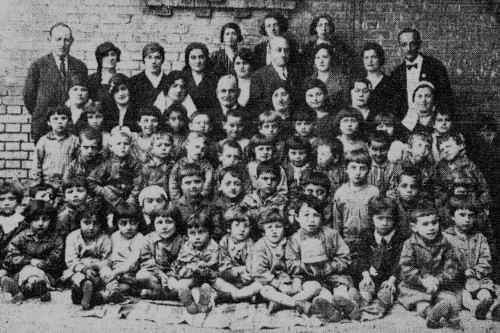
| Children at the Lutsk TOZ |
As a result of the hunger among the Jewish population, the Joint [Distribution Committee] was forced to create hundreds of kitchens for children and adults all over Poland.
The hunger began to spread tuberculosis in a terrifying manner. We do not have any exact figures about that era (all statistical materials were lost), but we know that during the first five years, more people died of tuberculosis and typhus than from the war operation in the years 1914-1918.
In those days, the society was confronted with the fact that it was impossible to do without the radical aid from an institution that would carry on prophylactic work. Such an institution was TOZ.
As I already said, TOZ had as its purpose not giving help with donations, even not (from the start) with healing, but to protect from illnesses: sending the children who were threatened with tuberculosis to special institutions, nourishing them as appropriate, maintaining them in hygienic conditions, planting concepts about hygiene in the children, giving them sun and so on. The children of pre-school age were isolated from their preoccupied parents at least for a few hours a day, taken away from the dirt and from hunger, creating for them children's homes, surrounding them with warmth, joy and happiness and creating an atmosphere for them in which the poor child would not feel worse than the rich children in their homes.
Our Lutsk excelled in this area the entire time – from when TOZ arose until the last day of its existence.
Our principle was – not to carry out any philanthropic work, not to transform any people into beggars. We tried not only to create the appropriate hygienic and health conditions among the Jewish population, but also to change the mental attitude of the person, that is, to make healthy the body, but also the spirit.
When I touch upon the question of the children's homes, I want to make a small digression. Actually, this area belongs more to education, so why did we give so much energy and means to a health institution par excellence? Actually, because we were interested in developing the Jewish body and spirit. The exhausted children of the unemployed, candidates for tuberculosis, needed to find an environment that was absolutely not comparable to that of the cellars and structures from which they came.
The clean, esthetically decorated rooms certainly had an effect so that a child would almost forget about its cheerless apartment. With pain in our hearts, our devoted teachers always said goodbye to the joyful, fortunate children. The teachers, who were like true mothers to the children, knew well that in their homes, the children did not have a warm corner and no hot foods. Not to speak about toys and games, about what they could only dream until the morning – when they would again be found in an enchanted land.
When I speak about the beautiful work of TOZ and, particularly, about the activity in the children's homes, I especially want to underline the names of the dear [female] educators who gave away their entire souls to the children. They were masters in their work, which they carried out not only professionally, but with complete dedication. In the first place, among them, one must naturally place the unforgettable Mechtshe, Mechtshe Britwar. The children adored her and we all had extraordinary love and esteem for her.
In the area of supervision over mother and child, we unconditionally occupied first place in Poland. We already wrote and spoke about this a great deal.
The Prophylactic Work
As we already said earlier, the main task of TOZ is to prevent illness, that is prophylactic.
[Page 233]
The children's homes actually entered structured activity. The day was spent in cleanliness, in ideally cleaned rooms, in clean clothing, with baths where soap and water were in abundance, a great deal of sun and air, a sufficient and valuable quantity of food (measured by calories), cod-liver oil (as a means of preventing tuberculosis), a good, joyful mood – all of this led to this, that after the first years of work, even the children whose parents had tuberculosis were entirely healthy. Naturally, in addition to all of this, there were various inoculations as well as prophylactic summer colonies and halb kolonies [summer day programs arranged for poor children] and the winter activities. The children who had the good fortune to participate in the children's homes, halb kolonies and summer colonies were fit from a health and educational standpoint.
Naturally, one Mechtsha Britwar was not in a position to carry out the work in every children's home. Under her supervision, other very valuable [women] educators were trained.
|
|
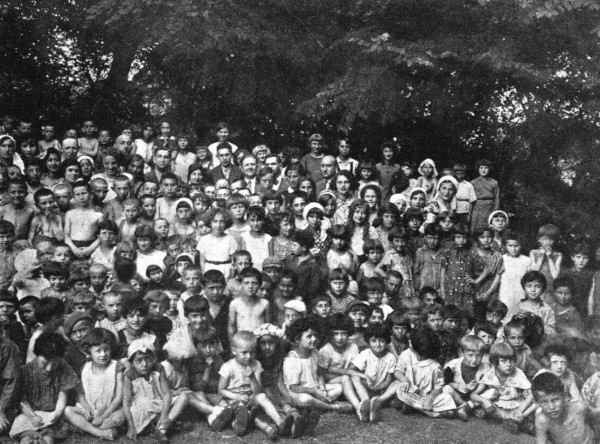
| TOZ children's colony in Lutsk (1933) |
|
JewishGen, Inc. makes no representations regarding the accuracy of
the translation. The reader may wish to refer to the original material
for verification.
JewishGen is not responsible for inaccuracies or omissions in the original work and cannot rewrite or edit the text to correct inaccuracies and/or omissions.
Our mission is to produce a translation of the original work and we cannot verify the accuracy of statements or alter facts cited.
 Lutsk, Ukraine
 Yizkor Book Project
 JewishGen Home Page
Copyright © 1999-2026 by JewishGen, Inc.
Updated 18 Jun 2026 by JH