 |
|
|
[Page 207]
by Moshe Ferdman, Mexico
Translated by Gloria Berkenstat Freund
|
|
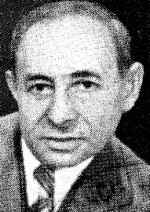
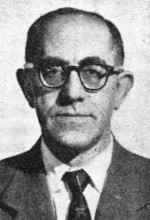
| Moshe Ferdman |
The work that we present here is not a documentary study about the Bund in Lutsk; we are not able to write an exhaustive characterization of its activity because we do not possess the Bund archive! It disappeared along with the Bundists, almost all died in Lutsk or in other places during the Holocaust.
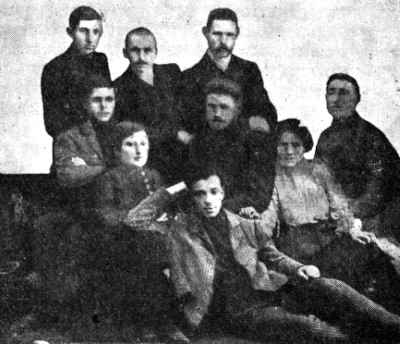
The Bund in Lutsk was active before 1905. I remember well an event from my childhood years that engraved itself in my memory. In the violent fifth year [1905], a large peoples-gathering took place, organized by the Bund in the Great Synagogue, where a well-known Bundist orator – Comrade David [Petrovsky] – appeared. The gathering was dispersed by Cossacks. Shooting was heard. A bit of a pogrom also took place then with the participation of the Black Hundreds [reactionary, ultra-nationalist Russian groups]. I remember that a Jewish locksmith shot into the Lutsk district police office.
Among the Bundists of that time were, as much as I know, Shmulik Ayzen, Kalman Friszberg, Shmulik Garber and Efroim Maranc – the latter also was active in Bundist work in the years 1923-1939.
The new Bundist organization in Lutsk was founded in 1923 by an emissary from the central committee of the Bund in Poland, comrade Artur Zigelbaum. He later became well known when he organized the Jewish professional movement in Poland. In 1942, he tragically and heroically took his life in London as a protest against the silence of the world while the Jewish people were being annihilated by the Germans.
Until the rise of the official organization, the Bundists and their sympathizers were grouped around the Jewish library, the kindergarten and other cultural positions as well in the professional unions that were created at that time, mostly thanks to their initiative.
Thus organized then were: the nourishment union (the workers with milk and bakeries); the wood unions (the carpenters, cabinetmakers, construction workers and so on); the leather union (shoemakers, leather cutters, tanners and so on). The three mentioned unions were international – Jews, Poles, Ukrainians, Russians belonged to them. Later, two more professional unions arose – purely Jewish: the needle [trades] union and the union of sales workers.
The professional unions were occupied with economic actions that had the purpose of bettering wages and working conditions. Among the unions, the nourishment union, with its organization and readiness for struggle, with its internationalist spirit, as well as comradely solidarity and self-help, particularly excelled. Thus, for example, the institution of fayrant[1] was rigorously carried out and protected there. That is, that an unemployed baker would receive several days of work he was lacking from his comrade who [would work less] – this was applicable to both local members of the union and to those who came from outside [the city].
The professional unions – mainly the Jewish ones – would also carry out cultural-political work among the members, as much as was possible under the strict Kresy regime.[2] In general, the Polish regime used
|
|
| The committee of the Bund in Lutsk in 1905 |
[Page 208]
|
|
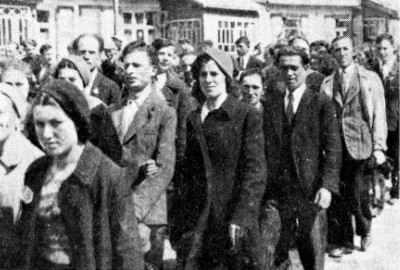
| A Bundist May 1st Demonstration in Lutsk |
all sorts of harassments and repressions against the professional unions and their activists.
All professional unions in Lutsk participated in the appropriate national central offices in Warsaw that stood under the influence of the P.P.S. (Polska Partia Socjalistyczna [Polish Socialist Party]) and the Bund.
At first, the Bund organization did not have a large number of officially declared members. The work of the organization mainly proceeded in the direction of ideological education and propaganda, as well as in general institutions in the city. Regular party meetings and circles would take place at which they conversed about various actual political problems of Jewish and general life. They would distribute the party press (Di Folks-Zeitung [The People's Newspaper] and so on). They took the first step of creating a youth organization (Tsukunft [Future]). The Bundists also were the initiators and the first activists of the reopened Jewish secular school (1925).
From time to time they would bring party activists from Warsaw who, in the majority, also appeared with public lectures on political and general cultural themes.
The first larger action of the Bundist organization was the election campaign to the first democratically elected city council in 1927.
At first, the Bund wanted to create a joint list with other radical activists. They negotiated about this with Shlomo Goldberg, Zalman Zarecki and so on, but nothing came of the plan because of a series of fundamental disagreements. And the Bund brought its own list to the election on which also appeared Dr. Josef Mininzon, who was not an official Bundist, but an old social-democratic activist. At that time Mininzon was the chairman of the Lutsk division of the Central Jewish School Organization (TSYSHO – Tsentrale Yidishe Shul Organizatsye) and of the school managing committee.
The election campaign carried out by the Bund was very lively and drew the attention of the Jewish masses. The election actions were used by the Bund for a wider informational campaign and actually led to significant growth for the organization. The election results were very good for the Bund, taking into consideration that Lutsk did not have a proportionally large working population. Three Bundist council members were elected: Dr. Josef Mininzon, Moshe Ferdman and Borukh Cwerner (a tailor, chairman of the Lutsk Needle Workers Union). Later, Shlomo Rimarczuk, a tailor, now in Argentina, replaced B. Cwerner in the city council. When Shlomo Rimarczuk later emigrated to Argentina, Tunya Bruman took his place.
Despite their proportionally smaller faction, the activity of the Bundist councilmen acquired a great importance in the city, particularly because of their matter-of-fact, but constantly principled attitude toward the most important questions of the municipal economy and its relation to the Jewish population. Even the Polish councilmen and the leaders of the city managing committee (city hall) took into account the Bundist councilmen, and they were represented in the most important committees (budget and so on). Their appearances in the budget debates would always evoke great interest, and many people would then come to the meetings.
The first city council did carry out relatively liberal communal politics, particularly in the matter of taxes; it also succeeded in providing
|
|
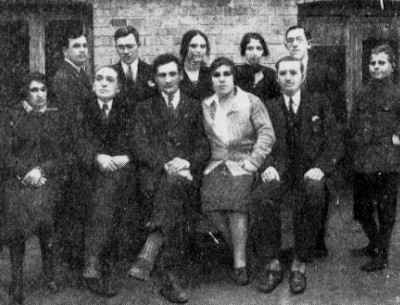
| A group of Bundists in Lutsk |
[Page 209]
subsidies for many Jewish institutions (schools, hospitals and so on).
There were cases when the Bundist councilmen often had to speak and even sharply against the attitude and actions of the remaining Jewish councilmen. For example, thus it was when a number of Jewish councilmen voted against the Bundist proposal to name a street after Yitzhak-Leibush Peretz and because of this the proposal failed (the Jewish councilmen then had a majority in the city council, since the Jewish population was the majority in the city). The Bundist organization then issued a sharp appeal again the conduct of the bourgeois Jewish councilmen. The appeal was, understand, confiscated by the starostwe [district office] and the writer of these lines (as the official responsible for the appeal) was tried as a result.
The Bund only had two city councilmen in the second city council. This was the result of the general changes in politics in the country. The government did everything in order to decrease the number of Jewish city councilmen and enacted a special limited election ordinance so that the Jewish population would not have any appropriate representation. All of the Jewish parties had smaller factions in the second city council. The Bundist councilmen were Moshe Ferdman and Tunya Bruman.
The election to the third city council, which took place right before the Second World War in the general atmosphere of fascism and national discrimination, particularly against the Jewish population, weakened Jewish representation in the city managing committee even more. By the way, the third city council actually did not begin its activities because of the outbreak of the war.
In the years 1936-1937, when the Polish government began carrying out openly antisemitic politics, when the country began anti-Jewish excesses (for example, the story of Przytyk[3] and so on), the Bund in Poland carried out a wide political campaign against antisemitism, for the rights of workers, and on so on. The Lutsk Bundists also took an active part in the struggle; this came most clearly to expression in the general protest strike on the 17th of March 1936.
In the Bundist publication, Der Yidisher Arbeter-klas [The Jewish Worker-class], in 1936, the following correspondence was published about the course of the protest strike in Lutsk:
“Our city had not experienced such a demonstration as a result of the well-known Kresy conditions that had not given any professional union the least opportunity to lead any activity, yet the protest strike showed the strength of the conscious labor force.
“We spread the call from our party and from the country council (of the professional unions) from mouth to mouth – the appeal that had been released by the local committee of the Bund had been confiscated.
“From seven in the morning, worker groups in various places in the city began to gather. (Later) large masses began to flow to the center of the city. The courageous conduct of the workers, and particularly of the young, carried with it the bourgeois population. One after the other, they lowered the shades of their businesses with a clatter. The strike was real.
“Despite the extraordinary [number of] guards (police on foot and on horses, on motorcycles), several meetings were successfully organized in the street that ended with calls and slogans. Many comrades were arrested over the course of the day.
“The Polish organized labor expressed its solidarity with the protest action. A protest meeting was organized in the premises of the local construction union by the P.P.S. comrades that was dispersed by the police in the middle of it.
“The entire city was impressed by our dignified fighting appearance against antisemitism.”
In time a large number of Jewish young workers, boys and girls gathered at the Bundist organization (tailors, business employees, construction workers, school youth and so on) and they helped the older comrades a great deal in the political organizational work. From 1927, an official Bund youth organization, Tsukunft, existed and it developed widespread and extensive activities among the working Jewish youth. Organized educational circles that included both general scientific and political instruction in their subject matter would take place. At Tsukunft a four-voice choir (under the direction of Shulik Ferdman) was later created, which appeared publicly several times and with great success. The members of Tsukunft would arrange frequent excursions outside the city and to the small shtetlekh [towns] around Lutsk (Torchyn, Rozhyshche, Oziutychi and so on) bringing both political instruction and entertainment for the young. Speaking about the entertainment, it is worthwhile to remember the beautiful tradition of the so-called red-blue balls (the members of Tsukunft would wear blue blouses with red ties). These were special and private evenings, intimate and cultural both in the program and in the atmosphere.
In order to give an idea of the work of the Bundist youth organization, we will cite several extracts from correspondents in Lutsk, published in
[Page 210]
the central office publication of the Youth Bund – Tsukunft – Yugnt Verker [The Awakener of Youth] – for the year 1929.
A correspondent in Lutsk, in the Yugnt Verker, no 2, January 1929:
“Our organization progressed; we carry on extended educational work among the young. We have recently sent eight older male and female comrades to the party. We arrange frequent readings in the unions. We carry on actions to gather money for a premises.”
| Motya
(Motya Gajer, today in Sao Paulo, Brazil) |
Yugnt Verker no. 11, 1929:
“We arranged a gathering in the municipal theater. After this, a procession formed under the flags of the Bund, Tsukunft, and professional unions. The procession marched through several streets in exemplary order with various labor songs and proclamations. Mass arrests took place on the eve of the First of May; one of our comrades was arrested who is still in prison.”
| Motya G.
(as above) |
Yugnt Verker no. 14, 1929:
“Shabbos [Sabbath], the 22nd of June, the gathering of the Volyn members of Tsukunft took place in the Czech Colony five kilometers from Lutsk. A few hundred comrades came from 10 locations: Lutsk, Rovno, Kovel, Dubnorca, Oziutychi, Kysylyn, Torchyn, Berestechko and so on. A solemn gathering took place with the participation of Mr. Lucian from the Central Committee (Central Committee of Tsukunft. Mr. Lucian – Lucian Bilt, now in London. – reported by M. Ferdman). In the evening, in the Ukrainian hall, Prosvita, a banquet took place; in the morning an excursion with boats on the River Styr. On Sunday, the comrades visited the castle, the Karaimer Synagogue, the old synagogue, the Jewish Folks-shul [public school] and so on. The congress, was a really great demonstration for the Tsukunft.
| A member of Tsukunft |
From a correspondent in Yugnt-Verker (June 1929?):
Third Lutsk regional conference
“The third regional conference of the Volyner Tsukunft organization took place on these days in which Mr. Lucian from the central committee also took part. Twenty-five delegates from 10 cities came to the conference; three cities did not send emissaries. From the report we see that our organizations in the region have approximately 300 organized members, in addition to a large number of sympathizers. Yugnt-Verker (the publication of the Tsukunft – reported by M.F.) distribute the organization's 280 [no indication of 280 of what]. We possess eight libraries with more than 9,000 books, 600 readers. Four organizations have Morgnsterns (the sport's organization of Tsukunft, reported by M.F.) with 250 members. Four organizations have well-functioning dramatic groups.
“The conference established that we were in a state of constant revival… The conference elected a new regional committee and drafted a complete series of work for the forthcoming time.” – Regional Committee
From Yugnt-Verker no. 19, August 1929:
The anti-war action in Lutsk
We proclaimed an anti-war action from the 3rd to the 10th of August. Over the course of the week, we carried out a series of special meetings. A solemn assembly with a very rich dramatic part carried out by the young people themselves took place on Shabbos, the 10th. The assembly took place in the premises of Prosvita. The assembly ended with the singing of The International and of Di Shvue [The Oath – the Bundist anthem].
| A Young Person |
From Yugnt-Verker no. 6, January 1930:
A Mikhalowicz Club in Lutsk
Despite the frightening unemployment among us in the city, we surmounted all of the difficulties and created a club named for Comrade Mikhalowicz. A large youth meeting took place on Shabbos, the 25th of January, dedicated to the opening. A banquet with the party organization took place in the evening. A comrade from the party committee spoke as well as a comrade from the youth committee, and so on. We sang various worker songs. We dispersed for our further work with enthusiastic courage. We now started the work. Every evening, the comrades come together at the club.
| Motya G. (as above) |
From Yugnt-Verker no. 11. May 1930:
A joint celebration with the Polish workers took place here in Lutsk. Immediately in the morning, the workers assembled in their (union's) premises. Then we marched out to the municipal theater where a (May) assembly took place. Giving speeches were: Mr. Zurowski on the part of the Poles [and] Comrade Buchman in the name of the Bund (This is a pseudonym. It could have been either Bruman, a Bundist councilmen, or Ferdman). A representative of the Tsukunft was supposed to speak, but the police did not permit it. The streets (through which) we marched were guarded by heavy divisions of riders and police on foot. Despite all of this, an impressive demonstration marched, in which 800 workers took part. The orchestra was at the head of the procession. We demonstrated with revolutionary songs and echoing calls through a number of streets. On the Peretz Square, not far from the Nidewer Bridge, near the Styr [River], a joint meeting took pace. There, too, the police did not permit [anyone] to speak in the name of Tsukufnt.
| Moshe (M. Ferdman) |
From Yugnt-Verker no. 20, 1930:
Police drive off the demonstration of Volyner members of Tsukunft
The second Volyner regional conference of the youth Bund, Tsukufnt, took place in Lutsk on Shabbos [Sabbath], the 30th and Sunday the 31st of August. They came on Friday from several shtetlekh; it felt like a holiday.
Shabbos, 2 o'clock in the afternoon, we left for the theater in closed ranks, where a solemn assembly took place. Mr. Ferdman, as chairman, opened the solemn assembly. Mr. Plapler delivered the report before the presidium that
[Page 211]
40 comrades from Rovno, Kovel - 35, Trisk - 3, Oziutychi - 11, Kysylyn - 6, Olyka - 2, Dubno - 1, Lutsk - 46; in total 144 comrades attended the meeting. After this, there were greetings from representatives of various institutions from Lutsk and other cities. Then the Dobno Morgnshtern [Morning Star – Jewish sports organization with ties to the Bund] carried out several gymnastic numbers. The Youth Bund's Tsukunft dramatic group in Lutsk performed a one-act play. In the afternoon, a meeting took place in the street. A procession formed that walked through the main streets of Lutsk. They carried torches and flags from Tsukunft and Morgnshtern.
When the procession was to end, the police arrived. They beat and chased – they did not permit the remaining part of the meeting to be concluded.
| F-R |
From the mentioned correspondences one can see that the Lutsk Tsukunft organization was also the center of the Bundist youth movement in Volyn.
A considerable number of young people grew up spiritually and politically in Tsukunft; then they were led to the Bundist party organization and took an esteemed position in it, for example, Motya and Stisya Gajer, Yoske and Guta Epel, Shmulik Braunsztajn, Ayzyk Gertner, Hersh Plapler, Malka Bidnik. Of the later generation of members of Tsukunft, these active young people must be mentioned: Sura Kloc, Roza Gergis, Etya Feldman, Moshe Zafran, Ruchl Ajzen, Sioma Fridman, Ayzyk Rajc and many, many others, whose names I cannot, alas, remember.
The Bund experienced the same fate as all of the non-communist parties and communal organizations with the outbreak of the Second World War in 1939, and particularly with the occupation of Lutsk by the Soviets – that is, complete liquidation.
Several Bundist activists from Lutsk tasted the flavor of investigation and constant supervision by the N.K.V.D. [Narodnyy Komissariat Vnutrennikh Del – People's Commissariat for Internal Affairs], but with good fortune, it did not lead to any arrests in Lutsk and exile as happened to Bundist activists in other places. We must assume that this happened thanks to the fact that the Lutsk communist activists did not sully themselves with any false accusations and denunciations against the Lutsk Bundists.
When the Germans took Lutsk, among the first victims were a number of Bundists, among them the long-time activist and Bundist city councilman Dovid Stoler, who was tortured to death in a horrible manner.
1960
Translator's footnotes:
[Page 211]
by Matya Gajer/Brazil
Translated by Gloria Berkenstat Freund
At Kanarska Street, no. 3, there was a communal house where the seven-class Jewish folks-shul [public school] was located, named for our great classical writer, Sholem Aleichem. This house was actually the property of the synagogue. In its time, the house was bought for money that was brought by the American delegate Papir, I think, in 1920. In addition, the Jewish folks-bibliotek [people's library], the largest in Lutsk which had hundreds of readers was located there.
The members and the readers of the library mainly were younger and older workers and employees, also a certain number of the Jewish intelligentsia. In the 1920s, one can say, in the rooms of this historical house, workers from various trades were grouped: tailors, shoemakers, carpenters and so on, who were the founders of the later well-organized professional movement in Lutsk.
In the evenings and on the Shabbosim [Sabbaths] and holidays, it was boiling on Kanarska Street like in a kettle; ardent political discussions were carried out that sometimes led to quarrels. The young people at that time were influenced in great numbers by the communists (this phenomenon was noticeable not only in Lutsk, but in all of Poland, particularly in Kresy [Borderlands – formerly territory in the eastern part of Poland], where a strict police regime reigned). At this seething time, the Lutsk Tsukunft organization was organized at the initiative of the Rovner Tsukunft organization and their representative. The founding meeting took place, as I remember, on a frosty Friday night at Kanarska 3.
The first group consisted of seven members of Tsukunft. However, it did not take long and tens of young workers and business employees joined Tsukunft. These young people who were not educated in any school (except in the kheder [religious primary school]; but it should be understood that
[Page 212]
for the girls not even this), did not have the taste of happy years of childhood – because of the great need that reigned in their homes, so the young ones, who were forced to go to work in their very first years in order to help out their widowed mother or their sick father – felt like someone in the newly created youth organization had inspired them, led them to a new, elevated and more beautiful world. At the weekly kestl-ovntn [Box evenings. These were evenings where speakers and writers presented their ideas to help teach people who lacked an education. Questions were placed in a box and selected for discussion by the speakers and writers], which the Lutsk Tsukunft organization would arrange, from time to time, at the lectures, the young people felt that they were not alone in their loneliness and need, that their fate was connected with hundreds of thousands of working young people throughout the world who were striving and fighting for a new, more beautiful and more just world.
A new world opened in the Tsukunft organization for the young workers and employees. They talked about literature, politics and other matters in the organization. Many young workers began to visit the evening courses at the Sholem Aleichem School because the impulse for more knowledge, knowing more, awoke in them. In the free days, the Tsukunft organization would arrange collective excursions outside the city – in the free air, in the field and forest.
In addition to the educational work among the Lutsk working young, Tsukunft also took part in political and economic actions that the Bundist party organization in Lutsk carried out in the city, as for example, at the elections to the city council, the Sejm [Polish parliament], the kehile [organized Jewish community]. The young people would then be very active in the distribution of Bundist election literature, in leading the house-electioneering in the poor, Jewish houses. Young Tsukunft activists would also appear at public election meetings and, particularly, at
|
|
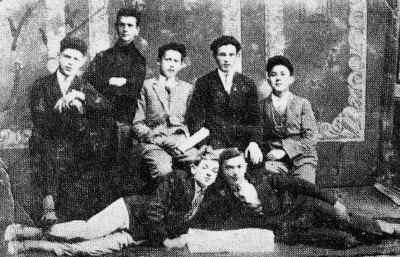
| Committee of the Youth Bund Tsukunft in Lutsk |
|
|
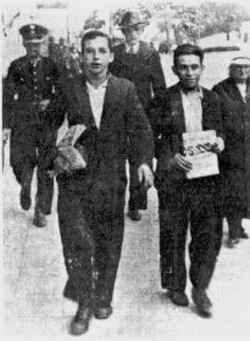
| Members of Tsukunft arrested while distributing the Folks Zeitung [People's Newspaper] |
smaller regional meetings that would be arranged in the residences of the workers or artisans.
The Tsukunft organization was very active during the economic actions – the strikes that would be led by the various professional unions in Lutsk in order to fight for better working conditions.
The members of Tsukunft also would always excel in [taking] part in the First of May street demonstrations and at other opportunities that were protest manifestations against the reactionary Polish regime. Political demands would be revealed there both of a general and of a Jewish character and they particularly emphasized the demand for the right to work for Jewish workers and artisans (as is known, at that time in Poland, they discriminated against Jewish workers; they were not allowed to work in the factories and the like).
In 1931, the Tsukunft organization organized a Skif Farbund [Sotsyalistishe Kinder Farband – Socialist Children's Union], a division of the national central [organization] of the Skif [the initials of Sotsyalistishe Kinder Farband]. Young school children and children of workers, in general, assembled around this organization. There they were educated in the socialist spirit and they were prepared as future members of Tsukunft.
The Tsukunft organization also was strongly active
[Page 213]
in spreading the Bundist press in Lutsk – the daily publication of the Bund, the Folkstseitung [People's Newspaper] that would be published in Warsaw and of the Yugnt Veker [Youth Awakener], the publication from the central administration of the Youth Bund, Tsukunft, also from Warsaw. From time to time, special “press days” would be organized during which the young members of Tsukunft as well as the Skifistn [members of the Skif] would go out on the streets of Lutsk and distribute the special Jewish press.
One of the most important and most beautiful works of the Lutsk Tsukunft organization was the taking out of the young, Jewish workers and employees from time to time from their crowded and stifling homes and workshops – without any hygienic conditions – to the free air. We would do this on the Shabbosim [Sabbaths] and holidays when we would arrange excursions to open nature. Summertime, on Friday nights, we would also – after the hot discussions at a kestl ovnt or after a reading – go to “Bene's boats” and take collective strolls on the Styr [River]. The singing of our “young Gvordia” [guards] echoed very far in the quiet of the night.
I will never forget the impression of one such collective excursion that our Tsukunft organization arranged to Taczyn and Oziutychi. Friday night, with a light, star-filled sky, accompanied by the full moon, we, a group of 14 young people, boys and girls, started on the road to Taczyn (22 kilometers [over 13-and-a half miles]). In the morning, right at sunrise, we arrived in the small shtetl [town] with song. After a short rest, a group of Taczyner members of Tsukunft joined us and we began to go further – through Kysylyn to Oziutychi, where a congress of the Tsukunft organization from all of Volyn took place. There, the multitude of active, young Jewish socialist-Bundists – many for the first time – came together and it did not take long until everyone felt like one family, like true brothers and sisters. We then had a very joyful and cheerful time with various games. However, we did not neglect the informational work. Various lectures on political, social and cultural themes took place at the congress in Oziutychi. These were joyful days with unforgettable events that lay their stamp on our whole being.
During the regional congress of the Volyn Tsukunft organization, in 1931, we, several hundred young people, filled the Lutsk streets. In the evening, before closing the meeting, the young Jewish men and [women], those who came from poor and cheerless homes, went out, joyfully and cheerfully, dressed in their blue blouses with red ties, through the streets of Lutsk with lit torches in their hands and [they] demonstrated their readiness to fight for a better and more beautiful world. This occurred on a beautiful summer evening when hundreds of people were strolling in the street. This Tsukunft demonstration made a colossal impression in the city. During the demonstration, the members of Tsukunft held moving mass meetings with cries against the police regime in Poland, against the discriminatory politics with regard to the Jewish masses and the like. Understand, the Polish police immediately appeared and dispersed this demonstration.
The Tsukunft organization in Lutsk over the course of its 12-year widespread activity educated and trained many hundreds of young people. The young Jewish workers and employees [in shops] going through the school were armed spiritually and aware of their obligations as a person and a Jew. A significant number became mature communal and political activists, both in the old home and in the new Jewish communities to which a number later emigrated.
1960
[Page 214]
by Berl Brik, Cordoba
Translated by Gloria Berkenstat Freund
Moshe-Yose strode from the Beis Midrash [house of prayer] not with his usual gait. His head wrapped in the soft skunk-fur collar of a sheepskin coat, he did not look at those passing by and did not answer everyone's “good morning,” which eagerly greeted him from all sides. He quickly changed foot, often missed the small well-trodden path and the high, white snow continuously entered his deep galoshes.
In front of his house, he encountered Chaim who had left his house with a bundle of books under his arm. Chaim greeted him with a cheerful good morning and quickly went on his way.
Moshe-Yose remained standing and watched Chaim. Both of the coattails of his [Chaim's] gymnazie great coat waved on the sides; the brass buttons of the patches on his back shone like gold. Moshe-Yose stood for a long time, nodding his head in worry and argued quietly with himself.
When having his coffee, Moshe-Yose was troubled, tore the only hair from his hand, bit his finger nail and with a broken voice began telling Lipsha the news that he had learned at the synagogue while at prayers:
– This night the police arrested many young people. They also took the old one's daughter.
– What am I hearing? – Lipsha asked, almost with satisfaction – the blond moyd [a word often used in a derogatory way to mean old maid]?
Yes, Moshe-Yose sighed – and Mendl the shoemaker's young man, too. A shame, truly a shame! Nice children and a pity on their parents – a misfortune.
Their neighbor, Layzer Stelmach, had said:
– They began to knock on the door in the middle of the night. Knocked and shouted: Police, open! And before they looked around, the room was full of policemen and secret agents who began the “craft.” They turned everything over in the house with the feet up and the head down. Searched and rummaged; they also picked through the straw from the beds and created a real ruin in the residence. After all of this, they took the only son with them. Who knows when they will see him again… Oh this is what a calamity is! Alas, Alas!
Moshe-Yose would have sat longer and felt regret.
However, Lipsha could no longer endure and she interrupted him with a long drawn out oy [oh].
– Ah, what is the matter with you? How did you so reach such a point? It does not begin to bother me. If one does not eat onions, one's mouth does not smell! A mitzvah [commandment – good deed] on them; serves them right…”
Moshe-Yose stood from the chair, set a pair of wide eyes on his wife and shouted:
– Lipsha, they are Jewish children!
Lipsha, it appeared, was not impressed by her husband's shout. She propped herself with her hands on both sides, eyeing Moshe-Yose from top to bottom, shook her head and answered with stubbornness:
– So, they are! So what? Will I bend over backwards?
In anger, she walked away to the kitchen and there she began to tell the servant the news.
– Do you hear, Malka, Moshe-Yose returned from praying… Serves them right. Snot-noses want to straighten out the world!
Moshe-Yose suddenly appeared at the kitchen door and called with resentment: Lipsha, I advise you, stop. I advise you…
Lipsha's shoulders twitched nervously and she was quiet.
The small part of Jagelonski [Street] from the Bazilansker Bridge to “Rename's Apothecary” looked as if on a holiday. In addition to the usual birzhevikes [currency speculators], new people walked around here: young workers, young men and women, groups from Kanarska [Street], the “red” [communists] and from the Bund, a few students from the Jewish as well as the Russian gymnazie [secondary school]. There were village young people and peasants. The latter arrived in wagons from the surrounding villages. All were waiting for the arrestees who were supposed to be driven by. The older ones stood in circles and commented on the events. The young could not control themselves and paced around back and forth.
It was repeated:
Entire groups of arrested peasants from the villages… the train kept taking arrestees, among whom were a great number of Jewish faces. It was said that about 100 arrestees were still at the train station from
[Page 215]
the surrounding cities of Rovno, Kovel, Rozhyshche, Ludmir and so on.
A porter related: very early in the morning, when he went to the market and the businesses were still closed, they led one such [arrestee], an older one, in the middle of the street surrounded by 10 policemen.
Through the window to the street was heard Nakhum the crazy one's shouts: “Let it be quiet in the house. The beds are burning!” He went outside and hastily strode. He stopped once in a while, waved his hand to the heavens, ceaselessly cursing Avraham Kisch [an instructor of Moses Mendelssohn] and always ending with the liturgical poem: “I vino v” retstskiye ney vylevayetsa!” [Russian – Wine is not poured out in a river.] When he returned to the market, where a thick group of people stood, he left the sidewalk and began to stride in the middle of the roadway. Suddenly, he lingered and turned to Moshe-Yose, taking his hat off his head and taking Moshe-Yose's hand – laid it on his forehead and looking him in the eyes, said: “It is burning, Reb Moshe-Yose, it is burning!” Later, he moved a tiny bit to the side, remained standing, spread his feet a bit, rocked his body and clenching his fists, he began shouting without end: “Here there were already Germans, already Bolsheviks, and there were already followers of [Symon] Petliura, but there were not bastards like the Poles, and wine is not poured out in a river!”
Throughout the entire time that he that he shouted his liturgical poem, he looked in Moshe-Yose's eyes. When he finished his speech, he moved closer to him and asked him: “I kto vinovat [and who is to blame]?” Forthwith, he immediately received an answer in his ear from a known comrade: “Avraham Kisch!”
– Pravil'no [Right] – he shouted with satisfaction and left. From afar, his white, clean shirt shone with its snowy whiteness and the clean kapote [long black coat worn by religious men] shook along with his hurried walk.
Moshe-Yose followed him with his eyes for a long time. His heart again became heavy. He had seen Nakhum in a such a situation so many times, but it had never made such a strong impression on Moshe-Yose as now. Why? He asked himself, why? The words rang in his ears: “Takiye svolotshi, Polyak [Such scoundrels, Poles]!” He had never been afraid of the police, but now such a feeling ruled over him. What does one do? How does one do it so that one is sure of one's own children; mainly with Chaim? He once encountered Chaim strolling with Katya Blumenkranc and also with Shayka Kibrik. The latter had now been arrested.
An outcry was heard: “They are being led; they are being led!” Everyone in the street arranged themselves at the edge of the sidewalk with faces to the highway. When the arrestees were led by the masses of people, Moshe-Yose looked at the faces of several arrestees. Yes, he said in his heart, these are Jewish children and such dear ones.
He suddenly felt a specific closeness to them. He could not understand what was happening to him. They were close and familiar to him. And how free they felt! They were walking around in the middle of the street surrounded by armed policemen. In their walking was felt such lightness and self-assurance. In general, no sadness was seen on their faces. On the contrary, their appearance showed that they were completely happy and proud. In general, he did not notice any expression of anxiety or fear on their faces. Alas, what do children know; what do they understand?
Moshe-Yose did not eat anything at lunch. Everyone in the house was very preoccupied. Lipsha learned from Ayzykl that among the arrestees were five students from the Jewish gymnazie [secondary school], among them two from Chaim's class, from very rich homes. From time to time, Moshe-Yose exchanged words with Chaim, which Lipsha always accompanied with a sigh and moan: “Oh, woe is me!”
And Moshe-Yose kept arguing with Chaim: “Chaim, I beg you, do not make any hardships for me. Do not shame me!”
Chaim's face blazed as if from a fever; his father's words had long disgusted him. He would willingly have wanted to make an end of it, take his great coat and leave the house. However, he was afraid of a new flood of questions. He satisfied himself with standing up from the table and going to the window, just looking at the two black balls that lay between the double windows on clean, snow-white cotton. He thought of his school comrades who were now [held by] the political police. He knew exactly what this meant… The stories about Zarembo's sadism were known to him. They spoke a great deal about his [Zarembo's] special methods at extracting statements from the arrestees. His arrested comrades now appeared before his eyes, became great, very great – true revolutionary martyrs.
Without stopping, the father kept saying: “Chaim, I beg you; I do not want it!” Chaim hastily turned around and shouted: “What do you not want? I do not know what you keep saying to me. I have told you once that I have no business with them.” In addition, he added with a shout: “They will not arrest me; they will not arrest me. They will not arrest me!'
Lipsha did not stay in one spot. She was always in and out of the kitchen. Hearing Chaim's screams,
[Page 216]
she began to interfere and reproached Moshe-Yose:
– Why did you attach yourself to him? What do you want from him? Since they arrested the shoemaker's son. Chaim does not occupy himself with such things!
With half-attentive eyes, she began to observe him from the side.
Moshe-Yose lifted his eyes and looked at his wife with disdain and pity and he asked her:
– Do you know what he is engrossed in and what he is not? If you know, say! I do not want him to meddle; this is not for him.
This was said just as if Chaim were not standing nearby and not listening to the conversation between his parents. At the same time, Moshe-Yose added:
– I was told that Chaim is engrossed in this business. A school comrade of his warned that I should watch over him!
Lipsha braided her fingers and again said quietly so that she herself barely heard her own words: “Woe is me, woe is me”
Chaim sprung up and hastily stood opposite his father and began asking:
– What did they tell you? Tell me who? I want to know.
Moshe-Yose did not answer; he remained sitting immobile and thoughtfully considered Chaim. Just as if he had just seen him for the first time. At that moment, it became clear to him that Chaim, the same one who was standing before him, his son, was now someone else. Suddenly, he saw a completely different Chaim before him. This was not the same quiet son, for whom he would have sacrificed so much, his pride and hope. Before him now stood an arrogant young man who kept on demanding: Say, say!
Moshe-Yose answered with a relenting voice:
– A young man from your class.
– Who? – Chaim again asked him impatiently.
– Leib Margolies – Moshe-Yose answered.
Chaim straightened up with diminished tension. His mood lightened. He had heard his family speak with contempt many times about the “soapmaker Pan [Mister] Margolies,” who considered himself a manufacturer… and was always Panie [Mister] Potrzebowski[1] and also his sons were mere nothings and considered themselves as great, privileged people.
– Oh, the fool, the tall upstart! – Chaim shouted out – he gathers a few children, teaches them to walk in rows, runs around them with a stick, looks at their feet and keeps giving orders: One, one, one, two, three… Chaim began to pace around the room like a soldier, mimicking Leib Margolies. – He thinks that if he is the head of tens of children, he is a terrific person-in-charge, a real general and whoever does not do as he does is considered by him as a communist.
Moshe-Yose felt guilty and wanted to calm Chaim:
– Stop pacing around; it is making me dizzy. You are creating a wind in the house!
But Chaim did not listen to his father's words and continued to pace around the house.
Moshe-Yose deeply regretted that he had mentioned Margolies' name. However, he could not take it back. He stood up from his chair and quickly, condescendingly said to Chaim:
– Do not argue with him or try to hit him. I dislike scandals.
He went into his room where he calculated [the accounts] with merchants and sellers. A tone of regret was felt in his words.
Lipsha learned from where Moshe-Yose's melancholy had come; she began to curse all of the Zionists who wanted to bring Mosheikh [the redeemer]. She was particularly angry at the scouts who strolled through the streets with sticks on their shoulders. May they, God in heaven, [walk] on wooden feet!
She did not stop cursing until Ayzykl reminded her that he also was a scout. At that, Lipsha [stopped] and quickly asked: Hah, what? So, already! I do not mean you. Pu, pu, pu. In addition, she spit three times, adding: On my enemies' heads… He is also here. And with anger, she shouted to him: You do not need to be a scout!
Moshe-Yose entered his separate room, slowly closed the door after him, lay a hand on his head and stood for a while as if frozen. He tried to find a solution: what should he do? How to avoid the calamity that was drawing near? If it was a lie or a hypothesis, Chaim would not have been so angry. The question is only how deeply had he already gone into the matter. Is it just the beginning or was he deeply into it?
And he again started with his thoughts… He began to speculate, just as if he were standing over a page of Gemora [Talmud] and splitting hairs over a difficult inference. Should I permit him to go to Eretz Yisroel? What do you mean permit? He intends to, then? How? If even, Ayzykl wants to become a halutz [pioneer] – I shout chai ve-kayam [alive and well] no! Gitele graduated from the Tarbut [secular Zionist Hebrew-language] school in a memorable manner, speaks Hebrew, already had a young man who wanted to be in the land [Eretz Yisroel] even more quickly yet I screamed until nothing became of the match. And here suddenly, I'm going to send Chaim! In what way, does he want? He will not! But what then; we should all go? We should all go! Do
[Page 217]
like Hershke from the brewery! Taking along Shimeon and his daughter-in-law and grandchild. All – it is all, God willing!
Everything now was as usual at supper. It appeared as if everyone wanted to forget about the arrests and arrestees; they spoke about much different matters…
Moshe-Yose unwillingly, apparently remembered Hershke from the brewery, Hershke Sznajder who had sold the factory, the pareve [neither milk nor meat] mill and everything he possessed and traveled to Palestine, to Eretz Yisroel – that is, took along all of his children, he even took along his son-in-law, the dentist Motl Aptsug. He had discussed this matter several times and began to praise what Hershke had done, about which he began to speak with an easier respect.
On the contrary, Lipsha considered the matter differently. She tried to provoke him: Oh no, a terrible exploit! What was he lacking here? Did he not, alas, have any income here? If only I were lying: he will [beat his chest] with regret! He will have to break stones there.
– He will not break any stones, Moshe-Yose answered, moving his hand.
Lipsha did not stand up:
– He will break [stones]. Oh, will he break [stones]. They will all [break stones]! They will beat cream with their slipper. There will no longer be brewers. No!
Moshe-Yose held to his view. Hershke Sznajder was not a foolish Jew, no matter what. Perhaps he knew what he was doing. A Jew, a scholar, a Jew, a sensible person. I would want it to be good for them there!
– Yes, Lipsha continued – I want that, too. But how does wanting help here? For me it is pure insanity! Went and broke such a good thing that he had here and went where? For what?
Every time, when Moshe-Yose found a justification, Lipsha found various drawbacks.
Moshe-Yose felt that to realize his plan would be difficult. He was ready for a war with Lipsha, even if he would have to use force. However, meanwhile he did not want to reveal his decision. Gradually… He therefore changed to another tactic in the matter of Hershke Sznajder: What can one know? Who can judge another's deeds? Perhaps he was forced, perhaps he had to… High duties, various official reports… What do you think, one can know something? What do you think, it is so easy with the Poles? If they begin to pick on someone, they do not want to stop… They like the Jews so much… They are capable of breaking the strongest man. They will leave him in his last shirt and even take his last shirt…
Moshe-Yose sat on his bed in the darkness. From time to time, he turned his head to the side where Lipsha slept pleasurably.
It is a big jump from saying to doing. One does not do as one says. How does one start? How does one sell everything? How does one crawl out of the princely promissory notes? A story of years! And how do I know the danger of temptation? Will the police wait until I finish everything?
The wall-clock in the near-by dining room rang two o'clock after midnight and there was no trace of sleep.
The day of heartache, the police, the arrestees, the stock market – everything lay in the head and pressed on the heart. He now saw Nakhum the crazy one's eyes in the window, full of warning… His voice still echoed in his ears: “Takie swolocz jak poliaki yiszczo nie boli [There have never been such scoundrels as the Poles.]!”
Yes, it is true; they take revenge against the Jewish children who fall into their hands; they have tortured several to death! Chaim would not endure this. God in heaven, do me a favor. Not because I am worth it.
He began to remember all of his sins that he had committed. They were mainly sins between man and man. He was in order with God; he almost did not have anything to beat al khet [Yom Kippur prayer “I have sinned…”]. Oh, Gotenui [diminutive of God], [the] only One and dear! I have sinned; I have earned punishment, forgive me!
He did not feel as if he had raised his voice. Lipsha woke up from a delicious sleep, turned over and began calling to Moshe-Yose:
– Moshe-Yose, you are not sleeping?
Moshe-Yose jumped and pretended that she had woken him up from sleep:
– What is it? What are you saying?
– You spoke, laughed – Lipsha said to him with a sleepy voice.
Moshe-Yose felt lighter. If she is saying that I laughed, it means that she did not hear anything! He began to calm her. It is nothing; you imagined it. What, I laughed? No, you only imagined it.
Slowly, without noise, he lay down on the bed. Waiting for Lipsha to fall asleep again and that he would also be able to get some sleep.
The sound of the wall clock was heard again from the dining room; three! Moshe-Yose thought: It is already late. We need to go to sleep. It is almost day. In order to divert himself from his melancholy thoughts, he thought about a matter that he had to take care of in the morning.
Everything began to move in the opposite direction.
[Page 218]
Fear was gone; danger was gone. He felt a wide smile spreading over his face and very different thoughts began to flow.
Telling the truth, I was an empty soul. So frightened… So what? What then? Leib Margolies supposed that Chaim was… So this was the beginning, the entire reason for getting angry! For the entire melancholy! Why did I create such an uproar? Why did I torment him? Lipsha and everyone living with him? How many such dear children, like my Chaim, were there here in Lutsk? Five, 10, 15? Must Chaim be the 16th? Why? Because Dovid Margolies thinks so? My Chaim was correct, [I] did not have to listen to this fool, and if, yes, listening to him, no need to pass on what was reported.
Moshe-Yose reproached himself: I am a yidene [a Jewish woman, often used in a derogatory sense to mean a foolish woman], even worse than a yidene. It is good that I did not reveal my plan! And I was ready to start on my way… Everything would have led to an abyss, to poverty. Lipsha was correct. Hershke from the brewery had broken, ended it all for himself, for everyone, for the children. They will have great regret!
He regretted the day of heartache that he himself had caused, and calmly and certain he fell asleep.
1959
Translator's footnote:
[Page 218]
by Dr. Yakov Szampanier
Translated by Gloria Berkenstat Freund
During the last years before the outbreak of the Second World War, Lutsk began to feel the taste of antisemitism. The antisemitism strongly took root among the non-Jewish population, encompassing every stratum, from small to large. Earlier, Jewish children also would seldom feel free and unafraid to go out on an excursion outside the city. At the end, this was truly impossible. The beautiful nature of the area around Lutsk was as if poisoned by the antisemitism bacillus. Jewish children were afraid to appear in such places as Olenivka, Kopachivka or the Rozyszcze bridge, to which poor Jewish children would go for Shavous [holiday commemorating the giving of the Torah], to Krasna or Nidev in order to provide the Jewish population with burdock plants [as a decoration] for the holiday – they would often be beaten by hooligans.
From 1936-37 [on], Jewish children could almost not be accepted in the state schools with the Polish language pedagogy. With the teachers looking on, they [the Jewish children] often were insulted and beaten by the [Polish] students. Even stricter restrictions were adopted against accepting Jewish children in the professional gymnazie [secondary school].
The situation for the wide-ranging masses of traders and artisans grew worse and worse every day. Once, trade and the work of artisans lay almost exclusively in Jewish hands, but in the last years between the two World Wars a great change for the worse began. The small number of Christian merchants and artisans did not carry on a commercial competition with their Jewish competitors, but that was done by hooligans [and their actions against the Jewish businessmen]. The well-known picket action also reigned over Lutsk. Jews hoped that this rampage would finally end.
And when the pickets did not help and Jews continued to trade and to work – the antisemites simply began to use hooligan methods and to start using means of terror.
This was on Shabbos [Sabbath], at the end of 1938. A Yiddish film was being shown in the movie-hall, Slonca. Hundreds of Jews assembled at the box office. The local hooligans headed by the well-known Rozalinu made use of this. They left the coffee house and attacked the Jews who stood quietly in a line in front of the box office. However, the Jews took revenge on the gang; all of the attackers were bloodily beaten and there was blood on the ground. The arriving police saved them [the hooligans], ostensibly by arresting them.
Another such incident took place when, in Autumn 1938, the maneuvers of the Polish Army took place for which [Marshal Edward] Smigly-Rydz came to Lutsk. The local hooligans again felt in the saddle. They ran through the Lutsk streets and looked for an opportunity to beat Jews. They succeeded in this when here and there they came across a small group of Jews. They let themselves live it up until they came across a larger group of young Jewish men at the Krasna Bridge. Here they met resistance. Several were
[Page 219]
wounded and the rest more quickly cleared out.
Such attacks from hooligans kept increasing. Hooligans did not pause and even threw stones in the houses of prayer when Jews were quietly praying.
There once was a case where hooligans threw what were called di kitajskes, rags with incendiary materials, into the synagogue. A panic broke out. Several Jews were wounded. It is an interesting fact that this synagogue was located not far from the police office. The police reacted very weakly to this attack.
With luck, the common Jews, the simple Jews from the alleys where the poor Jews lived in Lutsk, knew how to defend Jewish honor. Thanks to them, the hooligans were a little tamed.
However, various Endeke [Polish antisemitic nationalist party] and fascist organizations increased. The Endeke hooligans raised their heads without restraint. Their black uniforms with serpents on the arm reigned over the Lutsk streets. The antisemites, who had their seat on Sienkiewicz Street, spread their authority over the non-Jewish population and penetrated into all of the cracks of Polish communal life in Lutsk. At the same time, the Ukrainian Petlurowces [follower of Symon Petliura, Supreme Commander of the Ukrainian People's Army] rose again. They swarmed near the Russian cathedral every Sunday. The Petlurowce uniforms began to feel familiar. The hatred against the Jews poisoned their minds.
With the approach of the war, the situation for the Jews in Lutsk worsened even more. At night, there was a fear of going across the Krasner Bridge; it was self-evident about Bena's Bridge. The Petliura Drubitko group, which later sadly excelled [in their actions] against the Jewish population, ruled there.
In September 1939, when the Hitlerist army began to take Polish territory, the Jewish population was struck with great unease. The Jewish population dug trenches against the Hitlerist army. However, pro-Hitler elements among the Polish population looked at this with mocking glances, as if the entry of the Hitlerist army would have signified a national victory for them. They walked through the streets and flaunted their joy.
The local Polish regime ordered businesses to open. They began to buy various products en masse. Two Jewish traders were arrested for ostensibly charging too high prices. On the doors of their businesses were hung notices: “Here was a paskacz (speculator) who was sent to Kartuz-Berezah.” Every Jewish trader was threatened with this fate.
In the morning, the first wave of escaping Jews from the central Województwes [regional governments] of Poland appeared. Jews with all of their possessions, hungry and thirsty, exhausted from the long march, looked for a place to lay their heads. Parents searched for their children; children looked for their parents. The screaming and hysterical crying was heard everywhere one turned. Jews looked for acquaintances and relatives with whom they could stay and rest from their long and arduous journey. Clothing lay around in the streets.
A rumor spread – we were afraid to say it out loud – that the Red Army had crossed the border and was marching against the German Army. Immediately, we learned that the Red Army had taken Rovno and was marching to Lutsk. A ray of hope appeared on Jewish faces. Jews became confident. On the other hand, the Petlurowces, the Endekes, police officials became melancholy and dejected in their hearts. This element quickly left Lutsk.
The first tanks of the Red Army appeared and were greeted here and there by Jewish boys with red flags. The young people who had run away from Lutsk returned to their home city on the Russian tanks. Joy was in our hearts.
Every day brought news with it. The residents began to be provided passports. Not everyone had the right to receive full citizenship passports. For certain citizens, Jews included, Paragraph 13 was implemented – they did not have the right to live in their birth city.
On a certain night, all non-local residents were gathered and were sent deep into Russia.
Days thus passed, weeks, months. Not so cheerful greetings from the German side began to arrive. Jews were suffering, Jews were being tortured, the Jewish destruction was great. There was the feeling that Europe was standing before a catastrophe. The German beast was preparing to spring. However, meanwhile, Russia did not see anything. It kept supplying products to Germany. A collection point was established in Nidev through which large amounts of various products were transported. At the same time, the ranks of the government businesses increased. The black market blossomed. From time to time, residents of Lutsk were arrested and expelled because of this.
Lutsk was bombed again by German aviation on the 22nd of June 1941. This began the last and most tragic chapter of the Lutsk Jewish population.
[Page 220]
by Dr. M. Giber, New York
Translated by Gloria Berkenstat Freund
Taczyn had a population of 5,000 residents, among them more than 3,000 Jews. Located along the highway from Ludmir to Lutsk, Taczyn was only 20 kilometers [almost 12 and a half miles] from Lutsk.
There was a time when Krasna, today a part of Lutsk – past the Styr River where the bridge was built – belonged to the Taczyn rural district.
Taczyn did not have its own train station. Among the scant tens of wagon drivers who would serve the shtetl [town] with goods and passenger transport were only two who drove to Rozhyshche. The rest would travel back and forth to Lutsk. Even the post [mail] would travel back and forth by coach daily between the two mentioned cities.
Lutsk was always the larger city that enticed and enchanted the Taczyn child. When a child showed a desire to study, he was sent to the Lutsk yeshiva [religious secondary school], to the school or to the gymnazie [secular secondary school] or to learn a trade. When a bride demanded to be better outfitted, she also had to go the Lutsk.
When a theater or circus would come on tour to Lutsk, many of the leading residents of Taczyn traveled to the city to see a performance. During the first ten years of this century [20th century] there was a strong spiritual connection between Lutsk and Taczyn.
Although a bit off to a side, Taczyn was not behind the times in worldly activities.
At the end of the [19th] century, new powers arose in the shtetl [town] that were seized by the new movements – general and Jewish.
|
|
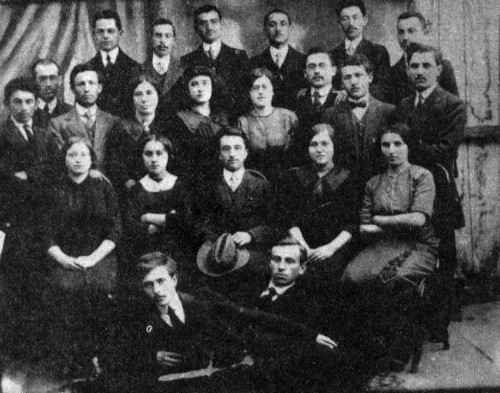
| Literary club in Taczyn (1912) |
[Page 221]
|
|
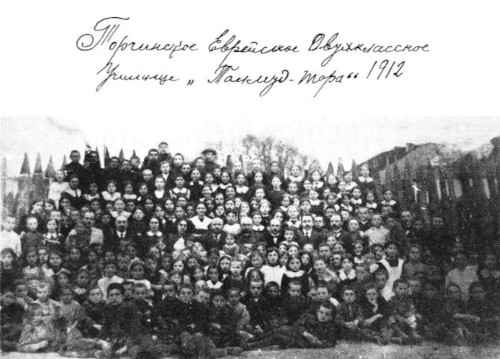
| The communal-political life [The heading on the photograph is in Russian. It says, Taczyn Jewish Two-Class School[1] “Talmud Torah” [school for poor children] 1912] |
The Enlightenment had an influence on the Jewish population in the shtetl. There arose the Hovevei Zion [Lovers of Zion] groups. The young people later became active in the Zion[ist] movement. Various literary and other cultural organizations arose whose purpose was to raise the population to a higher cultural level. There also arose organizations among the toiling and working population.
During those years, Basha Lerner, the actress in Lutsk, would very often come to us in the shtetl where, with Yankl Golperson, Ita Flajszer, Berl Wechter, Grisha Lerner, Zunya Kon, Zisha Baglajbter and so on, she organized a theater group and performed.
Amateur groups that were organized in 1906 were active until the outbreak of the First World War. The [income] from the performances was used for the children's school, the library and so on.
Taczyn always looked up to the larger city, Lutsk, with great respect. However, it also possessed its own folksiness and warm cultural atmosphere. Our young people created a dramatic group in the 1920s that earned praise from the Lutsk actors.
Lutskers would often come to interesting discussions that Mendl Cuker, Hershl Pel and so on arranged for us.
Various political opinions existed within the group. Yet, this did not disturb working together in the theater work. The income was distributed to each organization, without concern for the political viewpoint.
The First World War brought with it the complete destruction of Taczyn.
The shtetl was completely burned as a result of war operations. The rebuilding of the area took place very quickly. The roads that connected Taczyn with Lutsk were paved. This decreased the [time necessary for travel between the two towns], which began to take place by bus. In the meantime, many Taczyn residents moved to Lutsk. Among others who moved were the following:
Dr. Bajlin, Zisha Baglajbter, Yontl Armel, Avraham and Gitl Armel, Shayka Wajsberg, Yitzhak Juz and his family, Ita Dawidson (tanner), Uzer Tublin, Yisroel Szwarc, Mordekhai Szajnszpan, Yisroel Wajsenberg, Motke Szwarc, Chaim Gersznzon and his family, Shmuel Racies, Yisroel and Kayla (the Polish one), Datnowski family, Avraham Leib Boncies, Ben-Tzion Kopelman, Fuks the feldsher [traditional barber-surgeon], Leib Topler, Hochman family, Avraham Gorensztajn, Shimkha and Miriam Sznajder.
[Page 222]
Among the enumerated [above] were several who were later active in the communal area in Lutsk. Dr. Bajlin, who was active in the communal sphere in Taczyn and dedicated much energy to it, was later also active in Lutsk. He and other esteemed members of the middle class in Taczyn organized a children's school, a saving and loan fund, built a highway in the municipal part, erected two pumps that provided fresh water for the population.
|
In Lutsk, he also showed the same energy. He became the chairman of the People's Bank, published a newspaper and so on.
The Gersznzon family was active in the Zionist area. After the death of the father, they left Lutsk and emigrated to Eretz Yisroel, where they live in Haifa.
When Shayka Wajsberg arrived in Lutsk, he threw himself with all of his energy into the activity of various organizations with as much material and physical help as possible. He was active in the school system, the children's home, the library; he was elected as chairman of the Lutsk Professional Union. After his wedding to Ester Juz, both were active in the Lutsk amateur dramatic club. Frequent theater performances took place with the [cooperation] of the well-known Lutsk actor, Laybtshe Lerner. When he succeeded in establishing a family, he became a rich merchant and was successful in his business.
When the Bolsheviks entered Lutsk in 1939, he was arrested and sent to Siberia. As a great merchant he was accused of hatred toward the new Soviet regime. He was sentenced to eight years in the camp. He left Russia after the end of the Second World War, went to Brazil through Uruguay, where he died in the 60th year of his life.
Beni Tauber, from Taczyn, lived in Lutsk until 1928, where he also became active and contributed much with his energy. He, with Dr. Bajlin, became a managing committee member of the People's Bank and over the course of five years, secretary of the Jewish Artisans Union in Lutsk. In New York, he was active in the Tortchiner landsmanschaft [society of people from the same town].
Many Tortchiners [Yiddish spelling of those from Taczyn] were active in the revolutionary area and became fervent followers of the Bolshevik Revolution. They left the shtetl [town] and crossed into the Soviet Union where they took part in the construction of a new life – according to their ideals.
Many Tortchiners left the shtetl and started on roads and roundabout ways to Eretz Yisroel where they took an active part and provided their great contribution to the rise of the Land of Israel. Many others started across the ocean to America where they built a new life for themselves.
Notably, the former warm and familiar atmosphere of the shtetl still prevails and holds us, wherever we find ourselves, together.
At the time of the First World War in 1915, we the Taczyn landsleit [people from the same town] in New York, were among the first who organized an aid committee for the Taczyn Jews who remained in the old home. We also showed concern for all those from Taczyn who were spread around the world. With our help, a savings and loan fund was established in Taczyn, which gave loans to the poor artisans and poor shopkeepers and made it possible for them to stand on their feet after the war. We also supported the Talmud Torah [school for poor children] and the Tarbut school [secular Zionist Hebrew language school]. In 1923, the Tortchiners in America concerned with the need, founded a Tortchiner landsmanschaft. Our landsmanschaft then numbered 200 members. We carried on vigorous communal and cultural activities.
In the years of the Second World War, we organized multifaceted aid for our refugees who had succeeded in saving themselves from the catastrophe and survived.
With the rise of the State of Israel, the Taczyn landsleit excelled in the area of help for the young state and took part in all political and money campaigns. We sent much help to all who went to Eretz Yisroel and took part in building it.
The Taczyn women in the landmanschaft excelled greatly, thanks to whom much [money] was raised, with which we helped the needy refugees. Our women created the necessary warm, friendly atmosphere that cemented our unity.
We immortalized the memory of several of our landsleit by creating foundations at important institutions in Israel. Thus we immortalized the remembrance of the name of Dr. Samuel Kavaler at Jerusalem University in the medical faculty.
A playground was built in Afula named for our landsmanschaft secretary of many-years, Yehiel Garber.
We have to thank the activity of a group of activists with Borukh Czapnik at the head for all of this. In the mentioned group that contributed greatly to our activity are:
Max Razel, Ayzyk Szifris, Dr. Yakov Tublin, Dr. Mordekhai Yona Giber, Avraham Gersznzon, Asher Garber, Moshe Goldweber, Emil Grinberg, Sam Sztern, Sam Wogszal, Fanny Tublin, Helen Kecz, Khona Gersznzon, Ester Garber, Helen Szpiro and so on.
1960
Translator's footnote:
|
|
JewishGen, Inc. makes no representations regarding the accuracy of
the translation. The reader may wish to refer to the original material
for verification.
JewishGen is not responsible for inaccuracies or omissions in the original work and cannot rewrite or edit the text to correct inaccuracies and/or omissions.
Our mission is to produce a translation of the original work and we cannot verify the accuracy of statements or alter facts cited.
 Lutsk, Ukraine
 Yizkor Book Project
 JewishGen Home Page
Copyright © 1999-2026 by JewishGen, Inc.
Updated 24 Apr 2026 by JH