 |
|
[Page 234]
by Sh. Szlajfsztajn
Translated by Gloria Berkenstat Freund
Lutsk, the old historical city, rich in important historical monuments that tell about its greatness and rich past of general significance, also possesses many Jewish monuments. However, the difference is that the general, non-Jewish part has a rich written history and Jewish Lutsk, alas, has very few documents that would tell us the history of each created institution, establishment or of other communal events.
It is the same for the Jewish hospital. It cannot be established according to documents when this useful institution arose. Almost everything we know is from what the old people say.
According to the above-mentioned sources, the Lutsk hospital was likely built in the years 1870-1880, along with the old-age home. Both were “as one” and carried the general name hegdesh [poor house or hospice][1] and later, Bikor Kholim [Society to Visit the Sick]. According to the story from an old man, the hospital was probably erected by Reb Yisroel Klowner, may he rest in peace, who also was the supervisor for a time.
In the last years of the past century [the 19th], the then-Russian regime began to interest itself with the institution and designated “guardians.” The first such guardians were Reb Avraham Gliklich and Reb Shlomo Bardach. Later, Reb Shmuel Yitzhak Iserson and Reb Mordekhai Katzenelbogen.
|
|
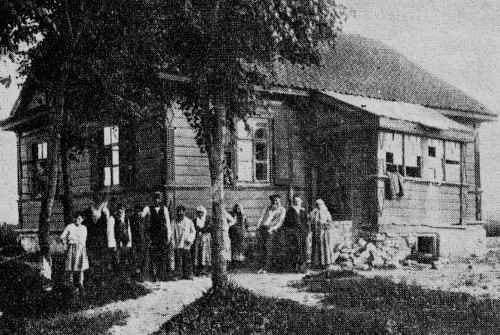
| The Jewish Hospital in Lutsk |
To support the Bikor Kholim, they would mainly use the so-called korobochny sbor [tax on kosher meat], the large sum of 600-700 rubles a month. This sum with the increase of treatment provided the possibility of a more secure existence. The doctors were few. The main doctors of that time were Christians. So for a certain time, the main doctors in the Jewish hospital were Dr. Waunicz and Dr. Josnikow. Dr. Ranc also would work with the hospital.
In addition to the sick who were taken into the hospital for treatment, the sick also would be accepted for a small payment. These sick patients were only examined and the necessary treatment was prescribed for home.
Dr. Waunicz remained the chief doctor at the hospital for a long time and when he left for the front, this office was taken over by the old, well-known Dr. Abramski. He worked voluntarily without wages. A permanent feldzer [old-time barber surgeon], Mr. Barchasz, was also hired.
During the [First] World War, in 1915, when Lutsk was occupied by the Austrians, the hospital was taken by the occupiers and transformed into a military hospital.
In 1916, after the large, historical offensive by General [Aleksei] Brusilov, when the Austrians ran from Lutsk, they naturally also left the hospital, leaving behind a rich inventory. The Russian regime came and occupied the hospital, leaving it to the leadership of the Wszechrosyjski Związek Ziemstw [All Russian Union of Zemstvos – a zemstvo was an institution of local government – the organization was created to serve sick and wounded soldiers] and the director of the Merchants' Union, M. Bak, was designated as the manager.
This situation lasted until 1919, when the city was taken by the Polish regime. The Poles bullied the local Poles and, in general, wanted to take over the hospital as [their] possession. However, thanks to the untiring intervention of Khaykl Wajc, of blessed memory, there was success in showing that the hospital was the possession of the Jewish population and needed to be returned.
In 1920, old, known leaders, Reb Avraham Gliklich and Kalman Goldberg, again came to the hospital and with their entire energy took to bringing in the necessary renovations, modern sanitary facilities and the Bikur Kholim was transformed into a modern, Jewish hospital. At the head of the medical
[Page 235]
personnel then came Dr. Rafalowski, of blessed memory, who with his devoted work gave a strong push forward to the development of the institution, winning the sympathies of the entire population.
The hospital drew its income for its necessary great expenses from the payments for treatment, subsides from the city hall, from voluntary contributions and from a series of Jewish philanthropic sources.
This income was not enough to run the hospital to the extent to which the leaders intended, but this did not frighten the dedicated workers and they thought about expanding the activities and appropriating a space in the hospital for arranging a special maternity division.
This decision was made in the year 1922, when the hospital had no more than 15 or 16 beds and, therefore, they could not do much
|
|
|
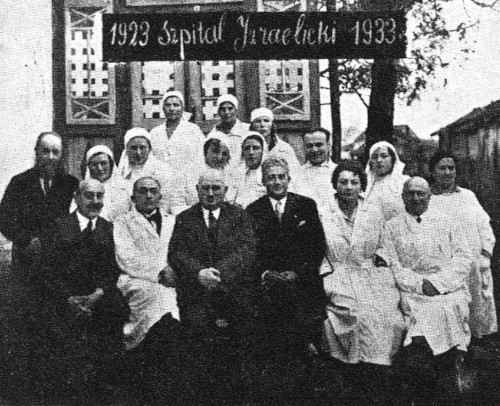
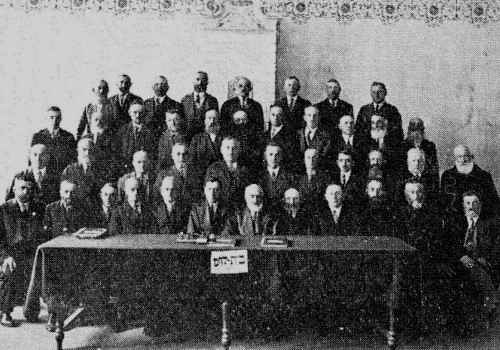
Managing committee and doctors from the Jewish hospital
From right to left in the first row: Dr. Pemow, Dr. Bakszt; Sitting: Friszberg, Dr. Mininzon, Lawyer Bakszt |
in this area. However, the impression that the decision made in the city, mainly in the poor circles was colossal. And this was completely understandable. A scarcity of such a hospital ward that would be accessible for those without money had long been felt in the city. The private well-arranged clinics were not approachable for the broader strata because of the high prices. These Jews had to remain at home where the most elemental sanitary conditions were lacking, not to speak of the fact that in many cases the poor pregnant women simply did not have the few zlotes for a doctor or a midwife.
Alas, however, all of the needs could not be satisfied because they had very little space to designate for this purpose. Yet, Lutsk is a big city and there was no lack of the sick. In addition, the city hall sent their non-Jewish sick to the hospital.
In 1923, however, an obstacle emerged that prevented the hospital work, in general, and accomplishing the idea of opening a maternity division, in particular. The obstacle was the illness of the main activist, Reb Avraham Gliklich. The hospital remained without appropriate leadership.
The popular doctor, Moshe Rafalowski, and the well-known communal leaders Kalman Friszberg and Josef Czitin then took an interest in the fate of the hospital.
When a newly elected Jewish kehile arose in 1928, as the highest possessor of Jewish public property, a special trustee board headed by the Messrs. K. Friszberg and J. Czitin was created to run the Jewish hospital.
The hospital began to prosper and its conditions significantly improved. This did not happen because the kehile would subsidize the hospital with large sums. On the contrary, a few years before, the kehile subsidies for the hospital were not significant. The hospital grew because the mentioned trustees earnestly undertook [the work for] the hospital, showing great initiative and, mainly, dared to undertake substantial and significant work.
First of all, the number of beds was increased from 15 to 36. This alone was a step forward, but it did not end with this. In 1931, actually when the [economic] crisis raged in general and for the Jews in particular, the trustees with Yosef Czitin at the head undertook an action to build a separate building for a maternity institution.
This was a step that elicited astonishment in the city. At that time, when the crisis simply choked and the majority of the income from the hospital fell, such a challenge was more than bold.
A beautiful pavilion was built that cost the board of trustees an entire 2,000 zlotes. In addition, contributions and assessments from various people and the American landsmanschaftn [organizations of people from the same town] (essentially) poured in.
A modern inventory was established and beds [were purchased] with everything necessary [at the cost of] many thousands of zlotes. A sign, Division for New Mothers, was hung – and “done.”
In a manner of speaking, only “done.” It is not easy in life to carry it through. However, the city helped. Many people also installed beds, thus memorialized their names. Our landsleit [people from the same town] from Baltimore
[Page 236]
sent a large sum of money to arrange the birthing room.
The doctors worked without wages. If all of the doctors would have had to receive an honorarium for their work, the hospital would not have existed.
The following doctors participated: Pemow (main doctor), Yosef Mininzon (surgeon), Sima Bakszt (coordinator), Tonya Kunica, V. Rozenkranc, M. Grifel, Sh. Goldberg, Rafalowski.
|
|
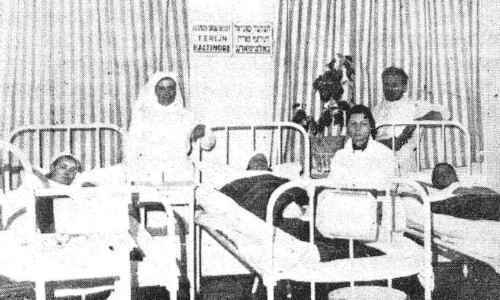
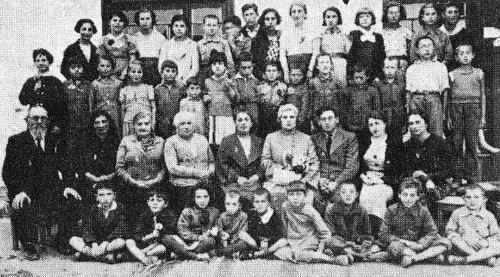
| Room for pregnant women |
Two midwives, three [female] caregivers, five nurses, one orderly and a pharmacist also worked [at the maternity division].
A laboratory was organized at the hospital that cost over 2,000 zlotes and it employed a special laboratory technician.
The hospital had a special steward, bookkeeper, a [female] cook and a [female] boss – supervisor, two laundresses and a janitor.
A special machine for oxygen that cost 700 zlotes also was at the hospital.
The budget of the hospital swung between 45,000 to 50,000 zlotes a year. In the last budget year, in addition to the usual renovations, a beautiful, hygienic kitchen that cost over three thousand zlotes was organized.
The number of sick admitted appears as such:
Year Number
of sickPregnant
Women1924 311 -- 1925 438 -- 1926 477 -- 1927 648 -- 1928 610 -- 1929 654 -- 1930 756 -- 1931 809 -- 1932 807 -- 1933 846 -- 1934 777 263 1935 924 321 1936 1,235 388 1937 1,298 366 1938 1,236 350
The number of free-of-charge patients:
1934 147 1935 194 1937 209 1938 198
Despite all of the this, the condition of the hospital led to much wishing. It would have been important for such a hospital to have its own X-ray room, where the well-to-do could have [X-rays done]; there would, of course, have to be Lux lamps [light therapy lamps] and many other tools.
The trustees, however, did everything they could in order for the hospital to develop in every way it could.
Lutsk, 1938
Translator's footnote:
Translated by Gloria Berkenstat Freund
The idea of creating a medical aid division for the poor artisan strata floated in Lutsk for a number of years. The idea grew out of the necessity of bringing concrete medical aid to the poor artisan families.
The situation of the Jewish artisans changed for the worse in the later years. The “fat seven years,” when everyone was envious of the Jewish artisans at whom one looked with respect and esteem as productive people who were blessed with the ability to support themselves and their families with the work of their own hands, disappeared. That time passed and the meager years arrived when the artisans began to be challenged while sitting without work.
On the one hand, the development of the craft began to penetrate the smaller cities and our model created large workshops which, with their
[Page 237]
|
|
|
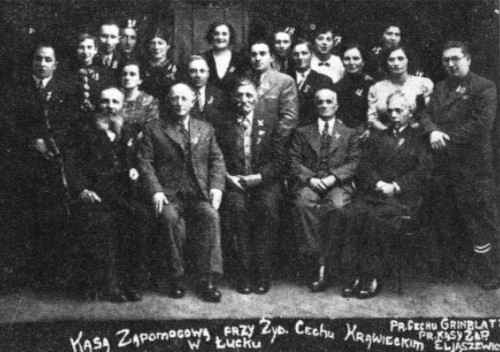
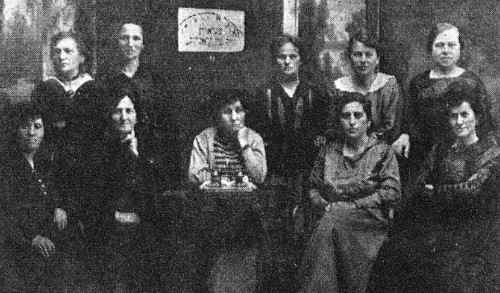
The interest-free fund at the Tailors Artisans Union
Sitting from the right: Rimarczyk, Chajak, Grinblat, Citwar, Sznajder |
competition, began to push out the simple and small artisans. This is what happened with the large Czech shoe firm, Bata; the large, second-rate garment workshops, large furniture warehouses of luxury finished furniture and the like, with their rich assortment and low prices, overshadowed the Jewish home-craftsman and the artisans that worked at home with their primitive workshops and lured away customers from them.
On the other hand, the increased state and communal taxes that had begun to be demanded from the Jewish artisans, expelled them from the position they occupied. With this, the living standards of the large masses of Jews was lowered.
For the first time, the artisan struggled greatly and used various means in order to [keep himself from drowning]. However, in the struggle against an unequal opponent, he fell into the abyss of poverty.
The Jewish artisans had a wretched existence, had no work and did not earn any income. Entire trades disappeared in Lutsk. So, for example, gaiter-makers, cabinetmakers and shoemakers who, years ago, ran workshops and were considered esteemed master craftsmen of their trades, were forced to liquidate their workshops and to take to “magnificent” means of livelihood such as selling bagels and Purim almonds from which one redeemed barely [a few] groshn.
There were hundreds of artisans who weekly did not earn enough for any bread. Their children literally starved and they survived only thanks to the nourishment that they received form the philanthropic aid kitchens, such as Centos [Centralne Towarzystwo Opieki nad Sierotami, also Związek Towarzystw Opieki nad Dziećmi i Sierotami – Central Society for the Care of Orphans], TOZ [acronym of Towarzystwo Ochrony Zdrowia Ludności Zydowskiej – Society to Protect the Health of the Jews] and so on.
In such a situation, when the artisans were impoverished, it was no wonder that they became candidates for various illnesses. The extraordinarily difficult living conditions where in one room many souls had to be housed together, the frequent hunger, the lack of warm clothing for winter and heating in the apartment – all of these reasons led to a bad situation for their health condition and that of their families. Therefore, the illnesses in the poor artisan family were a frequent guest. In cases of death, when people of a blooming age were prematurely torn from life, there were no exceptions. In many cases, medical help was simply lacking at the proper time.
Because of the situation created, a group of active workers from the artisans with a group of artisans' friends, decided to found a medical help division that would distribute free medical help to the needy artisans.
Among the initiators of this undertaking were: Editor Shmuel Chazan, an old artisan friend, vice director of the artisan cell, Josef Wegner, chairman of the photographer's guild, Annya Dossik and the artisan leaders: Zelik Fajntuch, Nakhman Melimewker, Ahron Plach, Mendl Koizol. Berl Lupin, Velvl Ranc and Chaim-Yekl Sigal.
Thanks to the effort of Mr. Wegner, there was success in receiving a subsidy from the artisans' cell of a few hundred zlotes that permitted the beginning of realizing the plan. The negotiations with the doctors were positively concluded and on the 26th of August 1931
|
|
|
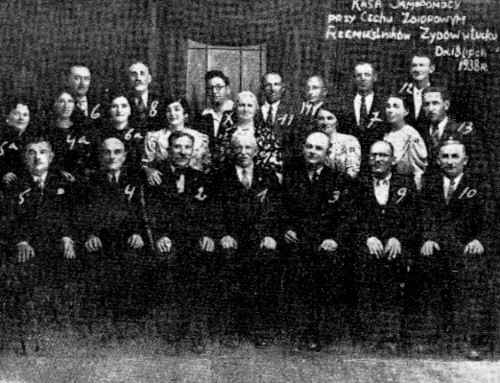
W. A. Margel, 1a. Kh. Margel, 2. N. Melimewker, 2a. B. Melimewker, 3. M. Kos, 3s. Sh. Kos, 4. B Lupin, 4a. R. Lupin, 5. M. Koziol, 5a. Kh. Koziol, 6. P. Szidler, 6a. R. Szidler, 7. A. Feldman, 7a. B. Feldman, 8. Y. Kuszmiecz, 9. Y. Gurman, 10. Y. Rafe, 11. F. Brajer, 12. L. Gitelman, X Sh. Chazan, 13. Sh. Bokowiecki, 14. Y. Korczak |
[Page 238]
the medical division was opened under the name: Sick Fund of the Artisans' Union.
The founding of the fund was greeted with great satisfaction from the artisan strata. Representatives of the city managing committee as well as many doctors were present at the opening banquet.
At the first moment of its existence, 105 artisan families benefitted from the fund. One thousand three hundred sixty-five cards were distributed for visits to doctors.
In the course of the ebbing time benefiting from our medical help were:
In 1931 – 105 families
In 1932 – 297 families
In 1933 – 365 families
In 1934 – 502 families
In 1935 – 497 families
In 1936 – 382 families
In 1937 – 402 families
In 1938 – 267 families
It must be added that the fund in many cases also supported the impoverished artisans with money. The size of the sums sometimes reached in the hundreds of zlotes. In many cases, it also gave loans with long-term installments and with very easy conditions.
The leaders of the fund and chairman, Avraham Margel, N. Melimewker and Mordekhai Kos, however, were not completely satisfied with the results of their activity. The believed that not everything had yet been done. It was a question that the sick fund should also be able to take care of the needy with free or lower cost medicinal medications. They tried to do this, but, alas, the poor financial means of the fund did not permit this to be done on a wide scale.
In a conversation with the chairman of the fund about the activity, he declared:
“The entire basis that supports this aid division explains the enterprises that are arranged from time to time and of the monthly dues. However, both sources are insufficient. From them we cannot even pay the doctors. It is only thanks to the good will of the doctors that we somehow get by. However, it is even worse with prescriptions. We have tried every method. Alas, we are not able to accommodate the existing need with our own efforts.”
Every venture that needed to be carried out was like parting the Red Sea. However, we need to add that the group of activists were devoted to the artisans' movement, to its aid institutions and were ready to give all their strength, were ready to sacrifice further.
The sick fund at the Joint Artisans Guild includes the following trades:
Tailors – 80, shoemakers – 15, hairdressers – 25, painters – 22, gaiter-makers – 10, hatmakers – 4, harness-makers – 8, watchmakers – 4, upholsterers – 3, bookbinders -4, carpenter-wheelwrights – 7, seamstresses – 2, locksmiths – 1, glazers – 19, bakers – 15, carpenters – 19, tinsmiths – 10, blacksmiths – 10, photographers – 8.
The remaining number are in many other trades that count a small number of members, such as, for example, brush-makers, boilermakers and so on.
The doctors who work at the sick fund are: Dr. Arnold, Dr. Mininzon, Dr. Leo Gutes, Dr. Goldberg, Dr. Fadenhecht, tooth doctor Frilingowa, eye-doctor Yosinski, throat-ear doctor Segal, X-ray doctor Ptic, bacteriologist De. Cila Winnik.
From the sick fund at the United Jewish Artisans Guild, from January until the 1st of December 1938
| Income | Zlotes |
| 1. From member dues | 210.00 |
| 2. Enrollment money | 73.50 |
| 3. Payments for visits | 366.00 |
| 4. Return for unused receipts | 3.00 |
| 5. From events | 512.00 |
| 6. Subsidies from America | 766.04 |
| 7. From other sources | 737.00 |
| Total: | 2,667.54 |
| Expenses | |
| 1. For healing and prescriptions | 482.00 |
| 2. For doctors | 1,307.50 |
| 3. Personnel and admin. | 295.00 |
| 4. Support for artisans | 200.00 |
| Balance on 1st December | 383.04 |
| Total: | 2,667.54 |
by Batya Hochberg
Translated by Gloria Berkenstat Freund
It was in 1917, after the horrible war, when we first saw the terrible results of the world slaughter: cripples, agunahs[2], widows, the lonely, the neglected, the sick and the hungry.
Lutsk lacked places at that time to which those in need could turn for help, for a doctor, for an item of clothing, for a prescription. The idea arose among a small group of women to found a Women's Union that would distribute help to the sick poor.
The first work was: calling a meeting of all the women who had an interest in the aid work. The group of gathered women unanimously took a position in favor of creating a women's union and immediately supported the work with time and money. A large sum of money from a voluntary assessment was collected in order to meet the primary needs of the municipal poverty. A managing committee was elected, to which entered the following esteemed women in the city: Bina Richter, Khaya Goldberg, Gitl Gendler, Brukha Kuliner, Shya, Khana Goldberg, Laufer, Berger, Brukha Grausburd, Kh.R. Kagan, Perl Hurwic, Goldberg.
To secure for the union a permanent income, a recruiting campaign for members paying regular monthly dues was carried out in the city. They also began to visit various celebrations to collect money. When the budget was more or less assured, the managing committee publicly announced throughout the city that the sick poor who needed medical help and could not provide their own help needed to turn to the Women's Union where they would receive help.
They did not have to wait long for the sick because, as was said, the need then was great and illness was a well-established resident with the Jewish poor. The sick flowed en masse – and they received medical help.
The activists were not satisfied with this work area and they began to visit the sick in their houses. A great deal of idealism and self-sacrifice was demanded for this because it was connected with the danger of infection from epidemic illnesses that raged then. However, the energetic activists did not consider this and they would visit the sick in their rooms. They brought medicines, doctors and, often, also something to refresh the sick. If this was not enough – they would transform into merciful nurses, busying themselves with cupping or bathing and smearing the sick and as was needed – they would spend the night with the patient.
Besides the danger of infecting themselves, there was still another one: to be punished by the regime for being involved with such an activity without legalization. The union did not have any certification statute then and, while the work of the union, had it had the right would have been humanitarian and noble, it could not be thought of as legal. The
|
|
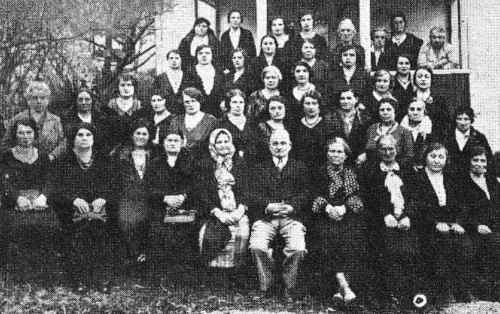
| Women's Union Bikur Kholim |
managing committee then had the ingenious idea to work under the wing of the Jewish kehile [organized Jewish community], that is, a women's committee of the kehile. The union, however, could not carry on normal activity, could not hold any public meetings, and so on.
In 1926, the hard-working leader, Serl Driker, who by then had already worked in the union for nine years, succeeded in getting the statute [for the union] legalized with the government. The work of the now legal institution increased at once. The legalization also provided the opportunity to appear at the agencies of self-rule with the demand for subsidies for the union. And this happened. The city hall and the kehile recognized the
[Page 240]
union and did pay out significant subsides. This provided the ability to expand the activity of the union and satisfy more needy.
Thus things continued until 1931. In that year a bit of a collapse occurred. The economic crisis strongly hit the existence of many city residents; the impoverishing hardships began to advance in Lutsk with rapid steps; the free donations and monthly dues became significantly smaller. In addition, the subsidies – both from the city hall and from the kehile – were stricken. This paralyzed in great measure the desire to work. Besides this, Serl Driker, for family reasons, had to leave the work of the union. Other women also left; some [emigrated].
The Union remained at the edge of collapse. It was left to inform all members about the danger to the existence of the Union.
On the 22nd of October 1932, a general meeting took place. There, it was made clear that the Women's Union fulfills a very important function and it could not be replaced by any other institution, that it must exist. All of those assembled committed themselves to continue to support the union materially. At the same meeting, a new managing committee was elected. Batya Hochberg was unanimously elected as chairwomen – as vice chairwomen, Henya Sztrachman, as secretary – Golda Erlechgerecht. The treasury was left in the hands of the energetic Gitl Gendler. A revision committee was also elected including Czitin, Czeczotke, Necht, Szpanerflig, Krakower. Ingberg, Buianer. The Nistarim Committee [Committee to aid those suffering from illness] remained in the hands of Serl Driker and Khana Goldwog.
With fresh energy, the union went to work. They carried out a recruiting campaign for new members; they began to expand visits to all celebrations and not let pass any opportunity that could bring in income for the Women's Union. Simultaneously, connections were established with our American landsmanschaftn [organizations of people from the same town], which at once warmly reacted to the appeal from the union and began to support it.
Thanks to the energetic work, the union's income grew and reached the sum of 7,000 zlotes, which, naturally, was all used for help in the form of doctors, medicines, X-ray films, analysis, with sending [the sick] for treatment in summer residences, care, and also monetary support. The greatest attention was given to the isolated people suffering from poor health who were supported with larger sums.
The managing committee of the Women's Union Bikur Kholim in 1938 consisted of the following women: Batya Hochberg – chairwoman, vice chairwomen – Khaya Libhober and Golda Erlechgerecht, secretary – Sura Marszalkowicz, treasurer – Finkel Rozensztrom, authorized to issue vouchers for medicines and visits – Etl Ingber.
Representatives: Tunya Goska, Rywke Szapiro, Szachniuk.
Members: Landsberg, Khaya Goldberg, Stolar, Brukha Szia, Fany Bluwsztajn, Gitl Wajsberg, Mayke Zelcer.
Revision committee: Rebbetzin [wife of the rabbi] Soroczkin, Hinda Kotlar, Szpanierflig, Hinda Pugacz, Brukha Kuliner.
Nistarim committee: Serl Driker, Khana Goldwog.
Society court: Dwoyra Goldberg, Czeni Muliar, Lender, Rywka Rajnmel, Buzi Ingberg, Khinka Sztajnberg, Khaya Kimelgarn, Rauer.
Directors at Krasne [Street]: Fanya Sznajder. Frayde Kigel, Fikus, Tenenbaum, Khaya Ita Goska, Zezi Sztajnman, Flamenbaum.
Lutsk, 1938
|
|
| Women's Union on Krasne |
| Income | Zlotes |
| 1. Balance on 1 October 1937 | 145.64 |
| 2. Members' dues | 3,125.43 |
| 3. Celebrations and deaths | 663.95 |
| 4. Holidays | 1,418.95 |
| 5. Support from America | 768.55 |
| 6. From events | 865.91 |
| 7. Flower days [sales of flowers] | 173.84 |
| 8. City Hall subsidies | 100.00 |
| 9. Various donations | 101.05 |
| 7,363.32 | |
| Returns | 32.60 |
| 7,395.92 | |
| Expenses | |
| 1. Money support | 1,981.12 |
| 2. For medications/remedies | 2,774.64 |
| 3. Doctors | 1,120.45 |
| 4. For cash box | 740.71 |
| 5. Various payments | 433.95 |
| 6. Treasury balance on 20th October 1938 | 345.05 |
| 7,395.92 |
[Page 241]
Women's Union Bikur Kholim in Lutsk Founded in 1926 Lutsk, the 9th of July, 1935.
To the Lutsk Lekhem Aniyim [Bread for the Poor] Society in New York
With this we acknowledge the receipt of 25 dollars in May of this year for which you are thanked in the name of the above-mentioned poor and sick who benefit from your help. If only the Almighty God will pay you according to your worth.
Simultaneously – in connection with the so-called season of poverty, God help us, when increased help is demanded for those who need it and when our income is so small – we come to you in the name of the heartrending calls for help by the poor and sick, with an appeal to remember our unfortunate sick sisters and brothers [whose number has now increased]. In connection with your decision to place in your annual budget a sum of 60 dollars a year for our union – we appeal to you and ask for a review and increase of the sum of our yearly subsidy. Remember that your increased help will secure our institution from liquidation.
In the certainty that our call for help will find an appropriate reverberation in your hearts and you will respond warmly to our appeal, we remain sincerely –
The managing committee
Chairman: Batya Hochberg
Vice chairman: Henya Sztrachman
Secretary: Golda Perlmuter
Translator's footnotes:
by G. Kruk
Translated by Gloria Berkenstat Freund
In 1924, the idea arose among a group of worshippers at the Great City Synagogue, led by the late Moshe Kiperman, of blessed memory, to found a Linas haTzedek [Shelter of the Righteous – charitable organization to provide for the sick] in Lutsk that would not have the character of the Linas haTzedek societies at the various synagogues and shtiblekh [one-room synagogues], but would be a modern institution with a [legal] statute and premises with an expansive medical and humanitarian mission of helping the sick poor.
Decided upon and realized. Moshe Kiperman, a person who had insight in general for organization and great experience with work for a Linas haTzedek in particular from the time that he spent in Warsaw, energetically began to accomplish the vital plan.
It was difficult for him to take the first step. Without possessing even the minimal means, Moshe Kiperman, however, did not belong to those who quit. With a small sum of money that was collected at the first founding meeting, he laid the organization ground stone for the Linas haTzedek.
A provisional managing committee was elected and a council with the following composition: Moshe Kiperman, Moshe Bik, Moshe Szpicman, Matis Szpanerflig, Mikhel Bruksztajn, Shlomo Dajtsz, Yakov Rudik, Shmai Brodecki, Yehosha Krauz, Gecl Kruk and Avraham Szajnerman.
The women Liba Szpanerflig and Fruma Beregowoj joined the work.
The first work of the managing committee was to recruit members who would pay monthly dues.
This campaign was successful and the number of members constantly grew. In addition to the monthly dues, the managing committee organized other campaigns and events that brought in considerable income.
Then the actual work of Linas haTzedek began, which consisted of the following two activities:
1) A group was created that would look after the Linas [accommodations]; that is, every night another pair would go to a sick member to spend the night and serve him according to the possibilities and knowledge. In addition, the necessary basic tools for an illness also were brought, such as bankes[cupping glasses], ice packs, basins, hot-water bottles, thermometers and similar [items] for the not well-off sick to borrow, and 2) doctors were hired who would give help to the sick poor.
[Page 242]
The first to agree to give a few hours to the sick poor through the Linas haTzedek was Dr. Abramski. Dr. B. Bajlin, Dr. Rafalowski, Dr. Pemow and Dr. Mininzon expressed their readiness to work.
In addition to this, a Khevre Kadishe [burial society] was created that would take on Holmoyes Hames [the mitzvah – commandment – of accompanying the deceased].
Little by little, the city began to take a strong interest in the Linas haTzedek and in its activity. People began to enroll as members and expressed their readiness to work for the institution.
Here we first saw that the institution needed a premises, because the synagogue where the group would come together for consultations was not very suitable.
|
|
|
1. Sh. Brodecki, 2. Sh. Etinger, 3. M. Kiperman, 4. Y. Finkelsztajn, 5. Y. Barak, 6. G. Kruk, 7. A. Cnoliwer, 8. M. Szpanerflig, 9. Dr. Mininzon, 10. Bakszt, 11. Dr. Grifel, 12. Rozenfeld |
Meanwhile, they used the room of Mrs. Szpanerflig. There they remained until 1925 when they finally were legalized by the regime as a "charitable society to help the sick poor, Linas haTzedek haRoshoni [the First Shelter of the Righteous] in Lutsk." Then a premises was rented and the institution began to function normally. A regular managing committee was elected that consisted of the most esteemed people in the city such as Avraham Gliklich, Ezra Pinczuk, Aleksander Berliner, Meir Wajnsztajn, Mrs. Zlata Bibergal, Reb Kalman Goldberg, Shmai Brodecki, G. Kruk, Avraham Szajnerman, Matis Szpanerflig, Mikhl Bruksztajn, Mrs. Mirl Kafe and Shlomo Kraus. The first flower [sales] in the streets of the city brought in a large sum of money.
The upturn of Linas haTzedek interested not only the older society, but also captured a significant part of the young strata, who reported in large number to the office, registered as members and began to gather in Linas haTzedek, bringing life and fervor for work. The young organized a dramatic section that was busy with arranging amateur presentations. These had a double purpose; yes, they brought in income for the Linas haTzedek; yes, the young worked meaningfully on them, providing the opportunity for the more capable ones to distinguish themselves. The young people from the circle, who did not take part in the performances, worked around the theater presentations, spending their free time in their own environment.
Working in the youth circle were: Chaim Kanfer, Chaim Shmuel Frajdfirer, Avraham Geler, Avraham Braunsztajn, Zvi Esterkis, Leib Gerbacz, Yakov Fiszman, Leib Fiszman, Yakov Cziczik, Ali' Cziczik, Zelik Szpicman and the misses: Rywka Szpicman, Genya Sznajder, Sonya Szpicman, Liuba Garmel, Sonya Najter, Fayga Geler, Czenya Matiuk and Roza Sznajder.
The institution strengthened and began to grow. In 1927, through the initiative of Shmai Brodecki, Yakov Barak, Dov Bauaner, G. Kruk and Yitzhak Kraun, the clinic of Linas haTzedek was created. A capital of several thousand zlotes was gathered to buy the necessary surgical instruments and tools, as for example, a quartz lamp, a gynecological chair and the like.
When the tools were bought, a meeting of the esteemed Jewish city doctors was called, at which Dr. Abramski appealed to all of his colleagues for each one of them to donate his effort for the only Jewish clinic in the city. He himself – Dr. Abramski – obligated himself to donate two hours every day to the Linas haTzedek.
All of the assembled doctors expressed their agreement. The medical personnel came together in the following manner: as directors, Dr. Abramski, Dr. Mininzon, Dr. Rywka Bakszt and feldsher [old-fashioned barber-surgeon] Barchasz.
Understand that with such well-known doctors employed in the clinic, it was always full of patients – all poor and without resources.
That year the following managing committee should be recorded as active and energetic: Meir Bak, Moshe Kiperman, A. Landsberg, Yakov Barak, G. Kruk, M. Szpanerflig, Dov Bauaner, Miss Tauba Draliuk, Miss Genya Sznajder, Manya Elbirt, Kh, Sh. Frajdfirer, Yosef Finkelsztajn and Noakh Mazur.
This managing committee also received a subsidy in the amount of 1,000 zlotes for a year from the city managing committee and implemented an infirmary group and a lottery that brought in a large income.
[Page 243]
A presentation by the amateur [actors] of the youth group also was carried out.
How popular the Linas haTzedek was among Jewish society can be seen from the fact that at an internal celebration at the premises of the Linas haTzedek, among the guests who registered in the memorial book of Linas haTzedek are found: Meir Kronsztajn, Szucman, Anuta Gliklich, Guta Wajnrajch and Reb Moshe Gliklich. The Christian engineer, Kazimierz Szkolnicki, who was famous for his open hand for Jewish purposes, donated the largest sum – 100 zlotes.
In 1931, the managing committee celebrated the seven-year anniversary of Linas haTzedek in a grand manner. The celebration brought in significant income and increased the number of members.
At that time, the institution found itself at the highest level of actions and activities. The doctors related extraordinarily well to the patients at the clinic; the managing committee did everything possible, acquiring more income, and the youth circle would come together every evening, organize the overnight stays and just spend time in the reading room of the Linas haTzedek.
But it was not destined, it seems, that this institution would grow. The Linas haTzedek suffered greatly because of the deaths of Dr. Abramski, Dr. Bajlin and Feldsher Barchasz.
Dr. Grifel and [Dr.] Jaszinska the [female] eye-doctor, were then hired for the work.
The activity of the clinic ceased completely after a short time, but Dr. Grifel was very dedicated to the clinic; the same for Dr. Jaszinka. On its part, the managing committee again sent out an appeal to the city about support for the clinic. The work began again.
From that era, of the active workers at the clinic must be recorded the following activists: Shmuel Etinger, Shlomo Leszner, Moshe Kiperman, Shmai Brodecki, Chaim Spektor, Yitzhak Germel, Genya Sznajder, Mordekhai Ranc, Moshe Szpicman, Leib and Yakov Fiszman, Y. Barak, Matis Szpanerflig, Chaim Shmuel Frajdfirer and Gecl Kruk.
In 1934, the tenth anniversary of Linas haTzedek was celebrated. Anniversary insignias were distributed in the thousands. At a special [gathering] at the hall of Hashmonai [Zionist sports and academic club] assembled the most esteemed businessmen in the city, who expressed approval and gratitude to the leaders of Linas haTzedek for their work.
1936 was a critical year for the Linas haTzedek clinic. The work was weak; members began to give up and murmured that the institution did not have any justification for existence, that it would have to close.
At a special mass meeting, the members had to express whether they were for restoring the institution or for liquidating it.
The numerous members of the group almost unanimously expressed themselves for continuing the useful institution. All promised their cooperation to the new leadership, which was transferred to the hands of the young and energetic activist, Councilman Dovid Berger.
The work of the clinic again strengthened; the members returned to the work. The new chairman, H.D. Berger, attracted more active people to the managing committee and they began to pull the wagon of Linas haTzedek again.
Helping were: Shlomo Grinblat and Ruwin Kagan – vice chairmen, Yakov Bawerman – the honorary chairman and the members: M. Szpanierflig [spelled Szapnerflig above], Kh. Sh. Frajdfirer, Yehiel Ranc, Chaim Spekor, Chaim Gamer, Yehuda Jucht, Mordekhai Pisarewski, Shlomo Sznajder, Khona Kapuste, Zwi Esterkas, Zishe Kelerman, Yakov Cziczik; particularly active were the energetic women: Khaya Elbirt, Genya Sznajder, Miriam Rauer, Ester Tenenbaum and Khaya Krisztalke; from the council: Editor, Sh. Chazan – chairman, Yakov Barak – vice chairman, Mordekhai Ranc and Gecl Kalike.
In the same year, Linas ha Tzedek was visited by Mrs. Dora Bratman from Chicago. The work of the institution pleased her greatly. Before her departure, the Linas haTzedek managing committee arranged a modest farewell for her and she was registered as an honorary member of Linas haTzedek.
In 1937, the chairman obtained a yearly subsidy for Linas haTzedek in the amount of 600 zlotes from city hall.
This did not happen so easily. At first, the regime had to be persuaded that Linas haTzedek was an institution that carried on useful work and, it, therefore, earned the right to be supported by the municipal treasury. Various commissions from the representatives of the regime came several times and audited the activities of the clinic. Even the city president himself came to Linas haTzedek to become familiar with its work.
The praise from the representatives of the regime was magnificent. They all determined that the clinic was very useful for the city and the subsidy was approved.
However, the chairman, Berger, was not satisfied with the subsidy. He undertook further efforts for the city hall to allocate a location for Linas haTzedek to erect a pavilion for the clinic. The matter
[Page 244]
proceeded on a good path; the location was designated and decided upon. However, the changes that took place in the plan of the city [construction administration] made it impossible to use the chosen plan.
Several reforms were carried out in the clinic itself by Chairman Berger. More doctors were attracted [to the clinic]: Dr. Segal and Dr. Fadnhecht, who substituted for Dr. Grifel. The work proceeded admirably. A performance was given from time to time and it generated income for Linas haTzedek. However, it was small in relation to the prevailing need.
The American brothers and sisters did not forget Linas haTzedek and their support made possible the carrying out of further work.
With the death of the initiator and founder, Moshe Kiperman, the most devoted friend of Linas haTzedek was gone. The deceased left 500 zlotes for Linas haTzedek in his will.
However, this was a drop in the ocean. The need kept growing. The sick increased and the work hours of the doctors, alas, had to be limited due to the lack of means.
The useful activity of Linas haTzedek can be illustrated by the following numbers of the sick received in its 12-year existence.
Year Number
of sick1927/28 5,090 1929 3,041 1930 1,890 1931 1,765 1932 1,093 1933 578 1934 654 1935 2,058 1936 2,041 1937 2, 587 1938 2,008
Lutsk, 1938
Translated by Gloria Berkenstat Freund
The Beis Lekhem [House of Bread – aid to the poor] has existed since the year 1929, when the decline began for a large part of the Jewish population, particularly the widespread, [economically] insecure strata.
The drudgery of impoverishment then was so widespread that people were in need of a simple piece of dry bread. A group of worshippers from several houses of prayer then came together, such as Reb Sholem Goldberg, of blessed memory, Y. Akman, Szlajf, Yakov Leibel, Rabbi Chaim Benyamin Graus and other town notables and the Beis Lekhem Society was founded, which took as its purpose supporting the poor, Jewish population with food products as well as with money.
The statute [for the organization] was immediately legalized. Very active work began that met with great sympathy on the part of all strata. Not only in Lutsk, but with our brothers and sisters on the other side of the ocean, who created aid committees in the name of the Lekhem Aniyim [Bread of the Poor] Society and began to help the Beis Lekhem here [in Lutsk] significantly to enable it to fulfill its task.
Among the worthy and very active old communal workers must be recorded: the first chairman Zwi Sztajnberg, chairman Reb Menakhem Mandelbaum,[1] chairman Reb Yehezkiel Szirczik, council chairman Dr. Avraham Hofman, chairman Yosef-Chaim Krisztalke.
The activity of Beis Lekhem consisted of giving bread and challahs to poor families every week. In several cases – also money for the isolated sick poor and, on the eve of every holiday – meat, sugar, oil and other products.
The income for Beis Lekhem were: from monthly dues, from various campaigns and in a significant amount also from the support of the landsleit [people from the same town] in America. In addition to this, every Shabbos [Sabbath], members of Beis Lekhem collected bread and challah throughout the city. This collection
|
|
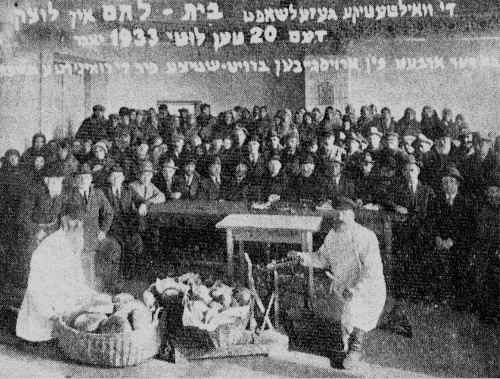
| [On the photo: The voluntary society, Beis Lekhem in Lutsk. 1933] |
[Page 245]
|
|
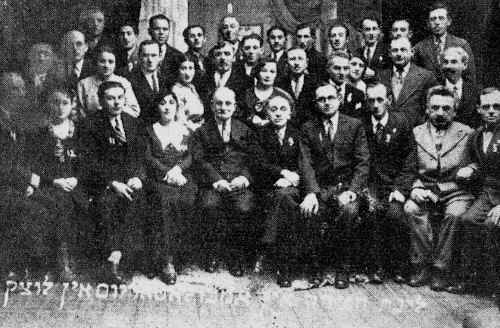
| Managing committee of Beis Lekhem (1933) |
of bread went to the poor. However, it did not suffice for many.
In 1935, the number of registered receivers of charity rose greatly, reaching up to 2,000 people. The managing committee then felt exhausted from the difficult work, constant collections and extraordinarily difficult connection of one with the other. It was decided to call a general meeting and to draw in new energy. Such new people were found and it must be admitted that thanks to the new leadership with the energetic chairman, Mr. Dovid Buslik at the head, the work proceeded much better.
This leadership consisted of the following activists:
Chairman of the managing committee – Dovid Buslik; chairman of the economic committee – Yehiel Ranc, one the oldest activists in Beis Lekhem, who knows all of the nistarim [the isolated poor suffering from illness] and as is written in the memorial book of the Beis Lekhem about his services; chairman of the council – Ruwin Kagan, also an active worker in the Jewish national-political area; vice chairman – Berl Pisarewski, also an old tested activist; Sh. Sznajder, Sh. Mesz, Naftali Debert, Ahron Rapoport, Yosef Bajgler, Tzvi Aksman, V. Spektor, Volf Marmor, Mordekhai Bezpanjasnik, M. Alter, Y. Wajsman, A. Gurfinkel, Sade, Y. Kuperszmid, A. Mesz, M. Liberman, Y. Grajewer, Yitzhak Garmel, Sh. Fuks, Y. Sime, A. Paszt, Y. Ejnbinder, Sh. Majstl, G. Goldberg, Zalman Barmak, Z. Kelerman, Y. Jucht, F. Tajtlbaum, F. Bojdman, Lipa Welweler, M. Litman, G. Kameniecki, Yakov Traub, Eliezar Abciuk, D. Arencel.
Thousands of people received support from Beis Lekhem; in addition to this, almost 2,000 souls received one-time support.
In 1938, the landsman [person from the same town] from America, the honorary chairman, Reb Mordekhai Diment, spent time in Lutsk [and] visited Beis Lekhem, spent time with the businessmen at a modest tea evening and determined that the activity of the Beis Lekhem was of utter importance. He helped organize extensive support from the brothers and sisters on the other side of the ocean for the needs and requirements of Beis Lekhem.
|
|
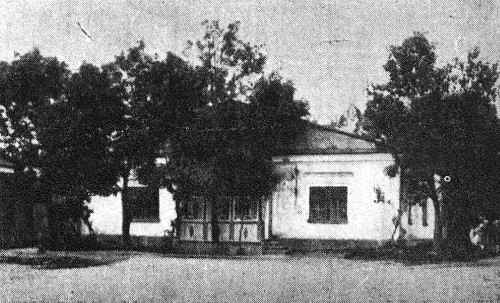
| Old-Age Home in Lutsk |
[Page 246]
|
(A letter written in 1930) Managing committee of Beis Lekhem in the city of Lutsk The most difficult crisis that we have been living through in a long time has created a great ruin in the entire economic life in general and, in particular, for Jews. Many victims have fallen, former well-to-do men; donors have been transformed into receivers of charity. The need has become more and more acute. The urgency for immediate help prompted a certain group of people to create an institution that would, at least a little, alleviate the great and difficult need and, at least, partially quiet the hunger of hundreds of unfortunate souls. Such an institution was actually created. A committee was organized of certain people who erected a charitable institution, Beis Lekhem, which has existed for two years. This institution is very popular in the city because of its usefulness, because:
Standing on watch for the interests of our impoverished and hungry brothers and sisters, the committee of Beis Lekhem made a decision to turn to you, dear brothers, with the call: Help! Do not let the great building fall, as with its fall, God forbid, thousands of our brothers will be suffocated under its ruin. Remember your old home, where the people you left in their splendor and glory have, alas, fallen so much that their entire existence is drawn only from Beis Lekhem. These people cannot stick out their hand and ask; former rich men cannot so quickly violate their pride. Such isolated poor people suffer hunger and cold. The tears choke them and if not for the vigilant eye of Beis Lekhem, which takes care of such respected isolated poor people, we would, God forbid, have many cases of death from hunger. Remember the poor widows and orphans who are the most hidden element in life. Imagine the cruelty of the situation when the young children, the innocent babies, stick out their little hands and ask, not for pieces of candy and not for any luxury, but for a piece of dry bread and the unfortunate widowed mother is drenched in boiling tears, not having any possibility to quiet the hunger of her most beloved and dearest; the only point of rescue is Beis Lekhem, which now finds itself in great danger. We want to believe and hope that although you are far from us, you remain organically closely bound to us. We turn to you as to our own dear brothers, who are not now in a position to help us and will surely find the appropriate reverberation in your warm, Jewish hearts. Brothers; Help! The fate of thousands of souls is now in your hands!
Chairman: Menachem Mandelbojm
Support can be sent to the following address:
Prezes Žydowskiego Towarzystwa Dobroczynności
The Head of the Rabbinical court of Łuck certifies and confirms that everything written in this letter is true and correct, without omission. From the signatory, for the sake of Torah and charity, Yechiel Yitzchak Rappaport, head of the local Rabbinical court. Stamp |
[Page 247]
From the 1st of April 1937 to the 1st of April 1938
| Expenses | |
| Distributed 28,621 kilograms of bread | 7,850.12 |
| 7,589 challahs | 719.01 |
| Support in cash | 74.25 |
| 420 challahs Shavous | 83.02 |
| 2,979 challahs for the Days of Awe | 461.89 |
| 158 pounds [71.6 kilograms] meat | 142.47 |
| Cash | 10.00 |
| For 502 Purim challahs | 79.80 |
| Various printings | 171.50 |
| Office | 120.90 |
| Heating and lighting | 61.41 |
| Apartment repairs | 131.65 |
| Collector of bills Ajzenberg | 113.64 |
| Fuks | 475.44 |
| Bookkeeper Rauer | 1,040.00 |
| Employee Maty Tabacznik | 490.00 |
| Insurance institution (Ubezpieczenie) | 408.71 |
| Arranging the Shavous campaign | 32.55 |
| Tin Pushkes | 8.00 |
| Supplies for the association | 181.96 |
| Provisions for the Days of Awe campaign | 96.05 |
| Various | 14.50 |
| Purchase of calendars | 346.49 |
| Provisions for Chanukah campaign | 42.93 |
| Provision for all kinds of campaigns | 132.13 |
| Provisions for Tu b'Shvat [New Year of the Trees] | 22.10 |
| Provisions for the Purim campaign | 43.29 |
| Unforeseen expenses | 81.76 |
| Total | 13,435.57 |
| Income | |
| From members' dues | 2,915.27 |
| From wedding, engagement contracts, etc. | 311.22 |
| From the Purim campaign | 293.56 |
| Advance payments for Passover campaign | 19.25 |
| Shavous campaign | 202.45 |
| Collected through pushkes | 112.12 |
| Ring campaign | 754.15 |
| Eretz Yisroel Agra d'Taanis [monies from fasts] | 127.16 |
| Pledges from the [Shabbat of the] Torah Portion of Re'eh | 229.99 |
| Rosh Hashanah campaign | 823.94 |
| Pledges from the [Shabbat of the] Torah Portion of Vayeitzei | 267.11 |
| Chanukah campaign | 237.35 |
| Calendar campaign | 877.00 |
| Tu b'Shvat campaign | 188.86 |
| Donations of products | 1,605.34 |
| Aid donations | 94.55 |
| Support from America 422 | 2,214.64 |
| Rent money | 510.72 |
| Contributions | 180.00 |
| Deficit campaign | 96.85 |
| Various benefactors | 168.70 |
| Various income | 147.05 |
| Deficit | 1,058.29 |
| Total | 13,435.57 |
Translator's footnotes:
by V. Cziczotka
Translated by Gloria Berkenstat Freund
At the beginning of 1923, the representative at that time of the Joint [Distribution Committee], Director Kahan, informed the communal activists who led the campaign for monetary support, which the Joint had given until then for the support of the suffering children after the [First] World War, that the Joint considered its mission complete. He, therefore, proposed that the care of the children should be given to the local community itself. Naturally, the Joint would also continue, as far as possible, to provide help.
It is understandable that this news surprised all communal activists in Lutsk who had become accustomed to the idea that the Joint would continue its productive help on behalf of the suffering for many years. The situation of the Jewish population in Poland in general and in Lutsk in particular, was not then very stable and firm economically, so, in general, no great possibility was seen of doing something with one's own strength.
A communal deliberation was called for all who had helped with the aid work for the poor children with the Joint. The representative of the Joint categorically demanded that the local community take over all agendas that were connected to this matter.
We have to admit that the local communal activists
[Page 248]
in Lutsk were truly afraid to take upon themselves the great responsibility. Yet they overcame their fear thanks to the honest will of individual dedicated activists and they cautiously undertook the organizing of the society named Gezelshaft far Yesoymim-Farzorg-Yung un Kinder-Shutz [Society for the Care of Orphans, Youth and Child Protection].
|
|
| Tsentos Summer colony for Children (1936) |
This organization, with the permission of the Volyn [Volhynia] supervisory regime, was organized in all of Volyn. A division of it also existed in Lutsk. The devoted activist (he was head of the Lutsk kehila [organized Jewish community]), Mr. Heikl Wajc, of blessed memory, placed himself at the head of the newly-organized society. Thanks to his capabilities and esteemed communal position, there was fitting success in organizing the Lutsk division.
The best and most intelligent people in Jewish Lutsk were drawn to the work of the newly created organization. Various committees were set up, such as: Registration Committee, Administration Committee, Nutrition Committee, Juridical Committee, Medical Committee, Trade Education Committee and so on, which encompassed all of the unprotected and orphans whose number reached to 600. Two hundred of them were placed with private families where the committee provided for everyone and the remaining 400 children received temporary support.
Special attention was placed on the education of the child. All children had to attend the school. The older children had to attend the special evening courses. A tailors' school was also opened for girls, where 40 students studied. Thanks to the good cooperation of the Tarbut [secular Hebrew-language schools] activist, Mr. Yehosha Berger, with Tsentos, the children also had the opportunity to attend the Tarbut School where they were raised in a national [Zionist] spirit.
Placing himself at the head of the medical committee was the widely known and valued Dr. Fridman Pemow, who gave his full time and energy to the large number of sick children, which were created by the war years. Thanks to his effort, a larger number of weak and sick children were sent to summer colonies. Hundreds of children were also healed of favus [fungal infection, usually of the scalp], a common illness of that time.
Simultaneously, there was a group of intelligent women in Lutsk, who had custody of a small number of children with food, clothing and so on and who carried on independent work. So there was the impression that there existed two committees for the care of orphans. There was a complete halt to all of this work in 1928.
In that year, the Joint [Distribution Committee] almost ceased its support transfers and we were forced to depend on self-support. Since then, both committees have united and coordinate [their activity].
The Lutsk city hall became interested when our activity began. This happened thanks to the friend of children, Mr. Kheikl Wajc, of blessed memory, who was then the vice mayor of Lutsk. Over the course of three years, we received payment of a subsidy of 3,000 zlotys on behalf of Tsentos. The city hall demanded of us that we consolidate the children in one place. We, at a time of great need for apartments in Lutsk, were forced to temporarily open an Orphans' Home for 32 complete orphans [both of their parents were dead] aged six to 14 in the cellar rooms of the Jewish kehila. The rest of the children, numbering 86, were arranged for privately.
From then on, the official activity of the Jewish Orphans' Home began in Lutsk.
In the era 1928-1931, Mrs. Guta Wajnrajch was chairwoman of the committee. From 1931 to 1935, this office was occupied by Mr. Avraham Czyż, of blessed memory. His unexpected death caused much harm to our activity. Before his death, he did not forget to write in his will a large sum of money for the house that we contemplated building soon.
According to the statistics, it seems that until 1928, 209 children who were under the supervision of Tsentos were independent. Of them, 34 emigrated across the sea to their relatives and closest ones who, thanks to the Juridical Committee, were found and their addresses received. The rest were arranged here [in Lutsk] in various trades.
Because of the lack of monetary means, our work, alas, was limited to a smaller number of children. From 1928 to 1931, 130 children were under our supervision, in addition to summer colonies that were carried on every year without interruption.
In 1931, the city hall subsidy was decreased. We turned to a system of asking for monthly
[Page 249]
payments (dues). We arranged many events that brought us a certain income and with the support of our brothers overseas, we had the possibility of continuing our normal work.
A part-time dormitory for 75 children also was active during the last years and a feeding place for 120 children.
The housing problem for the Orphans' Home did not let us rest the entire time. Alas, we must, with great regret, state that the Lutsk Jewish population, chiefly, our rich men, did not show any understanding about building our own buildings for our institutions. Consultations were called; we turned to the population with many calls about helping to create a better apartment for the unfortunate children. Alas, all of this was like a call into the desert.
The plot purchased is a good one and is located in a dry area and on sunny terrain. This is on the front side of the Boles³awa Chrobrego Street, number 124. According to the project, the following institutions need to be built: Orphans' Home for 50 children, a part-time dormitory for 75 children, a Froebel School [kindergarten] for 40 children and a [trade school] for 50 children who are learning a trade.
Thanks to the kehila managing committee with its respected leader, Mr. Kalman Friszberg, in 1936 we received the rooms in which the Artisans' Union was located. These premises, on the second floor, contained two large halls, an isolation room and a corridor. There we arranged the bedrooms for the Orphans' Home. The part-time dormitory remained in the cellar.
The Purpose of the Society
Caring for the lonely and orphaned child – from their birth until they become independent – with nutrition, education, medical help, clothing, trade instruction, buying him the necessary tools in order to become independent, searching for his closest relatives for him, helping [him] emigrate and so on.
The Society is the only one in Volyn that has run summer colonies since 1924 without interruption, sends children to cure colonies, arranges children in various trades. In the winter, the Society distributes a large quantity of cod-liver oil for the weak children.
| Year | Rest Colonies | Part-time Colonies | Ciechocinek[2] |
|
1924 |
132 | — | 22 |
|
1925 |
109 | — | 26 |
|
1926 |
85 | — | 16 |
| 1927 | 102 | — | 21 |
| 1928 | 84 | — | 12 |
| 1929 | 88 | — | 14 |
| 1930 | 92 | — | 14 |
| 1931 | 86 | — | 9 |
| 1932 | 92 | — | 12 |
| 1933 | 96 | — | 16 |
| 1934 | 95 | — | 14 |
| 1935 | 88 | — | 16 |
| 1936 | 108 | — | 13 |
| 1937 | — | 240 | 11 |
| 1938 | — | 260 | 9 |
During the era of the last 10 years, 87 children became independent, among whom were 48 boys and 39 girls in the following trades: carpenters – 7; tailors – 8, hatmakers – 4; shoemakers – 5; harness makers – 2; furriers – 2; painters – 1; employees – 6; hairdressers – 3; tinsmiths – 2; [female] teachers – 3; [female] kindergarten teachers – 2; housecleaners – 3; bookbinders – 2; emigrants to the U.S. – 4; other nations – 2; printing shop – 1; electrician – 1; total 86 children.[3]
1958
Translator's footnotes
|
JewishGen, Inc. makes no representations regarding the accuracy of
the translation. The reader may wish to refer to the original material
for verification.
JewishGen is not responsible for inaccuracies or omissions in the original work and cannot rewrite or edit the text to correct inaccuracies and/or omissions.
Our mission is to produce a translation of the original work and we cannot verify the accuracy of statements or alter facts cited.
 Lutsk, Ukraine
 Yizkor Book Project
 JewishGen Home Page
Copyright © 1999-2026 by JewishGen, Inc.
Updated 30 Sep 2026 by LA