 |
|
|
[Page 193]
by Yoal Perel
Translated by Gloria Berkenstat Freund
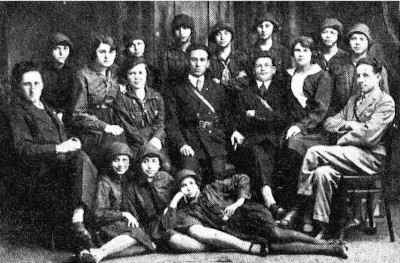
The so-called Gdud haYami [marine battalion] occupies a particular place in the history of the Hashomer movement in Lutsk. The waters of the fast-moving Styr River were even comically given the name ocean. Yet the name Gdud haYami was suitable for young men who were preparing to be future sailors on the Mediterranean Sea, in the dreamed of Jewish land. In order that we not be laughed at, we meanwhile called ourselves Gdud haMimi [the Marine Regiment]; for this we had full right, because almost the entire time of our guard duty was spent on the waters of the Styr.
Young men from 15 years of age and older voluntarily came together and joined the organization in the framework of the legalized organization, Hashomer Hatzair [the Young Guard – Labor Zionists] in order to enrich themselves culturally and physically and to prepare to emigrate to Israel as future servants of the Jewish naval fleet.
The head of the cell of Hashomer Hatzair, Uri Gliklich,
[Page 194]
amiably included the group in the framework of the Lutsk organization and even permitted it to choose a battalion head in a democratic manner. The choice fell on me. Why? I was then the youngest and there were better swimmers than I. Because I was a gymnazie [secondary school] student in the sixth level, knew a little Evrit [Hebrew] and I could lead the sobesedovaniye [conversation] in Russian; that is, the conversations about Dr. Herzl, the halutzim [pioneers] movement, [Robert] Baden-Powell, about the heroic [Joseph] Trumpeldor and so on.
All of the guards committed themselves not to smoke, not to drink alcohol, to take part in water sports every day and…to save those who are drowning in the Styr River. Such occurrences would, alas, happen often. We even designated lookouts at the spots where many people would swim and there was no lack of work.
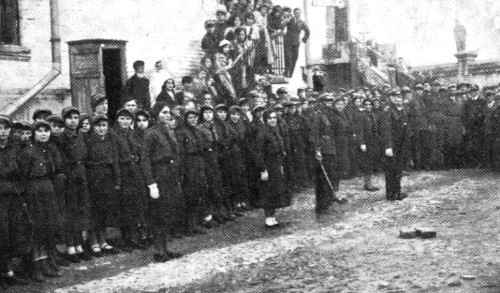
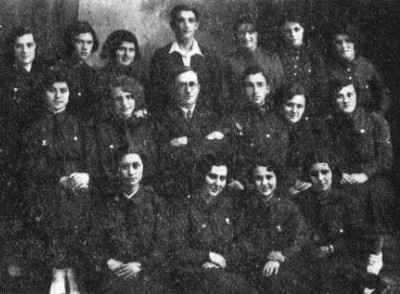
How do we take over even a bit of a “raft?” True, there were boats at Ben's and at Iliosz. However, we had to possess our own boats, even a motor boat. In order to create the necessary means, we put together an ensemble, also recruited capable scouts for it and began performing theater. The first play was, Der Vald-Kayzer [The Emperor of the Woods] in the Yiddish language; we performed in a hall of the kehila [organized Jewish community]. I remember the first performance: the hall was fully packed with young people. The buffet raised money. Meanwhile, the audience played der fliendiker post [the flying post, a gossip game in which a message is passed from person to person for delivery]. Suddenly, after the first round, it became dark – a short circuit. We mobilized our own electric motor. We looked at the fuses in the dark; we changed the wires without success. They burned up. What was to be done? Should the performance be ended? The young audience was patient and calm. Even the darkness pleased several. Someone had an idea: Go to the synagogue and take down
|
|
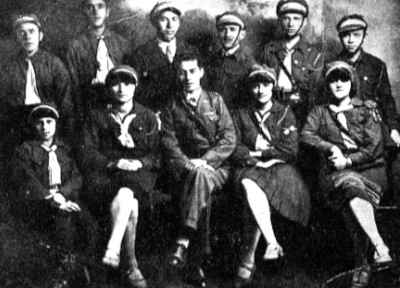
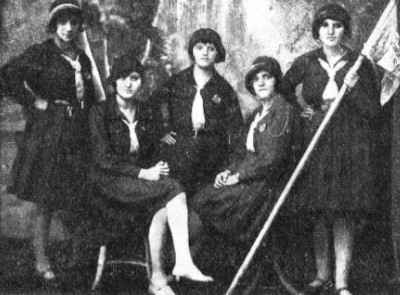
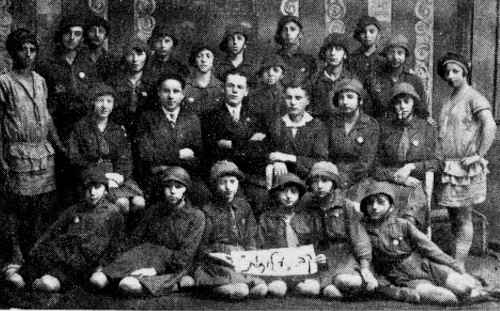
| A group of scouts |
|
|
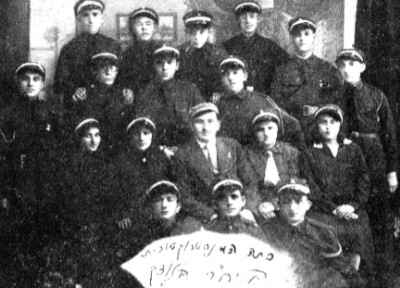
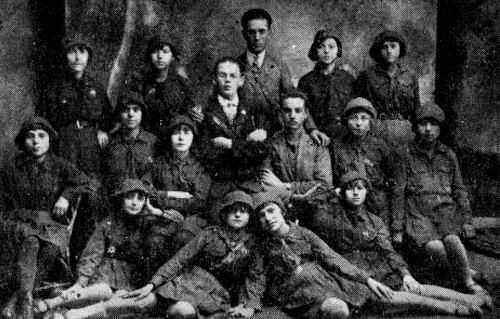
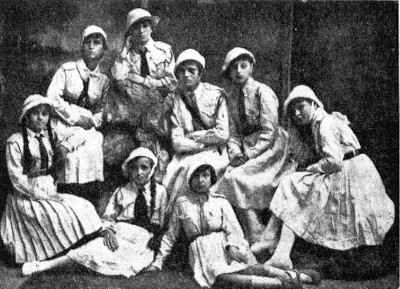
| A group from Hashomer Haztair |
two, large oil lamps along with their wire hangers and bring them to the theater.
The performance began at around 11 o'clock and went on with great success. The main thing – the cashbox brought a considerable bit of income that would suffice for one larger boat.
It is worth remembering: we later learned that young rascals from the Ukrainian Prosvita [society to preserve Ukrainian culture] were dispatched to stick a pin in the electrical wires because there were fewer spectators at their performance on the same evening; they hoped that several of our visitors would go to them.
On Shabbos [the Sabbath] we travelled to Tortchin [Torchin] with the same performance. This shtetl welcomed us with open arms, as if the Jewish military had arrived; we were dressed in costumes of white linen (I, as the oldest, in dyed-green linen) with fat, carved sticks in our hands. The Zionist representatives invited everyone to come to them in the private houses, even to drop in at the synagogue as honored ones. Many were called up to read from the Torah. They guaranteed that tickets would be sold, even if we only began to sell [the tickets] after Havdalah [ceremony ending the Sabbath].
Here, too, we had to endure a fight with Ukrainian nationalists. The performance was supposed to take place in the not-yet-completed building of the city rich man, Rajmer. The Ukrainians there carried out their performance of Natalka Poltovka [by Ivan Kotliarevsky] for us. The built a scene and also arranged seating from boards. To disturb our performance, on Shabbos they came to take apart the stage. The young mobilized themselves; the butchers and the healthy, in general, came with their axes and sticks, ready to fight until bloody and not to permit the taking of the stage. We bribed the police representative of the shtetl [town] so he would be helpful in the struggle. We were satisfied
[Page 195]
with dry slaps. The victory was on our side.
The performance was a great moral and material success. We had money to build two large boats, eight seats on each boat; this sufficed completely for our group which at the time had 15 guards.
The boats were the pride of our “water battalion.” Who would undertake to bring the drowned to the Jewish cemetery by water (one is not permitted to do otherwise), if not us? We would always be on duty and watch over the places where people would swim.
Once we saved a fat German woman and her two daughters who had begun to save their mother and themselves were drowning. The next day the German woman brought a bucket of flowers to my mother and confessed that “God had sent a punishment because she had cursed the Jewish children, they should drown…”
We would go on distant excursions with our own boats and also take part in competitions. On one such excursion, Khana Kirsztalke almost drowned. When Dovid Aszkhenazi tried to save her, she pulled him off the boat. It was a miracle that they were successfully saved with the help of the group.
The competitions for the swimmers' speed for a distance of a kilometer and for turning in the water took place in the presence of masses of young people. I, “the admiral,” and my assistant, “the vice admiral,” the well-known Lutsk swimmer, Benyamin Kolker (Friszberg), swam to the village Zhydychyn. They pulled us stubborn swimmers out of the water; [we had turned blue].
Later, we decided to go through hakhshara [Hebrew word meaning preparation – often an agricultural training center] and to prepare ourselves for the road to Israel. At the very end of the sixth-level class, I left the gymnazie and began the work. Some of us worked as porters and loaded goods on the train; some of us did all kinds of heavy physical work in the city. The money in the general fund grew from day to day. Only lacking were certificates [from the British Mandate government permitting emigration to Eretz Yisroel] and then the English Mandate regime stopped emigration. In order not to lose any time and not lag behind my school comrades, I entered the Polish-Jewish gymnazie, began to learn Hebrew with gusto. When we received several certificates, comrades from the battalion, such as Yekl and Dovid Aszkhenazi, Benyamin Friszberg emigrated.
Several of those remaining, such as Shmuel Melamud, Moshe Grosberg and so on perished at the hands of the fascist murderers.
Translator's footnote:
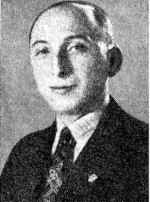
by Efroim Dik
Translated by Gloria Berkenstat Freund
|
|
| Efroim Dik |
In spring 1927, on the 28th of May, the Brit Trumpeldor [Trumpeldor Alliance] was founded in Lutsk. It suddenly became active near Fridman's mill, at the small, quiet river; young Jews gathered; they carried out conversations and from time to time also sang songs of national longing and hope.
The first meeting was held at the old Jewish cemetery near the graves of our grandfathers. This was the spring of our work in Lutsk and also in all of Volyn. Uri Gliklich came from Danzig then and began to spread the new doctrine of Zeev Jabotinsky. Almost all former leaders of Hashomer Hatzair [the Young Guard – Zionist youth movement] of 1920 immediately concentrated around him – and the first group, named Brit-Hashomer [Alliance of Guards] was created, which had a scout-like character.
As if in a film, the directors of the group, Gildin, Finkelsztajn, Bar, Drajszpin, Sura Spektor, Wajsman, Szwarcblat, Group Commander Liberman, Dodik, Leo Baril and many others, sneaked through.
During a solemn evening in the kehila [organized Jewish community] hall, “Moshele” put on the Betar hat for the first time. The first commander of the region, Uri Gliklich, and the first commander of the group, our Leo Baril, spoke about the significance of a flag during the solemn unveiling of the flag in the Great Synagogue and we all swore devotion to the idea and the head of Betar
The streets suddenly became lively on a Sabbath morning; on Betar
[Page 196]
|
|
| The Betar County Council |
Street, near the then premises of the Hasmonea [Soccer] Club, the procession stopped and with it – all of the movement on the main street. Our most devoted friend, Dr. Bronberg, of blessed memory, spoke from the balcony. It was the first public speech; for the first time, Lutsk heard a new word about a new way.
I was then a student at the Jewish gymnazie [secondary school]. A short young man in glasses would come to us often and [he would] urge us to go to Betar. His propaganda work found reverberations in our group and an entire group of students joined Betar. This person from Betar was named Moshe Sztajnberg, of blessed memory, an aware young man, a great devotee of the Hebrew language and a likeable comrade. The group commander, L. Baril, was very interested in us and the first Betar writings in Lutsk were published under his leadership, with the name Kadima [Forward]. I remember the first collection in Lutsk from all of Volyn in 1928 and, the second, in 1929, with the participation of Commissioner Propes. For the first time, our city saw healthy young people with brown shirts that symbolized the terrain of the Land of Israel. We had no legal standing; the local Hasmonean Club legalized us as their touring section. This was thanks to a friend of our movement, Benyamin Farsztaj.
After a certain time, the work of Betar became more practical. Hakhshara [Hebrew word meaning preparation – often an agricultural training center] settlements were founded in Klosov and Rokitne. The first of the local group who traveled to Eretz Yisroel were Truckewicz, Geler, Y. Szer and M. Morgun, who died very young as a result of the difficult work in the Rokitner glassworks.
The Polish military regime permitted us to study the defensive training. We received weapons and instructors. Our chiefs from P.W. [Przysposobienie Wojskowe – a military youth organization – military training] were Gendler, Sh. Osipow and Yitzhak Szlajfsztajn. Our fund for defensive training – the Tel Hai [hill of life] Foundation – began its activity. With the great strengthening of Betar, our revisionist group also began to work actively. The national leadership of the Revisionist Party invited Director Boris Grajcer and Dr. Bronberg, of blessed memory, to co-manage the local division of the Revisionist Party.
The students in Prague, Sh. Juniczman, Yisroel Leszner (fell in the ghetto), Tovya Leszner (now in America) and Engineer Mirski (fell in the ghetto) achieved a great deal. Thanks to the visit of Mr. Weliczker from Warsaw, a school youth organization named Masada was founded too. Yosef Kolesnik, Y. Waksman, Sztajnberg, Dik, Gutman, Sholem Rozenfeld and Zwi Rubinsztajn (both in Israel), Mrs. Totman, Hausman, Shimkha Szlajfsztajn and Mordekhai Kaniwz (now in Israel) helped Masada in its work. Masada carried out active work until all of its members joined Betar in 1933. The sports club, Trumpeldoria, also was created by the members Yoal Meshores, Brizgal and Naftali Perel.
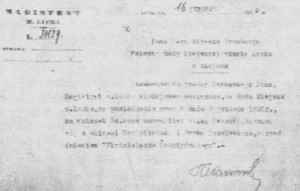
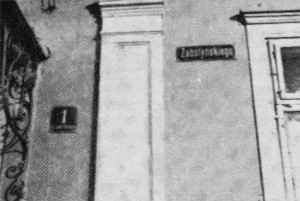
In January 1930, Director Boris Grajcer took part in the ninth all-Polish Zionist National Conference as delegate from Lutsk and he was elected to the most important commissions. The first visit to our local family by the head and leader of Betar, Z. Jabotinsky, was a great holiday. His visit even had a reverberation in the city council, where Councilman Bronberg proposed naming a street after him. The proposal was accepted and Szeroka Street (after a former “Wojnski Nachalnik [head]”) received the name Jabotinkiego.
An expansion in all areas of our work took place,
|
|
| Instruction Group of Betar in Lutsk |
[Page 197]
|
|
|
| The street named for Jabotinsky in Lutsk |
a strengthening. The group commander, Y. Bronfman (today in Brazil), created a division on Krasna named Hashakhar [Dawn]. Mrs. Hausman, Sh. Szlajfsztajn, Y. Finklsztajn led active party work on the presidium of Hatzohar [Union of Zionist Revisionists]. Mr. Shimkha Szlajfsztajn, who received permission for Betar in the entire area of Volyn from the provincial administration, took over the group, simultaneously becoming the commander of the region. The students organized themselves thanks to the work of the Messrs. Volf Klimburd, Leszner and Baril and they founded a student organization, Yardena. Seniors were: Y. Leszner, Volf Klimburd and Magistar [holder of advanced university degree] Mikhal Windzberg. A hakhshara group also was founded that existed for several years.
Our Revisionist family suffered a great loss with the premature death of our friend Dr. Elihu Bronberg, of blessed memory. His death brought forth great sadness in the Revisionist Party in the country. His memory was perpetuated by a library bearing his name.
Although deeply shocked by misfortune, our work did not cease. A county conference of the Revisionist Party took place with the participation of Dr. A. Lipman and Dr. Z. Lerner, representatives from the central office. The county conference elected a county central committee with Mrs. Hausman as chairwoman, Dr. Kreminecki as vice chairman, Mr. Kagan as secretary and Y. Szajner as instructor.
The visit of Dr. Josef Schechtman, who gave a lecture, which evoked a great deal of interest in the city, caused a great revival in Lutsk and all of Volyn. After his visit, a
|
|
| Betar Conference in 1932 |
[Page 198]
|
|
| Masada group in 1933 |
Brit haHayal [Soldiers Alliance] was created among us, which was led by the Messrs. Benyamin Farsztaj, Leo Baril. Sh. Szlajfsztajn and Werba.
In May 1933, we celebrated the sixth anniversary of our group. Dr. Juniczman, from the commission attended the celebration. Khona Spektor, Elkana Finklsztajn, Shoshona Szajnman, Yitzhak Szlajfsztajn and the writer of these lines, the members of Betar, who had been active since the founding of the group, were gifted with tokens [often bronze or gold medals] from the headquarters.
The Commander, Szlajfsztajn, also was gifted with a golden token as recognition of his accomplishments.
The year 1933 was under the influence of the Stavsky trial and of the great political action of Jabotinsky – the petition.[2]
In August 1934, Dr. Dovid Wdowinski, the President of the Revisionist Party in Poland, visited our city on organizational matters.
Certain changes took place in the leadership positions here. The leadership of Betar was taken over by the good friends Dov Bileraj and Efroim Dik, who soon after were designated as commanders of the group with the following command: Dov Bileraj, Sh. Szajnman, A. Szpicman, A. Pinczuk, D. Mandel.
The Revisionist Party strengthened its activity then, too, thanks to Mrs. Hausman, Director Bak, Director Grajcer, M. Mirski, A. Gertner, A. Gordon and Leo Baril. Director M. Bak took over the management of the Tel-Hai Foundation.
On the 12th of May 1935, we welcomed our dear leader, Z. Jabotinsky, here for the second time. In the city – thousands of Betar members from all over Poland. The streets grew more and more brown from minute to minute; they, the students of the great teacher and leader, traveled from all over Poland in order to see him and to hear his strong prophetic word. However, the joy was disturbed; when a banquet was to take place after a presentation, the sad news arrived that the Polish Marshall [Józef Pilsudski], the liberator of Poland, was no longer alive. Chairman Frisberg shared the news and asked the audience to disperse, and Jabotinsky, at once, sent a telegram of condolences to the government and to the orphaned Pilsudski family. Understandably, the banquet did not take place.
The history of the Lutsk group in the years 1937-38 need to be counted as the happiest epoch for emigration to Eretz Yisroel. The members of Betar who emigrated were: Khona Waksman, Sh. Rozenfeld, the Spektor sisters, Librik, Kuperman, Rawicz, Juniczman, Kazial, Szer, the Klajnman family, L. Kupersztajn, as well as the commanding officer, Dr. Sh. Juniczman.
We made great use of the course for mentors that we created under the management of the commanding officer, Yosef Chrust, and the guide, A. Amfer. Eleven instructors from the group graduated from the course, so the work in 11 areas was again strengthened. Then we took the Betar oath, Haneder [The Vow], which had been written by Jabotinsky himself. Among those who took the vow was Sholem Tabacznik – Ben Yosef. The oath was delivered by the commander of the group, Yitzhak Fugan. This was on the 11th of Adar 1936 [5th of March].
During the solemnity at the 10th anniversary of our group (May 1937), tokens were distributed to all 10-year Betar members by the commander, M. Grausman. They were a small number, and among the most distinguished was Shlomo Ben Yosef.
Avraham Szpicman led the group's work for a time. Then Jakub Farsztaj was nominated as the commander.
The newspapers of the 24th of April 1938 brought the news from Eretz Yisroel that our comrade Shlomo Ben Yosef was among the arrested members of Betar from Rosh Pina. Not everyone knew that under the name Ben Yosef was our Sholem Tabacznik.
|
|
| A Betar group |
[Page 199]
On the 12th of July in the Great Synagogue a prayer was said for his pardon. After the introduction by Director Grajcer, Rabbi Soroczkin gave a strong, moving speech and the Betar members, Farsztaj and Dik, spoke about the act of condemning Ben Yosef.
The days from sentencing to its approval by General [Robert] Haining extended for years. Protest resolutions against the sentence were sent to the English ambassador and we sent our dear comrade in Acre such a telegram:
“To our brother Shlomo Ben Yosef, your like-minded friends promise the world to follow in your lofty footsteps.”
The worst occurred when the radio announced on Tuesday, the 23rd of June at 9 in the evening that early the next morning Ben Yosef's sentence would be carried out.
Who could then fall asleep that sad night? Everyone, the entire group, was awake at the [headquarters]. Great sadness came from every corner. We phoned all of the editors in the country about the exact facts. At three o'clock in the morning, the “sad ritual” took place. Everyone who took part in it will always remember it. We recited Psalms in Trisker Synagogue at five in the morning and, at eight, 30th of Sivan, 5698 [29th of June 1938], at the old Crusader Fortress in Acre, Ben Yosef, arrestee number 3118, was led to the gallows. He had spent the night of the execution calmly. He wrote letters to his mother that “she should be proud that her son was dying for the will of the Jewish people,” and to the head of Betar he wrote that, “He is fortunate in his situation, knowing that his death will strengthen the struggle for a liberated, undivided Jewish state.” He asked the commanding officer, Dr. Juniczman, who visited him a day before his execution, that his closest comrades, Fabrikant, Szpicman and Rapaport be permitted to emigrate [to Eretz Yisroel]. The commissioners fulfilled his last request. When his last visitors entered his cell, Jabotinsky's words were expressed on the wall:
“To die and to conquer the mountain…”
When the English hangman approached him, he [Ben Yosef] shouted out:
“Long live the Jewish people! Long live Zeev Jabotinsky.”
The entire city was enveloped in sadness. Newspaper people from all over Poland came to learn the precise details of how Ben Yosef's city was mourning. A memorial service took place in the Great Synagogue with the participation of Rabbi Soroczkin, Benyamin Farsztaj, A. Dik, Jakov Farsztaj, Leo Baril and A. Propes, the Betar commissioner.
The work did not cease for a moment; the commander Jakob Farsztaj, and A. Szpicman, both dear, devoted members of Betar, left for Eretz Yisroel.
The writer of these lines took over the management of the group, and then, Y. Benis, with the following commanders: Deputy commander of the group Dov Bileraj, Jakov Sima, Y. Fabrikant, M. Ranc, Sh. Libuber, Y. Alter, Z. Sznajder.
We existed in Lutsk for 12 years and the work did not cease for even one day during the course of that time. Hundreds of young people were educated in a national spirit. They fulfilled their duty in Eretz Yisroel: Dr. Juniczman, Sh. Rozenfeld. D. Rawiz, Miriam Juniczman, Avraham Szpicman, Ayzyk Fugan (fell during the bombardment of Tel Aviv), Sholem Gledi.
Translator's footnotes:
The Revisionists distributed a petition in 1933 calling for the British to uphold the Balfour Declaration and establish a Jewish state in Palestine. The petition was signed by over 600,000 Jews. Return
by Y. Fershtey
Translated by Sara Mages
While they were busy with their normal activities at the Betar[1] ken[2] several members, from among the veterans, longed for a contact with Brit HaBirionim[3] in Israel whose echo of activity also reached Lutsk. And when Betar emissaries arrived from Israel in 1935 and brought a greeting from the “front,” the first group of “activists,” led by Shalom Rapoport (Giladi), was organized here. The group included: Shalom Tabachnik (Shlomo Ben- Yosef hy”d), Yitzchak Fabrykant, and later also Izik Fogen and Rosa Bakowiecka. Similar groups were organized in Betar's Hakhshara companies in Wolyn (such as in Horokhiv under the leadership of Avraham Szpicman from Lusk). Their center was in Torczyn.
However, only with the outbreak of the bloody riots in Israel in 1936, and the transformation of the National Defense into Hâ-'Irgun Ha-Tzva'î Ha-Leûmî[4], cells of Etzel were established first in Wolyn and later throughout Poland. Their job was to prepare cadres of underground members from among the members of Betar and Brit HaHayal[5].
These cells, four in number, that were established in Lutsk were conspiratorial in nature and structure. Each numbered five people and headed by a person in charge. Their members were engaged in learning the use of small arms (three Parabellum Pistols, Nagan and P&B were purchased for this purpose, and practiced target shooting with an air rifle), conducting street fighting, history of wars of liberation etc. The theoretical lessons (from Hebrew
[Page 200]
lessons (from Hebrew instruction booklets that came from Israel) were held at the ken's club in the late evening hours or in private apartments. The training and field exercises were conducted mainly in Polonka. In addition, the members of the cells distributed the propaganda material they received from the center in Warsaw after the establishment of the cells network throughout Poland - in parallel with the Betar branches.
The members of the cells in Lutsk were: B. Ainbinder, Y. Alter, M. Burstein, Y. Benis, Y. Belfiore, B. and A. Gergies, S. Voskoboinik, Y. Turysk, Y. Libhuber, A. Menker, Y. Sima, S. Fogen, B. Feldenkrajz, M. Ranz, M. Szyfer, Z. Schneider, and Y. Szidler, Farstei coordinated them and after his immigration to Israel - Ainbinder.
In the fall of 1937, the first unofficial course of Etzel in Poland was held in Lutsk under the command of A. Amper from Volodymyr (who later became the commander of the cells in Poland. He was murdered by the British in Tel Aviv) and under the guidance of Y. Poznanski (a Jewish officer in the Polish army who came especially from Lodz). The course was attended by members of the cells in the Lutsk area and lasted a week (in the ken's club near the District Court).
In the years 1938-9, the cells consolidated and some of their members managed to immigrate to Israel - with or without certificates of immigration.
As stated, at the outbreak of the World War, in September 1939, B. Ainbinder stood at the head of the cells (he was also the ken's commander after Benis). The entry of the Soviets forced the members of Betar and the cells to literally go underground. In the middle of the night the ken's flag was buried in Ainbinder's yard together with the archive and the weapons (to which were added the pistols that Menaker managed to steal from the pile of weapons accumulated in the city square by order of the authorities).
Although it was officially forbidden to hold any political activity, the members of the ken, and especially the members of the cells, continued to meet to consult on how to survive and get to Israel. Y. Benis was sent to Sniatyn to find a way to Romania. But he was arrested at the border and sat in a Russian prison until he was drafted into the Anders' Army[6] and his immigration to Israel with this army. Ainbinder left after him to the Romanian border. He was also arrested near Kolomyia and when he was released he returned to Lutsk. In the meantime, Y. Sima, and E. Perkal decided to leave for Vilna [Vilnius], which has not yet been occupied, and after the border was closed - Menaker, Turysk, Alter, Ranz and Ainbinder, also left for Vilna. But despite the fact that Betar was almost the only movement in Lutsk that had contact with Vilna, most of its members, and the cells' people, were unable to escape.
After the departure of the aforementioned to Vilna, the contact in Lutsk remained in the hands of Ajzik Gergies until the arrival of the Germans and the establishment of the ghetto.
In Vilna, the aforementioned joined the battalion of Betar's refugees and when it was dispersed by the Soviets they settled in the provincial towns. Meanwhile, only Ainbinder and Sima managed to immigrate to Israel through Turkey.
When the Germans occupied Lita [Lithuania] and began to establish the ghettos, a group of Etzel members from Lutsk were in Šiauliai (Alter, Turysk, Menker and Feldenkrajz) and they, together with other members of Etzel, went through the horrors of war in the ghetto and the concentration camps. They helped each other while maintaining their affinity for the organization (they even tried and managed to obtain weapons in the ghetto and in the camp). At the end of the war they rejoined the ranks of Etzel in Europe and later in Israel, like their friends who managed to reach Israel before them and were active in the ranks of Etzel and Lehi[7]. They also participated in battles against the British and the Arabs and held responsible positions in their organizations.
*
Quite a few members of Ken Betar and Etzel cells in Lutsk fell in the War of Independence:
Shlomo Ben-Yosef, who arrived in Israel with the Etzel immigration, was the first Jew to be executed since the occupation of the country by the British for the murder of Arab rioters near Rosh Pina in 1938.
By the way, Isaac Fogen, who arrived in Israel before the war, survived a similar fate. He was in the recruiting companies of Betar in the Galilee, served in the Jewish Brigade and by the orders of Etzel remained in Europe after the disbandment of the brigade. In 1947, he was arrested by the British in Hannover (Germany) for trying to blow up a German military train. He was prosecuted and sentenced to death. The verdict was commuted to twenty years in prison only thanks to great public pressure in England and the United States. He was pardoned after a three-year term in German prisons and returned to Israel.
Shimon Voskoboinik David Yacobi), who came to Israel with Anders' Army through Teheran, was active in the ranks of Lehi. He was drafted into the Israel Defense Forces with the establishment of the state as a radio operator in the Armored Corps, participated in the battles of the Negev and fell in battle near Auja al-Hafir in 1948.
Yitzchak Fogen, who also arrived in Israel on the eve of the war with the Etzel immigration, was immediately recruited to companies of Betar in the south of the country. He was killed during the bombing of Tel Aviv by the Italians in 1940.
The British prisons and detention camps in Israel and abroad, also knew the freedom fighters from Lutsk who had been detained there for many years.
Translator's footnotes:
[Page 201]
by D. Blorey
Translated by Sara Mages
Since there was no youth movement in our town Nieciecza, I, and another member, were sent in the summer of 1932 by the HeHalutz Hatzair[1] branch in Kamin-Kashyrskyi - to Lutsk for Hakhshara[2].
The company was still at the beginning of its formation. We were a total of about twenty male and female members and lived in one of the houses on Nowo Strojenic Street.
At first the main work was, of course, chopping wood. We occupied plazowka (places) on Yogelonske and Karsne streets and others, near the Jewish bakeries.
However, slowly slowly we also began to penetrate other industries: to flour mills, construction work, and the girls - also to housework.
Of course, it was not easy to prove to the Jews of Lutsk that a balebatishe kinder (children from good families) know how to properly do jobs that were usually done only by the Gentiles.
We had to face this struggle on several fronts at the same time: the Bund[3] called us
lumpenproletariat[4], while the Polish workers saw us as competitors who came to take a piece of bread out of their mouths. They did not want to understand that we have the right to be workers.
But, in spite of everything, the company grew. We rented another house on the same street, but it was not enough. So we moved to Michel Lumer's big house on Vilke Street. At the time the company already numbered over a hundred members (I do not remember the exact number). Lutsk became the Hakhshara center for the whole area, and there was not a day that the halutzim did not go in different directions. Lutsk took the lead in capturing places - from here they left for Demydivka, Torchyn, Klevan, Berestechko and more. Michel's house was always in turmoil.
|
|
| “Alizot” group (1927) |
|
|
| “Shalgoniot” group |
Memories of those days are now rising in me: on the one side the lumberjacks return from their work with axes on their shoulders; on the other side the construction workers walking and singing, heavy spiked shoes to their feet. And now they break into spontaneous singing: “we came to Israel to build and be built in it.”
In the meantime, the Jews of Lutsk realized that if a worker was needed, there was an address - the Lumer's house. No more balebatishe kinder, but real workers. The local HeHalutz branch also helped a lot.
It often happened that Michel Lumer, the homeowner, came to collect the rent and there was no money. Then, we also pulled him to the circle of dancers...
On Rosh Hashanah, a conference of all the Hakhshara kibbutzim in the bloc was held with the participation of members from the center. Members came from Klesiv, Dąbrowice, Olyka and other locations. From Israel came Feibush Bendori z”l from Givat HaShlosha and Gershom Ostrovsky from Ein Harod.
A heated debate was held at the conference over whether to approve the immigration of members after six months of training months. Those who demanded six months won. The country demanded immigration because it needed working hands.
The floors in the Halutz and Gordonia branches were lined with straw and in this way accommodation was arranged for members who came to attend the conference.
In the winter the situation worsened for members of the kibbutz, there was no work. There were also a large number of sick members. Chaika Binstock z”l (passed away in Givat HaShlosha), the coordinator, was at a loss. Not a day went by that we only ate a few potatoes.
I remember: in the “work schedule” three were assigned to look for work. I, and two other members, measured Lutsk in all directions, walked everywhere for a long time, rummaged in all the alleys, maybe we would found something - but everything was in vain. We crossed the bridge, arrived in Krasne, and a woman came towards us. She looked at us with tears in her eyes: Ich hab a tokhter in Chenstochov (I have a daughter Częstochowa), and added: kumen arayn kinder zikh anvaremen mit a glezl tey (children
[Page 202]
Come into the house to warm up with a cup of tea). Meanwhile, the day got dark. We walked back through the path along the creek, and here we found two meters of wood for sawing and a chopping. We reached an agreement on the price and started to work hard. It was already dark outside, but we worked diligently. We returned home in high spirits. We finally succeeded.
After a while we, a group of members, left for Demydivka to find work.
The whole time we were in Lutsk we met a lot with its Jews, especially with the members of the working class - builders, carpenters, painters, porters, carters and more. These were simple and kind hearted Jews.
And how painful is the heart that they were and are no more…
Translator's footnotes:
by Yosef Weitz
Translated by Sara Mages
On a rainy and gloomy morning of one of the last days of Elul in the year 5690 [1930], the train from Warsaw brought us - my wife and I - to Lutsk station. The whistle of the locomotive and the rattling of the carriages had not yet subsided as they began to stop when the train slowed down, and through the window I saw Uncle Hykle under the umbrella and his eyes, full of anticipation, followed the windows. My heart, which has been longing for my uncle since I parted from him twenty-two years ago, was excited to see him in the longings of youth, and when our arms hugged and wrapped around, his laughing eyes peered at me and a smile of kindness, generosity and forgiveness flickered on his lips.
The city of Lutsk was new to me. It was my first visit there, although the town of Bormel, in which I spent eighteen summers and winters until my immigration to Israel, was not far from it and its inhabitants traveled to and from the district city. And if I came to it on my short visit to Europe, and not to my hometown, it is because that most of my family members moved from that town and settled in Lutsk, and the purpose of my visit was to see them: my uncle's family, the families of Avraham Lender and Yisrael Lender, the families Yehudah Nol and Yekutiel Nol, and others. The members of an extensive family, who sent several sons and daughters to Israel, lived here, and the “ties of the homeland” - as much as they still survived in me after twenty two years in Israel - were with them.
Gloomy, dull and helpless, the city seemed to me as the carriage drove me from the station to my uncle's house in the city center. Thin, prickly rain, dripped from dark gray clouds, and Jews in the streets, their heads bowed, ran quickly to get out of this gloom into some hidden refuge beyond the intense fog. When I saw them, there was a heavy feeling of sadness and melancholy in my heart. It is possible - I thought to myself - that the night journey, lack of sleep and fatigue, are what caused this impression. But, later, in the following days - twenty-one in number - of my stay in the city and in the company of family and acquaintances, and also when the autumn sun, warm and bright, shone again the its streets, squares and river - I found, that indeed, the Jews live in a sense of having to evade the gloom that surrounds them in this city and in this country.
In those days, many came early to my uncle's house, among them those who had already immigrated to Eretz Israel and “returned” - to ask me about the political and economic situation in Israel and the possibility of settling there. The pulse of the Zionist movement pulsed powerfully and spiritually: Zionist education, the study of Hebrew culture, training in the Hebrew language, and also physically- collecting donations for the two founds etc. The youth, for the most part, were awake and active in the ideological or religious movements within the Zionist organization. Also in the local affairs the Jews of Lutsk seemed organized as a conscious public, awake and careful to preserve its rights, and many were the activists who gave their time and thought to the needs of the community. Quite a bit was the part of uncle Hykle, who then served as deputy of the Polish mayor, but almost all matters were decided by him. And yet, he did not shy away from the needs of the Zionist movement. As one of its leaders, he served as model for others in his loyalty, and devoted every spare hour to the affairs of Eretz Yisrael. In spite of it, and maybe because of all this, there was distress in their hearts: their future in Poland did not seem pleasant, generous and friendly to them. Deep down, below the threshold of consciousness, resided a feeling of fear and anxiety for days to come. By then, the echoes of the savage screams of the malignant devil - Hitler - had already arrived. And there, in their depths, a voice whispered: save yourselves before it is too late, leave and immigrate! But the shackles of daily life were strong, and in these were bound not only the masses, but also the leaders and the activists who deliberated between the desirable and the existing situation, between the hidden aspiration in the heart and the necessity of the gray life. And from here the same inner layer of sorrow, as the body is shaken all day in the war of existence. The same twinkle of sadness from the looks of the eyes even when they become tired - in an angry argument or in a friendly conversation, at family party or in mass gatherings, of adults and youth. And to my eyes, the eyes of an Israeli Jews, these brothers seemed like prisoners who have no power to release themselves from their imprisonment, and the Messiah who will release them is not here. I was severely depressed all the days of my stay in Lutsk.
And not only in Lutsk. One evening I took the train from Lutsk to the town of Horokhiv, to which I traveled to visit the greave of my father z”l who passed away on the month of Second Adar in the year 5669 [1910]. The journey lasted many hours, and at nearby
[Page 203]
stations many different Jews boarded the train with noise and tumult, as is the custom of Jewish people who have nothing in their world but the commotion of negotiations and running around. A few moments passed, and without me knowing how, they discovered the secret of my being: a Jew from Israel in the train - and immediately surrounded me with a question “what is happening in Israel,” and they became other other people, not of this world, as if an invisible hand changed their secular clothes and wrapped them in a coat of longing to another world, as a Jew at the arrival of the Sabbath in Heine's well-known poem[1]. And in all of them the same struggle between the two poles: the bitter reality that there is no strength and courage to get out of it and the longing to reach a safe shore.
It was a sleepless night for me, because I had witnessed that difficult deliberation, and my heart was filled with sharp grief. And when I saw them in the agony of their deliberation I asked myself: where is the Messiah who will cut off the shackles from these brothers and redeem them from bondage? Around dawn, I arrived at the last stop before town, and from there I continued in a wagon drawn by two horses, full of sacks and packages. The carter was a Jew from Horokhiv. I sat down on a straw sack next to him, and when I asked him if he knows the house of Simcha Shatzkis, he answered me with a question:
-- Are you from Eretz Yisrael?And without waiting for an answer, he showered me with questions that were repeated by every Jew - about life in Eretz Yisrael and the possibility that a carter like him could settle there, etc. He asked and he answered to himself, when the question was clear in its essence and purpose, and the answer was imbued with skepticism and hesitation as he hastened the horses to walk with his whip. And in the heavens the stars flickered, illuminated and sank, and the dawn twinkled and rose. The horses stopped and the carter also stopped his conversation and pointed with his whip to a house on the street.
--This is the house of Simcha Shatzkis.The house stood in the darkness, and yet I remembered the shutters in its inner rooms. I walked to one of them and knocked and a sleepy voice answered:
-- Who is there?I heard a cry of astonishment and double joy of two voices, and immediately a door creaked and I entered into a warm atmosphere of sweet childhood since then, since then.-- Open, Rabbi Simcha, open for me. I am Yosef here.
Simcha Shatzkis, a merchant and owner of a hostel mainly for the Gentiles, who came to the market days in the city and housed their cattle in the big yard behind the house, and his wife Golda - a childless couple, humble, quiet and kind - were friends of our family. They admired my father z”l and loved his sons as if they were their children. When my father passed away and the family moved to Eretz Yisrael, they were orphaned. My sudden arrival to their home was considered in their eyes as “the revelation of Elijah.” They hugged me, caressed me, put me in bed and covered me. I knew that in my few hours of sleep they would walk on their toes and keep their eyes on me. When I woke up a few hours later they gave me food and drink and did not open their mouths to talk, just glanced at me, and the glance was penetrating and sad .What a deep sadness! And when they accompanied me to the cemetery and stood with me in front of my father's grave - they shed tears, because I was as still as a stone. I saw my good-good father, carrying within him the longings to the country “in which spring will dwell forever,” and now his property is a crooked gravestone, sad in the Diaspora, and in my heart the anxiety is piercing: who knows what would be the fate of millions of Shatzkisim, Helenderim, Nolim, and Weicim that their hearts is a nest of pinching and biting longings.
And so it was on my return that day, and the evening after it, from Horokhiv in the wagon of the same carter to the train station, and with the same Jews (though they were others) on the train to Lutsk station. And the same Jews in Lutsk in the few days I have left to be there, until their number would be twenty-one days in a Jewish community in the Diaspora. A community that is troubled, worried, gripped by terror and hallucinations of an inverted dream. Among them is uncle Hykle who is like a typical father to this generation. And as in days gone by I see him walking alone at twilight and thinking to himself about “a modest pool dreaming of an inverted world and no one knows what's in its heart.”
- - - And it is time to say goodbye... My uncle walks by my side among the dozens of relatives who have come to accompany us. He walks bent, and no wonder. The sky there is always low, lying so in their gloom. This morning is also rainy. My uncle is tortured and depressed. I look into his eyes. The dreamy spark is gone, extinguish. I take his hand in farewell and whisper to him:The spark shone, but a damp veil covered it. We both cried. Has the heart foretold the evil of all the evils to come?- - My uncle, uncle, I want to see you again, but there, there, in the inverted world, in the world of your dreams...
Jerusalem, Hanukah 5719 [1958]
Translator's footnote:
[Page 204]
by Y. Ben-Arye (Ziniuk)
Translated by Sara Mages
A bundle of letters remained to us as a memory from our extended family in Lutsk. Here, it is laid before me, still, quiet, and in it are folded a life and a struggle of many years in Lutsk in the Polish Diaspora.
These letters are silent documents, they tell a lot about the life of our parents in Lutsk.
Despite the malicious Polish rule in the years 1933-1939, Jewish life continued in Lutsk, a life of Jewish pride, as if the lips whispered: “Never mind, we will enjoy them!”
Now, I seclude myself with the letters and read them. In my imagination I see our house on 4 Pushkina Street. It was small, but the place was not cramped. There was a small flour store in our house and our livelihood depended on it. Our dear father z”l, who had the burden of providing for the family, was forced to work and struggle hard to earn his living. Garbaski[1] the Pole, the bitter enemy of the Jews, imposed heavy taxes on the Jews. His tax collectors - at his command - wreaked havoc in the Jewish street. They had done their cruel work out of joy at the misfortune of others… Quite often our mother z”l struggled with the tax collectors who came to take the last sack of flour. Now, I see her standing in front of me spreading her palms in pleas not to take everything from the store, to leave breadcrumbs for the children… I keep reading… And as if out of a fog different images from the life of our unfortunate family come before me.
I don't have the strength to describe everything. Right now my father's Shabbat zemirot[2] are echoing in my ears. I look at his radiant face, the wrinkles on his forehead and his eyes, and marvel at his self-confidence, his great faith… Father asks in his letters how we sanctify the Sabbath in the Holy Land…
Years have passed. The steps of the devil were heard… Nailed boots gave their signals in the world, and different wind is blowing from the letters, a torrential wind, fierce and burning …
The German inhabitants of Lutsk raised their heads and showed their insolence everywhere. The treacherous Polish government oppressed the Jews with great force.
It was very difficult for our parents to live in this country. Gloom descended upon them and mental distress oppressed them…
And the letters tell and tell… about new decrees, about cruel exploitation, about extortion and insults, and about the shouting in the city streets “Jews to Palestine!” And indeed, their words of insult became a magic word for our parents. A spark of hope, a ray of light in the great darkness that surrounded them, the members of our family saw in immigration to Eretz Israel. From every line of their letters emerge yearnings and longings for Israel, and the struggle for permission to enter…
And the country is tightly closed. They knock on the gates and they are locked. And they write… every word cry out for redemption, and in every line there is an intense anticipation for redemption.
And we saw ourselves miserable here because we could not save them. Our action encountered the opposition of the mandatory government, but, still, we did not give up and continued to act. We encouraged them and in our letters we gave them hope, because faith never ends, “The Strength of Israel will not lie.” [1 Samuel 15:29]. We breathed life into oppressed people, and with this strength our parents lived and waited. We waited too, we hoped to see them when they came to us and the family would unite together. Our father's dream is coming true… but here came other days, dark days, days of horror…
The letters are placed on the table and I am leafing through them out of tremor of holiness, they are written in their heart's blood, and they are the only witnesses of our beloved parents, may their memory be a blessing…
Translator's footnotes:
by Elazar A. Hermoni
Translated by Sara Mages
As in a play, the sights of Lutsk, the cradle of my homeland, pass before my eyes. And although many years have passed since I left it at the dawn of my youth, the images of its people, its personalities, the youth in their age groups, the cultural and economic institutions, the places of entertainment, the youth clubs, the political parties, etc., are preserved in my memory.
And even though I have been in Israel for three decades, I have established myself there and almost became a sabra[1], nevertheless, I can testify, with full recognition, that if it was not for Lutsk, and similar cities and towns in the Jewish Diaspora, the country would not have been established - in any case, not in our time. The country was built on the destruction of the Jewish people in Diaspora. Indeed, this is a historical truth - Jerusalem was built from the destruction of the Diaspora.
And it was said: in the revival here in Israel and the immigration of Jews from all over the world, we will be comforted. Great is our privilege that in our days, and before our eyes, the miracle of Atchalta De'Geulah[2] took place. However, we must not forget the past. It is our duty to remind each other and teach our children the source from which we were carved.
I remember Tarbut school, its teachers and students. The latter mostly came from the circles of Zionist homeowners. The teachers saw in their work a sacred mission and fulfilled it with awe and reverence. It often happened that one of the teachers added his free time to the regular teaching hours and taught Zionism - without quotation marks. The teacher, Zvi Hamra, will be remembered favorably. Like a father he was devoted to his students, and his concern for them knew no bounds. Or the teacher, Schuster, the artist who knew artistic work and was a nature lover. On school holiday he gathered groups of students and spend time with them on trips and interesting hobbies. The atmosphere of Eretz Israel prevailed in all, and the sound of the Hebrew language, in free Sephardic pronunciation, was heard among the students of Tarbut[3] - within the school walls and outside it.
And from school to the ken[4] of Hashomer Hatzair[5], whose students were the nucleus in the years 1926/27. Cooperation, out of a sincere desire, and pioneering trend, prevailed at that time between the teachers and the instructors of Hashomer Hatzair. Educational and practical work was conducted quietly and seriously. It trained a generation of volunteers for Zionist work and to fulfill the order of the movement to make aliyah[6].
An aura of glamour and grace hovered over Lutsk's streets, that the life of its Jews and its youth, most of whom were Zionists, left their impression on it.
[Page 205]
I remember the holidays and festivals - their impression was evident on the city streets. In the mass flow to the many synagogues, and also to the minyan that was held at the Zionist Club.
I remember the holiday activities for Keren Kayemet[7] in which the youth played a large part. And as it is customary for us to say: “Now it is allowed to reveal.” In the years 1931/32, the of writer these lines organized, right “under the nose” of the authorities, an internal mail for sending blessings for Rosh Hashanah by using Keren Kayemet stamps, and the proceeds brought large sums into the fund. The project was carried out by the youth organizations.
I remember a lot, but there is not enough space to express my feelings when childhood memories arise. Out of the sorrow and pain for the vibrant life that was cut off by the enemy's hand, a trace of pride also creeps into the heart, a small part, for being a native of glorious Lutsk.
Many of us were privileged to make aliyah to Israel before it was too late, and many of the survivors found their way to us and renewed their lives in the bosom of the country.
Those who were not privileged to do so - may their memory be a blessing!
Translator's footnotes:
Translated by Gloria Berkenstat Freund
After the end of the First World War (6074-6078 [1914-1918]), Mizrachi [religious Zionists] began to be a very active organization of religious Zionists in Poland, which strove for the revival of the Jewish people in Zion on the basis of the Jewish religion and in its spirit. Its religious striving was expressed in its clear slogan: “Create a secure home in an open, legal manner for the Jewish people in Eretz Yisroel in the spirit of the Torah and tradition,” and its activity deepened the religious-nationalist settlement in Eretz Yisroel. The aspects of Mizrachi activity were: all general Zionist activities concerning the political rights of the Jewish land, redemption of the Jewish soil and creating Jewish work in Eretz Yisroel and special activity for the cultivation and development of the Jewish spirit, the spirit of our Torah and authentic culture. The organization of Mizrachi in Poland was a unit unto itself. It had separate Mizrachi shekels [membership tokens], a separate statute, a separate central council and a separate central office.
The goal of Mizrachi was to spread the knowledge of our written Torah and of the tradition, the might of our people and its history and the might of our language and our Hebrew literature. For this purpose, khederim [religious primary schools] for children and evening courses for adults were created by Mizrachi and their young people in various cities in which they were taught Tanakh [Torah, Prophets and Writings] and Talmud, Hebrew, Jewish history and other things through which the religious-national understanding, the religious-national feeling and pride were deepened.
Various emissaries would come to the Wolyn cities from the capital, Warsaw, where feverish Zionist activity took place, to organize the Zionist societies in the border areas. Lutsk and other Wolyn cities were late to the organizational work because of the situation created there after the occupation by the Germans, the proclamation of the Ukrainian Republic and the wave of pogroms that flooded the area at that time. All this actually stopped political activity after the revolution. The power and energy of Jewish society turned in a great mass to organizing self-defense against the various groups carrying out the pogroms. At the same time, the young people prepared for protection and emigration. The considerable concern for security and existence united Jewish society and there was no place for disunity and separation in the area of general Zionism.
The emissaries from Mizrachi from Congress Poland would visit the cities in Wolyn, Lutsk among them, and try to organize the religious Zionists to be active as a communal organization under the flag of Mizrachi. Rabbi Yehiel Rapoport particularly excelled among the emissaries with the speeches that he gave in the houses of prayer and synagogues. His beautiful speeches breathed a new spirit in the ranks of the old and the young, creating followers of the Mizrachi idea. However, the local religious Zionists saw no urgent necessity for a separate Mizrachi organization because the relationship between them and the general
[Page 206]
Zionists was exemplary and because the communal base in Wolyn was completely different than in Poland.
In the meantime, influences on the part of the followers of the Agudah [non-Zionist Orthodox organization] began to penetrate Wolyn and there were also such who prevailed among the Lutsk Jews according to the directive of the Agudah. Then, they were persuaded that it was urgently necessary to create a Mizrachi organization that would carry on the activities among the Orthodox in the spirit of religious Zionism.
In the Mizrachi publication (published in Warsaw in Hebrew) of 18 Iyyar 5681 [26 May 1921] it was announced that on the eighth and last day of Passover many people who sympathized with the idea of Mizrachi assembled in Lutsk to consult about the founding of a Mizrachi organization. A council was elected after negotiations with the Messrs. Aryua Fisz – chairman, Yehosha Bereze – vice chairman, Shraga Lewit – secretary; members: Yakov Sime, Yisroel Wajsnberg and others. The council prepared to appeal to all Lutsk residents to unite under the flag of Mizrachi.
At the beginning of 5682 [1922], the Zychliner Rebbe, Rabbi Yehiel Yitzhak Rapoport was invited to be the rabbi in Lutsk and its surroundings. The Lutsk religious circles rejoiced with this fortunate choice because the rabbi was one of the best Mizrachi activists, a speaker blessed by God. He tried to work for the Jewish population without regard to their viewpoint. He would appear with success and many Jews joined the ranks of Mizrachi. Mizrachi in Lutsk was concentrated around the activists from the organized religious Jewry and faithfully oversaw the traditional Zionist spirit, worked with the Zionists, participated in all money collections and stood in the fight during the elections to the state institutions and the municipal city institutions.
From time to time, rabbinical speakers sent by the Mizrachi central office would visit Lutsk. Rabbi Rapoport, himself, would appear in the neighboring cities and shtelekh [towns]: Dubno, Kovel, Kremenets, Ludmir, Ostroh, Brisk. He was the only one among the Wolyn rabbis who actively took part in the activities of Mizrachi with word and deed. He organized the Wolyn rabbis and tried to improve the economic situation. He warned daily about the neglected situation in the spiritual field in Wolyn as a result of the first horrible World War that caused devastation in all parts of European Jewry over the course of six years and the spiritual ruin surpassed the material ruins the war brought with it. During his visit to the larger and smaller cities in Wolyn, he found backwardness in them. In general, in many kehilus [organized Jewish communities], there were no Talmud Torahs [free religious primary schools for poor children] and the children of the poor grew up without any education. Rabbi Rapoport warned about the terrible situation for Yidishkeit [Jewish way of life]. He began to organize the Wolyn rabbis to act and to improve the situation as well as to raise the value of the rabbinate and the rabbis.
In 5688 [1928], the organizations Tzeirei haMizarkhi [Youth of Mizrachi] and Hahalutz haMizarkhi [Pioneers of Mizrachi] were founded. The young people were earnestly occupied with the shekel actions [membership actions] and with the collection of money for Keren Hahalutz haMizarkhi [Fund for Pioneers of Mizrachi]. Those drawn from the kheder [religious primary schools] and the yeshiva [religious secondary school] stood in the ranks of Hahalutz haMizarkhi and the organization would send its members to special Mizrachi hakhsharah [agricultural preparation] locations and fought for the right to emigrate, which became a question of life or death for many who knocked on the doors of the Israel offices. Every certificate was acquired through a difficult struggle among the various organization that had their representatives in Eretz Yisroel offices.
The joint activity of Mizrachi and its youth organizations did not cease. The movement of Torah V'Avodah [Torah and Labor] withstood every situation, strengthened its influence on the life of the Jews, on the building of the land [of Israel] and on the Zionist movement. The Mizrachi movement worked a great deal and tried to encourage members to emigrate. Among the member-emigrants were also found active people who worked with Hapoel haMizrakhi [the Mizrachi Worker] in the land and completed the long road to the accomplishments of religious Zionism until the rise of the independent Land of Israel.
|
(Y. Kh. Sz [initials of the author of the report]). The general gathering of the local Mizrachi took place at the kehila [organized Jewish community] last Sunday. Mr. L. Ederman opened the gathering with a short report about the “significance of Mizrachi.” Later, the Messrs. Y. Wajsenberg, Pinkhus Wajsman, Yosef Wajsenberg, and Naftali Ganuk spoke. A council was elected of these people: Y. Wajsenberg, L. Ederman, Yakov Wapniarski, F. Wajsman, Meir Rukch, A. Sznajder, Meir Sztajnberg, Z. Ratagman, Yosef Sztajnberg, Efroim Kac and Zev Marmur. Simultaneously, the Messrs. Borukh Hochman, Dov Goldsztajn, Naftali Ganik and Berish Szifer were absorbed into the council from Mizrakhi Hatzair [Young Mizrachi]. The council undertook active work.
(Reprinted from the Volyner Prese [Wolyn Press] number 20 [230] of 26 May 1933) |
|
|
JewishGen, Inc. makes no representations regarding the accuracy of
the translation. The reader may wish to refer to the original material
for verification.
JewishGen is not responsible for inaccuracies or omissions in the original work and cannot rewrite or edit the text to correct inaccuracies and/or omissions.
Our mission is to produce a translation of the original work and we cannot verify the accuracy of statements or alter facts cited.
 Lutsk, Ukraine
 Yizkor Book Project
 JewishGen Home Page
Copyright © 1999-2026 by JewishGen, Inc.
Updated 18 Feb 2026 by JH