 |
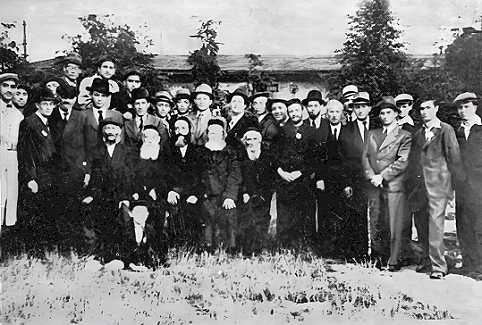
A group of Lizhensker held a memorial for their "shtetl"
in Germany on their way to Israel
|
[Page 257]
For the Martyrs of our community
Editor: Chaim Rabin
[Page 258]
[Pages 259-260]
by Yitzhak Tantzman
Translated by Zygmunt Frankel
Jews from Lizhensk used to meet in small groups in the street and discuss how the Polish State would be able to stand up against the aggression of the Germans. At that time we didn't know that a great tragedy awaited the Polish Jewry in general and, of course, the Lizhensk Jews amongst them.
Everyone had their own point of view, but one thing was understood – that the Jews would suffer greatly. But we couldn't predict how great the troubles would be.
Days passed quickly and then troubles came to Lizhensk. Thursday night 31st August Germany declared war against Poland and sent Nazi murderers into our midst to ruin our European culture. Friday 1st September we felt the war already in our town. The first aeroplanes had shown themselves in Lizhensk and just flew past. We felt that this was only the beginning. The same Friday night Jews in the synagogues of Lizhensk prayed with great devotion. In the meantime we received various pieces of news. That the German Nazis were moving forward with great force and occupying the cities and town of Poland. The rumor was that wherever they went they took all men prisoners. This created a great panic in our little shtetl. The men hurriedly started to organize and plan how to leave town.
The Germans then bombarded our shtetl and destroyed the railway line. That was the only communication with external life for our shtetl. Lizhensk self-defense organized a group who started to repair the railway line.
[Page 262]
I myself was in this group, but the German aeroplanes showed themselves over us and started to shoot at us with machine guns and so disturbed our work. Black clouds began to gather over our shtetl and from far away one could hear the heavy footsteps of the Nazi murderers. Men of Lizhensk, young and old, prepared themselves to flee the city a week after the outbreak of war.
Friday night the shtetl Lizhensk compared to a cooking vessel. There was bustle and noise everywhere as the men prepared to leave the city. That Friday night, the men of Lizhensk ate their Sabbath meal in great haste. Like a swarm of locusts the streets were filled with men leaving the town. People headed off in different directions. Some to Urzohow and some to Kurylovka. Everyone tried to get to the San River. There were some who tried to go to Greater Poland or to reach the border of Romania and in this way avoid falling into the hands of the Germans.
The days in Lizhensk were black and sad, very sad, after the men left. Two days later the German murderers entered in and proceeded to ruin the town. They burnt the synagogues and terrorized the women and children who were left behind.
Within a few days the Germans had occupied all the territories where the men had run away to and a few of them started to return to Lizhensk.
Rosh Hashannah, and the city was almost without men. Only the men who had no strength to go were left in the city on Rosh Hashannah. While we were praying, the Germans expelled everyone from the synagogues and destroyed them with explosives. By Yom Kippur almost all the men had returned home. The eve of Yom Kippur was disastrous. Jews could no longer go praying at the synagogues. Many went to nearby villages because there one could still pray with a minyan (quorum). Mostly people just stayed at home and everyone found themselves a corner and prayed, fasting and asking God to be redeemed from the German murderers.
On Yom Kippur night various rumors circulated about the Germans expelling the whole population from the city. The following evening (Sunday) Jews asked one another, what will happen, will the Germans really expel us from our town? The majority did not believe that such a thing could happen.
[Page 263]
One tried in such a way to hide oneself from the reality, until the infamous Tuesday came. That evening the city policeman, Peterkevich, with his known drum came to inform us that tomorrow, Wednesday 20th September, at 8.00 am in the morning all the Jews who lived in Lizhensk should gather in the market place to leave Lizhensk, carrying only hand baggage.
That was the main blow to our shtetl. That very night people started running in a panic. Many people ran straight to the nearby villages, brought horses and carts and packed them with what they could and went to the far shore of the river San. A few waited for a miracle, possibly that the order would be revoked. Tuesday night dragged on like the exile, until the early morning came and hope faded into oblivion. The German Gestapo came, together with the Volksdeutschen[1]. They went house to house through the town expelling the people from their rooms. Everyone had his pitiful parcel in hand, crying eyes and a heavy heart. All gathered in the market place, all the remaining Jews of Lizhensk, and waited for their bitter fate. At 10 o'clock in the morning we received the command from the Gestapo and then the sad march of Lizhensk Jews, who were rooted
|
|
|
A group of Lizhensker held a memorial for their "shtetl" in Germany on their way to Israel |
[Page 264]
in hundreds of years of history, started. Thus proceeded the traditional march of the Jewish people, known as wanderers for 2000 years of exile.
We were surrounded by hundreds of German Gestapo murderers. We were marched out of our hometown, some with a parcel in hand and some carrying a small child. That was the last road from our dear holy shtetl, the shtetl of the holy Rebbe Elimelech of blessed memory.
They led us to the river San and there they brought us over through a temporary bridge to Kurilovka. It was just on the eve of Sukkot when we came to Kurilovka. The Russians were already there. We fulfilled the commandment of sitting in the Sukkah, and thus ended the chapter of Lizhensk Jewry.
Now, 27 years after the beginning of the war and 21 years after it has finished, there is only one Jew left in Lizhensk. He returned from Russia and now occupies himself with gathering Jewish memorabilia and holy books. His name is Baruch Safir. That is the summary of Lizhensk.
Translator's footnote:
by Chaya Stelzer (the daughter of Feivel)
by Genya Spiegel (Basik)
|
JewishGen, Inc. makes no representations regarding the accuracy of
the translation. The reader may wish to refer to the original material
for verification.
JewishGen is not responsible for inaccuracies or omissions in the original work and cannot rewrite or edit the text to correct inaccuracies and/or omissions.
Our mission is to produce a translation of the original work and we cannot verify the accuracy of statements or alter facts cited.
 Leżajsk, Poland
 Yizkor Book Project
 JewishGen Home Page
Copyright © 1999-2026 by JewishGen, Inc.
Updated 05 Apr 2026 by OR