 |
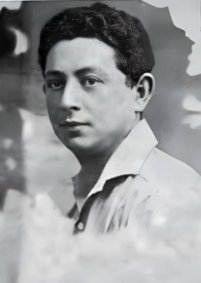
Moshe Grisman of blessed memory
|
[Page 239]
by Mina Miller
|
|
|
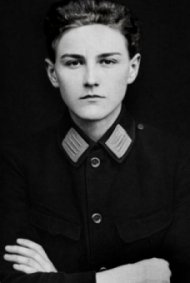
Moshe Grisman of blessed memory |
He was happy, full of energy, blessed with strength, quiet and deep. He had an eternal smile on his face, and he was goodhearted. These were his traits and mannerisms – everyone who crossed paths with him in life became his friend.
He made aliya to the Land in 1930 with the first group of “Hanoar Hatzioni Akiva”, and from that time until his tragic death, during his short time in Israel, he was filled with optimism, happiness and boundless love of all who surrounded him. He did not know weariness and despair, for he was diligent and did not request much out of life. He satisfied himself with little and whoever knew how to read his glowing and eternally happy face could not but be jealous of him.
I remember my first visit with him the day after I arrived in Israel. At that time, he already had left the Kibbutz. Naturally, for ideological reasons, when he worked as a worker in Petach Tikva, he lived in a small room in a hut, with a metal bed, and a half-meter long trunk with all of his belongings. The floor was covered with scattered newspapers. I stood in surprise, and he laughed as usual in response to the question
[Page 240]
that I did not yet have a chance to ask: “Thus is life in the Land, I do not need more”. He did not require much in order to be happy. At that time, I began to understand the adage: “Who is rich? He who is happy with his lot.”[1]. He was happy with his lot under any circumstance. He only saw the good and beautiful in everything, and in situations that were not particularly beautiful, he used his imagination to see things in a positive light.
I cannot remember Moshe ever being in a bad mood. Under any condition and circumstance he had laughter on his very pleasant face, and his laughter exuded optimism to all around him. He was pleasant in the home to his family, and he was pleasant to his many friends in his various workplaces in Israel. He loved people, and he loved the land. With every brick that was laid in the building up of the Land, he rejoiced and jubilated as if it was his own personal accomplishment.
Life was beautiful in his eyes, and he loved life. However, luck was unfavorable to him, and when he went to work for the final time he did not realize, and neither did we his closest relatives, that such a beautiful life, filled with sunshine and happiness, was not to be for him, and that in the wide world, there was not even to be a tiny place for him.
It was in the month of Av 5711 (1951), when he went to work for the final time, and did not return. A fatal work accident cut off the flame of his young and beautiful life when he was only 41 years old.
|
|
|
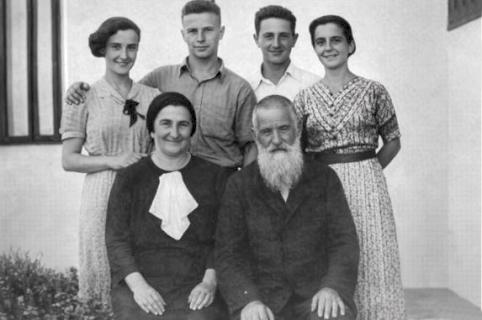
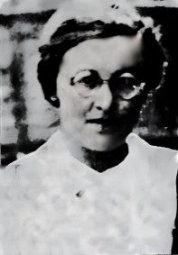
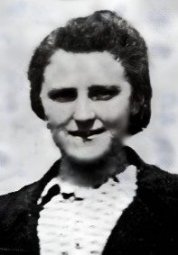
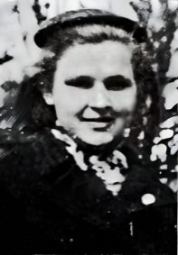
The parents of Moshe of blessed memory, along with his brother and sisters |
Translator's footnote:
by Dvora Arum
|
|
|
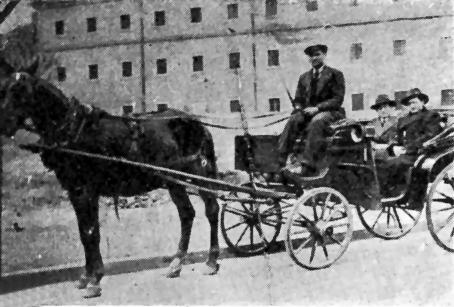
Mordechai Arum of blessed memory en route to making aliya |
I met Mordechai while he was still in the Diaspora. I was on an aliya preparation program (hachshara) in Slowikow, and he was on hachshara in Bielsko. He visited us in our wooden bunks, and I visited his hachshara camp. By coincidence, we made aliya together and we were together on hachshara in Kfar Pines.
We got married two years before we came to live in Kfar Etzion, and I got to know him from up close.
Mordechai was dedicated to his parents, and he honored them. He never argued with them or contradicted them. However, he stood for what he believed in, and did not hide his progressive outlook from them. He behaved properly toward them whether they opposed him or not.
He was a man of the book, and whenever he had a chance, he would read. His thirst for knowledge knew no bounds. His reading was ravenous and thoughtful, as if he united himself with the book. His quest for knowledge was thwarted by his parents, and was limited to religious studies. However through his own efforts, and with his thirst for practical knowledge, he registered for business school without the knowledge of his parents, and he studied there despite their disapproval. This school was to him a route to practicality, and a source of general knowledge.
On hachshara, he decided not to engage in clerkship, bur rather to become the shoemaker of the kibbutz. This was a form of opposition to everything that was acceptable to the older generation – a Jew was required to learn not only any trade, but even a denigrated trade that contains the route to freedom.
He went to a gentile in Bielsko, who was the shoemaker of that town, and studied the trade there. Mordechai did not continue with this for much time, since aliya interrupted his professional training.
Prior to his aliya to the Land, his mother took ill. Her illness was grave, and Mordechai was troubled. He was the youngest child, who supported his mother in her old age. How can he leave her on her sickbed? He almost decided to forego his aliya, but his mother called him to her bedside and commanded him to go.
On the day he arrived in the Land, a telegram arrived with the news of the death of his mother. On his first day in the Land, Mordechai began to sit Shiva.
[Page 242]
When he arrived in Kfar Pines, he took over the position of accountant of the group. At the same time, he would go daily to Karkur to apprentice in the trade of shoemaking.
The shoemaker in Karkur was the son of shoemakers, and knew his trade from his childhood. He did not know Hebrew, but only spoke Yiddish. Mordechai taught him Hebrew in return for his teaching him shoemaking. Thus, while he was learning his trade, he was engaged in cultural activities with his fellow.
He worked in shoemaking and cultural activities simultaneously also in Kfar Etzion. He engaged in very serious matters, affairs of defense and life and death. He was responsible for the local ammunition supply. He controlled the weapons cache, and took courses in military supply. There was nothing in the place that was done without his effort, dedication, or actual participation.
Mordechai was blessed with straightforward and logical decision making abilities. People placed their faith in him and relied upon him. Mordechai was quiet, strong, and always spoke to the truth to people.
As a family man, he was very patient with children. He was a dedicated father and trained them with his natural calmness. He was a good family man, and deliberate in his actions.
On May 14, 1948, during the massive attack upon Gush Etzion and our village, Mordechai fell in the losing battle before the order to surrender was issued.
|
|
|
Motek Feldman of blessed memory |
He fell in the defense of Geda from a shot that was fired by the ambush. He was a member of the Yagur farm. He was 23 years old. He made aliya two years previously as a university student. He left his studied in March 1935, and joined the Yagur farm. In the Diaspora, he was a member of the “Hitachdut” group, and a student of the University of Lvov. He studied chemistry and philosophy. He enlisted as a special guard, one of the seven special guards who enlisted from the Yagur farm.
by Shlomo Tamir
(From speeches in his memory on the occasion of his yahrzeit commemoration,
and printed in pamphlet 1432 of Tel Yosef farm, December 10, 1965.)
He left us when he was full with suffering, but according to the situation
today, not full of years. He was only 68. He was fully conscious until the day
of his death. He talked to his children, his grandchildren, and anyone who came
to visit him. There were days when he suffered from pains, when he was writhing
with suffering, when he was sustained by intravenous, pills, and fatigue
inducing medications, etc. Despite all this, there were days when he got out of
bed, walked around the room, ate and drank, talked to people, laughed when he
heard jokes, and took interest in the affairs of the farm. In accordance with
his request, he was taken to ballot box on the day of Knesset elections.
He was born in Lizhensk in Galicia. During the time of the First World War, he lived in Vienna, and served in the army of the Austrian Kaiser Franz Josef. He made aliya in 1920. During his first years in the land, he worked in street maintenance and building. He got married in 1922. In 1923, he traveled with his wife to visit Lizhensk. They stayed there for three years. After that, his family returned to the Land and he traveled to Argentina. He also spent some time in Brazil. He lived in South America for a year and then returned with his family to the Land.
He worked hard for his entire life. He wandered from place to place. He lived with his family in Jerusalem, Raanana, Tel Aviv (in a hut in the Nordia district), and he came to us 17 years ago (in 1951), to his daughter Miriam and her husband Mordechai Tamir. For most of his years in the Diaspora and in the Land he worked as a chef, in the army camps, in the workers kitchens of Solel Boneh, in the British Army camps, and for private individuals (such as the chief justice Gad Frumkin and others). For many years, he spent the weekdays in camps far from his family, in bunks and tents. He came home for the Sabbath.
There were long periods when his family lived in difficult conditions. Even when he owned a private restaurant he would often give food to the hungry and to those who were out of work. The list of people who owed him money was long enough to fill a book. For the most part, he was not repaid, but nevertheless he did not refuse to give food to anyone. He was naturally good hearted, upright, and tended to answer positively any request for donations.
When he arrived at Tel Yosef, he brought in a sum of money in return for the small dwelling which he received[1]. Until the day of his death he lived with his wife Rachel (may she live long), in a small room literally 4 by 3. In the latter years, it had a corner for a washroom (but not for a kitchen). Not infrequently, his daughter Miriam, with Mottel and their five children stayed over at his place. On occasion, his son Tzvi and his family of four children from Kibbutz Maayan Baruch in the Galilee also came, as did his son Amnon from Beit Shean along with his three children. He never said that the place was too small.
For his entire time on the Kibbutz he worked in the kitchen. He was not always satisfied with his work in the kitchen, with the behavior of the members to him, with the routines and customs. He was used to working in institutions where he was the boss, the head of the kitchen. Here he had to be satisfied with being a cog in the wheel, to be dependent on the goodwill and willing to take barbs from those who were many years his junior and who were less intelligent than he was. He accepted everything with love.
[Page 245]
In the later years, he had much pleasure from his children and twelve grandchildren. He was hoping to merit to see the marriage of a grandchild, and to become a great grandfather. Until his last days, he hoped that he would regain his strength and is able to return to work.
Whenever I visited him in the hospital or in his room, I found him interested in the issues of the movement, what was going on in Tel Yosef, and the situation of his children and grandchildren. He was cared for faithfully by his wife, children, and grandchildren. Miriam stayed with him day and night, as did his sons from Maayan Baruch and Beit Shean. Bluma was with him on his final evening, and she gave him a shot and pills. He and those around him never ceased to praise the dedication and good work of Bluma and Dr. Barta, who came to visit him often even when they were not called. He was writhing in pain that night. They called Dr. Barta, and while he was being examined and being prepared for an injection, he passed away.
A large group of members of the farm, his children, grandchildren, other relatives, and people from all parts of the country came to participate in his funeral. His casket was placed in the synagogue of the parents and in their dining hall. His requests were filled, a tahara[2] was performed, he was wrapped in a tallis (prayer shawl), his children and grandchildren recited the Kaddish prayer, and daily prayer services took place in his room during the Shiva period. During the Shiva, no movie was shown on the farm, and the party that was planned to take place on Friday night in the dining hall to mark the end of the olive harvest was cancelled.
During the fifteen years in which he lived among us, we were accustomed to see him at every celebration and every event that took place in the farm, along with his children and grandchildren. He loved them and they returned his love. They wailed publicly at the time of his death and during the funeral. This was unusual for Sabras (native Israelis).
There is nothing we can do.
He left us. He left behind a legacy full of dedication, work, experiences, wanderings, adventures, and help for his fellowman.
He left a large family behind, a family of workers. We hope that his children, his grandchildren, and all of us will preserve his memory. His family will grow up, they will make sure to name a grandchild or great grandchild after him, and his memory will be perpetuated. May his family be comforted, and may all those who knew him and were close to him be comforted.
Translator's footnotes:
by Dov A.
|
|
|
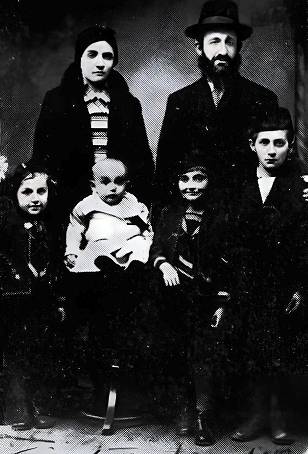
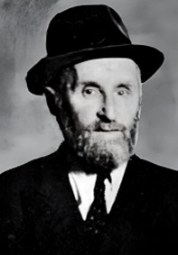
Reb Asher Zelig Miller and his family |
He was born in 1891 in Belzec[1]. He spent his childhood in that town, near the Russian border, under Austrian rule. After the First World War he got married and settled in Lizhensk. He quickly began to take part in the vibrant Jewish life of the town.
He served as the prayer leader on the High Holydays in the Kloiz of Aguda, and with his sweet and pleasant voice, and expertise, he would pour out supplications to the Creator of the World.
He was a proud Jew, and it was difficult for him to bear the exile. In 1925, he made aliya to the Land as a pioneer from his family, and for half a year he made efforts to bring his family over. He did not find work, he did not succeed in acclimatizing here, and he was forced to return to Lizhensk. There, he continued to live in the town from the toil of his hands, and he maintained his desire for the land of the patriarchs. At the outbreak of the Second World War he wandered from our town, and the trials and tribulations began, which caused him unspeakable suffering. During his wandering upon the face of the earth he suffered from the indignity of hunger, and he lost his son. Our sages say about this (Tractate Berachot, folio 5): “Whoever occupied himself with Torah and good deeds and buries his children will have all of his sins forgiven.”
With Reb Asher Zelig Miller, all three of these conditions were fulfilled. He occupied himself with Torah and good deeds, and his son David of blessed memory died during his lifetime, and he did not merit to bury him, for he died as a soldier fighting against the Germans, and his burial place is unknown.
His heart was pained by all of this. When he finally merited to arrive in Israel in 1949,
[Page 247]
he was full of suffering and weariness, however his Jewish pride was not damaged. It grew and became stronger, and he rejoiced in seeing the children in Israel studying Torah and serving in the Israel Defense Forces. He continued with his cantorial activities on the High Holydays, and the residents of Kiriat Motzkin enjoyed his services and the fullness of his Judaism.
In Israel he also occupied himself with Torah and good deeds. He shared the little that he had with others. However his heart was not able to take everything that happened to him, and all the suffering that he endured.
His heart ceased beating on the 11th of Tevet 5714 (1954) in Kiryat Motzkin.
May his soul be bound in the bonds of eternal life.
Translator's footnote:
The word “Zionism” was an exalted ideal for us, and everyone actualized it in his own way: one would prepare himself for a productive life in the Land, another would gather money for the funds for the Land of Israel, and there were those who took positions of honor in various representative capacities. Fishel Spergel was of the latter, who was engaged in arduous work. Quietly, as if in stealth, he came to our clubhouse on cold winter nights – for the most part, our clubhouse was not heated – leaving at home a beautiful wife and son. He would come after a difficult day of work in his store, and he would read to us poems of Bialik.
We studied Hebrew from various professional teachers, however we loved in particular those poems of Bialik. We learned to read and to love literature only due to him, for he had a special way of teaching, and he had a special charm in the way he explained and brought to life the poems, their content and ideas.
Every evening of reading of that sort was like a holiday. He was one of a kind,
who came constantly to teach us to read and understand the poems of Bialik.
There were other adult Zionists who were able to give over much to the youth
groups, however they did not find the free time for that purpose. Fishel
Spergel found the time and the will to teach us, and his dedication to this
difficult task was perhaps one of the reason for the breakup of his family
life, and finally their tragic separation. Let his short section be a thankful
memorial to his life.
by Dov Ausubel
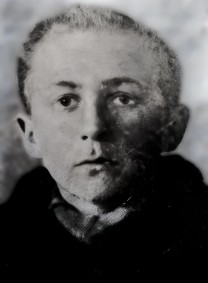 |
David studied in the cheder and in the public school, like the rest of the children of Lizhensk. From an early age, he spent his entire day at school, in the morning in the public school and in the afternoon in the Talmud Torah.
When he was still a child, he displayed exceptional talent in his studies and in arts and crafts. I still remember the illustrated sign on the wall of the Talmud Torah, which was the work of his hands. His name was signed in the lower left corner. This sign was written in large Hebrew letters, which caused joy to the hearts of the children. The large prominent Hebrew letters, which were noticed also by the adults, proclaimed the continuity of Judaism in the midst of a hostile gentile environment.
It is possible to state that if he would have been raised and educated in a different city, he would have developed his talents fully and attained greatness. Lizhensk was tiny, and it was impossible to find the appropriate schools in the area that would have been necessary to develop his rich potential.
David did not leave our small town. Despite this, his soul was interested in the wide world. From an early age, David had to forgo his own desires and the needs of his youth in order to help sustain his parents. His faithfulness to his parents was particularly prominent during the time of the war and the many wandering which came at that time. He did not abandon them, and worked hard in order to support their hungering souls.
When the time came that he was enlisted to the Red Army, he went out to the front with a heavy hart. His parents were left behind with nobody to care for them. This weighed upon him heavily, however he took comfort that on the front he would be able to help destroy the enemy of our people, the demon of our generation.
David merited to pursue the retreating Nazis, who were retreating in fear of revenge. As he was pursuing them during their retreat, he arrived in the destroyed Lizhensk, however he did not merit witnessing the final victory over him.
On the 4th of Shvat 5704 (1944), he was shot by an enemy bullet, and he fell in battle.
May we guard his memory forever.
Above everything, Reb Moshe Naftali Teicher loved chazzanut (cantorial arts). He loved to sing, and was able to do so well. When he sang, his soul was so stirred within himself as he scaled the heights of music, until it seemed that he was able to penetrate the celestial gate of melody.
It is not in vain that it is stated that the gate of melody is found next to the gate of mercy, for also the compassion of Reb Moshe Naftali of blessed memory was without bound. He had a heart that did not and was not able to turn away from the tribulations of his fellow. When he still lived in Lizhensk, surrounded by the comforts of his home, he regularly invited poor people into his home and fed them. Even during the years of wandering the breadths of Siberia, during the time of war and famine, he never hesitated in sharing his scanty bread with someone who was in need. Not only this, but when he heard that a Jew had come out of prison and was ill, forlorn, and infested with lice, he would take him into his house, wash him with his own hands, clothe him and support him until he was able to fend for himself. Even here, when he arrived in the Land of Israel, his hand was open to anyone who was in need. Anyone who inquired knew that for matters of loans and charitable deeds, one could turn to Reb Moshe Naftali, and one would always be answered positively.
Despite the fact that his pedigree was prestigious, and his family tree could be traced generation after generation to the holy sage Rashi, I never heard him boasting about this. I never even heard him mention this. Reb Moshe Naftali (Monia) Teicher of blessed memory was so modest and discreet.
[Page 251]
|
|
|||
|
|
The father of my grandmother was a G-d fearing Jew, as were most of the Jews of Lizhensk at that time. He was a communal activist from his young days, and he spent most of his time serving the Jewish community. After the great fire that broke out in the town, he was one of those who put effort into rebuilding the synagogue. He frequented the home of the rabbi and the communal leadership. If there was a dispute, they would turn to him as an arbiter, since he was known for his sharpness and honesty.
This was the father of my grandmother, whose name I bear.
My grandmother related the facts above to me.
by M. Spergel
They were friends from childhood, from grade one in the elementary school. Later they studied together in the Hebrew school. Together they dreamed of aliya and actualizing their dreams. Together they joined the “Akiva Hebrew Youth” youth movement. It seemed that they would continue along the paths of their lives together, and their strong bonds of friendship, which had withstood several tests, would continue.
With the coming of the time of disaster, their orderly lives were separated. Life broke out into tortuous paths in the forest of the tribulations of the Second World War.
The two of them remained inseparable as long as was possible – Riva Roitman and Henia Spergel.
When the Germans entered Lizhensk, the order was given to leave the town, to cross the San, and never to return to Lizhensk. Riva went immediately to Henia to discuss with her about what was to come. During the course of the conversation, Riva asked Henia if she knew the whereabouts of the jewelry of her late mother, and advised her to remove it from its hiding place in the wall and take it with her on her journey, for during the dark days, life would be ransomed for silver and gold.
Henia listened to her, and she had deep fears in her heart. For a moment it seemed as if it would be best to leave everything in its place for when life would return to what it was, and she would return to the town. However the advice of her friend weighed upon her and she took the “mementos of mother”, bundled them up in a bundle and kept them close to her heart for the flight.
When they arrived at the San, the Germans commanded them to leave all valuables and jewelry behind on a blanket that was spread out for that purpose, and whoever would disobey this command would be shot on the spot.
Her previous fears came back. She was disgruntled in her heart with the advice of her best friend, and for a moment it seemed that she would lose the last connection to her former life when normal life would begin again. However she knew that Riva's advice was made with the best of intentions, and she accepted the situation calmly and with forgiveness. She took out the bundle from its hiding place, ready to hand it over when her turn came.
That moment, a German came to her, and with a serious expression uttered the command: “hide that”. She was confused, for she did not know what was the intention of this enemy. She hesitated, however he repeated his command, and she returned the bundle to its hiding place. Then, the Nazi removed from the line, and placed her at the side. Henia knew that her fate had been sealed. The Nazi would be able to prove that he found a violator of the command, and her death would be certain. The German looked around from side to side and when he saw that none of his colleagues were looking, he took a handful of gold coins from the pile of gold that was at his feet, gave it to Henia, brought her by force to the bridge, and commanded her not to return.
The Jews who were around did not understand what transpired here. Nobody expected such a deep display of humanity from the Germans.
[Page 254]
The paths of the friends, remnants of a group of beloved friends, also separated.
Riva Roitman remained in western Ukraine. The Germans chased her as a hunted animal. She was lost trace of and nobody knows what became of her.
Henia endured the tribulations of the war in the forests of Russia. Her life was filled with suffering, travails, disasters, and hunger. The event at the San strengthened her in her belief in life and her will to stay alive. She endured everything and arrived in Israel.
Her in Israel, she hoped that she would have a peaceful life, however the remnants of her struggle for life left their mark. She was stricken with a terrible disease and her life ended.
by Mina
Chaya Diamand was one of the founders of the “Akiva Youth Organization” in our town. With her sure and steady direction, and her healthy laughter, she instilled security and strength into all of us, even though she was the same age as us.
She was one of the first volunteers for any activity of the group. She always found the free time and the positive desire, whether it was to collect charity boxes of the Jewish National Fund in the homes, to prepare a festive event, or to go out to a meeting with branches from neighboring towns. She was not hesitant to wear a large white band and march along the streets of the town at the head of a parade. She was always one of the first to go out to a summer moshava program, and from her, we would also gain the strength to be able to stand up to the demands of our parents.
Chaitzi was the strongest and most powerful of all of our friends. She was very fortunate in that she made aliya together with her parents and his sisters, and she did not have to deal with separation and longing for her parents' home. Her constant, infectious smile stayed with her.
When I arrived in Israel, I hurried to visit Jerusalem, and went to visit her in her parents' home. Her heartwarming laughter that I was familiar with from the past greeted me once again. In every encounter with her, I remember her smile, literally from ear to ear, pasted upon her face.
During the final time that I saw her, we were visiting together in Ramat Rachel, and she talked a great deal about the headaches that she had been suffering from. After that time, I never heard her deep laughter again. This was the beginning of the “end', and it was most unfortunate. It is unfortunate about her loss.
Chaitzi Diamand went to her rest so young and full of desire for life.
[Page 256]
|
JewishGen, Inc. makes no representations regarding the accuracy of
the translation. The reader may wish to refer to the original material
for verification.
JewishGen is not responsible for inaccuracies or omissions in the original work and cannot rewrite or edit the text to correct inaccuracies and/or omissions.
Our mission is to produce a translation of the original work and we cannot verify the accuracy of statements or alter facts cited.
 Leżajsk, Poland
 Yizkor Book Project
 JewishGen Home Page
Copyright © 1999-2026 by JewishGen, Inc.
Updated 21 Apr 2026 by LA