 |
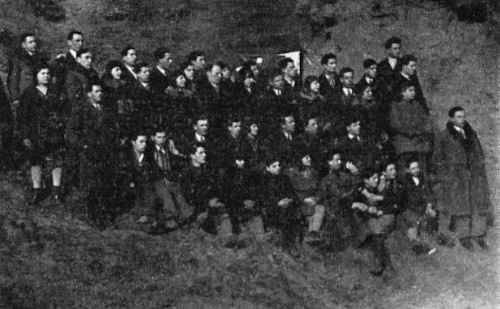
attended by representatives from Eretz Israel
|
|
[Page 167]
by Aharon Appelboim
Translated by Moshe Kutten
The memories I raise here date back half a century, to the Russian invasion of our town in 1915. In that year, I left Kosov with other refugees, and I was a thirteen-year-old.
The two World Wars were cruel to our town, destroying it to its foundations. I do not bring this up to compare the wars; rather, I want to clarify their differences. The first war was mainly a destruction of property, while the second uprooted everything—property and soul—leaving no trace behind. In comparison, the first war seemed almost idyllic beside the total annihilation of the second.
I would like to sketch a few outlines of the status and standing of the craftsmen in our town: their behavior, the mutual aid that was common among them, and their attitude toward Jewish and Zionist values.
At early dawn, they rose and went to the old Beit HaMidrash—where, as Bialik wrote, the nation's soul was shaped. After public prayer, eager to start work, they had little time for comfort or deep spirituality, yet devotedly observed the commandments—both those between people and God, and those between people themselves. They never violated the Sabbath or holidays. I remember when a gendarme came on Shabbat to buy furniture from my father, may his memory be blessed. Though a skilled carpenter with furniture to sell, my father did not yield. The gendarme's pleas and threats were in vain. My father said, “Today is Shabbat, and I will not desecrate the Sabbath.” Refusing a gendarme in a small Galician town took great courage; even his arrival could inspire fear.
Mutual aid was one of the social phenomena among the craftsmen. Most of the members of the society of “Bikur Cholim and Linat Tzedek” [“society of sick visitation and charitable lodging”] were the craftsmen and commoners. They were diligent in observing the mitzvot of gemilut cḥasadim (acts of loving-kindness) and hachnasat kallah (assisting poor brides). In times of misfortune—such as a fire or an outbreak of illness—there was no limit to their self-sacrifice in helping others.
A massive city fire remains vividly etched in my memory. I was jolted awake in the middle of the night
[Page 168]
by the urgent clanging of bells. Fear seized me, and trembling shook my entire body. My teeth chattered against one another like hammers. Through the window, I beheld a dreadful sight: the sky was ablaze. Great sparks were being carried by the wind. The members of the household wrung their hands in anxiety, fearful that the fire might spread to our home, and hurried to carry the furnishings out of the house. My late father was not at home. He was engaged in the rescue efforts and in fighting the fire, as were the others who were not themselves in immediate danger at that moment.
Others probably wrote about Shabbat and holidays in our town. I will focus only on one Jewish festival. This festival took shape in the Diaspora and grew from the unique Jewish experience in exile. It became a symbol for generations—the festival of Purim. The central commandment is joy: to rejoice and bring joy to others. On this day, a Jew refrains from work, stays at home, and waits for those who go from door to door. These callers are numerous that day, as they fulfill the commandment of “gifts to the poor.” This holiday is often called “the children's holiday” and, in Israel, has become the holiday of festive balls. In our town, it was loved by simple working Jews, those who earned their living by their own hands. They were pleased by this chance to exercise generosity.
It was a great experience to sit with Father at a table full of small coins, handing out money all day to those who came to our doorstep, both in groups and one by one. People came in costume or not, greeting us with 'A happy Purim' or singing a Purim song. My father's face beamed—he was truly happy. I spent many years abroad and never saw a similar custom among other people. On that day, all the residents opened their doors to anyone, without distinguishing between needy and non-needy. This allowed even the hidden poor to benefit from the townspeople's generosity.
The craftsmen in our town were far from affluent. They worked hard to earn a living. Despite their poverty, they remained honest and deeply concerned about raising their children in the spirit of Jewish tradition.
Faith in the Messiah, the Redeemer, and in the gathering of exiles in the Holy Land was very strong. Hardly a Jew neglected to pray three times a day, “And may You return in mercy to Jerusalem, Your city.” Most of them were sympathetic to Zionism, and many were Zionists in both heart and soul.
The town was situated near a stream that had little water during the summer. However, during the rainy season and snowmelt, it became a mighty, dangerous torrent. When flooding occurred, the stream raged across hundreds of meters, and threatened the houses on the southern side of the main road. As flood season approached, we lived in great fear. Our house stood close to the bank, and the roar of the rushing waters
[Page 169]
just behind our windows would shake the house. A large number of buildings—among them the frail dwellings of ordinary folk—stood surrounded by the raging waters during that season, and only by a miracle remained standing on their foundations.
When I think of those days, the town seemed economically unstable. Security was lacking. It felt as if only a miracle could sustain people's lives. Everyone hoped for redemption, believing tomorrow would be better. Their luggage was always ready to go.
This attitude showed in an incident: when I visited my father's home in 1935, he told me he planned to immigrate to Eretz Israel. To my shame, I opposed it, saying life there was hard and the climate harsh. My arguments didn't move him. He remained firm—he wished to die in the Holy Land, and so he did. May his memory be blessed.
by Dr. Yehuda Felix[a]
Translated by Moshe Kutten
Each writer, looking back twenty to thirty years, brings a distinct perspective. When I write about my town, Kosov, I see it through the prism of my childhood.
I left Kosov as a child. At fourteen, my parents sent me to high school in the distant city of Krakow. I studied there for two years. During the summer break of 1938, I returned home. Then my father decided to send me to Eretz Israel with a group of youths from Poland organized under “Aliyat HaNoar” [Youth Aliyah].
I will never forget that evening—the night after Yom Kippur—when I left Kosov with another youth my age, Moshe Shach, heading to Eretz Israel. Many townsmen still recall that night, too.
Fate decided my father's choice to send me to Eretz Israel, after hearing H***ler's speech attacking Beneš [Czechoslovakia President], saved my life. I was the only one from a large Kosov family to escape the Nazi tyrant. On the night I left at just sixteen, echoes of the 1936–1939 gunshots still persisted in Eretz Israel. Many in town—both kin and others—called Shalom Felix foolish, or even cruel. They asked, “How can a father send his son into danger, when in Poland a diligent student had a sure, if not a brilliant, future?” Indeed, the people who saw me off wept bitterly, as if sending me to certain death.
My father dismissed arguments against him. His vision extended beyond the present. He foresaw antisemitism worsening in Poland and the Nazis ascending in Europe. To him, there was no future in Poland for a young person seeking an education. Jews in trade faced barriers posed by government taxes and new Polish and Ukrainian rivals. Despite being a successful businessman and a kilim carpet expert, my late father discouraged me from entering commerce.
[Page 177]
He hoped one family member would study agriculture in Eretz Israel. My father imagined his son owning a citrus orchard or farm. He dreamed the whole family would reunite—“each man under his vine and fig tree.” This wish reflects the innocence and idealism of many Kosov residents toward Eretz Israel. Many would have left, but strong commercial ties kept them. Even stronger were family bonds. They could not leave relatives and friends, even if escape might have saved them from the oppressor. I think this explains why so few of the town's Jews survived, despite the chances when escape was possible.
Here are a few details about my late father, whose image has accompanied me throughout my life in Israel. I think it is worthwhile to sketch his character and those of my other close relatives, such as my uncles and grandparents. In many ways, they represent the people of Kosov, and perhaps many Jews of Eastern Galicia. I feel it is necessary to dispel the old stereotype about 'Galitzianer' as sly and crafty. In truth, Eastern Galician Jews were not as folklore suggests. Only Agnon seemed to portray them authentically. The typical Jew of Kosov was sincere, romantic, and honest. He was not a cunning schemer. Many of the first dreamers and pioneers in Eretz Israel came from Eastern Galicia.
My father was meticulous and acutely sensitive to any perceived slight to his dignity, yet this very trait reflected his unwavering integrity.
In many ways, my father mirrored my uncle Netta. Netta, a fabric merchant in Zabolotov [Zabolotiv], was actively engaged in community and Zionist affairs. In his youth, he was a dreamer—an 'Aspamia' soul, forever pursuing improbable visions. I recall a story capturing his essence. One day, a visiting agent pitched a new invention: sticky paper for catching flies. My uncle, endlessly enthusiastic, believed this would eradicate Galicia's fly plague. According to a relative, he purchased enough to fill a room, convinced it would sell quickly. There was so much flypaper it could build a wedding canopy for all of Kosov, but the stock languished unused for years. Eventually, the adhesive dried up, turning the paper into a banquet for flies instead of a trap.
My uncle Itzi, of blessed memory, was a different character. Athletic and restless, he craved adventure. His story took him far from home—he left his wife and children for several years and traveled
[Page 178]
to find his luck in South American countries. From there, he used to send songs and poems about the landscapes and the people¯particularly the women, of the banks of the La Plata River. Fortune did not favor him. He was stricken with a tropical disease, as a result of which one of his legs had to be amputated. Crippled and with his wings clipped, he returned to Kosov. Better fortune befell the youngest of the brothers, my uncle Gershon, who found himself in Vienna during the days of the “Jewish Flucht” and succeeded in establishing himself there. After the Anschluss, he fled to England. He was the only one of the four brothers, my uncles and my father, who survived World War II.
I allow myself to reach back to my grandfather Hirsh Felix's generation, once nicknamed “Krechmer” for running an inn at the town's edge. He devoted his life to Torah study. The inn's drunken Gentiles disrupted his routine, so he relinquished his income and became a melamed in the Kosov rabbi's court. He accepted only the top pupils, even though his earnings were paltry. He would never accept charity from his sons. Deeply pious, he fastidiously observed every commandment. Each Passover, so strict was he about koshering the oven and utensils that fires often broke out in his house. We grew accustomed to this. During Passover Seder, if we heard the alarm, we rushed to my grandfather's home on the Rozhnov road, certain a fire had struck him again—and, regrettably, we were often right.
His big dream from childhood was to make Aliyah to Eretz Israel and to dwell in the shadow of the graves of the great Tzadikim in Safed. (He was the administrator of the Safed Kollel in the region.) It was a tradition in our family that when one of its heads reached old age, he would make Aliyah to the Holy Land to die there. To this day, there are graves in Safed belonging to my family from past generations.
Connected with this was the fact that my grandfather always wore a “Chalat,” a long outer garment, in both summer and winter. The story behind this was as follows: When my grandfather's grandfather was preparing to make Aliyah to Eretz Israel, Hershe'le insisted on going with him. He argued that, when he was eight years old, his grandfather had promised to take him along. Hershe'le treasured that promise. When the day of departure arrived, he stood firm and refused to give it up.
He was so stubborn that he could not be persuaded by any means to give up the idea. Meanwhile, the wagon to take his grandfather to the border arrived. Hershe'le clung to the wagon, determined to join the journey. He believed going to the Holy Land was a calling he could not ignore. His family let him climb aboard, hoping to dissuade him during the trip. When they reached the border, his grandfather had an idea. He turned and said, “True, we are traveling to the Holy Land. But where is your little 'chalat' [a long coat worn by Hasidic Jews]?” Hershe'le looked around, perhaps hoping a miracle would happen and the long garment would appear, but to no avail. Then his grandfather tried again: “How can you imagine arriving in the Holy Land
[Page 179]
without a little 'chalat'? After all, what if the holy Ar”i, or perhaps even Prophet Elijah, should come to greet us?”
Upon hearing this, the child accepted that reason. With a broken heart, he agreed to return home. With a broken heart, he agreed to return home with his family. My grandfather later told me he decided never to remove the “chalat.” To him, it was clear that if he had a “chalat,” he would have been in Eretz Israel. He wanted to wear it always, so he would be ready to welcome the Messiah.
When my father decided that I should make Aliyah to Eretz Israel, my grandfather was very enthusiastic about the idea. He considered that a glimmer of hope for the realization of his dream of immigrating to Eretz Israel. At the doorway of the bus that was to take me from Kosov, my grandfather threw his arms around my neck and made me swear to bring him to Eretz Israel. But matters were otherwise ordained, and he, too—like my other dear ones—found his resting place among the holy martyrs of Kosov, in a mass grave on the mountain.
My grandfather, of blessed memory, measured the entire world by the standard of strict justice, and the fear of divine judgment in the World to Come was always before his eyes. His complete opposite was his wife, Grandmother Gitel. She was a true righteous woman—filled with love for all of God's creation. I would always remember her standing in front of the window, holding the Psalms Book, which she recited every day. However, she was not satisfied with reciting from the Psalms and would add her own blessings and prayers. These were directed toward every passerby on the Roznov road¯where her house was located, whether a fellow Jew or not, or to distinguish, even a creeping creature, animal, or bird that passed within her sight. She had a special blessing for everyone and every creature. She believed that every one of the Holy One's creatures was nothing less than the reincarnation of a human being; indeed, she would sometimes wonder—perhaps fearfully—whether it might even be the reincarnation of one of the Tzadikim!
In her later years, her eyesight gradually deteriorated as a result of cataracts. The family consulted physicians, who determined that surgery was inadvisable because of her age and frail health. But Grandmother insisted that without being able to see the creatures of the Holy One, blessed be He, life was no life at all. She firmly demanded that the operation be performed, hoping for a miracle. She passed away a few days after the surgery, in 1939, shortly before the Nazi invasion of Poland. Indeed, perhaps a miracle did occur, as she was spared witnessing the actions of the Ukrainians—people she had blessed ten times a day—who became predatory animals…
From here, I turn to myself and to my experiences in Kossov. I am reminded of [Poland's national poet] Mickiewicz, who sang of his homeland: “Only he who has lost you knows to value you.” I can relate, for I lost my birthplace twice in a relatively short period—first at the age of fourteen, when I was sent to study at Krakow's high school, “Tachmoni,” and then two years later, when I made Aliyah to Eretz Israel. My first departure took me 500 kilometers from Kosov to Krakow, with the aim of continuing my life in a religious atmosphere in a city known for its Jewish heritage. Indeed, Jewish Krakow was beautiful.
[Page 180]
I was well provided for in every way. While staying with a welcoming family, I became active in the HaShomer HaDati branch, led by Shalom Terler—later Karniel—one of the founders of Kfar Etzion and among its first martyrs. Despite these comforts, I found myself missing home—not for my mother's care, but for the distinctive human and natural landscapes of Kosov. Krakow lacked the warm, sociable atmosphere that made Kosov so special. I also longed for the unique prayer traditions of our town. I'll never forget the anticipation I felt for Passover vacation, when I would return home for the family Seder, complete with the familiar melodies of the Haggadah and my mother's Passover dishes. Equally, I also looked forward to the “Second Seder” at the “Mizrachi” synagogue, led by Avram'tche Kreizel. Many HaMizrachi members, including my father, would bring matzahs and wine to the synagogue, where they recounted the story of the Exodus from Egypt and spoke passionately about Eretz Israel throughout the night. Nearly 25 years have passed since then. I have participated in many Seders and visited many synagogues, but nowhere have I found the festive and warm atmosphere of that synagogue. I still remember how eagerly people listened to Avram'tche's simple, heartfelt words.
By the way, this is the place to mention the democratic spirit that prevailed in the HaMizrachi synagogue in Kosov. Honors and Aliyot were determined not by the economic status, social standing, or spiritual importance of the participants, but simply conducted by turn. In this way, every member of the synagogue had the opportunity to receive the “third,” “sixth,” and “maftir” Aliyot. Unfortunately, this custom was not practiced in other synagogues. Even here in Israel, the harmful tradition of showing favoritism in the distribution of synagogue honors—such as being called up to the Torah or being seated in the "Mizrach"—still persists, leading to friction and feelings of jealousy.
So far, I have explored the human landscape of Kosov; now, I will share a few thoughts on its natural beauty. Throughout my years engaged with nature and botany, I encountered many remarkable landscapes, but none stirred my sense of awe quite like the mountains and forests of Kosov. It is no surprise that these majestic mountains became the backdrop for the Hasidic movement, whose roots are deeply entwined with the appreciation of nature's beauty and the joy it inspires. I will always remember the hikes through the Kosov mountains with the counselors of the Bnei Akiva youth movement.
To what extent my soulful bonds to the landscape of Kosov were courageous will be proven by the following fact (which I mentioned in my article in the “Haaretz” newspaper dated February 27, 1959): When I immigrated to Israel, I arrived at the “Kfar HaNoar HaDati” [“Religious Youth Village”] agricultural school. Previously, I was told that the place was situated in a forested, mountainous area. I arrived at dark and immediately asked about the location of the forests and mountains that had been promised to me. They replied: “Wait until the morning light
[Page 181]
and you will see Mount Carmel that rises before us and the thick oak forests in the surrounding area.” At dawn, I arose to feast my eyes upon the long-awaited landscape. To my disappointment, however, all I saw was a high hill they called Mount Carmel, and a few stunted trees designated as a forest. Restless, I set out to search for mountains and forests in other parts of the country; I hiked through the Ginegar Forest and roamed the hills of the Galilee. It was only around the Grove of the Ten [Horshat Tal], near the headwaters of the Jordan River, that I found some resemblance to the landscape of my childhood. I missed it so much that I began to arrange my return to Kosov (I need to emphasize that I mainly missed my childhood natural landscape. In other respects, I found a home and a community in Israel—in the truest sense of the word).
Fortunately, my correspondence with my family at home lasted a substantial amount of time¯until H***ler's invasion of Poland. Meanwhile, I began to grow fond of that part of the Israeli landscape which was the complete opposite of the Kosov mountains and their forests. I came to love the stark, arid desert landscape and its wild canyons, the searing heat of the Beit She'an Valley, and its remarkably cool, refreshing springs.
I believe that this clash between the two landscapes within my soul awakened and fertilized in me a love for the nature of Eretz Israel, to which I dedicated my studies and research. In my book “The Biblical Plant World,” in which I discuss the plants of the Bible, I noted the following dedication:
Upon the unmarked grave
of my parents and family members, of blessed memory,
who perished in the atrocities of 1942 in Kosov-Hutsulsky
—a wreath of blossoms from the past
My intention in this dedication was to the flowers of the past—of the Bible: to the flowers placed upon the graves of loved ones—who are no more; and to the flowers of grace and beauty of my childhood landscape—in Kosov, my hometown.
Editorial note
by Yosef Winter
Translated by Moshe Kutten
The message of redeeming Zionism first reached me in 1918, when I was twelve years old and a student in the beit midrash. Older students–such as Moni Brimel, Yitzchak Kramer, Yosef Kalman, and others–had already been deeply involved in both Zionism and socialism. However, all their activities took place underground and were veiled in secrecy. We younger boys sensed that something significant was happening in the beit midrash, but everything remained hidden from us.
Curious, we started following the older boys. Once we uncovered their activities, they agreed to share their secret with us, provided we did not reveal anything to the late Ben-Zion Shiber, who then served in a role similar to the head of the yeshivah. After we pledged our secrecy, they began supplying us with reading material about Zionism, pioneering settlement, and Aliyah to Eretz Israel.
Of all the books we encountered, Ber Borochov's “Di Platforma” [“Our Platform”] captivated us the most. Not long after, events progressed rapidly, and on a momentous day, we revealed our true identities and publicly declared our membership in “Poalei Tzion Yamin” [Right faction of the Workers of Zion Party]. The party had already established a small branch in the city, led by Baruch Engler, Yosef Merbaum, Mordechai Bender, Leizer Brimel, Motl Brimel, Zayda Freilach, and others.
When we joined, the party gained a significant spiritual boost. Two members stood out: Moni Brimel and Yitzchak Kramer. Their words about socialistic Zionism during conferences and member discussions inspired enthusiasm in all of us.
The “Workers of Zion (Right Faction)” became the hub of the town's progressive forces and its proletarian classes. This included the working intelligentsia, artisans, kilim (rug) workers, porters, and others. The party grew both in quality and quantity.
Party members were active in all areas of life, from cultural activities to social aid. They organized conferences, meetings, and discussion sessions to explain Zionist ideals and promote the pioneering spirit.
Several hachshara [Pioneering training] camps were established in Kosov. The largest was Kibbutz Klosova [Klesiv], founded by the Workers of Zion (Right). Kosov supported the kibbutz and provided for all the trainees' needs–lodging, employment, representation before the authorities, and more.
[Page 183]
This included finding books and other necessities. As more young people joined the party, we established a youth organization with the central office in Lvov [Lviv] called “Freiheit” [Freedom].
|
|
attended by representatives from Eretz Israel |
At the top of our list of concerns was the advancement of cultural life in the town. The people who organized that activity were Yose'le Merbaum, Muni Berger, and Yitzchak Kramer. They devoted themselves, heart and soul, to this work. We should note that the members performed all activities voluntarily.
Among these activities we should mention the establishment of the drama troupe, under the guidance of Baruch Engler. That troupe performed many shows with great success.
We also established a large library in the town, also under the management of Baruch Engler, who always made sure to acquire any newly published book for the library. Indeed, that library was a source of enlightenment and knowledge for most of the youths in town.
One of the most important activities was the establishment of a school for the poor children, where the instruction language was Yiddish. These classes, organized by the party, taught basic literacy to children who had not attended a cheder or a school. Without these lessons, they would have remained illiterate. The members who devoted themselves most actively to these classes were Muni Brimel, Yitzchak Kramer, Yosef Kalman, Baruch Engler, and others. We also enlisted the help
[Page 184]
of teachers from outside the town.
of these outside teachers. Three of them remained in my memory to this day: Zechar, Mish, and A. Bergman.
In this way, all the poor children in the town were able to receive an education. Most of these youngsters later became individuals inspired by a strong Zionist and pioneering spirit. However, some of these young people later chose a different path and became passionate Communists.
The party also took care of the children's health. I want to mention here an exceptional undertaking by my good friend, Baruch Engler. He gathered a group of children suffering from a skin disease and took them to Lvov [Lviv] for treatment. Everything was done on a purely voluntary basis, without receiving any payment. The party covered all financial expenses. Funding came from a variety of sources: monthly membership fees, revenues from shows, the library, literature balls, regular balls, and similar activities. All proceeds were devoted entirely to communal activities.
Branches of other parties were also established in the city, including “HaShomer HaTzair” [“The Young Guard”], “Bnei Akiva” [“Akiva's Sons”], and “HeKhalutz” [“The Pioneer”]. Many members of these organizations made Aliyah to Eretz Israel and now live in various kibbutzim, moshavim, and cities across Israel. An organization named “HaOved” [“The Worker”] was founded to support those planning to make Aliyah. The author and his family immigrated to Eretz Israel in 1935 with the assistance of this organization.
Twenty-six years after making Aliyah to Eretz Israel, I still remember the prominent figures from other parties–those who held leadership roles and stood out for their dedication to the community. It is fitting to mention them here.
I will begin with the leading party in the town: “The General Zionists.” First, I would like to mention Shmuel Avraham Heisler, of blessed memory, who was also my teacher. He was a man of dignity, deeply rooted in Torah, learning, and Zionist national consciousness–truly one of a kind. Another notable figure was Berl Goldstein, a veteran and devoted Zionist. Among those still with us are Yehoshua Gertner, Shmuel Dresner, and others.
From the “Poalei Tzion” party, I would like to acknowledge the Lizer brothers, Motl and Muni Brimel, Mordechai Bender, Zeida Freilich, Yosa'le Merbaum, Yosef Kalman, Yitzchak Kramer, Yosef Hazenfratz, and Baruch Engler, who is still with us.
Among the people of the “HaMizrachi” party, it is fitting to mention Meir Kressel, Zusha Shlosberg, Shalom Felix, Mordechi Hitzler, Avrum'chi Kreizel?, to whom the title 'a basket full of books' aptly applies, and many others.
Among the craftsmen, I will mention Yitzchak Appelbaum, Zalman Becker, Yitzchak Eichner, Benyamin Winter, and others.
I want to dedicate in this memorial a place for the last rabbis of the Kosov Dynasty, Rabbi Moshe'le and his son, Rabbi Chaim, may their memory be blessed. They were the glory of the Haredi and Hasidic Jewry of the town.
[Page 185]
|
|
with the participation of the actor Zshak Luz (1930) |
|
|
[Page 186]
Their followers were not only Kosov's residents; many came from outside. During the “Days of Awe,” Rosh HaShanah and Yom Kippur, followers came from distant Hungary, along with the known prayer leader, Shmuel Koppel. The entire city came to listen to his pleasant and heartwarming prayers. The gabbais were Moshe and Shmelke Sack.
Since I have mentioned the prayer leaders, I should also note Moishe'le Shauber, who was blessed with a beautiful voice, and Hershele Litchis (Ernest).
I must also acknowledge the parents of my childhood companions from both the school benches and the beit midrash: Asher Marmarosh (Yaakov Marmarosh's father), now residing in Israel; David Landman; Fishel Simḥah, a man of great learning, and his wife, who was the very embodiment of gentleness; and Dr. Zalman Simcha's father, may he live long, who now lives in Israel. I vividly recall him playing the lead role in Schiller's play “The Robbers.” Although our paths diverged in adulthood–I joined Poalei Tzion and he the General Zionists–we remained connected and always found time for warm, friendly discussions.
I would also like to mention my closest friends: David Heisler, the comedian of our drama troupe; Yehuda Rosenberg, whom we affectionately called the “gentleman;” Koppel Heisler, who delighted us with his melodies; Yosl Kaes; Shamir and his wife, Dvora (née Sternberg); Yose'le Kramer, the renowned chess player, and his wife Gitchi (Tova, née Riffer); Mendel Kalman, who was never seen without a book in his hand, as if he and the book were inseparable; Alter Federing and his brother David, both accomplished violinists; Zeida Speicher, the most honest person and a fellow comedian in the troupe; Itzik Zemler (Pol Pol), famous for his tall tales; Israel Zeiger, serious and deeply devoted to the Party, always ready to undertake any mission entrusted to him; Abraham Hazelman, the jester; Yitzchak Greiner, the strongman; and others.
From my youth, I remember Rachel Shizl, the humble one; Babishka Pinder; Fanny Krunbein; Ikah Fuchs; and Gitchi Reifer-Kramer, always seen with a stack of books under her arm.
I would be remiss not to mention that there were also Communists in Kosov. However, I will not devote much space to them, as there is nothing positive to say. They became the first victims of the Soviet regime in Kosov. Many paid with their lives for their allegiance, and those who survived eventually returned to the Jewish community, now once again identifying as Jews. In the past, they had been our most bitter opponents, seeking to hinder our activities and obstruct our Zionist and pioneering efforts. They tried to disrupt our meetings and hachshara kibbutzim in Kosov, but their efforts were ultimately unsuccessful. On many occasions, these confrontations escalated into violent clashes. They did not even hesitate to enlist the “Selrovs” (the Ukrainian faction of the
[Page 187]
Communists) against their fellow Jews. When the war broke out, the “Selrovs” became the most brutal and dangerous perpetrators of violence against Jews. I cannot recall a single positive deed of the Communists to the Jewish Communists' credit. As the Torah states [Genesis 49:6]: “Let my honor not be joined with their assembly...”
I feel compelled to mention the names of my melameds, beginning with Reb Yosef Stein (“Der Langer” [“The Long”]), the father of A. Tz. Stein, may he live long. He laid the foundation for all my studies and was an exceptional teacher. His strict discipline shaped and educated hundreds of students. From him, I learned my very first page of the Talmud and Rashi's commentary. Every Shabbat morning, he would visit us for “Farheren dem shi'ur” ([“Listen to the lesson”]–a page of Gemara and Rashi). I can still hear the melody in his voice as he taught the Gemara. On Shabbat afternoons, his wife, Chasia, would gather us around the table and narrate the weekly Torah portion as a captivating tale.
After studying with Yosl Stein, I continued my learning under Pinni Re'uvlis, renowned for his vast Torah knowledge, strict discipline, and emphasis on deep understanding. Later, I studied with Anshel “der Rabines,” whose mastery of Torah and Talmud was truly extraordinary–his mind, a boundless sea of wisdom, held nearly the entire Bible by heart. My educational journey then led me to Ben-Zion Shiber, the head of the yeshiva at the Rabbi's beit midrash.
I also regard it as a sacred duty to commemorate here the souls dearest to my wife and me. With reverence and trembling, I permit myself to mention my wife's parents–Jacob and Frida Marbaum–humble, modest, pure, and guileless people who labored tirelessly to provide for their family. Yaakov Merbaum had many friends and acquaintances among the non-Jews with whom he conducted business, but when the hour of trial came, they turned their backs on him.
My parents: Bracha and Moshe Winter. (My mother passed away before the Holocaust.) My mother was a righteous woman, beloved by the poor of Kosov for her discreet charity and kindness to those in need. My father, Moshe, spent his life toiling to support our family, his greatest wish being to raise his children in the spirit of Torah and good deeds. He was a devoted Hasid of the Rebbe and an active member of the society of those who recited Psalms, knowing the entire Book of Psalms by heart. Of my entire family, only my sister, Shindel, and I survived, having immigrated to the Land of Israel before the Holocaust. From my wife's large extended family, she alone survived.
These were our beloved ones. Years ago, we bid them farewell, never suspecting it would be for eternity. We could not have imagined a day when Kosov would be wiped from the face of the earth. The calamity was immense, and our sorrow immeasurable. Who can bring us comfort?
May these words serve as an everlasting memorial to the pure and the holy who were murdered though they had committed no wrong. May their memory be a blessing. May God avenge their blood.
by Shlomo Kalmann
Translated by Moshe Kutten
Here I present episodes from my private life that reflect a broader sphere of life shared by a group of young people. Let this serve as a modest tribute to the aspirations of a segment of the youth of Kossov, whose hearts were set on the Land of Israel, though only a few among them were privileged to see those aspirations fulfilled.
I will outline the key milestones in our journey, progressing step by step from our early lives up to our arrival at the kibbutz, as well as our experiences living there. The stages are as follows: a) Childhood education as the foundation for our future. b) Education within the youth movement. c) Fulfillment through Hakhshara (pioneer training) and Aliyah. d) Life in the kibbutz in Eretz Israel.
During our childhood, we received a Hebraic education either at the Hebrew school or privately from a tutor. This education laid the foundation for our deep longing to live in Eretz Israel. Additionally, the positive atmosphere surrounding Eretz Israel and our engagement with the Hebrew language while learning further strengthened this aspiration. At home, we were also instilled with a desire for a different life and encouraged to leave behind the diaspora and all it represented.
Additionally, the harsh economic and social conditions imposed by the hostile regime made us realize, even in our early youth, the need to change our way of life. Before discovering the pioneering youth movement, we sought a meaningful way to fulfill that aspiration. After much thought, we chose to join “HaShomer HaTzair,” as its values resonated with our perspectives. “HaShomer HaTzair” called for self-fulfillment in every aspect of life–a principle the movement proudly upheld.
This wholeness of spirit gave the movement its powerful appeal to the young. Like most of the youth of Kosov, we began working physically at a very early age. This was characteristic of the town, regardless of whether a family was poor or relatively well-to-do. It also gave young people a sense of independence; most of them earned their own living or helped support their parents from an early age.
Many of the youths organized under political frameworks, since it was a period of considerable political agitation. Every youth who received their education under these political frameworks was filled with passion for the path they had chosen. The political debates filled the space. Our movement, whose main objective was to educate the youth to a different and unconventional way of life, devoted quite a bit of effort to political education, so that, among other things, the young members would be equipped to hold their own in debate with our political opponents, particularly those on the Left, who, in the late 1930s, sought relentlessly
[Page 189]
to undermine our very existence as a pioneering Zionist movement.
Although the Communists succeeded in attracting many older adults from the Zionist movement, most of them, before long, found their way into the ranks of the petty bourgeoisie. They abandoned manual labor and turned to commerce, and with it, their revolutionary fervor faded. Only a very few, endowed with personal courage and integrity, remained steadfast, devoting themselves with genuine dedication to the communist ideas.
Because of the youth's independence, we did not depend on our parents to secure the Aliyah fees. We saved money for years for that purpose. Our parents viewed it favorably and did not place obstacles in our way. They also understood the magnitude of that aspiration, since they did not want their children to perpetuate the stunted existence of Jewish life in the Diaspora. Even so, the decision to allow us to immigrate to Palestine was a difficult one for them, since, as already noted, most of them contributed to their families' livelihood.
Participating in and living at the Hachshara [training for pioneers] profoundly shaped our perspectives. Life in the Hachshara at Broshniov [today - Broshniv-Osada] was extremely harsh. Over 20 beds crowded into a single hut, combined with grueling work in a sawmill (tartak in Polish), made it a particularly difficult challenge. After Broshniov, our Hachshara group relocated to Krakow, where we encountered somewhat different circumstances. Although overcrowded living conditions persisted–about 40 beds squeezed into two rooms, with inadequate sanitary facilities–the main struggle there was the constant search for work and ongoing economic hardship. Without the overarching goal always before us–making Aliyah to Eretz Israel–I doubt we could have endured these hardships for long.
For young people who had no experience of working life, it was a true training process. For us, the test was only in terms of communal and social life.
After several months at the Hachshara, the time arrived to return home and prepare for Aliyah. We had to handle all the necessary formalities, including arranging a passport–rushing to do so before risking conscription into the Polish army. It felt like a race against time. We lived in tension and anticipation, waiting for the opportunity to make Aliyah. One Shabbat, I received a telegram with my departure date. Suddenly, I had just one day to pack and say my farewells. Much needed to be done in such a short time: attending farewell parties, listening to speeches–even though I had little patience or time for them. This was a significant Aliyah, marking a renewal of immigration from Kosov to Eretz Israel after a lengthy pause. The Zionist community hoped this event would revitalize the pioneer movements, whose appeal among youth had waned.
We felt secure about our future in Eretz Israel, confident we had a place to go. Members of our group were already gathered at Kibbutz Merchavia, waiting for the rest of us to join them.
[Page 190]
The very act of boarding the ship was an unforgettable experience. Several hundred pioneers had already infused the vessel with an Eretz Israeli spirit, engaging in lively discussions and spirited Hora dancing.
As we approached the shores of Eretz Israel, the young pioneers erupted into song and dance, swept up by youthful fervor and the realization that they had finally arrived at the land they had long yearned for–their homeland.
From the ship, we were taken straight to the kibbutz–no sightseeing, no recreational activities. Our only stop was the “Beit Olim” (Immigrants' House), which, unlike other immigrants, served simply as an overnight stay and for medical examinations.
When we got off the bus in the town of Afula and unloaded our belongings, I overheard local residents speaking Yiddish: “New immigrants are already speaking Hebrew fluently.” Thanks to the youth movement and its education, we truly felt like Eretz Israelis from the very beginning.
During that period, people in Eretz Israel eagerly awaited the arrival of immigrants through “Aliyah Beit,” known to the British as illegal immigration (referring to the wave between 1920 and 1948). The first ship to successfully bring clandestine Jewish immigrants to the shores of Eretz Israel added new members to our kibbutz, Merchavia, marking a pivotal moment for our group. This milestone led to our independent journey to the moshava[2] Kfar Saba in 1934. The 25 members of the kibbutz nucleus, “HaManof” (“The Crane”), set up a tent camp in the sandy area north of the moshava, surrounded by citrus orchards. It was here that we received our first real lesson about life in Eretz Israel.
The most serious challenge we encountered was finding work in the orchards, which were effectively closed to Hebrew labor. Jewish orchard owners hired only low-wage Arab workers. Consequently, many new immigrants who had just arrived in Kfar Saba left for Tel Aviv, where they could secure construction jobs under better conditions than those available in agriculture.
However, as a kibbutz collective, we did not seek an easier life. Our mission was to break into agriculture, make a living from it, and strengthen ourselves through this work. We were prepared to accept just 20 grush [Israeli pennies] for a day's labor in the orchards, but even that was refused. The Histadrut's labor bureau [the major labor union in Israel] organized pickets at the orchard gates, where Hebrew labor was being undercut. Alongside the workers of Kfar Saba, prominent national figures also joined these pickets to pressure orchard owners to hire Hebrew workers. The picket lines aimed to persuade the owners to employ Jewish laborers. In response, the owners called the British police, who arrested the picketers. Nevertheless, the struggle for Jewish employment continued until the Boazanim[1] acknowledged our rights, the residents' right to work, and the authority of the Histadrut's labor bureau as the official union of the workers in Eretz Israel.
Along with securing outside work, we also worked to establish an auxiliary farm, albeit slowly. We saved up to build a shack and workshops. We laid the foundations for several farming branches: a chicken coop, a dairy barn, and a vegetable garden, which became a significant source of income from the very beginning.
[Page 191]
We actively participated in the public life of the laborers in the moshava. Immediately upon our arrival, we were accepted into the ‘Haganah.’ We began military training in secret to avoid detection by the British police.
In 1936, riots erupted in Eretz Israel, with attacks by Arabs on Jewish settlements and travelers along the roads. Our camp was situated near several Arab villages, from which armed gangs launched attacks. We took part in defending the local orchards, and in our camp, we stood guard even without weapons due to the shortage of arms at the time. Nighttime guard duty and daytime labor became the norm, and life was marked by constant tension.
One chapter of my life etched in my memory was my visit to Kosov in 1939, five years after I made Aliyah. I found a city very different from the one I left behind. Although the city grew in buildings, social life among young people deteriorated. The social and political ferment of 1934 was missing. The youth were mostly philistine, without any clear goal for the future. Overall, the economic situation was not bad. Some young people left the town and migrated to Poland's major cities, where they made a living selling rugs.
However, some people either did not want to or simply could not adapt to the petty-bourgeois mindset. The town's stifling atmosphere drove many to leave. Many young people became disillusioned with their communist ideals, and more than a few voiced a desire to immigrate to the Land of Israel and live on a kibbutz. Had the gates to Eretz Israel been open, making Aliyah would have offered hope and rescue to many in despair. Even then, the scent of gunpowder lingered in the air, and H…er's threats echoed, stripping the Jews of any sense of security.
Aliyah Bet entailed life-threatening danger, and only a few were willing to take that risk. Yet, those with pioneering aspirations who did not shrink from hardship managed to rebuild their lives in Eretz Israel.
When I received a warning from the British consulate to leave Poland because the war was approaching, I had the feeling that I was saving myself without being able to help those whom I left behind in my town. Many asked how they could make Aliyah to Eretz Israel.
When I received a warning from the British consulate to leave Poland as war approached, I felt that I was saving myself but powerless to help those I left behind in my town. Many asked how they could make Aliyah to Eretz Israel.
When I returned home, I found our kibbutz members passionately debating founding a new settlement. Vibrant youthful energy filled the room as they spoke of establishing a kibbutz-like community in our homeland–deep in the south, in a predominantly Arab region, where water was scarce and rainfall limited. The vast southern lands captivated us,
[Page 192]
instilling confidence that we would indeed overcome the difficulties through the collective's shared forces. All the excitement of settlement made me forget the anguish I went through during my visit to Kosov.
A significant turning point in our journey was the construction of our house in the new settlement. This milestone marked a transformation in our way of life in Eretz Israel and within the kibbutz. While living in the moshava of Kfar Saba, we often faced a shortage of employment opportunities for all our members, forcing us to send groups to work elsewhere–paving roads, engaging in construction, or clearing stones in the Galilee. In contrast, the new settlement presented a different challenge: a shortage of workers because of the rapid pace of building and farm development. Huts and houses appeared quickly, one after another. We were eager to relocate the children to the new settlement as soon as possible, along with many members who remained in the moshava.
At the same time, thousands of dunams of farmland stretched out before our eyes, waiting to be cultivated, sown, and harvested; we had to gather the crops on the threshing floor before the rains came, and raise a roof to shelter the fruits of our labor. Our hands were full. We were repeatedly called upon to work extra hours beyond the regular day so the harvest could be gathered in on time. Day by day, we saw progress taking shape before our eyes, and our home steadily became established on a sound economic footing.
As for security, we were kept busy guarding the fields to prevent the Arab herds from trampling our crops, while within the camp we kept watch against theft. Our neighbors envied us our achievements, for our harvests were several times greater than theirs.
We generally enjoyed positive relations with our Arab neighbors. Mutual visits and active trade were common, and they consistently expressed a desire to live peacefully alongside us.
Only in 1947, after the UN decision on the division of Eretz Israel, tensions between us increased, and we were located in the Arab part of the country under that division.
It was then that security problems we had never known before began to confront us. Yet once again, by joining forces as a collective, we managed to overcome many of the difficulties we faced.
Here begins the story of our lives during the War of Independence–the fateful chapter of our existence in the very heart of the battlefront.
Translator's footnotes:
by Dr. G. Ravitz
Translated by Moshe Kutten
That remote little town still hovers before my eyes–the hill that rose above the marketplace and, during the days of the Holocaust, became the burial ground of a large part of its Jewish population.
What distinguished the Jews of Kosov, especially the younger generation, was their keen awareness of what was happening in the wider world, along with a powerful thirst for knowledge and progress.
Thanks to the initiative of the Jewish residents, our town gained access to electricity, a movie theater, and, as early as the 1920s, a bus line that connected it to the major city of Kolomyia.
The pleasant image of Mota'leh Bender, the father of Miriam Bender (no' in Kibbutz Gat). How nimbly he would stand on the steps of the bus he owned, beside the driver, and how warmly he would welcome every passenger! When the holidays came, and I returned home, how delighted he was to welcome me–the student from Kosov–and see that I was brought safely home to my parents! He looked after me as though I were his own daughter.
I vividly recall the hardships we faced traveling from Kuromiya's train station to our home–a journey that once took 5 to 6 grueling hours. Suddenly, everything changed: a bus arrived, transforming the ordeal into a comfortable 45-minute ride. It truly felt as if we had drawn closer to the wider world.
I want to share an event involving my grandfather, the late Chasid Shimon Meir, that remains vivid in my memory. During the election to the Polish Sejm (parliament), my grandfather–despite his deep piety–actively campaigned for the Zionist candidate, opposing Kosov's Chassidic Admo"r and his followers. His enthusiasm for discussing Zionist questions with his Zionist son-in-law, my father, Binyamin Ehrlich of blessed memory, was palpable, as was his joy at the Zionists' victory.
Thanks to the determination of my mother, Dvora, of blessed memory, my sister and I were sent beyond Kosov to pursue an academic education. My father had hoped that, through us, his own future would be secured–that when we went up to Eretz Israel, we would bring him with us. Tragically, he was not granted that privilege. He perished along with all the others in Kosov. May God avenge his blood.
|
|
JewishGen, Inc. makes no representations regarding the accuracy of
the translation. The reader may wish to refer to the original material
for verification.
JewishGen is not responsible for inaccuracies or omissions in the original work and cannot rewrite or edit the text to correct inaccuracies and/or omissions.
Our mission is to produce a translation of the original work and we cannot verify the accuracy of statements or alter facts cited.
 Kosiv, Ukraine
 Yizkor Book Project
 JewishGen Home Page
Copyright © 1999-2026 by JewishGen, Inc.
Updated 08 Oct 2026 by JH