 |
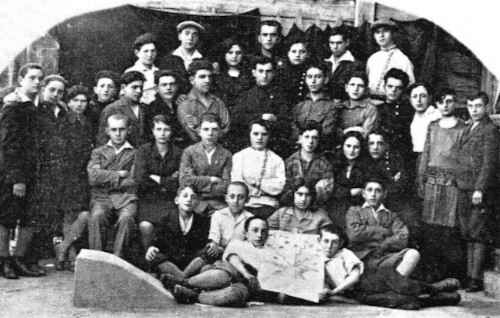
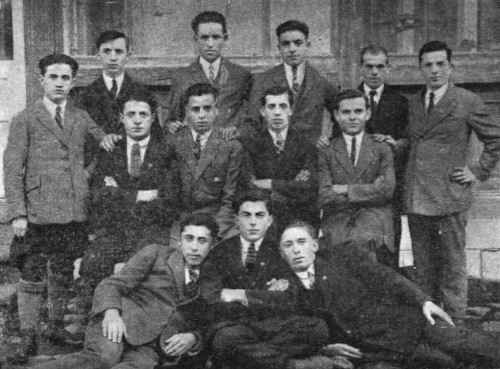
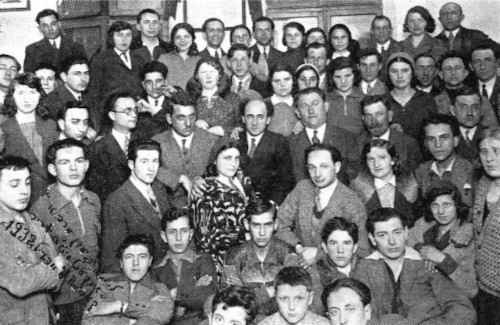
To his right: Y. Garner, Z. Finder and Dr. Bretler To his left: Z. Freilech. Bender, V. Landman
|
[Page 193]
by Yakov (Buzie) Reicher
Translated by Theodore Steinberg
There were a prominent number of them in the Kosiv Jewish population as well as among the merchants. For about three generations they undertook to go to the mountains to deal in cattle, hides, and other merchandise for the fair that took place every Wednesday in Kosiv. They were hardworking Jews, and in the conditions in Poland before the First World War, they struggled to maintain their existence.
As Shabbos ended, after Havdalah, as Jews said, “Have a good week,” people could see in these merchants' homes as groups of mountain merchants assembled. Partners settled accounts from the preceding week. Butchers and meat cutters also gathered to pay for merchandise they had gotten on credit. Jews from other professions also assembled, as did ordinary people to repay loans they had gotten from the merchants after the fair.
At two in the morning, you could see the same Jews gathered together to go to the mountains some with their own coterie, others with strangers. There were various categories. There were Jews who had their own “flannels”; there were others who were exporting cattle to Austria; there were some who were buying from other merchants; there were brokers and assistant brokers; there were some who traded merchandise and others who raised cattle. And so on.
Let us recall some of them:
Eliezer Glasberg, Avichki Ferlander (Haber), Duvid Greiner, Zindel Reicher, Shimshon Frizel, Shachar Kaufman, Moyshe Krauthamer, Moyshe Larish, Rubla Reicher, Moyshe Hersh Larish, Merbaum, Avraham Sterin, as well as their children.
There was once a case when from the other side of the border with Hungary there came a large herd of cattle. The
[Page 194]
Polish police confiscated them and sold them to the Kosiv merchants, who rejoiced in their great “good fortune.” But the Hungarian government quickly intervened in Warsaw and sent gendarmes who forcefully retrieved the merchandise from the Jews and returned their money. People then joked in Kosiv that a war had almost broken out between Hungary and Poland over Duvid'l Greiner, Eliezer Glazberg, and Zindel Reicher, and some said it could have been a world war!
It would have been a striking scene in the Carpathian Mountains when on a mountain top a shepherd played a pastoral song on his pipe and then suddenly there appeared from a valley a caravan of Jews with disheveled beards and sidecurls…
More than once these people encountered dangers. There were cases when thieves attacked them and there were even killings (Zeydel Sheberg, for example). There were also wild animals like wolves and bears that would attack them. When people escaped from such dangers, they would say a thanksgiving prayer on Shabbos and serve beer.
The Wednesday fairs in Kosiv were boisterous, with hand clapping and raised voices crying out. You might have thought these people were the whole world. When the fairs ended peacefully, there was income, and the merchants would gather at Vildhurn's or at Avramchik Steiner, make a toast, and play cards.
The Jews were far from sadness. In the harshest conditions, they never lacked trust and faith. One could amass a whole collection of folklore from their words and witticisms. Their lawsuits were similar and always ended with compromise.
Weddings among the mountain Jews were famous. Late at night at a wedding they would go out with great joy and enthusiasm, and the musicians would play “Either sponge cake or fruit cake, either the window or the shutter.” And if the in-laws
[Page 195]
were not so well-mannered, they would leave via the windows and the shutters!
In later years, when antisemitic politics began to dominate, the business became semi-legal. The village elders did not consent to the business, the gendarmes harassed the people, and the Jews had to give away a large part of their incomes as bribes and gifts to the higher-ups. The business stood still. The mountain merchants began to shift to other professions, and only a small number remained in the business.
All of the Jews, our dear brothers, were cut off by the Nazis. May God avenge their blood!
by Yosef Vinter and Baruch Enger
Translated by Theodore Steinberg
Until the First World War there was in Kosiv no organized working class. There were several people such as Zalman Moyler, Mordechai Mayer, Bender, Eliezer and Mordechai Briml, and others, known as the “Poalei Tzionistn” [Zionist Workers], but there was no organization. Aside from them there were some “Bundists”, such as Hersh Ziderer, Shmuel Schneider, Baruch Becker, and others. People discussed and quarreled about political activities, but the Jewish workers were never organized and never tried to improve their harsh lot. They worked twelve hours or more a day for small wages and very often in very poor sanitary conditions. An apprentice who set out to learn a trade had to pay his boss and then work for three years, but in the first year he was used for household cores such as, for example, taking the children for walks. Also, after three years they did not emerge as master craftsmen and they had little income.
Right after the World War, the abovementioned Poalei Tzion members were joined by younger people: Zayda Freilech, Meir Koyfman, Yossl Merboym, Muni Brimol, Yitzchak Kremer, Yosl Vinter, Bobtzi Hoffenberg, Chaya Sarah Bartfeld, Perl Roll, Barch Engler, and others. In 1921, they organized and founded the “Poalei Tzion” Party. Its goals were to improve the lot of the workers, to help the poor Jewish population, to provide the young with the opportunity to learn and to develop spiritually.
Because our material resources were very meager, at first, we held our meetings in the homes of a few members. But our membership increased from day to day. Young people and old people from all professions were drawn to the party. So then we rented the first
[Page 197]
party hall, a single room. But in a short time we had to change halls and rent a whole house with four rooms. And in time, this, too, was too small.
The elected committee was in contact with the craftsmen who employed workers and demanded from them higher wages, eight-hour workdays, and improvements in social conditions. Some of the employers negotiated with us and met our demands. But another group did not want to speak to us. We decided to strike against them until, after a time, they gave in.
We also sat at the table with representatives of the rug and sweater factories, and with the stubborn ones we had to call strikes, with picketers at their doors, until they also agreed
The situation of the workers thus became much better. They worked less and earned more.
The party's influence grew in the city, and not only among the workers. Other parts of the Jewish population showed their trust in us at various opportunities, such as elections for the city council, the kehilah, and the congress when they voted for the “Poalei Tzion Tz. S.”
Our faction in the city council was quite active, and even the enemies of the Jews had to take their opinions into account and deal positively with their frequent interventions.
The party threw itself enthusiastically into matters of education and culture. Those were broad areas of work. The young children of the poorer classes and the workers were for the most part neglected. They did not go to school or to cheder. They received their education in the “Talmud Torah,” from R` Avraham and the Talmud Torah teacher. Some of them were half- or totally illiterate, when the party used
[Page 198]
the small resources at its disposal, with some support from American landsmen, to establish, in about 1924, a Jewish folk-school of four classes, where the children, in addition to their elementary education, also received food and clothing. They studied Yiddish, Polish, Hebrew, arithmetic, and other subjects. Two of the teachers were paid, and the others were volunteers. The paid teachers, Leah Zakher and Aharon Bregman, were sent from the headquarters. The other teachers were party members: Yossl Merbaum, Yitzchak Kremer, Yossl Kalman, Muni Briml, Baruch Engler, and others.
The children studied industriously and became respectable people. In addition to the school for children, the party organized evening courses for teenagers, who would come after work and sit for hours and listen to talks and lectures by older members.
There were interesting talks on various topics, in which all the young workers would participate. The course participants were divided into circles, and each circle had its own day and time to meet. Participation was always full.
The workers library, which the party established shortly after its creation, grew in time into one of the finest cultural institutions in the city. Three hundred permanent members, Jews and non-Jews, used the books in Yiddish, Polish, and Hebrew. The best and newest books that were published, whether in the original language or in translation, were received by the members. Almost 3,000 volumes in a large hall, staffed by volunteers three times a week. There was a separate section of books for young people. In a second hall, young people and old sat by tales and read newspapers, journals, and weeklies in Yiddish, Polish, and Hebrew. People also heard lectures by local and invited speakers on political and current affairs, sometimes with and sometimes without discussions.
The party also had a “drama circle” that almost eerie month presented works by well-known writers such as
[Page 199]
|
|
To his right: Y. Garner, Z. Finder and Dr. Bretler To his left: Z. Freilech. Bender, V. Landman |
|
|
[Page 200]
Sh. Asch, An-sky, Pinsky, Bergelson, Sholem Aleichem, etc. The performances were always well presented and often were taken to nearby towns. Participants in the drama circle were: Baruch Becker, Yossl Helfer, Moyshe Viniker, Rokhl Shteynes, Sarah Krumbeyn, Perl Roll, Kayla Toy, Yehuda Hoffenberg, Duvid Heyzler, Frida Drezner, Nachman Blozenshteyn, Baruch Engler, and others.
Several times a year we would conduct “literary evenings,” which were always successful. Proceeds from these “evenings” went to the library.
The party's mixed chorus, which used to appear at the “evenings,” contributed to their success. Participants in the chorus were: Alter and Bas-sheva Federing, Kopl and Duvid Heizler, Esther and Chana Shef, Frida Drezner, Esther Luft.
The party also organized a sports club, “Ha-Poe'el,” which had a ping pong section and a football club that competed against Jewish and non-Jewish clubs. Active members in the club were: Yossl Vinter, Noson Frenkel, Yossl Kes, Yishayahu Shtenberg, Hisroel Tzeiger, Yossl Hazenfratz, Yossl, Drezner, Meyer Bieder, and others.
There was also a chess club led by Yosef Kremer.
There should be a special chapter for the youth organizations “Freyheit” and “Chalutz ha-Tza'ir,” which involved almost all the working youth of all professions. They had wide-ranging cultural activities for all their members. Every member belonged to a circle, where he received education. There was also Zionist-pioneer work. Many of them did preparatory work and then went to Eretz Yisroel, where they live today in kibbutzim. They worked in Zionist institutions and collected money for Zionist causes.
The older party members were, in addition to their activities in leadership and culture, active co-workers in Zionist institutions: Keren Kayames, Keren ha-Yesod, the Hebrew folk-school, the Hebrew gymnasium, and the Palestine Workers Fund.
[Page 201]
Because Kosiv was a training area, the party took care of people's employment and accommodations.
The party organized the “Labor” movement, and a group of its members made aliyah to Eretz Yisroel, among them: Yosef Vinter and his family, Shlomo Vinter, Henya Kremer, etc.
All of them fell victim to the Nazi beasts, may their names be blotted out.
|
|
Translator's footnote:
by Dr. Meshulam Simcha
Translated by Theodore Steinberg
There are Jews who say, “Enough already! Enough with pouring ashes on your head, enough with tearing open wounds. People must,” they maintain, “ allow the wounds to heal. People must forget what happened and put aside everything that will make our ongoing lives difficult.”
But no, we cannot and will not forget! Perhaps by always remembering we will succeed in preventing the awakening and unleashing of the bestial in human beings at a future time. And it is completely natural that the tragic subject of killing continues to find itself the order of the day as the subject of scores of new books around the world, of shocking new films, from a flow of Yizkor Books, scrolls, record books written in blood and tears by the surviving remnant who are scattered and spread out around the world.
While the dead are dear and unforgettable to us, there is almost no difference between those of our own families and others, both close and distant. For us they are all, through their deaths as martyrs, brothers and sisters.
I recall a moment after the great destruction of Polish Jewry.
I was with the Polish army in Lubin. There, in that world renowned Jewish city, there were no more Jews. As I left the surviving “Peretz-House”, where on the floor lay scores of Dutch Jewish women brought there from nearby Maidanek, yellow as wax, swollen from hunger. I suddenly saw a Jew on the nearly empty street. As we neared, we suddenly recognized each other and fell into each other's arms–he was a Jew from Kosiv (Ira Lapish). We kissed and cried like
[Page 203]
brothers who had found each other by good fortune. We went to an inn and spoke for a day and a night about everyone, and about some in particular. Blood drained from my heart as I heard for the first time from an eyewitness details of that devastating flood that drowned our dear town. We sat on low benches and I felt exactly like a mourner for the whole kehilah. Dear town of Kosiv, why did such a punishment fall on you?
Later generations will surely sorrow and see in the Shoah a very tragic chapter, perhaps the most tragic in our history. But we, the generation that bitter fate chose to bear the misfortune with our bodies and souls–our hearts weep bitterly and we tear ourselves apart.
Forget? No! On the contrary–remember and tell! The more one does so, the more is one to be praised. [This is a rabbinic phrase found in the Passover Haggadah.] And if you meet a fellow citizen, nothing will stop you from sitting and talking for hours and remembering past times in great detail, because we carry in ourselves ineradicable love and reverence for the particular warm, Jewish way of life in our Polish town.
Where do we begin? Understandably from childhood years and primarily from cheder…Remember the years when luckily you were with the lower-level teachers (Berele, Yerachmiel, etc.) and then went to the higher level of Yossl, Avrr\aham Berl, Pitzia, and others, delicate, impressionable years when a child's soul and character develop. And then you see yourself sitting on a cold winter morning at the long cheder table with two dozen other boys. The naphtha lamp casts a weak light in the room, and the rabbi, at the head, studies with the boys, “with the good” and “with the bad.” They study Chumash with Rashi. The great Rashi tells you in tiny, cute letters how the youthfully deceased Mother Rachel leaves her grave and weeps before God for her exiled, harassed children. In our childhood fantasies, we really saw our mother Rachel cry for her children, and we heard, really heard, the counseling voice in Ramah [a reference to Jeremiah 31:14].
Who among us does not recall each Shabbos, when we
[Page 204]
began to study Chumas and hold the “d'rash”? The questions that the rabbi posed and the answers given by the lucky cheder student? Deeply engraved, they remain in the memory.
I shiver at how they went, and I am glad that I can support my own memories with the text in Meir Hernish's (Zablotov) “From the House and from Outside”:
Rabbi: Come here, little boy.
Student: I'm no longer a little boy.
Rabbi: Then what are you?
Student: I'm already a fine student.
Rabbi: If you're already a fine student, can you be learning something?
Student: Certainly, I can learn.
Rabbi: And what are you learning?
Student: It's my good fortune to be learning Chumash.
Rabbi: If you're learning Chumash, what does Chumash mean?
Student: Chumash means “five.”
Rabbi: Five what? Five bagels? Five corkscrews?
Student: No, five books of the Holy Torah.
Rabbi: What are they called?
Student: Bereshis, Shemos, Vayikra, Bamidbar, D'varim.
Rabbi: Which book are you studying?
Student: The third book, Vayikra.
Rabbi: What does Vayikra mean?
Student: Vayikra means He called.
Rabbi: Who called? Moyshe the Sexton called the Jews to come to shul?
(Moyshe was the sexton of the Kosiv shul.)
Student: No, God called Moyshe Rabbeinu and spoke to him from the Tent of Meeting in order to teach him the laws and sacrifices.
Rabbi: Why the laws and sacrifices?
Student: Because the sacrifices are sacred, just as the children who learn the Holy Torah are sacred.
From there to the higher level of Torah study, to R'
[Page 205]
Mordechai Yosef Herzele, the scholar and learned man of his generation; to the person known as “the Rabbi,” the great scholar and “mad man”; and finally, “to the far-reaching, infinite messenger from the beis-medresh and the synagogue.
And speaking of the beis-medresh, I recall having a special affection for the “city beis-medresh” and its simple facilities, with its long table and oil-burning lights, with its warm homeyness and with the multi-colored group of those who prayed there. Mostly the people who came there were simple people who came to hear a lesson on the Torah portion of the week, to study a chapter of Mishnah, or to look into a chapter of the Eyin Yakov. You could also find there on a cold winter night an itinerant poor person, sometimes half-crazy, or some mysterious person. All it needed was a Peretz…
I will not describe the larger or smaller synagogues of the town, only the “Salash” Synagogue and my personal youthful recollections about it–I cannot pass it up. The “Salash” made the greatest impression on my youthful fantasies. For a whole year, the huge, wild, endless building of the “Salash” would stand empty. Only at the High Holidays it would suddenly come to life and take in perhaps a thousand Jews from near and far, most of them Chasidim from the Kosiv court, who led by their rebbe, filled the large interior with prayers and supplications and erased the dead silence of the whole year. Who, according to my young fantasy, could rouse in this “Salash” the noise of a whole year, and especially at night? Who, if not the souls of the dead?… For a certain time, I studied in the small Kolomayer Shul that was right next to the “Salash”, and the door between them was always open. Oy, what a shiver went through my body late at night, near midnight, when the light on the shtenders suddenly began to flicker and one by one go out, and I did not willingly look at the open door in the black, mysterious hall of “Salash”!… Even today the same shiver goes through me…
I had the privilege of studying there with R Hershele Feuer,
[Page 206]
that great scholar, that dear Jew, that fiery fanatic who was totally devoted, body and soul, to the work of the Creator. The splendid figure of R' Hershele for us young people seemed metaphysical and at the end became even more sublime through his awful tragic murder for the Sanctification of the Name. There is a separate, intense chapter devoted to him in this book.
R' Hershele, z”l, should pardon me a thousand times when I, the least of his students, recall a childish experience from those days. R' Hershele taught us Musssar [morality], and wanting to make a stronger impression on us, that we would be eaten by worms after we had become dust and ashes, one evening he pinched his nose with two fingers and, to my great amazement, he twisted out something that in the shul's weak light appeared to be a thin worm. Totally shocked by this concrete evidence, I, when I came home, immediately tried to do the same experiment, but there was no way I could produce a worm, simply because I had on my skin no plugged glands…
Another figure jumps out from my youthful memories, a very characteristic person–R' Menachem Plakh, z”l. I see him now as I saw him then, an old man with a long white beard, wearing a gray-black shawl on his head, bent over, looking at the ground. He knew, as I recall, no other path to take except to and from the beis-medrresh. It was my own deep secret that R' Menashe was–one of the Lamed-Vovniks [one of the 36 righteous people by whom the world was preserved, according to Jewish legend]! Aside from other mitzvahs and good deeds, he had the sad claim to deliver eulogies for the dead in the Great Synagogue. He would make the eulogy so frightening, so otherworldly, with his hoarse voice, as if speaking from the grave, with an impressive vanity-of-vanities tone, the even today I shudder from his “El Moleh Rakhamim,” and in those days, you wanted to be near the dead and die with him…
[Page 207]
A dear Jew of a totally different type, engraved in my memory, was R' Pinia Reveles. A white beard adorned the handsome face of our beloved R' Pinia, who was endowed with a beautiful, full voice. When he led the prayers before the Holy Ark, sang “I set the Lord before me” [Ps 16:8], he felt the words truly and totally. His “Behold, I am poor in deeds” before Musaf on the High Holidays, or his emotional “Hear our voices” on the cold autumn nights of Selichos have stayed with me through my whole life, and I can hear them even now. The elevation of soul that I felt in those years at the prayer of R' Pinia Reveles, such a beautiful prayers, so elevating with no artificiality, I never found in world-famous cantors or opera singers.
And from the group of fine Jews to another very different group. Several distinct figures from the large number of early Zionists, teachers and soldiers, perhaps not the most outstanding, perhaps small-town, but fine people, valuable, devoted fighters for the idea of redeeming the people and their land. Their service lay, first of all, in their having formed the generation that laid the foundation for Zionist Kosiv, of which we could always be proud.
Duvid (Dudia) Eltis, the first–chronologically–who went to the Zionist Congress in Basil–was a fanatical Chasid and a blind admirer of Herzl. He gave money generously to Zionist causes. He gave much and he gave well and fervently.
Shmuel Avraham Heisler, a small man with a patriarchal beard and a stately appearance, was for us young people the embodiment of militant Zionism. Always young, with a font of energy, he had–along with his not easy job of spreading the Haskalah among the middle-class children–time to lead untiringly the political battle against all types of Bundists, kehilah people, assimilationists, and all the enemies of Zion. Who does not recall his
[Page 208]
figure at the meetings and gatherings as he put his heart and lungs into his polemics against them.
Avraham (Avrahmzia) Kreizel. An unusual, many-faceted type of a maskil with an amazing, indeed encyclopedic knowledge in religious and secular studies, with a phenomenal memory and intelligence, and also a person of rare modesty. His small, cramped bookshop in the rabbi's houses was a meeting spot for Kosiv's intelligentsia. Between one customer and another, Avraham would discuss with everyone all the momentous problems of the world. Burdened with a large family and a bookstore that did not bring in much money, Avraham was very active in Zionist life, especially in its religious branch. He was deeply religious. His faith was unshaken even in the last hours of his life, when he lay hidden in a bunker, suffering indescribably torments.
(Separate articles on Heisler and Kreizel can be found in the Hebrew section of this book.)
Berl Goldshteyn–a four-square character and a spiritual aristocrat. His mere presence at a project was a guarantee of its rectitude and solidity.
Zindel Feeber–a maskil, among the first Zionists. He always sat with a book in his hand behind a table at the inn. The book could be by Rambam, Gravity, Gordon, and even–you should excuse me–Lessing, Heine, and others. He was a modest and devoted soldier of Zionism.
Similar among the first Zionist were also Shloyme Eizenkraft, Avraham Shoyer, Fish Simcha (my dear, wonderful father), Moyshe Shauber, Meir Drezner, Sholem Felix, and many, many others, from all ranks and classes.
I will end by recalling two people who were especially dear to me, my friends from work, Dr. Gertner, and Dr. Shenberg.
Dr. Yakov Gertner, or as the town knew him, “Yankl”, with his impressive, appearance, energy, and industriousness,
[Page 209]
was greatly esteemed and loved by everyone. This was especially because he was a good person and always prepared to help. He responded to each need either with free medical advice or with a helping hand. Thanks to these qualities, he was also esteemed by the Christian population, and he was even elected mayor of the city.
And Dr. Moyshe Shenberg, “Moyshele”--that fine spirit, the refined character, the gentleman with the special talent for tact and handling of people.
When I said goodbye to these dear friends in the Donbas in Soviet Ukraine, when our group, which included Dr. Vielitshker and the Drs. Binder, had been ordered from on high to depart, we divided our small resources equally. We kissed and said our last “Be well.” I felt, as I stood in distant, freezing Russia, that I had lost the last remnant of my family. How terrible was the thought that Gertner was in Persia, not far from the dreamed of borders of Eretz Yisroel, fallen, as it was said, to the bullets of Polish soldiers on the basis of a denunciation from a Kosiv Polish mailman. And that Shenberg, on the grounds of incorrect, exaggerated reports, returned to the Nazi Gehenna and ended his life in a gas oven!
I outlived the group, and that reminds me sadly of Anatole France. The great French writer says that on an Egyptian sarcophagus, in which lay an important mummy, an inscription was deciphered that curses anyone who dares to open the coffin. The curse says, “You should be punished by surviving everyone close to you!” We who have outlived our brothers and sisters, old and young, children and babies, can understand with pain the devilish sense of the curse! More than one person who “outlived” could not bear the difficulty of the curse and put an end to his own life!
by Victoria Mandel
(widow of Dr. Menashe Mandel)
Translated by Theodore Steinberg
Two neighboring cities, and so different one from the other. Kitow–sits comfortably on a large, flat, sun-drenched stretch of land as far as Czeremosz, the large, raging mountain river; Kosiv–narrow, squeezed between a hill and the small Rybnitsa River.
Kitow had for a long time been industrial. It had, for example, the large sawmill for wood and lumber, the great steam-powered grain mill, tanneries for leather, artistic ceramic works. Kosiv, on the other hand, had craftsmen, stronger commerce, and a housing industry that developed into a large rug industry and a source of income for the whole sector.
Their inhabitants also differed. Those from Kitow were by nature more self-contained, more sealed off, and thus more peaceful and tolerant; those from Kosiv–more dynamic, open, more involved with the community, and most of them used the more informal “du.” I think that for this reason the class differences were fuzzier. Those from Kosiv were happier, wittier.
Both towns were proud that in this area the founder of Chasidism, the Baal Shem Tov, had spent years traveling, and legends about him were transmitted from generation to generation by Jews and, remarkably, by the Hutzuls.
That lively, growing, happy Kosiv is no more! In their very first aktion, the German beasts, with the help of the Ukrainians, over two days shot more than 2,000 Jews, and the fate of the remainder was no better. The Nazi cruelty to the Jews of Kitow–most died by fire or by suffocation [a reference to the High Holiday prayer Un'netaneh Tokef]-cannot be described. And so, too, disappeared the comfortable city of Kitow with its Torah scholars, fine people with Jewish and secular educations, dear ordinary Jews!
May all their memories be honored! May God avenge their blood!
by Dr. G. Ravitz
Translated by Moshe Kutten
That remote little town still hovers before my eyes—the hill that rose above the marketplace and, during the days of the Holocaust, became the burial ground of a large part of its Jewish population.
What distinguished the Jews of Kosov, especially the younger generation, was their keen awareness of what was happening in the wider world, along with a powerful thirst for knowledge and progress.
Thanks to the initiative of the Jewish residents, our town gained access to electricity, a movie theater, and, as early as the 1920s, a bus line that connected it to the major city of Kolomyia.
The pleasant image of Mota'leh Bender, the father of Miriam Bender (no' in Kibbutz Gat). How nimbly he would stand on the steps of the bus he owned, beside the driver, and how warmly he would welcome every passenger! When the holidays came, and I returned home, how delighted he was to welcome me—the student from Kosov—and see that I was brought safely home to my parents! He looked after me as though I were his own daughter.
I vividly recall the hardships we faced traveling from Kuromiya's train station to our home—a journey that once took 5 to 6 grueling hours. Suddenly, everything changed: a bus arrived, transforming the ordeal into a comfortable 45-minute ride. It truly felt as if we had drawn closer to the wider world.
I want to share an event involving my grandfather, the late Chasid Shimon Meir, that remains vivid in my memory. During the election to the Polish Sejm (parliament), my grandfather—despite his deep piety—actively campaigned for the Zionist candidate, opposing Kosov's Chassidic Admo"r and his followers. His enthusiasm for discussing Zionist questions with his Zionist son-in-law, my father, Binyamin Ehrlich of blessed memory, was palpable, as was his joy at the Zionists' victory.
Thanks to the determination of my mother, Dvora, of blessed memory, my sister and I were sent beyond Kosov to pursue an academic education. My father had hoped that, through us, his own future would be secured—that when we went up to Eretz Israel, we would bring him with us. Tragically, he was not granted that privilege. He perished along with all the others in Kosov. May God avenge his blood.
|
JewishGen, Inc. makes no representations regarding the accuracy of
the translation. The reader may wish to refer to the original material
for verification.
JewishGen is not responsible for inaccuracies or omissions in the original work and cannot rewrite or edit the text to correct inaccuracies and/or omissions.
Our mission is to produce a translation of the original work and we cannot verify the accuracy of statements or alter facts cited.
 Kosiv, Ukraine
 Yizkor Book Project
 JewishGen Home Page
Copyright © 1999-2026 by JewishGen, Inc.
Updated 11 Nov 2026 by JH