 |
|
|
[Page 103]
by Yeshayahu HaLevi Ish Horowitz
Translated by Moshe Kutten
When I arrived in Kosov, I found a well-established and vibrant Zionist movement and an active Zionist Association. Zionism here began with the rise of Dr. Herzl. Nearly all adherents were political Zionists in the Herzlian tradition, dedicating themselves to Herzl both by conviction and deep admiration, trusting his words and actions without reservation. This created a unique, al-most Hasidic devotion to Zionism.
I was not raised in a Hasidic tradition or taught to follow leaders without question; I prized independent thought. While I respected and admired the great leader, I kept my own counsel, which set me apart from Kosov's Zionists, and did not refrain from
|
|
From voicing views that the Kosov Zionists did not accept, which they saw as “against” Herzl. While I was a political Zionist, I did not reject settlement, the “Yeshuv ” of Eretz Israel, which had been sacred to me long before Herzl's appearance.
[Page 104]
Upon joining Zionist activities in Kosov, I quickly noticed a clear difference in perspective between myself and the local Zionists, creating a strange and uncomfortable atmosphere. I saw that every proposal I made was rejected by a large majority, no matter how reasonable or well-considered it was. The cause was not due to a substantive debate or compelling counter-arguments, but rather because the majority sided with Sh. A. Heizler, whom they viewed as their mentors in both enlightenment and, especially, Zionism. It seemed unthinkable to vote against him. I sensed an unspoken sentiment in the air: “Look at this outsider who has just arrived among us. He will not prevail; he will not succeed with us.”
And I, although I resented those who voted not on the substance of the matter but simply on “who the proposer was,” never asked any of them why they had voted against me. I accepted the verdict–the verdict of democracy, which says the majority decides. At the next meeting, I participated in the discussions as though nothing had happened.
Over time, however, the members learned to separate the “who” from the mat-ter under discussion, recognizing the value in evaluating issues apart from personal prestige. This evaluation marked an important shift from their earlier stance, and slowly things began to change for the better.
In Kosov, as in much of the Jewish world–including Israel today–it was cus-tomary to disregard scheduled start times. When announcing gatherings or meetings, organizers would typically list the start time 30 minutes or even 1 hour earlier than the intended time. For ex-ample, if the actual event was to begin at 8 o'clock, they would advertise it as starting at 7 o'clock. This practice conditioned attendees to ignore punctuality, often putting on-time arrivals at a disad-vantage.
We opposed this flawed practice. When we wanted to start a meeting at 8, we made it clear and always started at 8, regardless of attendance. Over time, people realized the meeting time would not change, so they began arriving on time. Initially, people mocked us and said our ap-proach would fail–that the public would stop attending. It took persistent effort to convince local activists to adjust their habits. In the end, everyone learned to respect the stated time, and punctuality became the norm in Kosov.
[Page 105]
As in other towns, Zionist activities in Kosov increased mainly in winter. Activity peaked during Hanukkah, with a main event called “The Maccabean Celebration” (“Maccabi-Fayer ”). This celebration had two parts:
The main speaker at the ball, Dr. Sh. Rosenhak from Kolomyya, spoke passionately about the importance of the new enterprise. It sought to redeem the land of Israel from foreign hands. To illustrate his message, he shared a folklore tale about two people who met at the Royal Lottery Hall, known as the “Lotteria.” On that day, the organizers were preparing to draw the three winning numbers. Whoever bet on these numbers would win a sum a thousand times greater than their original stake. The two individuals, standing together in anticipation, spoke as they awaited the results. One asked, “How much did you wager?” The other replied, “Such and such. And you?” The first responded sheepishly, “I… didn't bet at all.” To which the second retorted, “Then what are you waiting for? You know that only someone who has wagered can win. If you have not risked anything, you cannot expect to win.” At this point, the elder and chairman of our group, Mr. David Eltis, inter-jected and declared, “In that case, I will stake it myself.” He pulled a handful of gleaming gold coins from his pocket and began to throw them on the table–one, two, three, and so on–until there were twelve coins, exactly the amount required
[Page 106]
to be registered in the Golden Book of the Keren Kayemet Le'Israel. This spontaneous act of generosity sparked an unexpected wave of enthusiasm among the audience. It left an indelible impression on everyone present at the ball.
As mentioned, we invited distinguished speakers from beyond to the Hannukkah balls. We selected the finest available from both near and far. These guests traveled from Lvov [Lviv] in eastern Galicia and as far away as Czernowitz in Bukovina. Notable speakers who visited our city included Libel Tuybash, Dr. Sh. Rosenhak, Dr. P. Mentsher, D. Meir Guar, Dr. Nathan Birn-baum, Dr. P. Korngruen, Sigmund Weisglass, Leo Waxler, Dr. David Spindel, and many others. On one occasion, we invited a rising star, an exceptional orator, and sent a carriage with one of our youths to greet the guest.
When the speaker took the stage, he dedicated a portion of his remarks to recalling the pleasant journey he shared with his companion on his trip from Zlotov [Zolochiv] to Kosov. Who could have anticipated that a young man from the Beit HaMidrash , dressed in the tradi-tional long coat of its scholars, would be so broadly educated and possess such extensive knowledge? He spoke with heartfelt admiration, offering generous praise for the “young man.” That young man was our Yoskeh Shimon, who would later be known as Dr. Yosef Meir, of blessed memory.
As mentioned, we celebrated the Maccabees' festival with great enthusiasm. The deep roots this festival had in our local movement became evident through an incident sparked by the cancellation of the celebration.
It was the year after the Kishinev Pogrom in 1904. The Zionist organization's committee, affected by the widespread mourning and sadness in the Jewish community, decided to mark the holiday with only a modest gathering. Some younger members questioned our motives, accusing us of being lax and neglectful. The dispute escalated until the minority group broke away, form-ing a rival organization they called “popular and democratic.” They insisted this new group emerged from resistance to the “rulers” and “leaders,” whom they accused of ignoring the voices of ordinary people.
The driving spirit behind this factional opposition was a young man–energetic and stubborn,
[Page 107]
Yisaschar Kaufman. The Admo'r from Kosov volunteered to allocate an apartment in his house for the new organization, known also as “Yissaschar's farayn ” [Yisa-schar's association], a term coined by the generation's clowns.
It was not long before the association quietly breathed its last, despite having been born with great fanfare, and the veteran “Zion” society continued to be the only Zionist organization in the town.
The Zionist Movement in Kosov and its leaders and activists, as in other towns, came from circles of the enlightened and the “petty-bourgeois” intelligentsia. Yet the movement's roots were deeply grounded among the common people–known as “Amcha ”–including melamed s, craftsmen, laborers, assis-tants, and even the poor and destitute who begged at thresholds. Some of these individuals were organized as members of the “Zion” organization, while others simply supported the movement's ideology. Their loyalty and dedication were sometimes expressed in various ways, as shown in the following examples from different layers of the community:
[Page 109]
Our Zionist association also had a flag, an azure-white flag with a Star of David in the middle. On festive occasions–mainly on the holiday of the Maccabees–it was hoisted on the façade of the Great Synagogue and fluttered there proudly. The flag was the handiwork of Izik Schneiberg, known as Izhy Frida-Menucha's.
And this was the design of the flag: it was made lengthwise from two equal strips of cloth, azure and white–azure above, next toward the head of the pole, and white below. In the center was a blue-and-white Star of David, arranged in the reverse orientation–that is, the blue of the Star of David lay upon the white of the flag, and its white upon the blue of the flag–so that from a distance it appeared as a single, complete Star of David standing out, as though detached above the background of the flag. Both the design of the flag and its execution were entirely the work of Izhy.
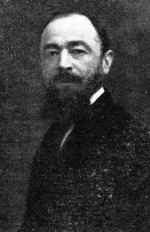
Shmuel Avraham Heizler. The first Zionist leader in Kosov, the head speaker at its gatherings and festivals, and a lecturer in literature and science clubs. He was the driving spirit behind all the special and routine activities, and the fighter of Zionism with its rivals within the Jewish public, and its haters and oppressors on the outside. He was the pillar of fire, igniting the torches of enthusiasm, and a pillar of cloud to absorb the catapults and calamities.
I recall his brief arrest by the authorities due to his efforts to have Yiddish recognized as the Jews' mother tongue–a cause closely tied to the recognition of Jews as a distinct people among other nations. Heizler was also a prolific writer for the Kosov Zionists, publishing numer-ous articles in various newspapers and journals of the time under his real name or the literary pseudonym “Shmaver.”
Yosef Simcha Heizler was the cousin of Reb Shmuel Avraham and will be fondly remembered as our “house poet.” Under his pseudonym “Jospe,” he published poems in both Hebrew and Yiddish. A talented singer, he was the first to introduce Bialik's “Zemer le-Shabbat” [“A Song for Shabbat”] to Kosov, teaching us to sing it and making it a memorable part of our Sabbath zemirot . He was also an out-standing “ba'al kri'ah ” (Torah reader), known for his melodious voice and devotion.
Izik Shneiberg was a dedicated member of the association who served on the executive committee. He made significant contributions to every activity he undertook, excel-ling particularly at the Hanukkah ball–most notably during the banquet. He managed every detail, from buying and cooking to baking and serving, ensuring everything was carried out with exceptional taste and care.
[Page 110]
Izik was blessed with another gift: a beautiful, clear tenor voice. He held a special privilege–when the celebration reached its peak, after everyone had tasted and savored the delicious food he had prepared, Izik had the honor of singing. He would climb onto a bench and perform Psalm 137, “By the rivers of Babylon,” as well as [Yitzchak Peled's poem,] “There, in the place of cedars” (“dort vu di tzeder ”). His warm, resonant voice would fill the hall and spill beyond its walls, while those present cupped their ears to catch every note, delighting in his moving performance, rich with emotion and longing for Zi-on. When he finished, the audience would erupt in applause and enthusiastic handclapping, and Izik would step down from the bench, filled with deep satisfaction.
Moshe Schauber. He was a loyal and dedicated member, gifted with a powerful tenor voice, though his tone was less clear than his friend Izik's. While he could sing, his true strength emerged as a prayer leader, standing before the ark during special minyans organized by the association, especially on Simchat Torah.
Zionist activity was a daily part of life in Kosov, centered especially around the Keren Kayemet le'Israel (KKL, Jewish National Fund–JNF). At the heart of this work stood Ye-hoshua Gertner, who served as both organizer and driving force. Tirelessly, he managed the sale of KKL stamps, the distribution and collection of blue charity boxes, and the gathering of waste materials whose proceeds went to KKL. On the eve of Yom Kippur, he arranged for donation bowls to be placed in synagogues and oversaw supervisors stationed by each bowl, urging wor-shipers to contribute and not overlook the cause.
In addition to these activities, he organized special activities, such as the Zionist post for greeting cards before Rosh Hashanah, which were affixed with JNF stamps and distributed by students in the schools and cheders . The distribution was carried out efficiently and re-sponsibly, so that, over time, they earned the trust of the Jewish public, which had almost ceased using the official postal service, and the income reached substantial amounts.
Indeed, Kosov was recognized as one of the places excelling in their activity for the KKL. I realized as much when I happened to visit the center KKL bureau at 9 Tuerkenstrasse in Vienna. The officials had nothing but praise for Kosov and its dedicated activist.
The sale of Eretz Israel's products–such as Carmel wine, etrogs , soaps, and more–also required considerable effort. This endeavor became a central focus of Zionist activity.
Among the young Zionist activists
[Page 111]
we should mention Avraham Tzvi Kirchner (Keren), who now resides in Israel. He served as the head of the local council of Kfar Saba for many years and was the first Histadrut [Israel's largest union] representative to hold this role in a moshava . As a young activist, he stood out in his persistence and tenacity in all his undertakings. These attributes helped him secure a place in the first row among those who worked for the KKL, in the association's library, and in other Zi-onist activities. We should also mention the quiet, diligent Aharon Rigler (Ahar'chi), who worked with devotion and method in these fields of activity.
Our members also engaged in other activities dedicated exclusively to advancing the Zionist cause. For instance, during Simchat Torah, there was a longstanding Kosov custom: after reciting the verse of “Chatan Bereshit ” and before the prayer leader repeat-ed it, worshippers would sing a Hasidic melody. Instead, our young men sang “HaTikvah” as they visited different synagogues. Initially, the Hasidim were angered by this change, but eventually, they embraced it, and the practice became a cherished tradition for many years.
The sixth Zionist Congress in 5663 [1903], known as the “Uganda Con-gress,” was the last in which Herzl z”l participated. For the first time, Kosov was represented by a local figure: Reb David Altis, the venerable chairman of the Kosov Zionist Association. Previously, Kosov had always “honored” outside Zionist activists as its representatives. Reb Altis, though not a speaker or preacher, was a wise and shrewd man, well-versed in world affairs and only half-educated–but a Zionist in both heart and soul. He was also a wealthy banker in Kosovo, distinguished by his dignified bearing and rare elegance.
He did not rise to the stage of the Congress, but he kept his eyes open, observing eve-rything around him and immersing himself in the uplifting atmosphere. Most of all, he eagerly watched and was captivated by that revered personality–the exalted phenomenon, the ma-jestic figure named Herzl. I recall what he told me immediately upon his return from Basel, when I greeted him. He held my fingers in his gaunt yet powerful hand, clasped them so tightly my fingers nearly came apart from the pressure, and said: “Yeshaya, do you wish to know my impression of Herzl? I saw a face upon which the sufferings of the entire people of Israel, both collectively and individually, are engraved. That which pains me, you, and each one of us is re-flected in that face. It is, as it were, a mirror of all these…”
[Page 112]
At the time, I did not properly grasp the meaning of those words, and I may even have felt a certain disappointment at such an impression. Only later–afterward–did I come to realize that he had indeed seen rightly, and that my own impression, in its very simplicity, surpassed in depth and greatness all that I had then expected…
On 20 Tamuz, 5664 [July 3, 1904], a bitter and ill-fated day, our leader, Dr. Theodor Herzl, died. The blow that fell upon the Zionist movement, upon the Zionists, and upon the entire nation struck us as well–the Zionists of Kosov. Not only because of our particular devotion to Zionism and its leader, but also because this calamity came upon us in Kosov so unexpectedly. In that remote corner, we knew almost nothing of his grievous illness, and only a few days before the tragedy, we learned something–hinted at in an article by Nachum Sokolov in “HaTzefira”–which struck us like thunder on a clear day. In the sentence in Sokolow's article, it was stated: “Many suns have already sunk for the people of Israel, yet if the sun of this Zionist leader should also set, I fear the darkness will prevail…”
Indeed, a shudder seized us upon reading these words, and as we tried to inquire and learn what was happening and how far the news had reached, behold–the terrible certainty that overwhelmed us to the depths… We were orphaned, and there was no end to our grief and pain…
Herzl was known and considered a wealthy person. However, after his passing, it was discovered that he had lost his wealth and left no assets. Therefore, his widow and small sons were left in utter poverty, with nothing at all. He spent all of his wealth during his time as a Zionist leader, directly and indirectly, for the needs of the movement and its institutions.
Until the central leadership of the movement saw fit to appeal to the Zionist public and proclaim a special fundraising campaign for the benefit of the bereaved family. The campaign was called a “National Contribution” (Natsional Shpende in Yiddish). Ko-sov Zionist came out to collect donations for that purpose, and the town responded generously and with an open heart; they gave and solicited donations with a charitable hand… Even the Admo”r of Kosov made a substantial contribution to this campaign.
Kosov maintained a vibrant, direct connection with Eretz Israel, but not through Zionism or the emerging Yishuv –rather, solely with the old, “distributed” Yishuv[1].
[Page 113]
This connection endured for many years. For several generations, a special institution, the “Kosov Kollel,” was tasked with collecting donations through the “Rabbi Meir Ba'al HaNes” fund and distributing them according to the well-known method of “Yoksin” [”distribution”]. Under this system, individuals or groups would receive annual allotments based on tradeable notes (bonds).
At the head of the kollel stood the Admo”rs (Hasidic spiritual leaders) of the Kosov dynasty, who served not only as rabbinical and Hasidic authorities but also as administrators, inheriting the presidency of the Kosov kollel . As a result, Jews from Eretz Israel who belonged to the kollel often traveled to Kosov, staying for varying periods. These visitors brought with them engaging stories and melodies from their home-land. On special occasions–such as significant Shabbats, festivals, or the High Holy Days–several Jews from Eretz Israel would be present as guests, customarily dining at the Admo”r's table. These lively gatherings filled the Rebbe's court with joy and vibrancy.
During my years in Kosov, I remember a few people who made Aliyah to Eretz Israel: (a) Berl Trutiner from the neighboring village of Pystin, (b) Moshe Shizl, (c) Shlomsky (“Tzotz”) Rosenroich, and (d) the rabbinical judge Zaidy, the son of the rabbinical judge. When they left, most of the Jewish residents accompanied them for a long distance.
Reb Moshe Shizl, originally from Zhabya [now Verkhovyna], was a resident of Kosov. Zhabya was a large village in Sud province–the largest in Austria-Hungary–situated far to the west of Kosov among the Carpathian Mountains, and part of the Kosov District. Reb Moshe was one of four Shizl brothers: Avraham, Menachem Mendel, and Zecharia. Three brothers were common but honorable men–very wealthy, well-known, and charitable. In contrast, Reb Moshe was a learned man, though he had not prospered financially. His Aliyah to Eretz Israel was made possible mainly by his brothers' support.
Reb Shlomky “Tzotz” (I am unsure of the origin of this name; perhaps it is a corruption of “Mo”tz”–acronym of “Moreh Tzedek,” [meaning halachic authority]). He was a Jewish man with a long, unkempt beard, restless, with wandering eyes. In his later years, he aspired to make Aliyah to the Holy Land–and he suc-ceeded. He obtained a permit and traveled, accompanied by a large escort, as did Rabbi Zaidy, the Moreh Tzedek. He journeyed with nine small children, all of whom were disabled. Despite being cross-eyed and having a stammer, he remained an intelligent and God-fearing Jew.
Every Aliyah was a significant event that left a strong impression on Kosov, as evidenced
[Page 114]
by the large number of townspeople who accompanied those making the Aliyah. This, in turn, reflected the community's deep longing for the land of our ancestors.
It would be both unjust and ungrateful to overlook the influence of traveling preach-ers on the spirit of Zionism in Kosovo. Each one of them had its own character and style. Their unique sermons, delivered in synagogues and Batei Midrash halls, captivated large crowds of ordinary people with teachings rich in verses, midrashim, and parables. Most important-ly, their messages inspired a deep love for the nation's sacred heritage, Eretz Israel, and for the revival of the people in their ancestral land.
Reb Leibel Toibesh, who made it his life's mission to go from place to place, carrying the message of Zion on his lips. There was hardly a town or remote corner in Gali-cia that he did not reach. None arose to rival his popularity.
Elazar Rokeach, a wandering preacher from Safed and Jerusalem, jour-neyed across continents and countries, inspiring countless people to embrace Zion and settle in Eretz Israel. He enchanted listeners with vivid tales of his adventures in the East and evocative descriptions of the new Yishuv –the splendor of the Holy Land, its unique qualities, the unforgettable springtime (when in Petah Tikva, when the intoxicating fragrance of the citrus blossoms would compel residents to close their windows) and so on…
Chaim Katz, from Vilna [Vilnius], delivered his sermons with a melody that was soothing to the ear and penetrated the heart. And how harsh and deeply piercing was his re-buke–his criticism of the indifferent, unresponsive Jew toward the movement of national revival and the spirit of the times…
Avraham Abarmson, also a Lithuanian Jew, would inflame the masses with his distinctive chant. He would stand at the podium and speak without swaying his body or ges-turing with his hands–yet within him burned a fire, and his words struck sparks. He would captivate the educated youth with special lectures on modern literature, including Bialik, Achad Ha'am, and others. He was the father of the writer H. Sh. ben Avram.
Bezalel Tzadikov, with his yellowish-reddish beard, gaunt and thin, his whole being aflame. He would stand at the podium and set before his listeners scenes like a paint-er upon canvas, portraying in vivid, striking colors episodes from Jewish history, such as the lives of the Marranos in Spain, and the like.
There was another anonymous preacher from Eretz Israel, who drew hearts to him with his parables
[Page 115]
and stories about life in Eretz Israel–kindling love for it, attachment to it, and the desire to ascend to it, to work it and live. He left an unforgettable impression when he explained the differ-ence between a lover of Zion who resides in the diaspora and a Jew who rises up, makes Aliyah, and lives in Eretz Israel. What does that resemble? It resembles a man weighing himself, keeping one foot on the ground and the other on the scale. He makes an effort and presses down on the scale, but it never shows his correct weight. Only when he lifts his other leg from the ground and stands with both feet on the scale does it show his correct body weight.
Did you hear about what happened last night? This was the question on everyone's lips the following morning.
At night, three of our youths–Aharichi, Zaidy'li, and Yoski–vanished with-out warning. They had secretly conspired and, without telling their families, quietly gathered, packed their belongings, and went out in an unknown direction.
Whispers, rumors, and speculation quickly spread through the community. Eventually, it was discovered that they had traveled to Vienna to pursue a high school education, aiming to pass the matriculation exams and earn certificates that would allow them to continue on to uni-versity.
It was an event that set the whole town abuzz. Nothing like it had ever happened in Ko-sov: a genuine escape, carried out without regard for parental authority. Was it really true? Two of the escapees, Ben Tzion Pesler–known as Zaidy–and Yosef Meir–known as Yoski–were their parents' only sons. The parents walked about mournfully and downcast. Eventually, tempers cooled, and the parents accepted the situation. There was no counsel or wis-dom against the facts. Aharon Rigler, or Aharichi, returned home after a short time, but the other two remained away, immersing themselves in their studies with enthusiasm and vigor. These two prodigies, after a year and a half, sat for their matriculation examinations and were admitted to the University of Vienna–one to the Faculty of Law, the other to the Faculty of Medicine.
For the parents, grief turned to joy, and sorrow gave way to pride. During vacation peri-ods, when the young men returned home, both the town and the Zionist association were ener-gized. Now, Kosov had its own “academics” who spread Zionist ideals–no longer relying on the fleeting support of itinerant visitors from outside.
[Page 116]
On a summer day in 1914, Izzy approached me, agitated and as pale as chalk. “Did you hear?” he asked. “The crown prince, Franz Ferdinand, has been mur-dered.”
I was indeed an Austrian patriot, but not a monarchist, and I certainly had no sympathy for that heir to the throne–he was regarded as a hater of Israel. I told Izzy, “Don't get so excited, there is a successor!” “But this is war,” Izzy replied, his voice sad and frightened.
At the time, I regarded his conclusions with skepticism and dismissiveness. Yet it was not long before Izzy Schneiberg's fears were terribly confirmed. How accurately he had foreseen the grim reality–and how blind I had been.
In the year 5,666 [1905/6/6], a tremendous wave of political excitement swept throughout the entire Austrian Empire. Under the pressure of the radical parties, led by young progressive forces, the conservative regime was forced to advance a new election law, granting the voting right to every adult man 24 years and older.
This was a political revolution in the structure of the kingdom's public life. Political awareness penetrated even the Jewish street. The Jews–and at their forefront the Zionists, the dynamic and renewing element within the Jewish community–could not remain indif-ferent to the new political developments. They saw far-reaching possibilities for political action within the state: for the election of an independent Jewish representation that would defend and safeguard the civil and political rights of Jews throughout the monarchy, for the organization of the Jewish public, and for its elevation from a scattered mass into an organized ethnic unit pos-sessing relative power and influence.
In the summer of that year, the Zionist Union convened an all-Austrian assembly in Kra-kow. Kosov was represented at this significant conference by two delegates. The first was Chaim Altis, then a member of the local association committee, who, while traveling to Karlsbad (Kar-lovy) for treatment, also served as a representative. The second representative was the author of these lines.
The conference was presided over by Dr. Shalit of Vienna. Two sharply opposing views quickly emerged. On one side were the members of the “Limited Executive Commit-tee,”
[Page 117]
of the World Zionist Organization, who had worked closely with Dr. Theodor Herzl. After Her-zl's death, their influence waned, with Dr. Leopold Cohen and Yorek Steiner among the most prominent.
They strongly opposed any state-wide political activity by the Zionist Union or by Zion-ists individually, even if conducted through a dedicated organization. To them, this represented a departure from Zionism's true path and posed a threat to the movement's very existence. On the other side were the advocates for such political engagement, led by Dr. Shalit, Adolf Böhm, Dr. Arthur Mahler of Prague, Adolf Stand, Dr. M. Z. Braude, Dr. Yehoshua Thon, Dr. Leon Reich, Dr. Michael Ringel, and others. The debates were turbulent and contentious. In the end, the op-ponents of territorial policy became a small minority, while the overwhelming majority of the conference voted in favor. The conference adopted a program proposed by the main speaker, Dr. Braude of Stanislaw. The resolute opponents left midway through the proceedings, disappointed and dejected.
When I learned that Dr. L. Cohen is planning to leave, I approached him to say goodbye. He exclaimed, as if in despair: “Little foxes ruin the vineyards” [Song of Songs 9;15]… I replied: “But Dr. Cohen, what is a man like me to do–a Zionist in my entire being–who takes his answer to every public question from within the Zionist sphere? And now, in the new political life, in matters such as the elections to parliament, which have become an issue for every individual in the country and for every Jew as well, where shall I turn, from whom shall I seek an answer amid this tangle of questions, if not from my own movement?” He shrugged his shoulders and said nothing.
Going forward, we, too–the Zionists of Kosov–entered, head and shoulders, into the difficult business of national politics.
When we arrive at this affair, the argument about involvement in State politics, in which opinions were divided between supporters and opponents, it is worthwhile here to clarify the matter, even though it does not strictly belong within the narrow framework of our subject.
First of all, and for the sake of historical truth, it must be noted that neither side–neither the proponents of national politics nor its opponents–ever contemplated uprooting themselves from the Diaspora and setting out for the Land. That was not the issue un-der debate.
The proponents of political engagement were those Zionists who drew the full, uncom-promising conclusion from their commitment to Jewish nationalism. They accepted upon them-selves the responsibility and the risk of becoming entangled in the web of conflicts inherent in Jewish national political activity,
[Page 118]
which inevitably led to confrontation with the authorities, the government, and the dominant na-tional groups. Those who rejected national politics, on the other hand, tended toward the more comfortable path. Because they upheld, at that time, an abstract ideal–the longing for Zion and the revival of the people in Eretz Israel–they were unwilling to become entangled in an open conflict with the authorities and the nations among whom they lived.
“It is possible,” they argued, “to live in relative tranquility, without in-terference from external forces or the surrounding alien environment.” And indeed, at that gathering in Krakow, the advocates of political engagement counted opponents among the assim-ilationists and regarded them accordingly. In our own town, Kosov, opinions were also divided regarding political activity in the Diaspora. There were those in favor and those op-posed–but not out of considerations of convenience; rather out of concern lest harm come to the Zionist cause, and because they were, in essence, absolute rejecters of the Diaspora.
Among the supporters of political work in the Diaspora–Jewish communities living outside their ancestral homeland–at that conference, some supported working with the Polish progressive Socialists, who promoted social equality and reform. These were the Jewish Zionist socialists, represented by a young, thin, bespectacled delegate, Mr. Sh. Kaplanski. He de-clared that in state politics, Zionist socialists belong with their Polish socialist colleagues.
Galicia's Poles' attitude toward the Zionist Movement was hostile from the beginning. The emergence of Zionism as a Jewish national movement, demanding recognition of the Jewish collective as a nation, stood in opposition to the Polish political conception. They had, as it were, “adopted” the Jews as part of the Polish nation. This was a one-sided adop-tion–namely, that Jews were considered equal in obligations to the Poles: they were ex-pected to align with them in all elections, whether to parliament or to the national Sejm, to local councils, and the like; Jews were, in effect, bound to vote for Polish candidates, even if the can-didates were openly antisemites. By voting for the Polish candidates, the Jews thus drew upon themselves the hostility and vengeful aspirations of the Ruthenians, who in Eastern Galicia con-stituted the majority of the population but were pushed aside by the Poles–through an elec-toral strategy, aided by Jewish support–into a position of an inferior and politically power-less minority.
The poles considered the Jews as what they called “a religious group,” but not as an ethnic- national unit. And here came Zionism and declared the Jews as a “nation” and people like any other nation. In the face of such a rebellious declara-tion, the Poles rose in staunch opposition, employing every means of pressure and repression at their disposal as the rulers and dominators of the state.
[Page 119]
With the Zionists now stepping onto the political stage and fielding their own candidates, hostility and political pressure grew manyfold.
The Poles refused to recognize the Jews' right to nominate their own candidate and disre-garded the legal freedoms granted by the new election law. Although the law allowed Jews to vote for their preferred candidate, reflecting the principle of free choice, the Poles interpreted the nomination of a Jewish candidate as an act directed “against” them. They failed to view it as the Jewish community seeking representation to defend its rights, a fundamental ex-pectation in any democratic process.
The persecutions and pressure exerted by the Polish authorities against the Zionists and Jewish nationalists pushed the Jews toward a certain degree of political cooperation with the Ru-thenians, who, as a politically oppressed “minority,” found themselves in opposition to the Polish authorities in the state. These conditions further gave rise to endless complications and problems.
When the time came for the elections to the Austrian Parliament in 1907, the Zionists en-tered the electoral campaign, presenting their candidates in a considerable number of constituen-cies–primarily in those where Jews constituted a majority of the electorate or were close to it, and even in places where they were a minority.
The full weight of official terror and governmental pressure was directed against the Zi-onist lists and their supporters. Everywhere, the Poles proclaimed the Zionist candidacies to be hostile to the regime and to the Polish people. Throughout Galicia, there was but a single Pole–an extreme radical oppositionist, Dr. Ernest Breiter–who dared to stand coura-geously against this hostile tide and its agents, the official oppressors, and aligned himself with the Zionists.
As a result of the situation described, the Zionists were pushed to align with the Rutheni-ans in this election struggle and even reached certain agreements with them. Thanks to these, Dr. Gabel and Dr. Mahler were elected in by-elections–so-called “restricted” elec-tions–with the support of Ruthenian votes.
As previously mentioned, the election district containing Kosov was predominantly Ru-thenian, with Ruthenians making up eighty-six percent of the population. Pressure from the Polish authorities, directed against all groups they considered “opposition”–in this case, the Ruthenians and also the Zionists–led to some collaboration between the two groups. Most Ruthenians supported the radical party, led by Dr. Trilovsky as the first candidate and the farmer Lavruk as the second candidate.
[Page 120]
Indeed, both candidates emerged as winners in this election and were elected as dele-gates to parliament. However, in Kosov, this cooperation failed to materialize. The Ruthenians, owing to their overwhelming numbers, had no need for Jewish votes. Also, our list had little pro-spect of success beyond collecting the Jewish votes as a “counting candidacy.”
The Ruthenians attended our election assemblies and, with their large numbers, helped fill the halls. In return, they honored us by inviting us to their own gatherings. I recall one district assembly of delegates–representatives of the radical party from the entire region. Delegates and crowds poured in from all the villages and towns, numbering in the hundreds. Representa-tives of the Zionists–Sh. A. Hiezler, Berl Goldstein, and Yeshayahu Horowitz–were invited to this assembly. Those who extended the invitation treated the Zionist delegation with respect, seating them in the first rows. During the event, one of the speakers stood up and re-viewed all the parties running in the election. He remarked, “There is also a party of the Zionists. It is a reactionary and clerical party.” However, in the course of his speech, the young Gentile reconsidered and added, “Actually, I am not familiar with the Zionist party or its program, and perhaps I am mistaken in my assessment; that is simply what I have heard. Yet if I am wrong, I see that representatives of that party are present here–let one of them please rise and prove my error.”
Our delegates exchanged glances and hints–What was to be done? One could not remain silent–but should one take the stage? There was, after all, the question of language. It was impossible to address this assembly except in their own tongue–so what then?
The Zionist delegates entrusted Yeshayahu Horowitz with the task of trying his hand. It was an unusual and difficult assignment. He himself had not yet had the experience of speaking before such a non-Jewish audience, addressing them in their own language, and on so delicate a subject–especially in a setting where a long-standing accusation against us had just been voiced and had already taken hold among the crowd. But there was no choice; it was necessary. He ascended the stage and unfolded the program–the Zionist electoral program. He ex-plained, and apparently not without success–judging by the applause and cheers that ac-companied his words from the assembly.
The Zionists of Kosov, devoted to every matter that bore any connection to Zionism and Jewish nationalism, entered the political arena with all the fervor of their enthusiasm. Yet in a direct and practical sense, they were unable–much to their regret–to take part as a decisive factor, for Kosov had been placed within an electoral district in which the Ruthenians
[Page 121]
consisted 86% of the electorate, and we, the Jews, our share was only 6% or even less than that. Despite that, we, Kosov Zionists, insisted and demanded from the central election committee that they would stand a candidate also in our region, so that we could concentrate most of the Jewish votes around our list, and would not be forced to be drawn into the darkness and shadow of death of the strife between the other two nations of the state.
For the 1907 parliamentary elections, we nominated Sigmund Weisglass, a dedicated Zi-onist activist from Bukovina who was highly educated and well-read, as our candidate. The Jew-ish community in Kosov was energized. We succeeded: the vast majority of Kosov's Jews voted for our list, despite pressure, intimidation, falsifications, and legal distortions imposed by the au-thorities and their officials. Although an electoral victory was numerically impossible, it was a significant moral achievement to demonstrate that nearly all Jewish voters in the region supported our list.
As compensation for our inability to send our candidate to the Austrian Parliament, we elected Sigmund Weissglas as our delegate to the Zionist Congress, which was to take place that very summer.
Following Krakow's conference, as the Zionists became involved in Austria's internal pol-itics, they encountered an organizational-political obstacle.
According to Austrian law, it was forbidden for groups such as local Zionist associations to engage in politics. The right to do so was only provided to special groups who were called strictly “political,” and those were placed under special police supervision. It was only possible to do so in the capital, Vienna, where the police supervision was “softer.”
Thus, Zionist leaders in Austria established a representative political body, the “Jewish National Association,” headquartered in Vienna. The creation of branches for this central organization was prohibited; instead, individuals from provincial towns who wished to affiliate were required to register separately as individual members. A complete list of all association members had to be submitted to the police for inspection.
When the association published a proclamation inviting Austrian Jews to join, Kosov's Zionists actively promoted the initiative, resulting in approximately 170 to 180 members register-ing.
Since the association served as the official body representing Jewish political interests throughout the Austrian kingdom,
[Page 122]
any appeal to the national authorities on political matters had to be submitted in the name of this association. In our naive innocence, we Zionists of Kosov imagined that the Jewish National As-sociation in Vienna boasted tens of thousands of members, while in our small town alone, we had enrolled nearly two hundred.
However, when I found myself in Vienna in 1914 as a refugee, and the paths of Vienna became familiar to me, I learned that the total membership of the National Association amounted to only three hundred–including Kosov…
The Kosov District bordered the Snyatyn District, which included the city of Snyatyn. Our candidate there, Dr. Nathan Birenbaum, faced a challenging campaign against the Polish candidate, Count Moysa. In the first round, neither candidate achieved an absolute majority. By law, a second round–called a “limited election”–was required between Count Moysa and Dr. Birenbaum, who earned a simple majority in the first round. In this second round, the Ruthenians supported our candidate, helping him win. To engage Ruthenian voters, we brought one of Kosov's most skilled Ruthenian speakers to Snyatyn to deliver a persuasive speech to the Ruthenians in support of Dr. Birenbaum.
Thus, the reach of Zionist advocacy from Kosov extended beyond our own region and was not confined to the activities described above.
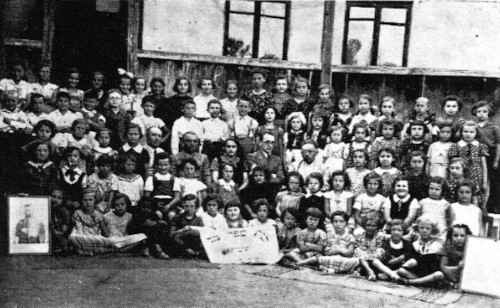
In 5,669 (1908/9), a Hebrew school was established in Kosov. During this period, several similar schools were opened in Galizia, and the Kosov school was not the first.
To support this initiative, an association called “Safah Brura” (“Clear Language”) was established. This association owned the school, and its executive commit-tee oversaw the school's management and addressed all its needs.
From its inception, the committee sought to administer the school and its affairs in accordance with the most progressive standards of the era. Initially, the school employed two local teachers, Meshulam and Zindel Fiber. Two years later, a head teacher–who also served as the peda-gogical manager–joined the team. He was an outstanding educator, a respected Torah scholar, and a person of integrity and expertise, with a profound command of both Torah and modern Hebrew literature. This head teacher was Reb Yitzchak Tennenbaum from Lvov. His wages were set above the norm for those days.
[Page 123]
|
|
The management also ensured that the school's external appearance and administrative ar-rangements would be of a high standard. Indeed, the Hebrew school in Kosov maintained for a time a relatively high level, ranking among the better institutions in the country. This was attested by both official and unofficial inspectors and visitors who came from time to time to observe its organization. Among them, we may mention several by name: Shlomo Schiller, N. Ziegel, Dr. Meir Geyer, Dr. P. Korngruen, Dr. Gershon Ziper, and Yosef Shor.
Below are several details regarding the school's external appearance and internal administra-tive arrangements:
Translator's footnote:
by Dr. Yosef Meir
Translated by Moshe Kutten
Each city has its own character. Los Angeles differs from New York. Paris differs from Berlin. Chernivtsi differs from Lviv. Kosov is not like Vizhnitz.
Our town was a single long street. It resembled Raanana in Israel, but it was closed on two sides. On one side–A mountain with a large cross at its summit. The legend said the cross was in memory of “Dovesh,” and it reminded Jews they were in exile. On the other side, by the river, was the “Zarinik.” Property owners, wealthy merchants, Chasidim, and the enlightened lived along the main road in the center.
Around the center, in the alleyways, the poor lived. The extremes weighed on the center, although the way of life was not greatly different. The wealthy were known for their stinginess, but concern for the poor and basic social assistance helped create some equality. Shabbat and holidays also helped with that equality. On weekdays, they made do with what they had. The portions of meat, even for the rich, were small. On Shabbat, it was different. Every house had a white fresh challah, Shabbat candles, fish, cholent, and the “neshama yetera”[1] [“additional soul”]. Meat portions, some larger and some smaller, but essentially, they did not differ by much.
The river had no name, for reasons unknown. This troubled couples seeking a divorce. It seemed to say: Jews of Kosov, marry as you wish, but to divorce, travel to Kuty, Vizhnitz, or Kolomyia. There, the river's name would be put in the bill of divorce with the city's name. This made sure neither spouse would make a mistake and return home. I do not know if this explains the low divorce rate in our town. Still, up to 1908, the nameless river is remembered fondly.
It was the season of Emperor Franz Josef, and Austria was at its peak. The Emperor, His Majesty, ruled two lands, Austria and Hungary, and nearly all the Balkans were included in his kingdom as well. One could enjoy Hungarian wines, Bosnian tobacco, and so on. And the Emperor (“Kaiser und König”), as is well known,
[Page 127]
was fond of Jews. Even in Vienna, he didn't allow the anti-Semitic mayor Lueger to oppress them.
Antisemitism at that time was relatively moderate–there were no furnaces, expulsions, mass killings, or serious pogroms. For this reason, the Jews felt secure under the protection of His Imperial and Royal Majesty and looked with compassion upon the Jews of Russia, who suffered under the rule of the Jew-hating Tsar, may his name be blotted out.
During the Russo-Japanese War, Kosov's Jews sided with Japan. They hated the Russians because of pogroms and oppression. In Austria, Jews thought such events could not happen. They wished their emperor a long life, although they whispered about the crown prince, Franz Ferdinand, saying that a new spirit surrounded him. In contrast, the younger prince, Carl, was like his father, Franz Josef. When Jews saw him in Kolomyia during military exercises, stories about him inspired optimistic Galician Jews.
They hoped that the future would be fine. Even a fleeting life was good. Indeed, when Franz Ferdinand was murdered in Sarajevo, Jews did not mourn him much. They were only angry at the Serbians for daring to attack the heir of the Habsburgs. If not for World War I, they would not have mourned him at all. Still, Jews trusted the Austrian Empire and its victory. Let us return to our town.
And so, on one side, there was the mountain, and on the other, the nameless river, which, at times, would rage during the rainy season and destroy bridges. But even that was not so terrible–only a slight inconvenience for those who lived across the river, in the gentile quarter of Maskolovka. By contrast, we children enjoyed this river in the summer days, when we could bathe in it and swim a little. The river had an additional advantage: it flowed along the eastern side. Any Jew who wished, wherever he might be, to recite the Shemoneh Esreh and direct his heart toward the east needed only to know his position in relation to this river, and he could be certain that he was praying the Shemoneh Esreh properly, facing the correct direction.
On the other two sides of the main street were rural and semi-rural settlements. Those in the center felt secure, protected from all directions, though the large cross atop the mountain cast a silent threat over the town. No one could imagine it would one day be a witness to the murder of half the Jews–elders and infants–in the pit nearby. At that time, the cross was not thought of as cruel. It went unnoticed, except once a year, on the emperor's birthday,
[Page 128]
when bonfires were lit atop the mountain. In town stood the “Cloister,” decorated with many crosses and bells, both large and small. The bells sounded strange to us children, showing the city's underlying disharmony.
For some unexplained reason, most of the Batei Midrashes and the Great Shul [synagogue] were concentrated around that “Cloister.” In fact, this “Cloister” did not trouble us much; however, it did cause us, the younger ones, some discomfort when we had to hurry past and whisper the verse, ‘You shall utterly detest it and utterly abhor it, for it is accursed.’ And indeed, more than once, the shkutzim [a derogatory name for gentile boys] beat us when they caught us spitting at their “Cloister.” We would flee from those big shkutzim– and was there any sheketz who wasn't bigger and stronger than us?–but we fulfilled our duty. Only once a year were we seized with mortal fear of those shkutzim. Only once a year did we fear those ‘goyim’ with mortal dread. On Christmas Day, they roamed the streets carrying lanterns in their hands and singing all sorts of strange songs that filled us with revulsion. We were especially careful not to go outside, for we knew that then “he” was in power, and that his “Cloister” posed a certain danger. On the other hand, we took a certain satisfaction in sitting at home that evening, with the prohibition upon us not to open a book lest the “Yoyzl” (the crucified one) set his foot there.
Fortunately, we had all learned the prayers from a very young age and did not need the siddurs that night. Even Father and Grandfather, who usually avoided playing games, could enjoy a few rounds of cards, as opening a book was forbidden. For us children, it felt almost like a commandment to take part in this unique tradition. Watching Father–usually so worried and serious–relax with neighbors and hold cards in his hand was a rare and special sight. The game was played without money, but the leash was loosed–on that night, everything was permitted, even refraining from study. The adults played cards, but the pleasure was brief – only an hour or two. That same night, I had to rise early, at four in the morning–practically the middle of the night–and run through the frost with Grandfather Yechiel to Bait HaMidrash to study our chapter from one of the tractates. If it happened to be one of the more challenging tractates, such as Bava Batra (“Last Gate”) or Bava Metzia (“Middle Gate”), it weighed heavily on the heart. Yet as we progressed toward Bava Batra, we knew that at some point we would reach sections of aggadic narrative, where the path was smoother, less complicated, and less obstructed.
Every city has its own character that shapes its residents. Kosov, for example, was surrounded and isolated from the outside world. No railroad reached the town,
[Page 129]
buses had not yet arrived, and radios were unheard of. In this isolation, the Jews of Kosov turned inward, focusing on thought and feeling. This insularity led to a provincial narrowness, cleverness, and greater self-awareness, and sometimes to mocking outsiders. Yet, it also fostered a particular innocence and a Hasidic kind of faith. Kosov's people believed deeply in tzaddikim, in Zionism, in socialism, or even, paradoxically, in apostasy. This atmosphere encouraged strong devotion to their ideals and visions–whatever they might be–along with much emotion and sentimentality.
The city was surrounded on all sides, cut off from the wider world, and led its own independent life with the Poles and Ukrainians, who depended on each other for their livelihoods. The Gentile Ukrainian would bring cows, calves, sacks of wheat, and other goods to the market, exchanging them for items like sickles, axes, and dried, salted fish. As far as I recall, we had a fondness for the simple Ukrainian villager but felt a certain apprehension toward the educated Pole. We conducted trade with the Ukrainian, sometimes mocking him, yet ultimately feeling a closer bond with him. In contrast, encountering an educated Pole–such as the short, stout “aptiker” (pharmacist)–required a show of respect, like removing one's hat in his presence. Even inside the “aptik” [pharmacy], which stood on the main street opposite the “gemeindeh” [community house] and the school, its mysterious and stimulating aromas inspired reverence in every child, and no one dared stand there with their hat on.
The same respect was shown toward the wachmeister [police officer] and the short and chubby eccentric physician, who drew many visitors to our town. He embraced an almost-vegan, natural lifestyle–walking barefoot or in sandals, eating simply (mostly vegetarian food), and taking frequent excursions into the beautiful countryside. They feared and kept their distance from this Polish intelligentsia; whereas the Ukrainian peasant they mocked, yet they also felt a certain sympathy toward him. There were many Hasidic songs, containing whole Ukrainian sentences, but not in the polished Polish. When a new Ukrainian generation rose up to rebel against Polish tyranny, what affection our young men had for their popular lecturers and speakers, and what sympathy they felt for the Ukrainian national revival movement!
In the Jewish street–as usual–there were divisions and factions. When, on Shabbat during prayer, a Jew from the “Kosover Shilechen [Shtiebel],” or even from the “Vizhnitzer Shilechen,” entered the “Sommar Shieichen,” or vice versa, everyone would look at the newcomer as if he had come from another world. And all of them regarded it as beneath their dignity to attend communal prayer in the “Great Shul [Synagogue].” All of that was during Shabbat; on weekdays, it was different. There you could find in the “Beit HaMidrash”, located inside the “Great Synagogue”, Jews from all other “Shilelach”, praying hastily, eager to return to their business and secure a bit of livelihood, as everyone needed.
[Page 130]
And it is interesting that, ironically, on Shabbat–with the general sense of the “additional soul” the same foods, the same customs, and for the most part the same prayers–divisions stood out even more. On that day, it seems, they were simply more available for dispute.
There were also exceptional days. When a cantor arrived in town, the stature of the “Great Shul” rose–where else could such a large crowd be housed? People flocked to the Great Synagogue from all the Shilelach, hurrying to finish prayers in their own synagogues to listen to the cantor's singing and praying. The population mixed also when a “maggid” [preacher] came to town. People came to listen to moral and Torah talk delivered by the visiting maggid, although here too, the Hasidic and scholarly elite expressed reservations. They claimed that it was beneath their dignity to listen to empty talk.
It was a kind of natural division between the followers of “Ein Yaakov”[2] on the one side and the adherents of the “Zohar”[3] on the other. The followers of “Ein Yaakov” sat modestly, with a certain sense of inferiority, in the study halls in the afternoon, studying the weekly Torah portion or the “Ein Yaakov,” both individually and together. Not so the follower of the “Zohar.” They were, as it were, a kind of sect unto themselves. They did not mingle with the crowd–‘into their assembly let my honor not be joined.’ Indeed, not all those who studied the Zohar understood it; many were merely those who “recited” it.
On Shabbat afternoons, ordinary Jews–tailors and shoemakers–would gather to hear a chapter from Reb Menashe Ploch. Though he emerged from humble origins, he had not attained the stature of a kvitalach. Many Hasidim supported him–“Hasidim or followers” in quotation marks, since they had not submitted to him “kvitalach”[4], and he did not perform miracles or wonders.
Not only did the cantor and the preacher blur the boundaries. Even Purim and Simchat Torah–those two festive, popular holidays–did quite a bit to bridge, at least to some extent, between the extremes.
Despite those divisions, there were memorable moments of solidarity. During fires, when awakened in the middle of the night and the window glowed red, flames mingling with columns of smoke, you could be certain that most homes were awake, and everyone hurried to the scene to save whatever could be saved. I recall one such night when, suddenly, I saw my father in a completely new light: he wore a short coat and carried an axe reserved for emergencies. With these, he ran to rescue (in Yiddish, “rateven”). He was not the Jew who sits on the floor on the 9th of Av and weeps; not the man who covers himself with his tallit and mourns The Ten Martyrs of the Roman Persecution; not the Jew standing in awe before the Rebbe of Vizhnitz, basking in the radiance of the Divine Presence–one of sixty essences of the World to Come; nor the storekeeper, tirelessly serving customers, anxious that a buyer might change their mind and enter a competitor's shop.
[Page 131]
No–before you stood a completely different man, wearing a short “peltzil” [fur coat] and holding an axe–truly one-sixtieth of a wood-chopping peasant. How endearing that figure was!
Other natural calamities, such as floods and loss of life, further amplified and underscored the community's sense of solidarity. I recall hearing stories as a child about the great awakening, when the cholera epidemic swept through the town. A dedicated association–whose name I have forgotten (perhaps “Bikur Cholim”)–was established to aid the needy sick, especially on extraordinary days. During the cholera outbreak, people went from house to house offering encouragement to the ill and their families; some paraded through the streets with musical instruments, believing that raising spirits (and the alcohol level) could aid the sick. There may have been some truth to that belief.
It was a heroic mobilization, undertaken at great personal risk. Whenever someone succumbed to illness, the entire town was enveloped in sadness.
These moments of solidarity were points of light in an otherwise dark and monotonous town life…
Could one even speak of hygiene in Kosov? Did anyone pay attention to it, or was anyone truly concerned? The alleys of the “Unterbar” [lower hill] on one side and the “Mitzrayim geslech” [“Egypt alleys”] on the other were plagued by extremely poor sanitary conditions. The toilets–located outside in the yards–and cesspits were exposed and served as feeding grounds for pigs, which sprawled contentedly in the mud and filth with their piglets. It is no wonder we loathed the Gentiles who ate this detestable animal. As for kolbas (pork sausage), we abhorred it as something “set aside due to its repulsiveness.”
Given these conditions, it was a miracle that not everyone perished. Infant mortality was high, but those who survived were hardy, though not necessarily robust. Remarkably, sudden deaths at a young age were almost unknown in Kosov. Our town was blessed with a relatively large number of elderly Jews–perhaps thanks to the mountain slopes, the green fields stretching beyond the river, and the dense forests near the town. Although the “shkutzim” dominated that area, the fresh, pure air reached us as well. They could not prevent us from enjoying it. How we envied the shkutzim for their fine mountain, rocky cliffs, river, and forests, which God had granted them so generously, and for their ability to leap over
[Page 132]
the mountains, skip across the hills, climb the rocky crags, and swim in the river without fear or dread!
Nevertheless, us, the children, also enjoyed a bit from this goodness when we would snick out from the cheder in the summer, during the afternoon hours, and steal away for a dip in the river, or on Shabbat take a walk on the hill, or outside the town, or along the “oyfn nayem veg” [new road], and at times we even reached the forest. It was, in a sense, a kind of inoculation against the town's poor sanitation. For this, we gave thanks to the Master of the Universe.
The Great Synagogue, nameless Beit HaMidrash, and the Tailors' Synagogue (das Shneiderisheh Shilechen) were all housed within a single, impressive building–the tallest structure in town, befitting the city's main synagogue.
The Great Synagogue's magnificent Ark captivated all who saw it with its masterful woodcarvings, spanning nearly half the wall and soaring up to the ceiling. Nowhere in the region, far or near, could one find such sacred splendor, and its fame was well deserved. Crowning the Ark were two cherubim with outstretched wings, flanked by two lionesses holding the Tablets of the Covenant and the Crown of the Torah between their paws. Myrtle planters adorned the two upper corners. Along each side of the Ark, from top to bottom, were the emblems of the twelve tribes–six on each side–while at the rear, columns resembling Torah scrolls stood watch. A high platform with wrought-iron railings ascended to the Ark, accessed through an iron gate with two barred doors.
Mass gatherings of the community were held at the Great Synagogue. The wide raised area in front of the Ark doors served as an excellent place for speakers.
At the Great Synagogue, prayers were held only on Shabbat, particularly during the wintertime. Here prayed the commoners: wagon owners, butchers, shoemakers, porters, and more. The enlightened filled the corridor. They felt obligated to attend the synagogue, but did not come to pray.
The Beit Midrash was open every day of the week, during Shacharit [morning] and Arvit [evening] prayer. In Shacharit, several minyans prayed. In the other synagogues, only a single minyan would pray at Shacharit at sunrise; no services were held there on weekdays. In the “Schneiderishe Shilechen,” the tailors prayed–a group unto themselves. Here, Reb Zeide, the tinsmith (der blecher), a heavily bearded man of dignified bearing, would expound Torah every Sabbat. In the Beit Midrash, lessons in Scripture, Mishnah, and Gemara, as well as in works of ethics and Hasidism, were delivered by Reb Zerah Erlich
[Page 133]
–a fine Jew of gentle and kind temperament, who possessed an excellent memory–and by Reb Menashe Ploch, a teacher of the common folk and the lowly. True, he was not a “Rabbi” in the accepted sense and did not receive kvitlach[4], yet he had followers and a circle of devotees who believed in him and supported him, gathering around him every Shabbat, at the third meal (seudah shlishit) and on festival days, to hear words of Torah and moral instruction from his lips. There, too, Reb Wolf Hirsch Greenberg taught Torah–the somber skeptic, a sharp “mitnaged,”[5] who dismissed everything as dust of the earth, yet was upright of heart and pure in his ways.
On the same street stood three synagogues close together. The first was the Kosov Synagogue, serving the Kosov Hasidim. The second, the Vizhnitz Synagogue, shared a common wall with the Kosov Synagogue. The third was the “Sommar Synagogue.” Interestingly, the Vizhnitz Hasidim gathered primarily at the “Sommar Synagogue” rather than their namesake. While daily minyans were few, Shacharit and Maariv prayers were regularly held, and in the evenings, young men often stayed to study, especially during winter nights. During Hanukkah, they also played with kvitlach (Hanukkah cards, see [4]), though not with regular playing cards.
Distanced somewhat from the Great Synagogue, on the other side and beyond the main road stood another three synagogues:
[Page 134]
He was a Mizrachi Zionist and worked in teaching, yet while still young–only about thirty-four–he fell victim to his tragic fate.
Adjacent to the other two synagogues stood a third, known as “the Shalash,” whose construction was never completed. Lacking doors and windows, its openings were boarded up with wooden planks. The synagogue was used only once a year, during the Days of Awe, when Rabbi Moshe'leh, of blessed memory, would descend from his mountain residence to the town. On these occasions, Hasidim from near and far flocked to the Rebbe for the High Holy Days, as the synagogue in the Rebbe's courtyard was too small to accommodate everyone. During these holy days, Rabbi Moshe himself passed in front of the Ark. For the rest of the year, the “Shalash” remained deserted, and in the late evening, children were afraid to pass by it.
Yet even this did not complete the list of synagogues. There were others: the Rebbe's Beit Midrash (dem rabines beit midrash) in the Rebbe's courtyard, the “Monaster” (Monasterski Shilechen), and the synagogue in the lower part of town (untershteh shilechen), as well as various small minyans. Among these, the “Mizrachi Minyan” stood out for its well-organized practices, such as abolishing the preferences for the third meal and sixth Torah Aliyah.[6] Torah Aliyah (ascending to the Torah) was assigned alphabetically. They also did away with the special honor given to the “eastern side,” which was sought after in other synagogues. Every place in the synagogue was considered equal, and all worshippers were regarded as equals–everyone was a descendant of Avraham, Yitzchak, and Yaakov. The custom of making a pledge with the Torah Aliyah was also discontinued. All expenses were covered by membership fees and other sources. The driving force behind the “Mizrachi Minyan” was Avraham'chi Kreizel, assisted by Meir Kressel, Shalom Felix, Mordechai Heitzler, and Zusia Shlosberg. These individuals were known for their exceptional personal qualities, unwavering devotion as Zionists, and constant willingness to help others. Special mention should be made of Reb Yosel Simcha Heisler, the “Kosov poet,” who regularly served as the Torah reader in this minyan.
Most synagogues housed invaluable collections of sacred books and ancient Torah scrolls. All of these treasures were destroyed during the Holocaust, leaving no trace behind. Most tragic of all was the fate of the great synagogue, which was set ablaze by non-Jews, who burned it to the ground and threw the Torah scrolls into the flames, along with Zalman Shmertz, Berl Ernst, his two children, and his brother-in-law Yosel Hazenfratz. No one knows how they came to be there; perhaps they went to save the ancient books when the murderers caught them and cast them into the burning inferno. May God avenge their blood!
The Hasidic community in Kosov was composed primarily of Kosov Hasidim and Vizhnitz Hasidim, with only a handful of Utinia Hasidim and even fewer Chertokov Hasidim. Notably, Vizhnitz Hasidim
[Page 135]
prayed in the “Sommar Shilchen” rather than the Vizhnitz Synagogue. In Sommar, every aspect of Hasidic life was centered: the prayer rituals, the melodies, and the customs of Hasidism. Brotherhood flourished there, especially on Shabbat and holiday nights, as members gathered over a cup of drink–all in the pure Vizhnitz tradition.
Tensions ran high between the Kosov and Vizhnitz Hasidim. The Vizhnitz Hasidim opposed the authority of the Kosov Rebbe, often referring to him dismissively as a “tzaddik” in quotation marks. Conflicts between the groups intensified, eventually leading to open hostility and even acts of vandalism, such as smashed windows.
Journeys to visit the Rebbe were major events. The Hasidim celebrated the holidays of Shavuot, Rosh HaShanah, and Hoshana Rabbah with the Rebbe in Vizhnitz. Traveling together by wagons, they sang Vizhnitz melodies, recited prayers, shared stories of the tzaddikim, engaged in lively conversations about the Rebbe, and were filled with deep devotion and love for him.
The purpose of the trips to the Rebbe was to study his ways–his worship of the Creator and his profound love for the people of Israel. This love, especially, was of an exceptionally high order, such as the love for Rabbi Yisrael'ik of Vizhnitz, may his memory as a tzaddik and holy man be blessed. Many impoverished followers received weekly financial support from him (Vochengeld), and many gathered in his court.
As children, our parents brought us to the Rebbe to learn the ways of Hasidism, hoping the Rebbe would bless us with his watchful gaze. The prayers with the Rebbe remain etched in our hearts–the fervor that swept through the Hasidim as the Rebbe raised his hand, white and pure, during prayer, and every heartfelt sigh that rose from him, echoed instantly by thousands of Hasidim. The table–“der tish”–as they called the gatherings around the table on Shabbats and holidays, or on their eves, was a time of melodies and Torah talks. Everyone listened with reverence and love; even if only a few grasped the words, all understood their meaning intuitively. That experience left an indelible mark on us. When we arrived in Eretz Israel, we found the same Hasidic melodies, and the fervor and devotion of our pioneers–hewers of gravel and dancers of the hora.
We would not have fulfilled our duty were we not to mention the Simchat Beit HaShoeva in the “Sommar” synagogue during the festival of Sukkot, and the dancing in water that was poured over the wooden floor on the night of the seventh day of Passover, in order to enact the verse, “And the children of Israel went on dry land in the midst of the sea.” It is impossible to imagine the fervor that reached its peak during the communal singing at night–truly like the parting of the Red Sea.
The Rabbi of Kosov–may his memory as a tzaddik and a holy man be blessed–enacted a beautiful custom. At the conclusion of Yom Kippur, klezmer musicians would make their way to the Rebbe's home, located in the heart of the town. The doors
[Page 136]
and the windows were thrown wide open, letting the music spill out into the night. The singing and dancing continued until the first light of dawn. In the morning, the Hasidim–led by the klezmer band–paraded through the city's streets, dancing and singing. The joy throughout the town was immense. A sense of relief and renewal filled the air as everyone cast off their sins and transgressions, emerging purified and uplifted for the new year.
Our generation was already the third Enlightenment generation in our town. Among the first enlightened people I remember were: Reb Zindel Fiber, who was one of the first members of “Chovevei Tzion” [“Lovers of Zion”] and one of the first two teachers at the Hebrew school; Reb Meshulam Kamil, the second teacher in the school; Reb Yosl Simcha Hizler, the local poet; and finally, Reb Shmuel Avraham Heisler, our admired teacher and the father of the Enlightenment in our town.
Our general knowledge of foreign languages and of Hebrew came from Reb Shmuel Avraham. With him, we became acquainted with Schiller and Goethe, with Y. L. Gordon and Nachman Kromchal, and from him we learned Zionism and an unqualified devotion to the idea of national revival in Israel. He inspired in us a sense of wonder and reverence–as a teacher and educator, as a Zionist and a diligent scholar who did not waste even a single moment, devouring books and reading the journals “Neue Freie Presse” and “Die Zeit” from beginning to end.
Among us, there were no “enlightened” individuals in the willful, provocative sense–no deliberate heretics. True, old idols were shattered, yet no empty void took their place. New ideals rose to fill it: Zionism and socialism offered purpose, pride, and something worth believing in. Ours was a generation of seekers, hungry for knowledge and genuine enlightenment. We had no rich libraries or abundant books at our disposal. Whatever book or newspaper found its way into our hands was passed eagerly from one person to the next, devoured like the first fruits of summer. Copies of the journals HaTzfira and HaShiloach were scarce, shared among us one by one.
There was a story about a book seller who came to our town, and among the “ma'aseh bichlekh” [story booklets], we found Spinoza and Uriel DaCosta – a treasure of such value that no wealth can compare to it. When a tailor returned from America, bringing Yiddish brochures, we saw for the first time, “Capital” by Carl Marx. To us, the way to realize Socialism seemed simple. In our naivety, we expressed this in a simplified way: from all the proletarians, there will be one proletarian, and from all the bourgeoisie, there will be one bourgeois. Then the bold proletarian will rise up against the timid bourgeois, take his property, and distribute it equally among everyone–and thus socialism will be realized.
This ideology, tempered by certain modifications and a greater sense of decency, was preached throughout our city by the elder, Reb Bertzi.
[Page 137]
He would say: Why must there be poor and rich, buying and selling, acts of loving-kindness, and charitable donations? Let us gather all the money from everyone and place it in a pit in the market – whoever is in need shall come and take as much as he requires, and all will be well with Israel…
Many among the youth studying in the cheder and the Beit Midrash found no satisfaction or purpose in their native town. They left and wandered far away – with their parents' consent, and without it – they ran away: Ben Zion Fesler (Zeide'leh), Yosef Meir (Yosk'eh), and Aharon Rigler. These were the first to “escape” as pioneers. It was the golden age of our lives, and in doing so, they gave voice to an ardent desire – to learn and to know, to understand and gain insight, to get to the very bottom of things.
When Shabbat arrives, redemption comes to the world.
The Jews of Kosov, who all week long were pressed and burdened, weighed down by worries of making a living, shed their weekday cares on Shabbat and forgot everything. There was no need to repay debts, and even acts of kindness did not have to be returned.
On Shabbat, there was no hunger in Kosov, since in our town, people took care of the needy. There were no developed social institutions here, yet there were deeds and people who did their work faithfully. They understood the great value of the commandment to give in secret and made sure to bring a little comfort (the acronym for a candle, challah, and a cooked dish. The acronym spells the words “deep satisfaction” in Hebrew) to every household in need for Shabbat.
But when Shabbat afternoon arrived, and the shadows lengthened, the joy of Shabbat slowly drained from the home and from the heart, and sorrow settled in its place. At the synagogue, Mincha had already been prayed, and the congregation had gathered for Shabbat's third meal–the bare minimum: a piece of challah and a tail of salted fish. They sang “Dror Yikra” [“Freedom shall proclaim”], and a melody full of longing dissolved into the encroaching darkness. Once again, anxiety and dread descended upon the world as the bleak weekdays drew near. Once again, the chase after a meager livelihood would begin–the search for charity and the hope for a customer, Jew or Gentile, who might wander into the shop seeking some small bargain.
Shabbat passed, and they made Havdalah. Yet even without the Havdalah, they felt the difference between the sacred and the mundane. They began to count the days–the weekdays: Sunday, Monday, Tuesday–just to somehow get through these days in order to reach Wednesday–thank God, tomorrow is Thursday, and then the eve of the Sabbath; soon it will be Shabbat again… With the coming of Shabbat, redemption comes to the world.
[Page 138]
Of all the holidays, it was Passover whose impression was most strongly felt in Kosov. Long before the holiday, the bustle of preparation would increase. As soon as the festival of Purim had passed–the holiday of sending portions one to another, on which one is commanded to drink until one cannot distinguish between ‘cursed be Haman’ and ‘blessed be Mordechai’–the preparations for Passover would begin. War was declared on ḥametz, and along with it on dirt and filth. Indeed, this was the greatest and most important hygienic undertaking in the home. Of course, this was but a minor, secondary matter compared to the main concern–kashrut. For the prohibition of ḥametz applies even in the smallest amount, and one transgresses it not only through “it shall not be seen but also through it shall not be found”. Therefore, everything had to be completely clean–scoured, scrubbed, polished, and spotless to the utmost degree.
As this beautiful holiday draws near, and the snows of a harsh winter melt away, so too does the ice within the heart. The windows are thrown wide open. A spring breeze carries the scent of fresh matzah through the air, filling the soul with hope and a heartfelt prayer for a joyful, kosher Passover – and a season of health and renewal.
Do not laugh, people–poor and impoverished Kosov, where the means of livelihood were far from plentiful, was nevertheless a highly musical town. It knew how to rejoice and to sing despite everything. Although there was no Opera or a philharmonic orchestra before the outbreak of the First World War, and concerts were not conducted there, there was not even a concert hall; however, there was music in Kosov, and it knew how to celebrate.
When there was a wedding, who would not rejoice when so-and-so–whether rich or poor–married off his daughter? Who would not share in his joy? At the weddings of the wealthy, there was even a “poor man's feast” (an aremeh seudah). And when the daughter of a poor man entered the covenant of marriage–celebrating was a mitzvah! Everyone wished to honor them (bashenen) and gladden them. Indeed, let there be joy–if only once in a lifetime–even in their humble home. And the dancers–Reuvili Atis and his band–arrived, invited or not, people danced the whole night until dawn, and the celebration was great.
In Kosov, there was a klezmer band that earned a renowned name throughout the entire region, reaching as far as Kolomyia, a major city.
[Page 139]
Even non-Jewish Poles sought them out, not only for weddings but also for grand parties and concerts. Who had not heard of Yekel'eh Witsher, or Yekl Chaim Nachman? The latter was a true musical talent, and it was a shame such a gift was left to wither away in Kosov.
That band had a profound influence on the city. Young people took up the violin, and even Chaim'el, the only son of the Rabbi of Kosov, studied under Reb Nachman, the band's leader. When the days of Hanukkah arrived, and the Kosov Zionists celebrated the Maccabees holiday (Makabiyer Fyeir) in great splendor, holding the traditional “gatenfest,” the moment would come for Aizik Shneiberg and Moshe Shoyber, together with Chana'le, his daughter–the beloved local singers–whose voices lifted the spirits of all present. How great was the joy! The musicians played, the dancers danced, and happiness filled our home.
Whenever a cantor or a gifted ba'al tefillah [prayer leader] came to Kosov to lead the service, it became a momentous occasion. The cantor would take his place before the Ark, as was the custom in the Great Synagogue, and the whole town gathered to hear him. Even the Hasidim in their kloizes set aside their pride, hurried to finish their own prayers, and came to listen. When the celebrated ba'al tefillah – Reb Chaim Israel Felix, the insurance agent, and his partner – arrived, dressed in shtreimels and zhupitsas, a great excitement swept through the town. People carried his melodies with them long after: “Our God and God of our fathers, be pleased with our rest” (from Shabbat liturgy), “Your way, Oh our God… and for Your sake, act…” from the piyyutim of Yom Kippur, and “My son, do not walk in their way” from Proverbs, among others. He did not go unrewarded – the day after, many came to him to take out insurance policies.
In the streets, people sang many songs in Yiddish: “A Brivaleh Der Mamen” [“A Little Letter to Mother”], “Freitik oif der Nacht” [“Friday Night”], “Di Troikeh” [“The Troika” – a Russian three-horse carriage], and more. They also sang Zionist songs in Yiddish and Hebrew, and even songs about thieves in Kosov. Among the lower classes, Ukrainian songs were common as well – a tradition that notably seeped into Hasidic melodies. Also widely sung were the popular folklore songs of the Dreyfus era, heard in every alley and street.
Kosov was a musical town. Its Jews had a deep sensitivity to singing – they knew how to sing, how to rejoice, even in the face of hardship.
Poor Malka. Slight of frame and quiet in spirit–without demands, without pretensions. Her strict husband set the tone, as was only natural; it could not, and need not be otherwise. A woman of valor, she divided her days between the home and the shop–who else would take her husband's place there when he left for the synagogue
[Page 140]
to pray or to study Gemara. It was remarkable: though she was, at heart, a housewife, she carried the weight of their livelihood and finances as though it all rested on her alone. And yet she bore this burden without complaint, with quiet endurance and patience.
Meshulam Velvel and grandmother Zissel. To her, he was “herst” [“listen”]; to him, she was “zog nor” [“just say it”]. They have not used names. He was a Jew like all other Jews. He read chapters in a Mishnia or a chapter in “Ein Yaakov,” but did not delve too much into the Mishna, Poskim, or Midrashim. He made a living from his paint store–a non-Jewish occupation. How did he arrive at that? Not clear.
She was a woman of stature and standing; she set the tone in the household. Her house was open to every guest and drifter, as well as to rabbis and tzadikim. Every kvitalach who came to town from Vizhnitz, Ottynia, Boian [Botyani], Horodenka, and more lodged with her.
Although the store had its own servers and the home its own maids, she still took an active role in both. She divided her time between the home, the store, and the street – the last of which meant visiting the poor, bringing food hidden beneath her apron, and collecting donations for “hachnasat kallah” [assistance for poor brides], all while keeping a watchful eye on the household. The following lines are from Shimshon Melzer's poem “HaShavis shel Savta Zissel” [“Grandmother Zissel's Headscarf”][b]:
Grandmother Zissel needed a considerable sum for a hachnasat kallah –
to help marry off an orphaned girl. She made her way to the pawnshop,
and left her headscarf as collateral, receiving a modest loan in return.
hat money, she furnished a dowry, bought clothing, and led the bride to the wedding canopy…
Yechiel Goveh [?] came from a rural family – a sturdy man, his beard and sidecurls long and straight, unadorned. His character matched his appearance: upright and firm, without embellishment. Yechiel was a strict man. He served as the town's mohel, bringing all its residents into the covenant of Abraham Avinu, may peace be upon him. His main livelihood came from an iron shop – fitting, perhaps, for a man of iron character, exacting in all things.
He was one of the close associates of Rabbi Chaim Kosover, of blessed memory. However, after the latter's death, Yechiel did not join any Hasidic sect–not the Kosov's sect, not the Vizhnitz's sect, and definitely not the Utinian sect. Anyone who saw Reb Chaim'l in his greatness might perhaps respect his sons and grandsons, but could not revere them with Hasidic devotion. It seems that Yechiel's relationship to Rabbi Chaim'l, of blessed memory, was more than that of an intimate associate, a man of the household, and an advisor, rather than that of a disciple. His character was not Hasidic. Neither excessive joy in his home, nor longing for the hidden and mystical. Neither overdone dancing nor sentimentality. The essential thing–a page of Gemara–even not a “little page.”
[Page 141]
From this it follows that even a “little page” (blettel) already implies a certain softness–and this man was not soft. When we, the grandchildren, saw him smile, it was as though something extraordinary had happened, and the whole world had softened.
[Finally, I would like to share two anecdotes that capture the spirit of this article's experiences:]
Trekking to the Beit Midrash on winter nights–at 4 or 5 in the morning, braving darkness, mud, mire, snow, and storms–when the iron stove had yet to warm the room, only to eagerly immerse myself in the Nezikin tractate or Bava Kamma or Bava Metzia, was certainly no simple feat.
A memory from my father's home: Subtle hints about traveling to Eretz Israel often served as a cover for preparations to secretly depart for study in Vienna. On Saturday nights, after Havdalah, the old man would sit down and say: “Shimon (the father of Dr. Meir, the author of these lines)–you know that this is a messianic mission; otherwise, what does it mean to travel to Eretz Israel?” My father would dismiss this–yes, Zionism, perhaps even heresy, but not a messianic mission.
Author's footnotes:
Translator's footnotes:
|
|
JewishGen, Inc. makes no representations regarding the accuracy of
the translation. The reader may wish to refer to the original material
for verification.
JewishGen is not responsible for inaccuracies or omissions in the original work and cannot rewrite or edit the text to correct inaccuracies and/or omissions.
Our mission is to produce a translation of the original work and we cannot verify the accuracy of statements or alter facts cited.
 Kosiv, Ukraine
 Yizkor Book Project
 JewishGen Home Page
Copyright © 1999-2026 by JewishGen, Inc.
Updated 29 May 2026 by JH