 |
|
by Moshe Paltieli (Plott)
Translated by Selwyn Rose
|
I was ordered to go out with a local comrade, reconnoiter the movements of a Hungarian regiment that was encamped near Drahichyn under the command of the Germans, and bring back information regarding their movements.
When we arrived in enemy territory, they were exposed and encamped close to the forest. We loaded our rifles got off the highway riding on pathways through the fields of growing produce, close to the villages. Silence reigned over all and only the distant barking of dogs could be heard.
About 10 kilometers from Drahichyn, was a village with just one main street with farmyards on both sides. We made our way in complete silence, as were accustomed to do and using only signs to each other, decided between the two of us to make our way to the house of our “informer” , in order to get information from him and also to convey instructions.
It was twilight time. From all around came only an unusual silence. Sure of ourselves and without waiting for full darkness, we entered the village riding straight down the main street. Suddenly we became concerned.
Hungarian soldiers line the entire length of the street, their rifles in their hands. Only a few paces from us was a machine-gun post, ready for action, with a belt already threaded into the shiny gun. Next to it lay the operator, while behind him on a bench close to a house,
[Column 188]
sat some officers and among them a conspicuous one in German uniform with glittering golden epaulettes. They, too, it seems, were stunned by the sudden appearance of two armed riders.
However, we very quickly recovered ourselves, pulled on our reins, wheeled our horses and made off with all our strength and speed galloping as fast as we could, laying across our horses neck to present as low a profile as possible. However, the enemy also recovered themselves and in a very few seconds the soldiers opened a hail fire at us from all sorts of fire-arms, especially from machine-guns. The bullets hummed past our ears and above us. I carefully turned my head and looked back, seeing several of the soldiers coming after us riding on horses. I instantly decided to deter them by shooting several rounds at them and fired a few long bursts from my Sten. Bad luck took a hand and the gun jammed. In despair I began to recite the opening verses of the Kaddish, carefully and precisely. A passing thought came, that I should be permitted at least to finish the prayer before being hit by a bullet, for it was extremely unlikely that I wouldn't get hit from such a hail of bullets. Interestingly, my comrade also, a dyed-in-the-wool communist and sworn atheist, was murmuring the prayer. And miracle of miracles! We both made it unscathed, without a scratch. Only my friend's horse was lightly wounded in the leg.
Since then I have come to believe that there is an address on every bullet – and perhaps we were saved by the grace of the Rabbi's Kaddish – who knows?
by Moshe Kahanowitz
Translated by Jerrold Landau
@ Roberta Paula Books
Only a small portion of the Jews who broke through the barbed wire fences of the ghettoes of Byelorussia, Ukraine, and Lithuania, using so many different means, achieved the blessing of seeing the day of liberation and the exit from the forests. Most of the Jews fell a short time after they escaped, before they found refuge in the family camps or fighting units. The Germans, the police, and the fascist Polish and Ukrainian partisans wreaked havoc on the helpless, shocked, escapees.
Even before the second slaughter, the three Zwibel brothers went out from the Kamin Kashirsky ghetto with a group of 17 people. They were armed with weapons that they had received from farmer acquaintances in return for gold and clothing. They immediately set up contact with the Kruk brigade.
Family camps were set up alongside the partisan brigades in the Polesye region as well. Two family camps, in which more than 300 Jews found refuge, existed alongside the Pinsk brigades (Komarove units) headed by Major Shovakoda (a Georgian). Those Jews were survivors from the towns of Janow, Lyubashov, Drohochin, Kamin Kashirsky, Pinsk, and Ludimirtz, Polytsi, etc. In the spring of 1944, when the brigade was forced to retreat southward, the family camps retreated with them. Thus, these Jews were saved from the hands of the Germans and the Banderovchiks.
The fate of the Jews of Kamin Kashirsky who escaped to the forests before the final slaughter (November 2, 1942) was tragic. Many were killed on the roads and in the neighboring villages by farmers and the Ukrainian police. Those who succeeded in reaching the forests without incident ran into a band of twenty-five Russian partisans, called Suvorovche. (Later, they joined the Molotov brigade.) This was the band that attacked lone Jews as well as groups. They stole whatever Jews had succeeded in taking out of the ghetto, including shoes and clothing, and then murdered them. In Stor Odroznov, eighteen Jewish youths were stabbed to death by murderous partisan gangs.
In January 1943, Boris Nikolaevich was parachuted into the district of Kamin Kashirsky and appointed as commissar of the Subarov brigade. The situation in the region improved in noticeably.
In July 1943, the Pinsk partisan unit reached the region, and relations with the Jews improved. However, to that point,
[Column 190]
almost all the Jews who had escaped for their lives from the Kamin Kashirsky ghetto had been killed by attacks from the fascist Ukrainian gangs, and the anti-Semitic farmers and partisans. Melech Katz, a Jewish partisan from the Wlodawa Ghetto, along with several other Jews who survived, attempted to expose the terrible tragedy that befell the Jews of Kamin Kashirsky in the forests. Many anti-Semitic partisans who were members of the brigades of murderers were arrested and punished as a result of their efforts.
In its time, there were wide echoes of the bombing of the water apparatus in the railway station of the city of Kamin Kashirsky, literally under the nose of the local German army. The water apparatus, which served the trains passing through the station, was guarded carefully by German sentries. The commander of the Kruk brigade sent several groups to that station to destroy the water tower. However, the groups returned as they had come, as they did not succeed in approaching the station.
At the end of September 1943, the Jewish division of the brigade received a command to destroy the water tower at any price. As they approached the railway station, the commander of the division, Malinka, chose several strong young men, and reached the water tower together with them. They began to dig a pit under the foundations of the tower wall, with the aim of placing the explosives in it. However, they realized that, on account of the thickness of the walls of the tower, the apparatus would not be damaged. Then they decided to penetrate inside. They knocked on the closed door, and demanded that the guard open, presenting themselves as police.
When the guard carefully opened the door, they entered and place a trap beneath the machinery. Then they left the place, taking the guard and his wife with them to prevent them from summoning the Germans. After a few minutes, a powerful explosion demonstrated the success of the action. The entire water tower, with its machinery and apparatus, was destroyed. The Jewish partisans returned to their base without any loses. Later, they were given medals of excellence.
After they had been organized, the Jewish division of the Kruk brigade began to confiscate the pillaged Jewish property. Similarly, they
[Column 191]
killed all those who had spilled Jewish blood and who had turned surviving Jews over to the Germans.
The following operated in the Kruk brigade, and later in the Jewish division: the division commander Berl Lorber (nicknamed Malinka), the political director Yosef Blobstein (of Kamin Kashirsky), group commanders Yitzchak Kuperberg, Vladimir Werba (both of them are in Israel), Yaakov Zwibel, and Yosef Zwibel (Kamin Kashirsky).
A group of fifteen men from the aforementioned brigade went to the village of Cherche (in the region of Kamin Kashirsky) to capture the secretary of the village council. That man had murdered tens of Russian commanders and privates during the panicked retreat of the Red Army in 1941 and participated in the liquidation of the Jews from the town of Kamin Kashirsky. The house of the village secretary was surrounded, and an order was issued to open the door for Ukrainian police officers. After a careful search confirmed that there were no strangers in the house, the family of the secretary was ordered to lie on the floor with their faces to the ground. The secretary himself was absent out of fear of retaliation and did not sleep in his house. Suddenly, the guards who were standing in all parts of the village saw a man wandering about. He began to escape when the command, “Halt! Hands up!” was issued. A partisan bullet hit him. Only then did it become clear that this was the murderer they were seeking. His property was destroyed, and his house was burnt down.
Until the German invasion, Berl Lorber lived in Lishniska, where relations between the Jews and the Ukrainian farmers had been friendly for generations. After the German invasion, the Ukrainian neighbors changed their skin (point of view).
One night before the transfer of the Jews of Lishniska to the nearby town of Manevyichi, Lorber escaped to the forests at the head of a group of thirteen people. While he was still living in Lishniska, he made contact, through the intermediation of Yosef Zwibel, with the Mikolai Konishchuk (known by the nickname Kruk), who was wandering through the forests. When he joined him, together they organized the partisan movements of the area.
Lorber, who knew the area and its residents, displayed initiative, and was appointed as the deputy commander of the brigade. Shortly thereafter, more than 100 Jews, who had survived the slaughter in the towns of Manevyichi, Povorsk, Troyanovka, and Kamin Kashirsky, were taken into the brigade. After a few months, the brigade numbered more than 200 Jews and was considered to be a Jewish brigade. In February 1943, Lorber was appointed commander of the Jewish division. Tens of enemy trains flew into the air under his command and with his participation in the action.
[Column 192]
Through the month of April 1943, Lorber's division succeeded in bombing eight German vehicles on the roads of Kamin Kashirsky-Wibzor, Kamin Kashirsky-Kovel, and Kamin Kashirsky-Lyubashov. Approximately fifty Germans and their servants were killed, including Kampo, the district police commander of Kamin Kashirsky. Through the initiative and under the command of Lober, German shops and dairies in the entire area were set on fire and destroyed. They obtained weapons for the youth who had arrived in the forest with the aim of taking revenge on the German agents.
The following is a summary of Lober's battle actions: 1) He booby-trapped with his own hands and derailed eight German trains. 2) Sixteen enemy trains were bombed by the head of his division. 3) Eight German vehicles were bombed and set on fire. Fifty Germans were killed in their vehicles. 4) Two sawmills, three German estates, and sixteen grain warehouses were set on fire. 5) The water tower in the Kamin Kashirsky railway station was bombed. 6) He participated in two battles with the stationary forces of the police, in two battles with the Balachovkes, and many ambushes of the German and Ukrainian fascists. He also issued verdicts sentencing German agents and murderers of Jews to death.
As a strong commander of the division and an expert in ambushing, he was beloved by the upper partisan commanders and their soldiers. He was awarded the “Red Flag” level A mark of recognition and the “For Victory” and “Partisan of the War of the Homeland” medals for his achievements in the battle against the enemy.
The following especially excelled in the Jewish division of the Kruk brigade.
by Chaim Leizerok
Translated by Jerrold Landau
@ Roberta Paula Books
The First World War found us in the city of Lyubashov. In 1938, we moved to the town of Kamin Kashirsky. Our family consisted of nine people: Father Isser Leizerok, Mother Lea, and the children: Chaya, Chaim, Roza, Avel, Yaakov, Vitel, and Fishel.
Chaya died of typus in 1919. We were miraculously saved from the Balachovke disturbances.[1] The period between 1921-1939 was peaceful for us. Roza, Avel, Vitel, and I were already married. In 1939, I had two children, Roza had 3, Avel had 1, and Vitel had 1.
Our father was wealthy. We owned forests covering thousands of dunams [Ed. Note: a land measure equal to about a quarter of an acre], a sawmill for boards, and a factory for building bricks. We all worked, and we knew no want. Our parents were G-d fearing and philanthropic. Guests and indigents would be regular visitors to our home, especially on Sabbaths and festivals.
I recall that my brother and I once returned from the synagogue on the eve of the Sabbath, and we had no guest. My mother of blessed memory informed me that none of us will eat until a guest comes for the Sabbath. My father did not recite kiddush over wine. We waited. We made the rounds through the roads of the town until G-d provided us with a passer-by. However, he refused to come with us, claiming that he had already eaten to satiety. We pleaded with him to do us a favor and not ruin our Sabbath. He was convinced. He came, and my mother was happy about this.
We had cows, and my mother distributed milk to the needy and the sick.
My father of blessed memory conducted business. I helped him in his contact with merchants. The Sabbath brought us all together, and after Melave Malka [post Sabbath meal] we planned our activities for the following week.
With the outbreak of the war between Germany and Poland, my younger brother was taken into the army. He returned home after two weeks because the State of Poland had been partitioned between Russia and Germany.
My father called us all together to deliberate about the new changes that had overtaken us. He warned us as follows: My sons, the government has just liquidated our business and nationalized all our property. Therefore, you must search for work outside and scatter yourselves. The Red Army took control of our forests,
[Column 194]
warehouse, and factory. We were not even given firewood. During those days, my wife of blessed memory became ill and did not recover. She died two months after the conquest and left me with the great burden of two young children.
One night, the Russian mayor summoned me and told me: “If you want to save your and your family's lives, you must direct the work in the former factory.” I agreed, with my father's consent.
Then our family was taken off the list of those to be sent eastward, and it seemed to us that we had been saved.
My brother Avel was employed in the railway station. Yaakov worked in agriculture, and Fishel worked in the slaughterhouse. Thus began our “new lives.”
On June 21, 1941, my brother Fishel and I were drafted into the Red Amy. My brother made his way on foot with the other young soldiers, and I went in a vehicle. That night, we slept outside the city. In the morning, my brother Yaakov and my sister came to visit me. They brought me clothing and food. Yaakov offered to switch with me, for I had more experience in life and the burden of children, whereas he was a bachelor. I refused out of fear that he would fall in battle. I explained to him the tasks that he was responsible for, and what he should do in a time of danger. We had enough food for many months, and we were also not lacking in silver and gold. I warned him that in a time of danger, he should concern himself with the lives and not worry about the property. I placed four precious souls into his hands: my father, my mother, my 12-year-old son Mordchai, and my 10-year-old son Akiva. He swore to me that he would take care of them and give his life on their behalf.
We continued eastward in the morning. Along the way, I met my younger brother who was going on foot. I gave him a ride on the horse. However, this was forbidden by his commander, so we separated. I did not see him for more than three years, but I heard that he had been wounded.
We served in the Russian army for only one month, because an edict came to transfer all the Polish citizens to labor camps. I decided to seek a way to leave. I became friendly with one of the commanders, who provided me and two other Jews with certificates of discharge. At night
[Column 195]
we snuck out through the fence and disappeared. Then, the long train journey began. After a month we reached the border with Afghanistan in the republic of Uzbekistan. There, far from the tumult of war and world events, I first worked as an employee and then for four years as a foreman in the supply division. I was not afraid and did not starve; however, I did not know anything about my family. Then, one day, we heard about the liberation of our town. This was at the end of 1944. I immediately wrote a letter to find out what remained at home. Fate had it that a similar letter from my brother arrived that week. Both letters were given over to the hands of the late David Lerman, who had formerly worked for us as a supervisor. He informed my brother of my address, and me of my brother's address. Thus, we made contact with each other, from the far south of Russia to the north.
I met my brother in the city of Kovel in September 1945, after four years of separation. It is difficult to describe this meeting. Our first order of business was to search for the family, for we did not believe the things that we had been told.
We found several Jews in Kovel who had been partisans, and from them we heard about what had taken place in our region and our town.
Eyewitnesses Yaakov Goldstein, Yitzchak Urmland, and his wife Batya (living today in Israel) told us about the suffering and the annihilation.
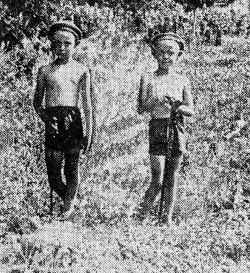
My brother Yaakov, who had wanted to save my two sons, gave them over to Ukrainians as cowherds.
Ida Rofeh, who today lives in Israel, told me that once, when she was walking in the forest accompanied by her husband, she saw from afar a lad who was a cowherder. They were afraid that he would inform on them to the slanderers, and they began to flee. The lad (who was my son) knew them, ran after them, and called to them in Yiddish: “Don't flee, I am a Jew, I am Chaim's son.” He gave them his food, which included bread and cheese, and said: “My host is a good man. He will give me more bread. Take this.”
On 27 Av 5702 [Ed. Note: August 10, 1942], they took all the Jews, numbering about 2,000, outside the city, to a place next to the cemetery. They arranged them in groups of 50, stripped their clothes, shot them, and tossed them into pits that had been dug by the Ukrainians. That day, a Ukrainian informer took out my two sons who were hidden (the reward for every Jew was a kilo of sugar and two kilos of salt). He beat them until blood flowed and brought them to the place of murder. They were murdered along with the 1,700 people in that aktion.[2]
The part of our family who were in that slaughter were: my parents Isser and Lea, my sons Mordchai and Akiva, my brother-in-law Moshe, my sister Vitel, their daughter Sonia, my nephew Fishel, and Roza.
My sister Reizel, her husband and their two children managed to survive, and they returned to the ghetto. My brother Yaakov also survived, for he was not in the ghetto on the day of the slaughter. When my brother met my sister and her husband, he advised
[Column 196]
them to escape to the partisans in the forest. He set a meeting place with them for the next day. After work, my brother Yaakov waited for them with a friend named Kalman, armed with a gun. However, by the morning, he had not met up with my sister and her family. She did come with her husband and her two sons, 18-year-old Berish and 16-year-old Yeshayahu. They were accompanied by a woman from the Zborski family (she survived and told me everything). They looked for each other all night but did not meet.
With the morning light, they decided to go to the forest, as did my brother and his friend. In the forest, my brother approached a gentile acquaintance to ask for bread and cheese. Later, the gentile told me that when my brother and his friend left the cottage, a Ukrainian policeman named Savko encountered them and ordered my brother to return to the town. My brother pleaded with him to let him escape, but the policeman shot a bullet at him, which entered his left hand and exited through his shoulder. My brother beat the head of the policeman with the butt of his gun, and he fell into a ditch. My wounded brother was unable to shoot at the policeman, so he asked Kalman to do so with the only bullet that they possessed. Kalman, who was not trained in using weapons, shot and missed. They had no choice other than to beat the policeman again with the butt of their gun and to escape. These things were told to me later by Kalman himself.
In the morning, they both reached a second gentile acquaintance, who was an expert in healing in accordance with the concepts of forest dwellers. The gentile cleaned and bandaged my brother's wounds. He even agreed to grant shelter to my brother, but not to his friend. Therefore, my brother left the house of the gentile after receiving a bit of food from him.
|
|
| The children of Chaim Leizerok, Mordchai and Akiva |
My brother and his friend finally reached the Jewish partisans, who were not organized and were also not properly armed. He gave them his gun and asked that they take him to a doctor, for it was necessary to amputate
[Column 197]
his hand. There were no doctors in the forests, and my brother died of his wounds. They did bring him to a gentile acquaintance before his death, who wanted to help, but it was already too late.
“Kalman, please take my boots, furs, and my five dollars,” my brother said to his friend who was at his side, “For I am going to die. Give greetings to anyone of my family members you meet and ask that they avenge us.” He died on the first day of Chanukah, 5702.
I heard about the fate of my sister Reizel, her husband, and their children from a the woman who accompanied them. When they did not meet my brother, they too went to the forest, albeit in a different direction. They advanced and approached the Stokhod River, where they met a gentile acquaintance. My brother-in-law told me that he exchanged almost all the gold that he had taken with them for a gentile to arrange refuge for them in the forest. They indeed made it through a half a year. Afterward, the matter became known, and someone informed the Nazis. My sister's family once again set out for the road. The woman did not join them. My sister's family crossed the river and met a gentile acquaintance on the other side, who agreed to take them to the partisans in exchange for five gold rubles. The gentile took them through a day and a night to the place where Christian and Jewish partisans were centered, armed with a great many weapons. When they arrived with their escort, they were asked what they wanted. They said, “The gentiles showed us the way, and we want to find shelter with you.”
The guards quickly shot the gentile so that he would not return and inform on them. Later, they approached their commander and asked what they should do with this family of Jews. The response was, “If they are weak and have no means, as you say, they are to be killed.”
When the shots were heard, the Jewish partisans wanted to find out what happened. Abba Klorman (living today in America) was among them. He knew our family well. He was astonished at what he saw and began to shout at the guards. They answered that this was what the commander ordered, and that one of the family members escaped. They finally found him lying dead on the ground.
My youngest brother Fishel and I returned to Kamin and found out that a Russian family and the N.K.V.D. offices[3] were occupying our house. They promised to return the house and factory to us. However, we visited the cemetery and took leave of our dear ones. Now that they were dead, the city was foreign to us. We directed our steps to the Land of Israel.
Editor's Notes:
by Simcha Lavi (Leker)
Translated by Selwyn Rose
Once upon a time there was an ancient shtetl that nestled in a small valley, between fields and forests, on the River Styr. Wrapped in mist are the early days of the village. And the histories of the Jewish community plumb the depths of forgetfulness.
Who were the Jews, who after centuries of wandering stuck their tent-pegs in this place? Why did they desire only this shtetl for their residency? Was it from their own wish that they came here? Or was it the hand of fate that guided them here? We cannot know today. But her sons who came after them were courageous indeed and of noble spirit. Here they lived their life. Here they taught and raised many generations yearning for Zion. Here they fought for their existence. A war that sometimes pit them against the hardships of life and sometimes against hooligans. Until the awful storm arrived that wiped them entirely off the face of the earth. Nevertheless their memory is not lost and is perpetuated in this memorial book.
The village of Kamin Kashirsky is known for its sons of toil; as men of honest work, laborers and shopkeepers.
It is known for its Zionist movement, for its institutions and youth movements, its funds and its Hebrew school.
It is also known for its intelligentsia. Among whom were men of the free professions, as well as men of simple toil, for whom a good book was bread and butter during their hours of relaxation.
Throughout the generations, magnificent institutions were created here – synagogues, institutions for charity and nursing, schools and loan clubs.
There is no doubt that there were many in Poland like it. But each one had its own special life and each one contributed its own special contribution to the wonderful Jewish life, shining and exemplary. Each one had its own special variation, sometimes tributaries to the mainstream. A wealth of legends and folklore of its own. The folklore of Kamin Kashirsky was particularly rich. The grace of antiquity poured over it.
The village even radiated its glow over the surrounding area and its villages and acted as a cultural and spiritual center for Glusha, Lubieshov, Pnevno and many others.
Generations came and went. Quietly and modestly, the old people would vacate their positions to their children. They didn't go far. The cemetery and its ancient and eroded gravestones were an inseparable part of the town. It was not a scary place. It seemed that fathers and mothers,
[Column 200]
who had grown weary of life were resting there under the great trees and protecting their beloved children.
Occasionally this quiet town became fearful. Sometimes she was attacked by sudden, flying storms and gales. Sometimes rioters-soldiers visited there. The same happened after the First World War , when Bulak-Balachovich rioters went storming throughout Volhynia; nor was this shtetl given a miss. Then the learned Jewish shoulders stooped under the suffering of two-thousand years of exile and bitter groaning emanated from their throats. But what happened was that the Jewish hand turned into a fist; the Jewish back straightened and Jewish youth grasped hold of clubs in order to defend Jewish lives and their honor. Yes! That also occurred in this wonderful shtetl.
Until the night of darkness arrived, the night of terror when the Nazi jackboots invaded the town and destroyed it to its very foundations. Even at those times there was evidence of exalted heroism and not a few youngsters fled to the forests to continue the desperate fight for their honor – if not their lives. But the ancient Jewish community, young and old, was humiliated beyond measure, imprisoned within the ghetto, its property pillaged, tortured and wounded and eventually exterminated.
Buried in a common grave is the generations' dream. The golden chain of tradition and faith broken. The Jewish heart has stopped beating. Gone are the little, ancient lanes, once teeming with life. Only a very few remain. But these few will carry, as long as they live, the memory of the little town in which they were born and first saw the light of day and in which all their loved-ones were lost.
In blood and tears these chapters are written by the survivors of Kamin Kashirsky. In reverence this memorial is set up to the martyrs and heroes, to the reality of the suffering of the years of the Holocaust and also with a shadow of hope, that those who have come after them and know not the lovely shtetl and its way of life, will remember her and place her above all other joys.
A special place is set-aside in the book for individuals or groups who were martyred for displaying a spirit of revolt and carrying out deeds of heroism. But the memory of those who were herded like sheep to the slaughter is honored and holy, for the Satanic forces wiped them from the face of the earth and they are not the guilty ones for failing to stay alive.
We will remember them all. This is their memorial – a holy memorial. They will be remembered for all time.
|
JewishGen, Inc. makes no representations regarding the accuracy of
the translation. The reader may wish to refer to the original material
for verification.
JewishGen is not responsible for inaccuracies or omissions in the original work and cannot rewrite or edit the text to correct inaccuracies and/or omissions.
Our mission is to produce a translation of the original work and we cannot verify the accuracy of statements or alter facts cited.
 Kamin'-Kashyrs'kyi, Ukraine
 Yizkor Book Project
 JewishGen Home Page
Copyright © 1999-2026 by JewishGen, Inc.
Updated 17 Jun 2026 by JH