 |
|
|
[Column 177]
(Pnivne, Ukraine)
51°41' 25°16'
by Mendel Chazan
Translated by Jerrold Landau
@ Roberta Paula Books
|
The small town of Pnevno [Pniewno] is situated in a remote place on the border between Polesye and the forests of Volyn, 23 kilometers from Kamin-Kashirsky, and 20 kilometers from Lyubeshov [Lubieszó;w], a slightly larger town. The town of Pnevno was situated in a central, strategic area. Approximately fifteen agricultural villages surrounded it within a ten-kilometer radius.
A weekly market day took place in Pnevno. The villagers would bring their produce to sell, and they would purchase their vital necessities in the shops, all of which were Jewish owned. The small Jewish community in Pnevno started around the years 1840-1850. Approximately 120 Jewish families, numbering 650 individuals, lived there prior to the Second World War. The economic situation there was not good. Most were small-scale merchants, who could not hold their own during tough times. Some were tradespeople – tailors, shoemakers, butchers, wagon drivers, builders, etc. There were also several families who were occupied in agriculture. They leased fields from the landowners [poretzes] and worked the land with the help of farmers from the area.
There were also chasms within the small Jewish community. We had an elderly shochet of stature. He was a veteran shochet, a member of Mizrachi, with a Zionist outlook, and a Jewish heart. He displayed some understanding of the spirit of the younger generation. In time, a rabbi came to us, a member of Agudas Yisroel, who was opposed to the opinions and outlook of the veteran shochet to the point that he brought an additional shochet to Pnevno. Approximately half of the population followed the rabbi, and the other half maintained their faith in the elderly shochet. They even built two synagogues – the rabbi's camp separate and the shochet's camp separate. The youth continued to follow their own unique path.
We had a Polish government school, which was compulsory to attend. However, the Jewish children did not suffice themselves with that. They also studied with a rebbe. Eventually, a cheder was founded in the fashion of the Tarbut Hebrew School, in which boys and girls studied together. The teachers possessed modern, worldly education and outlooks, imbued with the spirit of Zionism.
Despite the poverty that pervaded in Pnevno, every family made a supreme effort
[Column 178]
to ensure that their children studied in the cheder, knew Hebrew, and were educated in the Jewish spirit and tradition. There was also mutual aid in this area. The youth established a library which was exemplary in the entire area. They would obtain the newest books in Hebrew, Yiddish, and Polish. The library contributed greatly to the spiritual development. The library maintained itself from the monthly dues of readers. Special fundraising campaigns were organized on occasion.
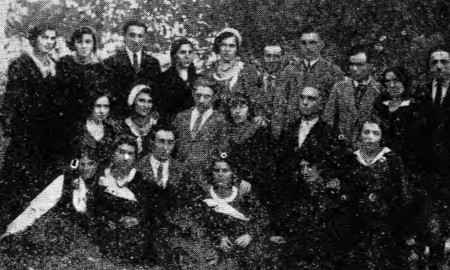
We had chapters of Hechalutz and Hechalutz Hatzair, which educated most of the youth in the spirit of Zionism and pioneering.
Most of the children had no future in Pnevno (after concluding the Polish elementary school or the cheder). They sought ways and sources of livelihood. Therefore, they traveled to the villages of the area to serve as melamdim (teachers of young children). A village with several Jewish families would hire a teacher to teach the children Hebrew and Torah in return for food and a sum of money. Some studied a trade. The only future for the youth was – the Land of Israel. Therefore, they cleaved to Hechalutz and Hechalutz Hatzair. After finishing work in the evenings, we would enter the gathering place, speak only Hebrew amongst ourselves, and dream about aliya to the Land of Israel.
When you would enter the Hechalutz Hatzair hall, your eyes would notice a living wall of newspaper that included surveys on events from the world at large, happenings in the Zionist movement, a list of donors to the Keren Kayemet LeYisrael [Jewish National Fund] and Keren HaYesod, feuilletons, etc. We would arrange a general discussion every Friday night. We had advisors, but no special activists. We also organized Hebrew courses. We busied ourselves with collecting donations for the funds. Everyone gave their donations willingly, except for the rabbi, who was a follower of Agudas Yisroel, and some of his followers. There were those who were lacking provisions for the Sabbath but nevertheless gave their donations.
From time to time, an emissary from the Hechalutz Hatzair headquarters in Warsaw would visit us. On such occasions we would arrange a festive gathering. We would decide who would be required to attend a convention, moshava, seminary, or hachsharah.
We played basketball. We were a strong group, and travelled
[Column 179]
to compete against gentile teams in the area. We also practiced light athletics. The results were good. We organized excursions and meetings with other chapters in the area. We set a meeting on Saturday with the nearby team at the half-way point next to the Stokhod River. From a gentile, we rented the field as well as the hay storehouse, so that we could rest there. When we met in the morning, we conducted a joint meeting in which we established the order of the day and the activities for the near future. We spent most of the day bathing in the river and sailing on the rafts that we rented. The food was shared.
In the winter, we would go out with skates and spend Saturday on the ice. Toward evening, we would rent several winter wagons with horses. We would drive over the soft snow and enjoy the healthy, pleasant winter air.
Our first members went out to Hachshara in 1932. The wave of Hachshara increased in the years 1936-1937 and continued until the outbreak of the war in 1939.
The economic situation of the Jews of our town worsened from day to day. Taxes increased, and anti-Semitism was prevalent. Our youth realized that only Hechalutz could assure them a human and Jewish future. Everyone began to go to Hachshara, despite the objection of most of the parents. No small number left without informing their parents. For this reason, a not-insignificant number survived and are living in the Land. The Hechalutz Hatzair activists went to Hachshara in 1936-1937, the writer of these lines among them. Some people who went through the Hechalutz chapter of Pnevno were among the activists of the Ha'apalah [illegal immigration] before and after the war. The Ma'apilim arrived in the Land on all types of boats, including the “Exodus from Europe” ship. All this was due to the education that they received in the chapter.
The following are details from Shmuel Shulman and his wife Sara, who survived (their children were murdered by the Nazis along with all the Jews of Pnevno).
|
|
| A group of youth who were members of Hechalutz in Pnevno |
[Column 180]
Shmuel Shulman relates: During the last years prior to the outbreak of the war between Poland and Germany, the local Jews already felt an increasing wave of anti-Semitism from the Polish authorities. First of all, this was expressed by the cancelling of the sales permits and the imposition of unbearably heavy taxes. The Jews and their property were left with no owner (hefker) in the eyes of the local residents. Thus, in 1939, the well-known pogrom broke out, perpetrated against the Jews by the local residents. They came to Pnevno from all the villages to divide up the spoils. However, this was for naught, as the Jews found out in time and were able to counter them. People lived in fear throughout the entire year of 1939, without means of livelihood. When the war broke out, the retreating Polish soldiers pillaged all the remaining Jewish property.
The Russians appeared on Yom Kippur of 1939. They also began to search for “transgressors.” In particular, the local Communists did this. The property of the local Jews was nationalized.
Most of the Jews became accustomed to the situation and set themselves up in all types of jobs. A non-insignificant number were occupied in agriculture. Tradespeople organized themselves into mutual cooperatives. They lived in this manner until 1941, when the war between Russia and Germany broke out. After the Russians left us, the local residents began to perpetrate pogroms against us. First, they murdered 18 Jews, whomever came into their hands, elderly and children, women or man. These are the names of the martyrs: the elderly shochet Yossel Abba Beker and his son-in-law Moshe; Avraham Dorok, age 75; Binyamin Marczok; Yisrael Bergman who was burnt alive; Aharon-Shlomo Steinkruk who was burnt alive; Bracha Wisman; Michal Shulman; Rachel Shulman, a 16-year-old girl, the daughter of Shmuel; two sisters from the Pinsker family, one 11 years old and one 15; the elderly Perl Wieidz; Feiga Kospt; and Chana Gober.
The rest succeeded in hiding with gentile acquaintances or fleeing to the fields or the forest. The honorable ones from among the gentiles who saw that it is impossible to continue ordinary life in the city in this manner decided to set up
[Column 181]
an internal militia to maintain quiet and order. All the local Jews were ordered to come out of their hiding places without fear of attacks. The Jews returned, but now several families lived together so that they could defend themselves.
After that, the Germans arrived and agreed to set up a militia on the condition that the Poles be removed from it. The Jews were ordered to come to the police station, where they were informed that from that time and on, they have no rights as citizens, and were obligated to wear a 15-centimeter white band on the street, and a Magen David on the left arm. They chose Yechiel Gober to be responsible for maintaining contact with the local authorities.
About a month after the establishment of the German regime, they brought us together for a meeting and commanded us to exchange the white band for a yellow band. Thus we were left unprotected (hefker) and without a source of livelihood. However, the situation improved with time since there were no tradespeople among the gentiles of the area. The local authorities demanded that our local representative provide tradespeople for all types of jobs. The German authorities received the pay for the Jewish labor, but the working Jew was able to eat to satiety and was also able to bring a bit of food for his family.
One Friday evening, a few weeks later, a group of S.S. men came to the town to begin annihilating a portion of us. We knew about this beforehand, and we arranged with the priest to attempt to repeal the command. After he received several pieces of jewelry and gold, he promised to do everything to help us.
When the Germans arrived, the priest and other city notables welcomed them and brought them to the monastery, where they began to discuss the “issue.” In the meantime, the Germans issued a command to our representative to bring provisions for their horses – twenty-five bales of grain within a half an hour – not from gentile fields but rather from the fields of the Jews. Guber came and chose 25 young, healthy men. We ran like madmen to the fields and began to prepare the provisions.
[Column 182]
The Germans ran after us and beat us over the head with sticks. We did not have anything with which to cut the grass. I ran to a gentile and obtained work tools. Others tied the grain stalks. We quickly prepared twenty-five bales. Each of us took a bale weighing about forty kilograms, and began to run to the church, with the Germans running behind us and beating us.
|
|
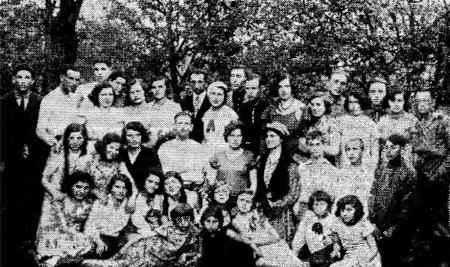
| Hechalutz Hatzair in Pnevno |
We placed the grain in the designated spot. In the interim, the priest debated with the Germans and did not allow them to kill us. He told them that we were tradespeople and we had no connection with Communists. After deliberations, it was decided to send us home. When we exited through the door of the church, Germans stood at both sides, beat us with sticks, and plucked our hair along with some flesh. We passed through the gates and were commanded to stand in a line. There, we endured more beatings. Then, they let us go, and commanded us to run home. They chased after us and beat us to the extent possible. Each of us arrived home broken and shaken.
About one month after this incident, they imposed upon us a contribution -- 500 kilograms of copper and gold. After several weeks, they took ten young boys from us to “work on the roads” – but actually for annihilation. They took youths from the entire area and sent them to Kamin-Kashirsky. The community in Kamin-Kashirsky did everything it could so that they would all go free. During this time, we did all types of jobs for the police commander as well as for the police. In this way, we remained secure for approximately four months.
After the Passover holiday of 1942, they chose from us all who were builders by trade and sent us to Kamin for work. When we arrived there, the Germans chose only eight of us, and sent the others home. Our daily food ration was 150 grams of bread, a half a liter of black coffee, and a half a liter of soup. However, the local community gave us additional food portions.
We were 1,000 workers for the district commissar. This was then the best place from a security perspective. Every
[Column 183]
two weeks, they gave us permission to travel home. We worked for about six months. Life continued in Pnevno as previously, without change.
Sara continues and relates: At that time, the Germans began to prepare the ghettoes. They sent the people of Pnevno to the Lyubeshov Ghetto. They did not permit us to take anything. They imprisoned us in the synagogue under terrible conditions. We received 100 grams of bread (Ed. Note: this is a bit more than a quarter of a loaf of Pepperidge Farm rye bread) and a bit of soup every day. We remained there for two weeks. They perpetrated the first slaughter in the ghetto on 26 Av, 1942 [Ed. Note: 9 August 1942]. Already at an early hour, we saw many S.S. men surrounding the ghetto from all sides. We sensed and knew that something serious was about to take place. They knocked on the door at 4:00 a.m. A Judenrat man entered and stated that within a half an hour, everyone must present themselves at the Judenrat headquarters. We did not have enough time to get dressed properly. I grabbed the children and hurried with them to the yard. There was a bus there with the symbol of the black head – the emblem of the “death brigades.” The children cried from cold and hunger as the German soldiers prepared for the aktion. I held my baby Shlomole in my arms. My two older children, Salik, and Perl, stood next to me. Then the commissar approached with a sub-machine gun in his hands, and the look of a wild boar in his gaze. He asked, “Who is Sara Shulman?” When I responded that it was me, he told me to follow him and to leave the children where they were. I did not want to leave them, but he took the children from me with all sorts of subterfuge. He transferred me and the rest of the women whose husbands worked in Kamin-Kashirsky to a certain place and ordered us to lie down. When I saw how thy were placing the children separately and the men and women separately, and I noticed my children, I rose and wanted to run after them. I immediately received a beating over the head from an S.S. man, and I fell. At that moment, the Germans began the slaughter. They murdered and annihilated all those who were in the field. They placed the children in the synagogue, removed their clothing, and murdered them. The older ones were forced to dig pits. When the pits were ready they commanded the children to place all their clothing in a certain place. The fear was etched on their faces even after their deaths.
He commanded us to toss all the dead bodies into the pits, and then to cover them with sand. We were perplexed and oppressed. We were forced to search for gold and silver in the clothing. We worked at this for about a week.
Shmuel relates: When the aktion in Lyubeshov was finished, the commissar returned to Kamin-Kashirsky, gathered all the workers there, and informed them of the slaughter. To me he said, “I killed your children and left your wife alive.” One had to thank him for this. If one did not, one would suffer a beating. He gave me permission to return to live with my wife, who worked at all sorts of jobs for the Germans in the ghetto.
Three months after the aktion, a gentile came and told
[Column 184]
us that the Germans were approaching with the “black head.” We decided to escape. We went out at night, forty men from all the workers, and approached the designated place where the guard stood. We told him to be silent, or else we would kill him. The guard turned aside, and we escaped. We ran in a specific direction with the goal of arriving in the forests. However, we finally got stuck in the bogs and could not extricate ourselves. We sunk up to our necks in the bogs and could not move. We stood there all day, and only got out at night and advanced to the village of Bukhovna, where we entered the home of a gentile acquaintance. We waited as we deliberated about what to do. We finally decided that some of us would go to Lyubeshov to find out what was taking place there. We also decided to tell the women to come to us. However, to our sorrow, none of the people who went there returned. Then, we requested that the gentile send someone to the ghetto. The emissary of the gentile returned with the wife of my friend. She told us that after we escaped, they came to murder the women, but thanks to the efforts of the city physician, a Russian who liked the Jews, they did not do this.
We returned to the ghetto, and the Judenrat made sure we would return to work in Kamin. However, the engineer did not want to accept us until the commissar approved this. The commissar agreed under the condition that we would not go home for a month. After a month, we were given permission, and we traveled [See Note 1].
On 13 Cheshvan 1942, the Germans prepared for the second, final aktion – to murder and kill all of us without exception.
In the meantime, Sara prepared, together with several friends, a hiding place beneath the earth. At night, when the aktion started, we entered our hiding place. There were two other families along with us. We remained there for three days and three nights. When the murderers left, we exited secretly, cut the barbed wire fence of the ghetto, and escaped.
The Nazis murdered everyone in this aktion, including the Judenrat and the Jewish police officers.
As we were escaping, a gentile yelled to us, “Escape quickly!” He did not harm us. This was on 24 Cheshvan. It was dark outside, and a torrential rain was falling. Thanks to this, we succeeded in escaping. My wife fainted, and after much effort, I succeeded in standing her on her feet. In the meantime, the other families who were with us escaped in all directions. We got confused, and when we came close to the station, we realized our error, and began to escape in the opposite direction until we arrived at a gentile acquaintance. He had a large dog, but he recognized us and did not attack us. The gentile brought us into the house with great difficulty and gave us a half a loaf of bread with leben [Ed. Note: a fermented milk, think buttermilk]. We lay down to rest a bit. This was 2:00 a.m. We fell into a deep sleep. However, before the hour was out, the gentile thought that if the mater becomes known, they would kill him and his family. He woke us up, and told us to leave immediately, so that none
[Column 185]
of the neighbors would see us. He gave us old rags to wear. We went outside and did not know what to do. After that, we decided to go to acquaintances near the village of Derevok.
We arrived toward morning. The gentile was outside, and he panicked a bit when he saw us, because everyone knew that there were no longer any Jews, for they had killed them all. At first, he was afraid to let us into his home out of suspicion that his worker would report him to the police, and then he would be killed along with us. Despite everything, however, he brought us into the house and told us to go up to the attic. He gave us clothing to cover ourselves and also food. We stayed with him for three days. Then, he asked us to continue on. He told us the directions to the partisans. We thanked him and went.
Satiated and dressed, we arrived in the village of Uhrynychi and entered the house of a gentile acquaintance. He received us well. We remained there all day. We advanced further at night and reached the village of Chervyshetz, where we again entered the house of a gentile acquaintance. It should be noted that all the aforementioned gentiles were of the Shtundist-Evangelist sect. A few Jews survived thanks to them. They helped to the extent possible.
The latter gentile transferred us to the Stokhod River at night and directed us toward the partisans. Similarly, he gave us the names of Jewish partisans from our area. We began to advance in that direction until we reached the large Kochowel Forest between Drovishetz and Borovne. The Germans did not reach there, and the gentile residents were also afraid to go to that place. We lit a fire with the matches that we had received from the latter gentile, and cooked and fried potatoes. There were many houses there which had been abandoned by their residents. Hiding places remained next to the houses, with small potatoes for the cows, which we took to eat. At night, we slept in the barns. That is how we lived for more than three weeks.
One night, when we were sitting next to the fire that we lit, we suddenly heard a wagon approaching, with the people singing partisan songs. We thought that our redemption had come. We let the wagon pass before us, and then we began to follow it. Two of them, armed with guns, noticed us and began to shout, “Who are you?” We answered them. After that, they asked us how we had survived. To our misfortune, however, they were not able to accept us into the partisan ranks without guns, for their captain was an anti-Semitic gentile. They gave us a lot of food – bread, butter, and honey. In addition, they told us that there were other Jewish partisans in the forest,
[Column 186]
and also Jewish captains. Perhaps they would take us. Having no choice, we returned to our previous place and began to search for the partisans. Suddenly, we saw an elderly gentile cowherd from afar. We approached him and asked him to tell us where the partisans could be found. He told us to go in the direction of his house and barns, where there is a great deal of food and also a place to rest. We went, and reached the yard. Everything was exactly as he had told us.
We lay down to rest. Suddenly, we heard the singing of partisans in our ears. They arrived. The gentile told them that we were there. One of them immediately approached us and began to call me by name. This was Yeshayahu Zwibel, the captain of the local partisan unit. His two brothers, Yaakov and Shlomo were with him, as well as other Jews. He kissed us and said, “As long as we live, you too will live. And we hope that we will witness the downfall of Hitler.” Then he instructed us to bathe and remove our old clothes. He gave us new clothes.
We should note that these lads had organized immediately after the arrival of the Germans. First, the three Zwibel brothers, Yeshayahu, Yaakov, and Shlomo, went out. They obtained guns and began partisan actions. Then, other Jews came to them. Thus did they organize and became a significantly large group. They instilled fear upon all the villages of the area, and especially upon the Germans, who decreed a large monetary prize for anyone who would capture them.
My wife and two other women worked in the kitchen and took care of all the domestic affairs. Yeshayahu's group continued to grow. We lived in bunkers that were built in the ground. We had a radio receiver, and we knew about what was taking place. We maintained direct contact with the Russian command on the front.
There were six groups of partisans in this forest, led by Russian commanders.
Russian airplanes came to us from time to time, dropping brand-new weapons and food. In time, the Germans also began to kill gentiles who had escaped to the forests, and the partisan groups grew by multiples. We lived in that manner for almost two years. My wife worked in the yard and in the house, as I went out with the rest of the men to all types of partisan actions – destroying bridges, bombing railway tracks and trains of German soldiers, etc. Victims fell in those actions. They died the death of heroes. Yeshayahu Zwibel fell in an action when he went out to destroy a train of German soldiers. The action succeeded, but he was killed along with the Germans.
We left the forests in 1944, when the Russians liberated our area.
Translator's Footnote
|
|
JewishGen, Inc. makes no representations regarding the accuracy of
the translation. The reader may wish to refer to the original material
for verification.
JewishGen is not responsible for inaccuracies or omissions in the original work and cannot rewrite or edit the text to correct inaccuracies and/or omissions.
Our mission is to produce a translation of the original work and we cannot verify the accuracy of statements or alter facts cited.
 Kamen Kashirskiy, Ukraine
 Yizkor Book Project
 JewishGen Home Page
Copyright © 1999-2026 by JewishGen, Inc.
Updated 10 Jun 2026 by JH