 |
|
[Page 159]
by I. B. Alterman
Translated by Seth Morgulas
In the Mogielnica Rebbe's low-roofed little courtyard, there stood four small houses: in front, facing the street – a square, old wooden dwelling with a wide, pointed roof tilted over the dusty windows, like Nathan the beadle's angular cap with the long, worn-out visor over his watery yellow eyes; further on – the Rebbe R' Yerachmiel Moshe'le's “little study house” – as it was called in Gritze – with its yellowish, smeared little windows; next to it – a fifty-year-old sukkah, which always, except for the days of Sukkot, stood with a disheveled head of loose s'chach, like the Rebbe's wife's weekday wig; the fourth little house was a tiny slaughterhouse. Upon entering the Rebbe's courtyard, one was immediately met by the singing, drawn-out voices of young boys, who spent entire days there engaged in interpreting deep tractates and difficult questions and answers. These ringing, heartfelt Talmudic voices mixed a little further from the study house with the clamor of chickens and geese, which servant girls and housewives brought for slaughter.
The entire courtyard later passed by inheritance to the Blandover Rebbe's daughter, Sarah'le, R' Elimelech's granddaughter.
Sarah'le was, alas, left a young widow with two sons – the older R' Avramele, a twenty-year-old, and an eight-year-old boy, Aaron'dl – after the Rebbe R' Yaakov'l, the Mogielnica grandson, who departed from the world prematurely.
Before R' Yaakov'l's burial, a whole commotion took place in the town: should they “crown” R' Avramele as his successor, or should they provide a weekly allowance for the young widow and the children? –
“A Rebbe must be a scholar, a master of the Holy Spirit, a leader of the generation, and an advocate for the people before the Throne of Glory. R' Avramele is young, not a great man of character, can still barely study, and is not worthy of leading the rabbinical throne,” argued the scholars. To the simpler Hasidim and household regulars
[Page 160]
R' Yankel said: “It is a shame for the deceased that his family should live off a pension. Heresy is growing in the shtetl; in these times, one must have a Rebbe! R' Avremele is, after all, a son of holy men, a grandson of the Maggid; let him start leading, it won't hurt. It won't ruin anything. On the contrary, he will clothe himself in holiness, and he may yet become a great man in Israel.”
It was indeed decided that R' Avremele should become Rebbe, and some Jews said “Mazel Tov” to his father after the burial.
R' Avremele had very few Hasidim at first, but all the Gritzer Jews grew to love him. Because he truly gave himself heart and soul for a Jew. Many Hasidim did come to him later, even though there was much talk that his Torah teachings at the Sabbath tables in the small study house were quite weak. Gradually, the entire community of Hasidim who used to come to the father also began to hold his son in high regard. Because, some said, they did not want to travel to any other Rebbe, and “in Gritze there is simply no one else to go to.”
R' Avremele led the table for only half a year. It seems he did not have long life and departed from the world prematurely.
He left behind a young widow, a granddaughter of R' Yerachmiel Moshe'le, with four little orphan-swallows, one smaller than the other. “Because of the sins of the town, his young years were cut short,” said pious Jews; the dignitaries and learned Hasidim recited “Baruch Dayan Emet” and remained silent–after the burial, everyone agreed to collect weekly funds for the seven grandchildren.
After R' Avremele's death, the five young orphans were left without any supervision. They grew up like wild fruit on neglected trees standing on abandoned roads.
Old Jews used to tell: Gritze was once a shtetl of the most learned men and Hasidim. Simple people, craftsmen, were few, but even they knew how to study a portion of the Chumash. There were only two prayer houses then: a Kozhenitser and a Vorker. Every day, people would pray there several times, in the morning and in the evening. There was always a large crowd there; on Sabbaths and holidays, it goes without saying, there was simply no room to drop a pin. In the great study house and in the synagogue, they only prayed once on Sabbath and holidays. During the week, there was barely a minyan.
[Page 161]
In my years it was already the opposite: few Hasidim and more simple Jews.
In the Beth Midrash and in the synagogue it was always packed and in the shtieblach they only prayed on Sabbath. All week they were closed. But later, many Hasidic shtieblach were added: from the Kozhenitser's cheder remained five grandsons – all of them led a tish. From the Vorker court, the same thing. And the Hasidim divided themselves, even though in every room there was one custom, not even a difference in the melody, but everyone only cared for their own Rebbe and prayed only in their own shtiebel.
Nevertheless, in the small Beth Midrash, a large crowd always came: mostly old Hasidim, who did not travel to anyone, remained loyal to R' Avremele and his father, and young boys, who studied there until their wedding.
For these boys, who were already wearing tefillin and had finished the highest cheder with R' Bendit the teacher, it was very difficult to come here and take a place at one of the two long tables, which stood on both sides of the Holy Ark along the entire length of the Beth Midrash.
Yehoshele, Benjamin Malazh's son, the oldest boy in the shtetl and the greatest scholar in the Beth Midrash – was the supervisor here. When he examined a boy and saw that he could already study a piece of Gemara with Tosafot by himself, he pointed him to a place at the second table, which stood by the door, on the left side of the Holy Ark and said, “You stay here.” For this “stay,” the richest and most distinguished householders even had to send their Bar Mitzvah boys into the cheder for another term.
Everyone had respect for Yehoshele; he was the greatest scholar in the whole shtetl, knew the Shas by heart like water, and was a great expert in the chapters. With great diligence, he used to study while humming very quietly; often while studying, his long-lashed black eyes would smile as if he were feeling the greatest pleasure in the world. He was already 28 years old and had a decent little beard, which he constantly wound under his chin. But always, as if to spite him, it crawled back up, and especially when in-laws came to “look him over.”
[Page 162]
But it was not his long little beard that repelled the prospective in-laws. On the contrary, everyone agreed immediately, but when they saw his father with his lime-splattered face and paint-smeared trousers, they left at once.
After such a departure of a prospective in-law, Yeshaya'le's round face flushed a little. He lowered his long black eyebrows and buried his eyes in the “Choshen Mishpat.” He took his little beard from behind his collar and bit it with his teeth. For several days he spoke to no one and studied with more diligence. In those days we loved him even more.
He treated us fatherly, except for one whom he dismissed. This was R' Aaron'dl, the eldest grandson among the orphans (R' Yankev'l's son), who had entered his father's small study house prematurely, hung around only among the young boys, and never studied.
No one examined him and no one pointed out a place to him – the small study house was, after all, his inheritance. Who had a say over him? He hung around at all the tables and wherever he wanted, there he sat, and indeed always at the large table that stood on the right side of the Holy Ark, among the groom-boys who were studying “Choshen” and “Yoreh De'ah.”
Years passed. Time went by very quickly and he still had not opened a Gemara. He used to always listen to melodies – he had a ringing soprano voice – tell wonder-tales of his great grandfathers, and carefully groomed his red, half-curled sidelocks, which dangled like stretched springs on his rosy cheeks on which hairs were already sprouting like young grass in spring.
“What will become of him?” – some of the boys whispered to each other. “Such an arrogant person! He doesn't even know the meaning of the words.” “People say,” – one once related – “that they are already talking about many matches for him. Matchmakers are coming from the whole surrounding area; they simply don't close the door at the Rebbe's wife's house. After all, he is a son of holy men! Once he suddenly left and came back a groom. It was rumored that the Otwock Rabbi, a grandson of the Pshiskher (Przysucha), had arranged a match through the old Rebbe's wife. After a short time, the 17-year-old R' Aaron'dl came to Gritze with his young wife – a beautiful young woman with reddish cheeks, black and sparkling
[Page 163]
eyes and in a shiny black wig.
The grandchildren lived in peace. They multiplied and were, thank God, already nearly sixteen in number. The town paid a weekly stipend, and the two rebbetzins traded a little in stuffed cigarettes and yeast for Sabbath challahs. It was even strictly forbidden by the Polish government to engage in this secretly, but they carried it into the houses in silence, and people bought.
R' Aharon'dl had already become a man burdened with children, and he could not make ends meet on his share of the weekly stipend, not even with the few zlotys his mother gave him every week from the trade. He never had anything for the Sabbath. –
What will be? – his Rivka'le said – one must have something, the children are growing, one must do something.
These words were like spears in his heart. What does one do? – The question gnawed at his brain, and one morning he got up quite early and said to his Rivka'le: – Just say, I am going to the Rebbe, be well.
He traveled to Otwock to the Parisover (Parysów) and asked for advice: – One needs a livelihood; trading does not befit our ancestors. A craft is out of the question, and I didn't learn enough in my youth to become a rabbi. What does one do? Perhaps start leading [a Hasidic court]?
The Parisover was silent, sighed, and sent him off with the words: Well, be successful. He came to Rivka'le a happy man: the Rebbe had agreed: silence is like consent. He immediately procured a beadle, began to walk in pairs, installed a Torah scroll, established his own minyan, and began to lead the third Sabbath meal.
The head of the community, Yitzhak, the main leader of the craftsmen – who prayed by him and always sat at the table next to the “Rebbe” – introduced a special weekly stipend for him among the artisans in the town. He had a comfortable livelihood and led a royal house.
Among the grandchildren, a dispute arose: How can this be? – R' Avrahame'le's sons argued – “why is he a Rebbe? Such an ignoramus and not a man of the Holy Spirit. He is desecrating our lineage.”
[Page 164]
But he asked no one and continued to lead as a Rebbe, and a large crowd came straight to his “tishn”! Some wanted to hear beautiful singing. There was a musician in the shtetl. Whoever was curious to see how he led a “tish”, spoke Torah. After all, he had never studied. Many Jewish craftsmen used to come, who prayed in chevras and in the large bes medresh, and never traveled to any Rebbe.
He “led” a tish like all Rebbes. He would taste something – distribute the leftovers, humming Modzitzer (Modrzyce/Dęblin) melodies. He also used to speak Torah, but it was hard to understand – heavily allegorical with various verses from the Zohar. Truly by heart, every word was sung more than spoken, and in the middle of it he would say: “Yochonon Gerer El Mistater.” A Belzer Hasid once said after such a tish: It is idolatry. Everything is false and imitated. His “Hasidim,” finding out about this, simply wanted to stone him, and when later one of his children–may it not be known to any Jew–died, everyone began to be silent.
Once in the Piaseczner shtiebel, between Havdalah and Melave Malka, Shlomo Yisroel, coming from the Rebbe, told the few Hasidim, among whom were R' Avromele's children, that the Rebbe, while speaking Torah, had thrown in: There were once great Jews and great leaders of the generation. A Maggid, of blessed memory, a Kozhenitser, a Vorker, great scholars, masters of the Holy Spirit, and miracle workers. Today, poor things, there remain tiny little Jews with little “yak-mak” Rebbes. There are even many imitators, but no one recognizes them. Everyone wears velvet skullcaps, silk robes, and white socks, but al tistakel b'kankan ela b'mah sheyesh bo (do not look at the pitcher, but at what is inside it).
You hear words! I mean our Aharon'dl – and I tell you – calls out Shlomo'le, an old Kozhenitser Hasid, who travels to no one, that the Rebbes who already have many Hasidim also have no Holy Spirit. That does not come by inheritance. Individuals can only have it, and the rest is all imitation.
The grandchildren broke out in an uproar: Sinner of Israel! How dare you speak? The Piaseczner (Piaseczno) Hasidim also flared up: Scoundrel, get out! They threw him out of the shtiebel.
Until his death, the old Kozhenitser Hasid had to pray in the “Chevra Tehillim,” celebrate shalosh seudos at home, sing in solitude, and never blessed with a minyan, not even with a quorum.
by Genia Rinkewicz, Tel Aviv
Translated by Seth Morgulas
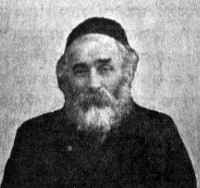
R' Boruch Bendit Rinkewicz, of blessed memory, my father-in-law, was well known to the Jewish community for his scholarship, kindness, and love for the common person. May I be permitted, as a close member of his family, to provide a few strokes of his spirited life.
R' Boruch Bendit possessed three main virtues: a strong will to study and spread Torah in public, devotion to the ideas of the Return to Zion, which at that time were beginning to take root on the Jewish street, and an extraordinary love for people, especially for the poor, the lonely, and the suffering.
On Shabbat, R' Boruch Bendit used to teach a lesson, the Daf Yomi for several groups of Jews and the weekly Torah portion for laborers and hard-working people. The greatest scholars of the town loved to have a conversation with him about words of Torah. R' Boruch did not get heated, did not argue, but loved to clarify, to explain; if someone had a difficult question about an unclear
|
|
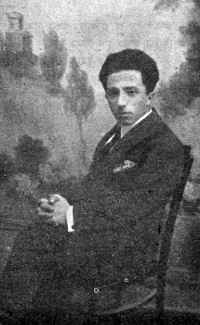
| Bendit Rinkewicz |
passage in the Gemara, they would come to R' Boruch Bendit. Everyone listened to his opinion. Besides his immersion in the world of Torah, he also had a strong inclination toward various sciences, among other things.
[Page 166]
interest – in astronomy, botany. Before his window stood flowerpots with various flowers, which he used to tend with the greatest piety. R' Boruch was a deeply religious Jew, but piety in him was coupled with goodness. “Being pious is little,” he used to say, “one must also be good to people, justice, love from person to person.”
It will be interesting to relate the following fact: On Fridays, women would often come to him with various questions: (when the Rabbi was not at home) here a needle in the gizzard of a chicken, spots on the intestines, or a cup of milk had overturned and run under the soup, and so on. Well, he would first inquire to whom the chicken belonged. And if it belonged to a poor Jew, he would take a long time to look up and search through all the laws, in order to find a permission to rule it kosher!
As a pious Jew, R' Boruch gave his children a strictly religious upbringing. His two sons, Moshe and Isaac, he educated especially in Torah and good deeds. Moshe, the eldest son, was very pious. He died, however, very young and left behind a wife and a daughter, who are today in Israel. Isaac studied in the Gerer Yeshiva. The Gerer Rebbe said of him that he was growing into a prodigy. Isaac, however, was swept away by the free Enlightenment movement, which at that time had broken into many scholarly-Hasidic circles. The freedom movement, socialism, had a great influence on him. Isaac, with his “heretical” thoughts, influenced the largest class in the yeshiva and led everyone off the straight path… Because of him, the class had to be disbanded. Isaac married the Gerer Rebbe's granddaughter, Leah Kurz, whom he met in the illegal socialist circles. For a time, he was one of the leaders of the Gerer “Bund.” In his later years, he lived in America and died there.
Even now, the long table by the window stands before my eyes, around which sat R' Boruch Bendit's adult students. Even now, his look, smiling with happiness, hovers before my eyes toward the students, whom he taught sharp Torah and planted in them a love for Eretz Yisrael. A portion of them, today important personalities, are in Israel. He did not involve himself in any communal affairs. He did not
[Page 167]
chase after honor. He did not blow his own horn. On the contrary, he was very modest, kept himself simple, and was very approachable to people. Especially to the common man. That is why the common folk loved him. His only social activity was the Mea Shearim Yeshiva in the Land of Israel, where he was a gabbai. In those years, all connections with “Mea Shearim” were conducted through R' Boruch Bendet. From the Land of Israel yeshiva, he used to receive various matters to take care of. It would be worthwhile here to relate a characteristic episode:
Once, my father-in-law received a wooden matzah box sent from the Land of Israel, which had been crafted at the Bezalel School. It was a rare work of art that the whole town admired. The postmaster found out about this item and insisted strongly that the matzah box be sold to him for ten rubles. R' Boruch did not want to sell it to him, so that an object of a mitzvah would not fall into the hands of a gentile.
Every year for Sukkot, my father-in-law also received etrogim sent by Rabbi Kook, who truly cherished the beautiful compositions of R' Boruch Bendet Rinkewicz.
R' Boruch Bendet often spoke about settling in the Holy Land, and he was happy that his sons, Avraham Yaakov and Reuven, had settled with their families in the Land of Israel in 1932.
For the characterization of this Torah scholar, the following fact, which relates to the aforementioned matzah box, must also be mentioned:
R' Boruch Bendet's son, my husband Avraham, did not let the matzah box rest, and in order to produce such a piece of work, he became a carpenter. True, he did not craft such a matzah box, but he remained in that trade. My father-in-law's brother, R' Hershel, who was a rabbi in Mińsk Mazowiecki, was even very upset that his brother's son had become a carpenter. He believed that being a craftsman was a blemish on the family, but his brother, my husband's father, replied at the time, “Work is royalty.” One can be a craftsman and be a good Jew.
Even his close ones understood him little; he was little appreciated during his lifetime. A lot, very much, this scholar wrote. Written in his tiny, neatly circled Rashi script. Once, I [asked] him…
[Page 168]
“Father-in-law, why don't you publish your writings?” “That I leave for you, after my death,” he answered with an innocent smile. These writings, however, did not manage to see the light of day. Because shortly after his death, the cruel war broke out, and his writings, along with his wife – my mother-in-law Bashe – and my young sister-in-law Toybe Leah and her husband Fayvel and child, together with the dear, precious Jews of the town of Gritze, were annihilated by the Germans. The Gritze community, with its spiritual life, was destroyed. We will never forget the tormented townspeople, and with deep respect, we will always remember the figure of my father-in-law, the great Jew and Torah scholar, R' Boruch Bendet, of blessed memory.
by Y. B. Alterman
Translated by Seth Morgulas
After thirty years of wandering across different continents, it is a little difficult to recall episodes from my already so distant cheder years, when I studied Torah with the innocent folk-Jew, the Gritze Gemara teacher R' Bendit Rinkewicz, of blessed memory. After all, in that span of time, we have lived through a terrible, a horrific catastrophe, whose black shadows obscure those so dear, bygone childhood years. We have become more realistic, more practical over time, and despite all this, one yearns for that little bit of faith that my Torah teacher revealed to me.
My teacher, R' Bendit the melamed, taught me: to know less and to believe more; every person was born with a special mission, to rectify something in this earthly world; our life only has meaning when one constantly renews the Torah, and the most important thing of all to remember – that after the transient life of flesh and blood, the continuous, beautiful, and eternal life of the Garden of Eden only then begins – how easy it was then, when one truly believed in this.
The most important thing that has remained in my memory of my teacher, R' Bendit the melamed, is my love for him, for that noble and simple folk-Jew. He also planted in me this feeling of love for simple people.
In the small, always quiet and poor little town of Gritze, there were many interesting and honest Jews. There lived true idealistic workers, who gave their whole lives for the struggle to improve the so gray, miserable, and always sad life of the toiling person. There were many fiery Hasidim, great scholars, and very capable Zionist activists. For all of them, I had great respect. But in my teacher, I saw the brightest figure, who, with his spirituality and simplicity, surpassed them all.
Everyone who knew R' Bendit well was always full of admiration for his Torah knowledge and modesty. He was isolated from almost everyone, starting from the Hasidic, scholarly, bustling world and ending with his own household, who even knew little of him. R' Bendit never had any time for the vanities of this world – he used to always
[Page 170]
be busy: studying or just being absorbed, lost in thought and concentrated in his dream-like Torah world.
I remember how my childish heart – I was already a Bar Mitzvah boy by then – hammered in fear within me, when I went up for the first time into the cheder to Reb Bendit the teacher. Entering, I found him as if he were in a book. On the table lay several artistically crafted, ivory-colored ink pens and postcards, inscribed with tiny, symmetrically even Rashi-script lines. On his face shone a beam of joy like an artist's, while finishing his creation. After a while, he raised his eyes and began to speak to us students quietly, as if to very good acquaintances: “Look, I received this from Jerusalem.”
He said these words while showing us a new book. We began to leaf through it. Astonished, we looked at one another, seeing that at the end of an article, it was printed with letters: “From the Gaon Bendit Rinkewicz of the holy community of Gritze.”
My astonishment was even greater, because for the first time I learned that even a Jew from Gritze could write Torah. I was later proud of the fact that I was studying under a rabbi, an author of books.
Bendit, seeing our astonishment, quickly closed the book and spoke no more about it. He later showed us the ivory-colored Land of Israel pens. He told everyone to look into the round, pearl-shaped little glasses that were stuck into the pen caps. We saw in the little glasses pictures of the Land of Israel: the “Western Wall,” Rachel's Tomb, the “Cave of the Patriarchs,” and the yeshiva building in Mea Shearim in Jerusalem. For us children, it was a great surprise to see the stories of the Chumash in pictures.
Our teacher Reb Bendit used to tell us wonder-stories often, which awakened in us a longing for the Holy Land. He had his own way of studying Torah: “Every letter of the holy Torah,” he used to say, “has its intention. There is no such thing as idle talk in the Torah.” He truly taught us various Torah innovations. Later, when I already understood a little of his printed articles in the Jerusalem books, that so captivating feeling was born in me – also to write.
[Page 171]
Despite his scholarship – he was considered the greatest scholar and Kabbalist in the shtetl – he was a humble man, keeping to himself modestly. The virtue of humility he also taught his students. In simple conversations he would tell us: “A mortal must not be arrogant. The fleshy body has a foul end anyway.”
This teaching he not only taught others but also practiced in his own life. Never was he seen pushing himself among the town's notables. Even his dress was simple. He was never dressed in velvet and silks. Even on Sabbaths and holidays he wore simple clothes like all the common folk with whom he studied the weekly Torah portion every Sabbath.
After studying the weekly portion with the Jews, the craftsmen, Reb Bendit would hurry to the Gerer shtiebel where he prayed. Despite his praying in the shtiebel, he still kept a bit of a distance from the Hasidim. Not because he dismissed them or Hasidism, but he simply did not have any spare time for the frequent Hasidic conversations, stories, and celebrations. Whoever knew him well knew that his entire being was genuinely Hasidic. With all the Hasidic fervor, enthusiasm, and childlike innocence.
My teacher, Reb Bendit, used to make a habit of studying with his students very quietly. However, he would weigh his words carefully so that one would listen well, so that the word of Torah would not be lost and would penetrate into the souls of his students. He carried a warm feeling of love for all Jews; he especially loved children. By the merit of the “schoolchildren,” who are full of faith, joy, and longing, the world has its existence –
he repeated to us dozens of times. His students also loved him and took pride in him. Like all original and creative natures, Reb Bendit's life was also a bit tragic. He lived in solitude almost like a hermit. Only a few town “idlers” came to him, those who had a soul-affinity with him. Even his closest household members did not properly understand him. His closest ones were therefore his students and the simple folk with whom he studied Torah.
Reb Bendit the teacher was in Gritze one of the most beautiful and hidden figures, similar to the legendary 36 righteous ones.
by W. Kula
Translated by Seth Morgulas
The name Asher-Zelig was a household word in Gritze. Although other Jews with the same name lived in the shtetl, nevertheless, when someone told a story about Asher-Zelig, it was understood that they meant my father. My father was born in Warsaw. He came to Gritze while very young and soon became beloved and known as a man of the people, a good mohel, a special menaker (kosher butcher), and a heartfelt baal-tefillah (prayer leader) in the Great Beth Midrash.
There was not a single Jewish home in the shtetl where my father had not brought the children into the covenant of Abraham our father. As soon as he learned of a child being born, he would already see to it that he was circumcised and registered at the magistrate. On many Sabbaths and holidays, he would leave our family and travel off to some remote village where a lonely Jew lived, whose newborn child he would circumcise. Our mother, may she rest in peace, was even against this traveling around the villages.
My father, however, always calmed her with wise, heartfelt words until she agreed and he carried out his will. There was once an incident: A couple of days before Passover, a village Jew came to us and announced that on the first day of the holiday, he was holding a brit (circumcision).
My father asked him to bring the child to our home, because during the days of Passover, he would not eat at anyone else's house. The village Jew, however, was stubborn that the brit must take place only in his village.
Having no choice, my father paid another mohel to travel out to the Jew and circumcise his child. My father was also the scribe for Jewish weddings and carried out all the civil and religious formalities in the necessary offices. He was especially known for literally sacrificing himself to help the sick and the needy. As soon as he learned of the sick, the lonely, the old, and the poor, he would immediately go there, inquire about what he
[Page 173]
can help the needy. After these visits, he would collect money from Jews, buy medicines himself, often even prescribing them himself – because from practice he was well-versed in various remedies – and provide nutritious food. He used to carry all this to the sick, for whom he cared fatherly until they got back on their feet. Many Jews used to come to our house to seek advice regarding complicated matters and disputes. My father would listen to everyone, giving everyone sound advice. He was famous in the town as a wise man and a peacemaker between conflicting parties.
It is worth telling a few episodes of our father's practical deeds. When we lived at Lipman Bul's, our neighbor's child became ill. Doctors had already given up hope, determining that the child was in mortal danger.
Asher-Zelig mocked the doctors' diagnosis. He did not rest, running around day and night, bringing money, food, and various medicines to the poor shoemaker's house. His tireless work was crowned with success. He saved the child.
Before every holiday, Asher-Zelig would send his children to poor people to check how the situation looked there. If one of us told him that such-and-such a Jew did not have [provisions] for the holiday, he would immediately see to it that the poor person was provided with money and food products.
He would pack the holiday food products, add a few zlotys, carry them himself, and hand them over to the needy with various clever excuses, saying that he was lending them out and God willing... In some houses, he would simply ask about the health of the family members or about other things, and in the process leave packages, so that none of the household members would notice.
More than once, Asher-Zelig would risk his life while helping the poor, sick, and needy.
During the time of the First World War, when heavy fighting took place near Gritze, a Russian soldier shot a Jew in our courtyard.
Our father purified the slain man and buried him in the cemetery. During the burial, a terrible shooting began. Because of the flying bullets on the cemetery grounds, all the funeral participants scattered.
[Page 174]
from. Our father risked his life. He remained alone with the corpse. After burying the unknown Jew, he returned home safely.
Some time later, when Gritze was occupied by the German military (during the First World War), he went to the city commandant to ask for permission to search the battlefield in the vicinity of Gritze for Jewish victims, in order to bring them to a Jewish burial. Having received permission, he went to Glachow (Głuchów), a village near Gritze. There he hired peasant wagoners, who brought the Jewish dead to Gritze.
During that wartime, when typhus was raging in Gritze, he used to visit the sick, providing them with money, food, and medicine, which were very difficult to obtain at that time. The military doctor then serving in Gritze often called him in and warned him that by personally visiting contagious patients, he was spreading typhus among the population. Asher-Zelig was threatened with arrest and even with becoming ill himself. But he paid no attention to anything. He literally sacrificed himself just to help. Bringing aid to the sick and suffering, he considered a great mitzvah and a human duty.
Once, a village Jew came to call my father to travel to him for the brit milah of his child. For the trouble, the village Jew wanted to pay. Our father refused to take money: “What do you want?“ he said to him, “That I should sell my mitzvah?”
With his charity, our father was known not only in Gritze. He was one of a kind. Even in the surrounding towns. His whole life he lived only for others. Our father perished from a murderous German bullet, which struck him while he was walking on a street in Gritze. An eternal sorrow has remained in the hearts of the two surviving sons (seven daughters with their families perished). We will never forget our father.
by A. Friedman, Buenos Aires
Translated by Seth Morgulas
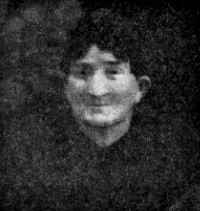
In the shtetl, Feigele the Rebbetzin was called “The Mother of Gritze.” She received this name for her motherly care for the sick, the poor, and all kinds of sufferers. If a poor housewife lacked the money to prepare for the Sabbath, Feigele the Rebbetzin would ensure that the holy Sabbath in that poor home would not be disturbed. If a poor man became ill and had nothing with which to heal himself, Feigele would move heaven and earth to procure money for doctors, medicines, and also tasty foods to revive the heart.
|
|
| Feigele the Spinner |
She helped many poor, sick orphans, old maids, and just plain unfortunate people. In the shtetl, the well-known simpleton Neta Tzemach, “Netele the Madman,” used to wander around. Wrapped in tattered clothes, the perpetually dirty Netele, overgrown with long hair, would wander through the alleys of Gritze, the Hasidic prayer houses, and both study halls.
He used to always be silent, speaking to no one. If he ever did say something, it was crazy, incomprehensible words, strange expressions with fantastic-astronomical numbers ” people actually said that he had lost his mind from too much calculating.
[Page 176]
Netele did not wash himself. For years he did not cut his hair or nails. Feigele the Rebbetzin was determined to cut his wild, long hair. Once she said to Netele: “Natan, I have a complete remedy for you.” As always and as with everyone, he looked at her with melancholy. But suddenly he smiled as good-naturedly as a small, helpless child. The clever Feigele felt with her motherly intuition that she had seized the right moment. From a dress pocket she took out a pair of scissors and Netele was freed from his dirty, long hair.
In the war years 1914-1918, when typhus was mercilessly killing young and old, Feigele preached: that people are sinful, therefore they die young along with their children.
“Something must be done,” she decided. She began to occupy herself with pairing up poor orphan couples, marrying them off. She believed that in the merit of pairing up orphans, God would atone for the sins and stop the terrible plague.
The wedding ceremonies used to take place in the cemetery by the graves of the young-deceased fathers and mothers of the bride and groom. She ensured that wealthy and kind-hearted Jews would bring to the celebrations drinks, food, and wedding gifts. Yitzhak the Klezmer also had to come with his band. They played happy and sad pieces, and badchanim (wedding jesters) sang to the bride and groom with such heartbreaking Torah verses, interpreted in the mother tongue, that it even clutched at the heart. In the cemetery, many weddings of orphan couples were celebrated, matched together by “Feigele the Rebbetzin.” When the typhus epidemic actually stopped a little, women said: “Feigele the Rebbetzin” succeeded. In the merit of the married-off orphans, her dear name stopped the epidemic.
In the year 1913, Feigele found out that a Jewish prisoner was dying in prison. Feigele hurriedly went to the Gritz Rabbi and turned to him: “A Jew is dying in prison, among gentiles, we must save him.” The Rabbi thought for a while and answered: “Listen, with the government you can't do anything. A difficult matter. What can I help?” After thinking for a while, he said further: “One must call Yekel Klepfisz. Perhaps he will succeed with the authorities.”
[Page 177]
They called Yekl Klepfisz. He went to the prison warden and returned with a bad answer: The warden says that he is only an overseer here.
Only the supreme court or the governor has the right to release him. Feigele did not let anyone rest.
Thanks to her initiative, on that same day a Jewish delegation left for Warsaw to the Jewish community, so that they might accomplish something. The next morning, an order came to release the sick man.
Feigele did not rest day or night, wanting to save the Jew from his severe illness. She did not succeed in this. However, he died among Jews.
Feigele the Rebbetzin belonged to the most heartfelt, most luminous figures of Jewish mothers in general, and in particular of the typically folk-oriented, modest women in the Jewish Gritz.
Because of her motherly care and love for all the poor, lonely, sick, orphans, and suffering, the town's Jews called her the “Mother of Gritz.”
by Sh. M. Ketler
Translated by Seth Morgulas
Yisroel Klepfisz was born in Grójec in the year 1899. He came from a wide-ranging, distinguished family. His father was the well-known social activist in Grójec, R' Yaakov Klepfisz. Yisroel's grandfather – R' Zaynvile Klepfisz was the last Av Beit Din
|
|
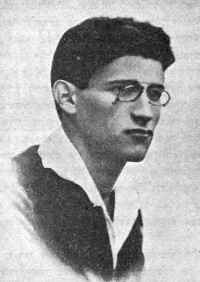
| Israel Klepfisz |
of the Warsaw Rabbinate. He was renowned as a great lover of Israel and a sympathizer of the Hovevei Zion. In general, the Klepfisz family was known in Grójec and the surrounding area as very noble and sympathetic Jewish people.
[Page 179]
Israel, as well as all the children of Yekl Klepfisz, received a religious and secular education. From his youth, Israel distinguished himself with great energy, courage, determination, and kindness.
As soon as he began to be active in social life, he became known and beloved by everyone.
Despite his decisiveness, he never attacked any of his opponents, political or personal. He always found a compromise and a common language even with opponents.
In the year 1915, several hundred Jewish refugees arrived in Gritze, driven out of the city of Pinsk and its surroundings. The Jewish community at that time provided the homeless and needy Jews with the most necessary items. In the administration that organized and led the relief work, Israel Klepfisz occupied an important place. He was one of the most active collectors of money, food, and clothing.
In the year 1917, the Zionist organization “Hatikvah” was founded in Gritze – Israel Klepfisz was one of the founding initiators and later a very active member of Hitahdut.
He was also one of the founders of the Zionist library. With his industriousness and sympathetic attitude toward people, he became very popular in the town.
With his brother Raphael Klepfisz, a devoted cultural activist, social worker, and leader of the Gritze “Bund,” Israel, the ardent Zionist, often had to argue over party matters. Both party followers derived satisfaction from the dispute, but as it was told, they loved one another.
Israel Klepfisz also helped to establish the Hachshara kibbutz of “Hanoar Hatzioni.” He gave all his time and energy to the Zionist movement. In the Nazi era, when Gritze Jews were driven to Warsaw, Israel was among his fellow people for whom he sacrificed his strength and life. In the list of the fallen in the ghetto battles in Warsaw, the name Yitzhak Klepfisz is also found.
In all likelihood, it may be that our fellow townsman is meant: Israel Klepfisz, who is said to have participated in the combat groups of “Dror.”
by A. Friedman
Translated by Seth Morgulas
Like a film image, my hometown of Gritze unfolds before my eyes with its streets and alleys, Gritze Jews, Gritze merchants, Gritze craftsmen. I see my friends, with whom I went to cheder together, and with whom I actively participated in various social circles.
There is Joseph Drajer!
His father, Daniel, was a maskil (enlightened person). In his home, activists from the Gritze community would come and talk there about various matters: culture, literature, and education.
In such a family and such an environment, Joseph grew up well- bred. Everyone saw in him that he was growing into an important person. He read a lot, worked a lot on himself, and rose from day to day.
After my departure from Gritze, Joseph was elected as a councilman and re-elected several times to the Gritze City Council.
Although he represented a certain political direction, he nevertheless defended the entire Jewish community, respected all factions that grouped themselves in the Gritze City Council. He was like a father. He helped with advice and action, not only Jews, but also Poles. It is worth noting that when he lay ill, a Polish delegation from the Gritze City Council came to visit him, headed by the first secretary. This was an achievement and an honor that a Jew could attain in the then antisemitic Poland.
Joseph gave much time and effort to the TSYSHO school. In the City Council, he secured such subsidies for the school that other larger cities and towns could never have dreamed of.
A Radom school activist once said: If we had such a Joseph Drajer here, we would also have such schools as in your Gritze.
[Page 181]
In the Gritze library, Joseph held first-rate positions. Joseph immediately recommended important books that appeared in the country and abroad to enrich the library. He knew well which book to recommend to a reader. He invited speakers for lectures and organized events in Gritze and the surrounding area.
When the Nazi murderers entered Poland, Joseph and his family left Gritze for Bia³ystok, where he joined an underground organization – fighting against our enemies and their accomplices.
If a future historian gathers all the chronological data about the heroes and martyrs of the ghettos in Poland, Joseph Drajer will certainly occupy an honorable place. We, the people of Gritze, are proud that our fellow townsman sacrificed his life for the Jewish people. Joseph, you are dead, but your spirit lives and will live forever – we will never forget you!
Who is Leibel Zanger?
A prominent figure. I remember how he fought together with me against a horde of hooligans who wanted to drive pigs onto the Gritze cemetery. The hooligans hailed stones at us, and we defended ourselves. True, we were quite beaten up with bumps raised on our heads. But Leibel Zanger hit the target with a stone, striking the red-headed Janek, who was their leader, and he collapsed to the ground in convulsions. With joy, I shouted: Leibel! You are the second David – you laid Janek low with a stone. The hooligans carried Janek home on their shoulders, and several of them remained on guard.
Soon we stretched out on the ground, and like snakes, we moved over graves and sunken tombstones to the other exit of the cemetery. Through back alleys, we made our way to the well, where we washed off the bloodstains and pressed our raised bumps with copper six-groschen coins.
Yehoshua Chelemer. – Of medium height. Hair like black pitch, bulging eyes. On his face, a poured-out seriousness, which
[Page 182]
bordered on melancholy. But when one got to know him better, one felt his goodness, his devotion and loyalty, ready to help with everything.
Yehoshua Chelemer came from a very distinguished family. He mastered Yiddish and Hebrew. He was the guide of the better Gritze youth. For years he did not eat meat, he nourished himself with dairy foods. During the revival of Yiddish social life, in the period of the First World War, Yehoshua was its trendsetter and guide for the youth and the main organizer of the Gritze library.
And I remember how Yehoshua, in his attic room, would often knead with his friends chapters of Jewish history, chapters of general Jewish literature, political economy, etc.
|
|
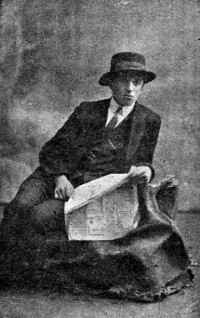
| Rafael Klepfisz |
Rafael Klepfisz. – A relative of the hero Klepfisz in the Warsaw Ghetto. A degreed intellectual. Completed 2 faculties: philosophy
[Page 183]
and law. An eternal student, always learning. He gave lectures to the mature youth who were about to move on to higher circles. When all of Gritze was asleep, Rafael would sit down by a candle and study. “My best learning or studying is at night – Rafael said – when everything around me is quiet, still.”
I am reminded – the year 1918, when the German army was collapsing and Polish independence was about to be declared, a self-defense organization of the Gritze Jewish youth was created under the initiative of Rafael Klepfisz, in order to oppose any attack, from wherever it might come, against the Jews of Gritze.
Yechiel Goldberg. – A slender young man with sparkling beer-colored eyes, long hair styled poetically upwards, which often slid down over his forehead.
His way of life – like a bohemian. Everything that belonged to him could belong to anyone. Yechiel read a great deal and read deeply.
At every general meeting of the Gritze library, Yechiel was the chief critic.
During the time of the German extermination of the Jews, Yechiel Goldberg with a group of young men from Gritze encountered a band of well-armed Germans in a village between Gritze and Ger, who opened fire with automatic weapons. Yechiel and his friends found themselves lost. But they did not surrender in the fight. They fought with stones, for as long as their last means held out.
They were led away into a small forest, where a mass grave had been dug, and into it the murderers threw the weak and exhausted fighters alive. And when it came to Yechiel Goldberg, he did not let himself be taken easily, and before his hands were bound, he laughed at the Germans for their heroism against unarmed and exhausted people and spat in their faces.
Several revolver shots brought down Yechiel's body, from which trickles of blood flowed.
Cries and curses were carried over the mass grave: Mass murderers! – the tortured ones shouted – you will pay dearly
[Page 184]
Pay for your vile deeds!
Shovels of earth, clutched in fiery palms, stifled the cries of the living-buried Gritzer Jews, whose mass grave was pressed and compacted with military wagons, after it had been filled in.
Thus it unfolds before my eyes like a film strip, my perished Gritzer Jews, my perished dear friends. The image unfolds and it will never unfold from before my eyes, nor from the eyes of the coming generations.
[Page 185]
by Goldfarb, Paris
Translated by Seth Morgulas
The Jewish People's Library in Gritze played a very important role in Jewish social and cultural life. Its multifaceted work in various cultural fields was famous in all the neighboring towns. It was transformed into one of the main factors of progressive Jewish life in pre-war Gritze.
Every evening, many young people and older workers would gather there. Some came only to exchange a book. Others to chat, play chess, participate in fiery discussions, or read the wall newspaper, which dealt with daily questions of worker life in Gritze.
The Jewish People's Library had various sections, of which the Jewish youth in Gritze were proud. The following sections were active: mandolin orchestra, choir, drama circle, sports club, and chess section. The cultural undertakings of the Jewish People's Library in Gritze attracted the largest part of the Jewish population in the town. From this cultural activity grew politically mature individuals who were known to all Gritze residents. Let us mention a few of them:
Joseph Drajer – one of the most respected activists of progressive Jewish Gritze. He always strove to alleviate the need and suffering of the Jewish poor. As a member of the city administration (councilman), he helped everyone as much as possible.
Abe Lenga – grew from a simple worker to one of the leaders of the labor movement. Murdered by the Germans.
Yechiel Goldfarb – secretary of the Jewish People's Library. With his knowledge and organizational skills, he contributed to the greatness of the Jewish People's Library. Murdered with his wife and child by the Germans.
[Page 186]
Feivish Ambaras – member of the board of the Jewish People's Library. He was devoted heart and soul to social and cultural activity. Eventually, he was forced, due to police persecution, to emigrate to France and was from there deported to a death camp.
Tzvia Zlata – one of the few women who was engaged in cultural, political, and professional activity. Murdered by the Germans.
Among the perished members of the Jewish People's Library the following must also be mentioned: Israel Lenga – long-time member of the board, and Yosef Flint – doctor.
The antisemitic regime of Piłsudski and his successors looked with an evil eye upon the activity of the Jewish People's Library and waited for an opportunity to liquidate it. Police raids on the premises of the library were quite frequent occurrences.
From time to time, arrests were carried out among the leaders. In 1937, the police found a pretext to seal the People's Library. But the attachment of the Gritze Jewish population to its institution, the devotion and self-sacrifice of the members to the library, forced the police to withdraw the ban and allow it to continue its activity.
Together with the destruction of the Jewish community in Gritze, the Jewish
People's Library was also liquidated by the Nazis.
by E.
Translated by Seth Morgulas
Chanina Kramarski, the well-known Bundist activist, ended his life in New York at the age of 59. A heart attack cut his life short.
Comrade Chanina hailed from the small town of Białobrzegi, not far from Warsaw. His father, a Hasidic Jew, ran a cheder. Hardship forced Chanina to go to work at a very young age. He became a shoemaker.
|
|
| Chanina Kramarski |
While still an apprentice, during the years of the harsh Tsarist reaction, he joined the Jewish labor movement in Warsaw. In the years on the eve of the First World War, he was already known in the Warsaw organization of the “Bund.” He was often seen at the then-offices of the “Bund,“ or in the poor coffee houses on Dzika Street,
[Page 188]
where the Bundists used to gather. Even then, Comrade Chanina was drawn into passionate discussions. His whole life he remained a seeker, who was not satisfied with conventional truths.
Later, when Chanina's parents lived in Gritze, he often came home. He would tell the town workers the latest news from the illegal offices of the Bund. His stories encouraged the Jewish workers in the town to organize themselves into a political body.
During the First World War, his best and most fruitful years as a labor activist began. In the atmosphere of constant struggle against the German occupier for the right to exist of the growing Jewish labor movement, Kramarski's abilities and qualities quickly blossomed. He was a member of the famous initiative group that built the Jewish professional movement in Poland at that time. This group later trained the leadership of the Jewish professional movement in Warsaw. Chanina was very popular among the Jewish leather workers and stood at the head of their professional union. At the same time, he belonged to the leadership of the Warsaw organization of the “Bund”.
In 1916, Chanina was arrested by the German occupation authorities; they sent him to the Havelberg prisoner-of-war camp. The arrest took place because of a speech he gave at a large “Bund” meeting in the “Panorama” hall on Karowa Street. He gave a sharp speech against the war and the occupiers. The German police agent who arrested him noted him in the papers as a “dangerous people's tribune”.
Before the end of the First World War, Comrade Chanina returned to Warsaw, where he continued to be active in the Bundist and professional movement.
In 1921, he emigrated to America together with his wife, Comrade Miriam.
Even here in America, Chanina Kramarski tried to be active in the local labor movement – in the political and in the trade unionist. However, he could not find a place for himself; he could not adapt to American methods and customs. The American
[Page 189]
Jewish reality dealt him more than one bitter blow, destroying many of his dreams. But Comrade Chanina still struggled, wrestled, searched and researched, read a lot and thought a lot.
Until the last days of his life, working in the shop as a pocketbook worker, he grieved over the situation – the political, cultural, and professional [situation] – of the workers and over his powerlessness to contribute anything to improving the situation.
In his last years, he was a member of the Ehrlich-Alter Branch. His last wish before death was to pay his dues to the “Bund“ organization in New York. He declared that he did not want to remain a debtor to the “Bund.”
Honor to the memory of a comrade and friend.
by Y. B. A.
Translated by Seth Morgulas
Avraham Drajer was born in Gritze in 1916.
His parents, poor small-scale merchants, lived in need, never able to provide for the small family. Because of this, young Avraham had to interrupt his studies at the Tarbut school and begin learning tailoring, in order to be able to help his poor parents.
Already as a worker, he became a flaming follower of A. D. Gordon, joined the Gritze “Gordonia“ branch, and took an active part in all political and cultural-educational work. He was active in all Zionist work and also in the campaigns of the League for Labor Eretz Israel. Later, he joined the youth movement of Poale Zion, “Freiheit.“ There, too, he was active, devoted, and energetically carried out all party work.
In the first days of the war in 1939, Drajer left Gritze; together with other comrades, he settled in Warsaw.
As soon as he found out that the Zionist-Socialist parties had a secret, active underground movement, he immediately joined it and, with self-sacrifice, precisely carried out all tasks of the underground leadership. Later, he is seen in the agricultural colony in Grochów. For a short time, he was also active in the kibbutz branches in Warsaw. Finally, during the preparations for the ghetto uprising – in the “Dror” combat group.
Everywhere and always, he took upon himself the most difficult and dangerous tasks. With heart and soul, he was devoted to the holy underground movement.
When Jewish Warsaw revolted against the Nazi murderers and the well-known ghetto battles began, Avraham became inflamed: Now – he said – the day has come when I will be able to take revenge. With extraordinary heroism, he fought in the central ghetto in the Arsztajn group.
[Page 191]
The surviving ghetto fighter Tuvia Borzykowski recounts in his book “Between Falling Walls,“ how Avraham Drajer and Moshe Rubin heroically led the attack on the Germans. Borzykowski writes: “It was the evening before Passover, from the 18th to the 19th of April 1943.
On all three sectors of our unit, the battle is proceeding with fierce stubbornness. It is noticeable among the comrades: Yaakov Guterman, a young, tall and thick giant, shoots incessantly from a front balcony. Feivel Schwarzstein stands by a window on the top floor and shoots from his automatic pistol. Avraham Drajer and Moshe Rubin lead the attack from the other two positions, which are located in the courtyard, by the rear entrance from the side of Gęsia and Kurza streets. Zecharya (Zachariasz Arsztajn – 1923-1943) – the group commander of 'Dror', runs from one position to the other and encourages a sharpened fight.
Liaison men run across the various positions with news of the combat situation and with orders from the commander. Constantly and increasingly we are deafened by the explosions and by the rattle of the heavy machine guns, which are shooting at us incessantly. The fight lasted about two hours.“
Among the ghetto fighters who fell at their positions the name of our fellow townsman must also be immortalized – the heroic martyr Avraham Drajer.
by Y. B. A.
Translated by Seth Morgulas
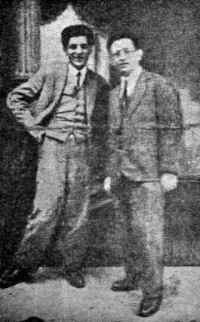
Joseph Drajer's father, Daniel, was well known in Gritze as one of the first maskilim (enlightened ones), a fervent Zionist, and a friend of the first, illegal Jewish labor activists. His house was always open to anyone
|
|
| Joseph Drajer and Yechiel Goldberg |
who just wanted to read a page (a newspaper), a book, or participate in an interesting discussion. Friendly and warm, Daniel welcomed his frequent guests, who filled his home with discussions about various “world-saving” problems.
This progressive-cultural environment, as well as the modern up-bringing that Daniel Drajer gave his children, had an influence
[Page 193]
on the young, charming Joseph (born in 1900), the later socialist fighter and cultural activist.
At the age of twenty, he joined the Gritze professional labor union. Later, he was active in the “Bund.“ Very quickly, he became one of the most active labor activists in the town. His influence on the workers was so great that he was elected as a councilman in the Gritze city council, where he occupied a respectable place. His opinion was respected there, and his proposals were treated seriously. Joseph's courageous speeches made a special impression on all the councilmen. They were always well-prepared, rhetorically well-constructed, and filled with sharp, logical, punchy arguments. He would always attack the Polish anti-Semitic councilmen and expose the absurdity of their anti-Jewish policy, which was simultaneously also the enemy of Poland's independence.
Often, Joseph also had to politically “work on” the Jewish councilmen, who, due to partisanship, could not always agree with the radical position of Drajer. However, thanks to his intelligence, oratorical talent, and power of persuasion, he often won over even his political opponents to his side. Joseph Drajer also had the courage to deviate from his leftism when it came to general Jewish matters. In those cases, he proved himself to be a loyal son of his people. Courageously and unambiguously, he fought against every threatening decree against Jews. In very many cases, with the support of all the Jewish councilmen, he pushed through many favorable decisions for the benefit of the Jewish population.
The Jews of Gritze knew well and appreciated the political activity of Joseph Drajer. Almost everyone, regardless of party affiliation, related with reverence to the courageous, young Jewish councilman.
One of Joseph Drajer's most heroic deeds was organizing the self-defense in Gritze.
The left-wing socialist and later communist Joseph Drajer succeeded in bringing about an understanding between the professional labor union and the artisan organization, and an exemplary, well-disciplined self-defense organization was created. Secretly, he held meetings at which he stepped forward with fiery speeches, saying that Jews must not be passive. He urged them to [prepare themselves to]
[Page 194]
defend against any attack. This indeed protected the Jews of Gritze, who were not subjected to pogroms as they were in other small towns.
Regarding his role in the Gritze self-defense organization, it would be worthwhile to write a special treatise. Unfortunately, I have not yet found the people who could tell me about Joseph's heroic activity during the organization of the secret group. I hope, however, that documents from that stormy time in the town will yet be found, and we will learn many details about Joseph's self-sacrificing willingness to organize the Jews of Gritze to defend themselves against the bloodthirsty Polish hooligans, who were also preparing there to carry out pogroms against the Jewish population.
Joseph had a special inclination for various types of cultural work. He contributed a great deal to the Gritze tisha school, which was always in a poor financial situation. Joseph actively participated in every fundraising effort and in all cultural and entertainment events for the benefit of the school. He was always the main initiator and the one who carried out almost every action himself.
He devoted no less energy to the municipal Jewish public library. The library administration made use of him on all occasions: when organizing interesting literary readings, artistic theatrical performances, and music and singing concerts. Throughout the entire time of his very rich social and cultural activity in Gritze, Joseph Drajer faithfully served Jewish culture and was a devoted worker for the cause. He defended the interests of the poor, hardworking masses, for whom he fought with heart and soul.
In all of this, Joseph never forgot – on the contrary, he was always proud – that he was a son of the eternally persecuted Jewish people, who must be defended from the constant attacks of the bloodthirsty Polish antisemites.
After Poland's capitulation in 1939, Joseph and his family (mother, wife, his young daughter, and brother) left his beloved little town of Gritze. They settled in Białystok, which had been occupied at that time by the Red Army.
[Page 195]
Joseph Drajer's Activity in the Białystok Anti-Fascist Committee
In January 1940, I visited the sick Joseph Drajer in Bialystok with my wife, Chana Alterman. He and his family were living at that time in a tiny little room at 11 Kupiecka Street. In fact, this was my first acquaintance with my wife's cousin, about whom I had heard very interesting things while in Warsaw regarding his cultural-social activity. I found a man then with a pale, sickly face and weary eyes that kept searching for something…
In order not to provoke his ideological feelings, I avoided talking to him about the difficult situation of the thousands of Jews who were wandering around the Bialystok houses of study without any prospects. He, however, spoke about it and said to me: “One must have patience… not everything can be done in one day…”
To my question of whether he intended to go to Russia, he answered: “You see, I am sick.” And it was precisely because of this illness that he remained in Bialystok.
There, too, he quickly became known, occupying an important place in the city's communist-social life. His illness, however, hindered him greatly in his work. It chained him to his bed for months and also prevented him from evacuating with his family when the Red Army retreated from Białystok at the end of June 1941.
In the Bialystok ghetto, Joseph became a bakery worker. His difficult material condition, the illness, and the German cruelty toward Jews completely broke him. He fell into a depression. But fighting natures do not capitulate so quickly: his depressed mood lasted only a short time. Realizing what the Germans were doing to the Jews, he came to the conclusion that one must offer resistance. He was one of the first organizers of the Anti-Fascist Committee in Białystok.
Regarding him and his work in the committee, B. Mark writes in his book “The Uprising in the Bialystok Ghetto”:
“…This was a man with a rare character – a harmonious synthesis of kindness and steely firmness. A dangerously ill man and
[Page 196]
always cheerful and active. Lying sick, Joseph Drajer from the very beginning preached the idea of direct struggle. In his weak hands, he held a significant portion of the internal threads of the underground movement, which had just begun to emerge. His apartment, at 11 Kupiecka Street, was the meeting point for the leading activists from the surrounding province. Drajer was indeed the one who maintained contact with his fellow fighters from Grójec and even from distant Słonim. Joseph Drajer was the soul of the organization, its constant advisor, a man with a clear, logical way of thinking. Even from the forest, from the partisan movement, people came to the seriously ill optimist to seek advice on important political and combat matters[1].
In the same book, it is told with what self-sacrifice our sick Joseph directed almost all the propaganda work of the anti-fascist committee. With the help of several comrades, hectographed communiqués about the situation on the fronts were issued.
B. Mark writes in his book: “A special place in the appeals and overviews was occupied by information about Warsaw. It was already after April 1943, and the Warsaw Ghetto was already holding its second armed uprising. In Warsaw was Joseph Drajer's brother Yaakov (Kuba), one of the activists of the Polish Workers' Party in the ghetto. Kuba regularly sent informative materials to his brother in Białystok through a sixteen-year-old boy”[2]
On the First of May 1943, the Białystok underground movement carried out a demonstration. “In honor of this holiday of freedom, Joseph Drajer wrote a fiery appeal, which was distributed in the factories and houses“[3].
This is how one of the bravest Jews of Grojec lived and fought. More detailed information about Joseph Drajer's active participation in the heroic uprising in the Białystok Ghetto, which began on the 16th of August 1943 is
[Page 197]
unfortunately little known. According to some reports, he died heroically during the fighting. However, it is not known how our fellow townsman Joseph Drajer died, who, starting from his earliest youth until the last minute of his heroic and meaningful life, courageously defended the honor of his persecuted and tormented Jewish people.
Author's footnotes:
|
JewishGen, Inc. makes no representations regarding the accuracy of
the translation. The reader may wish to refer to the original material
for verification.
JewishGen is not responsible for inaccuracies or omissions in the original work and cannot rewrite or edit the text to correct inaccuracies and/or omissions.
Our mission is to produce a translation of the original work and we cannot verify the accuracy of statements or alter facts cited.
 Grójec, Poland
 Yizkor Book Project
 JewishGen Home Page
Copyright © 1999-2026 by JewishGen, Inc.
Updated 21 Jul 2026 by OR