 |
|
Recorded by: Avraham Yaakov and Yosef Hammer
Translated by Seth Morgulas
Of the 83 Jews whom the Germans took to Smolensk and the surrounding area, only a few survived: the brothers Yosef and Avraham Hammer, who immigrated to Israel, Ch. Sh. Graman, and Ch. M. Zilberstein.
The following people perished: Fishl Leng, who went into the barrack to shave, was brutally beaten by the German murderers. He became ill from the blows and later died. Melech Lenga – Fishl's son, and also his son Malik, were shot. Menachem Belzhitske was shot by the Germans. Yaakov Akiva Graman and his daughter died. Getzel Rotblatt with three sons and a daughter – shot. Chana Rotblatt perished in a strange way. While washing the windows in the “White House,” she fell and was badly bruised. At night, S.S. men came to the barrack and told her that she was being taken to the hospital.
They took her out into the yard, where she was shot.
Nisel Breitman and his son died of hunger and cold. Eliezer Reiter also died of hunger. Pinchas Lachman – a locksmith – with his three sons, Yosef Gurnzweig, and Yosef Sofer's son, were shot. Noech Bitter and his son Yosef also perished in Smolensk. Noch Bitter had a terrible end: on a frosty evening, the Germans took him out of the barrack and placed him under a crane from which cold water was flowing. Afterwards, the Germans beat him. Yehuda Bez, a shochet, was killed by a German with a piece of wood. Motel Shulzinger with two sons, Moshe and Yisrael, were also shot. Natan Piaskovske. The watchmaker Berkovich poisoned himself. The following Gritzer Jews also perished: Zechariah Kapper, Moshe Poshlednyak, Baruch Lipshitz and his daughter, Moshe Traksbetreger, Chaim Shaul Graman, Hershel Kurz, Isaac Zilberstein, Chaim Yitzchak Friedman, Elimelech Bitter and his son, Gershenowitz and his wife, David Klein and his brother and sister: Chana, Yisraelik Graman, David Hecht, Moshe Klein, Elimelech Klein, and Himmelstein. Of all 83 Gritzer Jews who were sent to Smolensk, 15 survived, who were sent together with another 240 Jews to Minsk.
[Page 300]
We were there for two weeks. We lived in a large horse stable. Afterward, the Germans sent us to Majdanek. And in that death camp perished: Leibl Kurz with his entire family, Shlomo Himmelstein's son, Mendel Hammer with his wife, Chana Viatrak, and Malka Kurz. After being in Majdanek for a very short time, the very small, still surviving group was sent to Blizyn, where we were for six months. In Blizyn died the Gritze Jews:
Yitzchak Lifshitz and Shlomo Rotbard. From Blizyn, the dear Jew Gershon Klein was sent away, who helped many Gritze Jews. To this day, it is still not known where he perished. From Blizyn, we were sent to Plaszow and from there to Ebenzee, Austria. In Ebenzee, Yitzchak Speinman perished (Yediddia Klein perished in Lublin), there we were liberated.
We, the very small group of Jews who survived the Holocaust, traveled after the war to our former home village of Gritze, which was completely Jew-free.
In liberated Gritze, two more Gritze Jews perished: Moshe Yosef Greenberg and Feigman.
Recorded by: Goldfarb Sarah Stabziv's husband
Translated by Seth Morgulas
Ambaras Feivish, Bas Moshe with his wife and 2 children, Bitter Hersh-Leib (Koval) with his son Moshe, Bluzhitzki Moshe and Dinah, Hena Bron's husband, Dr. Blass Sarah, Dreyer Minye (Ankerman), Zusman – Gittel Goldenfein's husband, Zeidman Moshe (Hatmaker) Billa Pickman's husband Lachman Avraham – Esther Pickman's husband, Lenga Pinchas (Watchmaker) with his son Yechiel, Lieber Leib with wife and children, Mosher Avigdor, Leibish Miller's wife and daughter, Pint Shmuel (Chinke's son), Kornfeld Max, Finkelstein (Czarkes' family) Pessil and husband, Zhigel, Tereza and Klara (4 sisters), Pickman Ben-Zion with wife and children, Pickman Mendel's wife and 2 children, Rotbard Avraham, wife and 3 children, Romandel Rachel (born Rachfeld) and daughter, Rachfeld Eliyahu, Shmer Zishe, Shaiman Arie, Spielman Leib (Deaf Leibl), Rachel Spielman's husband, Breindel Millstein's husband (Aryeh Shaiman's brother-in-law), Hauffman – Feige Rotbard's husband,
by Yitzhak Borenstein
Translated by Seth Morgulas
When the Jewish artisans were taken from Gritze to Smolensk, a group of 200 Jews remained in Gritze. These were the healthiest. They worked on the airfield, which is located 4 kilometers from the city.
This group included the head of the Peretz library, the photographer Yechiel Goldberg, Zachariah Zilberberg, the belt maker Melach Bitter with his family, and others. According to a Polish lawyer, the well-known Warsaw concertmaster, the fiddler Gold, was also in the group.
For many months, these Jews toiled hard and bitterly until one summer evening in 1943 – on that sad evening, as the Jews sat in the barracks resting after their hard day's work, trucks suddenly arrived with a large number of SS men.
The victims were taken out in pairs and their hands were tied with wire. Once everyone was bound, they were thrown onto the trucks like logs and taken to the village of Chinow, which is located near a forest 4 kilometers from Ger. Here, a deep pit had already been dug.
The bound Jews were thrown off the trucks, and after they had been bound again in groups of 5, they were hurled into the deep pit.
According to the peasants of the village, terrible scenes unfolded during the event, and the voices of the desperate Jews could be heard for kilometers.
There were also many who resisted. The daughter of Melach Bitter did not allow herself to be tied and threw herself at the SS men.
Those who resisted were immediately shot or murdered with the butts of the rifles. When the bound victims were thrown in, the Nazis threw hand grenades into the pit. Immediately afterwards, the heavy trucks drove onto the pit to level the ground.
[Page 302]
After the war, the surviving Gritzer Jews decided to carry out the exhumation of the 200 martyrs in order to bring them to a Jewish burial. The work lasted an entire week.
Approximately eighty human skeletons were taken away in 20 coffins to the Gritzer cemetery.
At the open grave, the Gritzer Jews David Berman, Moshe Perl, Yechiel Berent and Wirzbicki, who lives in Gritze to this day, bid farewell to the martyrs.
The expenses for this funeral were covered by the Gritzer Committee in Argentina and also the surviving Jews in Gritze.
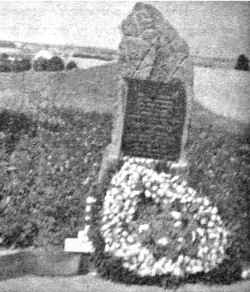
The Gritzer Jews planned to erect a large matzevah (tombstone) on the brother's grave, which would be a memorial to the entire annihilated Jewish community – this will be the only matzevah for generations, because the Hitlerites destroyed the cemetery and paved a highway with the Jewish tombstones. Yitzchak Bernstein
|
|
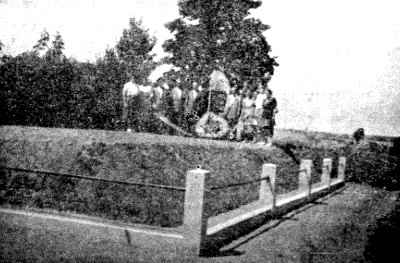
| Brother's grave of the 200 martyrs |
|
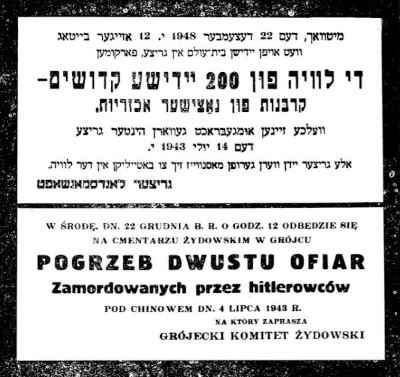
Wednesday, December 22, 1948, at 12 noon, at the Jewish cemetery in Gritze, will take place
The Funeral of 200 Jewish Martyrs –
Who were murdered behind Gritze on
All Gritzer Jews are called upon to participate
Gritzer Landsmannschaft
|
|
|
| A group from Gritze at the grave |
Recorded by: David Dreyer
Translated by Seth Morgulas
Among many other specific Gritzer peculiarities, the town also possessed its own “Telegraph Agency” – as the magistrate's drum was called in Gritze. Its bearer, the Gritzer “Speaker” would first drum well and then read out the local announcements from a paper. According to his drumming, Jews already recognized whether the “Speaker” was bringing us “neutral” news, or whether he was coming to announce new decrees.
As soon as the drummer appeared in the streets and his boom-born-call was heard, the townspeople already expected new “good news” …
In the last war years, during the cruel German rule, the Gritzer “Telegraph Agency” became particularly active. At that time, the drummer no longer announced such minor decrees as young men having to report for conscription, auctions, new taxes, etc. The drummer announced bloody German decrees:
“Boom-boom” – the German authorities demand 600 Jews for work. The number must be ready tomorrow morning. Otherwise, 60 Jews will be shot” – “Boom-boom! Boom-boom!” – For not providing the required number of Jewish workers in time, several Jews were shot.
“Boom-boom” – Jews are requested to pay contributions.
Such and similar sad news, the drummer spread daily. The telegraph agency drum became purely Jewish, an announcer of all evil only for us.
But people also got used to such news. People became indifferent to the constant “Boom-born” with the, what were once worse, evil decrees.
In the early days, the “Speaker” called the Jews to do menial labor: digging sewer pits, shoveling snow, washing floors, road work and cleaning toilets. All Jews, aged 14 to 45, had to work two days a week. The pay was: beatings, bloody wounds, and sometimes some Jews were murdered.
The longer the bloody German rule lasted, the more…
[Page 305]
The drummer's “boom-boom” echoed with his sad news: “All Jews, even the elderly, must report to work. Instead of two days a week – every day. The drummer announced one disaster greater than the next: hard labor, robbery contributions, murdered, ghetto, until the last boom-booms were heard – the liquidation of the Gritzer community. And this happened on a wintry early morning. Suddenly it was heard:
Boom-baaam, boom-m-m-m – tomorrow at six in the morning all Jews, men and women and children must report to the market. Everyone has the right to take 10 kilos of things and food for two days. Anyone who hides and is found will be shot.
Boom ba-a-a-m-m-m!!!
A cold early morning.
The order was carried out: a huddled, hunched-over Jewish mass waited trembling for the Gritzer disabled. Quiet sighs and weeping were heard.
And Gritzer Jews were taken to the Warsaw Ghetto.
|
JewishGen, Inc. makes no representations regarding the accuracy of
the translation. The reader may wish to refer to the original material
for verification.
JewishGen is not responsible for inaccuracies or omissions in the original work and cannot rewrite or edit the text to correct inaccuracies and/or omissions.
Our mission is to produce a translation of the original work and we cannot verify the accuracy of statements or alter facts cited.
 Grójec, Poland
 Yizkor Book Project
 JewishGen Home Page
Copyright © 1999-2026 by JewishGen, Inc.
Updated 18 Jul 2026 by OR