 |
|
[Page 123]
[Page 124]
[Page 125]
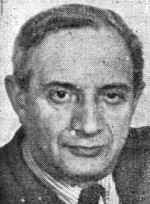
by Yosef Heftman z”l
Translated by Seth Morgulas
|
Yosef Heftman was born in 1888 in Brańsk, Bielsk district. He received a
religious education and studied secular subjects at a gymnasium. At the age of
12, he began writing, and in later years, he published poems, stories, and
feuilletons. At the age of 22, he became a permanent contributor to
“HaTzfira,” which was published under the editorship of Nahum
Sokolow. In 1912, he became one of the main editors of the Warsaw newspaper
“Moment.”
In 1933, Heftman came to Eretz Israel and remained a resident there. From 1936 until his death, he was the editor-in-chief of “HaBoker.” He passed away on January 18, 1955, in Tel Aviv.
Yosef Heftman was one of the leading personalities in the Zionist movement. He participated in Zionist congresses, founded “HeHalutz,” and created the Zionist grouping in Poland – “Et Livnot.” He was also active in Eretz Israel even before his permanent settlement in the country. He edited a whole series of Zionist periodicals in Hebrew and Yiddish.
In connection with his social-Zionist activity, Yosef Heftman traveled to give lectures throughout the cities and towns of Poland. Very often, he visited the Jewish community of Gritze. The cultural activity in that town was deeply etched in his memory. Upon our request, he immediately complied with the plea to write for the Yizkor book about Jewish Gritze. Four months before his death, he wrote this magnificent essay – “The Little Town of Gritze,” which we present below.
Names of Jewish towns in former Poland are not only
[Page 126]
the names of certain geographical points on the map: to a Jewish ear, they ring like distant music, like a romantic song from vanished childhood years. Because, just like childhood years, they already belong to that realm we call “the past,” to which we will never return.
Just as the golden past of childhood is closed to us, so too is that time when the names of Jewish cities and towns meant pulsating life for us, when Warsaw and Łódź, and Lemberg and Kraków, and the hundreds upon hundreds of cities and towns between them, were vibrant points of Jewish activity, of a drive for life and creative work. That map no longer exists for us Jews. But we must return to it from time to time, in order to revive in our memory those sources of energy and dreaminess that nourished our spirit. Without them, there would have been no pioneering spirit, there would have been no Jewish tradition, and our culture would have perished long ago.
Most characteristic were the small Jewish towns that lay in the vicinity of the big cities. The towns of the general provinces, where the connection to the big centers was difficult and where development generally proceeded very slowly, were different. And the towns around Warsaw, for example, which were more closely connected to the big city, looked quite different. In certain respects, these towns stood much higher than the suburbs of the big city.
And so, for example, Gritze was higher in its cultural level than Powązki or Mokotów, not to mention the Praga suburbs. Because a suburb often gathers within itself the refuse of the big city, the backward, and also the corrupted elements. Whereas the small town, living for itself in the surroundings of the big city, strives to imitate the most beautiful things of the big city: the cleanliness, the beautiful appearance, the elegance, the fine manners. A town that is not located far from the big city feels almost responsible for its neighborhood, as if it were obligated to keep itself decent, cultured, and tidy, so as not to shame its large, honorable neighbor.
Why does Gritze come to mind precisely when I mention these towns in the surroundings of Warsaw? – Because Gritze
[Page 127]
made on me the impression of a dignified neighbor of the capital city. Every time I visited this little town to give a lecture on Zionism or literature, I was surprised by the refinement and the distinct “propriety” with which the inhabitants distinguished themselves. It was easy to notice that they were actually “big-city” people who happened to live in a small town, in a suburb of a great metropolis.
I do not want to convey here the impression that I always received from the urge to know, to learn, and to become acquainted with the world and science. When I close my eyes and try to transport myself back to those past years – I always see the dear Jewish youth of old Poland, who always filled the halls where lectures and readings, literary conversations and discussions, political meetings and election assemblies used to take place. It was roaring and temperamental, and one could feel heart and soul in every impulse with which the audience reacted to speeches and lectures. In Gritze, naturally, the same thing happened, and yet it was a little different. Perhaps it only seems so to me now, but it is a fact that I always had the feeling that here, in this little town with big-city manners, the people were more settled and deeper. That it was not the word itself that interested them, however beautiful and strong it might be, but the content, the deeper meaning that hid behind the expression. One can explain it simply by saying that the audience was more intelligent due to the frequent contact with the big city. But that is not the real explanation. It was much more due to the seriousness with which the Gritze youth related to all the movements and events of Jewish life. Always close to the center of great Jewish activity – on the political, economic, and cultural ground – they did not view all these struggles merely as a kind of abstract idea, as a witty pilpul between leading personalities, but as a concrete task that had to be solved one way or another.
Therefore, I remember the walks and conversations with the local youth after the lectures. Because that was much more important. The Saturday afternoons after the lecture held in the morning. How beautiful those walks outside the town were then, with lively, humorous youth –
[Page 128]
dear friends, who carried within yourselves the fire of enthusiasm and the wisdom of all generations! In the dark sky, stars ignited, and in our hearts, dreams arose, that not only we, the small group walking here among foreign fields, were immersed in dreams – but that along with us, millions of young hearts were pulsating with the same dream, with the same hope.
All of this is no more. Everything has been wiped away. But the names of these little towns, hundreds of such small places, murmur incessantly in our ears, like old music, like the heartfelt notes of a youthful song.
by J. Mastbaum
Translated by Seth Morgulas
Of all the towns that lay in the vicinity of Warsaw, Gritze – or as it was called in Polish, Grójec – was the town that lived more with Warsaw than all the other towns. Gritze was known to me from the time when I was a shop assistant on Franciszkańska Street and used to drag in the little Jews from Gritze, who would come to pick up peasant coats, Ciechanów cloth, and fabric for peasant trousers on credit. They used to be called the “second-hand dealers.” My principals used to have great trust in their Gritze customers. A person from Gritze never let a protest fall on his promissory note. From my childhood years, I remember the town as a large village with wooden stalls and with Jews dressed in cotton caftans and cotton trousers. And when I used to come there, sent by my principal to collect money for a promissory note even before it was due, I would be met with Russian rubles and with “beer money” and even a pinch on the cheek. It was a good, simple folk in Gritze, which, however, also had its enlightened ones and men of Torah, a town whose spiritual cornerstones later produced the well-known, bubbling Gritze, with its Zionist organization, with the “Bund,” Poale Zion, Agudath Israel, etc. Those who knew the town knew that Gritze was a suburb of Warsaw. Gritze knew absolutely nothing of provincialism and small-town mentality, because everything that felt big in the big city also felt big in Gritze with its debates over party issues, conferences, and conversations. You always saw Warsaw's central figures there, and everyone wanted to win over Gritze for themselves.
And the town looked just as metropolitan in its commerce, in the taste of organizing the trade. A beautiful, clean town with little streets and a square and with beautiful, tasteful shop windows. I used to stop many times by the shop windows of hat cleaners, tailors, and hairdressers. The taste of Warsaw lay upon Gritze even in the Russian years.
[Page 130]
What I have to tell specifically about all the towns around Warsaw, Gritze has remained in my mind as a town that lived with theater life. There was actually not a single good play that was successful in Warsaw that would not soon come to Gritze, and more than anything – the musical life. And when we used to meet the Kipnis-Zeligfeld couple and one would ask them: “Where are you going?” – they would answer: “To our first home to give our concert.” Because their second home was Warsaw. And Shneur with his choir did all the most difficult recitations in Gritze, and he always came to Warsaw from there as a finished product.
The Warsaw Philharmonic had its good audience thanks to Gritze; local artists who used to perform at the Philharmonic always recognized their listeners there by their warm applause.
During the times of the occupation, the people of Gritze strongly supported the Yiddish word, Yiddish institutions, children's homes, refugees, etc. Thus, Gritze from those years has remained in my memory as a town that was spiritually very strongly connected to Warsaw's spiritual life.
by Rabbi Simcha Elberg
Translated by Seth Morgulas
Grójec, a town similar to a city, located near Warsaw, prided itself on its lineage. The Jews of Grójec saw themselves as urbanites, not provincials. For who among the Jews of Grójec would not visit Warsaw, the capital, several times a year? The distance between Grójec and Warsaw was not very great, and especially once the small train line was put into operation, the journey to Warsaw became even
|
|
|
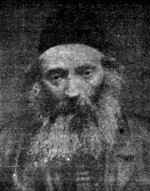
Rabbi Eliyahu Lipshitz
of blessed memory |
easier. From then on, the trips of the Jews of Grójec to Warsaw became
even more frequent and regular. And Jews would travel, some for trade and
merchandise, some for matchmaking, and some to see their Rebbe: everyone would
travel to Warsaw. But these people would travel with the intention of returning
after settling their affairs, whereas the young people related to their
charming town as if it were a narrow cage, in which they, the eaglets, had no
space to spread their wings and attain all the wealth and happiness of the
great world, for which Warsaw the capital served as both a showcase and a
store. And the young dreamers of the pleasures of the great world would turn
their backs on their family nest and the town of their childhood cradle,
deserting and uprooting themselves to greater Warsaw. But once they were
disappointed by the metropolis, which sated them with many hardships instead
[Page 132]
of hopes, would return to their longed-for town, which would always receive its children-captives with open arms.
And Gritze had the manners of a big city, but the special charm of a small town, full of yearnings and dreams unfulfilled and realized in life, was never blurred from it.
And Gritze boasted and took pride in its great rabbis, whose fame spread its good name throughout the country. And Gritze was privileged to have rabbis great in Torah, in Hasidism, and in wisdom. Alexandrian Hasidism struck deep roots in Poland. The Alexandrian dynasty produced brilliant figures on the Hasidic horizon in Poland. R' Yechiel of Alexander was one of the most stylized figures in the world of Hasidism. The author of the “Yismach Yisrael” was known and famous throughout Poland. And who was it that laid the first cornerstone for that branching dynasty? It is none other than R' Feivel of Gritze. He was the founding father and the root-source, from which branched out and spread tall and lofty trees, in whose shade thousands of longing souls found their spiritual satisfaction and supreme tranquility.
When R' Feivel of Gritze passed away, the community accepted as its rabbi the author of the small-volume book named “Yad Ketana” (Small Hand), whose pages were indeed few, but the high quality of its content reflected the immense greatness of its author. For he was holy in his life, and in his sanctified life, he also sanctified the city in which he resided. In his abstinence and purity of character, he served as an example to all his surroundings. Upon his passing, the entire congregation was orphaned and burning longings were awakened in it for a warm, fatherly hand, for someone who would encourage and lighten the burden of sorrow. And Gritze – a city full of scholars and wealthy men – began to search for someone worthy of its rabbinical crown. It sought a person who would be capable of fulfilling the role of the “eye of the congregation,” an eye that sees and grasps everything that is happening, an eye that would be open to the course of all the congregation's affairs and that would guide this congregation in the ways of God. They searched and searched until they found a young man, a father in wisdom and tender in years, R' Eliyahu Lipshitz from the city of Skierniewice, who had long since gained a reputation throughout the vicinity and across the country as a wise man with a sharp mind and noble qualities, which create what is called a personality. And this personality grew and flourished until it became one of the giants in the world of the rabbinate and bestowed its splendor upon the entire community.
Rabbi R' Eliyahu Lipshitz was born between the years 1862–1865 in the city of Skierniewice in Poland to his father, R' Moshe. R' Moshe Lipshitz was famous throughout the district as a clever Jew, to whom people flocked from all the neighboring towns to consult on the most complicated problems. R' Moshe was a pride of the householders in the city, an enthusiastic Grodzisk Hasid, and naturally, in this spirit, he raised and educated his sons. He was a wealthy Jew, managed many businesses, and did not keep his hand away from the timber business either. And the Holy One, blessed be He, sent blessing into the work of R' Moshe's hands, and his house became open to every Torah scholar and Hasid. And R' Moshe had three sons: Yeshaya, Eliyahu, and Natan, and also two daughters: Toyba and Leah. All of R' Moshe's sons inherited his deep wisdom, and all of them rose and grew to a level of excellence in
[Page 133]
personality, each in their own circle and environment, and each was blessed with a clear and sound mind.
R' Eli, the middle son, excelled especially in his wondrous talents. Even in his childhood, he was known as a sharp-minded individual, and his immense progress in Torah studies was a marvel and the talk of many in the near and far vicinity. In his youth, he became even more famous in the world of scholars as a great sharp-witted and profound thinker, and also as a wise Hasid, and he would often travel together with his father to the Rebbe of Grodzisk. But the fame and glory only swirled around him; they did not reach him, nor did they sway him for even a moment toward arrogance or away from the path of diligent study for the sake of increasing knowledge and seeking the spiritual perfection found in closeness to God.
At a very young age, his parents, with the Rebbe's consent and blessing, married him off to his wife, Dina, daughter of R' Zelig Freindreich, a respected and wealthy householder from Molganitsa (Mogielnica), a small town near Warsaw. In the years following his wedding, while supported by his father-in-law and free from the burdens of livelihood, he would sit over Torah and service day and night, and through the greatness of his talent and diligence, he reached a high level of scholarship. He devoured tractate after tractate, along with the Rishonim, Acharonim, the codifiers, and everything related to them, and while studying, he would commit his thoughts to writing in many Torah novellae. But man does not live by Torah alone, and R' Eli also dedicated his time to books of the pious and Hasidism to improve the quality and character traits of a Jewish person, and from time to time, he would examine himself to see how much he was fulfilling what was written therein. And since “external,” “self-taught” study is not enough to raise a person to the desired path of perfection, and there is a need for a living teacher and guide, he would travel once every few months for a Sabbath or a holiday to the Rebbe in Grodzisk, the grandson of the Maggid R' Yisrael of Kozhnits (Kozienice), R' Chaim Meir Yechiel, who was a Kabbalist and known as a great tzaddik and wise in fear of Heaven; as they used to say in Grodzisk that the Holy One, Blessed be He, Himself does not love fools. R' Eli had admired the Rebbe of Grodzisk since his youth, and even now, being already close to the age of thirty, great in Torah and Hasidism in study and practice, his esteem for his Rebbe did not diminish, and he treated him with awe – in the sense of “You shall fear the Lord your God – to include Torah scholars” – and the Rebbe's word was to R' Eli like the word of God and a halachic ruling that could not be challenged. Yet, he did not find complete satisfaction here for his soul, which was yearning and thirsting for real achievements, for renewal in its striving for closeness to God. And the Grodzisk Rebbe walked the paved path of the Kozhnits (Kozienice) Hasidic method without inclinations or deviations. And R' Eli was thirsty for a new word, for a new speech that would stir him. R' Eli needed something more than a Rebbe who spoke to him in hints of some fragmented sentences. R' Eli was looking for a friend before whom he could reveal all the storm of his heart, a friend who would shoulder with him the joint effort to search for and find a new way for spiritual ascent and for achieving perfection for the sake of Heaven. And indeed, he found his request in Grodzisk, succeeding in acquiring there a dear and loyal friend, and the two of them forged a covenant of eternal friendship, a covenant whose validity did not fade even after his friend became the Rebbe of thousands of other Jews. This friend was the Rebbe of Ostrovtse (Ostrowiec), who at that time was still
[Page 134]
the Rabbi of the Skierniewice community, the birthplace of R' Eli'. And indeed, if R' Eli' merited becoming that great R' Eli' – who dedicated his entire life to Torah, Hasidism, and communal work, and whose love for every Jew truly burned in his heart – all this must be credited to his friend and mentor, the Ostrovtzer (of Ostrowiec); his influence on R' Eli' was at work even before his revelation and appearance as a Tzaddik of the world, known by the title “The Rebbe of Ostrovtza (Ostrowiec),” while he was still in the state of being “hidden among the vessels” as the Rabbi in Skierniewice… This was before the great world knew what a sublime soul was concealed within the Rabbi of Skierniewice; he was destined to bring about a revolution in the way of serving God and to be revealed as a sublime personality, before whom all the great men of the generation stood with feelings of astonishment and reverence.
In the shadow of the Ostrovtzer, R' Eli' found his spiritual fortress, especially after the passing of the Grodzisker, when Ostrovtza became a center of Torah, Hasidism, and scholarship all at once, attracting all the spiritual “elite” of the Grodzisk Hasidim. Parallel to the Hasidic discourse, a line of scholarship extended with sharp pilpulim in Halacha, mathematical resolutions, and wondrous calculations. In this way, Ostrovtza rose, and in this way, all the students of Ostrovtza followed and walked with precision and loyalty – and R' Eli' was among the group of students, yet he carved out a special and important position for himself. Indeed, R' Eli' would try to deepen the sharpness and at times would deviate from the charted line. But deep down, in his approach to every problem and question, he remained a complete Ostrovtzer. And when the time came that the Ostrovtzer suddenly turned his back on the life of the world and began to engage in self-mortification and fasting, his students imitated him in this as well, and R' Eli' also turned to this path.
By nature, R' Eli' was a man of solid health and was considered a robust person, just as the Ostrovtzer was considered, whose health seemed to spray sparks from his body onto all his surroundings, and his black, burning eyes were shining with warm Hasidic enthusiasm. But when he decided that one must break the physical through fasting, R' Eli' also began to fast and continued to do so for the best of his years, until his sturdy body began to weaken. Even while still a young scholar, R' Eli' grew and rose to the level of a multi-faceted personality and was praised for many virtues: a scholar, a Hasid, clever, and with greater intensity, the trait of kindness stood out in him. Doing a favor for a Jew was for him a holy commandment and at the same time a great pleasure, and being famous as a man of many talents, he was approached by dozens of cities, including even large cities, to accept the rabbinate there, but he chose Grójec, which was near Molganitsa (Mogielnica), where he had been a resident for several years, when he was supported by his father-in-law.
In Grójec, he was accepted and respected by all strata of the public. His livelihood was secured and provided with a generous hand, and thanks to this, it was possible for him to devote himself entirely to the good of the public and the individuals, and a short time after he began to serve in holiness as the local Rabbi, everyone already cherished him as the “father of the city.” His word and opinion were decisive in everything, and everyone had a great deal of trust in him, knowing that R'
[Page 135]
Eli would delve deeply and examine well the situation and fate of each and every person.
Thus, R' Eli became the central personality of the entire area, and from all the surrounding towns they would come to him to consult on matters both general and personal and to ask for a favor. R' Eli served not only as the local Rabbi of Grójec, for his influence spread throughout the entire region, and R' Eli was also accepted by the government officials, and all the foreigners who came into contact with him respected him greatly, and through this influence, he would perform many good deeds for Israel. In the most complicated problems, whether municipal or familial, they would turn to him, and he would always succeed in extinguishing the fire of dispute and even establishing peace between hostile families. The local activist and intercessor rose over time to the rank of a political activist on a large scale.
Shortly after the founding of Agudath Israel, he appeared as one of the active figures in this movement. And when the rabbinical authority of Agudath Israel was established under the name “Moetzes Gedolei HaTorah” (Council of Torah Sages), he was elected as one of its esteemed members. His name appeared in every public enterprise; he took part in all kinds of conventions and assemblies. And even though he was not seen much in public, his opinion was always taken into account very seriously. By nature, he was a man who walked humbly, a deep and hidden thinker, and he hated with absolute hatred the noise, the emotional mass-behavior, and the boastfulness of rhetoric. In every single matter, he would look and examine with seriousness, and he would weigh every problem with all the gravity of responsibility, and he was accustomed to presenting the essence of his reflections and their results to his associates, and in most cases, they would agree with his guidelines. Very rarely would one see him lecturing and debating on a speaker's platform – but even when he was silent, general interest would surround him, as they were always ready to consider the opinion of the Rabbi of Grójec on matters on the agenda.
He was always elected, unanimously, to every delegation, mission, or committee for the purpose of handling important public matters. In 1922, Agudath Israel sent a mission composed of the most esteemed rabbinical figures to visit all the Jewish centers in Europe and also in America, to instill the idea of Agudath Israel in world Haredi Jewry and to strengthen in this way the ties between all its parts. And in this delegation—the first for the dissemination of the Agudath Israel idea in the world—the Rabbi of Grójec held one of the most honorable places. The other members of the delegation were: Rabbi Meir Dan Plotzki, Av Beit Din of Ostrowa, author of the famous books Kli Chemda and Chemdat Yisrael; Rabbi Mordechai Menachem Mendel Zilberstein, Av Beit Din of Warka; Rabbi Yosef Lew, Dayan in Warsaw; and Dr. Nathan Birnbaum.
Incidentally, it is worth saying a few words here about the Rabbi of Warka. He was the right hand of the Grójec Rabbi. The two cities, Grójec and Warka, are close to each other, and a great friendship was forged between the two aforementioned Rabbis, an intense friendship of the level of love that is not dependent on anything. Both possessed similar character traits: both were blessed with a generous measure of wisdom, and both of their hearts were burning with love for Judaism. Both were equal in their views and their assessments of various problems.
[Page 136]
Both of them were counted among the leadership of Agudath Israel. And when the Warka Rabbi passed away at a young age, much of the joy of life also departed from the Gritze Rabbi. Many friends were added to the Gritze Rabbi afterwards, but the place of the Warka Rabbi was never filled for him again.
The work of the Agudah was divided along the way. Due to family matters, these two rabbis, the Gritze Rabbi and the Warka Rabbi, were forced, after spending several months in Belgium and England, to return to their homes and could not participate in the delegation's journey to America. But the Jews of America were later given another opportunity to enjoy the light of his countenance and the light of his Torah. Parallel to his work for the Gritze Rabbi in Agudath Israel, he was also active in the development of the Union of Rabbis (Agudath HaRabbanim), of which he was one of the first founders and throughout its existence was a member of its presidium. In the name of the Union of Rabbis, he would frequently visit the Polish Ministry of Culture, and through various intercessions, he succeeded in bringing about the elevation of the honor of the Torah and the encouragement of religious influence.
In 1928, he traveled to America on a special mission for the Union of Rabbis in Poland. In the stream of refugees from the cities of Poland during the First World War, many Jewish families were separated; the husbands disappeared along the paths of refugees, fugitives, and prisoners of war, and their wives faced the danger of being agunot (chained wives). The Union of Rabbis opened a special office and succeeded in finding the traces of hundreds of such husbands and freeing their wives by obtaining a get (divorce) or confirmation of the husband's death. And since many such husbands had ended up in America, the Gritze Rabbi took upon himself the yoke of this holy work and traveled to America, and in the year and a half he spent there in dedicated work, he succeeded in releasing the wives of these husbands from the shackles of being agunot. Upon his arrival in America, he was received with great honor. They immediately recognized him as a great rabbi and a multifaceted personality.
The Union of Rabbis in America held a special reception in his honor, in which some of the greatest rabbis participated, and as he continued to stay in America and came into contact with more people, his circle of admirers and devotees expanded, as his personality, way of life, and interaction with people aroused admiration that exceeded all the praise showered upon him in speeches and in the press. His admirers—men of Torah, rabbis, and learned, God-fearing householders—still tell today of his high level in the service of the Creator. While in America, several communities and synagogues asked him, through delegations of distinguished men, to be their rabbi, and they offered him excellent conditions and were even prepared to cover all expenses for bringing his family from Poland to America. But he rejected all these offers, for Gritze was dear to him, and even while in America, busy with his holy mission, his eyes and heart were with his beloved community and the members of his community, and even there he worried about them, searched for and found all those who had relatives in Gritze, and demanded help from them for their relatives.
And it was not only in America that they offered him distinguished rabbinical positions. In Poland, too, they often approached him with such offers. Radom, a large city and industrial center, invited him to be the rabbi of the community. And during the First World War, while in Warsaw, he became beloved by the Jewish population
[Page 137]
and they offered him a rabbinical chair there and asked him to stay. He had several opportunities to be appointed as an official member of the Warsaw Rabbinate, but he always rejected the offers. Friends and respected householders urged him to stay in Warsaw, where he had excellent prospects, and his sons also begged him to establish his residence in the capital city – but he remained firm in his refusal, as he loved Gritze very much, and Gritze loved him as well. Despite the new winds that began to blow in Gritze, from the right and the left alike, even his most partisan opponents treated him with a great measure of reverence, and no one dared to oppose the Rabbi's opinion, even if it was contrary to the party line. Indeed, the Rabbi of Gritze felt the loyal bond and the faithful devotion that the city felt toward him; he also acquired devoted followers and loyal friends, and it is self-evident why no other honorable offers appealed to him. In Gritze, his entire personality developed, and Gritze was what he desired as his seat for fifty years, and even in the most turbulent hours he remained with his congregation, until the bitter day came and he was expelled along with his entire community from the city.
His Attitude Toward the Land of Israel
The Land of Israel filled a very rich chapter in the life of the Rabbi of Gritze. From the dawn of his youth, he had a strong desire to settle and take up residence in the Land of Israel, which, in addition to its holiness and the possibility of reaching high levels of service to the Creator there, was also connected to him by family ties. His older sister, Toyba, lived in Jerusalem, and she admired her brother greatly. Aunt Toyba, as they called her in the family circle, was famous in Jerusalem as a woman of valor, righteous and wise, and her good name was carried on the lips of the Jerusalemites with great esteem. In 1924, under the pressure of economic conditions, great activity began in Poland among the Jews for immigration to the Land of Israel. In every city and town, committees were founded for the purpose of purchasing land in the Land of Israel, and of course, Gritze did not lag behind in this regard. On the initiative of the Rabbi, the Jews of Gritze, both wealthy and poor, began to organize for the purpose of buying land in the Land of Israel. The Gritze committee united with the committee in the city of Skierniewice and they became one organization, and the united committee sent a delegation to the Land of Israel to investigate the situation and also to buy land, and the Rabbi of Gritze was placed at the head of the delegation. For over two months, the Rabbi spent time in the Land of Israel, and upon his return, he was full of enthusiasm for everything his eyes had seen there. In the Land, he met with all the great Torah scholars and also participated in several important meetings. He became very close with Rabbi Kook, of blessed memory, and even tried, through his influence, to quiet the fire of controversy that had ignited then and divided the Haredi community. But the power of the urge for controversy overcame the moral strength of the respected guest Rabbi from Poland, and his efforts were to no avail. The purchase of land for the Jews of the two aforementioned cities also did not come to fruition. But all these were minor details. The main point remained, that from then on, the Rabbi's longing for the Land of Israel grew with greater intensity, and upon returning home, he would repeat and say to all his family members and acquaintances: My place is
[Page 138]
in Eretz Yisrael, but many circumstances, familial and others, did not allow him to fulfill his heart's desire immediately, and he decided that after he married off all his children, he would immigrate to the Land.
Thus, he would postpone his immigration and settlement in Eretz Yisrael from year to year. Needless to say, when the community of Gritze learned that their Rabbi intended to leave them, they opposed it with all their might. The entire city, from the smallest to the greatest, could not imagine Gritze without the Rabbi. And so, obstacles arose from all sides, but although the Rabbi postponed his immigration until the right time came, he never for a moment gave up his aspiration. In 1930, his wife of his youth passed away.
The disturbances increased, and he remained in Gritze. In 1938, his eldest son, Rabbi Yitzchak Nissan of blessed memory, passed away. He had been a Dayan in Gritze for 25 years, was known to the people as R' Itzil, and was known as a holy man, the Tzaddik of the city. He fasted often to atone for the sins of the generation, and he spent his nights as his days engaged in Torah. He was a Jew with a special character. Burdened with many children, he lived all his days in poverty, but his face always radiated happiness and joy. A modest man who hid himself away, locked and enclosed within himself. He loved to seclude himself and would hover in the upper worlds. Due to his many fasts, his body weakened, and at a young age, he developed a heart condition. Because of his difficult financial situation, he was unable to receive the appropriate treatment. His life force collapsed from day to day until death snatched him suddenly at the age of 54.
The death of his dear and beloved son shattered the Rabbi of Gritze to his core. The place in his city became very narrow for him. From then on, he devoted himself with greater urgency to completing his preparations to settle in Eretz Yisrael. There was nothing that could hold him back anymore, and despite his elderly age, he felt enough strength to struggle with the material obstacles involved in such a step. But having been in Gritze for over forty years and being in constant contact with hundreds of people and political institutions, and wishing to arrange all matters so as not to leave behind confusion for the trouble of others, more and more small obstacles piled up, which delayed the completion of his preparations from day to day. During these final arrangements, he would stand and count the days and hours… soon he would be traveling… the long-held dream would be fulfilled. A little while longer and he would leave Poland and settle in Eretz Yisrael. And then came the first day of the month of September 1939, and all the dreams evaporated suddenly and all at once.
The Second World War broke out. On the first of September, I was at my grandfather's house in Gritze. At nine o'clock in the morning, the siren began to sound the first alarms, and the whole city trembled, even though they did not know for sure if this alarm was the sound of the war that had already broken out, or perhaps just a test of the alarm siren. Alarm wailed after alarm, and very quickly it became known that the Holocaust had indeed begun. With lightning speed, the news arrived from Warsaw that the first bombing had already claimed victims. He sat then before an open book on his table.
His gaze seemed frozen, and he was completely stunned and silent without uttering a sound from his mouth for a long hour. I, too, was as if stunned
[Page 139]
and paralyzed by everything that was happening, and one thing I knew: my days near my grandfather were numbered, for the draft notice would reach me very soon. Before the outbreak of the war, I had spent many years outside of Poland for my studies. The fear of the war that might break out had kept me from returning to Poland all that time, and only under the pressure of my parents and grandparents did I come here for a short visit, and now it turned out that I had come straight into the flames of war, and even before I had managed to bring a little joy to my relatives, the storm arrived that demanded of me and others like me to defend the “homeland.” Apparently, my late grandfather read dissatisfaction with my coming to Poland from my facial expression, and he felt guilty about it. It was he who wrote to me and encouraged me to come… and now, what had become of me? The world was locked behind seven seals.
Grandfather closed the book and called me to come closer to him and said to me: – The ways of God are hidden, everything is in the hands of Providence, and I am certain that here in Poland you are protected and safe no less than in France. I have already been through one war, my dear son, and I know how much situations are subject to change. Now the storm is raging here and in France it is quiet, but who knows what tomorrow will bring. I pray for you, that you be saved from all evil spirits. The Master of the Universe, there is no place devoid of Him, even at the war front, and even there He will protect you. Grandfather interceded with the authorities to appoint me as a military chaplain but did not succeed. All doors were locked.
The panic drove everyone out of the town. Grandfather's house was filled with a multitude of people. Mothers of children, whose husbands were taken to the army in the middle of the night, fainted, and their bitter weeping carried far. Grandfather did not lose his composure even for a single moment; he comforted and encouraged everyone. Master of the Universe – I remember how Grandfather cried out from the depths of his heart – where will comfort be found for so many troubles?
Without a word, I parted from Grandfather. He said nothing, but reached out his hand and blessed me briefly that we should merit to meet again soon, and he suppressed and hid his sorrow within himself, so as not to cast my spirit into panic, and he accompanied me down the stairs.
I traveled to Warsaw and Grandfather remained in Gritze. Upon my arrival in Warsaw, it became clear to me that they would no longer send us to the front. At every moment, another front was collapsing. The confusion was terrible and all the offices were shuttered.
A few days after I left Gritze, my cousin Moshe, who had hidden in the basement with me from the bombings, happened upon me and told me that Grandfather was also there. In Warsaw, on Grzybowska Street, together with the rabbis R' Zvi Perkal of Sochaczew and R' Yaakov Silberstein of Praga and others. Only five days had passed since I parted from Grandfather, and how many changes had occurred in such a short period of time. In the middle of the night, Grandfather received word from the mayor that he must leave the city, because in a few hours the Germans would invade it. Frightened and shaken, Grandfather left the house, and leaving everything behind him, he grabbed his tallit and tefillin bag and did not even have time to put his hat on his head. That was how great the panic was. During the entire siege of Warsaw, the Rabbi of Gritze remained there. He would sleep in a basement, and fasted the entire time and all the subjects
[Page 140]
speeches were only about Eretz Yisrael. “Who knows if I will ever merit to go up to Eretz Yisrael,” “All my life my desire was to travel and I did not travel! Woe is me…”
After the Germans invaded Warsaw, the Rabbi of Gritze stayed for a few weeks on Krochmalna Street with an acquaintance from Gritze. After the holiday of Sukkot, my brother-in-law Nathan Ash and I came to receive his parting blessing. Grandfather traveled back to Gritze. To all my entreaties and requests that he remain in Warsaw, he did not lend a listening ear. “I am forbidden to leave my congregation in a time of trouble, dear children, one must not flee,” was his answer, and he returned to Gritze. My brother-in-law and my sister Rachel remained in Warsaw, and I cast myself upon the waves of wandering and displacement… from Warsaw to Radzymin, to Malkin, and to Vilna. In Vilna and Kaunas, and later also in Japan, I would receive small, short letters written in Polish. I do not know what he went through during his last years of exile until his passing. His last letter was from Białobrzegi, a town near Gritze. I have no clear information about his suffering and struggles under the German occupation. Various rumors reached me, the reliability of which I have not been able to confirm, according to which he was imprisoned for a time in the Gritze jail and was released thanks to the intervention of his Polish admirers, who revered him greatly for his wisdom and the holiness of his way of life. From Gritze, he was deported to Białobrzegi and lived in the house of the local rabbi, Rabbi Blumenfeld. He spent more than fifteen months in Białobrzegi under the rod of the Hitlerite occupation. His friends and admirers did not abandon him in his bitter hours. Even in the days of terrible hunger, they did not forget the Rabbi of Gritze, until on the 19th of Elul 5701 (1941), his soul departed, and the entire ghetto community accompanied him to his eternal rest. Of his entire large family, which was scattered and dispersed in the various ghettos in Poland, only one daughter stood at his deathbed, Chana, who had lived in Eretz Yisrael and had come to Poland for a visit, and there she met her death in the hardships of the war.
These are the life stories of the Rabbi of Gritze.
The Rabbi of Gritze was a father not only to his children but to the entire family, and the measure of his love and concern for his grandchildren and great-grandchildren was no less than for his children. God blessed him, and he merited to see children and grandchildren, great-grandchildren, and even great-great-grandchildren. And he carried each one of them in his heart; he worried for each and every one, for this one in a material sense and for that one in a spiritual sense. Rarely can one find such loyalty and deep devotion that characterized the Rabbi of Gritze as a father and head of the family branches that stemmed from him, and especially toward his grandchildren. And indeed, the grandchildren knew that in every important matter, one must ask for Grandfather's advice. And even though it was often found that Grandfather and his grandchildren lived in two separate worlds, Grandfather always knew how to phrase his opinion in such a way that it would be acceptable even to the new world in which some of his grandchildren already found themselves. Full harmony prevailed between Grandfather and his grandchildren. With all his heart and might, he would strive to help them. Grandfather was the central figure in the family, who united everyone. Despite his many burdens, he found opportune hours to make time to play a little with his grandchildren. And indeed, Grandfather had
[Page 141]
some satisfaction in his life. The Rabbi of Gritze was privileged to see with his own eyes a generation of the righteous, blessed with sons and grandsons who were Torah scholars, Hasidim, and men of good deeds. The grandfather had someone to take his place after one hundred and twenty years. And had it not been for the destruction, surely one of his sons would have graced the rabbinical chair in Gritze as his worthy successor.
All his days he yearned and hoped to see his son, the late R' Itzil, the righteous and pious man, sitting on the rabbinical chair. And later, after this son passed from the world, he would not consent to leave Gritze until he could merit seating his grandson, his beloved, there. But his wish was not fulfilled. Gritze was destroyed along with most of his children and grandchildren. Only a small part of his family survived.
From the children of the Rabbi of Gritze, the following were saved: his son Israel and his six children, his daughter Miriam, his grandsons Rabbi Simcha Alberg, Yeshaya and Pinchas, the sons of his son-in-law, the late pious R' Aharon Shimon, and his righteous daughter Gitel, may God avenge their blood. His grandchildren: Shalom and Ruchama, the children of his son, the late Rabbi R' Itzil.
Gritze, my little town… I write “Gritze, my little town” even though I was not born there; nevertheless, Gritze is my town. There my grandfather reigned as rabbi for about fifty years, and under his wings I found rest from the dawn of my youth until my older years. From a tender age, when I was six until the year of the destruction, I would spend days, months, and even years there. For a long period, I would breathe in and inhale the Gritze fragrance. In childish mischief, I would fill my nostrils and lungs during the long summer days with the fresh scent of the hay they would harvest in Czestinow, at the squire's estate, not far from Gritze, a place where the grandfather's family would travel for summer vacation. I also remember the long, dark nights when I would trudge with my grandfather through the mud and sludge by the light of a small kerosene lamp to reach some place. I remember all the Gritzer types: the teacher, the beadle, the wealthy man, the pauper, the Hasid, the maskil, the devoutly religious, and the heretic. Their ways of life were different, and each would keep to his own circle. And sometimes a thick partition would separate them, but the final, terrible death united and consolidated them into complete unity. Gritze, my little town, was destroyed, and in the destruction of the town of Gritze, the destruction of a great world is reflected and revealed before me. On the map of the world, Gritze was almost a negligible point, and even in Poland, it was but one of many towns, but to the Gritzer people, it was the center of the world, the center of their own world.
Six million Jews were finished and cut off, and with them sank hundreds of cities and towns throughout the great European world. Every town that was cut off is dear and honorable to me, but dearer and more sacred to me than all is Gritze, my little town. Gritze was neither more beautiful nor better than all the towns like it, but it is dear to me, and my heart is most pained for Gritze, my little town. And Gritze had a holy community of thousands of Jews, young and old, women and children – and their leader and captain there was my grandfather.
[Page 142]
Dear to me and close to my soul are the Jews of Gritze, and my heart aches for their loss. And a thousand times more do I ache for the loss of my grandfather, the Rabbi of Gritze, who lived the life of his community, who rejoiced in their joy and sorrowed in their sorrow, and in their destruction, he too was destroyed and silenced forever.
Six million were annihilated; a third of the Jewish nation was cut off by a cruel, satanic hand. And it is as if the earth felt that it was not only the people of Israel as a whole body that lost a third of its quantitative existence, but that also within the very core of every Jewish soul that remained alive, a third of its quality was severed; something of the inner Jewish point was damaged and missing, and there is no Jew today who is whole in their soul. And therefore, we mourn not only for the destruction of the Jews who were and are no more, but also for the destruction that was wrought within us, the survivors who remained alive. With the destruction of Gritze and its entire community, something invisible within me was also destroyed and vanished. The destruction of others is grasped quickly, but the destruction and collapse of the self is difficult to discover, for such a destruction is covered by thousands of grains of deceptive dust and hidden behind thousands of secret partitions.
by Rabbi Simcha Elberg, Brooklyn
Translated by Seth Morgulas
Gritze, the small town near Warsaw, considered itself quite big-city, aristocratic. The Jews of Gritze did not consider themselves provincials, because what Jew from Gritze wasn't in the capital city of Warsaw a few times a year? The distance was not great, and ever since the “train” began running, popping into Warsaw became very easy. The frequent trips to Warsaw made the town “big,” and everyone brought back to Gritze something of the big-city lifestyle. Jews traveled to Warsaw to trade, to make a match, and to see the Rebbe – all roads led to Warsaw. As for the youth, it goes without saying; they would literally embarrass the town. The town possessed a thousand charms, but the youth were drawn to Warsaw – they ran away from the town. Warsaw lured them with its big-city magic. One small thing: Warsaw! There, one could achieve everything, happiness and joy and everything the heart desires. And when Warsaw made them tired, disappointed their hopes, led them astray from the straight path, they would return home, and the town always received with open arms the disappointed ones who came back seeking comfort.
Gritze possessed a great deal of big-city quality. But its specific charm was not erased – the charm of a small town, full of dreams and unfulfilled longings…
Gritze boasted and prided itself on its great rabbis, who made the town famous throughout Poland. Gritze was privileged to have rabbis who were great in Torah, wisdom, and Hasidism.
The Aleksander Hasidism struck deep roots in Poland. The Aleksander lineage produced great figures who illuminated Polish Hasidism. R' Yechiel of Aleksander represented a significant and multifaceted personality in the Hasidic world. The “Yismach Moshe” was famous throughout all of Poland, and
[Page 144]
who was the first to lay the foundation for this widely branched dynasty? – R' Fayvel of Gritze! He was the trunk, from which the great branches grew, and thousands of searching souls found their spiritual satisfaction, their relief, and enlightenment in their shadow.
When R' Fayvel passed away, Gritze took on as rabbi the author of a small book titled “Yad Ketana” (Small Hand). Small in scope was the little book, but great was its author; he was a holy man and with his holy life brought sanctity into his town. With his asceticism and character traits, he was a model for those around him. When he passed away, the town was orphaned, and like an orphan, Gritze began to look for someone who would cherish it with a fatherly hand, who would encourage and lighten the sorrow. And Gritze – a town full of scholars and Jews who were men of Torah, began to search for a rabbi who would be worthy of the Gritze rabbinical crown, who would be capable of fulfilling the role of an “Eye of the Community,” a watchful eye that sees and catches everything that happens in the shtetl, who would keep an eye on the community and lead it in God's ways. Gritze sought a watch- man, a faithful shepherd, who would stand on guard and protect the Jewish community from all evil.
They searched for so long until they found a young man from Skierniewice, who in the surrounding area and in all of Poland had long been famous as a great sage and “sharp mind” and was particularly distinguished by those elevated qualities that create a personality. This young man rose higher and higher, until he became a giant in the rabbinical world. Thus, Gritze became famous for its rabbi, and the surrounding cities and towns were cast into the shade because Gritze had the merit that its spiritual leader should be Rabbi R' Eli Lipshitz. Thanks to his dynamic personality, sharp mind, warm heart, and good character traits, Gritze was elevated, and its constant ascent continued until the tragic day of September 1, 1939.
Rabbi R' Eli Lipshitz was born in Skierniewice, approximately in the years 5622 – 5625 (1862-1865). His father, R' Moshe Lipshitz, was known in the surrounding area as a clever Jew to whom people used to come from the neighboring towns to consult about the most complicated matters. R' Moshe belonged to the “elite” of the town. He was a fervent Grodzisk Hasid and in that spirit
[Page 145]
he raised his children.
He was well-to-do, managed large businesses, and – as was the custom of some Jewish merchants in the small towns – also traded in forests. He was successful, and the businesses went not badly. R' Moshe's house was always open to every Torah scholar and Hasid. He had three sons – Yeshaya, Eliyahu, and Natan, and two daughters: Toybe and Leah. The children inherited from him his deep life-wisdom, and each one of them – in his own environment – rose to greatness and was esteemed and beloved. “R' Moshe's children are wise” – everyone knew this, whoever even knew the family.
R' Eli, the middle son, was especially distinguished by his extraordinary abilities. He was still a child and had already become famous for his “open mind.” R' Eli constantly rose in learning and was quickly famous in the entire region. In a short time, Eli was already famous in the world of scholarship as a sharp and deep learner, a Hasidic sage, and very often he traveled together with his father to the Grodzisk Rebbe.
R' Eli was possessed by an inner restlessness. Already in his young years, he was known as a God-seeker, a deep-thinking person, who knows that he is still far from perfection, that something is still missing for him, which would calm his longing soul. He was still very young when he married Dina Freudenreich, the daughter of a rich and respected homeowner, R' Zelig of Mogielnica, a small town near Grójec.
After the wedding, while being supported by his father-in-law, R' Eli sat devoted to Torah and service day and night. Being freed from life's worries, he could devote himself entirely to Torah study and Hasidism. And he constantly rose in learning. He finished one tractate after another, wrote Torah innovations. As mentioned, he was a seeker of perfection. Being already a young man of 28 years, this feeling became even stronger in him. One must, after all, begin to become a person… One must constantly rise, a step after a step in Torah study, and how can one reach that, when one encounters so many obstacles in the way! And so he sat and studied for long months, and from time to time he would drop down for a Sabbath or holiday, to Grodzisk, to the Rebbe.
And in Grodzisk, by the Kozienice Maggid's grandson, he literally
[Page 146]
refreshed himself. The Grodzisk Rebbe, R' Chaim-Meir-Yechiel, was known as a great tzaddik and sage. In Grodzisk, it used to be said that even the Almighty Himself does not like fools, and the Grodzisk Rebbe was a great sage. R' Eli understood him well and, even in his younger years, grew fond of him. He was possessed by a deep sense of respect and awe, literally fearing him in the sense of “and you shall fear your God” – which includes Torah scholars. The Rebbe's word was for him a word of God and a halachic ruling that had to be strictly fulfilled. But R' Eli's spirit did not find rest, despite the Rebbe's greatness. R' Eli feared Grodzisk, but he did not learn much there. The young man with the sharp mind and deeply feeling heart was constantly looking for something new, something refreshing, and in Grodzisk, there was no innovation; one did not hear a new word. Grodzisk had its well-trodden path, which followed the “Kotzk” method. And they strove there to walk along this beaten path, without deviations.
But R' Eli longed for a new word that would inspire him. He needed something more than a Rebbe who spoke to him in clipped sentences, in hints. He sought a friend to whom he could open his stormy heart, his fluttering soul. He lacked a friend to whom he could confide, to unburden his heart and tell him what was troubling him, a friend who would be helpful to him in seeking a shared path to spiritual elevation and perfection, and if the existing old way did not satisfy, they would strive to find, with God's help, a new way to reach that perfection.
And R' Eli found more than a Rebbe in Grodzisk. He succeeded in finding a dear, loyal friend. Both formed a bond of eternal friendship, which was not broken even when his friend became the Rebbe of thousands of other Jews. This dear friend was the Ostrovtzer Rebbe (Rebbe of Ostrówiec), who was then still the Rabbi in Skierniewice – R' Eli's birthplace.
And indeed – if he became the great R' Eli, who dedicated his entire life to Torah, Hasidism, and communal work, in whose heart burned a fire of love for Israel, it is thanks to his Rebbe and friend – the Ostrovtzer. And it is possible that the influence on R' Eli from the Ostrovtzer after his revelation, when he became famous as a great tzaddik
[Page 147]
The Ostrovtzer Rebbe was not as powerful as he was during the time he was the Skierniewicer Rav, when the great world had not yet realized what a great soul was hidden within the Skierniewicer Rav, who would in time bring about a revolution in the manner of serving God, would gift the world with his righteousness and genius, and would become an exalted personality before whom the great men of the generation stood with astonishment and reverence.
In Ostrovtza (Ostrowiec), R' Eli found his rectification in the deep and hidden friendship between him and the Rebbe; in this friendship and boundless devotion to the Ostrovtzer, R' Eli found the path to himself. In the shadow of the Ostrovtzer Rebbe, R' Eli found his spiritual fortress, because the town had taken the “face,” the eastern wall, of Grodzisk.
After the passing of the Grodzisker, Ostrovtza became a center of Torah, Hasidism, and scholarship. Parallel to Hasidic discourses went the path of scholarship. Pilpul and sharpness “on the razor's edge,” mathematical achievements, and wondrous calculations. With this path, the town grew and ascended, and on this path walked all the loyal and honest Ostrovtzer students. R' Eli belonged to them, but he earned for himself his own important position.
True, R' Eli strove to deepen the sharpness and at times deviate from the established line. But deep down, with his approach to every matter, he remained an “Ostrovtzer.” And when the hour came and the Ostrovtzer Rebbe turned away from the world and began to engage in self-mortification and fasting, his students followed him. It is understood that R' Eli was one of them on this path. R' Eli was physically healthy and strong, and he was – like the Ostrovtzer – considered a man of vigor. His body bubbled with health and freshness; his flaming black eyes sparkled with enthusiasm and Hasidic fervor. R' Eli also decided that one must break the material, and like his Rebbe, he also began to torment his body. Thus he continued for many years until his healthy body began to collapse. His best years passed in fasting.
While still young, R' Eli rose and grew into an interesting and colorful personality. R' Eli was a household name. He had
[Page 148]
embodied many virtues: scholarship, piety, wisdom, and above all, his kindness – his midat ha-chesed – found expression. Doing a favor for a Jew was for him a holy commandment and, at the same time, a great pleasure. From dozens of cities and towns, people turned to him and offered him the rabbinate. Great communities wanted to have him as their rabbi. But R' Eli chose Gritze, near Mogielnica, where he had spent several years supported by his father-in-law.
In Gritze, he was loved and esteemed by all strata of the population. Being secure in his livelihood, which he received with a generous hand, R' Eli devoted himself to the good of the town. Only a short time had passed since he took over the rabbinate, and already everyone, as one, recognized his dedication to accomplishment and saw in him the father of the town. There was not a single Jewish house in Gritze that the Rabbi's word did not reach. His opinion was decisive in many questions, and everyone had trust in him, knowing that R' Eli carefully considered the situation and fate of each person individually and that every matter was close to his heart.
Thus, R' Eli became the central personality in the entire surrounding area. From all the neighboring towns, people used to come to Gritze to consult with him about matters of the community and the individual, and to ask for a favor. R' Eli was not just the Rabbi of Gritze. His influence spread over the entire district. And he was also recognized and esteemed by the authorities; even Christians who came into contact with him revered him, and he used this to do many favors for Jews. Thus his name and prestige grew. In the most complicated matters – urban as well as familial – people turned to him, and he was always successful in calming every dispute and bringing peace between warring families.
The communal activist and intercessor became, over time, a political figure. Before the emergence of “Agudath Israel,” he proved himself to be one of the most active personalities in that movement. And when the great rabbinical association known as the “Moetzes Gedolei HaTorah” (Council of Torah Sages) was founded by “Agudath Israel,” he became one of its most important members. He participated in meetings and conferences. Although he appeared little in public, one always reckoned with his opinion and considered his words seriously.
[Page 149]
By nature, he was a modest and reserved person. He hated noise, grandiloquence, and oratorical gestures. He considered every matter seriously and with deep responsibility. He used to report the essence of his considerations and conclusions to those closest to him. It goes without saying that in almost every case, people agreed with his findings. Very rarely was he seen on the speaker's podium reporting or debating, and yet, people were interested in knowing his position on every issue. He was always elected, unanimously, to every delegation or commission that had to deal with important social matters.
In 1922, “Agudath Israel” sent a delegation consisting of the greatest rabbis to visit Jewish centers in Europe and America, in order to spread the idea of “Agudath Israel” among religious Jews and thus establish contact between all parts of religious Jewry in the world. In this delegation – the first to spread the idea of “Agudath Israel” in the world – the Gritze Rabbi held an important position. The delegation consisted of the following personalities: Rabbi Meir Dan Plotzki, Rabbi of Ostrów, author of the books “Kli Chemda” and “Chemdat Yisrael”; Rabbi Mordechai Menachem Silberstein, Rabbi of Warka; Rabbi Yosef Lev, Dayan in Warsaw; and Dr. Nathan Birnbaum. Incidentally, it is worth mentioning a few words about the Warka Rabbi.
He was the right hand of the Gritze Rabbi. The two towns – Gritze and Warka – were close to one another, and a strong friendship developed between the two rabbis – a friendship that reached a great mutual love, an ahava she'eina teluya bedavar (a love not dependent on anything). Both possessed many common character traits. Both were gifted with wisdom and love for Judaism. Both used to have the same outlook and opinions on various issues, and both stood at the head of “Agudath Israel.” When the Warka Rabbi passed away, while still young, much of the Gritze Rabbi's joy of life also departed. R' Eli had many other friends, but no one could ever again replace the place of the Warka Rabbi for him.
Simultaneously with his work for “Agudath Israel,” the Gritze Rabbi actively participated in the work of the “Agudath HaRabbanim,” for which he had accomplished much since its inception. He was one of its
[Page 150]
active contributors, and throughout all the years of its existence, he was a member of the presidium and held an important position in the union. In the name of the “Agudath HaRabbonim,” he would often visit the Ministry of Culture of the Polish government, and thanks to his efforts, many things were achieved that contributed to the elevation of the honor of the Torah and the strengthening of religious influence in Polish Jewry.
In 1928, the Gritze Rabbi traveled to America as a special envoy of the “Agudath HaRabbonim” in Poland. The First World War, which destroyed dozens of Jewish cities and towns, also destroyed the lives of many Jewish families – due to Jewish married men disappearing on the battlefield or fleeing to America, their wives were threatened with the danger of agunah (being chained to a marriage). The “Agudath HaRabbonim” opened a special office, thanks to which thousands of women were saved from loneliness. Many men did not return to their towns and went to America; the Gritze Rabbi took upon himself the difficult and holy mission and traveled to America, where he spent a year and a half. His dedicated work was crowned with success. In America, he was received with great honor. People immediately saw in him the great rabbi and multifaceted personality. The “Agudath HaRabbonim” in America organized a special reception for him, in which the most important rabbis of that time participated.
The Gritze Rabbi quickly became popular in the United States as well. He inspired deep reverence in everyone. His appearance there evoked admiration. To this day, people in rabbinical circles tell of his high level and service to God. Several communities in America suggested that he accept the rabbinate with them. Delegations came to him from various synagogues and offered the best conditions; they were also prepared to cover the expenses for bringing his family from Poland to America. But the Gritze Rabbi did not even want to hear about it, because Gritze was dear to him and he longed for his town. While in America, he did not forget his beloved community for a moment; he sought out and found all those who had family in Gritze and obtained help from them for their relatives. Not only in America was he offered high rabbinical positions –
[Page 151]
also in Poland, he was often approached with similar proposals. Radom, a large industrial city, invited him to be its rabbi. Being in Warsaw during the years of the First World War, he became very beloved by the Jewish population, and they asked him to stay. He had many opportunities to be nominated as an official member of the Warsaw Rabbinate, but every time he rejected the proposals. Friends and prominent householders asked him to stay in War- saw, where he had brilliant prospects, and his children also asked him to move to the capital, but he did not want to. He held firmly to his decision not to leave Gritze.
He loved Gritze very much, and the town loved him. Despite the party currents – from right and left – that began to influence the Jews of Gritze, even his sharpest party opponents treated him with great respect and reverence. No one dared to oppose the rabbi, even when his opinion was against their party line. The Gritze rabbi felt the attachment and devotion of the town to him; he had earned ardent followers, Hasidim, and loyal friends, and therefore it is self-evident why he did not want to hear about other, albeit important, rabbinical positions. In Gritze, his personality developed, and here he wanted to remain.
Eretz Yisrael in the life of the Gritze rabbi
Eretz Yisrael – this is a special chapter in the life of the Gritze rabbi. From his youngest years, he strove for Eretz Yisrael and dreamed of the happy moment to be able to settle there. Family connections also linked him to the Holy Land. His older sister, Taube, lived in Jerusalem, and she loved her brother very much. “Aunt Taube” – that is what she was called in the family – was known as a woman of valor, a righteous and wise woman. She was known in Jerusalem, and people used to speak of her with great reverence.
In 1924, when in Poland – under the pressure of economic conditions – activity for Eretz Yisrael intensified, and in every city and town committees were formed to buy land there, it is understandable that the Gritze rabbi did not remain behind. On his initiative, the Jews of Gritze – the wealthy and the poor – began to
[Page 152]
organize in order to purchase an estate in Eretz Yisrael. Both committees in Gritze and in Skierniewice united and sent a delegation to Eretz Yisrael to familiarize themselves with the situation on the ground and to purchase an estate. At the head of the delegation stood the Rabbi of Gritze.
The Rabbi of Gritze spent two months in Eretz Yisrael. Upon returning, he was full of enthusiasm for everything he had seen there. He met with the greatest personalities of the Yishuv and also participated in important meetings. He became very close friends with Rabbi Kook, of blessed memory, and endeavored to exert his influence to calm the sharp disputes that were then dividing religious Jewry due to the two approaches of Rabbi Sonnenfeld, of blessed memory, on one side, and Rabbi Kook, of blessed memory, on the other.
After his first visit, his desire to settle in Eretz Yisrael became even stronger. He would constantly tell his family and acquaintances: “My place is in the Holy Land.” His ultimate goal was Eretz Yisrael. But various family matters did not allow him to realize his dream. He then decided that as soon as he married off all his children, he would immigrate to Eretz Yisrael. Thus, he postponed his Aliyah from year to year.
It is needless to say that when people in Gritze found out that the Rabbi wanted to leave the town, they did not even want to make peace with the thought. The whole city, young and old, could not imagine Gritze without the Rabbi. Despite the fact that he had many difficulties and obstacles from all sides, the Rabbi did not want to resign from his idea. He only postponed it for a suitable moment, not giving up for a single minute on his aspiration.
In 1930, his wife became ill and he could not leave the town – in the same year, she passed away. In 1938, his eldest son, Rabbi Yitzchak-Nissen, of blessed memory, passed away; he had been a Dayan in Gritze for 25 years. People called him R' Itzel and considered him a holy man. He was truly the Tzaddik of the city. He spent his whole life fasting. Day and night he was occupied with Torah. Burdened with children, he lived all his years in poverty, but always bubbled with joy and contentment. He was a modest man, loved solitude, to seclude himself and soar in the higher worlds. The frequent fasts weakened him, and being still
[Page 153]
at a young age, he began to suffer from a heart condition. Due to his difficult economic circumstances, he did not receive the necessary medical treatment. From day to day he grew weaker, and at the age of 54, he breathed his last. The death of his beloved son broke the Rabbi. He felt stifled in the city. He energetically began making preparations for his aliyah to Eretz Yisrael. Nothing would hold him back anymore. Despite his age, he felt that he still had enough strength to overcome the difficulties associated with taking such a daring step. But after having lived in Grójec for over 40 years and being connected with hundreds of people and social institutions, difficulties arose again, which he could not overcome so easily. He had to make technical preparations and also prepare himself mentally for his aliyah. The idea of making aliyah to Eretz Yisrael had already matured, but in practice, everything was moving at a slow pace. The Grójec Rabbi sat and counted the days and the hours… Any moment now he would set out on his way; the long-held dream would be realized. Any moment now he would leave Poland and settle in Eretz Yisrael. But – then came the day of September 1, 1939, and the dream was over. The Second World War broke out.
The Grójec Rabbi during the war until his tragic passing
On September 1, 1939, I was with my grandfather, the Grójec Rabbi. At 9 in the morning, the first siren alarms were heard, announcing an air raid. The city trembled. Although one did not know if this was just a test alarm or if the war had actually already begun. One alarm after another, and it immediately became clear what had happened. With lightning speed, the news that arrived from Warsaw spread, that there were already victims from the first air raid.
The Grójec Rabbi was sitting at the table at the time and was immersed in a book. His gaze seemed to have frozen. For a long while, he was silent. I, too, was as if petrified by the news. One thing I knew: that the days of my being close to my grandfather were numbered, because soon I would be called into the army.
For many years, I had spent time outside the borders of Poland because of my studies. The fear of the outbreak of war had kept me from returning to Poland. Only under the pressure of my parents and grandfather did I come
[Page 154]
on a short visit and straight into the fire of war. I had barely managed to enjoy my relatives a little when the storm came and called me, and many others like me, to defend the “fatherland.”
It seems that my late grandfather read a sense of resentment and regret on my face as to why I had come to Poland. He apparently felt guilty because he had asked me to come – and now, what would happen to me? The world had been locked behind seven seals. Grandfather closed the book, called me closer to him, and said: “God's ways are hidden; everything is in the hands of Providence, and I am sure that here in Poland, you are no less safe and protected than in France. I have already lived through one war, my dear child, and I know what happens in wars. Now the storm is raging here in Poland and it is quiet in France, but who knows what tomorrow will bring. I am praying for you that you may be saved from all evil. The Master of the Universe is everywhere – also on the battlefield – and will guard you everywhere.”
Grandfather tried with the authorities to have me appointed as a military rabbi, but he did not succeed. All doors were closed. The community had driven everyone out of the shtetl. Grandfather's house was full of people. Mothers of children whose husbands had been called into the military in the middle of the night were fainting and wailing. Grandfather did not lose his composure for a moment. He comforted and encouraged them. “Master of the Universe” – I remember how Grandfather cried out – “where does one find comfort for so many troubles?”
Silently, I said goodbye to Grandfather. He said nothing. He offered me his hand and blessed me that we should yet be privileged to see each other again. Grandfather, like me, stifled his grief so as not to intensify my pain, and accompanied me from the stairs. I left for Warsaw and Grandfather remained in Gritze.
Arriving in Warsaw, it turned out that they would no longer be sending me to the front. Every moment, another front line was collapsing. All offices were closed. Chaos reigned everywhere.
A few days after I left Gritze, my cousin Moshe came to the cellar where I was hiding from the bullets and told me that Grandfather was also in Warsaw on Grzybowska Street, together with
[Page 155]
the rabbis R' Zvi Perkal of Sochaczew, R' Yaakov Zilbershtein of Grójec, and others. Five days had passed since I had said goodbye to my grandfather, and what had already happened in that short time! In the middle of the night, my grandfather received an order from the mayor to leave the city immediately, because in a few hours the Germans would occupy Grójec. Terrified, my grandfather left the house, leaving everything behind; he took his tallit and tefillin and did not even manage to put on his hat, so great was the panic.
The entire time of the siege of Warsaw, the Grójec Rabbi was in Warsaw. He spent the nights in a cellar, fasted, and did not stop talking about Eretz Yisrael. “Who knows if I will yet be privileged to ascend to Eretz Yisrael! All my years I have strived for it and did not go. Oh, woe!”
After Warsaw was occupied by the Germans, the Grójec Rabbi stayed for a few weeks on Krochmalna Street with an acquaintance from Grójec. After Sukkot, we – I and my brother-in-law, Nathan Ash – came to say goodbye to him and receive his farewell blessing. My grandfather returned to Grójec. I begged him and tried to persuade him to stay in Warsaw, but he would not hear of it. “I must not abandon my congregation in a time of trouble! One does not run away from children” – was his answer. And he returned to Grójec.
My brother-in-law and my sister, Rachel, remained in Warsaw, and I set out on a wandering path – from Warsaw to Radzymin, Małkinia, Białystok, Vilnius. In Vilnius, in Kaunas, and later in Japan, I used to receive short letters written in Polish. I do not know what happened to him in the last years of exile before his passing. His last letter was from Białobrzegi, a small town near Grójec.
I do not know about his sufferings and struggles during the German occupation. Various reports reached me, but none were precise. For a certain time, he was arrested in the Grójec prison, later released thanks to the efforts of his Christian friends, who greatly admired the “Pan Rabin.” From Grójec, he was driven out to Białobrzegi, where he stayed with the local rabbi, Rabbi Blumenfeld. For over 15 months he was in Białobrzegi; his friends and admirers did not abandon him in those critical hours. Even in the days of hunger,
[Page 156]
he was one not to be forgotten. On the 19th of Elul, he breathed his last.
The entire ghetto accompanied him to his eternal rest. Of his branched-out family, which was scattered in various ghettos in Poland, his daughter Chana was at his bedside in his final moments; she had lived in Eretz Yisrael and had come to Poland for a visit, only to perish in the war.
So tragic was his death and so lonely was he who had lived for over 50 years in storms, in inner struggle, and had stood with both feet in life.
When he passed away, his large family was taken from him, his community, which he had led for 50 years. Suddenly, everything vanished, was destroyed. This is the life story of the Gritzer Rav.
The Gritzer Rav was not only a father to his children but, above all, the head of the entire family. As great as his paternal love for his children was, so strong was his love for his grandchildren and great-grandchildren. God blessed him with children and children's children. He remembered each one of them and carried them in his heart, caring for each one – spiritually and materially. Very rarely can one find such deep devotion and love from a father to his family. The grandchildren knew that one must obey the grandfather; despite the fact that often the grandfather and the grandchildren were already two separate worlds, a common language was always found. The grandfather always managed to express his opinions in such a way that they would be accepted by his grandchildren, who already considered themselves modern people. A complete harmony reigned between the grandfather and his grandchildren. With all his heart, he strove to help them. The grandfather was the central figure in the family and he united everyone; despite the fact that he was always busy, he found a free minute to play with his grandchildren, who brought him much joy in his life. He was privileged to see a beautiful progeny of children and children's children, Torah scholars, Hasidim, and men of good deeds. He had those who would take his place after him. Had it not been for the destruction, one of his sons would surely have occupied his chair in Gritze and
[Page 157]
would have continued his way.
All his years he strove to see his son, R' Itzel of blessed memory, the righteous man and Hasid, on the rabbinical chair. And when his son passed away, he did not want to leave Gritze until he would see his beloved grandson in that place. His dream was not realized. With the destruction of Gritze, most of his children and grandchildren also perished. Only a small number of them managed to save themselves.
From his family, the survivors were: his son Israel with 6 children, his daughter Miriam, his grandchildren Rabbi Simcha Elberg, Yeshaya and Pinchas, the children of his son-in-law Rabbi R' Aaron Shimon of blessed memory, and his daughter, the righteous woman, Gitel. R' Yaakov Demb, his grandchildren Shalom and Ruchama, the children of his son Rabbi R' Itzel of blessed memory.
Gritze, my shtetl! Although I was not born there, it is nevertheless my shtetl; there my grandfather was a rabbi for about 50 years, and in his shadow, I found healing from the simple years of youth. From the time I was a child of 6 until the destruction, I spent days, months, and years there. For a long period, I breathed the air of Gritze. In the long summer days, I used to breathe in with childish playfulness the scent of fresh hay that was cut in Czestochowa at the nobleman's estate, not far from Gritze, where my grandfather's family used to go for summer residence.
I also remember the long, dark nights when I used to trudge through the mud with my grandfather, carrying a kerosene lantern. I remember some Gritze figures: the teacher, the beadle, the pauper and the wealthy man, the Hasid and the maskil, the pious and the skeptics. Their way of life was diverse, and each one shut themselves off in their own circle. It seemed as if a partition stood between them, but the terrible death united them in its arms.
My shtetl Gritze was destroyed, and in the destruction of the shtetl, the destruction of a great world plays out before me. For the Jews of Gritze, Gritze was a whole world; there they wove their dreams, and there those dreams would dissolve in the twilight hours of quiet, dreamy evenings. On the world map, Gritze occupied a small dot; in Poland, there were many shtetls like Gritze, but for the people of Gritze
[Page 158]
their shtetl was the center of the world. Their thoughts first and foremost concentrated around Gritze, and only afterwards did they see the great world.
Six million Jews were murdered, and together with them were wiped out hundreds of cities and shtetls in Europe. Every shtetl is dear and holy to me, but closest to me is Gritze, my shtetl. Gritze was not more beautiful or better than other shtetls similar to it, but it is dear to my heart, and I ache most for its destruction. Gritze possessed a holy community of thousands of Jews, young and old, women and children. My grandfather was their father, their leader.
Gritze Jews are dear and close to me. They are my blood and flesh. And even more, my heart is torn with pain for my grandfather, who lived with his community of Jews, rejoiced in their joy and grieved their grief, and he too was silenced forever together with all the Gritze Jews. Six million Jews, a third of our people, were cut down by the bestial murderers.
Often, I feel that not only has the people lost a third of its children, but that also in the essence of every Jew who remained alive, a third of his being, of his soul, has been torn away. Therefore we weep not only for the destruction of the Jews who were and are no longer, but also for the destruction within us, the survivors, inside. With the destruction of Gritze and its community of Jews, something invisible was destroyed, vanished within me… The destruction of others is grasped more quickly, but one's own destruction and collapse is difficult to reveal, because it is covered with a thick dust that blinds the eyes and is deeply, deeply hidden.
|
JewishGen, Inc. makes no representations regarding the accuracy of
the translation. The reader may wish to refer to the original material
for verification.
JewishGen is not responsible for inaccuracies or omissions in the original work and cannot rewrite or edit the text to correct inaccuracies and/or omissions.
Our mission is to produce a translation of the original work and we cannot verify the accuracy of statements or alter facts cited.
 Grójec, Poland
 Yizkor Book Project
 JewishGen Home Page
Copyright © 1999-2026 by JewishGen, Inc.
Updated 18 Jul 2026 by OR