 |
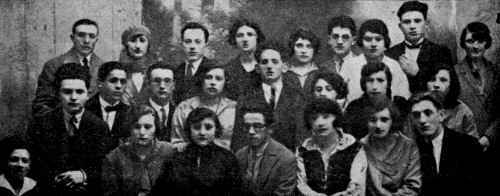
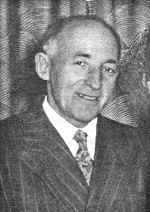
Seated from right: Pikman, M. Belzhitsky, Y. Leshna, B. Bombarski-Grinfarb,
Joseph Kettler
Standing: Pikman, L. Shpeizman Zilberberg, Eisenberg, Sh. Goldberg
|
[Page 79]
by A. Greenfarb, Tel Aviv
Translated by Seth Morgulas
In 1922, frequent and lively discussions began in the Gerer Zionist Association “Hatikvah” about different programs of the then-existing parties within the Zionist movement.
The Poalei Zion idea, of pioneering-socialist Zionism, founded by Ber Borochov and other socialist-Zionist theorists, was discussed there with great zeal.
A significant number of “Hatikvah” members were influenced by the ideas of Borochov. Among the most active of them were the comrades: Hershel Hammer, Eliezer Lipshitz, A. Greenfarb, Hannah Seidman, Hannah Rotblat, and others. This group began to conduct lively agitation and educational work among the “Hatikvah” members in order to gain sympathizers for the Poalei Zion program. This provoked strong opposition from those “Hatikvah” activists who held civic-Zionist views.
Sharp debates ensued, even quite stormy conflicts, during which the left-leaning comrades formulated and defended the socialist-Zionist idea at public meetings.
After a few months of ideological struggle, the group of Poalei Zionists realized that all efforts to continue their educational work within the “Hatikvah” association were futile. Their number there was small, and they were always in the minority in all the votes.
Therefore, it was decided to leave the “Hatikvah” association and to found a local group of the socialist-Zionist Workers' Party in the town.
The founders of the group, as active party members, distinguished themselves with extraordinary enthusiasm and dedication to the party's tasks.
[Page 80]
The first members of Poalei Zion Z.S. in Gritze were workers and children from poor homes. Gathering money to rent a room for the party was a dream for them. Indeed, in the early days, they gathered in Hershel Hammer's bakery and in the apartment of Mr. Bendit Bul, on Mogelnicer Street.
Despite all the difficulties and many obstacles from various actors, the Gritze Poalei Zion idealists developed a very vibrant activity in all sorts of organizational and professional fields. They successfully carried out many fundraisers for Keren Kayemet and for the then-Palestinian workers' fund. They also actively participated in all the actions of the town's professional workers' union and led some trade sections there. With time, the number of members grew. Their work also intensified significantly.
In 1924, with extraordinarily great effort, a very small attic room was rented on Amshinover Street. In this small attic room, all party work was reorganized. The devoted members gave their effort and time to the party. After the long, laborious workday, they would come to the party, which had become their home.
However, intensive cultural work was developed in this tiny attic room: self-education circles were organized, general, Jewish, and Zionist history, and political economy were studied. Lectures were given on Marxism, historical materialism, and Borochovism (“class interests and the national question”), and the work of Nachman Syrkin – “The Jewish Question and the Jewish Socialist State” – was discussed.
Public lectures were also organized with the participation of prominent Poalei Zion activists, well-known writers, and journalists. All cultural events were very successful.
The Poalei Zion members also cooperated very actively with the administration of the Jewish school in town. We participated in all fundraising events for the school, helped organize concerts, and thanks to the very successful performances of the member Bashe Bombolska, the dramatic section of the school organization always had success. This greatly helped to improve the poor material conditions at the school.
[Page 81]
The Poalei Zion administration established a youth organization called “Freiheit”. The work was led by comrades: Yankel Bui, Avraham Lesna, Shlomo Goldenberg, and others.
The older comrades educated the youth in a pioneering Zionist spirit. Lectures were held for the youth on historical and educational topics. The youth organization “Freiheit” quickly gained a good name in the town and thanks to its liveliness and activity, its number of members grew rapidly.
The “Freiheit” leadership often organized various entertainments, excursions, and meetings with “Freiheit” groups in the surrounding towns. The young people in their organization received a socialist-Zionist education. They later became the most loyal and best Poalei Zion comrades. And in Gritze they were well known as dedicated Zionists and labor activists. The party developed in them an unusual love for the Jewish people, for the Jewish and Hebrew language, and for the building, working Land of Israel.
Many of these young people, after finishing their training, immigrated to the Land of Israel.
In the thirties, the P.Z. organization in Gritze already counted more than a hundred members and was located in a very comfortable, large premises on Skarge Street. A very lively, active party activity was conducted there. Until the outbreak of World War II, in 1939, the Poalei Zion Z.S. in Gritze cooperated in many Jewish institutions and participated in all branches of Jewish social life in Gritze.
[Page 82]
|
|
|
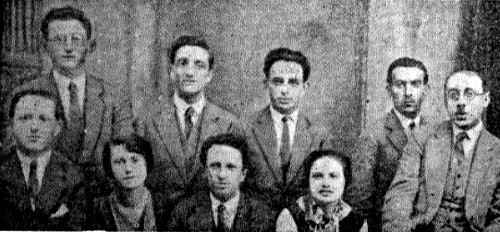
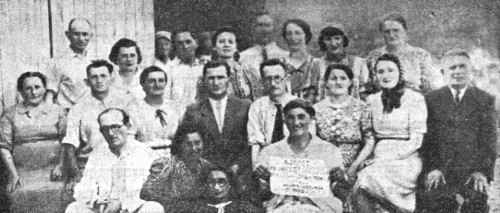
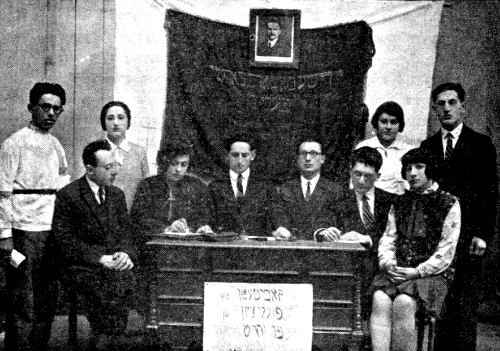
Seated from right: Pikman, M. Belzhitsky, Y. Leshna, B. Bombarski-Grinfarb,
Joseph Kettler
|
|
|
| A group from the “Freiheit“ organization |
Information from S. M. Rosenthal
Translated by Seth Morgulas
The religious party leaders of Agudath Israel in Gritze have achieved great merits: First and foremost, in organizing the religious Jews, especially the Hasidic ones, bringing a bit of secularism, enlightenment, political activity, and social discipline into the devout homes. The Gritze “Agudath Israel” activists were especially active in the years before the Second World War. They founded youth organizations: “Poalei Agudath Israel”, “Tzerei Agudath Israel”, “Bnos”, and a modern school for girls named “Beis Yaakov”.
According to information from Gritze native Sh. Rosenthal from Argentina, “Agudah” also founded a savings and loan cooperative in Gritze in 1925 – “Bank Kupiecka”. Only devout Jews could be members of the bank. The bank indeed gradually transformed into one of the strongest “Agudah” strongholds.
Thanks to the financial aid, “Agudah” gained many members, upon whom it exerted its political influence and compelled them to carry out party and local community decisions. The bank members received long-term loans up to 1000 zlotys – a very significant sum, which at the time enabled many Jews to maintain their economic existence. The bank management made the most extensive concessions for its members: if someone didn't have the exact money to pay the installment on the due date, their debt was extended. It never happened, since the bank existed, that a Jewish bill of exchange was sent for protest.
In those years, when Jewish trade was officially fought by the Polish government and the incited Christian population, the economic situation for Jewish merchants worsened significantly. Having little money, Jews were forced to trade on bills of exchange, and the bank provided discounts. Thanks to the institution's very good reputation and courteous treatment of its clients, 60 percent of Jews discounted bills of exchange at the bank. However, even in this case, the bank management made the most extensive concessions.
[Page 84]
The extensive banking activity earned recognition from the Gritze Jewish community for the noble bankers. Pinie Hershenfus, Yosef Eliezer Zylbersztejn's son-in-law, was the official cashier and trusted man there. His word carried weight and was honest. Chaim Braun was the president. He was also president of the Gritze “Aguda” organization. Chaim Braun used to dedicate entire days to the bank. From early morning until the late evening hours, he sat there and helped out with the work for free.
Working at the bank was a very capable secretary – a German refugee who had been expelled from his home after Hitler came to power.
This German refugee had a warm Jewish heart and a clear mind. He knew every Jew in town and their economic situation. In addition to the discounts the bank management offered, he would help everyone – both members and ordinary Jews – with friendly advice. He sought various means of relief when he realized that someone had no money to pay the bill. He was known in town as a convinced and active “Aguda” member. He was also active in all areas of the party. For city and community elections, he managed all the propaganda work.
The “Aguda” also founded a “Gemilas Chesed” (charity fund) in the same premises. The bank operated until 7 PM. Later, the same individuals managed the “Gemilas Chesed” fund. At the head of the institution were: Dr. Hersh Kern, Avraham Yaakov Rappaport, and Yisrael Klepfisz. Money was lent there only to poor Jews who were simply starving. The loans – one could call them donations, because dozens of borrowers didn't even start paying the installments – ranged from 100 to 200 zlotys. The “Aguda” supported institutions that were even run by worker parties. With money and activity, it helped in the children's kitchen, children's colony, and other charitable actions of various institutions.
The “Aguda” also opened a semi-modern Talmud Torah in the large Great Synagogue for poor children whose parents couldn't afford tuition fees.
Thanks to this multifaceted social activity, the “Aguda” activists in Gritze earned many friends and admirers.
[Page 85]
Indeed, the Gritze Jews gave their trust to the honest, noble community activists and sent them as representatives to the community, where they received a majority.
Their faction in the community was the largest and strongest before the war.
|
|
|
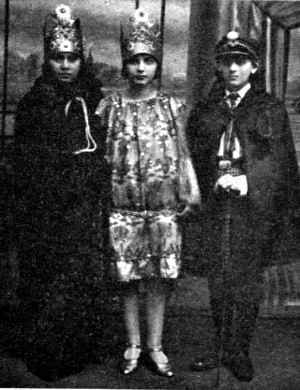
From left: Sarah Grinberg (Ahasuerus), |
[Page 88]
As I recall, on that Shabbos of Blessing, I wished my friends that they should follow my path and also ascend. To my great sorrow, they remained in the “Gritze”and together with all our loved ones were tortured by the Hitler beasts.
|
|
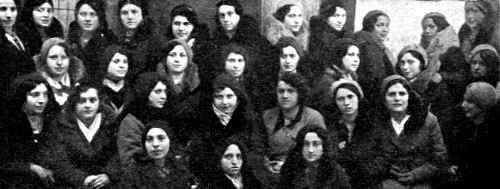
| The Daughters of Agudath Israel |
by L. Kula, Buenos Aires
Translated by Seth Morgulas
The socialist idea, which the “Bund” began to spread among Jewish workers in the early years of the twentieth century, also had a great influence on a group of intellectuals in Gritze. Together with many Jewish workers and common people, pious young men were also carried away by the momentum of the awakening Polish and Russian proletariat, which fought against the Tsarist reactionary regime.
The socialist-minded intellectuals, during conversations and frequent discussions, defended the revolutionary struggle of the workers as just and necessary for Jews. They were convinced that by overthrowing the Tsar and establishing a democratic Russia, the eternal Jewish problem would also be solved.
The socialist-revolutionary idea so inspired the intellectuals that in 1905 they actively participated in the revolutionary movement and later, fearing persecution, they emigrated to America.
The remaining Bundists, who stayed in Gritze, continued their educational work among the town's Jewish workers and were active in various cultural fields together with the intellectual Zionists. Zionists and socialists devotedly spread the Jewish book and founded a secret Jewish library, which was located at the tombstone carver Aaron Judi (tortured by the Germans).
Books were bought secretly and secretly distributed among the first readers. The book was often passed from one to another. The readers were afraid of the police and their parents, and of openly going to the library to exchange a book.
The secret library existed until the moment the Tsarist power left Gritze during the First World War. In 1916, the Germans occupied Poland. The Germans of that time, who still
[Page 90]
had human faces and even pretended they came to Poland as “liberators” and “culture spreaders” did not hinder the activity of Jewish cultural organizations. In all the cities and towns of Poland, Jewish cultural activity was out in the open. The secret cultural activists in Gritze also decided to open a legal library. The initiators of the legal library were: Yechiel Goldberg (buried alive by the Germans), M. Sanger, David Weissman, Yehoshua Chelemer, A. Finkelstein, Yosef Hammer, Ajzik and Yaakov Rinkewicz, Rafael Klepfisz, Avrehm'l Reiter, Feivel Artman, Leah Brickman, Hannah Rivka Bitter, Shlomo Varhaftig, Moshe Golombek, Motke Berger, brothers Rafael and Israel Klepfisz, Melech Bitter, Manes Sanger, and others.
After much laborious work, the first legal Jewish library, named “Yugnt-Bibliotek” (Youth Library), was opened on Chrobower Street.
At the first administrative meeting, a special committee was elected whose task was to furnish the library. This committee also included: Manes Sanger and Motke Berger, who personally donated all the wood material, and Yaakov Rinkewicz, who did the carpentry work for free.
The well-organized library was located in three rooms. In one room, books were exchanged, and the others contained a club and a reading room. The youth, who previously had to read a book in the fields, among ripening grain, or in a small forest, fearing their parents, as already mentioned, gladly welcomed the news that a place had opened where they could freely read a book and also spend time.
In the early days, devout parents tried to prevent their children from visiting the “heretical” library with its “forbidden” books. In many homes, sharp arguments occurred between parents and children. A large number of books were torn. Some parents waited for their children in front of the library and beat them soundly.
Despite all this, the library became a spiritual home for the Jewish youth. In the evenings, especially on Shabbos and holidays, the library rooms were overflowing and eventually became too small to accommodate all the visitors. A specially created cultural commission worked with love and dedication for the Jewish book and Jewish culture.
[Page 91]
The commission consisted of well-known cultural figures, whose task was to examine the readers during the complication of the uprising, in order to know if one was really reading, or just quickly changing books.
Every evening, discussions were held there on various topics: literary, theatrical, social, and political. The majority of visitors and members were non-partisan; there was no talk about the Jewish political parties that were then awakening to life in the Jewish towns. The Zionist and socialist cultural figures also did not engage in party activities there. They jointly cared only for the development of the library.
This idyllic period lasted until the date for electing a new administration approached. The old administration, wanting to secure its positions, began to fight among themselves. It divided into warring factions with outlandish names: the “Whites” and the “Blacks”. The first group was organized by the town's intelligentsia: Manis Zanger, the Weissman brothers, Yechiel Goldberg (all deceased). The second group was led by the cultural figures: Isaac Rinkewicz, Itche Finkelstein, Yehoshua Chelemer, and Motl Bitter.
The struggle of both sides lasted for months. All meetings were disrupted. It was impossible to reach any compromise understanding.
After long discussions, an agreement was reached: a commission was elected, which was to prepare the general assembly with the participation of a Warsaw representative…
To the designated general assembly came the “Warsaw representative”: Yosef Lifshitz. Or as he was called, “Yosef Bosak”. Many of us did not know then to which faction Comrade Lifshitz belonged. It never occurred to anyone that he was the secretary of the Warsaw Leather Union and one of the Bundist activists. Thanks to his organizational practice and tactful attitude, he succeeded in conducting the assembly without any disturbances. A new administration was elected. After the assembly, Yosef Lifshitz called all the “Blacks” to a special urgent consultation, at which he declared that all the “Blacks,” i.e., workers, belong in Warsaw to the “Bund.” For some of the youth, the word “Bund” was then still a foreign concept.
[Page 92]
The workers only learned about his basic ideas and goals from the speaker Yosel Lipszyc. The assembled crowd immediately agreed with the program and Ch. Yoself established the Bundist organization in Gritz.
In the first few months, no special political work was done. Meetings were often held half in secret. They were wary of the German authorities and informers. There were such informers in the town. We found this out when, after a secret meeting of the activists, the German police knew who had participated there and arrested several comrades.
I remember one incident:
During a meeting in Ger, a group of comrades were arrested. It was discussed at the time that this was a provocation. The party decided that L. Kula and the living Yosel Drajer (who perished in Białystok during the uprising) should investigate the matter. Suspicion fell on a certain homeless young man from Pinsk. Later, it turned out that he was a provocateur.
The entire time of the German occupation, we conducted party activity in secret and were always afraid: now we will be arrested.
The legal activity of the Bundist organization in Gritz began after Poland's liberation. The number of members in the party grew significantly at that time, and actual party work began. The main work consisted of organizing cultural events and running the library, which by then, after the split, had a different name, the “Peretz Library”, run by the “Bund”.
The Peretz Library
Thanks to the joint work of the Bundist comrades in the library, the number of books increased to 6000. The number of members and readers also grew. It became crowded in the three rooms on Chrobrower Street. The management had to move the library to a new, larger apartment on Amshinower Street, with Yitzhak Braun.
In the very comfortable apartment, the management had the opportunity to reorganize the cultural work.
A choir was founded, conducted by Yitzhak Bornstein, a collaborator from the sports department in the Warsaw “Moment”.
[Page 93]
Later, the gifted composer and conductor M. Szneur led the choir. The choir, which was known in Poland and often praised in the Jewish press, performed with it in Gritz and in several surrounding towns. Stable vocal and singing concerts were also organized, in which the best artists participated: Garbarz, Morevsky, Z. Turkow, Ida Kaminska, Yonas Turkow, Grossbart, Rachel Holzer, whose arrival in Gritz turned into a holiday. She was very loved by the Gritz youth, who literally did not let her off the stage boards. Also appearing were: Wolfstat, Yossele Kolodne, Kipnis-Zeligfeld and Rudeniaw-Levyash.
During Rudeniew's performance, an interesting incident occurred:
Among the invited guests was the local starosta with his wife. When the artist sang the song “A Goy Walks Into a Tavern”, the starosta and his wife left the hall. After this incident, he immediately withdrew the legalization of the library. However, it was reopened under the name Jewish People's Library.
The Jewish People's Library and “Morgenstern”
The same cultural activists returned to work. A sports club called “Morgenstern” was founded. The main work of the club consisted of organizing a football team, which, through successful matches, quickly created a good name for itself and became famous throughout the region.
The team included the following individuals: Mendel Blashevich, Chaim Daniel Zilberstein, Avraham Kaper, Shimele Friedman, Chaim Leizer Tober, Yuzhu Hirsch, Yankl Kurtz, and Chanale Rosenthal.
A dramatic section was also founded, and in general, almost all of the social and cultural worker life of the town gravitated towards the library.
In the evenings, it was noisy and quite lively there. They worked with dedication and were happy that they were creating something beautiful and valuable.
[Page 94]
Regrettably, the work was somewhat disrupted later. Ideological disputes began; communists appeared among the Jewish workers, who began by merely discussing, later raising their voices until they often came to blows. The party struggle intensified more and more. This disrupted the further development of the library. What one faction planned, the other opposed. The party struggle again led to a split in the library. The “Bund” opened its own library, under the name “Kultur-Liga”.
Kultur-Liga, “Tsukunft” and “SKIF”
Moving into a new, comfortable premises, the “Bund” began to recruit new members for the “Kultur-Liga”, which already included many Bundists and sympathizers, former members of the new library.
The Bundist activists began to focus especially on organizing the youth. The youth organization “Tsukunft” is growing apart, and the “SKIF” – Socialist Children's Union – is being organized, headed by: Yankel Frajdenrajch (deceased in Russia) and the Bundist councilman, the beloved Rafael Klepfisz (tortured by the Germans). From the youth organization grew the conscious Bundist activists: Yankel Ball, Yankel Frajdenrajch, his brother Yechiel Frajdenrajch, Shimele Friedman, Leibish Lemberger, Blume Drajer, Yehudit Kulia, Rozhke Klepfisz, Mania Kurtz, Pesele Drajer, the Rozhenholtz brothers, Sarah Itte Bitter, Balche Himelstein, Isaac Zilberstein, Chana and Tobe Brommer, Zelik Masher, Moshe Mendel Zilberstein, Mania Perlman, Laser Bitter, Miriam Blanke, and others. In “Tsukunft” various circles were organized, under the name Lichtenstein, Michaelovitz, Kmurner, and others.
The Bundist activists generally set themselves the task of recreating what they had lost, leaving the large “Folks-Bibliotek”. They organized a new drama circle, a mandolin orchestra, and a choir, conducted by the well-known, musically gifted Glatshtain.
Almost every Saturday, lectures were organized by the leaders of the “Bund”: Erlich, Pot, Mendelson, Oscherovitz, and Alter. All lectures and concerts were carried out with great success. We had
[Page 95]
spiritual enjoyment and also material benefits.
A school with Yiddish as the language of instruction
After the First World War, secular schools with Yiddish as the language of instruction were established in Poland, which later organized into the Central Jewish School Organization (Tsisho).
In 1924, we in Gritz also joined in organizing such a modern school with Yiddish as the language of instruction. On a Saturday afternoon, a group of parents gathered at the home of Złotagórska to discuss the issue of founding such a school.
The following participated in the first meeting: S. Josefowicz, M. Neiman, R. Klepfisz, Joseph Drajer, Sh. Chelemer, M. Berger, Dr. Kasher (all perished) and L. Kulia. The meeting was opened by Dr. Kasher. He spoke about the necessity of opening a Yiddish secular school in Gritz. The attendees became very enthusiastic about the idea and, on the spot, pledged 600 zlotys for the cause (at that time, a very significant sum). Dr. Kasher entered into a frenzy. He presented
|
|
|
From right standing: Dr. Kasher, Shaye Chelemer, Ankerman, LeibI Kulie, Joseph Drajer
|
[Page 96]
We understood that this was connected with colossal expenses. It was decided to refrain, for the time being, from realizing Dr. Kasher's proposal.
A few days after the meeting, we rented a place at 18 Amshinover Street and opened it. A kindergarten with a first grade. Ch. Blumenthal, Nahman Meisel's sister, was hired as a teacher. The number of children in this educational institution increased.
|
|
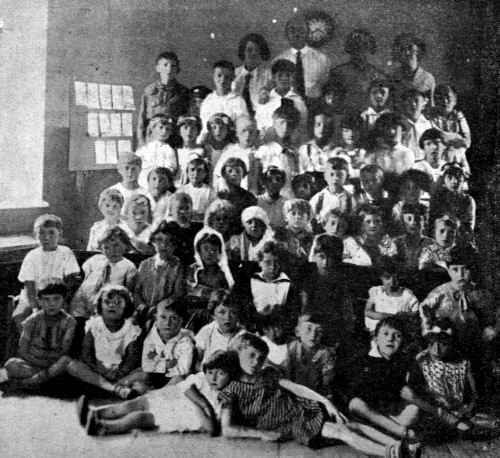
| Mrs. Hiller from America visits the Jewish school in Gritze |
[Page 97]
She would work and help the teachers. Chaya Gorenzweig. She worked very diligently. Often, finishing the Central Training Institute and the pedagogical staff, and primarily the love, all visitors to the school admired the hygienic conditions.
Lipshitz – the son of the Gritze Rabbi, and Blume Drajer – the daughter of Israel Drajer and 5 teachers from the Central Training Institute, one Gritze teacher, Moshe, and one assistant, worked there. Each teacher taught in two classes. Later, in 1931, there were already four classes. Two teachers were employed.
|
|
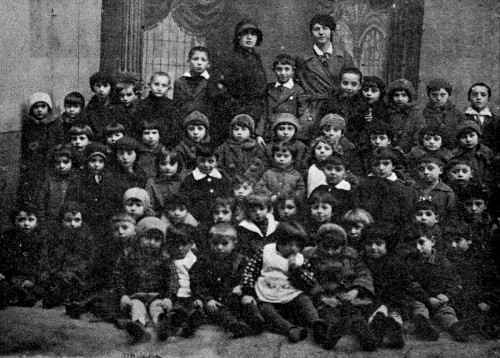
| Children's Home at the Jewish School Organization in the year 1929 |
[Page 98]
|
|
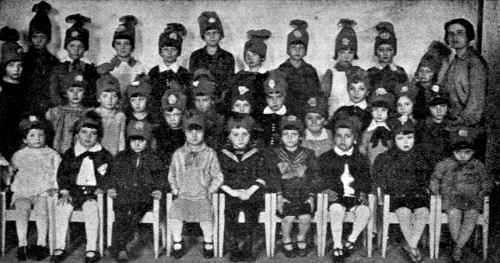
| A group of children from the first grade of the Jewish People's School in 1929 |
|
|
|
(TSYSHO – Tsentrale Yiddishe Shul-Organizatsye / Central Yiddish School Organization)
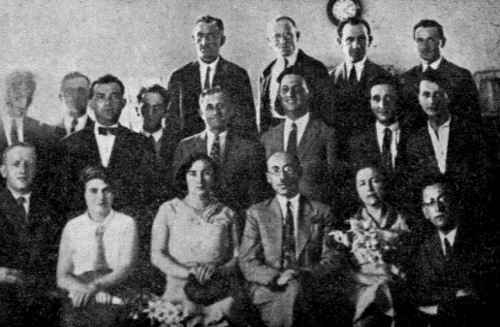
Seated from right: Y. Drajer, S. Blumenthal, Dr. Kasher (name not known), T. Josepowicz.
Standing: Yankel Bul, L. Kolya, Y. Gorencwajg, Rafael Klepfisz, (name not known), Motke Berger, (name not known). Last row – seated: M. Weissman, Y. Zaidman, Ch. M. Naiman, Itshe Finkelstein. |
[Page 99]
The school managed to survive thanks to the minimal tuition fees and the hard-fought, meager subsidy from the municipal administration. The largest income flowed in from the consistently successful events that were carried out with great results.
We worked with devotion so that the school would exist. In general, all the cultural institutions that were created were guarded like the greatest treasure. We gave our best years to them, all our youthful strength, our entire energy. But it was worth it. We were proud of the cultural institutions, of the fine, conscious youth – that was our glory.
I will never forget the day when I was invited to the Yiddish school to say goodbye to the children before my departure for Argentina. Two children came up to me and handed me a plaque on which a little green tree with lily leaves was painted. The picture was tied with a green silk ribbon.
On the plaque was a large inscription: “To the Chairman L. Kulie – a happy journey.” One child then turned to me with these words: Comrade Leybl! In the name of the children of our school, we turn to you, asking that you not forget what you helped to build, and give our greetings there to our Gritzer [people from Gritze]. Beautiful, bygone days!
I left for Argentina. Our leaders of cultural work also arrived there. From far-off Argentina, we longed for our shtetl, for that vanished Jewish life, for the excursions into the Cęstochowa IKA forests, for the happy evenings spent in the youth library, the Peretz library, the people's library, in the school, for the discussion evenings, and also for the party squabbles in the trade union. We dreamed of coming home one day and seeing everything that we ourselves had helped to build. We longed for our loved ones and always hoped to meet again with father and mother, family, comrades, friends, and mere acquaintances. The German extermination of the Jews destroyed all these dreams. A shudder goes through my body when I remember the perished Jews of my home shtetl, Gritze
[Page 100]
Can all this be forgotten? No! Impossible. Not a single survivor can forget his loved ones and acquaintances who were so murderously tortured. It is also impossible for me to forget my dear and beloved family, my colleagues and dear friends: the darling Rafael Klepfisz – Bundist councilman, the quiet and calm Shmuel Juzefowicz, Jehoshua Chelemer, Jechiel Goldberg, and the one who fought so stubbornly in the Grójec city council to subsidize the Yiddish school and for social justice – Josef Drajer, who was active in the anti-fascist committee in Białystok and fell so heroically at his post. No, I will never forget that.[1]
Editor's footnote:
by Leon Oler (Probus), New York
Translated by Seth Morgulas
On June 12, 1952, Isaac Rinkewicz died in New York; he was once the central figure of the Bundist movement in Gritze and in the entire surrounding region.
|
|
| Isaac Rinkewicz |
He departed into eternity and took with him many memories, facts, and experiences that were connected to the stormy years in the life of the Jews of Gritze – years of cultural, social, and political upheaval: the years 1917–1921. The one who would have been most able
[Page 102]
to tell about this time, the creator and builder of this magnificent Bundist movement – Isaac – was, however, unable to do. In the last months of his severe illness, he often mentioned how necessary it is to write down the most important things that were done then, and also how necessary it is that those who gave their best strength and youthful enthusiasm to the struggle for socialism should not be forgotten.
Gritze has inscribed itself with unforgettable lines in the history of the Jewish socialist movement – in the history of the “Bund” in Poland. Already during the first city council elections in Poland, in the year 1919, Gritze's Jewish workers and common people gathered around the “Bund.” Later, a long chain of Bundist deeds unfolds, so that the history of the Bundist movement in the small town is such an extraordinary phenomenon that it would deserve a special study, a larger monograph. For thiys, documents and archives, memories and memoirs of all those who could tell something or pass it on in writing about this period would be necessary.
Gritze, however, belongs to the hundreds of Jewish settlements that were destroyed during the last great catastrophe. Because of this, in this article, which should also simultaneously be a remembrance of Isaac Rinkewicz, we must rely only on what my memory has kept within itself, and on what the heart carries within itself: sentiments and feelings of past experiences.
When I came to Gritze in 1919, I already found a bustling social-political life there. This year has been etched into my memory, because everything I saw and heard there, in the small town, had a strong effect on me, despite the fact that I had come from bustling Warsaw.
Isaac brought me down to Gritze. I went there for party and social work. And it only took a few days for me to be convinced of what role the former yeshiva student, the son of the great scholar and town Talmud teacher, Bendet Rinkewicz, played. He grew spiritually over the course of a few years and
[Page 103]
along with him, just as quickly and noisily, the town also grew. The town of Grójec, 44 kilometers from Warsaw, did not possess any industry. It did, however, possess a considerable hardworking mass: craftsmen – cart and saddle makers, tailors and cobblers, who used to sell their finished goods at the markets and supply the surrounding peasants. They and their journeymen, together with the bakers and porters, formed the working public, the proletariat of the town. The only place where they used to gather was the beit midrash (house of study) or the tavern.
Later, a cultural movement began among the middle-class youth. The former yeshiva students tore themselves away from the beit midrash and went off to a new rabbi: to Peretz. The first among them was Isaac, who more than once told of the impression that Peretz's funeral had made on him. Isaac remained in Gritze and decided that in Gritze, too, just as in Warsaw, Peretz and other Yiddish writers must be read. The first institution that was created then, in the years 1917–1918, was the library, and at the library, a choir and a dramatic section were later founded. The entire town was stirred up, and first and foremost the youth, regardless of social stratum. To the library, choir, and dramatic section belonged everyone then: the rabbi's daughters and the cobbler's son, the daughters of the finest Hasidic families and the children of the peddlers.
Organizing a cultural evening with a dramatic staging and a performance by the choir was truly a revolution in the town, and the initiator, the organizer, and the executor was Isaac Rinkewicz. I believe that there are still somewhere former s of the library administration, of the choir, or of the dramatic circle who re those years when Szneur, the well-known folk conductor, and Yosef Szyd?ło, the Yiddish-Polish artist, used to come week in and week out to Gritze, brought there by Isaac.
Almost the entire town youth used to come to the cultural evenings. Not for long, however, did Isaac and his group of active collaborators content themselves only with cultural work. Not far away, in Warsaw, a branched professional and political activity was blossoming. This activity could not remain without an echo in Gritze. Isaac
[Page 104]
decided to create trade unions. He organized the tanners, bakers, tailors and shoemaker apprentices, and the porters in the mills. In 1918–1919, the entire town's workforce belonged to the trade union. The organizational work was carried out so quickly and so comprehensively that the union became the undisputed arbiter of working conditions in the town. Very quickly, the feeling of proletarian solidarity closely bound the workers of the different trades. It was not rare for the porters and bakers to abandon their work in order to help the shoemaker or tailor workers in their strikes. For the town's youth, cultural work alone was not enough.
The echo of world events and revolutions reached Gritze very quickly. Political organizations – both of the youth and of the older generation – arose as if by themselves. But at the head of both – of the party, Bundist organization, and of the youth organization “Zukunft” (Future) – was, once again, Ayzik. Over the course of a few years, he managed to recruit and draw into active cooperation the best of the town's youth. At first, these were management s of the library: Manes Zanger, Yechiel Goldberg, Shaye Chelemer, Leah Brikman, Chana-Rivka Bitter, and others. Later came the activists in the professional movement and in the party – the more active ones, who could not be content with their role as cultural workers; they became the first s of the Bundist party committee in Gritze: Manes Zanger, Yisroel Likverman, Chana-Rivka Bitter, and Finkelstein the tinsmith.
Around this group of about twenty people gathered a crowd of several hundred, the most active, most dynamic part of the town's working population. Both the youth and the older generation, who read a lot, discussed a lot, and learned a lot in self-education circles, as well as reading circles and lectures. Warsaw was close, and very often the organization would bring lecturers down from there.
Ayzik would always ensure that lectures took place on Saturdays. The lecturers were often paid more with bread and other food items than with money. These were the years of great food shortages, but also the years of great spiritual hunger.
[Page 105]
At the library, there existed an evening school; lectures and courses helped the youth prepare for school, for middle school in Warsaw. However, more attention was paid to political education and enlightenment work. With what enthusiasm the small-town youth used to receive the lecturers and speakers who would come to them! So sincere was the friendly feeling of the listeners, so deep their gratitude, that the speakers used to be moved. It was not for nothing that the Bundist leader Vladimir Medem reed well the town of Gritze, where Isaac had brought him. Medem's arrival in Gritze turned into a popular holiday; almost the entire town came to hear him. And the youth welcomed him with bouquets of flowers. This deep, all-encompassing cultural and enlightenment work later yielded its results; during the first city council elections in independent Poland, the Bund had a great victory.
We must also mention one more area, and a very important one at that: In the first year of Poland's independence, provisioning – supplying the population with the most necessary items – bread, sugar, kerosene, and coal – was difficult, very difficult.
The Polish population in Gritze had its economic institutions that took over these functions – these were the “spó³ki” (cooperatives) and cooperatives. Isaac decided, following the Warsaw model, to also create a consumer cooperative in Gritze.
Very quickly, the cooperative became the sole distributor of rationed products among the Jewish population. The trust in the cooperative was so great that the Starosta of the Gritze district gave the cooperative the right to purchase or requisition grain from the surrounding noble estates for the needs of the population. Isaac also managed to attract people to this work who worked selflessly, giving their time and effort.
More than one of them hauled sacks of products on their shoulders and then stood for whole hours distributing them – let those mentioned here be Leibish with the small-town nickname “Chip-Chip,” Finkelstein the tinsmith, Shaye
[Page 106]
Chelemer. As I have already mentioned earlier, the cultural work in the shtetl took off in the years 1916–1917; the movement reached its high point in the years 1919–1921. In this small place, the characteristic features of the Bundist movement were revealed. Just as in the large centers – Warsaw and Łódź – in Gritze, too, the same people, the same activists, leaders, and simple s of the organization, were able to engage with the most important problems of the international workers' movement. They could passionately discuss the revolution in Russia and in Germany, argue about the tomorrow of a proletarian Poland, and at the same time not lose their sense for real, day-to-day life and needs. They put the same enthusiasm into political work as into professional and economic activity.
These people did not then make any distinction between “great” tasks and the small daily worries of the working person and laborer. And because this work was done with devotion and persistence, the success of the Bund grew. Many young people came to the Bund. Those who had seen or participated in the first Russian revolution in 1905 also returned to it.
Years of tireless, painful, persistent work yielded their harvest – the Bund became the organization of the Jewish laboring population of the shtetl. And even the persecutions by the Polish government had no influence whatsoever on the mood of the working Jewish population.
In July 1920, the Polish government outlawed the Bund. In Gritze, just as in many other places, the following were arrested: Ayzik, Shaye Chelemer. It is possible that others were also behind bars. Unfortunately, I do not re any more names. Incidentally, I myself had to go into hiding and flee from Gritze. And I must mention that the one who risked himself and led me out of the shtetl was Peretz Langer – an unforgettable character, about whom it is worth mentioning: Peretz Langer – a tanner, who would proudly parade through the shtetl in shoes made of leather that he himself had tanned
[Page 107]
was a Bundist devoted heart and soul and listened attentively to the passionate discussions at the long-hour party meetings. True, he could not always hold back and would burst into loud laughter, bringing cheerfulness into the overly serious atmosphere. He took to heart what he was told then about the Russian Revolution, and finally left for there, to see the “new world” with his own eyes. Not only him, another comrade of his, a of the Bundist committee, a former yeshiva student and later an external student – Yisroel Likverman, also left for there to seek education and work for the benefit of the revolution. They left, and very quickly every trace of them was lost…
These memoirs cannot convey the full color of the Bundist activity in Gritze, if I were not to at least mention, in a few lines, some local characteristic types: Moshe Mihael Bitter, a military saddle and harness maker, limped on one leg and told everyone that he owed his crippled leg to a bullet he received in 1905 as a young Bundist. He was much older than the others of the party and could not understand why they argued so passionately and stubbornly about formulations and slogans. They were once discussing Geneva or Moscow. He suddenly exclaimed: Before going straight to Moscow – let us first stop in Ger… Ger is closer.
To his ears, Geneva sounded like Ger. Of a completely different cut was Feivel Artman, a respectable, calm man in his middle years. A father of two children, who traded in grain and with noblemen. It was during the time of the elections. It was necessary to send someone to the city council who would be able to read the declaration of the Bundist faction at the first meeting, a declaration that had to contain both general programmatic formulations of a socialist party and concrete goals that a socialist city administration would set for itself. Without any hesitation, he accepted the mandate, later had to go into hiding during the persecutions, and remained unyielding thereafter. Finkelshteyn, the tinsmith, whom one could easily drag down from the roof,
[Page 108]
where he often used to work, in order to go to the municipal offices – to intervene, he would gladly, even after the hardest day of work, go off to meetings of the various organizations to which he belonged. A man of clear, sound judgment, feeling, and understanding for economic matters – he was the treasurer of the consumer cooperative and of the party.
More than once he would say with a good-natured smile: “My Chana will give me a scolding for coming home so late – she will have to warm up supper again.” Chana Bitter – a of the first committee of the Bund in the shtetl – was Moshe'l Bitter's daughter. He was called Moshe “the Gentile.” When I came to the shtetl, he was already in his fifties, of the older generation of maskilim. A Jew, a musician, who had his own choir and orchestra: all the children, sons and daughters, sang and played. And what an Oneg Shabbat he had!
When the shtetl intelligentsia: the teacher, the doctor, the passing social or cultural activist, would gather at his home, that was a true holiday. From his hospitable table, one would enjoy a double treat: food and even tastier singing. A progressive man, he kept his home open to everything that was fresh and new. His eldest daughter – Chana, a teacher, became politically active very early, becoming a member of the party committee while young. She later left the shtetl, also for Russia – and disappeared there. From this same home also comes the only son, Melech, now Mark Bitter, the escapee from Majdanek, today a communist activist in Poland. The entire family: Gitel and her husband Hershel, the son Shanan, Hinde and her husband, Frimet and her husband and child were murdered by the Germans.
Although not a native of Gritze, Shlomo Wahrhaftig must be mentioned here, the later-known Bundist activist in Białystok, who spent several years in Gritze and participated very actively in the work there. And finally, I want to dedicate a few lines to the unforgettable Raphael Klepfisz, a son of a religiously enlightened family; his father was the dayan in the shtetl. While still a young man, he drew closer to the socialist movement, possessed a strong will and
[Page 109]
ambition – he wanted to study. With perseverance, he devoted all his free time to learning. He became an external student and was admitted to the University of Warsaw. He remained just as steadfast in his socialist work. Later, when the town went through the difficult time of the split, when Isaac and many of his colleagues left, he remained the loyal Bundist, the leader, and the activist. He perished a martyr's death. I had the last greeting from him through Comrade Gotayner, who met him in a wagon packed with Jews, being dragged to a German camp. By chance, a piece of a newspaper appeared there, a torn-off leaf – Raphael fell upon it thirstily and devoured every line.
Jewish artisans and Jewish merchants used to come into contact with the Polish population of the town and the surrounding area. However, this was merely an economic contact. Only the Bundist movement brought the workers of both peoples closer, who had lived as neighbors in this town for many decades.
The Bundist consumer cooperative already connected the Grójec Jewish workers with the Polish central cooperative – with “Spo³em” in Warsaw. But it was only in the party organization and the election campaigns that the Jewish and Polish socialists were brought closer. The young Polish socialist organization in the town – the P.P.S. – did not have any activists of its own; the notary's daughter and the pharmacist's son led the movement in the town, which, however, had a colossal number of sympathizers outside the city.
When the city council elections showed that the Bundist organization in Grójec was strong, the P.P.S. drew closer to it, and the then-Sejm deputy Dobrowolski handed over the supervision of the P.P.S. organization to the Bundist committee: he asked the Bundist activists to help the P.P.S. with advice and action.
The attitude of the peasant movement toward the toiling masses in the city also became friendlier.
I remember May Day in 1920. The town market was packed with thousands of peasants who had come from the surrounding villages with scythes “on point,” decorated with green and red ribbons. Hundreds of red flags and banners of the workers from the surrounding sugar refineries
[Page 110]
in Yoshenits (Jasieniec). The Bundist train firmly integrated into the vast world. The P.P.S. deputy Dobrowolski spoke, and after him, the leader of the local P.P.S., Dr. Czarnecki, was supposed to speak, but he did not come. It then fell to me to speak on behalf of both local organizations, both in the marketplace and in the People's House. In my life, it happened more than once later that I had to appear at meetings of thousands of Polish and Jewish workers. Yet, to this day, my experience has been deeply etched in my heart, when a thousand mouths loudly shouted their agreement with what was said in Polish and Yiddish by the young, twenty-year-old Jewish socialist.
After the speech, an old freedom fighter stood up in the People's House, whose father had once fought against the Tsar, and with a moved voice greeted the young Jewish socialist who was fighting together with the Polish working man for a better, brighter Poland.
If a word of disbelief and doubt ever came to my memory, which had escaped a young Jewish student, that the youth is without a goal and without a tomorrow – images would immediately float before me of a packed hall with a youth full of faith and courage – a youth striving and storming; there would appear in my imagination the green-red-decorated marketplace, in whose waves of people were also found the masses of the Bundist party with its youth.
I did not undertake to give a detailed history of the Gritzer Bund, and I also did not think to give silhouettes of everyone who was actively involved in Gritzer. I only wanted to sketch a few strokes and tried to revive, to refresh memories among those who remained alive and re those times.
by Rafael Bruin
Translated by Seth Morgulas
In the year 1917, a professional labor union was founded in our town. The Gritze Jewish workers placed many hopes on this professional organization, which would fight for better working conditions for them, raise the then-low wages, and reduce the working hours per day. At the beginning, all trade sections worked together under the leadership of the secretary Shmuel Gayer. Later, when the number of s increased, each trade had its own section and conducted its actions quite separately.
Within a short time, the union became an important factor in the life of the Gritze Jewish workers, who used to come to their organization every evening. In the union premises, it was homey: people discussed world problems, mainly how to save humanity. The discussions were heated, full of faith and sincerity of soul; here in the union, all the political labor parties of the town were indeed forged.
In the professional field, the union accomplished relatively much, settled labor disputes, encouraged the then-spiritually depressed Jewish working person, and helped to improve his very low standard of living a little. The union conducted its activities for only a short time until the police closed it down.
However, the Gritze labor activists did not want to give up their professional union. After a few weeks, they opened a new union on Warsaw Street, actually right opposite the town prison…
In the new union, the workers of the following trades were active: wood, tailoring, and leather.
The first main action of the newly opened union was – to fight for a ten-hour workday. This, too, was a great [achievement] at that time…
[Page 112]
It was not so easily achieved: in the autumn, before the season, in almost all trades, the union declared a strike of several sections. The workers won: they received raises, but after the New Year, after the season, the bosses reduced the wages back. The activists in the union fought with determination against the reductions.
Also, the struggle to introduce an eight-hour workday was very difficult and took a lot of time. The first trade that won this struggle was the rimazhes (coachmen/drivers). Their section had few s but was well organized.
Other trades: tailors, carpenters, shoemakers, gaiter makers did not fight at that time for the eight-hour workday, because these professions were occupied more by Poles, and it was very difficult to find a common language of understanding between the Jewish and Polish workers.
It must also be noted that there was almost no one to fight against. The bosses themselves, the employers, were paupers in “seven falls,” not even possessing the most basic human necessities for their own families. A baker section was also organized. This was before Passover. The matzah-baker workers took advantage of the season, led an action, and won something.
Besides the activity in the economic field, the trade union also occupied itself with cultural work. Lectures, presentations, and discussions on various topics were organized. The artisan-bosses also had their artisan union. The founders declared that their union was necessary not so much because of the frequent strikes of the workers, but to improve the working conditions of the craftsmen. But in fact, the artisan union occupied itself with labor disputes.
Both organizations were very active. Due to the spread of antisemitism and hooligan attacks on Jews, an understanding was reached between both unions, and a self-defense organization was created, led by Yosef Drajer. Jews from all strata joined the self-defense with one task: to defend themselves against hooligan attacks. The defense organization indeed prevented pogroms from occurring in Gritze, as they did in other small towns in Poland.
by Yaakov Kristal, Tel Aviv
Translated by Seth Morgulas
Until the year 1912, the middle-class element among Jewish artisans in Poland did not dream at all of unification or social activity. Only in 1912 was the first artisan club founded in Łódź by Eng. Jan Kirszrot – it had to call itself that due to the Tsarist laws, which created all sorts of difficulties for the existence of social institutions. A little later, a similar club was formed in Warsaw on Zimna Street.
During the First World War and immediately after the war, the Jewish artisan in Warsaw organized himself, developed social activity, and sent his representatives to various political and social bodies. Already in the year 1916, the artisan activists in Warsaw thought about traveling around the province in order to clarify to the artisan there the necessity of unity and organization, but due to the war, we did not have the possibility to move freely. Also, meeting with the Jewish artisan in the province was difficult. The Jewish artisan was then beaten down by the difficult war experience and the long workday.
In the year 1920, when the Polish-Soviet war ended, the central artisan activists set out into the province in order to encourage the Jewish, dejected artisan toward social activity.
The more life normalized, the more regularly we visited the Jewish small towns. I was one of the visitors and organized a large part of the provincial artisans.
In the year 1920, on Saturday, November 5th, I, along with comrade Avraham Goldberg of blessed memory, visited the small town of Grójec. I remember the warm welcome that the Grójec artisans gave us. The municipal People's House
[Page 114]
was overflowing with Jewish artisans. Dejected, with looks of despair in their eyes, they sat quietly, listening curiously to the disseminators of a new artisan “Torah.” We clarified our ideas and movements for them: “The craftsman must be drawn into political-social life and occupy an important place there.” It was decided to establish an artisans' association in Gritze. Unanimously, a board was elected consisting of the following comrades: M. Becker, Preisendreich, Amberg, A. Hecht, N. Mepen, A. Bitter, Seidman, M. Ambaras, Toper, Brumer, A. Morgenfeld, F. Merker, Messinger.
The board elected Comrade Goldberg as chairman. It was also decided at that time to establish a cooperative.
On May 28, 1927, I visited Gritze again. The artisans were by then already represented in the community, the city council, and had their own bank directors and leaders of various communal and social institutions. In the small town, a Jewish life pulsed and bubbled.
Translated by Seth Morgulas
In the state public school, 900 Jewish children studied. They were instructed in the Polish language and in the Polish spirit. The majority of the students were from poor homes. As the liberal Polish school director reported in 1934, most children came to school without food and were poorly dressed.
In order to help the poor children, a Jewish relief committee was created at the school consisting of the following persons:
|
|
| Parents Committee of the Jewish State Schools |
Dr. Baum, Yosef Tepper, Berele Zilberberg, D. Herszenfus, Miriam Greenberg, Motele Hochberg, Hershel Finkelstein, Rosenthal, Shmuel Josepowiczcz and his wife, Złotogórski with his wife Chayetshe, Feige Leah Rosenthal, Sheyele Gelbardt, David Berman and his wife Frumtshe, Sarahle Neiman, Dvora Drajer, Sarahle Groman, and Rivka Zeifman.
The committee organized a concert for the benefit of the poor children. After the concert, it was decided to give the children breakfast every day: a roll with milk. Clothing was also purchased, which was distributed to those in need. Thanks to an intervention with the city mayor, the magistrate donated chalk, ink, pencils, notebooks, and other small writing supplies.
[Page 116]
The parents' committee also turned to the Jewish cultural institutions, and they contributed their assistance. The Jewish People's Library, with the help of the “Bund,” organized a concert at which its choir of 50 people performed with a mandolin orchestra. Kaplan conducted. The entire proceeds went to the school committee. The Jewish brass band also gave a concert for the benefit of the poor children.
The committee expanded its work. A kitchen was founded for 300 students. In practice, poor children who did not attend the school also received food there. Even poor adults often ate there as well. The supervisors of the kitchen were Motele Hochberg and Feli Rozental. The kitchen was located in the “Tarbut” school on Krakower Street. Shoes were also purchased for the children.
It must be mentioned that the dedicated Dr. Boim examined the children for free. If he saw that a child was sick, he immediately alerted the committee, demanding help.
In the pre-war years, the economic situation of the Jews of Gritze worsened. This caused many malnourished children to become sick. The committee called a parents' meeting with the purpose of saving the poor, sick children. It was decided to establish a colony in a wooded area. In Częstoniew, a village near Gritze.
A special commission took care of the colony: Berl Zilberberg, Sh. M. Rozental, Motl Hochberg, Hershl Finkelstein, Motke Berger, and also the parents' committee.
The commission worked very intensively. They rented two rooms and a large “stodole” (a barn) from a farmer. A teacher and 2 cooks were hired. Carpenters then volunteered, who made little beds for free. Wood and iron were donated by D. Weismann and Motke Berger.
Everything was finished quickly. The first group of 100 children received full free maintenance in the colony for a certain period of time. Not only Jews admired the self-sacrificing work of the committee; even for Poles, this was a model institution. They criticized their own directors as to why the Polish schools did not take an example from the Jews.
[Page 117]
The committee had decided that two committee members must spend the night at the colony every evening. Doctor Baum traveled down every day, free of charge, to check the hygienic conditions and the state of health of the children. The first group of 100 children returned. Their appearance was admired by everyone. They were cheerful and happy.
The second group of 100 children was sent out. They also returned happy and satisfied. When preparations were being made to send out the third group, the war broke out. Our plan was destroyed. These school children, together with all the Jewish children in Grodno, were the victims of the German mass murderers.[1]
Editor's note:
Translated by Seth Morgulas
As we write elsewhere, most Jews in Gritze were occupied with trade and a small part also with crafts. The craftsmen barely earned a living. They used to work with their families for many hours a day in order to scrape together a meager livelihood. Against this productive part, the Polish bourgeoisie raised a bitter, antisemitic struggle.
Soon after the emergence of independent Poland, after the First World War, economic anti-Semitism began to grow strongly in Gritze, as in the whole country. In the thirties, the Jew-hating Guild Law was adopted by the Polish Sejm. Every professional had to have a special permit (trade card) to be able to run his workshop. Such permits were issued by the Polish, anti-Semitic guild, which caused Jews great difficulties in obtaining these certificates.
The leader of the Gritze guild association, Ravinski, was known as a great Jew-hater. Despite the fact that formally there were Jewish representatives of various trades represented among the members, such as: Getzl Rotblat (tailor), Leibel Kurtz, Yosl Weintraub (carpenters), they nevertheless had little influence when it came to issuing a diploma to a Jewish craftsman. The candidates had to pass a professional examination.
Besides professional questions, actual trade exams, the examiners also used to force the older Jewish craftsmen to answer questions about Polish history, geography, and other subjects, which the simple craftsmen could not answer. All this had one goal: to take away from the Jewish craftsman the possibility of being able to independently run a workshop. The officials of the guild later became a little softer.
[Page 119]
The Jewish settlers hinted that if one were to “grease palms,” the exams would become easier. A new bribery-based livelihood began. It was worse at the tax office. The Jewish representatives there: Moshe Ambaras (artisan), Yisrael Binem Gisser, and Moshe Rochman (merchants) had almost no say in handling and determining the taxes.
The tax assessments were different for Poles in the same trade and completely different for Jews, even when they were much poorer than the Polish merchants. The poor small-scale traders suffered especially from this tax system. The wealthier ones somehow settled their affairs in the private homes of the tax officials…
The Gritze Jewish small-scale traders and artisans, as we have already mentioned, barely eked out a meager living. Understandably, 80 percent of Jews never had the money to pay the demanded taxes by the set deadlines. The taxes were collected by special sequestrators hired from outside and local young Poles, well-known Jew-haters. They recorded goods and furniture and immediately added interest and penalties. Upon coming a second time, they confiscated the recorded items.
During the seizure of goods and household items, heartbreaking scenes took place. Jews wept, caused scenes, and begged for the seizure of their belongings to be postponed, but nothing helped.
The officials went around collecting taxes especially on market days. If they noticed customers in a Jewish shop or market stall, they would enter, drive away the buyers, search the Jew's pockets, and take the entire day's earnings along with the goods. During such incidents, the remaining Jewish shopkeepers would quickly pack up their stalls, lock their shops, and scatter.
The Jewish worker, who lived off the small-scale traders and artisans, suffered from this tax system, as they often did not have the money to pay the meager wages. The squeezing of money from Jews, through taxes specifically imposed upon them, caused a general crisis in the Jewish workshops, and even the Jewish banks and other financial institutions lacked money. The standard of living of the town's Jews became lower. People cut back on many expenses, ate less, and dressed worse.
[Page 120]
People stopped buying books, even newspapers; lectures and concerts were less attended. The economic situation worsened from day to day. On top of all this, Endek propagandists incited that Jews had seized all the trade.
Polish shopkeepers and “straganes” (stall traders) began to appear in the market. They were financially supported by Polish anti-Semitic organizations. The new shopkeepers also received long-term, interest-free monetary loans from the Polish “Bank Kredytowy.” This was all done so that the new merchants would be competitive with the Jewish shopkeeper. Conflicts occurred between the Jewish and the new Polish shopkeepers, who would seize the Jewish market stalls. Often, the police had to intervene, and they always justified the actions of their “fellow countrymen.”
The Polish shopkeepers increased from day to day. Anti-Semitism spread quickly, like a plague, in all Polish cities and towns. The well-known picketing of Jewish shops also took place in Grójec. Polish hooligans would stand in front of Jewish shops all day; if they saw a Polish buyer, they would warn him not to buy from Jews and also hand out inflammatory proclamations. Fights often occurred between Jewish merchants and the “swoi do swego” (one's own to one's own) shouters.
It became even worse after the Przytyk pogrom. Jews were afraid to travel to fairs. Meanwhile, nothing was sold and nothing was earned. Besides the economic struggle, the local Polish authorities invented new decrees: the magistrate sent out “cleanliness commissions,” which visited shops and homes specifically belonging to Jews; in almost all the visited places, even where cleanliness was most strictly maintained, they wrote up protocols.
Price controllers also went around, who only found fault with the Jews. For the slightest error, heavy fines were imposed. Jewish shopkeepers often had to pay more money for fines than their total revenue. This became a very good business for the police and all the controllers. They became the de facto rulers over the Jewish population. The local police used to organize balls every two weeks. They would go around to Jewish shops to
[Page 121]
buy tickets and demanded the most expensive prices. No one was allowed and no one dared to refuse them, fearing their penalty protocols. There were also various Polish people going around for donations: for the Red Cross, air defense, firefighters, etc., who simply made money from Jews for “charitable” purposes.
From all sides, in an organized manner, money was squeezed out of Jews. We saw our situation worsen. Jewish business people went bankrupt, trade became paralyzed, unemployment grew. But the Endek Poles did not stop inciting that Jews were rich, had seized all Polish property. Even in the last weeks before the war, when Jews in Gritze also bought up the loan bonds for the “LOP” (Air Defense), Poles made wildly antisemitic accusations that Jews were interested in a war in order to make good business.
From day to day our situation became sadder. There was no one to appeal to. The official power, wanting to please the neighboring Hitler- Germans, semi-officially supported all antisemitic actions and barely punished even official robbery and murder attacks. Our lives and property became fair game.[1]
Editor's note:
[Page 122]
|
JewishGen, Inc. makes no representations regarding the accuracy of
the translation. The reader may wish to refer to the original material
for verification.
JewishGen is not responsible for inaccuracies or omissions in the original work and cannot rewrite or edit the text to correct inaccuracies and/or omissions.
Our mission is to produce a translation of the original work and we cannot verify the accuracy of statements or alter facts cited.
 Grójec, Poland
 Yizkor Book Project
 JewishGen Home Page
Copyright © 1999-2026 by JewishGen, Inc.
Updated 17 Jul 2026 by OR