 |
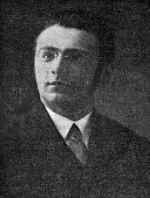
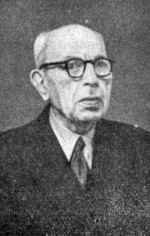
Beinesh Mitelsberg,
died in Jerusalem in 1953
|
[Page 49]
[Page 50]
[Page 51]
by Y. B. Alterman, Hadera – Givat Olga
Translated by Seth Morgulas
The First Maskilim
At the beginning of the twentieth century, almost the entire Jewish population in Gritze was still Orthodox-religious. The town was famous in Poland as a place of Torah with many scholars and Hasidim, who were greatly influenced by the Rebbe's courts of the surrounding towns: Ger [Góra Kalwaria], Mogielnica, Błędów, Amshinow [Mszczonów], and Vurke (Warka).
In almost all of Gritze's streets, there were Hasidic shtieblach, often packed with young and old devout Jews. On Saturdays, holidays, and weekday evenings, they would study diligently, pray with fervor, sing with devotion, and dance joyfully – they served the Creator of the Universe with heart and soul, with faith and happiness.
Hundreds of young men, Kest-yungelait, studied there, or conveyed profound teachings from their Rebbes and told of their miracles.
Among these students, at that time, a small group stood out, which began to think and dream about changing their way of life. Strange thoughts infiltrated the young men's minds – remnants of the Haskalah movement, which was then breaking into Jewish religious life.
A couple of maskilim secretly read books and from time to time one could hear strange heretical words against the old-established Jewish religious customs.
Understandably, they were condemned as heretics and removed from the shtieblach and bati-midrashim. This caused them to officially come forward as maskilim.
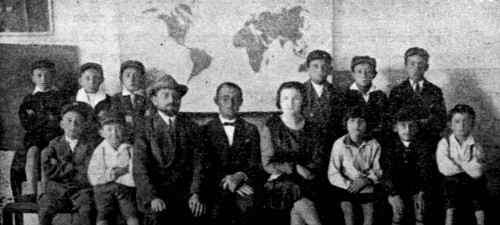
Their first work was to open a “Cheder Metukan”, a reformed cheder that Gritze received in the years 1908/9. A few dozen students learned Bible and the Hebrew language there – Hebrew in Hebrew.
[Page 52]
Among the Hasidim and ordinary pious Jews, there was an uproar; they saw in this forbidden cheder a great danger to Judaism, a terrible evil force, where Jewish children become heretics. They indeed called the reformed cheder: 'Dangerous Cheder'.
All the pious Jews at that time united and, with the local rabbi at their head, fought against the forbidden, disqualified cheder, which corrupts the young generation, leads it astray from the straight path.
The parents of the students were especially persecuted, sympathizers of the Haskalah and founders of the reformed cheder – Beinesh Mitelsberg, Eliezer Kurtz (father-in-law of Yitzchak Rinkewitch), Shmuel Ber Marienk, Daniel Dreier, Avraham Yitzchak Gelbardt (the first buyer of shares of the Colonial Bank), Hershel Finkelstein, Avraham Reiter, Avraham Yitzchak Perl and others.
|
|
|
One of the first maskilim
Beinesh Mitelsberg, died in Jerusalem in 1953 |
Some parents who sent their children to the cheder were placed under a ban – they were also hindered in their livelihood.
Also in the Beis Midrash and in the synagogue, during prayers, disputes and scandals occurred. The very pious forcefully removed the heretical parents from the houses of prayer, whose children attended the reformed cheder.
But the more the initiators of the cheder were fought,
[Page 53]
the more they worked with great fervor: spreading the Enlightenment ideas and improving the school conditions and curriculum. The semi-modernized Cheder quickly gained a good name, achieving success with many parents who began sending their children there. However, the religious opponents did not cease their fight against the parents of the modernized Cheder students.
The holy war lasted a long time until the Tsarist authorities, receiving a bribe (as was rumored in the town), closed the school.
Despite the persecution, the Enlightenment idea had by then struck deep roots in Jewish life in Gritze. The small but fiery group of Maskilim began to grow rapidly. They secretly began to spread Jewish books and open cultural institutions. Their activity became more and more active.
From this very group of Maskilim later grew the best, most conscious, most active cultural workers and founders of the two largest political parties in Gritze: the Zionist Organization and the 'Bund'.
Activity of the Zionist Association “Hatikvah”
The Zionist idea, which in the early years of the twentieth century had many sympathizers and actively organized members in the larger Jewish settlements of Poland and Russia, was still not very popular in small Gritze at that time. Some of the first Maskilim, who were persecuted for founding the modernized Heder, suffered even more troubles for spreading the 'heretical' redemption ideas among the Gritze Jews. However, the persecutions did not frighten the Gritze Lovers of Zion at all. With idealism and enthusiasm, they agitated for the Zionist program as the only means of salvation for the suffering Jewish people.
Many Gritze Jews were indeed influenced by this agitation and decided to emmigrate to the Land of Israel.
The first immigrants from Gritze to the Land of Israel were: Avraham Reiter's father – a glazier, the learned king – a shoemaker, and Yekeleh “the umbrella man” – a Piaszczyn Hasid. All of them settled in Jerusalem. This immigration to the Land of Israel further encouraged the first Zionists. They strengthened their propaganda, and thanks to their dedication, enthusiasm, and activity, the Zionist idea won.
[Page 54]
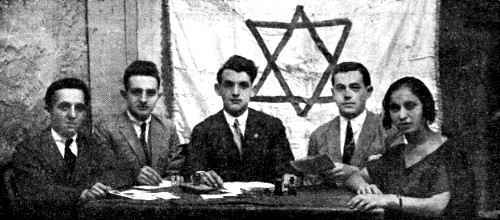
What grew more and more sympathetic among all Jewish strata in Gritze, [beginning] in 1917 when the group numbered several tens of members, was the first Zionist organization, “HaTikvah,” that was established in Gritze. In the first administration of “HaTikvah” the following persons were active: Miriam Greenberg – Chairwoman, Joseph Teper – Secretary, Moshe Yosef Flink, Israel Klepfish, Yudel Kaminer and Nathan Greenberg – Administration members.
|
|
|
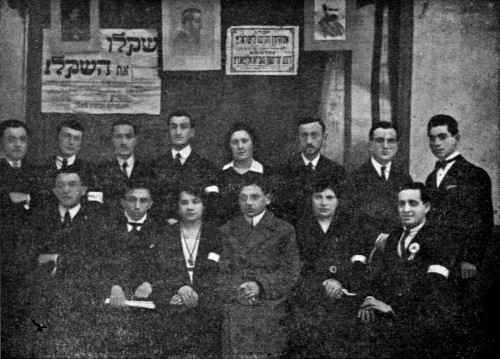
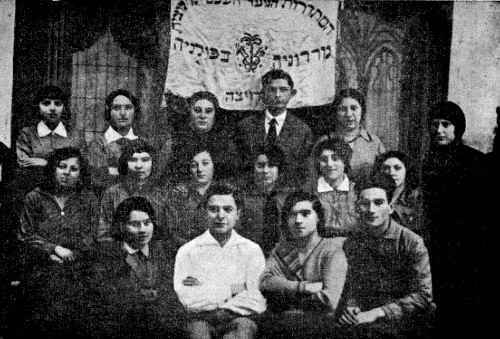
The administration of the Zionist organization “HaTikvah” in 1919
Sitting from right: V. Kolya, Hannah Lenga, N. Greenberg, Malka Korenfeld, J. Klepfish, Sh. M.
Ketler
Standing from right: L. Kurtz, J. H. Rosenberg, H. A. Kaper, Hannah Kaper, L. Zucker, D. Freiman, A. Wasserman, David Seidman |
The main organizer of “HaTikvah” was the son of the Blendover Rebbe, R. Moshe's son – A. Spira, the then founder of the “HaShachar” organization in Mogielnica. Among the most active members of “HaTikvah” later belonged all those who left the non-partisan Peretz Library, which began to engage in party matters.
[Page 55]
The administration rented a locale in Reuven Venglar's house on the “Rinek” and began its active work. The main work of “HaTikvah” consisted of: spreading the Zionist press, selling shekels, collecting money for national funds, and organizing cultural events.
After a year of activity, which was distinguished by many positive deeds and achievements in various fields, the organization gained many supporters. New forces joined. The organization included: Yossef Chaim Rosenberg, Sh. M. Ketler, L. Berger, A. Wasserman, “Esther Kirschenbaum, Moshe Flint, Treitel Lipschitz, Tsima Greenberg, Chantshe Drezner, and others.
These temperamental members, full of raging youthful energy, were, after joining the organization, not satisfied with the slow pace, the little achievement-oriented work of the first founders of the association. The newly arrived took upon themselves new tasks, namely: to energize the activity and to recruit new members from the working youth and the common people from all circles. Thanks to their activity and dynamism, the entire organizational work became revitalized.
The old party founders were, quietly, against the young oppositionists. All the newly arrived members, however, grouped themselves around the young activists, who won sympathy thanks to their energy and courage.
At the second general assembly, the opposition group already numbered 70 members. They had the opportunity to elect their own youth leadership. Out of fear, however, that a split might occur, they resigned from it. An understanding was reached with the older, original founders of the association, and a joint administration of both groups was elected, consisting of the following individuals: Natan Greenberg – Chairman, Sh. M. Ketler, Israel Klepfisch – Vice-Chairman, H. Zucker – Treasurer, Y. Ch. Rosenberg – Secretary, W. Kula, L. Kurtz, H. A. Koper, David Seidman, A. Wasserman, D. Freiman, M. Kornfeld – board members.
The new administration energetically set to work. The old members became more active. New members were recruited. Cultural work was especially strengthened.
[Page 56]
Friday evening box evenings took place, at which various problems were discussed: literary, Jewish national, political, and scientific. The box evenings, led by the most conscious members, were very interesting, achieved great success, and attracted hundreds of listeners from all strata of society. From this assembly, which existed for many years, some townspeople's speaking talents developed. Here, for the first time, the then Beit Midrash teacher Y.B. Alterman also appeared.
The box evenings became a talking point in Grójec, in the surrounding towns, and even in the literary circles in Warsaw. They were often mentioned and praised in the Yiddish press by prominent Yiddish writers.
The cultural work continued to strengthen. The administration, at one of its meetings, after the Zionists abandoned the Peretz library, accepted the proposal of S. M. Ketler to establish its own library.
The decision was quickly realized: members collected 1200 books, and the library was solemnly opened. For the celebration, the then editorial board member of the Warsaw “Moment”, later editor of “HaBoker” and chairman of the “Association of Journalists” in Israel, Mr. Yosef Heftman, was specifically invited. (Died in Tel Aviv on January 18, 1955.)
The library had many readers. Its income covered almost the entire club budget.
The “HaTikvah” cultural commission also organized lectures every Saturday on current political and literary topics. Many prominent Zionist activists visited the Jewish-cultural Grójec.
Dramatic Circle
The circle was actually founded by Mr. Reichenbach. After a short time, the leadership was taken over by Yechiel Rechtman, a brother of A. Rechtman. Anyone who had even a little talent and inclination for theatrical art found his spiritual satisfaction there.
The following members, theater amateurs, participated in the drama circle: David Freudenberg (now in Tel Aviv), Yaakov Watman and his sister (Pinsker), D. Rosenberg, S. M. Ketler, Zecharia Zilberberg, Yedidya Klein, Friedman, Beyla Grosman, Esther Ketler, and Bashe Bombalski (now
[Page 57]
in Tel Aviv, and the wife of A. Grinfarb).
During the time of its existence, the drama circle has presented serious one-act
|
|
|
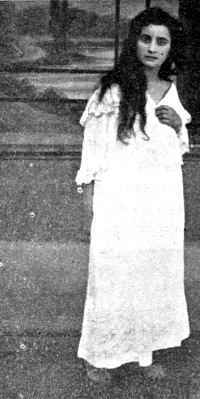
Esther Ketler, in her leading role in
“Shkhita” by Y. Gordin |
plays and several plays, such as: Bimke's “Thieves” and “The Slaughter”. With these plays, the circle performed in the neighboring towns: Ger and Piasetzne. The participating circle members received no honorarium for their performances. The entire income from all the performances was designated for the library, with the aim of purchasing newly published books.
Zionist Manifestation
One of the most beautiful, very successful actions was the street manifestation, in honor of the confirmation of the Balfour Declaration in San Remo.
[Page 58]
The demonstration took place on a summer Thursday afternoon, on the day of the weekly market in Gritze. The farmers were still in town, looking to buy something. Suddenly, the Jews, earlier than every Thursday, packed up their wares, took down the stalls, and quickly went home. The Polish population looked on and marveled, not understanding what holiday the Jews were celebrating and why they were hurrying home in broad daylight.
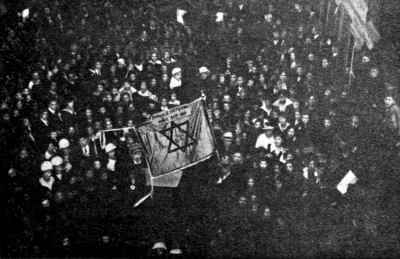
Within a few hours, an impressive demonstration appeared. Hundreds of Jews, young and old, marched out of the Tarbut school on Waretzka Street. The demonstrators carried a blue and white flag and many banners with national slogans. The Polish inhabitants of Gritze and the village farmers watched the proudly marching Jews, who were demonstrating a great national achievement, with respect. They marched through all the streets to the synagogue courtyard.
|
|
| The Zionist demonstration after the historic decision in San Remo |
In the synagogue, overflowing with a thousand-strong crowd, a truly grand mass meeting took place. Several speakers spoke about current events.
[Page 59]
Among them: Mr. Sh. M. Ketler. The enthusiastic public truly cried for joy. All were filled with the hope that finally we too would become a people with equal rights like all nations and also have our own homeland.
The speakers, in touching words, called upon the Jewish population to join the Zionist movement, to help in all its actions. The magnificent manifestation and the imposing mass meeting made a great impression on the Jews of Gritze. Whoever attended those celebrations will never forget that great festive day in Gritze.
The Culture School
In 1922, the administration of the Zionist Organization founded a Hebrew “Culture School” with a “Gan-Yeladim” (kindergarten). In the school, hundreds of students received a national education. Besides all the normal school studies in the Hebrew language, Bible, Jewish history, and Palestine studies were also taught there. Some Gritzer Jews who graduated from the “Culture School” and made Aliyah to Eretz Israel are today respected officials in the state.
The very capable school leadership (Miriam Greenberg, Chaim Yankel Weissman, Mrs. Lenga, mother of Kipa Langer) built a wooden house on Khrobower Street. In the school rooms, in the evenings, the activities of all Zionist youth organizations were conducted: “Gordonia”, “HaNoar HaTsioni”, HaShomer Haleumi, and Betar.
In general, the “Culture School” was the crown of the Zionist movement in the shtetl.
Hitachdut
In the same period, a new group was founded in the organization: “Hitachdut shel HaPoel HaTzair and Tzeirei Zion”. The group was led by the members: A. Wasserman, L. Berger, Sh. M. Ketler, and others.
According to a decision by the central committee, the name of the organization “HaTikvah” was later also changed to “Hitachdut”.
The so-called older group, led by Greenberg, organized themselves into the group “Et Levnot”. Their work was mainly limited to supporting the Hebrew “Culture School”.
[Page 60]
|
|
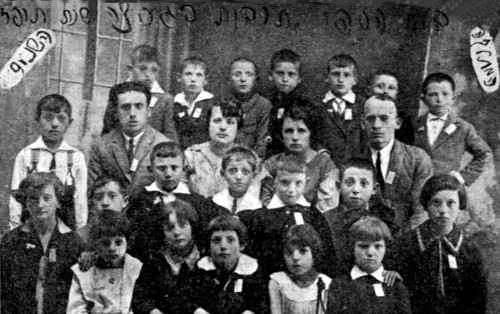
| Culture School, 2nd Class, in the year 1924 |
|
|
| Kindergarten at the Culture School, in the year 1931 |
[Page 61]
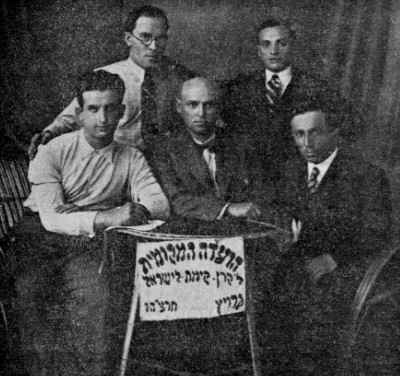
The other Zionist actions are carried out by the “Hitachdut” administration, which consisted of the following persons: Sh. M. Ketler – Chairman, L. Berger – Secretary, Yechiel Braun – Treasurer, W. Kula.
|
|
|
Administration of Hitachdut of Tzeirei Zion and Hapoel Hatzair 1923
From right: Z. Grinberg, Y. Brahn, Sh. M. Ketler, L. Berger, W. Kula
|
A large number of “Hitachdut” members later became sympathetic to the “Al Hamishmar” movement, headed by the then leader of Polish Jewry – Yitzchak Grinbaum, who was against the expansion of the Jewish Agency.
At the national conference, in Warsaw, in 1923, the three Grójec delegates did indeed defend the “Al Hamishmar” standpoint.
At the same conference, a great tragedy occurred: the faithful comrade, and secretary L. Berger died suddenly at the age of 21. After the great loss, all members of the Zionist organization and all of Jewish Grójec mourned. His pure image, his self-sacrificing work for the Zionist movement, will forever remain in our memory.
In 1924, a festive banquet was organized in honor of the active administration member of “Hitachdut”, W. Kula, on his Aliyah to the Land of Israel.
[Page 62]
To this event came the most active party members from the surrounding shtetls: Ger, Piaseczno, Mogielnica, and many members from almost all Zionist organizations in Gritze.
The farewell banquet lasted until the early morning hours and left an impression on everyone, especially on those who were also preparing to immigrate.
Unsuccessful land transaction by Gritze residents in the Land of Israel
Thanks to the initiative of the Gritze Rabbi and a group of Hasidic and ordinary Jews, a committee was established in Gritze with the task of creating a money fund to purchase land in the Land of Israel. In 1924, “the Gritze committee united with a similar committee in Skierniewice. Both committees are working intensively to realize their plan.
In a short time, a significant sum of money was collected in Gritze.
Many Jews, Zionists and non-Zionists, contributed their help: they gave themselves and helped collect money.
After the fundraising action concluded successfully, the Gritze Rabbi and Yankel Rechtman (Yankel Pinyes) traveled to the Land of Israel. Later, joyous news arrived that the Gritze delegation had purchased 2,000 dunams of land in the Haifa area. However, the joy did not last long. It was discovered that the buyers had been tricked by a cunning land swindler.
Instead of buying land from the “Keren Kayemet LeYisrael”, the delegation made a transaction with some private land dealer, who sold the Gritze delegation land that was not yet registered in the seller's name… Many years passed, and the land “dealer” still did not have the right to transfer the land to the names of the Gritze buyers.
Lawsuits were conducted for ten years with the so-called landowner. As early as 1934, Advocate Eisen, together with Sh. M. Ketler, as authorized representatives of the Gritze Rabbi, handled the lawsuits against the cunning land dealer.
This sad case destroyed the plans of some Gritze Jews who were preparing to immigrate to their own land. In the meantime, they learned construction trades and agricultural work in order
[Page 63]
to come to the Land of Israel already prepared with professionals who will ease settlement on the land, which was later to be transformed into a colony of Gritze immigrants.
Training center in Chenstokhov [Częstochowa]
Gritze Zionist activists influenced Mr. Singer – head of Y.K.O. – land (Jewish Colonization Organization) in Chenstokhov – to establish a training center in that village.
As soon as Mr. Singer agreed to the proposal of the “Hitachdut” administration (Hapoel Hatzair and Tzeirei Zion), the well-known training center in Poland was established there, where 100 young pioneers, male and female, received national training, worked in their own agriculture, on Y.K.O. land; lived in a communal society, preparing themselves for a new peasant life in the Land of Israel.
The Y.K.O. leadership treated the young pioneers with fatherly love. They gave the group all the rooms of the former handicraft school in Chenstokhov. From this important training center emerged many trained farmers who immigrated to the Land of Israel. Thanks to the training center, Gritze Zionist activists had the opportunity to come into close, personal contact with some “Hitachdut” leaders of the Central Committee in Poland, who used to visit the Jewish-decorated Chenstokhov and stop in Gritze, to familiarize themselves with the local Jewish life and Zionist activity. Mr. Levinson – current editor of the literary quarterly: “The Golden Chain”, Dr. Heller, and Moshe Chatzew visited.
The training center had a great influence on the Gritze youth. The spirited pioneers also encouraged the Gritze Zionist activists, who further intensified their activity in the organizations. They also influenced ordinary Jews, who became members of Zionist parties. The majority of the trainees immigrated to the Land of Israel.
Zionist influence on the artisans and the fight against the excise law
In the then-known, anti-Semitic excise law project, which was being handled in the Polish Sejm (parliament), Jewish businessmen
[Page 64]
and craftsmen saw a danger to their economic existence. All Jewish craftsmen in Poland fought against this anti-Jewish law. The administration of the Gritzer Craftsmen's Association assessed the danger and began to mobilize its members for the fight against the anti-Jewish census law. All details of the new decree, which could diminish the meager livelihoods of most Jewish artisans, were explained to the craftsmen.
At administrative meetings, it was unanimously decided to turn to the local, very active Zionist organization, so that it would help, when necessary, to conduct a joint protest action. The decision was conveyed to the administration of the Zionist organization by a delegation consisting of the following individuals: M. Ambaras, N. Mefan, M. Tauber. The Zionist activists approached the problem very seriously. It was decided to help, by all possible means, the craftsmen and their just struggle for existence. The administration appointed Yechiel Braun and Sh. M. Ketler to deal with the matter. Soon, a general assembly of the craftsmen was called in the large Beit Midrash. The necessity of being organized was explained to the large assembled crowd. The attendees elected a new administration: M. Ambaras – Chairman, Sh. M. Ketler – Honorary Secretary, P. Artman, N. Mefan, Yitzchak Bromer, and Getzel Rotblat – Board Members.
The new administration, thanks to its popularity in town and practical achievements for the craftsmen's association, attracted almost all artisans, who became members of the association.
A new, comfortable, beautiful venue was rented on Skarga Street. The artisans gathered there daily, resting after their hard day's work and chatting about their situation. Also at that time, the Loan and Savings Fund was reorganized, which originated before the First World War and was located in the private apartment of Mr. Bashevitsh. All association members became members of the fund.
At the annual general meeting of the burial and sick fund, an administration was elected with the following composition: Chairman – Aharon Goldman, Vice-Chairman – Sh. M. Ketler, Treasurer – M. Ambaras. In the council were included: Chairman – B. Artman, Vice-chairman
[Page 65]
M. A. Alexandrowicz, Council Members – Y. Graman, N. Mepen, S. Lewkowicz, and Kalman Brumberg.
The new institutions have done a lot for the Jewish artisans, helping them in many difficult situations.
The elections to the Gritzer City Council
The Zionist activists, through their active work, have gained sympathy among Greitzer Jews and have influenced the Jewish social life in the town.
This was evident during the elections to the Greitzer City Council in 1926, where thanks to popular candidates, the Zionists achieved a victory.
It is worth noting some episodes, characteristic of the then provincial Jewish political life.
The Zionist activists at that time strove to create a united Jewish bloc. The goal of this bloc was: during and after the elections, all Jewish council members would jointly fight for Jewish equality in all municipal areas. Unfortunately, the entire plan was not realized due to provincial attitudes of certain party representatives.
A bloc was successfully created after much effort from the following parties and institutions: Zionist Organization, Agudath Israel, Merchants' Union, Artisans' Association, and other smaller aid institutions. However, even this combined bloc had little luck: a few days before the elections, the parties quarreled… After many efforts, new lists were submitted on the eve of the elections. The following were elected as council members: Merchants' Union – Natan Greenberg, Levi Kaper; Zionist Artisans – Sh. M. Ketler, M. Baker; Personal List – A. Kronenberg; Socialist Artisans – P. Artman; Agudath Israel – Y. Margolis. After Natan Greenberg became a deputy, A. M. Hamer represented him.
All the above-mentioned council members defended Jewish interests with a national-Jewish stance.
Thanks to their courageous appearances, it was possible to obtain annual subsidies from the city administration for the Greitzer Jewish schools from the
[Page 66]
Central Jewish School Organization (Tzysha) and cultural schools for 2500 zlotys. Later, subsidies (500 zlotys) were also received by the Gmilut Hasadim fund and the library of the Zionist Organization.
The Jewish interventions in the city council aroused respect among everyone for the Jewish municipal representatives, who, one and all, defended Jewish honor. They boldly demanded that the Jews of Gritze, who had fulfilled all state and municipal duties, should also enjoy rights like the Polish citizen.
Events in the Land of Israel in 1929 and the protest of the Jews of Gritze
As soon as the well-known Arab pogroms on the Jewish settlements in the Land of Israel in 1929 became known in the town, a united committee of all Zionist organizations was immediately formed. A protest meeting was called, in which a thousand-strong audience participated.
All Jewish merchants closed their shops, artisans and workers did not work. A significant sum of money was also collected for the pogrom-affected Jews and destroyed settlements.
All Jews contributed without exception. The Jews of Gritze expressed brotherly sympathy to the affected Jewish settlements and protested against the then-ruling Mandatory Power in the Land of Israel, which always inspired smaller and larger bloody events.
Activities for the Keren Kayemet
Impressive meetings and academies were held annually, organized by the united Keren Kayemet committee in Gritze. The Maccabi's Warsaw brass band often came to these celebrations. Street demonstrations preceded each academy. The proud Zionist youth and members of all Zionist organizations marched bravely through the streets of Gritze. The demonstrators carried party banners and posters with national slogans. The youth organization parades, with their burning torches, looked very impressive.
The Zionist demonstrations were well known in Gritze
[Page 67]
and also in all the regional towns. They always made an impression on the Jewish and even the Polish population of the town.
In the Keren Kayemet committee, the very active members distinguished themselves: Yechiel Braun – General Zionist; A. Fried, Sh. Zilberstein – “Dat Ve'Avoda”; Yekel Dreizner – “Gordonia”; Belczicka – “Poalei Zion”, Shlamberg and others.
|
|
|
Seated from right: Y. Klepfisch, M. Ambaras, Shimon Zilbermintz Standing: Shmukler, Brahn |
The Keren Kayemet works, besides their money collections, had a very great significance for the general Zionist activity. This was the only place where the activists of all Zionist organizations, from Betar to “Poalei Zion”, met. All parties worked here jointly for one common goal – this was the spiritual cement that connected them, reminding that all work for one holy cause: redeeming the land of Israel from foreign owners, helping to create a national home for the suffering Jewish people.
Mizrachi and Tzeirei Mizrachi
In the year 1918, a Mizrachi organization was also founded in Gritze.
[Page 68]
Active members were: Yechiel Flint, Mendel Pisetshner's son, now living in Haifa, Shlomo Hamer, Eliezer Kurtz, Avraham Reiter, Michael Baker, Motl Hochberg, and others.
Later, a Tzeiri Mizrachi organization was also founded, headed by: Elimelech Feitshner – Mendel Budzhyner's son-in-law, now living in Jerusalem, and now calls himself Ben Porat, and Avraham Seidman. Mr. Feitshner was chairman and Avraham Seidman – secretary. In the Mizrachi organization, the then yeshiva students began their public activity: Yosef Chaim Rosenberg, Eli Wasserman, D. Rosenberg, Yechiel Braun, and other Beit Midrash students, who later played an important role in public life. Their main work consisted of spreading the Zionist idea among the religious Jews. This was a very difficult matter. Often, they were fought by their parents and ardent Hasidim, who viewed the Zionist idea negatively.
The loyal Mizrachi members, however, did not get discouraged, they worked tirelessly in almost all Zionist actions.
Gordonia
According to information received from our countryman Y. Drezner, the Gordonia organization was founded in 1929.
In the beginning, a very small number of very young members belonged to the organization: from 12 to 15 years old. Over time, the organization grew – the number of members reached up to 150.
The main activity of “Gordonia” consisted of collecting money for Zionist funds, giving youth pioneering training, sending them for Hachshara and later for Aliyah.
The organization was divided into groups: Megashmim, Tzofim, and Mit'orerim.
Thanks to the help of Gritzer “Hitachdut”, the pioneering “Gordonia” developed quickly. Zacharia Zilberberg did the most for the organization. In the first years of its existence, “Gordonia” was affiliated with “Hitatidut”. Later it became independent with its own central leadership. After the best “Hitatidut” members
[Page 69]
|
|
|
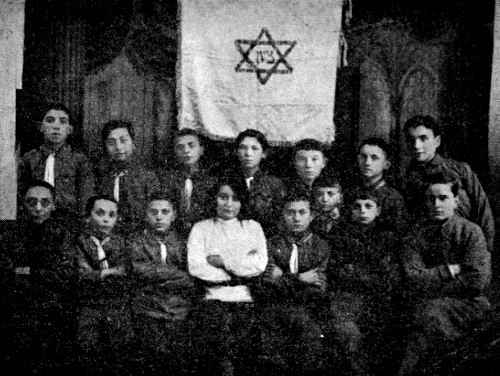
A group of friends from the Gordonian group “ChuIda” in the year
1933
The first from the right is Avraham Dreier, who participated in the Warsaw Ghetto Uprising. |
|
|
| A group of “Gordonian” friends in the year 1936 |
[Page 70]
|
|
|
Seated from right, 1st row: Y. Dreznner, Ch. Mepen, Sh. Zilberstein, Chaya Elin
|
When the founders left and the survivors neglected the work a bit and finally abandoned the organization, almost all Zionist activity was carried out by the “Gordonia” members. They had to collect money for KKL, organize “HaChalutz” and were active in the League for Working Eretz Israel. Their activity became more and more active as time went on.
The “Gordonia” leadership sent its members for training and later to Eretz Israel. Well-known and convinced members grew up in the organization, who received Zionist education there. Almost all immigrants who came to the country through “Gordonia” certificates joined kibbutzim.
[Page 71]
The remaining “Gordonia” members, who were preparing to immigrate and remained in Nazi captivity due to the outbreak of war, actively participated in the Warsaw Ghetto Uprising. One of the prominent Ghetto heroes who fought against the German murderers until the last moment of his young life was the dear Jew and person, Abraham Dreier, well-known in Gritze.
HaNoar HaTsioni – HaShomer HaLeumi
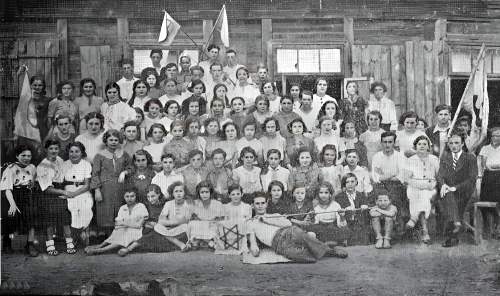
The National Zionist youth organization “HaNoar HaTsioni” – “HaShomer HaLeumi” was founded in 1929. Among the most active members of HaShomer were a group of youngsters (the majority students in the Tarbut schools): Zelig Lenga, Zvi Zelzer, I. Weintraub, Ephraim Gisserman, Esther Schultzinger, Miriam Rosenblum, Shmuel Weissman, and Shlamberg.
|
|
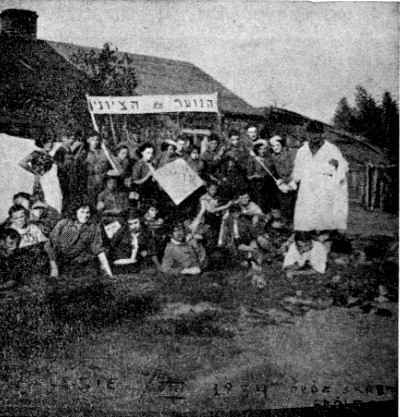
| “HaNoar HaTsioni” Organization in 1934 |
The organization was primarily engaged in national educational work, sports, and helping to collect money for Zionist funds. The youngsters were divided into groups: Tsofim, Bogrim, and Ze'evim.
“HaNoar” conducted its activities in the Tarbut premises.
[Page 72]
|
|
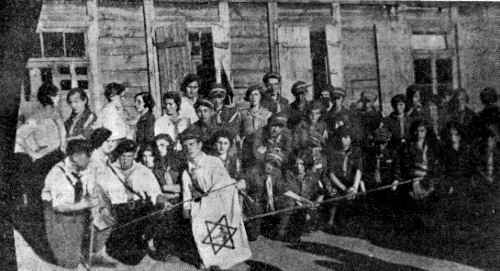
| A group of friends from the “National Guard” in the year 1933 |
|
|
| The “Scouts” group |
School, where every evening was lively: they sang, danced, and did gymnastic exercises.
Local guides and special teachers from the central office in Warsaw often gave the youth lessons on Zionist history and “Palestinography.” Special attention was paid to introducing the children to the life and work of the Zionist leaders.
[Page 73]
Among the most active members, special mention should be made of the talented young painter David Hamer – now living in America. Even then, he displayed his artistic and decorative abilities. He compiled the illustrated wall newspaper, in which the “Hanoar Hatzioni” members participated: Lotka Freiman, Feige Graman, David Hamer, Hannah Alterman, Ephraim Gisser, and others.
The organization quickly became known in the town with its organized entertainments, film outings, and summer colonies in the neighboring villages: Częstochowa, Zalesie, Głuchowo, and in Serock; beyond Warsaw. A special impression was made on the entire Jewish population by the participation of the “Hanoar Hatzioni” youth in the impressive street demonstrations, which took place every year on Lag B'Omer.
In 1930, the administration sent some members for Hachshara: Tzvi Zeltzer, Esther Shulzinger, Samuel Weissman, and Mindi Rosenblum. After completing their Hachshara, they made Aliyah to the Land of Israel in 1933.
Betar
According to information from [Moshe] Ostwind, in 1934 a branch of “Brit Trumpeldor” was founded in our town. The organization, which later numbered 80 members, was led by the youth: Moshe Goldberg, Moshe Greenberg, Moshe Ostwind, Shalom Rechtman, Yaakov Leng and others. The main responsible parties – patrons – were two older Zionists: Advocate Leib Nabozhne, who led the cultural-educational work, and Dr. Herszkorn, who led the instructors for sports and military exercises.
In time, the number of members increased. Older people also registered in Brit Tzehir and “Brit HaChayil”.
A small library was founded within the Revisionist organization. Various entertainment and concert events and Lag B'Omer gatherings were also often organized.
The organization was represented in many Zionist city institutions. In the city council, the Revisionist organization was represented by Dr. Herszkorn.
In the pre-war years, when the Revisionist leader, Ze'ev Jabotinsky,
[Page 74]
who came forward in Poland with the slogan – 'If you will not liquidate the diaspora, it will liquidate you' – and urged Jews to emigrate to Eretz Israel. Some of the Gritze's Betar members listened to Jabotinsky's words and emmigrated to the Land of Israel. Their names are: Shalom Rechtman, Yechiel Rechtman, Yaakov Lengo and Moshe Ostwind.
Religion and Labor
The semi-secret founding meeting of the Religious-Socialist-Zionist organization, known as “Dat Ve'Avoda,” [Religion and Labor] took place on a winter Saturday night in 1930, in the apartment of Henoch Kamliner, a well-known Ger Hasid and scholar in Gritze.
The owner of the apartment was not in Gritze at the time. This opportunity was taken advantage of, and in utmost secrecy. A 'Melocha Melucha' feast was organized… to which several dozen Hasidic youths were invited. There were already rumors in the town about them, that they were going down a bad path: reading, God forbid, heretical storybooks by God-defying 'Shaber youths'.
Among the founders of “Dat Ve'Avoda” and initiators of the 'Melocha Melucha' meeting were the following Beit Mid rash students: Shmuel Zilberstein, Eliezer Fried, Yisrael Ber Alterman, the beloved simpleton Shlomo Bron, and Kaminer's two youngest sons.
From the “Dat Ve'Avoda” center in Warsaw, the two best, most talented speakers specially came down to Gritze: Shmuel Halberstadt and Shlomo Weissbaum. Both were fiery Hasidim, great scholars, knowledgeable in economic and scientific matters, and the practical founders and theoreticians of the 'Oat Va'avoda' movement in Poland.
Imposing and festive was the gathering of the Hasidic youths who were thinking about changing their way of life. The Warsaw guests spoke to the feelings of these slightly enlightened young men. Their sharp-witted lectures were both speakers' foundations with verses from Tanakh, Gemara sayings, instructive folk tales, and quotes from socialist theoreticians. Primarily, they explained the ideas of Professor Steinberg's writings.
The ideological speeches of the sharp-witted Halberstadt and the scholar Weissbaum, made upon the Gemara and P'sukim learners an extraordinary impression.
[Page 75]
|
|
|
Shimon Weissbaum may his memory be blessed
A member of the Central Committee of “Dat Ve'Avoda”, murdered by the Nazis |
A moving impression. Some of those present declared themselves on the spot in the “Dat Ve'Avoda” party.
In the morning, early Sunday, when news of the meeting with the “Bal” spread, the town came alive. In the small Beth Midrash of Rabbi Yerahmiel Moshe'leh, may his memory be blessed, and in the Hasidic shtiblech, pious Jews grumbled against the new “Dais Ve'Avoda-Anshikenuis,” may the Merciful One save us. Pious Jews swore to “put in worlds” and not allow the heretics to be together with the remaining students. The meeting organizers were threatened that they would be “taught” for the Mlava-Malka-spitzl… In the homes of the new “Dat Ve'Avoda” members, it was also stormy. Pious parents “taught their children sense” with various punishments for becoming “Zionist Bundists.”
All this, however, had little effect. The “Dat Ve'avoda” activists rented a small room from Elazar Moshe's son-in-law on Piłsudski Street. The Gemara students, who were persecuted in the Beth Midrash and in the shtiblech, found a place there where they had the opportunity to read books and discuss various religious and
[Page 76]
worldly problems. In this room, frequent discussions took place about the secretly read books of Spinoza, Marx, Bergson, Max Nordau, Ahad Ha'am, Herzl, and others. “Box evenings” were organized, and led by Eliezer Fried.
The very interesting and educational gatherings of the Hasidic-dressed youths in the small room, over time, gained great popularity in the town. Finally, when the pious parents made peace with this “heresy” of their children, the organization of the Hasidic youths officially joined the Zionist organization as a separate “Dati Leumi and Labor” group.
They participated intensively in all Zionist activities, presented with speeches at public meetings, and took part in Zionist institutions. From the “Dati Leumi and Labor” members who immigrated to the Land of Israel were: Eliezer Fried, Shmuel Zilberstein, and Shlomo Bran.
In 1949, the former “Dati Leumi and Labor” member, the writer of these lines, came to the country.
|
|
|
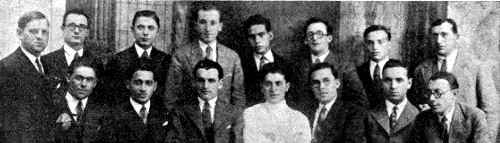
A group of Zionist members
Standing from the right: A. Hak, Schmuckler, Weinreich, Y. B. Alterman,
Nathan Zelzer, Sh. Zilberstein, Menachem Belzitzky, Mordechai Greenberg
Sitting from the right: Gurt, Rosenblum, Bran, A. Fried, Sh. M. Ketler, and Yedidya Klein |
[Page 77]
Outside of party and Zionist work, the national activists traveled for training and later made Aliyah to the Land of Israel.
Together with the workers, the activists had to fight daily against the dark Polish reaction, which carried with it the dirty stream of the rebellious bloodthirsty antisemitism.
(Information from: Hanna Alterman, Y. Dreizner, M. Ostwind, Sh. Weissman, and Wajnsznabel).
|
|
| The Aliyah of V. Kula to the Land of Israel in 1924 |
[Page 78]
|
|
| Departure of A. Grinberg to Eretz Israel in 1925 |
|
|
|
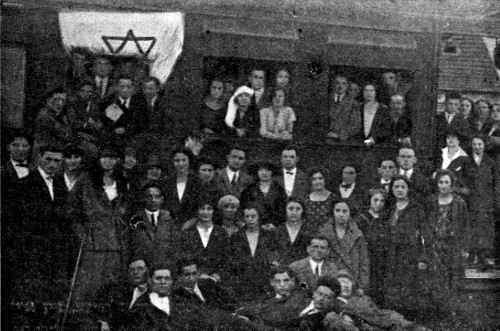
A group of Zionist activists at the Warsaw train station during the departure
of Mr. Sh. M. Ketler to Eretz Israel in 1933
Seated from right: D. Alberg, Esther Ketler, Sh. M. Ketler, Hannah Lifshitz-Ketler, Miriam Grinberg, Yechiel
Standing: M. Karim, M. Shulzinger, Eli Wasserman, A. Lifshitz, Israel Klepfish, Getzel Rotblat, Bunce Lewkowicz, Y. Klein |
|
JewishGen, Inc. makes no representations regarding the accuracy of
the translation. The reader may wish to refer to the original material
for verification.
JewishGen is not responsible for inaccuracies or omissions in the original work and cannot rewrite or edit the text to correct inaccuracies and/or omissions.
Our mission is to produce a translation of the original work and we cannot verify the accuracy of statements or alter facts cited.
 Grójec, Poland
 Yizkor Book Project
 JewishGen Home Page
Copyright © 1999-2026 by JewishGen, Inc.
Updated 02 Jul 2026 by OR