 |
|
|
[Page 375]
|
[Page 376]
[Page 377]
by Wolf Tshinski [Czynski]
Translated by Beate Schützmann-Krebs
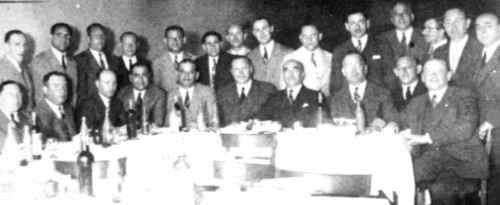
The first attempts to establish a Bialystoker Association in Argentina were made in 1922 and again in 1926, but without results. Only in 1930 was the founding successful, and we have recently celebrated the fiftieth jubilee of our Association.
There was not much to debate regarding the program, because everything took shape naturally, and through a shared understanding that we had to help one another in every area – especially in view of the prevailing crisis in Argentina. For this purpose, interest-free loans were given, as well as medical and legal assistance.
In the cultural sphere, one person drew another in; people spent time together in our clubhouse and out in the open air. At the same time, the Białystoker family became part of the local Jewish community and took part in all its activities. The Association maintained contact with Białystok, sent help there, and also kept ties with the associations in New York, Melbourne, Uruguay, Asunción, and other places.
Important work was done by the volunteers who met the arriving landsleit at the port. They also cared for them during the first period, when they were completely helpless.
The number of members grew from day to day. Among the first activists we find the sons of our town: Zorekh Ponyeman, Pinye Burshtin, Hershl Bialostotski [Bialostocki], Khulyo [Julio] Lisman and his brother Borukh, the Ovsekhevitshes, Trivaks, Kornblit, Orlinski, Levin, Zelikovitsh, Zakhari, Mines, Fuks [Fuchs], Yosem, and others. A library was created at the Association, but soon a standstill set in. The Second World War broke out, and everyone fell into deep despair.
Only when the great destruction revealed itself in all its horrors did our landsleit begin to reorganize themselves anew, in order to help the few remaining sons and daughters of our town. They immediately established contact with Białystok, with the refugee camps, and with the Bialystoker associations throughout the world, with the aim of helping to resettle the surviving remnant in new homes.
In this field, our Association distinguished itself and surpassed all the institutions of the local community with its achievements. This also found an echo in the local press.
The activity continued to grow stronger. In 1947 the journal Bialystoker Vegen was published, and it has appeared up to this very day. The first editor was Yitskhok Munaker, of blessed memory. Later issues were edited by Avraham Shevakh, of blessed memory; Betsalel Terkel, of blessed memory; Moyshe Rudi; Yitskhok Grintsvayg, of blessed memory; and Shmuel Tsesler. From issue no. 12 onward, the liaison with the contributors has been Ben-Zion Bruker. The journal has received a good response.
Among the later activists we note: Gindzburg, Peker, Tsimshteyn [Zimstein], Pat, Esterkis, Dubinski, Khodzhinski, Kirzhner, Bez, Daytsh, Shmid, Gutman, and Mines.
In 1950 the twentieth jubilee was celebrated.
The role of the Białystokers in developing the textile industry in the region is highly valued. Much is done for all the social work of the community. Cultural activity among the landsleit is strengthened; excursions are organized, and all national and traditional celebrations are carried out. Of particular importance are the memorial gatherings for the holy martyrs of Białystok. At these mourning assemblies, all the sons and daughters of our town take part.
The Association engages in publishing work. A book by Chayele Grober has been issued; a collection of poems by Avraham Shevakh; music by Henokh Kohn and Tsiganeri; songs by Zusman Segalovitsh; and essays by Yehoshua Rapaport, Dr. Khayim Sloves, and others.
The Association is especially active in celebrating the establishment of the Jewish state and in creating funds for the Magbit [United Jewish Appeal]. Direct aid was sent to the suffering landsleit during the War of Liberation.
On the initiative of Shloyme Pat, of blessed memory, a pinkas [community register and impressions book] was created at the Association, in which all visitors sign their names and express their impressions and opinions.
In 1957 the credit cooperative La Textil was founded, headed by Tankhum Ovsekhevitsh. New activists made their mark: Yehoshua Matis, of blessed memory; Metshanski; Varon; Volkoviski; Palter; Kravyetski [Krawiecki]; Grossman; and others.
At the same time, an academy in memory of Osip Dimov (Perlman) was held; his life and work were evaluated by distinguished figures.
The idea ripened to create a Beis Bialystok [a community house of the Białystoker landsmanshaft]. For this purpose, a special commission was organized. Among the new activists we note: Zalman-David Yevreyski, Gedalya Faynsod, Yehoshua Grutski, Menakhem Shvets, Izzy Kogan, Moyshe Vitshiker, and Misha Serzhenski.
At last the goal was achieved. On December 10, 1964, the house at Jean Jaurès 622 was purchased, where the Beis Bialystok is now located. A special issue of Bialystoker Vegen appeared. Gedalya Faynsod was added to the editorial board.
A special commission was organized to raise funds with the aim of rebuilding our own communal home.
[Page 378]
|
|
The number of activists was expanded with: Avraham Dayan, of blessed memory; Shmuel Gonyandzki; Alter Levin; Berl Bialostotski [Bialostocki]; Hersh Polak; Yisrael Sifitski; Ruven Atlas; Yitskhok Milevitsh; Yitskhok Mazur, of blessed memory; Khayim Faylnboygn; Leybl and Yankl Bez; Sonye Yevreyski; Sofya Grudzki; Fani Mazur; Amalye Kirzhner; Reyzl Kravyetski [Krawiecki]-Efron; Sonye Vayner [Weiner]; Roze Grutski; Nekhome Tshinski; Khane Dayan; Khaye [Chaika] Grossman; Rokhl Tsesler; and others.
A larger group of second-generation Bialystokers also emerged. But their existence was not lasting.
At the time when Dr. Albert S. Sabin was residing here (1967), a delegation of landsleit visited him. As a memento, he was presented with a complete set of all the published issues of Bialystoker Vegen.
The passing of David Sohn, of blessed memory, brought forth deep mourning. Expressions of sympathy were sent to the family and to the Center. Appreciative tributes appeared in the local press and in Bialystoker Vegen.
The Białystoker family has been – and has remained – strongly united. This becomes evident in both joy and sorrow. Private celebrations are turned into communal events, and they are held in the Beis Bialystok.
The Chazanowicz-Library was established, and it receives a large number of books in Yiddish, Hebrew, and Spanish from the landsleit. This institution was directed, until his passing, by the activist Avigdor Karp.
The Bulletin appears, edited by Yitskhok Tsesler, who publishes each year the Haggadah for the Third Seder. A new club, Akhva [“Brotherhood”], was also established at the Association, where on Sunday afternoons a number of landsleit and invited guests gather.
Our Bialystoker Association has recorded interviews with landsleit and notable personalities: Chayele Grober, Chaika Grossman, Dr. Emanuel Pat, Dr. Khayim Shoshkes, Harry Faynberg, Zalman Koleshnikov, Yisroel Beker, Yitskhok Ribalovski, Yitskhok and Sara Harkhavi, Dr. Efraim Klok of Cape Town, Dr. Aryeh Busten (Grushka), Yosef Broyde, the komendant of the former partisan organization in the Bryansk forests (now in Maracaibo, Venezuela), Gedalya Gonen, Fridl Kapelman, Avraham Margolis of Haifa, Devora Mints and her daughter Rita Seyman, Aryeh and Fele Fuks [Fuchs] of Melbourne (nephews of Reyzl and Yisroel Efron), and others. Cultural programs are carried out with the participation of our own members, led by the reciter David Zabludovski, as well as invited lecturers.
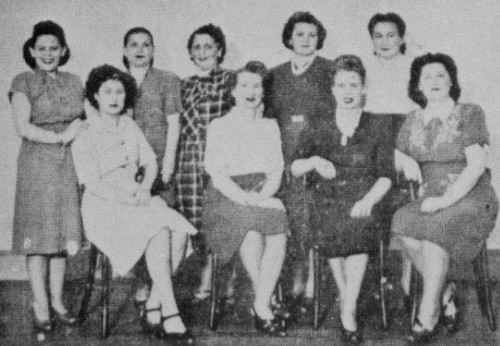
An important factor in the Association is the Women's Committee, which deserves full recognition. To them we owe our ongoing progress. Recently we have felt the generosity of Zvi Feygin, Yehoshua Grutski, Yitskhok Shturman, and Fishke Volkovski, who contributed substantial sums to the Association.
to carry forward the legacy of destroyed Jewish Białystok. |
Translator's notes:
by D. Sherman
Translated by Beate Schützmann-Krebs
An intriguing depiction, written more than thirty years ago, of the Białystoker Jews in Argentina.
In the Idisher Tsaytung, published in Buenos Aires, we find a remarkable description by the columnist Shmuel Rozhanski of the great achievements and the many acts of kindness carried out by the Białystokers in Argentina. We present here at least a portion of his account, from which many Białystoker landsleit in America and in other countries can draw a meaningful lesson.
When people in Buenos Aires speak about the Białystokers – writes Shmuel Rozhanski – you can be sure they are speaking about the Jewish weavers, especially those who live in Villa Lynch [a neighborhood in the Partido San Martín, in Greater Buenos Aires]. There, only twenty years ago, several hundred young Białystokers were all workers; but today many of them occupy a highly respected place in the textile industry as prominent manufacturers, with impressive accomplishments, with drive, with bold initiatives.
In recent years Villa Lynch has become so well known, so familiar to every Jewish ear, that to speak about the Jewish textile industry in Buenos Aires means to speak about Villa Lynch – more than about any other Jewish neighborhoods or regions.
This does not mean that we are dealing with thousands of Jews! No more than six hundred Białystokers, together with a small number of Jews from Łóź, are involved. In all, about eight hundred Jewish weavers have created such a remarkable success – one that reaches far beyond the idisher gas – that is, the Jewish public – and into the broader Argentine [textile] industry, where they have managed, in less than two decades, to secure a very prominent place.
On the idisher gas, Villa Lynch has earned an exceptional reputation thanks to the broad generosity with which its residents contribute to all kinds of Jewish communal causes. Those who, only a few years ago, gave a single peso for a communal purpose now give thousands – even tens of thousands – of pesos in Villa Lynch. As a Jewish collective, the people of Villa Lynch have risen far beyond all other Jewish groups in all of Argentina.
What impresses one most about the Jews of Villa Lynch is that they are folks-Idn, truly our Jewish brothers and sisters. They don't put on airs or act superior, as so many others do who have climbed quickly to success. On the contrary – they have remained nash brat [one of us], unpretentious people who take joy in the Jewish word, in Jewish schools, in the Yiddish theater, and who are the first genuine participants in all these things. For they and their little children live in a truly Jewish environment, even though they are surrounded by thousands of non-Jewish workers.
Interestingly, Białystoker Jews belong to the very earliest Jewish immigrants in Argentina. There is even a colony in Argentina called “Bialystok.” This is the colony Las Palmeras, near Palacios and near Moisés Ville. It is called “Bialystok” because it was founded by Białystoker immigrants. Among those who arrived from Białystok half a century ago were a number of weavers. But even these weavers, fifty and forty years ago, became agricultural colonists in Argentina.
It was not until 1921 that immigrants from Białystok immediately took up weaving upon arriving in Argentina. The younger generation of Białystok immigrants chose the weaving trade instead of the path to the agricultural colonies. And seeing the success of the younger ones, some Białystokers from the very first immigrant generation even tried to find their way back into weaving.
|
|
Today it is known not only in Argentina but even among Jews abroad that near Buenos Aires the Jews have created a textile city that people call the “Jewish Manchester.” The Jews of Villa Lynch are very pleased that there is so much interest in them and that people speak about them this way – after all, who wouldn't be pleased to be spoken of kindly?
But they smile broadly – almost mischievously – when people start talking about their “multi-millionaires.”
“Oy,” a well-known Villa Lynch manufacturer said to me, “they really exaggerate when they talk about the Villa Lynch millionaires…”
[Page 380]
And he calculates for me that, all in all, there are no more than six manufacturers in Villa Lynch who own more than a million pesos, while the others include many so-called “millionaires” whose personal capital amounts to a hundred or fifty thousand pesos…
Such claims will surely astonish many people who imagine that in Villa Lynch you can practically pick millions up off the street. The millions catch the eye especially because this is an industry that booms, that occupies a great deal of space, and that has developed thanks to the extraordinary vitality, energy, and entrepreneurial spirit of a community that spends the entire day immersed in the industry and, in the evenings, is engaged in other work – in communal affairs, in schools, libraries, relief committees, and so on.
At the same time, however, there are Jewish manufacturers in other branches of industry about whom “the world” says nothing – yet they truly move the world, for they possess far more millions than Villa Lynch, the very heavy millions… But the breyte gas – the everyday public – hears nothing of them and knows nothing about them – writes Shmuel Rozhanski.
But from our Białystokers one does hear – not only in the broad public of Argentina. One hears them not only at the looms in Villa Lynch, but also in cultural, communal, and relief work in every sphere, and especially, of course, in the efforts for our devastated hometown of Białystok.
Recently an important book, Khurbn Białystok, written by the partisan Srolke Kot, appeared in Buenos Aires. The book consists of two parts: the first part, “In the Białystoker Ghetto,” and the second part, “The Partisan Struggle in and around Białystok.”
This book, too, is a major achievement on the part of our Bialystokers in Argentina, and they deserve our deepest recognition and heartfelt thanks for all their good works in Argentina.
(Bialystoker Shtime, May–June 1947)
Translator's notes:
by Yitskhok Munaker
Translated by Beate Schützmann-Krebs
A description of the activities of the Białystoker landsleit in earlier years.
Already in 1922, the first Bialystoker Landsleit Association was founded in Argentina, under the chairmanship of Leybl Vigodski, of blessed memory. I say the first because, for various reasons, that association did not last long and dissolved after a single year.
Only in 1930, when several enthusiasts – headed by Mr. Julio Lisman as president – rebuilt the Association of Bialystok and its Surrounding Region, did it become a lasting reality. By creating a small corner for the newly arrived landsleit, they did everything possible to ease their hardships, giving them the chance to find their footing among their own people.
There, the Białystokers could soothe their longing for their hometown, with its truly vibrant Jewish life, its energy, and its rich Jewish cultural and communal activity. And so the Association became the address for every newly arrived immigrant – the place to which he would hurry after a hard day's work, to pour out his longings and to live a little among the Białystoker family.
The Białystokers who brought the Białystok tradition of building and creating to Argentine soil succeeded, with the knowledge and experience they had brought from the old home, in establishing a major textile industry – a chapter all its own. As if touched by a master's magic wand, they gathered together into a compact community in Villa Lynch (a suburb of Buenos Aires), and before our very eyes an industry began to develop on a grand scale. It soon earned a name both in Argentina and abroad as the “Manchester of Villa Lynch,” contributing through their skill and knowledge, through tireless labor and sweat, to the economy of the country – and to the honor of the entire Jewish collective.
The present-day industrialists and former wage-earning weavers and garment workers – warm, down-to-earth folk, steeped in the traditions of Białystok Jewish culture and creativity – understood, as their economic situation improved, how to build a broad cultural life within this small but active community. They founded the Peretz School, with its own building, where nearly a hundred Jewish children study, and a youth club where young people can express themselves in the Białystoker way. This building has become the axis around which the cultural and social life of the Białystokers in Villa Lynch revolves – a source of pride for the Jewish community of Argentina in general and for the Białystokers in particular.
Even though the cultural center in Villa Lynch does not have a purely Białystoker character, it nevertheless bears the unmistakable imprint of the Białystokers who poured their entire sensibility and spirit into elevating it into a veritable gan-eydn – a paradise of culture and creativity.
[Page 381]
This led to a certain loss among many Białystokers of the sense of local patriotism and of interest in the Association. As a result, the Association lost much of its appeal, with each person living his life within his own surroundings, his own home and family – and with only a small trickle of new immigrants arriving. Because of the newly imposed immigration restrictions, the Association found itself stagnating, limiting its activities to organizing one or two events a year, occasions on which the landsleit would come together to meet acquaintances and exchange memories of the old home. There were other reasons as well.
And then came a turning point in Jewish life: the terrible destruction of European Jewry – the horrifying reports of the annihilation and death in our hometown of Białystok, with its 60,000 Jews. Every heart began to beat anxiously, fearing for the fate of its dearest ones. A storm of local patriotism arose, even as the heart bled no less for the entirety of European Jewry.
The Bialystoker Association roused itself from its slumber. The committee understood the responsibility of the moment and called for broader consultations among the Białystokers. Very soon a united relief committee was formed within the Association, made up of a group of activists who threw themselves with full seriousness into the relief work. And as an example to the entire Jewish street, in an astonishingly short time – barely a few weeks – they succeeded in raising the remarkable sum of a quarter of a million pesos, an amount that large relief organizations had not managed to collect over the course of many months.
The enthusiastic and swift response of the Białystokers to the appeal of the relief committee became a name of note both in Argentina and abroad. A large shipment of clothing, food, medicines, and two crates of books was soon dispatched. Aid was sent to Germany, France, Italy, and to the Land of Israel. Impoverished relatives came asking for ship tickets for their rescued family members. In nearly every case – whenever the relatives were truly without means – the request was fulfilled almost one hundred percent, within the limits of our abilities.
The Association once again became the address for all Białystokers – the place where they came to inquire about their relatives and friends who had survived the terrifying inferno, and where they received precise instructions on how to make contact with the living, while the Association did everything in its power to help them – in word and in deed.
At the initiative of the well-known journalist and communal activist Mark Turkow, the Association published a book by our townsman, the beloved poet Z. Segalovitsh, who, on his wandering flight from the murderer's hand, reached Palestine, where he settled. In this way we honored one of our own – an artist – on the occasion of his sixtieth birthday. We take an active part in all aspects of Jewish life in Argentina and are almost always among the first to respond, with an open hand, to the appeals of various cultural organizations.
The new executive committee, elected in March 1947 and bringing in a fresh element of active members, set itself the goal of establishing closer contact with the membership. In the short time since its election, it has already succeeded in doubling the number of members, awakening in them a renewed interest in our work.
We took advantage of the presence of an honored guest of Argentine Jewry – the representative of the YIVO Central Office in New York, Dr. Jacob Shatzky, the well-known historian and scholar (whose father, incidentally, was a Białystoker) – and invited him to give a lecture. In his brilliant talk on the topic “The History of the Jews in Białystok,” he presented many new insights into the life and development of the Jewish community of Białystok, which wrote glorious and richly detailed chapters in the history of the Jews of Poland.
To the periodic publication Bialystoker Vegn – which has, fortunately, become a firmly established reality – we wish a long life. It should be a reflection of Białystok of yesterday and today, and of the lives of all Białystokers throughout the world; and it should serve as a bridge of connection among all Bialystoker centers, a link in the chain of Białystoker Jewish tradition, contributing to Jewish culture and creativity. We hope that our periodical will be worthy of bearing the name Bialystok and will gather around itself all Białystokers, regardless of the political group to which they may belong.
Our goals for the future are as follows: First, not to rest until we have done everything within our power – together with all Bialystoker centers – to rescue, to the very last Jew, those who still remain in the surviving concentration camps, and to help them find their place. Second, to take an active part in the social and communal Jewish life of Argentina, assisting and contributing to the revival of Jewish culture. Third, to gather around the Association all Białystokers who cherish the tradition of the Białystok Jews who gave their lives al kiddush ha-shem.
By fulfilling their legacy – to continue building Jewish life, culture, and learning – and by walking in the path of this Bialystoker tradition, we hope to raise the Association to a level worthy of bearing the name Bialystoker Association.
(Bialystoker Shtime, March–April 1948)
|
|
|
JewishGen, Inc. makes no representations regarding the accuracy of
the translation. The reader may wish to refer to the original material
for verification.
JewishGen is not responsible for inaccuracies or omissions in the original work and cannot rewrite or edit the text to correct inaccuracies and/or omissions.
Our mission is to produce a translation of the original work and we cannot verify the accuracy of statements or alter facts cited.
 Białystok, Poland
 Yizkor Book Project
 JewishGen Home Page
Copyright © 1999-2026 by JewishGen, Inc.
Updated 15 Apr 2026 JH