 |
|
|
[Page 369]
|
[Page 370]
[Page 371]
by P. Albert
Secretary of the Bialystoker Center in Australia
Translated by Beate Schützmann-Krebs
The first group of Białystoker Jews arrived in Australia in 1926. The material situation of these newly arrived immigrants in that distant land was difficult. It was the same then for others as well. As was the way of things, people worked hard in order to make a living. The newly arrived Białystoker Jews therefore established, in Melbourne, a relief fund and also a loan fund, so that they could help one another. In this way they assisted, as far as possible, the needy Białystoker landsleit and those from the surrounding area who had made their way to far-off Australia. And so the years passed.
After the Second World War–after the terrible destruction of the Jewish people under Hitler, when the once-wonderful Jewish Białystok, with its tens of thousands of Jews, was wiped out–a new chapter began for the landsleit in Melbourne. News began to arrive about rescued landsleit from Białystok and from the surrounding shtetlekh, who had escaped death at the hands of the Nazis through miracles. Efforts were begun to bring such landsleit over to Australia from Europe. It was well understood that both here, and in the relief work for the survivors in Europe, new activities and appropriate measures would be required.
Soon after the war, a special fund was created among the Białystoker landsleit in Australia. For this purpose, in 1946 a large house with many rooms and several halls was purchased at 19 Robe Street, St. Kilda, in Melbourne. Here they immediately began to receive the arriving landsleit from Europe – those rescued from Hitler's hell and from the deportations to Soviet Russia. It was at that time that the Bialystoker Center in Melbourne was established.
Thanks to the efforts of a number of our landsleit who had already been living in Australia for some time, the administration of the Bialystoker Center succeeded in securing about 600 permits that would allow new immigrant landsleit to enter the country. A small number of those for whom such permits had been obtained did not make use of them; they emigrated from Europe to other countries, not to Australia.
Most of the landsleit who arrived in Australia at that time were temporarily housed in the new building of the Bialystoker Center. The administration also ensured that the newcomers had proper food, other necessities, and small allowances. This continued for a certain period, until the surviving remnant from Białystok had been helped to settle fully. The administration of the Center, together with the newly formed Women's Committee, meanwhile assisted the landsleit in obtaining apartments, finding work, and so forth. At the same time, interest-free loans were provided to the new arrivals.
The president of the association, Mr. M. Pit, also established a special loan fund at the Bialystoker Center in the name of his late wife, Esther, of blessed memory. Various individuals deposited money into this fund in order to settle their disputes. This fund issued larger interest-free loans to the newly arrived landsleit, enabling them to establish themselves properly and to begin their newly created undertakings.
In this way, the Bialystoker Center in Melbourne has written a fine chapter in the history of the activities of the local landsleit – in helping to bring the rescued brothers and sisters from Hitler's terror from Europe to Australia, and in helping them to settle properly here. Thanks to this fraternal assistance, the newly arrived postwar landsleit from Białystok were indeed able to establish themselves well; they became an important and useful part of the Jewish community in Australia.
But the Bialystoker Center in Melbourne did not limit itself to bringing over and settling the deeply afflicted landsleit from Europe – those who had suffered so terribly during the Second World War.
Meanwhile, the Bialystoker Center in Melbourne also provided extensive assistance – in various ways and with all available means – to the rescued landsleit from Hitler who were still in different places in Europe, in the DP camps, and to those who had been deported to the island of Cyprus.This important aid took the form of sending essential parcels of food and clothing, as well as cash for those in need.
At the same time, here in Melbourne, our Białystoker landsleit also carried on a broad range of Jewish social and cultural work. The Bialystoker Center was likewise active in supporting general Jewish needs, as well as the needs of the State of Israel – work that continues to this day.
[Page 372]
Our esteemed landsman and friend A. Zbar successfully carried out publicity and educational work – in speech and in writing – on the necessity of maintaining the Center, for the benefit of the Białystoker landsleit and those from the surrounding area, as well as for the community at large. Thanks to the brothers Velvel and Khatskel Davis, whose gift of about 600 books made it possible to establish a fine library at the Bialystoker Center – named in memory of the martyr Pesach Kaplan, of blessed memory – this important cultural institution came into being.
In the Center's building, a kindergarten was also created for the children of the temporary residents living there. Thirty little children of the refugee families received their first instruction here, in Yiddish and Hebrew. In the building of the Bialystoker Center, Bible courses were held, and there was also a special hall where services were conducted on Rosh Hashanah and Yom Kippur, as well as on other holidays. Courses and lessons in English, Yiddish, and Hebrew were also conducted at the Center.
|
|
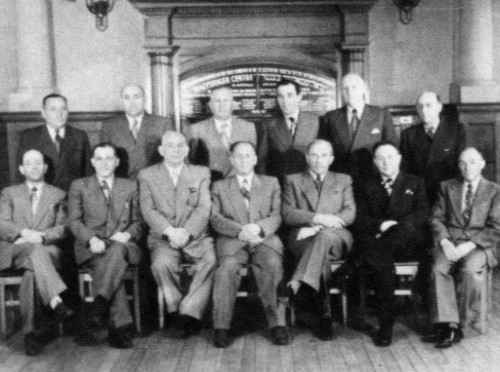
Seated, from right to left: M. Efron, A. Davis, P. Lapin, M. Pit (President), A. Sokol, M. Hemery, M. Gibgot Standing, from right to left: P. Albszteker, M. Mekel, J. Slonim, A. Sery, V. Zucker, V. Weller |
Because immigration of Białystoker landsleit to Australia had come to a halt, the house was no longer inhabited, and the Center's deficits increased steadily. It was therefore decided to sell the Center's building. The large Pesach Kaplan Library, consisting of about five thousand volumes, was donated to the great cultural center “Kadimah” in Melbourne, after their own library had been destroyed by fire.
A portion of the proceeds from the sale of the Center's house was transferred by the administration to Magen David Adom. With this, an ambulance was purchased in the State of Israel, bearing the name of the Bialystoker Center in Australia. We also sent a sum of money to the Irgun Yotzei Bialistok [Organization of Bialystok Emigrants] in the State of Israel, as a contribution toward the Yizkor Book that is to appear.
We wish to note as well that the Białystoker landsleit in Australia collected funds for Kiryat Bialystok in Israel, as well as for various other Jewish institutions in Melbourne. The Białystoker here in Australia form an important part of the local Jewish community and occupy a prominent place in its life.
The Association of the Biaystoker landsleit in Melbourne continues its important activities, both for our own landsleit and for Jewish interests in general. To this very day we send assistance, on the holidays, to needy landsleit in the State of Israel and in other places. Systematic support is also provided here for local landsleit in need.
Each year, in the month of August, we organize memorial gatherings on the anniversary of the uprising and destruction of the martyrs of Białystok and the surrounding region. Every year we also take an active part in the United Israel Appeal, and significant sums are raised. We remain in constant contact with our Białystoker landsleit everywhere.
With devotion, the landsleit here in Australia also preserve and uphold the great heritage of the beloved Jewish Białystok of earlier days.
|
|
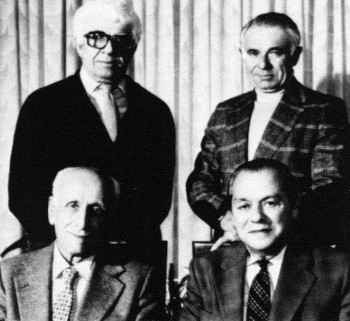
Seated, from right to left: Mr. Michael Pit; Mr. Yankel Shostak, Honorary Treasurer Standing, from right to left: Mr. Jeff Kagan, Honorary Secretary; Mr. Leon Kagan, Assistant Honorary Secretary |

Translator's note:
Translated by Beate Schützmann-Krebs
The Bialystoker Center in Australia received 465 permits to bring Białystoker refugees over from Europe. People who have no connection to the Center at all admire our work and consider it a tremendous achievement for a relatively small group. But our work does not end with the permits alone.
We decided not to do things halfway, and to make every effort to secure ship tickets as well. But since we were dealing with hundreds of people, and a ship ticket cost a full 200 Australian pounds (850 dollars), the total ran into many tens of thousands of pounds. Naturally, this was beyond our means. We therefore approached the local united relief fund, and they agreed to charge us, as an organization, only 100 pounds per ticket.
But what will happen next? The money will eventually run out, and we must continue issuing permits, because requests keep coming in, day after day. And why should we stop? Why should Yankev receive a permit and Yitskhok not? Who will take it upon themselves to decide such things?
Stopping the work is absolutely out of the question. But on the other hand, to continue in this way could mean being left stranded in the middle of our efforts – bankrupt…
And then something else happened. You must not forget that the housing situation in Australia, just as in the rest of the world, is a very serious problem, one that will not be solved so quickly. The first thirty-six “shvalbn” – families from among those for whom we had arranged permits – have already arrived. How are we to provide them with a roof over their heads?
But we have a great God, and it happened that just then a large mansion belonging to a recently deceased local millionaire was being auctioned off. We decided that no matter how tight things were for us financially, we could not let the opportunity pass, and that we must buy the house. For usually when one buys a house (if one manages to get one at all), one must pay, in addition to the official purchase price, another fifty percent. But here the price was a normal one, accepted by the government. So we decided to stake everything we had and secure the house. And it worked!
It is hard to give up the house. How are we to manage? For the moment we have borrowed and gone into debt over our heads. And, as you can well understand, the work of securing permits and ship tickets cannot stand still even for a moment.
(A. Zbar, “Bialystoker Shtime,” May–June 1947)
The Young Center
As we learn from a report, our Białystoker landsleit in Australia – a group of scarcely 200 members – have raised enormous sums through initiatives, appeals, help from their own and from outsiders, and through contacts abroad. They have brought hundreds of Białystoker landsleit to Australia, who found a place of refuge within the walls of the Center, with housing, food, medical care, clothing, and other necessities of life, until they were able to stand on their own feet and integrate into the new country.
Among the many Jewish and non-Jewish guests who have visited the aristocratically comfortable, richly furnished Bialystoker Center, Mr. Jordan, the representative of the Joint, was also a visitor. He expressed his admiration and remarked that “what they are doing for the immigrants in their new home is of great importance and deserves the support of all organizations whose mission it is to help.”
From the heartfelt welcome at the ship to the intimate rooms of the Center, the newly arrived Białystoker immigrant breathes the homelike atmosphere there – the atmosphere of old Białystok.
The local patriotism for Białystok does not, however, overshadow among them the national consciousness for our Jewish homeland and for the general needs of our people. In addition to the large sums for Białystoker immigrants – including more than 13,000 dollars from our American landsleit – and in addition to the shipments of clothing and food to the camps, the Białystokers in Melbourne extend a brotherly hand to the Jewish refugees in Cyprus and also to the Jewish settlement in the Land of Israel. Colossal sums have been raised during the appeals for the Jewish state. “An enthusiastic group of warm, devoted Jews,” says Rabbi Zlotnik, emissary of the Jewish National Fund.
The activities of our Australian brothers and landsleit are not limited to rescue and relief alone, but extend into the cultural sphere as well. The Bialystoker Center in Melbourne is a nest for the Jewish word, culture, and art for the entire Jewish community in Australia.
On this occasion, the members of the administration deserve to be mentioned with praise – many of whom our landsleit still remember from the old home: M. Pit, president; A. Sokol, vice-president; A. Zbar, vice-president; W. Davis, honorary secretary; M. Hemery, honorary treasurer; and the esteemed friends M. Gibgot, N. Glogovski, Ch. Dorevitsh, T. Lapin, Y. Slonim, A. Serey, G. Pruzhanski, and M. Kornen – all of whom are devoted with heart and soul to the landsmanshaft and responsible for its great and achieved success.
(Bialystoker Shtime, May–June 1948)
Translated by Beate Schützmann-Krebs
The Bialystoker Center in Australia addresses our landsmanshaft everywhere, as well as the broader Jewish public, with a rich record of important work and meritorious achievements as we bring the year's activities to a close. With our energy, effort, and funds, we have brought over hundreds of Białystoker refugees from the European valley of misery with our ship tickets, giving them a comfortable home in the house of our Center, a brotherly atmosphere among our landsleit, and a cultural corner for their spiritual needs.
Here among our local Białystokers, we have also deeply rooted the landsmanshaft consciousness and feeling, and have likewise satisfied their cultural needs. In addition to this, we have contributed our significant share – in work and in funds – toward the building up of our State of Israel.
In our tasks and achievements, we have been greatly helped by our landsleit abroad. Taking into account the considerable expenses of the Center – such as maintaining the house, support and loans for the newly arrived, sending money, food, and clothing to Białystok refugees throughout the world, and ship tickets for our Białystokers to come here – and considering that we here in Australia, a small handful, cannot by ourselves cover the enormous budget, we decided to appeal for help to our brothers and sisters overseas. After lengthy negotiations, we achieved our goal and secured assistance for immigration funds.
Thus, from our landsmanshaft in the United States there flowed in 5,700 dollars; from our Białystokers in Toronto – 1,000 dollars; from our brothers in Mexico – 1,500 dollars; from the Jewish Congress in Montreal – 1,500 dollars; and from our landsmanshaft there itself – 3,500 dollars.
It goes without saying that our immigrants also received a thorough medical examination and treatment, which they so greatly needed after the seven circles of hell under Hitler. Immediately after disembarking from the ship, following a friendly reception by our special welcoming committee or its representatives at the ports of Sydney or Melbourne, a medical examination was carried out. X-ray pictures were also taken when necessary, and several operations were performed. Our thanks go to the doctors Veyman, Mashin, and Treyvish, who used to carry out this work and who serve the Białystoker immigrants regularly without any honorarium.
A particularly proud chapter in our work for this year is the assistance for our stranded Białystokers in Cyprus, on their way to the Land of Israel. Besides Cyprus, we also took part in the general Jewish “State Appeal,” from the proceeds of our card parties, designating fifty percent of them for the State of Israel.
With our face turned toward our old, destroyed home, we have also fulfilled our duty to honor the memory of the Białystok martyrs. We contributed toward a fence to enclose the cemetery of the martyrs, which had been purchased from the Christian owners. The cost of the land that was bought back – where the martyrs were exhumed, brought to Jewish burial, and honored with a monument – was borne by the landsleit in America.
On the recommendation of the last general assembly to engage also in cultural work, our Center included important cultural activities in its program. The Center, with its wide-ranging and richly varied activity, attracts many visitors.
(M. Pit, Bialystoker Shtime, Sept.–Oct. 1948)
|
|
|||
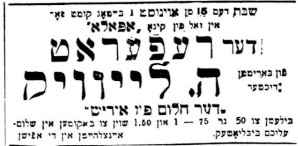
| An announcement for a cultural event at the Apollo Cinema: The poet H. Leyvik will deliver a lecture titled “The Dream of Yiddish.” The event takes place on Shabbat, August 16, at 1 p.m. |
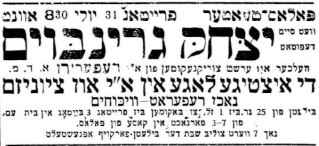
An announcement for a public lecture at the Palace Theater: Deputy Yitskhok Grinboym, newly returned from the Land of Israel, will speak about the current situation in the Land of Israel and Zionism. The event takes place on Friday, July 31, at 8:30 p.m. | |||
|
|
JewishGen, Inc. makes no representations regarding the accuracy of
the translation. The reader may wish to refer to the original material
for verification.
JewishGen is not responsible for inaccuracies or omissions in the original work and cannot rewrite or edit the text to correct inaccuracies and/or omissions.
Our mission is to produce a translation of the original work and we cannot verify the accuracy of statements or alter facts cited.
 Białystok, Poland
 Yizkor Book Project
 JewishGen Home Page
Copyright © 1999-2026 by JewishGen, Inc.
Updated 15 Apr 2026 JH