 |
|
|
[Page 383]
|
[Page 384]
[Page 385]
by David Podliashuk [Podliachouk]
Translated by Beate Schützmann-Krebs
Speaking of the Jews of Białystok in France, it should be noted that between the two world wars, in the 1930s, our well-known and universally respected townsman, the devoted communal activist Dr. Avraham Bantshevski, attempted to create an Association of Bialystoker Jews in Paris. Unfortunately, he did not succeed. After the outbreak of the terrible war, the unforgettable Dr. Avraham Bantshevski, together with his son Viktor, was deported to Auschwitz. A few months later Dr. Bantshevski's brother, Hershl-Georges, was also deported, and all three perished in the extermination camp.
During the occupation, when the German murderers ravaged France, our Jewish Białystok was honorably represented within the resistance movement in Paris by our esteemed landsman Dr. Aharon Yukhnovyetski [Juchnowiecki] and his wife Rivka, née Bernstein. They were among those who risked their lives every day and every minute in the sacred work of rescuing from annihilation first the children, and then all those who were in danger of falling into German hands. And which Jew – man, woman, or child – was not in danger at that time? They themselves, the Juchnowieckis, were exposed to danger even more than others; they often slept wherever they could, for going home was too dangerous.
Immediately after the Hitlerite occupation, a Committee of the Bialystokers in Paris[3] was created under the chairmanship of Dr. Aharon Juchnowiecki. In its early period, the Committee enjoyed great success among our landsleit here, for it became a source of information about the fate of our brothers and sisters in the ghetto – their suffering and their annihilation. After the bitter truth became known about the ordeal and destruction of their loved ones, the local Białystoker landsleit nevertheless continued to take a strong interest in the Committee's work, for all the surviving remnants of our people – landsleit and those rescued from the destruction – passed through Paris on their way to America, Canada, Australia, and other countries.
From these deeply afflicted and miraculously saved landsleit, one could learn many details about the martyrdom of our townspeople who had been imprisoned in the Białystoker ghetto, and later about those who survived the death camps, or had been deported by the Soviets to Siberia, or had come from other places.
When all the refugees who had arrived in Paris had moved on, the interest of the remaining Białystoker landsleit in the Committee's activities grew weaker. This was true, to some extent, even at the annual memorial gatherings for our murdered martyrs. A smaller number, however, remained faithful in observing the yortsayt for our loved ones who had been murdered by the Nazi killers. The Committee, which had carried out various important tasks, made it its principal mission to preserve the memory of our hometown and of the martyrs who were murdered.
Every effort was made to gather as many people as possible at each yortsayt, in order to honor the martyrs and to recall and highlight their suffering and their heroism.
At the same time, our Committee – though only to a modest degree and amid many difficulties – carried out cultural and social activities. These included holiday gatherings in honor of Chanukka, Purim, and other similar occasions. Thanks to the artistic collaboration of the late Sara Babitsh, the talented pianist, and thanks to our well-known folk artist Zalman Koleshnikov, these events enjoyed success both among the Białystoker landsleit and among non-Białystokers.
Another deserving Białystoker landsman in Paris was the late Wolf Babitsh. Together with his wife, the late Sara, their home became a place of refuge for many Jewish artists – especially musicians and singers – who had a connection to Białystok. Much credit for this is also due to the aforementioned esteemed landsman and well-known stage artist Zalman Koleshnikov, who was known among Jews everywhere.
When the Committee of the Bialystokers in Paris was created shortly after the war, its members – besides Dr. Juchnowiecki – included the late Wolf Babitsh; the well-known Białystoker actor Yisrael Barnboym [Barenboim]; Moyshe Ayznshtat [Eizenstadt], who had been an actor in Białystok during the First World War; and myself. Barnboym later emigrated to America together with his wife, the actress Zevkina, and their rescued son (the other was murdered by the Nazis). Later, Mrs. Genya Dreizin, a loyal and devoted woman from Białystok, was co-opted onto the Committee. The famous Bialystoker artist Benn also lent his support.
The Committee of the Bialystokers continued its various activities in this manner until 1977. The work, however, became increasingly difficult as the number of active workers grew smaller.
[Page 386]
Nevertheless, despite everything, we have continued to make an effort to remain connected with one another. We also maintain contact with Białystoker landsleit. Naturally, with the passage of time and changing circumstances, the situation is no longer what it was in earlier years, nor are the activities as extensive as they once were.
In addition to our local activities, the Committee maintained contact and cooperation with the Irgun Yotzei Bialistok be-Yisrael in the State of Israel. There was also a connection with Kiryat Bialystok near Tel Aviv. Within the limits of our modest means, we collected a small amount of money and contributed it in order to help maintain the bond between the small number of Białystokers in Paris and our ancestral community, as well as with the State of Israel.
I would also like to mention that at certain memorial gatherings, thanks to the efforts of the late Wolf Babitsh, we had as a speaker our esteemed landsman, the well-known international attorney and scholar Dr. Samuel Pisar – he who, as a child, suffered in Auschwitz and emerged from that hell through miracles.
|
|
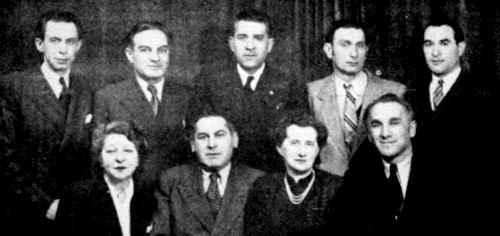
Seated, from right to left: Wolf Babitsh; Mrs. Juchnowiecki (Rivka Bernstein); Dr. M. Juchnowiecki; Mrs. Barnboym (Zevkina) Standing: Dr. Wolf Perl; the renowned painter Benn (Ben-Zion Rabinovitsh); Yisrael Barnboym; David Podliashuk; and Moyshe Eizenstadt |
After the death of Dr. Aharon Juchnowiecki in March 1977, the activity of the Bialystoker Committee weakened considerably. Wolf Babitsh, of blessed memory, was already very ill, and many of those who had remained loyal to Białystok had withdrawn because of age and illness. Yet we do not allow the spark of Białystok to be extinguished among us here in Paris.
The Committee, which had been active for thirty-two years, from 1945 until 1977, has written a beautiful chapter in the history of our landsmanshaft and in the continuity and heritage of Białystok Jews everywhere – those who lovingly and faithfully preserve the great legacy of our once-beloved Jewish hometown, of its people who were murdered, and of the city itself that was destroyed in the terrible time of Hitlerism.
Here is a list of Białystoker landsleit in Paris who were deported and murdered by the Hitlerites between 1941 and 1944:

Translator's notes:
Translated by Beate Schützmann-Krebs
Shortly after the end of the war, as soon as the Hitlerite flood of destruction and annihilation had subsided, the Białystoker landsleit in France also joined in the activities. We present here a letter, dated October 8, 1945, which the Bialystoker Center received from the Committee of the Bialystoker Association in Paris.
To the Bialystoker Relief Committee in New York,
228 East Broadway
Dear landsleit,
We wish to inform you that on Monday, October 8, 1945, the first founding meeting of the Association of Bialystokers in France took place, with about fifty Białystokers participating. The meeting was held in the home of the Białystoker physician Dr. Juchnowiecki.
In a brief overview, Dr. Klementinowski, who served as chair, outlined the main tasks of the Association. He recalled the 45,000 Białystok Jews who were murdered by the enemy, the partisans who fell in battle during the uprising in the Białystoker ghetto, and those who died – even of natural causes – but whose lives had nonetheless been shortened by the enemy through suffering and torment.
In a longer address, our landsman and friend Avraham Raiski – who not long ago had been in America, met with you, and worked with you – conveyed warm greetings from the Białystok Jews in America and from your esteemed institutions. His report aroused great interest among those present, many of whom were perhaps becoming aware for the first time of the significant role that the Bialystoker institutions in America play – and will now play even more strongly after the destruction of Białystok – as a second home, a new Bialystok with another 50,000 Jews.
Dr. Lunski, who had lived in the Grajewo ghetto but had also spent some time in the Białystoker ghetto and managed to save himself, recounted several horrifying details about the fate of Białystok. Dr. Klementinowski read to those assembled excerpts from articles in the Bialystoker Shtime that he had just received from you in recent days.
Taking part in the discussion that followed were Dr. Juchnowiecki, Mrs. Juchnowiecki, Padlashyuk [Podliashuk], Mareyn, Lev, and others. The provisional initiative committee that had functioned until now was confirmed as the Committee of the Bialystoker Association, consisting of Dr. Juchnowiecki, Avraham Raiski, Padlashyuk [Podliashuk], and Dr. Klementinowski. The tasks that the initiative committee had presented to the meeting were also approved:
The funds we will receive from you will be used to support several Białystokers who have only recently returned from the concentration camps and who must be provided with clothing, housing, and help in rebuilding their economic lives. They will also be used for Białystokers who managed to save themselves here in France but who have lost everything they once possessed.
We ask that you ensure that we receive the money as quickly as possible. At the same time, we ask you to send us 30–40 copies, in individual packages, of your latest issue of the Bialystoker Shtime. We will sell them, and the proceeds will also be counted as a contribution from you.
We hope that this first official letter will mark the beginning of a closer relationship with you, in fruitful cooperative work for the benefit of our landsleit.
With friendly greetings,
The Committee of the Bialystoker Association in Paris
Translator's notes:
by Fishl Faynfeld
Translated by Beate Schützmann-Krebs
From a correspondence of that time.
The postwar Bialystoker Committee in Paris began its work under difficult conditions. Without any assistance from abroad, it initially supported every passing landsman with its own limited means – providing money, helping with the necessary formalities for temporarily remaining in Paris, and assisting with onward emigration.
The administration of the Bialystoker Committee in Paris consists of the following distinguished Białystokers: Chairman Dr. Juchnowiecki; Treasurer Wolf Babitsh; Secretary David Padlashyuk [Podliashuk]; and members Mr. Benn (Ben-Zion Rabinovitsh), the prominent painter in France, and Mr. Barnboym [Barenboim], a well-known artist in Paris. They devote themselves wholeheartedly to helping our landsleit who pass through Paris.
Great credit for assisting in the Committee's work is also due to Mrs. Dr. Juchnowiecki, as well as to the Białystoker woman Mrs. M. Hofnbakh [Hofenbach], who survived the Białystoker ghetto and the German concentration camps. A group of landsleit who had recently arrived in Paris directly from Białystok received a warm welcome from the Bialystoker Committee, which provided them with all necessary assistance.
In arranging accommodations for the newly arrived Białystok comrades in Paris, our landsman Yitskhok Ribalovski – a son of Meir Ribalovski, who had run a wayside inn with a wedding hall near the train station – also rendered valuable service.
Great credit is due to the Bialystoker Committee in Paris for assisting the fifty Białystok children with everything they needed. As is well known, the children returned some time ago from the Soviet Union together with their caretaker, Mr. Tobyash. The children's colony was located on the Rothschild summer estate, forty kilometers outside Paris, where they were frequently visited by members of the Committee as well as by Białystoker landsleit living in Paris.
High praise is likewise owed to the esteemed Committee member Wolf Babitsh, who showed remarkable personal initiative in helping our Białystok orphans. Significant credit for the fundraising campaign that took place among the landsleit in Paris is also due to the distinguished Committee member David Padlashyuk [Podliashuk].
The administrative Committee member, the well-known artist Mr. Benn, donated a painting at the most recent administrative evening of the Bialystokers in Paris (not for the first time).The Committee sold it that same evening for a handsome sum.
On March 31, 1947, a General Assembly of all Białystoker landsleit in Paris was held under the chairmanship of Dr. Juchnowiecki, with 180 people in attendance. The distinguished guests from Australia, Mr. Wolf Fink, and Mr. Freydkes, the editor of a Jewish newspaper in Buenos Aires, were invited to join the presidium. At the beginning of the meeting, the memory of our fallen brothers and sisters was honored by a standing tribute.
Dr. Aharon Juchnowiecki gave a brief report on the Committee's activities to date. A detailed financial report was delivered by the secretary, D. Podliashuk, who emphasized the substantial monetary support of two thousand dollars received from the Bialystoker Relief in America.
The speakers who took the floor included comrades Ginzburg, Babitsh, the guest from Australia, Mr. Wolf Fink, and the guest from Argentina, Mr. Freydkes. Among other points, Mr. Fink assured the Assembly that the work among the Białystoker landsleit in Australia would be further expanded in order to help rescue the remaining Jews from the devastated city of Białystok. The guest from Argentina, who is soon traveling to visit Białystok, likewise assured the Assembly that in the future the Białystoker landsleit in Argentina would assist the unfortunate Białystoker Jews in Poland.
In concluding remarks, the recently arrived comrade from Białystok, Ayzik Grodski, conveyed a heartfelt greeting and request from the remnants of Białystok's Jews, who ask that they be given the opportunity to emigrate as quickly as possible, so that they may rescue themselves from the ruined city, where the earth is soaked with the blood of our brothers and sisters.
After hearing the reports and speeches, the General Assembly expressed full confidence in the administration, with the wish that it continue its work in the same spirit as until now.
Chairman Dr. Juchnowiecki announced that, according to a decision of the administration of the Bialystoker Committee in Paris, a traditional first Passover Seder would be arranged for all deported landsleit, to which the Białystoker landsleit of Paris would also be invited.
A heartfelt greeting from all the Białystokers in Paris to all our landsleit throughout the world! The unity of Białystokers throughout the world is eternal.
[Page 389]
The First Traditional Passover Seder
On Friday, April 4, 1947, the Bialystoker Committee in Paris arranged a special first traditional Passover Seder for former deportees and for the Białystoker landsleit living in Paris. The chairman of the Committee, Dr. Juchnowiecki, welcomed all the guests, after which everyone exchanged holiday greetings.
Around one hundred Białystokers sat at beautifully set tables, and our landsman Shimen Amyel conducted the Seder. The son of the Committee member Mr. Babitsh asked the Four Questions.
Speeches were delivered by Dr. Juchnowiecki, who greeted the guests with warm holiday words, and by Fishel Faynfeld, who first called upon the assembly to rise in honor of our fallen martyrs, our brothers and sisters.
Greetings were extended to the Bialystoker Center in New York and to all Białystokers throughout the world. A special greeting was sent to our landsleit in Australia for their great efforts in sending permits, thereby enabling hundreds of our landsleit to emigrate and save themselves from the blood-soaked soil of Europe.
Comrade Litvin (a deportee from the Białystoker ghetto and the German camps) sang the Białystoker ghetto songs “Bialystok, My Home,” “In the Białystoker Ghetto,” and “Markovtshizne.”
In a deeply moving atmosphere, all the guests expressed their gratitude to the Bialystoker Committee in Paris for its great efforts and for arranging the first traditional Passover Seder, where the Białystokers had the opportunity to meet one another.
On Sunday, April 13, an outing for the Białystoker deportees was arranged at the invitation of Mr. Benn, to the studio of our well-known Białystok artist. Over a glass of wine and in a warm, brotherly Białystok atmosphere, the guests viewed the beautiful paintings, which were explained by the beloved artist Benn.
The Bialystoker Committee in Paris, with the assistance of the Białystok landsman Yitskhok Ribalovski (a professional printer), decided to publish an album of the Białystoker ghetto songs with their musical notation.
(Bialystoker Shtime, May–June, 1947)
Translator's note:
Translated by Beate Schützmann-Krebs
Yesterday, our colleague Mr. Litman Rozental received the following letter from Mr. Yosef Barondes of New York, which we print here word for word:
September 21, 1925
My dear Mr. Litman Rozental,
I have just received your letter.[a]
I will certainly do the very best I can in the matter of helping our brothers in Białystok. But you know yourself – “my strength lies only in my mouth.”[b][2] I am not a Białystoker, and although I am the honorary president of the Bialystoker Center, my so-called title is truly nothing more than an honorary one. This, of course, does not free me in any way from my obligation to help the Jews of Białystok with the small influence I have over the Bialystokers in America. It must be said, however, that no landsmanshaft has done as much for its landsleit in the old home as the American Jews from Białystok.[c]
Besides this, we here in Jewish America have a whole series of “drives”[d]:
Yes, I received a clipping from the Białystoker newspaper Dos Naye Lebn, sent to me by the Center's secretary, David Sohn.[f] He asked me why I had not first consulted with the officers of the Center before writing to you about this matter. I replied that this had been a mistake, but the article in the Forverts [Forward] was filled with so many astonishing and terrible facts about the Jewish situation in Białystok that I could not withstand the impulse to say a word of comfort to my unfortunate brothers in Białystok.
As I said: I will do everything I can in this matter.
Yours, Yosef Barandes
A khsime-toyve – may you be inscribed and sealed for a good year – to you, your wife, and all Israel.
[Page 390]
In the name of the Jewish leadership of Białystok, we wish to express to Mr. Yosef Barandes our heartfelt thanks for his warm and sincere words, which show a deep concern for the fate of our city. We hope that these words will lead to positive and fruitful efforts.
(Dos Naye Lebn, Białystok, October 9, 1925)
|
|
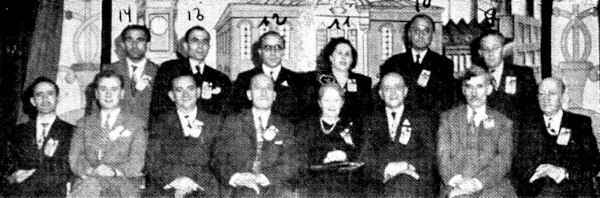
Seated from right to left: David Gotlieb, Yosef Yehuda Zakharyash [Zachariash], Avraham Lev, Fanni Yankowitsh [Yankovich], Yakov Khazan, Avraham Tiktin, Benyamin Rozental, Shimen Amiel Standing: Simkhe Tsfat [Simcha Tzfas], David Zabludovski, Naomi Kaplan, Max Yofe, Shmuel Zabludovski, and Yehuda Monkito |
|
|
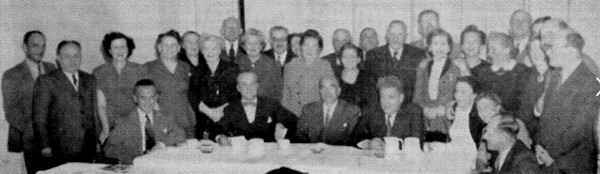
Seated from left: Mr. Yud, Y. Gringhoyz, Dr. Shoshkes, A. Levin, Mrs. Gringhoyz, Mrs. G. Levkovski, G. Levkovski [sic] Standing from left: Mr. Gimpel, Mr. Stufler, Mrs. Yud, Mrs. Rekhtman, Mrs. E. Shmush, Mrs. Bialystotski [Bialystocki], Mr. Shmush, Mr. Gurvitsh, Mrs. Gurvitsh, Mrs. Gimpel, Mr. Yudelovitsh, Mrs. Israel, Mr. Astrinski, Mrs. Milevitski, Mrs. Gershati, Mr. Kohn, Mrs. Blum, Mr. Valazinski, Mrs. Valazinski, Mrs. Pines, Mr. Kleyn |
Editorial Notes:
Translator's notes:
Translated by Beate Schützmann-Krebs
|
|
Translated by Beate Schützmann-Krebs
Bialystoker bilder album [Białystok Photo Album], New York, 1951.
Bialystoker yovel zamlbukh gevidmet dem 70-yorikn geburtstog fun David Sohn [Białystok Jubilee Anthology Dedicated to the 70th Birthday of David Sohn], New York, April 1961.
Di farshvundene velt [The Vanished World], New York, 1947.
Bialystoker fraynt [Bialystoker Friends], New York, March 1950.
Bialystoker lebn [Białystok Life], New York, September 1939.
Bialystoker lebn [Białystok Life], New York, March 1943.
Avraham Shmuel Hershberg: Pinkas Białystok, band 2 [Record Book of Białystok, Volume 2], New York, 1950.
Bialystoker fraynt [Bialystoker Friends], New York, October 1955.
Der Bialystoker pioner [The Białystok Pioneer], New York, November 1931.
Bialystoker vegn [Białystok Paths], Buenos Aires, September 1973.
Natsyonale un politishe bavegungen bay yidn in Białystok, heft 1 [National and Political Movements among Jews in Białystok, Issue 1], New York, 1951.
Bialystoker lebn [Białystok Life], New York, September 1938.
Bialystoker lebn [Białystok Life], New York, 1940.
David Klementinowski: Lebn un umkum in Bialystoker geto [Life and Death in the Bialystoker Ghetto], New York, 1946.
Seyfer Białystok, heft 3 [Book of Białystok, Issue 3], New York, April 1964.
Seyfer Białystok, heft 2 [Book of Białystok, Issue 2], New York, 1963.
Pinkas fun yidishe druker in Poyln [Record Book of Jewish Printers in Poland], Warsaw, 1949.
Bialystoker vegn [Białystok Paths], Buenos Aires, December 1947.
Di yidishe presse vos iz geven [The Jewish Press That Once Was], Tel Aviv, 1975.
Seyfer Białystok, heft 1 [Book of Białystok, Issue 1], New York, 1951.
Rafael Rayzner: Der umkum fun Bialystoker yidntum [The Destruction of Białystok Jewry], published by the Bialystoker Center in Australia, Melbourne, 1948.
P. Grim (Moyshe Grossman): In far'khisheftn land fun legendarn Dzhugashvili [In the Enchanted Land of the Legendary Dzhugashvili], Paris, 1946.
Yosef Rubinshteyn: Megiles Rusland [Scroll of Russia], New York, 1960.
Leyb Shpizman: Khalutsim in Poyln, band 3 [Pioneers in Poland, Volume 3], New York, 1962.
Algemeyne entsiklopedye, band 1 [General Encyclopedia, Volume 1], New York, 1963.
Bialystoker geselekh [Bialystoker Alleys], Buenos Aires, 1951.
Lider fun Bialystoker geto [Songs from the Bialystoker Ghetto], Paris, 1947.
Nina Tenenbaum-Beker: Mordechai Tenenbaum-Tamaroff, der held fun di getos, band 2 [Mordechai Tenenbaum-Tamaroff, the Hero of the Ghettos, Volume 2], Tel Aviv, 1977.
Chaika Grossman, Unzer vort [Our Word], Bamberg, Germany, August 1946.
Yisroel Beker: Di bine fun mayn lebn [The Stage of My Life], Jerusalem, 1979.
Srolke Kot: Khurbn Białystok [The Destruction of Białystok], Buenos Aires, 1947.
Yidisher teater in Poyln tsvishn beyde velt-milkhomes [Jewish Theater in Poland Between the Two World Wars], New York, 1968.
Kiryat Białystok byuletin, no. 1, [Kiryat Białystok Community Bulletin], New York, December 1949.
Kiryat Białystok byuletin, no. 2, [Kiryat Białystok Community Bulletin], New York, July 1950.
Bialystoker vegn [Białystok Paths], Buenos Aires, September 1980.
David Sohn: Di tetigkayt fun der Bialystoker landsmanshaft in Amerike [The Activities of the Białystok Landsmanshaft in America], New York, 1934.
Dos naye lebn [The New Life], Białystok, 1925.
Grodner vegn [Grodno Paths], Buenos Aires, 1959.
Bialystoker fundament, New York, 1935.
Di yidishe landsmanshaftn fun Nyu York [The Jewish Landsmanshaftn of New York], New York, 1938.
Jewish Resistance During the Holocaust, Yad Vashem, Jerusalem, 1971.
Ryszard Krasko, Białystok: A Tourist Guide, Kraków, 1972.
Polacy i Żydzi, 1939-1945, Książka i Wiedza, Warszawa, 1971. [Poles and Jews, 1939-1945]
Bialystoker shtime [Białystok Voice], New York:
Jan. 1928, Sept. 1963, Sept.-Oct. 1941, Sept.-Oct. 1949, Feb.-Mar. 1945, Nov.-Dec. 1945, May-Jun. 1946, Sept. -Oct. 1945, Sept.-Oct. 1946, May 1941, Nov.-Dec. 1946, Sept. 1956, Sept. 1965, Sept. 1953, Sept. 1959, Apr. 1943, Mar.-Apr. 1948, Sept.-Oct. 1944, Sept.-Oct. 1948, Feb. 1943, Sept.-Oct. 1948, Jan.-Feb. 1949, Sept.-Oct. 1946.
Special issues: 1946, 1947, 1948, 1952, 1957, 1958, 1949, 1959, 1960.
Apr. 1963, Mar.-Apr. 1946, Jan.-Dec. 1945, Sept.-Oct. 1949, Apr. 1973, Apr. 1974, Sept. 1971, Apr. 1972, Sept. 1972, Sept. 1974, Mar.- Apr. 1948, Sept. 1946, Jan.-Feb. 1948, Sept. 1952.
Apr. 1978, Jan.-Feb. 1945, Sept.-Oct. 1945, Apr. 1946, Nov.-Dec. 1946, Sept.-Oct. 1946, Mar.-Apr. 1947, Apr. 1948, Jan.-Feb. 1948, Apr. 1976, Apr. 1961, Sept. 1961, Apr. 1958, Sept. 1978, Jan. 1939, Sept.-Oct. 1942, Jan.-Febr. 1952, Apr.-Mar. [sic] 1949, Sept. 1979, Apr. 1954, Sept. 1949, Sept. 1979, May-Jun.1946, Sept.1980, Mar.-Apr. 1948, Seot. 1934, Apr. 1954, Apr. 1962, Apr. 1948, June 1953, Jan-Feb. 1948, Sept. 1928, Apr. 1946, Mar. 1975, Sept.-Oct. 1949, Sept. 1974, Sept. 1976, Sept. 1980, Apr. 1968, May-June 1947, Mar.-Apr. 1948, Jan.-Dec. 1945, May-June 1947.
|
|
JewishGen, Inc. makes no representations regarding the accuracy of
the translation. The reader may wish to refer to the original material
for verification.
JewishGen is not responsible for inaccuracies or omissions in the original work and cannot rewrite or edit the text to correct inaccuracies and/or omissions.
Our mission is to produce a translation of the original work and we cannot verify the accuracy of statements or alter facts cited.
 Białystok, Poland
 Yizkor Book Project
 JewishGen Home Page
Copyright © 1999-2026 by JewishGen, Inc.
Updated 20 Apr 2026 LA