 |
|
|
[Page 355]
|
[Page 356]
[Page 357]
by Zalman Yerushalmi and Kopel Lev (Tel Aviv)
Translated by Beate Schützmann-Krebs
The Irgun Yotzei Bialistok be-Yisrael [Organization of Białystok Survivors in Israel] was established shortly after the Second World War, in 1946, following the terrible tragedy and destruction of European Jewry. The association was founded to help the new oylim – rescued landsleit who had come to the country – find their footing, obtain work, and receive support and loans when needed.
Later, the organization undertook to realize the idea of building a settlement in Israel bearing the name of our Białystok community, annihilated by Hitler. To this end, as is well known, a world conference was convened in New York in 1949 on the initiative of the unforgettable David Sohn, of blessed memory, bringing together representatives of Białystok organizations from around the world.
The delegate from the State of Israel to this world conference was Attorney Zvi Klementinowski. At the conference, the Kiryat Bialystok Foundation was established, headed by Ralph Vayn [Wein], of blessed memory.
At the same time in Israel, a committee for the establishment of Kiryat Bialystok was formed, with the Białystok activists Zalman Yerushalmi, Zvi Klementinowski, Mordechai Kruglyak, of blessed memory, and others.
In 1950, a contract was signed with the Rassco Company [Jewish Agency housing and settlement corporation] to build Kiryat Białystok on land belonging to Yehud, where, a hundred years earlier, pioneers from Białystok had already tilled the soil. In 1951, the great idea was successfully brought to life, and the first hundred houses in Kiryat Białystok were settled by newly arrived oylim – Jews from the destroyed Białystok community and its surroundings.
At that time, an administrative committee was also elected, consisting of the following members: Kopel Lev, chairman; Y. Tsernihov [Chernihov?], secretary; B. Lurye, M. Gelbord, Kh. Tsitsovits, and Sh. Garber (Revisions Committee). They worked to develop the new little town properly, so that it might grow into a community modeled after the former Jewish Białystok.
With the financial assistance of Białystoker landsleit in America, Australia, Mexico, and other places, another 108 houses were built, along with very important communal institutions such as a kindergarten, a children's home, a community center, a high school, a large and beautiful synagogue, and a monument financed by the president of the Kiryat Bialystok Foundation, David Lubin, of blessed memory.
In 1963, an industrial building for textiles was constructed with the help of the Foundation in New York, in the name of David Heyn [Hein] – a devoted activist and vice-president of the Foundation – and Avraham Sokol, of blessed memory, from Australia.
The streets in Kiryat Bialystok are named after prominent Jewish figures from the former Białystok community, such as Rabbi Shmuel Mohilever, Chazanowicz, Tenenbaum, Malmed, Sukenik, Kaplanski, and others. At the monument, the annual memorial services are held in remembrance of the Białystok martyrs and heroes.
In the Beit-Am [community center] building, a club for elderly residents has been established. The community is now also engaged in the cultural absorption of the newly arrived oylim from the Soviet Union. Courses in Hebrew and English are offered for these Jews. They also attend theater performances, go on excursions throughout the country, and listen to lectures on a variety of topics.
The library lends books in three languages, for both youth and adults. The Gemilut Hasadim[3] fund, named in memory of the Białystok martyrs, provides substantial low-interest loans in Kiryat Bialystok. Many Białystokers from abroad have visited the community, and they take pride in its development.
We are the only landsmanshaft that has succeeded in perpetuating our destroyed pre-war Polish community in the way that has been achieved in Kiryat Bialystok.
The Association of Białystoker Jews in the State of Israel convened a world gathering of our landsleit in 1969 to mark three important anniversaries: twenty years since the establishment of the State of Israel; twenty-five years since the uprising in the Białystoker ghetto and its final liquidation; and twenty years since the first World Conference of Białystokers in New York, at which the founding of Kiryat Bialystok was also proclaimed. Among the many distinguished personalities who participated in that conference was Dr. Sabin, the discoverer of the polio vaccine.
At our world gathering in 1969, the following resolutions were adopted:
The Jewish community of Białystok, destroyed by the Nazis, was adopted [taken under its memorial care] in 1964 by the Daled High School in Tel Aviv.
The administration of the high school, together with the students, committed themselves to studying and presenting the struggle for life and creativity in the Białystoker ghetto, as well as the uprising, the liquidation, and the destruction.
[Page 358]
With the help of the Bialystoker Center in New York, we established an auditorium and cafeteria in the school, named for the unforgettable leader David Sohn, of blessed memory. We also created a memorial corner dedicated to teachers and communal activists, among them Moyshe Zabludovski, of blessed memory.
We likewise commemorated our unforgettable Mordechai Kruglyak in the high school. In his name we established a study room equipped with various visual learning materials, where children of Middle Eastern and North African Jewish origin could strengthen their studies and improve their educational level. This project was realized thanks to the initiative of our friend Zalman Yerushalmi, who donated and raised a substantial sum of money at the banquet celebrating his 80th birthday, as well as a fund for scholarships for the students of Daled High School.
Translator's notes:
Translated by Beate Schützmann-Krebs
The following letter, which we present here, was sent to the Bialystoker Center in New York after the First World War and describes the early steps taken by Białystok Jews in Eretz Yisrael many years ago. It was written at the time when they were first establishing their central landsmanshaft organization. The letter was sent by the Bialystoker Center in the Land of Israel.
Serving on the provisional committee of this center of Białystoker Jews in Israel at that time–shortly after the First World War–were the following members: Leyb Rozenblat, Dr. Yosef Mohilever, Zvi Myasinovits, Dr. Rozenberg, Binyamin Serlin, Rabbi Freydenberg, Shmuel ben Tovim, Moyshe Markus, Mordechai Barkan, Mendel Levints, Yitzhak Lurye, Ze'ev Suraski, Shmuel Shatski, Yitzhak Zitser, and Avraham Yakov Bagon.
The letter from that period is presented here without changes.
Dear landsleit,
In recent years many families from Białystok have come to Eretz Yisrael, together with the stream of the Fourth Aliyah [1924-1929] and even earlier. The reason for this is that the Jews of Białystok have always been among the Chovevei Tsion [Lovers of Zion], and already in the days of Rabbi Shmuel Mohilever, of blessed memory, they devoted themselves to the idea of settling the Land. Eretz Yisrael is dear to them, despite all the hardships and troubles they endure.
In addition, the situation in Białystok is extremely difficult and offers no hope of making a living–especially for those who have already been ruined and for whom it is impossible to return and begin anew there. Their love for the Land has already taken root in their hearts, and their only hope is to remain in Eretz Yisrael, all the more so since those who left the Land and returned to Poland have regretted it.
Therefore, it is our duty to seek out ways and means to support them and to give them the opportunity to establish themselves here, thereby bringing blessing also upon the Land.
First of all, it is necessary to establish a loan fund (a Gemilut Hasadim fund) for our Białystoker landsleit, through which they could, with small loans, set up modest enterprises in trade–ventures that require only small amounts of capital, capital they simply do not have at the present time. With just a few dozen dollars, many of them could be saved from ruin; there are many such cases. For this purpose, a minimum of $2,000 is needed.
Later, when the aktsyon-bank [shareholding cooperative bank] is legally established, the money from the loan fund will be transferred to the bank, and the donors will receive shares corresponding to their contributions. It must be emphasized that the creation of this loan fund is extremely urgent and must be established without delay, for it is now the most essential means of supporting our brothers until they can fully establish themselves. In this way, we will save many of them from literal danger to life.
It is also very necessary to create an assistance fund for the Białystokers who wish to learn a trade – such as stone crushing, stonecutting, construction work, carpentry, and so on. As is well known, our brothers, both the older and the younger ones, are not craftsmen. Most of the older men were merchants, tukh [cloth] manufacturers, or factory workers. Most of the younger ones are schoolchildren, and even the craftsmen from the old country are not suited to the kinds of work required in Eretz Yisrael. By giving them such an opportunity, we will save many from great hardship.
For this purpose, a minimum of $2,000 is needed, because one must pay both for the training itself and for the living expenses of the trainee during approximately four months. After that time, the trainee can already begin to earn his own livelihood. These funds are given to the above-mentioned individuals only as loans, and they are obligated to repay them at fixed times.
After the aktsyon-bank [shareholding cooperative bank] is legally established and takes over this task as well, the sums will be transferred to the bank, and the donors will receive shares for the amounts they contributed.
As for the home-industry sector, this too is one of the most important areas that must be organized.
Most of the Białystok immigrants are skilled workers in the weaving industry. If they were given the opportunity to work in the same trade they practiced in the old country, they would be able to develop a significant branch of industry here – one that would be a blessing both for them and for the Land.
[Page 359]
This would make it possible for dozens of families among our Białystok brothers to engage in the weaving trade here as well, to emerge from the difficult situation in which they now find themselves, and to secure their livelihood for the future.
Since we see that, for the time being, there is no place in Eretz Yisrael for a large-scale industry, it is clear that there is wide potential for a small home-industry sector in the area of weaving – one that could directly employ dozens of Białystok families, and indirectly hundreds more, as well as many other inhabitants of the country.
Białystok had always distinguished itself through its woolprocessing industries. It was virtually the only place engaged in this branch. In the Land of Israel there is wool, of course, but it is not processed locally because of the lack of spinning mills. Without spinning, it is impossible to develop this important branch of industry.
Once spun yarn is available, it becomes possible to weave and finish all kinds of goods, and the home-industry sector can develop even with modest means and limited capital – just as it once did in Białystok. Therefore, first of all, it is necessary to establish a wool-spinning mill – not on a large scale, but with a single set of machines of the kind used in Białystok, adapted to local products. (Even today, a representative of the Białystok firm “Trilling & Son” is active in the country, purchasing local wool on their behalf.)
This could provide employment for several families who would have steady work in the spinning mill. It would also make it possible for many others to make use of the machines: they would receive the yarn from the mill and work it further at home.
Beyond this, it could foster the development of another important branch of industry – the carpet industry – which is widespread throughout the Middle Eastern countries and is already active here in Jerusalem, employing about a hundred workers. The lack of spinning facilities prevents this important branch from expanding.
Many immigrants from the Eastern lands are specialists in this trade, but they do not have the means to bring in yarn from abroad, because they lack the financial resources – needed in large measure for this–and the whole matter involves considerable difficulties. As a result, the entire field suffers.
If only a wool-spinning mill were established, everyone would be able to work and earn a livelihood. Many former residents of Białystok would also be able to learn this trade easily, since the work is quite simple and is carried out mainly by women and children, and is done at home and in their free time. This would ease the lives of workers both in the towns and in the villages.
We have pointed out here the importance of establishing a spinning mill for wool. We believe that this is clear and evident, but unfortunately it cannot be done with our own means. To carry this out, help from outside is necessary. We want to call attention to the fact that the Białystok landsleit, wherever they live, have an obligation to take the initiative into their own hands and establish a wool-spinning mill, because, after all, this is a responsibility of the Białystok community.
The sum required for this undertaking is, relatively speaking, not large. The best machines needed for it can be brought from Białystok, where, because of the crisis prevailing there, they can be purchased cheaply. According to the information we have, the cost should come to about six thousand dollars. A building for the factory is available for rent. This spinning mill will be the property of Białystok and will be under the direction of an administration chosen by the former residents of Białystok living in the Land of Israel, with the agreement of the donors. The Białystok immigrants in the Land of Israel will be able to make use of it. The administration will set the prices for spinning, calculating only the amortization and adding a small profit. With the remainder of the amortization, the factory will be gradually expanded, and the profits, according to the balance, will be credited to the capital of the loan fund that is being established. After the legalization of the shareholding bank, the capital together with the profits will be added to the general bank capital. The donors will, of course[a], receive bank shares for their contributions.
To organize and make possible the realization of this very important matter, we have established a coordinating center (merkaz) for Białystok immigrants in the Land of Israel, whose purpose will be to bring together our brothers who are in the country, in certain ways, according to the following regulations:
|
Author's note:
Translator's notes:
by Chaim Yisraeli
Translated by Beate Schützmann-Krebs
One of the most beloved pioneers among the Białystok landsleit in the State of Israel–as well as in the local Jewish community more broadly–was the warm-hearted and widely admired Zalman Yerushalmi. He came from a long and distinguished line of Jews from old Białystok. Born in March 1899 at 22 Bialotshanska [Białostoczańska] Street to Rakhel and Gedalya Yeruzalimski [Jerusalimski], he grew up in a family deeply rooted in the city. His father, Gedalya (son of Reb Dan Yeruzalimski), had already been, as early as 1870, one of the first founders of the knitting-work enterprises in Białystok.
Zalman studied in Białystok and abroad, but he felt drawn to a different path. As a young man, he entered his father's business, where–thanks to the knowledge he had acquired–he helped further develop and expand the enterprise. In September 1924, Zalman married his destined partner, Rakhel, a daughter of the respected Yudkovski-Repelski family. Already in his early youth, Zalman had become active in the Zionist movement, and in 1925 he came to Eretz Yisrael together with other members of his family.
As was common in those days, people arrived in the Land with new plans, but life here was difficult from the very beginning. Nevertheless, Zalman Yerushalmi–like many others–showed boundless determination as a pioneer in industry, development, and entrepreneurial initiative. He continued the traditions of his father in Białystok, who had been well known for his textile enterprises.
From the very beginning of his life in the Land, Zalman Yerushalmi showed remarkable pioneering spirit in helping to develop the textile industry. He also contributed to improving work methods and introduced new innovations modeled on practices in more advanced countries. All of this, at first, came with various difficulties and obstacles, but the capable and energetic Yerushalmi did not allow any hardship to deter him. At that time, this was also a blessing for Eretz Yisrael. He accomplished all of this together with his brother, Chaim, who was likewise an initiator with strong entrepreneurial ability. The Yerushalmi brothers became well known throughout the country and served as an example to many. During that period, other members of the family also came to the Land from Białystok.
This chapter in Yerushalmi's life is both important and compelling. He strove– making every possible effort–to bring his entire family to the Holy Land. And he succeeded. In the 1930s, the enterprises of the “Yerushalmi Brothers,” together with other family members, expanded significantly. Yerushalmi also took the initiative to bring new, modern machines from abroad. Branches of the Yerushalmi enterprises spread to various regions of the country, making it possible for many families at that time to earn a respectable livelihood.
The enterprises that Zalman Yerushalmi developed and expanded in the country–knitting, weaving, and other branches of the textile industry–continued to grow broader and larger. And so, over the course of decades, up to this very day, Zalman Yerushalmi–the pioneer [from old Białystok]–has remained tireless in his industrial undertakings. At the same time, he has always been active in the banking life of the country. He is counted among its prominent businessmen, and throughout all these years he has remained active in the Zionist movement and in various branches of local communal life. Everywhere, people listen with respect and attention to the words of the beloved Zalman Yerushalmi, who brings with him a new spirit of initiative, accomplishment, and achievement.
Naturally, from the very first day of his arrival in Eretz Yisrael, Zalman Yerushalmi remained deeply connected to the Jewish Białystok heritage that he–and others–brought with them to the Holy Land. Yerushalmi was also a pioneer in organizing, uniting, and coordinating the local Białystok landsleit, in order to help Białystokers in Eretz Yisrael and to support Białystok Jewish interests everywhere. Zalman Yerushalmi earned great distinction for helping to create and develop various organizations of Białystok Jews here in the country. It is well known that, thanks to his initiative, Białystok Jews in Eretz Yisrael remained connected to the old home even decades later. He truly did not rest, did not let go, and continually encouraged–true to his nature–every effort to remain connected with, and to help, the Jews of Białystok, even decades after leaving.
When the terrible destruction of the Jewish people under Hitler began, Zalman Yerushalmi was, of course, among the first–together with others in the country–to help our brothers and sisters in the old home. Zalman, the ever-steadfast, dynamic, and at the same time warm-hearted Zalman Yerushalmi, was shaken to the core when the horrifying news arrived about what the Hitlerite murderers were doing to the Jews of Białystok, as well as in other places.
[Page 361]
That was how it was for everyone in those days. But tragically, there was little that could be done to help our unfortunate brothers and sisters who were trapped in Hitler's hell, where they endured suffering, torment, and death.
Soon after the war, when it finally became possible to help those who had survived the Nazi annihilation, the Association of Bialystoker Jews in Eretz Yisrael did everything it could to ease, even a little, the pain and sorrow of our brothers and sisters whom the Nazi Angel of Death had not reached. And once again, one saw Zalman Yerushalmi at the forefront of this fraternal relief work. Throughout this entire period, Zalman Yerushalmi has stood at the head of the Irgun Yotzei Bialistok in the State of Israel, where his words, his advice, and his guidance are received with respect.
It should also be noted that Zalman Yerushalmi was one of the initiators and builders of Kiryat Bialystok, the shtetl in the Jewish state that commemorates the beloved Jewish Białystok of old.
And finally, let it be said that Zalman Yerushalmi–together with Advocate Klementinowski and others in Israel–was among the very first to insist, again and again, that everything possible be done to publish the Białystoker Yizkor Book. We are all proud of our dear and esteemed landsman Zalman Yerushalmi, who brings honor to Białystoker Jews everywhere. His pioneering work, which he began decades ago in Eretz Yisrael–both as a respected industrialist and on behalf of the interests of Białystoker Jews, as well as through his communal activities in general–is a truly beautiful chapter in his life, one that already spans eight decades.
We wish our warm-hearted Zalman Yerushalmi many more happy and satisfying years together with his loved ones, and for the benefit of Białystoker Jews everywhere.
by Avraham Wertheim
Translated by Beate Schützmann-Krebs
The pioneering spirit, idealism, accomplishments, and achievements of Białystok Jews have always been properly recognized in the Jewish homeland.
I want to recount here the remarkable story of the Białystok settlement in Eretz Yisrael, which was founded by Jews from Białystok. At the beginning of 1925, a group of Białystok Jews, together with the assistance of others, established in Eretz Yisrael–twenty kilometers from Haifa–a Jewish village called Jeida Manor, which today bears the name Ramat Yishai. Among the founders were the following Białystok Jews:
A. Loyb, vice-chairman of the Zionist Organization in Białystok; Avraham Lifshits, Yirmiyahu Litmanowich, Gershon Valman, Pinkhas Levints, Ayzik Rubin, Z. Frid, Moyshe Slutski, Yehoshua Kuk, Pesach Melnitski, Yakov Grintsvayg, Perets Tsemakhovits, Betsalel Dolobovski, Yakov Starinski, and others.
Most of these founders, many of whom were specialists in the textile industry, wished to establish a settlement in Eretz Yisrael that would not rely solely on agriculture but would also include textile production. For this purpose, 7,500 dunams [7,5 km²] of land were purchased from the American Jewish Land Company Kehilat Zion, and a textile factory was built with thirty-three technical weaving machines, diesel engines, and other equipment. The factory was constructed by the firm Simons Shukart [Siemens-Schuckert] of Berlin. Altogether, up to 150,000 dollars were invested in the purchase of the land and the establishment of the factory.
Seventy families then came from Białystok and the surrounding area and settled in the village of Jeida, in temporary wooden barracks (tsrifim) that had been put up for them. Despite the poor housing conditions and the lack of water in the region, the new settlers were inspired by the idea of developing the new settlement and building a life in Eretz Yisrael.
In 1927, however, a severe economic crisis broke out in Eretz Yisrael, while at the same time economic conditions in Poland improved. As a result, some of the colonists left Eretz Yisrael and returned to Poland. The smaller group that remained in the village of Jeida worked hard to keep the settlement alive and to find ways to secure their livelihood. This remaining group consisted of only twelve to fifteen families.
During the years 1936–38, in the period of the Arab uprising, the small settlement in Jeida defended itself heroically and repelled many attacks by Arab assailants. But on August 30, 1938, the factory was set on fire by marauding Arabs, and during the defense of the village one of the residents was killed.
The remaining residents of the village of Jeida did not abandon it. Instead, they devoted all their strength to rebuilding the ruined factory.
[Page 362]
Thanks to the support of the central Jewish institutions, the factory was reconstructed. Twenty-five workers were employed there, and each of them also cultivated his own small plot of land–two and a half dunams. Through effort and hard labor, they managed to continue life in the settlement and to maintain this Jewish foothold.
With the outbreak of the last war, the situation of the factory improved. But the main difficulties remained the lack of water and the fact that such a small settlement, made up of only a handful of families, was simply unable to establish the necessary communal institutions–a study house, a school for the children, or a clinic for the sick.
And here an extraordinary event occurred. A Jew in Eretz Yisrael, the former teacher and well-known educator Yishai Adler, donated his entire fortune of ten thousand pounds (forty thousand dollars) for the development of this Jewish settlement. The village received the name Ramat Yishai, and the money–ten thousand pounds–was turned into a fund that provided loans to those who wished to build houses and live in them. This fund also granted a loan for bringing water into the village, and water pipes were laid over a distance of three kilometers. In this way, the water problem was completely solved.
Thanks to the fund, ten houses were built, and another five were erected with the help of another social institution, Bitzur. Altogether, there are now fifteen houses in the village, in addition to the factory building and an office structure. Twenty-five families now live in Ramat Yishai (Jeida), and there are objective possibilities for many more families to settle there.
The great catastrophe that befell Poland–the annihilation of millions of Jews by Hitler (may his name be erased)–also claimed the lives of the Białystok members of the Jeida settlement who had returned to Poland in 1927. These martyrs had maintained contact with Jeida (Ramat Yishai) right up until the time of the Hitlerite slaughter, and they had hoped to return to their village, where they still held their estates. A danger then arose that the Palestine government might inherit their share, and so a trust company was established to take over these inheritances, which consisted of a portion of the textile factory and nearly 1,500 dunams of land. This property is now administered by the trust company.
At the present moment, the question arises of how to expand this Jewish outpost, strengthen it, and enlarge the settlement in Ramat Yishai. There is sufficient water, and there is enough land to settle many additional families. As is well known, in the camps of Europe, as well as in Cyprus, there are many rescued but homeless Jews from Białystok. It would be the most fitting memorial to those Białystok martyrs who, years ago, had hoped that they would one day be able to go up to Eretz Yisrael and settle on their own land. And since they were not granted that privilege, this settlement should now take in other landsleit, who will surely arrive before long.
What must now be done so that the settlement can absorb new immigrants? First of all, it is necessary to establish a school for the children of the village. In time, this school should also become a vocational school, where young people can be trained to work in textiles. The textile industry is developing very rapidly in Eretz Yisrael, and the prospects for well-trained textile workers in the future are excellent.
It is necessary to establish a study house and cultural center, the construction of which has already begun. But because of a lack of funds, the building cannot yet be completed. A small clinic, where the residents can receive medical assistance, is also needed. The construction of such a clinic has likewise begun, with the help of one of the village's earliest builders, H. Diker of Tel Aviv, who contributed three thousand dollars for this purpose. But several thousand dollars are still needed to finish the building.
The most important task is to build additional houses in the village, so that it may grow into a shtetl bearing the name “Bialystok,” where the new immigrants arriving in Eretz Yisrael can settle. With the development of the textile factory, the newly arrived landsleit will find work there. They will also be able to receive plots of land around the houses, to cultivate them and make a living. Work will also be created for the newcomers in other trades–tailoring, shoemaking, metalwork, carpentry, masonry, and the like.
This would be the most fitting memorial to the murdered Białystok martyrs. It would also be the greatest help to those Białystok Jews now in the camps and in other places throughout Europe, who are striving–now that we stand on the threshold of the opening of the gates of Eretz Yisrael–to come and settle on the land that was once acquired by their own landsleit.
(Bialystoker Shtime, January–February 1948)
the memory of our martyrs |
Translator's notes:
by Avraham Lis
Translated by Beate Schützmann-Krebs
Two important Jewish personalities were instrumental in ensuring that the Chibbat Zion [Love of Zion] movement in Białystok would take root and flourish, and that the quiet, yearning, generation-after-generation hope expressed in the verse “and the children shall return to their own borders” [Jeremia 31:17] would become reality. These were Rabbi Shmuel Mohilever, the city's chief rabbi, and the remarkable, unique doctor of the poor, Yosef Chazanovicz.
There is no doubt that the Jews of Białystok were a naturally receptive element for the development and elevation of the Jewish national idea. First and foremost, they were Jews who were deeply Jewish. They were Jews who had not assimilated; Jews upon whom foreign cultures had no influence whatsoever. Even the governments of Prussia, Russia, and Poland, which ruled the city at various times, left no deep imprint that could have weakened the steadfast Jewish character and the Jewish folk-spirit that Białystok possessed.
The Białystoker Jew was an authentic and special kind of Jew. Within him were synthesized the spirit of the Polish Jew, the emotional responsiveness of the Chasidic Jew–his sorrow and his joy–and the sober thinking and steadiness of the Lithuanian Jew, together with the breadth, warmth, and vitality of the Russian Jew. And it was precisely for this reason, no doubt, that the city–an important industrial and commercial center situated at the crossroads between Russia, Poland, and Lithuania–absorbed and reflected every variety of Jewishness.
Chasidic merchants and tukh [cloth] commission agents brought vigor and piety; manufactured-goods merchants from deep inside Russia infused the city with their commercial drive, their sensitivity to social issues, and their open-handed generosity. And the Białystok factory owners and textile traveling agents, whose products reached the farthest markets in Russia and at times even Manchuria, China, and India, often carried Jewish activity with them into those distant places and became pioneers of social movements and pioneers of cultural endeavor.
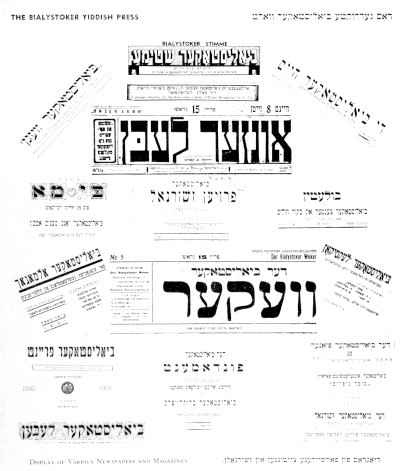
(It is worth noting the “expansion” of Białystok Jewry also in the realm of the press. In 1920, in Charbin (China), the textile traveler and writer Eliezer Faygin [Feigin] founded, edited, and published a Yiddish weekly newspaper called Der Vayter Mizrekh–The Far East.)
Not to mention the remarkable chapter of courage and self-sacrifice that the Białystok working class contributed to the broader revolutionary upsurge and to the national Jewish struggle.
|
|
The Jews of Białystok were also among the earliest oylim [immigrants] and among the pioneer settlers in the new Land of Israel. It is now ninety-six years since the first Białystok Chovevei Zion [Lovers of Zion] arrived in the Land. They came already imbued with the awareness that they were the first to pave the way, and they became co-builders of what was then an agricultural colony and is today the city of Petah Tikva.
These were the four prosperous Jews of Białystok: Elkhonen [Elchanan] Bulkin, Mordechai Dinowitz, Daniel and Dov Lifshitz-Yemini. This was probably the first group to come in an organized fashion from the Białystok Chovevei Zion society.
But only a few years later came the Magisevitsh family, who were among the founders of Kfar Uriya, and the Danin and Sukhovolski families, along with dozens of others who became co-builders of Hadera, Afula, and Ekron.
The Białystok historian and scholar A. Sh. Hershberg recounts the following important detail in Pinkas Bialystok concerning the building of the colony of Ekron: “The Białystoker Chovevei Zion society rose greatly in prestige and activity after Rabbi Shmuel Mohilever was appointed as the city's rabbi in the year 5643 (1883). A year earlier, in 5642 (1882), he had succeeded in winning over Baron Edmond Rothschild (the known benefactor) to the idea of the Land of Israel and to founding, according to his proposal, the Rozhenoy [Ruzhany]-founded colony of Ekron. From that time on, the Białystoker society became the center of the entire movement in the Diaspora.”
The far-reaching and influential activity of Rabbi Shmuel Mohilever on behalf of the redemption of the Land of Israel is well known.
[Page 364]
Among those early pioneers–the builders of Petah Tikva, Kfar Uriya, and Ekron–it should be mentioned in passing that even before them, individuals had already come to the Land. For here we find the courageous guard and early colonist Sender Chadad, who arrived seven years before the first group of four. Sender Chadad came to the Land of Israel in the year 1875–one hundred and six years ago.
From those earliest pioneers to the most recent arrivals–the Białystoker Jews and the descendants of Białystoker Jews, survivors of Nazi camps, ghettos, and deportations –the Jews of Białystok have forged their link in the chain of our national rebirth. They contributed their labor, their initiative, their endurance, and their courage to every sphere of our life: to our arduous struggle for independence, to the establishment of the State, and to the building and development of the Land.
Białystok residents in the Land of Israel were pioneers. They were among those who laid the foundations in many areas of our newly consolidated and rebuilt national life. Białystoker Jews were among the founders of the first textile factory in Jeida (Ramat Yishai). At the same time, the Yerushalmi family also immigrated and soon established their own factory. But this achievement–made some sixty years ago–was not their only contribution. Equally important was that, alongside their devotion to traditional industry, they also cultivated a deep love for working the land. With the age-old, folk-rooted “sweat of their brow,” they dedicated themselves to reviving the raw, stony, parched soil–whether in the kibbutzim or in the colonies of the Jezreel Valley and the Beit She'an Valley.
With their innate impulsiveness and their instinct for vibrant activity, Białystoker Jews not only helped develop crafts and industry, commerce and agriculture. We also find Białystokers among the creators and builders of Hebrew culture and art, and of the Hebrew theater.
Chayele Grober lived and created here for many years–one of the first actresses of the Habima Theater, whose founder and first director was also a Białystok native: the Hebrew teacher and theatrical visionary Nahum Zemach.
And here, too, was Professor Israel Halperin, one of our most important scholars, a historian and the author of numerous monumental works. And the late Yosef Serlin, former Minister of Health. And let us recall, in blessed memory, the late Professor Lipe Sukenik, and Dr. Shloyme Kaplan-Kaplanski, the labor leader and long-time builder and director of the Haifa Technion. And alongside them stood a great number of other scholars, writers, artists, social activists, and party leaders who enriched every field of our spiritual, artistic, and economic life with their initiative and their creative drive.
In this way, the Jews of Białystok helped build and develop our land, and here, too, they remained active and connected in every field–like links in the enduring chain of Jewish creativity. It was, and continues to be, an exalted continuation, accompanied by tireless energy and spiritual resolve, whose roots draw deeply from the beloved home we all once shared in unforgettable Jewish Białystok–a home that was annihilated and wiped away in so cruel a manner during the terrible time of Hitler's rule.
Let us preserve all this with love and loyalty; let us continue to carry forward the great heritage that has been entrusted to us. Yes, once there was a wondrous Jewish community in Białystok–an ir va'em be-Yisrael, a true mother-community of the Jewish people. Now all of it lives only in the memory of those who descend from there. Yet we must remember that although the once-famous Jewish Białystok was physically destroyed by the Nazis, it continues to live–and must always continue to live–spiritually, in the hearts of the children of that remarkable community.
The Białystok pioneers here, in the Jewish homeland, through their labor and their struggles, ensured that on this sacred soil as well, the great lineage of the Jews of Białystok would take root and continue forward, enduring and everlasting.
|
|
|||
| Invitation to an open-air public meeting at which the poet L. Yofe [Jaffe] from Jerusalem will speak on the topic of “Eretz Yisrael.” | Invitation to the Palace Theater, where the Vice–Chairman of the Zionist Central Committee in Poland, Dr. Y. Gotlib, will give a lecture on the topic “Our Preparations for the 14th Zionist Congress”[3]. |
|||
Translator's notes:
by Avraham Lis
Translated by Beate Schützmann-Krebs
The Significant Beginning
Immediately after the Second World War, after the great Jewish destruction wrought by Hitler, when the once-wondrous Jewish Białystok had also been wiped out by the Nazi murderers; when the sixty thousand Jewish women, children, men, and elders of our former hometown had been slaughtered, small remnants of our landsleit–saved against all odds–arrived, with great difficulty, in the Land of Israel.
Together with long-established Białystoker Jews already living in the Jewish homeland, they immediately put forward an important plan. In it was expressed the will and the striving that, in the Land of Israel, a Bialystoker shtetl should be built–one that, through its inhabitants and its way of life, would recall and continue the legacy of the Jewish Białystok that had been destroyed by the Nazis. Thus arose the idea of building a “Kiryat Bialystok” [a new Bialystok community] in Israel – an idea that was quickly embraced with enthusiasm and supported by the Bialystoker Center in New York together with the local landsleit, by Białystoker Jews in other cities in the United States and Canada, and also in other countries.
Thanks to the efforts of the Białystoker landsleit in America and in other lands, the idea of creating a “Kiryat Bialystok” in the Land of Israel was brought to fruition. Printed below is the first letter from a group of Białystoker landsleit in the Land of Israel to their landsleit in America and elsewhere, concerning the building of a “Kiryat Bialystok” in the Land of Israel.
Call from Israel Regarding the Building of Kiryat Bialystok
This call appeared in the Bialystoker Shtime, No. 249, in the year 1948, shortly after the establishment of the State of Israel.
Dear brothers and sisters!
After two thousand years of exile, after we have endured the most terrible catastrophe in the history of humankind, which cost us six million lives, we have regained our homeland and the right to self-determination.
In these days of joy, we turn to you in the name of the small handful of surviving brothers and sisters, and in the name of those who are still in Cyprus, and in the German, Austrian, and Italian camps – please help us!
We have set ourselves the goal of building in our Jewish land a living memorial to our city. It will be a settlement bearing the name of Jewish Białystok. Our city is no more; therefore, in this way, everything that once lived and created in that city shall be preserved forever. At the same time, it will be a home for the few who survived and for those who wish to come here and will come here. In this settlement they will find a roof over their heads and the possibility of work and of life.
Here will be found our heroic Białystoker partisans, the former soldiers of the Red Army and the Polish Army, who fought with weapons in hand against the bloody fascists for the honor of our Jewish people. Here will be found the survivors of the German concentration camps, who have already endured hell on earth, and Białystokers from all corners of the world who will build their lives in our Kfar [village] Bialystok. All together they will build their lives along with the entire Jewish people in the struggle for its freedom and independence.
Dear brothers and sisters! Who among us has not lost someone in our Białystok? Some lost those closest to them, others their dearest friends. For all of us, their memory is precious. In this living monument that we are creating, their memory will be eternally preserved and will live on through the generations – an everlasting glory for them and an everlasting shame for the murderers.
We know and deeply appreciate the immense relief work that you are carrying out: the splendid institutions you have created, your tremendous achievements in making possible the emigration of our landsleit to Australia and other places. May your hands be blessed for this sacred work.
For this reason we are all the more certain that you will, with all the means at your disposal, help us carry out the task we have set for ourselves and enable our surviving remnant to find its place in the land of our future – in the Land of Israel.
We know that each of you is helping our common cause – our land. Yet we believe, and we are confident, that you will greet with even greater warmth and support the building of our Bialystok memorial settlement here in this land.
Dear brothers and sisters! Let each of you fulfill your obligation to our holy martyrs and to the few who remain alive and who wish to build their new home.
The first nucleus of more than fifty young landsleit of the future Bialystok settlement is already in place. We have also established contact with the national Jewish institutions regarding the acquisition of land for this purpose.
The awareness of the great work accomplished, and the gratitude of those whom you will help, will be your reward.
The Committee for the Building of Kiryat Bialystok in the Land of Israel
Attorney at Law Zvi Klementinowski
Dr. Szymon Datner
Mordechai Kruglyak
Pesach Burstein
Translator's notes:
by Avraham Lis
Translated by Beate Schützmann-Krebs
On August 21–22, 1949 – exactly on the sixth yortsayt of the liquidation of the Białystoker ghetto, after the Jews of that city had been led out by the Nazis to a gruesome death – a major gathering of Białystoker landsleit took place in New York. This was the great Bialystoker Convention, convened by the Bialystoker Center in New York. At this important world convention, which drew wide attention, 277 delegates participated, representing Białystoker landsmanshaftn and groups from across the United States and Canada, as well as from twelve other countries, including the State of Israel.
At this World Convention of the Białystoker landsleit it was resolved to establish a new Bialystok on the sacred soil of the State of Israel. It was decided to build a “Kiryat Bialystok” in the Jewish state. At the sessions of this large and significant world gathering, reports, speeches, and greetings were heard concerning the activities of the Bialystoker Center in New York, as well as those of Białystokers in other cities in the United States and Canada, and in other lands.
The central and most elevated point of the great convention was the question of building a Kiryat Bialystok in the Jewish state–one that would forever memorialize the destroyed Jewish Białystok, annihilated by the murderous Hitlerites. On the importance of building such a Białystoker shtetl in Israel, all who spoke were united.
On the necessity of creating a Kiryat Bialystok in the State of Israel, Attorney at Law Zvi Klementinowski also spoke in deeply moving words. He was one of the most active leaders of the Association of Bialystoker Jews in the State of Israel and had come as a delegate to the World Convention in New York. “What we will create,” said Mr. Klementinowski among other things, “a new Bialystok in the Jewish state, will not only be a roof over the heads of the Białystoker oylim who are waiting for it; it will also be a resting place for our holy martyrs, whose souls wander across the entire world – and they are here as well, among us, in this hall.”
The impressive address by Attorney at Law Zvi Klementinowski, on the need to eternally memorialize the annihilated Jewish Białystok in Israel through the building of a Kiryat Bialystok, made a powerful impression on the 277 delegates at the World Convention, who represented 132 organizations from twelve countries. At the close of the great World Convention, during a festive banquet for all the delegates, with distinguished guests also in attendance, the building of a Kiryat Bialystok in the State of Israel was proclaimed.
In response to the appeal of David Sohn, who concluded the convention in solemn words, the sum of one hundred thousand dollars was raised on the spot, in cash and in pledges.
In the special resolution adopted regarding the realization of this important historical project, and read at the end of the great Bialystoker World Convention, it was stated:
A New Bialystok in the State of Israel
We, the surviving Jews of Białystok, will never forget the beautiful, dignified, national, and proud life of our brothers and sisters. We will forever remember and sanctify their death for the sanctification of God's name and the sanctification of the Jewish people. We will forever tell our children and our children's children about the beautiful life and the heroic death of our brothers and sisters.
Having heard the reports and views of the participating delegates from the Białystoker landsmanshaftn and regions in the United States, from the delegates from abroad, and especially from Israel – expressing their deep sentiment for the beloved hometown – the Convention resolves to build a Kiryat Bialystok in the State of Israel, in the name of Białystoker Jewry.
This new Bialystok will be an eternal, living monument to the ashes and dust of the destroyed home, and to the memory of the sixty thousand martyrs of the liquidated Białystoker ghetto, as well as to the surrounding shtetlekh and the murdered Jews of the former Białystok province, who in their lives and in their struggle hoped for the national liberation of the Jewish people.
Kiryat Bialystok is to be divided into two quarters. One quarter will be the garden city, where several hundred houses of various sizes will be built. In this garden city all the necessary and important social, cultural, and religious institutions will be located.
The second quarter will be the industrial section of the town, where industrial enterprises – textile and other industries – will be established.
The streets, the communal institutions, and the industrial enterprises will bear the names of Białystoker personalities and major benefactors. The Białystoker and regional landsmanshaftn, as well as individual donors, will have the opportunity to perpetuate their names through substantial contributions or by financing the construction of essential institutions, industries, and a number of houses in Kiryat Bialystok.
[Page 367]
Proclamation of a One Million Dollar Campaign
With the clear awareness that the realization of this grand project is bound up with large financial sums, the World Bialystoker Convention proclaims a one-million-dollar campaign as the basic fund for the project. The campaign begins with the Convention and concludes on August 21, 1951.
With a landsmanshaft spirit toward the regional organizations of the former Białystok province – which always identified themselves with Białystok – and in recognition of the fact that the Jews of the surrounding towns suffered, fought, and fell together with the Białystokers themselves during the years of our terrible destruction, we understand that all of us together must now, as then, take part in the rebirth of Bialystok and its region in the State of Israel.
Therefore, the Convention appeals to all organizations to join the World Bialystoker chain and help carry out this historic project.
The World Gathering of the Białystoker landsmanshaftn greets the surviving remnant of Jewish Białystok – those who remain and who are striving to organize their lives there. We understand the feelings of the Jews who still live in Białystok, in an environment where every ruin and every stone reminds them of the bestiality of the Nazis and other bloodthirsty antisemites.
As long as Jews live in Białystok, their landsleit throughout the world will not forget them and will give them their fraternal help.
David Lubin and David Hein
Among the principal active workers for Kiryat Bialystok – those who devoted great effort and provided substantial financial assistance – were President David Lubin and Treasurer David Hein. Both were deeply committed to the project. After David Lubin passed away several years ago, David Hein became President of the Kiryat Bialystok Foundation, whose main office is in America.
Our friend David Hein has continued, without interruption, with wholehearted dedication and devotion to help sustain and strengthen Kiryat Bialystok in the State of Israel.
Translator's note:
by Avraham Lis
Translated by Beate Schützmann-Krebs
The resolution adopted at the World Convention of the Białystoker landsleit, which took place at the McAlpin Hotel in New York, to build a Kiryat Bialystok in the State of Israel, immediately found a powerful response among the landsleit everywhere. Contributions for this important project soon began arriving from all directions. The plan adopted at the World Convention quickly became a reality.
On Monday afternoon, June 26, 1950, at a special festive luncheon, the contract was signed to build the first one hundred houses of Kiryat Bialystok in Israel. At the signing of the contract, those assembled experienced a moment of unforgettable joy and uplift. Following this, a large and successful Brick Campaign was proclaimed. The price of a brick was one dollar, and each booklet contained ten “bricks.” In this campaign, the Białystoker women's organizations, as well as all branches of the landsmanshaft, were especially active. Naturally, the Brick Campaign was only a small part of the larger general campaign to raise one million dollars in order to build Kiryat Bialystok.
The following most important and prominent organizations within the Białystoker landsmanshaft were, from the very beginning, affiliated with the Kiryat Bialystok Foundation:
New York
|
|
|
|
JewishGen, Inc. makes no representations regarding the accuracy of
the translation. The reader may wish to refer to the original material
for verification.
JewishGen is not responsible for inaccuracies or omissions in the original work and cannot rewrite or edit the text to correct inaccuracies and/or omissions.
Our mission is to produce a translation of the original work and we cannot verify the accuracy of statements or alter facts cited.
 Białystok, Poland
 Yizkor Book Project
 JewishGen Home Page
Copyright © 1999-2026 by JewishGen, Inc.
Updated 13 Apr 2026 JH