 |
|
|
[Page 327]
|
[Page 328]
[Page 329]
|
[Page 330]
[Page 331]
by David Sohn
Translated by Beate Schützmann-Krebs
It is always interesting to learn the history of one's own landsmanshaft – of our first Bialystoker immigrants in America, of their difficult pioneer lives in this country, and of how today's large Bialystoker landsmanshaft in America eventually grew out of those beginnings.
Over the years that the Bialystoker Shtime has appeared, it has published many important materials about the history of Bialystoker immigration to America. And surely more than one of our landsleit has asked himself at some point: Who was the very first Jew from Białystok who set foot on American soil?
I have had many occasions to speak about this with older landsleit – people who had already been in this country for many years. These were Bialystoker elders who used to say that when they arrived here, they already found a considerable number of landsleit who had been in America for quite a few years before them.
There is no doubt that Bialystoker Jews were already in America at the beginning of the 1850s. I remember how the elder Aharon Boyarski, of blessed memory, one of the founders of the Anshei Białystok Synagogue, told me many years ago that when he came to New York in 1884, his father had already been here for ten years. And his father had told him that when he himself arrived in New York in 1874, he already found Bialystoker landsleit here.
This was also confirmed by our well-known landsman, Rabbi Chaim Shraga Brodsky, of blessed memory, one of the earliest activists in our landsmanshaft, who passed away in Newark, N.J., in 1937 at nearly ninety years of age.
There exists a document – a copy of a charter issued to a Bialystoker Untershtitsungs-Fareyn [Bialystoker Relief Association] in New York in 1864. That association existed for only four years and was dissolved because of internal disputes among its members. I came across this document purely by chance, when in 1925, I was elected president of the Bialystoker society Somekh Noflim [Society for Supporting the Needy].
It turned out at that time that Somekh Noflim, which had been founded in 1886 and is one of the oldest Bialystoker societies, had never had a charter at all, even though it had existed for many years. As president and active member, I became interested in modernizing the society, which by then had fallen behind and was clearly in need of certain reforms. The first step, naturally, was to obtain a state charter for Somekh Noflim and make it into a truly legal society.
When submitting an application for a charter, it emerged from the government records that as early as 1864 a Bialystoker Untershtitsungs-Fareyn [Bialystoker Relief Association] had been incorporated in New York. That association, as mentioned, existed for only four years.
|
|
From all my conversations with Bialystoker elders and from all the various inquiries and investigations, one historical fact remains indisputable: the first Jew from Białystok to come to America was a certain Simcha[3] Tzfas, who died in New York at the age of 103.
About this remarkable first Bialystoker immigrant, so many interesting details have been preserved that some of them sound almost like legends.
[Page 332]
I myself had the opportunity to see Simcha only once. That was when I had been in America just a few weeks. I met him at the home of a landsman on Henry Street, where Simcha was a frequent guest. Someone pointed him out to me and said that this man was already close to a hundred years old – but I didn't want to believe it, because Simcha truly looked much younger and was full of life, nothing at all like an old man nearing a hundred.
In later years, I often heard from well-known landsleit – “old-timers” like Yosef Lipnik, Yerakhmiel Lifshits, Alter Kushes, Louis Goldman, Philip Tashman, and others – who told interesting details about Simcha's life: about his frequent trips back and forth to America, about his various encounters and adventures, from which one gets a picture of a man whose story is exceptionally fascinating.
Simcha Tzfat came to America in 1842. As he later told, he arrived here on a sailing ship that had departed from London and spent many months at sea. When he reached New York, he found no landsleit from our town at all, and his first stop was on Water Street, by the East River, with a Dutch family.
|
|
Simcha Tzfas was 28 years old when he came to New York – a tall, strong young man, a true hero. His strength, his courage, and his fearlessness must have inspired great admiration and respect among his non-Jewish neighbors. And even though he already wore a beard at that time and had not abandoned his Jewish ways, he was accepted in the Christian circles around Water Street as one of their own, and he got along well with everyone.
Simcha found work with an export firm, where he had to load ships and do other heavy labor, and he earned a decent living.
When the historic “Gold Rush” to California began in 1848, Simcha was among the first fellows from the East who set out in search of gold. He trudged for months on foot and with horses and wagons together with a group of daring young men, traveling across the wild American trails of that time, fighting off attacks by Indians and bandits along the way, and he was wounded twice. Eventually he made his way to California, where he spent two years – and found no gold at all. He decided to return to Europe.
He went back to Białystok, where he spent some time and then decided to travel to the Land of Israel, where he had close family. After a few years there, he came back to America. Here he joined the American army under the command of General McClellan and served for three years. Later he became a farmer in Minnesota.
In 1860, a year before the war, the wanderlust seized him again, and he once more set out for his hometown of Białystok, where he stayed for a short time and then again departed for the Land of Israel. It is quite possible that Simcha – at the age of forty-six – married for the first time in the Land of Israel.
In 1865, Simcha returned to America once more. On that voyage he became acquainted with the future banker and well-known Jewish philanthropist Jacob Schiff. Their acquaintance began on the ship that brought them both to America: Schiff, then a young man traveling for the first time, and our Simcha – already on his third crossing. Schiff was apparently very taken with Simcha – large and solidly built, with his handsome black beard and iron hands. He struck up a conversation with him and perhaps, for the first time, saw before him the true type of a simple Russian Jewish folk man.
From that voyage on, a friendship developed between Simcha and Schiff – so close that many years later, when Schiff had already become the famous millionaire and philanthropist, he still remembered that remarkable Russian Jew and would regularly send Simcha a check every month.
[Page 333]
The landsleit indeed tell that once, when Schiff was traveling in Europe, his New York office neglected to send Simcha his monthly checks for four months. Simcha went to Schiff's office in great agitation. When the clerks tried to expel him, he shouted: “I want to see my Yankele! Let me see my Yankele!”
Schiff, who had already returned from Europe, heard the commotion from his private office and came out to see what was happening. He saw Simcha – flushed, furious, ready to tear everyone apart. Schiff brought him into his office, ordered that a check be written immediately, and scolded the official responsible for his charitable affairs for having neglected to send Simcha his monthly check.
Simcha visited the Land of Israel five times, and none of his sea voyages cost him anything. He had his own ways of securing a free ticket. Incidentally, a ship's ticket in those days cost only a small sum. Several times he traveled from there to Europe on an ox-ship, on which he hired himself out as a worker – and even earned a few dollars on the journey.
His frequent visits to the Land of Israel were connected to his family life. Every five or six years he would travel to visit his wife, with whom he had a daughter. His wife, because of her strict piety, never came to America, but he did bring his daughter over. What became of her is not known.
During the many years that Simcha lived in America, he worked at all sorts of trades: he was a ship loader (a longshoreman), a laborer, a fisherman, a coal miner, a soldier, a farmer, a night watchman, and held various other jobs. His adventurous nature and his physical strength drove him toward the hardest and most hazardous kinds of work and undertakings. He was a fearless man, fond of danger and fond of living well – eating well, drinking well. His enormous appetite was well known.
When Simcha grew old, he began esn teg[4] – taking his meals with the landsleit. And about Simcha's appetite, our esteemed landsman, the elder Philip Tashman of Yonkers – who in those days, in the 1890s, was a prosperous butcher on Broome Street – told me the following:
When Simcha came to eat his “daily meal,” the table would be set with a loaf of bread weighing two and a half pounds, several rolls, and a whole herring prepared with vinegar and onions. After that he would be given a large plate of meat – a couple of pounds (meat was never lacking in a butcher's home, and in those years meat was very cheap, seven or eight cents a pound) – a bowl of coarse oatmeal (krupnik), and then, to top it off, an entire garlic sausage (a dried kishke) weighing a pound and a half. And no meal passed without at least a little liquor and a pint of beer.
Another day he ate at the home of our landsman Jack Soper. The neighbors would purposely come in, curious to witness the unbelievable sight of how much a man could eat. Once, Mrs. Soper – a very fine woman – tried to prepare a dairy meal for Simcha: half a pound of fish, noodles with cheese, kasha with milk, and latkes with coffee, along with a dozen rolls. It was a large meal, generous and plentiful.
But Simcha, it seems, left the table still hungry, for he soon went downstairs to Mrs. Grossman (the mother of the owner of the Grossman Hotel in Lakewood), who lived on East Broadway, and complained that he was starving – maybe she had something to take the edge off his hunger.
Mrs. Grossman, a great hostess, immediately set before him a feast fit for a king, and Simcha polished off everything as if he hadn't eaten in days.
The landsleit used to say that Simcha could eat mountains whole; there was never such a thing as “enough” for him. Everyone knew that when he came to “eat his day” at someone's home, one had to prepare as if feeding a regiment of soldiers.
Our various landsmanshaftn, which existed in those days often had Simcha visit their meetings. One time he needed a new garment; another time he was short on rent for his room – every visit brought a different request.
Once he came to the Somekh Noflim [Society for Supporting the Needy] with a request for a new shoe. They asked him, “Why just one shoe?” He answered that he would get the other shoe from Brotherly Love. And so it was: Somekh Noflim gave him a dollar and a half for one shoe, and Brotherly Love gave him the same amount for the second. This “tradition” of giving Simcha a new shoe every year was maintained by these two societies until the very last day of his life.
For a certain period in his old age, Simcha stayed at the Beth Hamedrash Hagodol on Norfolk Street, where he often received a few dollars in support. Then one day the following story occurred:
The New York Journal came out with a great sensation – that the famous General Kruger, the Boer president, had arrived in New York incognito. This was in 1899, during the Boer War between England and South Africa.
The next morning the New York World appeared and mocked the Journal's “sensation,” writing that the entire story about General Kruger was a fabrication cooked up in the Journal's editorial office.
The story caused a great uproar in the English-language press, and the Journal had to make good on its bluff. What to do? One of the clever reporters at the Journal hit upon a bright idea. He went down to the Jewish East Side to look for a fellow with a beard who might resemble General Kruger. He searched – and he found one.
[Page 334]
The next morning the Journal came out with a front-page picture of “General Kruger,” in full uniform, and once again declared with absolute confidence that General Kruger was in New York and had even visited the Journal's editorial office, where the photograph had been taken and printed on the front page. The other English-language papers were stunned and lost the battle, and the Journal emerged victorious.
As fate would have it, one of the householders of the Beth Hamedrash Hagodol happened to look into the New York Journal that very day – and recognized our Simcha as “General Kruger.” Simcha admitted that he had received a twenty-five piece for the gimmick. But because of the incident, he lost his support from the Beth Hamedrash Hagodol.
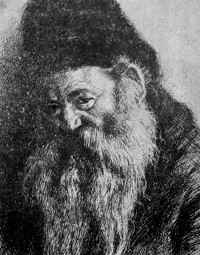
Another time, Simcha caused a public scandal through a portrait he posed for, painted by the well-known artist Maksim Suzanov. This happened when the painter was looking for an interesting type to portray as a Rav-Hakoylel [Chief Rabbi]. He found his model in Simcha, whom he paid three dollars a week to come and sit for him. The painting is truly a masterpiece. It was displayed at the Educational Alliance, among many other works left by the late artist. A reproduction of the painting is printed with this article.
Simcha was never sick a single day in his life. He never needed glasses. He remained sound in all his senses until the very last day of his life. And he lived, as already mentioned, to the age of 103.
As the number of our landsleit grew in later years and the Bialystoker colony on the East Side expanded, people began to celebrate simchas – weddings, circumcisions, bar mitzvahs. And Simcha had to be invited to every one of them; otherwise, it was as if “the heavens wouldn't open.” Many times he would come on his own, uninvited, as soon as he heard that a landsman was having a celebration somewhere. He would leap onto a chair in the middle of the room, a tea glass full of liquor in his hand, and shout with a roaring, lion-like voice that sent a jolt through everyone in the room:“Without Simcha [3] there is no simcha! Mazl-tov, l'khayim!” – and then he would toss back the entire glass.
People had a great deal of fun with him at our Bialystoker Bikur Cholim[5] on East Broadway, where Simcha came almost every day to meet landsleit, pick up the latest news, and sit and chat. By then he was close to a hundred years old, but his mind was still sharp and his body strong as iron.
He had the “privilege,” so to speak, of being called up for the tokhekhe[6] twice a year. The Bikur Cholim minyen would pay him fifty cents for the tokhekhe. He was no great scholar; he barely even knew what the tokhekhe was. He could hardly manage more than a little davening.
Once a few fellows egged him on by saying that the tokhekhe was full of curses – so why should he let himself be scolded so harshly for only fifty cents? So he declared a strike – basta. They called him up for the tokhekhe, but he wouldn't go – absolutely not. What could they do? They had to settle the “strike” with him and raise the fee for the tokhekhe to a full dollar.
Simcha Tzfat died in his lonely room on Division Street in 1917. His death was a very easy one. He lay down to sleep and simply did not wake up again.
|
|
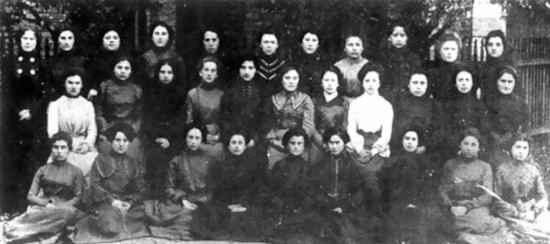
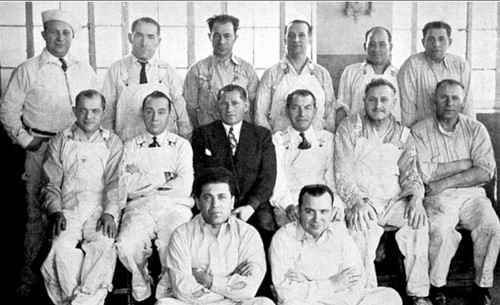
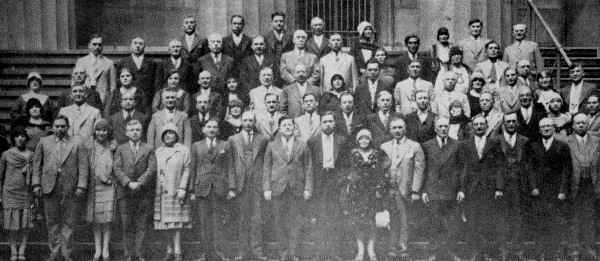
The fifth from the right, in the top row, is Mrs. Raya Zak, now living in New York. |
Translator's notes:
by Isak Ribalovski
(General Secretary of the Bialystoker Center; Home for the Aged and Hospital)
Translated by Beate Schützmann-Krebs
A rich and noble heritage stretches from our old home in what was once the wonderful Jewish city of Bialystok all the way to the great, free America. It is truly remarkable how our Bialystoker landsleit have never severed the golden thread that binds them to the very first Bialystoker Jews who came here to this country – those who, as it were, carried with them a piece of Jewish Białystok, our once-beloved shared home that was destroyed by the Nazis.
[Yet, the tradition has lived on]. Every year it is carried forward here with love and devotion, with sincerity, and with that Jewish folk spirit that awakens in everyone a deep respect for the Bialystoker Jews in America.
It is no wonder that the great Bialystoker landsmanshaft in America – firmly rooted and centered at 228 East Broadway in New York – has remained one of the few surviving societies from the once large number of local landsmanshaftn that were active in American Jewish life. This is because the Bialystoker landsmanshaft has always had loyal landsleit around it who, despite many difficulties, helped build, strengthen, and sustain our communal work – the various important activities carried out for the benefit of our landsleit everywhere and for Jewish interests in general.
The chapter of the Bialystoker Jews in America is one of the finest chapters not only in the history of the Bialystoker Jews here; it is also one of the most uplifting chapters in the history of Jewish communal life in America.
As is well known, the great wave of Jewish immigration from the towns and small cities of Eastern Europe to America began shortly after Rosh Hashanah in 1881, during the time of the major pogroms in Tsarist Russia.
Yet, as we know from documents in our possession, Jews from Białystok had been in America long before that. In fact, as early as 1864, a charter was issued in New York for a Bialystoker organization that at that time bore the name Bialystoker Untershtitsungs-Fareyn [Bialystoker Relief Society.]
Old Bialystoker landsleit would often tell how their relatives had come here – from Białystok to New York – many years before the great immigration from Eastern Europe even began.
At the Beginning
Thanks to their wide-ranging activities on behalf of their own landsleit – and in every sphere of Jewish life in America more broadly – the Bialystoker Jews here have always stood in the front ranks of the many former landsmanshaftn. And so it remains even now, at the beginning of 1981, as these lines are being written.
From the very beginning, the Bialystoker Jews in America were pioneers in building Jewish communal life. As we know, the first Jew from Białystok, Simcha Tzfat, arrived in America in 1842. Shortly afterward, other Jews from Białystok also began to come here, taking root in the new life of this great new world – a life they filled and shaped with the distinctive Bialystoker Jewish spirit.
Our unforgettable David Sohn, of blessed memory, the longtime leader of the Bialystoker landsmanshaft in America, wrote about the Jews of Białystok in America in his work The Bialystoker Century, an original contribution to three hundred years of Jewish life and creativity in this country. He brings his own unique light and color to the vibrant rainbow of Jewish America.
The Białystokers here are more than a landsmanshaft that immigrated from their home city and settled in the “New World,” benefiting from the good fortune and blessings of this land. They are the living symbol of all Eastern European Jewry; they are like the swallow – the first to arrive, the earliest and only such Jewish community, the pioneer and “pilgrim father” who came from those distant places to America, took root here, and helped build the new world.
“They did not come here to a table already set, with everything prepared for them, and they were not the kind of American citizens who only ‘took.’ They were true partners – people who gave so much, who built, and who to this very day contribute their energy, service, and talent for the good of the entire country.”
These words of David Sohn are just as relevant now as when he wrote them years ago. The greatness of the Bialystoker Jews in America has always rested on this – and so it remains today: they held together, helped one another, cared for their landsleit in a communal way, and at the same time played a major role in Jewish social life more broadly.
And since the establishment of the State of Israel, the Bialystoker Jews in America – through the great Bialystoker Center in New York – have been an important source of support for the Jewish state.
[Page 336]
From the very beginning, as soon as Jews from Białystok began arriving in America, they clearly understood that it was necessary to build and create their own organizations – institutions that would help unite and strengthen the standing of the landsleit, both among themselves and within local Jewish communal life. And indeed, right from the start, a number of organizations and institutions of the Bialystoker landsleit were established, which over time grew into a great force.
Let us list here the various Bialystoker organizations that were created in America, beginning with the very first group, the Bialystoker Untershtitsungs-Fareyn [Bialystoker Relief Society], which was founded in the year 1864. Although many of those early organizations no longer exist today, they nevertheless contributed greatly to the development, relief work, and social activities of the broader Bialystoker landsmanshaft – work that continues to this very day.
From the list that follows, one can see that from the very beginning of the arrival of Bialystoker Jews in America until the year 1949, some forty Bialystoker organizations were founded and active. Here are their names, arranged in chronological order, as they were all established and carried out their work:
|
|
Expanded Relief Work
One of the most important and central organizations of the Jews from Białystok in America – an organization that took upon itself the mission of providing broad assistance to our landsleit – was the Bialystoker Relief Committee in America, founded in New York in 1919. It emerged as a direct response to the hunger and poverty that afflicted the Jews of Białystok in the period immediately following the First World War.
This Bialystoker Relief Committee, established through the initiative of David Sohn and others, wrote a remarkable chapter in the [history of] relief work for our brothers and sisters in the old home. Soon after the First World War, when news reached America about the grave situation of the Jews in Białystok, the landsleit here collected more than five million dollars, which was sent as aid to the Jews in the old home.
In addition, needy Jews in more than sixty towns and villages around Białystok also received assistance. Beyond this, the Bialystoker Relief Committee in New York sent another half-million dollars to various institutions in Białystok.
[Page 337]
This broad and steadily expanding Bialystoker Relief Committee was, in many ways, a continuation of the earlier Bikur Cholim society, which had collected aid for the landsleit. After the First World War, the newly established Relief Committee had its headquarters in a basement at 246 East Broadway.
Alongside its relief work, the Relief Committee began to develop social activities – both for the landsleit themselves and in connection with the wider local Jewish communal life. Out of this very work there eventually emerged the Bialystoker Center, which later grew into a large and respected institution. The Center quickly became an important address for Bialystoker landsleit throughout America, as well as for Jews from Białystok around the world.
From that basement room at 246 East Broadway – where the Bialystoker Relief Committee had been located and where the Bialystoker Center first took shape – grew and branched out into our present-day large Bialystoker Center at 228 East Broadway, well-known among Bialystoker Jews everywhere and throughout American Jewish life in general.
David Sohn, of blessed memory, once expressed it this way:
“From the depths – mima'amakim – of that Bialystoker basement on 246 East Broadway sprang forth the lofty ideal of an organized landsmanshaft, one that became a model for Jews from other towns who had immigrated to this country. That basement served as a kind of laboratory, bringing together all layers and shades, all classes and tendencies within the landsmanshaft – from the fanatically Orthodox to the extremely radical, from the conservative to the progressive, from the immigrant elements to the American-born descendants of Białystok.
In other words, it melted them together under one common banner of landsmanshaft solidarity, mutual responsibility, and philanthropic aid.”
The Greatness of Our Center
In 1921, when the great Bialystoker Center was founded, all organizational work was transferred into its own building, which had been purchased at 228 East Broadway in New York. With this, a new chapter began in the life and activities of the great Bialystoker landsmanshaft in America. As soon as they moved into the new address, a wide range of activities began to unfold – and they did not stop there.
When the building of the Bialystoker Center was later enlarged and expanded into a ten-story structure, another highly important institution was established. The leaders of the Center, together with the loyal circle of landsleit, decided at that time to create a home for the elderly – a true home, with heart and soul, as befits Jews from Białystok.
Thus, in the years 1929–1931, the Home for Elderly Jewish Men and Women was established. Over time, it developed into one of the finest institutions of its kind, imbued with a Jewish, folk-spirited warmth for its elderly. Our Bialystoker Home and Hospital for the Aged, located in the building of the Center at 228 East Broadway, earned over the years an excellent reputation in the local Jewish community, as well as among the authorities of the state and city governments under whose supervision it now partly operates.
It is well-known today that the Bialystoker Home and Hospital for the Aged is a home with heart and soul.
|
|
[Page 338]
Here, hundreds of elderly men and women live out their later years in peace and comfort, under devoted supervision and homelike care. In the Home's hospital, the elderly residents also receive proper medical attention.
It is therefore no wonder that the residents of the Home – as well as their children and grandchildren – are grateful to the leadership of the Bialystoker Center and to all the loyal supporters of this noble and deeply Jewish work of compassion.
It must be mentioned that in helping to build the Bialystoker Center and the Home for the Aged at 228 East Broadway, all the landsleit in America took part at that time with generous contributions. There was a great mobilization then – of fundraising and activity – in the effort to build our own Bialystoker home on the old Jewish Lower East Side of New York.
And so, for fifty years now, the Bialystoker Center has been like the heart of the Bialystoker [community] in New York, in America, and throughout the world. With the establishment of the Center, half a century ago, wide-ranging activities also began for our landsmanshaft in the social, cultural, and communal spheres – work that we continue to carry out with great devotion.
To this Bialystoker Center in New York, the threads of connection from landsleit everywhere are drawn. Here, in the great and majestic building on the East Side, people seek help and comfort, closeness and friendship – as one would from a beloved mother. Here, to the Bialystoker Center, come letters, inquiries, and communications from landsleit in every part of the world.
Our Bialystoker Center is a central address with heart and soul, sustaining with love and loyalty that little core of Białystok– dos pintele Białystok – which is so dear and precious to all of us, the surviving remnant of the Białystok that once was.
A very important role was played by the Bialystoker Center immediately after the Second World War, following the great destruction of the Jewish people under Hitler, when help was urgently needed for those who had survived as if by a miracle. In 1945, the Bialystoker Center re-established and reorganized the earlier Relief Committee and began its relief work for our rescued landsleit from the Nazis who were still in Europe.
Thanks to the loyalty of our landsleit, tens of thousands of dollars were raised here, which were sent to surviving Białystokers and to Jews from the surrounding towns – wherever such people could be found on the other side of the ocean. Aid was sent in cash, food parcels, and clothing.
A special relief effort was carried out for the small number of surviving Jews who had returned to Białystok. We sent a substantial sum of money to Białystok, with which four work cooperatives were established there after the war. The Center in New York also sent a special sum of money to restore the Jewish cemeteries in Białystok – the places where mass graves of Jews murdered by the Nazis were located – and to erect appropriate monuments for the martyrs and the holy dead.
It should be noted that after the surviving Jews left Białystok, and only a small group remained there, the Bialystoker Center in New York has continued – up to this very day – to send ongoing assistance to the handful of Jews still living in Białystok. Special sums of money are also sent to ensure the proper upkeep of the Jewish cemetery, the mass graves of the martyrs, the memorial stones, and other such sacred places.
Important relief work was also carried out by our Bialystoker Center for rescued landsleit from Hitler's Europe who, by various means, managed to make their way to Israel. These landsleit received significant assistance. At the same time, help was also provided – through various means and in various ways – to those landsleit who were settling in the Jewish homeland.
The Center also showed great warmth and brotherliness, accompanied by appropriate assistance, to the surviving Bialystoker Jews who arrived in America, helping them adjust to their new and more secure lives.
|
|
[Page 339]
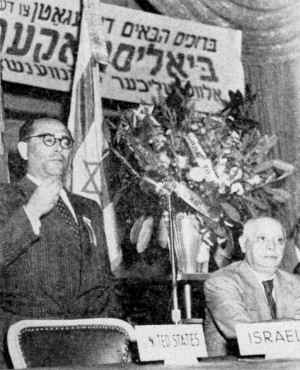
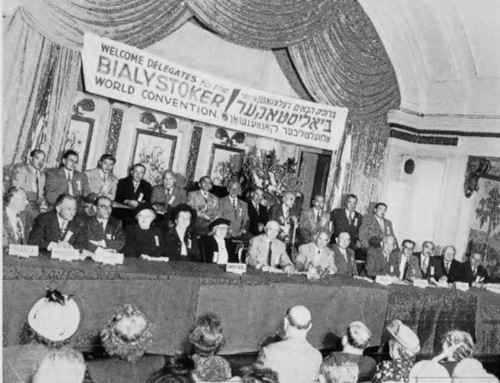
Let us recall that the Bialystoker Center in New York played a major role in helping to establish the shtetl of Kiryat Białystok in the State of Israel, at the World Conference in New York in 1949 – a matter described in detail elsewhere in this book.
Organizations and groups of Bialystoker landsleit were also active in various parts of America: in Chicago, Philadelphia, Milwaukee, Los Angeles, Newark, Paterson, Detroit, and other cities, as well as in Montreal and Toronto in Canada.
The Bialystoker Shtime [Voice]
One of the greatest accomplishments and achievements of the Białystokers in America was the founding and publication of the fine journal Bialystoker Shtime, which has brought great benefit to our landsleit and has earned broad respect in Jewish communal life in general. David Sohn, of blessed memory, the founder and first editor of the Bialystoker Shtime, wrote the following – among other things – about the founding of the journal more than sixty years ago:
“At that time, in 1921, I and several other activists of the Bialystoker Center had the idea of creating a journal that would reflect all our local activities, record all the important accomplishments of our societies, acknowledge the contributions of our communal workers; keep the American landsleit connected with the lives of our brothers and sisters in the old home; and gather and preserve all the important historical facts and events of Jewish Białystok and its notable Jews.
We also wanted, through our journal, to acquaint the Jewish world with our Bialystoker communal work – with the achievements of our landsmanshaft – which might serve as an example for other landsmanshaftn as well. In addition, the forty thousand Bialystoker Jews then living in America simply needed their own press organ, one devoted to their local communal affairs – matters for which there was not always room in the general Jewish press.”
From the very beginning of its publication, sixty years ago, the Bialystoker Shtime became an important instrument for all the many-branched activities of the Bialystoker landsmanshaft in America. From the outset, the journal began to connect – and continues to this day to connect – not only the Bialystoker Jews in America, but also those throughout the entire world.
Throughout all these years, every effort has been made to ensure that anything relating to Bialystoker Jews – their lives and their activities, whether in America or in other countries – should find proper expression in the Shtime. The journal has always been rich in content, including general literary and cultural articles, which have elicited a fine response in broader Jewish life.
The Bialystoker Shtime, which is always published with great care, remains to this very day the only regular landsmanshaft publication in America, in both Yiddish and English.
It should be mentioned that among the first builders, writers, and also co-editors of the Bialystoker Shtime were such well-known literary figures and landsleit as – besides David Sohn – Jacob [Yakov] Krepliak, Herman Frank, Sam Kosel, Yekhiel Weintraub, Louis Greenhouse, and others. All the contributors to the Bialystoker Shtime were always respected members of our landsmanshaft, whose writing and various creative works brought great honor to the journal and to our community as a whole.
The publication also printed important articles and descriptions that had been sent before the war from Białystok by our former Bialystoker landsleit: Pesach Kaplan, Noach Zabludovski, Avraham Kotik, Yisroel Lipski, L. Faygin [Feigin], M. Goldman, Y. Y. Inditski, and Litman Rozental.
Most of them, as is well known, were murdered in Białystok by the Nazi murderers.
The Bialystoker Shtime has always – as it does now – printed everything that had any connection to the activities of our landsleit in America and throughout the world, as well as reports about what had taken place in Jewish Białystok before the terrible Hitlerian flood descended upon it. At all times, the Shtime also published interesting photographs relating to the landsmanshaftn, to the old home in Białystok, to the activities and personalities of our people, and to other events in the lives of Bialystoker Jews. The Shtime likewise printed many news reports and photographs of various celebrations among our landsleit.
All of this – sixty years of the lives of Bialystoker Jews spread across both sides of the ocean – has thus been permanently preserved in the columns of the Bialystoker Shtime. And we continue to do everything, with loyalty and devotion, so that twice a year (before Rosh Hashanah and before Passover) the Bialystoker Shtime may be brought to our landsleit in America and throughout the world, as well as to the broader Jewish community.
It should also be noted that a large number of Yiddish writers, poets, and others have, over the years, published their work in the Bialystoker Shtime. Among these prominent Yiddish authors and poets were:
Hirsh Abramovitsh, A. Almi, S. Bornshteyn, B. Botvinik, M. Basin, B. Y. Bialostotski, A. Beyzer, F. Bimko, Naftali Gross, Leon Grushka, Dr. B. Dubovski, M. Dluzhnovski, Kh. Ayalti, Moyshe Veysman, Y. Chaikin, “Der Tunkeler,” Sh. Tenenbaum, Dr. Sh. Landoy, A. Lutski, Yud Libman, Yerukham Levin (Eretz Israel), David Lerner, N. B. Minkov, M. Mratshni,
[Page 340]
Z. Segalovitsh, Alter Epshteyn [Epstein], Yankev [Jacob] Pat, Avraham Reyzen, Yitskhok Rivkind, Avraham Rayski (Paris), Prof. Solomon Kahan (Mexico), Yosl Kohen, David Klementinowski, Y. Kisin, Harry Graf (Hershl Zlates), Dr. Shimen Datner, Osip Dimov, Daniel Tsharni, Nakhum Yud, Jacob Jerusalimski, Aleksander Mats, Israel Kagan, Rabbi Avraham Kravetz, Y. Rapoport, Shmuel Leyb Rabinovish (the “Bialystoker Sholem Aleichem”), Dr. Khayim Shoshkes, A. Sheykevitsh, and many others.
The Bialystoker Shtime has always been – and continues to be – an important force and a central link for the many-branched activities of our landsmanshaft in America, as well as a vital connection to the activities of Bialystoker landsleit throughout the world.
We may proudly note that in 1951 the Bialystoker Center in New York published the great Bialystoker Album, containing 1,200 photographs as well as Yiddish and English text, all of which had been collected and compiled at that time by David Sohn. This publication, which tells in pictures the three hundred years of life of Bialystoker Jews in the old home and throughout the world, and which consists of 386 large-format pages, bears the title: Bialystok bilder album fun a barimter shtot un ire Idn iber der velt [Bialystok: Photo Album of a Famous City and Its Jews Around the World.]
This, too, is something of which we in the Bialystoker Center may be proud – just as we are proud of so many other accomplishments.
The Ladies Auxiliary
A very important role in the life and activities of the great Bialystoker Center has always been played – as is still the case today – by the Bialystoker Ladies Auxiliary. This large women's organization, which counted several thousand members, was founded in February 1923. The new organization brought a great revitalization to the work of our Center. The women took an active part in all undertakings, contributing greatly to the success of the work, and they also helped raise the necessary funds for its many-branched activities.
From the small group that first created the Bialystoker Ladies Auxiliary, there later grew a large and strong organization. With loyalty and dedication, the women carried out various activities, which were duly appreciated by all. It is no exaggeration to say that the Ladies Auxiliary became one of the most important parts of the Center's work.
The women's organization also always maintained substantial budgets for its activities, through which assistance was provided to needy landsleit, to the sick, and – especially in later years – to the residents of the Bialystoker Home.
The Ladies Auxiliary also always brought beauty and a sense of festivity to the activities of the Center. The work of the Ladies Auxiliary consisted of three parts: Bikur-Cholim work and medical assistance; social-cultural activities among the members and friends; and work on behalf of the Home for the elderly residents.
Whenever the Bialystoker Center found itself in need of funds, the members of the Ladies Auxiliary were among the first to provide loans. During the major building campaign for the moyshev-skeynim [home for the elderly] in 1930–1931 – at a time when the country was also in the midst of a severe economic crisis – the members of the Auxiliary privately loaned the large sum of more than fifty thousand dollars. This was later repaid to each woman with gratitude and appreciation.
Among the first founders and principal officers of the Ladies Auxiliary were: Mrs. Ida Eidak, president; Mrs. Rose Lipman, treasurer; and Mrs. Sophie Kohn, financial secretary, among others. They held their offices for more than ten years.
The Bialystoker Ladies Auxiliary also maintained well-organized branches that carried out important activities in all parts of New York, as well as in various cities across America and Canada. Our Ladies Auxiliary has always been a fine example of good and noble work. This tradition is warmly upheld by the present leaders and workers of the Bialystoker Ladies Auxiliary.
Young Men's Benevolent Association
Among the few older organizations of Bialystoker Jews that were founded many years ago and that remain active even today is the Bialystoker Young Men's Benevolent Association (B.Y.M.B.A.). This is thanks to a number of activists of the organization who, despite all the changes over the years, have continued – and still continue – to work in various areas. In their activities they assist the great Bialystoker Center, the Home and Hospital for the Aged, and they remain active in and around our Center. They also carry out important work on behalf of the State of Israel and for Jewish causes in general.
This organization, the Bialystoker Young Men's Benevolent Association, was founded on October 21, 1906. The founders at that time were: Isidor Vayt [White], Ralph Vayn [Wine], A. Bernstein, Jacob Halpern, A. Henkovitz, Sam Shapiro, G. Vitof, and others.
The present leaders of the B.Y.M.B.A. are our friends Charles Kos, Manuel and Emily Grodnik, Herman Schwartz, David Fein [Fine], and others. Our friend David Fine is the president of the Bialystoker Young Men's Benevolent Association.
It should be noted that the organization has worked closely with our Bialystoker Center throughout all the years, and has always shown great dedication. David Fine and Charles Kos were recently honored by the organization for their loyal service of more than fifty years to the Bialystoker Young Men's Benevolent Association.
[Page 341]
It should also be said that more than fifty years ago, when the great Bialystoker Center in New York was being built, the leaders and members of the Bialystoker Young Men's Benevolent Association contributed generous donations and helped raise funds for the important purpose of establishing the Center in New York. The B.Y.M.B.A. also assisted in the building of Kiryat Białystok in the State of Israel.
Our friends Charles Kos, Herman Schwartz, David Fine, Manuel and Emily Grodnik, and the other leaders and workers of the Bialystoker Young Men's Benevolent Association are greatly beloved and respected among the Bialystoker landsleit and beyond.
This year, 1981, the fine organization will celebrate its seventy-fifth anniversary, since its founding in October 1906.
The Club of Bialystoker Friends
One of the youngest and most important organizations within the Bialystoker Center in New York is the Club of Bialystoker Friends. This organization was founded soon after the war, in 1945. When I arrived in America, at the beginning of June 1947, I already found the Club well organized. I immediately became active myself in the organization.
Among the first members of the organization – which had been founded at a ball of the Ladies Auxiliary – were the following friends: Sam Mines, Bernard Kaganovski, Barney Sachs, Harry Feinberg, Nathan Mines, Sam Said, Sol Said, Sol Mines, Martin Fein [Fine], Sol Krim, Leon Krim, Yudel Zabludovski, Harry Lazar, Nachum Gross, William Perl, Harry Silver, George Lazov, and Dave Miller.
When rescued Bialystoker landsleit – survivors of Hitler's Europe and of the Soviet deportations – arrived in America soon after the war, they found a warm home in the Bialystoker Center. They were received with great warmth and affection, as if by their own close family, and through the Center they were helped to regain their footing. In this welcoming environment at the Bialystoker Center, the newly arrived gathered together as they would within a loyal family of their own.
It was in this atmosphere that the idea arose to establish the organization Club Bialystoker Friends, which would carry out various social and cultural activities and, of course, assist the Bialystoker Center in its important work.
We, the leaders and active members of the Club of Bialystoker Friends, immediately began to carry out important activities. From the very beginning, for example, we sent packages of food, clothing, books, newspapers, medicine, and other necessities to our surviving landsleit in Białystok, as well as to those in the DP camps in Germany, Austria, and Italy. We also assisted our landsleit who had been deported to the island of Cyprus and those who were in Switzerland for recuperation.
One of the first major undertakings carried out by our Club was to raise a substantial sum of money, which we turned over to the Center to be sent to Białystok, so that the cemetery on Zhabia [Żabia] Street could be repaired and enclosed with a proper fence.
In 1947, a special cultural circle was established within the Club in order to lead various cultural activities. Our undertakings of this kind found a strong response among our landsleit and friends. At that time we also published the album of songs and photographs from the Bialystoker Ghetto, which I myself had collected.
From its earliest days, the Club established the tradition of holding an annual memorial gathering in remembrance of the sixty thousand Bialystoker martyrs – a tradition that is observed with dignity every year.
Immediately after the establishment of the State of Israel in May 1948, the Club of Bialystoker Friends became active in the forefront of our Bialystoker Center's work on behalf of the new Jewish state. This has remained the case ever since. The members of the Club take an active part in all fundraising efforts for Israel – through the purchase of Israel Bonds, through the United Jewish Appeal, and in other ways.
At the World Conference of Bialystoker Landsleit, which took place in New York in the summer of 1949, where the decision was made to build Kiryat Białystok in Israel, our Club of Bialystoker Friends raised a substantial sum of money for this important purpose. The funds were collected within a short time and sent on to Israel.
The Club of Bialystoker Friends has written a fine chapter not only in the history of its own activities, but also a distinguished chapter in the history of the Bialystoker Center in New York as a whole.
A Summary of Pride and Honor
When we take stock of more than one hundred years of life of the Bialystoker Jews in America, we see that we have every reason to feel pride – pride that also brings great honor to the name of Jewish Białystok.
Let us not forget that among the first Bialystoker Jews who came to America in the 1880s and in the years that followed were, for the most part, people of modest means – small-scale merchants and others like them. Yet despite the difficult lives our brothers and sisters faced at the beginning here in the New World – as was true for so many Jewish immigrants from Eastern Europe – they nevertheless rose to the highest levels of achievement in American life.
[Page 342]
A considerable number of the early Bialystoker Jews who came to America were craftsmen of every kind, who, through their labor and sweat, helped enrich and build up America. The same was true of many Bialystoker Jews who succeeded here in becoming manufacturers, building contractors, even major industrialists and the like – people who constructed enormous hotels and apartment buildings and thereby made it possible for Americans to enjoy a fine, modern standard of living.
Bialystoker Jews who came here also developed major enterprises and factories that helped expand the clothing industry, furniture production, cigar and cigarette manufacturing, the gold and diamond trades, leather processing, publishing, bookbinding, as well as large bakeries, upholstery shops, and many others. Across the length and breadth of America, Bialystoker Jews spread and developed, in an honest and upright way, the broad world of commerce – trade on both a large and small scale.
The Bialystoker Jews who came to America in earlier years, as well as their children and grandchildren, have reached the highest levels in American medicine, science, research, literature, music, entertainment, journalism, and many other fields. We refer here to those of Białystok descent who achieved all this in American life at large, not only within Jewish life. And despite their great careers, such people never concealed their origins, their Jewishness, or their enduring connection to the old Jewish Białystok.
We also know well that Jews who came from Białystok to America have always held – and continue to hold – prominent positions in American Jewish life. Jews of Białystok descent have always been found in America, as in other countries, among the leaders of various Jewish parties and organizations, in Jewish religious life, in institutions, clubs, circles, and similar bodies.
It is also well known that Jews who came from Białystok to America have always occupied important positions in American Jewish journalism, literature, music, the arts, the cantorate, and many other fields of this kind – fields that helped enrich and spiritually elevate the diverse Jewish community in America, which is the largest Jewish settlement in the history of our people.
It is like a long golden chain – the continuation of the old Jewish Białystok that once existed there, which was annihilated and wiped out by the Nazi murderers, reaching all the way to the present life of the Bialystoker Jews in America. It is also a long and elevated lineage that stretches across more than a hundred years, accompanied by great love and loyalty, as has always been the case among the Jews of Białystok.
It is a source of pride and great honor for us that, despite all the profound changes that have taken place in Jewish life in America, the life and activity of the Bialystoker Jews here remain united and closely bound together in such a fine way among the landsleit. All this is possible to a great extent because we have the great Bialystoker Center at 228 East Broadway in New York, which unites, gathers, and keeps connected the landsleit from all over New York and throughout America – like children around a loyal home.
Let us therefore continue, Bialystoker landsleit in America and throughout the world, to carry forward with loyalty the elevated continuity and lineage of the beloved old Jewish Białystok that was destroyed by Hitler. Let us lovingly preserve the great spiritual heritage that the martyrs and holy ones left to us. Let us remember that the spiritual Jewish Białystok of old continues to accompany us even now – and will continue to do so for the generations to come.
|
|
Translator's note:
by Isak Ribalovski
Translated by Beate Schützmann-Krebs
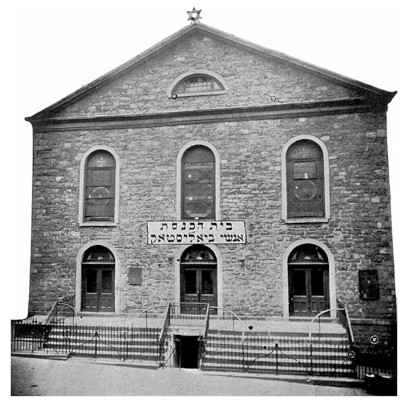
The Beit HaKnesset Anshei Bialystok, one of the oldest shuls [synagogues] on the Lower East Side of New York, located at 7 Willett Street, was built more than a hundred years ago by Jewish immigrants who had come from the old Białystok. Earlier, in 1868, there had been two Bialystoker societies on the Lower East Side – Anshei Chesed [Society of Lovingkindness] and Adas Yeshurun [Congregation of the Upright]. They held prayer services with [regular] minyanim, among whom were, in those days, carpenters, shoemakers, tailors, bricklayers, painters, and other craftsmen.
Later, all these societies united, and with their combined strength and contributions – even though life was difficult – they built, in 1878, the great Beit HaKnesset Anshei Bialystok. This is the large shul that still stands today at 7 Willett Street on the Lower East Side of New York.
This large shul, which is one of the most beautiful Orthodox synagogues in New York, is also one of the few remaining great synagogues on the Lower East Side. The interior reconstruction of the shul – the Holy Ark, the paintings, and the massive wooden benches – resembles what once existed in the great municipal [Wielka] synagogue of pre-war Białystok.
This Bialystoker shul, which celebrated its hundredth anniversary at the end of 1978, was also recognized some time ago by the State and City of New York as a historic landmark. For many years, the spiritual leader of the shul was the renowned scholar Rabbi Yaakov Eskolsky, of blessed memory, who passed away in 1931. After him, the rabbi of the shul was his son, Rabbi Michael Eskolsky, who passed away in 1951.
Most of the leaders and active members of the old Bialystoker shul later became founders, leaders, and devoted workers of the great Bialystoker Center at 228 East Broadway, which is not far from the synagogue.
|
|
Translator's note:
by Rabbi Shmuel A. Kronick
Translated by Beate Schützmann-Krebs
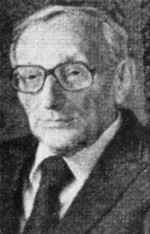
I have worked very closely with Isak Ribalovski over the course of the past nine years at the Bialystoker Center, Home, and Hospital for the Aged. This gives me at least the opportunity to offer a brief appreciation of him. It is no exaggeration to say that Mr. Ribalovski's entire life here – day and night – is filled with thinking, planning, and carrying out tireless activities connected with everything that concerns Białystok. This applies both to the great Center, well known in the local Jewish community, and to the Bialystoker landsleit here in America, as well as to those throughout the world.
In all of this, Isak Ribalovski displays boundless energy, devotion, and loyalty. He never grows tired – neither physically nor mentally – of standing like a soldier at his post, working for the Center's activities and for landsleit everywhere. And in all the many-sided tasks he undertakes, Isak Ribalovski is always precise, exact, disciplined, and at the same time friendly and approachable. Everyone who comes into contact with him immediately feels a warmth and a sense of home, as if they had known him for years. This is a great virtue, and it is precisely for this reason that the Bialystoker Center has so many friends, supporters, and benefactors – even beyond the ranks of its own landsleit.
Another great virtue of Isak Ribalovski is this: not only is he himself always tirelessly active, he also inspires and motivates others to take part in all kinds of activities. One can say with certainty that thanks to him the Bialystoker Center can point to many truly fine accomplishments. A particularly noteworthy chapter in Isak Ribalovski's work is his connection with Bialystoker landsleit throughout America and in various other countries. He receives letters from landsleit in many parts of the world – and he answers every one of them. He always finds the time and the energy. Nothing is ever neglected. It is therefore no wonder that Mr. Ribalovski is known among landsleit everywhere as “the Bialystoker Ambassador.”
Isak Ribalovski is also well known for his frequent travels to various countries. Everywhere he goes, he is received with great warmth by Bialystoker landsleit and friends, because wherever he arrives – in America or abroad – he immediately brings with him warmth, friendliness, and the familiar Jewish Bialystoker folk spirit.
All of this is because Isak Ribalovski lives unceasingly with the great spiritual heritage of the Jewish Białystok of old. He brings this into his important work at the Bialystoker Center, into his private life, and into every encounter he has with others. With this elevated Jewish Bialystoker heritage – with the greatness of the old home that was so brutally destroyed by the Nazis – he also inspires others. And this is how the loyal Isak Ribalovski has conducted himself ever since 1947, the year he came to America and was drawn into the work of the Bialystoker institution by its unforgettable leader of that time, David Sohn, of blessed memory.
Isak Ribalovski attained his present high position thanks to his great abilities, his energy, and his tireless work. One is often amazed at the vigor with which he carries out his activities. For it must be remembered that Mr. Ribalovski, who comes from a distinguished family in Białystok, endured suffering and hardship during the Second World War in Europe. His closest relatives were murdered by the Nazis. And yet he does everything with great loyalty and love – everything for Bialystoker landsleit and for Białystok, for Jewish interests, for Israel, and for the Jewish people as a whole.
Throughout all the years since 1947, when he came to New York after the war, Mr. Ribalovski has held various positions in the Bialystoker Center. It would take too much space to list them all here. It is enough to say that thanks to his tirelessness – and thanks to the trust and respect he inspires in everyone – Isak Ribalovski gradually rose to his present high position as General Secretary of the Bialystoker Center, Home, and Hospital for the Aged, a position he has held since 1973.
It should also be mentioned that, despite the fact that Mr. Ribalovski is constantly occupied with the many activities involved in directing the Bialystoker Center, and despite his continual contact with landsleit in America and throughout the world, he still finds the time – and devotes great effort – to preparing, editing, and publishing the well-known Bialystoker Shtime twice a year. As is well known, this journal, which appears each year before Rosh Hashanah and before Passover, always contains interesting material and evokes a warm response. It is probably the only publication of its kind among local landsmanshaft organizations.
[Page 345]
All of the tireless, sincere, and devoted activities that Isak Ribalovski constantly carries out for the great Bialystoker Center in New York, as well as for Bialystoker landsleit in other places, would surely not be possible were it not for his beloved life partner, his devoted wife Molly. She gives him much encouragement, along with good advice and guidance, which help him manage his wide-ranging work. The warm-hearted Molly, the daughter of Khayim Shloyme and Sheyne-Gitel Goldberg of the old Białystok, also has a distinguished heritage of her own.
Coming to America in 1930, and bringing with her the fine upbringing and knowledge she had absorbed in her parents' home, she continued here along the same path. She studied in high school and at City College, and eventually became an experienced bookkeeper, a profession in which she worked until 1977, when she retired.
Mrs. Molly Ribalovski has also been active for many years, in her own way, in the Bialystoker Center. She is a member of the Board of Directors, and she is always present at all of the Center's activities. You can see and hear her involvement in the Center's many branches of work. Mrs. Molly is also active in other areas of Jewish communal life, where she is rightly appreciated for her sincerity and the warm, homelike spirit she carries with her – just like her beloved husband Isak – from the heartfelt, folk-spirited Jewish Białystok of old.
|
|
Translator's note:
by Louis Silver
Translated by Beate Schützmann-Krebs
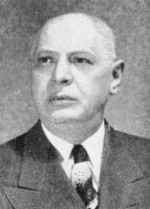
Jewish Białystok has, in every era, produced prominent personalities in all fields – people who illuminated and uplifted Jewish life there. Among such figures were also respected community leaders who brought great honor both to the Jewish settlement in Białystok and to Jewish life in other places. One of these distinguished personalities – a Jewish community leader of broad scope – was the unforgettable David Sohn.
David Sohn was a Bialystoker Jew, a people's leader, of and for the broad Jewish masses, with all his heart and soul. He was this kind of leader from the very beginning in the old home, and he remained so here in America and for Białystokers everywhere.With all his senses and thoughts he was always connected to the old home in Białystok, and to Bialystoker Jews and their activities here in America and wherever Bialystoker Jews lived and created.
With deep devotion, David Sohn always safeguarded the great spiritual heritage of the beloved Jewish Białystok of old – the heritage that was destroyed by the Nazis.
With the passing of David Sohn in February 1968, the world lost one of the most colorful personalities in Jewish communal life – a man with a great Jewish and deeply human heart.
|
The departed was the representative of the Bialystoker Jews in America and throughout the world. He was also one of the pioneering builders of Jewish communal life here. Over the course of nearly fifty years, David Sohn served as the leader of the Bialystoker Center and Home for the Aged in New York, and at the same time he was the address for Bialystoker Jews everywhere.
As the founder and longtime leader of the Bialystoker Home for the Aged, David Sohn devoted himself for almost fifty years to removing the sense of rootlessness and fear that weighed upon elderly, isolated people, giving them comfort in a warm and friendly home. David Sohn was the very embodiment of Bialystoker creativity, of good deeds, of initiative to broaden and enrich constructive Jewish life wherever it existed. For this reason, the death of David Sohn was met with grief everywhere. Wherever there were living, active, creative Bialystoker centers and individuals who contributed to Jewish and general communal life, his name was known.
He was loved not only as a founder, a builder, a constructive organizer, but also as a warm and gentle human being who came from the depths of Jewish folk life and who brought and wove that beautiful spirit – the Jewish folk spirit and folk soul – into the great, many-branched Bialystoker landsmanshaft. With his refined approach to individuals, with his national consciousness toward the community, with his literary taste and cultural elevation, David Sohn brought blessing and good fortune.
The Białystokers always valued this.
David Sohn's life was an open book. In his memory we turn its pages, one after another, each rich and beautiful with fruitful activity and great accomplishments. Every page is a tangible, living document – something that any person or organization could take pride in – for what it contributed to Jewish life in general, and to Białystok and the Białystokers in particular.
1919 – the First World War had ended, but Białystok was still caught in a new war between Russia and the newly re-established Poland. At that time, David Sohn founded the Bialystoker Relief in America, and in the midst of the fighting – when life was in danger at every step – he traveled to Białystok as the secretary and delegate of the American Relief Committee. He rescued Jewish Białystok not only materially, not only economically, but spiritually as well. His arrival in his hometown brought hope to the Jewish population there. It strengthened their morale and their faith in humanity.
[Page 347]
It was not only the Białystokers who recognized the great creative and moral strength of the Bialystoker landsmanshaft – the Jewish world, and even the non-Jewish world, saw it as well. People saw the deep sense of responsibility and the profound respect the Białystokers had for their fellow townspeople, and the remarkable way they related to each individual and to each person's needs. In this work, David Sohn was the driving force and the guiding spirit.
For nearly fifty years, David Sohn embodied Bialystoker communal life and philanthropic activity. These were remarkable fifty years in world history – and the most tragic in the history of the Jewish people. Białystok – our Białystok – was consumed in fire and destruction during the horrors of Hitlerism, together with the other six million of our martyrs and with tens of thousands of other Jewish communities.
In such a time of destruction, it often happens that people become cynical, that they lose faith in themselves and in humanity. In such a time, the leadership of the community must be in the hands of people with spirit, with courage, with vision. Fortunately for the Bialystoker landsmanshaft, they found such a person in the unforgettable David Sohn.
According to Jewish tradition, one may begin the morning prayer when it is just light enough to recognize a friend at a distance of four cubits. To recognize a friend at such a distance is a sign that dawn is breaking, that light is coming. Sometimes such a distance can become very close – across seas and continents.
This was understood by the Bialystoker survivors – our she'erit hapleitah – when, in the darkness of their lives, they recognized the friend: the outstretched, friendly, brotherly hand of the Bialystoker landsmanshaft through David Sohn. He sent not only tens of thousands of dollars and thousands of food parcels to the rescued and the needy, but also letters of encouragement, written in defiance of all adversity. David Sohn's outstretched hand of help, his call and his uplifting word, was: Live – and we will help you!
In the darkness they recognized the friend and heard the message: Dawn is coming, light will come, help will come! And help did come – everywhere, and also for the community in Israel.
Humanity – in our times this is a very great thing. It happens all too often that when a person works “for humanity,” he loses his own humanity. True humanity must come naturally; it must come from the depths of the human soul – and this is what David Sohn possessed. His great virtue was that he never lost it, even amid the daily worries and the many-branched responsibilities of his office.
The Bialystoker landsmanshaft has been a great creative force in Jewish life throughout the entire world. The Bialystoker landsmanshaft, with its tireless activities for its own people and for Klal Yisrael, is no miracle. It is the work, the effort, and the dedication of human beings. And David Sohn stood at its forefront, because he placed his abilities and his magnetic personality at the service not only of the landsmanshaft, but of Jewish life as a whole.
He enriched Jewish life with his fine Jewish word and with the highly important journal The Bialystoker Shtime, which he founded and of which he served as editor for nearly fifty years. He turned his face toward the people, and through this he succeeded in gathering around himself individuals from every party and every direction. Thanks to this, the threads of Białystokers from everywhere drew together to one central point – to David Sohn in New York.
What made this possible? It happened because everyone respected and loved him; everyone admired him, valued him, and trusted him. This was the great strength of David Sohn. It was always an honor and a pleasure to be in his circle and to work with him for the good of the Bialystoker Jews and for Klal Yisrael.
The beloved Jewish Białystok of earlier days is, to our deep pain and sorrow, destroyed – it now belongs to the past. But Bialystoker Jews continue to draw out and weave, as they always will, the golden chain of the old Bialystoker Jewish spirit and creativity. And with this, we will continue – in our own time and for the generations to come – to enrich and strengthen our lives.
We will also always remember the countless distinguished Jewish personalities from Białystok who helped illuminate, fortify, and elevate the lives of Bialystoker Jews everywhere. One of these, whose memory we will recall with love and with respect, is David Sohn.
to carry forward the legacy of the destroyed Jewish
B i a ł y s t o k. |
Translator's notes:
by Zalman Heller
Translated by Beate Schützmann-Krebs
Zalman Heller, the well-known Hebrew-Yiddish writer, educator, and communal activist, wrote this biographical article about David Sohn for the special jubilee issue of the Bialystoker Shtime in May 1932, when the Bialystoker Center celebrated Sohn's “bar mitzvah” – his thirteen years of communal service.Z. Heller, a cousin of the Sohn family, had been a close friend of the household in Białystok and later here in New York. He passed away in 1954 at the age of eighty-five.
The First World War of 1914–1918, which devastated a great part of Europe and killed or crippled countless people, aroused a major relief effort among the American public in general, and especially among us Jews. But the relief work was not organized: the aid that came through various banks was chaotic, without any coherent idealism or sense of responsibility, until the Joint Distribution Committee was founded. The same was true among the landsmanshaftn. They wanted to help, they had the means to help, but they did not know how to help. The Bialystoker societies were no better in this regard than the others.
But suddenly – as if from heaven – a young man appeared among us: tall, slender, with a pair of smiling eyes. With his fine oratorical talent he awakened and challenged people, called meetings, mobilized, and founded the Bialystoker Relief. Who was this young man, previously unknown, who with his extraordinary abilities and tireless work accomplished such a great relief effort for the suffering city of Białystok – an effort that amounted to many, many hundreds of thousands of dollars? It was none other than our dear friend, David Sohn.
Who is David Sohn? Who were his parents? From what family did he come? These are the questions many of our Bialystoker landsleit ask – people who know him only from his work here, who admire his accomplishments, but do not know who he was back in the old home.
The writer of these lines, who has known him from birth, can give a brief answer: the apple does not fall far from the tree. His maternal grandfather, Reb Moyshe-David Bialystotski, the podratshik [contractor], and his grandmother Sheyne – a daughter of the renowned Reb Zalmen Kalisker – were fine, respected householders in Białystok, who lived with dignity and were known as people of charity and good deeds. Their children –four daughters and one son – were raised as truly pious Jews, as was the custom in those days.
Their daughter Nekhama, the mother of our friend Sohn, distinguished herself with her intelligence and beauty, and all who knew her would say that she had a brilliant mind. When the time came to arrange a match, Reb Moyshe-David said that he wanted to find for her a groom who would also be an exceptional scholar. He would provide board and a fine dowry – as long as the young man was truly of that rare quality.
Such a groom was found in the person of Reb Moyshe Sohn, who was renowned for his sharp mind in learning and for his great knowledge of the Hebrew language as well as several European languages. At the age of seventeen he had already received rabbinic ordination, though he never made use of it. His father, Reb Mendel, came from one of the oldest and most respected families in Białystok – a learned and knowledgeable Jew, and one of the first Jews to engage in the cloth industry ninety years earlier.
The young Moyshe Sohn was well known among all who knew him as a great maskil, and he was therefore chosen as the groom for the worthy Nekhama, the daughter of Reb Moyshe-David Bialystotski.
After the wedding, and after the period of kest [financial support], Nekhamke – who had been well trained in her father's business as a major podratshik [contractor] supplying meat to the military – opened a meat business, both wholesale and retail, and became known as one of the leading businesswomen. Their courtyard on Jurowiecka Street was known to everyone as a house of charity, and Nekhamka was a true mother to every person who came to her.
Reb Moyshe Sohn spent more time among the scholars and intellectuals in the study-house than in business, and he was respected and esteemed throughout his years in Białystok until his departure for America. And here in New York, such a scholarly personality could not go unnoticed; in the Beth Hamedrash Hagadol [Great Study House] on Norfolk and Delancey Streets, where he prayed and studied, he was likewise highly regarded and appreciated until the end of his life.
David Sohn, the youngest of eight children, received his education as all children of respectable families did in those days – in the kheyder and with private tutors, with whom he studied, in addition to the sacred subjects, Hebrew, Russian, and German. With his great abilities he made remarkable progress in everything. He read extensively in all these languages, and even as a very young man he had already developed a feeling for writing. He wrote poems and stories in various genres. By the time he came to America, he was already a developed writer, with a strong sense of communal responsibility.
[Page 349]
From his father he inherited great abilities and a sharp mind, and from his mother a generous heart. With this rich inheritance he came to America in 1911. Here he tried his hand at various kinds of work: he was a furrier, a reporter, a tsementer [rubber-cement worker] in the raincoat trade, a painter – but he was not satisfied. His great energy, his remarkable talents, and his soul longed for larger, more meaningful work. Only in the relief work did his soul find its true fulfillment. He threw himself into this work with all his strength, influenced dozens and then hundreds of others, and ignited them with the fire of his youthful spirit so that they, too, would devote themselves to helping others. And the work grew. The relief effort continued for several years, and his heart swelled when he saw how, through his initiative, thousands of people were helped. But he was never entirely at peace.
Alongside his relief work, an idea was born in him: to create a center that would unite all the Bialystoker societies in New York into a single organization, so that with combined strength they could accomplish something truly significant. And here a new source of activity opened up for him, until the idea became a reality and the Center was established – a building that brought together the Bialystoker societies, through which great assistance was provided both to Białystokers in America and to the landsleit back in Białystok.
When the work grew to a large scale, another idea took shape in him – that women, too, should be drawn into the relief effort. And so he founded the Ladies' Auxiliary.
The number of members in the Ladies' Auxiliary was small at first – only a few dozen women. Over the course of all these activities, a large group of communal workers emerged within the Bialystoker landsmanshaft organizations, people who grew through the work itself, both men and women. Individuals developed with real abilities, with speaking talent, and with a will to serve the community. And David Sohn saw before him a growing circle of helpers and good friends, and he came to the conclusion that the time was favorable – though he did not yet know that soon, in 1929, the crash on Wall Street would come – to realize one of the great dreams of the Bialystoker landsmanshaft: to build a home for the elderly, one that would be a model of communal achievement and a source of pride for all Białystokers in America.
The work did not come easily. It demanded from Sohn all his abilities, all his energy, tireless effort day and night, hundreds of meetings and gatherings, and all his speaking talent to draw hundreds of people into lending a hand. He never tired of calling and awakening others, of enduring all kinds of complaints and resentments. Nothing was too difficult for him, so long as it helped reach the goal – and the goal was achieved.
Such was David Sohn through all the years: tireless, devoted, working for the well-being of our landsleit. He won thousands of friends. In 1916, in New York, David Sohn married Vera Epshteyn [Epstein], also from Białystok. Together they built a fine family.
Translator's notes:
by Shmuel Yitzchaki
Translated by Beate Schützmann-Krebs
Great is the power of a person's lineage – of the childhood, home, and surroundings from which one comes. One usually carries this within oneself for an entire lifetime, even when living under new conditions and in new places. Only those whose early environment deeply shaped them never cast off what they absorbed in their childhood home. Such people continue to carry their noble heritage forward, even in a changed environment.
One such person is our esteemed Bialystoker landsman, the prominent industrialist, businessman, and respected communal leader, Max Ratner of Cleveland, Ohio. It is truly remarkable: Max Ratner, who has lived in America for decades since leaving Białystok as a child, remains constantly surrounded by the Jewish spirit of that wondrous old Jewish Białystok. This spirit he absorbed in his childhood home; with this spirit he breathes and lives, unceasingly, to this very day.
One must not forget that as a prominent industrialist and businessman – in America as well as in other countries – and as a leading public figure, our friend Mr. Ratner has reached, as the saying goes, the highest circles. He receives well-deserved honor from all sides, and people show him the respect that is his due.
Yet he is connected to the Jewish spirit of the old Białystok not only in his heart and thoughts, but also in a practical and tangible way. This finds expression in his close involvement with the Bialystoker Center in New York, as well as with everything related to the interests of Bialystoker Jews – with Bialystoker relief work and its goals.
[Page 350]
Despite the fact that Mr. Ratner is an extremely busy man, day in and day out with his far-reaching business affairs and his public activities, he always finds time – whenever it is needed – for Bialystoker matters.
Often, even when he has very little time, he telephones from Cleveland to the Bialystoker Center to speak with the general secretary, Isak Ribalovski, in order to know and hear what is happening in the great Center – its activities and its tasks. More than that: Max Ratner even comes to the institution in person, although his schedule hardly allows it, to be present at the Bialystoker Center, where he takes an interest in everything.
It is no wonder, then, that Max Ratner – prominent and respected in every circle – is also greatly beloved among the Bialystoker Jews. One must remember that our esteemed landsman also holds the important position of president of the American-Israel Chamber of Commerce. Yet when one sits with him, when one speaks with our friend Ratner, one immediately senses a rare simplicity and a genuine folk-like warmth.
Mr. Ratner loves to speak and to tell about the old Jewish Białystok – especially about his home and childhood – as well as about his life here in America over all the years, during which he has continued to carry forward the noble heritage of Bialystoker Jewishness. And when one speaks with him, one learns…
Once, on Polna Street, there lived a respectable family – Moyshe and Peshe Ratovtser [Ratowcer] – who owned weaving looms. In 1921 the entire family left Białystok and came to America. There were eight children in the family, four brothers and four sisters. One of them is the unique and distinguished Max Ratner.
“My oldest brother, Kalmen,” relates our friend Max Ratner, “came to America already in 1905. Back in the old home in Białystok, as a young man he had been active in the local revolutionary movement. The Tsarist gendarmes were on his trail, and he faced the danger of being sent to Siberia. So Kalmen, when he was only thirteen years old, left for America. Life here was very hard for newly arrived immigrants in those days. Kalmen slept for three weeks in Hester Park on the East Side. He would even sing in the streets in order to make a living…”
When the family came to America in 1921, they settled at once in Cleveland. From the very beginning the family had a store. One of their cousins, George Saglovitsh, had a lumber business there. At first, Max's two brothers, Kalmen and Leizer, worked for the cousin. A little later, Leizer opened a grocery store of his own, and Kalmen opened a lumberyard. Meir (the present-day Max) also helped in the lumberyard while attending school. After completing his studies in 1925, Max joined Kalmen in the lumber business. Around that time, Leizer sold the grocery store and opened a lumberyard as well.
And in 1929 all four brothers united their businesses and opened one large company under the name Forest City Enterprises. The company, which became a family enterprise, soon began to rise steadily and with great success. In that same year, 1929, Max Ratner became president of the large and respected enterprise, and to this day he continues to lead the well-known company.
The Ratner family, with Max as its leader, never spared work, effort, or exertion. Thanks to this, their enterprise grew with great success. Forest City Enterprises in Cleveland employs thousands of workers. The company also has branches in Chicago, Detroit, Portland, and in various other places. In addition to producing all kinds of lumber products, the company also builds shopping centers, hotels, motels, and the like. Around this large and far–reaching enterprise, some twenty families are connected and employed – almost the entire family.
Max Ratner's wife, Betty, was born in Cleveland. The couple has four sons – Charles, James, Ronny, and Mark – all highly educated academics and professionals. Yet they and their families are, in various ways, connected with the great family enterprise, Forest City Enterprises. Max Ratner is well known in Cleveland's Jewish life. He is energetically active in various Jewish communal, charitable, and other institutions. He is involved and active in many Jewish organizations, where he holds important positions. Our friend Ratner has also served as president of the Great Park Synagogue, one of the largest Conservative synagogues in America.
Max Ratner is also a great friend of the State of Israel. Besides helping to build the country and personally giving large sums of money to Israel, he is connected with the Jewish state through business as well. In Israel, too, Mr. Ratner has various enterprises. And as president of the American-Israel Chamber of Commerce, he continually makes great efforts to strengthen the commercial and industrial ties between the State of Israel and America. In this field, Mr. Ratner has earned truly great merit. In connection with this work, he also makes very frequent visits to Israel.
When one speaks with Max Ratner, one always senses his warmth toward the Jewish homeland.
[Page 351]
He also takes pride in the fact that already in his early childhood, in his home in Białystok, he absorbed a love and warmth for the Land of Israel. He recounts how clearly he still remembers the time at the end of 1917, when England issued the Balfour Declaration, which announced the future rise of the Jewish state. At that time, our friend Ratner relates, he was an eight-year-old boy, and he still remembers how his beloved mother took off her gold earrings and gave them to the pioneering khalutsim in Palestine.
Mr. Ratner is also proud that he studied in the first Jewish Hebrew Gymnasium in Białystok, which was on a very high level. This love for Israel, which he absorbed in his childhood, he has carried with him all his life.
And so it is as well with his attachment to the old Jewish Białystok – the heritage of his origins – which he has also carried with him through all the years here in the New World. As we see, this has in no way hindered the dear Max Ratner in his successful life he leads here, accompanied by well-earned achievements.
A few years ago, in 1976, our friend Ratner traveled on a visit to Białystok, his former home. He took along his son Charles, cousins, and other family members. Altogether they were twelve people. Mr. Ratner led them to his old home, the place where he was born and where he spent his childhood. He wanted his family to see and understand both the heritage of the old Jewish Białystok and also what had become of that deeply rooted Jewish community after the terrible destruction under Hitler.
“Coming to Białystok,” our friend Ratner related, “I found only a handful of Jews there – just a few elderly, broken people who needed help. Coming to Białystok fifty-five years after I had left it as a young man brought back many memories of those earlier years, more than half a century ago. But when I walked around the places where Jews had once lived, where there had once been a vibrant Jewish life, I could not comprehend how such a thing could have happened. ‘How is this possible,’ I thought to myself, ‘that in Białystok – where Jews lived for eight hundred years – there is now not a single sign of the former Jewish life? Nothing at all remains of what once was; everything has disappeared, wiped away. How is such a thing possible? All the streets in today's Białystok, where Jews once lived and where there had once been a flourishing Jewish life, have been rebuilt, given a new appearance, new names. But of Jews and Jewish life – nothing remains…’”
While in Białystok, our friend Ratner showed his family the house of his childhood, at 4 Tshiste [Czysta] Street, near the corner of Polna.
“Being in Białystok,” our friend Ratner related, “and although there is no trace left of the former Jewish life, I remembered everything from long ago. I saw it before my eyes. Here is where my mother used to buy fish; not far from our house stood the synagogue; and here is the place where I used to play with the other children. I looked at these places,” our friend Ratner said with pain, “and I thought about the past. It was like a dream to me – a dream, nothing more – a dream that dissolves the moment you try to hold on to it…”
During his visit to Poland, our friend Ratner also went to Warsaw. There, too, the same is true of the former Jewish life – everything has been wiped away, vanished. He visited the Nozhik [Nożyk] Synagogue on Twarda Street, where he found a few elderly Jews. The tables in the synagogue, the benches, the prayer books and volumes were covered with dust. From this one could see how rarely they were touched.
Max Ratner also took his family to Auschwitz, the tragically famous death camp of the Nazis. “A visit to Auschwitz,” our friend Ratner said, “makes a terrifying impression. When you are there, it is as if you are surrounded by the shadows of the millions who were murdered there, most of them Jews. No matter how much one reads or hears about the crimes of the Nazi murderers, one cannot truly grasp or understand it unless one sees it with one's own eyes.”
With deep sorrow, our friend Ratner carries with him the heritage of old Jewish Białystok – a heritage that accompanies all of us, the Jews of Białystok.
Translator's notes:
by Irving I. Stone
Translated by Beate Schützmann-Krebs
My father, Yakov Sapirshteyn [Sapirstein], lived with his family in our hometown of Białystok. In 1905, the Cossacks suddenly came and burned down the house. At that time the Russo-Japanese War was going on, and my father decided to leave before he would be drafted into the Tsar's army. He had seen soldiers being sent off in wagons stuffed with straw, abandoned to fate without care or help. His urge to leave also came from the general oppression under the Tsarist regime.
He left for Szczecin, from where he managed to get across the border into Germany. There, the Jewish community arranged for him to be taken into a hospital, where over the course of six weeks he regained the strength that hunger had taken from him.
After that, with the help of Jewish relief organizations, he came to America. He arrived in Boston in 1905 and then went on to Chicago, where he began learning the tailoring trade at Hart, Schaffner & Marx. But he didn't like that kind of work, so he contacted an uncle in Cleveland, Ohio, who at that time had a postcard shop in the Hollenden Hotel. In 1906 my father came to Cleveland, where he became a salesman in his uncle's store. In those days, stores sold a great many postcards.
Over the course of the year, the relatives let my father know they were liquidating their shop because they could no longer make a living from it, and they advised him to look for other work.
Having no trade and knowing no other kind of work, Yakov Sapirstein opened a little shop for himself in the room where he lived. He bought postcards and sold them to drugstores, candy stores, and similar places. Using a horse and wagon, he was the buyer, the salesman, the one who took orders, the deliveryman, and also the bookkeeper.
Before the First World War, it should be mentioned, most postcards were imported from Germany. When the import stopped, Yakov Sapirstein bought the locally produced tsuleyg [replacement] postcards that were being made in America.When his three sons – Irving, Morris, and Harry – grew up, they, too, joined their father's business.
In the late 1920s, the family began producing their own greeting cards, realizing that this brought in a greater income. During the Depression, the production of various greeting cards grew even more, because people did not have the means to send gifts to one another, and instead they sent cards. During the Second World War, the production of all kinds of cards increased even further, as family members traveled across the country and people wanted to stay in touch with one another.
And so, the small undertaking that Yakov Sapirstein had begun in such a modest way grew larger and larger.
|
|
By now, the American Greetings Corporation, which Yakov Sapirstein had once founded with such modest beginnings, has nineteen thousand employees and does more than five hundred million dollars in business annually. The company has twenty-four plants in the United States, Mexico, and Canada, as well as four in Europe.
Throughout all the years, and despite his great and successful rise in business, Yakov Sapirstein has always observed Shabbat and the Jewish holidays. He has also been active in Jewish organizations. He was one of the founders of the well-known Hebrew Academy in Cleveland, a day school with more than eight hundred students. Sapirstein also purchased four hundred dunams [about 100 acres] of land in Israel and helped establish Kiryat Telz-Stone there, which has grown into a thriving town.
Yakov Sapirstein married Jenny Kantor, who also came from his hometown. Their wedding took place in Cleveland on June 7, 1908.
[Page 353]
In the early years, his devoted life partner worked at her husband's side, filling postcard orders late into the night.
Mrs. Sapirstein passed away on November 29, 1969. The loyal and happy couple had four children – three sons and one daughter: Irving I. Stone, chairman of the board and chief officer of the American Greetings Corporation; Maurice S. Stone, vice-chairman of the company; Harry R. Stone, president of Courtland Management, Inc.; and Mrs. David E. Davis (Bernice M.). The family now includes twelve grandchildren, twenty-one great-grandchildren, and four great-great-grandchildren.
The American Greetings Corporation, which Yakov Sapirstein founded in 1906, celebrated its seventy-fifth anniversary not long ago. The enterprise has grown from a single small store into today's vast and incomparable private business corporation – the largest of its kind in the world. Despite the general economic difficulties of recent times, the company has nevertheless enjoyed great success, both in sales and in income. This is the result of the tremendous growth in the use of greeting cards among the broader public, whether to express joy or, God forbid, sorrow, in the times in which we live.
The company employs nearly twenty thousand people, whose talent and abilities in planning and production are reflected in the countless designs created by our American Greetings Corporation.
All of this once again demonstrates the great entrepreneurial strength, abilities, and dynamic spirit of the Jews of Białystok. I am satisfied and proud that I, too, have a share in this heritage and that I am part of it all.
Translator's notes:
Translated by Beate Schützmann-Krebs
| Country | Jewish Population at the Outbreak of the War (1939) |
Jews Murdered by the Nazis and Their Collaborators |
Percentage |
| Poland | 3,250,000 | 2,850,000 | 87.7 |
| Russia | 2,100,000 | 1,500,000 | 71.4 |
| Romania | 850,000 | 425,000 | 50.0 |
| Hungary | 400,000 | 200,000 | 50.0 |
| France | 300,000 | 90,000 | 30.0 |
| Czechoslovakia | 315,000 | 240,000 | 76.2 |
| Germany | 193,000 | 110,000 | 57.0 |
| Austria | 90,000 | 45,000 | 50.0 |
| Lithuania | 150,000 | 130,000 | 86.2 |
| Latvia | 95,000 | 80,000 | 84.2 |
| The Netherlands | 150,000 | 150,000 | 70.0 |
| Belgium | 90,000 | 40,000 | 44.4 |
| Yugoslavia | 75,000 | 55,000 | 73.3 |
| Greece | 57,000 | 60,000 | 80.0 |
| Italy | 57,000 | 15,000 | 26.3 |
| Bulgaria | 50,000 | 7,000 | 14.0 |
| Other | 15,000 | 5,000 | 33.3 |
| 8,255,000 | 5,957,000 | 72.1 |
Dedicated with tears to my unforgettable wife and child
Translated by Beate Schützmann-Krebs
|
Your tenderness is still so close to me, Your loyalty still fresh and true. Your form is before me, as if I still held you close, Your beauty like flowers touched with dew.
You would often lose yourself in dreams,
You spent your quiet hours reading,
I locked the bunker in the ghetto,
Your final path, in the bloom of your thirtieth spring,
The sun hid itself in shame behind the clouds,
And though years have passed, I do not forget |
[Page 354]
|
|
JewishGen, Inc. makes no representations regarding the accuracy of
the translation. The reader may wish to refer to the original material
for verification.
JewishGen is not responsible for inaccuracies or omissions in the original work and cannot rewrite or edit the text to correct inaccuracies and/or omissions.
Our mission is to produce a translation of the original work and we cannot verify the accuracy of statements or alter facts cited.
 Białystok, Poland
 Yizkor Book Project
 JewishGen Home Page
Copyright © 1999-2026 by JewishGen, Inc.
Updated 13 Apr 2026 JH