 |
|
|
[Page 303]
|
[Page 304]
[Page 305]
by Yosef Blumson
Translated by Beate Schützmann-Krebs
“Although so many years have passed since the day when I jumped from the moving train that was carrying me to my death, I still remember everything as clearly as if it had happened only yesterday. I see it all before my eyes; it follows me by day and by night, even now, in my present life. I will never forget it…
The screams, the crying, the desperate calls for help from the Jews who were with me on that same speeding train – the one the Nazi murderers were driving toward Treblinka, toward death – those cries accompany me constantly. I will never forget them. The pleas for help from the Jewish women, children, men, and the elderly, who begged and cried out – they stay with me always. I will never forget.
Among the victims whose lives were cut short then were many of my own close family members. I cannot forget that. I will never forget…”
Thus speaks Sam Solazh [Solasz], the young and energetic president of the Bialystoker Center, the Home and Hospital for the Aged in New York, who was saved from certain death at the hands of the Hitlerites thanks to his extraordinary courage. It was an act of heroism carried out literally on the threshold of death. Mr. Solazh can truly be called a miracle child, pursued relentlessly by the Nazi Angel of Death – but never caught.
When the war broke out in September 1939, Sam Solazh was a boy of barely eleven years old. His family came from the town of Knyszyn, near Białystok. Both of his grandfathers had been important leaders of the local Jewish community. His mother's father had been the rabbi of the town of Biała Podlaska. His father's father had been the shames [sexton] in Newark, New Jersey.
Sam Solazh was one of eleven children in the household – seven boys and four girls. His parents and the entire family were warm, deeply religious people, whose goodness Sam absorbed already in his earliest childhood, and which he still carries within him today.
When Sam Solazh was a small boy, he recalls in conversation, he would accompany his father to Białystok, where his father conducted business. From this came Sam's own love for, and attachment to, Jewish Białystok. He remembers well the Jews of Białystok of those days – their lives, their ways – and they remain close to him to this very day.
For this reason, Solazh mourns constantly, together with all the Jews of Białystok and the surrounding region, the great destruction that the Hitlerite murderers carried out against the precious Jews of that place.
From the end of 1939 until the spring of 1941, when Białystok and the surrounding region were under Soviet occupation, Solazh moved freely between his hometown of Knyszyn and Białystok. Later, when the Nazis entered Białystok and subsequently created the ghetto for the Jews there, Solazh returned to Knyszyn. He still remembers that time clearly – the time when life became unbearably hard for the Jews of the towns and villages in that region. Every single day brought new troubles and new decrees. There was hunger, there was sickness, and Jews were taken for forced labor. The German murderers and their collaborators robbed Jewish property; Jews were beaten and tortured. Yet the unfortunate Jews of that time could not imagine that all of this was only the beginning of the tragic end…
In early November 1942, the terrible “Aktionen” began. The Nazis rounded up the Jews, young and old, drove them together, and forced them out in transports. The road led to Treblinka – which meant certain, horrific death. This fate also awaited the young Solazh at that time, just as it did so many other Jews.
“The day of November 2, 1942,” recounts Sam Solazh, “is engraved in my memory. On that day the Nazis beat, tortured, and drove the Jews of my town, Knyszyn, just as they did to Jews in other places. My family and I, together with other Jews, were taken out and brought to Białystok, to a collection camp there. From there we were deported to Treblinka. But even though I was only fourteen years old at the time, I understood that if I did not try to save myself, my life would come to an end.”
Together with a friend, Solazh managed to escape. The two of them quickly climbed onto a truck and hid themselves under a large rubber wheel. This made it possible for Solazh to remain in the Białystoker ghetto for nearly another year. He would often go in and out of the ghetto, bringing in smuggled food for his relatives and for the Jews there.
Outside the ghetto, Sam (Shloyme) Solazh passed as a Polish boy. For that purpose, he even wore a cross. In doing so, he lived constantly between life and death. Yet time and again he succeeded in deceiving the Hitlerite murderers.
Once, Shloyme (Sam) Solazh recounts, something happened to him that helped save a Jew from certain death.
[Page 306]
At that time, there was also in the ghetto a man named Pinye Khorovski, originally from Zabludove [Zabłudów]. He had been taken out by the Hitlerites for forced labor on the highway. Each time he returned to the ghetto, he would bring back a little food from the free side. One day, when Khorovski had gone to a nearby village to quickly obtain some food, a peasant came to Solazh's father and told him that peasants had murdered the Jew.
“At that time,” recounts Sam Solazh, “at the beginning of the winter of 1943, I once managed to get out of the ghetto in order to obtain some food. Suddenly, from a distance, I saw Pinye Khorovski coming toward me. He was running in panic, shaken with fear; he was in danger of being caught by the Hitlerites.
When he saw me, he was overjoyed. He asked me how he could get back into the ghetto, because the Nazis were coming and would catch him. The Hitlerite murderers were indeed chasing after the Jew who had been wandering around; they even fired shots into the air. This happened on Sienkiewicza Street, not far from the house where the Gestapo men were stationed. I quickly told Pinye which way he should go to reach the ghetto, and he ran off to the right, onto Biała Street. He did indeed get back into the ghetto.
Suddenly, as soon as the Jew had moved away, several Gestapo men came up to me. They were certain that I was a Polish boy – the cross I wore around my neck testified to that. When the Hitlerites, with murderous rage, demanded of me, ‘Where is the Jew?’, I told them he had gone off to the left. The murderers immediately ran in that direction to search for him. But their search was in vain – Pinye Khorovski was already safely back inside the ghetto.”
|
|
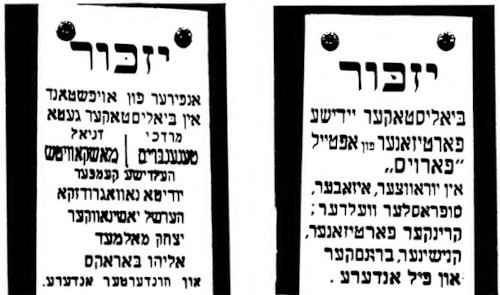
[Left side: In memory of the commanders of the Białystok Ghetto Uprising, Mordechai Tenenbaum and Daniel Moshkovitsh, and the fighters Yudita Novogrodzka and Hershl Yashinovker, Yitskhok Malmed, Eliyahu Baraks, and hundreds of others. Right side: In memory of the Białystoker Jewish partisans of the “Foroys” detachment in the forests of Jurowce, Izoby, and Supraśl; the Krynki partisans, the Hajnówka partisans, the Brańsk partisans, and many others.] |
Solazh had, in this way, helped save not only the other Jew's life but also his own. After that, Khorovski – just like Solazh and the other Jews – remained in the ghetto until the tragic end arrived. In August 1943, when the Nazis liquidated the Białystoker ghetto and the Jews there were taken out for annihilation, the young Sam Solazh was among them. Together with his relatives and the other Jews of the ghetto, he was taken to Treblinka, on the road to death…
The miraculously saved Pinye Khorovski was also deported from the ghetto. He endured suffering and torment in various Nazi extermination camps and survived the Hitlerite murderers. After the war he came to America, where he built a good life with his family. He now lives in Long Island, N.Y.
While being transported in the horrific train bound for Treblinka, Solazh once again resolved to take the risk and try to save himself from death. Still a young and agile boy, he leapt from the moving train at full speed – and he succeeded. He fell onto a field not far from the tracks; the Nazi Angel of Death did not reach him.
[Page 307]
Together with the other Jews, his close family members were taken on to the gruesome camp of Treblinka, where they were murdered in the gas chambers.
Solazh's heart aches constantly; his eyes fill with tears whenever he recalls and speaks about what happened to his loved ones. “A miracle truly happened to me,” he says. “I escaped from Hitler's hell. But… the Nazi murderers killed my father and mother, Shamai and Esther, as well as my six brothers and four sisters. There were eleven children in our family. I alone remained from such a large and widely branched family.”
After he jumped from the moving train on the way to annihilation in Treblinka, Solazh was left entirely on his own, like a broken branch torn from a great, spreading tree. He did not know what to do or how he might continue to save himself from the dangers that lurked everywhere. He began living as a Christian boy, wandering about with a cross hanging from his neck. In his loneliness, roaming and drifting from place to place, Solazh managed to reach a peasant in a nearby village, with whom he became a shepherd and performed other hard labor. Yet he remained surrounded by danger on all sides. Nazi murderers lurked everywhere, as did Christian informers. He lived in constant fear of being recognized as a Jewish boy.
Solazh left the peasant, fled, and disappeared into the forests. In those endless, desolate woods he lived alone and unprotected, like a wild creature constantly hunted by pursuers. While in the forests, he made his way to the partisans and joined them. With the partisans he also took part in dangerous operations against the Nazis. Shortly afterward, in the summer of 1944, he was liberated from the Hitlerite nightmare.
After the liberation, Sam Solazh spent some time in the DP camps for rescued Jews in Germany. He also lived for a period in Israel, where he once again showed his courage and, together with others, helped fight for the independence of the Jewish state. In 1951 he arrived in America. Here he built a happy family life with his wife, Rose, and their children. Sam Solazh [Solasz] – the heroic boy who, as if by miracles, tore himself free from a terrible death at the hands of the Nazis – is now one of the most prominent and successful entrepreneurs in the meat business.
The courage he showed on the road to death led him to a new and contented life, a life that Mr. Solazh knows how to value deeply through the good deeds he now performs in helping others.
Translator's note:
by Srolke Kot
Translated by Beate Schützmann-Krebs
|
Where are you, my world, where are you, my youth, With dreams of the future and visions of truth? The Nazi, the murderer, shattered my dream – My brothers and sisters burned on pyres.
With the patches on our backs, driven over bridges,
Under whips and blows and the terror of killing,
For our parents, sisters and brothers who died,
Through forests and fields, through marshes and ways,
You, Fritz, now wander through the forest,
The Germans in the forest walk in fear;
“Don't kill me! I have a wife and child.
The victory in the forest reaches forward,
We brothers have won – yet no victors are we. |
by Hirsh Feygin
Translated by Beate Schützmann-Krebs
Time passes quickly, but such things are never forgotten. I remember everything clearly; these memories remain. When I recall what I lived through–those indescribable sufferings and pains, and how I hovered constantly between life and death– a shudder still goes through me, and a deep inner jolt shakes me even now. As I write these lines, I relive it all once again. But it must be told and written down, at least a little, as much as my strength allows, so that it is preserved not only for myself and for the present moment, but also for the generations to come.
Before the outbreak of the war in September 1939, I had my own plumbing and heating business in Białystok, under the name “Buda-San.” My business partner, whose shop stood on the Kościuszko Market Square, was Idl Las. But everything changed when the Soviets occupied Białystok and the surrounding region. As happened to many others, my business was nationalized. Yet because I was a highly skilled specialist, the Soviets employed me as an engineer. I worked in various places; they even sent me deep into Russia to procure necessary raw materials to bring back to Białystok.
Suddenly, a terrible storm…
When Hitler launched his unexpected attack on Soviet Russia on June 22, 1941, a terrible upheaval began–something no one could ever have imagined, not even in the wildest fantasy. For the Jews of Białystok, great troubles began: suffering and pain, humiliation and plunder. The violence perpetrated by the Nazis against the Jews was so enormous that it is impossible to understand how anyone managed to endure that time. The Gestapo killers also had eager helpers among the Ukrainians, Lithuanians, and Croatians. After that came the sorrowful ghetto.
As a trained specialist, I was taken away together with others. We were a group of about 150 people, packed into hermetically sealed buses that had room for only thirty. The way they transported us was horrifying. To this day I cannot understand how we survived those several days. In the end, we were brought to Grodno, where we were locked up in the local prison.
After three days, we were again shut into cramped buses. All of us were certain we would die of thirst and heat…This time they brought us to Łomża, where we were placed in the prison called Tshervonyak [Czerwoniak], a kind of copy of the American prison Sing Sing.
In that prison, together with the other Jews who had been brought there, I endured terrible suffering, even though we were held there only as detainees. The only food they gave us was potato peels and warm water. The prison guards were criminal types, and causing us torment and pain was, for them, a source of great pleasure. This went on for several months, which felt like an eternity.
After that, we were once again packed into cramped rail cars and taken off in an unknown direction. No one knew where they were taking us.
On the third night, we realized that the train we were in was being driven onto a ferry boat and that we were now moving over water. We had no doubt that the Nazi murderers intended to drown us there. At last, toward morning, they drove us all into a large forest. At the entrance there was a sign: “Forest Camp.” Actually, it was an island near Danzig, where there was a labor camp for Poles. It would take too much space to describe the hatred with which the Poles conducted themselves toward the Jews who had been brought there.
In reality, this was the terrifying camp of Stutthof. Besides our group of Jews from the Białystoker ghetto who had been brought there, the Hitlerite murderers also killed the Jews of Danzig and, more broadly, of all Pomerania – along with other Jews and the Poles who were imprisoned there. Since the Nazis were building important factories in that region at the time and needed skilled workers for that purpose – and since I too was such a specialist – a miracle happened to me then, and I remained alive. There I received the number 26652.
Working alongside me was Khayim Roznblum, a locksmith from Białystok, who is now in Australia. There were also other Jews in our group of skilled workers.
Life and work in that camp, which was also known as the “EB Factories,” was one long chain of pain, torment, and unbearable experiences. None of us ever imagined that we would remain among the living. Yet despite all the suffering and pain, I endured there until March 1945.
Every day they would take me out, together with the others, for heavy labor, where we were constantly guarded by a Ukrainian or a Lithuanian with a large dog. Even without such strict watch, it would have been impossible to escape.
[Page 309]
This was because the Stutthof camp and the surrounding area were located on an island, surrounded on all sides by water.
While I was assigned to the slave labor around the EB Factories, I had a chance to obtain a small piece of extra bread. I received it from English and French prisoners of war who were also employed there in various kinds of work. They received a little more food than we Jews did, thanks to the Red Cross.
Every day, returning from work to the Stutthof camp, I would throw that bread–which at that time was like a treasure–over the fence into the nearby women's camp. Jewish girls and women were held there, brought from the Vilna ghetto. Among them were two sisters, for whom those pieces of bread greatly helped in surviving that terrible time. The two sisters indeed remained alive, and today they are: Ida Katz, who lives with her husband and children in Venezuela, and Mashe Kaprinski, who lives with her family in Tel Aviv.
During the period when I worked in the factories around Stutthof, the Nazis deported all the Jews who had been brought there from the Białystoker ghetto to Auschwitz, where they were murdered in the gas chambers. Among those deported and killed in Auschwitz was my beloved father.
In the first days of April 1945, already close to the end of the war, the Nazis selected about 1,400 people from the camp blocks and drove us, under heavy guard and without provisions, in an unknown direction. They forced us to march for dozens of kilometers across fields covered with snow.
After that, they began to drive us back again.
Throughout the entire route, which lay within Germany, we saw the bodies of those who had been shot or had collapsed after being driven like slaves, no longer able to endure the “death march.” Of the 1,400 people who had set out at the beginning of the march, no more than 300 remained alive…
In the end, they brought us to a prison in the small town of Vekhorovo [Wejherowo], near Danzig. In that harsh prison, I, like the others, again went through severe pain and torment. It seemed to me that my life was coming to an end.
Unexpectedly, however, something extraordinary happened–truly like a miracle from heaven. It taught me once again that a person must never give up hope, even in the last minute when one finds oneself in danger.
In the first days of May 1945, detachments of the Hitlerite army suddenly surrounded the prison in Wejherowo. The murderers ordered that all those locked up inside were to go out into a large open square. At that moment I felt that the end had come, that the murderers were going to shoot us all.
As they were driving everyone out of the prison, I suddenly noticed a bathtub standing on four little legs. Quickly I slipped underneath it and hid there. My good friend Khayim Roznblum also hid himself in a similar way, down in the prison cellar where the heating boiler was located.
Some feeling, deeper than reason, told us that the great, almost unbelievable day of liberation was drawing near. One could already sense chaos all around, a confusion that signaled something extraordinary was about to happen.
But the feeling I had then–that the end was drawing near–did not deceive me. All the prisoners of the jail, people of various nationalities who had been driven out onto the large open square, were shot by the Hitlerite murderers with their machine guns. Immediately after carrying out their crime, the Nazis fled in great panic. The downfall of Hitler and his army of beasts in human form had arrived–those who had brought such a terrible destruction upon the Jewish people and upon other lands and nations.
At last, after more than five years of suffering and pain, after Europe had been flooded with Jewish blood and tears, after six million Jews–women, children, men, and the elderly–had been murdered, liberation from the Hitlerite hell finally came.
Yet each of us remained orphaned and wrapped in mourning. Each of us had lost our near and dear ones, who had been murdered by the Nazi killers and their collaborators. This grief, this sorrow and pain, will remain with us forever. And this must be known and remembered by all the generations to come.
Our task must always be to remind the world of what Hitler did to the Jewish people, while the great world looked on with indifference. We Jews must never forget this; it must always be remembered.
Zakhor – Remember…
My grief is great as well; it accompanies me in my daily life. It does not let me sleep at night. The sum of my family – my closest loved ones whose lives were cut short – is a story of sorrow and pain.
My beloved mother, Frume, a warm and kind Jewish woman, died in the Białystoker ghetto from suffering and anguish. My dear father, Beynush, endured great hardship and pain under the Nazis together with me. In the end, he was tortured to death in Auschwitz.
My younger brother, Khlovne, together with his wife Sore and their little daughter, were murdered by the Nazis in Treblinka. My sister, Rokhl, was married to Yerakhmiel Tsipuk in Vilna. Both of them, together with their two young sons, were murdered by the Nazis in Estonia.
Many others from my once-large extended family in Białystok were also murdered by the Hitlerite killers.
Translator's notes:
by Moshe Bender
Translated by Beate Schützmann-Krebs
Night. Plundered and burned, ruined and desolate, the liquidated Jewish Białystoker ghetto lies in the lap of thick darkness. Jewish belongings and goods are strewn throughout the courtyards and streets; Jewish bedding lies torn open, feathers scattered everywhere like snow on a winter's day. Pieces of furniture, clothing, pots – all flung about, truly as if after a pogrom. There in the courtyard at 24 Jurowiecka Street, where we had lived, the body of the woman from that house, the sixty-year-old Mrs. Finkelshteyn, lay by the garbage bin. And beside the corpse, three hungry cats – the ones the Nazis had chosen to let live – were mating with a greedy, unrestrained appetite.
Silence, like a cemetery. The wind howls angrily, a kind of Kaddish over the 143 Jewish souls who had still lived here only yesterday and had hoped for deliverance. Death stared out from the shot-out windows and shattered panes of the abandoned Jewish homes with a thousand piercing eyes, as though through the hollow sockets of human skulls. It feels as if the holy ones – the released souls of the heroes and martyrs of the ghetto – are hovering here, like the spirits in I. L. Peretz's “A Night in the Old Marketplace,” weeping out their loneliness and pain.
The blood runs cold; the heart tightens. A shudder of horror passes through the body in the ruined Białystoker ghetto at night.
Building Bunkers
The ghetto is dead – that much is true. But the one who, by some miracle, escaped the fate of the tens of thousands of murdered Białystoker Jews and remained alive still clings with teeth and nails to bare existence. It is an instinctive urge to hold on, as if to defy the enemy simply by continuing to live. People begin to build bunkers (skhrones), for the only way to escape the evil eye of the Nazis is to sink deep beneath the earth, where the wild beasts cannot reach.
A new Jewish architecture has taken shape: dwellings carved into the depths of the ground. With one striking difference – the floor, which is usually meant to be walked upon and to rest upon the building's foundation, now becomes the roof over one's head. The stronger the floor, the safer the shelter.
The mass psychosis of bunker-building began already after the first Aktion of February 5, 1943, and reached its peak after the liquidation of the ghetto.
In every yard there were five to ten skhrones – mostly under the floor; in some cases also up in the attics. Among them were simple shelters with little space and little air, and about ten to fifteen percent were better bunkers, equipped with every convenience: electricity, ventilation, air pumps, water pipes, and even arrangements to preserve food supplies for as long as six months. Remarkably, although in the end all the bunkers were discovered, the “luxury” cellars were the first victims, because they occupied more space and were easier to find. The Nazi murderers went around with building engineers, probing and measuring the houses to see whether there might be a double wall or a hidden entrance.
They would usually come upon the more aristocratic, comfortable hiding places. Besides, they had a greater interest in those than in the poorer cellars, because among the amkho [the common people] they found only human victims, while among the wealthier they also discovered in the hiding places furs, manufactured goods, jewelry, and other valuables that had been concealed. They uncovered a rich bunker at 26 Jurowiecka, in the yard of Bale, a local Volksdeutscher, where they found forty Jews. This was next door to our yard and our shelter.
Thus the persecuted and unfortunate sought protection in the depths of basements, sunk into the earth. Once, people dreamed of rising upward; and even deep below the ground they dug tunnels to make contact easier, to shorten the way – a real kfitses haderekh – to bring one person closer to another. But today, in these so-called modern times, one must sink ever deeper into the earth, because people flee from one another, hide from one another. After all, this is the twentieth century…
In a small hiding place there were four to eight people. One could not lie down there because of the lack of space – only sit or stand. Even the “privilege” [of sitting] had to be taken in turns, because [from all the standing] the feet would swell.
From the cramped space and the foul, stale air one could practically suffocate. It was so hot that we had to strip half-naked, and streams of sweat ran down our bodies. We could hardly wait for nightfall, when we could slip outside for a moment and draw a little fresh air into our stifled lungs.
That is why our hearts truly grew weaker from day to day.
Abandoned Jewish property and valuables
As early as eight o'clock in the morning the looting brigades would set out – made up of Poles and White Russians.
[Page 311]
They would collect and sort all the items of Jewish property and goods that had been brought out of Jewish homes. With German meticulousness and system, the servants of the “Master Race,” under Nazi supervision, laid out separately the furniture, clothing, shoes, and other articles, which were then sent off to the poor Fatherland as “Christmas presents” for the Volksdeutschen. From the special warehouses and factories, freight trucks would arrive and carry off everything that suited them. Everyone took whatever item he needed.
While emptying out the houses, the murderers would tramp with their boots over the heads of the Jews hiding in the bunkers. From below we could hear them, and our hearts would drop in terror. The nerves felt as if they were being pricked with needles. One was afraid even to cough. It was even more tragic in those bunkers where small children were hiding. Only the little ones, with a kind of grown-up understanding sensed the danger and often held their breath and wept silently. Yet there were cases when a child's cry betrayed and delivered the entire hiding place to death.
The entrance to a skhron [bunker] was usually concealed with a piece of furniture – a wardrobe, a couch, or the door of a bake oven. We lived in constant fear that the murderers would find the hiding place.
A case of a hiding place being exposed by a child's crying occured in the bunker at 1 Tsheple [Czapla] Street, in Lapidus's yard. Paderevski from the café had two small children there, two or three years old, and his skhron was discovered in the eighth week after the liquidation. When that happened, the children were taken out into the yard and shot on the spot, and the adults were taken away to the prison, where the same fate awaited them. There were children in my skhron as well, but they controlled themselves and did not make even the slightest rustle.
Later, the water in the hiding place ran out, and we refreshed the children by fanning a kerchief over their little heads to give them a bit of relief. The people in the bunker were already praying to God that everything above would finally be taken away, and that the murderers would leave the house.
Our greatest enemy in the skhrones was the filth, which took root because of the foul air, the cramped space, and the unwashed clothing. It broke us more than hunger and thirst. It had a terrible effect on our nerves. We were simply envious of the dead, who had already been burned in the crematoria. The accumulated grime settled on our lungs and made our already short breath even heavier. Under these conditions we lived long, sorrowful days, weeks, and months – in despair and hopelessness, in deadly fear and constant danger.
For a Drop of Water
The electric company reported that the electric meter (the test meter) showed that thousands of kilowatts of electricity were still being consumed in the ghetto – a sign that somewhere Jews were still hiding. The Nazis then shut off the water system and began intensified searches. This made the bitter life in the cellars even harder. One had to look for water in the wells outside. Many went to fetch water in Bale's yard, at 26 Jurawiecka Street, where there was a fish pond, but doing so meant risking one's life. Two Jews were in fact shot there.
Abrasha Chudin, the cantor's son, and I were among those who took the risk. We went out at night to look for water, and in the darkness we bumped into two men. We thought they were Jews, our neighbors. But it turned out they were Germans. There was hardly any time to understand what was happening. I was lucky; the German grabbed me by the shoulder, but I pushed him away and ran. Abrasha was not so fortunate, and five or ten minutes later I heard a shot. The murderers had killed him. That is how one paid with one's life for a drop of water, because the thirst was unbearable.
The “small ghetto” was located on Fabryczna Street. About two thousand Jews lived there, together with Engineer Barash and the Judenrat. For a short time the Jews bought themselves a little reprieve from death with the money and gold they still had; others held posts under the Nazis and enjoyed a semblance of protection. Later, however, the same fate overtook them as all the other victims of Białystok. Barash was taken away to his death on October 15, 1943. He perished in the Lublin extermination center.
On the March of Death
The Jews found in the skhrones were first gathered on Ruzanske [Różańska] Street, at the Linas Hatzedek [Home and Association for the Poor and Sick], and taken on truck into the forest and shot. If anyone tried to escape, or simply displeased the drivers, he was shot on the spot. Some were sent to the main prison, and from there groups of two hundred or three hundred people were taken out and shot. Thus the Jews went to their own funeral, the last sorrowful path, when their footsteps had already fallen silent forever.
Our once bubbling Jewish Białystok became “Judenrein.” On the streets from Kupiecka to Bilke [Bielkowa?], Jurawiecka, Czapla, Fabryczna, Nowogródzka, and the surrounding small lanes, White Russian peasants were settled in November 1943 – people who had been resettled from the villages.
Those who managed to hold out in the bunkers until October 1943 found it somewhat easier to save themselves, because by then ninety-five percent of the hiding places had already been discovered, and the Nazis were no longer searching so intensely.
[Page 312]
They believed that not a single living Jew remained in Białystok. Those who were discovered were sent to the extermination camps, from which, of course, none ever returned.
In this way, about twenty Jewish souls were saved in the bunkers, and another forty escaped into the forest or hid with peasants. I am one of those who left the bunkers and joined the partisans in the forest. I parted from my bunker neighbors at the end of November 1943.
These are brief lines about the struggle for life of the Jews of Białystok under the ground, after the liquidation of the ghetto. I found it necessary to record them so that the future historian of the destruction of Białystok may preserve them as a memorial for generations to come.
Translator's note:
Translated by Beate Schützmann-Krebs
This moving poem was written by Ruven Ribalovski in memory of his daughter Frida, who was killed during the uprising in the Białystoker ghetto on August 16, 1943. The grieving father of the heroic daughter wrote the poem while standing at the grave of the seventy heroes in the Zhabye [Żabia] cemetery in Białystok, where the heroic Frida is also likely buried.
Ruven Ribalovski, who survived the war in Soviet Russia, returned to his hometown of Białystok shortly after the war. He submitted the following poem, dedicated to his daughter's memory, to the Jewish Voivodship Commission in Białystok at the end of December 1946.
Ruven Ribalovski – a brother of Isak Ribalovski, the distinguished general secretary of the Białystoker Center – lived in Uruguay in the postwar years. He died there in 1955. Ruven's second daughter, Lizele – whom he mentions at the end of his poem – died in Uruguay in 1972. The poem was copied from an original provided by Dr. Shimen [Szymon] Datner.
who fell al kiddush ha-Shem – in sanctification of God's name – while defending the Białystoker ghetto on August 16, 1943.

I stand by your grave, my head bowed low.
Your longing for life and for deeds of goodness
I have come to bid you farewell, my child.
Driven by desolation and the blood-soaked pavement before me,
There will come faithful friends to your resting place.
I – your unfortunate father – and your friends |
Translator's note:
Pesach Burstein [Peysekh Burshteyn]
Translated by Beate Schützmann-Krebs
Our esteemed landsman Pesach Burstein, of blessed memory, wrote this article in 1961, at the time of the historic Eichmann trial in Jerusalem. Burstein – a well-known communal activist and one of the miraculously saved survivors who endured suffering and torment at the hands of the Nazis – served as a witness, together with other rescued Jews from Białystok, in the trial against the Nazi criminal Artur Gosberg. The trial took place in West Germany. In the postwar years, Pesach Burstein, of blessed memory, lived in the State of Israel, where he was also active in the local Białystoker landsmanshaft.
The Megile Eykha – the Book of Lamentations – of our suffering and torment unfolds anew before us at the Eichmann trial in Jerusalem. Once again the graves open and speak of the last dying gasps of a people and its annihilation. Once again coils of smoke and fire rise from the crematoria, through which a people ascended to the heavens.
We have lived to see the profound, bitter satisfaction that from the ruins of German Nazism we have become its judges. And before our Israeli court stands one of the most horrifying murderers and tormentors. We relive those terrible days. We immerse ourselves once more in our own blood and tear open again our barely healed wounds.
And not only that. We are confronted again with an even more tragic phenomenon: that our own brothers do not understand us.
In the name of the survivors of the death camps, we expressed our gratitude and highest recognition to the Attorney General of our government and chief prosecutor at the Eichmann trial, Mr. Gideon Hausner. He succeeded in entering into the tragic web of our destruction, and although he himself – to his good fortune – did not live through the tragedy, he succeeded in his great prosecutorial address in bringing before the world the full scope and depth of our catastrophe.
But on the other hand, at this same trial there are those who cast doubt on our dignified conduct during that tragic period and ask: Why did you not fight. Why did you not resist.
And it does not help that through all these years we have spoken, reminded, and explained. It does not help that we have told and retold against what enormous power of evil we were standing – against what immense force that, within a few short months, succeeded in conquering countries and trained armies equipped with the newest weapons.
Against the Nazi murderers everyone was helpless – even more helpless than we were. In the ghettos and camps we were cut off from the world and from one another, trapped with hunger, confinement, filth, and disease, marked with yellow badges, fenced in by barbed wire, held in a tormenting encirclement. And yet, out of this people tortured to death, what heights were reached: culture, theater, help at the very edge of the grave; uprisings in the ghettos of Warsaw, Vilna, Białystok, and others; uprisings at the gas chambers of Auschwitz, Treblinka, and other death camps; one and a half million Jewish soldiers in the armies that fought German Nazism; Jews in the fighting groups in France, Belgium, Holland, Greece, and elsewhere; forty percent Jewish partisans in Eastern Europe; Jewish acts of individual heroism – and still we are told that we went like sheep to the slaughter.
No. We stood not only against the Eichmanns who are now being judged. He was not alone. Hundreds and thousands and millions together with him exterminated us. His verdict will not be our final reckoning with the German murderers, and let no one imagine that with this our account will be settled.
Hundreds of thousands of them still move about freely in both Germanies [East and West Germany], holding high positions. They go about freely across the entire world, sowing once again the poison of Jew-hatred and hatred of humanity, preparing a new beyn-hashmoshes – a twilight in-between for the world – preparing the ground once more for gas chambers and crematoria.
A few months ago I saw the Germans. I saw the prosperity and the luxury in which they live after having lost the war. I saw their meticulousness in the transports of the dead that used to arrive at the railway station of Auschwitz. Dr. Mengele – the monster in white gloves and monocle, who now roams somewhere on God's earth – used to receive them and, with the smallest movement of his little baton, send them to their death.
I was invited to Germany as a witness in the trial against a small Eichmann: the camp commandant of the labor camp Blizyn, the Unter-Scharführer, the SS man Artur Gosberg.
In that camp thousands of Jews from Białystok perished. More than three thousand people were counted on the transport that arrived in Blizyn directly from Białystok, from the small ghetto. And we, who had arrived a week earlier in Majdanek, were then joined with the transport from Białystok and together sent on to Blizyn.
[Page 314]
The terrible hunger that reigned in Blizyn cut down lives by the hundreds each week. We were all swollen, and our swollen feet could no longer carry even the dried-out bones of our tortured bodies.
The dreadful confinement and filth, the impossibility of washing ourselves, and the ragged clothes with which we covered our tormented limbs brought on a horrifying epidemic of spotted typhus, and it completed the work that hunger, pain, and brutal forced labor had not yet done. The typhus claimed more than a thousand victims from Białystok.
And it was to this trial of the Blizyn camp commandant that I was invited as a witness.
Shortly after the liberation I made a vow that my foot would never again in my lifetime step on accursed German soil. But it was my duty to help bring–even if only one of our German murderers–to justice.
We were five witnesses from Israel: the son of the well-known Białystoker textile manufacturer and communal activist, Feivel Zitron [Citron]; Dr. Tuvia Zitron [Citron], today the chief surgeon of the Hadassah Hospital in Tel Aviv – the man with whom I went through all the hells, who saved dozens of Jews from death, and to whom I myself owe my life; Dr. Milstein from Haifa, a surgeon who had also worked as a doctor in the concentration camps and helped his fellow sufferers; Mrs. Yentshman [Jentschmann]; Leon Zandberg from Haifa; and myself.
The trial took place in the half-million-strong German city of Wuppertal, near the Dutch border. It was a jury court composed of four professional judges and eight citizens of the city as assessors. Within the walls of the centuries-old courthouse, the distant echoes of our suffering and torment were heard again. On the defendants' bench sat a red-faced, well-fed German in gray civilian clothes. Men like him can be seen everywhere, in their thousands – and perhaps all those thousands had been engaged elsewhere in the same work of killing.
And there, too, in its smaller scope, the same Megile Eykha of our suffering unfolded.
Dr. Milstein told of broken bones and split-open skulls of the camp inmates who came to him for help in his small infirmary in the Blizyn concentration camp. He told how the accused would come to watch him treat the wounded and forbid him to use any anesthetic. He stood there himself, looking on as broken bones were set and living flesh was stitched – no chloroform, no ether… “For Jews,” he said, “a hammer blow on the head is anesthesia enough.”
The carpenter Leon Zandberg told the court how the accused had ordered from him a special whipping bench, built according to his own drawing – a bench that would make it impossible for the victim to move and exposes the buttocks perfectly to the blows. The witness told how he himself had received twenty-five lashes from the accused because the whipping bench did not have the proper angle. He told of two Jews who were shot for the great “crime” of wanting to see their wives.
Mrs. Yentshman told of the suffering of the women in the camp: of the heavy, inhuman labor; of hunger, filth, and torment; of beatings and lashings; of the inhuman and impossible work quotas and the punishments for failing to fulfill them.
Dr. Zitron told how healthy, young people were transformed in a short time into skeletons, with feet swollen like logs; how they became “Muselmänner,”[3] and what this new term meant in camp life.
He told of the terrible typhus epidemic that claimed two thousand victims. People had become so weakened that they no longer felt themselves performing their physiological functions, and their bodies rotted while still alive – people whose skin had no flesh beneath it, so that the bones pushed through the yellow, swollen skin. He told of the dreadful hunger and of the food rations that the accused had authorized for his slaves; of the chopped-up, wounded, and lashed Jews who were brought to him in the stable that was called the “sickbay,” and who died there from the wounds and the beatings they had received.
And here I sat on the witness stand, facing the judges, forcing myself not to turn my head to the left and see the loathsome-faced murderer. I wanted to hold on to my composure and not break under the weight of these memories – to recall calmly everything that had happened, to reopen those pages and once more go through all the pain.
I told how I came out of the so-called sickbay after the severe spotted-typhus and the internal hemorrhage – a skeleton on two swollen, log-like feet that threatened to burst at any moment from the pressure of the fluid. More than once at night we heard a tearing sound – someone's foot had burst open, and the flesh split apart and exposed the white bone. I told how the accused then kicked me with his boots and left me lying unconscious by the prisoners' block.
The twelve judges sat and listened. Who could know what thoughts were in their minds.
[Page 315]
Perhaps some of them had also taken part in our destruction. Or perhaps they were ashamed of what their people had done. Who could know. And above their heads, on the great wall of the courtroom, I saw a huge fresco in vivid colors. It showed the Judgment of Solomon: King Solomon, the Jewish king, with the child on his lap, the sword, and on both sides the two women who had come to him seeking justice.
The presiding judge asked me what more I could tell, what else I had seen of the deeds of the accused.
I told how once, during the daily roll call – four thousand men and women standing – the accused called out from the ranks a young Jewish girl of about twenty and asked her something. I did not hear what he asked her. I did not hear what he said to her. But later I learned that she had been found with a piece of bread when she came in from work through one of the gates. She refused to say from whom she had received the bread, and the accused shouted: “A hundred lashes!”
The girl lay down on the whipping bench, and the whipping procedure was about to begin. But no – the SS officer Artur Gosberg, representative of the so-called superior German race, ordered: “Lift up her dress and tear down her undergarments, and she is to be whipped naked, before four thousand pairs of eyes of her fellow sufferers.”
I told of this disgrace: how the woman screamed at first, then fell silent, and how after the whipping she was taken to the so-called sickbay. As I later heard, she died a few days afterward. Dr. Zitron, too, in his testimony, spoke of the Jewish girl who had been brought to him after the whipping and who died in the sickbay under his care.
And I said to the judges: “You may wonder how I can remember this case so clearly. After all, seventeen years have passed, and since then I have lived through so many terrible things in the shadow of the gas chambers and crematoria of Auschwitz. But in this case I saw a return to the jungle. I saw how all human values were trampled underfoot by booted feet.
I look now over your heads and I see on the wall the fresco of King Solomon. This is the symbol of the German court. It means that there is something higher that binds peoples and religions, and in all religions there is the principle and the thought that the human being is born and created in the image of God. So you should know that together with that young Jewish girl, God Himself was violated.”
Tears stood in the eyes of the judges. I do not know, and I do not want to know, why. Germans are as they are, and who can understand them. Yes, of course, there are others among them as well:
On the airplane between Düsseldorf and Munich a young German was sitting next to me. He told me that he had rescued Jews and that they are now living in America, and I could no longer restrain myself and asked him:
“I have been in Germany for a week now. Every German I have met has rescued Jews. Where are they, all these rescued Jews? If all of this were true, we would now be a people of thirty million.”
He showed me the photographs that had been taken when he visited the family he had rescued. Sitting at the table with him were Jews with beards and yarmulkes, and their children and grandchildren, and there he was photographed with them in Central Park and at the Empire State Building in New York. Pure truth.
So again the same thing. One could have rescued and helped. And how many did so. A few, isolated individuals – and ninety-nine percent, and perhaps even more of the German people, took part, actively and passively (which is also an offense), in the greatest crime in the history of humanity. They annihilated, slaughtered, burned, and desecrated an innocent people, only because they were Jews.
Translator's notes:
Fanny Garfinkel (Boyarski)
Translated by Beate Schützmann-Krebs
My suffering and the terrible experiences I endured under Hitler are bound up with the hardships my husband, Sholem Garfinkel, went through as well. Our shared path of suffering began in the Białystoker ghetto, where we were together with our loved ones. My husband had come to Białystok with his family from Trestine at the end of 1941, when the Nazis began driving out and liquidating the Jews of the surrounding small towns. His family numbered nearly one hundred people. But after the war he remained entirely alone – the Hitlerites murdered all his relatives. His father, Shimen Garfinkel, forty-three years old, took part in the heroic uprising in the Białystoker ghetto. The Nazis shot him together with the other fighters.
From my own large family, only my older sister Etke and I survived. She now lives with her family on a farm in Youngsville, New York. Only one cousin of mine escaped the Nazis – Rivke, who now lives with her family in Melbourne, Australia.
Both of us – Sholem Garfinkel and I – were still young then, already close to each other, almost like bride and groom. Our great shared suffering began in the summer of 1943, when the Białystoker ghetto was liquidated. Garfinkel was then a young man of only seventeen, and I was a little younger.
In the ghetto, Garfinkel worked in the shoemaking shop, at Liberman's on Ruzhanska Street. After the Nazis had deported many Jews to Petrashe [Pietrasze], from where they were taken out to be murdered, a group of Jewish shoemakers was singled out – specialists the Hitlerites needed to finish the work left behind in the ghetto. Garfinkel was among them. My sister Rokhl and I were taken along as well. All the others from both our families had already been taken away to their destruction.
A week later, when the Nazis were preparing a new transport of Jews for deportation, they also seized the remaining Jews from the workshops and factories. Garfinkel was among them. The Nazis also rounded up many of the Jews who had been in hiding – men and women alike. All of them were taken to the Judenrat building on Kupiecka Street.
After that – it was already August 1943 – all the Jews from the ghetto were driven into the large courtyard of the “TOZ” [Jewish health center] on Fabryczna Street. This was just before the final summer liquidation of the ghetto. All the Jews – men, women, children, the elderly, and the sick – were kept there for several days in the intense heat, without food or water.
We were surrounded and guarded by Nazis and Ukrainians with rifles. They fired shots into the air, and sometimes for no reason at all – a warning that no one should dare try to escape.
Suddenly there was a great commotion – fear and panic everywhere. People began shouting and crying, sensing that something terrible was about to happen.
At that moment the Hitlerites and the Ukrainians began running around with their rifles held out in front of them, driving the gathered, tormented Jews forward in great haste. The Nazis quickly separated the women with children into one group, the elderly and the sick into another, and then singled out a separate group of young, healthy men. Sholem Garfinkel, who was then young, strong, and handsome, was placed by the Hitlerites to the group of young and healthy men.
I felt that the end was coming for me – that I would soon be placed with the women and children. But suddenly I felt within myself an incomprehensible strength rising within me, and a thought flashed through my mind like lightning. Standing close to Sholem Garfinkel, I said to him quickly:
“Sholem, I am desperate! They are taking the young men for labor, but the women with children – where they will send me – they are taking to their deaths. My end is near as well. Save me. Quickly disguise me as a man so I can go with you.”
At that time Sholem Garfinkel was wearing three pairs of trousers, as many others did, because people tried to take a few things with them on that terrible journey. He quickly pulled off his outer pair, and I hurried to put them on. A few friends shielded us while I slipped into the trousers, sitting on the ground.
Meanwhile, the women with children, as well as the elderly, had already been taken out to the railroad cars of the transport waiting on the Polesia Line, not far from Fabryczna Street. Garfinkel also quickly took off his jacket and cap, which I put on. With a shoemaker's knife he carried with him, he swiftly cut off part of my hair.
I slowly began to rise from the ground so I could pull the trousers up properly and fasten them. A German SS man who was guarding us noticed this – he had seen it from a distance.
[Page 317]
The murderer immediately shouted at the top of his voice to the guards at the gate that there was a Jewish woman in the group – a woman among all the men – who had disguised herself as a man.
At the same time, the young, healthy Jews were already being driven toward the exit gate of the TOZ building, five people in a row. The women with children, as well as the elderly and the sick, had already been forced into the waiting railroad cars of the transport. At the gate, Garfinkel was placed in a group of five other men, not together with me, so that the two of us would be separated.
At the exit gate the murderous Nazi guards examined each of the thousands of young Jews. The murderers opened every man's jacket and shirt to make sure he was a man. They did the same with me. When they searched me, the Hitlerite murderers immediately recognized that I was a woman.
The murderers tore the clothes off my body, and I was left standing half-naked, wearing only a short undershirt.
The rows of thousands of young Jews kept passing through the gate. The murderers led me aside and beat me terribly. To this day I cannot understand how I endured those blows. Even now I still bear marks on my forehead from that time.
At last, when I was covered in wounds and blood, the Nazis placed me near a fence not far from the gate, where eight Jews were standing – men who had earlier tried to escape from the ghetto. They were all lined up facing the wall, their hands raised, waiting to be shot. The Hitlerite murderers fired at the group of Jews and killed them one after another.
I felt that at any moment the bullets would reach me too – that the end of my life was coming. But right after the murderers had shot the eight Jews, one of them said to me: “You will be shot while running.” And they ordered me to run.
I began to run, not knowing where or what would become of me. I ran, and the Nazis fired after me, but to the side. Two Ukrainians ran after me. Each time they caught up with me, they beat me severely, knocked me to the ground, then lifted me up again, drove me on, and beat me once more.
In the end, the Ukrainians drove me toward the train cars where the many thousands of Jews who had been driven out of the ghetto and were now being prepared for deportation were gathered. Nearby were the train cars beside which the young, healthy men who had been selected were standing. The Ukrainians wanted to push me into a car where the women with children were locked in. But those cars had already been sealed.
At that moment Sholem Garfinkel caught sight of me. He barely recognized me, for I was terribly beaten – almost nothing but flesh and blood. He slowly approached me. Suddenly the Nazis began driving the men into the train cars in great haste, a hundred people into each car. In that instant, like a flash, Garfinkel pulled me inside with him into the car in which he and the others were being locked. Immediately the door of the car was shut, as it was with all the other cars.
I was the only woman in that car – one woman among a hundred men. The transports set off, carrying the Jews on their final journey…
When the transport with the Jews from the Białystoker ghetto and the surrounding area passed Starosielce and Łapy, Jews began jumping out of the train cars. Word had already spread among us, and it had become clear that we were being taken to Treblinka. Almost all who jumped from the cars were shot, for along the tracks stood armed Nazis with dogs. They were also stationed in the guard huts positioned between the cars.
The Nazis fired through the small windows into the train cars, at the unfortunate Jews who were being taken to their deaths. One bullet struck me in the left hand; to this day I still have a broken finger from that.
When our transport arrived not far from Treblinka, about twenty train cars with the women and children, as well as the elderly and the sick, were immediately separated. Everyone understood what that meant. The weeping and screaming – cries that could have moved a stone – I still hear in my ears to this day. They were taken straight to the gas chambers.
A number of other cars – the ones in which I, together with Sholem Garfinkel and others, was traveling – were not brought into the Treblinka camp itself. These were all men, and I was the only woman among them – the ones whom the Nazis intended to use for forced labor. After several hours the transport began moving again and finally brought us to Majdanek.
Throughout the entire journey I was dressed only in rags, looking more like a man than a woman. I remained on the spot with all the wounded, beaten, and shot who had been brought there. I tried to help the unfortunate people with a little water and in whatever way I could. Garfinkel, together with the other young Jews, was taken into the bathhouse to be “deloused” and shaved.
After that, the Nazis gathered several hundred such men – among them shoemakers, tailors, and leatherworkers – and loaded them onto a transport. I, however, had already been condemned to remain with the others who were destined for the gas chambers and crematoria in Majdanek. But at the last moment, when the men were being led into the transport, my dear Sholem pulled me along with him. Once again I found myself in a train car among only men, passing before the Nazi murderers as a man.
[Page 318]
Our transport was eventually taken to the forced labor camp Blizyn, not far from Skarzhisko [Skarżysko]. In Blizyn there were many Jewish women, and I was placed among them. In that camp I also met my sister Etke, who had likewise endured suffering and torment. Sholem Garfinkel worked in the camp as a shoemaker.
After nine months in the camp, we were separated. Sholem was taken away and sent to the camps of Płaszów, Mauthausen, Melk, and Ebensee, where he was liberated in early May 1945. I too was taken out of the Blizyn camp – first to Auschwitz, and afterward to the camps of Indenburg [Hindenburg/Zabrze?], Nordhausen, and finally to Bergen-Belsen, where I was liberated in April 1945.
Soon after the war I was reunited with my husband. We were married in Salzburg[2], near Frankfurt am Main, and we built a peaceful family life together. That is how we have continued our new life ever since we came to America.
When one recalls the terrible experiences of the war years, it is impossible to understand how we managed to endure them. Each of us lost our dear and closest ones, who were murdered by the Nazis. We take great comfort in knowing that we are leaving behind new generations who will carry on the continuity of our annihilated families. My husband and I take great joy in our children and their families.
Our son Shimon, who is married to Carol, is in the textile business. They live in Plainview, Long Island, and have two dear children. Our second son, Steven, who is married to Marlene, is an accountant. They live in Brooklyn, N.Y., and lead a contented life.
Every time I recall that moment when I was saved from death at the hands of the Hitlerites – disguised as a man – and when I think of the terrible suffering I endured, it all becomes a painful experience for me once again. Everything comes back to life in my memory; it does not let go. But we must tell about that dreadful time under the Nazis, so that the present and future generations will know of it as well.
Translator's notes:
by Charles Shvekher [Schwecher]
Translated by Beate Schützmann-Krebs
I still see that terrible image before my eyes – my father's last journey, the tragic road that led my beloved father to his death. I will never forget it…
When the Jews of Białystok were locked into the dreadful ghetto, my family lived on Khmyelna [Chmielna] Street. Our family consisted of five people – my father, my mother, and three sons. Like everyone else in the ghetto, we had barely a single room.
During the first Aktion, while we were living in that room, there was on the left side an opening that led into a small attic space. We placed a wardrobe in front of the door and hid there for an entire week, as long as the German murderers were rampaging through the ghetto. My uncle, my aunt, and their two children were also hiding with us; they were concealed in another room.
Suddenly we heard that the Nazis, who were searching everywhere for hidden Jews, had entered our room. We all lay there, hardly able to breathe, in terrible fear. We felt that at any moment our end was approaching. The Nazis shouted; their screams came closer and closer. The murderers kept asking whether there were any Jews there. It did not occur to them that on the other side, behind the wardrobe, Jews were hiding who were trying to save their lives.
And so we survived the first sorrowful Aktion in the ghetto, which took place in February 1943.
After the Nazi murderers had carried out their terrible slaughter of the Jews, they began to leave the ghetto. We had a family we knew who lived in the third house on the same street. When my father and I went into their room, our eyes could hardly believe what we saw.
The older daughter of the family was married and had a child. They had been hiding, just as we had, and when the murderers were searching everywhere for hidden Jews, the child was just about to cough. To keep this from drawing the attention of the nearby Hitlerite killers, the mother placed a rag over the child. In her desperation she held the rag over the child's head so long that the unfortunate child suffocated…
When my father and I rushed into the room in fear and haste, we saw the grief-stricken mother still holding her dead child in her arms. We were utterly shattered by what we saw. But the troubles for all of us – the suffering, the hunger, the terror – continued to drive our tragic lives forward with relentless speed.
[Page 319]
And so we struggled on until August 16, 1943, when the Nazis ordered all remaining Jews to gather on Jurowiecka Street. As they drove us there, the complete emptying of Białystok of its Jews began – the beginning of making this once-famous Jewish community iden-reyn [“free of Jews”].
At the same time that the remaining Jews of the ghetto were being driven toward Jurowiecka Street, we heard a great deal of shooting. It was the resistance of our Białystoker heroes, who stood up against the Nazi murderers.
When we reached Jurowiecka Street, we were pushed closer and closer together into a single mass of people. The crowding was unbearable; even now I cannot understand how anyone managed to endure it. But it seems that a human being is stronger than steel and can survive every kind of suffering and pain.
At that time it was a terrible thing to witness how, in that mass of people on Jurowiecka Street, men and women collapsed from exhaustion and pain. People simply began stepping on those unfortunate Jewish women, old people, children, and men. And the suffering only grew greater and greater.
When we finally dragged ourselves, with tremendous difficulty, to the fields of Pietrasze, where all of us were being held, the German murderers began separating our families. It hardly needs to be said how terrible this was for each of us. The separation was: older people to one side, younger people to the other. At that time they left me with my two brothers, and my father and mother were driven off to the other side.
That scene still stands before my eyes. It was terrible then, and it is terrible to remember it now…
After we had been lying for several hours on the grass, waiting for whatever uncertain fate awaited us, I saw flatbed trucks passing by – open platforms on which many dead people were already being brought back, and beside them walked Jews. When I looked more closely, I saw among those walking my beloved father.
As it turned out, when the people were being driven toward the train, a shooting broke out between the Jews being herded along and the murderers. Many Jews were shot at that time. Since the Nazis wanted to clear the roads of the dead, they brought them to Pietrasze. When my father arrived there, he remained with us. My mother, however, was taken away to Treblinka together with others, where she was murdered.
In the end we were taken to Majdanek. We – that is, we three brothers – were together with our father. When we arrived in Majdanek, a new hell began. The suffering we endured over the course of two weeks – the shootings and the screaming – cannot be described.
After that, we were taken from Majdanek to the camp in Blizyn. There we performed heavy forced labor, accompanied by suffering and hunger, and many of our fellow Jews perished. In Blizyn my youngest brother, Yankl, fell ill with typhus. The same happened to my father's brother, Berl Shvekher [Schwecher]. Both of them died there.
In June 1944 we were driven further; we were taken to Auschwitz. There a new, darker chapter in our tragic lives began.
When we arrived in Auschwitz, we were driven into Block 9. There were many children there as well, and measles had broken out among them. We, the newly arrived, were then kept in quarantine. For roll call they drove us out naked to be counted. Several Hitlerite murderers walked around us, counting and recounting without end, as if it would go on forever. They looked each of us in the face, and when one of them made a sign with his cursed finger, another murderer wrote down the number from that person's arm. That day, my father's number was also written down. As we already knew by then, a person whose number was recorded in that way was being marked to be taken to the gas chambers.
On the second day of Sukkot, 1944, the murderers took my father out of the barrack. My brother and I accompanied our dear father as far as the gate. We cried, we kissed each other, and the words with which we took leave of one another could have moved a stone. It seemed to me then that those sorrowful words, together with the bitter tears that flowed between my father, my brother, and me, reached all the way to the heights of heaven. But the heavens were silent, looking on indifferently at the terrible suffering of the Jews, at a world of downfall and degradation that had descended upon the Jewish people in that cruel time.
Together with my father, whom the German murderers were now driving to his death, many Jewish children were also being taken – children who had been brought to Auschwitz from Vilna. The screams, cries, and pleas of the children still echo in my ears to this day. How those dear little ones begged the German murderers, with words I will never forget: “We are still young, we want to live, let us live…” But the pleas of the Jewish children, who lived in such a tragic time for the Jewish people, fell on deaf ears. The children were pushed into the crematorium together with my father.
When I returned to the barrack, I stood the entire night by the keyhole,
[Page 320]
looking outside to see the smoke rising from the crematorium, where my beloved father was burning together with the precious Jewish children from Vilna…
In the same barrack in Auschwitz where I was, the following were also there at that time: the three Sidres brothers (later of Philadelphia), Leybl Biber, Shayke Arkin, Ayzik Milinder, and many other acquaintances.
From Auschwitz, in November 1944, my brother, I, and all the others were taken out and sent onto a new path of suffering. Once again a tragic chapter in our lives began, when every minute we stood on the threshold of death.
Several months later we were liberated from the Hitlerite nightmare. But until then – although it was only a short time – it felt to all of us like an eternity of indescribable suffering and pain, something that seemed as if it would never end. I could have written an entire book about all of it.
Translator's notes:
by Arye (Leon) Sherenyets
Translated by Beate Schützmann-Krebs
The author of this article, who now lives in the State of Israel, survived the war in Warsaw together with his wife by living on “Aryan papers.” His name was Kazimierz Raczkowski.
In the cellar of the main building of the Warsaw Pawiak Prison there were eight sections: Section 7 for Christians, and Section 8 for Jews. After the heroic uprising in April 1943, only two cells remained in Section 8; for all the other cells there were no more skhoyres [“goods.”]
Cell No. 287, known as the “resettlement cell,” was where Jewish victims were held overnight. Early the next morning the cell was opened, and the prisoner was taken out to be “resettled” – that is, sent to yener velt [the next world] – in the burned-out house at Dzielna 27, opposite the main gate of Pawiak.
In Cell No. 258, where Jews under investigation were held, they still “played” with the victims. Two kinds of Jews were kept there: the first were those who had good Aryan papers and still needed to be “interrogated” further at the Gestapo headquarters on Aleja Szucha; and the second were those who had arrived in Pawiak as Poles, but during one of the “medical” examinations in Section 5 it was discovered – with great satisfaction – that they were circumcised, and they were thrown into the cellar. I myself belonged to this second category.
The Poles in all sections received a loaf of bread every Sunday from the Polish organization that aided political prisoners. This was an important addition to the weekly rations, since we received only 100 grams of bread per day.
As Jews “under investigation,” some of the German non-commissioned officers assumed that we still had “something in common” with the Aryans. One Sunday the NCO Altmann – a good-natured village fellow – opened the cell door and handed each of us a piece of bread. Having been spoiled by such a gift, we waited again the next Sunday for the bread. When it was already past ten o'clock and the extra bread still hadn't come, people began to “remind” them of the debt.
The Ukrainian, Zoybenko, came in. He listened to our complaints and said he would pass them on.
To our misfortune, that Sunday the sadist and murderer on duty was the Austrian Harder, whom we called “Shtshurik” [little rat]. He said he would “take care of it.”
Enraged, he burst into the cell and drove us out into the corridor, shouting: “I'll give you bread soon enough!” He searched everyone to see whether we had any bits of bread on us. He ordered the Ukrainians to search the entire cell and the straw mattresses.
A few days earlier, five Gypsies had been brought into our cell. They were treated differently and were allowed to bring food with them. When we were not in the cell, the guards found many pieces of bread among their things, and in one loaf they found a gold coin. We were driven out into the Pawiak courtyard, and the Gypsies were left in the corridor to receive a beating as punishment.
We did not know what Harder was preparing for us until we heard the word “frogs.” The murderer loved “spectacles.” All twenty–five victims had to crawl three times around the large courtyard on their knees and elbows and “dance like frogs,” on the crushed gravel scattered across the yard. When the command “march” was given, the murderer chased us with screams, beating the victims mercilessly across the shoulders.
During the first round, we still managed to carry out the orders to jump faster. But by the second round we already felt the pain of our bleeding knees and elbows. Some of us – the older and weaker ones – had to be pushed or dragged along so that the murderer would not notice that there were already wounded among us.
[Page 321]
By the third round, one needed superhuman strength and willpower to finish this bloody ordeal. Some of us were already close to death…
After the “performance,” the murderer ordered us to line up for “inspection.” Some of our comrades had to be held up on both sides, because they could no longer stand on their feet. Then he ordered us to lie face–down on the ground by the prison wall that borders Pawia Street. At that moment we were convinced that this was the end for us, and lying there side by side, we began to say our farewells.
The farewells did not last long, because the murderer gave the order to wash off the dirt – so that we would come “clean” into the next world… The Ukrainians poured water over us, and the mud only grew thicker. Aside from the pain, we no longer felt anything at all. Suddenly we heard a shout: “Back to the cell!” Everyone began to run, dragging along those who could no longer move on their own.
When we fell back into the cellar, it was impossible to enter the cell – the straw from all the straw mattresses had been scattered everywhere. Within five minutes we had to refill the mattresses and clean everything up.
Exhausted and in pain, we carried out the order and collapsed onto the straw mattresses.
Later that evening, when two dead bodies of our comrades – who had died in agony – were carried out of our cell, the murderer stood at the door and asked sarcastically: “So, how did you like the Sunday bread?”
It was a Sunday in June 1943.
Translator's notes:
by Tsirl (Berkovitsh) Shteyngart [Steingart]
Translated by Beate Schützmann-Krebs
The author of this article is a contributor to the Forverts [The Forward].
Many years have passed since I left my hometown, and yet my memories remain as clear and vivid as ever. With deep longing, love, and attachment, I always remember Białystok, the city of my childhood.
We – like so many others – lived a poor life in the narrow streets around the Great Synagogue and in other neighborhoods where the poorer strata of the Jewish population made their homes. But spiritually, Jewish social and cultural life there was rich. Białystok had a broad network of Jewish secular, Hebrew, and religious schools; the city teemed and pulsed with Jewish cultural institutions, sports clubs, and youth organizations of many different political orientations. Jewish workers were also organized into professional unions according to their trades.
The influence that my home and my surroundings had on me during my childhood and the beginning of my youth became a guide for my entire later life. My mother served as an example to me through her honesty, kindness, and devotion to people. The Bundist education I received planted in me a strong sense of social justice and fairness, of equality and a spirit of human brotherhood, regardless of a person's origin, skin color, or religion. I remained deeply connected to my own Jewish people, language, and culture. I never saw any contradiction in this – on the contrary, one enriched the other.
Throughout my life I have been grateful to those who took the trouble to be my spiritual teachers and guides. From my earliest youth, they helped me develop an independent outlook on life as a whole, and to judge events and problems on my own.
In January 1933, at a very young age, I emigrated from Białystok to Paris, France. I immediately became active there in Jewish social and political life. But the specific field to which I devoted most of my energy and time over the years was the education of Jewish children. Teaching the assimilated, French-born Jewish children our mother tongue, Yiddish – acquainting them with the past of our so sorely tried Jewish people, with Jewish literature and culture – always occupied an important place in my work.
At the same time, in our SKIF groups (the Bund's children's movement), we raised the children in a spirit of solidarity and human brotherhood with other people and nations. We taught them to be proud, dignified Jews and courageous, decent human beings, striving for freedom, peace, equality, and justice for all.
[Page 322]
We were able to appreciate and see the results of this fully only later, during the tragic and terrible years of the Nazi occupation of France, when we organized these now-grown young people into clandestine aid, combat, and resistance groups. Their self-sacrifice, despite their youth, their sense of responsibility, and their readiness to fight were, to a great extent, the result of the consciousness and education they had received in those earlier years.
The heavy experiences of that tragic time will remain forever etched in my memory – those years when every single day I, like so many others, was exposed to arrest, torture, execution, deportation, or death. Yet these painful memories are accompanied by a sense of satisfaction that I, together with many others, did everything in our power during those tragic years to hinder the Nazis in their devilish plans to exterminate us Jews.
In those years it often seemed to us that this wild nightmare would never end; that none of us would survive; that there would be no one left to tell the world about our suffering and our fear. And yet each of us so deeply longed to survive, to live to see the end – the downfall of the Nazi criminals.
When one walks through the streets of Paris, Lyon, Grenoble, and other cities and towns of France, one sees on many houses memorial plaques dedicated to the fallen Jews who died for the liberation of France. These are the houses where the fallen resistance fighters lived before their heroic deaths. Among them, the large number of Jewish names stands out. They are the names of heroic Jewish young people who fought side by side with their French comrades for the liberation of the country.
These Jewish heroes also fought against the greatest enemies of our people. These heroic young Jewish fighters inscribed, with their spilled blood, a glorious page in the history of the Jewish people, in the history of France, and in the history of all civilized humanity.
Many of us, under normal circumstances, would not have been capable of harming even a fly. But seeing the brutality of the Gestapo and their French collaborators filled us with such deep revolt that we were transformed overnight into fighters. We found within ourselves superhuman strength to engage in illegal rescue and resistance work. Every day each of us faced danger, yet with great courage we continued the necessary activities.
Even with false papers as Christians, it was extremely difficult to remain hidden – and even harder to move about and carry out resistance missions. We never knew who was a friend and who was an informer. Fortunately, there were also good French people who did not collaborate with the Nazis and who helped us hide Jewish children, obtain false documents for Jews, and purchase weapons for our fighting groups.
Among all my illegal activities, the rescue of Jewish children held a particularly important place. They were, after all, the most helpless. And it was also easier for parents to remain in hiding when we relieved them of the burden of caring for their children.
We also carried out many other tasks, such as printing illegal leaflets, distributing them, or pasting them on walls. Through these leaflets we often encouraged the remaining Jews in hiding and called on the French population to show solidarity with the persecuted Jews. We pointed out and explained to them that the radio and the bought-off press were telling them lies; that they were being incited against innocent people; that it was not the Jews but the Nazis who were their enemies, and that only through united forces could the German occupier be driven out of the country.
Among other things, I also helped publish and distribute the Bund's illegal newspaper Unzer Shtime [“Our Voice”], and I took part in producing the illegal French-language Yugnt Veker – Le Réveil des Jeunes – the organ of the Bundist youth.
With great effort and difficulty, we created – and often produced ourselves – false documents under Christian names, which we provided to Jews. Bringing aid to Jews in their hiding places, or helping certain Jews escape from camps in France before they were deported, also involved enormous risk and danger. Obtaining weapons for our fighting groups was no simple matter. And teaching the young people how to handle weapons in secret apartments and in the forests required tremendous self-sacrifice. We also conducted courses for nurses, so that in the event of combat they would be able to give first aid. We likewise distributed the illegal publications of the French Socialist Party.
A highly ramified illegal activity was directed by the united Jewish aid and action committees – one of the youth and one of the adults – in which my husband (Henri) and I were active in the leadership. In these committees, Bundists, Jewish Communists, both the Right and Left Poale Zion, and also representatives of the religious Jews were all represented and worked together.
How can one forget all those activities and the daily terror? How can one forget all those who, just like me, hoped – but did not live to see the liberation?
[Page 323]
How can one forget the tragic days of the uprising in Villeurbanne (a suburb of Lyon), in France, where our young people fought with weapons in hand, side by side with heroic French youth, against the Germans?
During those heroic days, I served as a liaison between the already liberated area of Villeurbanne and still-occupied Lyon. My husband Henri led our Bundist fighting groups and was part of the leadership of the uprising. Our young fighters distinguished themselves there with their courage and readiness to fight, and we were so proud of them.
But in August 1944, the Germans were still armed to the teeth, while we lacked weapons. After several days of fighting, they drowned the uprising in blood. Many victims fell. They also set entire houses on fire and, as punishment for helping the resistance fighters, shot many residents of the area.
For several days I searched for my husband and my comrades-in-arms among the dead and the wounded in the hospitals. Some of them – my husband among them – turned up one by one several days later in my illegal apartment.The Germans had been searching for them, and French peasants had hidden them. But the ones who had been killed did not return.
During a raid on an illegal apartment where we were holding a secret meeting of the illegal Jewish Lyon United Aid Committee, six of us – representatives of various political tendencies – were arrested. I was there as the representative of the Jewish Villeurbanne Committee of the adults, the Lyon United Jewish Youth Committee, and the commission for rescuing Jewish children. To this day I do not know whether this happened as the result of an informer.
At the last moment, before they were to hand us over to the Gestapo, we – together with the three comrades – managed to negotiate with them, and they agreed to take ransom money for each of us. This was the only case I know of in which an entire resistance committee succeeded in buying its freedom.
But in fact they deceived us. They took the money and immediately sent a Gestapo truck after us to arrest us. They arrived half an hour later to look for us, but by then found no one. Fortunately, we had left the illegal apartment right after they departed. After the arrest I dyed my hair blond and continued my resistance work under my false name and with the appearance of a real shikse [non-Jewish young woman].
After the long–yearned-for liberation, our spirits were deeply depressed. Only then did we fully grasp what had happened to such a large part of our Jewish people, and each of us had lost, in this terrible destruction, our closest family members and many friends.
In those first free days, I could hardly believe that I had truly survived. We rejoiced over every unknown Jew we encountered alive in the street. During the first few months I remained in Lyon and worked in the Jewish Aid Committee, bringing together rescued members of Jewish families and reuniting surviving mothers or fathers with their rescued children. Later, through the Arbeiter Ring of Paris (in France), with the help of the Jewish Labor Committee of New York, we organized children's homes for the Jewish full or half orphans.
With renewed energy, I threw myself into the work of helping to rebuild Jewish social life in France: I continued teaching Jewish children our mother tongue, Yiddish, and told them about the heroism of Jewish fighters – not only of long ago, but also of our own time.
Our Białystok has been almost emptied of Jews since the Second World War. But the surviving Jews of Białystok continue to spin the golden thread of a glorious city and its past. They devote themselves to various important activities in all the countries to which fate has scattered them.
|
|
[From right to left]: Y. Lunyaski, Dovid Zabludovski, Mrs. Likhtenberg, Kreyndel Nevadovski, Miss Margolis, Benyamin Tabatshinski, Bobl Grokhovski, Miss Tabatshinski, Hershel Grokhovski, Miss Menukhe Dvoyre Rabinovitsh, A. Rapoport |
Translator's notes:
by Nekhome [Nechama] Dinur (Drogotshinski)
Translated by Beate Schützmann-Krebs
My maiden name was Laznik; I am a granddaughter of Khane Azder, from 22 Zhelazne [Żelazna] Street in Białystok. I am married to Shmuel Drogotshinski; today our family name is Dinur. We have lived in the State of Israel since 1950, and we reside in Holon. We have a son and a daughter and four grandchildren, and they all bring us great joy.
In the summer of 1941, when the war between Germany and Soviet Russia broke out, we had been married for four months. After that we were together with the other Jews in the ghetto, where we too endured troubles and suffering. Once, when my husband and my brother tried to smuggle a little food into the ghetto through the fence, they were caught.
The vicious dogs in the Białystoker prison tore and ripped pieces from their bodies – and no one ever came out of that place alive. Every few days the Hitlerite murderers would take groups of Jews from the prison out to the fields and shoot them.
After great efforts, and after serving four months of torment in the prison, my husband and my brother – the only two Jews – were released. They returned to the ghetto six weeks after I had given birth to our baby boy. Shortly afterward, the first Aktion took place, when twelve thousand Jews were taken away to the extermination camps. At that time we lived in the ghetto at 26 Jurowiecka Street, where there were two bunkers: one in the attic and the other underground. It was announced among the people that mothers with their small children had to go down into the lower bunker so that the children's crying would not be heard. With me was also my little sister, Sore'le, ten years old. The small children could not survive the terrible conditions during that week of the Aktion. I lost my child then, who was eleven months old.
In the meantime, the Nazis discovered the bunker in which my husband, my parents, and also my husband's parents were hiding. They were all taken out through Fabryczna Street. As they were being led out of the ghetto, my mother pushed my father into a courtyard and said to him: “Go save yourself, go to the children.” He came to me in the bunker.
After the seven-day Aktion, word spread in the ghetto that anyone who worked would receive a shayn – a certificate granting the right to live. I registered my father and my little sister on the shayn. I went to work at Waksman's factory in the tricot department. We knitted socks and gloves for the Nazi soldiers so that I could support my father and my sister with a piece of bread.
Then came the second Aktion. There was panic, chaos, and terror. People were forced to assemble in the area of Ciepła Street and Jurowiecka Street – all those who were being prepared for deportation to extermination. At that time, the resistance of our heroic young men and women rose up; they showed extraordinary courage in the face of the Nazi murderers.
We went into the bunker again, where we hid during the day and at night, at great risk, searched for something to eat. At that time there were only a small number of bunkers. The Hitlerite hunters constantly caught hidden Jews, locking some of them in the Białystoker prison and taking others to be shot. No one was allowed to remain in the ghetto, where posters already hung announcing that it was to be made “judenrein.”
This meant that none of the Jews were allowed to remain in the ghetto. Groups were constantly taken out for heavy forced labor, and others were taken out to be shot. There was also a warning that people had to leave the bunkers, otherwise they would be shot on the spot. Despite the terrible conditions, we stayed in the bunker. In the ghetto the electric power had already been cut off, and the water supply had also been shut down. Through inhuman effort, we managed to obtain water from a filthy stream where frogs lived. We strained the water through cloth, and in this way we survived for two months…
Suddenly, one night, our bunker too was discovered by the murderers. There was chaos; they beat us and drove us in all directions, and everyone scattered. I do not know how it happened – somehow, in a strange way, I was dragged out, confused and disoriented. When we scattered in terror, we were fifteen people, half of what we had been before. We entered a second bunker, also discovered, from which the people who had been caught there had already been killed. We had no other choice.
When I went down into the bunker, I was alone, with no one. My father and my little sister were no longer with me; they were among the other victims… We, the temporarily surviving ones, stayed in that bunker for another two months.
[Page 325]
In the meantime, we burned Jewish property. At night we went through Jewish homes, poured kerosene over the belongings, and set them on fire. Let the murderous Nazis have less Jewish property to seize!
In the end, our bunker was discovered once again. The murderers caught us, beat us, tortured us, and finally threw us into the prison, where we were – already among the last – locked up for six weeks. After that came the order to send us to the torture and extermination camps. That meant the camps Stutthof, Auschwitz, Ravensbrück, and the last camp, Neustadt. I went through – as so many others did – suffering and torment without measure. Many times I stood at the threshold of death; I endured a terrible path of suffering and, through miracles, escaped certain death…
Immediately after my liberation, in May 1945, I returned to Białystok, my hometown, hoping to find out whether any of my loved ones had survived. Sadly – as was the case for so many others – my hopes were faint. But suddenly something extraordinary happened.
I went to 1 Minsker Street, where the few Jews who had survived Hitler and those returning from deportation to Soviet Russia were gathering. There a young woman ran up to me, kissed me, and told me that my husband was alive. I could not believe it; I thought perhaps she meant my husband's brother.
Soon afterward, however, my husband's friend arrived – who had lived together with him. He took me firmly into the house, where I found my husband lying there, sick with a high fever. A doctor was brought immediately, and my husband was taken to the hospital, where he lay ill with typhus for two months.
Even after he left the hospital, he was very weak. My husband walked on crutches, and it took a long time before he regained his health.
All of this was the result of the terrible experiences my husband – like so many others – had endured at the hands of the Hitlerite murderers. As it turned out, he had been taken away during the first Aktion, to Auschwitz, where he had to part from his mother and little sister. His mother said to him: “Go, my child, save yourself,” and then they were separated. My husband still hears his beloved mother's words ringing in his ears…
After that, my husband was sent to the camp Yavozhne [Jaworzno], where he worked for nineteen months as a slave laborer in the coal mines. Later he, together with others, was driven on a terrible “death march” to Blechhammer. After two days there, the Białystok group organized themselves; they dug a tunnel under the fence and escaped from the Blechhammer camp. Among these heroic Białystoker Jews were Leyzer Olshanski and his son Khayim, now in Argentina; Yeshua Kravyetski [Krawiecki] and Khayim Kurnyanski; and my husband, Shmuel Drogotshinski.
And so it was that we two – my beloved husband and I – almost the only man and woman who met again after the destruction in Białystok, were reunited after surviving our agonizing path through the Hitlerite hell. Today, together with our children and grandchildren, we live contentedly in the Jewish homeland.
Translator's notes:
by Alice Kremer
Translated by Beate Schützmann-Krebs
The writer of this article is the daughter of Khane and Moyshe Kremer, survivors who endured and were rescued from the Nazis. Alice Kremer took part in the historic World Gathering of Jewish Holocaust Survivors in Jerusalem in June 1981.
Once again we were confronted with the question from Psalms [137:4]: “How shall we sing the Lord's song in a foreign land?” This, too, became our central struggle. In Israel we see with great clarity the continuity of Jewish history – the link between Masada and the ghetto uprisings.
From June 14 to 18, 1981, thousands of Jews of the she'erit hapleitah [Holocaust survivors] – those whom the Nazis had sought to annihilate – gathered in Jerusalem. Our people returned from that tragic exile to pass on to their children the message of “Do not forget,” and the legacy of their faith. I am the daughter of Khane Goldfarb and Moyshe Kremer, one of thousands of children from 27 countries who accompanied their parents to this extraordinary event – the World Gathering of Jewish Holocaust Survivors in Jerusalem.
This World Gathering had several aims. First of all, it offered a precious opportunity to remember our own murdered mothers, fathers, sisters, brothers, and other loved ones – those now referred to collectively as “the Six Million” – and also to recall the wondrous Jewish life that was destroyed together with them.
[Page 326]
Despite all efforts to find close family members, friends, or acquaintances, everyone who attended the Gathering knew that the chances were slim. The sight of that great assembly, with its handmade signs and notices – many of them bearing the names of towns in Poland now emptied of Jews – was, for me, heartbreaking. Among all of them, there was not a single one from my mother's small, destroyed shtetl that showed any family connection. My aunts and uncles, who were murdered as children, would not appear here.
At Yad Vashem, I laid wildflowers where the inscriptions read “Treblinka” and “Auschwitz.” A few months earlier, I had heard Elie Wiesel tell a gathering of the second generation that our cemeteries are in our hearts, and our hearts are cemeteries.
But the World Gathering of the she'erit hapleitah in Jerusalem was not only a memorial. From the participants I sensed a deep longing to stand proudly once again after the terrible experiences they had endured, and to bring to an end the years of isolation from a world – often including the Jewish community itself – that had found it difficult to face and acknowledge the suffering of the survivors.
Those who had suffered under Hitler and who came to the Gathering laughed and sang as they felt the joy of Jewish life – of Yiddish, and of being together again with people to whom they felt so deeply connected. People proudly showed photographs of their grandchildren. I met people from Białystok and Grodno who had been with my father in the ghetto and in the camps, and who had also known my parents when they were married. Every day I found myself marveling at the details and memories of childhood, home, and school – recollections exchanged among us with such striking clarity. A great feeling of redemption was in the air.
The final ceremony of the World Gathering took place at the Western Wall. After the pilgrimage had concluded, the survivors of Hitler passed on their legacy to the new generation in six languages. In response, we pledged never to forget the world's indifference to the fate of the Jews of Europe, and we pledged to do everything in our power to ensure that such destruction would never again befall any people.
The legacy read in Russian reminded us that many are still not free to live openly as Jews even today. For the last time, we sang together the Partisan Hymn and “Hatikvah.”
We also had the privilege of seeing and hearing six rabbis blow the shofar, which once again reminded us of a single people whose roots reach back thousands of years before the exile.
During the World Gathering, the children of the she'erit hapleitah came together to establish an international center made up of groups from the second generation. Its task would be to preserve and sustain Jewish culture, and to ensure that the experience and knowledge of the Jewish destruction and resistance would be remembered forever.
As I listened to the debates among young people from Israel, America, and Europe – the children of survivors – I became convinced that we face many of the same problems our parents confronted as modern young Jews in Poland in the 1930s, even though we do not live in countries or under regimes of oppression and open antisemitism as they did there. We, too, must grapple with questions of self-worth and Jewish identity, and with the meaning of living in the Diaspora and in Israel.
Our understanding of ourselves must also include the reality of the destruction, not as others imagine it, but as we know it – for we understand well the potential for evil, even among so called civilized nations.
We have inherited a world in which antisemitism continues to thrive, and we must harbor no illusions about culture as a safeguard. There are people today – among them academics and a certain type of revisionist historian – who deny the destruction of European Jewry. There are also others, more well-intentioned voices, who point out that Jews were not the only victims of the Nazis. So why should we regard our suffering as something uniquely sacred?
But we must always remember that Jews were murdered not for their actions or their politics, but solely because they were born as Jews. And we, as children who know of the heroism of our parents, can take the lead in ensuring that oppression is never turned back upon its victims.
At the meetings of the second generation during the World Gathering, we expressed our shared concern about how to work through guilt and suffering by interpreting events properly – something that is often not conveyed as it should be. Feelings of isolation and of being different from those around us were frequently discussed in my group. At the Gathering, we – the children of the second generation – were united and able to take on the legacy of our parents, a legacy that was often too heavy for any one of us alone.
I felt that we had discovered what our parents had known since their youth: that redemption is possible only through belonging to a united people.
Translator's notes:
|
|
JewishGen, Inc. makes no representations regarding the accuracy of
the translation. The reader may wish to refer to the original material
for verification.
JewishGen is not responsible for inaccuracies or omissions in the original work and cannot rewrite or edit the text to correct inaccuracies and/or omissions.
Our mission is to produce a translation of the original work and we cannot verify the accuracy of statements or alter facts cited.
 Białystok, Poland
 Yizkor Book Project
 JewishGen Home Page
Copyright © 1999-2026 by JewishGen, Inc.
Updated 30 Mar 2026 JH