 |
|
|
[Page 259]
Translated by Beate Schützmann-Krebs
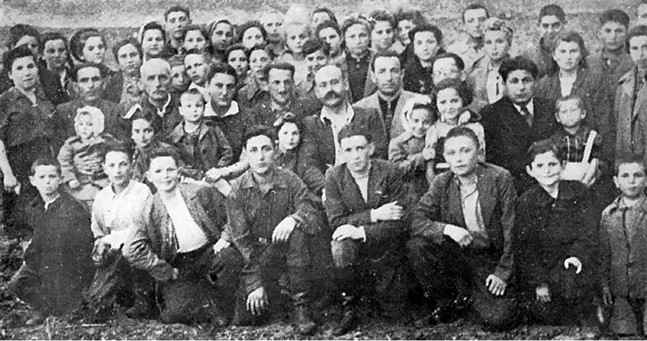
In the Bialystoker Shtime [Bialystoker Voice] of March–April, 1946, there was printed a full list of the Jews then in Bialystok. The lists were sent by the American emissaries Yaakov Pat and Dr. Khayim Shoshkes, who at that time had returned from a visit to Poland.
It was indicated there that among the more than four hundred Jews in the list, not more than about one hundred were truly Bialystokers. The other several hundred, rescued from annihilation under Hitler, were at that time from the surrounding towns and townlets of the Bialystok region.Translator's note: The names are transcribed according to YIVO standards, with minor adjustments where necessary.
-א-
Surname Given Name Asevitski Avraham Olshak Wolf Izgur Adam Alpern Aba Animan Mira Animan Avraham Ostroburski Sholem Okun Betsalel Ostrinski Yenkel Agurek Dakhovitsh Nekhoma Ostroburski Avraham Izak Leon Urshanski Leyzer Urshanski Khayim Urshanski Mikhel Atlas Esther Indurski Nisan Indurski Lola Amyel Shimen Amyel Leah Alkon Rivka Alkon Meir Abramovitsh Gedaliah Ayzenshat Tsvia Alpern Shabtai Azya Yakov Alkon Luba Abramitski Binyamin Abelski Khaya Odin Binyamin Apel Sholem Andman Leyb Abelevitsh Gzhegazh Asevitski Avraham Olshak Wolf Izgur Adam Alpern Aba Animan Mira Animan Avraham Ostroburski Sholem Okun Betsalel Ostrinski Yenkel Agurek Dakhovitsh Nekhoma Ostroburski Avraham Izak Leon Urshanski Leyzer Urshanski Khayim Urshanski Mikhel Atlas Esther Indurski Nisan Indurski Lola Amyel Shimen Amyel Leah Alkon Rivka Alkon Meir Abramovitsh Gedaliah Ayzenshat Tsvia Alpern Shabtai Azya Yakov Alkon Luba Abramitski Binyamin Abelski Khaya Odin Binyamin Apel Sholem Andman Leyb Abelevitsh Gzhegazh -ב-
Surname Given Name Brenner Aba Brenner Ida Bramson Yisrael Bale Maria Bialistotska Bela Brenner Moyshe Berman Khaya Barash Khana Bialistotski Moyshe Berkovsko Dovid Biblyovitsh Avraham Borovski Gitel Burshteyn Peysakh Beryo Dore Bialystotska Peshe Bobkes Ide Bener Avraham Boyarski Shmuel Babiker Nakhman Baron Golde Berkovitsh Avraham Bakhrakh Avraham Blumshteyn Moyshe Bikels Zyuta Boyarski Stavis Boyarski Yenkel Bartnovski G. Bogash Golde Bekerovitsh Avraham Borushtshak Yosef Bas Zina Bas Leyzer Blaz Shloyme Barakin Kalman Bondner Dvoyre Balgley Rivka Berman Mine Botshkovski Leon Biberman-Vebman Dovid Bialystotski Yakov -ג-
Surname Given Name Gordetski Yisrael Gotlib Shimen Gershuni Moyshe Gotlib Avraham Grodyenska Sonye Grossman Mira Grossman Khaya Goldberg Shmuel Gurevitsh Genye Goldshtrom Wolf Gromadzkin Khayim Goldman Sholem Gazkovski Viktor Goldberg Bela Grinshteyn Shmaye Gutman Moyshe Grabowski Leyb Glazman Feyge Grinberg Khayim Glikman Moyshe Gagovitsh – Gordon Moyshe Gottlib Shmye Golubovitsh Sore Gottlib Shmuel Gezes Kutyel Goldstein Avraham Gertz Khola Grinberg Leyb Gnetsutska Klara Grakop Berl -ד-
Surname Given Name Dubski Yenkel Dutsinski Moyshe Datner Dr. Shmuel Dobtshinski Moyshe Dubravski Shmuel Dikhenkhauz Feygeza Dakh Leyzer Drogatsinski Lipe Davidovitsh Tuvia Diperman Hersh Dolinski Shayme Dipovitsh Leon Dolidzki Leon -ה-
Surname Given Name Halpern Shloyme Halpern Fanya Halpern Natan Hakmeier Hersh Hirshhorn Markus Hakner Ruven Hakner Yisrael Hakner Zuzana Hamburg Yedidya Liber -וו-
Surname Given Name Vayntroyb Elye Veyner Izak Vayntsimer Avraham Vayntroyb Avraham Videlets Mordekhay Varshavska Yeta Veyner Bela Vilentshik Shmuel Vaynshteyn Leyb Visotshek Yakov Veler Zalmen Vadman Avraham Vadman Moyshe Veyner Masha Verblud Sore Vaynshteyn Tuvia Vernitski Moyshe Valun Yosef Vrubel Khayim Vilanowitsh Kalman Vasilkovski Aleksander Veyner Tuvia Velyon Bela Veyner- Glezer Basye Vrubel Dovid Veysfeld Yakov Varhaftig Hirsh Vrubel Peysekh Volinski – Vinograd Yosef Vaynshteyn Dina -ז-
Surname Given Name Zubovski Rivka Zubovski Tsipe Zilberfenig Yakov Zasman Genya Zakharyash Leyb Zakharyash Khayim Zabludovska Sime Zeligzon Meir Zevke Nachman Zilber Yitzkhok Zhukovski Meir
[Page 260]
-ט-
Surname Given Name Trestshanska Dina Trayevski Pinkhas Trakhtenberg Sonya Trakhtenberg Leyb Trakhtenberg Yudel Meir Tabatshinski Zalman Triling Elizabet Terespolski Hersh Tshekhanovski Kalman Tshekhotski Eli -י-
Surname Given Name Yelin Fride Yoses Hirsh Yalovski Hirsh Yopak Efraim Yopak Dina Yankowski Artshik Yalovski Aleksander Yalovski Tsile Yanowitsh Rokhel Yelin Sonye Yabko Mina Yelin Peysekh Yavarovski Yosef -ל-
Surname Given Name Levitanska Ida Levitanska Asne Lederman Meir Lev Shimen Leshtsh Moyshe Lederman Chana Lifshits Meir Likhtenshteyn Ganan Levin Avraham Lederman Sore Lipa Edzhya London Khayim London Fanya Litvin Shmuel Likhtman Yosef Levitan Leon Litvin Shaul Levit Baruch Lurye Betsalel Levin Karl Lin Genadi Lipinska Fanye Loyfer Sholem Lerer Genya Levartovitsh Ida Lopata Paltiel -מ-
Surname Given Name Markus Avraham Mazur Zelig Menakhovska Lola Mazur Aharon Melikowska Melnik Melamed Rivka Madey Sonya Montshe Bela Mezritski Yosef Manelis Avraham Meler Hersh Madlinski Vald. Mines-Feler Ida Midler Binyamin Melamed Khaya Melamed Yitskhok Miler Eliezer Maykovska Tsesya Maykovska Sore Midler Aleksander Miler Shmuel Meyzler-Lev Sore Matilska Mine Matilski Velvel Milner Geneshe -נ-
Surname Given Name Nakhemovitsh Sima Nakhemovski Efraim Nayman Syome Novadomska Ada Naypakh Yosef Nyevyadomska Tsvia Natavitsh Naftali Naydus Pema Nayman Avraham Nareyn Don Nakhemovska Luba -ס-
Surname Given Name Sidre Avraham Suvalski Yurek Sandler Avraham Suranski Sore Sokolski Stanislav Syemyan Moyshe Soloveytshik Sonye Sidranski-Lipkes Hala Stolarska Lyuba Sokolski Yosef Sibirski Yakov Spektorovski Dr. Shmuel Sukhodolski Leyzer Sibirski Elke Sinegevitsh Doroshe Sedletska Khana Sokolska Ada Spzhanski Dovid Spzhanski Aharon Sapirshteyn Yudel Slonimski Avraham Skarbnik Ruven Surazka Sonye Savtshits Ide -ע-
Surname Given Name Edelman Zalman Epshteyn Zhenya Elentukh Lutsyan Epshteyn Shmuel Epelholts Yakov Epshteyn Izak Edelshteyn Bronye Erenkrants Blume -פּ-
Surname Given Name Pitluk Hersh Penski Berek Pokshiva Zuske Perlshteyn Nadshya Poznanski Zalman Peshkin Moyshe Psheshtshelenets Khayim Piletski Zelig Piletski-Farber Sore Piletski Boris Panitska Lili Peretsman Basye Plebsan Rokhel Prenska Raya Pshepyurka Yosef Pener Leyzer Polak Sholem Patluk (Latvia) Velvel Patluk Velvel Pyentnitshak Sholem Puznyak Fride Paktor Raya Pyenyonzhek Gershon Pribus Zalman Pribus Esther Paktor Gala Pyekarski Berl Polanska Mala Perei Meir Peylra Dovid Potashevitsh Dore -פ-
Surname Given Name Fridman Elyash Fridman Dina Fabriski Yenkel Feldman Yisrael Farber Khana Finkel Izak Feldshteyn Yisrael Fayand Yisrael Fridman Sore Finkelshteyn Shmuel Faynfeld Fishel Fayerman Motel Finkelshteyn Sheyne Fuks-Fayvezhinski Berta Feldman Zigmund Frish Moyshe Finkelshteyn Moyshe Fink Sore Farber Shmuel Fuks Leyb Fertel Binyamin Fridman Aharon Finkel Rokhel Fliker Izak Finkel Khayim Finkel Rokhel Finkel Fradel Finkel Mordechai -צ-
Surname Given Name Tsaytlin Edzya Tsukerman Avraham Tsibulkin Khana Tsitron Gala Tsitron Tobyash Tsimulkin-Senakhovska – Tsimerman Motel Tsekhotska Elke Tsitsovitsh Genya Tsitsovitsh Khava -ק-
Surname Given Name Kaplan Motel Kaplan Sera Kovarski Leon Kisler Efraim Kamelman Nakhum Kamelman Klina Kamelman Regina Kamelman Kristina Kaplan Pola Kuper Nina Krashevski Avraham Kaplan Sheyne Kuropanina Sakhar Kusner Fride Kolesnik Dovid Kolesnik Zalman Kolesnik Sheyne Knyazev Berta Knyazev Mira
[Page 261]
[still] -ק--
Surname Given Name Kats Yosef Klementinowski – Kahan Avraham Kranenberg Leib Kaplan Shprintze Kalinski Genia Kaltinovska Feige Kusevitski Salaman Karatnitski Zavel Krasnobarska Dina Klyatshka Mina Knishinski Dr. Avraham Kolodyanska Adasia Kremer David Kuropatva Isser Kvort Baruch Kayman Daniel Kaplan Hersh Kivaika Binyamin Karasyuk Avraham Kvort Hersh Kats Berl Kobrinski Mordechai Kon Baruch Knishinska Stella Kutsikovitsh – Kaminetska Naomi Kornyanski Khayim Kvort Dina Koshitser-Kagan Sonye Konetspolska Irena Koshitzer Khayim Kashitzer Moshe Kotniska-Shuster Roze Kolotniska-Shuster Bela Kisler Efraim Kaplanski Khatzkel Kaplan Moyshe -ר-
Surname Given Name Rozen Yakov Rozen Fanye Rozenblum Avraham Rivkind Menakhem Redak Sholem Rotshteyn Barukh Reyzner Shie Rudnik Gite Rudnik Yanine Rudnik Avivit Rashkes Binyamin Rizikov Mitrava Radak Sholem Raznovska Sonya Rozentsvayg Yisrael Radesenger Meir Rozenboym Fride Rudovska Yakha Rabinowitsh Fishel Reyzner Nekhel Ribalovski Ruven Rabotnik Berl Rubinov Avraham Rabotnik Liba Ribak Gedalia Rubinov Sera Ribald Anka Reytbord Khava Ravin Gersh Rubin Dora -ש-
Surname Given Name Schvarts Yasha Shneydman Sholem Shklarevski Yisrael Shtisberg Yakov Shtshupak Khava Shtshupak Shimen Shmukler Sore Sharnets Leon Shmush Peysech Shtshupak Khana Shtshupak Shprintse Shefer Yuzefina Shalmuk Mordekhay Shor-Milender – Shuster Mikhl Shuster Meir Shulzinger Itsek Shevakh Natan Shtsigel Shloyme Shneyder Moyshe Shkolnik Lea Shpagelski Yisrael Sheyn Bronye Shperling Baruch Shapira Sonya Shtroysberg Simkhe Schneyder Ida
by Rabbi Mordechai Kirshblum
Translated by Beate Schützmann-Krebs
Soon after the war, in the summer of 1945, the first Zionist World Conference took place in London, with representatives from various countries. Among them there was also a small group of delegates, survivors of annihilation under Hitler. In this group was the young fighter from the Bialystoker ghetto, Chaika Grossman.[2]
At the mentioned conference there was also, as a delegate, the well-known Zionist leader and distinguished Bialystoker landsman, Rabbi Mordkechai Kirshblum, from America. From London he sent an article to the Bialystoker Shtime in New York, in which he described Chaika Grossman's appearance at the conference, as well as his meeting and conversation with her.
What follows here is that account, with certain abridgements.
Chaika Grossman, in splendid Białystoker Yiddish, explained from where came the calmness and composure that was poured onto the faces of the she'erit-hapleitah [surviving remnant] of Polish Jewry: “This was our only weapon.”
Chaika Grossman declared with a metallic voice, forged by an epoch of incomparable struggle and suffering: “We waited with the greatest eagerness and sanctity for the opportunity to fight against the enemy, to sabotage his positions, and to give expression to the unbroken Jewish pride.”
Chaika Grossman then described the striving of the young Jewish generation for settlement in the land of Jewish hope and eternity, Erets-Yisroel [the Land of Israel].
For several days I walked around with a deep inner confusion and an indescribable pain, lacking the courage to ask the young Jewish fighter to tell me more about that painful chapter in Poland, especially Białystok.
[Page 262]
As a free and fortunate Jew from America, I felt so insignificant and diminished in the presence of those who had themselves embodied the netsakh Yisroel lo yishaker [“the eternity of Israel will not lie”][3] with regard to Polish Jewry.
Yet, at the close of our gathering, I yielded to the imperative of hearing a greeting from ruined Białystok – emptied of its colorful, cultivated Jewish population, and now struggling to rebuild a fragment of life upon the ash mountains of six years of annihilation.
“What shall I tell the Jews of Białystok in America about the khurbn [destruction] of Białystok and about their duties in this present moment of reconstruction, insofar as circumstances permit?” I asked the young fighter, who waits impatiently for the chance to take her place in the Jewish yishev [settlement] in Erets Yisroel, but not before the small Jewish yishev in Poland is given some care.
Her answer was direct, strong, and an outcry – a challenge to the tens of thousands of Białystoker Jews in America, chiefly in New York.
“Tell the fortunate Białystokers of America, who bear the name of a glorious but now ruined city, that their first duty is to provide for the small number of surviving youth from Białystok, as well as for those Jews who return to, or arrive in, Białystok – with food and clothing. They live in dreadful conditions, despite all the efforts of the new democratic Polish government and of the Jewish Committee to help them.”
Chaika Grossman then painted for me a harrowing picture of starving, impoverished, frozen, lung-sick people returning from concentration camps. Not small is the number of those mentally broken, permanently crippled, with no relative and no redeemer to care for them.
All the Jews go about in rags lacking even a sufficient minimum diet.
There exists a Jewish Committee that performs heroic work. Yet, with so few resources and such a gigantic responsibility, it cannot fulfill its duty: to restore to their feet those few who, by miracle, survived – the last bearers of a tradition-rich city.
“Shall I now describe the mind-splitting facts that I heard about the liquidation of the Białystoker ghetto – the last march to annihilation, to total liquidation, under the cries of Sh'ma Yisroel [Jewish confession of faith] and lema'an am Yisroel ve Erets Yisroel [for the sake of the people of Israel and the Land of Israel]? Who has the strength to live through inwardly once more that dreadful story?
Shall I describe the heroism of the several hundred youth who raised the banner of struggle against the Nazi beast in the final hour of their existence in bondage and at the moment of destiny? Was the Jewish people, condemned to death, to perish like mute sheep led to slaughter – or as heroes of a martyred nation?
Who can describe this in words? I also see the danger: that the dreadful facts of destruction, which cannot be grasped at all, and on the other side the depictions of heroism, which could only be compared with a Judah Maccabee or a Bar Kokhba, might weaken the main purpose of my call to the Białystoker landsleit in America – to lift themselves up to the desperate cry of pain from their home city, Białystok.
Do not forget your duty, do not persist in indifference. Food and clothing – lekhem le'akhol u-beged lilbosh [bread to eat and garment to wear] – this is the first and greatest need of the ruined Jewish community of Białystok.
Through the agency of the Joint, the means can be sent. Do not delay the hour. The hour of struggle and battle found us separated and cut off from our own flesh and blood. Let the hour of liberation unite us. Too great will be our stain if we again sin against history. The historical Eykho [Lamentations] cries to us from yesterday's valley of death – now must come our hineni [here I am].”
Chaika Grossman's moving words – her greeting from ruined Jewish Białystok, and her dramatic call to help in its revival – made a deep impression on everyone.
|
|
|
Translator's notes:
by Yedidya Hamburg
Translated by Beate Schützmann-Krebs
As the former vice-chairman of the Jewish Voivodeship Committee[3], which was established in Białystok soon after the liberation, I wish to record the condition and activities of the Jews in that time, in our ruined home city.
We know well that Polish Jewry, until September 1939 when the dreadful war came, was the crown of world Jewry. The Jewish community of Białystok, in turn, was one of the most beautiful pearls set into that crown.
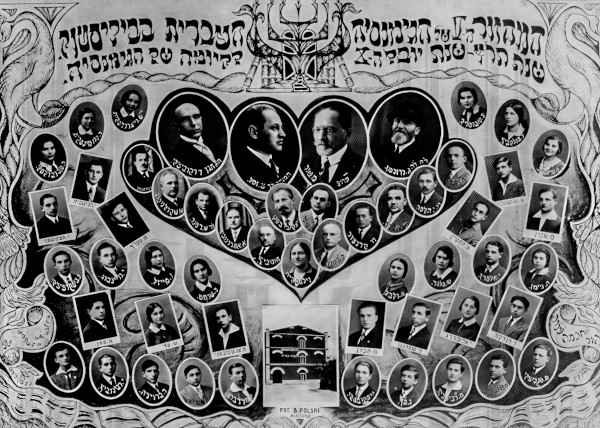
After the terrible destruction under Hitler, however, Jewish Białystok was transformed into skeletons of houses, into little hills overgrown with wild grass. Of the once-famous Great Synagogue there remained only the dome. And the well-known Hebrew Gymnasium [High School], as indeed with all other important Jewish institutions and residential houses, was left only as ruins, empty skeletons.
The geographical situation of Białystok changed considerably after the war. This district city suddenly lay only about twenty kilometers from the Soviet border. Quite often Białystok was isolated and cut off from the rest of Poland, because the road from Białystok to Warsaw was life-threatening for Jews.
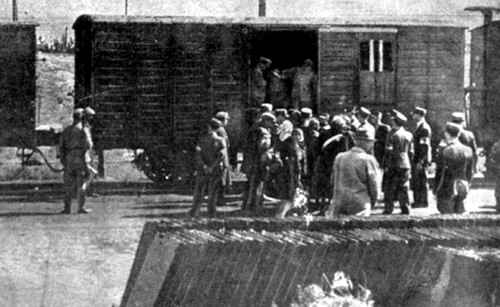
Near the train stations of Tzhizhev [Czyżew], Zarembi Koshtshelni [Zaręby Kościelne], and others, Jews were taken off the trains and shot by Polish bandits. This happened even though the trains were accompanied by a special wagon with military men who were supposed to protect the traveling Jews. Yet often even these escorts did not succeed in being protectors.
Such a case occurred two days after the dreadful pogrom in Kyelts [Kielce] at the beginning of July 1946. Near Zaręby Kościelne, four pioneers from the kibbutz in Białystok were taken off the train and shot on the spot. Their bodies were brought back to Białystok and buried in the ghetto cemetery on Zhabye [Żabia] Street.
Yes, in those times great self-sacrifice was demanded of the few surviving Jews who tried to build a new Jewish life in Białystok. Yet despite everything, they tried. They did not stop before any difficulty, striving to continue the thread and the existence of Jewish life. Into this they also put great effort, with the hope that it would bring the necessary results.
Białystok was liberated on July 27, 1944. The first Jews who returned were those who had managed to hide in various places, including with Christians. Only a few months later did survivors of the Nazi extermination and concentration camps begin to arrive. At the same time there was also a large influx of Jews–men, women, and children–who came back through repatriation from Soviet Russia.
The majority of those who returned soon departed again, seeking to reach the D.P. camps in the American zone of Germany. About 1,700 Jews remained in Białystok and tried to rebuild their lives there.
The Jewish Voivodeship Committee, created at that time under the chairmanship of Dr. Shimon Datner, was the sole Jewish representative body recognized by the Polish government. Within this committee all the different Jewish political orientations were represented, from Mizrachi to the Jewish Communists. The Voivodeship Committee was divided into various departments, which served the returning Jews in Białystok in a variety of ways.
Necessary labor cooperatives were also established, providing a livelihood for a number of families and helping to supply the small Jewish population with essential goods.
The following departments were then organized within the Jewish Voivodeship Committee in Białystok. They were active and oversaw the economic, social, communal, and cultural life of the local Jewish population, among other matters:
I wish to emphasize the assistance that the Jewish settlement in Białystok received immediately after the war from our, an assistance marked by great warmth. Among the first to help was the Białystoker Center in New York, under the leadership of David Sohn, of blessed memory. Likewise, our landsleit in Australia, under the leadership of Avraham Zbar, offered support. The landsleit in Australia sent visas to every member of the she'erit-hapleitah [the surviving remnant], and even paid for the ship tickets so they could come to Australia. This generous gift was partially utilized.
The Białystoker landsleit in Israel, in turn, gave us great moral support, with constant encouragement through their connections with Mordekhay Kruglyak, of blessed memory.
The Repatriation Department of the Voivodeship Committee also dealt with Jews who had arrived but were not originally from Białystok. Such individuals received all forms of assistance, just as the Jews of Białystok did.
When writing about the life of the Jews in Białystok after the destruction, one must also mention two further very important aspects of the work carried out at that time.
The first task was the rescue of Jewish children who had survived because during the war they had been in Christian hands. The Jewish Committee became aware of this when the “parents” of such children came seeking help for them. We made great efforts to remove these children from Christian custody and to bring them back to their Jewish roots.
The second important task that our Jewish Committee carried out at that time was to bring to keyver Yisroel (Jewish burial) the holy martyrs who had been buried in the Zhabye cemetery.
We succeeded in this thanks to the financial assistance of the Białystoker Center in New York. In addition, seventy heroic Jewish insurgents were exhumed and given proper burial. They had been shot by the Nazi murderers on August 23, 1943, at the corner of Kupiecka and Jurawiecka Streets.
Digging into the earth with a spade, the exhumation brigade came upon the bodies of the heroically fallen fighters. First there was a woman of about thirty, beside her a small child, as well as a man with a twelve-year old girl. On one of the exhumed bodies a number of bullets were found together with a passport in the name of Yekhezkel Zhulti. On another exhumed body, twenty-eight pistol bullets were discovered along with the name Zekharya Kaplan.
In total, 230 Jews were exhumed – men, women, and children. Some of them had been thrown into the mass grave by the Nazi murderers while still alive. All of them were brought to keyver Yisroel (Jewish burial) in the Zhabye cemetery on November 22, 1945.
On April 11, 1946, during an impressive mourning ceremony, a monument was unveiled in memory of the sixty-thousand Jews murdered by the Nazi killers.
|
|
At the end of 1946 and the beginning of 1947, the Jewish population in Białystok began to dwindle; in fact, it began to empty out. The Jews there dispersed to various countries –among them the Land of Israel, the United States of America, Mexico, Canada, Australia, Latin America, and other lands.
The attempt to build a new Jewish life upon the ruins caused by Hitler unfortunately did not succeed. Naturally, everything possible continued to be done, even with the diminished number of Jews who remained in Białystok. Yet the number grew smaller and smaller.
In the once flourishing and wide-branching Jewish Białystok, which had inscribed a remarkable chapter in the history of European Jewry, there are now only nine Jews.
Yes, it is sad–this is a tragic conclusion.
Translator's notes:
Translated by Beate Schützmann-Krebs
English Proofreading by Dr. Susan Kingsley Pasquariella
Excerpts from the Protocols and Reports of the Voivodeship Jewish Conference[3], Spring 1949.
The following presents a copy of the protocols of the conference of the Voivodeship Jewish Committee, held on April 10, 1949. These are excerpts from selected sections of the sixty page protocol book, which was then sent to the Białystoker Center in New York.This also provides a clear understanding of the newly rebuilt Jewish life in postwar Białystok – an attempt that, unfortunately, did not succeed and ultimately perished.
Under the heading “The Social Structure of the Jewish Population in Białystok,” it
is stated that by the end of 1948 there were 520 Jews in Białystok. Of this number, 182 were employed in work as follows:
Including their families–75 women and 68 children–one arrives at a total of 323 persons who sustained themselves from work. This represents 62 percent of the entire Jewish population.
In addition, as stated in the report, there were in our region 8 industrial enterprises with 23 proprietors and 12 commercial enterprises with 22 proprietors. There are no unemployed Jews – that is, none who were seeking work. All those who wished to retrain or to be placed in employment had every opportunity to do so and enjoyed the full support of the Committee.
Productivization
In the reporting year, a certain number of non-Jewish workers were taken into employment in the cooperatives, as they were necessary for the cooperatives and for production. Thus, the actual number of those employed in the cooperatives exceeded one hundred persons (118). Of these, Jewish workers numbered 42 (40 men and 2 women).
In the cooperatives there were employed:
In one of the reports, the reason is explained why two-thirds of the workers in the cooperatives were not Jews. It states: “It must be emphasized that the coexistence between Jews and Non-Jews is truly ideal. One can boldly say that the common workplace is a good school of internationalism and the best means of combating antisemitism.
We also could not conduct the cooperatives only for Jews, because that would have meant isolating ourselves from society and creating a ghetto of our own.”
Outside the cooperatives, by the end of 1948 there were in Białystok the following artisan workshops:
In the cash report concerning the financial activity of the Central Union of the Jews of Białystok in Poland, it is stated:
Income for 1948 amounted to 3,698,555 zlotys, and expenditures for the same period to 3,338,174 zlotys. Thus, as of January 1, 1949, a balance of 360,381 zlotys remained in the treasury.
The income consisted of the following: gifts from our landsleit overseas, which were transferred to our Union by delegates who visited Poland:
Local income, such as a fundraising campaign for the Ghetto cemetery, amounted to 1,190,000 zlotys, which is a colossal sum in comparison with the financial possibilities of the Jews of Białystok.
Jewish Cultural Society
With the founding of the Jewish Cultural Society on February 29, 1948, the Department of Culture and Propaganda of
[Page 266]
the Voivodeship Jewish Committee was liquidated. The Cultural Society is, in fact, an independent institution, not subordinate to the Voivodeship Committee.
|
|
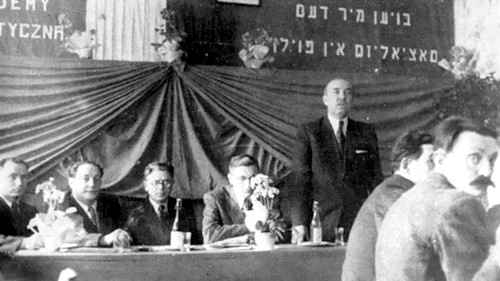
[In the Bialystok: Photo Album, page 158, Byalisṭoḳ bilder album fun a barimṭer shṭoṭ un ire Iden iber der ṿelṭ | Yiddish Book Center are given the names of the persons in this photograph, I quote: ”The Presidium, left to right: L. Bialystotzky, Secretary: M. Byter, representing the Central Committee of the Jews in Poland; H. Hakmeyer, Chairman of the Jewish Regional Committee; M. Wendlik, Chairman of the Regional Nat'l. Council. Addressing conference is Horodetzy.”] |
Within the Cultural Society there was a library, which possessed 2,100 books in various languages – chiefly Yiddish, Polish, Russian, and others. Memorial academies were arranged on the fifth anniversary of the liquidation of the ghetto.
A public meeting was organized in connection with the proclamation of the Jewish State. A fundraising campaign was held for the struggling yishev [Jewish population] in the Land of Israel. An evening was dedicated to the jubilee of the Soviet Army. An academy was held for the 31st jubilee of the October Revolution. A festive academy was dedicated to the Congress of Unification of the Workers' Parties in Poland.
The Jewish School
At the beginning of the 1949 school year, the Jewish school counted twelve children, divided into three classes.
Because there were only a few children in the school, the Central Committee in Warsaw decided to liquidate it at the start of the school year. Yet our committee succeeded in convincing the Central Committee to reverse this decision, since the children were not yet properly prepared to transfer into the Polish school.
From July 1948 the public kitchen was also abolished, since it could not be maintained due to the minimal number of diners. This fact demonstrates that the working people had organized themselves and were running their own household economy.
Agricultural Department
The Agricultural Department of our Committee undertook the great and weighty work of perpetuating the sacred memory of our heroes and martyrs, and also of uncovering and bringing to trial the murderers who directly and indirectly caused the annihilation of Jews during the time of the German occupation.
The landsmanshaftn, with the help of the Committee, unmasked many bandits who were responsible for the annihilation of Jews. Thus, the resident of the village of Aleshkin, Adamyuk, was sentenced to death for betraying Jews; another was sentenced to life imprisonment. Two other bandits were soon to be tried.
A group of more than ten men awaited judgment for murdering and betraying Jews in the town of Ciechanowiec. A trial was underway in Ełk of the brothers Gadolevski, Demekanski, and Kasmatshevski [Kosmajczewski], together seven bandits for the same crime in Radzhilove [Radzilów].
In Białystok, the man and woman Fukmanovitsh were sentenced to 15 and 6 years for torturing Jews in the Gestapo. Another group of hooligans in previous trials received the proper verdict. The priest of the Orthodox Church, Eugeniusz Virkhov, was sentenced to death for having a hand in the liquidation of the ghetto.
All the landsmanshaftn participated in the fundraising campaign to erect the ohel monument at the ghetto cemetery in Białystok.
We have completed a certain part of the work at the ghetto cemetery: the walled enclosure has been finished, and the graves and alleys put in order. Care was taken to ensure that no wild grass should grow there, and trees have already been planted. This cost 2,325,000 zlotys.
The fifth anniversary of the uprising and liquidation of the Białystoker ghetto was this year marked with particular impressiveness. In the mourning procession, which counted more than 2,000 people, about 50 wreaths were carried.
Almost all institutions of the city sent delegations with banners. At the head of the procession, together with the representatives of the Jewish society, walked the Voivode [provincial governor], the city president, representatives of the authorities and of political parties, professional associations, and others.
Social Welfare
In the reporting year, the Department for Social Welfare distributed much less aid than in 1947. This was because the situation had improved during the year. The Jewish society was already more or less settled and making a life. Assistance was distributed to children, the elderly, the sick, the disabled, and repatriates.
The moyshev-skeynim (Home for the Aged) is located in a pleasant, well-arranged space of several rooms. The elderly feel a warm relationship from the Voivodeship Jewish Committee, which cares for the pensioners beyond its means and has created the best conditions for their stay in the old homeland. In the moyshev-skeynim there are 23 pensioners, who in their later years remained alone without means of livelihood.
[Page 267]
For the elderly the Committee arranged Passover meals, a Chanukah evening, and so forth.
The TOZ Society in Białystok distributed much medical and material aid to the Jewish community, which undoubtedly contributed to improving the health condition of the Jewish population.
The Society employed an internist, a pediatrician, and a dentist. Visits during the year to all three doctors numbered 3,002 – of these, 1,203 were men and 1,357 women. The pharmacy issued 2,296 prescriptions, and in private pharmacies 143.
|
|
Historical Delegation
The Białystoker Jewish Historical Commission set itself the task of perpetuating the martyrology of the Jews in Białystok.
Up to the present, various valuable materials have been collected: manuscripts, diaries of ghetto life, testimony statements from surviving ghetto fighters and partisans, as well as memoirs and records from Christians who risked their lives to help and shelter Jews.
The ghetto archive, which contains reports and protocols of the activities of the Judenrat in Białystok, has also been preserved. In addition, Tenenboym's writings were found, as well as two works by Pesach Kaplan–The Destruction of Białystok and The Judenrat in Białystok –among many others.
Albums have been compiled, containing nearly 200 photographs that depict the liquidation of the Białystoker and Grodno ghettos.
Białystoker Province
In 1948, the following numbers of Jews lived in the Białystoker Province: in Bielsk Podlaski 39, in Suwałki 18, in Wysokie Mazowieckie 5. They engaged there in trade; some were artisans, and a small number worked in state enterprises.
In the resolutions reports it was stated:
|
|
Translator's notes:
by Dr. Shimen Datner
Translated by Beate Schützmann-Krebs
Sacred to us, the Jews of Białystok, was this earth of the ghetto cemetery.
The piece of land in the north-western corner of the ghetto, part of the pre-war cemetery at Bagnowka, lay far outside the ghetto and was forbidden to us for burials – for to reach it one would have had to leave the ghetto enclosure.
Therefore a plot of land was designated in the area of Gosnyerska and Armatnya Streets, right near the ghetto fence.
Here lie those who, within the ghetto, met a “luxury death” – a natural death, not at the hands of the murderers. Here lie the earthly remains of Dr. Reygrodzki and Pesach Kaplan, each accompanied by a grand funeral in the ghetto, together with countless others.
I recall that, personally, during the time of the ghetto I was at least twice at that sacred place. It was in February 1943, shortly after the end of the first “Aktion” (5–12 February 1943). We, the household of Marinski's stone house (Fabritshne Street 11), brought to Jewish burial the unforgettable Dr. Franke Horovits, teacher at the Hebrew Gymnasium. She had a great mass funeral, with the participation of the entire Judenrat, with Dr. Rozenman and Barash at the head; Berl Subotnik delivered the eulogy.
The second funeral, which took place a day earlier or a day later, was for the little four-year-old Bazhunye (Bashe) Bergman, the only daughter of the Latin teacher Dr. Mikhal Bergman and his wife Nyushe. The little angel was suffocated – unintentionally – in our hiding place (bunker) on the first day of the “Aktion,” when the child, waking from sleep, began to cry, and at that very moment it was heard that the raiders, i.e. the Germans, had entered the apartment above the bunker.
I, returning in the evening from the factory, buried the little angel at night, in the garden, a few meters from the window through which the mother handed me the stiff little body, wrapped in a white blanket, with the words: “And perhaps she still lives?…”
On Zhabye grew another small mound of earth, among others – tiny graves of suffocated small children, like little Bazhunye.
At that time, during those funerals, I saw in the cemetery the gathered victims of the Aktion. They lay in two rows, long rows in layers, as workers at the timber merchants used to stack cut wood, ready for sale and easily measured in fixed meters. Women, men, children lay there – mute witnesses to human depravity – all with great gaping holes torn in their faces and skulls; it was clear they had been shot with dum-dum bullets. They too were buried in long communal graves.
The evil German nightmare was gone. We, the handful of survivors, returned to our hometown. We found everything destroyed – the city, our Jewish Białystok, the people. Even the cemeteries had not been spared. On the Zhabye ground, grass had overgrown the graves, filth and refuse covered them, goats wandered over the gutn ort [cemetery], most of the tombstones smashed.
Together with the care for the living, we held it our duty to care for our dead.
So few remained – the two or three thousand of Zhabye; for most had been transformed into smoke and dust in the lime ovens of Treblinka, Majdanek, Auschwitz, and elsewhere.
Slowly this sacred place was brought into order: the graves cleared of wild growth, the cemetery enclosed with a solid wall, a steady watchman set to guard it. A small chapel was built, where many who had lost their dearest – those not brought to Jewish burial – immortalized their memory by hanging plaques with the names of their families on the walls.
On the second anniversary of the final liquidation of the ghetto, on 16 August 1945, a modest monument was unveiled. Beneath a Star of David there was, in Yiddish, the inscription:
“In memory of sixty thousand Jewish brothers of the Białystoker ghetto, murdered by the Germans, dedicated by the handful of surviving Jews.
16.8.1943 – 16.8.1945.
May their souls be bound in the bond of life.”
And below, or perhaps on the side of the stone – I no longer recall exactly – we engraved: “Am Yisrael Chai” (The people of Israel lives).
This was an imposing, first manifestation, in which all the surviving Jews of Białystok took part. Alongside the Jews, several Polish figures also appeared with speeches – representatives of the administrative authorities and of Polish society.
On June 26, 1971, I received a reply from the Presidium of the Municipal National Council in Białystok, stating that the cemetery of the victims of Hitler's terror and of the ghetto heroes is located in the midst of a newly built residential quarter. Until November 1970, the grounds of the cemetery had been the property of the Central Administration of the Cultural and Social Association of Jews in Poland [TSKŻ], and had been maintained by that association.
[Page 269]
Because the cemetery was required to be brought into proper order, in line with the conditions prevailing in the residential quarter, the Central Administration of the Association handed the grounds over to the state. In connection with this, a list of necessary works was drawn up jointly with the authorities. According to the program, all the work was to have been completed within the current year, by August 1972. Yet this was not done.
On July 5, 1971, I sent a registered letter from Warsaw, personally addressed to the chairman of the Municipal National Council in Białystok, Zygmunt Beżubek. I pointed out that I had no reason to doubt his good will, but the facts mentioned in the letter bore witness that the perpetuation of memory was not proceeding in the right way.
A terrible thing had been done: the ashes of the heroes and fighters, who were shot after the suppression of the uprising, were placed together in a common grave. A soldier's grave was thus liquidated. One might also hold such a conception, but Polish tradition demands that fallen soldiers be given a separate honor.
The larger cemetery possesses a soldiers' section, and no one would think to mix soldiers' remains with civilian bodies.
No trace remained of the burned bodies of those who fell in the uprising of the Warsaw ghetto, nor of the uprisings in Treblinka, Sobibor, and Auschwitz. Preserved until 1971 was only the collective grave of the Białystok fighters. The Germans did not burn the bodies of the shot fighters; they threw them into a pit – a refuse pit – and upon their bodies they shot a further fifty-five victims, who had endured in hiding after the liquidation of the ghetto in 1943 and were later captured.
With the greatest reverence and honor, Polish and Jewish society paid tribute to their memory, and on April 11, 1946, after an exhumation had been carried out, they were buried in a communal grave. At the open grave, speeches were delivered by the Voivode Stefan Zibowski, the city president Krzewniak, the chairman of the professional unions Kubiszek, the representative of the Polish Workers' Party Gawriluk, representatives of the People's Party and the Labor Party, as well as representatives of Jewish parties and organizations.
It was an unforgettable day of Polish-Jewish brotherhood, over which hovered the thought of the recently completed common struggle and shared suffering. The one who writes these words then closed the solemn mourning ceremony with the following remarks:
“I turn to you, comrades, who represent the Polish organs of power. Your warm words ease our pain. We feel that in your breast beats a fraternal and compassionate heart… Under the protection of the noble Polish people remains that which is dearest to us: the bones of our heroes and martyrs.”
Twenty-five years later, a blow was struck against those noble traditions. A slap was given in the face of the Białystoker Jews scattered across the world. A soldiers' grave was profaned; the armed deed of the Jews of the Białystoker ghetto was erased – a deed undertaken under conditions in which no other people fought during the period of the Second World War.
With what has been said above, I have not exhausted all the concerns raised by the matter of the Zhabye cemetery. Further reservations were also aroused by the project of the inscription on the planned monument, which was only in Polish. It contained both stylistic and orthographic errors.
The projected demolition of the cemetery wall, without first conducting broad educational work, could lead to acts of desecration, as I mentioned in my letter to the Presidium of the Municipal National Council of May 19 of this year. In my warnings I did not even mention the painful and enduring fact of the liquidation of individual graves at Zhabye, in which heroes and prominent representatives of the ghetto Jews found their eternal rest – such as Malmed, Mersik, Reygrodzki, Dr. P. Horowits, Zvi Vider, and others.
I never grew weary of writing letters and demanding attention to the condition of the Zhabye cemetery. Yet to my letters I have received no further reply.
We have presented to the reader precise facts about the efforts to preserve one of the holiest places of Jewish Białystok. Yet the attempt did not succeed. The three memorial monuments, which the surviving Jews of Białystok had lovingly and with great reverence erected on the gutn ort – for the sixty thousand annihilated, for the seventy shot fighters, and for the three murdered pioneers – have disappeared. The inscriptions in Hebrew and Yiddish, which together with the Polish inscriptions told of that cruel yesterday, have vanished. The mass grave of the heroes has disappeared – the only grave within the territory enslaved by the Nazis in Europe, the symbol of Jewish valor and martyrdom.
The only small consolation is that the bones of the saints and heroes have remained within a limited plot of earth on the former Zhabye cemetery. Perhaps one day this ground will find its proper restoration.
Translator's notes:
by Dr. Shimen Datner
Translated by Beate Schützmann-Krebs
In September 1928, I arrived in Białystok, leaving behind my position as a teacher at the Hebrew Gymnasium “Tarbut” in Pinsk. I recall, in passing, those three years of my life spent in Pinsk (1925–1928) – the gymnasium there, my fellow teachers, the students, and the Jews of Pinsk in general – with the deepest inner love and attachment. And thus I became a resident of Białystok.
My family – my wife Ruzke (Roze) and our little daughter Miryam (Mige) – came several weeks after me. A year later (1929) our second daughter, Shulamit, was born, already as a native of Białystok. All three, my family (in truth, my daughters), had a direct connection to the gymnasium. My wife taught there for several years (handicrafts), and both daughters were pupils until the very end of the gymnasium's existence.
No one could then imagine that forty years later I would write about them as the sole survivor of that four-member family, and add to all three names the sorrowful, traditional epitaph: of blessed memory. Nor that I would one day have to deliver a eulogy for Jewish Białystok and for my gymnasium, in which I worked from 1928 until 1941.
The Hebrew Gymnasium in Białystok, “Ha-Gymnasia Ha-Ivrit B'Bialystok,” was the crown of Jewish secondary education in the city. Besides “my gymnasium,” where Hebrew was the language of instruction, the city also had one Tsisho[3] Gymnasium with Yiddish as the language of study and four with Polish as the language of instruction.
The Hebrew Gymnasium in Białystok was founded in 1919. It always maintained preparatory classes for the gymnasium, the so-called mekhinot A, B, and C[4], which corresponded to elementary school grades according to the official curriculum. In its first year, the total number of pupils reached 174 – 100 boys and 74 girls. Throughout its entire existence, the number of boys was consistently higher, averaging around sixty percent.
The number of those who completed the gymnasium (graduated) between 1926 and 1936 amounted to 367. Of these, 144 later left for Erets-Yisroel.
Since 1927, the gymnasium building was located at 79 Shenkevitsha [Sienkiewicza] Street. Earlier – if I am not mistaken – it had been housed in a rented building at Sienkiewicza 74, almost directly opposite the new one. The new building contained sixteen classrooms, laboratories, specialized subject rooms, a large hall for performances and mass assemblies, a special gym hall, a spacious sports field, a large library, and an additional auxiliary building.
Besides academic studies and sports, great importance was given to music, especially to the school's brass orchestra under the direction of the conductor Shkolnikof, which enjoyed a fine reputation in the city.
The gymnasium did not belong to the Tarbut school network in Poland. Formally, it was a private institution headed by a governing board. Serving on this board were the community activists Dr. Moyshe Katsenelson, Menakhem-Mendel Kaplan, Dr. Moyshe Ziman, and Eliezer Kahane.
The menalem (directors) of the gymnasium under whose leadership I worked were: Dr. Lilyen (1928–29), Dr. Zemel (1929–33), and David Rakovitski (1933–39). Before my arrival in Białystok–apparently until 1927–the principal had been Dovid Braver. I did not know him personally, but I know that he left Białystok for Grodno.
There he served as the principal of the Hebrew Gymnasium, and in the tragic Hitler years he became the obman (head) of the Grodno ghetto, where he met a tragic death.
And now a few words about my fellow teachers. First, about those who managed to escape death at the hands of the Nazis. Incidentally, I no longer remember all of them today. Before the war, several left Białystok and immigrated to Erets-Yisroel: Dovid Bayans, Orinovski (both Hebraists), Malka Goldman, Goldstein. Leah Einstein, it seems, went to the United States. Hadassah Shprung survived the ghetto and the death camps; Fride (?) Fridman and Mrs. Shenbrun also survived. Dovid Rakovitski succeeded in escaping from Białystok after the outbreak of the war and reached the Land of Israel.
Mrs. Vilenska and I would have liked to complete this list, to add someone else, but unfortunately: either I do not remember, do not know, or there is simply no one left to add…
Before the war (1937?), my colleague and fellow teacher Maurycy Adler (teacher of the Polish language) died in Białystok. He had a grand funeral. This was the only case of a teacher's death before the war among the staff of the Hebrew Gymnasium.
The gymnasium with Hebrew as its language of instruction existed for a full twenty years–from 1919 until 1939, when the war broke out. When the Hitlerites invaded Poland on September 1, 1939, they occupied Białystok as well (on September 15), where they ruled for about a week.
[Page 271]
They then withdrew, and the Red Army entered Białystok. What happened to the gymnasium during that brief period is unknown to me. At that time, as was usual in those days, I was together with my family in Zakopane and Kraków.
When I arrived in Białystok in mid-November 1939, after difficult and dramatic events, the gymnasium was already functioning again. However, it had changed its name to the “Ninth-Tenth Grade Middle School,” with Yiddish as the language of instruction. The head of this new Soviet state school was a red-haired Jew from Minsk by the name of Montazh. His deputy was a Jewish woman, also from the Soviet Union, with the family name Rozina. The teaching staff remained the same as before, and most of the pupils as well.
One day, a sharp article appeared in the local Yiddish newspaper, the Bialystoker Shtern, and shortly afterward three of our colleagues were removed from the “Ninth School”: Moyshe Zabludovski, Dr. Franka Horovits, and Dr. Khayim Velger. They were transferred to other schools in Białystok, where they continued to work as teachers.
Weeks and months passed, and the school year 1939–1940 came to an end. The new school year, 1940–1941, began normally at the “Ninth School.” Only now, instead of Yiddish, the language of instruction had become Russian…
These two years were, for Białystok in general, years of relative calm – especially in comparison with the situation of the Jews on the other side of what had become the German border: in Warsaw, Łódź, Kraków, and elsewhere, from where unbelievable and terrifying reports were already arriving about Hitlerite decrees and persecutions of Jews.
On June 22, 1941, the dreadful days began for Białystok as well – the final chapter in the existence of the Jews of Białystok.
When, on that Sunday, June 22, 1941, the first bombs fell on Białystok, and after a brief moment of confusion it became clear that this meant war, thousands of residents – mostly Jews – set out eastward. Some, after long hardship, managed to escape the fate of Nazi brutality; some fell victim to German aerial bombardments along the way; some were seized by German soldiers and shot on the spot once it was established that they were Jews; and some turned back to Białystok, where a ghetto was soon established.
Among those who set out on the road were also two teachers connected to the Hebrew Gymnasium: Toyman, a physics teacher, and Avraham (?) Novodvorski, a former graduate of the gymnasium who later taught mathematics there. Both disappeared without a trace. In the ghetto it was assumed that they had perished on the way.
In Białystok, under Nazi rule, the following teachers of the gymnasium were present:
Dr. Khayim Velger managed to leave, a few days before the war, with his family to his hometown in Galicia and was therefore not in the Białystoker ghetto.
All those mentioned above were, of course, in the ghetto together with their families. Also living in the ghetto was Dr. Moyshe Katsenelson, one of the founders of the gymnasium. Dr. Moyshe Ziman had left for Erets-Yisroel before the war. Mendel Kaplan died before the arrival of the Germans. The fate of A. Kahane is unknown to me. In the ghetto, too, was Berl Subotnik, who, as a member of the Judenrat, played a prominent role there.
I now wish to recount in somewhat greater detail the fate of several of my colleagues –teachers of the Hebrew Gymnasium and others – who were in the Białystoker ghetto.
Y. Rotberg, a teacher of Hebrew, was the first to fall among them. He fell victim to the Thursday slaughter on July 3, 1941, in which 200 Jewish intellectuals of Białystok were murdered by the German killers in the Pyetroshe woods. This martyr had worked for several years in our gymnasium. He was quiet, calm, with a constant smile on his face. I no longer remember where he came from.
Ten days later, in the great murderous Aktion on Shabbat, the second victim fell. My dear colleague, the great scholar of Hebrew and Hebrew literature, the Białystoker Moyshe Zabludovski, was shot together with the four thousand Jews of Białystok on Saturday, July 12, 1941, in Pyetroshe. For many years – long before my arrival in Białystok – he had been a teacher at the gymnasium. Quiet, gentle, and modest, he combined scholarship with energy, was beloved for his mild manner toward the pupils, deeply devoted to the school, and regarded his task as a teacher of Hebrew as a national duty and a sacred mission.
[Page 272]
He was an exemplary husband and father. He had three daughters – intelligent, modest, and beautiful. His widow and his orphaned daughters lived in the ghetto and had to go on living without their beloved husband and father. I know that my wife, Roze, of blessed memory, kept in contact with them and helped them carry that heavy burden…
Among the “Shabesdike” [those who fell in the “Shabbat” massacre] was also Kosovski. He was not a teacher. He was the son of our Mrs. Kosovski, who ran the buffet at the gymnasium. She had two or three sons; one of them was killed (I do not know which). Whenever I happened to meet Mrs. Kosovski in the ghetto, she would always mention her son who had been torn from her. She believed that he was alive somewhere, working, and that he would one day return.
The same belief was held by most of the relatives of the “Donershtike” and “Shabesdike”. This painful, yearning hope for the disappeared of the “Thursday” and “Shabbat” massacres is best reflected in the world-famous Białystoker ghetto song Rivkele di Shabesdike.
The terrible slaughter known in the ghetto as the First Aktion, carried out between February 5 and 12, 1943, also claimed further victims among the teachers of the Hebrew Gymnasium. One was A. Bomkhil, a mathematics teacher, and the other was D. Petsiner, who taught Judaic studies in the lower grades.
Bomkhil was, it seems, a native of Białystok – a warm hearted, good man, gentle in character and temperament, beloved by his fellow teachers and by the pupils. About Petsiner I know, or remember, very little. I do not recall where he came from; he arrived at the gymnasium only a few years before the war.
I did not meet either Bomkhil or Petsiner in the ghetto, but after the dreadful February Aktion in Białystok – when the thousands of dead, murdered, and deported to Treblinka were counted – I heard about both of them, and people told me of their courageous conduct.
During this First Aktion, the gymnasium teacher Dr. Franke Horovits was also killed. The little four-year-old “Bazyunye,” the daughter of Dr. Mikhal Bergman and Nyushe Bergman, was killed as well. Bergman was not a teacher at our gymnasium, but at Druskin's Gymnasium.
Dr. Khayim Velger was one of the most gifted teachers of general history. He taught both at the Hebrew Gymnasium and at the Polish-language private Zeligman Gymnasium, where both Jewish and Polish pupils studied. Dr. Velger came from Podheytse [Podhajce], a small town in eastern Galicia. His wife, n&#eacute;e Kimel, came from Bolekhov, also a small town in eastern Galicia. They had a little daughter, Helenke.
When I arrived in Białystok in 1928, I already found him there. He had been a teacher at the Hebrew Gymnasium for a year or two before my arrival. He was quiet yet energetic, broadly educated, and held in great esteem both by the pupils and by their parents. As mentioned, he was dismissed from the gymnasium in 1939 – apparently as a result of an accusation–along with Mrs. Dr. Horovits and Moshe Zabludovski, but our personal contact continued nonetheless.
The last time we saw each other was in June 1941, a few days before Hitler's Germany attacked the Soviet Union. He left then with his family for a holiday in his home region. Once we were sealed inside the Białystoker ghetto, we had no information about him.
Until one day in 1942 or 1943 – I no longer recall the exact date – when, returning home from work, the members of the household (that is, the teachers who lived in Dr. Velger's spacious apartment during the ghetto period) told me that an unknown Pole had brought a note – a letter and verbal messages from Dr. Velger.
He described briefly the martyred path of his family. His wife and child had been killed in Lemberg. He himself was working somewhere in a remote corner in the mountains of eastern Galicia. He was in an optimistic frame of mind regarding his own prospects, as he was in a small, secluded place.
In the apartment in Białystok that had been left behind by Dr. Velger (in the Marinski building on Fabritshne Street 11), the following teachers from the Hebrew Gymnasium and from other gymnasiums lived during the ghetto period:
In that apartment, Dr. Franke Horowits committed suicide during the Aktion of February 5, 1943. On that same day, the four-year-old Bazyunye was smothered.
From that apartment I left – never to return – on June 3, 1943, at the head of a partisan group. Of all of us, only Hadassah Shprung and I survived.
Translator's notes:
[Page 273]
|
|
[Photo editing: Dr. Tomasz Wisniewski, “The Place”] |
|
|
JewishGen, Inc. makes no representations regarding the accuracy of
the translation. The reader may wish to refer to the original material
for verification.
JewishGen is not responsible for inaccuracies or omissions in the original work and cannot rewrite or edit the text to correct inaccuracies and/or omissions.
Our mission is to produce a translation of the original work and we cannot verify the accuracy of statements or alter facts cited.
 Białystok, Poland
 Yizkor Book Project
 JewishGen Home Page
Copyright © 1999-2026 by JewishGen, Inc.
Updated 17 Apr 2026 by LA