 |
|
|
[Page 275]
|
[Page 276]
[Page 277]
by Shalom Bechman
Translated by Beate Schützmann-Krebs
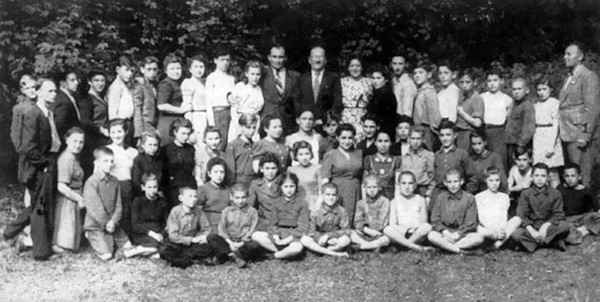
Białystok was probably the only city in Poland from which it was possible — truly as if by a miracle — to save a significant number of Jewish children from death at the hands of the Nazis. The rescue of these more than eighty children was also thanks to the well-known teacher, pedagogue, and idealist Yakov Tobiash. This, too, must be recorded for future generations.
After the outbreak of the Second World War in September 1939, when Białystok and the entire surrounding region soon came under Soviet occupation, these more than eighty Jewish children from Białystok were on summer vacation in the well-known Polish holiday resort Druskienik [Druskininkai]. When the Hitlerites attacked Soviet Russia on 22 June 1941, these children were quickly evacuated deep into Soviet Russia. Together with the children was their faithful guardian and companion, Yakov Tobiash. He accompanied the children on their evacuation route to the distant Urals, to the region of Karakulina, near the well-known Russian river Kome [Kama]. There the Białystoker children were placed in a children's home, together with other children of various nationalities.
Yakov Tobiash remained with the children the entire time; he watched over them with the devotion of a father caring for his own beloved children. Shortly after the war, in the summer of 1946, Tobiash succeeded — thanks to his efforts and persistence — in bringing the children back from Soviet Russia to Poland. From there he brought them on to France, from where they were later — before the establishment of the State of Israel — taken to the Jewish homeland.
The children, together with their rescuer, Yakov Tobiash, went through the “illegal” aliyah to the Land of Israel; they were detained by the British and held for a time on the island of Cyprus.
The children rescued by sheer miracle from Białystok — most of them orphans of the murdered martyrs and holy ones of our former hometown — have grown up in the Jewish state to become important and useful people, who have contributed, and continue to contribute, greatly to the Jewish state.
Yakov Tobiash, whom the children cannot forget for having saved them during the war, became the director of a government high school in Safed. He also held an important position in Israel's educational system. The warm-hearted and unforgettable Yakov Tobiash, of blessed memory, passed away not long ago in the Jewish state.
Yakov Tobiash always emphasized that he was happy and proud to have carried out this important rescue operation of the Białystoker children. These children — he would remind people — were the only Jewish children's collective saved from the great Polish Jewry. The Białystoker Center in New York participated, as was fitting, with the necessary assistance for the rescued children when Yakov Tobiash returned with them from Soviet Russia to Poland, and later as well when the children were in France, and finally when they were brought to the Land of Israel.
It should be mentioned that before the war, Yakov Tobiash was a member of the administrative board of the Jewish community in £om¿a. He was the director of the £om¿a Jewish orphanage Hashgokhes Yesoymim [Supervision of Orphans]. When the war broke out, and when the Jewish children from Białystok were in Druskienik, Yakov Tobiash was also staying there at that time. When the children were sent off to Soviet Russia, Tobiash, too, joined the transport of children, whom he accompanied with great care, and with whom he remained the entire time in deep Russia, as well as later in Poland and in France.
In the State of Israel as well, Yakov Tobiash cared for the orphans from the very beginning, until they were settled in the Jewish state. A number of the more than eighty Białystoker children remained after the war in Soviet Russia and in other places in Europe. Yakov Tobiash came to Poland, then to France, and finally to the State of Israel with fifty-four of the rescued children.
We present here the names of the fifty-four children who were rescued and brought to Israel, as well as the names of their parents and the years in which the children were born:
| No. | Child's Name | Parents' Name | Birth |
| 1 | Biali, Melekh | Yosef - Rivke | 1930 |
| 2 | Britvan, Zavil | Khayim - Henye | 1931 |
| 3 | Berenshteyn, Gershon | Yakov - Sore | 1934 |
| 4 | Balglei, Volf | Leyzer - Lyuba | 1929 |
| 5 | Brzhezinski, Frida | Aharon - Rokhel | 1936 |
| 6 | Kharavski, Shmuel | Gedalyahu - Lyuba | 1929 |
| 7 | Kharavski, Yehoshue | Avraham - Menukha | 1931 |
| 8 | Vasernis, Yosef | Moyshe - Khave | 1931 |
| 9 | Viltshuk, Fride | Leyzer - Blyuma | 1933 |
| 10 | Valanska, Yehudit | Leyb - Roza | 1933 |
[Page 278]
| 11 | Volfson, Khayim | Yitskhok - Rivke | 1930 |
| 12 | Edelshteyn, Khane | Avraham - Freyde | 1932 |
| 13 | Fridman, Meir | Sholem - Zelda | 1932 |
| 14 | Grinbaum, Leah | Moyshe - Adela | 1930 |
| 15 | Garbovitsh, Sore | Shloyme - Rivke | 1933 |
| 16 | Ribak, Fanya | Zelig - Gitl | 1930 |
| 17 | Rutski, Berl | Shmuel - Sore | 1930 |
| 18 | Rapitskes, Yakov | Shaul - Frume | 1934 |
| 19 | Rozantsik, Khaye | Moyshe – Peshe | 1933 |
| 20 | Lev, Klara | Moyshe – Rokhl | 1928 |
| 21 | Lev, Tsirla | Naftali – Rivke | 1930 |
| 22 | Likhtenshteyn, Yeshayohu | Shimen – Peshe | 1930 |
| 23 | Lin [Lynn], Khane | Yekhiel – Maryashe | 1929 |
| 24 | Levin, Avraham | Velvl – Sore | 1931 |
| 25 | Levin, Dovid | Tevle – Sore | 1931 |
| 26 | Lyan, Avraham | Shloyme – Sore | 1932 |
| 27 | Lin, Mindla | Avraham – Khane | 1932 |
| 28 | Mentskovski, Aharon | Yitskhok – Alte | 1930 |
| 29 | Miler, Zekharye | Khaykl – Tsivye | 1934 |
| 30 | Novik, Moyshe | Berl – Sore | 1931 |
| 31 | Nyeviyadomski, Yitskhok | Shabsai – Rokhl | 1931 |
| 32 | Openheym, Efraim | Yakov – Yehudit | 1931 |
| 33 | Openheym, Khayim | Yakov – Yehudit | 1936 |
| 34 | Oberman, Shimen | Hershl – Rivke | 1928 |
| 35 | Oberman, Kiyem | Hershl – Rivke | 1939 |
| 36 | Plantsak, Ester | Moyshe – Perl | 1931 |
| 37 | Plantsak, Nokhmen | Moyshe – Perl | 1933 |
| 38 | Perei, Lyuba | Kalmen – Mashe | 1930 |
| 39 | Panyemonski, Yoyne | Zalmen – Gitl | 1930 |
| 40 | Skovronyak, Khaye | Moyshe-Roye | 1932 |
| 41 | Surazhska, Fanya | Shmuel – Perl | 1930 |
| 42 | Sibirska, Khane | Leyb – Freyde | 1932 |
| 43 | Sokolski, Yulian | Hershl – Libe | 1931 |
| 44 | Sheytlis, Sonye | Peysekh – Roye | 1933 |
| 45 | Shefes, Bela | Yisroel – Naomi | 1930 |
| 46 | Treshtshanski, Meylekh | Shloyme – Khaye | 1930 |
| 47 | Krasnoburski, Yitskhok | Avraham – Sima | 1932 |
| 48 | Kafinus, Sore | Dovid – Basye | 1930 |
| 49 | Krishtal, Leyzer | Yitskhok – Feyge | 1931 |
| 50 | Kordon, Sima | Leyb – Khane | 1930 |
| 51 | Kaganovitsh, Lyusya | Yakov – Rivke | 1932 |
| 52 | Yabkov, Tsivye | Avraham – Gitl | 1928 |
| 53 | Yasinovski, Shmuel | Sholem – Rivke | 1932 |
| 54 | Zeligzon, Raya | Yoyne – Hinde | 1930 |
|
|
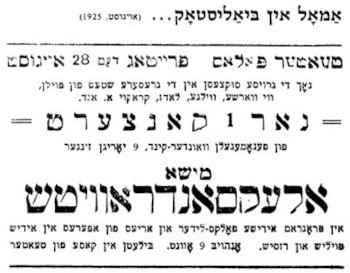
Once in Białystok…
|
|
Translator's notes:
by Khane Lin-Kizelshteyn
Translated by Beate Schützmann-Krebs
On 22 June 1941, a group of Jewish children from Białystok were in the holiday resort of Druskienik [Druskininkai], at a summer colony for children. At five o'clock that morning, our rest was suddenly turned into heavy hours of suffering and turmoil. The skies grew dark with German attack planes, whose aim was to destroy us in various ways. We were helpless then, alone, surrounded by bombardments and panic. The cries of the masses around us resounded through everything — and among all this were some 300 children, between eight and thirteen years old.
The tragedy that began for us then, and lasted five years, was immense. In the end we came to understand that we had remained war orphans. I remember it — for who could ever forget such things?
After twelve hard days and nights of bombardments and hunger, we finally reached, on 22 June 1941, the first place where we were allowed to wash ourselves and drink warm water — thanks to the director of our children's home, Samuel Markowitz Pevzner. Altogether there were 300 children of various nationalities, and we, the Jewish children from Białystok, among them. We had lost any ground for returning home, to our beloved fathers and mothers, to our families.
In those difficult days, the well-known educator Yakov Tobiash found himself in a struggle of survival. He was among the victims of the disaster and fighting for his life. Looking at us — the helpless children at the train station — he constantly did everything he could to calm us and to help us in our distress. In us, the Jewish war orphans who still, at that time, held a hope of finding our dearest ones, he also found a comfort for himself.
Our director, Samuel Markowitz, together with Yakov Tobiash, stayed with us in those days on every road and detour, in order to bring us out of danger. The panic was great, and gathering the children after a bombardment was not easy. One would scatter in different directions in order to save oneself from the fire. Yet the good fortune of life was with us. Not a single child was lost along the way. Our bond in those hard days was a close one, and our companions remained with us.
When we reached the Urals, no force could separate us anymore. There had been certain attempts earlier, when we were brought to a place without transportation, without water, and without other necessities. Yet even then, they did not succeed in separating us. We held together as a closed group, accompanied by our uncertain fate.
In those days, the warm-hearted educator Yakov Tobiash maintained a connection with the Jewish community in the Land of Israel, to whom he also sent a list of us — the rescued, surviving children of Białystok. And the idea, the very root, of the Land of Israel entered us then more deeply than ever before. Our longing for our dear and beloved ones did not diminish, even though we were cast far away into a distant and foreign world. The nights were very long, longer than nights usually are. The children's crying was strong and deeply moving throughout those difficult months. The bombardments and the terror of death left deep marks on us. The younger children sought warmth from the older ones, who began to take on the roles of caring sisters and brothers in those days of harsh struggle.
In 1945, a connection was established with the Jewish Anti-Fascist Committee in Moscow, with its prominent representatives: Dr. David Sefard, Itzik Fefer, Berl Mark, Avraham Doshinski, and others. They expressed heartfelt thanks to the Jewish educators for their important work, their devotion, and their care for the Jewish children in a time of hardship.
In 1946, when the question of repatriation from Soviet Russia to Poland became urgent, a great responsibility fell upon the educator. It meant persuading the children that they should return to Poland, fully knowing that their parents had been murdered by the Hitlerite killers. Even then, Yakov Tobiash's aim was already to prepare us for aliyah to the Land of Israel.
On 2 July 1946, a group of forty-nine Jewish children and youths, aged twelve to eighteen, set out on the road toward aliyah, passing through various stations and routes. Our faithful director, the warm-hearted Jew from Leningrad, Samuel Markowitz, cared for us and made it possible for all the necessary preparations to be carried out. Constantly in danger of his own life, he even accompanied us to the Russian–Polish border. He truly fulfilled his goal, as a good and proud Jew.
Upon entering Polish territory, the full responsibility for us children was taken over by Yakov Tobiash. He had already been in contact beforehand with the Zionist underground organization Brikha [Escape], which was active in Poland at that time. Our newly formed group joined the group Dror [Freedom, Zionist-socialist Jewish youth movement], of the Kibbutz HaMeuhad movement.
[Page 280]
The conditions were not bad, and we were surrounded by Jewish and Eretz Yisrael warmth and care. The children began to study Hebrew and knowledge of the Land, and we prepared ourselves for the road ahead.
|
|
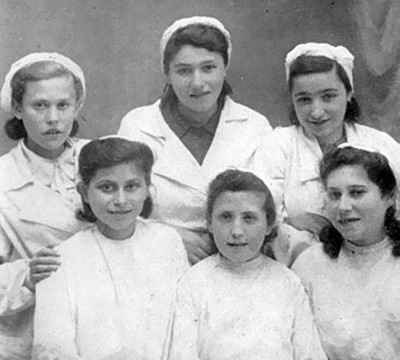
[In the Białystok: Photo Album, page 162, Byalisṭoḳ bilder album fun a barimṭer shṭoṭ un ire Iden iber der ṿelṭ | Yiddish Book Center we learn that “during their stay in Russia these six orphans were graduated from a medical school – some as obstetricians and others as nurses.” The names - from front right to back left – are “Chanah Lynn, Feigel Ribak, Chaya Fishman, Luba Perei, Batya Reichert, Tzivya Jablonka.”] |
The group of rescued children from Białystok, together with their educator Yakov Tobiash, continued their journey to the Land of Israel as the children's kibbutz Dror, named after Mordechai Tenenbaum. Many dear Jewish hearts from Białystok helped us along the way — in Poland, in Paris, and on every road leading toward the Land of Israel.
After the 22nd Zionist Congress in Basel, Switzerland, a new chapter began for the Dror kibbutz. We were divided into two groups, according to age and health, and preparations for aliyah began. A large part of the group set out for the shores of Israel on the ship Theodor Herzl. The others were taken to the island of Cyprus, under the leadership of the educator Shloyme Brod [Shlomo Brod]. It should be noted that the members of this group, who reached the Land of Israel through various routes and under various conditions, nevertheless united in the building and establishment of the State.
Only on 9 June 1966 did all members of the group gather for a reunion, to mark twenty-five years of our bond since those days of suffering and danger. We spoke at length, each in our own way; we relived the difficult times of the past and the extraordinary path we had taken. With pride, we also pointed to our achievements in the realms of study, work, and family life.
With great respect, I wish to mention here those friends from our group of children who are no longer with us today:
The devoted educator Yakov Tobiash continued his educational work in the State of Israel and served as head of the educational center and director of the Beit HaHinukh in Safed until the end of his life, on the 16th of Elul, 5730 [September 17, 1970].
Eternal honor to his memory!
Mr. Tobiash's bond with the group and with the children lasted until the end of his life. All of us, the rescued Białystoker children of the orphanage, strive to remain connected with one another. We meet at celebrations and on other occasions, and also through mutual help.
Once in Białystok…
|
|
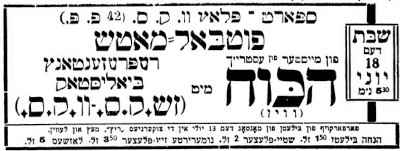
| [Announcement of a soccer match on Saturday, June 18, between the famous Viennese soccer team Hakoach and a select team from Białystok, with information about ticket sales.] |
Translator's notes:
|
|
JewishGen, Inc. makes no representations regarding the accuracy of
the translation. The reader may wish to refer to the original material
for verification.
JewishGen is not responsible for inaccuracies or omissions in the original work and cannot rewrite or edit the text to correct inaccuracies and/or omissions.
Our mission is to produce a translation of the original work and we cannot verify the accuracy of statements or alter facts cited.
 Białystok, Poland
 Yizkor Book Project
 JewishGen Home Page
Copyright © 1999-2026 by JewishGen, Inc.
Updated 17 Apr 2026 by LA