 |
|
|
[Page 243]
|
[Page 244]
[Page 245]
Translated by Beate Schützmann-Krebs
English Proofreading by Dr. Susan Kingsley Pasquariella
On July 27, 1944, after heavy battles in that region between the Soviet forces and the Hitlerite murderers, the Red Army liberated Białystok. Khurbn [ruin] and devastation, sorrow and grief, looked out from every corner.
In all the places where once there had been a branching, flourishing Jewish life, there now stood as if one vast ruined besoylem [cemetery]. The labor, the effort, the striving and the creations of many Jewish generations had vanished, as though swept away by a terrible storm.
In the Jewish quarters, streets, and houses, where once everywhere was full of life, all at once everything was wrapped in dreadful mourning. Everything had been erased, annihilated, destroyed by the Nazi murderers. It was almost unbelievable that such a thing could have happened in so short a time.
The once-precious, beloved tens of thousands of Jews of Białystok–women, children, men, and elders–were murdered in Auschwitz, Treblinka, and other Hitlerite extermination sites. A whole wondrous Jewish world–for Białystok was indeed like a world–was wiped away as though it had never existed.
Upon the ruins of Jewish Białystok, soon after liberation, a few Jews returned–men and women who had been saved by miracles from the Hitlerite gehenem [hell]. Alone, like broken branches from a mighty tree, they wandered through Białystok with constricted hearts, tears flowing from their eyes.
Yet one must not despair! From the once-flourishing community of sixty-thousand Jews in Białystok, there were, after liberation, around three hundred souls. At first, only a handful, solitary figures. Gradually, more came – the miracle-Jews from different places. They gathered and clung to one another, like mourners in a grieving family.
Those few who emerged from the Nazi gehenem [hell], the survivors of Hitler's extermination sites, from the partisan forests, from hidden shelters, from wanderings and escapes–the ones saved by miracles–still wrapped in the pain and suffering of their terrible experiences under Hitler, resolved to begin anew.
Let us try, perhaps it will succeed.
Soon indeed they stepped forward, the small number who had returned to Białystok, the survivors of gehenem, to build a fragment of new life. And this was possible at that time thanks to the brotherly and immediate help of Białystoker landsleit throughout the world. In this, as was the custom, a great part was the broad support of the large Białystoker Center in America, located on the old East Side of New York.
The remnants who returned to Białystok–the tormented and deeply suffering Jews after the dreadful Jewish khurbn at the hands of the Nazis–also in their former home city immediately and in a worthy manner consecrated the memory of the martyrs, the tens of thousands of murdered kedoyshem [martyrs] by the Hitlerite murderers; as well as the memory of the heroic sons and daughters of Jewish Białystok, who gave their young lives in battle against the enemy, who gave their precious lives defending and upholding Jewish pride and honor.
Translator's note:
by Avraham Shevach
Translated by Beate Schützmann-Krebs
English Proofreading by Dr. Susan Kingsley Pasquariella
|
Białystoker geselekh– You are no longer here, Białystoker geselekh– You will forever remain within me.
The shtibelekh, the zibelekh,
The nekhtelekh, the gelekhterlekh
Białystoker geselekh–
Białystoker geselekh,
No longer there the shtibelekh,
No longer do the Idelekh
Białystoker geselekh, |
Translator's note:
Geselekh: alleyways
Shtibelekh: diminutive of shtibl (little house); in everyday speech: small homes; in religious usage: small Chasidic prayer rooms.
Zibelekh: newborns, babies born at seven months
Shmatelekh: little rags
Nekhtelekh: little nights
Gelekhterlekh: little laughters
Nigunim'lekh: little religious or folk melodies
Takhnunim'lekh: little supplications
Bergelekh: little mounds
Gribelekh: little pits
Idelekh: yidelekh, little Jews, Jewish children
Lidelekh: little Songs; here: the well-known Raisins and Almonds Return
by Yitzchak Bornstein
Translated by Beate Schützmann-Krebs
English Proofreading by Dr. Susan Kingsley Pasquariella
This is a moving portrayal of how the few Jews who remained in Białystok, soon after the war, with great dignity honored the memory of the heroic fallen resisters against the Nazis.
From August 16th to August 24th, 1944, in the week of the first yahrzeit since the murderous Hitlerites carried out the final act of annihilation of the Jews of Białystok, the small but very energetic remnant of Białystoker Jews proclaimed an entire week of mourning, with the purpose of sanctifying the memory of the former “mother city of Israel” – Białystok.
These mourning assemblies showed us that, indeed, the enemy inflicted upon us a destruction, a terrible destruction, yet he did not succeed in erasing us. The Białystoker community, which now numbers, thank G”d, 500 Jews, has nevertheless, within this short time and with the devoted help of our brothers abroad, succeeded in creating a range of Jewish institutions, both cultural and economic. And this is the best sign that the Jews of Białystok live and create anew.
In the carriage of our train, which carried us from Warsaw, there traveled a group of young men, partisans. They were Jews from Białystok, scattered across various towns in Poland. They had lived in Białystok through those days, from August 16th to 24th, 1943. They reminded each other of facts that made their hair stand on end.
Leyb Pudlowski now travels together with his brother-in-law Kon. He is going to Białystok to look upon the grave of his comrades.
When the train pulls out of Łapy, one station before Białystok, he rushes to the window. Pudlowski points out the place near the Narew River from which he once jumped from the carriage. That train was then bound for Treblinka. At that spot near the Narew the ground is soft and sandy. It was there that, one after another, twenty five Jews leapt from the train. His brother-in-law, who now travels with him to Białystok, also jumped. His sister too jumped. She struck her head against a telegraph pole and, before his eyes, passed away in blood.
Of those twenty-five Jews, only three are alive today. The SS men and Ukrainians opened fire on all who had jumped, and in the ditch beside the tracks he saw many murdered Jews.
A City of Ruins
The day is bright and sunny. From the train we walk through the main street, the former, once very lively Lipowa Street. Now only two or three houses remain there. When the street comes to an end, we see on the right a wide, desolate space, overgrown with wild grass. There once stood many Jewish streets: Chazanovicz, Suraska, Shkolna, Dembowa, and others. These streets, together with the Great Town Shul [Wielka Synagogue] and the bote-medroshim [study houses], were set aflame by the Germans on the very first day they entered the city. That was Friday, June 27, 1941. On that day they seized Jews from the streets, locked them inside the synagogue, and set it on fire. Sixteen hundred Jews met a dreadful death in the flames.
When one looks upon this wasteland, it is almost impossible to believe that once houses stood here, that thousands of Jews lived and dwelled here. This part of Białystok recalls entirely the destruction of the Nalewki and Franciszkańska districts[3]…
To the left of Lipowa Street we turn into a narrow street, which is one great ruin. This street was once called Kupiecka, a street of purely Jewish houses and shops. Now it bears the name: Yitzchak Malmed Street. It is named after a young man from Brisk who had worked in Weinberg's paint shop in Białystok. On February 5, 1943, during the first “aktsye” [“Aktion” – Nazi roundup/deportation] in the Białystoker Ghetto, Yitzhak Malmed threw himself upon the Nazi who had come to seize him. Malmed doused him with a bottle of vitriol and burned out his eyes.
For three days Malmed was hanged before the gate at Kupiecka 29. Today, at that place, a plaque with flowers has been hung, and the street bears the name of this Jewish hero. Jews pause at that spot and contemplate the wall; Poles remove their hats.
A little further on stands the house which, during the occupation, was the seat of the Judenrat. Now the Jewish Committee is located there, together with part of its institutions, such as the Historical Commission, TOZ [Society for the Protection of the Health of the Jews], and others.
The Memorial in the Synagogue
The city of Białystok lost 60,000 Jews, and together with the towns of the province, 200,000 Jews were murdered by the Nazis.
[Page 247]
On the Shabbat, August 23rd, the entire remnant of surviving Jews gathered in the shul, where a solemn prayer and memorial were held in honor of the martyrs. Such a davenen [Jewish praying] the Jews of Białystok had not heard for a long time. From Warsaw came the chief cantor of the Nożyk Synagogue, the fine tenor Moyshe Serenson. As he intoned the El Molei Rachamim [traditional Jewish memorial prayer], a heart-rending cry burst forth.
The head of the cultural department of the Białystok Committee, Yakov Cohen, before the kries-hatoyre [reading of the Torah], recalled the great Jews of Białystok who perished during the liquidation.
To the Ghetto Cemetery
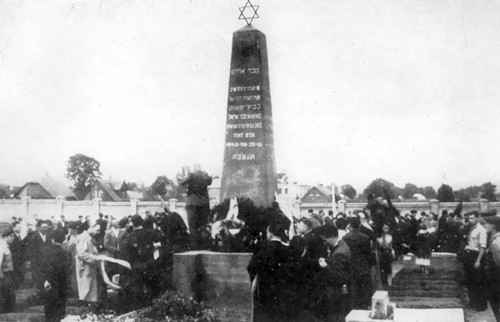
On Sunday, August 24th, from early morning the Jews of Białystok gathered before the building of the Committee. There a procession was formed, with banners and wreaths of flowers, bound for the ghetto besoylem [cemetery]. Yes, during the occupation Białystok was “enriched” with a besoylem, located near Zhabye and Tshiste Streets.
The cemetery is scarcely a few years old, yet it is already so densely “inhabited,” as though it had stood for decades…
Among those who gather before the committee, I also encounter unfamiliar Jews–Jews from towns that no one remembers. Imagine such a town as Łomża. Fifty percent of its population was Jewish. I remember that until the year '39 there was stationed there the 30th Pyekhote pulk [Infantry Regiment].
It was called Moyshe Rabeynu's Pulk [Moses our Teacher's Regiment], for more than half of its soldiers were Jews from Warsaw, Radom, Kielce, Kutno, and Włocławek. When the Sabbath or a yontev [festival] arrived, all the shuls [synagogues] and bote-medroshim [study houses] were filled with these Jewish soldiers, who, after prayer, would promenade with pride– dressed as smartly as officers–through the streets of Łomża.
Łomża also possessed a renowned yeshiva and a cherished rabbi. Today, not a single Jew is there.
I meet here a handful of Jews from Bryansk and Siemiatycze, though in those towns too, not one Jew remained. From Knyszyn there is one Jewish family–the Kaplans: father, mother, and daughter. All three survived, hidden by a peasant in his village until the Hitlerite beast was driven out.
Still, around Białystok there are towns where Jews live even today, and life goes on for them not badly. Bielsk-Podlaski (the town of Sh. Y. Stupnitski, of blessed memory)[4] has sixty Jews, and they sent a delegation with a wreath of flowers to the mourning ceremonies. In that delegation was also the photographer Yosef Lew. In Suwałki there are thirty Jews–and that is all.
|
|
The mood among the assembled Jews is serious, yet not broken, not resigned. They line themselves up four in a row.
At the head is carried the Polish national flag, then the banners of the parties: red, white-and-blue, the flags of the Bund, the P.P.R. [Polish Workers' Party] (written in Yiddish letters), Hashomer Hatzair [Zionist-socialist youth movement], Left Poalei Zion [left-wing Zionist workers' party], Ts.S. [Zionist-socialist faction] and Ichud [Jewish unity party].
Each delegation brings a wreath, with a ribbon inscribed in golden or red letters–in Yiddish, Hebrew, and Polish–in honor of our nearest and dearest. Here are wreaths from the Central Committee of Jews in Poland, from the Jewish Writers' Union in Łódź –which sent its vice-chairman, editor B. Mark– from the Central Historical Commission –represented by Mr. Rayak– from the Joint, from the Voivodship Committees in Warsaw and Łódź, from the partisans, from the city council, the council of professional associations, from TOZ [Jewish public health organization in Poland], from the Białystok landsmanshaftn in different towns, and more.
There is also a ribbon from the religious congregation, crying out:
HaShem yikom damam–“May the Lord avenge their blood.”
The procession is imposing, stretching across almost the entire length of the ruined street. And when we pass the wall where the holy martyr and hero Yitzchak Malmed met his death, we stop, and a wreath of flowers is laid down.
From there we go to the great empty square where once stood the Great Shul [Wielka Synagogue]. What remains of the shul is only that which the fire did not succeed in consuming: the iron cupola, lying as if in a pit, twisted… Here a memorial plaque is set up. Upon the iron, flowers are laid.
Through Lipowa Street we pass several ruined lanes on the way to the ghetto besoylem [cemetery]. At every street corner, Polyakn [non-Jewish Poles] gathered; many remove their hats. In the besoylem there are many, many matzevos [gravestones], smaller and larger, almost all new.
At one enormous matseyve [gravestone], standing in the middle of
[Page 248]
a great bruder- keyver [collective grave], the procession halts. Here, in this grave, only recently 125 Jews were buried, exhumed from various places in the city. In this grave also found their eternal rest seventy Jewish heroes, the oyfshtendler [uprising fighters], who on the tragic day of August 16, 1943, at nine-thirty in the morning, confronted the enemy on Ciepła and Chmielna Streets with fire from rifles and grenades.
Under the leadership of Mordekhay Tenenboym and Daniel Moskovitsh, the Jewish fighters attacked the gates at the exit from the ghetto, in order to break a path for the many thousands of unfortunate Jews whom the Germans were driving from Jurowiecka Street to the Umschlagplatz [deportation site] to the shkhite [mass killing].
To tear the Jewish masses from the murderers' hands, the uprising fighters began to set houses aflame. For three hours the bitter battle raged, and only after the Hitlerites brought in tanks to the fight did the murderers succeed in driving the Jews from the ghetto to the Umschlagplatz.
A group of seventy men held out in a bunker on Chmielna 7. The Hitlerites discovered the bunker and executed all seventy on Jurowiecka Street.
On the matseyve [monument] are inscriptions in Hebrew, Yiddish, and Polish with the following content (we bring here the Hebrew and Yiddish text):[5]
Here rest 125 persons,
70 fighters from the Białystok ghetto,
55 martirer [martyrs] who were murdered
by the tyrants. Among them: 108 men, 12 women, 4 children,
1 infant.
With a moving speech, the chairman of the Jewish Voivodship Committee in Białystok, Pesakh Burshtin, stepped forward. He pointed out that among those gathered at the besoylem was also the sister of the heroic commander Mordechai Tenenbaum, of blessed memory, and the wife of one of the leaders of the uprising in the Białystoker Ghetto, Velvl Volkoviski, of blessed memory.
Then spoke Deputy Satshilovski, vice-chairman of the Voivodship National Council, and Vice-Mayor Yanovski.
Afterwards, comrade Khayke Grossman stepped forward with a longer speech, speaking in the name of the Central Committee of Jews in Poland and of the main administration of the Partisan Union. Herself a participant in those bitter battles, she recalled moments that revealed the great self-sacrifice and heroism of the Jewish youth in the Białystoker Ghetto, where Jewish women too hurled themselves upon the murderers with hatchets.
At the end, she called to fulfill the testament of the seventy Jewish heroes: never to cease the struggle until every trace of fascism has been annihilated throughout the world and also in Erets Yisroel [Land of Israel].
After the speech of Deputy Kubyak, chairman of the professional associations, spoke the partisan Pudlovski and Yuzefovitsh, representative of the P.P.R. [Polish Workers' Party] in Białystok.
After the moving speech of Mr. Rayak, representative of the Central Jewish Historical Commission, the chief cantor M. Serenson performed a hazkore [memorial prayer for the dead] for the geselekh [martyrs] and recited Kaddish [Jewish mourner's prayer], which drew many tears from the assembled Jews and Poles.
Lezikhron olam [For eternal remembrance]
In the library hall the solemn unveiling of the memorial plaque in honor of the memory of the geselekh of Białystok and of the Voivodship, took place. The plaque, of white marble and wall-sized, is decorated at the top with a golden menorah. Upon the plaque is engraved in black letters:
“Białystok–once the city of sixty thousand Jews, the heart of a Voivodship numbering two hundred thousand.
The national city, the ir ve-em be-Yisroel [mother-city of Israel].
The fortress of Jewish culture, the city that shone with its national, religious, social, economic, and health institutions.
The city with its comprehensive and far-reaching school system of Yiddish and Hebrew folk and middle schools, talmetoyres [traditional religious schools] and yeshivas [rabbinical academies].
The city of of Sholem Aleichem - and study libraries, of Jewish press and theater.
The city of renowned national activists, of the struggling Jewish proletariat, of famous writers, scholars, and artists.
Białystok, whose heroic ghetto uprising against the bestial Hitlerite occupiers in 1943 continued the traditions of struggle from 1905.
Jewish Białystok, which perished in terrible suffering and pain, meeting a holy martyr's death at the murderous hands of the German fascists. May the horrific murders be the mark of Cain upon the German people, and may the sacred memory of the martyrs be the lighthouse shining for us and for the generations to come.
We, the Białystoker she'erit-hapleitah [surviving remnant], will forever guard your memory and carry forward the glorious history of destroyed Białystok.”
In deep silence, Dr. B. Mark unveiled the plaque, in honor of Jewish life and of the Jews of Poland. All rose from their places, and B. Mark delivered a major speech on the role that Białystok–the center between Warsaw and Vilna–had played in the cultural, political, and economic life of the Jews of Poland.
Other speakers included Chairman F. Burshtin, Vice-Chairman Yosef Tchernikhov
[Page 249]
and Avraham Shlakhtovitsh, former political officer of a large Jewish partisan detachment in the Baranovitsher region.
In Memory of the Heroes
On Sunday evening, in the Jewish Theater, a mourning academy was held dedicated to the memory of the uprising fighters, who had begun the struggle against the mighty enemy and who fell al kiddush hashem [in sanctification of the Divine Name].
The stage was decorated with the banners of the Polish parties, draped in black crepe. On the presidium sat a group who had fought in those bitter days.
After Chairman P. Burshteyn opened the academy, all rose from their places to honor the memory of the heroes. Among many in the hall who had known the fighters well, tears flowed freely.
The first to speak was Master Shatkovski, representative of the Voivode, who declared that the heroic deeds of the Jewish fighters in the ghetto were held in the highest honor by the entire Polish people.
With a longer speech came Rivka Voyskovska, one of the founders of the anti-fascist combat organization in the Białystok Ghetto, who conveyed several moving moments from those days.
The Vice Chairman of the Voivodship National Council, Deputy Saczylewski (Stronnictwo Ludowe – Peasant Party), spoke with great inspiration about the Jewish heroes and concluded with a cry: Long live the Jewish people!
Then the secretary of the Białystok Jewish Committee spoke, together with the uprising fighters Berl Pirei and Marek Bukh, who shared a series of vivid details. Also speaking was the representative of the Joint, the fighter in the Warsaw ghetto, Dr. Valevski.
In the artistic part, M. Serenson performed a series of ghetto songs, together with the artist Sara Grinhoyz, who with great passion recited Shulshteyn's Kh' hob gezen a Barg [I Saw a Mountain] and a piece by Julian Tuwim in Polish.
With “Am Yisroel Chai” [The People of Israel Lives] by Moyshe Knaphays, performed by M. Serenson, the solemn academy came to its conclusion.
The Author of “Rivkele the Shabesdike”
Throughout Poland the song “Rivkele the Shabesdike” has now become widely popular. Its author was the well-known Białystok publicist and writer, the editor of the pre war Jewish newspaper Dos Bialystoker Lebn [The Białystok Jewish Life], Pesach Kaplan, of blessed memory.
The song was written after the terrible pogrom carried out by the Hitlerites, on the third Sabbath after they entered Białystok. On that day, Jewish men were seized from every street and dragged from their homes; about five thousand were taken beyond the city and shot. These martyrs became known as the Shabesdike, and to them Pesakh Kaplan dedicated his song.
The energetic Jewish Committee in Białystok, which showed true heroism in organizing new Jewish life, decided to name its new library after Pesach Kaplan.
With this solemn act, the week of commemoration for the martyrs of Białystok came to a close. Also attending this solemn celebration was the entire Białystok community. On this occasion Editor B. Mark delivered a major lecture on Jewish culture, and he also unveiled the portrait of Pesach Kaplan, now placed at the center among the portraits of Mendele Mokher Sforim and Y. L. Peretz.
B. Mark donated to the Białystoker Library his newly published book On the Ruins of the Warsaw Ghetto. This modest gift was received with heartfelt applause by the audience.
The Białystok Library now possesses two thousand books, the greater part donated by Białystok landsleit [emigrants from Białystok] in Argentina and the United States. Two hundred books were also brought by a Białystoker Pole, with whom Jews had hidden them before going on their last journey.
On this occasion speeches were also delivered by Mr. Rayak, P. Binetski, and Yaakov Cohen.
With a concert program of the finest ghetto songs, performed by M. Serenson and his wife, the celebration was brought to a close.
|
|
Translator's notes:
by Srolke Kot
(from his book Khurbn Bialystok – The Destruction of Białystok)
Translated by Beate Schützmann-Krebs
English Proofreading by Dr. Susan Kingsley Pasquariella
After completing all the formalities and handing over the weapon, I turn toward Białystok. I go with a feeling of “joy” to behold the city of my birth, yet at the same time with a terrible pain and a question within myself: what will I find there? I know there is nothing. Reason tells me so. Yet an inner voice cries: perhaps yes? Perhaps something remains!
I walk ten kilometers on foot. Along the way peasants stand cutting the tevue [grain] in the fields, their scythes slicing as if nothing at all had happened. The villages along the road are partly destroyed, others entirely; on the fences, little jugs still cling. The peasants before their houses finish their daily labors.
I stride forward with one breath and one thought driving me: Białystok! How does it look? And who has remained?
Coming into the outskirts of the city, I already see the beginning of the khurbn [destruction]: chimneys without houses, all the bridges torn up, the railway station burned. From entire streets there remain only skeletons of many stone houses, while other streets are altogether erased. You cannot even tell whether anything once stood here, whether people lived– people I knew so well, with whom I spent time, and of whom enduring memories and kind thoughts remain forever.
German prisoners stand around. I approach, and with disgust I look upon them, asking the Red Army soldier guarding them: why are they still alive? He answers me with a smile: nitshevo podokhnyet [it is nothing, they will croak].
I continue along my street to see the house where I once lived, where only a year ago I left behind my brother and my little sister! I walk in the direction where once there was the ghetto.
My first glance falls upon the cobblestones where the fence once stood. For twenty meters the earth by the fence is overgrown with grass, the stones scarcely visible. No one has walked here, and grass has already taken root.
Where once the stones were worn down by countless human steps, now grass has covered them, and the stones, half-concealed, cry out:
Grass, you shall not cover us! People must walk here! Jews walked here and built their lives for generations. We must tell our story!
All the streets are empty, there are no people. All the houses are broken. Here walls are missing. One house stands with only a single wall, another with windows and doors torn away. Jewish sforim [holy books] and volumes lie scattered wherever you cast your eye and turn your head; broken furniture, chairs without legs, cupboards without doors, shattered beds that no one bothers to take.
Feathers from mattresses are mixed with photographs of the people who lived here: Jews with beards and peyes [sidelocks], Jews without hats, women with sheitlen [wigs] and women with the most modern hairstyles. A photograph of a child laughing, and a photograph of a mother holding the child with joy. A little boy on a horse, and a youth in a small talis [prayer shawl] with tefillin [phylacteries] for his bar mitzvah.
Generations of life and creation cannot be erased from the earth in a single stroke. The earth itself does not absorb it; it lacks the courage, and so it leaves everything lying upon its surface, demanding and crying out:
What has been done! And why?!
The blood freezes in my veins at the sight of it all, and I am shaken, even to tears. Coming to my street, Bialostotshenski, I walk slowly, as in those times when they used to tell me that they would shoot me.
The same feeling comes as I draw nearer to number 19, where I lived. Three houses before, I already see that the building is entirely gone, not even a skeleton remains to glance upon, to stumble against as if upon one's own, to weep, to cling like a small child who has just begun to walk, holding himself against the walls.
I find only stones of the foundation and half a chimney. Above them, sand and a trembling blade of grass have grown. I stand upon the foundation of the house, pondering and looking: where was the window? Where was the door? Where did my bed stand? And where did the picture hang of my parents, taken in the week of their joyful khasene [wedding], which we children always looked at, watching how they changed, becoming older, and how Mother always reminded us how they once looked. Yes! How they once looked…
And today, I stand alone upon my own khurbes [ruins], where everything I do reminds me of all the terrors, how they came to suffer unnaturally for nothing–only because we are Jews!
The air I breathe now as I stand is saturated with the smoke of their bodies, which were burned in the ovens of Treblinka, Majdanek, Auschwitz, and other places.
The smoke rose into black clouds of mourning toward the heavens, crying out and demanding: What does a mensch do to a mensch?!
But the air seized the smoke and absorbed it, annihilating it, not allowing it to remain as an eternal black cloud over the world. Yet for me the air has turned black, unable to distinguish their wisps of smoke.
The air chokes, and my hands fall in faintness. My feet grow weak –those same feet that have trodden thousands of kilometers across fields and highways, through mud.
[Page 251]
Now, seeing my own home destroyed, everything remains in helplessness, and my knees bend of themselves, as I sit upon a mound of foundation stones. I look straight ahead, and I see a piece of fence with wire above it –a remnant of the ghetto.
I close my eyes in fear and instinctively, move my hand over the sand, digging with my fingers–after what, I do not know–and I touch something hard. I open my eyes and pull out an old broken zayer [sieve]. I remember it from home, where once potatoes were sifted, and at once it reminds me of Mother's joyful words: Today, children, you have your meal–lentils with alkalehk [small dumplings], especially for Srolke…
It becomes hard for me to sit, and I rise. My eyes fall upon an opening in the earth, and I recall that here must be the pit I once made for Father, Mother, and my little sister to hide. I go closer and bend down, looking long into the opening, where a broken board sticks out, and inside it is dark. I see nothing more.
A heat bursts out from my whole body, and sweat, though it is already autumn in October. The wind rushes, drives, as if it wanted to flee from me, unable to bear seeing me stand here any longer–for who could come back and see such a thing?
It is unbearably stifling for me, though all around is open. There are no houses, no walls to block the air.
I stand bent over, looking into the darkness of the opening, and I ponder, unable to decide: should I begin to dig and go inside? No! I am afraid for myself. Can a person enter his own grave?! Perhaps my dear parents and little sister lie there.
I am seized with fear at the thought–what if I meet them there? And how could I answer them the question: Why was it I, of all people, who remained alive, and with what right do I now return to tread upon the same earth, soaked through with their blood?
And perhaps the grass I already see withering in autumn is moistened with their ashes from bodies? And the soap with which I once washed myself was made from their fat? You were torn away from life in such an incomprehensible way.
Mom! Dad! Raytsele! And my brothers!
What must I do to justify myself–before myself, before my own conscience, let alone when I must stand before others and say: I am still here, still alive in this world?!
How does every word now sound –about people, about the world–when in one stroke all loves of so many years, all absorption in everything that is life and human warmth, have been torn away. I stand broken from suffering, gazing continually into the opening. I sit down, rise again. I do not know what I am to do here.
To dig? I lack the courage. To leave? I cannot. I look around again and again, and every glance at the surroundings makes it harder for me. It begins to grow dark. Evening is already falling. Where does one go now? The question arises within me: have I not already come home, a victor…
|
|
It is already deeply dark when I leave my “home” and walk about, looking at the continually toppled houses, seeing no living person and no creature. From afar, like a shadow, I see someone passing among the open yards–a man. I hurry quickly, catch up to him, and ask in Polish: Where do Jews live here? He looks at me as if I were mad and answers: Żydzi? Wcale nie widziałem. Nie ma tutaj. [Jews? I have not seen any at all. There are none here.]
I remain standing and no longer know what to do. I begin to walk further and see in a window something shining. I go inside the house. A Polish woman sits there–in what was once a Jewish home–busy in the kitchen. Dobry wieczór (Good evening), I say to her, and ask: Where do Jews live here? She explains at length and answers that she thinks perhaps on Kupiecki Street 24 a few Jews had come. Surely, she does not know.
I go there and indeed see a half-ruined house, the panes hacked out, many things thrown about, filthy. Also on the stairs various things are strewn. I go up and in the darkness of a room, by a broken little table, on a chair a bit to the side, sits a woman–like a shadow, pale, thin, with nothing by which to recognize who she is. Good evening, I say in Yiddish. Do Jews live here? Yes, she replies with a quiet voice I can scarcely hear, looking at me with a cold, weary glance.
As we sit and look at one another, unable to recognize each other, asking–she of me and I of her–whether we are from Białystok, her husband comes in. Of him one sees, as he enters, only a pair of trousers and shoes worn upon the skeleton of a man.
We speak for a long time, each interested in the other –who has remained, whom each knows, what information he has. How terrible it is to hear that no one knows of thousands, or even hundreds, of survivors–only of individuals who can be counted on the fingers, and of those few who later come to spend the night in the dwelling, after a whole day wandering through the streets searching for something to eat.
Meanwhile, among old acquaintances from before, only one knows me:
[Page 252]
the woman Dine Treshtshanski, a former neighbor who once took care of me. She is the only one I meet who can confirm that I am from the city. The others are strangers to me, as if we had never been from the same town at all.
There is nothing for us to talk about, for each one of us knows everything, and yet for each the story is different – and more terrible. Meanwhile, whoever arrives bit by bit–some barefoot, some with nothing, in various poses–chooses a small piece of floor and lies down to sleep, resting the head upon the fist, covered with the papers and books that lie scattered around the dwelling.
It is hard to drive away the thoughts to which one must accustom oneself, to say: this is the reality, the one for which we waited so long, enduring unbelievable conditions that no human imagination has until now been able to describe. And the one who lived through it asks: was it truly possible to survive?
Dine Treshtshanski takes me into her little room and gives me a bed, which I have not seen for more than a year, and I am no longer accustomed to how one lies down here. She lays me out with clean linen, which I cannot even remember when last I saw, and I lie down to sleep.
I got up very late. So strongly did the bed carry me into sleep. Already I found no one of those who had slept upon the floor and tables. Each one goes about, looking around at the former places of dwelling, searching also among acquaintances for food…
Translator's notes:
by Z. Segalovitsh
Translated by Beate Schützmann-Krebs
English Proofreading by Dr. Susan Kingsley Pasquariella
|
Once-upon-a-time weavers, broad-shouldered Jews, Worn out, silent. One shoulder a little bent– By day and by night they began Weaving and weaving without meaning.
The sun, through the window,
From a small bonus on Yontev[1] |
Translator's notes:
by Srolke Kot
Translated by Beate Schützmann-Krebs
English Proofreading by Dr. Susan Kingsley Pasquariella
In the following description, Srolke Kot depicts the first Yom Kippur night, soon after the war, in Białystok.
When I recall that Yom Kippur in Białystok in the year 1944–when out of sixty-thousand Jews barely thirty had gathered, with another ten who had come from the provinces–I must pause on that day in particular, with the question: what brought us then into the synagogue? Not so much us, but Jewish officers of the Red Army, who stood with a sider [prayer book] in hand and prayed; Jewish officers of the new Polish Army, who did the same and even more; a Jew with a cross upon his chest, who had returned to the Jews, unable to determine what he was doing in the synagogue with the cross, and to whom he was praying.
Nature follows its own course, as it did thousands of years ago, unconcerned with what happens on the earth of men, nor with the changes people carry out in their lives on the economic or political field. She makes no distinction. Autumn arrives in our region with strong cold winds and rains, when one must already prepare winter clothing and secure the windows against the driving storm.
My dwelling then was at Kupiecki 39, an old ruined building with broken panes, wallpaper torn down, dark, no electricity–only a rag with a wick in a bottle, smoldering faintly. A bed, hollow and without a cover; a broken little table, found somewhere, with three and a half legs, which often fell over when I leaned on it, or when a comrade forgot and leaned on it.
So we sat, a few survivors, and conversed, telling one another episodes from our former lives, memories. Then one of us called out:
Come, let us go and see where they pray Kol Nidre –we won't have to pray for long.
There is nowhere to go and nothing to do. In the room it is cold, everything is open.
Today one does not need to walk long through the streets and alleys as in the past. As soon as one goes out, one goes straight ahead across yards, streets, houses.
[Page 253]
Everything is leveled to the ground.
Once, to reach the street where they now pray, at Mlinove [Młynowa] 157, one had to turn through alleys and streets. Today it is a kind of pleasure: freedom and equality–open ways without houses, equality–everything leveled to the earth.
Coming into the darkness, we already saw from afar how in the window of a new house something was shining. We entered, and at first glance a scene confronted us: in a small room, in the eastern corner, stood a table set with burning candles. The entire room was filled with Jews–mostly men, and perhaps six women, no more. All stood together and wept, their faces unshaven, neglected, dressed in old, torn clothing. They stood, each one laid bare with his wounds; not a single Jew with a beard, not a single child. All were between twenty-five and forty-five years old.
There were also military men: officers from every army, simple soldiers, some with decorations, others invalids. At the lectern someone led the prayers, but one could hardly hear him, for from every corner and every side another cry tore out–an ”Oy!' with a sob, breaking into spasms.
There were no taleysim, no white kitl garments, but all bore great wounds in their hearts and swollen eyes. They stood, choked with grief, and each thought and gaze was turned–where?! That I could not determine, nor could I enter into anyone's mind.
Among them stood a high-ranking Russian officer, holding a sider against a chest full of medals, and weeping. Was he truly praying? It was hard to believe! Only one thing could be believed, judged from within oneself: having lost everyone in the war and having seen the reality of life revealed as cruel, it had torn down many hopes once placed upon man while at the front, sacrificing life–and they had been broken. Seeking where, to whom to pour out the heart, they had come into the synagogue simply to weep.
It is hard to answer many questions for those who have lived through it all. There stands a Jew who had disguised himself as a Pole: large mustaches, a Polish cap, boots, a cross upon his chest. It is hard to recognize whether he is a Jew or not. But his eyes are swollen. He holds no sider, only a stick.
I look at him and try to read from such a man, from his bearing and conduct–what is he doing here? How broken he seems, what kind of hell of suffering this man has endured! Not having been religious before, having converted, and now in the synagogue, while everyone's eyes observe him, he weeps together with all, answering Amen!
He does not remove the cross, yet he is interested in all Jewish matters.
Later I learned that this Jew was killed in an attack by Poles on a town where ten Jews had returned; he perished there, among Jews. Thus his life came to an end.
But in the synagogue on Yom Kippur, each Jew had come separately to speak out with himself–not to ask anyone for forgiveness or a good year, but to demand an answer from God, from others, or from himself.
Not klapn al-khet [to beat upon one”s chest for sins], but to beat upon the table! Not to recite, but to demand–for the souls, and for oneself–a reckoning, an answer for all that had happened.
It was not the old way of praying, when one might occasionally catch the words of the cantor, who stood at the lectern and carried out all the duties the service laid upon him. Rarely did anyone take interest in the words of prayer he heard from the cantor. Only the words handed down from earlier days–that which bound a person to his people – and the present great destruction, no matter from which stratum or class he came, and whatever his outlook might have been–had so broken him that it drew him to the small gathering in the dark room, seeking something that might ease him, seeking an answer.
But leaving the prayer, it only deepened the bitterness and darkened the thought, as they observed what had become of us, and how we now stood in the shadow of a long foretold victory.
Translator's notes:
by Shloyme [Shlomo] Pat
Translated by Beate Schützmann-Krebs
English Proofreading by Dr. Susan Kingsley Pasquariella
|
We walk upon the Bialystoker paths Wherever we may find ourselves. We build, we create, we weave– The symbol of Bialystoker life.
Shuln, centers, and relief committees
Bialystok, our city, Bialystok, our birthplace–
Toward a unification of all Bialystoker landsleit,
Precious is our parents' tradition, |
[Page 254]
by Rabbi Dr. Avraham Kravetz
Translated by Beate Schützmann-Krebs
English Proofreading by Dr. Susan Kingsley Pasquariella
Fate decreed that my young life should pass through such a dreadful transitional period, that I should stand at the crossroads between life and death… I lived through and witnessed the complete uprooting of a firmly established Jewishness, a full-blooded Judaism… brilliant Rabbis, learned men, intellectuals, and simply fine balebatim [householders], and warm, simple folk – the most beautiful that world Jewry possessed. The spiritual reservoir from which our entire people drew has gone up in smoke: bedam va-esh u'temarot ashan [in blood and fire and pillars of smoke].
After the victory of the Red Army, when Poland was liberated from the Nazis, there began to emerge a weakened, withered, I would even say a rickety Judaism.
“Tempora mutantur et nos mutamur in illis” (Times change, and we change with them…).
That Białystok no longer exists – with its Jews, with its communal workers endowed with a particular charm. I recall those first days right after the liberation in 1945, when we, the first forty Jews, returned to Białystok after the dreadful slaughter. Forty Jews, each one of whom had lost what was dearest – the family – and was alone… forlorn… clinging to one another, living with the shared memories of the past…
I wish only to recount here a short episode from that first Passover in Białystok. At that time I lived on Rynek Koshtshushki [Kosciuszki] 40 (I think it had once been Markus's masonry house). On the third floor I had a small apartment for my family. All around, the place was empty. The entire shul [synagogue] quarter the Germans had burned when they entered Białystok. And when I would stand at the window, I could look far, far out, even to the forest.
The synagogue courtyard was already overgrown with grass, only the dome still protruded from the earth, concealing beneath itself the terrible victims who had been burned inside. The sight of that dome made a dreadful impression on me, a memento mori as one might call it, and it stirred thoughts of nekome [revenge]. It was truly as Shimonovitz expressed: “Ve-tzo'ek ha-dam lenishmat ha-am” [And the blood cries out to the soul of the people].
The streets were empty. Only now and then a Jew would slip along the sides of the street. That spring was, in fact, a warm one. The sun already gave good warmth, and this added a little courage to the broken Jews. There was hope for better times.
[Page 255]
Every day the radio carried reports of fresh victories of the Allies. The entire Nazi regime, with its dream of a thousand-year dominion, already lay in ruins.
As the Red Army drew nearer, newly freed Jews arrived daily from the liberated [concentration] camps. Białystok became a place of passage. The central office was at Minske Street 1, in the hekdesh [communal shelter]. There, in the courtyard, one would stand to warm a little one's bones, the atzamot ha-yeveshot [“dry bones,” from Ezekiel's vision of restoration in Ez. 37], and at the same time exchange words with the newly arrived – asking after acquaintances, relatives, or simply after Jews. Each felt so near to the other, bound together in simple brotherhood.
Even then we convened the Voivodeship assembly, with more than sixty delegates participating, and in truly democratic fashion elected a Voivodeship committee, of which I had the honor, for a time, to serve as vice-president. It is worth noting that this assembly found a broad and warm echo throughout liberated Poland in those days.
We organized a kitchen – indeed a kosher one – which began to distribute 300–400 lunches each day. A kosher butcher already existed. We established a small yeshiva [academy of Jewish learning] from the surviving members of the yeshiva world, who had once gone forth as partisans into the forests. In short, the committee worked well. A community, I would say, b'ze'ir anpin [in miniature].
Incidentally, the seal of this committee, bearing the name “Council of the Jewish Community in Białystok” and adorned with a Star of David, caused great distress to our local Yevsekes [Jewish Communists], who, poor fellows, had to turn to the “high windows” in Warsaw to have this supposed disgrace removed and abolished. But that is already another chapter.
And so Passover approached. The difficult question of matza [unleavened bread] weighed upon the mind. We had no connection with the outside world. In Warsaw, the Jewish Central Committee had assured us that it would strive to provide matza–but one could hardly rely on them. Within our own committee, the matter caused no small amount of tension.
And it was remarkable: at a time when all material values had been so diminished among these scattered remnants, the yearning for a touch of genuine idishkayt [Jewishness] was still very great. After so many years of suffering, the Jewish soul longed for a measure of spirituality, something to lift it out of the gray everydayness and carry it into the distant realms of the past.
We decided then to bake matzot ourselves. Soon we (myself and my deputy, Rabbi Yakov Fabritski) issued a heartfelt public appeal to our brothers in the small towns nearby, who had, for a short while, lived somewhat better materially and regained a little strength, that they should assist in the great traditional moes-khitim [fund for Passover wheat] campaign. The Jews responded warmly. Especially noteworthy was the town of Bra(y)nsk, where about seventy souls lived at that time.
Thus, within two weeks we collected about 1,400 kilograms of flour and some money. And our dearly beloved Dr. Shimen Datner (then chairman of the Jewish Committee), being no thief, added funds from other sources, and so we could begin to bake. But then the question arose: where to find a bakery? There was even a Jewish bakery, but it could not halt its work of baking bread for the city, which was suffering from shortage.
Here Mr. Osher Vayn [Wein] (himself from Amdur, who before the war had a haberdashery shop on Rynek Kościuszki near the Bata firm) came to our aid. He discovered at Yatke Street 11 a bakery that was not in operation and was well suited for the purpose. The formalities with the authorities were handled for us by Engineer Ribkind (the son-in-law of Rabbi Dr. Rozenman, of blessed memory), and with good fortune we began to bake matzot.
The workers we had were those just liberated from the Stutthof camp, wanderers without a home, who at that time were in Białystok on their way to Vilna, Kovno, and other Lithuanian towns. The heartfelt songs that rose from the mouths of these wanderers filled with life the half-dead Yatke Street.
At last came the eve of Passover. From all the surrounding towns people arrived in search of matza. In Białystok itself we distributed to everyone who came – even high Jewish officials from the Soviet and Polish authorities. Simply: Kol ha-poshet yad, notnim lo [Whoever extends his hand, we give to him].
The “tshvok” [the very nail] of the festival was the Seder, which I, together with Dr. Datner, conducted at Minske Street 1. The tables were beautifully set: fish, meat, and all delicacies. And naturally, true kosher pri ha-gafen [wine of the vine], which we ourselves had boiled and prepared. The gathering rejoiced greatly. Naturally, the speeches that were delivered stood upon the proper heights. We remained together until dawn.
That holy day of Passover was truly historic, for it was so full of hope for us, the unfortunate. It was, after all, the springtime of the nations. The future seemed to promise us something so beautiful; people believed that “a new sun would shine upon the world.”
Today, alas, we stand at the grave of those beautiful hopes and dreams. Yet I believe that those who took part in that Seder will carry it in their memory as a true zman kherutenu.[3]
Translator's notes:
by Pesach Burstein
Translated by Beate Schützmann-Krebs
What follows are several portrayals of the Jews and their lives in Białystok shortly after the war. The correspondence of our esteemed landsman, Pesach Burstein [Peysekh Burshteyn] of blessed memory, was published in the Bialystoker Shtime soon after the war.
Pesach Burstein was among the very first Jews to return to his native city after the Holocaust. He was also among the earliest organizers and builders of the new life that began there.
On Thursday, April 11, 1945, the exhumation of 125 fallen heroes of the Białystoker ghetto uprising was carried out, and they were brought to a Jewish burial. The funeral of the fallen heroes was most impressive. All the Jews of the city participated, as well as representatives of the authorities and of all Polish parties and organizations.
The holy martyrs of the ghetto had previously been buried in a pit into which the surrounding residents had thrown refuse. Many such pits, containing hundreds of murdered Jews, still remain in the city. The Jewish Committee is now engaged in bringing these fallen heroes to a proper Jewish burial.
Unfortunately, the material means are lacking to exhume them all, and for this the American landsmanshaft will have to come to our aid. The ground of the ghetto cemetery belongs to private Poles, who demand payment for it. The entire enormous expanse of the new ghetto cemetery must be fenced in and a monument erected. Millions of Jews were murdered, and their ashes scattered to the wind. At the very least, the small number of bones whose location is known, dispersed and scattered, should be gathered together and brought to a Jewish grave.
The old cemetery in Bagnowka is also in poor condition. The fence is destroyed, the gravestones overturned, and the graves desecrated. For the time being, a guard has been stationed there to watch over it.
During the exhumation of the fallen victims, much evidence was found of the heroism of the martyrs, who with their meager means hurled themselves against the armed murderer and refused to be led like sheep to the slaughter. They dearly gave up their young lives.
Among our fallen Jewish heroes were found revolvers, rifle bullets, and small pincers for cutting through the barbed wire with which the Jewish ghetto had been enclosed.
[Page 256]
All of this bore witness to their heroic struggle in the Białystoker ghetto uprising.
Their bodies, riddled by murderous bullets, were gathered into coffins and buried according to Jewish law. Honor to their memory!
In recent weeks, a large number of repatriates from Soviet Russia have arrived in Białystok. The Jewish Committee provides them with food, clothing, and a roof over their heads. A great sum of money is required for this work. This is a problem that must draw the attention of our American brethren. It is to be hoped that the Białystoker landsleit in America will not abandon the surviving remnant of their native city.
Both the Jewish Committee and all the Jews of Białystok are deeply grateful to the Białystoker Relief in America for the assistance it has already sent. In addition to the significant sum of money brought at the moment of greatest despair by its emissary, Dr. Khayim Shoshkes, further sums have now been received from Relief. Many parcels also arrive from Relief, both for individuals and for the Jewish Committee, which distributes them to the poor and needy Jews.
We know that these parcels, containing essential food products as well as clothing and other items, are a great help. And we feel with what heartfelt warmth these gifts are sent by our American brethren. Therefore, in the name of the Jews of Białystok who receive these vital gifts, I wish to express profound thanks to the landsleit of New York, Paterson, Los Angeles, Chicago, Detroit, Milwaukee, Montreal, and Toronto in Canada. May the American landsleit know what sacred and life-saving work they are doing.
We have received in Białystok the monthly journal of the Białystoker Center in New York, Di Bialystoker Shtime. It is truly a pleasure to read this splendid publication. How much warmth, how much labor and effort are invested in this journal, in its aims and in the tasks it describes. The issues that arrive here are read with captivated breath.
We are all starved for a Yiddish word, for a Yiddish book, and for a Yiddish journal. The articles in Di Bialystoker Shtime reflect very well and give a clear overview of our tragedy, as well as of the continuing dangers of brown fascism, which, unfortunately, has not yet been completely eradicated in Europe.
The articles about the Białystoker Center, the Home for the Aged, and the Białystoker organizations throughout the land tell of a grand work that is truly ideally organized and creative. As one sees from Di Bialystoker Shtime, there are plans to publish an important historical work in honor of the 25th jubilee of the journal.
We here in Białystok will be able to assist you with materials from the time of the Nazi occupation. The entire body of material collected in the ghetto by Pesach Kaplan has now been recovered, and it has colossal value for the history of our annihilation. Working diligently alongside this effort is the Historical Commission, headed by Magister M. Turek and Dr. Datner.
Among Our Brethren
In brief words I will attempt to give a picture of present-day Białystok. The city today counts about 39,000 inhabitants.
Białystok suffered terribly from the dreadful cataclysm and is heavily destroyed. The Jewish quarter – such as the shul-hoyf, Surazer [Suraska] Street, Anger's Street, Legionove [Legionowa], Sosnove [Sosnowa], Versalske, and all the Jewish lanes around the shul-hoyf and the market – has been completely wiped out. Of the bremelekh [the area around the clock tower, where there were many Jewish stores in whitewashed cottages standing in rows] and the town clock, not even a trace remains.
Relatively intact are: Khanaykes, Pyaskes, Rebbe's Street, and the area near the fish market. The streets of the former ghetto – Nayvelt [Nowy Świat], Gumyener [Gumienna], Byalistotshenske [Bialystoczanska], Tshenstokhovske [Czestochowska], Linas-Hatsedek [charity for the needy] Lane, Yurovtser [Jurowiecka], Fabritshne [Fabryczna], Strikovske, Yatke Street, Avnet's Lane, Prage's [Praga] Street, Mazurs [Mazurska] – are 90 percent destroyed. Rarely does one see a whole building standing.
Among the few buildings that remain intact are the Home for the Aged at Kupiecka 30, where our Committee is now located, as well as the hospital, the school, some stores, and also dwellings.
Of the communal buildings, only the structure of TOZ [Jewish Health Protection Society] on Fabryczna Street has remained intact, though it is now occupied by the authorities. Also intact is the Linas-Khoylim [charity hospital] on Yatke Street, likewise taken over by a Polish institution. Of Linas-Hatsedek no trace remains.
Of the houses of study, only Citron's Bes Medresh on Mazurska Street has survived. Today, one part of it serves again as a house of study, while another part houses our People's House and our theater.
Also intact is the old moyshev-skeynim [Home for the Aged] and the hekdesh [communal shelter], at the corner of Minske and Suraska Streets. There now are located our Home for the Aged, the People's Kitchen, the library and study hall, a shoemakers' workshop, a metal and construction cooperative, as well as dwellings.
Of the Great City Shul only the iron skeleton of the cupola remains–the sole vestige of the synagogue and its adjoining buildings.
The Khor-Shul [reform synagogue with a choir], the Green Bes-Medresh, the Pulkovoyer Bes-Midresh, the Nayvelt [Nowy Świat] Bes-Medresh, the Katsev'sher [Butchers'] Bes-Medresh on Yatke Street, the Argentiner Bes-Medresh, the Talmetoyre [Talmud Torah], the Jewish hospitals, the Payen-Bank [Jewish cooperative loan bank], the bathhouse – all have been wiped out.
[Page 257]
The great textile industry of Białystok, once widely renowned, has been almost entirely destroyed. Only a few factories are still operating: Beker's plush factory, Mareyn's factory on Bialystoczanska Street, and partially Novik's factory. The large factories of Sakal- Zilberfenig, Triling, Shapiro, Amyel, Kulikovski, Babełe, Fuks, Markus, Valman, Zilberblat, and others – all have been completely annihilated.
Up to now, in the direction of rebuilding, nothing has been done in the city, not even partially. Only recently has a small activity been noticed: clearing the overgrown grass and repairing a few buildings.
The oldest Jewish cemeteries on Sosnove and Mill Streets are completely destroyed. Of the surrounding fences no trace remains; one sees only individual gravestones half sunken into the earth. Human bones and skulls often lie exposed, strewn upon the ground.
The Bagnowka cemetery is also in poor condition – the masonry wall is in many places badly ruined, hundreds of gravestones have been overturned, and many destroyed. Massive stone blocks lie thrown down from their pedestals; the tore [ritual purification] houses and the entrance gate are completely destroyed. Even the dead were reached by German vandalism.
The youngest of our cemeteries, the Ghetto cemetery on Zhabye, in a field between Mazers [Mazurska] Street and Bialystotshenske [Bialystoczanska], still requires much attention. Up to now there is still no fence around it. We are not yet able to enclose it at all – because the land of the cemetery belongs to private Christians, who now demand exorbitant sums, knowing how precious this ground is for us. We are making efforts to reach an agreement with them; otherwise we will be forced to obtain the land through the authorities.
The primitive stone gravestones that were placed in the ghetto on the graves of those who had the fortune to die in the “luxury” of a natural death – that is, not murdered by the German killers – are being completely destroyed.
A good impression is made by the two monuments we have erected in the Ghetto Cemetery: one in memory of the 60,000 murdered Jews of the Białystoker Ghetto, and the other over the mass grave of the exhumed ghetto heroes, who fell with weapons in hand during the uprising at the time of the final liquidation of the Białystoker Ghetto.
For both cemeteries we have engaged Christian watchmen, who at least partially protect them from desecration and vandalism.
This is about the city and about the dead.
What is life like in today's Jewish Białystok?
As of today, there are 712 Jews in our city. Of this number, 292 are native Białystokers; the remainder come from the surrounding Białystok district. All Jewish settlements of the Białystoker voivodeship have been liquidated. The only exceptions are Bielsk, where 76 Jews remain to this day, and Sovalk [Suwałki], with 36 Jews. This is what is left after the terrible, unprecedented mass murder of 300,000 Jews from the Białystoker voivodeship.
A large part of the Jews now in Białystok live in the committee buildings, namely Kupiecka 30, Minske 1, and Nayvelt [Nowy Świat]. The others live in the few houses still intact on Gumienna, Nowy Świat, Bialystoczanska, and Yatke Streets. Housing conditions are for the most part very poor.
Of the above-mentioned number of Jews, the following categories are entirely dependent on aid: children, 48 elderly, 69 unable to work – that is, the sick, war invalids, work invalids, and cripples.
Eighty-seven Jews are employed by the Jewish Committee. Sixty-two Jews are employed in various state jobs – that is, in the military, offices, and government institutions, and so on. Eleven workers are in the Jewish bakers' cooperative, eleven in the tailors' cooperative, fifteen in the metal and construction cooperative, and five in the shoemakers' workshop.
All the cooperatives were established by the Jewish Committee in Białystok, thanks to the help of our American landsleit. They cost us over three-quarters of a million złotys.
Apart from those listed above, there are still working independently: ten tailors and seamstresses, ten shteper [quilters, stitchers] and shoemakers.
We also have twenty-four butchers, fourteen aleyarnikes [oil pressers], three painters, two glaziers, two tinsmiths, two barbers, and one dentist. The three Jewish doctors are employed in our shpital [hospital].
Until quite recently, there were several Jewish shops in Białystok. Some Jews from Białystok, Bransk, and Tshekhanovtse [Ciechanowiec] had jointly opened four shops selling various articles of first necessity. At present, in Białystok, there remains one Jewish shop, two small Jewish aleyarniyes [oil mills], and several Jewish yatkes [kosher butcheries]. Sixteen Jews trade in rags at the market. This is what remains of Jewish commerce.
When we count also the family members of those employed, it turns out that over seventy-five percent of the employable Jewish population are productive.
Not all can live from their work under present conditions. Many receive help from their relatives abroad in the form of parcels and a few dollars. Great assistance in goods and products is also given by the Committee – first of all, of course, to the elderly, the sick, the children, and the working poor.
The Jewish Voivodeship Committee in Białystok was created immediately after the city was liberated from the Hitlerite murderers.
[Page 258]
Our committee here was established even before the Central Committee of the Jews in Poland came into being.
This means that our committee in Białystok was the first organized Jewish committee in Poland. When our Voivodeship Committee was created soon after the liberation, there were in Białystok only about forty Jews. They had survived in bunkers, forests, and with the partisans. Only afterwards did more rescued Jews arrive, as well as the repatriates from Soviet Russia.
What are the prospects for the future – how will the new life in Białystok develop, what will be in the near future? No one knows, no one can give a clear and certain answer. All this will be revealed by the near future.
Meanwhile, we are doing everything we can – even with our small means – to rebuild, after the great destruction, a new Jewish life.
Translator's notes:
by Eliezer Nyudov-Nyevadavski
Translated by Beate Schützmann-Krebs
|
Days of my youth, of summer, of winter, Return in memory – they live now; The streets and alleys, the warmth of my home – My heart flickers upward, with hidden strength in flow.
Here I see my grandfather – his eyes full of grace,
Back to my youth carries me imagination:
Ruined and desolate – my home is now,
You wander in thought
The gates of Białystok stand in mourning,
Erased, vanished – no trace of bones: |
Translated by Beate Schützmann-Krebs
This is the first communiqué that the Bialystoker Center in New York received from the Jewish Committee in Bialystok, long awaited. The Relief Committee here [in New York] responded at once, and in the most substantial way.
To the Białystoker Relief Committee in New York! Honored friends!We have received your telegram regarding the 1,500 dollars you have sent us. We thank you most heartily. When we receive the money, we will use it to exhume the fallen heroes at the Białystoker ghetto cemetery. A part of the funds we will use for our sick and our invalids, and a part for our theater.
We gladly agree to remain in constant connection with you. We will inform you about our life and about our activity. We will send you precise lists of the surviving Białystoker Jews; we also wish to know about you and your life.
Concerning our activity, we can report to you that despite the difficulties we have accomplished much for the surviving remnant in Białystok. We have organized a school in which 25 children are learning. The language of instruction is Hebrew, with Yiddish as a subject allotted a significant number of hours. The children are being raised in the spirit of national revival and social justice. We have founded a Yiddish theater, which is already known in the largest Jewish centers in Poland.
On August 16, 1945, there took place at the ghetto cemetery the unveiling of the monument to the fallen 60,000 Białystoker Jews. At the solemn mourning ceremony there also participated representatives of the local authorities, in the persons of the voyevode [provincial governor] and the city president, as well as representatives of the Polish army.
On November 12, 1945, in the hall of the Białystoker Jewish Committee, the exhibition of the works of the Historical Commission was opened. At the exhibition we see photo images of the liquidation of the Białystoker and Grodno ghettos. A great and deep impression is made by the display of the Majdanek items, where we see children's belongings left from Jewish little ones who perished in the death camp Majdanek.
There is much to tell of our experiences, but this we will leave for another time. We wish to hope that from now on our connections will be more closely bound.
With respect,
Chairman of the Jewish Committee in Białystok
Dr. Shimen Datner
Białystok, the 27th of November, 1945.
|
|
JewishGen, Inc. makes no representations regarding the accuracy of
the translation. The reader may wish to refer to the original material
for verification.
JewishGen is not responsible for inaccuracies or omissions in the original work and cannot rewrite or edit the text to correct inaccuracies and/or omissions.
Our mission is to produce a translation of the original work and we cannot verify the accuracy of statements or alter facts cited.
 Białystok, Poland
 Yizkor Book Project
 JewishGen Home Page
Copyright © 1999-2026 by JewishGen, Inc.
Updated 28 Jun 2026 by LA