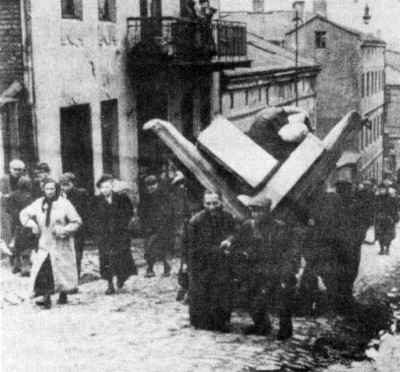
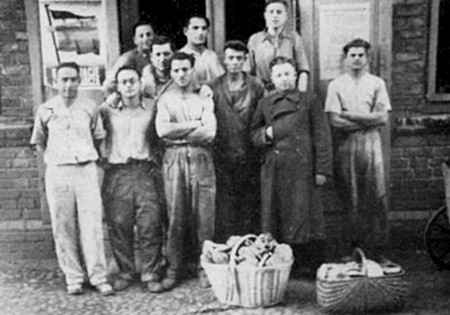
 |
|
|
[Page 232]
by Abrasha Gershuni
Translated by Beate Schützmann-Krebs
February 3, 1943. Dense clouds of a dark, fateful destiny had gathered over our Białystoker ghetto. From the somber hints of the Nazi overseers at the forced-labor sites, we inferred that the fate of a once-blossoming Jewish community of 60,000 souls had already been sealed, that the tragic end was near.
Within us, the youth, there grew a sense of self-worth and the will to fight – not to allow ourselves to be slaughtered like sheep in the slaughterhouse, but to answer fire with fire, blood with blood. The ancient biblical motif, learned and engraved in our memory since the cheder years – the tactic of Samson the Mighty, to die together with the Philistines[2] – now stirred us to fight against the present-day wild beasts, the Philistines of the Third Reich, and, if destined, to fall together with them over their dead bodies.
A terrible night, from Thursday to Friday – black as the abyss, darker than our sorrowful mood – descended upon the ghetto. Child and adult held their breath, so as not to betray themselves, not to deliver themselves into the hands of the enemy. It was silent as a cemetery; a city of Jews awaited the bitter, unavoidable end.
In our house on Khmyelne [Chmielna], however, there was movement. With the greatest caution we brought in the weapons, acids, vitriol, poisons, gasoline, lye, and irons that we had gradually collected. Orders and instructions were issued to the guards of our sector. Outside, too, our comrades stood watch, guarding against Jewish traitors – policemen and lackeys in the service of the Germans – as well as against the German murderers themselves.
We did not close an eye the entire night. We carefully examined the ghetto fences, in case it would become necessary to break through or set the fence on fire. The mood was somber. We lacked ammunition; our small supply was insignificant compared to the death battalion of murderers, armed from head to foot, who had spread out across the city like a camp of black birds of prey, ready to satisfy their appetites with Jewish property, goods, and blood.
Four in the morning. A gloomy dawn broke over the ghetto. The Nazi murderers, together with their Lithuanian and Ukrainian helpers, descended upon our street like an evil storm.
At lightning speed we barricaded ourselves in the attic. We were:
- Lyolek Mints;
- Zolye Dvoretski;
- Srolke Shternfeld,
- Khayim the Weaver (as the partisan Berl Shatsman explained to me in Białystok in 1946, Khayim the Weaver's family name was Glazer),
- Shayke and Yankl Drogotshinski with their mother,
- Motl, with an injured hand,
- Rokhel Roznshteyn,
- Sonye Rozhavski,
- Rivke Khatila,
- Rokhel,
- Karolye,
- Manyele,
- Sare,
- Fride (the last five were girls and women from Warsaw and Łódź),
- and I, the writer of these recollections.
Altogether we were a group of seventeen people.
A large part of us had recently worked in the ghetto factories – the felt factory, the saddle factory – and had refused to go there during the time of the Aktion in the ghetto, although from Judenrat circles we knew that the factory workers were supposedly not subject to the so-called “evacuation.” We did not want to desert our tormented brothers and sisters, but to share their heavy fate together.
The shooting in the ghetto grew stronger and stronger. Through a crack in the wall we observed the movement in the ghetto. Here they dragged Jews out of hiding places - “skhrones” - and cellars; there one heard the heart-rending cries of women and small children. At the moment when the Germans laid siege to our street, the two Gazhaltshani brothers and their sister ran up the stairs to us, shouting: “Jews, save us! Whatever happens to you will happen to us as well – but have mercy, let us in, save us!”
Understandably, it was an enormous risk, for it could have brought the Nazis onto the trail of our house – but how could one refuse to help Jews in misfortune? So we took them in.
The bandits came into our courtyard, searched and rummaged like tracking dogs, found nothing, and left to continue their killing. Friday passed in peace; we escaped with nothing but a fright. From Friday to Shabbat – a night of vigil – we stayed up through the night, keeping watch. To our misfortune, the bandits returned to our courtyard and continued searching. Every minute stretched into an eternity, and we could barely breathe from fear.
A gendarme called out: “We were already here yesterday,” but a Jewish policeman pointed out that they had actually not been in this house.
The robbers came into the house, rummaging through every corner, and we, up in the attic, already held our tools tightly, ready for resistance. They found no one in the house, but then they became suspicious of the little attic door, which betrayed our hiding place.
The murderers approached the door, and their helpers came to assist with hooks and crowbars, tearing at the entrance to the upper room.
[Page 233]
Then came our first response. We poured vitriol down on them – a splash of burning “perfume” onto the face of one of the executioners.
The Nazi, his face burned by the poison, let out a howl like a wounded animal, and the others began shouting even more wildly: “Verfluchte Juden schlagen unseren Kameraden, zum Donnerwetter nochmal!“ [“Accursed Jews are attacking our comrade – damn it all!”].
They all hurled themselves at the attic in furious rage and began shooting, while also tearing at the door and the beam with their hooks and crowbars. The battle had begun.
We answered with everything that came to hand. The attic was riddled like a sieve, and our ring grew ever tighter. Our battlefield shrank from moment to moment. One of our comrades struck one of the bandits on the head with a hook. The attackers became even more enraged.
|
|
The situation grew more serious. Our ammunition had run out. The bandits forced their way up into the attic and dragged us down from there. We could no longer defend ourselves.
Under armed guard they lined us up against a wall, and a bitter interrogation began. Who had poured the poison and thrown the hook? We bit our lips and remained silent. The leader of the bandits then turned to Khayim the Weaver with this tormenting question. He remained mute. A shot tore through the air, and Khayim was already lying in a stream of blood. He was our first victim.
The second to whom the same question was put was Srolke the “lomer” [the lame one], a strong, devoted young man. He too answered with a glowing silence, and a second shot severed the thread of his young life.
Then came the turn of Nisen [Nissan] Gozaltshani. Faced with the executioner's question, it occurred to him in an instant to point to Srolke's dead body. The murderers then halted their devilish investigation and led us away to the assembly point on Fabritshne [Fabryczna] Street.
Then began my wanderings and the seven circles of hell in the camps of Auschwitz, Gross-Rosen, Buchenwald, and Dachau, from which I was fortunate enough to emerge alive. What remained were painful memories and an eternal identifying mark on my body – number 100764 from the Auschwitz extermination camp. Later I learned that from our group there also survived:
- Fanye Rozhavski, a woman from Łódź;
- Karolye, also from Łódź, Auschwitz camp number 34824 or 34832;
- and Nisel Gozaltshani.
|
When Chaika Grossman was active as an emissary of the underground resistance, in the name of Hashomer Hatzair, she also met several times with the head of the Judenrat, Efraim Barash. Once, speaking with Barash about resistance, Chaika Grossman told him about the terrible slaughter the Nazis had carried out in Ponar. In response, Barash said: “I do not believe that what happened in Vilna will also happen in Białystok. I know the Germans – they will not dare to behave here in such a way. They do only what is ordered of them from Berlin… and if they receive such orders, they will let me know. They will not apply the Vilna methods here; they need us. In any case, for now we can live calmly. I am afraid that the youth will do something foolish. Will you dare to take such responsibility? I want to always know in advance if anything is going to happen.” On various occasions Barash warned that one should not organize or carry out resistance against the Hitlerites, because this could endanger not only the lives of the resisters, but also the lives of tens of thousands of Jews in the Białystoker ghetto. Despite everything, however, Barash simultaneously also assisted the resistance groups in their activities, as is recounted in various documents that have remained from that time in the Białystoker ghetto.
(“Jewish Resistance During the Holocaust,” English edition, Yad Vashem, Jerusalem, 1971.)
|
Translator's notes:
by Dr. Sh. Citron
Translated by Beate Schützmann-Krebs
The following account was given by Dr. Sh. Tsitron [Citron], who in Białystok served as an assistant in both the surgical and the Jewish hospital. Dr. Citron endured suffering and torment in a number of Hitlerite torture and extermination camps.
The main goal of the uprising was to take control of that part of the ghetto between Fabryczna, Nowogródzka, and Smolna; to break through the German encirclement; and to lead as many young people as possible outside the ghetto gates and unite them with the partisans.
Difficulties arose already at the very beginning of the uprising, because the Germans had designated the assembly point for all Jews on Jurowiecka and Fabryczna – precisely in the area the insurgents had chosen as the most suitable place for their actions.
Secondly, they had little weaponry and even less ammunition. Thirdly, the concealment of their position was poor, so that the Germans immediately discovered the place where the insurgents had barricaded themselves. The several hundred young people – men and women – stood ready to sacrifice themselves, with great enthusiasm and even greater courage, offering only their unprotected chests against the German bandits.
The uprising began around ten in the morning, with the setting on fire of various objects: a private factory on Fabryczna; the technical workshops; and several houses on Ciepła, Vonzke [Wąska], Smolna, and elsewhere. A house containing a skhron [underground shelter] also caught fire, and the 120 Jews inside were burned to death.
When this part of the ghetto began to burn, the SS withdrew to Kupiecka, into the building of the Judenrat, and called for reinforcements. Within minutes, tanks appeared. When the first tank reached the corner of Kupiecka and Jurowiecka, a mine exploded in the sewer well. The tank itself was not damaged by the explosion, but the others pulled back. The crowd of people who happened to be in the street at that moment hid in courtyards and in the surrounding side streets.
As soon as the tanks withdrew, airplanes appeared and began firing on the population. The first wounded were brought immediately to the hospital, and it was from them that the witness learned what was happening in the streets.
The Germans soon broke open all the fences on Smolna, Jurowiecka, and Chmielna Streets, and began forcing their way into the ghetto. The insurgents had barricaded themselves in the gardens of the Judenrat and in the surrounding places. The group that had to withstand the heaviest assault was the one positioned in the garden of the Judenrat, closest to Jurowiecka. Against this group an SS detachment stormed from the direction of Poleska, while a second detachment attacked from Jurowiecka and Ciepła.
The insurgents defended themselves heroically for as long as they still had ammunition, and they even repelled several SS attacks. In this battle the insurgents were supported by the remaining groups in the neighboring positions. The Germans who stormed the first group fell under crossfire from the adjacent groups and suffered several dead and wounded. They were immediately taken away on sanitary trucks and brought into the hospital.
After a three-hour battle, the Germans dragged the insurgents out of their hiding place and shot them – except for those who took their own lives. Altogether they were seventy-two heroic sons and daughters.
After the first group was liquidated, there was a lull in the fighting until five in the afternoon. Since the SS were not able to gain full control of the ghetto, they merely surrounded it. In the middle of the night, around half past two in the morning, two insurgents made their way through various side paths to the hospital. One of them was wounded in the hand. From them I learned the entire course of events. After receiving the necessary medical assistance, both insurgents returned to their comrades.
The second day of the uprising, the 17th of August, passed almost quietly. There were only a few insignificant skirmishes with the Germans. During these, the insurgents defended themselves in a systematic manner, conserving their ammunition.
On the 18th – the third day of the uprising – the German Białystoker Newspaper fell into the hands of our witness. It contained a notice stating that “bandits have attacked the ghetto, and the German military must defend itself against them, evacuating the population of the ghetto to a safer place.”
That same night another insurgent appeared at the hospital. He reported that he had come to find out what was happening in the city and conveyed that all efforts were being made to find a way to break out of the ghetto. They had even tried to attack the guard at the fence that night, but they had not succeeded.
The witness could see for himself how strong the guard line was: from the gynecological ward, which offered a view over the entire surroundings of the ghetto, one could clearly see that the guard line consisted of three rows.
[Page 235]
The first row was armed with automatic rifles; the second with heavy machine guns; and the third with light artillery – though not in as dense a formation as the first two.
By the 19th of August, the entire ghetto population had already been evacuated. Only small groups remained in the factories; the sick in the hospital, and several doctors – among them the witness. A part of the fire brigade also remained in the ghetto, as well as a part of the ghetto police. The fire brigade occupied itself with burying the shot; while the police began preparing the creation of the small ghetto. The area of Ciepła and Nowogródzka was still in the hands of the insurgents.
During the night, several hundred insurgents made another attempt to break out of the ghetto, but they were driven back with heavy losses.
In the night from the 20th to the 21st, Mr. Rozhanski came into the hospital (both of his sisters were nurses there) to find out what had happened to them. They had already been evacuated. He reported that the insurgents had begun digging a canal through which they hoped to escape from the ghetto.
On the 21st of August, the Germans had already broken open many skhrones [underground shelters]. The Jews they found there were gathered on Fabryczna Street, in the square opposite the Yiddish gymnasium. The Germans also intended to break open the skhrones on Ciepła, Nowogródzka, and Smolna, but they were held back by the insurgents.
On the 22nd, the witness, together with the remaining medical staff of the hospital, was also brought to the assembly point. Under strict guard by the SS and the Belarusians, he lost all contact with the outside world. The witness knows only that during the night of the 22nd to the 23rd of August, there was heavy shooting, which repeated itself again during the day on the 23rd. Those who arrived at the assembly point afterwards reported that the gardens of the Judenrat were surrounded by strong SS detachments, but that the insurgents were still holding out.
On the 24th, early in the morning, the witness was loaded into a freight car together with other victims and taken away to Majdanek.
On the 10th of September, 1945, the witness met his comrade “Yanish,” one of the insurgents of the Białystoker ghetto. He related that the last insurgents, numbering thirty persons, had remained in the ghetto until the canal was completed. This canal led to a house on Smolna Street, which lay outside the ghetto. The insurgents crawled out through this canal during the night of the 26th to the 27th of August, because the exit opened behind the German guard line. They fought their way as far as the railway embankment, and from there they made their way along the highway leading to Supraśl. Near the village of Tshilitshanka [Cieliczanka], beyond Supraśl, they clashed with the Germans.
During this clash, several insurgents fell, among them their comrade Sonye Shmid, who stood at their head; she was the soul of that group of insurgents. The others disappeared into the surrounding dense forests.
It is also worth mentioning that the first train loaded with “Tiger” tanks, which was being sent to the Eastern Front, was blown up by the Białystoker insurgents. Approximately fifty percent of those who were in the forests perished in unequal combat with the German beasts. Those who remained alive received the Order of the Red Star and the Medal of the Patriotic War , and almost all were decorated with the Partisan Medal .
Translator's note:
|
Translator's note:
by Fishl Faynfeld
Translated by Beate Schützmann-Krebs
Recorded by Fishel Faynfeld in Białystok. He lived there until the war, and during the German occupation he remained in the Białystoker Ghetto until its liquidation. Afterward, he survived the concentration camps of Blizyn near Radom and Auschwitz.
The Białystoker Ghetto had been preparing for an uprising throughout its entire existence – an uprising that was to be launched if the Germans showed signs of intending to liquidate the ghetto. For this purpose, underground organizations were formed, drawing into their ranks a large part of Białystok's devoted and courageous Jewish youth.
The members of these organizations were supplied with weapons by the bold men and women – such as Levinska and others – who risked their lives for this sacred goal. The organizations maintained contact with the partisan groups outside the ghetto.
Around August 8, 1943, representatives of the German authorities began making frequent visits to the ghetto. Their long walks in and around the ghetto fence signaled the approaching danger, and the ghetto began to prepare. Skhrones [underground shelters] were built; at every house, guards were posted who, in case of danger, were to rouse the entire population for the impending struggle.
In the event of an “Aktion,” the organizations set as their primary goal the destruction of the factories. In each factory, several trusted comrades had already been placed, waiting only for the agreed-upon code word to begin the planned sabotage.
Unfortunately, the plan could not be carried out. On August 16, 1943 – during the night from Sunday to Monday – the Germans entered the ghetto with heavy machine guns. Their first task was to occupy the factories with well-armed SS men.
Terrible panic broke out in the ghetto at once. Everyone began searching for a way to save themselves from the sinking ship. Soon an order was issued: all Jews living on the streets of Polna, Nayvelt [Nowy Świat], Kupiecka, Białostoczańska, and others were to move to the second section of the ghetto, into the streets of Ciepła, Górna, Fabryczna, and so on.
Thousands of desperate and confused people, driven by fear, pushed and pressed against one another. No one spared the elderly, the women, or even the small, crying children – all in the hope that by obeying the order, they might be saved.
The organization commanded that weapons be taken in hand and that the ghetto walls be stormed, to break out of the ghetto trap. The members of the organization immediately began carrying out the order, setting fire to the streets of Fabryczna, Ciepła, Górna, and others. The panic grew even greater.
The Jews ran back and forth, trying to save themselves from the burning gehenem [hell]. Soon the ghetto fence was broken through on Górna Street, near the tile factory. But escaping the ghetto entirely was impossible, for the Germans were far better armed. The whole ghetto and the surrounding streets were guarded by SS men equipped with machine guns, who fired at the slightest attempt to leave the ghetto.
With no other choice, a large part of the Jewish youth gathered in the garden of the Judenrat on Novogrudzke [Nowogródzka] Street, where they resolved to defend themselves by every means. They first set fire to the large piles of straw that had been collected there, in order to create even greater panic and at the same time alert the partisans outside the ghetto to their uprising.
The Germans quickly understood what the intention was and immediately opened heavy fire in their direction. Seeing, however, the stubborn and courageous fighting spirit of the insurgents, the Germans decided to destroy the nest of resistance once and for all: they drove a tank into the ghetto, and within a short time they had seized a large group of the fighters.
They brought this group to the place where another group of prisoners was already being held. Opposite them, the Germans set up a table, and on it – a machine gun. After these preparations, the SS took four people from among the Jewish fighters and led them down Jurowiecka Street. When they returned, they intended to take out another group of four.
But the others stood up bravely, and with heads held high they cried out in one voice: “Down with the accursed Germans! Down with fascism! Down with Hitler! Down with the German bandits!” They were shot on the spot.
The Germans, undeterred by what had happened, again tried to take out a new group of four – but then the entire group rose, and all as one began to run. Immediately a dense barrage of rifle fire opened in their direction from the German and Ukrainian guards standing around. When the shooting subsided a little, a horrifying sight became visible: the seventy-two insurgents lay in a pool of blood.
Soon a Gestapo officer approached the group that remained sitting on the paving stones and informed them that if they attempted to escape, the same fate awaited them.
Translator's note:
Translated by Beate Schützmann-Krebs
| This list includes the leaders, activists, and, more generally, the participants in the resistance movement in the Białystoker Ghetto. It has been compiled from dozens of eyewitness testimonies, contemporary recollections, notes, and postwar publications. Inevitably, the list is incomplete: for many fallen fighters no information survives, and in other cases their names are unknown. This provisional list also reflects, to some extent, the partisan movement that emerged from the ghetto – the “Foroys” [Forward] detachment. |
| Family Name | First Name | Remarks/Nicknames |
| א |
| Obyedzhinski | Ezra | |
| Abelevitsh | Nokhem | |
| Abelevitsh | Peysekh | |
| Abramovitsh | Hersh | |
| Ahrke | Ahrke der Treger [the Porter] | |
| Ozder, Dr. | ||
| Iglevitsh | Zelig | |
| Ayznshteyn | Anyela | |
| Ayznshteyn | Edzha | |
| Altervayn | Yosef | |
| Olshteyn | Adela | |
| Olshteyn | Khayim | |
| Osovitski | Shaul | |
| Ostrov | ||
| Osyash | Ruzhke | |
| Oskola | Aharon | (Artur) |
| Efres | Khonen | |
| Okon | Mordekhay | |
| Arontshik | Kalmen |
| ב |
| Babiker | ||
| Bonk | Yankl | |
| Bas | Avraham | |
| Bak | Fishl | |
| Baran | ||
| Borovik | Yudl | |
| Borovik | Shepsl | |
| Boraks | Elyohu | (Edek) |
| Bashe | ||
| Bashefkin | Borukh | |
| Bashefkin | Leyb | |
| Bashefkin | Shmuel | |
| Boymats | Simkhe | |
| Bulgar | Khayim | |
| Burak | Itke | |
| Burshtin | Leyn | |
| Burshteyn | Shloyme | |
| Byala | Khaye | |
| Biber | Tanye | |
| Bitenska | Etl | |
| Birman | Tsipoyre | |
| Birntsvayg (Birnboym) | Vatsek | |
| Blum | Khaye | |
| Blumentsvayg | Naomi | |
| Berlin, Dr. | ||
| Berman | Khayim-Yisroel | |
| Berstavitski | Kalman | |
| Berkman | Syome | |
| Brodzki | Nyunye [Nunye] | |
| Broyde | ||
| [2] |
| ג |
| Goladn | ||
| Goldberg | Yitskhok | |
| Goldberg | Moyshe | (Misha) |
| Goldberg | Syome | |
| Goldberg | Elye | |
| Goldman | Yakov | |
| Goldfarb | ||
| Goldshteyn | Arnod | |
| Goldshteyn | Henyek | |
| Goldshteyn | Nisn | |
| Galter | Avraham | |
| Galter | ( A girl) | |
| Garber | Avraham | |
| Gordon | Jack | (Yakov) |
| Gutman | Eydl | |
| Gutman | Khayim | |
| Gutkovska | Manye | |
| Gurnitski | Khayim | |
| Gurnitska | Sime | |
| Gurevitsh, Dr. | ||
| Gzhekhyen | Alek | |
| Gloz | Khayim | |
| Glatshteyn | Yekheskl | |
| Gliksman | Rokhel | |
| Goltshinski | Rokhel | |
| Gefon | Vladislav | |
| Gershuni | Shloyme | |
| Gershtenkorn | Leon | |
| Grayever | Yankl | |
| Grosman | An engineer | |
| Grublyak | Tsipoyre |
| ד |
| Davidovitsh | Dore | |
| Datner | Mika | |
| Datner | Roze | |
| Dorogoy | Feytshe | |
| Dorke | ||
| Dovid | Dovid der Vilner [the one from Vilna] | |
| Dvoretski | Zalye | |
| Dlugatsh | Sonye | |
| Dlugatsh | Pole | |
| Develtov | Sore | |
| Deretshinska | Sore | |
| Dreyer | Yosef |
| ה |
| Holdenderski, Dr. | ||
| Halpern | Moyshe | |
| Halpern | Syome | |
| Halpern | Sonye | |
| Herts | Adela |
| וו |
| Volivtshik | Yankl | |
| Volkoviski | Volf | |
| Vanegeshikt | Yosef | |
| Vanaginski | Yosef | |
| Varshavska | Rive | |
| Viderman | Avraham | |
| Vaynberg | Avraham | |
| Vaynshteyn | Yokheved | |
| Vaynshteyn | Leyb | |
| Vaynshteyn | Kopl | |
| Vays | Meir | |
| Vaysenberg | Henyek | |
| Veytsman | Yokheved | |
| Viltshinska | Gitl | |
| Vyernik | Renya | |
| Visotski | Leyb | |
| Vloshtshovski | ||
| Vrone (Vronek) | Dovid |
| ז |
| Zonsheyn | Rokhl | |
| Zapatshkovska | Tanye | |
| Zaks, Dr. | ||
| Zeyfman | Yekhiel | |
| Zilberberg-Ziskind | Zorekh | |
| Zilbershteyn | Hela | |
| Zisman | Manye | |
| Zelvyanski | Leyb | |
| Zhelazo | Syome | |
| Zhelonogura | Khenokh | |
| Zhelenyetska | ||
| Vaysenberg | Henyek | |
| Veytsman | Yokheved | |
| Viltshinska | Gitl | |
| Vyernik | Renya | |
| Visotski | Leyb | |
| Vloshtshovski | ||
| Vrone (Vronek) | Dovid |
| ח |
| [2] |
| ט |
| Taub | Yokheved | |
| Tanye | ||
| Tartatski | Motl |
[Page 238]
| Teybl | A flegerin [nursing aide]. She came from Vilna. | |
| Tenenboym/Tenenbaum (Tamaroff) |
Mordekhay | |
| Treger | Lyole | |
| Tshapnik | Grishe | |
| Tshapke |
| י |
| Yavorovski | Moyshe | |
| [2] | ||
| Yandzha | ||
| Yankele | Furman [wagon driver] | |
| Yosele | Yosele der Griner (der Groyer) [the Green or Gray one] | |
| Yosem[3] | First brother | |
| Yosema[3] | Second brother | |
| Yoskovitsh | Zoshe | |
| Yofe | ||
| Yakubovitsh | Shloyme-Lozer | (Myetek) |
| Yakubovitsh | Yulek | |
| Yashke | ||
| Yehudit | ||
| Yurkovski | From Krynki | |
| Yedlina | Sore | |
| Yisroel | Yisroel der Stolyer [the Carpenter] |
| כ |
| Khaves | Avraham | |
| Khazan | Avraham | |
| Khalef | Khane | |
| Khoroshukh | Leyzer | |
| Khatskl |
| ל |
| Lobzovski | ||
| Laptshinski | Khayim | |
| Laks | Blume | |
| Lunski | Grishe | |
| Lyonye | Lyonye di Shvartse [the Black-Haired] | |
| Lyontshe | ||
| Layvnt | Nekhome | |
| Likhtnshteyn | Yosef | |
| Likhtnshteyn | Menashe | |
| Likhtnshteyn | Feyge | |
| Lifshits | ||
| Lebyed | Yakov | (Yendzhey) |
| Lev | Khone | |
| Levin | Avraham | |
| Levin | Khane | (Khanke) |
| Levin | Ruvn | |
| Levin-Pat | Sheyne | |
| Levitan | Lize | |
| Levinzon | Hanke | |
| Levinska | ||
| Levinski | Kh. | Der Bibyotekar [the Librarian] |
| Leningradets | Alyosha | |
| Lerman | Lyolye | |
| Lerner | Yakov |
| מ |
| Madeysker | Rive | |
| Matus | ||
| Myodovnik | Yidl | |
| Malinyak | Yisroel | |
| Malmed | Yitskhok/Yitshak | |
| Maler | Petakhya | (Tadek) |
| Malarevitsh | Lilke | |
| Mandel | Hersh | |
| Mandelblit | Leyb | |
| Manela | Hela | |
| Margolis | Bronye | |
| Margolis | Yosef | (Yuzhek) |
| Margolis | Yisroel | |
| Mardetski | ||
| Marmorveg | ||
| Moshkovitsh | Danyel | |
| Mutshnik | Meir | |
| Mulye | Ketshemokh [This nickname could possibly apply to a young coachman.] | |
| Muravyets | Anyela | |
| Meyzler | Avraham | |
| Mints | Lyolek | |
| Melamed | Yakov | |
| Mendelson | Khave | |
| Mersik | Tsvi | |
| Mersik | Bashe | |
| Moyshe | Tate [Father, Dad] |
| נ |
| Novogrudzka | Yehudit | Yudita |
| Novodvorski | Moyshe | |
| Neyman/Nayman | Avraham | |
| Neyman/Nayman | Rokhl | |
| Nirenberg | Helena |
| ס |
| Sobol | Etl | |
| Savitski | Berl | |
| Melman | An engineer | |
| Sane | ||
| Sokolovitsh | ||
| Sarevitsh | ||
| Sukhodnitski | Elyezer | |
| Sukhatshevski | Yone | Sashe |
| Suraski | Hersh | |
| Strikovska | Hinde | |
| Strikovski | Khayim | |
| Strikovski | Misha | |
| Streblanski | Yitskhok | |
| Sivovitsh | Henye | |
| Sivovitsh | Yentl | |
| Sitsh | Fanye | |
| Sirotkin | Hersh | |
| Skhronis | An engineer | |
| Slapak | Moyshe | (Maksim) |
| Segal, Dr. | ||
| Segal | Tanye | |
| Segal | Royze |
| ע |
| Edelman | A girl | |
| Edelshteyn | ||
| Etingold | Dobe | |
| Etingold | Shloyme | |
| Etl | ||
| Elsner [Elster] | Hanke | |
| Epshteyn | Volf |
| פּ |
| Pogorelski | Tankhum | (Tolek) |
| Poznaski | ||
| Pat | Amnon | |
| Pototski | Aharon | |
| Polyak | Rokhl | |
| Pomerants | Ovadya | |
| Poports (Proports) | Sholem | |
| Patsanovska | ||
| Parazovski | ||
| Plaskovska | Menukhe | |
| Petlyuk | Gedalya | |
| Pelts | Henyek | |
| Perelshteyn | Moyshe | |
| Peretska | ||
| Pnina |
| פ |
| Fogelman | Avraham | (Kolya) |
| Fanye | ||
| Farber | Henakh | (Kovadle) |
| Feyrkin | An engineer | |
| Fayerman | Moyshe | |
| Fayershteyn | Stela | |
| Fisher | An engineer | |
| Floymenboym | Hersh | |
| Fleysher | ||
| Fel | Fride | |
| Felder | Zalmen | |
| Frodl | ||
| Franek | ||
| Fridman | Gine | |
| Fridman | Khayim | |
| Fride | ||
| Frenkl | Franke |
| צ |
| Tsviya | ||
| Tsibulski | Shimen | |
| Tselniker | Pinkhes |
| ק |
| Kave | Yosef | (Yashke) |
| Kozak | Nokhem | |
| Kot | Beybe | |
| Katshalska | Basye | |
| Katshalska | Bine | |
| Katshalska | Hinde | |
| Kotshvarski | Moyshe | |
| Kolye | Came from Krynki | |
| Koltun | Hersh | |
| Kon | Khayim | |
| Kon | Nera | |
| Kaplan | Zhenye | |
| Kaplan | Miryam | |
| Kaplan | Misha | |
| Kaplanski | ||
| Kats | Efraim |
[Page 239]
| Koryanska | Osne | |
| Koryanska | Dvoyre | |
| Koryanska | Rivke | |
| Kvart | Yone | |
| Kvarts | ||
| Koyfman | Bela | |
| Kukharevski | Sasha | |
| Kukharevski | Sasha's brother | |
| Kustin | ||
| Kusevitski | Savke | |
| Kuraza | Ester | |
| Kurte | Avraham | |
| Kushnir | Syome | |
| Kisler | Yoel | |
| Kirzhner | Benyomin | |
| Klarfeld | Bela | |
| Kenigsberg | Khane | |
| Knapinska | Sore | |
| Kramazh | Monyek | |
| Kramazh | Ruvn | |
| Krinski | Yudl | |
| Kratsovska | Khave |
| ר |
| Rogozhinski | Kuba | |
| Rozen | Mila | |
| Roznblat | Sore | |
| Roznblat | Felek | |
| Roznblat | Frume | |
| Roznberg | Ruvn | |
| Rozntal | Hersh | |
| Roznfeld | Sore | |
| Roznshayn | Rokhl | |
| Rotbard | Moyshe | |
| Ratker | Roze | |
| Rotshild | Hersh | |
| Ratshiski | Shalke | |
| Ratslav | Benyomin | |
| Rubin | Avraham | |
| Rubin | Leyzer | |
| Rubinovitsh | Zavl | |
| Rubinshteyn | Aharon | |
| Rubinshteyn | Bube | |
| Ruzhke | ||
| Ruska | Mute | |
| Ryol | Sheyne | |
| Riba | Avraham-Nakhmen | |
| Ribalovski | Fride | |
| Ribak | Khaye | |
| Ribka | Yosef | |
| Rayzner | Leyzer | |
| Rayzner | Shmuel | |
| Reznik | Shloyme | |
| Rembishevski | Hersh |
| ש |
| Shayak | Gedalyahu | |
| Shakhnes | Tsilye | |
| Shapiro | Brokhe | |
| Shvarts | Khaye | |
| Shuster | Khayim | |
| Shurik | Bira | |
| Shurik | Hela | |
| Shtifeld | ||
| Shteper | Nakhmen | |
| Shtern | ||
| Shternfeld | Yisroel | |
| Shtroysberg | Khaytshe | |
| Shtshepyatski | ||
| Shayke | Shayke der Tshekhanovtser [the one from Ciechanowiec] | |
| Shlumyal | Lipe | |
| Shlayfer | Benyomin | |
| Shloyme | ||
| Shlenger | Marek | |
| Shmidt | Sonye | |
| Shnayder | Arye | |
| Shedler | Hersh |
|
On 16 August 1943, the Germans began the “liquidation” of the only large ghetto in the east of Poland – Białystok – whose population numbered around 40,000 Jews. On that same day, the ghetto rose up in resistance. The major battles continued until 20 August, when the leaders of the uprising took their own lives in their headquarters. Yet fighting between Jews and Germans continued until 16 September 1943. The conditions in the Białystok ghetto were different from those in the Warsaw ghetto. The Białystok ghetto was not surrounded by a wall, but by wooden fences. The houses there were small and built of wood. This also worsened the [defensive] position of the Jewish fighters: the houses offered no protection against bullets, and yet the fighting continued for many days. On the fourth day of the battles, German armored cars and field artillery entered the ghetto. They were accompanied by about 1,000 SS soldiers and Ukrainian units. The Jews, in turn, fought back mainly with grenades and incendiary bombs; they also possessed several machine guns. A number of Germans and Ukrainians were killed. The Jewish fighters were captured and deported to Treblinka, Majdanek, and Auschwitz. A small group managed to reach the forests and joined the partisans.
(Abraham Foxman, Jewish Combatants of World War Two, no. 1, New York, Spring 1980.) |
|
|
Translator's notes:
Translated by Beate Schützmann-Krebs
The fighters in the Białystoker ghetto obtained weapons from various sources – with great difficulty. But the main source was the “Aryan” side, from where weapons were smuggled into the ghetto by different means. The principal smugglers and energetic liaisons were Kh. Byelitska, Ch. Grossman, B. Vinitska, L. Tshapnik, A. Rud, M. Ruzhitska, and others.
They bought weapons from Poles, and even from Germans and from peasants, who sold them at steadily rising prices.
The path to obtaining weapons for the fighters was accompanied by great danger. They broke into Hitlerite weapons depots, as well as into police stations. Among the tireless – and at the same time modest – women who smuggled weapons in those days was Yokheved Vaynshteyn [Weinstein]. She smuggled bullets and other instruments of death into the ghetto on her own body, under her dress. She also devoted herself with great diligence to preparing materials for demolition.
The resistance forces of the Jews in the Białystoker ghetto numbered around five hundred heroic and courageous members. Among them – as in the central leadership of the resistance – were members and supporters of Hakhalutz, Hashomer Hatzair, Dror, the Bund, Hanoar Hatzioni, Betar, and the Jewish Communists. The representatives in the central leadership from the various factions changed from time to time, but overall the composition of the leadership remained the same. The cooperation of all these factions – in the struggle against the Nazi enemy and in sustaining and strengthening the courage of the Jews in the ghetto – was marked by comradeship.
In its resistance activities, the Jewish fighting organization also carried out broad educational and informational work. This helped strengthen the courage of the Jews in the ghetto; it lifted their spirits. It also influenced both youth and adults, helping them not to break down in the face of Nazi crimes and encouraging them to fight against the Nazi murderers. An important propaganda instrument of the fighting staff was the radio bulletin. It was issued twice a week, in Yiddish and in Polish. Because secrecy was essential, the bulletin was always read aloud by the same comrade and to the same group. The news from the radio bulletin passed from mouth to mouth, and it became a great source of comfort and hope.
The courageous appeal of the Jewish fighting organization in Białystok, issued on August 15, 1943, when the Hitlerite murderers were liquidating the ghetto, had been prepared months earlier. It was said to have been written by Mordechai Tenenbaum-Tamaroff. The distribution and posting of the appeal were also carried out by young girls – practically children – who wished, through this, to make their own contribution to the Jewish resistance struggle against the German murderers.
From the very beginning there was close contact and cooperation between the fighting organization in the Białystoker ghetto and the partisans in the forest. The organization in the ghetto even supplied weapons to the partisan comrades – and, in turn, received weapons from them as well. They also exchanged important information and shared food, as far as this was possible, as well as clothing, medicines, and similar necessities.
The ties between the ghetto and the forest, maintained through the loyal resisters who kept this connection alive, contributed greatly at that time to their joint efforts. From time to time comrades managed to break out of the ghetto; they went into the forest to join the partisans. Later, when the ghetto was being liquidated, the partisan comrades in the forest made great efforts to help rescue Jews from the dying ghetto.
Special groups of partisans were sent out beyond Białystok. They positioned themselves along the railway tracks of the trains that were transporting Jews to Treblinka. These partisans then helped pick up escaped and wounded Jews from the transports and bring them into the forest.
During the liquidation of the Białystoker ghetto in the summer of 1943, tens of thousands of Jews were taken away to Treblinka, Auschwitz, and Majdanek, where they were annihilated. Other Jews from the ghetto were deported, tortured, and tormented in Poniatowa, Blizyn, and in other similar places. Thus came to an end the many-centuries-long chapter of the old Jewish community of Białystok. A number of those who escaped from the Białystoker ghetto – those who at that time succeeded in avoiding the terrible death at the hands of the Nazis – took part heroically in the battles of the partisans against the bloodthirsty enemy.
Translator's note:
Music transcribed and arranged by A. Hirshin
Translated by Beate Schützmann-Krebs
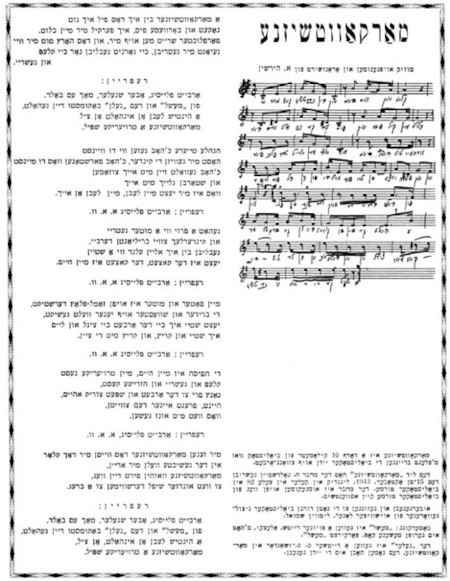
Markovtshizne is a village 10 kilometers from Białystok, where the Jews of Białystok were taken for forced labor. The song “Markovtshizne” was written by its author, H. Goldshteyn, on October 15, 1943, while lying in the cellar, in Cell 82 of the Białystok prison. The author perished on the way from the Białystok prison to Auschwitz. It was transmitted and sung according to these notes by a Białystok survivor of the Auschwitz camp, Shmuel Litvin.
Note: “Meshl” was a German from Poznań, Aletski by name; he was called Meshene Kop [“the brass-haired one”], shortened to Meshl. “Der Geler” [“the reddish-blond one”] was a German S.S. gendarme in Markovtshizne; this was the name given to him by the Jews.
| Yiddish Transliteration | English Translation |
|
A Markovtshizner bin ikh dos fil ikh gut. Naket un barvese fis, ikh ferkil mir mayn blut. Farflukhter shrayt men oyf mir, un dos harts tut mir vey. Geyogt, mir getribn, Bay gornit geblibn Nor bay klep un geshray.
Refrain:
Khanele tayere kh'hob gezen vi du veynst.
Refrain:
Gehat a froy vi a muter getray
Refrain:
Mayn foter un muter iz oyfn zaml-plats dershtikt,
Refrain:
Di tfise iz mayn heym, mayn troyerike nest.
Refrain:
Mir zenen Markovtshizner dos veysn mir dokh klor
Refrain: |
I'm from Markovtshizne – and I feel it's true. Naked and barefoot, I am freezing to the core. They curse me, they shout at me, and my heart hurts. Hunted, driven on, Left with nothing But blows – and cries once more.
Chorus:
Khanele, dear one – I saw how you cried.
Chorus:
I had a wife – faithful like a mother.
Chorus:
My father and mother were choked at the gathering place,
Chorus:
The prison is my home now, my sorrowful nest.
Chorus:
We are from Markovtshizne – that much we know.
Chorus: |
|
|
JewishGen, Inc. makes no representations regarding the accuracy of
the translation. The reader may wish to refer to the original material
for verification.
JewishGen is not responsible for inaccuracies or omissions in the original work and cannot rewrite or edit the text to correct inaccuracies and/or omissions.
Our mission is to produce a translation of the original work and we cannot verify the accuracy of statements or alter facts cited.
 Białystok, Poland
 Yizkor Book Project
 JewishGen Home Page
Copyright © 1999-2026 by JewishGen, Inc.
Updated 17 Apr 2026 by LA