 |
|
|
[Page 221]
by Shimen [Szymon] Amiel
Translated by Beate Schützmann-Krebs
It was nighttime, on August 16, 1943. Dense shadows had spread, like black crows, over the Białystoker ghetto with its 40,000 imprisoned and locked-in Jews. In their black wings they carried the sealed fate of destruction and death for the famed Jewish city with its great Jewish community.
We had barely closed an eye when the black tidings awakened us all and put us on our feet. The ghetto was occupied by military and police – Germans together with Ukrainians and White Russians. Confused by the sudden guard posts, by the uproar of the wild beasts and the sound of gunfire, we ran about as if poisoned, not knowing exactly what was happening. But the posters on the walls, which we began to notice, already made the entire maneuver clear to us. The posted announcements, signed by the Judenrat, cried out in their mute language, tearing pieces from the heart: “Białystok is becoming Judenrein.”
We already saw before us the beginning of the end and decided to carry out the long-planned resistance – to fight with dignity and, if destined, to fall as heroes, not like sheep to the slaughter. At six o'clock in the morning our youth, from the extreme right to the extreme left, had already begun to gather in secret for the battle. A handful in comparison with the overwhelming force of the thousands of Germans, Ukrainians, and White Russians with their machine guns and even tanks.
At nine o'clock in the morning the dramatic resistance began. We had 300 rifles and a few machine guns and grenades. But our strategic position was extremely unfavorable, in the wooden quarter between Fabryczna and Jurowiecka Streets. The Germans immediately threw incendiary grenades at us, and within a short time the entire quarter was already in flames. We fought like lions, but after six hours about a thousand of us had already fallen as victims, and the resistance was almost completely broken.
We now found ourselves directly between the teeth and claws of the predatory beasts in human form, surrounded on all sides by thousands of Germans, Ukrainians, and White Russians.
The Death March
Under a hail of bullets our death march began, from the ghetto to Białystoczek, onto the fields of Pietrasze. They took from us the last things we still possessed and drove us all together into one place, pushing us one against the other, so that hundreds were trampled to death or suffocated in the unbearable crowding. Many lost their senses, others had poisoned themselves, and old people and children fell like flies.
On the second day a “human hunt” began. The murderers started seizing children from six to ten years old under the pretext that they would be given food, but later it became known that they had been taken to Auschwitz and gassed. They took away 1,200 Jewish little children.
I was then together with my wife Lize – from the Glik family (a granddaughter of the bookseller Moyshe Glik of Białystok) – and with our bright little daughter Mirele, then seven years old. The child begged me to save her. I lifted her up into my arms, hiding her within the mass of people from the evil eye of the murderer.
We all let ourselves be driven in a procession of the dead toward the wagons that had been prepared for us. We were hungry and thirsty, four days without water, and the children had to moisten their parched lips with human urine.
By the wagons stood Ukrainians, who with violence tore the men away from their wives and children, and then they also wrenched me away from my dearest and best. I spent the night out in the field together with another 800 Jews. In the morning, the SS, looking for workers, selected 80 people – 70 men and 10 women – among whom I was also found. They took us away from that place and brought us to the Białystoker prison.
In the Białystoker Prison
After the first stage of hell under the open sky, the second stage began for us behind the locked prison bars. They placed us in four cells, men and women separately. Our food consisted of 150 grams of bread in the morning, mixed with potatoes, beets, and other ersatz substances; at midday a portion of sauerkraut; and in the evening a little cornmeal cooked with water. We also received a bit of water to drink, but the blows from the Polish prison guards and the forced labor were unbearable.
On the fifth day they drove us out on trucks, twelve kilometers beyond the city, to a farm called Markovshtshizne [Markowszczyzna], which was said to belong to the police chief of the SS in Białystok. The taskmaster, a Pole from Poznań named Olnecki, a wild sadist, beat us with sticks, boards, and anything else that came to his hand.
The gendarmes would mock us, curse us, and beat us.
[Page 222]
They amused themselves, as a kind of “cruel sport,” by stabbing us in the soft parts of the body, and in this way they injured a young Białystoker boy, Kozak, whose father – a Białystoker printer – had been arrested together with other printers and sent to a camp in Germany.
The hardest work was loading iron bridge parts, which demanded superhuman strength. Incidentally, many of us were poisoned during this work – among them Tevele Vrubel [Wrobel], who was ill for four weeks; Botshkovski, a metalworker and also a jazz musician in the years 1939–1941; and Zilberblat, who had a brick building near Druskin's Gymnasium.
Some of us worked in special workshops – tailoring, metalworking, shoemaking, and other trades – which the SS general had opened at 27 Warszawska Street.
From time to time they also brought more Jews into the prison – people who had managed to hide in bunkers, attics, and cellars during the liquidation of the ghetto, and who were later discovered by the Nazis. Those unfit for labor were shot, and those able to work remained with us.
In this way the young shoemaker Berl Shatsman also managed to save himself.
We Escape from Imprisonment
Things were getting worse for us from day to day. Life behind the bars had become unbearable. The next day was even more obscured and uncertain than the one before – all black and dark – and we decided to look for a way out, to tear ourselves out of this human cage, even if it meant risking our lives, for we had nothing left to lose. The plan was to escape and join the partisans.
Our newly arrived comrade Shatsman, and also our townsman Henokh Lupe, explained that they could establish contact with the partisans through a Christian acquaintance, Yuzhek [Józek], in the city. On 1 November 1943, we managed, fortunately, to slip out of our workplace on 27 Warszawska Street. Under the cover of evening, we fled toward Pyaskes [Piaskes] and Kyovska [Kijowska] Street, until we finally crept, all four of us exhausted, to this Christian.
We were eight comrades: the writer of these lines, Shimen Amiel; Berl Shatsman; Moyshe Grotkovitsh, who had a locksmith's workshop on Nowolipie Lane; Trotski, a son of the manager of the “Modern” cinema and son-in-law of Elboym's youngest daughter from Warszawska Street; Meir Bez, a weaver from Horodok; Henoch Lupe; Dzhakanski; and Itsele, a barber from Łódź.
At the Christian's place, we met with disappointment. He told us that the partisan who was supposed to come and take us had been shot, and that he himself could do absolutely nothing for us. He could not even hide us. For a few hours he had let us into a pigsty, but later he drove us out again, explaining that he did not want to risk his life for us. He told us that they were surely hunting for us from all sides – and this made perfect sense, for the disappearance of eight Jews would certainly set the entire police force on its feet.
From cold, hunger, fear, and nervous exhaustion, our comrade Dzhakanski fell into a persecution mania and kept repeating that we were surrounded from all sides. We could not calm him down.
A frosty night had fallen. Our teeth were chattering, one against the other; hungry, torn, miserable, abandoned in God's world, hunted by human wild beasts, and dependent on the mercy of a cold-blooded peasant, we fell at Yuzhek's feet and begged him to save us. He seemed to have been moved by our pleading – pleading that could have moved a stone – and he promised to lead us into the forest to the partisans.
He gave us signs to follow: we were to pass through one forest lengthwise, another forest crosswise, and then find, among the trees, a broken-down tank where partisans usually passed by. When we saw the partisans, we were to say only two [sic] words: “Marilke sent us.” (This referred to a Jewish girl, Ruditska, who used to connect the forest with the city and recommend new recruits to the partisans.)
At our insistent pleading, the Christian agreed to show us the way as far as the forest.
In the pitch-dark night, by the faint glow of Yuzhek's electric lamp, we slipped out of the city, moving in groups, each separated by about a hundred meters, with our guide walking ahead of us. On the way we lost one another, and after a long wandering we barely managed to find ourselves again on the Baranowicze highway; five of our comrades – together with us – met up again, but the remaining three were missing.
Yuzhek left us at the edge of the forest and disappeared. We were left abandoned, exposed to the cold, frosty night, with no idea where exactly to turn or which way to go. Having no other choice, we entered the forest – and there began for us the third stage of hell. From “prison Jews” we had now become “forest Jews.”
We become “Forest Jews”
Mysterious and ominous, the ancient forest rustled with its icy crowns, shaken by the wicked, cold wind. This primeval womb of nature – which usually serves as a hiding place for beasts from the evil human eye – now had to give shelter to five lonely, homeless Jews, fleeing from wild human predators.
But the question remained whether we would reach our goal: to find the partisans and save our bare lives. Or perhaps the forest itself was also a trap?
[Page 223]
Dark doubts mingled in our confused minds. We followed the gentile's directions. Hungry, frozen, and exhausted, we trudged into the depths of the forest. Our feet and our whole bodies had swollen from the thorny march, and blisters broke out on us, oozing with blood and pus. The skin, together with the nails, peeled off. We walked for three days and two nights without stopping, and we did not find the broken-down tank nor the trail to the partisans.
We encountered twenty peasants in the forest who were also hiding from the Germans. But they were distilling samogonke – homemade liquor – and we were afraid to stay near them. It often happened that even a village peasant would kill a Jew for a pair of boots, and we did not want to stake our lives on it. So we wandered on, without a goal and without a way out.
I had already collapsed from my feet, worn out by the hard march, the cold, and the hunger. I began to have hallucinations – terrible visions of devouring wild creatures circling around me, wanting to annihilate me. My strength left me, and I wished only to be full once more in my life.
Despite the fact that it meant the greatest danger, I dragged myself to a nearby village to beg for a little food. But the peasants drove me away from every side, and I returned to the forest even weaker and with empty hands. Meir Bez advised us to drag ourselves toward Horodok, but I decided instead to go back to Białystok, hoping that one of my Christian acquaintances might perhaps let me in, hide me, and keep my soul alive.
I left my comrades and, with my last remaining strength, dragged myself toward the city, walking from eight in the morning until six in the evening, and I reached my Christian acquaintance in Białystok safely.
Thus began the fourth stage of my hell under the Germans: the wandering through attics, cellars, and pigsties; from one gentile to another, like a hunted animal caught in a prepared trap.
My Christian acquaintance was terrified when he saw me; he thought I was some kind of apparition from the other world, for he could not believe that a Jewish survivor was still alive. He gave me something to eat, water to wash my feet, and let me stay for the night. But at five in the morning he woke me and ordered me to leave the house, because he feared Nazi revenge. I had no choice and had to go.
I then went to several other Christians, but they all drove me away. One young Christian woman did let me into her cellar for a few hours during the day, but at night she sent me away out of fear of her husband, who came home drunk.
She showed me a pigsty where I could hide for half an hour, but the frost was cracking. I felt myself freezing, powerless, beaten down, tormented – and so I let myself out, free and exposed, into the open, into the very fire of danger, delivered over to fate. I could no longer endure this stolen, hunted life in hiding, where there was no day and no night.
Back Behind the Iron Bars
It didn't take long before the gendarmes caught me, and soon I found myself back in the Białystoker prison from which I had escaped earlier. The murderers beat me mercilessly and told me that I would be hanged the next morning. They took the belt from my trousers, the laces from my shoes, and everything with which I might have been able to take my own life, so that they would not be deprived of the pleasure of carrying out the death sentence on me themselves.
I even had a small razor blade in my pocket, and for a moment the thought flashed through me: perhaps I should cut my veins and put an end to this abandoned, forsaken life myself. But at that very moment a spark of hope stirred – perhaps, perhaps there was still a chance; one can never know what the last minute may bring. A single minute in a person's life can sometimes mean an entire lifetime.
Besides, I thought, perhaps someone from my family might still remain alive, and they would forever judge my act as an eternal stain of shame – the deed of a weakling who could not hold out until the end and took his own life, a relative who became a suicide and lost both worlds.
And so I spent a full seventy-two hours in the dark kartser (the prison cellar). It is truly a wonder that I did not lose my mind, but sometimes a human being is stronger than iron.
Later they brought me into a separate little room with the sign: “Strictly isolated.” There it was impossible to sit and also impossible to lie down. One had to stand the entire time – it was that cramped – and I had to endure this for a whole night.
In the morning they drove me out, half-naked, into the cutting wind and frost, out into the prison yard. I thought that this was already my end. But then I noticed another forty Jews who had been dragged together from cellars, attics, and holes. Apparently they still considered us fit for labor, and so they threw all of us back into the prison.
There were also twenty children there, and I still remember some of them even now: a little boy of six, a child of Avraham Neyman; a ten-year-old boy of Nokhum Karp; one or two children of the Lipyets brothers from Grodno. The little children were kept for a few days and then shot. And we, the forty Jews still considered fit for work, remained alive.
[Page 224]
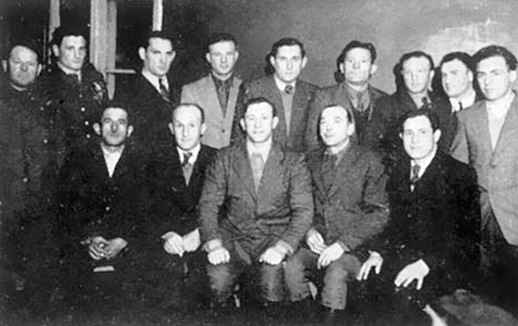
The following are the names of the forty Jews who were together with me in the prison:
A sorrowful case comes to mind: when they brought to us the well-known Białystoker Yudzik, a son of the former kosher-meat contractor on the corner of Polna and Białystoczaner Street, together with his wife – the daughter of Shlomiel, who had lived on Rabinska Street – and her brother. He was among the last Białystoker Jews who had managed to remain in hiding until the beginning of May 1944, concealed in a hole in the former Avnet's bakery on Gumienna Street.
He looked unrecognizable – completely overgrown with hair, with a pair of bulging, terrified eyes. When he saw us, this once-heroic man, this strong, solidly built young fellow, burst into tears out loud like a small child and told us about his unbelievable experiences in hiding.
Our situation in the prison was desperate. We were given extremely meager food rations and were beaten with murderous blows. Our Ukrainian taskmasters forced us to clean up human excrement with our tongues. The torments and humiliations were extraordinary. We had already begun to pray for death, waiting for it as for a long-awaited redeemer.
In the Augustów Forests
And then came yet another day, one far darker than all the ones before. They marched us all into the special transport wagon in which people were usually taken out to be shot, and under heavy guard by gendarmes with machine guns we were led out into an open field near the Augustów forests. They gave us shovels and iron hooks – the kind on which oxen are usually hung in a slaughterhouse. We did not know what they intended to use them for, but we understood that something terrible awaited us.
The field where they let us out was fenced in with barbed wire, and all around stood the gendarmes with their machine guns at the ready, to frighten us from attempting to run.
They ordered us to dig deep pits. At first we thought we were preparing graves for ourselves, but as we dug deeper into the earth, we struck mass graves filled with corpses. These were the Jews of Białystok from the liquidated ghetto. We were commanded to use the iron hooks to drag out the murdered, to lay them in piles like cordwood, to pour tar over them, and to set them alight.
One group dug; another dragged the unfortunate victims; and a third built the pyres from long logs cut from felled trees, upon which the dead were laid and then set on fire. It was the most revolting work we had done until then.
I was among those working at the pyre, and here came my fifth stage of hell under the Nazis – the bitterest irony, something only the devil himself could have devised: to be the burner of my own people. The pain reached to the very depths of my being – that with my wretched, miserable life I now had to sin against the dead, against my own flesh and blood, and carry out this barbaric desecration of the dead, not allowing them rest even after they had breathed their last in martyrdom, sanctifying God's name – and yet I did this dreadful work.
I cursed myself every minute of my servile days under the fiery Nazi lash. I hoped that God and my people would forgive me, for instead of bringing my brothers to a Jewish burial, I had been forced to burn their sacred remains into ash and dust – for I truly had no choice.
Thus we worked for two weeks in the Augustów forests.
[Page 225]
After the holy martyrs had already been burned, we were ordered to sift through the ashes and search for gold rings, watches, teeth, and other valuables that had not yet melted in the fire, and to hand them over to our taskmasters. The ashes themselves were then buried in a deep pit, and trees were planted over it, so as to erase every trace of this Nazi vandalism.
The sun shone, the slaughterer slaughtered, the fire burned, the earth swallowed the life of the murdered six million – and the world remained silent …
|
|
Our Failed Conspiracy
On June 6, 1944, I happened to find a scrap of newspaper and learned that the fighting in Europe had begun. One could already see that the Nazis were breaking their necks – collapsing – and that the evil, bloody game was coming to an end. We felt this ourselves as well. The Germans became even more bestial; they brought us back to the Białystoker prison. The guard around us was increased, we were completely isolated from the outside world, and they warned us that we must not dare to tell anyone what kind of work we had been doing in the Augustów forests. And whoever would let slip even a single word would be shot on the spot.
Two days later, they quartered us on Bojari, at No. 7 Kraszewskiego, in a barrack. Every morning at dawn they would take us out, first near Novosyolke [Navasiółka], and afterward along Zielona Way to Grabówka, to work. There, thousands of Jews had been shot during the liquidation of the Białystoker ghetto.
And while searching among the pits, I came upon two documents: one belonging to our distant cousin, Zalmen Amiel, a son of the former factory-owner Yankl Amiel-Kulikovski; and the second belonging to Finkelshteyn, from the hardware store on Kupiecka, at the corner of Rozhanski [Różański]. The latter had a father and a brother in the United States. Near him in the pit we found a note from America. Apparently, he had hoped to get in touch with his relatives and save himself by reaching America, but death cut off his path.
At the guard post we used to steal newspapers, from which we learned that the Russians had broken through the central front and were drawing closer to us. I understood that the Nazi beasts would not remain in Białystok much longer, and together with five other comrades we decided, at night, to kill the pair of guards near our cell and escape. But the plan did not succeed. It was supposed to happen at the time when they would always tear us from sleep for roll call. But that night they simply did not wake us at the usual hour, and we were unable to accomplish anything.
By Our Own Pit
On July 13, 1944, a Thursday, we noticed an extraordinary change. They packed us into the metal transport wagon and took us out to the field in Grabówka. They ordered us to cover all the open pits with the dead, and we already understood that our work was finished.
Next to each one of us stood a gendarme with an automatic rifle. One of them turned to me and asked: “What will you do to us when we lose the war?” I remained silent. But he himself called out cynically: “The women with the children – you'll take them from us, just as we did with yours, and with us you'll work the way we worked with you. But… don't worry. Before the Russian bandits come, you'll all be lying here dead.”
I understood that this was already our end, only a matter of counted hours.
They explained to us that at twelve o'clock Hauptsturmführer Nachol would come and give the order of what was to be done. Time dragged like tar, every minute practically an eternity. And here it was – the fateful hour, twelve o'clock. It was clear that the Hauptsturmführer, the chief murderer, had arrived.
Of all the pits, one remained open, and this immediately struck all of us. They took from us the shovels and all the tools and threw them into a fire. They took from us our jackets and shirts and ordered us to stand in a half-circle by the open pit, and the sixty gendarmes stood opposite us with rifles at the ready. Then came the command: into the pit, march, sit down.
The Escape Under a Hail of Bullets
Our last minute had struck. The mind was confused, the blood seemed to freeze in my veins, fiery wheels spun before our eyes. But staring the Angel of Death straight in the face, we nevertheless managed to orient ourselves and understand what had to be done. I barely managed to shout: “Comrades, run!” – and I was the first to start running, breaking through the line of gendarmes.
[Page 226]
It happened so lightning-fast that by the time they grasped what was going on, we had already run quite a distance. I still don't know to this very day how we were able to do it – it was simply as if spirits carried us, and the surge of impulse and the will to live drove us on.
Above our heads there immediately swept a hail of bullets, mixed with the cries of the wounded. We had been eighty in captivity, but thirty had been killed earlier, ten died later, and we – the last forty – tore ourselves free between life and death from the Nazi trap. Of these forty, many fell under that hail of bullets. Fresh Jewish blood spattered the soaked, blood-drenched Grabówka.
I, together with five comrades, lightly wounded, ran as far as the highway. This was the sixth hell-stage in my life – a run under a torrent of bullets, chased by the German murderers. Reaching the highway, we truly found ourselves caught in a trap. Rushing toward us, like angels of destruction, came armored cars, and they immediately opened fresh fire on us. We pulled back, but from behind the sixty gendarmes were shooting after us, like hunters running after their prey.
We saw on the field many new bloody victims, scattered and strewn about. We heard how our fellow landsman from Białystok, Yosef Lev, begged the gendarme Marinfeld to spare his life. But the Nazi brute shouted: “You're a Jew – you have no right to live. Marsch – into the pit.” We also saw how the gendarmes dragged the severely wounded into the pit.
Evening fell. On all fours we crawled into a thicket and lay there through the night. At dawn we crept forward again, crawling on our stomachs, until we dragged ourselves to a swamp and fell into it up to our necks in mud. A miracle that we did not drown.
So we lay there for three days and three nights in the freezing outdoors, naked and hungry, without food and without water. Under ordinary circumstances no one could have endured it. But then something inside us broke open – reserves of superhuman strength. On the third day we tried to enter a nearby Polish settlement. But they drove us away, warning that they would set the Germans on us. We barely escaped with our lives.
On the fourth day, thanks to our comrade Yisroel Felder, we found in the forest, on the Napoleonic Tract, a zyemlyanka – an underground dugout. He knew the area from his time as a partisan. We hid in that shelter for fourteen days, ten of them entirely without water. We kept our souls alive only with the few raw peas that we would crawl out to gather in the fields once every three days.
On July 26 we tried to go out again for our food. But we had to turn back, because the forest was heavily encircled. We did not know whether they were Germans or Russians. And then the seventh stage began for us – hungry, naked, homeless, surrounded in the depths of the forest by an unknown enemy.
At last, Salvation Comes
On July 27, 1944, we heard Soviet songs, and we already knew that our liberators were here. We came out of the forest and were received in comradeship by the Red Army, who clothed us, fed us, and brought us to Białystok. After the seven circles of hell under the Nazis, I breathed freely for the first time and once again tasted life.
We were five survivors:
About six months later we also heard that our landsman Avraham Karasik had been found wounded and was living in Russia. It was said that he later came to Białystok.
This was the epilogue to the terrible tragedy – the destruction of Białystok – already after the tragic chapter had been closed: the liquidation of the Białystoker ghetto. We, the last eight survivors, remained to weep over the devastation we ourselves had seen, and to bear witness before the world and before our people to the greatest crime in human history – the mass murder of our brothers.
Let the people of Białystok know it; let our landsleit remember to honor the martyrs of Grabówka, who never came to a Jewish burial, and to erect for them a memorial for all generations and to keep their yahrzeit.
Let the generations remember:
“Remember what Amalek[3] did to you!”
| Do not forget to preserve
the memory of our martyrs! |
Translator's notes:
|
by Shimen [Szymon] Amiel Translated by Beate Schützmann-Krebs The heroic resistance and the defense of the Jews in the Białystoker ghetto aroused great admiration and a powerful echo. News of it reached abroad even at that time. In a report of the Jewish National Committee, dated November 15, 1943, to Dr. Yitzhak Schwarzbard in London – signed by Dr. A. Berman, Yitzhak Zuckerman, and Dr. D. Kaftor (Daniel Guzhik) – the following was conveyed: “We want the Jewish people and the entire world to know that our youth fought bravely for life and for the honor of their people. After the heroic epic of the Warsaw ghetto, we have in recent months witnessed the beautiful, glorious struggle of the Jews of Białystok… On August 17 the liquidation began in Białystok… Heavy fighting took place in several streets. The Germans brought around a thousand gendarmes and SS men, and many units of Ukrainians. The Jews fought mainly with hand grenades and incendiary bombs; they also had several machine guns. They fought with extraordinary determination… In the fighting, several hundred Germans and Ukrainians were killed and wounded… The fierce battles lasted for eight days; armed actions of resistance by the Jews continued for almost a month, until mid-September (1943). The heroic struggle in Białystok will enter history just as the defense of the Warsaw ghetto did.”
(From the book Mordechai Tenenbaum-Tamaroff, the Hero of the Ghettos, volume two, by Nina Tenenbaum-Beker) |
by Shimen [Szymon] Amiel Translated by Beate Schützmann-Krebs Small, constantly darting bandit-eyes – the terror of the Białystoker ghetto. “Friedl is coming!” The Jewish policemen were already chasing everyone off the streets; no one was allowed to stand outside when the bandit passed. Some comrades had more than once resolved to ram the murderer off the road and kill him, but the more cautious ones argued: No – it must not be done; it could bring a great catastrophe upon the ghetto. And so the bandit lived on. On August 16, 1943, early in the morning, the cars with the bandits began to drive into the ghetto. The dog-like SS staff settled into the spacious rooms of the Judenrat. Last of all came Friedl with the higher officers. But he did not show himself; he only issued orders from the courtyard. And when heroic Jewish Białystok began its battle, people noticed the murderer slipping out of the ghetto with his guard. Suddenly, a petard went off not far from him. But by his vile luck he passed through unharmed. After the regular German army had subdued the area, Friedl was seen again with his sarcastic smile. Now the “hero” was once more active – this time against the helpless Jewish children. He gathered up the little children with their frightened eyes. He tore them away from their weeping mothers, whom he assured that the children were being taken “to work.” On Jurowiecka Street he lined them up in groups, looking at them with a sadistic, bandit-like smile. He himself took the machine gun in his hands, and suddenly the cries of the innocent little ones were heard, mixed with the wild laughter of the German officer Friedl. Afterwards he walked along the rows to inspect the results of his deed. Then another group of young girls was brought – they had been captured during the uprising. He looked them over. The young girls, however, looked back at him with contempt. He ordered them to sing, but none of them obeyed. He repeated the order… no one moved.
The “hero” aimed the machine gun; the young ones remained silent. A volley was heard, and our young heroines fell. But the bandit did not stop firing in his rage, even though all of them were already dead. |
by Shimen [Szymon] Amiel
Translated by Beate Schützmann-Krebs
The trial of the Nazi criminal Gustav Friedl took place in the Court of Appeals in Białystok at the end of October 1949. The trial, which lasted several days, heard testimony from around twenty witnesses – Jews who had suffered under the Nazis, as well as others – who described before the court the horrifying crimes committed by Gustav Friedl. Among the witnesses were:
Khatskl Pendzhukh, Avraham Ostroburski, David Koleshnik, Shloyme Blas,Khayim Vrubel [Wrobel], Yisroel Bramson, Mira Knyazev, Efraim Kisler, Fanya Lipinska, Dr. Tobiash Tsitron [Citron], Rachel Zakharyash, Berta Knyazev, and others.
Serving as expert for the prosecution was the well-known historian, scholar, and Białystok Holocaust researcher Dr. Shimen [Szymon] Datner. The prosecutor at the trial was Trembecki[3]; Friedl's defense attorney was Advocate Burak.
In a special correspondence by Y. Bialystotski, writing from Białystok and printed in the New York Bialystoker Stimme (January–February 1950), the trial against Friedl is described, among other things, as follows:
At the appointed hour the hall is overflowing. A hush reigns in the room; people speak in whispers, as if the former lord over life and death of the tens of thousands of Jews of the Białystoker ghetto – and the hundreds of thousands of the Białystok district – were about to enter with all his former power, and not Friedl, who now walks in wearing prison clothes, accompanied by four policemen, and who will now have to give an account of his murderous deeds in the Białystok region.
But the audience is reliving those days of the greatest destruction of Białystok Jewry. The nightmare days hover before them; dozens and hundreds of details of the crimes resurface – crimes that the German murderers, under the leadership of the chief bandit Friedl, committed against the Jews of Białystok and the surrounding area.
And so people sit with lowered heads, waiting for Friedl to be brought in. Quiet conversations arise throughout the hall about those days – days in which the accused decided over life and death of the nearest and dearest: father and mother, brothers and sisters, little children and the elderly, who have long since ceased to be among the living.
Friedl is the symbol of death – the death of all of them, of a quarter of a million Jews of Białystok and the province.
The tense anticipation is broken by the sound of firm footsteps. Four policemen lead the accused into the hall. Jewish faces turn pale; one already hears voices – “There he is… I recognize him… I do too… he has only grown thinner.” Yet there is one thing the assembled crowd cannot understand: how so much bestiality could be contained in a human being, and how he was able to commit so many crimes.
At exactly 9:30 in the morning the judges take their seats. The proceedings begin with the administering of the oath to the witnesses, who on this first day of the trial must give their testimony.
The indictment charges that the accused, as a functionary of the Gestapo in Białystok, committed numerous crimes between November 1942 and 1945, resulting in the killing of thousands of people. As head of the department for Jewish affairs, he was responsible for the liquidation of the Jews of Zabludov – 13,000 persons – the murder of 2,000 Jews in the Białystoker ghetto, many of whom he himself shot; the deportation of 13,000 Jews from the Białystoker ghetto; and finally the liquidation of the Białystoker ghetto (50,000 Jews) and their deportation to the camps.
He personally issued orders to hang, shoot, and kill, through which several thousand people lost their lives.
He is charged with the following: that in November 1942, after Jews from Zabludov and the surrounding towns had been brought to Białystok, to the barracks of the 10th Regiment, Friedl ordered the reduction of their food rations and personally shot thirteen members of the Zabludov Judenrat.
In December 1942 he threw a Jew, who had been brought to him at the Gestapo office, out of a second-floor window. In November 1942 he shot two partisans. In the winter of 1942–43 he hanged three Jews – the father and son Rubinshteyn and Shtshedrovitski – for allegedly stealing oil-seed kernels from the oil factory. In February 1943, during the first Aktion, he shot an eighty-year-old woman in the street because, in his view, she was unfit for transport.
He led executions and took part in the shooting of the 100 hostages as retaliation for Malmed's act. He shot Yitskhok Malmed after the gallows rope snapped and Malmed fell to the ground. On May 4, 1943, he murdered a group of butchers. In May 1943 he shot 150 people who had been seized during the roundup on Bojary. On August 20, 1943, he liquidated the ghetto hospital and personally shot 300 sick people beside the previously prepared pits on Zhabye [Zabia] Street.
In 1943 he murdered the Jews Moyshe Kunitsa, Salomon Warhaftig, Kaplan, and Finkel. In the courtyard of the Gestapo, at Erich-Koch Street 15 (Sienkiewicza), he personally shot three partisans because they refused to stand with their hands raised. In August 1943 he murdered a group of Jews. In August 1943 he took sixty children away from their imprisoned parents and murdered them.
In January 1944 he murdered a group of Jews together with Berkovitsh and others.
[Page 229]
In 1944 he shot a group of lawyers, among them Tileman and Gutman. In the prison he carried out two selections every week, each of which resulted in the death of dozens of people. During a visit to the Grodno prison he shot twenty-five Jews. He terrorized the Jews and plundered their property.
|
|
Concerning the first Aktion in the ghetto, he is charged that, despite the fact that the head of the Judenrat, Eng. Barash, had agreed to deliver 6,000 Jews for transport and had prepared the lists of those to be handed over, Friedl carried out the Aktion in such a manner that 2,000 Jews lost their lives and 13,000 were delivered to the transports to the death camps.
After the indictment is read, the accused gives his statement: he emphasizes at the outset that he wishes to tell only the truth, for he has no reason to conceal it. Yet he admits to nothing. He claims that the Aktionen against the ghetto were carried out by special envoys from Berlin. The first Aktion, he says, was carried out by Günther; the liquidation of the ghetto was carried out by the SS troop leader Glabatznik with military units specially brought in for this purpose.
Several dozen witnesses – we read further in the report – who had left Poland or, for other reasons, could not come to the court, submitted written statements. The court decides not to read these statements or add them to the case files, because the guilt of the accused has already been established through the witness testimony.
Over the course of the two days, sixteen witnesses were heard before the court. They established dozens of facts concerning individual and mass murders that the accused had personally carried out. The witness examinations also showed that, under the leadership and on the orders of the accused, thousands of people were murdered. There was not a single Aktion in the ghetto in which the accused did not take part and did not himself kill. Friedl was known in the ghetto as the executioner; together with him, the Angel of Death would cross the ghetto gate. Children and adults alike would hide in their shelters until he left the ghetto. To encounter the accused in the street meant, in the best case, being beaten – and often death.
In the numerous confrontations between the witnesses and the accused, many orders and commands that he had given were recalled to him – in the German language. He denies everything and admits to nothing, hoping in this way to save his life.
After the closing statements of Prosecutor Grembecki and Defense Attorney Burak, the court delivered its verdict. Y. Bialystotski [Bialystocki] concluded his correspondence about the trial of the murderer of the Jews of Białystok with the following words:
Exactly at 2:15 the sixth and final session of the court begins. The hall is filled to overflowing with spectators who have come to hear the verdict. The court enters. The audience rises, and the presiding judge reads the verdict, which sentences the accused, Fritz Gustav Friedl, to death.
In the reasoning of the verdict it is stated that the accused has been found guilty of the crimes listed in the specific points of the indictment as enumerated in the judgment. His guilt has been fully proven by the nearly twenty witnesses who were heard by the court.
“The verdict,” the reasoning concludes, “is not only against the murderer Friedl, but also against the regime that created such Friedls. And let this be a warning to those who wish to follow in his path. The verdict has been received with approval by the entire society.”
|
|
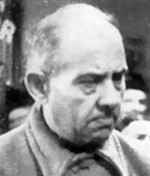
Fritz Gustav Friedel, who was captured and brought to justice |

Translator's notes:
by Peysekh Burshteyn [Pesach Burstein]
Translated by Beate Schützmann-Krebs
Białystok – the second city after Warsaw to rise in such heroism – holds a prominent place in the history of the terrible martyrdom of European Jewry. The Jewish youth of Białystok resolved to mount armed resistance against the murderous enemy.
It is exceedingly difficult, even in thought, to return to those dark days and grasp the vast scope of the tragedy – a tragedy without parallel in human history: not in its scale, not in the number of victims, not in the methods of annihilation, nor in the flood of blood we gave upon the altar of evil.
In utter hopelessness and the certainty of unavoidable destruction, in dreadful loneliness and abandonment by both God and man – locked inside their own ghettos, in overcrowding, filth, and hunger – the Jewish youth prepared for battle.
Now, after a span of thirty years and with full knowledge of the historical record, we can state with certainty that none of the peoples who suffered under Hitler's yoke wrote such chapters of heroism as our own. And this, although none of them faced total annihilation, and none endured such horrific conditions. All of them had a hinterland and support from the surrounding population for their underground struggle against Nazism.
Never, in all of human history, has a people been so alone, so abandoned, and so dependent solely on its own meager strength as the Jewish people during the period of the Second World War.
Everyone knows today how difficult it was in those days to obtain weapons. Even the partisan units – Jewish and non-Jewish alike – were very poorly equipped. In the Białystoker ghetto, Engineer Farber cooked dynamite on a simple tin stove, burning wood beneath it, with the exhaust pipe running out through the window. Ordinary bottles filled with gasoline served as the Jewish fighters' “Molotov” bombs.
On August 16, 1943, the German military and SS units that had entered the ghetto to destroy it were met with heavy fire. The Jewish fighting organization had resolved to sell its life dearly – at a high price. A fiery rallying cry rang out through the narrow ghetto streets: “Do not let yourselves be destroyed! Do not go to your death without resistance!”
Sadly, only a few were armed, because weapons were so scarce. Axes and iron tools were also turned into weapons, and with these they threw themselves against the German beast – armed to the teeth.
The fighting took place at the edges of the ghetto. There was no other choice. The Germans had learned from the uprising in the Warsaw ghetto. They concentrated the Jews in an area where house-to-house fighting was impossible, where one could not move from position to position. It was an area of open spaces, gardens, and wooden houses that offered no protection in battle.
Along the entire length of Jurowiecka Street stretched a dense chain of SS men. They cut off the city side of the ghetto. There was no way back.
The fighting would have to take place at the wires. There the way had to be opened – the way that would give the masses a chance to escape from the encircled ghetto.
The signal for the uprising was given. A flame of revolt rose toward the sky, and at that very moment the resisters opened fire from all their positions on the Germans at the ghetto fence.
At the same time, other members of the resistance set factories ablaze throughout the ghetto. From Fabryczna Street came loud explosions, and flames mingled with thick smoke. The first German murderers hit by the fire called for help. They pulled back behind the ghetto fence and fired with heavy weapons. The fighting spread across the entire section of the ghetto.
“Forward! Forward!” came the cries of the fighters and of the masses nearby – “we have nothing to lose!”
The wooden houses began to burn; the thick smoke choked the air and darkened the light. Ammunition grew scarcer and scarcer – but the battle went on.
The ghetto gate on Fabryczna Street, which had always been kept closed, opened, and a tank drove through it, advancing almost as far as Tshepla [Ciepła] Street. It suddenly came to a halt, struck by a bottle of gasoline.
[Page 231]
An airplane began to fly over the heads of the fighters. It swooped down and fired on the combatants.
The dense chain of black-clad SS men completely cut the crowd off from the area where the fighting was taking place. The fighters were entirely isolated from the masses.
The area was wrapped in thick smoke. Dozens of Germans were dragged away from the battlefield. Dead and wounded “Übermenschen” rolled in the ghetto dust. The shooting grew weaker; the ammunition of the ghetto fighters was running out. The uprising was breathing its last – together with the fighters.
The ghetto continued to burn for several days after we had been taken out to the large square outside the ghetto. Individual fighters, hiding in the ghetto cellars, destroyed everything that might in any way be of use to the Germans.
The vast majority of the ghetto fighters fell in the unequal battle. All those who found themselves in the encircled area fought until their last bullet. The few who did not fall in that hopeless fight withdrew into the previously prepared and well-camouflaged bunker that had been built at the bottom of an old well. Three days later, after all the Jews of Białystok had already been taken away to the death camps, their bunker was discovered. Four-legged and two-legged dogs tracked their traces and led them to their deaths. On Jurowiecka Street, beside a ruined ghetto wall, they were shot by the German murderers.
After the liberation of the city of Białystok, we found their common grave. They had been buried in a garbage pit near the ghetto cemetery. We carried out the exhumation of their sacred remains and brought them to a Jewish burial. We found them with clenched fists, with their sleeves rolled up, with wire-cutters in their pockets to bite through the ghetto fence. Sons and daughters of our people – fallen for our honor.
And by the garbage pit in which we found the seventy ghetto heroes, we found a second pit, and in it were the remains of fifty-five women and infants whom the Germans had taken out of the hospital and murdered. One woman was killed during childbirth. One half of the child was already outside, and the other half was still inside her body. The medical examination carried out by the Polish doctors established that some of the women and children had been buried alive.
We brought them to burial in one large common grave, together with the ghetto heroes. A great monument was erected on their grave, telling that holiness and heroism were united – and so they will remain for generations.
Their common grave and the monument have remained abandoned. There is no Jew left in our Białystok.
And along with this, abandoned too has remained the white marble plaque with the golden menorah, which I unveiled in the building of the Jewish Committee. Written there was:
“The sixty thousand Jews of Białystok,
the two hundred thousand Jews of the Białystok Voivodeship,
the national city, the mother-city of Israel,
the stronghold of Jewish culture –
the city that shone with its institutions of national, religious, social, and economic character,
and with its institutions of medical care,
the city with its wide-branched network of Yiddish and Hebrew folk and secondary schools,
its Talmud Torahs and yeshivas,
its Sholem Aleichem and study libraries,
its Jewish press and theater,
the city of renowned national activists,
of the struggling Jewish proletariat,
of renowned writers, scholars, and artists –
Białystok, which through its heroic ghetto uprising against the Hitlerite murderers
continued the ancient heroism of the Jewish people and its age-old traditions.
The Jewish Białystok that perished in terror, in torment and in fire,
with the holy martyr's death at the hands of the German Nazi murderers –
may these monstrous crimes stand as the mark of Cain upon the German people,
and may the sacred memory of the martyrs
be the tower of light for us and for the generations to come.
We, the remnants of Białystok, will guard their memory forever and continue the glorious
history of the destroyed Białystok.”
The echo of the battle in the Białystoker ghetto carried to the mountains of Israel and stormed across the world:
There shall never again be murder upon our people! Never again shall we rise to the heavens in smoke!
|
|
Translator's notes:
|
|
JewishGen, Inc. makes no representations regarding the accuracy of
the translation. The reader may wish to refer to the original material
for verification.
JewishGen is not responsible for inaccuracies or omissions in the original work and cannot rewrite or edit the text to correct inaccuracies and/or omissions.
Our mission is to produce a translation of the original work and we cannot verify the accuracy of statements or alter facts cited.
 Białystok, Poland
 Yizkor Book Project
 JewishGen Home Page
Copyright © 1999-2026 by JewishGen, Inc.
Updated 5 Oct 2026 by LA