|
|
[Page 206]
by Rafael Rayzner [Reizner]
Translated by Beate Schützmann-Krebs
“At eight in the morning” – Rafael Rayzner continues – “the streets were already in flames: Tsheple [Ciepła] Street, Fabrik [Fabryczna] Street, Nowogródzka, Chmielna, Gurne [Górna], as well as the large hay barns in the Judenrat gardens.
In the streets mentioned, the Jews who had been in the second part of the ghetto had gathered together. But because of the enormous fire, they could not find any place to go. The Jews ran into the Judenrat gardens, and soon twenty thousand Jews had gathered there. But there another misfortune struck them. As soon as the Nazi murderers saw that sudden fires had broken out on all sides of the ghetto, they began the shkhite [massacre] immediately – instead of at nine o'clock, when they had planned to begin. The murderers fired with machine guns from the balconies and windows, from the other side of the ghetto.”
From the shooting, a terrifying panic broke out at once. People trampled one another. Within moments, hundreds of people who had been shot or crushed were already lying on the ground. The tightly packed masses of people had practically nowhere to go, because on both sides of the gardens the houses were burning, and in the gardens themselves the large hay barns – so they threw themselves onto the ground.
Their cries and wails could be heard kilometers away, and the dreadful scenes that unfolded there are beyond the ability of any human pen to describe.
In the courtyard of the former TOZ [Towarzystwo Ochrony Zdrowia – Jewish Health Protection Society] building, where the Jewish hospital had been located, nearly a thousand Jews had gathered, believing that – just as in the shkhite of 5 February – the Jewish hospital would be spared this time as well. But the Nazi beasts opened fire on the assembled crowd from all sides, and most of the people there were killed.
Among those murdered in that courtyard was the well-known children's doctor, Mrs. Segal.
At the same time that the heavy machine-gun fire was opened from the other side of the ghetto, fresh, fully armed Ukrainian and White-Russian Nazis began marching into the ghetto through the gate on Yurovtser [Jurowiecka] Street.
At that moment, when the tanks started to push their way in, hand grenades began flying at them from all sides, thrown by the heroic Jewish youth. From the strong return fire, the leader of the self-defense group, Tadek (pseudonym), was soon killed. Before his death, however, he managed, with his accurate shots, to send a few Nazi beasts to the other world.
[Page 207]
The heroic sixteen-year-old Chava Chalef (sister of Chaim Chalef, the well-known Białystoker woodcarver and artist, who himself fought heroically as a partisan) fell at the very moment she threw her first hand grenade – meeting a hero's death under a hail of Nazi bullets.
The bloody shkhite carried out against the Jews of Białystok was conducted exactly as on a real battlefield.
In the Judenrat building, the leading Nazi staff had taken up position, and on the streets couriers on motorcycles raced back and forth with machine guns and hand grenades in their hands. Special telephone wires with apparatuses were also stretched out, where Nazi murderers stood on constant duty, maintaining uninterrupted contact with the bandits' central command in the Judenrat building.
In the courtyard of the Judenrat there stood a Nazi force of 700 men, making their final preparations for their man-devouring crimes. Besides them, more than a thousand White-Russian and Ukrainian Nazi beasts surrounded the ghetto fence. Several hundred men occupied the ghetto factories, and exactly a thousand bandits stood ready to lead the victims to their places of annihilation – so that in the final liquidation of the Jews of Białystok, a full 3,000 bandits, armed to the teeth, took part.
The murderous fire from outside the ghetto suddenly stopped, and in that very instant the 700 Nazi murderers who had been in the Judenrat courtyard began to pour out, opening a dense fire on the streets and on the houses.
Yet despite the hail of bullets, rifle shots were still being fired from many windows and attics at the Nazi beasts who were creeping along the walls. But it did not take long before they broke through, via Jurowiecka Street, into the Judenrat gardens, where more than fifteen thousand Jews were still gathered. Thousands of dead and wounded were already lying on the ground.
When the Nazis arrived, the self-defense group took up the fight against the Nazi bandits, who were armed to the teeth.
The Heroic Jewish Youth
The heroic Jewish youth fought a battle of life and death. In the place of one who fell, two fresh fighters immediately sprang forward. Our self-sacrificing Jewish daughters carried hand grenades and bullets to the fighters. Not one of them fell before she reached her destination. But this did not stop other heroines from helping to continue the fight.
Abrashe Galter (the son of the spinning-master Galter), one of the most active ghetto fighters, saw in the Judenrat garden how his sister was suffering in terrible torment from a Nazi bullet she had received while carrying ammunition to the ghetto fighters. Unable to bear her suffering, and unwilling that she fall alive into the hands of the bandits, he fired a bullet into her head and ended her heroic life.
Later, Abrashe Galter succeeded in tearing himself out of the ghetto and joining the partisans, where he continued to fight heroically. But during a heavy attack by a larger group of Nazi bandits on a small partisan detachment, Abrashe fell a hero's death.
The heroic resistance in the Judenrat gardens lasted barely half a day and cost the Nazi beasts several dozen dead and nearly fifty wounded. A large part of the ghetto fighters fell in this superhuman, unequal struggle, which they were forced to wage with the most primitive means against such an enormously armed military power.
A certain number of the ghetto fighters later succeeded in escaping, and they continued the fight in various places.
Around four in the afternoon, the fighting in the Judenrat gardens came to an end.
The more than fifteen thousand men, women, and children who, after the shkhite, were still in the gardens were surrounded by the Nazi beasts and, with rifle butts over their heads, were driven through Jurowiecka Street to the Petrasher [Pietrasze] Field, which had been specially designated as a place of torment for Jews – because on that very field they had, together with all the citizens of Białystok, taken part in the October celebrations that had been carried out there by the Soviet authorities in 1939.
After there were almost no living Jews left in the Judenrat gardens, I observed for a long while, from our attic at Chmielna 1 – which was located right next to the gardens – the entire surroundings. It was a horrifying sight. There was literally not a single spot where shot or half-dead men, women, and children were not lying, whose faint voices and groans reached my ears. Those who were still suffering begged for a little water; others cried out with their last strength: “Save us!” Some pleaded: “Shoot a bullet into my head, because I can no longer endure these terrible torments.”
Among the thousands of corpses that lay scattered in the gardens, the belongings of the exact twenty thousand Jews who had been here only a few hours earlier were also strewn about. All of it together created such a sight that one's heart was literally torn to pieces. I do not know whether even after the great battles of the last world wars the battlefields looked more horrifying than the Judenrat gardens.
[Page 208]
Among the heroic fighters who fell in the Judenrat gardens was Velvel Volkovski (the liaison between the partisans and the ghetto fighters, in whose apartment at Ciepła 13 the meeting place of the self-defense members had been located).
At the same time that the fighting was taking place in the Judenrat gardens, a group of Nazi murderers began creeping into Ciepła Street, and right behind them came a fire engine with which they intended to extinguish the burning houses along the ghetto fence. But the members of the self-defense, from the windows and attics, immediately opened fire, which caused great confusion in the Nazi ranks.
The two daring fifteen-year-old comrades, Shmuel Rayzner (son of the writer of these lines) and Nokhem [Nachum] Kozak (son of Hershl Kozak), were at that time in the attic of Ciepła 12. From there, with several accurate shots, they killed two Nazi bandits who were standing around the fire engine. A short while later, they were already fighting in other places.
As soon as it became dark, I crawled out of the hiding place and, not looking at the mortal danger, I crawled – creeping on my stomach – into the neighboring houses. I searched, I rummaged, I called – no one answered. Not a single living soul. But I did not give up, and I crept out toward the gardens, where bullets were flying around like a heavy rain. I crawled over dead and half-dead people, who groaned with their last strength. Next to several dead mothers I found living children, who, it seems, had not been noticed by the Nazi murderers. The quiet whimpering of the children was so tragic that one could simply not bear it.
In several places, older people also called out to me, asking where the nearest hiding places were. I told them in which houses, and two Jews went with me.
Suddenly it began to rain. The enormous fire and the glow of the flames grew smaller, and it began to get dark. The rain grew stronger – a real deluge. On that day even nature itself was against us.
In the dim glow of the dying flames, the appearance of the Judenrat gardens – where thousands of shot and wounded people lay, whose groans could have moved stones – together with the sea of bundles and small packages upon which a deluge of rain had poured down from the heavens, made a horrifying impression. My heart would have had to be stronger than iron to be able to endure all of this…
There were cases in which Jews who had escaped were caught by Polish hooligans, who delivered them to the Nazi murderers. Those who were caught were shot on the spot in the presence of the Poles, who were beside themselves with joy at seeing the Jews being slaughtered.
Because most of the remaining Jews hoped to be able to stay in the hiding places for a longer time – and for that one must, after all, have larger supplies of food – they went out from the hiding places, despite the terrible shooting, to look for food in the abandoned apartments. And most of the time, in the darkness, they would step on bodies torn apart by hand grenades that had been thrown in. After searching like this in deadly terror for a long while, one would crawl back into the hiding places with a little food that had been found.
The Shkhite on the Pietrasze Field
The roughly twenty-five thousand Jewish men, women, children, and elderly – as further described in Rayzner's memoirs – were squeezed into a narrow corner. From the crowding and the heat, one could easily have suffocated there. They were surrounded by three cordons of Nazi bandits armed to the teeth. Directly in front of the Jews stood the Ukrainians; behind them, Latvians and White Russians. The third cordon consisted of actual Nazi bandits, who, with a large number of machine guns, surrounded the field and the highway leading to Białystok and Wasilków, as well as all the surrounding side roads – across a wide area.
The Nazi beasts drove the mass of Jews back and forth. One person fell onto another. Those who fell were trampled by hundreds of others. When the torture paused for a moment, the Nazi murderers would immediately begin shooting into the crowd. The terrible thirst also claimed hundreds of victims. In the quieter moments, the bandits would take from the Jews everything they possessed in exchange for a little water – and even then they often did not bring the water. And when someone did finally bring some, the crush among the desperately thirsty crowd was so great that the water was spilled.
The Ukrainian Nazi murderers, who were standing directly next to the Jews, beat them with sticks and tore the rings from the women's fingers along with the fingers themselves. As an addition to this hell, the sudden, pounding rain that fell so abruptly soaked the broken people to such a degree that hundreds of them remained lying on the field, no longer able to rise.
From a distance one could see how the great fire in the ghetto grew smaller and was already close to being extinguished. And just so, the lives of those who had been driven together onto the Pietrasze field of inquisition also began to be extinguished. The small group of ghetto fighters who were there was likewise murdered by the Nazi killers in a bestial manner.
[Page 209]
On Tuesday, the second day of the slaughter, twenty minutes before seven in the morning, more than eight hundred Nazi murderers drove into the ghetto and, under the same leadership as the day before, established their staff headquarters in the Judenrat building. At a rapid pace, telephone wires were laid in new places, and exactly at seven the Nazi bandits poured out of the Judenrat courtyard and, dividing themselves into tsentlekh [ten-man squads], each with a leader, they prepared – like wild beasts – to make a tiger-leap at the Jews who still remained in the ghetto. But today no one was on the streets anymore; all were lying hidden in the shelters.
At every street corner a designated number of tsentlekh marched off; they received their orders from the leaders who sat at the field telephones. The man–devouring hunt began once again.
A smaller house would be attacked by one squad, and a larger one by two. Turning the apartments upside down, they first took for themselves everything of value, stuffing it into their pockets. When they suspected a hiding place in the house under attack, they began shouting that people should come out; if not, they would immediately tear the house apart. No one answered. The Jews in hiding already knew too well what awaited them – let the beasts do what they wished. Without waiting for any reply, the bandits threw hand grenades, and pieces of bodies of the hidden Jewish martyrs flew through the air.
Over the course of the day, every house was attacked at least ten times, and each time by a different group.
The Living Hell in the Hiding Places
How the ten thousand Jews who still lay in the hiding places felt, when almost every hour their houses were attacked by the Nazi murderers who were lying in wait for their lives, can be told only by someone who lived through it himself.
In a hiding place that might have had room for twenty people, sixty were crowded together. One was practically suffocated from the lack of space. Under such conditions people would begin to quarrel, and this often led to the discovery of the hiding place.
In a considerable number of hiding places there were small children who did not know and did not understand in what terrible situation they found themselves. As children, they would often begin to cry – and then the few Jews who were in that hiding place would become victims. Everyone's nerves were stretched to the highest degree, and what iron strength the hidden Jews had to possess in order to endure all of this! Many truly could not bear it any longer and ended their own lives.
The sorrowful total of the second day of the shkhite was this: with the help of various technical means – such as listening devices, tracking dogs, and so on – the Nazi bandits dragged two thousand Jews out of the hiding places. Some of them were shot on the spot, and the rest were taken to “Linas Hatzedek” which served as the collection point for the victims discovered during the day. From there they were taken, toward nightfall, to Pietrasze.
On that day the Gestapo shot Yakov Goldberg, the head of provisioning in the ghetto.
On the same day, the workers who had found temporary shelter in the cartonage factory were dragged off to Grodno, and from there they were transported in hermetically sealed trucks to the Łomża prison. On the way, several suffocated. A short time later the group was deported to the Stutthof concentration camp.
Thanks to the fact that among them there was a considerable number of tailors, who had the possibility of working at their trade in enclosed, heated workshops and receiving better food, nearly twenty men from the group of seventy succeeded in saving themselves.
The small group of Jews who were still working in the ghetto for the Nazi murderers received an order on the second day of the shkhite that tomorrow, Wednesday, one part of them was to go repair the burned sections of the ghetto fence, and the others, together with the Jewish wagon drivers – of whom only a small number still remained – were to go gather and bury the thousands of victims who lay scattered across the streets and gardens.
With this, the second day of the shkhite came to an end.
Just as on the first day, at six in the evening the Nazi murderers left the ghetto, and the terrifying shooting began. When it became fully dark, shadows began to crawl out of their hiding places, and, dragging themselves on their stomachs toward the abandoned houses in the neighborhood, searched for food, kerosene, light, and matches.
While one was busy searching in the darkness, several more Jews would suddenly slip in, and with their arrival throw deadly terror upon the Jews who were already there. When people later talked it over, they learned from one another that the Nazi bandits had, on the previous day, uncovered many hiding places, had removed the electric fuses, and had shut off the water in the houses, so that the hidden Jews would be forced to make fires on the stoves and to haul water from distant wells – making it easier to discover them from the traces they would leave behind.
After this realization, people began to pass the word from one to another that they should stock up on water only at night. Those who could still get by should, for the time being, not cook; and those who had to cook should do it in an abandoned apartment, and not too close to any place where there was a hiding spot.
[Page 210]
The remaining group of zelbstshuts [self defense] members in the ghetto also made several attempts during the second night to break out of the ghetto. Each time, however, they left several victims behind and, with deep bitterness, had to retreat. Attempts were also made to dig under the fence, but these too failed.
At two o'clock in the afternoon several S.S. leaders arrived at the Pietrasze field together with the man-devourer Friedl at their head, and ordered that everyone was to line up immediately. But no one wanted to stand in the front rows, and a tremendous pushing and heavy tumult began. Suddenly bullets began to hail down, which made the panic even greater. One of the bandit leaders ordered the shooting to stop and demanded that the Jews calm themselves and line up properly; otherwise, everyone there would be killed. His words had an effect. After a few minutes, the tormented crowd of condemned people had calmed down.
The robbers' commission passed along the rows that had been formed. In their hands they held sticks with curved handles, which they hooked over the necks of the stronger and younger ones, pulling them out of the rows, because they wanted to squeeze the last bit of strength from their bones through further slave labor. Those who did not want to part from their wives and children were struck several times over the head with the same stick, and, swollen [and beaten], they had to leave behind their dearest and most beloved.
At the same time that one commission was busy selecting the stronger ones, a second one dragged out the elderly and the weak, who were driven up onto the prepared wagons and taken to the ghetto cemetery. There the Jewish firefighters, on Friedl's orders, had already earlier dug a large number of pits, ten meters long, two meters wide, and three meters deep.
When a few hundred Jews would be brought to the cemetery, soon that man-eater Friedl would come flying there in his car and immediately order that the Jews be chased toward the pits. When the exhausted victims stood at their open graves, the first shot from Friedl fell. After him, from the group of Nazi robbers, a hail of bullets followed.
Those struck dead fell into the pit. Those who were still holding on – the robbers ran toward them, threw them into the pits, which were immediately covered over.
On the Pietrasze field there were also Rabbi Dr. Rozenman with his wife and both daughters. They immediately understood that the older people were being taken into the ghetto, and they quickly shaved off their father's beard.
A few hours later, accompanied by a Gestapo murderer, Kommandant Markus came to the Pietrasze field – he still had a certain amount of authority – and he arranged that Rabbi Dr. Rozenman and his family should be allowed to leave the Pietrasze field.
From the people standing nearby, voices and crying began to rise: “Mr. Komendatshe, Mr. Markus, take us with you too, save us.” Markus, with tears in his eyes, answered them that he could not save everyone. But he did take several more out of the rows and brought them with him to the Judenrat building, where more than fifty Jews were already gathered, people whom the murderers still needed for the moment.
The Rescued Children
The same Nazi commission that selected the young and strong for labor and led the elderly and weak into the ghetto to be shot announced that children up to ten years old should be taken out of the crowd, because they would be sent to other places where life would be good for them. The parents of the children hesitated and had no trust whatsoever in the refined promises of the robbers. But since, in any case, there was nothing left to lose, a great number of parents, with breaking hearts, took leave of their little children and handed them over into the murderers' hands.
1,200 children were brought back into the ghetto. They were placed in a building on Fabryczna Street, across from the TOZ hospital, and in those uncertain times much care was given to them.
Together with the children, several dozen women also went along, who undertook to keep the children in order and to do everything so that they would lack nothing. That was the will of the Nazi murderers.
The small group of Jews who still remained in the ghetto and enjoyed Gestapo protection also made sure that the children would lack nothing.
Accompanied by a Gestapo man, the director of the shoe factory, Liberman, also came that same day to the Pietrasze field. He needed several dozen shoemakers to help pack up the machines and the goods from the factory.
Hundreds of hands reached out to him, begging him to take them out of hell. But the Gestapo man did not allow him to take more than thirty people.
Over the course of the day, the so-called “unfit for work” from the Pietrasze field were taken to the train station. There they were driven into sealed freight cars, which had been boarded up with planks. On the second day they were already in Treblinka, where they were gassed and burned.
[Page 211]
Exactly as on the previous day, tens of thousands of men, women, and children were again driven back and forth in a narrow corner. After each round of running back and forth, hundreds of trampled people remained lying on the ground. Whenever the chasing paused for a moment, the murderers fired into the mass of people. The heat was intense at that time; hundreds of people fainted, and there was not a drop of water to revive them. As soon as it became light, one could see that hundreds lay across the field – suffocated, shot, and fainted. The last ones never regained consciousness.
This is the sum total of the second slaughter night on the Pietrasze field.
The 800-man gang of bandits brought with them on the third day of slaughter axes, crowbars, and saws, with which they tore apart the houses where they suspected that hidden Jews were living. When they caught someone, the murderers, with a robber's coldness, would slaughter their victims with the axes and crowbars.
On that day Jews began to crawl out of their hiding places. They realized that because the electricity had been cut off and the water shut down, they would in any case no longer be able to hold out. And so, on that day, about 300 Jews voluntarily gave themselves up into the Nazi murderers' hands.
Translator's notes:
by Rafael Rayzner [Reizner]
Translated by Beate Schützmann-Krebs
Raphael Rayzner, himself both victim and witness to those tragic days for the Jews of Białystok, also recorded with exacting precision the heroic and truly superhuman courage of the Jewish youth in their struggle against the Nazis. The same was true in the ghetto, among the desperate Jews, when the Nazi murderers carried out their final liquidation and the deportation of the Jews to their deaths.
On Jurowiecka Street, not far from the fence, there was a hiding place where a group of eighty members of the zelbstshuts [self-defense] was concealed. They had prepared to attempt a breakout from the ghetto, weapons in hand. But someone noticed them, and at two o'clock in the afternoon they were suddenly surrounded by more than one hundred bandits. A battle of life and death began. The heroic Jewish youth fought like lions, and more than one Nazi murderer fell from their bullets.
After a bitter three-hour battle, when seventy of the eighty heroes had already been killed, several Nazi robbers managed to approach the hiding place. The small handful who remained alive put up a final, desperate resistance, but they were overwhelmed by hand grenades and bullets. When the Nazi robbers climbed down into the hiding place, they hacked and tore apart the bodies of the heroic fighters with their axes and crowbars.
The sorrowful sum total of the third day of the shkhite [slaughter] was this: about one thousand Jews were discovered that day. A small number were murdered on the spot, and the rest – to Treblinka.
According to the Gestapo order issued the previous night, on Wednesday, the third day of the slaughter, a considerable number of Jews serving as wagon drivers were required to gather and transport the martyrs to the ghetto cemetery. These same wagon drivers also transported the victims from the Pietrasze field. In addition, the Nazi Ukrainians threw onto the wagons all those who had fainted, ordering that they be buried together with the dead.
Several of those who had fainted regained consciousness on the way and began begging the wagon drivers to let them down from the wagon. But the wagon drivers could do nothing, for they were accompanied by Ukrainian Nazi bandits, who forced them to throw the living Jews into the freshly dug pits together with the dead.
On Friedl's orders, the number of grave diggers at the ghetto cemetery was increased. The graves, however, had to be dug symmetrically and with exact precision, because every few hours Friedl would come running to inspect whether the work was being done properly. When he once had the impression that one of the diggers was not working precisely enough, he shot him on the spot, telling the others that if they did not work properly, they would meet the same end.
Because the Gestapo wanted to remove the machinery and goods from the Białystoker ghetto in the shortest possible time, they increased the number of workers. Since these workers were not allowed to remain in their former dwellings – from where they would have been dragged away together with other discovered Jews – and since the Gestapo still needed their labor, it ordered that at dawn on Thursday a certain number of workers should erect a fence around the TOZ building and the adjacent houses. This was to become a temporary small ghetto for the Jews who were still in the ghetto and who were helping the Nazi murderers remove everything from the factories.
As in the previous days, exactly at six in the evening the shooting in the ghetto began again, and once more, in the darkness, Jews crawled out of their hiding places to prepare a little food and water.
[Page 212]
When several Jews happened to meet somewhere, they spoke about the events of the day and about the heroic death of the eighty members of the self-defense group. They also mentioned those with whom they had still been together only yesterday, and who were no longer among the living today.
The situation in the hiding places grew more desperate with each passing day. Everyone felt that today or tomorrow he might be discovered. Faced with this terrible, catastrophic, and hopeless reality, Jews spent the nights digging new hiding places to which they could escape if the ones they were using until now were uncovered. An ocean of sweat and blood was poured into this difficult and dangerous work.
On the third night of the mass slaughter, a fire broke out on Kupiecka Street, not far from the building of the Judenrat. A two-story house standing close to the Biała River burned down. In its hiding places, twenty-six Jewish souls were burned to death.
All attempts to determine the cause of the fire were unsuccessful, and it cast a wave of terror over the several thousand Jews still in hiding. People feared that the Nazi bandits intended to liquidate the hidden Jews of the ghetto in this manner.
On Wednesday, August 18, 1943, the removal of the Jews of Białystok from the Pietrasze field began and was almost completed. Most of them were taken to Treblinka. Together with the later transports, about ten thousand Jews from Białystok were deported to Lublin, Ponyatov [Poniatowa], and Majdanek.
On the Way to Annihilation
Before the unfortunate people were taken away, an SS general from Markovtshizne [Markowszczyzna] arrived at the Pietrasze field early in the morning, accompanied by several Gestapo officers. From the three thousand Jews capable of work, he selected more than one hundred skilled specialists, who were taken to the Białystok prison, from where they were brought out each day to work in Markowszczyzna.
At twelve o'clock in the afternoon, the so-called “unfit for work” were lined up in rows of five and driven toward the train station. Behind them, in the same formation, came the group deemed fit for work. At the station they were driven into the first twenty freight cars, whose doors were immediately barred and locked.
Once the group deemed fit for work had been dealt with, the “unfit for work” were driven into the rear twenty cars. Their doors, too, were immediately barred and locked.
On the roof of each car a Nazi Ukrainian climbed up with a machine gun.
As the Jews condemned to death were being driven into the freight cars, a considerable number of them tried to resist, and some even managed to seize weapons from a few of the bandits. But the beasts immediately opened a terrifying fire, and dozens fell at once, shot or wounded. Under a hail of brutal blows, the entire crowd was forced into the cars within moments. Shortly afterward, the train departed in the direction of Warsaw.
From the terrible overcrowding and the heat, a considerable number of the unfortunate people were soon suffocated. One person trampled another. The cries rose to the heavens. The Nazi beasts sitting on the roofs kept firing endlessly into the cars. With every burst of gunfire, the screams and wailing grew even louder. Each time they fired, several were killed and many more wounded.
Those who dared, in utter desperation, to jump from the moving train were immediately fired upon from the roof. And even if someone managed to escape the bullets alive, he was still far from salvation. Along the entire length of the railway line from Białystok to Treblinka, armed Nazi murderers were stationed, and from their hands most of the Jews who jumped from the train did not escape alive.
At the Malkiner [Małkinia] railway station, the train would stop, because from there the specially constructed branch line to Treblinka began. The last twenty cars, the ones carrying the so-called “unfit for work,” were uncoupled. A second locomotive immediately arrived, was attached to these twenty cars, and began pulling them toward Treblinka.
In that “Treblinka train,” terrible screams and wailing broke out at once. They were even heard in the other twenty cars [– the ones with those deemed fit for work –], where a heartbreaking crying began. With every passing minute, the cries from the Treblinka train grew weaker and weaker, until finally the train disappeared into the dense forest.
After the Nazis had finished dealing with the Treblinka train, they went on to inspect the remaining twenty cars that were to be taken further. In several of the cars they found cut-through openings in the walls. They dragged ten Jews out of those cars, shot them before everyone's eyes, and warned that if they found any more such openings, all would be shot.
The cars were then tightly sealed again.
The guard was further reinforced, and only then did the next stage of the infernal journey begin, which lasted more than two full days.
During that time, in every car a considerable number of Jews were shot or suffocated, and people had to crawl and sit on their bodies. They were also forced to relieve themselves inside the sealed cars, and the air became almost impossible to breathe.
[Page 213]
When the scarcely three thousand Białystoker Jews had barely dragged themselves alive to Lublin–Poniatowa, they were quickly driven onto the roll-call square, where the camp commandant Tuman – the very same murderer who had directed the shkhite [slaughter] of the Białystoker Jews – inspected his slaves while riding on a white horse, and immediately shot many of them on the spot.
On the fourth day of the shkhite, the Nazi murderers set about applying a new method for discovering the hidden Jews.
In the houses they had surrounded, they would search and probe for half an hour, and not seldom even for a full hour. Afterwards, almost all of them would leave the house with firm steps. The two murderers who remained behind kept so completely still that none of the Jews hiding inside heard the slightest rustling.
The hidden Jews, who had barely been able to wait for the moment when the Nazi robbers would leave the house, would breathe more freely; movement would begin in the hiding place, and some would start to cough. One of the two Nazi robbers, who had listened to all this, would then run off in that silent moment to bring back a larger group of Nazi beasts, who would immediately attack the house from all sides, shouting to the hidden Jews that they should crawl out at once – otherwise all would be killed.
The sudden, unexpected attack would throw the Jews in the hiding place into confusion, and they often paid no attention to the shouting, for they knew very well that whether they came out or not, they were already lost.
The Nazi robbers would throw several hand grenades into various parts of the house, and in this way they would manage to uncover the entrance to the hiding place. There they would again throw in several hand grenades. Among the hidden Jews a terrible panic would break out. In most cases the entire hiding place was torn open. Inside already lay a considerable number of torn-apart men, women, and children. The survivors were dragged out and beaten murderously, with the accusation that they had not crawled out of the hiding place at the first command.
After carrying out a thorough search of the victims, during which the beasts would seize their money and jewelry, they were driven to the “Linas Hatzedek,” from where they were no longer taken to Pietrasze but directly to the slaughterhouse, and from there they were dragged that very evening to Treblinka.
Through this devilish method, more than two thousand Jews were uncovered in their hiding places on the fourth day of the shkhite, among them a considerable number of members of the self-defense group, who, just like all the others, were attacked so suddenly that they had no possibility whatsoever of offering even the slightest resistance.
Once again there were regroupings among the already very small number of remaining self-defense members, who were in despair and saw no way out of the terrible, catastrophic situation. Some of them tried, under cover of night, to crawl toward the fence and dig their way under it, but only one or two succeeded in tearing themselves out of the ghetto in this way.
Most of them were shot at the very beginning of their risky attempt.
The Heroes Shot on Chmielna
On that same day, the group of self-defense members who had been hiding on Chmielna was also discovered and shot. It was around noon. From a distance one could hear the heavy steps of iron-shod boots. A few seconds later, through a chink in the hiding place at Chmielna 1, one could already see a large number of Nazi robbers spreading out exactly as if on a battlefield, with rifles at the ready and hand grenades at their sides, as though prepared to launch an assault on a nearby enemy. Behind the robbers came a vehicle with heavy machine guns and a special car carrying the commanding officer.
The entire scene made a terrifying impression. One's heart nearly stopped from fear, and before one could even look around, a heavy gunfire broke out, followed immediately by the explosions of hand grenades, mixed with the loud cries of a large number of people. It did not last long before the heavy steps of the robbers were heard again, leading a larger group of Jewish boys and girls with their hands raised high, their faces pale as chalk. A few minutes later, from a distance, one could already hear the singing of revolutionary songs.
How the hiding place was discovered – a hiding place in which a considerable number of weapons had been stored and which had been very well camouflaged (its entrance led through a well) – remained a great mystery to those who were still in the ghetto at that time.
Two versions circulated. One said that the Nazi murderers had noticed steam rising from the well and began searching the area intensely until they succeeded in determining that the well concealed an entrance to a hiding place. The second version held that an insider had betrayed the hiding place, for never before had such a large number of heavily armed robbers been concentrated around any other hiding place as around this one; presumably they had been informed that a sizeable group of armed self-defense members was there.
[Page 214]
The sudden attack on the above-mentioned hiding place came so unexpectedly for the self-defense members lying there that they were unable to offer any resistance whatsoever and therefore all fell alive into the murderers' hands.
An SS man dragged out four members of the self-defense group and ordered them to walk. The four ghetto fighters began shouting anti-Hitler slogans. At once a hail of bullets was fired at them. In that moment the entire group began to scatter. But directly in front of them stood, on a table, a projectile-thrower, from which the murderers opened a terrifying fire. Within seconds the entire group had already been riddled with Nazi bullets.
When the heroically fallen were laid onto the wagons, it turned out that the seventeen-year-old Kukharevski (brother of Syamke Kukharevski, who had been killed during the uprising in the weapons factory) had survived by a miracle. He begged the robbers – he was young and wanted to live. But the beasts answered him with several bullets to the head. As a corpse they threw him onto the wagon together with his remaining comrades.
The Jewish volunteer firefighters, who had been digging up the mass graves of the brothers in the ghetto cemetery without interruption, came upon a very well-camouflaged hiding place in which several dozen Jews were lying. The firefighters camouflaged the hiding place even better and, throughout the time they worked there, helped the Jews inside in every way they could.
On the fourth day of the shkhite, the remaining Jews from the Pietrasze field were taken to the train. Under the same terrible circumstances as their brothers and sisters, they were dragged to the gas chambers of Treblinka.
On the Pietrasze field there still lay hundreds of the shot and suffocated, who were taken away by the Jewish wagon drivers to the ghetto cemetery. It often happened that, when laying the martyrs onto the wagons, some of the drivers recognized among the dead their own fathers, mothers, or children, and heartbreaking scenes would unfold. More than one of them, in overwhelming shock, committed suicide shortly thereafter.
The explosions of the grenades thrown at the hidden Jews in the uncovered hiding places, and their cries, spread terror among the remaining Jews in the ghetto. When it had become fully dark, even the bravest were afraid to crawl out in order to see what had happened that day and at the same time prepare the most necessary things for the following morning. Only around midnight did a few daring young people begin to creep from the hiding places. When a group of Jews from various streets gathered, each learned from the other what kind of destruction the Nazi murderers had carried out in the ghetto that day. Many with whom they had spoken only yesterday were no longer there today.
According to the reckoning they made among themselves, the number of Jews still in hiding after the fourth day of slaughter did not exceed about two thousand. After this realization, a deep sadness settled on their hearts, and a terrible mood of despair took hold of everyone.
Among the Jews in Hiding
The main meeting place for the Jews who crawled out of their hiding places at night was the garden of the Judenrat, which lay between Nowogródzka and Jurowiecka Streets. There they would learn everything that had happened and at the same time discuss among themselves what precautions they needed to take from then on.
The hungry Jews from the hiding places would, in those dark nights, tear out tomatoes, cucumbers, and other vegetables from the Judenrat garden. Had the Nazi beasts not dragged away full truckloads of produce from there, the garden could have fed hundreds of Jews for quite some time.
After they had established in their conversations the methods the Nazi murderers had used on the fourth day of the gruesome shkhite, they agreed among themselves that during the day everyone should sleep, except for a few who had to stand watch, and that cooking and eating should take place only at night. In this way, they hoped it would be easier to protect themselves from the various tricks of the robbers.
This idea indeed greatly hindered the Nazi robbers in their devilish work of uncovering the hidden Jews.
Toward two o'clock at night, two more fires broke out in the ghetto. Since no one could determine the causes, this spread terror among the several thousand Jews still in hiding, who feared that the Nazi robbers were setting fire to the houses in which they suspected Jews to be hiding.
On Friday, August 20, the fifth day of the slaughter, the Nazi murderers liquidated the more than two hundred patients together with the doctors and nurses of the Jewish hospital.
The severely ill were thrown by the Nazi beasts onto two military two-wheeled wagons that had been set up in two rows. Those patients who were still able to take a step were driven into the space between the wagons. Under heavy guard, and under the command of Friedl, they were driven to the Shabye [Żabia] cemetery.
Almost all the patients knew that this was their final road. Their weeping and cries rose to the very heavens.
[Page 215]
When they reached the cemetery, the order came from the blood-thirsty beast Friedl that all were to line up at the graves. He himself ran to a machine gun and opened the first fire. After him, the Ukrainian Nazi robbers began shooting at the sick with several machine guns. Within ten minutes the more than two hundred martyrs were already lying in the graves.
After finishing with the hospital, the Nazi murderers took a long break and then once again spread out across the ghetto. In squads of ten, exactly as on the previous day, they sat for a long time inside the apartments and then left with heavy steps, leaving two robbers behind in each house. On that day they succeeded in uncovering only about two hundred victims, because the Jews had learned from the mistakes of the previous night.
The captured Jews were brought to the ghetto cemetery, where most of them were shot by Friedl.
Among the two hundred martyrs were several members of the self-defense group. One of them attempted to throw himself at Friedl, but he was immediately struck down by a hail of bullets, and the beast Friedl continued murdering.
The fifth day of the shkhite claimed about four hundred victims – two hundred from the hospital and two hundred from the hiding places.
The fence that several dozen Jews had begun building around the small ghetto was already completed on the fifth shkhite day. The Jews who enjoyed Gestapo protection brought into it the food supplies of the Judenrat. On the grounds of the small ghetto they also found an active bakery. These “fortunate ones” hoped to be able to stay there for a longer time and survive. These hopes, however, were very quickly dashed.
The 1,200 children who had been taken from Pietrasze were placed in several houses on Fabryczna Street and lived there under not bad conditions. They had enough food from the Judenrat warehouses. A large number of women looked after them, and they were also treated by several doctors.
Late in the evening, when people gathered in the Judenrat garden, they learned everything that had happened during the day and established that, thanks to the precautionary measures they had adopted – sleeping during the day and similar steps – the robbers had discovered very few Jews that day.
But they spoke with fear about a new calamity.
At night, civilian Polish hooligans slipped into the ghetto, crawling over the houses to steal Jewish belongings and goods. It had already happened that, while someone was inside a house searching for something to eat, such a man suddenly slipped in – someone who had already learned the agreed-upon password. Only when he uttered a few words did one realize that he was not a Jew. At once one's tongue froze, and one's heart nearly burst from fear. No one knew whether the night robber had come only to steal, or whether he had been sent by the Nazi murderers to determine where Jews were hiding. In most cases, such encounters ended without harm.
For this new calamity it was very difficult to find any remedy. The situation of the more than a thousand Jews still lying in the hiding places grew more critical from day to day.
On Saturday, August 21, the sixth day of the gruesome slaughter, only a small number of Jews were discovered by the Nazi robbers. This threw them into a terrible frenzy. Whenever they had even the slightest suspicion that Jews might be lying in a house, they would literally tear the place apart piece by piece. When that did not help, they searched and dug through the yards and gardens as well. But even there they found no one.
According to their reckoning, a considerable number of Jews should still have been in the ghetto (they had apparently forgotten to count the nearly five thousand martyrs who had fallen in the ghetto). The true count, however, was that on that day barely a thousand Jews remained in the ghetto – those with strong nerves and great endurance. There were almost no children left among them, and for that reason it had already become very difficult for the Nazi murderers to discover a hiding place.
On that day, seven hundred Jews who had helped liquidate the ghetto factories received special passes and settled in the small ghetto. The several dozen Jews who were dragged out of their hiding places on the sixth day of the shkhite were shot on the spot. On Saturday, at two in the afternoon, the Nazi robbers left the ghetto.
Despite the fact that the Nazi murderers had left the ghetto four hours earlier than usual that Shabbat, no one dared crawl out of the hiding places before it was fully dark. When they gathered, they learned that Jews were already living in the small ghetto. The bravest immediately began making their way there. Noticing that the fence of the small ghetto was scarcely guarded, they slipped inside and received from the Jews there a considerable number of loaves of bread – a great boon for them, since most of the Jews in the hiding places were surviving only on vegetables from the gardens.
The very small number of remaining members of the self-defense group already felt beaten and resigned on the sixth night of slaughter. Some of them committed suicide; only a small group still struggled on and made several desperate attempts to break out of the ghetto.
As during the shkhite of February 5, the Nazi robbers also “rested” that Sunday. But this time the terror was so great that no one dared crawl out of the hiding places during the day.
Translator's notes:
by Rafael Rayzner [Reizner]
Translated by Beate Schützmann-Krebs
On Monday, 23 August 1943, when the second week of the terrible Nazi shkhite against the Jews of Białystok was underway – Rayzner continues in his testimony – 400 Hitlerist murderers drove into the ghetto. Dividing themselves into groups of five, they spread out over the entire ghetto.
Because in the previous two days the Nazi robbers had discovered very few hidden Jews, they began to use new methods: they searched in the garbage bins to see whether there was any fresh refuse; they checked the stoves thoroughly to see whether a fire had been made in them; in many houses they made marks on the stove and in other places.
On the first day they discovered a hundred Jews in this way. But by the next morning people had already learned about the Nazi tricks, and those who had to cook did so in houses where there was no longer any trace of a living Jew – and even there one had to be extremely careful with smoke and fire. By various clever means, people managed to divert the smoke from the stoves. Everything had to be done in darkness: first, so that the Nazi guards at the ghetto fence would not notice anything, and second, because one could never be completely sure that individual Nazi beasts were not roaming around the ghetto at night.
While the machines and goods from the factories were being packed up, in addition to the 700 workers who had received permits to enter the small ghetto, an even larger number of Jews were working. But when Friedl looked around and saw that he no longer needed them – because everything had already been packed – he ordered them to leave the factory and gather on Kupiecka Street. At the same time, the Nazi murderers rounded up several hundred Jews who had had temporary protection in the fire-brigade garage on Polna Street.
The two groups, numbering nearly two thousand Jews, were driven from Kupiecka into the small ghetto, where they lay about the entire Monday and through the night from Monday to Tuesday. On Tuesday, at exactly 12 noon, they were taken to the train, where they were divided into two groups: women, children, and elderly or weak men on one side, and the able-bodied men on the other. Both groups were driven into the freight cars – the stronger men into the front cars, and the others into the rear cars. The cars were immediately shut and sealed, and under heavy guard they were taken away in the direction of Warsaw.
At the Małkinia station the train stopped, and the procedure from the earlier transports was repeated. When the last cars were uncoupled, the same heartbreaking weeping and screaming of the women with their children broke out again – they already knew that this was the road to Treblinka.
When the Treblinka train disappeared at a hurried pace, those who remained in the first cars could still hear, for quite a while, the terrible cries and wails of their wives and children.
Arriving in Treblinka, they were driven out of the cars. On the square they were attacked and beaten by a whole gang of civilian workers from the camp there. Because of the sudden, furious assault, the helpless victims were thrown into confusion, and before they even managed to look around, they were already inside the “bathhouse,” from which no one returns.
In that same hour, the cars with the “able-bodied workers” left the Małkinia station, and after dragging along for several days in the sealed cars – in which there was no shortage of people who had been shot or suffocated – they were brought to Lublin-Poniatów.
The tailors, shoemakers, and other skilled workers – more than a thousand men – were taken away after a few days to Blizyn, where there was a labor camp. But life in that camp was significantly harder than in a concentration camp. During the first winter alone, hundreds of them died of hunger and various illnesses.
Also on Tuesday, on the eighth day of the shkhite, the Nazi murderers applied their new methods for searching for hidden Jews – but they did not discover anyone.
Despite the large number of wagon drivers who for several days had already been occupied with removing the bodies from the streets and bringing the thousands of martyrs to burial, corpses were still lying everywhere, because every day new victims were added.
In the Small Ghetto
In the small ghetto the Jews lived a nervous, agitated, and confused existence. Every few hours inspections were carried out to see whether there were any Jews there without a shayn [work permit], and after each inspection the Nazi murderers loudly warned that if they found even one person without a shayn, all 700 Jews would be taken out and shot.
[Page 217]
Despite this strictness, during the nights Jews began to sneak into the small ghetto from their hiding places, where life was becoming harder with each passing day.
The wagon drivers, who transported the machines and raw materials out of the ghetto, reported that they were loading them into freight cars marked “Lublin-Poniatów,” and it was known that a labor camp was located there. The Jews hoped that from the small ghetto everyone would be taken to Poniatów, and that perhaps it would be possible to hold out there until the long-awaited miracle would come. In those dark and hopeless days, almost everyone believed that if the ghetto were allowed to exist for at least a few more months, the Jews of Białystok would be saved.
This assumption was based on the fact that the Soviet Union, between 5 and 10 July 1943, had begun a massive offensive near Oryol and had already by that time achieved great successes, capturing Oryol, Belgorod, Kharkov, and Bryansk.
But all these assumptions and hopes, unfortunately, came to nothing. The small ghetto was liquidated very quickly – and even if it had lasted those few months, it would not have helped. The Białystoker Jews who were brought to Poniatów were murdered there in a very short time.
In the small ghetto there were still at that time, among others: Rabbi Dr. Rosenman with his wife and two daughters; Barash with his wife and son; Isak Markus with his wife and children; Limon with his wife and son; Dov Subotnik; and nearly all the factory directors with their representatives, as well as a considerable number of foremen with their closest relatives.
On Wednesday, 25 August, the number of Nazi bandits at the ghetto was again reduced. Instead of 400, no more than 200 were sent in – but even that number was already far too many. According to the estimates of the remaining Jews, there were altogether only five to six hundred Jews still hiding in the shelters. The murderers apparently believed that there had to be many more, and therefore each new day they invented new methods and means to discover the hidden Jews.
They measured the attics from the inside and compared them with the length of the houses to see whether the attic was shorter than the room; they measured the rooms from inside and outside to see whether no double walls had been built. But all this helped them very little. By nightfall they would leave the ghetto, having discovered only a few dozen Jews. In most cases, those who were caught were shot on the spot.
By reducing the number of Nazi beasts in the ghetto, no relief whatsoever came for the Jews who were still lying in the hiding places. The Nazi robbers, already disgusted with the searching, would enter a house and sit there for three to four hours. There were also cases when they entered an apartment under which, in a hiding place, several dozen Jews were lying. What the people lived through in such hours is very hard to convey.
It also happened that one brigade would leave the house, and shortly afterward another would arrive, which would also remain there for several hours. After living through such a day in a hiding place, one was already more dead than alive.
The Children on their Last Journey
Under heavy SS guard, accompanied by Dr. Katsenelson and several dozen Jewish women – among them the wife of the Judenrat elder, Engineer Barash, and the wife of Dr. Beylin – the last 1,200 ghetto children were taken out of Białystok in the final days of August. In sealed freight cars they were brought to Theresienstadt (Czechoslovakia), where they were isolated in separate barracks. The other camp inmates were forbidden any contact with them, as this was punishable by death.
The Jewish woman Paulina Fabian, from Czechoslovakia, later testified after the liberation that when the children were brought into the camp, she worked among them as a hygienist. A large number of them were heavily infested with lice, and therefore all their hair had to be shaved off. The children absolutely refused to let themselves be shaved, insisting to her that since she was also Jewish, she surely knew that after one's hair was shaved off, one was taken to the gas chamber.
Mrs. Fabian, who had already been in the Theresienstadt concentration camp for quite some time, had no knowledge at all of any gas chambers, and therefore did not understand the children. She told them they were frightening themselves for no reason. A little later, however, she became convinced that everything the Białystoker children knew about the gas chambers was true – and that they indeed had every reason to fear them.
Whether the children wanted to have their hair shaved or not – it was carried out by force. In Theresienstadt the children remained barely three months.
Compared with the other Jews in the camp, they were kept under very good conditions. In the camp it was said that they would be exchanged for German civilian prisoners. But nothing came of this. Suddenly people noticed that in the barracks where the children had been, no movement at all could be seen. Although the Gestapo at that time spread the rumor that they had been sent abroad, the children – together with the Jewish personnel who had been caring for them – were taken to Auschwitz.
When they got off the train, they were lined up five in a row, and together with the greater part of the personnel they were driven into the gas chambers.
[Page 218]
|
|
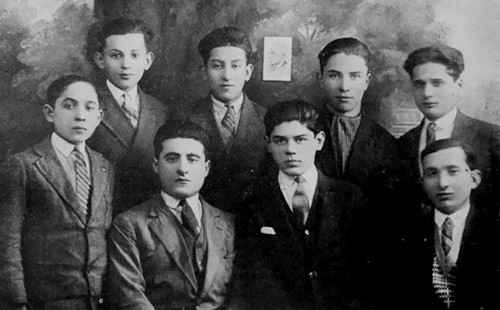
[On page 73 of David Sohn's Bialystok:Bilder Album, the following names are given: “Seated, left to right, are: H. Lev, leader of the Bund and lecturer, A. Sheikewitz (now serving as Secretary of the Bialystoker Center in Montreal), and Kaplansky. The others are unidentified.”] |
When the children were being burned, an extraordinary and tragic incident occurred. When one of the Jewish workers employed at the burning wanted to lift onto the fork – the implement on which the corpses of the gassed were placed to be pushed into the oven – the body of a gassed little girl, the ten-year-old child began to beg him not to burn her, because she was still alive. The Jew did not heed her pleas and pushed her, alive, into the oven. A few days later the entire camp was talking about it. The Jew who had carried out this atrocious act immediately went insane and was shot and burned by the SS robbers.
In connection with this tragic case, it is worth noting that there were instances in which children were gassed together with adults, and at the time when the adults were already completely dead, the children still showed faint signs of life.
In the last days of that week, very few Jews from the hiding places were discovered. But despite this, the mood grew ever more depressed. The impression arose that the Nazi bandits would not leave the ghetto until they had dragged out of it the very last Jew.
The question of nourishment also became harder from day to day. Although flour was prepared during the nights, it was nevertheless very difficult to bake bread. There were individual Jews who would take great risks and at night slip into an abandoned Jewish bakery, where they would bake a loaf of bread. Very often they paid for it with their lives by morning. The Nazi murderers would smell that bread had been baked in the bakery, and they did not rest until they found the Jews who had baked it.
After the two weeks of lying in the hiding places, people were exhausted, beaten down to the last limit. Because of the great filth in which they had been forced to lie, they became infested with lice, and more than one person fell ill.
For all these reasons, quite a number of Jews from the hiding places again began to sneak into the small ghetto, where for the time being one still lived under better conditions than in the shelters. By the end of the second shkhite week, the number of Jews in the hiding places was estimated at no more than 500.
In the first days of the third shkhite week, people began to say that the small ghetto would be liquidated today or tomorrow, because the Jews there were now also “superfluous.” All the machines with the raw materials had already been taken out of the ghetto, the corpses had already been cleared away, and the Jews in the small ghetto no longer had anything to do.
|
|
The Liquidation of the Small Ghetto
At the end of the week the order indeed came that all the Jews who were in the small ghetto – more than 1,200 people (among them 700 with shaynen and more than 500 who had slipped in from the hiding places) – were to be taken to Lublin-Poniatów.
This group of Jews was transported under no better conditions than those in which the tens of thousands of Białystoker Jews had previously been taken away. And when they arrived in Poniatów, they were assigned work in the factories there. During the short time they were there, they lived under better conditions than in other camps.
On 3 November 1943, all the Jews who were in the Poniatów camp – 22,000 people (among them about 9,000 from Białystok) – were taken out to a large square, where, on orders and under the personal direction of the camp commandant, Obersturmführer Tuman, they were all shot. Throughout the entire time of this horrifying slaughter, the camp orchestra, according to Tuman's instructions, played Strauss waltzes.
[Page 219]
In this gruesome massacre almost all the leading personalities of the Białystoker Jewish community perished – both those from before the war and those from the dark ghetto years.
The fourth shkhite week – and the search for the several hundred hidden Jews in the ghetto still had not stopped. The mood among the Jews in the hiding places was one of despair and resignation. The liquidation of the small ghetto had made a heavy impression on them. First, from the Jews there one could still receive a little bread each night to quiet the hunger; and second, when life in the hiding places became unbearable, a considerable number of Jews would slip into the small ghetto. There had still been a bit of “hope.” But now, after the liquidation, they became so apathetic and discouraged that many of them no longer even cared whether the Nazi murderers would discover them. They wanted only to be rid, as quickly as possible, of this desperate, hopeless situation.
Those who had decided to continue the struggle for life encouraged and strengthened one another. At night they again began, with renewed energy, to gather food. They decided to prepare provisions for a longer period and to hold out.
These Jews also set about building stoves in the hiding places. The stoves had to be constructed in such a way that the smoke would escape in a place where it could not easily be noticed. This was very difficult to carry out. But the will to live overcame all difficulties, and the stoves were built. They now had the possibility, at night, to bake small loaves or cook something, and in this way to feed themselves together with their families.
|
|
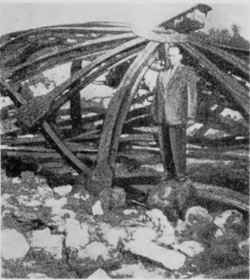
| Shortly after the war in Białystok. The remaining ruins of the Great Synagogue, which was burned down together with two thousand Jews by the Hitlerite murderers. On the right stands Isak Ribalovski, now the general secretary of the Białystoker Center, Home and Hospital for the Elderly, who was in Białystok after the war. |
The Gruesome End
Exactly one month later, on 16 September 1943, the “Aktion” was halted, and at the same time the nightly shootings in the ghetto ceased. On that very day a group of forty older Nazi bandits took over guard duty for the entire ghetto.
These Nazis quartered themselves in the building of the former Jewish Labor Office, right at the beginning of Jurowiecka Street, from where they were sent out in pairs to patrol the ghetto. Whenever they heard a noise somewhere in a house, one of the Nazis would run off to bring several more murderers, and together they would begin searching for the hidden Jews – whom they discovered in most cases. Many managed to escape, because, as mentioned earlier, this guard unit consisted of older men and invalids, from whose hands it was easier to slip away than from the young bandits.
In his further important testimonial notes, Rayzner presents information about the few remaining Jews in and around the ghetto who managed, for a certain time, to continue hiding; about arrested Jews who were locked up and tortured – and also murdered – in the prisons; and about the remnants of Jews whom the Nazis deported to various extermination camps, where they were killed in a horrifying ways.
Only a small handful of Białystoker Jews, who had lived through the terrible experiences during the liquidation of the ghetto beginning in August 1943, succeeded in escaping death at the hands of the Nazi Angel of Death.
Such few saved survivors from Białystok and the surrounding region are now among us in various countries. They continually recount that sorrowful time. They remind and admonish us not to forget the destruction, the annihilation, and also the resistance of the once wonderful Jewish community of Białystok – whose great and exalted heritage we, the few who remain from our home city, must steadfastly guard with pride and honor.
Translator's notes:
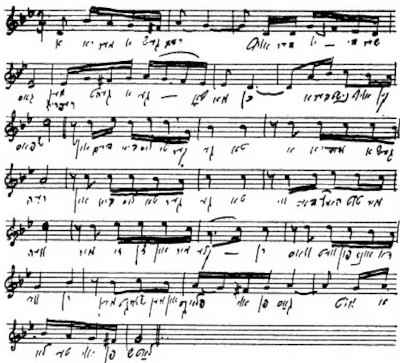
Music recorded and arranged by A. Hirshin
Translated by Beate Schützmann-Krebs
|
A yomer a geshrey oyf der idisher gas,
Refrain:
Men shikt unz tsu der arbet geyn un mir krign glaykh a shayn,
Refrain:
Mentshn geyn fun der arbet un fregn zikh,
Refrain:
In geto mark iz a ganeydn, men krigt ales oyf der velt
Refrain:
Ven vet shoyn a sof nehmen, tsu unzere tsores un payn,
Refrain:
Mir zitsn un mir klern, vi fun im poter tsu vern, |
A wail, a cry – on the Jewish street,
Chorus:
They send us out to work each day,
Chorus:
People come back from work and ask,
Chorus:
In the ghetto market it's a paradise – you find everything on earth,
Chorus:
When will there be an end at last to all our sorrow and pain,
Chorus:
We sit and we wonder how we'll ever break free of its grasp, |
|
|
JewishGen, Inc. makes no representations regarding the accuracy of
the translation. The reader may wish to refer to the original material
for verification.
JewishGen is not responsible for inaccuracies or omissions in the original work and cannot rewrite or edit the text to correct inaccuracies and/or omissions.
Our mission is to produce a translation of the original work and we cannot verify the accuracy of statements or alter facts cited.
 Białystok, Poland
 Yizkor Book Project
 JewishGen Home Page
Copyright © 1999-2026 by JewishGen, Inc.
Updated 04 Mar 2026 by JH