 |
|
|
[Page 187]
|
[Page 188]
[Page 189]
by Dr. Shimen Datner
Translated by Beate Schützmann-Krebs
English Proofreading by Dr. Susan Kingsley Pasquariella
Life for the Jews in the Białystok ghetto was constantly accompanied by great hardships. Even those who worked never had enough to eat to feel full. It was cold as well, with nothing with which to heat. Life was uneasy, marked by unending worries about how to get through each hour of the day.
At the same time, a single thought kept circling in everyone's mind: What will be? What will tomorrow bring? One sensed in advance that a terrible end was drawing near. And yet people did not want to allow themselves the thought that it would all conclude in such a tragically dreadful way as it later did.
Even in the worst of times, they did not want to give up hope for a better tomorrow.
No matter how much people tried to comfort themselves, and to bring comfort to others, each day brought news that made life even more bitter.
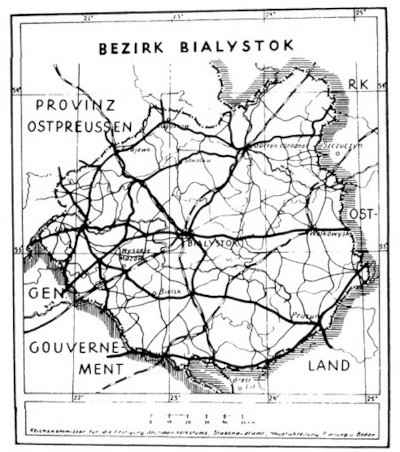
So, in the autumn of 1942, rumors began to spread that the Nazis were preparing to liquidate the Jews of the entire region around Białystok – that is, of the surrounding voivodeship, known as the “Białystok District.” This “Białystok District” had been divided by the Hitler authorities, just as they had done with the districts in central Poland, into the following counties: Białystok, Bielsk, Grodno, Grajewo, Wołkowysk, Wysokie Mazowieckie, Yagestov, Łomża, Sokółka, and Pruzhany.
This “district” around Białystok encompassed dozens of towns and small towns, where about two hundred thousand Jews lived. Together with the rumors that the Nazis were preparing to liquidate the Jews of the Białystok voivodeship came the news that, after the province, the liquidation of the Jews in Białystok itself would follow.
It is clear that this terrifying news created a painful mood and even panic among the Jews in the Białystok ghetto, as well as outside the ghetto. Jews hurried to build hiding places, which was done with great difficulty. Not everyone, however, could afford to create such a “farmegn” [possession].
People also knocked on the doors of the leaders of the Judenrat; they asked endlessly and wanted to know: What will be? Each time a member of the Judenrat official appeared among the people in the ghetto, he was bombarded with questions. But they, too, had no answers.
Suddenly, old, deep–rooted Jewish communities in the towns and small towns of the Białystok region were wiped away and disappeared – places where Jews, over the course of decades, had built, created, and nurtured a richly branched life with a proud lineage.
There, under the barbaric Hitlerite rule, a wondrous Jewish world suddenly came to an end.
The Jews of the province who were taken away to Treblinka had, of course, no idea where the Nazi murderers were driving them. For the Jews in Białystok as well, this was something deliberately kept hidden. Only a short time later did the tragic secret come to light.
|
|
When Hitler's forces invaded Soviet Russia in June 1941, the Nazi authorities established an administrative division of the occupied territories that had previously been part of Poland. The Białystok region, too, was organized as a separate area under the name “Białystok District.” As can be seen from the map, the “Białystok District” encompassed the following counties: Białystok, Bielsk, Augustów, Grajewo, Łomża, Wołkowysk, Sokółka, Wysokie-Mazowieckie, Pruzhany, and Grodno. |
[Page 190]
The Horror of Treblinka
At that time, toward the end of 1942, when the Nazis were deporting the Jews of the province to their annihilation, a heroic and undaunted young man arrived in Białystok – someone who would later play an important role in helping to prepare, organize, and lead the Jewish resistance against the Nazis. He also directed important activities in Białystok and the surrounding area among the youth of the Zionist labor movement.
This young man, Mordechai Tenenbaum-Tamaroff, was a leading member of Dror, the youth movement of Poalei Zion–Left. He had come to Białystok from Warsaw, Vilna, and Grodno, where he had likewise led significant activities connected with the resistance against the Hitlerites.
Mordechai Tenenbaum-Tamaroff was also in close contact in Białystok with certain leaders of the Judenrat, especially with Efraim Barash. From time to time, Barash would pass certain documents on to Tenenbaum.
Once, Tenenbaum received from Barash a bundle containing highly unusual documents and photographs. These had been found in the clothing of Jews from the province who had been deported. After proper disinfection, this clothing had been sent back to Białystok as raw material for use in the textile industry.
While sorting through this returned clothing of the deported Jews, the workers came across several personal documents belonging to some of them. The inscriptions on these items read “Treblinka.” And in this way the terrible secret that the Nazis had concealed about the deported Jews of the Białystok province at the end of 1942 was uncovered.
As it turned out – according to Tenenbaum-Tamaroff's notes from that time in his diary – seven wagons of clothing arrived in Białystok via Malkin. The clothing had been sorted and packed into separate bundles. On them was the inscription “Treblinka.”
Although the Nazis had warned and threatened with punishment the Jews who were employed in this work that they were not to take anything from the bundles, the Jewish workers did not heed this command. When they searched through the items, they found – and in some cases also took – various documents and photographs.
Money and jewelry, as well as similar items found in the clothing of the deported Jews, were taken bit by bit by Christian workers who were also employed there. Even though the Nazi overseers carried out strict inspections, these things nevertheless remained in the hands of the Jews and others.
When Tenenbaum received the bundle of documents and photographs from Barash, it shook him deeply. He could not part from it. It seemed to him – as he wrote – that his pocket holding the documents was burning, burning terribly and fearfully. Tenenbaum recorded this in his diary on January 29, 1943.
The news that the Jews of the Białystok province had been deported to Treblinka – which meant death in the gas chambers and crematoria there – made a horrifying impression on everyone. It was impossible to conceal the tragic secret, “T r e b l i n k a,” which also cast terrible panic among the Jews in the Białystoker ghetto. And indeed, it did not take long – only a short time – before the end also began to draw near for the Jews of Białystok.
During that period, Tenenbaum-Tamaroff also recorded in his diary pages of heroism and courage, endurance and Jewish pride, shown by the Jews of the province as they were taken to Treblinka and to other extermination sites.
The heroism of these and other martyrs will forever shine with dignity in the annals of Jewish history.
The fearless Mordechai Tenenbaum-Tamaroff also received another very important item from Barash during that period. Engineer Efraim Barash, in whose hands lay all the communications of and concerning the Judenrat, agreed to Tenenbaum's request to provide copies of the Judenrat archive for the leadership of the Jewish resistance organization in the Białystoker ghetto.
Two other important underground activists, Mersik and Petlyuk, were also involved in this effort. This archive contained, among other things, the minutes of the Judenrat meetings and various announcements to the Jews in the Białystoker ghetto.
After the war, all of this material – as already mentioned – was found and published in various editions. Yad Vashem in Jerusalem, the central institution for collecting materials and documents on the destruction of European Jewry and the Jewish resistance during the Hitler era, also published a large part of the recovered archive of the Białystok ghetto.
|
|
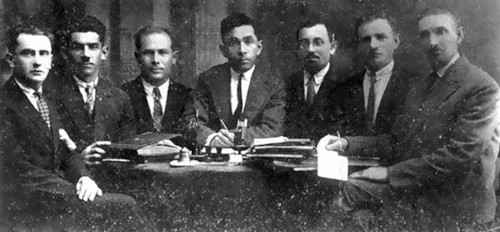
[On page 142 of David Sohn's Bialystok:Bilder Album, the following names are given:“Seated, from right to left: M. Schreibman, A. Poganitski, A. Werbin, I. Falk, A. Treshtzan, I. Novick, and H. Shabrinski.”] |
Translator's notes:
by Yitzhak Tsesler
Translated by Beate Schützmann-Krebs
English Proofreading by Dr. Susan Kingsley Pasquariella
In the archival documents published by Yad Vashem in Jerusalem in 1962, volume no. 4 – which bears the title “Darkho shel ha-Yudenrat” [The Path of the Judenrat] – the entire volume is devoted to “the recovered protocols of the meetings and the announcements to the Jewish population issued by the Judenrat of the Białystoker Ghetto.”
The author, Nachman Blumental, notes first of all that, in truth, we possess very few documents or preserved protocols from the meetings of the Judenräte established in the ghettos by the Nazi authorities during the Second World War. Most of these documents were destroyed together with the Jewish lives, institutions, and property.
Of the hundreds of Jewish ghettos in Eastern Europe, only a few left behind – or later had recovered, often by chance – documents or protocols from the meetings of their Jewish leadership. These materials reveal to us the great and terrible tragedy of that calamitous time which our Jewish brothers lived through.
Thus, Yad Vashem holds a rich trove of such documents: from the Łódź Ghetto (although not complete – they still amount to about 450), the protocols of the meetings of the Judenrat of Lublin and documents from its secretariat, and, in smaller number, preserved announcements from the Judenrat of Lemberg.
From the Warsaw Ghetto, for example – which was the largest at that time – only a few documents have survived. Most were written with the intention of being hidden for future generations and have not yet been found. Many such documents were discovered in German ministries, which had failed to destroy them during their retreat after the war.
Among these materials, a considerable amount of information concerning Jewish affairs was found, including letters and petitions from individual Jews to the German authorities, as well as correspondence between the Judenrat and the Nazi authorities and the Gestapo, who ruled over them.
As is well-known, it was not only the Judenrat itself that tried to hide the documents of that time – or at least the orders issued by the authorities – so that they might remain as testimony for the future, when this would be needed against those who would later try to evade responsibility for their crimes. This work was also carried out by people specially designated for this purpose: members of the so called shuts-eydes [witness preservation group] and of the resistance, who were simultaneously working within the Judenrat at that time.
But of all these documents, almost nothing has survived, because in the final moments they were unable to hide this material: they were killed, perished, or burned together with the buildings when the final liquidation of the ghettos took place.
Among all these ghetto documents, the protocols and announcements of the Białystoker Judenrat occupy a place of particular importance. They had been transferred at the time to the Aryan side in order to be hidden, and in this way they were preserved and saved.
How “the protocols and announcements of the Białystoker Judenrat” reached Yad Vashem is known: toward the end of 1945, a female co-worker of the “Jewish Historical Central Committee” in Łódź, who had returned from a certain mission, reported that in a small town (apparently Niska) near Reysha [Rzeszów] there was a Jewish doctor from the Polish Army who possessed an entire suitcase filled with documents and was prepared to hand them over for a certain compensation.
This emissary – the very same woman – indeed reached an agreement with the doctor on a price, [paid it, and] brought the suitcase to Łódź.
The above-mentioned doctor did not say when or how he had obtained the documents. But from the testimony of survivors, and from the notes of the commander of the Białystoker Ghetto uprising, Mordechai Tenenbaum-Tamaroff – preserved in the archives of Yad Vashem in Jerusalem – it becomes clear that Engineer Barash, the chairman of the Białystoker Judenrat, had instructed that the material be handed over to Tenenbaum-Tamaroff. He was to arrange for it to be taken to the Aryan side, with which he had connections, and hidden there. Barash foresaw that the ghettos would be destroyed…
It appears that the documents were taken to the Aryan side after April 1943, since no further entries are found in them beyond that date.
[Page 192]
(It is possible that the protocols continued to be written even after that, up to the final moments of the liquidation of the ghetto, but they have not been found.)
From the Białystoker ghetto protocols and announcements we know that, thanks to the Jewish doctor mentioned above – who had connections to the Aryan side through the status of his Polish wife and through a friend, Dr. Filipovski – the documents were [successfully] hidden. After the war, when this Jewish doctor, who had saved his life on the Aryan side, returned, the hidden material was restored to him by the same Dr. Filipovski.
It is also known that, in addition to the transferred protocols, a certain Polish woman handed over a large amount of material in 1946 to the “Białystoker Jewish Committee.” These items had been hidden in her home. Among them were notes by Mordechai Tenenbaum-Tamaroff, writings by Pesach Kaplan, and various witness statements, among other things.
The preserved fifty-two protocols of the meetings of the Białystoker Judenrat and the 435 announcements issued to the Jews of the Białystoker ghetto cover the period from 8 July 1941 until 5 April 1943. (The protocols themselves run from 2 August 1941 until 1 April 1943.) They tell us of the horrifying and terrifying period that the Jews of Białystok lived through in the ghetto, up to the day of the uprising on 16 August 1943 – the annihilation of the remaining Jews of its sixty-thousand strong Jewish population.
Protocol no. 1, from the meeting of 5 August 1941, states that this is the protocol of a “newly elected” Judenrat. There is reason to assume that such a body had already existed earlier, immediately after the Nazis occupied Białystok on 27 June 1941, when the military authorities created it.
The “newly elected” Judenrat consisted of the following persons:
Y. Rabiner, Dr. Rozenman, Eng. Barash, Y. Lifshits, G. Goldfarb, Sh. Lifshits, Sh. Punyanski, P. Melnitski, Y. Markus, Sh. Petsiner, Dr. Kaplan, Dr. Kershman, Dr. Segal, Dr. Holenderski, M. Rubinshteyn, Dr. Horovits, Sh. Polanski, Y. Goldberg, Eng. Shmigelski, M. Shvif, Y. Novik, A. Furman, and Dr. Kaplan.
In later meetings we also encounter the names of Pesach Kaplan (editor of the Białystok daily newspaper Undzer Lebn), Dov Subotnik, and several others.
The protocols are written in pure Yiddish, and it is more than certain that they were edited by Pesach Kaplan and written in a fine hand by a Warsaw graphic artist, a certain Goldberg.
The announcements to the population were usually posted at the entrance to the Judenrat building at Kupiecka 32. Many of them were also pasted up in various places throughout the ghetto, where Jews could come and read them. It is known that the kleper – the ghetto's poster-paster – was Bishke, the well-known Białystok newspaper vendor, who was murdered together with his wife in the Aktion of 5 February 1943.
We do not intend here to analyze or judge the actions of the Judenrat with regard to the Jewish population. But when reading the protocols and announcements, the full horror of the conditions endured by the Jews of Białystok under the brutal Nazi regime is revealed to us – the daily decrees, for which there was absolutely no possibility of annulment, or even of easing the suffering and need of the Jewish population. The Judenrat sought, by every possible means, to help the tightly packed Jewish masses in the narrow streets of the ghetto, as well as those who had fled there from the surrounding towns.
The constant decrees imposed on the Jews in the ghetto, and the demands made by the higher authorities – to be carried out through the Judenrat – created a situation that became hopeless and unbearable.
Although we already have a rich bibliography by many survivors who describe that terrible period in their works – among them Chaika Grossman, Srolke Kot, Bronye Klibanski, Dr. Shimen Datner, Ber Mark, Rafael Rayzner, D. Klementinowski, and others – it is still worthwhile to record several details that we learn from the recovered protocols.
For example: at a general assembly in Linas Hatzedek on 9 November 1941, Rabbi Dr. Rozenman reported on the great danger facing the ghetto if people did not present themselves for work. And Eng. Barash read out a letter from the Nazi authorities stating: “A punishment of lashes – and even the death penalty – is foreseen!”
At a special assembly in the hall of Linas Hatzedek on 11 October 1942 (Protocol no. 50), attended by the members of the Judenrat, the directors of the enterprises, house administrators, the fire brigade, the Ordnungsdienst, and others, Dr. Rozenman opened the meeting before a fully packed hall. With a drastic shift in tone, he said: “A true bacchanalia has broken loose in the ghetto…people are not obeying the orders…they are hiding to avoid coming to work”… and so on. “This will inevitably lead to destruction!”
Engineer Barash then took the floor and, in truly dramatic words, addressed those present:
“A few weeks earlier, the German Labor Office had demanded 200 women for work. Among the six thousand, the required two hundred could not be found. Only under the threat of the Schutzpolizei – that all unemployed would be lined up in one place – did the ghetto provide the 200 women. People had hidden those who were demanded… as if a struggle were being waged between the Judenrat and the population.
And when the women were taken away, people ran after the wagon and cried Sh'ma Yisroel…
[Page 193]
May this false Sh'ma Yisroel not bring us closer to the day when the true Sh'ma will be cried…”[3]
It is also noteworthy that in all the protocols and announcements, the Judenrat avoided recording, specifying, or describing the Aktionen carried out by the murderous German authorities – such as the transports to Treblinka, and so on (certainly out of fear of consequences from the authorities). Only the vaguest hints appear, such as: “the last difficult days we have lived through…” (Protocol no. 32 – 11 November 1942).
Although in one protocol (no. 24), marking the first year of the Judenrat's existence, Mr. Liman [Limon?] stated the following: “We have lived through a difficult year of persecutions, robberies, bestial mass murders in all Jewish communities. We too, in Białystok, have had a year of conflagrations – the ‘Freytikdike’… the ‘Donershtikdike’… the ‘Shabesdike’… evacuations, and so on.”
(He certainly meant the two thousand Jews burned alive in the Białystoker synagogue, and the martyrs of the Aktionen of 27 June, 3 July, and the Shabbat of 12 July 1941, which were later designated by those very names; and the “evacuations” – meaning the transports to Treblinka and to other extermination camps.)
In Announcement no. 1 to the population, children from the age of fourteen were required to wear a white armband with a blue Star of David, and adults the yellow patch, front and back, with a warning that severe punishment would follow if the regulation was not obeyed…
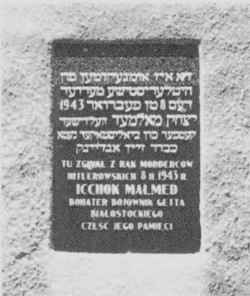
The great Aktion of 5 February 1943, connected with the “Malmed tragedy,” in which 100 hostages were taken and later brutally shot – even though the well-known hero Yitskhok Malmed had surrendered himself and was hanged by the Nazis on Gumyener [Gumienna] Street – is not mentioned at all in the protocols or announcements. There is only an added note, and in that note it says: “5–2–1943 to 12–2–1943, Aktion in Białystok… Treblinka, 10,000 Jews deported… 900 Jews shot on the spot…”
In announcements no. 376 and 388 of 1 January 1943 and 12 February 1943, the names of five [sic] persons who were hanged in the ghetto under the accusation of stealing products are listed…
In announcement no. 383 of 28 January 1943, ten persons are listed who were beaten by the authorities for leaving the ghetto without a personal permit or for failing to present themselves for work.
In announcement no. 396, dated 12 February 1943, a list of thirty-five persons is given who were placed on the pillory because, “during those sorrowful days, they had plundered the apartments of the evacuated.”
In the last announcements, nos. 432–435, dated 28 March 1943 and 1 April 1943, the population is strictly warned that “if the lights in the houses are not completely darkened in the evenings – which must be done fully and consistently – shots will be fired into the houses.”
In general, we may say that the volume containing the “recovered protocols and announcements of the Białystoker Judenrat in the ghetto”, published by Yad Vashem in Jerusalem, is among the most important documentary publications. It supplements and reveals for us many previously unknown events and details of the bloody murders committed by Nazism. It gives us a sorrowful picture of that terrible period which the Jews of Białystok and the surrounding area – concentrated in the Białystoker ghetto – suffered through and endured during those few years, until it led our brothers and sisters, the remaining remnants, to the culminating moment: following the example of Warsaw.
That is, carrying out the uprising against the bloody enemy, that Hitler-pest – which began on 16 August 1943 and continued for a month – and putting up a dignified and armed resistance against the bestial Nazi murderers; going with full awareness toward certain death, and dying for kiddush ha-Shem [ the sanctification of the Divine Name] and for kiddush ha-am [the sanctification of the people] – for the honor of humanity and of the Jewish people.
Only a few counted months had passed since the Hitlerites had deported around two hundred thousand Jewish women, children, men, and elderly people from the province to Treblinka and to other places where precious Jewish lives were cut down. Although it was no longer a secret to the Jews in the Białystoker ghetto what had happened to the provincial Jews, people nevertheless comforted themselves with hope. They did not want – and could not allow themselves – to accept the thought that something like that, or anything similar, would also befall the Jews of Białystok.
People continued to reassure themselves, as they had the entire time, that the Jews of Białystok would not be touched. They tried to explain this to themselves by saying that the last two remaining large ghettos at that time – Białystok and Łódź – would not be destroyed by the Nazis. Those who comforted themselves in this way, and wanted to persuade others as well, supported this hope with the belief that the Hitlerite war machine constantly needed various industrial outputs, especially textiles, which the Jews in the Białystok ghetto – and outside the ghetto – were producing.
They wanted to convince themselves and others that perhaps the terrible storm would pass over, that perhaps the Nazis would suffer defeat before they destroyed the Jews of Białystok.
But the tragic reality was entirely different. Suddenly, the terrible February Aktion descended upon the Jews of the Białystok ghetto.
Translator's notes:
by Rafael Rayzner [Reizner]
Translated by Beate Schützmann-Krebs
English Proofreading by Dr. Susan Kingsley Pasquariella
At the end of January 1943, rumors began to spread that the chairman of the Judenrat, Engineer Barash, had received a demand from the Gestapo to prepare a list of twelve thousand Jews who were to be sent out for labor.
These sorrowful rumors further deepened the already depressed mood of the Jews of Białystok, who clearly saw that they were approaching, with giant steps, the terrible catastrophe.
The young self-defense organization, which was still small in number at that time, set about preparing for the task with feverish urgency. New people were drawn into its ranks. Trusted comrades were also sent out of the ghetto to obtain weapons as quickly as possible. A larger quantity of zoyershtof[3] was distributed among daring Jewish women; at the moment when the Nazi robbers would approach them, they were to throw acid into the murderers' faces. But not much could be accomplished anymore. Too little time remained.
Once again, most Jews turned to the old method of preparing hiding places. Those who did not yet have any hidings built them secretly, day and night. And those who already had them tried to improve them. Others even installed water and electricity in them. There were also hiding places whose exits led outside the ghetto and were arranged for as many as one hundred persons.
Lightning-fast, the news spread throughout the ghetto that the Judenrat already had the lists of the demanded Jews. The first to go were to be the old, the sick, and the mentally ill; afterwards, those who did not work. Of whom the third group consisted, no one knew, except for a few officials who had compiled the lists – but they kept the secret.
The mood was tense to the highest degree. The terrible misfortune stood at the door.
At the moment it became known that the Judenrat already had the lists of the twelve thousand victims whom it was preparing to hand over to the Nazi robbers, the well-known, long-time craftsman-activist and member of the Judenrat, Zvi Vider, decided to put an end to his life. After writing a letter to the Judenrat and to his wife, he hanged himself in his own apartment. People spoke of his act with the greatest respect, and it was held that he had acted as a hero.
The suicide of Zvi Wider further deepened the mood of despair.
On February 3, 1943, a Gestapo commission arrived and examined the ghetto fence and the walls with great attention.
On February 4, all exit permits of the Jews who worked outside the ghetto were confiscated. On the same day, the Gestapo took the compiled lists of the twelve thousand Jews and all the records of the Judenrat.
There were, however, also individual cases in which high-ranking members of the Hitlerist party – directors of factories outside the ghetto – confidentially told their Jewish workers what was being prepared for them. Others even suggested that they remain in the factories for as long as the slaughter would last.
Most Jews refused this, because they did not want – and could not – in such a terrible time leave their families in the ghetto abandoned to their fate. Only a few accepted the help and were indeed saved in this way from the February slaughter.
After all these sorrowful reports, it became clear that the terrible misfortune could arrive at any hour.
During the night of February 4 to 5, 1943, a large part of the population did not go to sleep, waiting in fear for the gruesome catastrophe.
The Beginning of the February Slaughter
Thursday, at two o'clock in the night from February 4 to 5, 1943, a large number of automobiles with Nazi bandits drove into the ghetto, headed by the Gestapo officer Friedl, and stopped at the Judenrat. They ordered the Jewish Ordnungsdienst to bring at once the chairman of the Judenrat, Engineer Barash, in order to force him to assist in their criminal work.
In Barash's presence, the Nazi murderers immediately began their devilish Aktion.
Within minutes they surrounded the following main streets: Nowy Świat, Polne, Bialystotshaner [Białostoczańska], and all the adjacent little streets, and opened fire over them with machine guns. This was the introduction to the bloody bath.
With the lists in their hands, they threw themselves into the houses of the mentioned district. But the Jews who had been listed had learned of this in time and had disappeared. When the Nazi murderers saw that they could not find anyone from the lists, they began, with terrible slaughter, to carry out the massacre on their own.
[Page 195]
Following this, house after house, they dragged out whomever they found there. The Jews who could not, or did not want to, go along were shot on the spot.
Regardless of the late hour of the night, the news that the slaughter had begun flashed through the ghetto like lightning, and within minutes more than fifty thousand Jews had disappeared into the hiding places.
|
|
Because of the terrible rush when people lowered themselves into the hiding places, almost no one was able to take anything along, not even a drop of water. Everything was left behind, abandoned, and became good loot for the Nazi murderers.
At four o'clock in the early morning, when the slaughter was in full blaze, a part of the murderers threw themselves over to Kupiecka Street with their thieving work.
Yitskhok Malmed Pours Acid on a Nazi Murderer
When the Nazi robbers attacked the courtyard at Kupiecka 29, and all the inhabitants were gathered together in that same courtyard, the daring young man Yitskhok Malmed pulled from his pocket a bottle of hydrochloric acid and poured it into the face of a Nazi murderer, who soon became blind from it. The splashed Nazi beast still tried to recover, pulled out a revolver, and fired several shots. The bullets struck another Nazi robber, who fell dead at once. Malmed made use of the resulting tumult and disappeared.
The leader of the band of murderers, Friedl, ordered that from the courtyard where Malmed's attack had taken place, one hundred men, women, and children be taken out. They were driven to Prage's Garden, lined up against the wall of the Nayvelt [Nowy Świat] Study House, and shot with machine guns.
Afterwards, the Nazi murderers also drove together, in Prage's Garden, another group of Jews and forced them to dig a large pit into which the martyrs were thrown. A considerable number of them were still alive, and the thin layer of earth with which they were hastily covered heaved for a long while above them.
Among the hundred martyrs were:
Malmed's wife with their child;
the well-known dressmaker Mrs. Miler-Zabludovski;
the printing worker Naftali Feldman with his wife;
and the popular, long-time newspaper distributor Bishke Zabludovski.
The shot Nazi murderer was meanwhile carried off by his comrades to the Judenrat office, laid on Barash's desk, and they said to the present Barash: “Look what your criminal Jews have done!” And they added cynically:
“Now let us take our revenge, and you will see what we can do.”
|
|
of the uprising on the 16th of August, 1943 |
After carrying out the horrifying crime, the leader of the band of murderers, Friedl, ordered that Barash be brought to him, to whom he related the “fine deeds of his ungrateful Jews.” He demanded of him that the “criminal” be delivered within twenty-four hours.
[Page 196]
Otherwise he could not keep his promise to take out of Białystok only twelve thousand Jews – the entire ghetto would then be annihilated.
Engineer Barash knew very well that when it came to exterminating the entire Jewish community of Białystok, they would certainly keep their word, and he let the Jews in hiding know about what had happened. He also asked that Malmed, wherever he was, be told that he should once more show magnanimity and not bring it about that tens of thousands of Jewish lives be destroyed because of him.
As soon as Malmed learned of the terrible danger that threatened the Jews of Białystok because of his act, he showed his heroism a second time and gave himself up to the Nazi murderers.
The hero, Yitskhok Malmed, was in the morning hanged on the gate of the courtyard where he had carried out his heroic deed. Despite the fact that he was already half dead from the tortures the Nazi beasts had inflicted on him, he still delivered, before the hanging, a sharp speech against the murderers.
After a few minutes on the gallows, the rope suddenly tore. The fallen body was immediately riddled with bullets. Already dead, Malmed was hanged up again and remained on the gallows for two full days.
Jews Put up Resistance
When the Nazi robbers entered Kupiecka 10 (Varat's house), the inhabitants of the house put up a heroic resistance. They fought with axes, knives, and irons. The heroic wife of Mendel Kuryanski poured hydrochloric acid over the murderers and prepared to set the house on fire. The Nazi murderers began to retreat, but they received reinforcements; they seized Mrs. Kuryanski and threw her down from the second floor. Immediately afterwards they threw down her child. The heroine tried still to rise and escape. But she was pierced through by bullets and, covered in blood, fell onto the dead body of her child.
When the chief Ataman of the band of murderers, Friedl, learned of this fresh Jewish audacity, he came running like a wild tiger and, seeing in the courtyard the gathered heroic Jews, ran closer and shot one after another in the head. In the course of a short while, a mound of martyrs was already lying in the courtyard of Kupiecka 10.
At eight o'clock in the morning the slaughter was broken off. The robbers drove out to eat breakfast.
At ten o'clock larger detachments of Nazi robbers again drove in, among whom there were now also Ukrainians and Belarusians, and with animalistic fury they set about their man-devouring, bloody work. They also violently dragged along with them the Jewish Ordnungsdienst and the ghetto fire brigade with their machines and equipment.
The Nazis sent the Ordnungsdienst to search for Jews in those places where the murderers were afraid that a bullet might fly into their heads from a hiding place. Although the Ordnungsdienst in many cases came upon hidden Jews, they reported to the Nazi murderers – risking their own lives – that no one was there. Let this be to their credit!
In very few cases did criminal members of the Ordnungsdienst hand over hidden Jews into the hands of the Gestapo.
The Jewish fire brigade was forced to crawl over the roofs searching for hidden Jews, and with axes and crowbars they had to tear open the camouflaged attics and double walls. Yet no one in the ghetto accused them of having betrayed Jews.
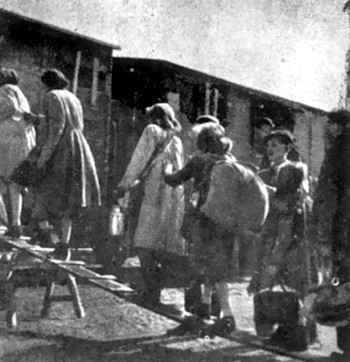
The slaughter lasted the entire day. On that long Friday, which stretched from two in the early morning until five in the evening, the Nazi robbers succeeded in uncovering barely three thousand Jews, who were taken away to the building of the Judenrat, where the leading staff of the slaughter-Aktion was located. From the Judenrat the unfortunate ones were taken away in larger groups to the train, where they were driven into the wagons, the doors nailed shut with boards, and on that very same day deported to Treblinka and Oshvyentshim [Auschwitz].
Tens of Thousands in the Hiding Places
In a hiding place that could normally hold twenty to twenty-five people, seventy-five crowded in, so that the narrowness there was terrible – one could practically suffocate. The result of this was constant quarrels. Not seldom did it happen that, because of the loud noises, one did not even hear the heavy steps of the Nazi robbers as they approached the hiding place. Hearing a sound, the Nazi murderers would throw themselves onto the house and turn everything upside down, roof and all. In most cases everyone would be discovered.
A second serious problem for those in hiding were the innocent little children. Although most mothers had prepared sleeping-potions for them, it nevertheless happened more than once that, in the very minutes when the Nazi murderers were upstairs in the apartment, a child would suddenly wake up and begin to cry. Such an incident, too, would lead to the discovery of the hiding place.
There were not few cases in which mothers, not wanting to bring about dozens of victims because of their children, would at the very first faint cry throw a pillow over the child – and the child would be instantly suffocated…
It was also very bitter with the coughers. No one wanted to be in the same hiding place with them, because even the slightest cough could bring disaster upon dozens of Jews.
[Page 197]
But the coughers would deny it, saying that they were not coughing. In places where they were not wanted and not allowed in peacefully, they would threaten that they would inform on everyone. One severe cougher was thrown out of a hiding place. In great agitation he informed on them. As a result, sixty Jews were deported to Treblinka…
Because of the extraordinary narrowness in the hiding places, such a tense atmosphere prevailed in them that, at the slightest necessary or unnecessary movement, one person was ready to strangle the other.
|
|
Under such dreadful conditions tens of thousands of Jews, together with their wives and children, had to live for more than a week.
Very few Jews knew, already at the beginning of the slaughter, that the workers of the ghetto factories were permitted to remain at their workplaces, where no danger threatened them. Many members of the Judenrat administration did not know this either. The Gestapo leaders had informed Barash on that day that all those who worked in the ghetto factories could stay there, and that during the hours when the Aktion was being carried out, none of the workers was allowed to appear in the street.
As soon as this information reached the hiding places, the workers from the ghetto factories took along their wives and children and went off to their workplaces. There hundreds of Jews were standing, wanting to save themselves and pushing toward the factory doors. But the guards and the Ordnungsdienst allowed in only those who worked there; the women and children had to go back.
In front of the factory buildings heart-rending scenes would unfold. The women with their children did not want to turn back, saying that their husbands worked there and therefore they should be allowed to be together with them. But it was neither the ill will of the factory directors nor that of the guards – this was the regulation issued by the Gestapo.
The Second Day of Slaughter
On Shabbat, the 6th of February, at seven in the morning, with German exactitude, the Nazi murderers began the second day of the gruesome slaughter, according to plan and with the same methods and means as the day before. On the second day, however, it was much harder for them to find hidden Jews than on the first, because people had learned from the mistakes of the previous night.
The Nazi robbers were extremely agitated at the “impudent” Jews who did not let themselves be caught so easily, and they carried out their wild man-hunt with increased bitterness. Yet despite all their intensified efforts, they captured on that Shabbat only half as many victims as on Friday.
The gruesome slaughter was carried out according to a fixed order: exactly at twelve o'clock there was a midday break, and precisely at five in the evening the slaughter would be broken off; by half past five the Nazi robbers were no longer in the ghetto. On the second day of slaughter many more Jews already knew that in the ghetto factories life was secure. Masses of Jews, bundles on their shoulders, made their way until late at night to these newly discovered places of rescue.
Just as on the first day, so too on the second day many people stood at the factory entrances. But only those who worked there were allowed in. The shouting and the tumult were even greater than the day before. The crowd was extremely agitated as to why the women, children, and parents of the workers were not being let in.
Engineer Barash kept intervening with the Gestapo so that the wives and children of the ghetto workers should be allowed to remain together with their husbands. The Gestapo leaders kept promising that they would grant the request in this morning.
On Sunday, the 7th of February 1943, it was already fully light. An hour passed, a second hour of the appointed time when the slaughter usually began. It was quiet; one heard nothing – no sound of cars, no heavy steps of the beasts, no alarm signals of the fire brigade truck, and no shooting. The bolder ones began to crawl out of their holes, lingered for a short while, returned, and reported that the ghetto was quiet. The Nazi murderers had not come into the ghetto today.
After half the day had passed, more Jews could already be seen, with pale, exhausted faces, crawling about the ghetto streets and courtyards. They were going to find out what could be heard from their nearest ones.
[Page 198]
Individual women also crawled out of the hiding places in order to cook a little food for their languishing little children, who for three days had not had even a spoonful of boiled water in their tiny mouths.
The Third Day of Slaughter
On Monday, the 8th of February, exactly at seven in the morning, the slaughter began again. All the streets were encircled, and with the same fury as before, the devilish march over the Jewish houses began. They broke through walls, tore up floors, ripped off roofs, shook the stables, dug up the earth in the courtyards and gardens – as a result, the Nazi murderers dragged out far fewer victims on this day than on the first two days.
The women learned that today Barash had succeeded in obtaining from the Gestapo that in the factories the wives and children of the workers were now permitted to stay together with them.
Until half the night people streamed toward the factory buildings, where a terrible crush took place. One person fought and beat the other in order to get inside sooner. The factories became packed full – literally not a needle could be thrown inside.
What was happening inside the factories themselves? There, where normally one thousand workers were employed in three shifts and where there was space for only 350 persons, there were now, together with the women and children, fully two thousand souls crammed together – one can imagine what kind of narrowness that was. In addition, efforts were made to set aside in each factory a few rooms for small children, for whom, according to the possibilities of those dreadful days, somewhat better care was provided.
The building of the Judenrat also enjoyed Gestapo protection, where a number of Judenrat members and the Ordnungsdienst were located. Most of the Judenrat members had received work permits from various factories, where they had been staying since Monday.
Through Barash, several individual Judenrat officials also received permits as factory workers: Moyshe Visotski; Osher Trzhanovitsh, the head of the registration department; Sh. Ravet; and Kh. Goldberg (formerly the owner of the zincographic establishment “Grafikon” in Warsaw), who held an important position in the Judenrat and at the same time recorded the daily events of ghetto life.
Gestapo protection was also extended to the four premises where the commissariats of the Ordnungsdienst were located – there their wives and children were staying.
In the fire brigade garage, the wives and children of the firemen found protection.
Editor Pesach Kaplan was in the tailoring factory run by Schlosser on Kupiecka Street, in the premises of the former Public Gymnasium on the third floor, from where everything could be precisely observed. The writer of these lines was also there with his family, in the same factory.
Pesach Kaplan had arrived at the factory suffering from a severe cold after having spent several days lying in a cramped hiding place. He lay more than he walked around, and although he felt very weak, the tension and the powerful nervous agitation lifted him from his bed. Every few minutes he ran to the windows (this was strictly forbidden, and more than one person had received a bullet in the head for such curiosity). He could not restrain himself and, with his once sharp but now almost extinguished eyes, wanted to see for himself the deadened ghetto streets through which, nearly every quarter of an hour, the captured victims were being led to the assembly point.
The tragic scenes made a terrible impression on Pesach Kaplan. He ran back and forth across the long factory hall with clenched fists, speaking as if to himself: “Jews, vengeance! Vengeance! I won't be able to bear it! My end is near!”
Pesach Kaplan no longer ran to the windows or up to the attic. He felt very weak and hardly left his bed. His eldest daughter, Sonye, who held a responsible position in the factory, and his wife, Rivka, did everything for him that lay within their possibilities. They did not leave his side, trying to calm and comfort him; when they left the factory after the slaughter, Pesach Kaplan was fatally ill.
Into the tightly packed factories the bandit Ataman, Fridl, would also suddenly burst in, in order to check whether there were any Jews present who did not belong to the factory. Needless to say, such people were not lacking. Those whom he managed to discover he would lead away and shoot on the spot. In the “best case” he would send them off with the transport to Treblinka.
The Fourth Day of Slaughter
When the Nazi murderers realized that Monday had not brought them the required number of victims, they began on Tuesday, the 9th of February, the fourth day of slaughter, to apply a new devilish method. When they discovered a hiding place where the number of victims was small, they would tell the captured, death-frightened Jews that if they wanted to be set free, they should point out where other hidden Jews were lying.
The desire to save one's own life clouded the human feeling in some individuals. Hoping in such a vile way to save their own lives, they would indicate where the hidden people were. Most of these traitors the Nazis let go.
[Page 199]
But it also happened that after extracting the necessary information from these informers, they were shot by the Nazi murderers with the shout: “You die like a betrayer of Jews!”
On Tsheple [Ciepła] Street a hiding place with Jews was discovered, among whom there was a woman with a child in her arms. Out of extreme nervous shock, the woman threw the child into the deep well that stood in the courtyard. One of the Gestapo bandits who witnessed the terrible scene (he still had, it seems, a small remnant of a human heart) ordered, with tears in his eyes, the three Ordnungsdienst men present to save the child. One of them lowered himself on a chain into the very deep well. It lacked very little for him himself to drown, but after extraordinary efforts by his comrades together with the Gestapo man, they succeeded in pulling him out together with the half-dead child. The “soft-hearted” Gestapo man then used every means to revive the child.
While all four were deeply occupied with rescuing the child, an elderly woman suddenly crawled out of a hiding place, whom the Gestapo man noticed and wanted to arrest. But the Ordnungsdienst men explained to him that the child's mother had just been taken away to Treblinka, and therefore the old woman should become a mother to the child. The Gestapo man agreed on the condition that the woman should immediately carry the child to the hospital.
Abramtshik, an orphan from the orphanage on Tshenstokhover [Częstochowska] 7, urged the children of the institution to put an end to their own lives, since in any case the vile death of gassing awaited them. Only two orphans followed him; together with him they hanged themselves at the entrance to the orphanage. But through their death they saved all the remaining children.
Despite the fact that a Red Cross sign was displayed on the orphanage, it did not prevent the bands of Nazi murderers from breaking in there several times a day. Yet when they saw the terrible sight of the three children hanging, their bloodthirsty hearts would soften for a moment, and with lowered heads they would leave the premises.
In this way, the tragic suicide of Abramtshik and his companions saved the lives of the hundred children who were in the orphanage at that time.
Because of the newly applied method of forcing captured Jews to become betrayers of their brothers, Tuesday – the fourth day of slaughter – brought far more victims than Monday.
As in the previous days, the slaughter was again broken off precisely at five in the afternoon.
When it was already quite dark, people crawled out again from their hiding places and ran to seek refuge in the factories, for word had spread that Barash had succeeded in obtaining from the Gestapo that the parents of the workers would also be permitted to stay in the factories.
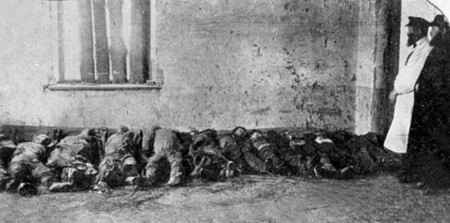
On Tuesday evening Barash received an order from the Gestapo to clear away the hundreds of shot people who were lying scattered throughout the streets. That same evening Barash informed the Khevre Kadishe [burial society] that they should admit into their ranks a larger number of Jews. Late at night hundreds of Jews indeed stood at the premises of the Khevre Kadishe, wanting to join the mentioned society in order to save themselves from the threatening death from which the Khevre Kadishe men were protected.
Almost every day Barash intervened with the Gestapo on behalf of prominent, respected Jews who had been dragged out of hiding; but only very rarely did he succeed in achieving anything in this area. He made especially great efforts to free from the murderous hands the elderly writer and historian A. Sh. Hershberg, the former head of the Jewish community Avraham Tiktin, and also his neighbor Dr. Beylin. His great efforts, however, had no success, and all three were dragged off to the gas chambers of Treblinka and Auschwitz.
The Fifth Day of Slaughter
On Wednesday, the 10th of February, the gruesome slaughter continued.
At night, when the Nazi murderers were no longer in the ghetto and the hidden Jews began to crawl out of their holes, people started to look around at what the robbers had done during the five terrible days of slaughter – and a shudder seized them.
On Wednesday as well there were cases in which the discovered Jews ended their own lives. At 26 Fabryczna Street a father cut the veins of his two daughters, his wife, and himself; the only son, who had been with them, refused to let himself be killed, and he managed to slip away from the Nazi murderers' hands. But from what he had lived through, he later lost his sanity.
After approximately six thousand Jews had found refuge in the factories, the hiding places became noticeably roomier and easier. During the day one could even catch a bit of sleep there. The women became more mobile, and as soon as it grew properly dark, they would crawl out of the hiding places in order to cook something for their little children.
[Page 200]
The Sixth Day of Slaughter
On Thursday, the 11th of February, when the Gestapo bandits realized that fulfilling the prescribed number of Jews was proceeding too slowly and that they would not meet the designated deadline, they began to apply, on an extraordinarily broad scale, the method of forcing the discovered Jewish victims to betray their brothers.To our great misfortune, they succeeded in increasing the number of informers.
With the help of these traitors, the Nazi beasts discovered up to two thousand Jews on that day.
On Friday, the 12th of February, the last day of slaughter, the number of Jews whom the Nazi robbers dragged out of the hiding places was very small.
It seems that they were already close to the required number of victims, and even among those who were discovered, many managed to escape.
The Ordnungsdienst men, who accompanied the Nazi robbers in their devilish work, already felt that today's day of slaughter appeared to be the last.
The Terrible Overall Toll of the Seven Days of Slaughter
On the seventh day of these horrifying experiences, everyone's nerves were already overstretched. It had simply become impossible to remain in the hiding places, where the dead lay beside the living, who themselves were already half dead.
Had the gruesome slaughter continued any longer, many more Jews would not have been able to endure it. Quite a number had already even decided to crawl out of the hiding places and surrender themselves to the Nazi murderers.
On that same day the Ordnungsdienst announced in the hiding places that today was the last day of the slaughter. Almost no one, however, wanted to believe the accuracy of this information, since on Wednesday and Thursday similar reports had also circulated. At exactly seven in the evening the Ordnungsdienst spread the news that they were one hundred percent certain the “Aktion” was over, because for the next day, the Shabbat, they had not been summoned – as they had been until now – to come to the building of the Judenrat, from where they had been required to accompany and assist the murderers in their work.
Everyone wanted to believe that this latest report was true. The hope of surviving began once more to rise up like a resurrection within each person. On the night from Friday to Shabbat no one could sleep anymore, and all awaited the coming day with impatience.
On Shabbat, the 13th of February, at seven in the morning, when the slaughter would usually begin with the noise of the cars driving in, the shooting, and the heavy steps of the Nazi beasts, everyone's ears were strained to the highest degree. But not even the faintest rustle from any living soul was heard. Through the cracks of the hiding places one could notice shadows of people slipping by. One also saw two little girls gathering at the side of the street, sent out, it seems, from some hiding place – like from Noah's Ark after the Flood.
The bolder ones took heart and crawled out as well, lingered for a short while, and returned with the news that the Nazi robbers were gone from the ghetto. Still, it was not advisable to leave the hiding places too hastily…
A larger group of men crawled out of their hiding places; an hour passed, and they brought the joyful news that they had been in the courtyard of the Judenrat, where responsible Judenrat representatives had declared that the slaughter was over… The joy that this news aroused was indescribable. People kissed one another and wept.
The appearance of the streets made a horrifying impression. The dwellings – plundered; in several houses the walls torn apart, the roofs dismantled; in hundreds of Jewish families not a single living witness of the terrible tragedy remained. In many places the dead lay scattered. In a considerable number of apartments one found people who had been poisoned. In other houses one encountered hanged Jews, and here and there dead children lay about, most of them suffocated by their own parents. The weeping was heartrending. No one could look another in the face; all felt guilty.
People spoke with seething anger about the newly swollen ranks of informers, because of whom so many precious Jewish souls had perished.
Vengeance Upon the Informers
The Ordnungsdienst, who knew who the informers had been, detained three of them already during the course of the Shabbat day, accusing them of alleged robbery during the days of slaughter – a crime punishable by death.
After they had been thoroughly beaten, they were hanged on the empty lot near the bridge on Kupiecka Street, right by the Biała River.
The vile traitors hung there for three days, and almost all the Jews went to look at them.
It was a disgrace and a pain to behold this image of one's own misfortune. Yet people thought that one could not save one's own life at the cost of hundreds of other Jewish victims.
Thus passed the first Sabbath after the great seven-day destruction.
On Sunday after the slaughter, a fully cynical notice appeared in the local Nazi newspaper, the Bialystoker Zeitung: “Ten thousand Jews have been taken out of the Białystoker ghetto for labor in Germany; two thousand who did not want to depart and offered resistance were shot in the ghetto.”
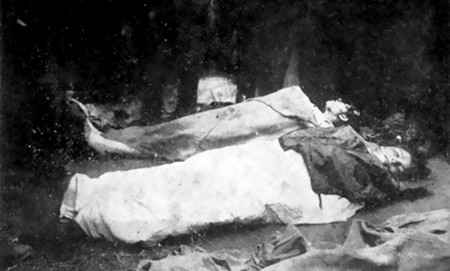
Throughout the entire Sunday men, women, and children ran about the streets like mad, searching for their loved ones. Large crowds hurried from early morning to the ghetto cemetery, where hundreds of martyrs still lay heaped together.
[Page 201]
Many recognized among them their dearest and most beloved; heart-rending scenes played out there. Their weeping and cries could have moved even stones.
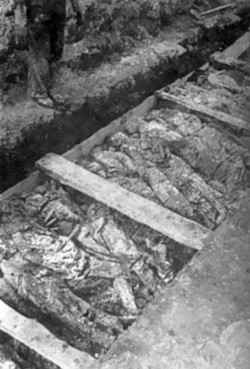
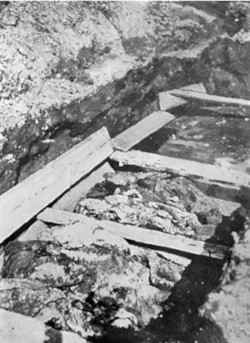
The hundred martyrs whom the Nazi murderers shot in Prage's Garden and covered with a thin layer of earth – so thin that their hands and feet were literally visible – were dug up by the Khevre Kadishe, with the help of other Jews, and transferred to the Zhabye [Żabia] cemetery, where they were buried together with those killed in the ghetto, in three large common graves: men, women, and children.
Cantor Khudin, formerly the cantor of the Nayvelt Bes-Medresh [Nowy Świat Study House], who in recent years had been almost the only person to conduct memorial prayers at the Bagnowka cemetery, and who would half-jokingly tell acquaintances that he did not wish to rest in the Bagnowka cemetery, died during the days of slaughter from a heart attack and was brought to burial in the ghetto cemetery.
The sorrowful overall toll of the February slaughter was this: around two thousand Jews were shot in the ghetto; six transport trains with six thousand victims were deported to Treblinka; and four transport trains with four thousand souls were sent to Auschwitz.
Of those who were taken away to Treblinka, almost no one survived. Of the Auschwitz deportees, several dozen succeeded in passing through all the torments of hell, and they are among the living today.
Translator's notes:
However, this is a separate translation and a substantial abridgement of the original text, prepared by Rabbi Lowell S. Kronick - or Rabbi Shmuel A. Kronick, as indicated on page VI. This version also contains several deviations from the original. Return
by Rafael Rayzner [Reizner]
Translated by Beate Schützmann-Krebs
English Proofreading by Dr. Susan Kingsley Pasquariella
In his diary about the course of the February “Aktion,” as well as about the courageous Jewish resistance, Tenenbaum-Tamaroff devoted a special chapter. Concerning Malmed's heroism, a number of interesting details have been recorded:
Already at the very beginning of the Aktion, Yitskhok Malmed distinguished himself with great bravery. Until the outbreak of the war he had worked in a paint shop in Bialystok; later, at the beginning of the war, he was driven to Słonim, where he lived through the terrible massacres. In the Białystoker ghetto he worked in a factory and lived with his wife and two children at 29 Kupiecka Street.
Before the Aktion, his family hid in a bunker. He too was preparing to go down into hiding when the Germans arrived.
Although Malmed did not belong to any political movement, he – encouraged by resistance elements and slogans, as were many other Jews – obtained a bottle of vitriol for his own self-defense. When the SS men entered Malmed's house and tried to seize him, he threw the vitriol at the attacker, burning out his eyes. Blinded by pain and murderous rage, the German fired wildly and hit his companion, who fell dead on the spot.
In the chaos that broke out, Malmed escaped and hid in a bunker. The dead German was brought to the Judenrat in order to determine the origin of the bullet, and the examination showed that it had not come from a German rifle… Meanwhile, as punishment, 120 random Jews were seized and shot, taken as hostages – most of them from the very building where Malmed lived.
The Gestapo demanded that the Judenrat hand over the assailant, and through the Ordnungsdienst they issued a communiqué offering a high reward for his capture:
“Malmed Yitskhok, born 1903… Whoever finds him or provides information about him will receive a reward of ten thousand marks, because he killed the German.”
The authorities also demanded that Barash bring Malmed's family to the Judenrat – at that time they were in a maline [hiding place] together with the khalutsim [pioneers], as Tenenbaum noted with satisfaction. In vain did the local informers, headed by Yudkovski, search for traces of Malmed in the ghetto, which at that moment lay empty on the surface.
The German ultimatum – that ten thousand Jews would be shot if Malmed was not captured – compelled him, before the deadline, to surrender himself to the police in order to save the ghetto.
A summary court-martial under the chairmanship of Heimbach was convened to try him. This took place on Sunday, the 7th of February. On that day no Aktion occurred.
Tenenbaum's diary dwells at length on Malmed's extraordinarily courageous and proud bearing during the interrogation in the Gestapo. When asked why he had killed the German, Malmed replied: “I hate you. I regret only that I killed just one. Before my eyes my parents were murdered. Before my eyes you slaughtered ten thousand Jews in Słonim. I have no remorse.”
Throughout the entire day Tenenbaum tried to get a dose of cyanide to Malmed – “but it was impossible,” he writes – for even the policemen were not permitted to approach the prisoner.
[Page 202]
On the morning of the 8th, sentenced to death by hanging, Malmed walked with his head held high to the gallows, which had been erected early that morning with great pomp opposite his dwelling. He spat in the face of the German who was leading him and said: “Your end is near as well.” Hundreds of dignitaries from various formations, with Friedl at their head, came to witness the “ceremony” of the execution.
For half an hour Malmed stood on the scaffold – they were waiting for a Nazi dignitary. The executioners mocked him the entire time and beat him, while he kept asking questions about the German he had killed. According to the German version, Heimbach, in accordance with formal procedure, read Malmed the sentence and asked what his last wish was. The condemned man requested permission to climb to the roof of a house and throw himself down from there. Heimbach denied his request.
Malmed maintained his dignity until the very end, asking for nothing – only once for a sip of water, and even that the executioners refused him. Various accounts report that, just before the execution itself, he cried out a fiery accusation against the hangmen, predicting vengeance and a swift end for them. “He bore himself heroically and even hurled sharp words into the faces of his murderers,” recorded P. Kaplan in his Khurbn [Destruction] chronicle.
“He died with honor… calmly. For forty-eight hours he hung on the gallows, and when the rope snapped, he remained standing like a living man, upright, tied so that he would not fall,” wrote Tenenbaum, describing his conduct and the deep impression it made on the Jews. Malmed's heroic death stirred the entire ghetto, especially the more active elements, and called them to acts of resistance.
The underground honored his memory by placing a wooden gravestone in the ghetto cemetery, with his picture and the inscription:
”To the hero – honor.”
After some time, when the Germans learned of it, the memorial was removed.
The Pain After the Slaughter
Early in the morning, right after the terrible February Aktion, when the Jews began to emerge from their hiding places, wrapped in sorrow and pain, people began – with horror – slowly to come back to themselves. Mordechai Tenenbaum recorded the following terrifying lines in his diary:
“Only now does one see the full horror: dozens of half-mad people run through the streets calling for their loved ones. Running and falling, running and falling. They drag out of the hiding places children who have been suffocated – they had begun to cry during the search, and were smothered. Everyone drags along their bundles. Everywhere people are weeping. Police go around the cellars, attics, and every hole, gathering the dead. The dwellings of those who were taken away are sealed. In the cemetery enormous piles of corpses – they are buried in mass graves. One great weeping.”
And a little further on, toward morning, Tenenbaum adds:
“Snow has fallen – covering the bloodstains. From beneath the whiteness of the snow – a gleaming redness. In the afternoon – rain. Everything washed away.”
|
|
In a separate passage, as in a formal act of accusation, Tenenbaum pointed to yet another crime of the Nazis – one that violated all international conventions: the use of “dum-dum” bullets. The fact was established through medical examinations. He sets out the macabre consequences:
”There were no wounded – every bullet meant death, the wounds enormous. A bullet to the head – a shattered skull and the spilling of brain matter, torn faces almost impossible to recognize among those shot from the front.”
Pesach Kaplan also referred in his chronicle to the horrifying appearance of the murdered. “Terrible it was,” he writes, “the sight of the dangling hands and feet, the heads thrown backward. Blood-soaked, split open, torn – like slaughtered calves.”
The heroic bearing and courageous conduct of the Jews during the dreadful February Aktion made a deep impression also on non-Jews. The underground press, as well as the legal Polish newspapers, reported and wrote about it. Even the Hitlerite press mentioned it.
Translator's notes:
However, this is a separate translation and a substantial abridgement of the original text, prepared by Rabbi Lowell S. Kronick - or Rabbi Shmuel A. Kronick, as indicated on page VI. This version also contains several deviations from the original. Return
by Rafael Rayzner [Reizner]
Translated by Beate Schützmann-Krebs
English Proofreading by Dr. Susan Kingsley Pasquariella
Rafael Reizner, who had been confined in the Białystoker ghetto until the very end, wrote down everything about his experiences during that time shortly after the war, as well as about the events among the Jews of Białystok before and after that period. Here we present, with certain abridgements, Reizner's descriptions of the liquidation of the Białystoker ghetto and of the deportation of Jews to their destruction. This material is taken from Rafael Reizner's book The Destruction of Białystoker Jewry, 1939–1945, published in 1948 by the Białystoker Center in Australia.
Between Life and Death
“In mid-July 1943,” Reizner relates, “a rumor spread that a very important commission was to arrive, and it was awaited with the greatest anxiety. On that day hardly anyone dared to appear in the street. Strong rumors also circulated that this commission would be the last one, whose word would decide between life and death.
At the same time it became known that the matter concerned the two larger ghettos still existing at that time: Łódź, with more than 80,000 Jews, and Białystok, with its 40,000 – and that the Nazi plunderers intended to liquidate one of the two. For almost everyone this was clear.
After the visit of the (Nazi) commission, Engineer Barash confided privately to his close co-workers that the latest visit had not left him optimistic. From this it became evident that Łódź would remain, and that Białystok stood next in line to be liquidated. The optimists of the Judenrat still hoped that perhaps it might be possible to avert the disaster.”
In connection with the approaching catastrophe, the resistance organization made its final preparations and once again repeated the earlier directives: that the factory fighting groups, together with the local workers, were to mount bitter resistance and prevent the Nazi plunderers from entering the factories; and when the struggle became hopeless, they were to set them on fire and continue the fight in the streets.
These were the plans that the self-sacrificing, heroic Jewish youth had adopted, under the given circumstances, in expectation of the dreadful day that was already very near.
From the moment this ominous news began to spread, life for the Jews in the ghetto became extremely tense. People were accompanied by fear, nervousness, and panic. It was a deeply unsettling time, a life overshadowed by despair.
Thus it dragged on for about four weeks – a stretch that felt like an eternity. At last the rumors turned into a sorrowful reality.
On Shabbat, 14 August 1943, a Gestapo commission arrived to inspect the ghetto fence and its gates. Workers who returned late from outside the ghetto reported that a large number of empty freight cars had arrived at the railway station, and that in the city one could see individual newly arrived Ukrainian Gestapo henchmen roaming about. In order to keep their arrival secret, they were hidden in several courtyards around the city.
There were also isolated cases in which Germans took people's watches in the ghetto before repairing them, explaining that they had to leave immediately. But the Jews of Białystok already knew very well what this meant, for before the fifth-of-February slaughter the Germans had acted in exactly the same way.
Leading figures of the Judenrat tried to convince the frightened and unnerved Jews of Białystok that no disaster would occur in the coming months, arguing that the Wehrmacht had, in recent weeks, placed very large orders which would require several months to complete.
The Wehrmacht officers who were involved with the [military] orders assured the factory directors – with whom they were supposedly on friendly terms – that the Jews of Białystok were at that moment in no danger whatsoever, and that all the disturbing rumors had no basis.
|
|
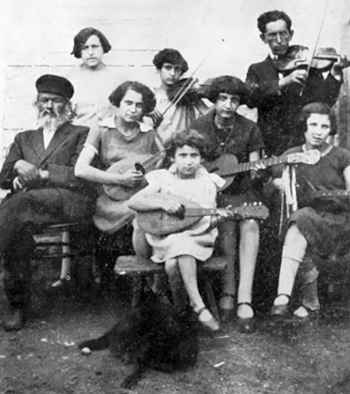
[On page 132 of David Sohn's Bialystok:Bilder Album, the following informations are given: “Lipa Perlstein of Washlikowa and his seven musical grandchildren as they appeared in 1930. The little girl seated in the center, second from right, is the musical artist, Chana Godeloff, of Israel.”] |
[Page 204]
|
|
[As noted on page 79 of David Sohn's Bialystok: Bilder Album: “At right: the Białystoker Maggid, Rabbi Rappoport (now in New York), and the communal leader, Osher Topolsky.”] |
With these troubling yet somewhat reassuring reports, the nerve-wracking Shabbat of 14–15 August 1943 came to an end. With fear people awaited the coming day.
On Sunday, 15 August, the ghetto was quiet, and little by little a spark of belief crept in that perhaps, this time, the Wehrmacht officers might be right. People tried to persuade one another that the fear was, at this moment, somewhat exaggerated. The crowds who had lingered in the ghetto streets until late at night began to disperse. They went to sleep with the hope that the horror would not yet come.
But – – –
At two o'clock on Sunday morning, between 15 and 16 August, Jews living near the ghetto fence suddenly heard suspicious noises. A minute later, the heavy tread of the Nazis' iron-shod boots could be clearly heard. It became evident to the Jews that larger groups of Nazi murderers were approaching the ghetto fence. A tremendous commotion broke out. People began waking the sleeping Jewish population and announcing the terrible news.
The Jews of Białystok, who in those days still numbered barely 40,000 souls, found themselves within minutes out on the streets, running back and forth in the darkness, bewildered. One asked another: Is it over? Is there no hope? Will the entire ghetto be liquidated now, or only a part? No one was able to give an answer.
Under the command of the Lublin camp chief, Obersturmführer Tuman, and with the assistance of the Białystoker Gestapo bandit Friedl, several hundred fully armed Nazi murderers entered the ghetto at three o'clock, occupying all the ghetto factories and the building of the Judenrat.
By five in the morning it became known throughout the ghetto that the Nazi murderers had informed Barash that the Jews of Białystok, together with the machinery of the factories, were to be taken to Lublin, where they would continue to work. The order also stated that today, Monday, by nine o'clock, the Jews living on Polna, Nayvelt [Nowy Świat], Częstochowska, Białostoczańska, Okronle Lane, Shlyakhetske [Szlachecka], Linas Hatzedek Street, Tshiste [Czysta], Zhitnye [Żytnia], Zamenhof Street, Kupiecka, Geldove [Giełdowa], and the adjacent streets were to gather on Yurovtser [Jurowiecka], Fabrik [Fabryczna] Street, Tsheple [Ciepła], Novogrudzke [Nowogródzka], Chmielna, and in the Judenrat garden, from where they would be sent to the railway. Those who did not obey the order and were found in an area where they were no longer permitted to be would be shot on the spot.
After this announcement it became clear to everyone that this was the liquidation of the entire ghetto.
The Jews from that part of the city – men, women, and children with their pitiful bundles on their shoulders – darkened the designated streets where they were ordered to assemble. By seven in the morning the streets had already become impassable.
The sudden assault by the Nazi murderers caught the self-defense groups not yet properly prepared. In addition, by occupying the ghetto factories, the plan to conduct the battle inside the factories and then set them on fire had been thwarted. After a consultation, the leading members of the zelbst-shuts [self-defense] decided not to wait until nine o'clock, when the Nazi murderers would begin the slaughter, but to inform the Jewish population immediately that they were not being taken to Lublin for work, but to Treblinka for gassing.
|
|
[Page 205]
|
|
[As noted on page 133 of David Sohn's Bialystok: Bilder Album: “The little girl in the center is Mrs. Esther Jeruzalimsky, treasurer of the Bronx League.”] |
In several places, members of the zelbstshuts [self defense] came out to deliver explanatory speeches. At 3 Chmielna Street, a member of the self-defense addressed a large assembled crowd and said, among other things:
“Be aware: you are being taken to Treblinka for gassing, and we will, to our great misfortune, share the bitter fate of the entire Jewish people in Europe. The only way out of this hopeless situation is to set our houses on fire, together with our possessions, so that our death will be of no use to the enemy. Take weapons in your hands – there are enough of them – and let us all try together to break through to the forests, where our brothers, the partisans, are.”
When he finished his speech, the youth, inflamed by his words, seized their weapons.
The self-defense also decided that, in order for the ghetto fence to burn down, all the houses standing close to it had to be set on fire. In this way, perhaps a small number of Jews might succeed in breaking out of the ghetto.
| Do not forget to preserve
the memory of our martyrs. |
Translator's notes:
However, this is a separate translation and a substantial abridgement of the original text, prepared by Rabbi Lowell S. Kronick - or Rabbi Shmuel A. Kronick, as indicated on page VI. This version also contains several deviations from the original. Return
Translated by Beate Schützmann-Krebs
English Proofreading by Dr. Susan Kingsley Pasquariella
|
Brothers, fellow Jews! Terrible days have come upon us – not only the ghetto and the yellow badge, hatred and enmity, insult and humiliation – death stands before us! Before our eyes, our women and children, fathers and mothers, brothers and sisters are being led out to annihilation. Thousands are already gone; tens of thousands will yet be taken away. In these dreadful hours, which decide our being or not being, we turn to you with the following words: Be aware – Five million Jews in Europe have already been killed by Hitler and his executioners. Of Polish Jewry, no more than ten percent remains. In Chełmno and in Bełżec, in Auschwitz and in Treblinka, in Sobibór and in other death camps, more than three million Polish Jews were tortured and murdered by various cruel and most gruesame methods. Be aware – all those taken away are being taken to their death! Do not believe the provocative Gestapo propaganda about supposed letters from those who were sent out. This is a cynical lie! The path of the deported leads to enormous crematoria and mass graves in the depths of the Polish forests. Each one of us is already a condemned man. We have nothing left to lose! Do not believe that work will save you. After the first Aktion there will be a second and a third – until the last Jew! The division of the ghetto into various categories is a refined Gestapo trick meant to deceive us and, through different illusions, make their work easier. Jews, they are taking us to Treblinka! Like mangy beasts they will poison us with gas and then cremate our bodies. Let us not go like sheep to the slaughter!
If we are too weak to defend our lives, we are nevertheless strong enough to defend our Jewish honor and human dignity, and to show the world that we are bound but not fallen. Do not go voluntarily to your death! |
[Page 206]
|
Fight for your life until your last breath! With teeth and nails, with axe and knife, with vitriol and iron – meet the executioners! Let the enemy pay with blood for blood! With death for death! Will you hide in holes like mice while your dearest ones are being dragged off to rape and to death? Will you, for the sake of a few more days of enslaved life, sell your wife and children, your parents, your soul? Let us attack the enemy from ambush, kill them, disarm them, resist the murderers – and if it becomes necessary – fall like a hero, and dying, do not merely die! We have nothing left to lose – except our honor! Do not sell your life cheaply! Take vengeance for the annihilated communities and the uprooted settlements! When you leave your home – set fire to the property, set fire to and demolish the factories! Let the executioners inherit nothing from us! Jewish youth! Take an example from generations of Jewish fighters and martyrs, from dreamers and builders, from pioneers and realizers – go out to battle! Hitler will lose the war. The axis of enslavement and man-devouring tyranny will be wiped from the earth. The world will be cleansed and purified. For the sake of this radiant future of humanity – you must not die a dog's death! Go out to the forest, to the partisans! Do not flee the ghetto unarmed – you will perish before fulfilling your national duty. Go armed into the forest. You can obtain weapons from any German in the ghetto.
Be strong! |
|
|
JewishGen, Inc. makes no representations regarding the accuracy of
the translation. The reader may wish to refer to the original material
for verification.
JewishGen is not responsible for inaccuracies or omissions in the original work and cannot rewrite or edit the text to correct inaccuracies and/or omissions.
Our mission is to produce a translation of the original work and we cannot verify the accuracy of statements or alter facts cited.
 Białystok, Poland
 Yizkor Book Project
 JewishGen Home Page
Copyright © 1999-2026 by JewishGen, Inc.
Updated 16 Apr 2026 by LA