 |
|
[Page 138]
by Yosef Ze'evi
Translated by M. David Isaak
Luninyets had four shuls [synagogues] also called “Batei Midrashim“ [Houses of Study]: the Large Synagogue, or, as it was called “Die Alte Shul” [The Old Synagogue], which was the center for the Stolin and Karlin Hasidim; the “Die Horodoker Shul” – the center for the Haradok and Brezen Hasidim; “Die Ashkenaz Shul” – for followers of Nusach Ashkenaz [Ashkenazi custom]; and “The Zemed Shul” for residents from the Zemed (Lithuania's Samogitia, region).
Die Alte Shul [The Old Synagogue]
Die Alte Shul, built in the Hebrew year 5665 (1905), 57 years ago, was the first. The founders and builders of Die Alte Shul were Tzadok Lichtenstein, Yisroel Treiboch, Dovid Greenstein, Aaron Feldman, Mattisyahu Diatlovitski, and others.
The Rebbe, the shochet [ritual slaughterer], original householders, and prominent Jewish residents prayed in this synagogue. It was the largest and most beautiful synagogue in Luninyets. The synagogue possessed a large and rich rabbinic library.
The majority of the worshippers were Stolin Hasidim, who prayed in their own unique manner. Stolin Hasidim did not like nor did they have cantors or maggidim [preachers]. R' Pinchas Tchernomeretz from Plotnitse was the ba'al-tefillah [prayer leader] for over thirty years. However, well-known cantors and maggidim did occasionally visit and deliver their sermons in the synagogue.
Stolin Hasidim had their own special traits when praying: with ecstasy and joy, which found expression by clapping of hands, stomping feet, or running from corner to corner, noisily and with emotional feeling. The main thing for them was the kavonoh [intention, concentration] and not the actual words themselves. Anyone who heard and saw how the Stolin Hasidim davened [prayed], especially how R' Alter Levin used to pray and say the Yehi Ratzon of the Sefirah [Counting of the Omer] – no one can ever forget that prayer, full of emotion and enthusiasm. Or who can forget the Pitum HaKetores when the Hasidim prayed it? There reigned among them a kind of competition, as each one, with his special melody and intonation, expressed in the words: “K'dei she-tehei dakah min ha-dakah!” [In order that it should be the finest of the fine!]
We hear a mixture of voices: here is Reb Alter Levin's, who thunders with his deep bass: “K'dei she-tehei dakah min ha-dakah!”; there is heard the weak, hoarse voice of the Rebbe: “K'dei she-tehei dakah min ha-dakah!”; a third voice, R' Motl Schwartzman's, shouts from a corner with a voice full of anger and bitterness: “K'dei she-tehei dakah min ha-dakah!”. And in these words, everyone expressed his own personality, his character.
The Shalosh Seudos [the third Sabbath meal] in the synagogue warrants a chapter of its own. Every Sabbath, after Mincha, the singing of zmirot by the Hasidim reached the highest level of enthusiasm. Among the Hasidim, there were those who
[Page 139]
distinguished themselves with strong and beautiful voices and composed niggunim [melodies], even though they had no knowledge of music.
The most famous classical niggun was the Adir Bimlucha which is usually sung at the Seder on Passover. Here, they carefully followed the accepted format of Lecha Ki Lecha, Lecha Af Lecha, etc. And when the Hasidim celebrated a simche [joyous occasion] or a Yahrzeit, or similarly a Simchas mitzvah, they made a L'chaim [toast]. As the body warmed up a bit after the L'chaim it reached the stage of casting off materiality and achieving an elevation of the soul, then the Hasidim would leave the table and form a circle, a karahod of Hasidim around the bimah [stage, raised platform]. Hand in hand, hand on shoulder, or holding onto another's gartel [belt] – the Hasidim danced. All barriers and hindrances then fell away; rich and poor, scholar and simple man, young and old – all melted together into one single entity. During a pause, the leader of the karahod would call out: “May we live to see another year, may we merit to hear salvations and consolations for Jewish people! May the Moshiach [Messiah] come quickly.”
In the later years, the Beis Midrash became a place for gatherings of various organizations. We must also not forget Itzik the Shames [beadle], who faithfully served the Beis Midrash for several decades. R' Itzik the Shames was a man unto himself, a Kozhanhorodoker, and when the Beis Midrash expanded, he was honored with two positions – as both Shames and mikveh [ritual bath] attendant. He had a residence in the Beis Midrash itself, a separate room. Reb Itzik paid strict attention to cleanliness and order in the Beis Midrash. He did everything himself. He made sure the Ner Tamid [eternal light] was always lit and took care of the Seforim [holy books]. His income came from the Beis Midrash, but because of his nature, he really was not suited for the tasks. He was very modest and hated what he considered ill-gotten gains, he would never ask another Shames or anybody else to pay him for his work and service.
The Horodoker Shul
The Horodoker Shul was built in the Hebrew year 5664 (1904) by the Horodoker Hasidim. The founders and builders were: Yitzhak Tzvi, Yechezkel and Shlomo Stabovsky, Shaul Wilk, Moshe Karlin, Yaakov Homer, and others. About 400 meters away, it stood parallel to Die Alte Shul . The Shul was not very large, but it was tall and full of light and air. There were no buildings next to it, just gardens and fields. The majority of the worshippers were craftsmen. There, near the eastern wall sat craftsmen like Yechezkel Stabovsky the shoemaker and Moshe Yitzhak Flaksman the tailor. The first Gabbai was Yitzchak Katz, the second Gabbaimoshe Leib Muzikant.
[Page 140]
Here, people davened with pleasant, gentle and soft niggunim, in contrast to the Karlin-Stolin's burning fervor and ecstasy. The scholar of the Beis Midrash was R' Leibush Kucykiewicz, a devout orthodox Jew who would never utter a single word of mundane talk, and who, from early morning on studied Torah. This writer has a sentimental, personal affinity for this Beis Midrash, because he had studied there with his friends Hershel Levin and Betzalel Stachovsky for whole days at a time and often for whole nights, conducting a mishmar [vigil]. Later we all left together to study in a Yeshiva.
A special liveliness and happiness was when one of the Horodoker Rebbes, the Ginzburgs, R' Babaleh, R' Elterke, and the younger Reb Velvele, made their traditional visit to the Hasidim. The whole week was joyous and festive. Hosting the Rebbes were R' Yitzhak Katz whose guest was R' Babale and R' Yosef Dovid whose guest was R' Velvele. R' Babale was a great tzaddik [righteous man] and very humble, everyone had a high impression of him; he was beloved and honored by the Hasidim.
In this Beis Midrash, the Chevra Kadisha [Burial Society] used to celebrate the feast of the 24th of Kislev, after their fast. Leah, Yosef-Dovid's wife, whose house was right next to the Beis Midrash, together with her friends, also pious, righteous women, baked and cooked with a generous hand, so that the members of the Chevra Kadisha “enjoyed” fasting on the short winter day, in anticipation of the evening's rich feast with wine, which was accompanied with scores of Hasidic melodies.
The central figure of the Beis Midrash was Aaronke the Shames, a native of Kazanhorodok, a Torah scholar, a Torah chanter, and also a ba'al tefilah [prayer leader]. He knew every Jew's Yahrzeit, and he would remind him a week in advance so the person observing the Yahrzeit would be prepared. Reb Aaronke introduced his own niggunim into the High Holiday prayers, such as: Ya Eli V'Goali, Ashrecha Yisroel , in which the congregation accompanied him and joined him in singing. In the final years, the Berezner Rebbe, R' Itzikel Peczenik, used to visit the Shul. The then Shames of the Shul, until its destruction in the Holocaust, was Reb Eizel the Melamed .
The Ashkenazic Shul
The Ashkenazic Shul was also built in 5664 (1904) by adherents of the Ashkenazic nussach [prayer version] who were not Hasidim; a portion of them originated from the Lithuanian region. The builders were: Avrohomke Molyar, Alter Tzion, and Hershel Damnitch. They also served as the Gabbaim. This Beis Midrash was located in the center of town, in an alley next to Sadowa Street in a muddy corner, and it was always full of worshippers, especially for the Mincha and Maariv prayers.
A Jew who was preoccupied with his livelihood and work, and did not have time to go the long distance to the Horodoker Shul or the Die Alte Shul, and had to say Kaddish , had to accept and go to this more convenient Shul so that he could daven at the pulpit.
[Page 141]
In this Beis Midrash, R' Yisrael Peretz conducted Gemara [Talmud] lessons with the congregation. Also, the fervent Stolin Hasid, R' Mordechai Pereplotshik, daily, after a hard day's work, would study his chapter of Mishnah at night until he fell asleep; his son would then come, wake him up and take him home. The Gabbaim strictly maintained the Ashkenazic nussach . That style of davening was in the Lithuanian custom, where they paid attention to the precise grammar of the text and to the individual's kavonoh [concentration], but without the Hasidic tumult and fiery enthusiasm.
The Zemdishe Shul
In the early years, before this Shul was built, the residents of the Zemler neighborhood attended two minyanim [prayer quorums]: one at R' Yehoshua Kashtan's, where mainly the Stolin Hasidim prayed, the second minyan was at R' Meir Kaplansky's. Most of the Zemler residents prayed there.
After a while, these minyanim became crowded and after great efforts, the worshippers at R' Meir's minyan obtained a permit to build a Shul. The Zemdisher Shul was built in the center of the Jewish neighborhood. At first, the worshippers from R' Yehoshua Kashtan's minyan did not participate in the building, but later they joined the effort, bought “holdings,” and helped build this Mishkan Me'at [small sanctuary]. The majority of the worshippers at the Zemdisher Shul were craftsmen, generally very hardworking, and among them were some who had learned a page or two of Gemara . Here, too, they prayed according to the nussach S'farad [Spanish version]. It is worth emphasizing the immense devotion with which the Shul was built.
Everyone took part and helped in this holy work; some with the actual digging, some with building, and some with collecting money. The leader and project manager of the building was R' Reuven Tennenberg the miller. His assistants were R' Yaakov Kashtan and his son, R' Avigdor Katzman, and R' Dovid Gonin the carpenter, who built the Aron Kodesh [Holy Ark], all of it was done fulfilling a mitzvah. The practice of reciting Tehillim [Psalms] was established in the Zemdisher Shul. On Sabbath afternoons, R' Avrohom'l from Witshyn would stand at the pulpit, and with his strong voice, recited the entire Book of Psalms over the course of a few hours. There were those who used to learn a page of Gemara . On one side sat R' Avigdor Katzman and R' Meir Kaplansky and studied Gemara ; on the other side sat Yedidyah Kucykowicz the glazier, agonizing over a difficult topic in the Gemara ; and in a far corner leaning against a lectern, stood R' Pinchas Cheynik the wagon driver, studying the Tractate Shabbes by himself. Others studied Mishnah and Ein Yaakov. The spiritual leader of this Beis Midrash was R' Ahrele Ginzburg, the Dovidhorodoker Rabbi's son. While he never
[Page 142]
became an rabbi officially; he was very learned, and the Zemler residents supported him. This Beis Midrash was always full of worshippers. The permanent ba'al tefilah for the High Holidays and Holidays was R' Reuven Tennenberg, until his departure for America. The permanent Torah chanter was R' Avigdor Katzman the painter, a fervent Torah scholar. The public felt very good and free in this Beis Midrash. There were no elitists or wealthy oligarchs here; no distinction was felt between the Stolin Hasidim and the Horodoker Hasidim, or between Hasidim and non-Hasidim. Young people who liked to have fun found an understanding and a sympathetic ear among the grown-ups. In this Beis Midrash, the Hasidim also held the Seudah Shlishis, but no longer with the fiery enthusiasm that pervaded the old Shul.
Here too, people used to celebrate a Seudas mitzvah [meal celebrating a mitzvah] or a Simchas Beis HaShoevah [Celebration during intermediate days of Sukkot]; they would dance “hand on shoulder,” but the blessings bore a more realistic character, regarding salvations and consolations for the Jewish people, as well as personal blessings, such as “May you live to see your daughter's wedding soon,” or “May your son be released from the military service,” and so on.
During WWII, after Pinsk was occupied by the Germans, many Jewish families escaped to Luninyets, there was a shortage of apartments, so several families settled themselves in the Shul's small shtiebel and upstairs in the women's section. Bitter fate decreed that the Ghetto the Nazis designated for the Jews was located in the same corner that included the Zemdisher Shul.
From there, our families were cruelly led away to their slaughter.
|
|
by Chaim Robinraut
Translated by M. David Isaak
“Shul-Kult” School Named After David Pinski
The Jewish national “Shul-Kult” school named after David Pinski was founded in the 1930 at the initiative of a group of Po'alei Tzion [Zionist/Socialist] comrades, who were joined by craftsmen and non-partisan individuals. The students consisted mainly of children from working-class circles and from the poorest strata. The language of instruction was Yiddish, with a large amount of Hebrew, Tanakh [Hebrew Bible], Palestine geography, and Jewish history. The school was conducted in the spirit of working Eretz Yisrael and was affiliated with the central office of “Shul-Kult” in Warsaw, which was under the influence of the Po'alei Tzion party.
The school consisted of 4 classes with 70 students. In financial terms, the school constantly struggled for its existence. Income from tuition fees was minimal, and it was only thanks to the devotion of comrades and activists that the budget was covered through campaigns and personal contributions.
Every year, when trying to renew the school's permit with the Polish school authorities, great difficulties were encountered. Lacking suitable premises, the school had to move from one location to another. In the school's 4th year, the authorities did not issue a permit, and the school was forced to close.
A kindergarten with 20 children had also existed alongside the school for two years.
|
|
[Page 144]
The Y. Ch. Brenner Library in Luninyets
The first Jewish communal and public library in the city was founded during the First World War by Dr. Cherniavsky, a military doctor, and local activists, as a branch of the Petrograd Society for the Promotion of Culture Among the Jews – “Chevrath Mefitzei Haskalah” [Society for the Promotion of Enlightenment]. For the most part, the books were Russian, with a small number of Yiddish ones, and even fewer in Hebrew. After the World War, with the emergence of a Zionist youth movement, the library passed into the hands of a group from the Z.S. [Zionist-Socialist] Youth and “Tzeirei Zion” [Youth of Zion]. The library began to develop. Many Hebrew and Yiddish books were added, and the number of readers grew significantly.
|
|
Through public collections and performances by the drama circle, financial resources were created for the library. In 1920, during the Polish-Soviet War, when the Poles set fire to the city upon leaving it, the library–which was located in David Greenstein's brick building–was also burned down. It did not take long, however, before the library was renewed again, named after Yosef Chaim Brenner. Thus, the library grew gradually until 1924. When the largest active part of the Z.S. [Zionist-Socialist] Youth and HeHalutz left for the Land of Israel, the library became neglected. For a long time, the books lay rolling around in crates in attics.
[Page 145]
Tel-Chai Library
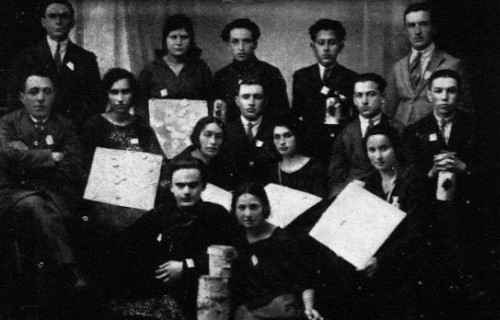
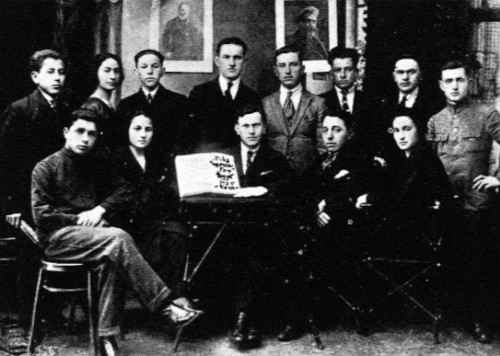
In 1927, a group of Poale Zion Z.S. members set out to renew the library once again. For legal reasons, this did not succeed, so they founded the “Tel-Chai” Culture Society and, by collecting books, created a new library named “Tel-Chai.” The entire library was contained in a small crate in the apartment of Michal Toptshik. Thanks to the tireless work of this group of comrades, the library developed rapidly. They rented their own premises, and a reading room was established alongside the library. The Jewish youth and working class rallied around the library and reading room; hundreds of readers became steady visitors. Within the course of two years, the library already counted over 1,000 books of Yiddish and Hebrew literature. The “Tel-Chai” Culture Society used to organize weekly question-and-answer evenings, lectures, literary trials, and so forth. A dramatic circle was formed which, through its performances, earned a reputation in the city and surrounding towns. Thanks to the tireless work of Menachem Leshtshinsky, the dramatic circle developed greatly. Among its best plays were “The Mother” by David Pinski, “The Country Youth” by Jacob Gordin, and “The Seven Who Were Hanged” by L. Andreyev. A choir, an orchestra, and a sports group were also formed. Within a very short period of time, the “Tel-Chai” Culture Society, thanks to its influence in the city, concentrated large segments of the youth and workers around itself. Through these same circle activists, the “Shul-Kult” folk school and children's home was established, which existed for three years.
In the work and development of the library and its branches, one cannot ignore
|
|
[Page 146]
the achievements and self-sacrificing activity of Asher Senderuk, who spared no effort and exertion, shelo al menat lekabel pras [not for the sake of receiving a reward]. At the outbreak of the Second World War, the library possessed 300 readers and approximately 2,500 books, consisting of all the newest editions of modern Hebrew and Yiddish literature.
The “Tel-Chai” Jewish library in Luninyets, the reading room, drama circle, orchestra, choir, and public literary events contributed immensely to raising the cultural level of the Jewish working youth in the city, strengthening their national and social consciousness in the spirit of Labor Movement in Palestine.
With the entry of the Red Army, the library was turned over to the Soviet authorities. All Hebrew books, as well as Yiddish ones with a nationalistic content or an undesirable social content, were destroyed. The remaining books were transferred to the general municipal library, erasing the inscription of the “Tel-Chai” library from every single book.
With the Hitler occupation, along with the entire Jewish community, the remnants of the Jewish books also went up in smoke.
Among the founders and active leaders of the “Tel-Chai” library and its branches who were murdered by the Germans were: Asher Senderuk, Menachem Leshtshinsky, Gadel Zuliar, Dina Toptshik, Shlomo Musikant, Uri Rotkopf, Chaika and Yaakov Bikman, Eliyahu Kuniets, and Velvel Saker.
by D'vorah Kutnik (Detroit)
Translated by M. David Isaak
When my father moved from Kozhanhorodok (after the great fire) to Luninyets, he decided to open a library for am'kho [Your People]. He was not deterred by the great difficulties, neither on the part of the Tsarist authorities, who gave no permits, nor on the part of the religious Jews, who feared that “Avraham the cheder teacher should not occupy himself with treif, possul [un-kosher, invalid (secular)] booklets.”
My father ordered and received several shipments of books from Warsaw and Vilna in Yiddish and Hebrew. The Hebrew books were mostly haskalah [enlightenment] books by Kalman Schulman, Mapu, Peretz, Sholem Aleichem, Mendele, and others. The Yiddish books were by Peretz, Sholem Aleichem, Mendele, Dinnesohn and so on.
The Yiddish books did not have a great following at first. Then my father, who understood the psychology of the small-town reader who wants “interesting” books, ordered Shemer's and Blaustein's fictional novels. The
[Page 147]
public began to read them with great eagerness and delighted in the stories of Counts and Countesses. It must be said that Shemer's novels worked and served an important purpose; the public became accustomed to reading a book.
Over time, my father managed to guide the public toward reading the new Yiddish classics. Every Friday afternoon, our home would be filled with tailors, servant girls, apprentices, and also workers–shoemakers and tailors, who remembered how they used to come from the mikveh [ritual bath] and drop in on Avraham the melamed [teacher] to take a book for Shabbat. The books (in our library), considered revolutionary booklets, were kept hidden in the drawers of the dresser or under mother's bed in a straw mattress. And more than once, when a policeman appeared in our alley, mother would turn pale with fear. Once, out of great fear, she took all the books from her bed and burned them.
The library had a great influence on the readers. The small-town person became acquainted with the wider world, his eyes were opened, and he began to realize and understand that there is a big world with problems beyond Luninyets and even Pinsk. In Detroit I often meet with a lands-froi [female compatriot], and she shares her memories with me about the books she used to take from us every Friday, and still remembers even the names of their heroes.
The library was destroyed in 1915, when we left our home and fled to Kozhanhorodok because of the approaching Germans. Then the Cossacks, who occupied our house, tore up and burned all the books, and thereby put an end to the first Jewish library.
by Ya'akov Kola
Translated by M. David Isaak
Twice a year, Luninyets found itself in a holiday mood that enveloped all strata and classes of the population, without distinction between old and young. This was when the Rebbes of Stolin and Karlin arrived. Each Rebbe would come to Luninyets for a Shabbat to encourage his Hasidim toward Hasidism and Avodas Hashem [the service of God].
It was customary on one Shabbat a year, for the Stoliner Rebbe, Rabbi Moshe'leh of Stolin, to visit the place where the famous Stoliner Hasidic court was located (founded by the world-famous Tzadik Rabbi Aharon Karliner, known as the Beis Aharon, or Der Alter Rav [the older Rebbe]). His successors were Rabbi Asher, Der Yunger Rav [the younger Rebbe], and his son Rabbi Yisrael'ke, who was known throughout the great world as The Yenuka. Among the Stoliner Hasidim, he was known as “The Frankfurter” (because he died in Frankfurt).
[Page 148]
Also once a year for a Shabbat, the Karliner Rebbe, Rabbi Motele, along with Rabbi Yisrael'ke's son, who lived in Karlin (near Pinsk), would come to Luninyets for a visit. In Luninyets, Rabbi Aharon HaGadol lived and was active. He was the founder of the Stolin-Karlin dynasty and the greatest spreader of Hasidism. He was one of the most prominent disciples of the Mezritcher Maggid. In Karlin, Rabbi Asher and Rabbi Shlomo Karliner continued their activities. A part of the Beis Aharon was also active there. Another reason for Luninyets' importance is that the holy graves of Rabbi Aharon HaGadol and his son Rabbi Asher are located there as well.
For a Shabbat like this, the town would prepare weeks in advance. A list of all Hasidim and sympathizers would be prepared, and everyone contributed generously to prepare a Shabbat full of all good things for the Rebbe and the crowd. Hasids from the surrounding towns and villages also gathered to visit and rejoice with the important guest.
The Hasidic women prepared the food and kugels [potato casseroles] for the guests (all the Hasidim would eat together with the Rebbe at the tish [the Rabbi's table] in the synagogue). Aside from the kugels that belonged officially to the tish, close associates sent in extra kugels. Hasidic women actually competed with one another over who could make a more beautiful and better one.
Arriving in town, the Rebbe would usually come on a Thursday (Stoliner Rebbes did not like to begin travels on Friday). From early in the morning on, they began preparations: Before prayers, they went to the mikvah [ritual bath], the intent being to complete the first part of preparations for the reception of the Sabbath. That day, the synagogue was packed. The davening [reciting of prayers] felt very different. The congregation prayed with a completely different flavor. After the davening, the order-of-the-day was confirmed and the the final preparations were made for the Kabbolas Ponim [reception], and simultaneously, all had a “hit” of Bronfen [brandy] making a L'chaim [toast]. Generally, a bottle of weisse [white spirits] was always ready, to avert any trouble that may (or may not) come–a L'chaim must always be ready, especially when hosting such an important and revered guest. Meanwhile, they would repeat a word of Torah commentary they had heard from the old Rebbe himself or from the current Rebbe, may he enjoy good health, and the prevailing mood was quite elevated. The one in charge of the bottle was Rabbe Alter Levin, who was a regular diviner in the second minyan, and when Rabbi Alter took the bottle, the blessing of abundance presided. Simply put, it was a second Chanukkah miracle. Because from this bottle, which held just enough for one day–they drank a whole week… Rabbi Alter had a little glass, a rare find. First of all, it had to stand on its head, because it had long since lost its base. For drinking, he held the little glass curled inside his small finger; this way the little glass quickly became full (Hasidim always drink up the full glass).
An hour before the arrival of the train, Hasidim were still streaming to the station. Everyone wanted to grab a front spot for a better view of the Rebbe and his entourage,
[Page 149]
|
|
|||
and personally greet them. The elderly Hasidim had dressed in Shabbat clothing: high silk hats, with black frock coats, and with a holiday spirit of joy, enthusiasm, and warmth, they awaited the important guest. With a large parade, they escorted the Rebbe to his quarters, supported on both arms by two elderly Hasidim. One of them was always Rebbe Alter-Yudel, the Rav, with whom the Rebbes would stay.
Soon, the quiet synagogue lane was transformed into a central hub; the movement was in full swing; townspeople who had not managed to be at the train station now went to greet the Rebbe.
On Friday, Luninyets took on a different form: shopkeepers left their shops, craftsmen–their workshops, and the yeshiva boys–their Talmud studies. The streets were full of visitors–guests for Shabbat who came to to hear the Rebbe. Every train brought fresh minyanim [quorums of 10] of Jews; also, people from the closer surroundings arrived by sleds and wagons. Here comes the Plotnitsa company, which had a special reputation as good Cossacks, who also used to come to the Karliner Rebbe. Here comes the most respected company with Rabbi Moshe-Meir the Shochet [ritual slaughterer] at its head, coming to see the Stoliner Rebbe. And here people rejoiced with Rabbi Matis the Lakhva Shochet, who used to come at the head of a company of Hasidim. Large groups of Hasidim used to come from Pinsk, Stolin, Dovidhorodok, Dubrovitsa, Vysotsk, Sarny, etc.–and the town was bubbling like a heated cauldron.
Every Hasid had a designated place to stay: some at Ephraim-Ichele's, some at Yosef Diatlovitsky's, some at Motl Schwartzman's, some at Itzik Katz's, some at Gerzulin's, and so on. Everyone felt at home; almost every house put up a few guests.
[Page 150]
On Friday evening, the crowd began streaming into the synagogue. The synagogue lane became black with people. Besides the arriving guests, local householders from other synagogues went to look on as well, wanting to be present during the Rebbe's davenen. In the synagogue, familiar and close acquaintances met; the Stoliner Hasidim are like one family. They greet each other and wish that next year, please God, they should meet again in the same way. The Luninyets Hasidim walk around with radiant faces like in-laws at a wedding. What joy!
Suddenly, like an electric spark, a message passes through the crowd: – The Rebbe is coming! The people make room to let the Rebbe approach the mizrach [eastern wall].
Getting late, beyn hashmashot [during twilight], at a given a signal, one of the Hasidim approaches the omud [platform] and begins singing: “Hodu L'Hashem Ki Tov, Ki L'olam Chasdo.” Like a holy fire, it sweeps through the entire congregation. The enthusiasm increases from minute to minute, reaching actual ecstasy. The inspiration becomes even stronger as the Rebbe himself approaches the omud for Kabbolas Shabbes [Receiving of the Sabbath]…
A distinct chapter in its own right was the tish [the Rebbe's table].
“Leading a tish” refers to the Rebbe's meals in general, and on Shabbat and Holidays in particular. Since the destruction of the Holy Temple, a person's table is called the “altar” – say the Sages – and the meal, which a person eats, a “sacrifice.” The Tzadik, who tastes from it, is like the High Priest, who offers the sacrifice to the Holy One, Blessed-be-He – so it is said among Hasidim. The Rebbe distributes shirayim [leftovers of the Rebbe's food] from every dish, from which everyone is eager to partake. And everyone strives to receive this directly from the Rebbe's own hand.
The tish begins on Friday night with the solemn singing of “Shalom Aleichem Malachei HaSharesh,” which in Stolin is not just sung, but performed with a unique melody. The Rebbe sings word by word, and all the Hasidim repeat after him in an undertone, standing with great awe, reverence, and enthusiasm.
The tension eases a bit when people wash before the meal. Everyone breathes easier; after all, one must also have a bit of physical pleasure… They eat the stuffed fish, which the Luninyets group prepared in good taste. Then they begin to sing. Singing among Hasidim in general, and Stoliner Hasidim in particular, occupies an important place. Stolin has a specific nusach [prayer style] and its own niggunim [melodies]. Here they do not merely sing from the neck (throat), but from the heart. In Stolin, care is taken that the prayer-leader or singer performs everything from the heart. For this purpose, there were always special composers who used to prepare melodies mainly for the High Holidays, for “Hayom Haras Olam” and for “V'ye'etayu.” On Shabbat at the tish, they used to sing the melodies of “Menucha V'Simcha,” “Hayom,” as well as the holy song for Shabbat “Yah Echsof,” which was composed by Rabbe Aharon HaGadol. Stoliner Hasidim and those who have a connection to the Stoliner Cheder sing it on Friday night and at the Shalosh Seudos [Third Meal at Sabbath's end]. Mostly, mostly sung were the melodies of Yankel
[Page 151]
Telekhaner, who was a prolific composer for Rebbe Yisrael'ke; his heartfelt niggunim are sung to this day. In recent years, they also used to sing the melodies of Rebbe Yisrael-Yehuda the Shochet from Dovidhorodok and Kobrin, who composed new melodies for the High Holidays, and they were also sung on Shabbat. He also used to come to Luninyets for Shabbat to the Rebbe Moshe'leh of Stolin, and his niggunim [melodies] are sung to this day among Stoliner Hasidim.
Luninyets had its own singers: Moshe Baruch Kahn, who was a ba'al koreh [Torah chanter] in the shtiebel [Hasidic prayer room] , Leibel Brevda, who davenned for the High Holidays, Noach Gedalyer, Mottele Schwartzman, and also Rebbe Alter Levin.
The tish used to end with a joyous dance, full of enthusiasm and happiness. In that moment, everyone forgot their troubles along with the terrible reality of daily life. One had entered a completely different world–a beautiful, spiritual one. Old and young, poor and rich, communal workers and craftsmen, clasped hand in hand, shoulder to shoulder, and all hearts were transformed into one great heart and joined in a large circle. One felt the supposed bliss of Olam Ha'Ba [the World to Come].
Despite everything having carried an earnest character and being thoroughly infused with awe and reverence, this Shabbat day was a joyful and cheerful one, with jests and pranks that enlivened the oilam [congregants]. During the dancing, various exotic and figure-dances were performed: dancing sitting on each other's shoulders, or dancing on top of the tables, Cossack type dances, angry dances, exchanging hats and garments. This was all done to lighten up a bit from the earnestness and tension, to introduce a bit of cheerfulness–the joy of Shabbat.
Luninyets Jews also had experts in stealing kugels. In Luninyets, every house had a large oven, in which bread was baked. Every proper housewife had custom-made iron trays and baked bread for the whole week. On Friday, the oven was heated, and in the evening it was raked out with a poker; the fire was put out, and immediately the pot of cholent [meat and bean stew] was placed inside, and they did not forget to tuck the kugel into special bags. Delicious delicacies indeed came out of there in honor of Shabbat. It was precisely on such kugels that the “kugel-thieves” cast an eye. Having exact information on where a tasty kugel had been tucked away (which was “seasoned” with plenty of fat back then), a few guys would sneak into such a house. They purposefully distracted the housewife, and when one stood watch, another pulled out the kugel and carried it off to the Hasidim. Pulling off such a piece of work, the joy was very great…
This same cheerful and elevated mood also prevailed during the remaining Shabbat meals and on Saturday night for the Melaveh Malkah [The ritual meal of “Ushering out the Sabbath Queen”].
[Page 152]
From the outside view, the shtiebel [Hasidic prayer room] exhibited a unified front, which defended its specific interests in town politics; but inside the shtiebel, a certain splintering and factional division prevailed.
After the passing of Rebbe Yisroel'ke, the crowd split into two camps: the Stoliners and the Karliners.
Luninyets Jews did not become hostile because of this dispute, thanks to the Rav and the Shochet, who with great wisdom charted a course of neutrality. They succeeded in avoiding misunderstandings between the two sides. Yet, nonetheless, the splintering was noticeable, and both sides, however, demonstrated their activity upon the arrival of the Rebbes.
Upon the arrival of the “Stoliner,” the leading role was played by Rabbi Dovid Fein. He was not a town tycoon, but rather a kochlefel [cooking spoon: a humble/simple person] and a Hasid, and therefore he played the role in the Stoliner camp. On the other hand, on Shabbat by the Karliner, the patriarchal figure of Rabbi Moshe-Volf Diatlovitsky and Rabbi Alter Levin stood out prominently. A very interesting type was Asher the factor [agent/broker]. A Jew, a doubled over poor man with a house full of grown children, he walked along his well-trodden path: studying a chapter of Mishnah, saying his chapter of Tehillim [Psalms]. On Shabbat, the Shechinah [Divine Presence] rested upon him, averting him just as he might have happily given away his children, without concerns, without any worries. On Shabbat afternoon, he used to pleasantly sing the “Kol B'ramah Ma'alah U'matah” according to the Stoliner nusach, “spending Shabbat before the Almighty acknowledging His great kindnesses.” Quite prominent householders did not skip the shtiebel, and especially when the Rebbe arrived.
The Karliner Yeshiva, which was founded by the Karliner Rebbe and was under his supervision played a significant role in the Hasidic life of Luninyets. Dozens of students, who dedicated themselves to Torah and Hasidism studied there. Next to the synagogue, a special building was built for the Yeshiva, and its spiritual director was Rabbi Chaim Mendele, the well-known Karliner Hasid, who had traveled to the “Old Rebbe.”
The righteous women of Luninyets cared with motherly love and devotion to ensure that the students lacked nothing. Standing out exceptionally in this regard was Chaya Henye Rubinraut, of blessed memory, who dedicated her life to charity and good deeds. Other women as well, like Mashe the Shochet's wife and Beile Schwartzman, did a great deal for the preservation of the Yeshiva.
Upon the arrival of the Rebbe, the yeshiva boys participated actively in the joy, during prayers, at the tish, or with dance.
Luninyets Jews, without exception, remember with a tremor of emotion the unforgettable memories of those beautiful Hasidic Shabbats in Luninyets.
by Yosef Ze'evi
Translated by M. David Isaak
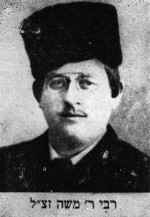
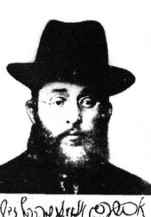
Our Rebbe, R' Alter Yehuda Zolyar, of blessed and holy memory, arrived in our town as soon as the Jewish settlement was established there. He sat on the seat of the Rebbenate until the final moment, until the town's destruction. He served his community loyally and with love for 46 years. He was the first, and to our great misfortune, also the last Rebbe. He came to Luninyets from Lechowitch, where he had been a Dayan [Rebbenic judge]. He himself was born in Volhyn, and his Volhynian dialect was evident in his pronunciation.
There he still stands before my eyes: a small, lean man with a small beard, sparkling eyes, and a smiling gaze. A great anav [humble person]. He led his community with simplicity and a folksy demeanor. He was not one of those Rebbes who are as meticulous about one's observation of light commandments as they are about the severe ones. In community matters, he did not mix in, even though he was knowledgeable and interested and knew about everything. He was a true disciple of Aaron Ha'Cohen [the Priest]–a lover of peace and a pursuer of peace-and therefore we all, old and young alike, esteemed and loved him. Everyone was united around him, Zionists and Socialists, without distinction, all had great respect for the Rebbe. Despite the fact that he was far removed from modern worldly matters, he always, with his wisdom, common sense and healthy logic, found a way to be a decisive arbiter and peacemaker in Din Torahs [Rabbinic judgements] and arguments between opposing sides.
But his free time was spent studying the Torah. His home was filled with people from within the town and outside it, and everyone felt at home there. With his moderation and fine character traits, he had a great influence on the youth–far more than other Rebbes with their sermons and strictness.
Our Rebbe was not blessed with the ability to deliver formal speeches. His voice was hoarse, and therefore he never preached to the public like, for example, the Kozhanhorodok Rebbe.
He belonged to the gentle, patient Beis Hillel [easy-going Rebbe Hillel] type of people, even in matters between man and God. I remember once before a holiday, a cow was slaughtered, and the shochet [ritual slaughterer] found a questionable defect that would make it treif [not kosher]. What do you do before a holiday? The community would be left without meat! They called the Rebbe, who in his early years had also been a shochet and an expert in sirchos [lung adhesions]. The Rebbe labored for two hours with his small, delicate fingers, resolving the sircha, which was very complicated, and koshered the animal so that the next day, on the eve of the holiday, a large crowd would have an enhanced holiday. “Let Jews eat in honor of the holiday, it is kosher meat!” In his early years, he also fulfilled the duty of a shochet. He also used to be a mohel [circumciser], and was also a sofer stam [Torah scribe]–he scribed an entire Torah scroll for himself. We young people used to enter the Rebbe's house without any fear. He would casually catch a chat with us and pinch us on the cheek. His joy was great when he gave a briev [letter of recommendation] to a boy who was going to study in a yeshiva.
[Page 154]
He took part in all town celebrations: at a bris [circumcision], a chanukas habayis [dedicating a new house, housewarming] and so on. And who doesn't remember his famous dancing at weddings to the tune of “Kaytzad merakdin lifnei hakalah, kalah na'ah vachasudah” [How does one dance before the bride…]. While doing so, he would lead the karahod [circle dance] with his red handkerchief, or express a humorous phrase: “Don't push, children, with God's help I'll marry all of you off.”
To our great sorrow, the Rebbe lived in poverty. Only in the later years, when the younger generation took over the leadership in the community, did he begin to receive his monthly salary with dignity. He had lived, as mentioned, in poverty. The weekly salary they used to bring him and the sale of wine and yeast helped him prepare the Sabbath. Yet, I do not remember the Rebbe or any member of his family ever complaining.
The children took after their father, possessing the fine character traits of their father. They eschewed honor and contentedly sufficed themselves with whatever they had. The Rebbe had no naches [joy/pride] from his children. Almost all of them died young, except for the eldest, Leibele, who left some thirty years ago for Harbin [China]. Leibele had joined the revolution movement back in the year 1905 and was one of its “Sisters and Brothers.” The second son, Motel, was caught in a whirlpool while bathing and drowned. Chaim, the third son, a student at the Kaminets Yeshiva, died at the age of 17. Itzel, the fourth son, was shot in 1919 together with ten other workers, by the Pollacks [Poles] when they occupied the town. Rishke–the only daughter, a noble example and true “Daughter of Israel,” especially with her charitable work for the poor, died in her prime, before fulfilling her wish to make aliyah [emigrate] to Eretz Yisrael [Palestine]. And Gedal, his beloved and youngest son, died in the year 1940.
Flisker, the “Haboker” journalist, who was in Luninyets in that winter of 1940, wrote an article about our Rebbe and his love of Jewish children and his homeland.
Even the Christians respected our Rebbe. There were cases where non-Jews who had a dispute with a Jew would call the Jew to go to and “stand” before the Rebbe, because he was so popular and known as a wise man. There was, however, one thing at which he did not excel: he did not master government's foreign languages–neither Russian nor Polish. (They tell an anecdote that often, when entering a government institution, he would confuse the greetings, and instead of “Zdravstvuyte” [Hello], he would say “Dosvidaniya” [Goodbye]).
During the Polish-Russian war of 1919, he was arrested together with the priest. After great efforts and with some higher “influences,” he was released. Unfortunately, great was our pain and sorrow that our Rebbe, this wonderful, righteous and humble man, did not die a natural death. Before his slaughter at a mass grave, he delivered a courageous speech to the public and foretold the downfall of Hitlerism.
[Page 155]
The noble figure of our Rebbe will always stand before our eyes as a perfectly pure symbol. May his soul be bound up in the bond of life with the holy and pure ones of our entire community, and may the Lord avenge his blood!
by Yosef Ze'evi
Translated by M. David Isaak
Dr. Gurevitch arrived in Luninyets in 1902. As the Jewish settlement in the town grew larger, they wanted to have a Jewish doctor, so several householders, along with the Rabbi, reached out to Jewish achievers in other towns; eventually they found and invited this doctor. For the first two years, the town also paid him a salary. Dr. Gurevitch was originally from Bialystok. An aunt of his had raised him as an orphan and sent him to study. During that entire time, what exacerbated his loneliness was the fact that no one came to visit him. In the early years, his aunt would visit him often, and especially for her, he would order kosher food from Chaya Henien's house.
During the Polish rule, his assimilationist-leanings, made him feel closer to high Russian society rather than to the Jewish one. Nevertheless, he was called “the Yiddishe doctor.” He was also very popular among the Christians throughout the entire region. When visiting Jewish patients, he specifically spoke in Yiddish. In many cases, when that patient's family was very poor, he would not take any money for the visit. The Yiddishe Punkt [point, spark] in him was not entirely extinguished. For Passover, he used to send the Rabbi a certain sum of money. The Russian revolution and the new Polish rulers in Luninyets also brought about a change in his convictions, and in his final years he became a warm, dedicated national Jew. He was the physician of the Bikur Cholim [visiting-the-ill] society and afterwards the chairman and doctor of the Zionist society, where he worked voluntarily and without payment.
Dr. Gurevitch became a Zionist and besides the Zionist shekel, contributed a great deal to Keren Kayemet and Keren Hayesod. When a delegate or missionary from Palestine would visit Luninyets, Dr. Gurevitch would invite him to his home and inquire about the situation in Eretz Yisrael in general, and about the medical situation in particular. He could not understand why the Zionists were so torn among themselves–why shouldn't unity reign among Jews? In the street, he always spoke demonstratively only Yiddish and was a model of a proud, national Jew.
He was murdered by the Hitlerists along with other Jewish doctors on the second day of their invasion into Luninyets.
|
JewishGen, Inc. makes no representations regarding the accuracy of
the translation. The reader may wish to refer to the original material
for verification.
JewishGen is not responsible for inaccuracies or omissions in the original work and cannot rewrite or edit the text to correct inaccuracies and/or omissions.
Our mission is to produce a translation of the original work and we cannot verify the accuracy of statements or alter facts cited.
 Luninyets, Belarus
 Yizkor Book Project
 JewishGen Home Page
Copyright © 1999-2026 by JewishGen, Inc.
Updated 29 Jun 2026 by LA