 |
|
[Page 121]
by Chaim Robinraut
Translated by M. David Isaak
Only after 1921 did an organized Zionist-Socialist movement emerge in Luninyets. Until then, there were only individual, smaller groups. As early as 1905, one could find a few, individual Po'alei Tzion and Z.S. [Zionist-Socialists] groups, however, they did not demonstrate any political or social activity. But in 1917, right after the February Russian Revolution, local comrades organized a popular group, the Tze'irei Tzion [Zion Youths], in contact with the central authorities of Tze'irei Tzion in Russia and later Ukraine. The group began to display a certain amount of activity, but due to the frequent changes of government, the connection with the headquarters was severed and the activity of Tze'irei Tzion ended.
In 1921, under the Polish rule, the Z.S. [Zionist-Socialists] Tze'irei Tzion party was established, which connected itself with the central office of the Tze'irei Tzion in Warsaw. A strong Z.S. youth group was also created; one of its main organizers was the young, prematurely deceased, Avrom'ele Kutzikovitz. The Tze'irei Tzion party, together with the Z.S. youth, distributed the party organ Bafreiung [Liberation], organized the library named after Y. H. Brenner, opened evening courses, organized the first local Chalutzim [pioneer] group with Hachshara [agricultural training for Palestine], distributed the Shekel, worked actively for the Keren Kayemet LeYisrael [Jewish National Fund], successfully carried out a fund-raising tools-campaign for Eretz Yisrael named Keren Ha'Avodah, and conducted intensive cultural-educational work through meetings, evening sessions, and so on.
During the elections to the Polish Legislative SEJM in 1922, the combined candidates of Po'alei Tzion and Tze'irei Tzion received approximately 70 votes in Luninyets–a few votes more than the very same candidates received in Warsaw, the headquarters of the three central committees of Po'alei Tzion, Z.S. Tze'irei Tzion, and Dror [Freedom]. The Luninyets Z.S. group was frequently visited by representatives of the regional committee in Pinsk, among them the late, prematurely deceased, young Hershel Pinski, as well as Arke Wiener, now living in Gvat, [may he enjoy a long life]. During the first merger of the Z.S.Tze'irei Tzion group with the Po'alei Tzion, the Luninyets Z.S. party and Tze'irei Tzion Youth, along with most of the movement in Polesia, who also joined the merger, the United Po'alei-Tzion Party and the Y.S.A.Y. [Jewish Socialist Worker Youth] in Luninyets were created.
[Page 122]
In 1923, Aliyah [immigration] to Eretz Yisrael [Land-of-Israel] began with the Y.S.A.Y. [Jewish Socialist Worker Youth]. A group of them were among the founders of Kvutzat Gvat, named after the martyrs of Pinsk, such as Michael Tzipershtein, Yaakov Wilk and others. A large portion of them worked constructing the Luninyets kibbutz, Kvutzat Achva in Tel Aviv. By 1925, almost the entire active Aliyah group had immigrated, and the work in town slowed down. Around that same time in 1925, the merger in Poland between Po'alei Tzion and the Z.S. Tze'irei Tzion took place, creating the Jewish Socialist Labor Party–Po'alei Tzion (now united with Z.S.), and between the Y.S.A.Y. youth and the Z.S. youth, creating a group called Freiheit [Freedom], also known as The League of Socialist Labor Youth.
Po'alei-Tzion Z.S. [Zionist-Socialist]
At the end of 1926 and the beginning of 1927, at the initiative of a group of comrades, the work of the Po'alei Tzion Z.S. party in Luninyets was restarted; it maintained normal activity which lasted until the outbreak of the Second World War in 1939. During this time, the Po'alei Tzion Z.S. party developed a broad and multi-branched political-cultural activity in behalf the national organizations. Before long, the Po'alei Tzion Z.S. party became a strong and influential party on the Jewish street. In the first town-council elections in 1928, the Po'alei Tzion Z.S. roster received the largest number of votes compared to other Jewish candidate rosters; in the Kehilla [community] Council as well, out of the 8 community trustees, 3 were Po'alei Tzion members. Upon the initiative of the Po'alei Tzion Z.S. party
|
|
[Page 123]
established were the Tel-Chai association and library, which conducted intensive cultural work in town, as well as the Jewish public school Shul-Kult [School-Culture] named after David Pinski; both institutes were founded and led by them. Alongside the party existed the Freiheit youth organization, which gathered together the working Jewish youth in town. Of all the collections garnered for the Keren Kayemet LeYisrael [Jewish National Fund] in town, the Po'alei Tzion Z.S. party was the most effective organization for many years. The League for Eretz Yisrael Workers, with its 400 members, was led by Po'ale-Tzion.
Members met daily in the large party headquarters of the Po'alei Tzion, and the party concentrated its efforts on the working classes in the town. All public events hosted by the party, such as meetings, lectures, etc., were always highly successful. The party's press outputs–Bafreiung [Liberation], Arbeiter Stimme [Workers' Voice], and Jugend Freiheit [Youth Freedom]–were widely distributed. The daily newspaper Dos Wort [The Word] also had many readers in Luninyets. The pioneer Kibbutz Shachariya, which existed in Luninyets for several years, was founded by Po'alei-Tzion comrades. The participation of Po'alei-Tzion comrades in Aliyah [immigration] to Eretz Yisrael was significant, and every year many Po'alei-Tzion comrades would make Aliyah to Eretz Yisrael.
The party secretary, Comrade Asher Senderuk, accomplished a great deal for the party. Among the most active comrades were Menachem Leshchinsky, Shlomo'keh and Dina Muzikant, Yaakov and Chai'keh Bikman, Uri Rotkoff, Zev Tucker and others.
All were murdered by the Germans.
by Chaim
Translated by M. David Isaak
One of the most beautiful Zionist undertakings in Luninyets were the bazaars of the “Keren Kayemet LeYisrael” (Jewish National Fund). The first bazaar took place during the days of the Purim holiday in 1933. Since then, every year until 1939, the bazaars would take place during the days of Purim. Over the course of this time, 7 bazaars were organized.
During the days of Hanukkah, the Keren Kayemet committee would meet with the representatives of the Zionist parties, youth groups, and women's circles to begin the initial preparations for the bazaar. Every Jewish home would be visited. For months in advance, the women would prepare their handiwork for the bazaar, and artisans would prepare their exhibits. The youth, through their organizations, would prepare collective and individual works. Schoolchildren diligently prepared drawings, woodcarvings, and other projects. All the Jewish shopkeepers and merchants would ask their suppliers and manufacturers in Poland to send their products free of charge. In this way, all segments of the Jewish population feverishly participated in the preparations for the bazaar.
[Page 124]
|
|
|||||||||||||||
The opening of the bazaar turned into a massive Zionist demonstration for the entire Jewish populace. Many Jewish visitors would come from all the surrounding towns such as Kozhanhorodok, Lakhva, Mikashevichi and Malkovichi, as well as from the villages of Bastyn, Lunin and so on. Young and old, children and elders, streamed from all parts of the town into the hall of the People's Theater, where the bazaars took place.
In the decorated halls, featuring Eretz Yisrael [Land-of-Israel] slogans and pictures, kiosks would be set up with handiwork from women, artisans, and youth according to the organizations: “WIZO”, “HeHalutz”, “Hashomer Hatzair”, “HaOved”, “Tarbut School”, and so on.
[Page 125]
During the three days of the bazaar, a special day was created for children, where they could enjoy themselves in a Land-of-Israel atmosphere with singing, dancing, and various performances.
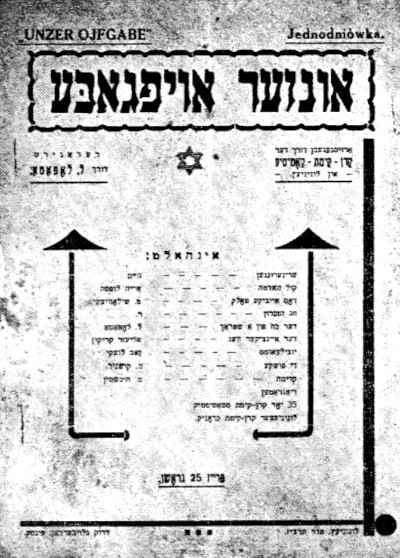
For the fifth bazaar in the year 1937, a Keren Kayemet journal was specially published under the name “Our Task” (see page 124)–which, incidentally, was the first and only printed Yiddish-Hebrew periodical in Luninyets.
Besides bringing in revenue for the Keren Kayemet Leyisrael, the bazaars were powerful Zionist demonstrations that brought a Land-of-Israel atmosphere into the town. Every home experienced and shared in this ambience for a long time afterward.
by Yosef Ben Shaul
Translated by M. David Isaak
In Luninyets, the revolutionary movement was influenced by the socialist parties S.R. (Socialist Revolutionaries) and S.D. (Social Democrats). Their main base of support was among the railway and telegraph workers, and especially among the depot workers.
Many of the Jewish workers joined the ranks of the Social Democrats and the S.R. There were anarchists as well, but the place of honor among the Jewish workers in Luninyets was held by the “Bund”. The leaders of the party, wishing to exert a major influence on the Jewish community, broke away from the general Russian Social Democratic Party and formed the Jewish Workers' “Bund.” They adopted a platform demanding cultural autonomy. With this, the “Bund” began to attract the small-town [shtetl] Jewish worker.
The “Bund” in Luninyets began organizing the workers, mostly shoemakers and tailors, and began looking out for ways to ease their working conditions, such as raising wages, shortening work hours, and so on.
They started cultural educational and distributed pamphlets among the workers. At first, our Luninyets employers reacted with mockery toward the “sisters and brothers.” But later, when workers began walking off the job and sometimes displaying a pistol they carried, they began to treat them with respect. After a time, their working hours were reduced to 8–10 hours a day. Leaders of the Jewish revolutionaries were: Yaakov Gloiberman the watchmaker, Esther Hofshtein, Leibl the Rabbi's son, Isaac Sherashevsky, Sender Petchenik, and others.
[Page 126]
1905
In Luninyets, too, a demonstration was held in honor of Tsar Nicholai II's new constitution, which was immediately suppressed. Persecutions and arrests began. Consequently, Avraham Yosef Cohen [David the bookbinder's son] and Avromel Schwartz were exiled to Siberia. The police carried out persecutions, but the revolutionaries did not lag behind either; they answered with terrorism. The Uryadnik [district police officer] Kowalski was assassinated. The Jews of Luninyets trembled and lived in fear of a pogrom.
A Selbstschutz [self-defense] organization was formed, consisting of both Jews and Christians. Instructors arrived from Pinsk, and weapons were obtained, these consisted of shpeyers [revolvers], nagaikas (whips/bludgeons), bombs, and daggers. The following episode is quite interesting: my father found a little box in the attic that my brother Yankel had hidden. My father knew that this was a forbidden, dangerous item. In order to rid himself of it, he wanted to throw it into the oven to burn. Fortunately, my young sister-in-law saw this; she knew what was in the box and managed to prevent a disaster.
An attempt to instigate a pogrom occurred at Moshe Karliner's shop: a drunk Gentile began to scream, “Zhid menya obmanul!” [“The Jew cheated me!”. Peasants and thugs immediately gathered around. However, the Selbstschutz group arrived right away with their nagaikas and dispersed the crowd.
Cossacks with long poles were deployed to Luninyets because the regular soldiers in the barracks refused to act as the firefighters to suppress the revolution. Aside from the main “Bund,” there was also the “Young Bund,” whose primary task was to stand guard, act as messengers, and so on. Following the failure of the 1905 Revolution and the subsequent mass arrests, a large wave of emigration to America began. Out of sheer terror, parents compelled their children to leave Russia. Thus, my father forced my brother Yankel to go to America. He went to the Luninyets emigration agent, Leib Wolf Petchenik, gave him cash in hand, and instructed him to get Yankel safely across to America. Luninyets became quiet, dark, and bitter again. Many of the former revolutionaries turned into silent, pious young men. This “quiet” and murky existence dragged on until 1917.
In February 1917, the revolution broke out and Luninyets served as a military hub. Significant revolutionary forces were concentrated within the Zemsky Soyuz (Zemstvo area), among them several Jewish doctors. Political party life in Luninyets boiled and bustled. The “Bund” was revitalized. On the “Jewish streets” of Luninyets, the Zionists and the “Bund” held sway. At the head of the “Bund”
[Page 127]
stood: Eizl Sherashevsky (the woodturner), Kremer, Shlomo Hofshtein (the pharmacist), and Baruch Ginzburg (the “Demon” [nickname]). Every party had its own club; almost every week a well-known speaker would arrive, and things were “lively” on the Jewish street. A Soldiers' and Workers' Council (Soviet) was established, and the “Bund” had its representative there. The Bundist newspaper, “Der Veker” [“The Awakener”], was widely distributed in Luninyets.
The political struggles between the “Bund” and Tzeirei Tzion [Youth of Zion] were fierce. The “Bund” sought at every opportunity to blacken the reputation of the Zionists in front of the Gentiles. At public celebrations, they opposed allowing Tzeirei Tzion to participate in the general May 1st demonstrations with their blue-and-white flag. Despite this, amidst all the Polish, Ukrainian, and White Russia [Belorussian] flags, the blue-and-white flag with a Magen David also marched.
A second conflict broke out when the first free meeting of the Jewish population was held in the Pozharnem Saray [fire station shed]. Russian military personnel came to greet the Jewish community and congratulate us on our liberation. The representative of the “Bund,” Kremer, defamed Zionism from the podium. Then, a Jewish soldier from Omsk named Kravtshuk stepped up to the stage. He spoke like a proud Jewish patriot and a socialist, and the large crowd enthusiastically applauded him.
A vibrant social and cultural life began to develop. Soon, a series of elections began, but the joy was short-lived. Bolshevism wiped out the “Bund” and the Zionists alike, marking the beginning of bitter, difficult days for Jewish townspeople, endured until the time of the Polish occupation.
During the period of Polish rule, the “Bund” no longer existed in the town; its active leaders had departed for Russia. In their place on the Jewish workers' street in Luninyets arose the “Poale Tzion”, who carried out fruitful work and established various vital institutions.
To our great misfortune, only a select few of our fighters and dreamers survived. The vast majority of them were killed by the devil, Amalek's descendant [Hitler].
by Leibl Zolyar
Translated by M. David Isaak
By the year 1902, three socialist parties existed in Luninyets: S.R. (Socialist-Revolutionaries), R.S.D.P. (“Iskra”), and the “Bund”. At the head of the S.R. stood Dr. Anishtschenko, Dr. Yavoleivo, the engineer Tarnowski from the railway, the post-master Charmov, Manda, the teacher Kaplan, and Yaakov Gloiberman from Pinsk. The leaders of the “Bund” were the writer of
[Page 128]
these lines, Aysl Sherashevsky the cooper, and Sender Patchenik, at whose homes our meetings took place. Over the course of a year, we counted many more comrades who joined us. Among them, active and dedicated young people were Lyone Bosel, Esther Hofshtein, Rachel Tzadok Lichtscheins, and many other workers. Especially helping us was Yankel Shovals Wilk from Bradilavka. Our meetings used to take place in secret in the woods; we used to distribute proclamations and also read lectures for the workers. For a period of time we organized the workers and introduced an 8-hour workday. Strikes were often declared when the workers' demands were not met.
Our Failure
Once, someone named Aronovitch from Pinsk came to us with a false passport, introduced himself as a speaker, and told us to gather in the woods. We liked him very much and trusted him; he promised to send us literature. After his departure, 28 comrades among us were arrested. Since nothing was found on us, each one of us was released. Aronovitch met a bitter end. The Party from Pinsk immediately found him and killed him in the Linishtser forest. But the Uryadnik [district police officer] Kowalski, gave us terrible troubles. He used to go out every night with a list in hand and arrest people. Once, in a single night, he arrested 56 people from all the parties. Among the arrested was the son of Prince Drutskoy-Lubetski.
We spent 5 months in the Pinsk prison. The S.R. party collected money to prepare for the court in the Vilna Chamber and to bribe the Rotmeister [cavalry captain]. Some of us were released, some were exiled to Siberia, and some of us were later freed from prison. In response, all parties decided to get rid of Kowalski. First, they sent him a warning letter to stop his over zealous behavior, that if he didn't, he would be killed. Kowalski laughed it off [scoffed]. However, he began to always walk accompanied by two policemen who did not budge from his side. A lottery was then cast to see who would have to carry out Kowalski's death sentence. The lot fell upon Charmov, the post-master's son, and one more person. I agreed to the lottery. I chose Yankel Shawels from Bradilavka, a brave young man. We created a secret password and began to work out the plan. For 3 days, we tracked where Kowalski went and when he returned home. When we had all the details, we gathered near the Christian cemetery on Sadovaya Street, and when Kowalski, together with his two policemen turned into Dr. Gurevitch's alleyway (where we were hiding),
[Page 129]
all six of us opened fire. They were so surprised, they didn't manage to even reach for their guns. Kowalski and one policeman fell dead on the spot; the other policeman lived until 11 the next morning. That same day, police arrived from Pinsk with an investigator, but they found no witnesses and had no clues. We knew and understood that a secret remains a secret only as long as it is kept, and remember, a goy [gentile] is always a goy. Charmov used to get drunk, and he started boasting that he knew who killed Kowalski. It was decided we all must disappear; some with false passports and some in disguise. That is how I became 'Boyarski' and left for America, where I spent 4 years; after which I returned to Luninyets.
“Selbstschutz” (Self-Defense)
In Luninyets, a Selbstschutz organization, consisting of both Jews and Christians was organized by all parties, especially by the depot workers. From the “Bund,” there were also young men and women who knew how to shoot revolvers and throw grenades. Around 90 Christians were well-armed. We collected money–the truth is, our Luninyets homeowners did not give with great enthusiasm, but they gave anyway.
Our weapons were hidden in various places: at Leizer Aaron Diatlovicki's in the stable, at Hershel Damnitshen's in the cellar, at Aaron Feldman's, at Yehoshua the factor's in the courtyard, at Moshe Baruch Cohen the butcher's, and at Chana and Yentel Rubinraut's in the wine cellar. Often, the homeowners themselves did not know what was lying in their possession. Thanks to the Selbstschutz, no pogroms or attacks on Jews ever occurred in Luninyets.
After the failure of the revolution and the demonstrations in honor of the manifesto of Nikolai the 2nd in 1905, the revolutionary movement in Russia was crushed, and the largest portion of the revolutionaries were scattered and dispersed in Siberia, and America. Whoever escaped became good and even pious and started worrying about their piece of daily bread.
by Chaim
Translated by M. David Isaak
The Craftsmens' Union in Luninyets was founded in1923 by a group of artisan-activists under the leadership of comrades Leizer Babrov and Yaakov Kolnik. The mission of the union was to defend the interests of the craftsmen workshops and to fight against the various decrees enacted by the Polish government against the Jewish artisan.
[Page 130]
In connection with the “Guild Decree” issued by the Polish government–which aimed to strip many Jewish craftsmen of the ability to run their own workshops–the union worked intensively to secure artisan certificates, to enable Jewish craftsmen to keep running their shops. Furthermore, in the state tax office, representatives of the craftsmen' union fought for a fair assessment of various state taxes for Jewish craftsmen.
The union took in over 200 Jewish craftsmen from all trades and served as the legitimate representative of all Jewish craftsmen, making it the strongest economic organization in the town.
The central headquarters of Jewish craftsmen in Poland was under the influence of the Folkists and leaned politically as anti-Zionist, or at best passive toward Zionism. However, the union in Luninyets was thoroughly Zionist; nearly all the craftsmen in the town were members of the Palestine League for Labor.
Among the craftsmen, it is worth mentioning the following comrades: Ze'ev Tsiperin, Yaakov Leib Rosenkranz, Leibel Eisenberg, Yaakov Glozerman, Ze'ev Tucker, and Feivke Kolnik, all had achieved a great deal for the Jewish craftsman; all were murdered by the Germans.
by Chaim
Translated by M. David Isaak
In Luninyets, the needle trade [tailoring] was in Jewish hands. Among the tailors were both highly skilled and ordinary craftsmen. Competition reigned among them because there were no stable prices, and because of this, the tailors themselves suffered.
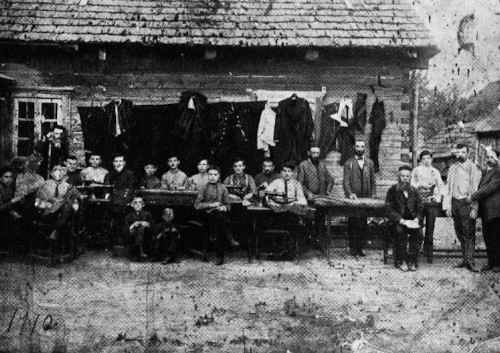
In 1908, a tailors' cooperative was organized under the name Der Shnayder-Artel [The Tailors' Artel]. The initiator and founder of the artel was Yaakov Gershtel, known in Luninyets as “The Lodz Tailor.” He was a cosmopolitan, a sophisticated man, and he expended great efforts until he convinced his fellow tradesmen of the benefits of an “Artel.”
The members of the artel were: Yaakov Gershtel–chairman, and Hershel Damnitsh, Yitzhak and Avrohomke Shulman, and Yitzhak Bromberg. The artel existed for several years until it was dissolved. Yaakov Gershtel left Luninyets and immigrated to America.
[Page 131]
|
|
by Chaim
Translated by M. David Isaak
For many years in Luninyets while under Polish rule, there was a butchers' association that concerned itself with defending the interests of the Jewish butcher–a profession from which approximately 30 Jewish families in the town made a living.
|
|
Among the founders and leaders of the butchers' union were: Shamai Frishkolnick, who was also a councilman on the city council and a parnas [trustee] of the community, as well as Hershel Tamarin; both were murdered by the Germans.
by Ben Moshe-Yosef
Translated by M. David Isaak
The Jewish Merchants' Association in Luninyets was established at the beginning of the 1920s, and its goal was to defend the interests of the Jewish shopkeepers and merchants in the town. Most of the representatives of the Merchants' Association were active on the tax assessment committees, as there was a constant danger that high turnover and income taxes would ruin Jewish businesses in town. The Merchants' Association also led a fight against the Jewish boycott by Polish organizations and the exclusion policies of the local government circles. The Merchants' Bank in town was established and managed by the leaders of the Merchants' Association.
One of the organizers of the Merchants' Association, and its long-time chairman, was Nechemia Hofshtein, who, through his interventions with the administrative authorities and tax offices, accomplished a great deal for Jewish commerce.
Among the most active leaders of the Merchants' Association were: Dovid Litman Gertsolin, Yakov Boiman, Avrohom Radman, Chaim Shteinman and others.
by Yaakov Levin (Kosovo)
Translated by M. David Isaak
Even before the First World War, there were two Jewish banks in Luninyets, one for artisans and small tradesmen, the Ssudosteberegatelne Kasse [South East Savings and Loan Bank] and another for storekeepers and merchants, the Vzaimny Kredit [Mutual Credit]. During the war, these banks were closed.
In 1921, with the assistance of the American “Joint” [Joint Distribution Committee] and through a group of active community members, the Savings and Loan Bank was reactivated, and over time changed its name to “The Cooperative People's Bank.”
With the “shares” from the members and small deposits from several community activists, the bank began issuing small loans of up to 100 Zlotys, to be paid back in 10 weekly installments. Each member had to contribute a “share” of 10% of the credit he was to receive.
This institution proved to be a vital necessity; it joined the Association of Jewish Cooperative Societies in Warsaw. Over time, the bank grew stronger and gained the trust of the local population; Jews began bringing in their savings, their dowry collections [for future brides] and so on. The bank helped its members by increasing the maximum loan amounts, at first to 250 and later up to 500 Zlotys.
The Jewish artisans and working-class men were always able to receive financial credit in the bank. The butcher, needing to buy a “piece” [livestock] for Shabbat, found the bank was the only place to secure a loan. The Jewish artisans and small traders were able, thanks to the bank, to buy raw materials and merchandise. If a wagon driver's horse happened to die, the bank was the place where he could get a loan to buy a second horse. More than one poor bride found the bank to be an honorable source for building a home.
There were some borrowers who were unable to pay back the full loan. This created a unique type of banking operation, where the borrower could still receive a loan amounting to the difference between their debt and their maximum credit. This category of members found a “father” in Lyshke Epshtein, the bank chairman. He listened to their plights with great empathy and helped them as much as possible. When someone faced difficulties in providing the guarantors the bank required, Lyshke Epshtein would step in. He would sign the promissory note himself, and later, more than once, paid it back out of his own pocket.
[Page 134]
The bank grew; the number of members increased, and along with this, its capital reserve grew. The bank earned the trust of the local population and received additional credit from the “Joint” [JDC], as well as further discount-credit from the Central Cooperative Bank in Warsaw. Larger premises were rented and its managing bureau was set up according to all guidelines. Its various banking operations included collections, discounts, letters of credit within the country, and even business abroad.
The Jewish People's Bank became a truly popular Folk-Institution, and throughout its existence, bore a distinctively positive public character. The founders and leaders of the People's Bank were: Lyshke Epshtein, Chaim Rubinraut, Ze'ev Tziporin, Bezalel Stakovsky, Boruch Gertzulin, Leizer Boborov, Moshe Ackerman, Leizer Ber Reznick, Moshe Leib Muzikant, Yaakov Kolnik, and others. It is also well worth mentioning the good, dedicated, and loyal bank employee, comrade Noach Senderik.
In 1927, in Luninyets, as in many other cities and towns in Poland, banks under the name “Cooperative Merchants' Bank” were established. Wealthier individuals from the Merchants' Union stood at the helm here, with Nechemia Epshtein as chairman of the board, and Yisroel (known as “Yisroel the Children's”) as chief accountant. Board members included: Avrohom Radman, Yaakov Boyman, Dovid Litman-Gertzulin, and Noach Eisenberg. It must be noted that the Merchants' Bank also played its part in easing credit for the shopkeepers. In later years, a category of sly people emerged who disrupted the bank's operations due to employing evasive tax policies and their antisemitic tendencies. Such people would seek a loan in one bank in order to cover their debt in the second bank, and later do the exact same thing in reverse, i.e., borrow from the second bank to cover their debt in the first bank.
The Cooperative People's Bank was very popular among the Jewish population and numbered about 500 members. According to the bank's charter, general meetings with its members were held annually, during which the management would present its annual report. Following the report, a “fiery” debate usually ensued. Simultaneously, the budget for the current year would be determined, and last but not least, elections would be held for the leading positions in the council and administration. This was the core of the assembly. Jews love elections after all, and spirits would run high. There was no shortage of candidates and “honor-seekers,” whose campaigns promised a lot and wooed the population with gifts to influence their choices and elect them. The social and class struggle
[Page 135]
also reflected itself here. After the votes were counted, tempers would usually calm down. Late at night, people went home, knowing they would meet again a year later. But for many more weeks, that meeting of the Cooperative People's Bank was the major gossip material in town.
In Luninyets, there was also a Gemilut Chesed [Dispensing Kindness] organization that distributed smaller, interest-free loans to the poor of the population.
by Yosef Ben-Shaul
Translated by M. David Isaak
Until the Polish occupation, the sanitary and medical situation was at a very low level. The Russian Tsarist authority cared very little about the health status of the population in general, and of the Jews in particular; there were no paved roads, no sewage systems or means to drain the swamps, and no direction or guidance among the population regarding sanitation and hygiene. The well-known Kozanhorodok feldsher [medical assistant] Epstein was considered an expert in medical matters, and the pharmacist awaited his notes and directions. People with infectious diseases, such as tuberculosis, lived together with their families. Only well-to-do people traveled to Pinsk to seek treatment. The bitterly poor man, a lonely soul, found his place in the poorhouse infirmary, and from there departed to his eternal resting place.
If the mortality rate among Jews was not too high under those conditions, it was only thanks to the Jewish laws concerning cleanliness and the washing of hands, which every Jew strictly observed. The Jewish custom of going to the bathhouse every Friday also played a part. The steam bath with its primitive steam, the well-known custom of “whipping oneself” [with twigs] made the Jewish body clean in honor of Shabbat. Needless to say, the Jewish woman strictly observed the laws of taharah [ritual purity].
The Jewish holidays, especially Passover with the bi'ur chametz [burning of leaven] and the scouring of the home in honor of Passover, helped greatly to improve the sanitary-hygienic situation. Kozanhorodok also had its Bobrovna [a named forest], its river, and its air that was much better than in Luninyets. Furthermore, the diet, which for the poor consisted mostly of vegetables, potatoes, and a little milk, protected them from various stomach ailments.
Generally speaking, the Kozanhorodok Jew was a healthy person; he worked hard outside of town, and his body was resilient. Still, the
[Page 136]
cemetery in Kozanhorodok was quite large and filled with tombstones. The Angel of Death's dominion was primarily noticeable among small children; child mortality was terribly high. The Jewish family almost resigned itself to this fact. Due to the frequent fires for which Kozanhorodok was notorious, the sanitary situation actually improved. After every fire, everyone built themselves a new and more comfortable dwelling. After the First World War, the “Joint” [American Jewish Joint Distribution Committee], accomplished a great deal in this regard, developing activities to make available and take advantage of advances in medicine. Kozanhorodok benefited greatly from this. The district committee of Bikur Cholim [society for visiting the sick], which was established in Luninyets, provided medical aid to the entire surrounding area. Dr. Gurvitch treated the sick from Kozanhorodok based on referral notes from Menashke Drebski.
Medical care was somewhat better in Luninyets. As the Jewish population concentrated there, the renowned Dr. Gurvitch, a general practitioner, arrived and quickly became popular among the Christian population as well. The town also had a midwife, Zhenye Hofshteyn. There was no ophthalmologist, gynecologist, throat and ear [ENT], or pediatric specialist in Luninyets; in serious cases, people had to travel to Pinsk. Since the general hospital there accepted no Jews, patients were forced to be taken to the Pinsk Jewish hospital.
After the First World War, the situation improved. The Polish authority paid closer attention to sanitary and hygienic conditions: the main streets were paved. Sanitary inspection was introduced for courtyards, butcher shops, stores, and so on. Medical assistance for the poor also improved. Thanks to the delegate from the Luninyets and Kozanhorodok Relief [Society], our townsman Harry Denenberg, together with support from the “Joint,” the Luninyets Relief Committee received many medications, and a clinic was opened in Moshe Wolf Ditalovitzky's house. Dr. Gurvitch would receive patients according to referral slips issued by the Bikur Cholim. All school children underwent a medical examination. A short time later, the clinic moved into Beyle Kuperman's house.
The Bikur Cholim society, which maintained the clinic–consisting of several rooms with a separate pharmacy–also helped in severe cases when a poor patient required a hospital or surgery. Bikur Cholim concluded an agreement with the Pinsk Jewish hospital, and the sick from Luninyets and Kozanhorodok were admitted to the hospital at the expense of the Luninyets Bikur Cholim. Funding and support for the Bikur Cholim came
[Page 137]
from evening events, concerts, performances, membership dues, and monthly allocations from the “Joint.” The administration of Bikur Cholim and its primary activists were: Yaakov Hirsch Zmudziak, Rishke Zolyar, Leibl Eisenberg, Berel Lerman, Zhenye Hofshtein, Yentel and Frume Rubinraut, David Brodnitski, Leah Pinsky and Leibl Holtzman,Secretary.
Alongside the Linat HaTzedek society, Bikur Cholim was primarily managed by women organized into a Ladies' Committee. They would devote themselves to providing household help for the sick: calling the doctor, sitting and staying overnight with a patient, and also ensuring that poor patients or postpartum women had something to eat. The chief director of Linat HaTzedek was Zelda Plotnik, under the supervision of Feitshe Pinsker, Moshe Gutinsky, Chatzchkel Stachovsky, and Velvel Resnick. Zelda Plotnik herself saw to it that a poor patient had some cooked food. She would personally cook and serve the sick person, especially a sick woman, and look after the children.
In the final years before the destruction of Luninyets, the Bikur Cholim was transformed into a more modern institution called “TOZ” (Towarzystwo Ochrony Zdrowia [Society for the Safeguarding of Health of the Jews]. Apart from medical assistance, “TOZ” opened a “Drop-of-Milk” station for infant children, sent weak children to summer camps, especially to the farm of Talia Trybuch, which was located in the woods along the way to Kozhanhorodok. In urgent cases, sick people were sent either to the Pinsk Jewish Hospital or to Warsaw. Funding of “TOZ” came from membership dues, donations from individuals and institutions, and from the central “TOZ” office in Warsaw.
The activists of “TOZ” were: Dr. Gorvitch, Chairman; Chayseh Gerzulin, Nurse; and Leshke Epstein, Chaim Rubinraut, Betzalel Stachovsky, Boruch Gerzulin – members. Besides Dr. Gorvitch, the other Jewish doctors were Dr. Gitler, Dr. Axelrod, and Dr. Yosef Frishkolnik [Shamai the butcher's son].
On the second day of the marching Germans invasion of Luninyets, all the Jewish doctors, among them Drs. Pinye Zaretsky and Yasha Gringstein, escapees from Warsaw, were the first victims to be murdered.
|
JewishGen, Inc. makes no representations regarding the accuracy of
the translation. The reader may wish to refer to the original material
for verification.
JewishGen is not responsible for inaccuracies or omissions in the original work and cannot rewrite or edit the text to correct inaccuracies and/or omissions.
Our mission is to produce a translation of the original work and we cannot verify the accuracy of statements or alter facts cited.
 Luninyets, Belarus
 Yizkor Book Project
 JewishGen Home Page
Copyright © 1999-2026 by JewishGen, Inc.
Updated 09 Jul 2026 by JH