 |
|
by Chaim
Translated by M. David Isaak
|
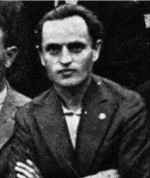
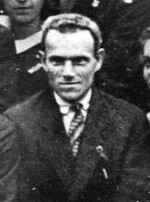
He came from a working-class family, was born and lived for many years among workers in Lodz in the Baluty neighborhood. In the First World War, he was drafted as a soldier and stationed in Luninyets. After his discharge from the army, he got married. He did not seek an easy livelihood and became a simple porter, and for all his years lived in difficult material circumstances.
Having very little formal education, he engaged in self-education and read a lot. Despite his large family of a wife and 5 children, he devoted himself completely, with body and soul, to party and social work, and to which he dedicated much of his time. He began his social work in Luninyets by founding a theater group for the benefit of the sick. In 1927, during the founding of the Tel Chai library, he became one of its most active co-founders, and one of the leading comrades of Po'aley Tzion, the Leftist party in town. In 1928, he was elected as a councilman from the Po'aley Tzion to the city council. With much dedication and stubbornness, he defended the interests of the Jewish poor.
He had a great passion for acting and created a drama circle within the Tel Chai cultural society; he also became the director and one of its most active actors. Despite having many worries about earning a livelihood for his large family, he would nevertheless rehearse various plays day in and day out until late at night. Also, he diligently collaborated in the management of the Tel Chai library and its school/synagogue-association, and was always ready to participate in various actions.
He spoke many times at meetings and gatherings. During the last community elections, he was the listed leader of Po'aley Tzion and was elected to the community council along with 2 other comrades: Asher Senderuk and Ze'ev Toker, out of the general number of 8 councilmen.
Despite the difficulties of Jewish social work under the harsh political Sanacja Regime in Poland, he fought proudly and valiantly for the democratization of the Jewish communities and for recognition of their important contributions to the nation.
As a person, he was a good friend, always ready to help another. Very modest, he was a symbol of honesty. Loyal to the movement, he was fully devoted to the Eretz Yisrael Labor movement. He always lamented that due to his old age and large family, he could not make Aliyah [emigration to Israel].
by Chaim
Translated by M. David Isaak
|
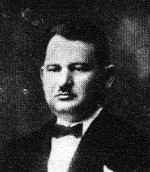
Born to poor parents in Lahishyn near Pinsk, as a young boy he came to Luninyets during the First World War. His father was a shamos [sexton] in the Great Synagogue. From early youth he was left without his mother. This affected his character; he was always serious, without a smile on his lips, bitter, worried, and anxious, because he lacked motherly tenderness.
Not having a home of his own, since his youngest years the movements were everything to him , and he lived them 24 hours a day. From his earliest youth he belonged to the Jewish Socialist Youth [Labor Zionist Socialists], from the Po'aley Tzion movement, and he became one of its loyal and dedicated activists. For a longer period of time he worked in HeHalutz (Agricultural training for Palestine) and was one of the main founders of the Bialik library (named after the poet Chaim N. Bialik).
Asher was the librarian from the time the library was founded; he spent days and nights there. He bound the books himself… He read a great deal, knew precisely the contents of the 2,500 books in the library. The day when new books arrived at the library was a joyous holiday for him. With body and soul he was devoted to the Shul-Kult [Jewish school] , and was one of the founders, as well as secretary of the school during the three years of its existence. In addition to this, he was the long-time secretary of the League-for-Labor in Palestine, secretary of the Po'aley Tzion party in the city, press and publicity agent and distributor of the party and league publications during all the days of Dos Vort [The Word] and Bafreiung [The Liberation].
Synderok was the committee representative of the Keren Kayemet Le'Yisrael [Jewish National Fund] party and the Keren Hayesod, he took part in all actions of the Zionist parties and was one of the most active workers in all campaigns of the Po'aley Tzion party for the League-for-Labor in Palestine, and so on. He used to devote much time to the Freiheit youth movement and was one of its leaders. There was no Jewish national institution that he did not represent or be a part of. He possessed a great deal of energy, knew no personal life. The parties and movements were the essence of his life.
In the final years he was a parnas [trustee] of the Kehilla [Jewish community council], elected from the Po'aley Tzion list. In all institutions he worked shelo al menat le'kabel pras [Hebrew phrase: “Without the expectation of receiving a reward”].
[Page 158]
With the capture of Luninyets by the Russian Army, his party and community work was interrupted. These were the blackest days of his life. It was then that the Tel-Chai library was confiscated by the Soviet authorities, and most of the library's books were destroyed.
Together with the entire Jewish population, Asher Synderok, as well as his wife and child, were murdered by Hitler's killers and were buried in a common mass grave.
by Chaim
Translated by M. David Isaak
|
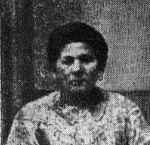
He came from Kozhanhorodok, a son of the well-known Luninyets feldsher [medical worker], Yosef Epshtein. In his youngest years he was active in the revolutionary movement. In 1905, after the failure of the revolution [against Tsarist Russia] when the harsh persecutions by the Tsarist regime against the revolutionaries began, he had to flee to America. After staying there for a longer period of time, he returned to Luninyets, and became completely passive politically, but he remained close to the Jewish masses and was always ready to help them in their need and suffering.
Leishke was one of the organizers and arrangers of credit for the Jewish cooperative of artisans, small traders, and workers in the city, as well as the founder and permanent chairman of the lei-un-shpor-kasse [loan-and-savings bank], later the Cooperative People's Bank. For a time he was one of the active leaders of the Gemilut-Chesed [interest-free loan fund], collaborated in the Po'aley Tzion administration, was a board member of the Shul-Kult [Jewish school], and a parnas [trustee] of the Kehilla [Jewish Community Council].
For the suffering layers of society, he was a loyal friend who did everything to alleviate their suffering. Although he was not a Zionist, he always gave with a generous hand to the national funds collections.
During the Hitlerite invasion, he wanted to save himself and his family by escaping deep into Russia, but the Soviet guard–who along with him had barred hundreds of other Jews from crossing the old border near Lenin–sent them back to Luninyets, where he and his family tragically were murdered by Hitler's bandits.
by Yosef Ze'evi
Translated by M. David Isaak
As is well known, the population of Luninyets, to a large extent, consisted of workers and employees. Because of this, a concentrated, cohesive Jewish community developed there. Among the craftsmen, a large portion consisted of shoemakers. Dozens of families drew their livelihood from making shoes and boots for the Christian population. All of a sudden, a competitor arose–the well-known Stolin Chasid and the town's Mohel [Circumciser], R' Alter Levin. He began to compete, and, bit by bit, effectively remove livelihood from the Luninyets shoemakers. In addition to his shop of haberdashery and galoshes, he began bringing in ready-made shoes from Warsaw and selling them at cheap prices.
At first, to try out the market, R' Alter brought only women and children shoes, and even those in small numbers. Later, however, seeing that the business went well, he began adding men's shoes by the hundreds.
Among the shoemakers, unemployment arose, and many families were left without a livelihood. Every craftsman soon began to complain to his wife that his poor situation was the fault of Alter Levin, who had flooded the town with ready-made shoes from Warsaw. The women confronted and began to fight with Alter Levin. At first–with grumbling and silent glares; later, when the situation became even worse–with screaming and curses against their enemy “who is tearing the little bit of bread out of our mouths.“ But this approach did not help.
The shoemakers concluded they must organize and take harsher measures; a meeting was called in the beit midrash and representatives were chosen, among them several older men with long beards. A delegation went to the Rabbi and poured out their bitter hearts and sorrow to him, (and with exasperation) pointed out that the bad situation of the shoemakers was strictly the fault of R' Alter who is never satisfied, and always wants more so that he can “shovel gold.“ The Rabbi heard them out, acknowledged the pain and suffering of the shoemakers, and immediately the next morning called R' Alter to a Din-Torah [rabbinical judgment].
R' Alter argued that, either way, if he didn't do it, the Warsaw factories would send a representative and they would sell even more and cheaper, and the shoemakers' situation would become even worse; furthermore, he argued: what should he do with the stock that he had already bought? The Rabbi, who was a very wise man, ruled that he must not be a masig-g'vool [trespassing on his neighbor's boundary], and that he may not steal
[Page 160]
the livelihood of dozens of families, and he banned R' Alter with an issur chamur [strict prohibition] from importing any more shoes from Warsaw. On the other hand, however, he permitted him to gradually sell off the remaining stock that he had, but no more. It is quite possible that had the Luninyets shoemakers established a strict oversight over R' Alter's shop, the Rabbi's psak-din [ruling] would have been of great benefit and with good results. But our shoemakers did not believe in “oversight,“ and neither did they have the patience to wait until R' Alter finished selling off all his merchandise. They decided to make a “Bund“ [organized action].
All the shoemakers gathered. Some of them took hammers in their pockets, and on a beautiful summer day, on a Thursday afternoon, they assembled near R' Alter's shop. Some stood off to the side and waited. The boldest among them entered the shop and turned angrily to R' Alter: “What will be the end of this? Until when will you continue to swallow up our livelihood?“
R' Alter, who was sitting on a soft chair in the shop near the cash register, wearing an apron and counting the day's earnings, raised his head with his broad, spread-out beard. When he saw who was standing and shouting so publicly in front of the Christian customers, he could not contain himself and let out a scream with his powerful voice: “Out of here, loafers!“
This enraged the shoemakers even more, and they began throwing merchandise off the tables. R' Alter then shouted with a booming voice: “Help, robbers!“ When the shoemakers saw that they wouldn't accomplish anything, one of them, out of great anger, with fury “honored“ R' Alter with his hammer. Immediately, a commotion broke out, everyone shouting, and curious people began to gather. The noise and commotion reached the police, who were close by, and police officers immediately appeared. Those standing outside signaled and warned those inside, so that the ones inside managed to flee in time. The police arrived at the shop, but R' Alter refused to hand over the names of the “robbers“ and asked the police to leave, as if nothing had happened.
At the head of the Bund stood Sh. S. [name abbreviation]. Because his workshop stood directly across from R' Alter's shop, he believed that were it not for that shop with the ready-made Warsaw shoes, he would have had a livelihood. Out of great disappointment, Sh. S. left a short time later for America.
And there he probably came to the realization that one cannot fight (innovative) mechanization with primitive means.
by Aharon Stachovski (New York)
Translated by M. David Isaak
I remember my cheder (schoolroom) years in Luninyets of more than forty years ago. There they stand before my eyes, those days, as if they were yesterday. I can actually feel their breath. I can still hear the sound of closing iron shutters, of the lowered bars of Zavel's, Shteinman's, and Dovid Greenshtein's shops in the marketplace. I can still hear the din of passing trains, blowing off steam at the station.
There I see the open shops in the marketplace from one side, and the booths with baked goods, wafting aroma of rye breads and hot bagels, from the other side. Peasants' wagons loaded with wood, hay, and potatoes arrive. The smell of horse sweat and the peasant's sheepskin coats invade one's nose. It is already late afternoon. In the houses, the double windows have already been installed for the season. In the mornings, when people go to daven [pray] in the synagogue, the puddles are frozen over and crack under one's feet like thin glass.
The sun still warms, but it doesn't have the heart to leave the poor, cold little houses. Only after half the day does the sun ignite, full of sorrow and mercy, opening its heart and spreading its wings over half the town: the old Stolin synagogue, the Horodok synagogue, and only in the very last minutes does it pour its entire wealth over all the roofs and yards; just as my Aunt Chaya, the butcher's wife, who chopped meat and bones all day long–comes into the house, exhausted and sweating, and sets down on the kitchen table a whole pan of peas, broad beans, chickpeas, and lima beans. She was a very honest and pious woman, my Aunt Chaya.
The following is worth telling:
Once it happened that the meat she had sold on Friday afternoon turned out to be treif [non-kosher]–“Treif Fleisch [meat]!” She ran and screamed over all the courtyards, and she herself helped throw away the entire cooked meat from everyone's pots. She reimbursed everyone for their loss, but she herself was left without a penny for the entire week.
There I see before my eyes the golden, round leaves of Reuben Shachman's tall wide-branched trees, which so wonderfully gave shade during the summer, now in the autumn have fallen, withered, spread out, like slaughtered chickens (from the Kappores ritual) in the Rabbi's courtyard on the eve of Yom Kippur. In the crisp air, there is the aroma of winter apples, surely coming from Moshe Ackerman's cellars in the marketplace. It is already dark, but in the windows, you can't yet see any light from the lamps inside. The high windows in the Horodok synagogue, which had just been reflecting the setting sun, have now gone dark.
[Page 162]
Aharonke the shamash [sexton] stands for a while at his post by a window, casting a long glance to see who is going to “grab” a daven en [prayer service].
In the mornings, the synagogue was always full of daven ers [worshippers]. Just not as many as on Shabbos… Deeply engraved in my memory are the early-morning dawn hours in the Horodok synagogue. I don't know why, but from my earliest childhood, they fully seized my heart. Something of the quiet tranquility, wrapped in secrets, perhaps from the holy souls who used to tell stories on Shabbos between the Mincha and Maariv prayers, behind the bimah [raised stage] on the bench near the warm stove. Aharonke the shamash, whom one rarely saw leaving the synagogue, wore a long overcoat–perhaps an inheritance from an elder relative–which covered his heavy, low body and his full, plump shoulders. The boots he wore, both winter and summer, barely showed. And the leather snuffbox–always in hand, unless he had to step down from the bimah to hand us youngsters something. His entire “essence” came from putting something into his nostrils; his nose was barely visible due to the dense, overgrown (moustache and) beard covering his face; one pinch of tobacco snuff cheered him up. Fully satisfied, he would then offer the snuffbox to everyone: “Take! Take!” and thereby take another sniff himself, announcing: “Truly, on my life, it revives the soul!.”
One never saw Aharonke on the street in town. His whole world was the synagogue and the synagogue courtyard near Yosl-Dovid's; further than that, he never went. Only once a year he would appear in town, but even then, no one saw him. One could only hear his approach. One could hear the “thud, thud” of his cane, but not him. Aharonke appeared in my eyes like a hidden saint, a Lamed-Vavnik [one of 36 hidden righteous men] a “Seer and Unseen.” Late at night, one heard his approach and then his voice: “Wake up! Get up for Selichot [penitential prayers]!” In the stillness of the night, his voice echoed like a holy echo from a very distant time…
And now I see him standing on the bimah. His tallit [prayer shawl] is over his head, and I, a young boy with a prayer book in hand, stand and look. It is the first of the weekly Shabbat portions [Shabbat Bereshit]. Everyone sits with open Chumashim [Pentateuchs] on their book-stands. Quickly and nimbly, Aharonke reads the weekly portion. Like a passenger train rushing along an early morning path, stopping for a brief moment at every station, he takes on new passengers: “Ya'amod Reb Yechezkel b'Reb Shimon Leib” [“RebYechezkel, son of Reb Shimon Leib is called to the Torah”]–and the further he reads, the stronger, more robust, and clear his voice becomes. And like a locomotive on great steel wheels, like a sharp knife, he cuts through whole miles. And when he chants the familiar passage “Vayehi erev vayehi voker” [“And there was evening and there was morning”]–it seems to me like a long, beautiful story is unfolding. And the trope incantation–was as if it was reaching us from the original six days of creation.
[Page 163]
What wonderful days unfold before my eyes! Thoughts, memories, and moods awaken in my mind. Especially shabbats and Holidays. The “gangen” (walks, promenades) on Fogamelski, parallel to the railway line, where we, the Cheder boys, used to go on the eve of Hoshanah Rabbah to cut hoshanot [thin twigs with small green leaves] for the Holiday. And there is the hill with the “Mayak” [lighthouse]–who among us didn't try to reach its peak? More than two ladders high, no one ever climbed it. It was said that at its very peak there's a table, and on the table is a telescope, and when one looks through the telescope, one can see Pinsk, and Kozhanhorodok and Lachwa lie right there, almost under one's feet… It was also said that Elinke, Hershl Domnitsh the tailor's son–who wore diagonally striped trousers and smoked cigarettes hidden in his sleeve on Shabbat–that this Elinke had once climbed almost to the very peak.
And there is the forest with the white birch trees which we used to tap for the sap… There go young men and women, whose fathers have dozed off after eating the cholent… People crack pumpkin seeds and exchange smiles… It is Shabbat, midday. In the marketplace, all is quiet; the shops are closed. It is Shabbat everywhere. It is Shabbat even in the only open stall in the market next to the station, where the sausages hang silently and do not even budge… Across the entire “Church Street,” all the way to the village, not a single peasant can be seen coming out of the tavern. A holy silence reigns in the houses, the tables covered with white tablecloths, the “ Korban Mincha” [prayer book/commentary] lies half open… Mother sits by the window and reads the weekly Torah portion in the Taytsh-Chumash [Yiddish translation of the Pentateuch]. Everything is at rest in the holy atmosphere of the Shabbat…
by D'vorah Kutnik
Translated by M. David Isaak
Yisroel-Peretz was the best Gemara [Talmud]-teacher in town. Besides the fact that he was very knowledgeable, overflowing with Torah wisdom, considered expert in his field, he also possessed a great sense of humor. Even the Stolin chasidim, who usually were afraid to utter any sound during prayers, used to burst out laughing from Yisroel-Peretz's jokes. My grandfather, may he rest in peace, coming home from the synagogue, with a look of reverence, would always retell Yisroel-Peretz's jokes and witticisms. We women often were jealous of the men for having the pleasure of hearing Yisroel-Peretz.
To my father, Avrohom Kutnik, Yisroel-Peretz was a good friend. My father was one of the more modern teachers in town. When the rain or snow would seep into his shtiebel [small, prayer room],
[Page 164]
Yisroel-Peretz used to boast and recall about his very righteous mother, saying that when he bought the house, she had wished upon it: “May the shtiebel stand and rot, but may no fire come to it.” And so indeed it came to pass–rain does pour on it, it is deteriorating and rotting (but no fire, so far).
Yisroel-Peretz was a very exacting man. I remember in 1914–15, when the German army stood near our town, the Jews sent their women and children away to Kozanhorodok. And because every morning the Germans used to visit us and throw bombs, the men set themselves up to guard their collapsing, bent-in houses and their few belongings. My older brother, Moyshe Kutnik and I stayed with father at home. Yisroel-Peretz was then with us. The nights seemed shorter because of their debates and disputes over the Torah. Those arguments still ring in my ears today. Immediately after Mincha [the afternoon prayers], the table and the room were transformed into a Beis Midrash [house of study]. In those nights our house was filled with the Torah spirit. For my father there was no distinction between son and daughter; together we learned the same subjects. The winter Friday nights and the summer Sabbath mornings remain as special, beautiful chapters in our memories.
As I have already stated, Yisroel-Peretz was full and overflowing with Torah, wisdom, and wit. He knew all the young, modern teachers “off the cuff” (literally: from the sleeve). Though he liked them, he enjoyed poking fun at them and playing tricks on the young teachers. Yisroel-Peretz was a man of the people. He loved people and everyone loved him. Every Friday at 12 o'clock, when he released his students from studying, he would stroll across the marketplace. He used to stop by the shops of the parents whose children had studied under him and joke with the owners. At one shopkeeper's he woke up another sleeping shopkeeper, at another he peered into the newspaper, at a third homeowner's shop he picked up a fine pack of tobacco “Istanbul”, or he'd receive a nice white package of sugar. Saying “A Good Shabbos,” he would soon go home to prepare and get ready for the Sabbath…
by Yosef Ze'evi (Wilk)
Dedicated to all our holy Yiddishe mothers
Translated by M. David Isaak
|
How shall I honor your memory, my dear mother? I do not even have the opportunity to go to your grave, I don't even know whether it's here; so where is it? Let my brief memories serve as a monument for you.
Mother, you were not just a mother, but rather a Yiddish mother, who lived her whole life and soul for her child. You didn't just care for my body, you nurtured and wanted me to have a Jewish soul. From as early as two or three years old, you began to plant “Yiddishkeit” (Jewishness) within me. In the morning, you took me by the hand, straight from my bed, and poured nagel-wasser [ritual water] over my hands from the two-handled pitcher–and only after washing my face did you recite with me the “Modeh Ani” [I-Give-Thanks prayer], word for word. And you taught me the blessing for the Tzitzit while holding them in my hand. And you never let me eat without saying “Hamotzi” [The blessing over bread].
From where did you draw the physical strength to toil and work so hard? Your workday began at dawn; in the winter, when it was still dark and cold, you were already up, bringing wood to heat the stove. You used to prepare breakfast for the children, which consisted of boiled potatoes and sometimes peelings, along with tea or a cup of chicory. Then immediately you went back to work, preparing lunch–peeling, grating, seasoning, and salting. God forbid you should mix up a pot, a plate, or a spoon from meat and dairy! How great was your sorrow when someone accidentally mixed a meat knife or spoon with dairy cutlery. The entire lunch was then “spoiled” (non-kosher); the food was not eaten, and the spoon was no longer a spoon. After eating, you didn't allow yourself to rest even a little, except for a brief break.
Whoever said a Jewish mother never lacks work? Knitting socks, folding wash and the little trousers. Every week, twice a week, you would bake bread, all with your own ten fingers: making the dough, kneading, mixing, and baking.
Today, every month there is a “laundry”: washing, rubbing, soaping, rinsing in the freezing river, hanging, ironing–all for your children. And if there was ever a free hour, you still found no rest. In the winter, late in the evening, you strained your eyes plucking feathers. A Yiddishe mother was already worrying for her young daughter, preparing a dowry for her wedding. And so, you were always working for your children.
[Page 166]
But there was also work for religious purposes: preparing for the Sabbath and holidays. A few days before Shabbat, you began preparing: baking, cooking, washing, polishing the candlesticks. Thus the Sabbath was truly holy for you. But the day of rest was not entirely for rest; the day was divided and designated: “Half for you and half for God.” On Shabbat, people would go to pray, and after the midday meal, one would hear the Taitsh-Chumash [Yiddish Torah translation, the Tzenah Ur'enah [“go out and see”] book, as well as the Techines [personal prayers], your Korban Mincha [prayer book], which you inherited from your grandmother Sarah. In those pages, you found your spiritual satisfaction. The pages of the Korban Mincha and the Techines were black and yellow, stained by the tears you, your grandmother and mother poured out before the Master of the Universe. They prayed for their children, especially when they were sick or going off to the military…
Dear mother of mine! Your weekly candle-lighting-blessings over seven candles, your blessings and prayers for your children and for all Jews, your whispering of the prayer: “God of Abraham, Isaac, and Jacob” intoned with your sorrowful niggunim [melodies]. Your deep, hot, heartfelt words: “Dear holy Sabbath is going away, may the week come to us with health and livelihood etc. for me, my children, and all Jewish children, Amen Selah.” How can I forget your hot tears when your child had to go for military service? How many tears you shed while sitting at the Seder reciting the Haggadah, when one of your children was absent from the table… how long you grieved when one of your children traveled away to the other side of the sea: “I will not see you anymore, let me look at you one more time, my dear child!” And how great was your joy when your child wrote a letter to Mama.
With the outbreak of the war, when your child was at the front, there was no peace in the house for you. You ran through the Batei Midrashim [study houses] crying and begging, standing next to the holy books. You gave special charity, ran and prayed at the graves of ancestors, good Jews, and righteous Tzadikim. Distraught, you went by foot together with your friends–also, Yiddish Mothers–to Horodok, to the grave of the old Tzadik, praying that he should protect your child from a bullet. Today I still remember, fulfilling the commandment “Honor thy Father (and Mother),” how you honored your father Shlomo Leizer, the Tehillim [Psalms] reciter. Could I ever forget all this? No!
You cherished every thing that held a memory of your Mother, or Grandmother. They were all dear to you: the cups, the Passover dishes passed down as an inheritance, the special Passover tablecloths and towels that you guarded for tens of years. Where did it all go? The pages of your Korban Mincha were likely torn by impure hands and their smoke rose into the air. A murderer–a “Samagonka” [bootlegger]–now drinks your wine using the holy cup of Elijah. Your Holiday clothes that you saved since your wedding, have now
[Page 167]
been “inherited” by Treyfene [unkosher] Goyim [Gentiles]. Oy! Master of the Universe, Is this right? Is this just? That Ivan and Stefan, Marysa and Sekleta are now the heirs of everything that belonged to our holy Mothers and Fathers?
by Yosef Ben-Shaul
Translated by M. David Isaak
In the “Sands,” the mostly Jews' neighborhood, in the corner street, lived Itzikl the wagon driver with his wife Sarah and their five sons. At first, after their arrival from the village of Ivanyovke, no one noticed or paid any attention to who Sarah was. Perhaps at first, she, a village woman, lacked the confidence to step forward and become a community activist. But gradually she became popular among the Jewish population, especially in the “Sands,” where they began calling her “Sarah the Rebbetzin.” Why Rebbetzin [A Rabbi's wife]? Was it because she had taught her husband–the simple wagon driver–to read in Hebrew from the siddur [prayer book] and later even to daven [lead prayers] from the pulpit when he had a Yahrzeit [anniversary of a death]? The truth is, she was truly a good “sayer” in the women's section of the Zhemisher Synagogue, where she used to read from the Taytsh-Chumash (Yiddish translation of the Torah) or a Techinah [supplicatory prayer] with her pleasant voice for the listening women; or she would give a moral sermon and comfort the women in times of trouble.
Aside from her duties in the Beis-Midrash [house of study], she was also actively engaged in the mitzvah [commandment] of Levayat HaMet, [honoring the dead], being among the metaheres [washing the female corpse] and the reciters of certain chapters from “Ma'avar Yabok,” as she walked at the head of the women to the cemeteries.
But her popularity was earned through her charity for the suffering and the needy. If, God forbid, a misfortune struck a home of a lonely, poor family, Sarah immediately appeared. She tidied up the house, prepared a bit of food for the unfortunate ones, and comforted the family. She helped a poor woman who had just given birth with a piece of chicken a bit of milk to refresh and strengthen her weakened body.
And she wasn't bothered by the lack of money–is that such a big deal? One takes a nice white tichel [head wrap] in hand, puts on a nice Shabbes dress with an apron; this works as a mitzvah by a righteous woman, as she takes a stroll through the town from house to house, and asks for a “necessary donation.” And which Jewish home would refuse? Someone gives a “fiver” [five-kopeck coin], someone a “three'er,” and poor Jews give a kopeck with pleasure. And that is how many needy people and poor widows and orphans were helped through their provider.
In town, wicked tongues used to say that she did all this so that God should remember her and grant her at least one daughter in addition to her five sons. But that isn't accurate. Sarah was a mother to many Jewish daughters…
by Yosef Ben-Shaul
Translated by M. David Isaak
Avreml the wagon driver, tall, thin, and short-sighted, was known as Avreml the Moshiach [Messiah]. Why was he called “Moshiach”? Because of his white horse, which was thin and blind in one eye–to distinguish it from its master. And as every Jewish child knows, the righteous Messiah will come to redeem the Jews from the diaspora, riding on a white donkey–so they called Avreml the “Moshiach”, even though he was on a white horse and not a white donkey.
Avreml was a Vozniak [carrier, transporter]; he used to transport various loads with his white horse, and with the sweat of his brow as well as his horse's sweat he rightfully earned his piece of bread honestly. His horse was kabtzen-ish [pauperly]–a hunchback, same as the wagon. He didn't have the means to buy a proper horse, only a lame and blind one, and he constantly had to help push the wagon himself. And perhaps he didn't even want to buy a special horse, which would require a lot of fussing and tending; and what would he do if that expensive horse were to get sick or die? A kabtzen [pauper] has to have a pauper's horse.
Often, in autumn, when his horse would get stuck in the mud and Avreml wasn't strong enough to pull the wagon out by himself, Jews would say with a bitter smile: “Fellow Jews, we must go help the Moshiach out of the mud” and fulfill the mitzvah [commandment] of Azov Taazov Immo [helping a neighbor with his burden).
Avreml never once complained about his difficult lot. He was satisfied with his meager livelihood. The main thing was that he, his wife, and their only daughter should be healthy and, not to compare, but to include his horse, the main earner, as well. “Blessed be God each and every day.”
Avreml davened [prayed] in the “Old Synagogue.” His regular seat was actually in the foyer of the adjacent “shtiebel.” There, he felt free and easy; no one would disturb him or pay attention to him if he chatted during prayers. There, in the shtiebel, he could grumble about the gabba'im [synagogue officials], criticize the community leaders, and those people who push their way inside. Even when a speaker came, especially a Zionist, he didn't change his spot. He would argue with the Zionists: “I don't understand you! You talk about the Land of Israel while sitting here, but who is stopping you from going to Palestine?”
Avreml, Avreml! If only many Jews were like you, and instead of just talking, had gone to Eretz-Yisroel [Palestine].
by Yosef Ben-Shaul
Translated by M. David Isaak
Our Sages highly praised the trait of “joy”–of being happy and carefree. Although many people know of this good trait and the great benefit it brings to a person–health for the body and for the soul,
[Page 169]
very few in the city or within a family were gifted with this trait. Unique among them in Luninyets was the person known for his constant liveliness and cheer–Shimshel Shifman, or as he was called, Shimshel the Shoemaker. Shimshel lived in a corner of the town on “The Sand,” near the railway. His small cottage consisted of one large room and a kitchen. His livelihood as a cobbler came from dealing with the railway workers. He worked alone without an assistant or a young apprentice. In the summer, he sat on a small bench, half naked, in his undershirt. On his head, a yarmulke and on his body, the “four corners” [tzitzit]. He hammered with a wooden mallet into the soles, or sewed with a thick needle. Meanwhile, he would hum a Hasidic niggun [tune] or a prayer melody. But there wasn't always something to hammer or sew. In the summer seasons, there was almost total unemployment, but this did not affect his outward demeanor. He was always cheerful and smiling.
His goodness and cheerfulness brought joy even to the worried faces of his neighbors, both in the street and especially in the Beis Medrash. Shimshel was the darling of the youth because wherever he was, things were lively. He would throw in a clever word, a nasty remark at some person's expense, give someone a nickname–and it would immediately catch on and stick to that person, like: “The Beet,” “The Kishkenick,” “The Ox”–all these were Shimshel's “achievements.”
During prayers, between the Mincha and Maariv prayers, someone would play a prank by tying together the tzitzis fringes of two or three worshipers during prayer, a quick flick in someone's ear and then act innocent–this brought liveliness into the Beis Medrash. His true peak of joy was displayed on the 24th of Kislev (the eve of Hanukkah), Purim, and Simchat Torah. On the 24th of Kislev, at the Chevra Kadisha' s [Burial Society] meal after their fast, the meal was not as grand as the feast of the Shklov or Zalman-Shneur families, but for the meal of the Luninyets Chevra Kadisha, there was nothing to be ashamed of. The Chevra Kadisha knew how to fast… and during the meal afterwards, the “happiness” of the Chevra Kadisha was enhanced by the 90-proof brandy they drank. Shimshel was the main provider of the cheer, dancing, and singing.
The song he'd sing: “What will be when the Messiah comes?” became a staple in the community. And as Shimshel was light on his feet–it was easier for his feet to perform jumps–he would throw off his shoes and dance with great fervor and devotion. On Purim, he would mask himself, take a fiddle in hand, and make the whole crowd merry. On Simchat Torah, there was no end to his antics and his “sacrifices”… Shimshel was a “Master of Joy.” It is a paradox that his own family, his wife and children, were very quiet. One never heard a sound from them. Such too were his sons: Selig, Meir, and also his daughters.
With the destruction of Luninyets, our “Cheerful Beggar” z”l, of blessed memory, also perished.
by Asher
Translated by M. David Isaak
Who in our town didn't know Hershele the Cemetery Keeper? “ Hershele” –people would say it with a smirk and a wink… because that's how he spoke–with a strong wink and a whistle. But Hershele was popular in town not just because of that; the main reason was that he was the guard of the “ Holy Place” [cemetery].
The “ Holy Place” was far from the town, so the Chevra-Kadisha [Burial Society] built a small hut there, and Hershele lived there with his family and guarded the “ Holy Place.” The jokers of the town used to say: “ Hershele guards the dead so they don't run away…”
But Hershele had no income from it. The Burial Society didn't pay him anything; they only gave him the rent-free dwelling. The rest Hershele had to find for himself. He worked for the local homeowners, chopping a bit of wood, dragging a wagon of hay into the stable on the market grounds, or digging a pit for waste. Understandably, Hershele had little luck with all these jobs… and Hershele remained a notable kabtzen [pauper].
However Hershele was indeed very well-known and popular. Pious women would worry and bring him Challah, fish and meat for Shabbos, so that, God forbid, Hershele shouldn't sit lonely out at the “ Holy Place” with his wife and children and have nothing for Shabbos…
And in truth, Hershele was a jovial fellow, and despite his poverty, he was very well-accepted by everyone in town. Regardless of the fact that he was a family man, burdened, but wonderful with children–and a pauper to boot–Hershele was always in a good mood, with trust in the One Above. “ If the One Above gives life, He will presumably give a way to live” –that is what Hershele used to say and truly believe.
Constantly, as they say, Hershele walked around with a smile on his lips, and from his eyes sparkled a bright spark. The world says a proverb: “ All graves have a happy face” –that is how our Hershele became with his lowly body and poor clothing.
Hershele was also a jokester; he spoke with a word and a sharp wit. He was not a great talmid-chochom, but he knew how to tell jokes and stories like the Hershele Ostropoler anecdotes. He had his typical Litvak witticisms, and everyone in town liked to have a chat with him. He could also interject something sharp when it fit, for example:
[Page 171]
On a nice, bright day, Hershele walks along Sadovoh Street, thinking about his livelihood–needing to earn something; whom could he ask for a bit of work. He passes by Epstein the medical-worker, who is sitting on a bench outside his house, breathing the fresh air. Seeing Hershele, he stops him and asks: “ Hershele, how are the 'residents' doing at the cemetery?” Hershele thinks for a moment and answers short and sharp: “ The dead aren't feeling very well today; they could use a medical-worker…”
Another time: a trustee of the Burial Society ordered a headstone for his mother's grave. He asks Hershele if it's finished. Hershele answers short and sharp: “ Your Mama's stone has been so reinforced and improved that she won't even be able to get up for T'chias-Hametim [Resurrection of the Dead]…”
Yes, Hershele had a joyful Jewish soul and a noble, refined heart but with no mazel, and a bitter lot in life. As a small boy, I knew Hershele well and heard his stories.
Hershele knew how to work with an axe, and my father would occasionally hire him for construction work on wooden houses. Naturally, Hershele was a frequent guest at our house to collect his wages–the few rubles for the week's work; and when Hershele came, it would become lively. Hershele would tell my mother a story, and mother would treat him to a glass of warm tea with chicory and “ nibbles” …
For us children, he used to bring pinecones from the Sosnovy Forest near the cemetery, and for mother, he would bring a gift of pine branches to make the house smell nice, similar to the way one enjoys the aroma from the oven during bread or challah baking.
Among us young people in town, Hershele had a special status. Despite being a short little fellow with a short, trimmed black beard and wearing low, patched-up boots, we looked at him like a hero, a brave Jew, a creature of strength.
We children were very afraid of the dead. We knew that the dead go every evening through the cold synagogues, they say, and pray… Incidentally, we were satisfied that in our town there was no “ cold” synagogue… and Hershele lived with his family at the cemetery and–nothing. In the dark nights when a strong wind blew with a heavy rain, we knew that Hershele goes around, alone, at the cemetery among the gravestones and observes. What does he watch for? – That the gravestones shouldn't fall down, God forbid. Perhaps one needs to see if a gravestone has tilted; perhaps the rain washed away the earth from a grave and one won't be able to recognize it anymore, one must fix it, shore it up with a board. Hershele is, after all, a loyal “ shomer [guard]” …
[Page 172]
It is understandable that our small childhood fantasies and imaginations simply could not comprehend this. Our thoughts surely carried us far and wide into the world of fantasy. And we understood that Hershele was not just anyone, a simple Hershele; Hershele was a great Tzadik [righteous man], a Lamed-Vovnik [one of the 36 hidden righteous people], disguised as a great pauper, a wood-chopper, and a Cemetery Keeper…
by Yosef Ben Adina (based on material by Joe Goldman)
Dedicated to my dearest Sura and Aba Wilk in New York
Translated by Gloria Berkenstat Freund
The emigration from Kozhanhorodok and Luninyets to America began after the 90's of the 19th century. The oppressive economic situation forced the provincial young man to part from his family and home. However, only a few people emigrated then. After the failure of the Russian Revolution in 1905, emigration increased. It was difficult and bitter for the emigrants who had never been in a large city and, in the majority, were religious, very well brought up, rooted in their families, accustomed to their local life, without the language, without an education. Therefore, it was no surprise that falling into the great kettle of turmoil of New York, it was very hard for him to adapt to a new life. The greatest number left Russia illegally and special agents who had connections with a net of helpers, organized the emigration. Reb Leib Wolf Petshenik was the agent in Luninyets and one would sneak across the border…
The fear when sneaking across the border cannot be described; until one heard the words of the guide – provozhator: Zdes uzhe za granitsei (here is already outside the country). And later – the travel on the ship, the Kesl Gardn [Castle Garden – the immigration reception station in New York City], the “Isle of Tears” [Ellis Island], all of the inspections, searches – this really tired the emigrant. Yet, he was fortunate when he left the ship, particularly after a relative of his or a landsleit [person from the same town] welcomed him. Now the emigrant heard completely different words – “this is a free land,” “you are a free citizen in Columbus' country, equal to everyone, no difference between a Jew and a Christian.” But these beautiful words were not enough to satisfy him. Adapting as a citizen was not so easy without [knowing] the language. Acclimation to a new living place, gaining work, income and so on.
[Page 173]
Almost all the newly arrived went to work in a shop and other places and this was a difficult chapter that not everyone could endure; the longing for their family, for their old home resulted in a certain number who actually left America and returned home. Especially those who left a wife and children. In addition, many of the newly arrived had to work on Shabbos and a number of them suffered morally from this. He could not agree that he should desecrate the Shabbos.
In general the Jewish immigrant was patient and accepted his suffering as a natural thing until he attained something; later a certain number settled down well. The landsleit [countrymen] helped the new ones to arrange things, particularly their relatives. Each newly-arrived one immediately sent his family his saved, hard earned dollars and soon his photograph as an American – after the First World War, dozens of families from Luninyets and Kozhanhorodok left for America, until the gates of the country were closed to new immigrants.
And after the departure to America, the emigrants did not forget their old home. A large number of the Kozhanhorodok Jews lived on support from America. The Kozhandorodoker landsman [man from the same town] remained devoted to his shtetl; everyone of them was proud of it and remembered with love the old “cold” synagogue with the wonderful artistic aron-kodesh [ark containing the Torah scrolls], the old cemetery, the “mountain of souls,” the Babrainie, the great rabbis, shoykhetim [ritual slaughterers], chiefly, the Rabbi, Reb Hilel Garelik, of blessed memory. Their love of the rabbi was so great that they took him with them to America. To great regret, he died a short time after. The old men, the pious women – all of this was engraved in the soul of the landsman. Their love was expressed by sending material help. The Luninyetsers also did not forget their old home and they sent urgent help immediately after the First World War and a special envoy – our friend Tzvi (Harry) Denenberg, who came at a very difficult moment after the war between Poland and Soviet Russia when the regime in Poland was not yet stable and there was no normal order. The Jewish population actually starved and Harry Denenberg was a savior. He came and brought a great deal of money, which each relative had sent for his family and a large sum of money from the Luninyetser and Kozhanhorodoker Relief Committee for the Jewish kehile [organized Jewish community]. Denenberg devotedly and honestly filled his mission and the people both in the old home and in America were so satisfied that our landsleit [plural of landsman] sent him a second time.
[Page 174]
Unions and Organizations of Our Landsleit in America
In 1917 the Luninyetser and Kozhanhorodoker Relief Committee was organized at the initiative of landsman Meir Lutzky, which came to help those impoverished by the war [World War I]. Over 3,000 dollars of relief money and 20,000 dollars for orphans was sent through delegate Harry Deneberg[1] and with this they saved hundreds of our families in the old home from doom. In 1943, in the very fervor of the Second World War, a Relief Committee was again organized on the initiative of Jakov Schwartz, of blessed memory, who anticipated the need for help. To great misfortune, Jewish Luninyetser and Kozhanhorodok no longer remained, only survivors who were spread across Russia, Poland and various camps. The Relief Committee, with Joe Feldman at the head – chairman, Meir Kruglin – treasurer and the efficient and devoted secretary, Max Lutzky, joined with the Irgun Yotzei [Organization of] Luninyetser and Kozhanhorodoker, which was organized at the same time in Eretz-Yisroel and was already active and had connections with survivors. Thanks to the great help of the Relief Committee in New York, the Organization of Luninyetser in Eretz-Yisroel expanded its aid and activity both by sending food packages to Russia and other places and by helping the dozens of surviving landsleit who came to Israel.
The Relief Committee also gave 200 dollars for the Haganah [paramilitary organization that later became the Israel Defense Forces] in Eretz-Yisroel during the Jewish war of liberation with the Arabs and also gave a sum of money for the Jewish Appeal on behalf of Israel.
The Luninyester and Kozhanhorodoker 481st Branch of the Arbeter-Ring
This Arbeter-Ring [Workmen's Circle], organized in 1917 at the initative of Joe Goldman, Y. Ginzberg, H. Kolnik, Muziker and A. Schwartz, gives help to its members in cases of sickness or a misfortune and has connections with sanatoria for members who have need of this help, so that they will not need to approach various charity groups. These last years, there is also an initiative here to build houses for the older members. A splendid building for this purpose was built in New York. Our landsleit, Joe Goldman, is one of the five members of the applications committee. The 481st Branch supported the building with over 3,000 dollars. It cares for its members not only during their lives but also after their death – with cemetery plots.
But the A. R. [Arbeter-Ring] does not only concern itself with social welfare. It is concerned
[Page 175]
also with cultural activities, such as organizing literary evenings, concerts and entertainments. The A.R. takes part in general Jewish undertakings: thus it took part in the action to collect money for the Jewish Workers' Committee, HIAS [Hebrew Immigrant Aid Society] and recently – also in the campaign for the Histadrut haOvdim [Federation of Laborers]- in Israel. – In 1935 a women's group was organized at the Branch that did important work for the Branch, such as helping the needy and organizing cultural events. – In April 1942, the 25th anniversary of the Branch was celebrated. A special anniversary journal was published in a splendid form. The main workers in the Branch were Joe Feldman, Joe Goldman, F. Stan, S. Feyn, Dovid Feyn, Hofets, Kalnik, Ginzberg, Selitser, Schneider, Klempner and Berson. The Branch counts about 180 members.
The number of Luninyetser and Kozhanhorodoker in America is around 600-700, of this, around 500 in New York and the remainder in various cities. The greater number of them draw their income from work or retail trade. There are no greatly wealthy men among them. But among them there are socially devoted workers, such as Max Lutzky and Meir Kruglin in the Zionist movement and Josef Goldman, Sender Petshenik and Joe Feldman in the Jewish Workers' Movement. Other landsleit are located in South America (Argentina), mainly in Buenos Aires, who carry on communal activities and several families are spread out in Brazil, Cuba, South Africa and so on.
|
|
|
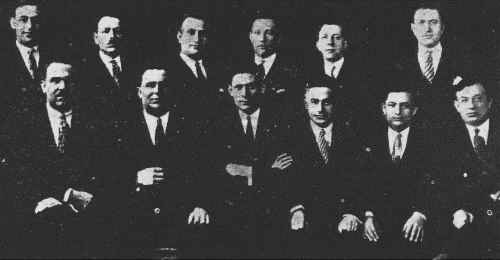
Luninyetser and Kozhanhorodoker 481 Arbeter-Ring (1927) New York Standing from left to right: Kwatnets, Shneyderman, Fenfild, Migdalowitch, Weyner and Berzon |
Translator's footnote
|
JewishGen, Inc. makes no representations regarding the accuracy of
the translation. The reader may wish to refer to the original material
for verification.
JewishGen is not responsible for inaccuracies or omissions in the original work and cannot rewrite or edit the text to correct inaccuracies and/or omissions.
Our mission is to produce a translation of the original work and we cannot verify the accuracy of statements or alter facts cited.
 Luninyets, Belarus
 Yizkor Book Project
 JewishGen Home Page
Copyright © 1999-2026 by JewishGen, Inc.
Updated 25 Jun 2026 by JH