 |
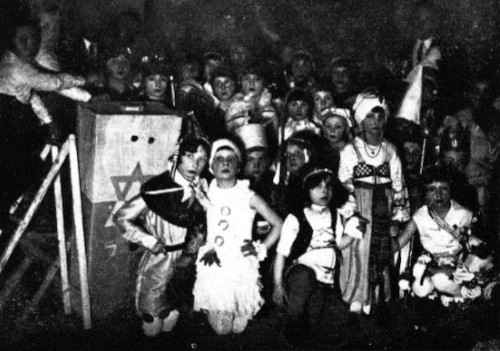
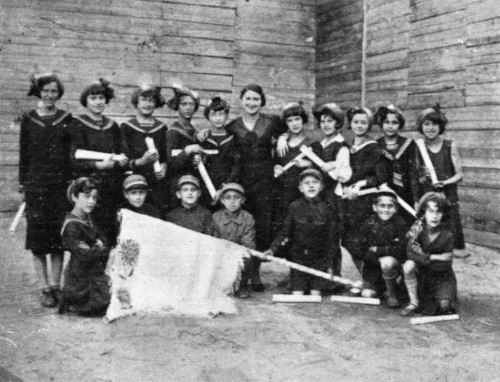
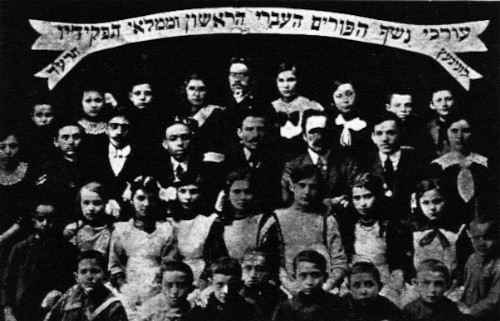
[Imprint on the Banner in the photo: “Arrangers of the First Purim Party, Honoring their Mission,” Luninyets, 1913]
|
|
[Page 44]
Cheders
by Y. Z. [Yosef Ze'evi]
Translated by M. David Isaak
The children of Luninyets received their education and learned Torah in cheders [teaching rooms] as well as in schools set up and owned by more secular teachers. Cheders were taught by melamdim (male teachers) and were for boys only, but in the schools, boys and girls studied together.
The most famous of the melamdim was R' Yisrael Peretz Holtzman, a Gemara [Talmud] teacher and a great scholar. His students were children approaching the age of Bar Mitzvah [13], sons of the well-to-do and the wealthy, since the tuition with him was 25 rubles for a z'man [a term of half a year]. Anyone who studied under R' Yisrael Peretz did not remain an Um ha'aretz [ignorant person] for long. In his cheder, they studied Tanach [Bible] and grammar in addition to Gemara. The zealous Hasidim rumored that he was once a maskil [a so-called enlightened thinker] and an apikores (heretic). Indeed, in his house, I once found volumes of Smolenskin's Ha-Shachar, the primary platform shaping the Haskalah [Jewish Enlightenment]. On simches [happy celebrations] and holidays, when R' Yisrael Peretz's heart was merry with wine, he would begin to deliver words of Torah and sermons laced with jokes, and the crowd thirstily drank in his words.
They showed him great respect. In the evenings, he taught a Talmud lesson to the public. Second to Yisrael Peretz was R' Asher Tziperstein, who was also a Torah scholar, but a humble, self-effacing man who fled from honor. After a hard day's work in the cheder, he sat in the Beit Midrash and studied by himself. All his life, he disseminated Torah to the Jewish children of Luninyets. On occasion he assisted the shochet [ritual slaughterer] with the slaughtering of poultry.
R' Mordechai of Pohost–though he did not teach for long because he died around 1913–was a Torah scholar who explained things beautifully. He had a beautiful handwriting and taught us to write letters using calligraphy. He would write a version of a letter for us in beautiful script and we copied it. He taught two levels: Level A and Level B.
Another melamed of young children was R' Yehuda Velvel Chinitz, who was known by the nickname Di Kalb [The Calf] because he was always biting his nails, notoriously pinching and hitting the children with a strap. Of course, it was mostly children of the poor who were pinched and bruised; he did not dare to chastise the children of the wealthy. He did not engage in teaching for long; he left Luninyets and immigrated to America.
R' Avraham Hershel Kutnick who was actually a craftsman, came to Luninyets from Kozanhorodok. In his cheder, he introduced a touch of modernism. His was a structured method for studies; his students spoke Hebrew and read Hebrew books. His students harbored a love and respect for books. In his low and damp house, which he bought from the heirs of Grandma Hinda, there was a library–the first in Luninyets. From his house, Haskalah [enlightenmen] students emerged who knew, to a certain extent, the teachings of the Zionist movement.
There were other teachers and melamdim who came for one or two z'manim [terms], but they did not leave any particular impression. In the cheders, children studied Tanach, the cantillation of the weekly Torah portion, reading, writing, and also a little arithmetic.Those who were In the schools, also studied the Russian language and had a general secular education. Sons of the wealthy continued their studies outside of Luninyets. When a boy reached Bar Mitzvah, the parents–with the exception of the wealthy and well-to-do–began to think about tachlit [to earn a living from a practical trade or future occupation]. Generally, the boys learned tailoring or carpentry, and the girls learned sewing, or were hired as shop assistants. When the youths grew up, they either left for the big cities or migrated overseas.
by Head of the Yeshiva, R' Eliezer Shach
Translated by M. David Isaak
The Yeshiva was founded in the year 5689 (1928/1929) by Rabbi Elimelech Perlow Z”TzL [this Tzaddik of blessed memory] from Karlin, Pinsk. It flourished and prospered under his direction. Up until the outbreak of WWII, there were about ninety students from all the towns of Poleysia and Volhynia. Among them were young men learned in Torah and devoted in their piety. And how splendid the scenario was when Rebbe Eliezer came to Luninyets! All the members of the Yeshiva went out to greet him at the railway station, and among them were the town Rabbi and several respected homeowners.
Rebbe Elimelech was dedicated with all his heart to the Yeshiva in particular and to the dissemination of Torah in general. And how his heart ached and worried over the suffering of the Jews in Poland and throughout the entire world. Even though at the outbreak of the war he was in Eretz Yisrael, he returned to Poland immediately, like a faithful shepherd, to share in their sorrow. Even when Vilna was liberated and it was in his power to come to Vilna, he did not abandon his community, and they perished in Karlin. May this be written for future generations, and from it they shall see and learn from the deeds of our ancestors, who sacrificed themselves for the good of others – “Rejoicing in their joy and suffering in their sorrow.” And how great was the joy of the entire town when Rabbi Elimelech Perlow of blessed memory of Karlin spent a Shabbat there, or Rabbi Moshe Perlow of blessed memory of Stolin! Every year they would come for a week to Luninyets, and then the entire town took on an atmosphere of joyous Holiday.
The house where they lodgedcwas always crowded with the many people who came to consult with them. They were encouraging and strengthening in their words. The joy was particularly great on the day the Karliner Rebbe met in private with the students of the Yeshiva. He spoke with them, encouraged them, and strengthened them. Like a father, he cared for them and fulfilled all their needs, eating together with them. The elders of the town also participated in the maintenance of the Yeshiva, such as R' Moshe Wolf Diatlovitsky of blessed memory, and R' Alter Levin and R' Ephraim Itzel Rubinrot of blessed memory, and at their head, the Rabbe, R' Alter Yehuda Zoliar, a unique individual, distinguished in his virtues, his simplicity, and his humility. He altruistically managed all the financial affairs of the Yeshiva, without compensation. I was with him for several years, and never once did I see him exhibit even a trace of anger. He spoke with everyone with a pleasant countenance; the goodness of his heart was beyond measure, and his greatness was incomparable.
How the heart aches that all of these people were taken from us in such a cruel manner! It is also worth noting here the blessed work of Bracha Hofshtein, the wife of the pharmacist R' Shlomo Hofshtein of blessed memory, who built the building for the Yeshiva. May her memory be blessed!
Eliezer Shach, Past head of the Mesivta [Yeshiva] “Beit Yisrael” in Luninyets, currently Head of the Mesivta of the Ponevetch Yeshiva in B'nei-B'rak, Israel.
by Asher Plotnik
Translated by M. David Isaak
Years of life and events, transitions of ages and worldviews will never be able to erase what I learned as a child. In the modern Hebrew school, we acquired reading and writing skills in Hebrew, grammar, Tanach [the Bible], and the history of Israel. In this school, we were given a spiritual preparation for the new winds that began to blow in the towns, and for the melodies that arrived from the Land where spring blossoms forever.
When a school like this came to our old town in the neglected swamps, we became “new;” it was as
[Page 46]
|
|
|
[Imprint on the Banner in the photo: “Arrangers of the First Purim Party, Honoring their Mission,” Luninyets, 1913] |
a ray of light shining in the darkness. The school quickly won over hearts among the town's residents, beginning with the town's Rabbi and the Chasidim, and onto the intelligentsia, who had already turned toward Russian culture and language. The Hebrew school was the spring from which the people's children drew their aspirations for redemption, and it was also what raised pioneers and fighting sons.
The education and teaching of the children in little Luninyets had traditionally been placed in the hands of the melamed [teacher] and the Cheder [traditional, one-room]. Just as craftsmen, shopkeepers, and peddlers flocked to the town to settle in it and find their livelihood, melamdim also came from various places. The melamed would gather about two minyanim (groups of ten) of children into his poor dwelling, seat them around long tables and, with punches and pinches, educate them and teach them Torah. However, in 1906, a complete change occurred in the education system of our town–a quiet revolution without strife or quarrels, thanks to the teacher Kaplinsky, of blessed memory, who opened his school in our town and which most of the town's children joined. We called his school the “Class.”
In this school, I began to learn the alphabet. This “Class” differed from the Cheders in two revolutionary ways, and they determined its character and progress: a) In this school, boys and girls learned together, studying all subjects and lessons without distinction, whereas in the rooms of the melamdim, girls were not accepted, and it never occurred to anyone to think of coeducational seating. The daughter of the melamed would sit in a corner of the house, quiet and innocent like a kitten, listening to the boys repeating their studies in their sing-song intonations, or to the readings by the older children. Among the wealthy and capable Jews, there were very few who actually educated their daughters when the time was right.
And thus, when this coeducational school opened in our town, all the girls of the town, including the rabbi's daughters, studied together with the boys. Kaplinsky taught the alphabet and reading by means of illustrated blocks (This was the pedagogical approach at that time; it was called the “analytical” method), and in just a few weeks, we were reading fluently. I remember that my grandfather–my mother's father–came to my mother and complained about my being sent to the “Class,” fearing I would grow up to be a shegetz (non-observant) because in it, they did not learn Yiddishkeit (Jewish tradition), prayer, or Jewish customs in it. My mother quickly answered,
[Page 47]
“Come and test the child to see how well he reads from the Siddur [prayer book], how he writes in lashon kodesh [holy language (Hebrew)], whereas in the cheder he didn't even know how to read during the entire z'man [term] he was there.”
And here is one unforgettable experience from my childhood: At the beginning of our learning to read, on one summer day during the afternoon hours, we sat on the benches in an unusual silence. On the teacher's desk was a pile of books. The teacher took out a Siddur titled “Safa Brura” [Clear Language], entirely elegant and shiny, with gilded letters engraved on its spine. And inside–beautifully printed letters. We received the prayer books with awe. We began to page through the Siddur with the tips of our fingers, careful not to wrinkle it. The teacher asked to open the prayer books, and one of the children opened and read: Mah Tovu Ohalecha Ya'akov [How good are your dwellings, O Jacob], before any of us even knew the meaning of those words. And yet, this was a holy moment, engraved in the heart of an innocent and tender child. However, Kaplinsky was not just a teacher of young children. Aside from the beginners' class, he conducted higher classes where they studied Tanach, Hebrew grammar, the history of Israel, and wrote compositions.
The school did not have a permanent residence; it wandered from house to house. Every half-year, with the start of a new z'man [term], he rented a room in another house from one of the town's homeowners. He saw to it that the school always occupied two spacious, sunlit rooms for his students.
The greatness of the teacher Kaplinsky lay in the fact that he dared to swim against the current, and succeeded in graduating students from his school who possessed a proper knowledge of Hebrew.
Three years later, at the initiative of a few parents, the teacher Ze'ev Bakalczuk, the son of Jesse, arrived in Luninyets. (He is currently living in Hadera, Palestine). His school was modern and organized. In our thirst, we drank from his clear waters. He remains etched in our memory as a glorious stronghold from the beginning and early days of the National Revival.
In a large, organized, and spacious wooden shack, in the courtyard of the local paramedic Mr. Epstein, was the permanent place of the school. The courtyard was spacious, clean, and fenced all around. The few trees in the courtyard, and the apple and cherry trees just beyond the fence, gave the courtyard a garden-like splendor, especially in the months
|
|
|
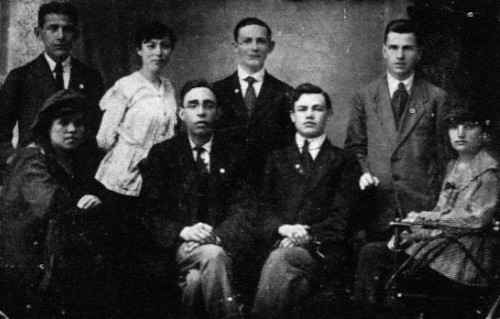
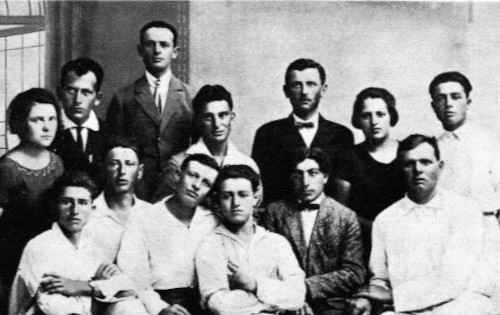
Seated, Right to left: Bosel, Lichovitsky, Kutnik, Friedman Standing: Tilshtein, Lichovitsky, Kutnik, Yosef Ze'vi (Wilk) |
[Page 48]
of spring and summer. In the courtyard we spent our time and amused ourselves during recess, with the ringing of the bell after every lesson. Parallel bars were in the courtyard for gymnastic exercises, and a sandy padded spot was allocated for wrestling and acrobatics. The first signs of sports were already seen in our town through a troupe of gymnasts who showed their skills to the public in the Government's garden by the train station. The teacher meticulously and strictly maintained the cleanliness of the house. He had the students wash the floor with soap and water once a week to rid the house of any stain and odor. He also insisted on the students' cleanliness. He himself was always nicely dressed, in pressed clothes.
We were about thirty students, boys and girls, all in one class. He had three other students to whom he dedicated a few hours a day. We spent those hours in the courtyard. There was one long recess. Reading and beautiful writing, and all of these–were taught in absolute silence. Preparing homework and memorizations were done only at home. The school hours were always from 8:30 AM until 4:00 PM. One hour was set for lunch. I was envious of the cheder children, who studied in the winter days until 8:00 PM and returned home on dark nights, holding a colorful paper lantern in their hands, while they stomped in boots and jumped over the snow piles in the street.
The main part of the studies was the Tanach and Hebrew literature. Isaiah was the favorite book of the teacher. He never sat while he read; he recited the chapters of the Tanach to us by heart. His explanations were in Yiddish. After his readings and explanations, we would read and explain, and recite memorized passages by heart.
We learned the Hebrew language according to the teachings of Y. Steinberg. This was one of the first attempts to compile selections from the works of the Enlightenment authors and modern literature, and to present them to a child learning the Hebrew language. A source of inspiration for us was the special lessons for learning [Chaim Nachman] Bialik's poems. Standing reverentially, the teacher would hold the “All the Poems of Bialik” book in his hands, beautifully bound in a light blue leather cover, with gold letters engraved on the the book covers, and with gold lines glistening from inside the wide-spaced lines.
First, the teacher would read the poem with flavor, emphasis, and explanation. Afterwards, he read it a second time, and then we would write the poem down in special notebooks. How much vision and imagination hovered over us to this day when the poem “In the Field” was read. It seemed to us, as if together with the teacher, we were bowing and swaying with the proud, upright stalks of grain. To this day, my ears still echo with the poems: “One Distant Star,” “The Dead of the Wilderness,” and “The People's Blessing”, with its opening words: Techezaknah [“Strengthen the Hands”]–the “Hatikvah” of its day. The melody of the anthem was not yet popular, but it had already won a proud and national status in many hearts, a great love for all the brothers who, in their sweat, were preparing to till the dust of the Land. We knew that the teacher's brother was in the Land among the pioneers. Was he not the agricultural pioneer, a member of the Nahalal colony of Ben-Yishai? This last year at the school was very pleasant for us. When we began to study “The Hebrew Style” by Krinski, we entered the palace of the Hebrew language. We did not learn grammar from a book. These lessons were given orally, analyzing verses of the Tanach, and so on.
We learned the history of Israel from “The History of the Hebrews.” We did not learn Russian and arithmetic at the school. With Bakalczuk, I started my Gemarah studies.
Vivid in my memory are the beautiful celebrations of Tu B'Shvat [the 15th day of the month of Sh'vat] holiday. The whole day was dedicated to life in Eretz Yisrael. The teacher brought symbolic fruits of the Land to the school: carobs, dates, and almonds, and read from Bialik's Zionist poems. There was an exhibition of postcards showing views of the Land and its settlements, and above all, the reading of letters from the teacher's brother. These were greetings and descriptions of the life of the pioneers
[Page 49]
who work in the orchards and vineyards of the Land. After that, we enjoyed a sweet treat. One of the important achievements of the teacher Bakalczuk was the library next to the school. A Hebrew book was a rare sight in the town back then. There were commercial houses, shops, grocery and flour warehouses, stationery stores, and notebook shops, but even a Siddur [prayer book] and a Chumash [Pentateuch] had to be brought from Pinsk or Vilna by people who traveled to those cities on business. Bakalczuk established the first library. Every student brought a certain amount of money as an investment, and also paid a reading fee. Hebrew reading books were purchased for the students, which introduced us to a new world. We read books like “Perachim” [Flowers], “Nitzanim” [Buds], and “Giborei Ha Uma” [Heroes of the Nation], and a world of renowned figures was revealed to us: the Tannaim, the Amoraim, the Geonim, and so on. Also purchased were books translated from foreign languages, such as “The Prisoner of Caucasus”, “The Prince and the Pauper”, and “The Mysteries of Paris” . We all were occupied with the interesting work related to the functioning of the library: writing catalogs, special cards, and distributing books. That new and unfamiliar word, “catalog,” held a certain magic for us. Bakalczuk stayed with us for about three years but was then forced to leave due to his failing health. The library remained in the possession of the students, who made great efforts to preserve it; unfortunately, they failed.
With the departure of this teacher from our town, the splendor of our beautiful childhood world faded.
by Ben Moshe-Yosef
Translated by M. David Isaak
The beginning of the development of a Hebrew educational institution in Luninyets were the klassen [classes] started by private teachers, such as Bakalczuk, Kaplinsky, Gloibersohn, M. Kutnik, the Liachowitzki brothers, Y. Tilchin, Zeldin, and Gorniansky. In the years 1919–1921, a public Hebrew school also existed. In the years 1922–1923, a building was erected in the courtyard of the old synagogue by religious householders for a religious school named…
|
|
|
|
[Page 50]
|
|
|
|
Beit Yaakov, which held its ground for only 3–4 years before closing. A group of Zionist activists took over the building and established instead the Tarbut school. In its first year of operation, only about 60 children attended the school. Devout religious parents were distrustful of a school with a secular character, and due to the high tuition fees, many of the poorer parents could not afford to send their children to the school. Nevertheless, the Tarbut school developed, and from year to year the number of students grew, reaching 200–250 in its final years.
The Tarbut school had a profound influence on the younger generation, and it did much to revive and spread the Hebrew language. It was a workshop for the soul of the youth, and from it several youth movements emerged, such as Hashomer Hatzair, Hanoar Hatzioni, and Betar.
The performances and public celebrations organized from time to time by the school children aroused great interest among the entire Jewish population in the town and its surroundings. The visit of the national poet Chaim Nachman Bialik to the school helped boost its prestige.
In the early 1930s, groups of young students from the Tarbut school organized themselves under the name Bnei Yehuda [Sons of Judah] in several places in Polesiya (places such as Dovidhorodok, Stolin, and Luninyets), committing themselves to speak only in Hebrew. These groups also had a noticeable influence on the adults in terms of adopting the language. Leading the Bnei Yehuda group in Luninyets was the student Niyomah Bilohoski, a passionate zealot for the Hebrew language. Another graduate of the Tarbut school was the talented young girl, Sarah Kotzikovitz, who, by the age of 12, wrote Hebrew literary works; many predicted a great future for her. However, the cruel axe of Hitler's murderers which fell upon the entire Jewish population
[Page 51]
of Luninyets, did not spare her either. Throughout all the years, the school struggled for its existence due to a constant lack of funds. It was thanks to the loyalty and dedication of a group of activists, such as Baruch Gerzulin, Moshe-Leib Schneiderman, Zalman Lopatin, Betzalel Stuchovsky, Mendel Tribuch, and others, who worked to collect funds from donations, campaigns, and other projects, that the school maintained its position all those years.
Among the teachers and directors of the Tarbut school in Luninyets, it is worth mentioning Moshe Rosen, Abseytchik, Lebovitz, Gordon, as well as Aryeh Lopatin–its last director until the school's liquidation by the Soviet authorities.
Translator's footnote
by D'vorah Kotzikowitz
Translated by M. David Isaak
There was a custom in Luninyets, that when a high-ranking government official or some distinguished gentile visited the town, a reception was held for him in the Great Synagogue, which was located next to our house. Nisseman, may he rest in peace, was forced to come to this Chasidic synagogue, even though he was a staunch mitnagged [opponent of the Chassidic movement], because he was an excellent cantor and superb singer; his Mi Sheberach [blessing] in honor of the gentile would reach all the way to our house, and we, the children, knew all of his melodies by heart. In our street, we felt more involved in these Polish ceremonies because we were ordered to fly their flag, which was so very foreign to us.
And how great was our joy and our immense excitement when, on one clear day, the Zionist activists in Luninyets told us to prepare a blue-and-white flag, because Bialik was coming to visit our town. The rumor of the great event–the visit of the genius of the nation–spread rapidly among the town's residents. Was there a person in Israel who had not heard the name Bialik? From the railway station, Bialik rode in a carriage lent by the Polish Starosta [district governor], to the home of the Zionist Committee. My sisters and I, may they be remembered for a blessing, felt the holiday in all its glory. As far as I can remember, they decorated the path from the synagogue to the school. We hung blue-and-white flags from all the windows facing the street. The school directors prepared the children and taught them recitations and songs. My sisters also participated in the reception for the great guest. The children wore festive clothes, and a spiritual uplifting was felt everywhere.
The children welcomed the guest with flowers and greetings near the school. Afterwards, we entered inside, row after row following him. I grabbed a place on a high bench, close to Bialik, and I still did not believe this was truly the poet. I recognized him from various pictures, but in my imagination, I had pictured him differently. Now, as I recall the features of his face, I remember his image, and I know that he truly was different from any ordinary person. An unusual silence prevailed in the room, which was packed with men, women, and children. Bialik began in a low, gentle voice to tell us about the lives of children in the Land of Israel. During that hour, I was not seeing in front of me. My imagination had me hovering over Mount Scopus and the hills of Haifa, as if I were among the children of the Land. Bialik woke me from my dreams by reading before us the song David, Melech Yisrael, Chai V'kayam [David, King of Israel, Lives and Endures]. Not to the well-known popular tune, but rather in a completely different melody, which entered deep into my heart and which we hummed for many days at home. To this day, when I remember those great days of yearning, I begin to sing to myself Bialik's tune. The dream of the dreamers of our generation came true, and David [Ben Gurion] the leader [Prime Minister] of Israel, lives and endures…
[Page 52]
by the Public Tarbut Hebrew School in Luninyets:
B[1]lessed are you
Wondrous Jew
We're welcoming your arrival–
Your words will be heard
As a voice of consolation.
Signed by:
Class #D – Yaakov Kobel, Asher Krogulin, Masha Chaya-Sara, Bracha Zuckerman, Tzipora Erdman, Chaya Perplotchik, Chaya-Sara Tribuch , Dvora Sterigatz , Henya Lieberman, Esther Bilohoskyt, Mordechai Golobey.
Class #C –Nechemia Shulman, Moshe Hochstein, Mendel Gekelman, Baruch Pilkov, Yehuda Pelt, Aharon Toker, Pesach Zlotnik, Leah Vyvet, Dov Levin, Vildevskyt.
Translator's footnote
by Avi-Ruth
Translated by M. David Isaak
Just as Yiddish theater was born in Purim plays and performances, so too in Luninyets did performances begin with Purim plays. As is known, Purim was half-holiday and half-commandment for Jews to drink spirits “until one no longer knows”… [the difference between ‘cursed be Haman’ and ‘blessed be Mordechai’].
This I remember as a child: Someone once came in from the Purim Spielers [Purim players], dressed as a Russian officer and recited what he recited, received his Purim-Gelt [Purim money, and then went out to the hallway and wrapped himself in an old garment (for in the street he was afraid to walk dressed in officer's clothes). There were also performances by troupes that went from house to house. In one performance of “The Sale of Joseph,” which was performed in our home, participants included: Uncle David and his son, Leib Wolf Patschenik, Avram'l Alpiner, and others. The Ishmaelites wore fezzes borrowed from the Turks, the local bakery owners in Luninyets. This performance lasted about an hour, and the troupe received payment of no less than 20 kopecks besides the honor…
In 1908, the splendid play “The Binding of Isaac” was presented with great grandeur in the hall filled with Pozsharne Saraye [local firefighters]. We prepared for this performance all winter. Among the participants was also old Nissen Kaufman, who played the role of Abraham. By the way: the Haredim [Ultra-Orthodox] leveled harsh words against him: “An old sinner who enjoined young men and maidens to act foolishly.” His son, Itche Kaufman Nissen, played the role of Isaac. My brother Abraham Isaac Wilk appeared in the role of Ishmael. Of the young women – it seems to me – the daughter of Avrohom Aaron Z'shuk and the daughter of Yosef Dovid Pilchik participated. The performance was a success and left a great impression in the town. For a long time after, people in workshops and homes sang the dialogue between the actors. To this day, these spoofed, rhyming (in Hebrew) stanzas are engraved in my memory:
“Avrohom, Avrom – my beloved husband, what I tell you to do, you shall do. You shall take your son, your only one, – you shall cut into his skin together with the bones.”
The last verse in Isaac's mouth still rings in my ears:
“Dear father – bind me well, so that
[Page 53]
God forbid no defect will be found in my bones.”
The performance concluded with this rhyming [Hebrew] verse:
“Everyone sing, Shoshanat Yaakov,
Rebecca became Isaac's bride.”
In 1909, the famous troupe of Pishzon visited Luninyets and stayed for several weeks. They performed the plays “Shabbat Kodesh” [Holy Sabbath], “Das Pintele Yid” [The Essential Spark of a Jew], “Soreh Sheyndil fon Yehupetz” [Sarah Sheynd'l from Yehupetz], and Hertzele Meyuchas [Distinguished Hertzele]. To my sorrow, only once was I lucky to sneak into the hall to see the performances. My soul longed to enter like all the children into the “theater” hall, but for lack of money, I had to stay outside.
These performances brought a lively spirit to the town, and for a long time afterward, people sang the songs from the plays. Following the visit of the aforementioned troupe, a drama circle was established in Luninyets that presented various plays from the repertoire of Goldfaden and Gordin [famous playwrights]. Among the active members were: Leizer Zshuk, Merel Dlemenitz–who was considered the “star” of the circle in her role as “Chasia the Orphan”–the daughters of Yosef David Pilchik, Eliyahu Mordrechik, and my sister Merel. Sometimes, actors would come from Pinsk to participate in the drama circle. They received no education or training, but the audience was very pleased and received the actors with cheers and stormy applause.
In 1917, the year of the Russian Revolution, a drama circle named Habima was founded after news reached Luninyets about the Habima theater in Moscow. At the head of this circle stood Yaakov Zshuk and Merel Damenitz. They performed: Tzuzeit ant Tzushpreit [Together and Separated], Die Shechita [The Slaughter], and others. There were also attempts at Hebrew plays: the first Hebrew evening and the play about children's lives were organized by students of the school of the teachers Gleiberman and Kotniuk. In 1918–19, a play about children's lives was performed at the Hebrew school.
Even during the days of Polish rule, drama circles were organized. Besides plays, Jewish folk-singing was beloved by the Jewish public, and since transportation to Luninyets was direct and convenient, famous artistic talents were invited. Thus, the famous Cantor Sirota was invited to a concert along with his daughter, as well as the famous Cantor Hershman, who appeared at an evening of folk singing. Among the listeners were many Christians.
by Yosef Ze'evi
In memory of my friend Menachem Shachori, of blessed memory,
who encouraged me to record my memories in writing.
Translated by M. David Isaak
A pregnant woman, especially during her final months, would not leave the house alone in the evening without an escort.
The birth took place at home, as there was no hospital in town, nor was there a midwife. Only after the First World War did a midwife named Zhenia Hofstein, daughter of Rabbi Moshe Aharon, settle in our town. Grandmother Hindah fulfilled the role of midwife with devotion and faithfulness. On the wall above the bed of the woman in labor, they hung Shir HaMa'alot, printed or written, featuring the names of the Patriarchs [for a male child] and the names of the Matriarchs [for a female child].
When a male child was born, the cheder students would come to recite Kriat Shema and bless the newborn on that night, receiving as a reward honey cookies, seeds, nuts, and candies. These visits continued throughout the week. On Friday night, guests would come for the Shalom Zachar [welcoming a male child] and were treated to peas, nuts, and wine. On the evening before the circumcision, guests would come again for the Mishmeret [guarding], out of the naive belief that the newborn faces danger from spirits and demons, and requires
[Page 54]
protection. The traditional mohel who participated in every circumcision was Rabbi Mordechai Perpelitzky, and after him came the feldtsher [paramedic] Epstein. The mitzvah of Metzitzah [Sucking blood] was performed by Rabbi Elazar Levin, and the Sandek [holder of the baby] was usually an honored grandfather, an uncle, or a distinguished guest. The newborns were named after deceased relatives and family members.
There were no professional matchmakers in town. Most matches were arranged by prominent heads of households. There were also matches made by personal choice, but for the most part, these matches were not made out of “love.” Most in-laws were chosen not from among the townspeople, but rather from outside of town. They would introduce the couple at a house in town or outside of town. The matchmaker would propose and describe the prospective groom or bride, listing all their virtues.
After two or three meetings, after the couple found favor in each other's eyes, they made a Vort [an agreement] or wrote Tna'im [engagement terms] publicly. They recorded the dowry amount and set the wedding time and so on. The signing of the Tna'im took place according to tradition, breaking a plate and wishing Mazel Tov. After the Tna'im, the couple would go out in public, arm-in-arm, walking along the street–a clear sign that they were a “couple.” Immediately after the Tna'im, preparations for the wedding began: sewing clothes, and so on. These were in addition to the pillows and blankets which every home in which a daughter reached age would have prepared for her. Pre-printed blank wedding invitations were bought to fill in the names of the in-laws and the bride and groom. When writing the invitations, they were careful not to leave anyone out, because that offense was great for someone who did not receive an invitation to the wedding. On the Sabbath before the wedding, they would escort the groom to the synagogue, for the Aufruf [honoring and calling the groom to bless the Torah], all his relatives came to pray at his synagogue. And when the groom went up to the Torah reading for Maftir, the women in the gallery showered him with nuts and all sorts of sweets. The cantor would bless him with the Mi Sheberach prayer in a particularly festive and melodic tone. The children snatched up the sweets. After the service, everyone went to the groom's house for a Kiddush, to which all relatives and friends were invited.
On the day of the wedding, there was great excitement. There was no special hall for weddings. The wealthy would travel out of town to hold the chuppah [canopy] ceremony and thereby free themselves from having to arrange banquets and feasts. But local folk conducted the chuppah and feast, down to every detail, according to the Kozhanhorodok traditions. In Luninyets, the ceremonies were held at the spacious house of Rabbi Ever Lutzki, or at the houses of Rabbi Meir Kaplansky and others. The houses were used for weddings, of course, because it was a mitzvah to do so. Mrs. Dovshe, or Bat-Sheva–despite all the great hassle and multi-layered bother–cleared out the house and put it at the disposal of the in-laws. They also cooked the festive meal there. The groom stayed in one house and the bride in another. About two hours before the canopy ceremony, guests gathered at the groom's house–his relatives, acquaintances, and the rabbi. Upon the appearance and entry of every relative and acquaintance, he was honored by the Klezmer (musicians): Rabbi Shimon Muzikant, or R' Sheps'l [Muzikant] who called out: Mit a sheynem Mazel-Tov begrist men Rabbi… dem chassan's…”[With great honor we greet the Rabbi - - and the groom - -]. The Klezmer played a short tune, and the honored guest slipped 10 or 20 kopecks into the hands of the Klezmer leader. They sanctifications were done by the rabbi. In some cases the bride's father settled and paid the dowry on the spot. Occasionally, last-minute disputes arose over money matters regarding the dowry. After completing the formal arrangements, they dressed the groom in a Kittel [white cloak] and escorted him with the musicians and a large crowd to the bride's house tzum badeken [the covering of the bride's head with her veil]. This ceremony was
[Page 55]
impressive. The bride, who sat on a special padded and decorated chair, with a veil on her head, was surrounded by righteous women and good friends who passed the time until the groom arrived. The overcrowding in the room was immense, mainly with boys and curious onlookers who came to watch. There was barely room for the groom and his entourage, who were showered with a rain of confetti and flowers. Before the covering of the bride's face, the badchan [wedding jester], Rabbi Yitzchak Shlomo Zmora'ik, demonstrated his skill in rhyming about current affairs and adapted his words to suit the bride. If, sadly, the bride was an orphan, they recalled the souls of the deceased, and here, as during the badchan's speech, weepings and sobbings were heard. But after this ritual, the musicians began to play, sadness evaporated, and joy and gladness returned.
Usually, the Chuppah was set up in the courtyard of the Beit HaMidrash. On the way, young men showed their strength through acrobatic displays. The sons of Kozanhorodok performed like this: They tied a rag soaked in kerosene to a pole. Two or three well-practiced individuals held a bottle of kerosene in hand, filled their mouths with kerosene, and sprayed kerosene onto the burning pole. Thus they then escorted the groom and bride to the Chuppah. After the ceremony, the reading of the Ketubah [marriage contract], and its delivery to the bride, they returned to the wedding house in joy and celebration, accompanied by music. The “couple” was received by the elders of the older generation in a dance, with the grandmother holding a large braided challah in her hands, and the people of the new generation held a tray of wine and flowers on the threshold of the house. For the groom and bride, their wedding day had been a day of fasting until the main feast began. The groom sat at the head of the table alongside his father, his father-in-law, the rabbi, and dignitaries. A quiet tension grew, mainly during the announcement of the gifts. The announcer, usually R' Shimon or R' Moshe-Leib Muzikant the Klezmer musicians, would take each gift, call it out and announce its giver. The gifts were usually household items, including holy books and actual money. This was a nice income for a couple lacking means. After the Grace-After-Meals, they escorted the groom and bride to their room, and the crowd continued in dances. The men and the rabbi at their head went on the floor to dance. Rabbi Elazar Yehuda Zolar, of blessed memory, held the red handkerchief in his hand, followed by a chain-dance, while singing in his booming voice: Keytzad Merakdim Lifnei Hakallah, Kallah Na'ah v'chasuda [“How does one dance before the bride? A beautiful and graceful bride”], repeating it over and over again. At each repetition, the pace grew until it reached the peak of enthusiasm. The next day, it was also customary to eat a lunch meal at the groom's or bride's house. The entire week after the wedding is called the “Seven Days of Feasting,” ending with the Seven Blessings on the Sabbath, when they escorted the bride to the Beit HaMidrash.
Among the holidays, the High Holy Days and Passover stood out. Before Rosh Hashanah, people went to Selichot [penitential prayers], especially for Zachor Brit [Remember the Covenant]. The Shamash [sexton] woke the sleepers while it was still dark. The Beit HaMidrash was full and packed, and even the town's infants and children were present. For Zachor Brit they went at it until four in the morning. At home, there was great activity. They baked challahs in the shape of birds, a symbol to pray that a good year would come from heaven. The highlight of the prayer was the blowing of the shofar. Before the blasts, they would sometimes preach about “matters of the day.” Girls also came to hear the shofar blasts without exception; except for severe invalids, everyone was in the Beit HaMidrash. There were no extreme heretics in town except for Dr. Gurevitch, a complete assimilationist (who also repented at the end of his days). At home, it was customary to dip slices of challah in honey and bless for a good and sweet year. Also, honey was
[Page 56]
spread on the four corners of the house and the mother would say: Zol undz Gott gebn a ziseh yor [“May God give us a sweet year”]. For Rosh Hashanah, they bought watermelons and grapes so they could recite the Shehecheyanu blessing. For Tashlich, they went to the stream behind Leib Wolf Petchanik's house, and in Die Zamd [the Sand] neighborhood they went to Rabbi Meir Kaplanski's garden, because there was no store or river in Luninyets.
The obligation of Kapparot [Forgive Our Sins] rests on each person, but two or three children would share it together. They baked a challah in the shape of a ladder–so that the prayers would ascend on the ladder straight to heaven. In the synagogue, after the morning prayers or the Mincha prayer, the synagogue Gabbaim [Beadles] sat in the Beit HaMidrash in front of a table set with wine and cakes. Each person cleared the obligation he donated for being called up to the Torah), and drank a L'Chaim. The table was full of “charity bowls” for various institutions, including the “Bowl for the Settlement of the Land of Israel.” Everyone donated as their heart desired. In the hallway or in a side room was the Shammash R' Itzik or R' Aharonke, or R' Avrohom, who whipped the worshippers with a leather strap as each one kneeled on the floor. The sexton received a fee for the “Kapores Beatings.” Two large candles were lit, one for the “East” wall and one for the “West” wall, inside the synagogue. They used to light a candle for each soul, but since the space was insufficient for candles on the windows–they lit them in a large box placed on the floor. In the synagogue, straw was spread on the floor. In recent years, they abolished the practice of spreading straw and lighting all the candles. The sexton kept a stock of candles for all days of the year. Regular prayer-goers did not have permanent seats for the main prayers, except in the Great Study Hall, where Rabbi Pinchas prayed for decades.
True joy was felt during the days of the Sukkot holiday. Each person built a sukkah for himself, and the children participated in its construction and decoration. At the Beit HaMidrash, they held Simchat Beit HaShoeva with musical instruments. The pious and meticulous bought an Etrog and Lulav for themselves. Whoever did not have an Etrog brought it to his home so that all his household members could bless over it. On the days of Sukkot, youth came to the study hall. The Chevra Kadisha [Burial Society] chose a Great Hoshanah (a willow branch woven in the shape of two hands clasped together). Every first and second member of the Chevra Kadisha would invite the congregation for a Kiddush at his home. The process of electing people to the burial society was done with great turmoil. For this purpose, they set up a large sukkah, and before the elections, held a grand Kiddush with wine and cakes–”fit for a king.” Sometimes quarrels broke out and arguments arose over the elections. I remember that R' Leib-Wolf Petchenik and I stood up and threatened to found a second burial society.
The peak of the joy was, of course, on Simchat Torah. On this day, the Jews unloaded all their worries and troubles and freed themselves from accepted etiquette. The joy began while still in the Beit HaMidrash. In the homes of relatives, they held a Kiddush, and after the prayers, groups went from house to house, sometimes dragging with them the cholent [meat stew] and kishkes [stuffed sausage], and thus the Jews rejoiced and celebrated on Simchat Torah. R' Reuven Der Milner [the Miller] gathered the youth in the Beit HaMidrash and read in Yiddish: Nit azoic Gott vi unzer Gott [No other God is indeed like our God], and the children translated and answered in the original Hebrew: There is none like our God, and so on to the end. In the streets, children streamed after R' Maysh'l, or someone else who shouted: “Holy flock,” and the children answered, bleating: “Maa, Maa!”
On Hanukkah, students were exempted from their studies. In the evening, each received Hanukkah money (Gelt)–mother sewed a small pouch specially for this purpose. It was customary to eat sufganiyot (doughnuts). They poured molten
[Page 57]
lead, making dreidels [spinning tops]. Some were winged, and some were in the shape of a cube, all engraved with the letters Nun, Gimel, Hei, Shin. And there were those who bought dreidels from Arel the wood carver. On Hanukkah, matchmakers arranged matches and wrote Tna'im [engagement terms and conditions].
On Purim, Jews had revenge on wicked Haman by making noise with graggers [noise-makers] whenever they heard his name. Poor people went door-to-door to collect donations, as did couples who collected money for social causes. It was customary to send portions of food, Mishloach Manot from family to family, as well as to teachers and rabbis. Purim Shpielers [actors] put on various fun plays. The feast was held in great splendor. The braided challah was sliced along its length. In the middle of the meal, musicians came and played. Purim Shpielers, and Jews in costume went from house to house, bringing smiles and joy to people.
A few weeks before the holiday, preparations for Passover began: pickling beets for borscht, baking matzahs; baking matzahs as donations for a widow. Wine was bought only from the rabbi; this was one of his sources of income. On the eve of Passover morning, it was customary to eat half-baked white bread which was then used for the ceremony of Bi'ur Chametz [Burning of the Leaven]. House cleaning was done according to the strict requirements of the law. It was customary during the days of Passover to play with nuts. The main area for the nut games was in the courtyard of R' Hershel Damnitz. This is how it was played: A small pit was dug, one person tossed 2 nuts into the pit and the second player threw either 2 or 4. This was called “4 against 4.” Depending on the accuracy of the thrower, If an even number of nuts was in the pit, the thrower won, but if the number was odd, his opponent won. The morning Barchu [prayer] usually took place in the weekday Beis Hamedrash where, during Barchu they threw so-called “farmer shoes” [chestnuts] at one another.
On Shavuot, there were no special customs other than decorating the house with greenery, and reciting Tikkun Shavuot [all-night Torah study].
On Tisha B'Av, young men used to gather thorny burrs and throw them at the beards of elderly men, despite protests from the leaders of the synagogues. Eventually, this ugly custom ceased. They also used to visit the cemetery.
If someone died in a nearby house, all the neighbors emptied the water from all vessels, pitchers and so on. Old men and women blessed the dying before their death, and recited the Vidui [confession]. In the deceased's house, candles were lit and placed near the head of the deceased, while reciting Tehillim [Psalms]. The shrouds were sewn by members of the Chevra Kadisha [Burial Society] themselves, without knots at the outer edge. The Taharah [Purification] was performed at the Beit HaTaharah [Mortuary]. Deceased men, were respectfully wrapped in a tallit and carried on a special stretcher on the shoulders of the bearers to the iron railway tracks. From there to the cemetery, they moved the deceased in a simple cart hitched to a horse, while part of the crowd called out loudly: “Righteousness shall go before him and set him on the way of his steps.” Over the eyes of the deceased and on his mouth, they placed pieces of earthenware, and beside him they placed a small wooden stick. My father explained: when the Messiah comes and we are resurrected at the Techi'at Ha'Metim [The Resurrection of the Dead], he will have something to lean on and rise with. After the burial, an announcement was made that the deceased was exempted and freed from all societies and institutions. After the Mourner's Kaddish was recited, the “Forgiveness Requests” were cited: “So-and-so, son of so-and-so, requests forgiveness.” They also asked that the deceased be accepted as an advocate for so-and-so, son of so-and-so, who is ill, and that so-and-so, son of so-and-so, be released from military service. Upon exiting the cemetery, they plucked grass and threw it behind their backs while saying the verse: “He will swallow up death eternally [Isaiah]. When the mourners returned home, they ate a Se'udat Havra'ah [Condolence meal].
[Page 58]
Throughout all the days of the Shiva [seven days of mourning], a minyan [prayer quorum] prayed in the house, and they turned the pictures and mirrors around or covered them. In many homes, a Yahrzeit board hung on the wall, on which was written in printed letters the date of the deceased's passing, along with verses and sayings of our Sages, of blessed memory, For example: “A person worries about the loss of his money, but does not worry about the loss of his days; his money does not help him; his days do not return.” On the day of the Yahrzeit, the son or close relative went before the cantor's lectern, was called up to the Torah, and the Shammash recited El Maleh Rachamim. On the evening before and all day of the Yahrzeit an oil lamp burned at home and also in the synagogue. The particularly pious fasted on the day of the Yahrzeit.
by Yaakov Kola
Translated by M. David Isaak
One of the continuers of the teachings of the Baal Shem Tov and spreaders of Chassidism in Polesia-Volhynia was Rabbi Aharon the Great, of blessed memory, of Karlin. A wondrous man, entirely devoted to Chassidism. With all the fervor of his enthusiasm, he acted and did everything for Chassidism's sake. He won over many good hearts and brought them under its wings. He burned entirely with holy fire, and all his bones proclaimed song and praise to God. He was stricken with “love of God,” as expressed in the zemiros [melodies] he composed for the Sabbath such as Yah Echsof, which is sung by Stolin-Karlin Chassidim to this day; “Holy Sabbath, my soul is ill with love for You,” and he sees the soul of the Jewish people as bound to the holiness of the Sabbath, which is an eternal sign between Jews and the Holy One, blessed be He.
Who does not remember the joy and delight that the Rabbi brought upon us in our town on one of the Saturdays of the year? The town wore festive clothing, and ten levels of joy descended upon it. Shopkeepers pulled down their shutters, the craftsman left his workbench, school children left their study benches, and the housewife left her kitchen. All joined together in the great joy, and the entire town immersed in a sea of song and melody.
And it was not only the devout, prominent Chassidim, but also people far removed from Chassidism who joined together on those days into a single group. The barriers fell and differences vanished. The entire town became one family.
The Stolin-Karlin Chassidim did not constitute the majority of the Jewish population in Luninyets, but they did occupy most of the buildings. In this congregation were gathered the cream of the crop and the elite of the town, all the notables–Rabbi R' Alter Yodel z”l, R' Moshe the Shochet (ritual slaughterer) z”l, R' Alter Levin and R' Moshe Wolf, R' Yisrael Peretz–and nearly all the townspeople were their disciples and more. The Stolin Chassidic synagogue served as the center of the community, and all its affairs were shaped under its influence; it stamped its seal upon the town's life. And it was itself influenced by the supreme authority–the court of the Rabbi from Stolin and Karlin.
To outsiders, unity and harmony prevailed in the Stolin and Karlin house–but in practice, they were strictly divided into two factions, where peace and unity did not prevail.
The Rabbi and Shochet restrained their loyalty; they left no room to direct their devotion to the Rabbi of Stolin, as they did to the Rabbi of Karlin. Nevertheless, the general impression was that they were counted among the Karlin Chassidim, and therefore the Chassidim affiliated with Stolin saw themselves as deprived regarding representation in religious matters, and looked forward to an opportunity to install at least a slaughterer from among their people. Here and there, cracks appeared, and there was a tangible danger that restrained unity would be destroyed. Only thanks to their alertness, the honesty of their hearts, and the love of peace among the leaders of the community–especially R' Moshe the Shochet z”l–was this painful problem resolved, and peace restored to its foundation before it was disrupted.
[Page 59]
R' Moshe the Shochet entered into a marriage alliance through his children with one of the central pillars of the Stolin Chassidim, R' Yisrael Yehuda z”l, the Shochet and Bodek of Kobryn, and thus the problem solved itself, and all the conflicts were resolved.
And if throughout the days of the year there were certain frictions, these vanished when the Rebbes visited our town on two Saturdays of the year. All the homes were placed at the disposal of the guests; Karlin Chassidim stayed with Karlin Chassidim and vice versa. During the visit of the Rebbe of Stolin, the guests stayed at the house of R' Moshe the Shochet: R' Yisroel Yehuda, Sho”b [Shochet and Bodek] of Dovidhorodok, R' Matisyahu Sho”b of Lachva, and R' Moshe Meir, the Sho”b of Pohost. They also stayed with R' Yosef Diatlovitzky, Itzik Katz, and David Gerzulin who were Stolin Chassidim; and also with Efraim Itzel Robinraut, Mot'l Schwartzman, and Meir Kaplansky who were Karlin Chassidim, and the homes were always wide open [to them].
|
|
|
|
|
|
|
|||
As is known, Stolin-Karlin Chassidim used to send a kugel [baked pudding] to the Rabbi's tisch [table] on the Sabbaths. Besides the seven kugels arranged on the Rabbi's table, Chassidim and men of action would add another kugel to honor the day and the event. Housewives competed among themselves over whose kugel would be more successful, so as to please the Rabbi and the guests.
Chassidim and men of action did not have the patience to wait until the meal of the day to fulfill their obligation to eat remains of the Rabbi's kugel. The early risers–smelling a good kugel–slid quietly into the kitchen of the housewives, brought out the kugel before it had even baked completely, and carried it out to the congregation of Chassidim. This ignited tremendous enthusiasm and reignited the crowd with an inspiration of joy, and the dancing did not stop until daybreak. Thus did the Stolin-Karlin Chassidim in Luninyets combine lightheartedness with the joy of a mitzvah and spiritual elevation; to transform the mundane into holiness. Such a Shabbat of Chassidism in our town was engraved upon the hearts of all the townspeople, and its memory will never leave their children.
by Yosef Ze'evi
Translated by M. David Isaak
We do not have exact numbers, but several families and individuals emigrated from Luninyets and Kozhanhorodok, and a large portion of the residents of these towns live abroad and in the Land-of-Israel. Entire families emigrated, and there was no household left where at least some family member had traveled abroad, especially to America.
The dire economic situation and the hardship of the Tsarist regime, which restricted and confined Jews to the Pale of Settlement, caused the emigration. The Russian Revolution of 1905, which ended in failure, brought in its wake a wave of pogroms and persecutions. In the early years, when someone departed for America, the grief in the family was immense. Especially intense was the eulogy-like lament at the train station: “Let me see my son once more, when will I merit to see you? Do not forget your mother.” The popular folk song, A Brivele der Mammen, [Write a little letter to your Mama (1907)] expressed all the pain and sorrow of the family separation. In the final years after the First World War, the situation changed, and anyone who could obtain a visa and leave for America was considered fortunate, and joy prevailed in the family.
At the beginning of the present century, those who emigrated were mostly craftsmen and ordinary folk who lacked a livelihood. The children of the wealthy and affluent hardly emigrated. When the emigrant found work or set himself up, he sent a Schiffskarte [ship ticket] and travel expenses in order to bring over his brother, sister, or bride to the “Golden Land” [Die Goldene Medineh] as America was called by Jews. Concerns about visas did not exist in those days. There were cases where a young man married a woman and after a few weeks parted from his young wife and set out for distant lands. A few years passed, and he brought her over to join him. The pain and suffering were great, but the Jewish family, accustomed to suffering, adapted for lack of any other choice. Even the socialist settlers, who believed that the rule of the Czars was short-lived and that freedom would soon reign–and fought against emigration and “territorialism”–they too took up the wandering stick so as not to fall into the hands of the police, and so as not to be sent to prison or hard labor.
As long as the gates of America were not locked, the Jews of Luninyets emigrated to America; a small portion also turned to Canada, and when the gates of America were locked, they set their sights on Argentina, and a few individuals also turned to other countries. The emigrants did not cut their ties with their “old home.” In America, there was an “Association of Natives of Luninyets and Kozhanhorodok,” which provided great aid to the community of Luninyets and Kozhanhorodok after the First World War. In Argentina, there was also an association of natives of Luninyets, which also conducted cultural activities among its members.
Despite the emigration and wandering, the Jewish population in Luninyets did not decrease, for new people were always added, mainly through births of children. Sons of Israel, or more accurately, daughters of Israel in Luninyets, like all the towns of the Pale of Settlement, did not know of “modernism” that prescribed two or three children per family, and no more. Almost every family consisted of 8 to 10 souls, or at least 5 to 6. Immigration to the Land-of-Israel had a special character, it was primarily for the idealist.
[Page 61]
We have no information about the aliyah [immigration to Eretz-Yisrael] of Jews from Luninyets to the Land-of-Israel until the year 1914. In 1909, David Bakalczuk–brother of the teacher Ze'ev Bakalczuk–emigrated from our town to the Land-of-Israel; he was a member of the Second Aliyah and one of the founders of Nahalal [The 1st Moshav in Palestine]. Indeed, he called himself ”David Ben-Yishai of Nahalal.” His immigration left a great impression, especially with his letters from the Land-of-Israel which inspired the local Zionists, and Jews began to talk about the Land-of-Israel as a real option, though nothing practical came of these conversations. Here, Ya'akov Krikun, from Brodylovka Street known as Ya'akov the Blacksmith, dreamed all his years of immigrating to the Land-of-Israel, but died in Luninyets.
Immigration to the Land-of-Israel began after the First World War, with the Balfour Declaration [1917]. The first to immigrate to the Land-of-Israel and pave the way for those who followed was R' Zerach Plotnitzki, who, without much talk about his departure from the town, caught us by surprise. We, the active Zionists, knew that R' Zerach Plotnitzki, had sold his house, his hotel, and his sausage factory to move to the Land-of-Israel with his entire large family and relatives–more than ten people. Indeed, a few days later, all of R' Zerach's acquaintances and friends went to accompany them to the train station. Near the train stood many affluent Jews, and they asked R' Zerach to write them letters detailing the situation and conditions, so that they too might consider immigrating. We young people envied him and thought: When will we merit to immigrate as well? R' Zerach had no regrets. In the first few years he underwent trials and tribulations, but eventually he integrated in the Land together with his family. Most of them continue to supply Tel Aviv and its surrounds with delicious cured meats and sausages to this day. In his old age, R' Zerach left bustling, noisy Tel Aviv, moved, and settled in Ramat Hasharon.
After R' Zerach, Moshe Kashton (of blessed memory), one of the active leaders in Socialist Zionism, immigrated to the Land-of-Israel, subsequently bringing over the entire Kashton family.
R' Avraham Perplotzick and Daniel Drabski, who immigrated in 1924, were among the founders of the construction group Achva [Brotherhood], a place of employment for every immigrant from Luninyets at that time. In 1924, the Fourth Aliyah began. Thousands of Jews began immigrating to the Land-of-Israel, and a severe shortage of skilled tradesmen was felt, especially construction workers. Most of the young pioneers who immigrated to the Land-of-Israel lacked trade skills; but our two townspeople easily received [work] certificates based on the recommendation of the Zionist organizations in Luninyets. Shortly after, two more skilled tradesmen from our town arrived: Aharon Zipershtein and Shneur Oleinik. The group grew and expanded; the young men worked as plasterers and bricklayers. They were joined by Kaufman, Michal Zipershtein, the writer of these lines, Ze'ev Dichter (a police officer in Tel Aviv), B.Z. Lutzki, Tiltshein, Boswitz. There was no lack of work. We worked on a contract basis per square meter of construction, and divided the earnings among ourselves by percentages: skilled tradesmen received 60%, and plasterers and bricklayers 40%. Whenever a new immigrant arrived from Luninyets or Kozhanhorodok, he was accepted into the group.
Since the number of “intellectuals”–as Daniel Drabski dubbed them–was very large, we arranged a shift system. They worked only a few days a week so that everyone would have a part in the work-brotherhood and an opportunity to integrate into the country. This group lasted until 1927, but then dispersed due to the economic crisis that swept the country during the depression. Several members moved to Kibbutz Pinsk , later going to settle in Kibbutz G'vat, while there were those who could not hold out and left the country. The Kibbutz fulfilled an important role in the lives of immigrants from Luninyets.
I remember when I arrived in Tel Aviv, I visited the immigrants from Luninyets who were accommodated in one large room in a building in Machaneh Yosef in the Neve Shalom neighborhood; an old building with an old tin roof. The whole group lodged there:
[Page 62]
Daniel Drabski, Avrahm'l P., Tzipershtein, Kooperman, Kashton. I myself also lodged there for a few days. This lodging was discontinued only upon the arrival of Daniel's family. Toward the Fifth Aliyah in 1930, immigration from Luninyets grew, and every immigrant managed on their own. A significant portion settled in Haifa and its surroundings, and the vast majority in Tel Aviv. Most of them were well-established in their work.
After the gates of America were locked, the Land-of-Israel became the only country that absorbed most of the natives of Luninyets who left it. With the outbreak of the Germany–Russia war in 1941, we grew deeply anxious about the fate of our families. In 1944, the Association of Luninyets Natives was established, with the purpose of raising money and coming to the aid of the surviving remnants. The organization worked extensively by providing assistance and loans to those who were privileged to immigrate to Israel, as well as sending food and clothing packages abroad.
|
|
|
From right to left: Seated: D. Drabski, A. Plotnick, A. Parploczik, Lutzki, Y. Kauferman, Kashton, of blessed memory Standing: M. Tzipershtein, Ziva Fishman, D. Ben-Ami, Gafni, Lutzki, Yosef Ze'evi and his wife Batya |
On the eve of Purim in 5685 [1925], I disembarked in Jaffa from the contaminated ship “Romania”. Since I did not come alone, but accompanied by my wife, we were not housed in the Beit Ha'Olim [Immigrant House] but in a hotel in the “Neve Shalom” neighborhood near Arab Jaffa. On the first morning, I went out into the street; my head was dizzy from the screams of the Arabs, and perhaps also from the pain of the injections. The narrow and dirty streets in Jaffa made a depressing impression on me. I hurried to see famous Tel Aviv, and indeed here my soul revived and my enthusiasm grew. My heart broadened with joy the moment I entered Achad Ha'am Street–behold, the place of residence of the actual author of At the Parting of the Ways! They indicated the chain blocking the passage near his house towards evening, so as not to disturb the rest of the “The Guider of Thoughts in Israel.” I stood for a few moments near the house; I longed to see the great teacher face to face. While I was still deep in thought, suddenly, a slender man comes out of the house, slightly stooped, leaning on his cane. Accompanying that man was an old man with a
[Page 63]
long, white beard; arm in arm they walked. I asked my friend who the two old men were and he told me: one–Achad Ha'am, and the second–R. D. Levontin. I could not take my eyes off them and followed them for some time. I recognized the “Herzliya” Gymnasium building from the pictures we had back in the diaspora. Herzl Street and Nachalat Binyamin Street were bustling with Jews and new immigrants. My spirits were high. We spoke Hebrew, and were it not for our lingering Ashkenazi accent, we wouldn't even have ben recognized as new immigrants. We also heard compliments in Russian: “He just arrived and is already conversing in Hebrew!” After a few days of wandering the city streets, we began looking for a room, but our enthusiasm waned bit by bit. Under no circumstances could we find a room. The aliyah was then at its peak, as many came before Passover for the opening of the Hebrew University. The shortage of apartments was acute. Finally, friends and acquaintances found us a small shack on the edge of the city, without a ceiling, covered with a tin roof, and with a small window. It had no running water in the room. For rent, we paid $5 a month. We furnished the room with a small table and two chairs, in the customary style of the pioneers of those days.
And then came my first workday in the Land-of-Israel. Working in an office, as I had done abroad, or getting by with another job–teaching or clerkship–did not even cross my mind. We knew that a Chalutz [pioneer] must engage in hard physical labor. I was invited to work in the Achva group. Daniel Drabski was my patron. The new building, which we began building, was located on Galil Street, which at that time was almost outside the city. I arrived early, wearing new work clothes and a Kova Tembel [cap] on my head, to carry bricks. It was my bad luck that just that day's weather was a Chamsin [extremely humid, hot day]. On my shoulders, I loaded my hod with 12 bricks and began carrying and handing them to the bricklayers, back and forth. Half an hour later, I was soaked in sweat and breathing heavily. I knew this was my first workday in the Land-of-Israel, and it was my test day to see whether I was capable of being a pioneer or if I would fail miserably. I exerted all my strength so as not to show signs of weakness. A water-tap in the yard of the Beit Am [People's House] was my savior. Every so often, I approached it and drank to my heart's content. An hour later, Daniel came over to me, saw that I was completely soaked, advised me to take off my shirt and undershirt, and spread them out to dry in the sun. He comforted me, saying: “Soon there will be a short break and you can rest. It's nothing, you'll gradually get used to the work.”
And so it was: a few days passed and I began to get used to work I had never done before. I came home tired, exhausted, and covered completely in mud. I had no place to wash, and only at my request did the neighbors in an act of kindness and allow me to wash off the dirt and mud. As if dead, exhausted, I threw myself flat onto the sofa and fell asleep immediately from sheer fatigue. I could not take my young wife out for a walk along the seashore, or go to a lecture.
After a month, I got used to the work and adapted to the routine of life. I began visiting the Beit Am and listening to lectures. Days went by and work proceeded at a rapid pace of pouring concrete or building a smooth wall. The concrete left its mark on us: fingers were cut and swollen, the blazing sun burned our skin, and it began to peel, causing great pain. However, over time I adapted and became a construction worker. My spirits were bolstered when my friend Tieltszin immigrated and worked together with us. No one would have believed that Tieltszin would adapt to construction work, but he carried the yoke of mud and bricks with fortitude and passed the test. Daniel often made fun of us, he'd say [In Yiddish]: “Listen, Tieltszin and Wilk, you big Zionists! Who hands bricks to whom? Me to you, or you to me?” All the comrades laughed and enjoyed Daniel's words. One day, Daniel said to us: [“Hebrew”] Well, my friends, prepare a supply of bricks and mortar today, because
[Page 64]
we must work on a smooth wall, quickly, [then switched to Yiddish]:so it'll be burning under our hands.” In a great hurry, we raised bricks and mortar in such a large amount that the scaffolding collapsed under the weight and all the supplies fell down. Everyone came out safely without any casualty. At the time I was right under the scaffolding, but a miracle happened: instinctively, I felt the scaffolding collapsing and moved away from the spot, but a single brick struck my head.
They brought me to the clinic. The doctor examined my head and bandaged it. I stared at the doctor with great interest without asking about the condition of my head. The doctor noticed this and asked: “What would you like to say?” I said: “Excuse me, doctor, aren't you the poet Saul Tchernichovsky?” – “Yes! Yes!” he answered, with pleasure. I began mentioning titles of poems by him that I knew. Great was my joy that I happened to converse for the first time in my life with one of our greatest Hebrew poets, who was also a physician. He was visiting the country at the time and worked for a few days at the Kupat Cholim clinic to get acquainted with the institution.
In the Achva group, I worked until the outbreak of the 1927 crisis [earthquake, depression] when our group disbanded. Afterwards, I worked with the Tarbut Ha'Oved group, which was organized by a member-teacher, who was out of work. We worked on road paving, on leveling sand and excavations. We received the work in partnership with other groups, and to this day I cannot forget how readily those teachers learned the work, how old A. Feinstein, the well-known Zionist from Pinsk, worked vigorously and did not lag behind in the work; and Mordechai Kosover, the young and learned scholar, (now in America) pushed the wheelbarrow with agility; and how Yitzhak Gorvits, now principal of the Max Fine School, spread tar on the road. And precisely during those difficult crisis days, our spirits were high and our faith in Zionism and in the Land was strong. We knew that this was a passing phase and that immigration would renew again. And so it was. Those who suffered and stood the test eventually settled into work; those who couldn't, and who left the country–not all of them were privileged to immigrate back.
|
|
|
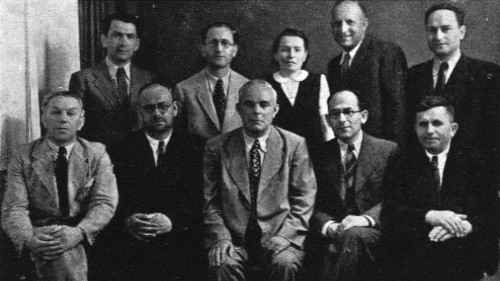
from Luninyets and Kozhanhorodok in Israel (1945) Seated from right: A. Kashtan, Yosef Zabi, H. Dannenberg (USA), Y. Kaplansky, B. Lutsky Standing from right: Y. Kolani, M. Drobtsky, Z. Shochat, H. Tzipershtein, L. Yosilevsky |
[Page 65]
|
|
|
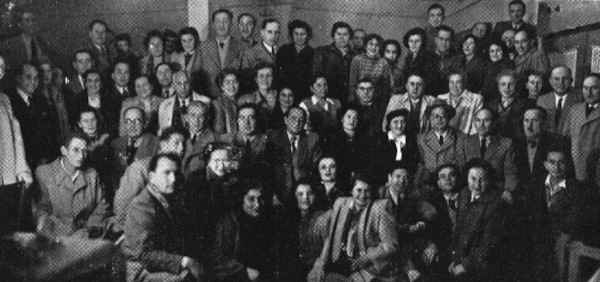
Chanukah Party, Tel Aviv (1952) |
|
|
JewishGen, Inc. makes no representations regarding the accuracy of
the translation. The reader may wish to refer to the original material
for verification.
JewishGen is not responsible for inaccuracies or omissions in the original work and cannot rewrite or edit the text to correct inaccuracies and/or omissions.
Our mission is to produce a translation of the original work and we cannot verify the accuracy of statements or alter facts cited.
 Luninyets, Belarus
 Yizkor Book Project
 JewishGen Home Page
Copyright © 1999-2026 by JewishGen, Inc.
Updated 17 Sep 2026 by JH