 |
|
|
[Page 23]
The Beginning of the Zionist Movement
by Yosef Ze'evi
Translated by M. David Isaak
In Luninyets, as in all places where Jews resided in Czarist Russia, the Zionist movement initially contented itself with ideology alone. The main focus back then was to spread the Zionist ideology, and anyone who accepted the Zionism concept for its own sake was considered to have accomplished much. This was because, in the eyes of opponents and those adhering to religious law, we were considered heretics; in the eyes of opponents from the “Bund” and the assimilationists, we were viewed as false dreamers, and only very few joined the Zionist movement. Practical work was expressed through the purchase of shekels, shares of the Colonial Bank, and its establishment, and Keren Kayemet [JNF=Jewish National Fund] fundraising–especially on the eve of Yom Kippur in the synagogue, plate donations, and small change that did not add up to a large fortune. Because the nature of the demonstration was Zionist, it involved wearing a Magen David [Star of David] on the lapel, singing the Hatikvah and songs of Zion, and especially in speaking Hebrew. The early Zionists in Luninyets were, as told to me: R' Itzeh Shulman, R' Shlomo Levin, R' Hershel Dimnitz, Tzadok Lichtenstein, Moshe Ackerman, Anschel Busal, David Gerzolin, Yitzchak Katz, and others.
Activities took place in secret, as the authorities looked unfavorably upon an Israel national movement. There was a time when they also persecuted the Zionists. Only when the “Society for the Settlement of Jews in the Land of Israel and Syria” was established could the Zionists act under the cover of this society without fear. The living spirits and spreaders of the Zionist ideology were the Hebrew teachers who came from the nearby areas to teach Torah to the children of Luninyets. Thanks to them and their fruitful work, the seeds they sowed sprouted and yielded glorious results. In the final years before its destruction, Luninyets was Zionist with all its soul; the most active teacher whose work bore fruit was Ze'ev Bakelchok Ben Yishai who merited immigration to to Israel [Palestine] in the year 5672 [1912] and settled in Hadera. He came to Luninyets in 1908, opened a Hebrew school organized properly, and raised a generation of young Zionists. Almost all of Bakelchok's students remained faithful to the Zionist ideology. Among his outstanding students was Michael, son of Baruch Yitzchak Lutsky, who is now in America, the Secretary of the Relief Association of Luninyets and Kozanhorodok Emigrants in New York. A man of brilliant talents who, had he continued his studies, would have poured his energy into Torah and scholarly goods, and surely would have become famous as a scholar; but our fathers did not know how to appreciate talents, and above all lacked financial means. At that time, until 1914, there were about three subscribers in our town to Ha-Russot, Ha-Olam, Ha-Shiloach, and Ha-Tzefirah; these were the spiritual resources for spreading the Zionist ideology. In 1908, they began to sell shekels in Luninyets (though buyers were few), distribute JNF stamps, and collect donations for tree planting in the Herzl Forest.
The most active Zionist activist was Teacher Chaim Gloybersohn, who came from Motol [Southern Belarus] and enthusiastically continued the Zionist activity in our town. He was a man of action and deed. In Gloybersohn's days, the spoken Hebrew language spread in the town, and in 5672 [1912] he organized the first Hebrew celebration in the theater, a Hebrew performance by the school children, which left a very favorable impression. Then many of the townspeople, even the strictly Orthodox, began to hand over their children to teachers like Moshe Kutnick and Yechiel Blizovsky, who started a private school, Klassen, and became Zionist activists. In 1912, the film “The Life of Jews in the Land of Palestine” was shown in Russia after much effort and labor.
[Page 24]
Among the visitors there were also many Christians. I remember when I came back from the yeshiva, my late father of blessed memory, told me with great enthusiasm about this movie he saw. He always mentioned this as an important event in his life.
The Zionist movement reached the peak of its development in 1917, during the days of the Russian Revolution, and struck deep roots during the period of Polish rule.
by Ze'ev Ben Yishai
Translated by M. David Isaak
I arrived in Luninyets at the beginning of the summer of 5668 (1908). With the help of Mr. Gerzulin, a hardware merchant, the “Reformed Cheder” (termed “the dangerous one” by the Hasidim) was opened. From an educational, social, and Zionist perspective, the town was a complete wasteland. Jewish children were educated in chaotic traditional cheders without a system or order: in an elementary cheder, in a cheder for Chumash, and in a cheder for Gemara. Wealthy households began accustoming their children to speak Russian, as the town was situated near a railway junction and earned its living from railway officials. At the reformed cheder, which contained two classes, the number of girls exceeded the number of boys. Girls were not “left out”; their instruction was taken care of. The curriculum specified that Hebrew was taught as a living language, children studied the Holy Scriptures as well as the history of Israel using improved methods and explanations. They learned about the Homeland, the Land of Israel, being rebuilt by pioneers.
The living Hebrew spoken by the children and the home preparation of lessons made an impression on the parents. In the second semester, many more students joined, and the parents themselves would visit the school and listen to the Tanach lessons. A small library was established that helped accustom the children to reading Hebrew books. The attitude of the Hasidim also changed; they sent their sons to learn Hebrew and the rest of the subjects at the new school. Gemara was studied in Israel Peretz's cheder.
Zionist activity blended with the educational work, expressing itself back then by selling shekels, of which there were few purchasers, and distributing Keren Kayemet stamps and greeting-telegrams. Information about the Land-of-Israel was distributed through postcards painted by laborers in the Land at the beginning of the Second Aliyah.
One event that occurred at that time in 5669 (1909) echo'd and gained publicity across the Land of Israel: my brother, David Ben-Yishai, now in Nahalal, made aliyah [immigrated] to the Land. The preparations for this aliyah, the departure from the town, and the large send-off (the whole town accompanied him to the train station) served as propaganda material for Zionism. For the first time, young men and women felt in their bones that there is truly a land where young people olim [immigrators] can come to work and build it. My brother's letters detailing the life taking shape in the Land inflamed spirits.
Here I must pay tribute to the mother of the Rubinraut family, to Yeshisha Chaya-Henya Rubinraut, a righteous woman, devoutly pious, and generous of heart, whose entire life was devoted to God. In her house I dined during all the years I stayed in Luninyets, and I wish to relate a characteristic fact: before my brother went to the Land-of-Israel, she toiled and baked cakes and crackers for him as provisions for the journey to my brother. Upon parting from him, she asked him to take a few crackers with him to the Land, where he would eat them and bless and remember her in God's name. “If I was not privileged to make aliyah, at least may the work of my hands do so.” Naturally, my brother promised to fulfill her request, and indeed he did. Arriving at the streets with other pioneers, he told them the story; they bought wine and held a feast using the crackers. My brother wrote to Yeshisha Rubinraut that they all signed a message to her. Words cannot describe
[Page 25]
her joy. Her eyes beamed with happiness. In order to give the Zionist work a somewhat legal standing (for those days were days of terrible reactions in Russia following the failure of the 1905 revolution), I turned to the Odessa Committee to approve Moshe Ben-David Grinstein, owner of a textile shop, as the committee's authorized representative, and under his sponsorship it became easier for us to work. On the eve of Yom Kippur 5669 [1908], for the first time, we brought the “Settlement of the Land of Israel” collection plate into the synagogue. It was customary for the Odessa Committee to print in a book the names of donors who contributed 20 kopecks or more–and who wouldn't want to see their name printed in black and white in a town? And indeed, from year to year, the registered donors in the book multiplied.
I stayed in Luninyets for 3–4 years, and the seed that was sown bore fruit. Comrade S. Shapira told me that in 5695 [1935], he traveled on behalf of the JNF (Jewish National Fund) to Polesia and visited all the Jewish settlements there. In Luninyets, they published a special bulletin for the JNF in which they commemorated me as the one who sowed the first seed, and upon his arrival in the Land, he came to visit me to deliver regards.
Where are you, oh dear Jews, you who were large in number and the mainstay of our people, the foundation for the building of our Land–where are you? The axe was raised against you, you were murdered by all kinds of unnatural deaths, woe unto us!
by Chaim Rubinraut
Translated by M. David Isaak
The dissemination of the idea of the redemption of the land and the collection of funds for the “Odessa Committee” began in Luninyets back in 1908, under the guidance of the teacher Ze'ev Bakalczuk (Ben-Yishai).
Activities were then focused on “collection plates” on the eve of Yom Kippur in synagogues. The Jews of Luninyets donated generously to the Zionist “plates.” The JNF “plate” was decorated with blue-and-white paper ribbons. There was also educational activity on behalf of the Jewish National Fund among school students. Stamps of The Jewish National Fund and its blue and white Box were distributed.
|
|
[Page 26]
|
|
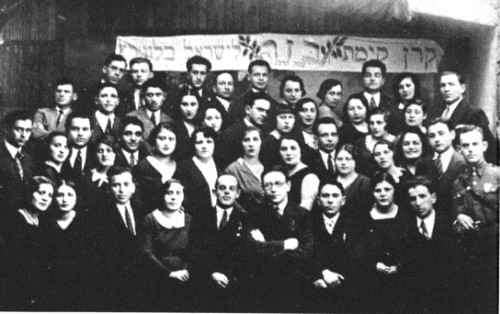
| Conference of Jewish National Fund (Keren Kayemet LeYisrael) activists from the Polesia district held in Luninyets in 1930 with the participation of the emissary from Eretz Yisrael, Mr. Z. Bonfeld. Present are representatives of the towns: Dombrovitsa, Vysotsk, Stolin, David-Horodok, Lakhva, Kozhan-Horodok, Mikashevichy, Lenin, and Hantsavichy. |
With the outbreak of the First World War in 1914, public life in Russia was destroyed, and activities for the Jewish National Fund were also halted.
Only in 1917, when the great revolution broke out in Russia, did the Zionist movement revive. Throughout the country, the movement expanded, and also in our town. Luninyets was then a large center of the Russian army. In the ranks of the army were many Jews, who had received a Zionist education, imbued with the spirit of Hebrew enlightenment, and they helped organize the activity in the town. At the head of the activity stood the Jewish National Fund, which was then the only fund in Zionism and captured many hearts. Many meetings and lectures were dedicated to the idea of redeeming the land. Film-days (“flower-days”) were organized, balls and parties were held whose incomes were consecrated to the JNF. Especially successful in their financial income were the performances of Chovevei HaBimah [Lovers of the Stage]. The best lecturers and speakers visited our town. Organizational connections were then with Kiev and Homel. The blue and white box could be found in almost every home, and every fundraising collection on behalf of the center was crowned with success.
With the establishment of Polish rule in the town, a tremendous momentum came to the Zionist movement, and again the Jewish National Fund was at the forefront. From now on, new areas were encompassed. Planting trees in the Herzl Forest on days of joyous occasions, certificates of inscription in the Golden Book. During the days of the Sukkot holiday and Simchat Torah, the incomes from the Zionist minyan were dedicated to the Jewish National Fund, and from 1933, income from the “Bazaar” on Purim was dedicated to the Jewish National Fund (Keren Kayemet LeYisrael).
The Zionist organization and the youth organizations such as “HeHalutz”, “HaShomer HaTzair”, “HaNoar HaTzioni”, “Freiheit”, and the Women's Organization, all participated in committees for the JNF. Emissaries from Eretz Yisrael visited Luninyets: David Cohen, Meir HaEzrachi, Yehoshua Menuach, Dr. Uris, Devorah Lachover, and more.
In the year 1930, a district conference of Jewish National Fund activists convened in Luninyets with the participation of Zvi Bonfeld from Eretz Yisrael. All the towns and settlements in the vicinity of Luninyets sent their delegates to the conference
[Page 27]
which left a great impression. The authorized representatives of the Jewish National Fund from 1925 were Moshe Schneiderman, Godel Zoliar, Ze'ev Zuckerman, and the writer of these lines.
All the activists, participants, and authorized representatives who worked for the Jewish National Fund did their devoted work out of dedication and not for the sake of receiving a reward.
In 1921, activity for the “Redemption Fund” (Keren HaGeulah) began in Luninyets. The first drive started with the collection of jewelry and gold for Eretz Yisrael. With the founding of Keren Hayesod, an appeal was conducted every year, and revenues rose from time to time. In recent years, revenues for Keren Hayesod reached thousands of dollars. In the town, there were over two hundred regular donors. In the first fundraising drives, the teacher Chaim Ben-Ma'amin (Gloversohn), Betzalel Stachowski, Baruch Garzolin, Avraham Yitzchak Schneiderman and his son Moshe, Zalman Lufta, Shmuel Gruber, and others worked and helped ensure the success of the enterprise. All were murdered by Hitler's killers, yemach shemom [may their names be erased forever]. To announce the fundraising appeals in Luninyets, leaders of the Zionists in Poland and emissaries from Eretz Yisrael would visit. The final fundraising appeal in Luninyets was announced by the famous activist and scholar Dr. Yitzchak Schipper. The chairmen and directors of the appeal were: from 1921 to 1924 – Chaim Ben-Ma'amin; from 1924 to 1930 – Noach Eisenberg; and from 1930 until the outbreak of the Second World War – the writer of these lines.
We must also remember the fine activity on behalf of “Keren HaAvodah” (The Labor Fund), which was announced in 1922 in Poland. In Luninyets, this activity was carried out with great success by members of the Ze'irei Zion (Z.S.) party in Luninyets. Many crates full of work tools and various equipment were collected and sent to Eretz Yisrael for road construction and various labor projects.
|
|
|
|
JewishGen, Inc. makes no representations regarding the accuracy of
the translation. The reader may wish to refer to the original material
for verification.
JewishGen is not responsible for inaccuracies or omissions in the original work and cannot rewrite or edit the text to correct inaccuracies and/or omissions.
Our mission is to produce a translation of the original work and we cannot verify the accuracy of statements or alter facts cited.
 Luninyets, Belarus
 Yizkor Book Project
 JewishGen Home Page
Copyright © 1999-2026 by JewishGen, Inc.
Updated 17 Sep 2026 by JH