[Page 66]
The Destruction of Luninyets
The Annihilation of Its Jewish Population
Translated by Fanny Pere
Only a few people of the shtetl somehow were able to escape the fate of the
others. They wound up in Russia because of the retreat of the Red Army in
Luniniets. They bear witness to relate how they lived through and saw with
their own eyes the sorrow of the catastrophe as it really took place.
When war broke out in 1939, the Red Army took over the town and there was an
immediate decline in the lives of the jews, who were hearing dire rumors which
became reality. Depression and fear of death took over. The Soviets had
immediately imposed edicts banning all political parties and organizations in
the town. Of course, support for Israel was stopped. This moderate control
lasted to June 22, 1941, when Hitler launched the attack on Russia.
That same day, the radio announced that the whole country was in a state of
war, and German planes appeared in the skies of Luniniets. The alarm and
confusion among the Jews is indescribable.
Most Jews of the town decided not to move. The thought of a general
annihilation never even entered their minds. Yet a considerable number of young
Jews – about 1,000 – tried to get to the Russian border to escape. There they
were caught by the Red Army and returned. Only a few were successful in
roundabout ways (through forests and swamps) in crossing the borderline of
Russia, and were saved.
Thus it was decreed that the entire shtetl would remain in the hands of the
murderers. In the beginning of July 1941, the Germans captured the town. On
August 18th, they enlisted all males from age 12 to forced labor beyond their strength and
the next day all were killed. On the 18th of August, only a few shoemakers and
tailors remained from the first annihilation. In a sandy area of the town, all
the women and children were gathered in a barb-wired fenced area under the
strict watchful eyes of the Germans and were shot. According to one woman who
was successful in remaining alive from her wounds in the pit, we know the
details of the suffering of these women and children in the ghetto during a
whole year, August 1941 – September 1942. Hunger, epidemics, brutality of young
children under the eyes of their mother was a daily occurrence. On the day of
Elul (holiday), total murder was put into effect – the remnants of the mothers,
sons and daughters, and dear grandparents. They were transported to a huge
death pit that was dug next to the town near the eyes of all the Christian
inhabitants, who used to live with the Jews in peace and quiet for so many
years.
Many of the Christians were ashamed of the Jewish plunder that took place – the
destruction, the desecration. For another three years the town was in the hands
of Hitler. After that, it was taken over by the Red Army. Remnants of the Jews
that remained alive in Russian – about 25 people returning – still saw for
themselves the shtetl of death, and found the large pit where their loved ones
had been thrown into. They decided to fence in the holy gravesite. They worked
together for six weeks in this sacred task, in memory of their lost relatives
and friends, until they completed the fence. Thus they separated from the
defiled earth – our blood was a testament to what took place.
Revulsion and defilement that our eyes had seen were with us as our eyes
carried us to our land of Israel.
The rest are names from the shtetl – outstanding people who were victims.
[Page 67]
What My Eyes Have Seen…
A survivor's account as told by Rivka Yosilevsky-Brevde
Translated by Fanny Pere and M. David Isaak
|
|
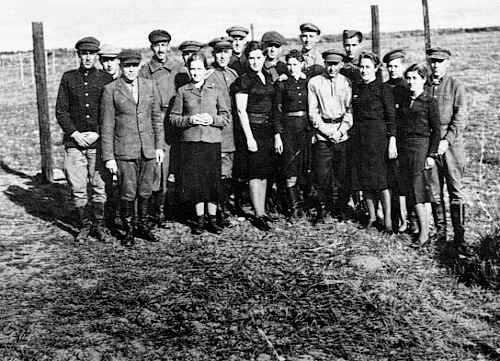
At the mass grave in Luninyets (1945)
Standing, Right to Left: Motl Gottlieb, Sarah Treybuch, Katz the teacher,
Reizel Treybuch, Zelig Pinchosovitz, Risha Pinchosovitz-Golman, Chanan Lutzki,
Rivka Yosilevsky-Brevde, Lutzki (Wolke 2), a Jew from Brisk, Motl Fein, Holman
from Lunin, Chadian Holman from Lunin, Avrohom Yosilevsky, Asher Chertok, and a
youth from Lachva.
|
The Jewish population of the shtetl Luninyets awaited the Nazis with broken
hearts and mournful depression. The news by radio that Hitler attacked Russia
without a declaration of war terrified all the residents of the town,
especially the Jews, who already knew what to expect of him. Anguish and dread
seized the population.
The loud hammering and thunderous crashing from corner to corner caused bitter
lamentation and questioning from person to person as what should be done. What
to do? A portion of the young population courageously decided to escape –
some by wagon and some by foot – in the direction of Micashevichi, Russia.
The escape was not easy. The first ones in line to try were the government
employees and their families because they were able to use wagons, but only
some, not only the young, were successful in getting space on a wagon. Yet a
number of them were lucky enough to reach the old Russian-Polish border, where
there occurred an event painful beyond belief to describe. The border was
closed by order of the Russian army. There was no other choice as to what to
do, they were forced to return to Luninyets or Kazanhorodok. A few escaped and
broke through somehow.
Many of the discouraged young people remained together with their parents and
were killed with them eventually. There was no escape, no refuge, and the
dispirited Jews awaited their fate. Then came rumors from captured Poland that
the situation was not yet hopeless, that not all Jews were being targeted to be
killed. They were prepared for a catastrophe, a pogrom perhaps, but surely not
for complete annihilation. With the entrance of Germany and its assault on the
city it was clearly otherwise. Their hatred of the Jews was rearing its head,
though the fear of mass killings and plunder was unthought of. Then came the
first command of the conqueror. Every Jew must attach a patch
[Page 68]
with a yellow circle of seven centimeters and a Star of David [Magen David] on
the front and back shoulder of his coat, and is forbidden to be seen walking on
the sidewalks. The Jews gave up walking on the streets altogether, as some of
them had been shot without any reason. Three days later more commands were
ordered by the Judenrat, who were in the hands of the controllers, and were
being played with as if in a ballgame. Decrees were given by the command, such
as making Jews clean the streets. Other actions followed: gathering of Jews'
money, gold, warm clothes and any other items the invaders could use.
On the first day of their invasion they grabbed and gathered the men in the
yard of the folk school, opposite Greenstein's house and forced them to perform
various tasks: Cleaning horses, polishing vessels and boots and many other
humiliating tasks. If the finished task did not satisfy the German, if a Jew
didn't thank him properly, or the clean ups weren't perfect, the Jews, with
great cruelty, were beaten with leather whips. No food was given. A German who
entered the home of a Jew took whatever he liked. The Jew was grateful that he
and his family were not murdered. Synagogues were ransacked and turned into
horse stables and warehouses. The Jews managed to rescue only one or two Torahs
from the Synagogues.
Out of fear, all normal work activities ceased. But when a gentile citizen
needed the services of a Jewish tailor, shoemaker etc. and received permission
from the German administration, the Jew, accompanied by the gentile set out to
fulfill the requested task. As a “reward” he was given food. What was
the quality of the food? At the war's outbreak the Jews started to store food
– flour, potatoes, groats etc. that they bought at full price or bartered
with a precious possession; they then hid the food in various hiding places. As
far as the gentile population was concerned, the alienation of the Jews, as
well as their friends, was complete. Many of them coveted the Jews' properties
– they suggested that Jews give them the valuables and they would hide
them, for in any case, the Germans would take them, and why not let
“friends” and neighbors have them instead.
As a result, six weeks after the invasion, on one of the Shabbats, they did not
believe the few peasants who came and told that they had heard that Jews were
being murdered, and that tomorrow, on Sunday, the 17th of Av, two battalions
would arrive: one would exterminate all men; the other would simply kill
randomly, without any particular purpose. The gentiles advised the Jews to
leave their homes and hide in the woods or the fields, but the Jews suspected
the peasants' intent was to rob and plunder their possessions and properties.
Their suspicions were not inappropriate. Out of fear and desperation some
desecrated the Shabbat, baked breads and hid them. They did not undress before
going to bed, and spent the night without even closing their eyes. To our great
misfortune and disaster, what the peasants had heard was true.
On Sunday, August 10,1941 [17th of Av, 5701], at 8 in the morning, a stream of
armed soldiers on horses, steel helmets on their heads arrived, after them came
soldiers in wagons; they went from house to house and pulled all males 14 years
and older into the street. They did not carefully search the houses. From the
street they gathered and assembled them in various places in the city and then
commanded them to walk. They were forbidden to take anything with them –
no bread or clothes. They did not allow the women or children to accompany
them. Most of the men were taken and led away, some on foot and some on trains,
to be slaughtered.
At the request of the gentile residents, worried they would be left without
tailors or shoemakers, a few tailors and shoemakers were pulled from the line
headed to be slaughtered. On that day, whoever was caught was killed, and on
the same day whoever was left behind, lived. On that day, killed were all the
Jews of Hancewicze, Malaszewicze, Lohiszyn, Telekhany, and the men of
Luninyets, Ditalovitz, Pohost and the villages. After a few days, when none of
the men returned to their homes, the Jews started to leave their homes and hid
in the forests, the gardens and the fields, fearful that
[Page 69]
they would come to take the women and children and whoever was left. The
gentile neighbors and “friends” started to rob and empty the houses
of the Jews.
In the months of Tevet and Sh'vat, 5702 (1942) the Germans collected the male
survivors and sent them to hard labor in Hancewicze. After a short time they
took the women as well. In winter, a decree was announced that every Jew hd to
bring furs, warm clothes and mittens. Until the establishment of the ghetto, a
Jew disguised and dressed as gentile, would then enter his own home, take an
object from the house and bring it to a farmer. In exchange he would get a few
potatoes to still his hunger. A few days before Purim, 1942, Ghetto boundaries
were demarcated. Starting at the big Synagogue (Die Zamedishe Shul), the
borders were in the shape of a triangle. From the house of Yehoshua Kashtan
(later Shapira) a straight line to the house of Moshe Brodnitzky (later Yosef
Kapliansky), and from there returned to Avrohom Hagunter's house and then to
Zerach the Rags [shmattes] Seller and almost to the edge of the Sokolovski
station.
Within the next 4 hours, all Jews had to enter and concentrate in the Ghetto.
They were allowed to take with them only what they could carry by hand, without
the use of carts. There were some instances when the guards were bribed to
allow greater than the allowed items to be brought in. The ghetto was fenced
with wire, and even the gentiles near the ghetto were commanded to leave their
homes. The gentiles were forbidden to approach the ghetto's borders. The
crowding was terrible, a few families had to dwell in a single room. The
Germans shaved the children's hair and ordered cleanliness in the ghetto; they
would frequently come to inspect to ensure their orders were upheld.
From the men of the ghetto an individual was chosen whom the entire ghetto had
to obey. The guards were watchful that no outside foods would be brought into
the ghetto. Those few who had permission to work outside the borders were
strictly inspected upon their return. They searched their belongings for any
food, a slice of bread. If any was found, that man was severely beaten. One
time, I witnessed a woman returning from her job outside as a seamstress in a
gentile's house who had taken a piece of sugar with her for her baby, and had
hidden it in her shoe. By the time she reached the Ghetto's gate the sugar was
crushed in her shoe and was hurting her. The policeman took off her shoe and
found the small piece of sugar. He took her shoe and then beat her mercilessly
with his whip. Once a woman hid a piece of bread in her hair, covered over with
a turban. Her “reward”? Many blows to her head.
It should be noted that the ghetto residents shared whatever meager food they
had among themselves, piece by piece. The hunger grew – children were
given grass to eat, their bodies swelled from hunger. All who died were buried
in the ghetto, those alive were jealous of the dead.
The person relating all the above (Rivka Yosilevsky-Brevde) was in the ghetto
for 10 weeks. As hunger grew, at night residents would cut the wire fence and
go to gentiles' houses and try to obtain a slice of bread. In Pohost a rumor
spread that the Luninyets Ghetto was going to be eliminated. Rivka's parents
sent a gentile to Luninyets who got her out of the Luninyets Ghetto and brought
her to Pohost.
As told to and written by Yosef Ze'evi
Rivka Yosilevsky-Brevde – bride of Leibel Brevde – who was brought to
Pohost, had been lying in the pit, wounded and immobile, amongst the murdered
corpses. At night, with her remaining strength, she escaped to the forest and
joined the partisans. After Hitler's fall, she made aliyah to Israel and
settled in Ramat-Gan.
[Page 70]
In the Old Days…
(Some of my experiences, 1939-1948)
by Chaim Rubinraut
Translated by M. David Isaak
Dedicated to my sister Rachel-Leah who,
in the prime of her life, died in Siberia.
Joy That Did Not Last Long
With great joy, the Jews of the town welcomed the Red Army instead of Hitler's
troops whose entry they had expected and feared at the start of the war. But
when the Soviet authorities began to eliminate not only the Zionist parties but
also public and cultural institutions such as the “TAZ” company, the
private banking cooperatives (Private and Merchants'), as well as the Hebrew
“Tarbut” school, the “Tel-Chai” library and the like, the
mood changed completely, and instead of joy, sadness surfaced. In particular,
the depression increased after the imprisonments, the emissaries' probings and
the night-time interrogations by the secret police (NKVD – The People's
Commissariat for Internal Affairs) no one knew who had been interrogated the
night before because they were forced to swear not to speak about it – and
who was in the queue to be next the following night.
Of the first who had been imprisoned by the Bolsheviks were Dr. Axelrod, his
wife Lisa Hofshtein and their son, Shlomo Kaplanski and his family; they were
sent to Eastern Kazakhstan. After that, imprisoned were: Dovid Litman and
Boruch Gratzolin, Velvel Maron, Feivel Dichter, Yaakov Musikant and Yaakov
Bauman. And they didn't skip me. Many times I was “invited” to a
night-time interrogation by the NKVD where they demanded I inform them of my
activities, especially about my Zionist activities. They showed me many photos
of the party's activities. They revealed a great interest in my visits to
Eretz-Yisrael (Palestine) and accused me of aiding immigrations to Palestine,
thereby proving my attitude towards English imperialism, because the new
immigrants, they stated, justified the British mandate in Palestine.
Furthermore, they claimed, the youth organizations and the Hebrew Zionists and
the “Hechalutz” movements serve orddinary Poles who are interested in
expanding the Zionist movement and its culture, helping prevent these circles
from joining the Communist movement.
“But for the important economic role you fill'” – they told me
(I conducted my activities at the time in the Luninyets forests and the
surrounds), – “We would by now have “fixed” you, but the
road to repentance is open to you, and if you prove yourself in the political
arena as well as you do in the economic area – then things will go well
for you.” And they continued, “You know, of course, what we
mean…” and, because I didn't respond to their advice – they
freed me, but not for long!
In Prison
My heart predicted and knew what was to come. Two days before Hitler invaded
Russia, on the 20th of June, 1941, the KGB appeared – “The People's
Commissariat for State Security,” announcing that I am under arrest. My
mother, brother and sister were to be sent to “who knows where.” The
time to settle affairs was very short. In the meantime they started to search
the house, looking for arms. After their search we were pushed onto a truck and
brought to a train on which, under police guard, were all those who were to be
sent away. I was led further, under heavy guard, to the building of the NKVD
secret police on Sodowa Street, opposite the Pravoslavi Cemetery.
[Page 71]
After carefully searching me they took my wristwatch, a fountain pen and many
simple personal items. The prison in the basement, a room of 3 x 3 meters, held
12 people. Among the prisoners was Nechemia Hofshtein. Those to be sent away,
in addition to my family, were the Hofshtein, Gratzolin and Eisenberg families,
Yaakov Gloiberman and Meyer-Leib Zmudiak. In the prison, Nehemiah Hofshtein was
the most frightened by the threat of imprisonment: purely out of fear he had
had no food for two days.
When new prisoners arrived they brought us, the “veterans,” news of
the war between Hitler and Russia. To the Poles who were imprisoned with us,
this was happy news, but to us, the Jews, this shocking news aroused grave
concerns and fears for the fate of our people in Hitler's occupied territory.
On the evening of the second day, they called me to the interrogation room to
inform me that because of my counter-revolutionary Zionist activities I was
accused of violating Section 58 of the Soviet Penal Code and was to remain in
prison until a Court date. I signed the document and was returned to the cell.
On the fourth day, the 25th of June, towards morning, we were taken out of the
basement and transferred via a truck to a train. As I passed Sodowah Street I
saw Gedalyahu Tzipkin standing by his house, and Golda Slutsky, who was
sweeping the street. Those were my last impressions of Luninyets.
At the train station we were transferred to two sealed freight cars and
attached to a train of 30 carriages in which were about 1300 prisoners from the
Pinsk prison.
On the way we passed trains laden with soldiers, woundeds and refugees. In the
last group were hundreds of Luninyets Jews who had fled to avoid Hitler's
troops who were chasing the retreating Soviet army. Near the former Soviet
border, near Mikashevitchy and Lenin, the border guards returned the Luninyets
refugees – except for the few who'd managed to cross the border and were
saved. Most returned to Luninyets but later perished at the hands of the
Germans. In contrast, those who successfully crossed the former Soviet border
wound up being sent to remote areas in Russia that were far from the front.
After two days of travel, we reached Yeletz in the Orlov region. There we were
separated into cells. Among the prisoners, I encountered acquaintances from
Luninyets, Lenin, Pinsk and Dovydhorodok. Two of them were Yaakov Boiman and
Asher Golub from Lenin. The latter gave me a shirt, handkerchief, soap and a
bread bag. From Yaakov Neuman, I got a few pieces of sugar…
“Normal” prison life began. Before we entered our cells we washed in
a bathroom, and were given various injections. They rolled in the notorious
“Container” (a large barrel for certain biological needs). For food,
we got 400 grams of bread each day, warm water serving as tea, thin, watery
soup and occasionally millet porridge. For “airing” we were taken
outside once a day for 10 minutes in the yard, under heavy guard. There were 3
Jews in the cell: Me, Nechemia Hofshtein and Yisroel Buch, a Jew from Warsaw.
We “sat” for five weeks in Yeletz and then our upheavals started
again. The rapid advances of Hitler's armies forced the authorities to move us
further and further away, into the depths of Russia. This journey took 15 days
in sealed cargo cars, under heavy guard, in terrible conditions. Because of
their panic due to the war they often forgot to give us food, sometimes for
days on end. There were 45 or 50 people in our car; but only two Jews, me and
Nechemia Hofshtein. Our food this time was salted herring and water –
[Page 72]
water from the barrel of salted herring that was in our cargo car. It was no
surprise that some died during the journey…
I remember that one of those who died in the other train car was Bronchik, the
teacher at the “Tarbut” school in Dovidhorodk. In our car, two Polish
gentiles died, and a pair of new boots, a large fur coat of theirs had caused
the prisoners to argue violently over them, and they came to blows. The fight
was settled by the Soviet authorities that accompanied us.
We arrived in the city of Kirov accompanied by hundreds of NKVD agents. They
immediately led about 2,000 prisoners from the cars and led them about 6
kilometers from the train station to the big prison in Kirov, which housed
about 15 thousand permanent prisoners. This prison also had a well-known
reputation: In the days of the Czars it was the central gathering place for
those to be sent to Siberia; from there the revolutionaries and freedom
fighters were brought to distant places near the Siberian borders. After the
revolution, this prison remained, still serving the same function of this
“holy” mission…
The Kirov population, apparently accustomed to these sights, watched the parade
of tired, broken and ragged “criminals” and how the trucks would
gather those who stumbled and fell behind. In spite of the strict prohibition
to communicate with us, they handed us bread, water and milk. This was a tiny
flash of light in the darkness of our days. Further encouragement reaching us
was the news of the contract signed between General Sikorsky and the Soviet
authorities about the freeing, with amnesty, of Polish citizens from camps and
prisons. While awaiting the anticipated freedom, I met, on the way to the
prison, Dr. Nachum Gitler and Pessach Pakatz from Pinsk.
In the meantime, we were organized in large cells that held 160 people. There
were 11 Jews: 7 Pinskers, 1 Warsawian, Nechemia and me, and 1 Soviet Jew. We
Jews were together in one group.
The composition of the prisoners was very diverse; simple thieves, mostly
young, Soviet bureaucrats, among them an engineer who spoke several languages
who, with Soviet connections worked in various other countries (this was his
fourth time of imprisonment, a veteran of 15 years total in prison…),
there was also a group of evangelist farmers who appropriated for themselves a
special corner in the cell where they prayed and sang, in deafening volume,
their religious songs.
Trade between the prisoners was very lively. The bread, the soup, or the
porridge we were given served as currency to make trades. I received a pair of
galoshes for 2 portions of bread and 2 soups. Nechemia got, by giving up his
food, a beautiful cotton suit, a pair of shoes, underwear, socks, soap and
other things, and left the prison “wealthy.”
I'm Free!
After two months I was freed, and with me, a Jew from Pinsk, Isaac Goldman and
a farmer from Rokitno, a town close to Luninyets. We were of the first in our
cell that were freed due to the contract mentioned above between General
Sikorsky and the Soviet authorities. We left the prison on an autumn day in the
evening, without a coin in our pockets, disconnected from home and family,
strangers in the city – I was brooding over my mother, brother and sister
[Page 73]
where are they? My friends were immersed in similar thoughts. We then finished
a task of chopping wood for a bakery that would surely provide us with some
bread to satisfy us.
Like butterflies drawn to light, our feet led us to a light-filled restaurant
in which high level military men were dining. Our appearance in worn-out
clothes, grown beards and pale faces attracted much attention. To their
questions “Who are you?” We answered “We were released!” A
Jewish army physician invited us to eat at his expense, others said come to the
back and had a smoke with us, they also wanted to give us money. Of course, we
refused. After wandering about looking for a place to stay on our first night
of freedom, I stumbled onto the railway terminal station in Kirov. Sleep
awaited me desperately, even though my “find” was a damp, cold floor,
and my sleep-mates? Thousands of soldiers and refugees.
The six rubles I got for the galoshes were enough for a photo of me with my
beard, a shave and a haircut, a telegram to Lizah Hofshtein in which I asked
about my family's fate and a loaf of bread. The first five rubles I earned by
loading cartons of matches. After that, we worked, a group of three releasees
(Me, Dovid Bronner and Moshe from Pinsk), removing wood beams from the river.
Kirov's train station was a transfer point for thousands of releasees from the
prisons and the camps. From there, most streamed to Central Asia. It was there
I met Yaakov Bauman, despondent and talking as if losing his mind (but
meanwhile, appreciative of finding shelter in Kirov's Main Post Office), also,
I met Hershel Himmelfarb, the noted Bundist, torn and worn out. From fellow
workers I learned that Yaakov Muzikant was freed and is in Syktyvkar (Capital
of the Komi Autonomous Soviet Socialist Republic in northern Russia), and that
Nechemia Hofshtein was working as the manager of a pharmacy in Omutninsk, near
Kirov. I got a position managing forest workers in the village of Bovinah, 6
kilometers from Kirov. I joined together with Dovid Bronner and Yaakov Bauman.
Finally, I found out that my family was in the Altai region in Southern
Siberia. I quit my job in Kirov and set out to find them.
In Siberia
At the time when the main stream of people was leaving the cold countries for
the warm middle east, I went in the opposite direction. My driving desire was
to meet with my family. On my way, in Molotov, I met the butcher Beryl Kodman.
And finally, here in the village Zagaynovo, 20 kilometers from the train
station in Altai, I finally met my mother, sister and brother – after
rolling around in the train for three weeks. The joy of this reunion is
impossible to put in words. They told me that before the pardon (amnesty) they
lived in shacks and worked in the forests (my brother and sister gathered
firewood), and that after the amnesty they settled in the village, rented a
room from a farmer and were living together.
In Siberia, I met Yaakov Glauberman, Meyer-Lev Zmudiak and their families. I
learned that the Gartzulin and Eisenberg families were in the Middle East, and
Shlomo and Winosik Hofshtein went to live with Liza Hofshtein in Eastern
Kazakhstan.
I correspond and receive letters from Pessach Pakatz, Ziskind Minkovsky,
Nechemiah Hofshtein, Yaakov Muzikant, Yaakov Bauman, Feivel Dichter, Kasia
Levin and others. My sister
[Page 74]
receives letters from Basya Lutzki (Daughter of R' Moshe-Yitzchak) working at
the front as a nurse.
I work in a forest, about 75 kilometers from the train station. The
availability of nutritional food is very bad. The best we can do for food is to
exchange our work for a pail of potatoes. In the Soviet newspapers, the first
notices of the killings and exterminations of Jews in the Nazi-invaded
countries begin to appear. This causes us deep depression. To
“safely” stay here in this dark forest, uprooted from home, the
movements and Palestine, and from all those I was connected to in my youth?
– Disturbing thoughts, both during work and afterwards.
But here comes a beam of light from the East: A telegram is received in the
forest from Meilech Neustadt, from Allenby Street #115, Tel-Aviv, exactly while
I was having supper with the workers. It's hard to describe the emotions that
engulfed me. At first I was petrified. I could not believe my eyes. But shortly
after, my eyes started tearing, incessantly. These were tears of joy and
happiness. Indeed, we are not alone in our place! A friend's hand from the
movement has been extended from Ha' Aretz [Palestine], the place for which we
long and yearn. And perhaps – a fleeting thought – we may still
succeed to make aliyah to Eretz-Yisrael?!
To this day I don't know how my friends in Eretz got my address. But with the
renewal of this connection the bond increased with each communication. The
parcels we received through the efforts of Shlomoh Wallner and the Organization
of Luninyets Survivors in Palestine [today, Israel], had great material value,
because we hungered for simple basic food, but their spiritual value was like a
stimulant drug, strengthening our hope in the future – of far greater
value than the material value of the packages.
The communications with friends in Russia and other countries grew by the day.
Herzl Motznik and Aryeh Golub from Tel-Aviv keep advising me to travel from
frozen Siberia to the warmth of Asia. From America, Saul Leon Hofshtein asks
about his family in Luninyets. From Canada, Mary Frumkin asks about her family.
Tannenbaum, a Stolin chasid now in New York, who came from Kovrin, asks about
the fate of the Rabbis of Stolin and Karlin.
Our economic situation is improving. On one hand are the packages, and on the
other hand we received over 1,000 kilograms of potatoes, tomatoes, cucumbers,
and melons, etc. from the vegetable gardens which my sister worked at so
successfully (she'd never worked in agriculture before).
At the same time the Polish army under General Andres is leaving Russia. On the
way to Iran many are the Jews who want to join him, but the General, renowned
for antisemitism, is not enthusiastic about having many Jews join him. We know
of only family from our town that connected with him: Alizah
Ozochovsky-Glauberman and her husband.
We move from the village to the district town of Troitsk. I transfer my friends
from prison here: Yaakov Bauman and Dovid Bronner. My brother has been
conscripted into the Army. Meanwhile, they are imprisoning people again. This
time it is in connection with the former Poles not accepting Soviet
citizenship. They were ordered to get Soviet passports, and when they didn't
comply, they were imprisoned. We were informed of the detention, for reasons
unknown, of Beilah Gratzolin and her sister, of Ziskind, Minkovsky, Shalom
Schwartz, Globinsky from Brisk and others. Parcels from Iran are received
regularly from the Sochnut, as well as greetings from Shaul Myerov from the
“uncles” Reiss and Neustadt, but in addition he sent us worrying news
from Warsaw about what Frumkah and Tzviyah occasionally write to him…
[Page 75]
Meetings
The meetings came about unintentionally. The Jews of Russia, disconnected from
World Jewry for 25 years and more, thirsted for meetings with Polish Jews.
Until the break-out of WWII their lives had been tossed about to the breaking
point, and they never tired of listening to our stories, hearing about our
hopes, our struggles and wars, and our accomplishments in Eretz Yisrael.
Due to my work, I am being transferred with my family to Barnaul, the capital
of Altai [Southern Siberia]. There, I met with a lecturer in the Soviet
High-School who was once a member of the central committee of the Russian
Zionist Youth, and he listened with tears in his eyes as I told him about our
organization in Poland until 1939, about the “Pioneers”, the
Kibbutzim, the Histadrut now in Palestine, and on and on.
In Novosibirsk I met the son of a Jewish family from Leningrad, a medical
student, fluent in many languages, who knew nothing about Judaism. On vacation
in a Siberian city, he got to know a Jewish girl from Lithuania who'd been sent
there as a Shaliach [messenger], and she taught him a little about Jewish
history and Zionism, Dr. Herzl, Dr. Weitzman, and Eretz Yisrael that was being
built… The youth returned home and railed against his mother for raising
him without the values he just heard about. When he learned I had been in
Eretz Yisrael, he wouldn't let go of me and asked me over and over again to
tell him about it. I had a sense that this youth, child of the Soviet
administration and it's education system, had been born anew, and turned, in
front of my eyes, into a faithful Jew devoted to his people. In the local
synagogues (as I discovered, at that time, synagogues were established only in
Novosibirsk and Tomask) on Shabbat, there were about 10 Minyans praying, among
them quite a few soldiers. There I met with the families of Noah Plaksman,
Mordechai-Yosef and Zina and with member Alter Levi from Lakhvah [Belarus].
And again an experience: On my travel to Omsk to meet with my brother I found
Kasia Levin and Yakov Musikant. In Omsk I also met a Jewish Soviet engineer, a
relative of [Chaim] Weitzman, despondent for being disconnected from all his
family in Palestine and from Judaism in general.
Bad News from Liberated Luninyets
In the summer of 1944, the Red Army liberates Luninyets from the hands of the
Nazis. Nechemia Hofstein who was visiting there writes he is broken and
destroyed by the sights and could not stay there. All our families were
destroyed, the town burned down, our properties robbed and in the hands of the
local hooligans. In their Soviet nickel beds were our pillows and blankets. Our
closets with the big mirrors full of the clothes of the dead, the buffets, the
tables, the chairs, sewing machines, the precious curtains – all of the
stolen items – decorating their homes.
And here in Barnaul arrives Hirsch Leib Zmodiak from Luninyets, a released
disabled soldier from the Polish army who also reports on what he saw in
Luninyets, and in his hands are photos of mass graves of our brothers and
sisters. Among everything else, he describes that during the siege of Berlin
Hershel Beilin was killed, and that he himself was crippled.
In addition, Feivel Dichter also writes what he saw with his own eyes: Two
enormous mass graves
[Page 76]
in which are buried all the town's Jews, and all their properties and
belongings are in the hands of the goyim [gentiles]. The joy of liberation from
the Nazis is quickly abated. What good is the liberation when the city is
completely devoid of Jews? Who is there for us? What is there for us?
Leaving the Soviet Union
With the total defeat of Hitler in May, 1945 and the end of the war, hope of
leaving Siberia grew rapidly. Rumors were flying: Here was an announcement in
the Soviet newspapers about Truman's plan to enable 100 thousand Jews to
emigrate to Eretz Yisrael, and it was understood by the Jews that the intent
was directed at us, the Polish Jews. But then Soviet radio announced, in July,
1945, that a contract between the Polish and Soviet governments related to the
return of former Polish citizens to their homes in Poland was formulated, and
the joy quickly sank.
Registration of returnees to Poland was handled by the Union of Polish
Patriots. The Barnaul branch of the Union counted about 1050 Jews among 1200
Polish citizens, and I was put in charge of this local chapter. My mission was
quite delicate… Propaganda about leaving Soviet citizenship was forbidden,
and at the same time, bitter tidings reached us about the burning of the
Synagogue in Karkov, pogroms against Jews in Poland, throwing Jews out of
trains and so on. What's to be done? Return to Hell? Every Jew had to make his
own decision, yet in spite of all this they all registered to return to Poland.
The Death of my Sister Rachel Leah, z”l [May her memory be a blessing]
On the brink of liberation and returning home and reconnecting with the free
world, that in her soul she had so longed and yearned for, she was defeated by
the Typhus disease that lasted 4 weeks.
All our attempts and efforts to save her were to no avail; on August 2nd, 1945,
the 23rd of Menachem Av, 5705, she expired, in a foreign land… With this
our Mother lost her only precious, beloved daughter, and I the sister I had
devoted myself to most of my life. Cut off in her prime; there's no consolation
for us.
Our Return to Poland – A Stormy Reception
We left Siberia in May, 1946, in a special train. In our cabin were the
Zymodiak, Yakov Gloiberman, Yakov Boiman, David Bronner families, as well as
the Vinikov family from Baranavichy and a woman, Pintoswitz from Lithuania. The
trip took 4 weeks. In Petropavlvosk we met Shlomo Kaplanski and his family, in
Omsk – Yakov Musikant. All were returning to Poland. We are traveling by
way of Moskow and Minsk, we cross the former (till 1939) Soviet border. Here
are the cities: Stawiski, Baranavichy, Skawina, Brest (Brest-Litovsk). They
were all close to my heart when they were full of Jews, but now – they're
strange to me. The Goyim [gentiles] murdered and “inherited” their
belongings…
We enter the renewed Poland. The Poles look at us with daggers in their eyes,
their looks full of hatred and murder. They ask “How were so many Jews
left over?” Here we were sure Hitler murdered them all, to the last one,
and here a shit-stream of them is covering Poland all over!
[Page 77]
This “welcome” was not what we expected when during the long dark
Siberian nights we longed for the peace and consolation that would come when we
were “home” again. Increasing thoughts entered my mind: What power
protected me and those like me from being killed and decimated like all the
others? The answer: Zionism! Because of “it” I was arrested and sent
deep into Russia, and because of “it” I don't despair now, even in
the bitter circumstances we find ourselves. Our true home is no longer here,
but there, in Our Land. It was from there that we received the first joyful
news during the dark, Siberian nights; It is to there we must strive and
finally arrive.
I arrived in Łódź. I veered right away to the Central Committee of
Po'alei-Tzion, I meet with Stefan Greek and Shmuel Tzetzik, they fill me in on
all the activities going on in the Movement. And about the divisions within the
Map'ai Movement in the Land. This upset me very much. My only consolation was
that in Poland there were no such disagreements. Leading us further west, to
the areas freed from the Germans, to Lower Silesia. Our stop now is in Wroclaw
– formerly, Germany's Breslau.
I want to keep going further West, but the Central Committee of Po'alei-Tzion
explain the need to temporarily absorb the large stream of Polish Jews and
direct them forward on their way to Eretz Yisrael.
With all my heart and soul I dedicate myself to the Movement. Daily, the stream
of people grows and bursts through the borders, their destination: Palestine.
The number of Jews leaving Poland was particularly large after the Kielce
Pogroms [July 4, 1946]. The mass migration out of Poland was at its highest; it
was our Movement that led the way.
Among these Jews were also folks from Luninyets: The Kasiah Levin family,
Meyer-Leib Zmodiak, Yitzchak Kuznitz, the Isar brothers,(By the way, Isar, who
was in Auschwitz met with his brother in Germany – he did not know that he
had survived). Tuviah and Hershel Boswitz. Slowly but surely the survivors from
Luninyets gathered together; about 30 families arrived. We are in communication
with our people in America and Eretz Yisrael. From the Luninyets
“Relief” groups in New York we receive $300 and divide it between the
survivors. This is all due to the efforts of member Michael Lutzki. From the
Survivors-of-Luninyets-Organization in Palestine we get letters, bulletins,
advice and answers to our questions.
On the 5th of Elul, 5707 [August 8,1947] all the survivors of Luninyets
gathered in the Synagogue in Breslau to arrange a memorial service for the
deceased in our town that were murdered in the Luninyets ghetto 5 years ago.
The elderly Noach Plaksman led the service – everyone's eyes streaming
tears as they looked around at who was left from a town that had once been full
off Jews. We are just shadows saved from the fire, on the other hand, excited
by the very fact of the meeting and getting together. Here I am, a visitor in
the former prison camp in Silesia. I stand among piles of articles, especially
the high pile of children's shoes, I come across books and newspapers in
Yiddish and Hebrew. They are now stamped with library stamps from Baltic
countries. I choose to remember the literature leaves of the past, and imagine
my astonishment when I saw in one of the journals a description of the Tel-Chai
Library in Luninyets. I had worked there in my cultural activities for many
years. There was an echo here of a distant sound that faded and
disappeared…
A Flame That Flared Up and then Died Down
The Jews of Poland, though much reduced in numbers, still had within them the
enthusiasm of the “old days.” We renewed the Zionistic work. Funds
were raised for the Keren-Hayesod and the Keren-Kayemet, and Hebrew schools
were opened.
[Page 78]
With the proclamation of the Jewish State, the vestige of the Jewish population
in Poland spontaneously demonstrated their joy and solidarity with their
brothers in Israel. In Wroclaw I appear at an assembly dedicated to the
establishment of the Jewish State. Thousands of Jews attended. I ended my
speech calling out and honoring the first President, Dr. Chaim Weitzman, and
the Prime Minister, our member, David Ben-Gurion. The thousands assembled there
cheered. Protests started to take place in the city, sweeping everything away,
including the communists…
The Arabs attacks in Israel provoked enlistments in Poland to the Haganah.
Hundreds of young men and women volunteered. They had to pass a military course
in a special Haganah camp in Bolkow (within 2 months, about 3,000 youths had
enlisted). A special endeavor was announced to raise monies for the Haganah,
and in a short time enormous sums were collected. I was in charge of
conscriptions in Lower Silesia.
In any case, none of these activities brought me closer to the illusion of
continued Zionist Movements and activities in Poland. I realized and knew:
Whatever Jewish life was like in Poland until 1939 will never be the same
again! This is no longer a place to hesitate or delay! In October, 1948, we
left Poland, my mother and I, and ascended [made aliyah] to the land of our
longing and aspirations, Israel.
Thoughts and Memories
by Ben-Zion Litzki
Translated by M. David Isaak
The heart yearns in memory of the missing. Were they truly here and are now no
more?…
From the dawn of my youth, the image of my birthplace, the town of Luninyets,
its streets, its alleys, and its winding paths, remains etched in my memory
– entirely bathed in sun and light. The wooden houses are covered in
shingles, and peering from their windows are the Cheder children of
hardworking, upright, and innocent families.
And now an image of my town arises before me, wrapped in the holiness of Shabbatot
(Sabbaths) and Yom Tovim (Holiday festivals). The cheerful faces of
the craftsmen, the shopkeepers, and the merchants of all kinds, as they gather
in the synagogues to pray with minyanim; their radiant appearance as they
welcome guests for Shabbat or a holiday. Homeowners dressed in festive clothes,
walking leisurely, returning home to recite the Kiddush over the cup of wine.
Shabbat afternoon: Crowds are strolling, some to visit family, acquaintances,
and friends, some to hear a Maggid Tov in the synagogue, and some for a stroll
in the public town garden. Also, the strollers are many on the bridge over the
train station, and groups gather and go for a walk outside the city behind the
iron bridge. Here and there, organized Zionist youth will gather for a meeting
or to hear a lecture from a member who happened to be visiting at the home of
one of the friends.
And back to the mundane: the hammers are banging in the workshops, people are
hurried, running, preoccupied, and busy with matters of livelihood. Even the
housewives are toiling, buying, and preparing what is necessary. Here your ear
will catch the “Oy” coming from the mouth of a poor wagon driver,
whose cart, laden with black coal, has sunk into the mud. His stubborn horse
stands in its refusal and does not budge from its place, until people gather
and with one shoulder, they perform the mitzvah of “helping a
neighbor” and pull the cart out of the mud. And across the sidewalk, your
eyes will see two noble women walking arm in arm – righteous women
concerned about obtaining help and support for a failing family or for the sick
and the poor. Where are these refined souls?!
[Page 79]
The days of Elul breathed a special life into our town. The “Days of
Awe” were knocking at the gate, and every Jew was anxious to take upon
himself the yoke of commandments and good deeds. Even before dawn, the sound of
the Shamash's hammer-tap at the doorways pierced the silence, calling to come
and daven (pray), for the saying of Selichot (prayers of forgiveness). The
people of our town are seen departing, Tallit and Tefillin tucked under their
arms, their hands holding a lantern by whose light they walk to the synagogue.
The days are days of heavy labor; the housewives are busy cleaning and
whitewashing the houses in preparation for the holiday. The hands of the
laborers knew no weariness. The shoemaker's mallet and the tailor's needle did
not cease their work until the late hours of the night. They were occupied with
sewing shoes and fine holiday clothes, which were the pride of the town's
children. Now they have gathered together in the synagogues, and out of envy
and competition, they steal a glance at each other.
And behold, the cackling of the Kapparot chickens is heard; women and children
hurry to the house of the town's shochet. The Day of Judgment cast its awe upon
everyone. Dressed in white Kittels the householders sat, and with them all the
members of the community, as they “afflicted their souls” with
fasting and prayer in the synagogues. And at nightfall, soon as Yom Kippur was
over, they drove the first stake for the Sukkah into the ground. Before Sukkot,
the children showed great activity: they competed with each other in decorating
the Sukkah, bringing the s'chach (leafy green branches for the roof), and
covering the top of the Sukkah. Slowly, the town seemed covered in green, and
by nightfall, white Sukkahs emerged in the courtyards, through which the light
of candles and lanterns flickered. Here and there, openings could be seen in
the Sukkah roofs; these were at the edges of the Sukkahs that were erected
between the houses; they served as targets for the shkotzim (troublemakers) who
threw stones into them.
Chanukah brings back good memories for the little ones in town: playing with
the dreidel, cards, eating fried latkes prepared by skilled and experienced
hands. And above all – the Chanukah gelt (coins) generously given by
father and mother, uncles, relatives, and other family members. The children
spent hours with great interest counting the coins until they had summed up
their worth. How many things could be bought for those pennies! Even a pair of
konkyes (ice skates) – to glide on the frozen ice of the Laguve lake and
the frost and snow-covered town streets.
And from Chanukah to Purim. The joy of the day filled all the townspeople, from
the young to the old. Various kinds Purim-Spiels (humorous plays) took place,
with Reb Shmuel at their head, with performances such as the Sale of Joseph,
the story of Queen Esther, King Achashverous and Haman, and so on. Trays
covered with white napkins are carried carefully by the townspeople from house
to house, mishloach manot (gifts of food) sent to one another. The town's
beggars go from door to door and benefit from the generosity of the celebrants
who invite them to dine with them at the family Purim feast.
The days of Passover approach and arrive, and again the hands are full of toil
and labor. Is it a simple matter to clear the chametz (leavened bread) from the
houses and courtyards? Work is plentiful in every house regarding koshering,
whitewashing, airing out books and clothes, etc. And finally, when everything
is ready for the holiday, comes the duty of Hag'alat Kelim (Koshering the
utensils for Passover). Shiny, scrubbed pots are strung on a long rope and
carried to the courtyard of the Great Synagogue, which is bustling with the
noise of newcomers. The poor Shamash (sexton), sweating, stands next to the
boiling cauldron, takes the utensils and dips them three times in the boiling
water.
At night the Passover Seder would arrive and imbue everyone with a festive
feeling, each person basking in the holiday atmosphere with his family. It was
a joyous experience.
[Page 80]
It was most important for the children to be together and with their families
(during the celebration of the Holiday). The children were busy from morning
until evening playing their nuts game. Most of these games took place in the
courtyard of Rabbi Moshe Wolf Dialabinski, O”H. During all of Pesach, the
children would walk around, their pockets swelled, filled with nuts, and at the
meeting place they would gather around a round area in which a depression was
created by digging it with their heels. This became the target receiving the
nuts tossed by the children. Those were special days, full of sunlight and a
childlike sense of freedom.
Periods of various changes passed over the Jewish settlement in Luninyets and
influenced economic and social life.
* * *
The war years, 1914-1917, caused a decline in the standard of living in the
city due to the lack of livelihood and work, and the absence of assistance from
various organizations that were mobilized for the army's needs. Indeed, sources
of livelihood were found for other families, which began producing various
products for the Russian army using small workshops, having received contracts
from the State. Unfortunately, as a result of the frequent fires and epidemics,
morale suffered greatly, as did their properties. Whoever had the means to flee
did so – toward the east, as far as possible. Was the town left empty? The
Russian army retreated, taking with it part of the population, and sought
refuge and shelter far from the battlefront. The German army's entry in 1917
did not significantly change the course of life. Gradually, the townspeople got
used to the new situation and began to interact with the occupiers, and thus
life slowly returned to its normal course.
I Shall Not Forget You, Luninyets
by Zahava Shochet
Translated by M. David Isaak
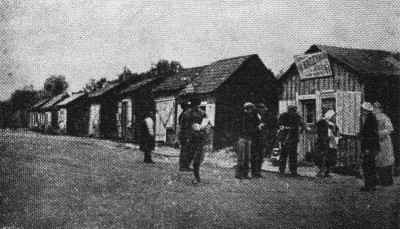
Many years have passed since my feet last trod on the soil of Luninyets. Before
my eyes there appear a circle of planted trees, long rows of stalls and sheds,
serving both for work and for selling food supplies and other goods –
shops of every kind. This was the commercial center. And beyond it –
streets stretched out, with their low houses, most of their roofs covered with
green, decaying moss. The windows had no shutters, and sand embankments stood
beside every house – barriers against the cold of winter… Almost
every house leaned to one side, due to poor construction and lack of a solid
foundation. Even the sturdy beautiful birch trees that grew in front of the
houses did not hide the poverty. Walking on the sidewalks of mainly rotten
wooden planks along the street was very difficult. As people came and went, not
infrequently, a foot would sink in, and only with great effort could it be
pulled out. The black, sticky mud – which even wagons could not always get
through – also left an ugly impression in the depths of one's heart. Only
in the summer did it dry up, turning the mud into dust that stung the eyes and
blurred the vision…
There was one corner in Luninyets that brought freshness and light into the
surrounding gloom – the forest. When you went out to breathe fresh air and
enjoy the warmth of the sun, the path toward the forest stretched through
golden sandy hills and green fields, with tall, aromatic pine trees –
revealing nature's beauty in the bosom of this little town.
Generally, the faces of the Jews of Luninyets were gloomy and sad, as their
livelihood depended on lively work and trade which had become scant.
[Page 81]
Small-scale commerce – this too had dwindled and decreased in recent years
due to hostile factors: the boycotts and the government taxes that sucked the
marrow from their bones. With what supreme heroism did the Jews of Luninyets
fight for their wretched existence! How many were the schemes they used in this
tragic struggle! And if one's hand faltered and it came down to just needing a
loaf of bread – compassionate Jewish women hastened to his aid, fighting
off the shame of hunger…
But in contrast to the material gloom, light and warmth radiated in the town in
the spiritual realm. Religious and traditional Jews found comforting and
spiritual satisfaction in the houses of study, in Mitzvah meals, in supporting
their Yeshiva, and so on. On Sabbaths and festivals, the gloom vanished from
all faces. Bright spots were the visits of the Chassidic Stolin Rebbes, who
breathed into their hearts a spirit of life, hope, and faith in good days to
come – for the future – the days of the Moshiach (Messiah).
The younger, rebellious, generation, however, could not reconcile itself with
the bleak reality; instead, they dreamed of a new life in the Land (of Israel).
Not only did they dream – they also planned to make aliyah (ascend) to the
Land and there fulfill their national and social aspirations. There they would
find fulfillment of their ideals and their strivings and aspirations – and
there they would tie their lives and futures.
The crowning achievement of the national youth activities was the Hebrew school
founded by the Tarbut society. This corner shed light on all its Jewish
residents and eased their sorrow. The students of the school, some of whom were
outstanding in their talents, spoke only Hebrew among themselves, and in the
Bnei-Yehuda groups, not even a single non-Hebrew word escaped their mouths even
with their parents. For many years, this corner was a shining light in my
imagination over the gloomy memory that remains for me from Luninyets, but,
alas! Even this place of many lights has now darkened in the shadow of the
horrors of the mass graves that swallowed them up in a cruel, evil death –
all our precious and beloved ones.
Forever, never to be forgotten – my town, Luninyets!
|
|
The Stalls, Luninyets Market (1922) |
This material is made available by JewishGen, Inc.
and the Yizkor Book Project for the purpose of
fulfilling our
mission of disseminating information about the Holocaust and
destroyed Jewish communities.
This material may not be copied,
sold or bartered without JewishGen, Inc.'s permission. Rights may be
reserved by the copyright holder.
JewishGen, Inc. makes no representations regarding the accuracy of
the translation. The reader may wish to refer to the original material
for verification.
JewishGen is not responsible for inaccuracies or omissions in the original work and cannot rewrite or edit the text to correct inaccuracies and/or omissions.
Our mission is to produce a translation of the original work and we cannot verify the accuracy of statements or alter facts cited.
 Luninyets, Belarus
 Yizkor Book Project
 JewishGen Home Page
Yizkor Book Director, Lance Ackerfeld
This web page created by Jason Hallgarten
Copyright © 1999-2026 by JewishGen, Inc.
Updated 27 Jul 2026 by JH