 |
|
|
[Page 25]
by Yeshaye Trunk
Translated by Tina Lunson
Number and Growth of the Jewish Population from the 16th to the 20th Century
When addressing this question, we should first note that our dates and conclusions regarding the oldest times until the beginning of the 20th century are only approximations and may vary in plausibility. During the Middle Ages, it was impossible to gather statistics in the modern sense of the word. Additionally, the censuses that were carried out in the second half of the 18th century lack accuracy.
Given that all the countings of the Jewish population in what was once Poland were primarily motivated by fiscal goals – specifically the control and increase of Jewish taxation led one to try to conceal themselves and from outsiders. As a result, there was an effort to conceal the true number of individuals, especially children, both from themselves and from outsiders. This is supported by contemporary sources, such as the memoirs of Ber Kolekhover.
Only in the 19th century were our statistical materials given a more certain base for comparison and inference.
The table below illustrates the growth of the Jewish population in Lublin during the 16th to the 20th centuries:
| Growth, percentage |
Growth, absolute |
As % of general residents |
Total | Year |
| –– | –– | –– | 840[1] | 1550 |
| 138 | 1,160 | –– | 2,000[2] | 1602 |
| -13 | -275 | –– | 1,725[3] | 1764–1765 |
| 150.4 | 2,596 | 49.6 | 4,321[4] | 1787 |
| -31.2 | -1,348 | 42.0 | 2,973 | 1806 |
| 128.5 | 3,822 | 50.0 | 6,795 | 1827 |
| 28.7 | 1,952 | 56.0 | 8,747 | 1857 |
| 1 9.0 | 1,666 | 57.0 | 10,413 | 1862 |
| 126.5 | 13,173 | 50.9 | 23,586 | 1897 |
| 58.3 | 13,751 | 39.5 | 37,337 | 1921 |
| 4.5 | 1,600 | 34.7 | 38,937 | 1931 |
| 10.0 | 3,893 | –– | 42,830[5] | 1939 |
[Notes to table:]
As we see from the table, the Jewish population grew at a quick pace in the first quarter of the 19th century. Over twenty years (1806–1827), the Jewish population increased more than twice as much (128.5 percent) – the average yearly increase reached 6.4 percent. The increase was weaker in the second quarter of the 19th century; during the 30 years (1827–1857), it increased by 28.7 percent – the annual increase reached no more than 0.96 percent.
In the third quarter of that century, growth climbed: over five years (1857–1862), it increased by 19 percent, with an annual increase of 3.8 percent. Growth of the Jewish population stopped more or less at that percentage until the end of the 19th century. In the period 1862–1897, it reached an annual average increase of 3.6 percent.
Beginning with the 20th century, the growth of the entire Jewish population declined quite remarkably. During the first quarter of that century (1897–1921), growth was 58.3 percent. Annual growth reached only 2.8 percent. In the following years, annual growth was even smaller. In the twenties (1921–1931), it reached an average of 0.45 percent.
The hasty growth of the Jewish population during the 19th century can be explained by the economic blossoming of Congress Poland and the Tsarist Empire (1857). Jewish merchants and industrialists played a large part in that blossoming.
On the contrary, the fall of Jewish growth in the first decades of the 20th century was a result of emigration overseas and the shrinking of the natural increase.
Now, when we compare the number ratio between the Jewish and Polish populations, we see frequent fluctuations during the 19th century. In 1787, the educated Jewish population was almost half of the entire population (49.6 percent). In 1806, the Jewish population reached only 42 percent, and twenty years later rose further to 50 percent.
In the following period, the proportion changed continually in favor of the Jewish population. In the years 1827–1862, a majority of the general number of residents (57 percent) lived in the Jewish section of Lublin.
In the last three decades of the 19th century, the proportion changed in favor of the Polish population: In 1883, the Jews made up only 47.6 percent, and in 1899, 49.6 percent of the general total Population.[6]
In the first decades of the 20th century, that ratio changed even more in favor of the Polish population – in 1931, the Jewish population was already only 34.7 percent.
This relative shrinkage of the Jewish population in comparison with the Polish one in 1921–1931 is an artificial one, because it was a result of the crafty enlargement of the town's area by adding to the suburbs and even farther peripheries where there were heavy Polish populations.
Translator's footnote:
Jewish Trade in Lublin
The First Period, 16th Century to 1648
A. The Scope of Jewish Trade
Lublin already played an important role in Polish trade by the end of the 15th century. Lublin occupied a central position, lying at a point where important trade routes crossed from west to north and south to east, and in that detail, not far from Lemberg [Lwow]. It is no wonder that the famous Lublin fairs in their golden age (16th into the half of the
[Page 27]
17th century) were visited by large numbers of Jewish merchants from all of Poland's large cities and trade centers. Merchants came from Poznan, Lemberg, Belz, Chelm, Brisk, Tsoyzmir [Sandomiriz], Lutsk, Wladimir in Wolyn, and another dozen towns. Merchants from Brisk would buy up their foreign merchandise at the annual fair in Lublin. Wolyn merchants brought fur items, pelts, and homemade fabrics (in particular from Lithuania) to Lublin. We can offer a few more numbers that illustrate the scope of Jewish trade in Lublin during the 16th century.
In the year 1530 to 1531, Jewish merchants brought in through the Lublin chamber some 135 barrels of mead, 503 oxen, 40 “bales” of fabrics, 197 “litera” of silk goods, 28,297 pieces of fur and leather, five wagons of iron goods, 82 “stone” of steel, 22,170 cubits of linen, and so on. In 1584, Jewish merchants from Krakow brought around 185 wagons of various merchandise to Lublin's annual market.[1]
The significance of the Lublin fairs for Jewish merchants is evidenced by the fact that the Jewish communities of Poznan and Krakow would send special messenger-arbitrators to Lublin to smooth out conflicts between Jewish merchants, and that in their community record books there was a special place for “Lublin expenses”.[2]
The greatest Jewish merchants of that time were involved with Lublin relations, such as Yitskhak Nakhmanovitsh from Lemberg. Even foreign Jews, like the Turkish Jew Tshelebi, had factories in Lublin.
Those Lublin fairs at which thousands of Jews gathered – merchants, brokers, rabbis, Jewish scholars from all four corners of Poland – were the cornerstones that later gave rise to the central organization of Jewish autonomy, the Vaad Arbe Artsos [the Council of the Four Lands].
The Lublin Jewish merchants themselves did not play any outstanding role in the development of trade at the Lublin annual fair. In general, our sources have very little to report about the scope of trade from the Lublin merchants' side. By the end of the 15th century and beginning of the 16th century the most prominent merchant was “the king's Jew” Yoske (Yosef – the father of the later-famous great Talmudist and chief rabbi of several communities Sholem Shakhna), thanks to his wide range of properties and becoming an important tax-collector for the king's taxes and revenues in almost all of Belarus and Podolia. Lublin's Jewish merchants conducted their business in Poznan, Krakow, and other places. In 1502, in Krakow, the Lublin merchants Shabday and Yehuda were elected in connection with their businesses. In 1536, the Lublin Jew Yankev Shimanovitsh, in partnership with another Jewish merchant from Lentszic, purchased 200 “latn” of potash for Prince Feodor Sanguszko.[2a]
In 1544, we hear of a Jewish merchant in Lublin, Meyshe, who dealt in saltpeter. In the second half of the 16th century and the first half of the 17th, Lublin Jewish merchants also took an active part in the northern trade which passed through Toyern and Kenigsberg.[3]
In the second half of the 15th century, the Polish city-dwellers stepped out to fight with the Jewish trade. Kraków gave the first signal; in 1485, they had already pressed the heads of the Jewish community for an agreement to a covenant that limited Jewish commerce to trading in lost pledges (and that only during fairs and market days), as well as with specific productions by Jewish tailors and hatmakers. The Krakow merchants' solution was later adopted in Lemberg and, a few years later, in Poznan, Tsoyzmir, Plock, and Lublin; and in 1521, a coalition of the biggest towns in Poland even formed to fight Jewish trade.
The first notice in the sources about limiting
[Page 28]
Jewish trade in Lublin dates back to 1518. On October 2nd of that year, King Zygmunt the First ordered the Lublin Elder Jan from Piltsz to reduce the wide range of Jewish commerce because it was taking earnings away from Christian merchants 4. This apparently happened following an accusation by some citizens. Three years later (1521), the town complained about the Jewish merchants in the King's assessors' court, that they had taken the entire revenue, conducted retail trade, dealt in pepper and other spices, bought up village produce to sell in the suburbs, paid higher prices, and so on.
On December 30, 1521, in the Pietrokow Parliament, the king issued a decree prohibiting Jewish dealers from buying grain from peasants, so they took the matter to the town and appointed an arbitrating commission to investigate the other points of the accusation.[5]
The decree that the king issued three years later, based on the Assessors' court (1523), compared the Lubin Jews in their trade rights to the Jewish merchants in Krakow, Lemberg, and Poznan[6] where a whole list of limitations had been applied to Jewish trade, their general characteristic was the almost absolute prohibition from retail trade and the strict regulation and limitation on wholesale trade, regarding both the merchandise and the sums. Besides that, they were prohibited from setting up open shops on the market square. It was only permitted that they trade from storehouses in the residential streets. The magistrate, in his resolution in 1529, even forbade Christians from renting Jewish booths or putting up Jewish merchants, except for the time of the fairs, under a penalty fine of 10 “grivnas”.[7] Although the Jews did not have any rights to reside in the city, they used to rent apartments and shops from city-dwellers and princes, where they lived and traded during the fairs, which took place three times a year (the biggest being the “Gromnicz Fair” during the Catholic holiday of “Maria Gromniczna”) during which the ban on Jews was annulled. A responsa from the Krakow Rov [“Rabbi”] Meyshe Iserlis (the “RaMO”) is also witness to this.[7a]
On the other hand, the king favored Jewish commerce by freeing the Jewish merchants from paying various tariffs that other Lubliners had to pay. So, for example, Zygmunt the First, in 1530, freed the Lublin Jews from paying tariffs on their merchandise as an expression of appreciation for their services to the castle.[8]
In 1531, a court case was brought against the city about the so-called “Strigald” (a fee for introducing manufactured merchandise). At the trial, the Jews demanded that they should be freed from that tariff, equal to that of the other citizens. The citizens maintained that the Jews were not citizens, since they lived outside the city and did not pay town taxes. On the 15th of September, the king issued a resolution that obligated Lublin Jews to pay the same tariff.[9]
In the following years, the Lublin Jewish merchants once again achieved greater freedom from fees. So, for example, they were freed in 1543 from fees for conducting trade in Krasnystaw and Belz, when they received a free trade connection with Lemberg and the southeast
[Page 29]
provinces. In 1550, they were on equal standing with the Christian merchants regarding retail trade and paying the fees for cattle (decree from King Zygmunt August).[10]
In view of the royal powers' positive relationship with Jewish commerce and their refusal to resort to chicanery or violence to disrupt it, the magistrate had to accept compromises and secure agreements with the Jewish community. Regarding an agreement concluded in 1550, we discover from a later decree by King Jan Sobieski dated 11 February 1689 (sadly, its content was not preserved) that agreements were also made in the years 1555 and 1564 (or had their terms extended from 1550).[11]
Besides the magistrate of the city itself, the Jews still had to endure a struggle with the Christian community in “Podzamcze” which had various rights and privileges such as a monopoly on brewing and dealing in beer, whisky, mead, as well as the exclusive right to deal in flour and baked goods, and on that basis came into mutual conflicts in which the royal powers had to be involved. In the years 1590–1594, Zygmunt the Third prohibited the Jewish residents of “Podzamcze” from brewing and selling beer and whisky for Christian consumption. In the agreement with the community in 1628 and 1633, the Jews had to recognize the production monopoly of their Christian neighbors, with the concession that Jews be allowed to trade in whisky bought from the local Christians. A commission of eight Christians and two Jews had the task of setting the wholesale prices. A Jewish tavern-keeper who did not want to buy his supplies from the local Christians had to pay an annual fee of 100 zlotych to the city treasurer. Jews were generally not forbidden from selling flour and bread to the Christian population. Additionally, Jews were obligated to give each Councilman 35 cubits of fine fabrics each year, except that twice a year, on Christmas and Easter, they were to provide the mayor, seven Councilmen, and the community recorders with one pound of butter and a half-ounce of saffron. That agreement was renewed every couple of years, in 1628 for five years and in 1633 for 15 years.[12]
In 1639, King Wladyslaw the Fourth finalized the agreement, which seems to extend it to both parties forever after.[13]
Also, the Elders of Lublin class, who had a jurisdiction over Podzamcze, corroborated the agreement. The Elders Karol Firley and Jerzy Osolinski protected such agreements (around 1640) from Zbigniew Firley in 1645. That also occurred later.
The Struggle for Commerce and Right of Residence
The Cossack Rebellion and the war with the Muscovites and the Swedes wiped out the Jewish community in Lublin. The horrible fire and slaughter of Sukes 1655 (sav-vov-kof-zayn) turned Lublin Jewry into a mountain of ashes. Over that stormy period from 1648 to 1660, Lublin changed hands several times. Merchants and craftsmen were utterly destitute. Commerce was dead. Lublin had stopped playing the role of a great Jewish and commercial center. In the second half of the 17th century, the Lublin fairs had lost their former sparkle, and beginning in 1680, they were moved to Łęczna. Barely able to right themselves after that catastrophic period, the year 1672 poured out a fresh misfortune on Lublin. In that year, the Tatars stripped Lublin and all the suburbs, including the Jewish town as well.
Since the Jew-town was destroyed, the Jews pressed further into the city itself and, for good money, rented apartments and shops, especially in princely palaces and church houses, to which the city laws did not apply.
[Page 30]
Wealthy patricians rented apartments [to Jews] and shops too, for large sums. The residents of the city could not tolerate this and began a sharp, almost unheard-of battle – a fight that lasted more than 200 years and only ended with the end of the independent Polish state.
It was a battle of principles. Supported by the privilege Ave non toleranis judeis from Zygmunt the First (issued in Krakow in 1535), based on which the Jews were required to leave the city and settle themselves in “Podzamcze”, which lay under the jurisdiction of the Elders.[13a] The privilege served the magistrate and the Guilds to eliminate the Jews from the city and push them out to the old, ruined Jewish-town. Thus, the Jews' struggle for their position in commerce is linked to the current fight over residential rights in the city. The difficult economic situation in the city after the period of destruction gave that struggle a specific sharpness and drama. We will briefly show its unfolding.
On the 16th of July 1649, Jan Kazimir confirmed in Lublin all the accumulated Jewish rights and privileges granted by earlier Polish governments regarding free, undisturbed commerce in the suburbs and the city proper.[14] The magistrate did not want to make peace with a free Jewish commerce. In two years – the 26th of August 1651 – he took on, along with the representatives of the “plebians”, a resolution in which he complained about the sins that the city suffered because of the Jewish (and other) privileges, both regarding commerce and regarding crafts. The resolution demanded that Jews not be allowed to lease the city's immovable property or the whisky monopoly, and the Jewish merchants were required to pay the same commercial taxes as the Christian merchants. In case the Jews did not enter into an agreement with the city, the city could begin court proceedings in the king's court. Also, the Councilmen who gave the Jews protection and aid were strongly warned with legal sanctions.[14a] The dispute dragged on for several years. The Jews finally had to concede and, in 1658, accepted an agreement for ten years, which contained the following redress: 1. All the trading rights that the Jews had until now are confirmed. 2. Jews were banned from commerce on holidays, both in the city and in the suburbs. 3. Jews were forbidden to trade in the taverns with other merchants while drinking.[15] 4. The Jewish community is obligated to pay the city 300 gildens in four installments of 75 gildens, except for the 80 cubits of dyed fabrics. 5. During the fairs, there were the following fees: For each open shop (except taverns), two gildens; for an open cellar, one gildens, and for booths, 15, 6, or 3 groshen depending on size. 6. On Christmas and Easter, the Councilmen received the appropriate gifts according to the old custom. 7. In case of an enemy attack on the city, the city is obligated to take the Jews with their possessions inside the city walls for a fee, provided that the Jews carry all their burdens and taxes like the other residents. 8. This agreement cannot revoke the rights of the Guilds, who are, however, prohibited from overstepping any rights themselves, but are obligated in case of conflicts to turn to the magistrate. 9. Both parties are obliged to maintain the agreement under penalty of 500 gildens.
In 1672, on the 31st of March, the agreement of 1658 was extended for six years. The prohibition against trade on a holiday was changed in
[Page 31]
the sense that it was forbidden to sell liquor during prayers, unlike other shops, which must be closed the whole day. A second point of the extended agreement forbade Jewish merchants to possess a weight larger than a stone (a chicanery against Jewish wholesale dealers – a “stone” weighs 32 pounds). Also, it prohibited them from using the “privileged” city storehouses.[16] That agreement was extended on January 15th, 1677, for a further term, and on the 3rd of April that same year, received confirmation from Jan Sobieski.[17]
|
|
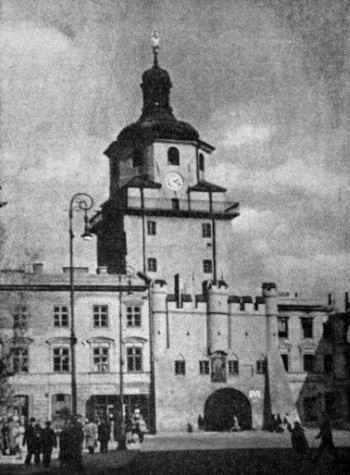
| The Kraków Gate in Lublin leads into the Old Town |
The agreement was continually extended on the 15th of November 1679 for ten years, and on the 31st of March 1693 for another ten years.[18]
The simple Christian shopkeepers and proprietors rebelled against these “pacts” with the Jews. In opposition to the wealthy patricians, the city-gentlemen who took huge sums of money from the Jews for rents and bribes had no real use for the Jews. Instead, they felt Jewish competition at every step and turn. The “plebeians” send complaints to the king, in which they decried “the baseness and love of bribes on the part of the Councilmembers and Aldermen in Lublin” and the harmfulness of Jewish commerce.
In the second half of the 17th century, the Lublin magistrate entered into a sharp battle against Jewish commerce, adopting a series of resolutions, including those of 1655, 1671, 1679, and 1691, forbidding Jews from residing in the city. That resolution was often approved by the Polish kings. An exception was made for Jews who benefited from royal protection: thus, for example, King Jan Kazimir allowed the general syndic of Polish Jews, the chief cause Marek Zekel and his family, to reside in the city in 1659, and to conduct free commerce in all kinds of merchandise and liquors, and to free him from taxes for his houses.[18a]
On the 11th of February 1679, the king issued a letter of protection for the Christian buyers in which he firmly stated: Because the Jews carry out non-permitted trade in Lublin and therewith harm the well-being of the Christian merchants, the king forbids them from trading on Sundays and in general forbids them to appear in the city on any holidays. The Jewish brokers are forbidden from appearing in the city; they are forbidden from opening any shops or stores there and must not sell any merchandise, not their own and not for others; Jews may trade only among themselves.
[Page 32]
That royal decree abolished all the established trade treaties certified by the magistrate. In order to stand up to the watch of the royal decree, the Christian merchants founded a new brotherhood of buyers – the “Confraternity” – and the king confirmed their status on June 6th, 1685. Paragraphs 23, 24, 25, and 27 set out in great detail the framework for Jewish commerce. Here is their content:
Paragraph 23: The non-believing Jewish folk used various protections and sold various merchandise in our city of Lublin, especially during the meetings of the town tribunal, and, with their deceit, brought the Lublin merchants to decline and loss. They traded on Sundays and on the Catholic holidays, which had already been forbidden earlier by the decrees of the Lublin governor. In order to eliminate that and support the writings and privileges that were provided in the governor's parliament on the 11th of February 1679, it says in that decree, “we give the Lublin Buyers' Brotherhood the following rights against the Jews:
Paragraph 24: “No Jew whatsoever shall dare to rent and open any shop or store, not on the market square and not in the streets of the city of Lublin (because Jews have their own town, Podzamcze) and they are forbidden to sell there any merchandise by measure, weight or volume under penalty of confiscation, of which a half of the confiscated goods go to the magistrate in order to improve the city fortress, and half for the Christian merchants. The citizens of Lublin will be strictly forbidden to rent their houses or shops to Jews under the cover of the agreed-to contracts.
Paragraph 25: No Jew is permitted to carry or sell any merchandise in a basket or any other place in the market or on the streets, in houses, or within the city walls. They must wait for princes or ordinary citizens by the city wall, with the exception of their own quarter. For transgressing these points, the guilty party's merchandise will be confiscated, and the Lublin magistrate will be forced to renew their decision about transporting the Jews out of the city.
Paragraph 26: Jewish brokers who go around the city looking into all the businesses, and lead astray strangers, citizens, and princes who buy at Christian dealers and drag them in to Jewish merchants, are forbidden to appear in the city under punishment of arrest “for a term of 3 months and a monetary fine up to 30 grivnas”. (Half for the court and half for the treasury of the “Brotherhood” of buyers.
Paragraph 27: The Jews are forbidden from willingly broadening the firmly established framework of their trade and from buying out a Christian merchant of his merchandise, unless the Christian dealer has the right of primogeniture for each customer. After laying out the cash, the merchandise is his.[19]
Naturally, Jews could not submit themselves to those draconian laws that strove to undercut the entirety of Jewish commerce. Fresh mediations began on both sides by both high officials and the king, and that brought on an arduous battle that dragged on for over a hundred years and did not end even after the fall of the Polish state.
It is clear that the royal decree of the 6th of July 1685 gave courage to the Merchant Brotherhood in its intention to realize its maximal program – to drive the Jews out of the city. In the document that they agreed to with the magistrate on the 14th of June 1692, they had already spoken about the realizing of all the resolutions that were taken into the question of driving the Jews out of the city, so in that way, in that radical way, they could be rid of the illegal Jewish commerce.[20] Also in 1693, the assessor's court condemned the Lublin Jews by default to lose their commercial rights in the city.
[Page 33]
The Jews apparently did not sit with their hands folded, and over three years, the situation changed radically. In 1696, King Jan Sobieski declared the Merchant Brotherhood's privileges “invalid, because they have come to it by a dishonest way and are forbidden to disrupt the Jews in their commerce, which they have until now carried out freely and undisturbed.” That decree was confirmed two years later (31st of August 1698) by King August the Second and incorporated into the summary of the privileges of the Lublin Jewish Community.[21]
It was characteristic of the wavering positions of the Polish royalty and in the fight conducted around Jewish commerce, that the same August the Second did twice – the 4th of August 1697 and the Coronation Parliament in Krakow in 1698 – confirm it through the Jan Sobieski-approved status of the Buyers' Brotherhood from the 6th of June 1685 with all its anti-Jewish paragraphs.[22] That wavering position was a result of the impossibility of making peace between two conflicting interests of the royal treasury, which was unlimited, and the prospering Jewish commerce which was a source of a lot of revenue from one side, and of the citizenry who felt the Jewish competition strongly, on the other.[23]
For a short time, official documents are silent about the struggle between the city burghers and Jewish merchants. The city experienced great misfortune, including the Great Plague in 1695 and the catastrophic fire in 1702, during which the majority of the city's buildings, as well as those in the suburbs, were destroyed. And the Northern Wars (1701–1721) brought an interruption in the conflict, but not for long. New members came into the city council in 1716, aldermen and guild-masters, and adopted a decision in the name of all positions and “nations” about a crusade against Jewish commerce. A delegation traveled to Warszawa and, after much intervention, beat out a decree on the 26th of November 1720, directed against the Jews in Lublin.
The introduction to the decree assessed a long list of Jewish sins, for example, conducting unlimited trade, not paying any taxes, keeping Catholic servants, and driving the Christian merchants to absolute ruin. And so the king ordered 1) the commerce agreements with the Jews should not be renewed; 2) the Jews should immediately lose their residences in the city and the agreements with the proprietors should be voided; 3) under a penalty of 1000 grivnas a Jew was forbidden rent a business space or an apartment in the city; 4) a commission will be established that will carry out these resolutions and investigate if any one of the Jewish merchants who brought the shame on the city's commerce.[24]
After 16 years of investigation, the commission was still not ready with its work, and on the 5th of June 1736, the issue emerged again in the Assessor's court. The ruling came out against the Jews. A new commission was appointed and given the task of carrying out the redress of the decree of 1720. The decree repeated the warning that any Jew who did not submit to the decree would have their merchandise confiscated, and the disobedient citizens who rented apartments to Jews in the city would be penalized with a 1000 grivnas fine and would lose their honorary positions.
Uncertain about the effectiveness of the general decree, the king in 1737 issued a decree aimed directly at the protectors of the Lublin Jews, to the high spiritual leaders and secular officials – for example the Lemberg Canon Wladyslaw Zalevski, to the Crown Cossack Chief Jozef Pototski, to the Lithuanian Marshal Pavel Sangeszka, to the Lubomirskis, to the cloisters of the Trinitarians, Piarns and Bernardines and others – with a harsh penalty for keeping
[Page 34]
Jews in their palaces or houses, and for renting them, breweries and taverns.[25]
The commission set to work, but the Jews intervened with the princes and high officials and, in the end, reached a place that, since the king had, in two decrees (12th August and 12 September 1738), abolished the ruling of the year 1736.[26]
It was characteristic that a battle similar to the one the city people were conducting against their Jews was being carried on in the Jewish town and within the town's Jewish community, which was dominated by the rich Jewish merchants and newly arrived Jewish dealers and artisans, who mostly consisted of a non-propertied element. In the above-mentioned summary of the privileges of the Lublin Jewish community as set by August the Third, the 12th of July 1736 (in the last paragraph) gave the community the right to confiscate the merchandise of and to put into jail the foreign dealers and butchers. A strong warning was also provided that no one should dare to rent any apartment (Oblata of 1750, p. 9, YIVO archives). Similarly, the magistrate pursued not only the Jewish merchants and artisans but also Christian resellers (przekupnie, przekupki) who disturbed the monopoly of the organized Merchants' Guild. In his decision of 1651, the magistrate prohibited poor vendors – both Christians and Jews – from buying merchandise outside of the city from the peasants. In that regard, both the magistrate and the Jewish community acted in accordance with their own class interests, independent of the national relevance of the warring social groups.
But the citizens did not consider the acts, nor the king's decrees, nor the iron-clad protection letter, and systematically removed the Jews from their apartments in the city. They also complained to the Assessor's court about any citizens who allowed Jews to continue to live in their apartments. The Christian merchants again complained to the king, and again a commission was delegated to Lublin to study the matter (17th December 1743). On the 14th of March 1744, the commission finished its investigation and presented a ruling that, within eight days, all Jews must leave the city and move into the Jewish quarter. Additionally, the Jewish Community was fined 3,000 gilders for failing to comply with the ordinances.[26a]
But the ruling did not have any great effect, as the proprietors of the houses where Jews resided would not easily resign to give up the significant rental income from their Jewish tenants, and they pushed back on the issue of the damage they would suffer if they lost their Jewish renters. Even the city counselors themselves, rich patricians who owned the finest houses in the city, could not decide to lose such fat bites and throw out the Jews. The matter touched the pockets of the princes, in whose jurisdictions Jews also lived. The princes even sent their castle militias into Lublin to protect “their” Jews, but the stubborn citizens did not give them a fight.
Fifteen years went by, during which the Catholic Reaction in the land was further strengthened, and at the same time, the situation of the Jews in Poland became starkly worse.
Parallel to the strengthened religious provocation (ritual murder trials did not fade from the agenda), a redoubled economic battle went on from the side of the citizenry. The Jews lost the help of their mighty protector – the princes.
In 1759, the councilmen, aldermen, and guild masters came together and
[Page 35]
solemnly took up a long resolution in which, reckoning all the wrongs that the city had suffered from the Jews, it was decided “to chase them out, to drive and evacuate from the houses of the nobles, the citizens and the priests, in the city and suburb, to abolish the commercial agreements and consider them non-existent.” As the city fathers were afraid of a repeat of the incident with the princely militias, who had not allowed them to drive the Jews from the princely houses, they requested “the merciful commander of the Lublin castle for help in order that we may once and for all be rid of the Jews”. The resolution also foresaw heavy punishments for councilmen, aldermen, and ordinary people who would dare to bring Jews into the city.[27]
Carrying out the resolution however did not make less of the old antagonism between the city elite, rich property owners and merchants who had stopped commercial relations with Jews and drew large revenues from Jewish rents on the one side, and the aldermen and guild-masters who had no kind of use for Jewish trade in the city, instead the opposite – they suffered from Jewish competition, on the other hand. They delivered a fresh complaint to the assessor's court in Warszawa, and on the 28th of September 1761 the court brought out a ruling that contained an order for the Lublin Elder to give military help in driving the Jews out of the city. This time, the order was carried out, and the Jews were driven from the streets and places where they had lived for more than 100 years, into the crowded and swampy Jewish town.[28] Only a small group of wealthy Jews who, for huge amounts of money, rented apartments in princely houses and palaces in the Krakow suburb and in the cloister, houses belonging to the Piarn and Bernardine monks, remained in the city. The magistrate – whether willingly or not – had to make peace with the fact and, in 1770, signed a formal agreement with the Jews remaining in the city. According to that agreement, the Jews were required to pay 38 gildens a month for the right to reside and trade.[29] Smaller merchants would go secretly into the city for a few hours, for a certain sum, in order to sell their wares in the houses of the patricians and magnates.
But the Jew-hating elements in the city were not satisfied with this partial victory, and the sources tell us more about the conflicts (1773–1774) and agreements (1777) with the remaining Jews in the city.[30]
In the meantime, the First Partition of Poland took place (1772), and for the newly created “Commission for Good Order” (“boni ordinis”) that dealt in particular with rehabilitating city relations, the old argument about Lublin between the city fathers and the local Jews was revived. Neither side spared any effort or money; they sent deputies to Warszawa, they hired attorneys, and they knocked on the doors of the high officials. Meanwhile, the handful of Jews in the city was as if on a volcano, until it came to a breaking point in 1780.
Then the last Polish king, Stanislaw Poniatowski, in the decree of 17th April 1780, definitively ordered that the Jews be driven out of the city and forbade the Jews from trading in the city.[30a] Naturally, this gave courage to the Jew-hating party.
On the 12th of October 1780, all the Councilmen, aldermen, the mayor, delegations from the merchants' guild, representatives from the “plebs” gathered in the town hall specially for the purpose of electing a triumvirate and taking up a resolution about driving the Jews out of the city.
That triumvirate – the former city president Stefanowski and the brothers Makariewicz, and with the help of the “Merchants' Brotherhood” and military units – carried out a true “scrape” of the city: they closed the Jewish businesses, confiscated the merchandise, drove the Jewish merchants from the
[Page 36]
city and even penetrated the “hateful territory”– the Jewish quarter – to tear Jewish commerce out by the roots. Jews filed a complaint against the president and the city councilors. (Catalog manuscript, Nr. 344a)
Those tales of deceit brought out the Lublin Elder, Prince Lubomirski, who, on the 1st of April 1781, wrote a sharp letter to the general procurer of the Piarist Order in Poland, pleading for an end to the robberies. And the Vice Elder Suchodolski – who had until now militantly supported the Jew-hating action, and the city president, realized that the pogrom against the Jewish businesses had brought harm to the city's finances and endangered the public order. The president, therefore, announced to the city that until the signing of a new agreement, the Jews were allowed to trade freely for a period of six weeks. Parallel to the Jew-hating action in the city, the Christian merchants in Warszawa had carried out a feverish activity at the king's court.
Both sides, represented by the brothers Bialobzeski of Lublin, let great sums of money flow in the long-lasting and costly court trials to the ruin of both the city's finances and the Jewish community.[31]
Meanwhile, on the 12th of January 1782, the magistrate prolonged the terms of the expulsion of the Jews continually, until he authorized a fresh agreement in which the Jews were allowed to lease shops in the Grodzka Gate (21st December 1785). On the 3rd of January, the contract, signed for five years, was renewed.[32]
The king and the city drew it out so long that Austria had, in the Third Partition of Poland (1795), taken the part of Lublin Province with Lublin in it, and finally, as in Lemberg and Krakow, drove the Jews out of the city back into the ghetto and into the suburbs. After a battle of 150 years, the Jews had to retreat before a foreign power. Plus, the government of Congress Poland had closed the city gates to the Jews – Lublin belonged to the 90 towns where Jews had houses only in the ghetto. Only the reforms of Markgraf Wielopolski, which equalized the Jewish population in the detail of citizens' rights with the majority population (1862), reopened the sealed gates to the residents of the ghetto.
Translator's footnotes:
|
|
JewishGen, Inc. makes no representations regarding the accuracy of
the translation. The reader may wish to refer to the original material
for verification.
JewishGen is not responsible for inaccuracies or omissions in the original work and cannot rewrite or edit the text to correct inaccuracies and/or omissions.
Our mission is to produce a translation of the original work and we cannot verify the accuracy of statements or alter facts cited.
 Lublin, Poland
 Yizkor Book Project
 JewishGen Home Page
Copyright © 1999-2026 by JewishGen, Inc.
Updated 27 Jan 2026 by JH