[Pages 573-574]
Courage in Flames
Translated by Guillermo Levrio*
They Went Out and Perished
The five young people who went with Leizer Reisner to the forests — and of whom he alone returned alive at the time from their journey — were the first group of the Zionist-pioneering movement in Grodno that intended to search out a path for their comrades and to feel its way toward friendly partisans and partners in the struggle, or even to establish a “partizanka” of their own.
But attempts to search for paths to the forest had already been made earlier by young men from the Grodno ghetto, most of them butchers and wagon drivers, who had ties from normal times, because of their occupations, with non-Jewish villagers in the surroundings, and who intended to save themselves also by armed defense against the enemy. More will be told about this later.
[Columns 575-576]
In the last days of the “Aktion of the Ten Thousand,” after the planned “counter-action” had not been carried out and the assassination attempt on Streblow had also failed, the pioneering underground decided, as recalled, to send a larger group of its members to the forest.
“Zerach helped them,” relates Haika Grossman. “Only the older ones went out, eighteen people from the 'Ha-Carmel' troop under the command of Eliyahu Tankus, without contact, without a clear goal set in advance. They went out to search for a new place of fighting. They set their faces toward the Augustów forests. On the way they spent the night with the peasant Jan, with whom contacts had been made to acquire weapons. Motl Solnicki's family was hiding in his house, in the village of Korobczyce, twelve kilometers from Grodno on the Bialystok road.
“After some time we learned that they had bought two rifles from him and hurried to leave the village. From peasants Jan learned that they had been caught on the way. While they were lying down to sleep under a haystack, a peasant found them with the help of dogs and handed them over to the Gestapo. When the Gestapo men came to the village and began to surround them, our comrades knew nothing. When they awoke, they saw the Gestapo around them. They fired several shots with their few weapons, but all were killed.”
As it became clear, among those who went out with this group were Miriam Popko, Gedalia Brovarsky, and Ch. Marsh. The names of the others were not known.
Motl Solnicki was saved for the moment, because he had stayed there with his family. They too later fell into the hands of the Germans, due to denunciation by the villagers. Motl, who was very dear to the peasant, was the first to discover the possibility of buying weapons from him, even at full price. When Motl was transferred, after some time, with the help of his women comrades in the underground, to Bialystok, and proper means were obtained to pay for purchases, he claimed for himself the first right to return to Jan to carry out the purchase. Although he was warned, because of his Jewish facial features, that he would thereby endanger both the mission and his life, he continued to insist firmly on his desire to be the one to open the important acquisition that was at hand. But on his way out of Bialystok he fell into the hands of the Germans, who arrested him and tortured him during interrogations, and he never returned.
To the Narocz Forests
Several young people from the Grodno ghetto, among them members of youth movements who had survived the “Aktion of the Ten Thousand” under various circumstances and by various means, finally succeeded in slipping into the Vilna ghetto. There they united together and sought contact with the Jewish underground, with a firm intention to go out to the forest.
They continued to strive for this even after they made contact with the headquarters of the F.P.O., the Jewish fighting organization, which there, as we have mentioned, advocated an uprising in the ghetto itself. Indeed, they obtained what they sought at the end of July 1943, when the Jewish partisan fighting unit “Nekamah” — “Revenge” — was established in the Narocz forests, seventy to eighty kilometers east of Vilna, between Smorgon and Vileyka. They went out and took part in guerrilla warfare against the enemy.
“In the days before the great Aktion in Grodno,” relates Zvi Lifshitz, one of the members of the group, “I worked in the Arbeitsamt together with a young Pole, Tadeusz Soroka, one of the Righteous Among the Nations, who later saved me.
“With his help, I and my comrade Lotek Schneider, born in Bielsk and a member of the family of Noah Bass, obtained two documents belonging to gentiles, replaced the photographs in them with ours, and from then on I became 'Henryk Lipowski.' Soroka connected us with a railway worker who engaged in smuggling, and he transferred us, for a certain payment, to Vilna.
“With the help of that same Soroka, and by the same route, more young people from Grodno reached Vilna after us, among them Eliyahu Yezerski, Meir Zamoszczanski, Yulik Trachtenberg, and Reuven Lubicz. All of them survived.”
In the Vilna ghetto, these Grodno people performed hard labor and maintained contact among themselves. Lifshitz and Zamoszczanski also managed to acquire pistols from Lithuanians. After they linked up with the underground people, the Grodno members were trained in the use of firearms and grenades, and they also participated in its actions in the ghetto.
“In the forest,” Lifshitz continues, “we were received well, and the commander even delivered a short speech before us in Yiddish. Our battalion, named 'Mest,' 'Revenge,' reached 350 people, Jews, during the summer. I served as base manager, and Zamoszczanski as commander of a platoon of thirty men. After some time, missions were assigned to us, and Zamoszczanski, Lubicz, and I were commended. In autumn 1943 an order was given that the 'Revenge' battalion would no longer continue as a specifically Jewish unit.
“Afterward I belonged to various partisan brigades. I moved with the battalion to the Belorussian unit 'Komsomolsky,' and in the course of time to the detachment named after Kalinin. I was also included in a 'special department,' into which local partisans began to be accepted, those who had distinguished themselves in sabotage operations and in carrying out special tasks.
“I participated in various actions, including the burning of bridges and the blowing up of railway tracks, and I managed to derail five enemy trains. In July 1944 I took part in an attack that our battalion carried out against one hundred German officers during their retreat through the forest. In this battle I was also wounded.”
Grodno People in the Nacza Forests
The departure to the forest of youth from the Zionist-pioneering movements was preceded, as we have noted, by attempts and feelers in this direction by members of other circles in the Grodno ghetto.
Shabtai, Shapsel, Gorbulsky, a butcher, son of butchers, and a wagon driver in the ghetto, relates that already when the ghetto was sealed off, he and two other “fellows” decided to go out and search for a way to reach the partisans. These were Isaac Shabchowicz, son of Nachum the butcher, who later fell in the partizanka, and also a young butcher from Wasiliszki, who had already told earlier that near Radun there were partisans, and that in that area he had acquaintances among the gentiles with whom he had had commercial ties in cattle for slaughter. Another young man, Feivel from the town of Sobakintsy, joined them.
They took food with them and at night slid down a drainpipe from the third floor of the “Yavneh” school building, where they lived, into the church courtyard. Gorbulsky and Feivel continued to the “end of the road,” and they reached the partisan contact and one of their organizers, a Belorussian Communist named Kostya Bochko. He explained to them that he could not attach them to one of his units because of the shortage of weapons and food.
The two were forced to return to the Grodno ghetto. After prolonged adventures, they arrived there at the end of December. At his home, they had already thought him, Gorbulsky, dead, and his brother even argued before him that there was no point in going to the partizanka,
[Columns 577-578]
since everyone was returning, as there was no possibility of remaining there.
Yedidya Kaminski, also a butcher and son of a butcher, relates that after the liquidation of Ghetto B, information slipped into Grodno from Polish railway workers that the Jews were being sent to death. However, arguments were heard that these were rumors deliberately spread by Jew-haters. Kaminski had already earlier, when he spent some time in Bialystok, kept his ears open to rumors about the existence of partisans wandering in the forests near Lebiedz. News of partisans was also brought to Grodno by young men from Radun and Marcinkañce, who had first spent time in the forests but then decided to “turn aside” to Grodno to check whether the situation in the ghetto was better. These men suggested to the young people, sons of wagon drivers and butchers, that they go out to the dense Nacza forests near Radun.
At the beginning of January 1943, therefore, Kaminski, as part of a group of sixteen young men, jumped from a window of the aforementioned “Yavneh” school building into the church courtyard. They gathered on the road leading to Skidel, where two sleighs awaited them, which had gone out from the ghetto with permission for transport purposes. They set out on the road toward Szczuczyn, to reach the contact Bochko, but they did not succeed in finding him and were forced to retrace their steps to Grodno. They left the horses and sleighs in the village of Przesió³ki, north of the city, where the members of this group, the butchers, used to buy poultry, and whose peasant inhabitants were friends of the Jews and did not harm them by informing and handing them over to the Germans.
“The rumor that spread in the ghetto, that a large group of wagon drivers and butchers had left it and disappeared with their wagons, with equipment and food with them, made a great impression,” relates Yehudit Gliksman, née Pikowski. “But the act displeased the members of the Judenrat, who argued that the matter could bring disaster upon all the Jews of the ghetto.”
And Yehudit's sister, Tzipora Loshovitz, adds:
“The matter of those young men's departure to the forest, about which the rumors were vague, spread like wings among the youth in the ghetto, who were angry at those who had gone out because they had not revealed anything about it to the other young people.”
At the beginning of 1943, another group was also formed in the ghetto, aiming to obtain weapons and go out to the forest, to the partisans. At its head were Leib Reiser, Shlomo Zhukovsky, Israel Reisner, a printing worker, and Sonia Epstein. They also cooperated with Leib Reiser, one of the activists of Poalei Zion–Z.S.
Sonia Epstein was among those who first went out from this group, together with her brother Pesach, Peishke, Manus, and with Yaakov Mogadovsky, to seek contacts with the partisans. They too reached Bochko, who first suggested that they obtain weapons and then come to him. Sonia herself returned to the ghetto with several of her toes frozen. She later fell in the Nacza forests at the hands of Polish nationalists.
Leib Reiser worked in those days in carpentry for the Germans in the military hospital, which was located on the Aryan side of the city behind the fence of the Great Synagogue. Near the workshop, in the office of the supervising officer, stood a locked cabinet containing weapons, and Reiser set his eyes on this treasure. Meanwhile, a conversation developed between him and Chanan Yelgin, one of the activists of Gorbulsky's group. Reiser learned that these people had decided to go to the forest, to the partisans, or even to establish a partisan group of their own — but that the absence of weapons was holding them back. Only if they had such weapons would they be able to carry out their decision, immediately.
Here, therefore, Reiser told them that he had a source from which weapons could be obtained, but he made a condition: that they include him and his people in the group. This condition was indeed accepted.
Meanwhile, the great Aktion took place in the ghetto. The members of these groups were saved by a miracle — each through his own stratagems and ways. Yedidya Kaminski was even caught and taken to the Great Synagogue for deportation, but he succeeded, together with other young men, in extricating himself from there by jumping through a window above the Holy Ark to the outside, under a shower of shots from the guards at the place.
On one of the nights, toward February 7, Reiser, together with two of the youngest among his comrades, Pinchas, Pinye, Krinski and Berl Lipski, succeeded in sneaking into his workplace in the military hospital, entering through a window into the weapons room, and removing, with the help of a bottle opener, several pistols and bullets from the cabinet. They managed to leave there safely and reach Przesió³ki with additional comrades, where their horses and sleighs were waiting. From there they reached Slobodka, where the rest of their people were waiting, and set out on the road. On the road they also chose three commanders, whose authority they had to obey with strict discipline: Berl Lipski, the elder, L. Reiser, and Shabtai Gorbulsky.
For four days the group traveled on their way by winding paths. Here and there they were also forced to trudge on foot through sinking snow, until they reached their destination. This time they were accepted by Bochko into the ranks of the forest people. Several veteran partisans instructed them how to establish a “family camp” in dugouts covered with branches and bushes, and how to obtain food through raids at night on the wealthier peasants in the area.
Not many days passed before in one of these operations four members of the group fell: Abraham Pawe, brother of Shlomo and Wolf, from the “strongmen,” owners of the sleighs and of one of the horses; the butcher Leizer Sisson, “Trotro”; Pinchas, Pinye, Mazowiecki, son of “Soldai,” the poultry merchant in Yorzika; and the shoemaker Berl Lipski. German and Polish policemen from Radun came upon their tracks, surrounded the hut in which they had stopped to camp, and burned it. Those surrounded defended themselves to the last bullet, but went up in flames or were killed.
Even before this, some of the brave-hearted members of the group mustered themselves, disguised themselves in peasant clothes, and set out toward Grodno to try to save more Jews from there. On the way they were misled by information, then false,
[Columns 579-580]
that no one remained in the ghetto anymore, that all had been liquidated — and the young men returned to the camp.
Twenty-four souls still remained in it, all Grodno people. Among them, besides those already mentioned, were the wagon-driver brothers Manus — Leibel and Peishke, Pesach, owner of a horse and sleigh, together with his wife and their child; their sister Sonia Epstein, mentioned above, and her husband Kadish, today in Israel; the carpenter Chanan Yelgin, the technical organizer of the group, and his mother Tzvia, formerly a worker in Shershevsky's factory; the butcher from the suburb Abraham Kapulski and his boy Hirshle; the porter from the suburb Berl Lipski; Yedidya Kaminski; Zeidel Ash; Yankel Levin, from a family of fishermen in the suburb; Avrahaml “Bontz”; and Reiser's wife, Frumke Gordon, and their child.
Later, more young people who had fled from the Grodno ghetto joined them. Among them were three women — Liza Menker, Rita Shkop, daughter-in-law of the son of R. Shimon Shkop, head of the yeshiva, and a woman named Brezovska from the tar workers near Grodno, with two boys. Among the men were Yitzhak Goldray, the wagon driver Yaakov Mogadovsky, Peishkes, and the carpenter Yankel, son of Leib Gratz, from the “Tsukunft” movement, a graduate of the “Tsisho” school. Afterward Eliezer Kaminski also joined.
The young people in the group tried again and again to be accepted as fighters into the Russian partisan brigade “Leninsky Komsomol,” which operated in the area, but they encountered difficulties because of the shortage of weapons. “However, little by little several of them were accepted, and by their courage they sanctified the name of Israel,” relates L. Reiser.
These were: Yaakov Mogadovsky, the quick and brave machine-gunner, who brought down many Germans; the sharpshooter Yaakov Gratz, who was afterward transferred to the “Perekop” brigade near Slonim; and Abraham Kapulski. All of these perished when they fell in battle. Among those fighters were also the brothers Shlomo and Wolf Pawe.
“Also distinguished among the fighters,” in Reiser's words, “were Lipski the wagon driver, 'Pavlyuk'; Shabtai Gorbulsky; and the very young Hirshle Kapulski, son of the aforementioned Abraham, who showed wonders in his bravery.”
“Berl Lipski and I,” relates S. Gorbulsky, “would often meet with the Grodno family group, eat with them, sit by the fire, and sleep together. The old woman Tzvia Yelgin would feed us, wash our clothes, wash our backs, kiss us, and pray for our welfare. We would bring her, and the other women and children, food and also clothes, fruit, and shoes. She became a mother to us.
“Among the missions in which I took part were: burning wooden bridges, sabotaging telephone lines, and mining railway tracks. I received several marks of distinction and reached four medals.”
In mid-July 1943, forces of Germans and Lithuanians surrounded the Nacza forest thicket, attacked it from land and from the air, and carried out a hunt in it. They cruelly tortured and killed the Jews who fell into their hands, while the surviving remnant were harassed from behind by the Polish “Whites” of the A.K. Among the Grodno people too, victims fell: the brothers Pesach and Leib Manus, from Grandzicz Street.
“They were driven, during the general flight from the Germans, into swamps, where we later discovered their decomposing bodies,” relates Reiser. “We gathered them, piece by piece, into peasant sheets, and dug a grave in a firm patch of ground. Someone peeled off a thick piece of birch bark and we stuck it into the ground, and wrote on it in pencil: 'Here lie innocent Jews who found their rest here, murdered by German murderers. May their memory endure forever, and may their blood be avenged.' One Jew recited Kaddish over their grave, and the echo of the answering 'Amen' resounded in the forest and carried far into its depths.”
With the siege in the Nacza forests, the partisan brigades split for a time into small groups in order to break through the encirclement. Discipline weakened, and tendencies appeared among some of the Russians in them to settle accounts with their Jewish comrades-in-arms. Several Jews, including some of the Grodno people in the “Leninsky Komsomol,” were then expelled and sent to the Lipiczany forests near the upper Niemen, while others were transferred to the banks of the Szczara near Slonim.
“It was no longer possible to remain in the Nacza forests,” Reiser concludes, “and our survivors set out on new wanderings to more distant regions.”
The Bloody Aktion and the Revolt
Days of anxiety and terror descended during the three weeks after the Aktion of the Ten Thousand upon the 5,200 remnants in the Grodno ghetto, whose area had now been reduced by half, and of whom 2,500 were officially “legal,” while the rest were among those in hiding.
We learn what happened in those days in the remnant of the ghetto and among its survivors mainly from two records from that time that have reached us. One is the blood document of Abraham Broide, the veteran activist of Poalei Zion–Z.S. in Grodno, the deputy to the last chairman in the leadership of the Jewish community there, and head of the Jewish militia in Ghetto B. This record, entitled “Treblinka — Camp of Death,” is Broide's account when he reached the Bialystok ghetto in March 1943 after escaping from the hell of Treblinka, about which more will be told below. The second record, from February 23, 1943, was left to us by an anonymous man from the Grodno ghetto who signed with the name “Eliezer.”
“Now no one deceived himself any longer,” Broide related. “Reliable information was lacking about the place where Treblinka was located. The meager information about the manner of killing there was not even enough to form an idea of the death chambers in Treblinka and of that 'modern' method for liquidating the lives of millions of human beings.
“Different versions circulated: that only the women, children, and old people were put to death — by electric current or by steam; or again, that everyone was put to death, except for a few strong men who were assigned to work.”
And “Eliezer” recorded:
“Immediately after the January Aktion ended, they began preparing malonot, shelters, in which it would be possible to stay for a longer period. I happened to see one of them. They had begun building it already the previous year. Its location was in a bakery beneath the oven, and the entrance to it was underneath. Eight people were sitting there, supplied with food for two to three months; electric lighting and a faucet were installed.”
[Columns 581-582]
Other amenities and conveniences too were present in this malona, whose area reached twenty-four square meters.
“Our group (of those living in the building where the Judenrat was housed, at 3 Zamkowa Street) set about installing a malona in the courtyard, in a barn, inside which they built a hut and spread straw around it so that it would no longer be recognizable. Inside they prepared food for two weeks, so that it would be possible to stay in the shelter until an opportunity arose to leave it for the forest.
“Everyone in the ghetto was of the opinion that a new 'Aktion' was approaching. The men of the Schupo, however, assured the Judenrat 'one hundred percent' that nothing more would happen to the Jews of Grodno, and that they would no longer be sent to work (from the city to distant places). So too announced the commander of the Jewish police and confidant of the Gestapo, Noah Serebrenik, and he asked that regular work be resumed. An order was therefore given to the enterprises in the ghetto to return to work as usual, and the workers in the city, including the 'illegals,' were once again sent out to their workplaces.
“New bread cards were distributed, and according to them 400 and even 600 grams per day were issued. In addition, they began to distribute to the public portions of good meat, sausage, potatoes, groats, cigarettes, and other foods to which the people of the ghetto had not until then been accustomed. The kitchen prepared lunches with meat, cooked in fat, for all the inhabitants. The workers in the city were able to bring everything into the ghetto without any difficulty. The searches near Gate 1, which had been a daily routine, were abolished, and life in the ghetto began to 'stabilize.' People gradually began to calm down and to believe that indeed nothing more would happen. Jews who had intended to hide in the city returned to the ghetto, and at several points the police guard was even removed — and this too helped to relax the public's tension.
“Two weeks after the January Aktion, the area of the ghetto was again reduced” (to one-third of its original area).
Meanwhile, Wiese and the rest of the band of criminals of the extermination detachment freed themselves to carry out slaughter and deportation in the Bialystok ghetto. In one week, between February 5 and 12, 1943, they shot to death 900 Jews there, and about 9,000 were taken to the death camps. On Friday, February 12, when Wiese had finished his bloody work in Bialystok, he sent a letter to the presidency of the Judenrat in the Grodno ghetto, in which he demanded 400 Jews for work, specifying how many the labor office was to send and to which enterprises. The workers, it said, were to assemble on Saturday morning at seven o'clock in the Shulhoif square and wait until the commander came and gave permission to go out into the city.
“Since there were no longer enough people liable for labor in the ghetto to fill this number,” notes “Eliezer,” “it had to be completed also with women. Everyone therefore assembled at the appointed hour.”
“The demand for the recruitment of new forces for military workplaces,” relates Broide, “was regarded by the ghetto inhabitants as a sign that the deportation had been halted, and they breathed more freely at that moment. But the announcement was only one link in the chain of lies of the German security service, and a repeated cynical plot to paralyze the Jews' alertness, so that it would be easier to deport them suddenly, without extra effort and while their attention was diverted.”
And so, like a heavy blow, the news now descended upon those assembled in the square: the ghetto had been locked, and no one was any longer allowed to leave it for work. From experience it was already known that this was how a new Aktion began.
“Indeed, this time too,” according to Broide, “the two hangmen, infamous in evil memory, Wiese and Streblow, burst and invaded into the ghetto, firing their automatic weapons at the crowd in the square (according to another testimony, they also threw hand grenades and killed and wounded people). Everyone was now rushed into the Great Synagogue. The Aktion for seizing Jews for Treblinka had begun.
“Reports about the dates of previous Aktions in Grodno,” says “Eliezer,” “had arrived even before they took place. This time the ghetto was calm until the very last moment, although on Friday night, before the present Aktion, it became known that railway cars were already prepared at the Lososna station. Astonishment therefore seized those assembled in the square, and, frightened to death, they marched in formation on the road to the synagogue, arranged by the Gestapo men at the sides — the men at the front and the women behind them, to make escape more difficult — while the two (Wiese and Streblow), with machine guns ready in their hands, guarded the men. The women, realizing the situation, began to flee in panic; the master-butchers turned toward them and opened fire. Many succeeded in escaping and were saved at that moment. More than one hundred women were killed and many were wounded. The wounded women were brought to the synagogue, and it was forbidden to give them medical help.
“A terrible panic seized the ghetto. The streets, which had been crowded with Jews, emptied in an instant and fell silent. Immediately after the gunfire, gendarmes placed the courtyard of the Judenrat, where I lived and from where I could follow what was happening, under siege. They were armed not only with their usual weapons, but also with two hand grenades each. Now Wiese and Streblow appeared, dressed in black overalls over their military uniforms and each carrying hand grenades. They also brought with them packages of explosive material and stink bombs (for attacks on hiding places).
“The first victims,” Broide related, “were the members of the Judenrat who were at that hour in their office, as well as the workers and residents of the building. I too was then led away with them. The synagogue filled little by little with hunted people who had been taken out of hiding places. At noon the workers who had gone out of the ghetto early in the morning (before the Aktion had begun) returned. They had no idea what was happening, and they were suddenly attacked near the gate and were also led to the synagogue. After several hours, the people of the 'isolators' were also brought — that is, the houses in which all those supposedly needed (by the Gestapo) and 'armored' against deportation had previously been concentrated.”
These were the workers of the felt-boots factory, about 500 people, and a handful of workers in the starch-production enterprise — those with privileges, who had not been harmed in the previous Aktions; this time they too were taken to the synagogue. Now the Gestapo left only those craftsmen and workers who worked for it directly, concentrating them as “immune” in the building of the felt-boots factory. In such an “isolator” the families of the Jewish policemen were afterward also left.
“Almost all the men,” says Eliezer, “assembled in the synagogue brought with them tools and various instruments, anything that might serve to break open the railway cars during the journey and escape.
“The behavior of many gendarmes toward those imprisoned in the synagogue was savage. They would even come to announce that Wiese was about to enter, and demanded that everyone stand at attention before him. The youth began to break doors and windows and tried to escape. But everything was blocked and fortified from the outside. One person managed to jump outside from a window at a great height, but on the other side the policeman Aizike Labondzh stood guard, caught the young man, and brought him back inside. Some began to barricade themselves inside the synagogue itself: in cupboards, among books, and in other places.
“At noon I found an iron bar and decided to break open the door of the toilet. I worked for about two hours and managed to lift the door and remove it from its hinges. Dozens began to escape through the opening, and many were saved. The police noticed this, and immediately Wiese burst in and opened fire from his machine gun. About ten fell dead near the door, and the Jewish police returned it to its place and fortified it from the outside with boards and stones.
“Toward evening Wiese took the chairman of the Judenrat, David Brawer, out of the synagogue. He too was among those imprisoned, together with his two children. The murderer led him
[Columns 583-584]
to the synagogue of the butchers and put him to death by shooting.”
“'K.' said that they did this because he knew too much about the deeds of the Gestapo,” notes Mordechai Tenenbaum in his diary on February 17 — the editor.
“At ten in the evening Wiese ordered the hospital staff to come outside. Half of them he sent back to their work, and the rest he sent to the synagogue, without any distinction.
“Gendarmes from the guard posted at the entrance to the synagogue allowed (the prisoners) to leave it in return for a personal ransom — a wristwatch, a gold ring, or money — and filled their pockets with hidden hoards of valuables. There were also those who transferred Jews, for larger sums, even beyond the ghetto gate to the outside.
“At three after midnight the public was taken out of the synagogue in formation to the railway. Old people, the sick, and the exhausted, who did not have the strength to walk, were loaded onto trucks. On the way, on Brygidzka Street, a crowd broke out of the lines in flight. The gendarmes opened fire. Twelve people were killed, and several dozen managed to escape; among them was Abba Tarlovsky.
“About 2,500 people were taken out.
“On Sunday the murderers rested, and the fire of hell was suspended. The kitchen workers, who for the moment remained there, were ordered to cook a good meal in fat for the Jewish policemen and their families — and for them alone. Silence stood in the streets of the ghetto, for everyone had gone down into hiding places, except for the policemen. Any other Jew who appeared — the Germans killed him on the spot. The dead of that day were brought to the old cemetery without being buried.
“On Monday,” says Eliezer, “a large group of gendarmes entered the ghetto, accompanied by Jewish policemen, to discover hiding places, and that day they gathered from them about 200 people — most of them with the help of those policemen.”
“Still more Jews were needed to fill the quota of those demanded for deportation,” it is told in a Bialystok record of March 17, 1943, from the mouths of refugees from Grodno, “and therefore they again tried to exert pressure on the Jewish police, so that they would inform and reveal the hiding places. They threatened them that they too would be deported if they did not cooperate. But this time they did not let themselves be deceived, and they showed no activity. When they entered houses and attics, they contented themselves only with routinely sounding the command ordering people to come out of hiding, since Grodno had been declared 'Judenrein' — 'cleansed of Jews.' But most of those in hiding did not surrender and remained in their places.
“The behavior of the Jewish policemen, which this time was beyond reproach, caused the failure of the German plan to liquidate finally all the 'superfluous' Jews.”
It is further told there that several Jewish policemen even protected the hiding places of their brothers, supplied them with food, and guarded them so that they would not fall into the hands of the enemy.
“Toward evening,” according to Eliezer, “Wiese and the gendarmes gathered from the 'isolators' also the 'privileged' workers in the felt-boots factory, and they were led to the synagogue, except for the managers of the enterprise — Yaakov Efron, Abraham Lifshitz, and Lichtenstein. Thus the murderers deceived even these workers, who had deliberately first been concentrated all together in the 'isolators,' so that there would be no need at all to search for them in the malonot. At the time, Wiese had promised them that he would transfer them to Bialystok, and many of the ghetto people then rushed to get into these shelters, among them some who paid the Jewish police for this in hard cash.”
“That same day,” says Broide, “our hiding place was betrayed to the hangmen — by the commander of the Jewish police, Serebrenik, who also helped them take us out of it and lead us to the synagogue. There were already assembled there at that hour about 1,600 people — the catch of that day. At night, at three o'clock, we were led to the railway platform behind the city and put into passenger cars, some of us into freight cars.
“Under cover of night, several of the bravest among the youth jumped from the cars during the journey — immediately after we had passed the Lososna station. Further attempts to jump were no longer safe, because of the speed of the train and because the area was now more open and exposed. The accompanying gendarmes made their guard very strict and immediately opened fire at anyone who tried to get out from the window onto the threshold of the car. Nevertheless, dozens jumped from the windows, but most of them met their death in this way, from the bullets of the gendarmes or by being crushed in the fall.
“Our journey did not stop again and sped on its way to that station whose very name was enough to electrify all those being brought there and make their flesh bristle with terror and fear: 'Treblinka.'”
Rebellion in Treblinka
By all indications, this was the transport from Grodno whose people are said to have rebelled when they reached the valley of death of Treblinka.
Kalman Teigman, a Warsaw Jew who was taken to Treblinka and left in the labor camp there, testified at the Eichmann trial:
“The transport of the Jews of Grodno came toward evening (usually they arrived in the morning). They were brought into the courtyard between two barracks. They were told to undress, to tie their shoes together properly; ropes were even distributed to them for this purpose — but they refused to undress. Then the Germans and Ukrainians began to beat them, even to shoot at them. But they persisted in their refusal. We stood at a distance and saw everything. Afterward we heard an explosion. Apparently someone had thrown a grenade, and a severely wounded Ukrainian was brought from there. But the Germans overcame them afterward and pushed them by force onto the path to the gas chambers. They went, but still in their clothes, most of them.”
A second eyewitness in Chicago in the United States, David Lebkowicz, who was also among those imprisoned in the labor camp at Treblinka, also told of the rebellion of that convoy of Grodno Jews. When the people of the convoy were ordered to take off their clothes — not only did they refuse to do so, he stated, but they rose up by force against the murderers who intended to compel them, using bottles of water and apparently also knives, until volleys of gunfire were poured into the victims and everything fell silent. The hangmen hastened to kill them, but they met their death while clothed.
This rebellion also served as a first impulse for moving forward the date of the Jewish uprising in the entire death camp and for burning it down, in August 1943.
[Columns 585-586]
The End of the “Aktions”
On the morning of February 16, 1943, after the second transport — the last one of the February Aktion — had set out on its way, there still languished in the Great Synagogue 200 prisoners, exhausted and helpless.
“That morning,” says Eliezer, “the Jewish policemen went from courtyard to courtyard and called aloud to all those hiding in the malonot to come voluntarily to the synagogue, since no danger threatened them any longer, and since anyone discovered afterward in a hiding place would be shot on the spot. But no one — not even old people and children — emerged from their holes. And when not even one of those hidden appeared by the afternoon, Wiese declared that the Aktion was over. He released those who remained in the synagogue, and together with the rest of his entourage left the ghetto.”
It is further told in the same record that the area of the ghetto was now reduced to only sixteen houses, at the end of Zamkowa Street. Little by little Jews began to emerge from their hiding places, but with the clear awareness that not many days would pass before the murderers would again devise tricks of deceit and cunning to catch in their net the remnant that had survived.
And when Eliezer emerged from the darkness of his tunnel beneath the Great Synagogue into the sunlight, a scene of horrors was revealed before him. Wherever he turned — frozen bodies of the shot victims lay stretched out in pools of blood, as after a prolonged bloodbath. So too at Entrance 1 of the synagogue and inside the synagogue itself. And beside the bodies lying and leaning there were piles of books, satchels, and backpacks, red from the blood they had absorbed. The walls were pierced by bullets, as was the large clock above the bimah, whose face now looked like a torn sieve.
Three hundred was the number of the dead who were collected.
So it was inside the surviving fragment of the ghetto. And what was outside it, in the area of the ghetto — most of which had been cut off after the “evacuation”? Two witnesses happened to be there then: Eliyahu Skowronski and Haika Grossman. The first, a young man from £ódŸ, a member of Hashomer Hatzair, was working on behalf of the pioneering underground in Grodno on the Aryan side, and worked in the government-municipal printing house, formerly Meilachowicz's, through which he maintained information links with the underground in Bialystok and Warsaw.
Now he visited “Troytze” and the Shulhoif, emptied of their Jews — together with his German work manager, who went to buy there a bathtub from Jewish property that had been abandoned, and which the Nazi authorities had sold to one of the many merchants from the people of murderers who descended upon Grodno in those years. As for H. Grossman, whom we remember, she was there in those days because of the underground's decision to try once more to settle accounts with Streblow, who was now spreading the net of his deeds over the Jews of Bialystok and on the road there. We shall return to this matter.
The streets in the former ghetto, they tell, stood desolate and silent. Sacred books rolled about in them, abandoned baby carriages, torn blankets, feathers filling the air. The doors of the apartments were broken open, and most of them were almost empty; the floors had had their boards torn out, and scraps of rags lay upon them. The gentiles around, especially the peasants, had already managed to remove or to buy for pennies from the German merchant the movable belongings and clothes of the Jews, and to carry them away from there. But one still encountered there a peasant's wagon, whose frightened owner looked here and there, searching for booty that might fall into his hands from the estate of the House of Jacob.
The Catastrophe of Grodno in Numbers
In the tiny ghetto and in hiding places outside its boundaries there still remained about 1,500 survivors of the Jews of Grodno.
Until those days, according to a list of the Nazi “extermination detachment” in Grodno, dated March 5, 1943, discovered by the Red Army there in 1945, 20,577 souls from the Jews of the city of Grodno had been taken to the death camps, as well as another 23,472 from the surrounding towns. Another 500 “escaped on the way,” and 238 others were “shot on the way.”
These numbers appear to be reliable, since even the counting of the murdered by the wicked was conducted with the utmost German precision. They did not include the Jews who still remained now in the tiny ghetto, or those who were later taken from it, except for several hundred, to Bialystok, until its own hour arrived. Nor were the dead and fallen of our people included in this calculation — those who fell during the period of the murderers' rule in Grodno and in its ghettos, and those who left it and fled not from the transports.
In schematic numbers, it may be summarized that when the Nazis invaded Grodno, there were about 23,500 Jews in it, and of them, until the end of February 1943, about 4,000 were taken to Auschwitz from Ghetto B; about 4,400 through the hell of Kielbasin to Treblinka — and perhaps also to Auschwitz; 7,500 from Grodno itself in the “ten-thousand” Aktion to Auschwitz; and about 4,000 in the February Aktion to Treblinka. About 1,500 died or fell in Grodno itself and in its ghettos; about 300 went out to the forests, slipped into Bialystok, or hid wherever they hid; about 300 from Grodno itself escaped or were shot “on the way” from the rows of the transports.
Jumpers from the Deportation Cars
Manifestations of rebellion and desperate means to escape from the jaws of the murderers by any possible way — whether for the rescue of the body, or also for active struggle against the enemy — some of which have been told here, became more and more frequent from the “ten-thousand” Aktion onward, and their scale broadened and grew in February, and especially after the Aktion in that month. For there was no longer room for illusions or postponement for anyone who saw the situation with open eyes.
Great was the number of those who jumped, with self-sacrifice, from the trains
[Columns 587-588]
in the middle of their journey to the death camps, among them women from Grodno. Most were shot by the guards or crushed, and a few had the good fortune to be bruised or wounded and to find their death later on their way; but there were also those who succeeded in dragging their feet, by night, to some hiding place, especially to Bialystok.
A “Grodno” Underground in Bialystok
To reach Bialystok, especially before the Aktion was carried out there too in February, was like a dream for not a few of the youth in the Grodno ghetto. That too was the direction toward which the underground members among them aimed to concentrate.
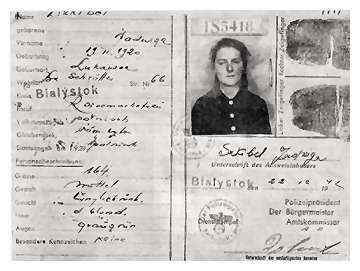
Bronia Winicki was the first among the women comrades of the Dror movement in the pioneering underground in Grodno who had already reached Bialystok in 1942, from the ghetto in Slobodka, to act from there as a courier between the ghettos. Now she became “Jadwiga Szkibel” and “settled herself well” on the Aryan side in Bialystok. “We have already spoken,” Mordechai Tenenbaum recorded in his diary, “about contacts and about preparing a place outside the ghetto for concealing the material.” Indeed, Bronia later concealed there the archive of Zvi Mersik — Mordechai Tenenbaum, including Mordechai's diary; and from this treasure we draw abundant information also about the catastrophe of Grodno.
Also arriving in Bialystok were two women comrades of the Communist underground in Grodno, Liza Chapnik and Ania Rud, older than she, who had been a pupil of “Tarbut” — both with forged documents as “Polish women,” prepared by the underground of their party, with Shlomo Zhukovsky among its activists. They too now operated on the Aryan side on behalf of the Jewish Fighting Organization.
The departure of their comrade Hasia Bielicka to Bialystok, together with Tsila Shachnes, in the midst of the “ten-thousand” Aktion in Grodno, has already been mentioned here, and we shall return to the story of the activity of these women of the underground.
Rebellious and Fighting Youth in the “Ha-Carmel” Troop of Hashomer Hatzair
When Zerach (Zilberberg) was late in returning from Grodno in those days, and it was not known in Bialystok what had happened there during the Aktion, the underground decided to send Tsila Shachnes back to Grodno, to check the situation and perhaps to save comrades from there as much as possible. Tsila not only reached Grodno in the very midst of the Aktion, but with the help of Eliyahu Skowronski she also succeeded in taking out with her from the ghetto to Bialystok, together with Zerach, several young people from the scouts of the “Bitzaron” troop of Hashomer Hatzair. Among them were: Luntshik (Aryeh) Pinchanski, whom we shall mention again; Dodik (David) Rosenberg, the “laboratory expert” for forged documents; and Meir, who organized the daring departure from the ghetto during the days of the transfer. “These young people,” writes Haika Grossman, “flowed into the fighting channel in the Bialystok ghetto, and they were also the ones who discovered the hidden hiding places and the openings from it outward, for smuggling weapons and people. After them came their daring women comrades to Bialystok.”
Tsila Shachnes herself too, despite the fact that her appearance was not necessarily Jewish, preferred to operate in the underground inside the ghetto itself, with all her comrades, and afterward took an active part with them in daring operations to prepare the revolt. She perished in it together with the other fighters.
During the days of the Aktion in Bialystok, in February 1943, the Germans discovered the forgery in the documents “from Skidel and Derechin” of those coming to Bialystok from Grodno, and within a few days seventeen young men and women among them were arrested. They were held in prison separately from one another, beaten and tortured, in an attempt to extract from them who the “manufacturers” of the documents were
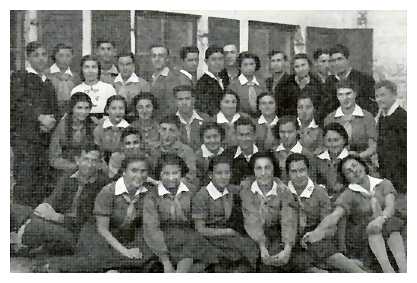
|
|
Young fighters against the Nazi murderers
(of the Hakarmel corps of Hashomer Hatzair)
From right to left in the first row, sitting: (2) Tsila Shachnes, (3) Miriam Popko, (6) Sarah Shabchowicz
Second row: (2) Hasia Bielicka, (5) Eliahu Tankus, (6) Lonchik Pinchanski
Third row standing: (4) Fania Lipkes; eighth from right in the top row, Eliahu Yezerski; the last one, David (Dodik) Rozovski |
[Columns 589-590]
and which underground organization stood behind them. But not one of them opened his mouth to reveal anything, and none returned from the prison. Such was Chaim Wolberg of the Dror movement, one of the defense activists in Grodno, from among the members of the underground who had been sent for its needs into the militia in the ghetto and was later taken out of it; and such was Chana Yezerski, Aryan-looking and tender in years, who, when she was arrested, declared before the gendarmes, to their astonishment, her Jewishness and her hatred of the Germans, and slapped their faces and spat at them.
Again to the Forest
In February, the departure of Jews from Grodno to the forests increased, especially among the youth. Four groups that left this ghetto, including the two of them that reached their destination, have already been discussed here. There are also testimonies about additional individuals and groups who went by this path. Among the individuals there were some who returned to Grodno, to their parents, one of them entirely covered with severe wounds and bruises. They could not survive alone in the forest in cold and insecurity; and the partisan groups also refused to accept Jews into their company, except for several women whom they needed in their “household.” The partisans advised them to dig their own huts in the ground and arrange themselves in them separately. They also claimed that they were afraid to live together with Jews.
Mordechai Tenenbaum mentions in his diary, on March 19, 1943, a unit of comrades that went out from Grodno to the forest. It is possible that this refers to a third group of members of the pioneering underground, and that Israel Landa had a hand in organizing it. Of him himself it was told that he hid for a certain time in the ruins of Grodno after it had been emptied of Jews.
A group of young people fled from the Grodno ghetto in February, during the Aktion, and went to the Nacza forest, reaching the Grodno people who had preceded them there. We have already spoken about this at length.
The Curtain Falls on the Judenrat
“On February 17, in the morning,” writes Eliezer, “Wiese came to the ghetto and ordered the entire archive to be removed from the Judenrat offices and burned completely. He himself stood all day to guard that no one should, God forbid, take any important document. The pages of the history of Jewish life in the Grodno ghetto were thus destroyed together with the Judenrat.
“The internal authority in the ghetto was handed over to the Jewish police, with Noah Serebrenik as its commander.”
Thus the Gestapo handed over authority over the remnant of the ghetto to its chained loyal servant. Serebrenik — not a native of Grodno, the son-in-law of Aleksandrowicz from the suburb, formerly manager of the plywood factory in Grodno — was a “veteran” in the service of the Gestapo, for already as a policeman appointed over the guard at the ghetto gate he had distinguished himself by cruelty toward his brothers and by willingly assisting the murderers in their searches and in their harassment of his people. In the days of the Aktions he became an object of disgrace to the entire people.
Indeed, now the curtain fell also on the Judenrat in Grodno, when destruction descended upon it, even if two or three of its men still remained in the place — those who supervised its craft and industrial enterprises and who had won the protection of the Gestapo. And even if we have spoken at length, in other contexts, about the deeds and failures of the Grodno Judenrat and about its head, it is still proper to add several more lines to the figure of David Brawer.
Kurt Wiese, born of impurity, made certain to burn completely the archive of the local Judenrat and to erase every written trace of the deeds of the murderers, and of this master-butcher himself above all. In doing so, the criminal also set fire to all the material from which it might have been possible to determine with greater certainty the struggle, doubts, opinions, and nature of the members of the Judenrat and its leaders. For they were not all cast from one material; Israel Landa, the underground man, Yitzhak Gozhansky and Aharon Yezerski, or Dr. Tzvi Belko, Yehoshua Sukhovlanski, and Dr. Yehuda Lipnik, were not the same as Abraham Lifshitz and Yaakov Efron.
Yet from the meaning of the deeds and facts known to us, some of which have been brought here, there emerges the tragedy in the figure of David Brawer, whose lot it was to steer a ship wrecked amid the breakers of the sea and to stand before tests and torments of soul and body unlike those experienced by many captains of the communities of Israel even in generations of destruction and calamity in the history of our suffering people.
Brawer was first and foremost a public activist of his community as it was, under the conditions of the time in which he served as head of the Judenrat. Until the decree of extermination was completed and decided in practice upon the community of Grodno, he showed great ability in organizing the life of the ghetto according to its circumstances, in the hope that its inhabitants would “outlast” Haman. The failure of Brawer and of the Judenrat and of the masses of the people in Grodno, as in the other communities, was rooted in the factors that we have already discussed; and it is not for us here, who were not in their place, and today, after the fact, to judge them and pronounce sentences.
Let the words of Mordechai Tenenbaum-Tamaroff, who went up in the flames of the Jewish revolt and knew Judenrats and their heads well and closely, be trusted by us: “Three such men I knew — honest men,” he notes in his record of the Aktion in Bialystok, in Pages from the Fire: “Engineer Czerniakow, who killed himself at the time of the Aktion in Warsaw; Dr. Brawer, Grodno, shot by the Germans; and Barash (of Bialystok), the third. And an honest man — that is a very great compliment for the chairman of a Judenrat.”
The Last Weeks of the Ghetto Remnant
About the situation in the remnant of the Grodno ghetto during its last weeks, the young Noah Bachalowski told in Bialystok, among other things, in the record “The Life of the Last Thousand Jews in Grodno” — the words are brought here in shortened form:
[Columns 591-592]
“No one goes out any longer to work outside the ghetto. People want to save themselves, and dozens leave here every day, beyond the wire — some into the city, some to the forest, and others wherever their eyes carry them.
“Many crossed into the part now cut off from the ghetto area, to hiding places. These say that they intend to remain there until the complete liquidation of the ghetto, and then they will go out to the forest. People return to the ghetto from outside it, because Christians are not willing to take them into their homes. They even take money and gold from the Jews and immediately hand the Jews themselves over to the Germans.
“One day panic arose outside (in the ghetto). The public disappeared and quickly hid in the houses. Shots rang out. Twenty Jews — women, men, and children — were shot to death by Wiese. No one could be recognized, because their skulls were smashed. They say that Wiese and Streblow used 'dum-dum' bullets. It became known that those shot had been caught in the city and in hiding places, and tortured in prison. The announcement of the Jewish police, that every Jew caught outside the ghetto would be shot, made no impression on people, and they continued to go out in order to save themselves.
“Food in the ghetto became more expensive from day to day, because such food was no longer brought in from outside. The illegals were employed by the Jewish police in cleaning the latrines and burying the dead. Their wage was 400 grams of bread per day and lunch from the kitchen, where food was cooked for the legal Jews.”
“The situation of the latter,” Bachalowski related, “was now without parallel” — according to Grodno people who arrived in Bialystok, recorded on March 17, 1943 — “they received one kilogram of bread per day per person, for themselves and their family members, as well as good lunches from the kitchen, in large portions, even in buckets. In addition, the Gestapo men privately supplied the craftsmen who worked for their personal needs with bread, meat, and butter. The legal Jews shared their food and their meals with the illegals, including the surplus bread in their possession, which could not be obtained for any fortune.
“Worse was the situation of those hiding in the area that had been removed from the ghetto, where they were forced to lie in the cold days in their cold hiding places. Hunger and filth forced them from time to time to leave their malonot and, at mortal risk, to slip quickly into the ghetto area, to wash and to find some food.”
“The situation of these people,” Bachalowski related, “now became unbearable because of the land-poor peasants who had now settled in the former ghetto and worked in the city in the workplaces where Jews had previously been employed. When they caught a Jew there, they would take his money and other valuables and hand him over to the Germans. These would lead him to the prison (now controlled by the arch-sadist Karl Rinzler, remembered in infamy), and there they would torture him and kill him by shooting. Many of those in hiding were therefore forced to slip back again into the remnant-ghetto, and their number grew from day to day and reached one thousand. There was a belief that Wiese was delaying the last transport so that a larger number of Jews would gather.
“One day toward evening, a car appeared from Bialystok and took there the remaining members of the Judenrat: Yaakov Efron, Abraham Lifshitz, and Lichtenstein. Their departure increased the impression that the ghetto stood before its liquidation. Dozens now began seeking a way to Bialystok.
“The next day Wiese appointed other supervisors in their place over the bakery and the kitchen.”
Resistance and Bloodbath
One of the massacres carried out by Wiese and his companions at the beginning of March, after their return to Grodno from their deeds in Bialystok during those days, is related by Yosef Rusiansky — today in Be'er Sheva, Israel — and Yedidya Winicki, in Grodner Opklangen, published in Buenos Aires by people from Grodno, issue 3–4, September 1950.
The matter concerns a group of ghetto people who were caught in the “chalk hills” near Pyszki, close to the outskirts of the city, and who, according to what is told, had hidden there and, when caught, offered armed resistance to the murderers. It is not known for certain who and how many were there in that group or groups. They had with them a pistol or a rifle with which they tried to defend themselves, but which apparently did not function. Some estimate the number of men and women who hid there at fifty and more, and some add that there were even several policemen among them. In all versions, the bookkeeper Sheime Amdurski is mentioned — in his time a member of the city council, a representative of Tzeirei Zion, and afterward of Poalei Zion–Left — as well as the son of Blach from the pharmacy. To them is even attributed an assault upon the gendarmes who sought to arrest them. Of one of the two it is said that the murderers shot him and threw him there into the Niemen. Another version says that a member of the Bund youth movement “Tsukunft” stood at the head of the above-mentioned group, and that the activist of that party in the underground, Chaya Dubinsky-Auerbach, was also among them.
It is also told that the gendarmes brought them to the prison, where they were tortured with cruelty to the point of madness and most of them were killed.
And the two eyewitnesses whom we mentioned saw how the remnants of the above-mentioned group were brought to the ghetto — all barefoot, their faces pale as the dead, their skulls covered with bruises to a horrifying degree, wrapped in paper pasted over them to cover them — and how they were placed in formation in the courtyard of Lubicz.
“Near the house where we were lodging,” writes Yedidya Winicki, “a commotion suddenly arose: Wiese was leading eighteen Jews who had been caught on the Aryan side, and now they were placed opposite our window. Among them I noticed Leah Slutzki from the brewery and the son of Efron, Asher Kosowski's partner, and with them also Asher's wife, holding an infant in her arms. The rest beside them were among those caught in the 'chalk hills.'
“A group of gendarmes around them, with Wiese at their head, opened fire on them with their automatic rifles, aiming at their legs so that they would not escape. Very soon they rose into a bleeding mass, from which skulls, legs, and bodies protruded. Streams of blood flowed from the heap of the dead and colored red the whiteness of the snow around. If any sinew was still felt moving in the heap, they immediately fired additional volleys at it. And when the murderers had had their fill of the blood of their victims, they sent for a Jewish policeman to guard that the dead not be brought to Jewish burial before nightfall, in order to warn the Jews not to flee from the ghetto.
“Toward evening, Efron the Amdur man arrived at the place of slaughter — he had always led the prayers at the lectern in Frumkin's study house — and with him two wagons and several other Jews, to bury the dead. To this day the sight does not leave my eyes: how Efron scooped the blood from the puddle with a shovel and poured it into a bucket.”
Another group of Jews was also arrested and taken out to be killed at that time because they had kept a radio receiver in their possession. Among them were the barber Shaul Kletzkin, Simcha Gabowicz, and Sender Shapiro.
[Columns 593-594]
The Community at its Extinction
by Dov Rabin
Translated by Guillermo Levrio*
The Final Liquidation
The Survivors Taken to Bialystok
“The commander of the ghetto,” Bachalowski says, “summoned several skilled workers to complete a certain job for him, and told them that he would transfer the rest of the Jews to Bialystok. The people in the ghetto did not believe this, since he had deceived them more than once. Some believed that he would transfer the legal Jews. Many now waited helplessly for the convoy that would lead them toward death.
“Before every transport in the past, there had been signs of preparation by which it was possible to guess when it would take place. If Wiese came to the laundry to receive his black overall, which he used to wear with every Aktion and return afterward for washing, this was a sign that the deportation was imminent. On March 11 it became known that the master-butcher had already taken the overall. The public was terrified and sought a way to leave the ghetto. Many came from the hiding places outside it — to wash themselves. Many decided for the time being to go to Bialystok, since no better path than this seemed available at the moment.
“In the evening the ghetto filled with gendarmes. Everyone was certain that an Aktion was beginning and ran to the hiding places. Immediately the two murderers appeared — Wiese and Rinzler — in their black overalls, with machine guns in their hands, and ordered that everyone assemble by themselves by 7:30 in the morning in the synagogue, and that they would be taken to Bialystok. But no one believed them. Many hid, and the rest who went to the synagogue intended to jump from the journey before it reached Bialystok. Each took with him only a piece of bread, for there was no longer any need for anything else before death (according to another testimony, others left behind in their houses goods and valuable objects; the person giving the testimony believes that for this reason the authorities did not publish on the Aryan side any official announcement about the place to which the public would be taken). The gathering in the synagogue proceeded this time quietly; no victim fell, and the Germans did not pass through the houses to search them.
“Wiese left three families of carpenters so that they would complete the preparation of his furniture, and he went with them and sealed all the houses. In some of them he encountered Jews, but did not touch them, only sent them to the synagogue.”
“Suddenly the public was moved,” Noah Bachalowski continues. “They left the synagogue. Several small children, for whom there was no one to take them along, were placed in the Ark and left behind.
“A German stood at the exit (of the synagogue) and counted those going out with a stick. In the square, guards of gendarmes and Polish policemen surrounded us, and again they counted us.
“The young people each took with them an axe, a hammer, a saw, and pliers — to break open the railway cars on the way and jump.
“In the streets stood a crowd of Poles, watching how the last Jews of Grodno were being taken out. Many Germans were also seen. Many looked at us through the windows; some cried and some laughed.”
“The hour was 10:30,” writes Eliyahu Gornitzki in Grodner Opklangen, no. 3–4, January 1950. “The victims marched in formation through Zamkowa Street, Batory Square, and Listowska Street to the freight railway station. A crowd of Christians from the city and from the surrounding villages, sitting on their wagons and on balconies, roofs, and trees, watched the death march of the remnant of the Grodno community. At its head rode on his horse the commander of the German security police; and as rear guard there was a truck loaded with the sick, as well as old people and children who had been gathered from hiding places. On the step of the truck beside the driver stood Wiese in his black overall, tall and thin, with the face of a black eagle, and his machine gun on his shoulder. Germans, from balconies, busied themselves photographing the sight.”
“As soon as the journey began,” Noah Bachalowski concludes his story, “we set to work, preparing everything for the jump before Bialystok. At the first station one person jumped. Through the window we saw how little brats ran after him. Again several jumped when we reached KuŸnica (according to Yosef Rusiansky, five or six girls jumped there from the window of a car). Poles caught them at the station and shot them to death on the spot.”
(According to The Catastrophe of the Jews of Grodno, among those shot was a girl who “excelled in her energy and had organized in the last weeks the smuggling of Jews from Grodno to Vilna.” According to another report, some jumped later in the journey and succeeded in escaping safely.)
Grodno “Judenrein”
On that day, Thursday, 5 Adar II, 5703 — March 12, 1943 — 1,148 people from the remnant of the Grodno ghetto were brought to the Bialystok ghetto, which continued to exist for another five months. From that day Grodno was declared “Judenrein” — “cleansed of Jews,” “without Jews.”
There now remained in Grodno: a few Jews still employed by the Gestapo for the needs of its men; people in hiding who had not heard of the complete liquidation of the ghetto and of the transfer of its survivors to Bialystok — and who were now cut off from everything; and a handful who rolled about in pits in the cemetery and in hiding corners on the outskirts of the city and among Christians, only very few of whom later survived.
What happened to several people in hiding in “one of the best malonot” is related in an anonymous record from Bialystok, titled “Sixteen Days in a Bunker after the Liquidation of the Jews in Grodno”:
“Our hiding place (in the barn in the courtyard of the Judenrat on Zamkowa Street, which was mentioned in Eliezer's record),” the record states among other things, “was one of the best, because in time of need it was possible to escape from it through several exits. The outer wall of the hiding place bordered a section that had originally been outside the ghetto. In this wall we broke an opening into the garden of the church (the main Orthodox church at the time), from which it was possible to go out to the street, and thus to maintain contact with the city and obtain bread, which we no longer had. We had water, since the supply line had not been cut here, unlike in the area of the ghetto that had been evacuated; and other foods we collected at night, in considerable quantity, from the abandoned houses, toward which we also had an exit.
“Difficult days came upon us after March 12, when even the remnant of the ghetto was evacuated. Out of fear of searches in hiding places, we shut ourselves in and did not go outside for a week. We made do with tiny portions of food and water. Then we again began to go out into the city, to Polish acquaintances, to obtain bread, and especially to establish close ties with them; but very soon we were forced to give up even this.
“Announcements appeared in the city that if a Jew were caught with someone, the host would be put to death together with his family; and this sentence was also carried out in practice against several Poles. Searches were likewise conducted to discover Jews in the ruins of the place, and for every head one hundred marks were paid to the discoverers — a lure that tempted the dark Polish masses to betray those in hiding. The Gestapo would bring the victims to the prison and hand them over for torture by the filthy hands of Rinzler, that terrible sadist, until they were taken to the forts to be executed by shooting.
“And if in the city the Polish mob sometimes contented itself with extortion alone, then when a hiding place was discovered in the ghetto area, the victims were definitely handed over to the murderers by the Belorussians who were occupied there with emptying the apartments
>[Columns 595-596]
of all Jewish property. These would knock and pound on walls and ceilings and scrape the floors in order to discover hidden treasures, and in the process they would discover people in hiding and receive in return thousands of marks — a great reward, which encouraged them to continue searching and rummaging with even greater diligence and energy. And those whom these did not succeed in discovering were found by the Polish policemen and gendarmes, who at night followed Jews emerging from the hiding places to search for a piece of bread in the city or a little water in some apartment.
“When the Belorussians began to clean the courtyard of the Judenrat, they tore the lock from the door of the barn in which our hiding place was located, and began to remove the straw from there, and we were faced with no way out. The next day two of our companions in misfortune, Meir Blach and Y. Goldberg, fell into German hands when they came out to go into the city. A few days later N. Fischer went out and did not return. It was not possible to hold out for a long time in the attic to which we had gone up and in which we had barricaded ourselves; to find shelter with the Poles in the city was impossible for any treasure; and to reach the forest was not possible either, nor had we prepared ourselves properly for that. The only way out was to reach Bialystok, but of all my companions in the hiding place, only I succeeded in doing so.”
The Story of Grodno Beyond Its Borders
The Survivors of the Grodno Ghetto in Bialystok
The last lodging place of the survivors of the Grodno community was now, for about five months, in the Bialystok ghetto — together with those who had slipped there earlier — a thousand and several hundred souls. More than half of those brought there were from among the “illegals” in the Grodno ghetto at the end of its existence, and were destitute. The Judenrat in Bialystok took care to provide them with clothing, bedding and other coverings, and some furniture — from the property left behind by the Jews who had been “evacuated” from that city.
Those who had been “legal” in the Grodno ghetto in its final days — that is, the policemen and those who had worked there for the Gestapo — now appeared wealthy in their way of life in their new place. And the “privileged” among them, with Serebrenik at their head, stood out to many because of their wastefulness and satisfaction, and aroused suspicion. The policemen demanded to be accepted into the local police. The activists from the remnant of the Grodno Judenrat also demanded autonomy for themselves in a special Judenrat, and a militia of their own in their own place of concentration, or representation in the Bialystok Judenrat.
Mordechai Tenenbaum notes that these people intended “to attain influence and 'power' in the ghetto by means of the Gestapo,” and that he warned Barash, the head of the Judenrat there, against them, and asked that they not be brought into any responsible work in the ghetto, nor even into the society. And in the underground Jewish Fighting Organization, in which many activists were from the youth of Grodno, there was even talk of “liquidating the above-mentioned Grodno clique,” and a death sentence was also issued against Serebrenik. Indeed, all the demands of this clique were completely rejected. But Barash forbade the killing of Serebrenik. “Lynch trials” against informers and servants of the Gestapo, and death sentences on behalf of the underground, were carried out in the Bialystok ghetto more than once. Serebrenik even managed to remain alive after the destruction of the Jews of Bialystok, and was afterward taken from there with the last survivors to Majdanek. There they were employed in a labor camp and received special treatment until their end too came at the beginning of November 1943.
The representatives of Grodno Jewry who adorned it with glory in its Bialystok lodging were the young women and men who risked their lives to die for the honor of Israel — and who wrote a brilliant page in their new place in revolt and uprising against the kingdom of evil and destruction. They will be discussed further.
Again: “Get Rid of Streblow!”
After the February Aktion in Grodno, the two chief hangmen, Wiese and Streblow, appeared in Bialystok to show their murderous satisfaction to the Jews in that ghetto and on the roads to it. Streblow was the first to be revealed there. On the Grodno–Bialystok trains he searched for Jews fleeing from the hell of Grodno, and later in the day he would suddenly burst stormily into the gate of the Bialystok ghetto. There he would hand out murderous blows over a bottle of milk he discovered under the flap of a garment, and for a bottle of oil he would order its owner to drink it completely before his eyes and add twenty-five lashes. Inside the ghetto as well he would rage as his impulse desired, and then suddenly disappear.
The underground decided to settle accounts with him this time once and for all. Haika Grossman, who happened to be in the area of Grodno on matters of acquiring weapons, was assigned to go to the city itself and to scout around the residence of the murderer, to determine whether and how the assassination could be carried out.
For the act itself, the very young Aryeh (“Luntshik”) Pinchanski volunteered — the son of a timber sorter in Grodno, a pupil of the Hashomer troop “Bitzaron,” and one who had belonged to the underground from the beginning of its rise. He was an alert, thoughtful boy, made without fear, ready for the most dangerous operations, and outwardly looked less Jewish than his young comrades who had come from Grodno.
At risk of his life he now left the Bialystok ghetto to fulfill the mission assigned to him, to lodge for a time in Korobczyce with Jan. But there a German and Poles thirsty for Jewish souls arrested him, under the claim that he was a Jew, and even began to examine his flesh to confirm that this was indeed so. Only through the great resourcefulness of H. Grossman, who happened to be there, and of the friendly peasant, was Luntshik this time saved from death.
Haika Grossman, the “Polish woman” Halina Woronowicz, went to Grodno and scouted around the house in which Streblow lived, on “11 November” Street in the north of the city. But she was forced to retrace her steps when she aroused suspicion in the eyes of the sentry standing guard at the entrance of the house.
[Columns 597-598]
Meanwhile, Streblow suddenly disappeared from the horizon and was no longer seen in Bialystok or in Grodno, and the plan to take vengeance on him was not carried out. It is told that he was killed in the summer of that year while taking part, together with Wiese, in a punitive expedition of the Gestapo against Polish partisans in the vicinity of Sopoækinie.
Luntshik succeeded in returning to Bialystok, and in the underground he became one of those trained in the use of weapons and one of the active fighters during the revolt, in which he fell a hero's death.
Broide Relates the Horror of Treblinka
In the second half of March, a refugee from the hell of Treblinka reached the Bialystok ghetto — Abraham Broide, one of the active public figures of Grodno. As remembered, he had been taken from the remnant-ghetto in the February Aktion. When he arrived with the Grodno transport at Treblinka, he was “selected” for work in the labor camp near the gas chambers, about three kilometers from them. For seven weeks he suffered there, until he succeeded, together with several of his Jewish companions, in killing with an axe the Ukrainian who was guarding them, and escaping with them. According to one version, he reached Bialystok with two other escapees, Grodno men: Kirshenboim and his brother-in-law Pesach the builder or stove-maker — “der molyer.”
It is told that Abraham Broide appeared in the Bialystok ghetto “torn and worn out,” helplessly exhausted, his face drained beyond recognition, with endless suffering and terrible fear reflected in it. The things that escaped from his mouth sounded like the horrifying imaginary chatter of a madman. But as his story continued, the full truth he had brought with him was revealed.
Two activists in the underground organization wrote it down, one of them the jurist Grisha Chapnik — Liza's brother and Ania Rud's husband; he perished — in a pamphlet titled Treblinka — The Death Camp, in which the reality of this extermination camp was revealed for the first time. The booklet was duplicated by hectograph, distributed in the ghetto, and served as a spur toward preparing the revolt in Bialystok. It is told that a young woman from among the underground comrades, Bina Kaczalski, who was to copy the draft of the scroll, was so shaken by its horrifying content that the next day, after handing over the clean manuscript for its purpose, she took her own life.
Broide himself was now brought into the “Tel-Hai” kibbutz, in which a group of members of Hechalutz Hatzair from Grodno were members — but he still knew no rest. He met his death in a street clash between the rebels and the Germans during the revolt in the Bialystok ghetto on August 20, 1943, in which he took part together with other comrades from his city in the underground.
On Guard for the Honor of Israel
Two young men, Chaim Numberg and Finkelstein, members of Betar in Grodno, who had jumped from the journey carrying the remnant of the ghetto to Bialystok, later reached there and joined the Jewish Fighting Organization. One day, apparently in May 1943, they were about to smuggle weapons into the ghetto on behalf of the organization. On the way they met a Jewish wagon driver, one of those engaged in removing the refuse from there to the outside, who was returning to the ghetto. He invited them to place their satchels in the wagon and even made room in it for one of them, while his companion dragged along after it.
When they reached the ghetto gate, the young men slipped aside. But in the routine search carried out in the wagon, a pistol was discovered in one of the satchels. The wagon driver was arrested, and during the interrogation he revealed how the satchels had reached his wagon. Two Gestapo men disguised themselves in civilian clothes, with a Star of David patch sewn onto them, to search, with the help of the wagon driver, for the young men. Finkelstein, the owner of the pistol in the wagon, was arrested and taken to the Gestapo. Numberg drew a pistol he had with him, shot the German and killed him, and then took his own life by shooting.
For two days the Gestapo men tortured Finkelstein, demanding that he reveal where the weapon had come to them from, and whether he belonged to a partisan organization. When they failed to extract a word from him, they put an end to his life.
Notices were published stating that two unknown men had been shot while trying to smuggle weapons into the ghetto, but someone added there in tiny letters: “They fell in sanctification of the Name.”
The funeral was not held publicly, but a large Jewish crowd gathered at the cemetery to pay honor to the two heroes.
“The White Furs”
Among the young people who had made their way to Bialystok from Grodno, and who resolved to go out to the forests with weapons in their hands, was the group that bore the name “The White Furs” — “Vayse Kazhukhes.” They were called this, apparently, because they wore furs of that color in order to camouflage themselves in the snow. They left the Bialystok ghetto close to its liquidation in August 1943. Active in this group were: Yosef Rusiansky, Abraham Liptzer-Manelis, and Mishka Lubicz — from the suburb, son of the engineer who headed the volunteer fire brigade in Grodno — who later fell during a sweep conducted by the enemy in the forest.
This group concentrated mainly on acts of revenge against people of the surrounding area — of Czarna Wieœ, Jasionówka, Knyszyn — who had abused Jews and murdered them, or who had handed them over to the Germans. “The White Furs” would burn the property of these people, and also execute them.
For a time the group even operated together with a unit of Polish partisans close in spirit to the nationalist-antisemitic circles of the A.K.; in the end they united with a Russian partisan unit headed by a Jew, from the “Mucha” groups, and operated within their framework until the liberation of the area by the Red Army.
[Columns 599-600]
“The Girls”
A wondrous tapestry, filled with deeds of heroism and daring, was woven by the group of girls from the Grodno underground, whom we have already mentioned and who had crossed at the time to Bialystok, to operate on the “Aryan side” — for the rescue of brothers, for rebellion against the enemy, for armed defense against him, and even for guerrilla war against him.
The wonder lies first of all in how they succeeded in overcoming the task that stood before them, which required supreme and instinctive resourcefulness every single day: to find a dwelling for themselves that would be suitable in most respects to serve as a base for their activity; to obtain work by their own power, and precisely among the Germans, and of a kind that offered a chance to pick up information of great value to the underground and to reach connections that could be useful to it; and very importantly — thereby to avoid needing the labor office, since all the Christian residents of the place were required to work and to be equipped with a suitable certificate. Anyone who did not have one in his possession was liable to be sent to forced labor in Germany. Moreover, at the labor office there also lurked the danger of an examination of the passport, which the girls held in forged form, and any failure in this matter — who could foresee its end?
But the girls all stood the fateful test and knew how to “manage,” each on her own and according to her ability.
“I lived in the house of Christians, together with Haika Grossman (my comrade),” relates Hasia — now “Helenka” — Bielicka. “They did not imagine that I was Jewish, and a distinctly antisemitic atmosphere prevailed in the house. The children were put to bed accompanied by murder-songs about Jews. I had to learn well the rules of the Catholic holidays and their customs.”
This is only a hint of the conditions in which they lived. As for work, Jadwiga Szkibel — that is, Bronia Winicki-Klibanski — was employed by railway managers and, in the course of time, reached important contacts for her activity with one of them. Liza Chapnik, who became “Marysia Morozowska,” worked for a family of S.A. men, and for several hours, together with “Helenka,” in their canteen. Ania Rud became a menial worker in the kitchen of the luxurious “Ritz” hotel, where high-ranking Germans and guests from Berlin and Königsberg, the center of the government responsible for the Bialystok “district,” would dine.
“At first I worked for a German family as a maid,” Hasia Bielicka continues. “The husband was a Nazi, an S.S. man named Lichterhand. I pretended to be a foolish girl, showing signs of fear of weapons, and especially of the pistols that were in the house. Lichterhand would tease me and force me to touch the pistol grip with the tip of my finger, and I would twist my face as if struck with horror and tremble with my whole body. He assumed that I did not know how to read or write and that I came from a remote village.
“Here I began the work of collecting pistol bullets and transferring them to their destinations.”
Under such conditions of “adaptation,” in order to acquire the trust of a hostile and distant environment and to keep suspicion away from them, the girls were given the role they had taken upon themselves: to be the couriers between the “Aryan side” in Bialystok and the fighting underground in the ghetto, and afterward, with its liquidation, between the underground in the city and the partisans.
They collected and supplied valuable information to them, initiated the obtaining of weapons and transferred them to the underground in all kinds of ingenious ways and means — and above all, they rushed at risk of their lives to save the souls of Jews, young women and men, from Grodno and from the nearby towns, and to provide them with shelter, even if only for a time. Not a few of these later devoted themselves to daring operations of armed defense
|
|
Forged “Aryan” certificate of Bronia Winicki,
with the name Jadwiga Szkibel |
[Columns 601-602]
and revolt in the ghetto itself, and some reached the ranks of the Jewish partisans and fought among them.
Any armed defense in the ghetto itself, and all the more so outside it, depended on weapons — which at first were not in the hands of the defenders, and remained very scarce even afterward. Some of these girls would go, without any hesitation before danger, to the surroundings of Grodno, where weapons could be found in the hands of peasants who had gathered many of them during the panicked Russian retreat. There they would acquire whatever they could in exchange for gold coins and equivalent valuables, and with fear and trembling transfer the “purchase” to Bialystok.
“Pistols, bullets, and grenades,” relates Bronia Winicki, “I would hide inside large peasant loaves of bread, or in a small suitcase — preserved today in the museum at the Ghetto Fighters' House — and transfer them by train to Bialystok, and afterward to the ghetto. After its liquidation, there was an urgent need to arm the Jewish partisan group in the area, which had been joined by those who had escaped from the death trains and by survivors of the ghetto. Most of them had reached the forest, with the help of the girls, without weapons and destitute. Their mental and physical condition was very poor, and their lives without weapons were in danger.
“Haika and I therefore decided to transfer from the surroundings of Grodno to Bialystok a machine gun that we had managed to obtain. Thanks to my connection with one of the German railway managers for whom I worked, we transferred it, under dramatic circumstances, in a huge suitcase that had been borrowed from the German for this purpose — to Bialystok. The railway manager received the suitcase from me at the Todorkowce station and guarded it during the journey. I whispered to him that meat was hidden inside it, and therefore…
“When the train reached Bialystok, he transferred the suitcase through the service passage to his house. Haika and I were arrested as we left the station building for traveling without documents. On the way to the police station I managed to escape and rushed to the house of the railway manager: I feared that he might have noticed the hidden cargo. Now he tried to persuade me to divide the meat into pieces and remove it from his house piece by piece, so as not to endanger him and his suitcase at the same time. My arguments against this did not seem convincing to him, but I insisted that dividing the meat would cause me financial loss. In the end his mind was put at ease. The suitcase was placed on a hired wagon, and with the help of all the girls who were waiting outside, including Haika, who meanwhile had been released, the cargo was transferred to Liza Chapnik's room.
“The next day we presented our railway manager with several kilograms of meat, supposedly from that which he had helped transfer.
“Over several nights the machine gun was transferred to the forest, piece by piece, in different forms, so as not to arouse the suspicions of the evil eye…”
During the dark hours of curfew, the girls would carry out their principal holy work, hauling on their backs in sacks, over a distance of nearly twenty kilometers, the precious cargoes — to their comrades in the forest, and returning before morning to their day's work.
With the arrival of winter, when the Jewish partisan groups of the “Nekamah” battalion were confined in the forest to their huts, the girls took care to provide them with clothes, food, and medicines. Incidentally, among the commanders of this battalion was also Chaim Chalef, formerly a resident of Grodno, one of the Hashomer Hatzair activists and one of the workers of the vocational school.
And with the liquidation of the Bialystok ghetto and the fall in battle of the rebel comrades, the girls labored, as noted, to save survivors, to “lodge” them on the Aryan side, to gather them together, and to transfer them to the partisans.
When the Soviet partisan forces, in the final stages of the war, approached the forests of Izzob–Supraœl in the surroundings of Bialystok, the Jewish “Nekamah” battalion also united with them. The girls, whose activity now aroused the admiration of the headquarters of the Soviet partisan brigade — named after Kostus Kalinowski — were assigned highly responsible duties, especially espionage and reconnaissance, and the organization of a fighting antifascist underground in Bialystok itself among non-Jews, especially industrial workers.
The girls stood at the head of the antifascist committee, and Liza was its chairwoman. The action against the oppressors expanded, and the girls even managed to draw several Germans into it. Close to the liberation of the area by the Soviet army, the girls were transferred to the forest, and Hasia Bielicka also took part in an operation to mine railway tracks, successfully. They won praise and appreciation, and Ania Rud was even awarded a high-ranking medal by the government of the Soviet Union for her acts of heroism.
They Wore Courage Wherever They Were
Apart from young people from Grodno who were forest fighters and partisans, who acted and worked in groups with people of their own city, there were also individuals from this community among their comrades.
An anonymous woman, the last survivor of a group of Jewish partisans from the Grodno ghetto who had reached the forest with their weapons and were all murdered by partisans of the Polish “Orze³” battalion, was discovered in April 1944 by a partisan from the Kovno ghetto belonging to the battalion “Death to the Occupiers” — in the forests of Druskininkai–Marcinkañce. She was the only young woman in the camp, and she begged her discoverer not to say anything about her Jewishness, for the fear of death had still not left her.
An unknown young man, who had left the Grodno ghetto after the massacres carried out there at the end of its existence, belonged to the Jewish partisan battalion of the Bielski brothers in the Naliboki forests, relates Dr. Shmuel Amarant, formerly a teacher in the “Tarbut” seminary in Grodno, who was himself also counted among that battalion and was one of its activists and staff workers. Between one action and another, Dr. Amarant would record what was happening in the ranks of the Jewish fighters and everything that reached him about the fate of Jewish settlements in the area, about martyrs, and about manifestations of heroism. He also served as an “informant” to his comrades about what was happening on the war fronts and in politics, according to German and Russian newspapers that were dropped to them from airplanes, and he would also speak at various holiday gatherings. Dr. Amarant remained in the partisan movement with his wife until liberation, in June 1944. Today they are in Israel.
Chaim Alexandrowicz, born into a poor family in “Chortkes” Alley, a tannery worker and revolutionary from his youth, who had been forced to leave Grodno
[Columns 603-604]
for the Soviet Union, where he acquired a high level of education and became a journalist and editor — reached the partisan movement, the “Borba” battalion, from the Minsk ghetto, where his family perished. He gained renown as a bold machine-gunner and marksman, who did not flinch before any danger and who distinguished himself in battles by destroying German murderers and thwarting their plans. With his machine gun he also took part in saving the Jews of Miadel in the Vileyka district. He reached the rank of deputy commissar in one of the Belorussian brigades, and at the same time served as editor of a partisan literary periodical. After liberation he was awarded high-ranking decorations. He died in 1948.
Noah Berezowski, a son of Grodno, from the “Nevsky” battalion, was sent from the Lipiczany forests with Russian partisans for a combat action in the Grodno district and distinguished himself by his courage, loyalty, and devotion to his commander, who had been wounded in a German ambush. While his Russian comrades fled and left the wounded man to his fate, Berezowski removed him from the line of fire and carried him on his shoulders to a place from which he was transferred by wagon along a long road through an area swarming with hostile White Poles. He even crossed the Niemen with him and brought him to the battalion headquarters in the Lipiczany forests. For this he was honored at the brigade formation and was proposed for a high decoration.
Shmuel Garber, the director, the “father of the Jewish theater” in Grodno, and editor of the newspaper Grodner Leben before the Second World War, who, when it broke out, moved with his family to Dzyatlava, was among the first to establish the “Orlyansky” partisan battalion. He served as a medic-healer and treated Jews in the “family” camps. He was active in the “Borba” detachment of the “Leninskaya Brigade” in the Lipiczany forests, and fell there during the great manhunt conducted in December 1942, when he was about forty years old.
His son Abraham was also a partisan; and his sister Leah Garber, a talented Grodno actress who had married a young man from Dzyatlava, escaped the slaughter in that town and was also in the Lipiczany forest in a family camp.
Bella Bornstein — daughter of Mordechai Hirschhorn, owner of a soap factory in Grodno, now in Israel — belonged to Dr. Atlas's company of Jewish partisans, which operated in the Lipiczany forests. She worked there in the household economy, but also took part in combat operations, and was proposed for an award for this.
During a punitive expedition in May 1944 by the “Leninsky Komsomol” brigade and other partisan units against the Lithuanian village of murderers, Musteika near Marcinkañce, the Grodno-born partisan Lampert fell when he entered, with his group, the Lithuanian village of Kabeliai to requisition food for the fighters. Three Jews from the area, among them the brothers Yitzhak and Yehoshua Kobrowski — the latter now in Israel — sons of Marcinkañce, went at the head of the expedition as guides.
Mordechai Monkarsh escaped from the Grodno ghetto during the “ten-thousand” Aktion and turned to the Augustów forests, where he acted as a partisan for eighteen months among the Polish A.K., who did not know that he was a Jew. He killed many Germans.
Frankel from Grodno was among the first partisans in the vicinity of Dzyatlava and Niemen. He too belonged to the “Borba” battalion mentioned above. His traces were lost.
Kaminski from Grodno, the work manager in the group of Jewish workers in the crematoria of Auschwitz, took part in an attempt to organize a revolt there in the spring of 1944. He was shot and burned when the plan was discovered because of the denunciation of a traitor.
Yosef Reznik, a butcher and football player in Maccabi in Grodno — now in Israel — who testified at the Eichmann trial, was drafted into the Polish army in 1939 and fell into German captivity. He passed through prisoner-of-war camps until he was brought to Lublin, where he was employed together with fellow Jewish prisoners in building the Majdanek camp. He worked in the death camp and escaped to the partisans, where he stood at the head of a Jewish group.
Aizik Shabchowicz — born in 1923 in Grodno — was, as remembered, among the first who left this ghetto to seek a way to the forest, to the partisans, and reached there in January 1943. He belonged to the “Iskra” detachment of the “Kirov” brigade, which operated in the Naliboki forests, where he fell in June 1943 in an ambush by Polish nationalists of the A.K., while carrying out a liaison mission on behalf of his unit.
In April–May 1944 there was brought to the Stutthof camp near Danzig a Polish policeman named Lulaj, a native of Grodno, a sadistic murderer who had shed much Jewish blood in his city. The prisoners, people of Grodno — Jews and Poles together — among them £ukasz Sienkiewicz, one of the rescuers of Jews in that city, stoned the man of blood with benches and killed him.
In September 1944, when the Germans retreated from Lublin, they transferred to Auschwitz, among others, a group of Jewish women from Grodno who had earlier been brought from Treblinka to the Majdanek camp. The women were led to the crematoria, but on the way they showed resistance, throwing at the S.S. men their sandals and whatever came to hand — but the latter overpowered them.
The Heroism and Resourcefulness of a Child
Hasia Bielicka tells of the heroism and resourcefulness of the child Elinka Goldenberg from Grodno; this is also told, in the name of Liza Chapnik and Ania Rud, in The Uprising in the Bialystok Ghetto by Prof. Berl Mark, p. 354:
[Columns 605-606]
Elinka's father was a drawing teacher; her mother — the kindergarten teacher on Dominikañska Street — was the sister of Liza Chapnik. Liza, who operated, as has been told in our book, as a “Polish woman” on the “Aryan side” of Bialystok and lived there, brought the child to her in order to save her. The child was, of course, initiated into the secret of Liza's “Polishness,” her aunt's, and of her own.
It appears that one of the Polish neighbors denounced Liza to the Germans. Gestapo men came to her apartment, but found there only the child. They arrested her and took her with them. They treated her to chocolate and tried to extract from her that she and her aunt Liza were Jews — as “the aunt had told.” But Elinka insisted firmly that they were not Jews, and that if the aunt had indeed said she was Jewish, then she had merely lied. The Gestapo men's attempt to extract “the truth” from the child by means of various tortures, with which they tortured her, also failed.
Liza, when she learned that the child had been arrested, hurried to the Gestapo. There Elinka received her with indignation, calling out:
“Aunt, why did you lie to them and say that you are Jewish?”
And thus, at that moment, the child prevented disaster for herself and for Liza alike. She was released, but later perished.
Appendix
A Song of the Grodno Ghetto
By an unknown author
Translated by: Yehoshua Tan-Pai[a]
A gloomy, cold day,
Flakes of snow descend;
Into the fenced ghetto
Jews were brought in.
Into the pens they were brought,
Their bundles in their hands;
Everything was looted
Between the fences.
Woe and alas for the Jews,
For the Jews, alas, alas,
For they have no homeland,
They have none, alas!
For they have no freedom,
They have none, alas!
Abandoned here without shelter,
Woe and alas for the Jews,
Abandoned alone in the field.
We reached the ghetto,
To the pens here.
Among yellow walls
We found a dwelling here.
Three families together,
Eight Jews in one room,
And from morning until evening
They quarrel all day.
Woe and alas for the Jews,
For the Jews, alas, alas… |
Original footnote:
- The translation is brought according to From the Depths I Called, Songs of the Ghettos, collected and introduced by Moshe Prager, published by Mossad Harav Kook, Jerusalem, 5715.
Sources
As sources for the study of destruction and courage in Grodno, the author used — apart from all those mentioned in the body of the text — first and foremost, and mainly, the notes that he prepared at the time from testimonies he collected from more than fifty survivors of the catastrophe in this city, in conversations with them. He also had written notes from survivors of Grodno abroad, which they had prepared according to his request and questions; as well as other reliable documents and memoirs from people of Grodno who witnessed the destruction.
Documents and testimonies of great value were supplied to him by archives and institutions in Israel and the Diaspora, especially Yad Vashem, as well as the Ghetto Fighters' House named after Yitzhak Katzenelson, the YIVO Institute for Jewish Research in New York, and the Jewish Historical Institute in Warsaw.
The author was greatly aided by the many articles published in the collections Grodner Opklangen, issued by former residents of Grodno and its surroundings in Argentina, and appearing in Buenos Aires.
This is in addition to Holocaust literature, especially on the destruction of the Jewish communities of Vilna and Bialystok, which were close to Grodno and its surroundings, and on the activity of the Jewish partisans in that region — M. Kahanowicz's book The War of the Jewish Partisans in Eastern Europe, Tel Aviv, 5714; and The Book of the Jewish Partisans, vol. 1, published by Sifriat Poalim, 1958; as well as articles and essays that appeared in newspapers and periodicals.
This material is made available by JewishGen, Inc.
and the Yizkor Book Project for the purpose of
fulfilling our
mission of disseminating information about the Holocaust and
destroyed Jewish communities.
This material may not be copied,
sold or bartered without JewishGen, Inc.'s permission. Rights may be
reserved by the copyright holder.
JewishGen, Inc. makes no representations regarding the accuracy of
the translation. The reader may wish to refer to the original material
for verification.
JewishGen is not responsible for inaccuracies or omissions in the original work and cannot rewrite or edit the text to correct inaccuracies and/or omissions.
Our mission is to produce a translation of the original work and we cannot verify the accuracy of statements or alter facts cited.
 Grodno, Belarus
 Yizkor Book Project
 JewishGen Home Page
Yizkor Book Director, Lance Ackerfeld
This web page created by Lance Ackerfeld
Copyright © 1999-2026 by JewishGen, Inc.
Updated 8 Jun 2026 by LA