 |
|
|
[Columns 607-608]
by Moshe Nots
Translated by Guillermo Levrio*
How We Were Sent
The “great Aktion” in Grodno, in January 1943, did not surprise me, because it was not hidden from me what the matter truly meant — and I decided to hide. I hid in a house on Peretz Street, opposite the former vocational school. I tried to enter the place where, they said, a number of Jews were being concentrated who were supposedly “protected” from deportation; but there the head of the Jewish police, Serebrenik, remembered for evil, discovered me, struck me with a whip, and handed me over to the Germans. They ran me to the assembly point for the “transports” — the Great Synagogue, which was now lit inside with full illumination as on a festive night, and was filled and packed with men, women, and children.
After several hours we were driven outside and led, with our bundles on our shoulders, through the narrow “Yatke-Gesl” and along Zamkowa and Mostowa Streets, across the river, and from there, through Bialystok Street, to the Lososna freight railway station. On our route outside the ghetto the crowd in the streets was not large; some watched us from afar, and some had faces expressing joy at our misfortune.
At the Lososna station they packed us into cattle cars. The windows were shut and barred with barbed wire, and the crowding was unbearable. Armed Germans supervised the journey, some of them on the roofs of the cars. On Thursday at noon the transport left Lososna, and on Friday night we reached Auschwitz. When we passed the Ma³kinia station safely, there were those among us who breathed more freely and said: “S'iz tsum lebn!” — “We have won life!” — for if they had not taken us down at Treblinka, that was a good sign and we had not been sentenced to die.
In the “selection” — the sorting carried out when we reached Auschwitz — they pointed to me to move to the row of those designated for work, and thus my fate summoned me to remain alive.
Here I wish to record some things that I see myself as obligated to say regarding comrades, friends, and acquaintances from our city, who were with me in Auschwitz and Mauthausen, whom I saw there, met there, and with whom we suffered our sufferings together, and who did not withstand them and are no more.
From Auschwitz-Birkenau Camp
In the darkness of the night, toward January 20, 1943, they brought us, a group of young Grodno men, about 250 people, to Birkenau camp. They brought us into a brick building that looked more like a horse stable than a place for human beings to live. Here, in the dim light, we saw for the first time who and who was among us, for along my way until now only my immediate neighbor in the fateful march had been visible to my eyes. I will not remember them all, and there were among them some whose names I did not know. I will mention those I remember, and they are:
Molya — Shmuel — Golub, in Grodno a member of the Maccabi committee, son of a tailor from Dominikañska Street. Yitzhak Dimant — one of his brothers, Kaddish, was murdered by the Nazis in Bialystok; another brother is in Israel. Peretz and Zerach Helpman, twin brothers; they have a sister in Israel, now named Axelrod. Hirsh Klatzkin. Chalavneh Lubicz.
We were all confused; we did not believe what our eyes were seeing. Everything here happened as in a nightmare. Around us hurried creatures in black clothing striped with red along the back and across it and along the sides of the trousers, with clubs in their hands. After we passed through all the accepted “procedure” of hair-cutting, a bath in hot steam and immediately afterward a cold shower, we received the striped “uniforms,” and without any covering on our heads were driven outside into a cold of twenty degrees. Under the open sky we spent the last hours of the night and the following day. Toward evening we were finally brought into a “block,” where they lodged us on broad wooden shelves, with no covering over us and no mattress beneath us. After one day, a Grodno “reinforcement” arrived — half the ghetto itself! At first, at a first glance, it was difficult to recognize people, with their hair cut and in their strange clothing.
And here were: the Kosman brothers; the elderly Dr. Epstein and his son, whom I barely recognized; Dr. Burka Epstein from the suburb, son-in-law of Dr. Neiman; Freidowicz, formerly owner of a restaurant on Bonifraterska Street; Abraham Bloch, owner of a locksmith shop on Mieszczañska Street; Cohen from the suburb, son of a fabric merchant; the lame Kagan-Linik; Nissel Alexandrowicz, son of a wagon driver from the suburb; Wolinski — two brothers who worked in the “Niemen” bicycle factory; Yehuda Tsyrolnitsky and his brother Zelig, as well as Shmuel Lapetz, who also worked in the same enterprise and where Yehuda was work manager; Yitzhak Leizerowicz; Chaim Chomol; the son of Avrahaml Bonc; Dov and Yaakov Steinberg — cousins, who survived; Chaim Sawicki from the suburb; and others.
After a few days, during which they tattooed the numbers into our flesh and arranged a few other technical matters, they divided us into several groups, and we were transferred as reinforcements to “blocks” whose occupants went out to work. In the “block” into which I was placed, I encountered for the first time the “way of life” of the camp: a terrible stench of sweat and excrement; figures walking on two legs, once human beings and now shadow-skeletons, whose gait was like that of drunken men. There was a strange shine in their eyes and an expression of laughter of indifference on their faces.
They showed us, the new arrivals, where each of us was to “settle” — a kind of cubbyhole from which skulls of skeletons protruded, with signs of life still visible in them. Into such a pit I too was pushed, with a blow from a stick, for the place was packed with human creatures covered in rags, wounds, and scars, from whom a bad smell rose. I was barely squeezed in among the heap of bodies and waited for what would come. And while I was sunk in thought, I heard a voice of weeping and wailing break out opposite me and call my name:
“Moshele! Is that you?”
I looked and did not recognize who was calling, but answered him: yes, I am Moshele.
“Don't you recognize me?” the voice asked again. “I am the son of Jonas the baker from the suburb, on Platz Cerkowny, near the Siberian Jews…”
I did not recognize him. According to him, he had been imprisoned in the camp for six weeks. That day he had been given twenty-five blows with a stick on all parts of his body because he dared to rest a little from his exhausting day's work carrying building materials. To my question, how long one could hold out here, he answered that it had not yet happened that a person remained alive here more than two or three months. He was right: that evening many “numbers” were “called,” and he was among them, and he did not return.
The workplace was assigned to each person by chance and arbitrariness. On the first day, when we returned from it toward evening to the camp, we lined up for roll call on the square before the block. Even as I stood there, something reached my ears about Shmuel Golub, that “something had happened to him” and that he had also suffered blows at the hands of the kapo. And now he was opposite me, before me, and I hurried to ask him what had happened. This I managed to hear from his mouth: they had worked in an open field, carrying loads from place to place. Suddenly a kapo approached him and invited him to go with him to some warehouse to bring from there a crate. At that hour a roll call was being held for the whole company in which he worked, and it was found that one man was missing. Meanwhile he returned, they gave him blows and wrote down his number — meaning trouble awaited him. Indeed, after the roll call in the block square, while Golub was standing beside me, they called his number. He still managed to whisper to me: “Zei gezunt” — “Be well” — waved his hand toward us, and went. And he did not return; for from the Strafkommando, the “punishment unit,” no one returned, and a Jew did not hold out there for more than twenty-four hours.
Three weeks passed over us in filth, absorbing blows and doing forced labor, without washing and without taking off a garment.
[Columns 609-610]
On Saturday morning, while it was still dark, the sound of gunfire broke out nearby. When we lined up for roll call, it became clear that one person was missing from our block. The whole camp stood on its feet. No one went out to work until the missing man was found, alive or dead.
They searched and rummaged, and now they dragged and brought the missing man. His legs were failing. They tossed him opposite the first row. He was a Grodno man, one of the sons of the butcher Avrahaml Bonc. Life had become loathsome to him, and he had decided to put an end to it. At night he had gone out secretly from the block and approached the electrified wire fences. The German soldier on the watchtower greeted him with a burst of bullets and brought him down, but did not kill him. They found him wallowing in his blood. Now the kapos and the Blockälteste — the “block elders” — crushed his skull with clubs and smashed it completely.
The most dangerous thing in the camp of doom was to become ill. When a prisoner fell ill — usually with bloody diarrhea, dysentery — and no longer had the strength to stand on his feet, he had to turn to the Revier, a kind of so-called hospital, and from there he did not return. If the Angel of Death did not redeem him, the S.S. brutes took care of it. Trucks loaded with living skeletons would leave the courtyards of the “hospitals” in the direction of… the crematorium. Such was the end of most of the Grodno people.
One day I met one of the Helpman twin brothers.
“Where is your brother?” I asked him. He sobbed in tears and replied: “In the Revier. He became ill and could not hold out. I too will go there. I no longer have strength. I am sick, and there is no hope for me.”
From day to day the familiar faces became fewer. And it was precisely the “strong men” — the shtarke, porters and the like — the Kosman brothers and those like them, who held out less than the others.
In “Buna” and Again in Auschwitz
This was after we had stayed in Birkenau for three weeks, on the day of the incident with the son of Avrahaml Bonc. On Saturday afternoon, S.S. murderers came to our workplace, held a roll call, selected from among us about 200 people, most of them from Grodno and its surroundings, and brought us to the bathhouse. We washed, our clothing was changed, and we were transferred to Auschwitz camp itself — a distance of about two kilometers. The camp made an impression on us with its large and beautiful buildings, the decorative gardens beside every house, and the asphalt roads. Here we undressed in one attic, and naked as on the day we were born, they ran us across the snow to the bathhouse, while kapos and other evildoers stood on both sides of the path, beating us with rubber hoses and urging us to gallop. After the washing they returned our clothes to us, and we lay down to sleep — two in a bed. Compared with our previous place, this was like paradise. But we did not spend much time there.
In the afternoon they drove us in trucks about four kilometers and set us down near a small building. Again — hot showers, and our clothes were handed over for gas disinfection. Afterward they put us into a cold room, and naked we waited patiently for several hours until our meager clothing was returned to us. We dressed quickly, and, without having eaten all day, we set out on foot. Surrounded by S.S. men riding bicycles, we were forced to run forward for about an hour. Now they brought us into a new camp: Buna.
Here there were wooden barracks. Inside — exemplary cleanliness; outside — mud. The sanitary conditions were in order. Again a hot wash, without eating all day. And when we asked to drink, the block leader, an old German, made an effort for us and brought a bowl with a tin cup, and each person received one sip — like a teaspoon. After several days we went out to work. They would load us with heavy burdens, and we had to carry them while the S.S. men dealt us blows with their clubs and hurried us on. At the sides they would pair a tall man and a short man together, to make the already terrible work harder. More than one man's knees failed. They collapsed under the burden one after another, never to rise again.
This will be our end — that was everyone's opinion. One day we were returning from work, and beside me walked Hershl Kletzkin — son-in-law of Meir the blacksmith from Indurska Street, who had built with his own hands his house on Bialostocka Street, where he had a grocery store. Hershl had been my gymnastics instructor in Maccabi. In his time he had also worked in the oil factory of Klempner and Loss. Suddenly his legs failed him; he felt unwell and asked me to help him. I supported him and encouraged him, and we reached the camp. The next day I did not see him anymore.
Within several days, here in Buna, the ranks of our Grodno transport thinned out as if a plague had broken out among them. Every day many among us were stricken with high fever and sent to the hospital, never to return from it. Thus disappeared Yudel Tsyrolnitsky, Molya and Aharchik Lapin, Nissel Alexandrowicz, Mitek Puria from Slobodka — his brother is alive — and many others.
Only a few of us remained. They no longer allowed us to go out to work. We were transferred to quarantine. After several days, truck no. 7 suddenly appeared, with that famous trailer of the crematorium service attached behind it, and it stopped near our block. They took us outside, ordered us to climb onto the truck, and, surrounded by S.S. men armed with submachine guns, we left Buna camp.
We were all certain that this was our final road. I withdrew into myself and was wholly given over to my thoughts. I did not have the strength to look at the faces of my comrades lying on the floor of the truck around me. Curses, sobbing and loud wailing, and silent prayers and confessions. Yitzhak Leizerowicz — who had once worked in Lacki's pharmacy — was crying beside me like a baby, and I comforted and encouraged him. If annihilation has been decreed upon us, I told him, let us die proudly, and not reveal ourselves before the murderers as struck by weakness. And from where comes the certainty that this is the end?
Indeed, we traveled in the direction of Birkenau, the place of the death furnaces, but… we passed safely by them and were brought into the camp. The place could no longer be recognized. Changes had taken place there. No acquaintances were encountered.
The first who came into our company was Zelig Tsyrolnitsky, Yudel's brother. We rushed upon him with questions: where and what? “They burned everything,” he said, “almost the whole camp.” We met a few other familiar faces: a doctor named Kaplan from Wo³kowysk, and he told us that new winds had begun to blow in the place in recent days: it was forbidden to administer blows; they were strict about cleanliness. Indeed, we felt some change for the better, and we continued on. Weeks and months passed, and I calculated how long I had already been holding out. One bright day, we were returning from work, and now many numbers were called — mine among them.
We were called to come to the Schreibstube, the camp office. We came. We remained in expectation… Meanwhile we made use of the time, each one sunk in his thoughts and alone with himself, wondering what was about to happen. Slowly we began to exchange opinions and guesses. A rumor passed — no one knew its source — that we were leaving Birkenau. Where to?
In truth, we had already become accustomed to the conditions and to the workplaces, and the question, which each of us asked himself, was: would a change of place also bring a change of “luck”?
At that time we found interest and a spiritual need to meet and to live together as much as possible. We held the meetings toward evening after roll call, near the blocks of the “Kanada” commando, where prisoners were housed, among them several Grodno people, whose main work was to collect and sort the bundles — objects and also food — left there from the “transports” of those brought for extermination. These prisoners served us as a source of news from outside and also as smugglers of valuable objects or goods passing into trade inside the concentration camp. At these meetings we benefited not a little from the generosity of the “successful” ones.
A large group of prisoners was transferred to Auschwitz camp, which was the opposite of Birkenau, being wonderfully clean and orderly, more like a military camp and not a detention pen in which people were imprisoned though they had committed no wrong, most of whom had been sentenced in advance to annihilation.
This group included a considerable number of Grodno people. Together with me worked, as far as I remember: Zelig Tsyrolnitsky; Neta Falk; Dov and Yaakov Steinberg; Yaakov Kapulski and his brother, who in their time made hair brushes in the Margalit house on Batory Square; Dov Ferner, one of the young instructors in Maccabi in its last period;
[Columns 611-612]
Yudel “Captain,” who had been involved in the quarrel at Reiser's dancing salon on Brygidzka Street, in which a Polish sailor was then killed and after which the pogroms of 1935 broke out; and others whose names I do not remember.
In Birkenau we left behind us: Yitzhak Leizerowicz — whom I was still privileged to meet in Auschwitz, and after the war in Italy; Chaim Chomol, a photographer; two Elian brothers, who had once worked in Grodno for Starowolski; and others.
Grodno people whom we found in Auschwitz were: Yosef Freilichman and another “Yossele”; Itchele Ash and Kopel Zimmermann. They did much to help the new arrivals who came there. There were also Jews there from the Grodno area. What all those transferred to Auschwitz had in common was that they were all registered as craftsmen “useful” to the German war effort.
I too began to work here in one of the workshops as a lathe operator. To my misfortune, after several days I caught cold, came down with a high fever, and was sent to the hospital. After three weeks I returned from there as a “Muselmann” — weak, exhausted in body and spirit, indifferent to everything. My weight had fallen greatly, and I dragged myself along, swaying on my feet like a drunkard. I was not accepted back into my former work and was attached to another group that worked chopping wood. My condition was very bad. I looked for an opportunity to transfer to another work group, one more “useful.” Finally I managed to join a group engaged in preparing gravel for road paving — work done while sitting and in the fresh air, and my physical condition improved somewhat.
One day, in the summer of 1943, we again met Yitzhak Leizerowicz, who had been transferred to Auschwitz camp to work in the clinic — and who had been registered as a pharmacist. Now they employed him as a medic.
At the end of 1943 rumors spread that they intended to “reduce” the population of Auschwitz. I made efforts and tried to move to work in a more “useful” and safer place. I succeeded, and Yosef Freilichman helped me in this. I moved to the “Union” ammunition factory. The work there was considered difficult, but since its workers were “required” skilled workers, the view was that they would be the last to be “liquidated”; and in our eyes every additional day might bring salvation.
Connections with the Women of Grodno
In “Union” I met a Grodno man named Gershon Molyarowski. Later Zelig Tsyrolnitsky also joined the work in this plant. Grodno women worked there too: Chayele Nisselkowski, now in Israel; Yehudit Ginzburg, today in America; two sisters, one of them tall, named Hadas, and her younger sister, who did not survive. They later perished.
Through these women we were able to maintain contact and learn what was happening in their camp. I served as a liaison and would pass on information in writing and orally. I transferred medicines, bandages, and ointments for the Grodno women who needed them and for others. Yitzhak Leizerowicz, who, as mentioned, worked in the clinic in Auschwitz camp, served as the “supplier” of medical aid.
A different kind of contact with the women of Grodno I maintained when going to work and returning from it. On the way we would usually meet and pass a group of women who worked sorting clothes and shoes.
When we passed them the first time, I heard cries: “Grodno, Grodno!” I moved closer to the edge of the row near them. They recognized me and called: “Moshele, Moshele!” I too recognized them: they were Yehudit and Tzipora Pikowski, Rachel Adonski, Feigel Bachrach, and others.
From that day on we tried, when going to work and returning, to move at the edge of the rows — I and they too — in order to glimpse, to see, and sometimes also to exchange a word. There were cases when Yehudit Pikowski pushed into my hand a small package containing some warm garment or a shoe, which was of great use to me.
At the beginning of 1945 I injured the thumb of my right hand. I was operated on in the clinic and after several days was sent to the hospital, to the surgical ward. Among the medical staff employed there was Dr. Yaakov Gordon, whose origin was from Ozyory near Grodno. After several days they brought another Grodno patient, Kopel Zimmermann, who suffered from a growth on his ribs.
At that time the Red Army was drawing closer and closer to the surroundings of Kraków, and during the days of our stay in the hospital the echoes of exploding artillery shells already reached us. Our hearts filled with hope: perhaps… very soon…
Twenty-four hours after Kopel was operated on, an order came to leave Auschwitz. Our comrades from Grodno did not forget us. They came to us and we consulted what to do. We also included Dr. Gordon in the consultation, for the seriously ill had been given the possibility of remaining, without knowing what might happen to them before the Red Army entered.
It was decided that we, the sick, too, would join the march from Auschwitz. I took with me a sewn sack and tied it like a backpack, as well as one blanket for the two of us, and we set out forward, with sticks in our hands to lean on. Thus we dragged ourselves along arm in arm, both of us wrapped and bandaged: I on my right hand and he around his chest. We walked a whole night and day, and toward evening we reached a football field covered with snow. We were ordered to lie down and rest for a short while. Kopel's strength failed. I asked the help of other Grodno people for him. After a short negotiation, we managed to seat him in a trailer-wagon pulled by a large group of prisoners. From then on I did not see him again. I knew that he had reached Mauthausen with the entire transport that had left Auschwitz. But my comfort and joy were many times greater when, after liberation, I was told: one bright day a young fellow entered the camp, introduced himself as a Grodno man named Kopel Zimmermann, and looked for me. At that time I was under treatment in a hospital of the American army. When he did not find me and learned that I had remained alive, he asked them to convey greetings to me and hurried on his way. Near the camp a wagon harnessed to two horses was waiting for him, and he was in great haste. So they told me.
With the Soldiers of the Jewish Brigade
In Mauthausen I met for the first time soldiers of the Jewish Brigade, who encouraged us and poured hope and faith into our hearts. I continued with many others on the road to Eretz Israel. As I crossed the border into Italy, I happened upon the first Grodno man who told me what was happening in the Land and among many of my acquaintances. This was Avrashke Shulkes, dressed in the uniform of the Brigade soldiers. After several hours we parted: he to fulfill his mission, and I to Italy.
In that country I met several more Grodno people, among them two soldiers from Anders' Army: Efron, son of a merchant in building materials; and Wilinski, a wagon driver — both sons of the suburb. I succeeded in making contact with the Land, and as a result my friend Yaakov Feivushowicz-Naor discovered me. He was then serving as a soldier in a British unit in Italy and had previously known nothing of my fate. We met near a military camp in the area of Naples, and afterward with my friends Bella and Aryeh Sorin, who had hidden for seventeen months inside a pit beneath the floor of a remote house in Slobodka, and survived. In Naples I also met our townsman Getzl Goldray.
In southern Italy a group of former residents of Grodno and its surroundings concentrated, and there again appeared: Zelig Tsyrolnitsky, Neta Falk, Yitzhak Leizerowicz, and later also Yehuda Farber, who served as a soldier and searched for Grodno survivors. There Falk met his brother, who later died in Germany. In Italy I also met, for the first time after liberation, Yehudit Pikowski-Gliksman before she immigrated to the Land, as well as a Grodno woman named Fanny Milner, now in America.
From here my path was clear: to Cyprus, and from there to our homeland — to Israel.
by Zipora Pikovski-Loshovitz
Translated by Ettie Zilber
Edited by Yocheved Klausner
When we arrived with the transport, expelled during the Big Aktzia (roundup) to Auschwitz-they hurriedly kicked us out of the wagons, positioning men and women separately, and the young girls among them, in a special group. We were “privileged”, I and my sister Yehudit, and they put us in that group – to work.
We were 'employed' in outdoor work, demolishing buildings in a Polish village near Oswiecim, which was annihilated. Thereafter, I worked in taking apart old shoes and in cleaning their leather– shoes that were brought to the camp from Germany and afterwards returned there.
Among the Grodno women who were with us in Auschwitz and died, I remember: Miriam Gorbolski; Artzishevski – the mother and daughter (who was married to Labondz), from the store on Dominikanska Street; Batia Barzovski, the daughter of the editor of “Grodner Moment,” David Barzovski; Rachel Birger from Zamkova Street; Mina Kabakfein; Rozovski (3 sisters, they had a haberdashery on Mishtzanska street); Liza Dobski (her sister Sonia – in Kibbutz Dan - the wife of Elimelech Horovitz); Hana Beranson, from Lososna Street, from the family of gardeners.
by Hillel Shklarski
Translated by Ettie Zilber
Edited by Yocheved Klausner
When we arrived in Auschwitz, after 3 days of torture from thirst and other suffering, we were rushed and removed from the transport wagons, with beatings and gunshots. Then they separated us, 350 men out of 2,400 people who were in the transport from Ghetto Slobodka, and brought us to the 'work' camp. The rest, our families and brothers, were taken immediately to the gas chambers.
Our fate, for those who were still alive, was forced labor, hunger and beatings, that we got every day causing dozens of us to die. The first of those, from the Grodno men, was Itcha the blacksmith. The SS, the murderers, made him run, after stripping him naked, like on the day he was born, thrashing through the deep, sticky mud and beating him with sticks until he didn't get up again.
The next day, 22 people were needed for carpentry work. I situated myself with the others – all from Grodno. As we were brought, on foot, to another camp, we encountered on the way some female workers, wearing wooden shoes, light dresses and looking horrific. Among them I recognized the daughter of Mulye Pais the horse-cart driver, Boyarskit and Yochke, whose brother was the owner of a pub in Troitze.
[Column 614]
The Grodno men from my group who I remember: Shayke, my brother Lezer Shaykovski (today in Israel); Yehudl ben Yehoshua Stolarski from the 'new' market; two sons of Shmuel Chaim the carpenter from Farshtodt; David Gornitzki, carpenter from Rabbi Eliahu Street; Shlomo Palnitzki, son of the porter in the brewery of Moshel Slotzki; Moshe Grodzlski and the wood-turner, Nots from Podol (whose wife worked in the tobacco factory), and the son of Haim 'the gypsy' – innkeeper on Lososna street. These two contracted typhus and died a few days later.
And, there were some other Grodno men with us in another camp: Nachum “Cossack” (Topolanski); Ahron Reizner, owner of the laundry opposite the jail; the son-in-law of Mendlyusa “Parech,” Israel Pipak (his father, Todel, from the ”Gvarvarim” [young men trying to act grown-up] was also in Auschwitz); Yankel nicknamed “Die Maise” (the story) – a newspaper kiosk owner on Jerusalimska street; son of the mute shoemaker from Slobodka; the Kasman brothers from the ”Gvarvarim.”
One day, as I was trying to find the block of the Grodno people, I was caught and given 25 lashes. I felt that my strength would not last and my end was near. My salvation came from Lipa Ostrinski, of Skidel, who took me into his group that was about to leave for Birkenau to fix doghouses. For this privilege, I gave my portion of bread to the head of the group. Because of those dogs, I was “healed” somewhat, as the dog's food was better than ours and I would steal from them.
One day, on my way to work, I heard a voice call me from afar. It was a Grodno woman from my son's group who worked sorting the shoes of the dead. She was in a group and her food was better than others'. The young woman threw me a loaf of bread and a few pair of socks and told me to frequent this location.
In February, 1943, I encountered others that got caught up in the 'Big roundup' in the Grodno ghetto: the son of the tailor Alexandrovich; Berel, the fisherman and his brother; Kapulski the brushmaker; Velvel Grodzenski, the rider “from the field;” Yoske Freilichman, from a butchers family, who worked in the camp laundry and always searched for Grodno men in order to help them, however he could, with a bowl of soup, a loaf of bread, a pair of underwear.
On one of the days, Israel Pipak came to me, gave me his portion of bread, and uttered that after his father, Todel, ended his life by jumping on the electrified barbed wire – he had no strength to continue and he goes to 'the hospital', with the knowledge that from there you go to the crematorium. Like Todel, so did Yankel “die mayse” and others from Grodno.
it was my good fortune to be one of the few Jews to be saved from the valley of death – even after they set my hair on fire over my nakedness and shoved me under a pipe of freezing water.
[Columns 615-616]
by Dov Rabin
On July 14, 1944, the Soviet army liberated Grodno from the hands of the Nazi murderer-hangmen. About two hundred of its Jews, survivors of the catastrophe, now gathered again in the city. Among them were those who emerged from hiding places, who came from places of concealment in the area, who returned from the forests and from partisan units or entered together with them, as well as those who had managed to return first from the expanses of Russia. But they could no longer find any rest for their souls or any foothold in the alienation and terrible orphanhood, and they hurried to uproot themselves wherever fate carried them. Most of them immigrated, through great suffering, to Eretz Israel — now the State of Israel. Only a few, about two minyans, remained in Grodno, and even they were almost all solitary firebrands from their families.
In the course of time, Jews from the Soviet Union and from the remnants of the settlements in the surrounding region reached Grodno and gathered there. Their number is not known, even by estimate, since they generally do not identify themselves as Jews, and it is also difficult to identify them, for they speak Russian even among themselves, and all the more so outside their homes.
There is no house of prayer for Jews in the city, and no public Jewish prayers are held there. When, in 1947, Jews gathered to pray with a minyan in a private apartment, Jewish Communists denounced them; the authorities immediately became alarmed and forbade the prayer and all gatherings of this kind. Since then no similar attempts have been made. The great and magnificent synagogue named after the “Levush,” in which the last chapter of the catastrophe of the Jews of Grodno took place — its building still rises as a memorial to the destruction, but serves as a warehouse for the government “Consumer Union of the Region.”
Several Jews in Grodno customarily observe Jewish holidays, especially Passover, and pray publicly on the Days of Awe — in Vilna, where a synagogue still exists and a religious Jewish community functions.
But in the Catholic “parish church” in Grodno, and in the Orthodox church, worship is held according to law, and on Sundays and holidays they are filled with a large public, and no one opens his mouth or chirps.
There is no trace of Jewish life in the city. Yiddish is not heard, except from the mouths of the few veterans of Grodno, and even this only among themselves. It is reported that several times singers visited the city and presented in the local theater a program of Jewish songs in Yiddish.
Every trace of the Jewish past in Grodno has been erased from its face. Even the central street of the former ghetto, which during the antisemitic “Sanacja” regime in Poland bore the name of Y. L. Peretz — is now called “Komsomolskaya.”
Of the two Jewish cemeteries in the city itself, not even one still exists. In both rested great men and holy ones. The old cemetery, which had existed from the beginning of the settlement of the children of Israel in Horodna, and where, most recently, the victims of the catastrophe had been buried in mass graves — was liquidated a short time after the Red Army entered the city, and housing blocks were erected on it, while half the area of Grodno stood desolate from its destruction and available for construction. A Jew with specifically “Leninist” principles, who protested this act of the authorities at a family celebration, paid for it soon afterward and was sentenced according to the full severity of Stalin's rule.
No sign remains either of the “new” cemetery on Grandzicz Street. The Nazis had already used the tombstones for a sidewalk and for a flight of steps that they built down toward Podgorna Street.
In 1947, a witness relates, an official notice was published in the city's Grodnenskaya Pravda and in Minskaya Pravda — the newspaper of the Belorussian republic — that the area of this cemetery was to be used for other purposes, and that families interested in removing the bones of their relatives from there would be permitted to transfer them to the Jewish cemetery beyond the Niemen. Several Jews were then found, some of whom came there for this purpose from various places in Russia, who performed this final act of kindness for their kin and transferred their bodies to secondary graves.
The burial plot in Pohulanka, near the “Hechalutz field,” where about 300 of the dead of Ghetto B had been buried at the time, was completely plowed over and no memory of it was left.
A Jew who dies in Grodno, if he did not himself request before his death, or if no family member or acquaintance is found to request that he be brought to Jewish burial, has his body laid in the “general” cemetery, that is, the Orthodox one.
The only eternal resting place for the children of Israel in Grodno is now the one on the outskirts of the suburb beyond the Niemen. It was preserved by a miracle, thanks to the non-Jewish watchman who lived there in the days of the Nazis, and who would set up the fallen tombstones and watch over the cemetery from destruction by those who plotted against it; and he continued with this kindness afterward as well.
In 1947, part of the cemetery fence collapsed, when a mass of earth broke off from the slope above the river. A collection was then held in Grodno among the Jewish survivors, and the fence was repaired.
This is today the last solitary Jewish public remnant — a memory of the congregation of Jeshurun in the city and mother in Israel, Horodna — Grodno.
by Dov Rabin
We have already dwelt, in the chapters of our book, on the fabric of the ties of the Jews of Grodno throughout their generations with Eretz Israel; on their immigration to it; on their part in the movement of revival and the Return to Zion; on their work for the settlement and rehabilitation of the Land, in order to absorb there the dispersed of our people and to create the foundation for its rise there in its own sovereign state. Here we shall add further remarks, within the limits of the data in our possession, on the role of immigrants from Grodno in the campaigns of our homeland and state since the end of the First World War.
Immigration, labor, settlement, and defense served as the foundation for the independence of Israel in its homeland, and they are still a cornerstone in the fortification of our Hebrew state. In this fabric, former residents of Grodno wrote a glorious page.
The Immigration to the Land of the People of Grodno
The first and foremost in the immigration from Grodno, at the close of the First World War, in 1919, was one of the great Zionists of the city, the man of many deeds, Leib Yesseh, of blessed memory.
The young pioneers of Grodno opened, in the spring of 1920, the “pioneering” immigration, the first of its kind: by the middle of the summer of that year, when the city was captured by the Russian Red Army, dozens of members, men and women, had already managed to immigrate to the Land and set out toward it, in two groups from Grodno and one made up of people from the surrounding area (Krynki, Skidel, Amdur) — a group organized by the regional committee of “Hechalutz” in Grodno.
After them came immigrants of all kinds and all ages from this city — young pioneers, sons of “householders,” members of the intelligentsia, men of the yeshiva, and also working people; and Zionist families too began to immigrate, in successive waves. Afterward came the wave of the “Fourth” immigration, among them many of those harmed by the “Grabski wagon.” There came again, in the later flows and currents of immigration, graduates of the youth movements, the “ma'apilim” of their day, in the various waves of “Aliyah Bet” (“illegal” immigration). And so immigrants from Grodno continued to come, from all classes and all the streams that yearned for Zion — even “ordinary Jews” by their own efforts, or with the help of close relatives, or with the help of “emissaries” from the Land — until the outbreak of the Second World War. And after the Holocaust, the surviving remnants of the blessed community of Horodna streamed to the Land, and they arrived broken in body and soul.
The Grodno Group
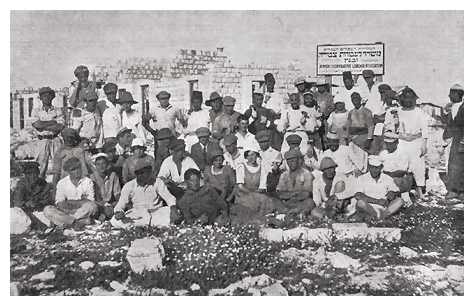
Something will be told here about the “Grodno Group,” which existed in the Land for more than three years, in the days of the Third Aliyah. Its foundation lay in the three first groups that immigrated from Grodno and its surroundings, part of whose members had been training for years in the “Tzeirei Zion” movement and in “Hechalutz” and in the Histadrut there. The first of the Grodno pioneers, the nucleus of the group to come, who reached the Land a few months after the affair of Tel Hai, were tested upon their arrival, taking part first in defense activities in the Galilee; afterward they were among the first workers in laying the road around Tiberias — Tzemach, until they went up to Roshmiya to engage in the afforestation of the Carmel. Members of another branch of the group, which descended to the Land after many hardships, passed first through the laying of the road between Haifa and Jeida (Ramat Yishai). The afforestation of the Atlit hills was their first main task (alongside fishing as well). From there its members were called, with the riots of 1921, to the conquest of labor in Petach Tikva, and chiefly in Pardesiya, and to its defense. From here, when they joined the first “Builders' Group” in the Land, they moved to Rishon LeZion, to build there the first row of houses of the Yemenite workers' quarter “Shivat Zion.” The construction work was entrusted to the group by the Histadrut of Agricultural Workers, since there did not yet exist a special workers' institution for this purpose; the “Histadrut for Public Works and Construction,” the precursor of “Solel Boneh,” was established only later.
[Columns 621-622]
Some of the members of the group set up, when the “Joseph Trumpeldor Labor Battalion” was being established, in order to conquer the work of construction in Jerusalem for the Hebrew pioneer. Many of the members of the group continued at their craft in the building trades for years. Some of them rose to an academic-technical level (Yedidya Yunovski and the late Ephraim Pis), and some attained excellent expertise in their branches and showed great inventiveness and resourcefulness in them. They even continue to stand at their calling to this day. Let these be remembered here among them: Arye Ben-Ami=Pis, who is a special expert in the certification of industrial works (his brother, Israel, of blessed memory, one of the Grodno pioneers and a diligent builder of wells, fell victim to an accident during his work); Yitzhak Gan; Isser Kulik — in the management of construction work on housing projects, and especially of the central buildings of the University and the Hadassah hospital in Jerusalem.
The remnant of the group, which absorbed into itself a considerable part of the Grodno pioneers who immigrated from there over time, chose to settle on the land as farmers. In 1921 two of the women members of the group, Sonia Yunovski, of blessed memory, and Sara Kulik-Goren (today one of the settlers of Motza Ilit), were even sent to specialize in agriculture at the women workers' farm in Nachalat Yehuda, under the direction of the Grodno woman of the Second Aliyah, Sima Paporoch-Krasnotzki.
The matter of the longed-for joint settlement, however, was greatly delayed for years, and only part of the Grodno pioneers and of the group merited establishing themselves in independent farming, whether as individuals or in pairs. The first, at the beginning a hired agricultural laborer, was Zecharia Kimchi — as a farmer in a colony near Tiberias. Afterward his brother Shlomo joined him, and Yafa, of the Yelin family, Shlomo's wife, and in Atlit she settled. At the time the group lived there, Arye Gashri-Mostovski also joined. Several members of the Grodno group, among them Tzvi Rotbord and the late Shayme Zak — pioneers of Krynki —
|
|
[Columns 623-624]
attached themselves in 1924 to the group at Geva in the Jezreel Valley. Shalom Berlin and Tzvi Klemfner-Kfari later left the building and stonecutting trades and settled in Be'er Tuvia, the rehabilitated; and Abraham Golov, of blessed memory — in Atarot. Dov Gosman, who remained in Atlit, is today a farmer in the moshava of Even-Yehuda. Chaya Domb³anski-Wisovati turned, together with the Bialystok company and a man of the Grodno group, to the moshav Bet-Herut. And more of the first Grodno pioneers joined, upon their arrival or after a time, the collective farms: thus Chana Bloch; Mina Cohen-Ami; Maria Goldschmid — to Ein Harod; Yaakov Yanovski — to Ramat Yochanan. And the list is certainly not complete. Nor does it include those of the later waves of immigration from Grodno.
The Grodno people, men of the watch, stood firm, together with all the volunteers in the Yishuv, against those who attacked it and plotted against it. On the guard of the Haganah they also fell, in the bloody events of the years 1936–1938. The defenders who came from Grodno: Michael Tzadin — in his moshava Menachemia; Abraham Golov — near Atarot; Isser Tankus and Daniel Statsenetski — in the vicinity of Karkur (Statsenetski was one of the commanders of the Haganah in his place).
With the breaking away of factions from the people of the Zionist-Revisionist camp and its sympathizers from the organization of the general Haganah, there are activists among the Grodno people also in the bodies that split off from it, and among them those who carried out important roles and missions in the difficult years, in the operation of the “Aliyah Bet” of the Betar movement — Yitzhak Yelin, as the emissary of his movement from the Land; Natan Friedman-Yelin (Mor), as a member of the first staff of the movement, in Poland, for the affairs of the said immigration.
Among those active in bringing immigrants to the Land, on behalf of the Haganah organization, across the borders with the Arab countries, there will be remembered from among the Grodno émigrés Manya Shochat-Wilbushewitz, of Kfar Giladi, and Arye Gad. In this crossing activity, as in underground work and other tasks of the Haganah, Arye took part also in bringing out his close ones, and he even prepared a “secret cache” for their personal weapons, which he always carried with him.
In the mobilization, on behalf of the national institutions in the Land, for the war against the German murderers of our people, the Grodno émigrés — and not only the young among them — took their part.
In the Campaigns of Israel: The Fallen, the Commanders, the Industrialists
[Columns 625-626]
Together with the whole Hebrew community in the Land and with the volunteers among the people, the people of Grodno and their children stood firm in the War of Liberation and Independence. And those of them who fell in heroism — may their memory abide in the annals of Israel forever: Aba Boroditsky, Moshe Dovdevani-Wishnewski, Tzvi Zviri (Grisha Zawierszczanski), Yaakov Kaufman, Arye ben Sarah, Eliezer Prodovski, Reuven ben Pesia, and Zecharia Kimchi. Uri, son of Feiga Ilanit and Shlomo Ilan, met his death in Syrian captivity.
Grodno émigrés from the ranks of the Etzel (IZL) and Lehi took part in the combat operations of these organizations and in their commands. Eitan Livni (Bzhozowicz) served as operations officer of the Etzel, and Natan Friedman-Yellin served as commander of “Lehi.”
Isser Kulik, of blessed memory, was commander of a company of the Engineering Corps in the Jerusalem sector, and Arye Gad-Goldschmid had a large part in organizing the supply convoys to besieged Jerusalem.
Grodno natives among the senior commanders of the Israel Defense Forces are: the former military attaché at the Israeli embassy in Britain, Aluf (General) Moshe Goren (Gornitzki); and Aluf Shmuel Tankus, formerly commander of the Navy, afterward head of the training department in that corps. — Lieutenant-Colonel Gideon Shochat, of blessed memory, son of Israel and Manya Shochat of blessed memory, was one of the founders of the Israeli Air Force.
Nachum Wilbush, of blessed memory, together with his two brothers of blessed memory, Gedaliah and Moshe — among the pioneers of industry in the Land — were among the investigators of the possibilities for its development and the pavers of its way, especially in the oils industry. — Bezalel Yaffe, with the help of Gedaliah Wilbushewitz, established and built the first central irrigation enterprise in the Land, at the waters of the Yarkon, near Petach Tikva. — Dr. Moshe Yavnin was among the first of the chemical industry, in Tel Aviv, and his laboratory served the “Haganah” in its early days, in its efforts to manufacture explosives for its needs. — The sons of the Lapidot-Yezerski family, owners of the glass factory in Grodno, established and built the “Gvish” glass-manufacturing plant in Rishon LeZion. — The brothers Yaakov and Avraham Shor fill chief managerial roles in the industrial-economic enterprises of the “Workers' Company” (Chevrat HaOvdim).
Shlomo ben Sarah and Avraham Yaffe, of blessed memory — among the active Zionists of Grodno — to whom much credit is due in the development of industry and commerce in the Land; he was among the founders of the Union for Produce of the Land and of the “Commerce and Industry” company, and among the initiators of the “Levant Fairs” (Yeridei HaMizrach) in Tel Aviv.
In the array of public life in its various streams, in the arms of government and in municipal institutions, in parties, institutions, and public organizations — an honored place belongs to the people of Grodno. In the government of Israel there participated, from the establishment of the State until his death in the year 5731 (1970), the minister Moshe Chaim Shapira. Before that he had been a member of the executive of the Jewish Agency, one of the leaders of “HaPoel HaMizrachi,” today the “National Religious Party.”
In the municipal sphere, Avraham Krinitzi served as the accepted head of the Ramat Gan municipality for close to forty years, until his death in an accident in 1968. Israel Einstein, deputy commissioner of the Northern District, was head of the “appointed committee” of the Nazareth municipality.
Bezalel Yaffe was among the pioneers of the organization of the Yishuv in “Knesset Israel,” a member of the “National Council” (Vaad Leumi), and for years one of the heads of the community in Tel Aviv–Jaffa.
Among the 87 founders of the General Federation of Hebrew Workers (the Histadrut) in Eretz Israel, at its convention in Haifa during Hanukkah of 5681 (1920), were five from Grodno: Eliezer Shochat, and Israel Shochat and his wife Manya Wilbushewitz — the three of them from the people of the Second Aliyah; Yedidya Yanovski and Dov Rabin.
Yitzhak Yelin was counted among the founders of the “Organization of Workers of the Tzohar and Betar,” which preceded the “National Labor Federation” (Histadrut HaOvdim HaLeumit), and is at present deputy mayor of Ramat Gan.
The faithful and meritorious public figure Yitzhak Lowenstein, of blessed memory, was, among other things, one of the pillars in the management of the General Sick Fund (Kupat Holim) in the Land. Dr. Shimshon Tschertok, of blessed memory, served as director of the “Sick Fund for National Workers,” founded by the “National Labor Federation,” and Reuven Yelin is one of the directors of that sick fund.
A pioneering role of great value is known to the Grodno émigrés in the enterprises of the “WIZO” organization — to Hannah Yaffe née Margolin, to Rosa Yavnin her late sister, and to Hannah Maisel.
Among the figures of the political parties in the State of Israel from the people of Grodno, besides those already noted, will also be remembered Dr. Gershon Gershoni, of blessed memory (of “Achdut HaAvoda–Poalei Zion,” its representative on the Zionist Executive Committee of the Histadrut), and Eliyahu Gozhansky (the general secretary of the Communist Party in Israel).
Rabbis, Scholars, Physicians, Writers and Artists
Also in the spheres of religion, spirit, and science in Israel, the people of Grodno occupy a very honored place. The Chief Rabbi of Israel, Rabbi Isser Yehuda Unterman, served in his time as rabbi of the “Forshtot” community of Horodna. The late Rabbi Dov Maayani (Krikstanski) served as rabbi of Magdiel. — Rabbi Yehoshua Chana Tortchin serves as a rabbi in Haifa, and his brother Nissan — in Yehud.
[Columns 627-628]
Serving as heads of yeshivas are these rabbis from Grodno: the brothers Yosef and Shmuel, sons of the religious judge (moreh tzedek) Rabbi Michel David Rozovski, of blessed memory — the first at the “Or Israel” yeshiva in Petach Tikva, the second at the “Ponevezh” yeshiva in Bnei Brak; Rabbi Yehuda Kolodicki, at the “Yeshivat HaYishuv HeChadash” in Tel Aviv. Rabbi Moshe Bulbin directs the “Jerusalem Yeshiva” in the Holy City, and Rabbi Shabtai Shmueli (Tobolski) serves as secretary of the “Rabbi (Kook) Yeshiva” in Jerusalem. Rabbi Mordechai Galburd, grandson of Rabbi Avraham Galburd of blessed memory, was until his death the director of the Yeshivas Organization. Rabbi Zerach son of Rabbi Zalman Shapira is head of the “Knesset Bnei HaGolah” yeshiva in Jerusalem.
Natan Grosovich serves as professor of bacteriology in the Faculty of Medicine of the Hebrew University in Jerusalem, and recently published the first Hebrew textbook on bacteriology.
As physicians in the Land served: Dr. Mordechai Boroditsky, in charge of the medical service of the Tel Aviv school network; Dr. Ben-Zion Weinshal, formerly one of the leaders of the Physicians' Association in Eretz Israel; Dr. Mordechai Lifshitz, a blood-disease specialist at “Hadassah” in Jerusalem; Dr. Sarah Soloveitchik, formerly one of the leaders of “WIZO” and physician of the “TOZ” in Grodno; Dr. Mordechai Shmukler — all of blessed memory. Dr. Moshe Statborowski, may he be distinguished for long life, directs a surgical department in the municipal hospital.
Among the people of Grodno in Israel there are also those who created in the field of literature and journalism of various kinds: the poet Leib Yaffe, of blessed memory, who also engaged in editing (of the newspaper “Haaretz,” the “Congress Book,” and others), and in the field of fiction and the translation of works into Hebrew; Chaim Shalom Ben-Avram (Avramson), of blessed memory, formerly a resident of “Forshtot” in Grodno. — Eliezer Shochat, a man of complete self-realization and one of the founders of the Labor movement in Eretz Israel. — A militant publicist and editor, Achi Golnitzki, and Yitzhak Golani. — A keen and many-sided journalist and author in her writing (her books: “In the Footsteps of Jews — Notes of a Journey in the Lands of the Holocaust,” and “In Tents” (BaOhalim)) — is Rachel Adiv.
Among the theater people, Grodno natives in Israel, may be noted: Shimon Finkel (actor of “Habima”), an eminent director and creator; Israel Rubinchik (actor at “Habima”); Matityahu Z”k and Rachel Markus (at the “Cameri” theater); Avraham Abramowicz, of blessed memory, and Grodner-Chaim Shalom Avraham (Yiddish actors).
Among the cultivators of music in the State of Israel are recorded here the Berzowski brothers (sons of the conductor of the choir of the Great Synagogue in Grodno): Shaul — the conductor-composer, and Azriel (Lola) — the teacher-musician. And among those active as patrons of the arts, music included, will be remembered Arye Goldschmid-Gad, of blessed memory, who did much, in his kibbutz at Ein Harod, to establish the “Mishkan LeOmanut” (Museum of Art).
Bearers of the Name of Grodno and Its People, in Israel
A “Grodno Court” (“Horodner Hoyf”), which was acquired by the “Kollel Horodna” at the beginning of the 1850s, existed in the Jewish Quarter of the Old City of Jerusalem, until it fell into enemy hands during the War of Independence, and returned to us in the “Six-Day War.”
“Batei-Horodna,” on Yelin Street in Jerusalem — a neighborhood also called “Minchat Yehuda,” after the philanthropist “Rabbi Yehudel Horodner,” the first to contribute from his money to its building — exists still from the year 1902.
In the Ponevezh Yeshiva town in Ashdod, there exists a spiritual center named “Yeshivat Grodna HaGedolah” (the Great Grodno Yeshiva).
The name of Leib Yaffe, of blessed memory, is borne by the kibbutz Talmei-Yaffe near Ashkelon, a street in the Talpiot neighborhood of Jerusalem, and streets in Petach Tikva and Ramat Gan.
Streets named after Grodno people no longer living: Gedaliah Bublik, one of the leaders of “Mizrachi” in the USA — in the veterans' housing in Netanya; Akiva Arye Weiss, in Tel Aviv; Dr. Yosef Chazanowicz — in Jerusalem and Tel Aviv; and also Bezalel Yaffe, Aharon Kahanshtam (director of the “Hebrew Pedagogical Courses” in Grodno), and Shmuel Yosef Fin — in Tel Aviv. “Rechov HaShnayim” (Street of the Two), in Karkur — after the defenders Isser Tankus and Daniel Stanecki, who fell there at their post in 5697 (1937).
A public garden and a colored fountain named after Manya Shochat-Wilbushewitz, of blessed memory, were established on Mount Carmel, in Haifa, near the “Rothschild House.” A prize named after Moshe Wilbushitz is intended for research into the use of wheat for human nutrition.
[Columns 629-630]
Institutions named in recent times after personalities of Grodno: after the minister Moshe Shapira, of blessed memory — a regional center of the “Shapira” regional council near Ashdod (including a yeshiva, school, youth center, library, and clinic); streets in Ramat Gan and Netanya; a cultural center in Be'erot Yitzhak; a youth hostel in Beit-Meir; buildings in the yeshiva in Kfar HaRoeh; and a prize for religious-Zionist thought and for belles-lettres and religious literature. After Avraham Krinitzi, of blessed memory: “Derech-Avraham” (Avraham Way), which passes through the great crater (Makhtesh) in the Negev; “Gan-Avraham”; a secondary school for carpentry; a prize for sculpture; and the national park of Ramat Gan. “Bet Chana Yaffe” is a secondary vocational school for girls in Nachalat Yitzhak, near Tel Aviv. A library and reading room in the “Mishkan LeOmanut” in the city of Haifa bear the names of Tzvi Givol and of Arye Gad-Goldschmid. The secondary agricultural school of WIZO in Nahalal bears the name of Hannah Maisel-Shochat, of blessed memory.
|
|
|
|
We have brought up here the headings of the deeds of the people of Grodno, in the last two generations, in the campaigns of Eretz Israel and its State. The tapestry is neither complete nor finished, and it will continue in the fortification of Israel and in the ingathering of our dispersed there, to a life of independence and sovereignty, in freedom and liberty, forever.
|
|
JewishGen, Inc. makes no representations regarding the accuracy of
the translation. The reader may wish to refer to the original material
for verification.
JewishGen is not responsible for inaccuracies or omissions in the original work and cannot rewrite or edit the text to correct inaccuracies and/or omissions.
Our mission is to produce a translation of the original work and we cannot verify the accuracy of statements or alter facts cited.
 Hrodna, Belarus
 Yizkor Book Project
 JewishGen Home Page
Copyright © 1999-2026 by JewishGen, Inc.
Updated 10 Jun 2026 by LA