 |
|
|
[Columns 517-518]
They said: “Come, and let us cut them off from being a nation, that the name of Israel may be remembered no more.” Psalms 83:5 “O earth, cover not my blood.” Job 16:17
Translations by Guillermo Levrio*
[Columns 519-520]
At the Gates of Hell
by Dov Rabin
Bombing and Bewilderment
A consuming fire from the heights suddenly shook and flooded Grodno in the dead of night, toward June 23, 1941. It was one of the cities within the sphere of Russian rule upon which the Nazi aircraft first laid their lightning attack from the air. Wave after wave, in a storm wind through the skies of Grodno, they rose and poured down upon it without pause a hail of explosive and incendiary bombs. The first of them fell near the bridge over the Niemen, close to the army barracks. A dreadful panic seized the bewildered inhabitants, who at first did not grasp the meaning of the disaster and did not know where, how, or in what way to find shelter.
Half of the residential houses in Grodno became prey to the flames of the bombing. In the “suburb,” all the quarters south of Lipowa Street were burned, including the ancient wooden synagogue. In the city itself, everything above the Niemen — from Podol to Batory Square, as far inward as the corner of Castle Street, Zamkowa, on one side, and beyond Mieszczañska and Bonifraterska Streets, the “new market,” as far as the water-pump tower on the other — was consumed.
Only the day before, the Soviet authorities had still managed to carry out a “purification” in the city and to evacuate from it those whom they considered “elements hostile” to the Communist regime. But now even the army men themselves fled for their lives, leaving the inhabitants to their fate.
The roads eastward filled with groups of Jews fleeing in panic from the enemy, abandoning everything behind them, while the predatory bombers pursued them, even catching up with convoys of evacuees and wreaking destruction among these as among those. Whoever remained alive had no choice but to retrace his steps amid the chaos and make his way along roads strewn with corpses and wounded people, severed, abandoned, and writhing in their death throes. Only a few of our people from Grodno were lucky enough in their flight to escape into inner Russia, beyond the war front, with all that awaited them there.
Hatred, Coercion, Abuse
No sooner had Grodno been conquered by the Nazis than the local haters of Israel began to pour out the full measure of resentment stored in their hearts against their Jewish neighbors. In posters that appeared in the streets, the Germans were presented as redeemers who had come “to liberate the Poles from the Jewish-Masonic yoke.” And when a severe food shortage immediately arose in the city and everyone began crowding in long lines in order to obtain some ration of bread, the guardians of hatred stepped forward to drive by force from the lines anyone whose face showed a Jewish appearance.
Two days after the invasion of the German thugs, all Jews between the ages of sixteen and sixty were obligated to forced labor from then onward, without compensation in wages or food. Everyone was ordered to report for this purpose every morning in the courtyard of the Great Synagogue, from where they were sent wherever they were sent. They were also obliged to obtain a “work certificate,” in which it would be marked whether its bearer had fulfilled his day's work and where.
In the streets, a hunt was conducted for Jewish passersby, including women, and they were seized for “work,” whose meaning, most often, was nothing but torment. In the building of the “Royal” café, where the German field police were now quartered, these forced laborers were given murderous beatings. They were abused, smeared with excrement, immersed naked in a pool of water, and ordered to “soap” one another with fragments of bricks, while singing in rhythm, as the Nazi sadists stood over them and urged them on, even photographing the “amusing spectacle.”
Jewish women who were put to hard labor there were ordered to strip off their clothes, wash the floors with them, and then put them back on as they were, with all the filth that had soaked into and clung to them. Their tormentors did not say “enough” until they had poured wastewater over them. At the same time, other Jewish women were brought to the vegetable gardens in the area and ordered to weed, not kneeling or crouching, but only bent over at the back.
Decrees
On June 30, Jews were forbidden to visit the markets or walk on the sidewalks. Even on the roadway they were permitted to move only on the right-hand side and only singly. They were also ordered to remove their hats before every German in uniform, to wear on the left arm a white armband with a blue Star of David on it, and likewise to mark their homes with a Star of David. Some time later an order was issued to replace the armband with yellow patches in the shape of a Star of David, sewn onto the outer garment and onto the one beneath it, on the chest and on the back, on the left side.
About twelve days after the entry of the Germans into the city, the Jews were required to register, and their identity papers were stamped with the word “Jew.”
[Columns 521-522]
Radio receivers were confiscated, and listening to broadcasts was forbidden. Beatings of Jews in the street, attacks on them and on their homes, robbery, and other acts of terror against them became a daily routine.
The Establishment of the “Judenrat”
About two weeks after the Nazi invasion of Grodno, the field command of their army ordered its Jewish interpreter, David Brawer, formerly an administrator in the Hebrew educational network of “Tarbut,” to establish a Jewish representation in the city and to stand at its head. He was ordered explicitly to form the “Council of Jews,” the Judenrat, consisting initially of ten members, within twenty-four hours.
It is told that among the activists of the various circles and currents, whom Brawer summoned to decide on the establishment of the Judenrat, opinions were divided. Some warned that this was nothing but a deceptive stratagem on the part of the Nazis, so that a Jewish representation would make it easier for them to carry out their murderous plans. The majority, however, found that it was necessary to establish an institution that would represent the community and that might be able to act to blunt the edge of the decrees. Moreover, it was impossible not to care immediately and with all urgency for those who had been burned out, for orphans, for the sick poor, and for all the others suffering and in distress, of whom there were now so many in the Jewish community of the city.
As Brawer later related, the balance of power among the public currents in the community, excluding the Communists, served to some extent as the key to composing the “Council of Jews.” Thus, according to the testimonies, the ten members of the Judenrat included: David Brawer, who was appointed “Head of the Jews” in Grodno; the lawyers Yitzhak Gozhansky and Abraham Zadai; activists of the Jewish merchants and their public representatives, among the leaders of the Cooperative Merchants' Bank — Abraham Lifshitz, its chairman, and Yaakov Efron, its director; the industrialist Asher Kosowski; the economist and expert in financial affairs, public activist and former deputy mayor Yehoshua Sukhovlanski; Zvi Tarlovsky; the Orthodox activist R. Ze'ev Wolf Berman; and Dr. S. Bik.
The number of members of the Judenrat was later increased to twenty-four. Among its additional members are mentioned: teachers of “Tarbut” — Dr. Tzvi Belko, Israel Landa, Ze'ev Yekel, and Israel Grub; the industrialist Aharon Yezerski; the physician and Bund activist Dr. Yehuda Lipnik; the lawyer Y. Fürstenberg; and, for a time, the owner of the lithography shop, Lazar Meilachowicz, who later withdrew from this institution. In individual testimonies, the lawyer Yehoshua Neubauer is also mentioned as a member of the Judenrat, as is Abramowicz, a textile merchant in the suburb.
Killing
At the beginning of July, a unit of the Gestapo — the Geheime Staatspolizei, the Nazi secret state police — arrived in Grodno. They demanded from the heads of the Judenrat that they submit to them a list of “distinguished Jews” in the city. As is known, it was the practice of the Nazi authorities, and of the Gestapo in particular, that every demand they made was accompanied by a threat that failure to fulfill it on time would bring about the execution of such-and-such a number of Jews. Moreover, at that time the Jewish communities were still far from being able to penetrate fully the meaning and abyssal depth of the demonic plan of destruction. The requested list was therefore submitted to the authorities.
Immediately, the tormentors arrested eighty members of the community's intelligentsia and finest people, led them wherever they led them, and no trace of them was known. Only after some time did it become known that they had all been murdered in cold blood in the forts in the surrounding area. This was the first killing of Grodno Jews by the Nazi scum, and this community was not alone in this; but one community did not know what the murderers had done to another, for all of them had been made to dwell alone, enclosed under siege and destruction.
Thus, bound and sacrificed, fell some of the finest sons of the Jewish spiritual elite — may their blood be avenged. Among them were: the young rabbi R. Zvi-Hirsh, son of R. Michel David Rozovski; the lawyers Moshe Gliksfeld and Rafael Lubman; some of the best teachers — the historian of Grodno Dr. Chaim Woliczker, Y. Kaminski, both from the real gymnasium, Yehoshua Fruchterman, Yosef Wigdorowicz, and others.
“Contribution” and Extortion
At the beginning of August, Grodno was included within the territory of White Russia. A civil governor was appointed — an evil monster named Becker — later governor of Minsk and destroyer of its Jews. This tyrant, who cast mortal fear upon the representatives of the Judenrat who were forced to come into contact with him, immediately imposed, with an unmistakable threat, a heavy contribution upon the Jews in objects and clothing, and afterward, partly, in money.
The Judenrat therefore had no choice but to fulfill without delay what was demanded, in order to satisfy the Nazi appetite for extortion. For this purpose, two departments were established in it — one for confiscations and one for finances. The first had to collect and confiscate from Jewish homes furniture, tablecloths, sets of eating utensils, and other objects, as demanded by the appetite of the German officers. The first task of the finance department was to collect the ransom money of the community for the Nazi authorities. Special one-time levies were imposed for this purpose on those of means, and in the course of time a regular comprehensive tax system was introduced. Within several weeks, therefore, from the Jews of Grodno — half of whom had been burned out and the rest impoverished already from the days of Soviet rule — about 200,000 dollars in cash and valuables were extorted.
[Columns 523-524]
Aid to Brethren
The first task of vital importance that stood before the Judenrat was to do something to provide food for the Jews of the city, and especially to ease the distress of the many destitute members of the community. The department of social aid was now established and began to operate immediately. A collection was organized for the needy, and the Jewish public responded willingly and generously, donating especially all kinds of clothing and footwear. In the attic of the former community building on Hoover Street, where the Judenrat was now housed, a temporary laundry was also set up, and volunteers would come there to wash, mend, and iron linens and clothes for distribution to the needy. Bread and also money were distributed to them as well.
At the same time, the Judenrat established a department for registration and documentation, and after some time, departments for supply and labor. Later the Ordnungsdienst was also set up — the so-called “Jewish Order Service,” that is, the Jewish militia or police.
Expulsion from the City Center
At the end of September, the Jews living on the main streets — Dominikañska and Orzeszkowa — and the inhabitants of “Slobodka,” were ordered to move out from there, all of them, within a few hours. The expelled now suddenly lost not only their real estate, but also most of their remaining property, which they were not allowed to transfer or which they could not transfer at once.
After some time, Grodno was removed from the territory of White Russia and annexed, as part of the entire “Bialystok District,” to the “Third Reich,” at first formally, and in March 1942 also in practice — to East Prussia.
“In the Third Reich Such a Thing Will Not Be Done”
Before long, the first terrible tidings began filtering through and reaching Grodno about the catastrophe the Nazis had brought upon masses of Vilna Jews, and about the atrocities the murderers had committed against them. Reports also came in rapid succession about the massacres in towns, some of them close to Grodno, about the burning of study houses and the abuse of our Jewish brethren, and about other deeds of terror against them.
But the broad public among the Jews of Grodno — and also in Bialystok — chose to amuse itself with vain hopes that the evil would not reach them, since in the “Third Reich,” among whose inhabitants they were now “counted,” “such a thing would not be done.”
On the Threshold of Imprisonment
Meanwhile, rumors began to multiply and grow stronger that the Jews of Grodno too were about to be locked into a ghetto, and that a certain area was being designated for this purpose. But no one yet grasped the true meaning of the matter, and opinions about it within the community were divided. Those who were confident argued: “In the 'Third Reich' things will not reach such a point.” There were others who thought that the enemy probably meant only to prevent Jews from trading or from visiting non-Jewish neighbors.
In general, it was not considered possible that tens of thousands would be imprisoned behind a barbed-wire fence. Certainly the far-reaching plan was not understood in its true meaning: that this was a stage on the road to the destruction of an entire people. On the other hand, the Jews were already exhausted from enduring the break-ins of the Nazi ruffians into their homes and the boundless arbitrariness and abuse against them. It seemed to them that, concentrated together and fenced off from the outside, they might perhaps be better protected.
Nevertheless, heavy suspicions gnawed at the heart, and fear of what was to come now embittered life and gave no rest. The situation on the war fronts did not yet inspire hopes for the better either, for the Nazi thugs still stood at the height of their victories at the gates of Moscow and Leningrad.
Many therefore began feverishly preparing for the coming days — stocking up on food and selling, for half nothing, furniture and objects and anything that seemed in any way unnecessary for an emergency transfer. The non-Jewish neighbors now pounced on the unusual opportunity to profit handsomely from the Jews' disaster and to acquire, for pennies, the fruits of their labor and their property. There were quick-moving peasants who went around the city and returned to their villages joyfully in their wagons, filled and overflowing with all kinds of goods from Jewish homes, which now fell to their share for mere tokens.
There were also Christian “friends” who came to their Jewish acquaintances, ingratiating themselves and asking them to entrust some of their movable belongings to them, to keep them “until the wrath had passed.” There were also those who “invited” the victims to them, threatened to denounce them to the Gestapo as “speculators,” and took from them their last garment and shirt and drove them away.
Lately, rumors began to circulate among the public that not one enclosure would be designated for the Jews of Grodno, but two ghettos — something that now cast fear and trembling, especially upon those who had reflected on the Vilna affair and on the terrible end of one of its ghettos.
At the same time, one day an order appeared requiring all Jews engaged in a trade to equip themselves with a “craftsman's card,” which could be redeemed from the authorities for a suitable payment. Everyone now regarded such a card as a certificate of salvation, for it was clear that the Nazi war machine needed craftsmen and skilled workers, and these would surely not be first in line on the day of judgment. Whoever still had one last object left to sell ran in the final hour to sell it at any price and hurry to the Judenrat office, to squeeze in there among the crowded mass struggling for the right to redeem the fateful card and to become, from then on, a Jewish glazier, baker, electrician, or some other required craftsman with a chance of prolonging his life.
The distribution of these certificates ended on Friday of that week, and
[Columns 525-526]
before the Sabbath had even managed to spread its wings over Jewish Grodno, a terrifying report shook everyone: the Germans demanded that two companies of workers, equipped with shovels and axes, be supplied to them for the Sabbath. Some said that this indicated preparations for a mass slaughter; others saw it as preparation for the establishment of a ghetto.
Before those who rose early the next day, Saturday morning, November 1, 1941, notices appeared in the streets in thick black letters, surrounded by a broad red frame. Their title was: “Order for the Establishment of a Jewish Quarter in Grodno.”
The Jews were required to be, by the following day, Sunday, November 2, in only two quarters designated for them. One, set aside for skilled workers — “Ghetto A” — had the Shulhoif as its center and would include the area between the courtyard of the Great Synagogue and Vilna Street on one side, and between the top of the slope down to the Horodniczanka stream and the northern side of Zamkowa Street, or the courtyards of the houses whose fronts faced Dominikañska Street, on the other.
Ghetto B, for all the rest of Israel, the “non-productive,” would be located in “Slobodka,” between the top of the slope above the railway line canal and the main road beyond the village of Pohulanka on one side, and between the road leading to Skidel and the Christian cemeteries on the other.
The Jews, the order said, were to move into the ghettos from twelve noon, and not before, until six in the evening, after which they were forbidden to leave these quarters. Anyone violating the order would be punished with the most severe penalty.
The work companies went out to their task, drove posts two meters high around the designated ghettos, and stretched around them a tangled fence of barbed wire. In each ghetto, only a single entrance gate was established.
The Entry into the Ghetto
There were those who tried already during the Sabbath day to smuggle some of their movable belongings into the ghetto, but a dense network of patrols of German and Polish policemen was spread over every corner of the city, to confiscate every bundle from Jewish passersby and to give them murderous beatings in exchange. Local Christians also took part in the hunt for the Children of Israel, showing particular eagerness in handing Jews over to the policemen.
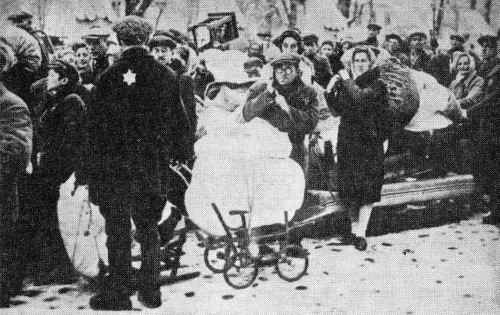
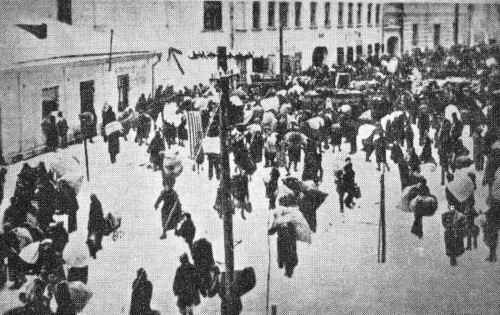
That night the first snow fell and covered the face of Grodno. But by morning it began to melt; the ground beneath it filled with puddles of water and became sticky, deep mud. At the appointed hour, the Children of Israel poured out in masses into the streets, their bundles on their shoulders or in wheelbarrows and baby carriages, and their faces turned toward the ghettos. Any use of vehicles or other transport was forbidden to them. Most of them did not know to which of the ghettos they had to turn, and confusion and wandering increased. Everyone ran as if stunned by thunder, trying to arrive first and find for themselves and their households some place of shelter.
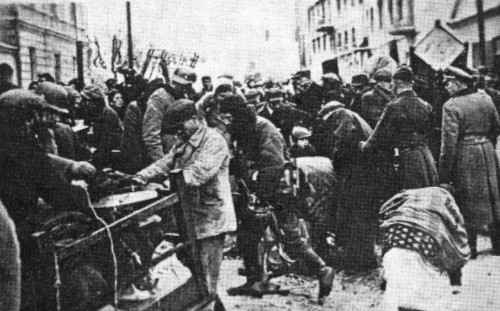
On the roads to the ghettos stood Polish and German policemen, supposedly to maintain order, but in fact to increase panic and confusion. They searched the belongings of the Jews hurrying in their masses, and robbed whatever their eyes desired. “Aryan” neighbors also attached themselves to them, offering their help, supposedly, and taking for themselves objects of every kind.
But before entry into the ghetto came an “inspection,” and the gate was too narrow to pass through. Thus, on a gloomy day, standing in the deep, sticky mud, masses of the House of Israel of Grodno — fifteen thousand people, from old men to nursing infants — stood in a line stretching along Batory Square and Zamkowa Street, up to the entrance of the butcher's alley, the narrow “Yatke-Gesl,” watching and hoping that they would be allowed to enter their enclosure.
It was a horrifying sight to behold, an eyewitness relates: an entire people standing in frenzied haste, laden with all the “property” that remained to it — these bundles on its shoulder — like the Exodus from Egypt, which surely was only a kind of children's game compared with this uprooting into the ghetto. In the arms of many were whimpering infants freezing from the cold, and all together they pushed and crushed one another to the point of mortal danger, stunned, turbulent, some even quarreling among themselves in their impatience. One still imagined he could slip away on one foot to the apartment he had just left and carry from there some additional object or a few pieces of wood for heating, while his fellow was seized with anxiety lest he arrive late and no longer find a roof over his head for himself and his household.
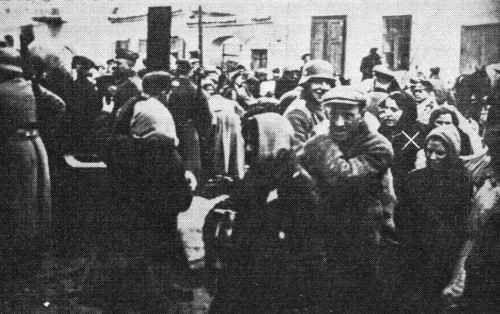
And here stood and raged the Nazi villains and greedy men appointed over the “inspection” of the bundles. As was their way, they deliberately sowed disorder and chaos in order to increase confusion and suffering. Every valuable thing that their hearts desired was immediately “confiscated” and placed into their own containers; and every object that their urge to abuse moved them to deny the Jews was thrown aside into the mud and ruined.
A crowd of Poles from among the inhabitants and civilian Germans gathered here as well, as did “merciful sisters,” daughters of the Teutonic “master race,” from the nearby military hospital. These women “helped,” supposedly, with the inspection. They spared no one; they did not shrink from rummaging in the trouser pockets of men down to their private parts, and they did not disdain to obtain by force even the smallest of trifles. The heaps of remnants of the fruits of Jewish families' labor — down to the last footstool or pillow from their furniture and bedding — piled up and rose higher here before everyone's eyes, beyond the barbed-wire fences outside the ghetto, with no one to claim them.
Such was the road to Ghetto A, the “privileged” one, for craftsmen and for those whose purses had enabled them to acquire “craftsman's certificates”; and such was also the entry into Ghetto B, which was designated for the rest of Israel, including skilled workers who had not been fortunate enough to redeem the imaginary “certificate of salvation.”
At six o'clock in the evening the gates were locked. The Jews of Grodno were now imprisoned behind them.
|
|
| On the day of the entrance into the ghetto, on Zamkowa Street. At the ghetto gate (where the arrow is), at the Yatka Gesl corner; the central building is the Judenrat headquarters. |
|
|
| Waiting in line to enter the ghetto |
|
|
| Grodno Jews on the way to the ghetto — the Nazis' search of entering Jews |
|
|
| After the search. On the right, marked with an X, is Yehudit Lapin. |
|
|
JewishGen, Inc. makes no representations regarding the accuracy of
the translation. The reader may wish to refer to the original material
for verification.
JewishGen is not responsible for inaccuracies or omissions in the original work and cannot rewrite or edit the text to correct inaccuracies and/or omissions.
Our mission is to produce a translation of the original work and we cannot verify the accuracy of statements or alter facts cited.
 Grodno, Belarus
 Yizkor Book Project
 JewishGen Home Page
Copyright © 1999-2026 by JewishGen, Inc.
Updated 16 Aug 2026 by LA