 |
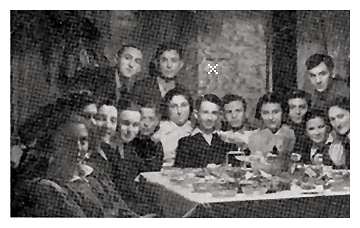
Standing first from right is Gedalia Brovarsky; sitting in the center (marked with an X) is Sheike Matus; third from left is Miriam Popko
|
|
[Columns 547-548]
Translations by Guillermo Levrio*
The Beginning of a Joint Underground
At the beginning of 1942, a joint underground was formed in the Grodno ghetto for active resistance to the Nazi tormentors. Israel Landa, a veteran member of Poalei Zion–Z.S. and formerly a teacher at “Tarbut,” tried to establish a movement with this aim together with representatives of other parties, such as Tankus, a Communist woman; Eliyahu Tankus and Miriam Popko from “Hashomer Hatzair”; and Chaya Urbach-Dubinsky from the Bund. As stated, Yaakov Leizerowicz of the Betar movement maintained similar contacts with him.
Among the participants in the joint committee for the underground from among the Communists are mentioned, among others, Shlomo Zhukovsky and Israel Reisner; and from the members of the Communist youth — Liza Chapnik and Ania Rud.
However, the attempt to maintain the movement did not succeed. The Gestapo came upon the trail of the activists, and they were forced to stop the meetings until an opportune time.
Optimism Beside Anxiety
The year that passed over the ghettos of Grodno, since their establishment in November 1941, was supposedly “stable and quiet.” Despite everything and in spite of everything, most of the Jews became accustomed and adapted even to the life of the enclosure with all its suffering. Our brethren displayed, as we have shown above, endurance, organizational ability, great creative capacity, and readiness for mutual aid in the face of the enemy's plan to destroy them “by natural means” — through hunger, epidemics, and the crushing of their spirit to the dust.
They hoped, and many believed, that they would hold out and “outlast” their tormentors. The optimism was not shaken, despite the grave reports and tidings that filtered into the ghetto, and not only through anonymous youth emissaries.
Thus a refugee reached the enclosure who had himself escaped from Warsaw and told, in deepest secrecy, that the Jews were being deported from there “to work,” supposedly, and it was not known where; and it was assumed that their road had not been long.
In May 1942, Jews escaped to Ghetto B in “Slobodka” from Lida and told of the terrible slaughter of our brethren there. Similar reports came in rapid succession from other settlements in the distant and nearby surroundings within Belorussia, about massacre, killings, and total annihilation. But in Grodno, the faith of many had not yet vanished that “with us, in the 'Third Reich'” — in which Grodno was included, as recalled — “such a thing will not happen.”
This is noted by the witness Leib Reiser, who adds that healthy reason was not yet capable of digesting the truth in its full meaning, or of believing that human beings born of woman could reach such cruelty as the complete extermination of an entire nation.
At the beginning of autumn, persistent rumors spread that the Jews of Grodno were about to be sent to work somewhere, and from day to day the authority attributed — as people whispered from mouth to mouth — to “reliable sources” for these reports increased.
The Closing of the Ghetto
Thunder of gunshots suddenly awakened the residents of Ghetto A in the night toward November 1, 1942. Everyone was alarmed and frightened, not knowing what had happened, awake and wondering whether they were destined for slaughter or for deportation.
[Columns 549-550]
Toward morning the ghetto was found to be completely blocked and sealed off, surrounded by various SS men and machine guns all around, even at special commanding positions. Exit beyond the gate was forbidden, and anyone who violated the order did so at the cost of his life.
Control over the ghetto was handed to the Gestapo, and the fate of its Jews was placed in the hands of two arch-villains: Kurt Wiese, commander of Ghetto A, and his deputy Streblow, in charge of Ghetto B. Both were thin, tall men, wearing caps that bore the emblem of this band of murderers: a skull with human bones beneath it.
“Jews gathered in groups, wondering and arguing and raising various conjectures,” relates Yosef Freilichman, a man of Ghetto B. “Surely they mean to send people to work somewhere far from here,” one reasoned. “Perhaps they intend to conduct a thorough search for prisoners who have recently slipped into the ghetto,” a second expressed his opinion. “No,” another Jew argued, “they are planning to impose heavier contributions.”
“In the afternoon the tension in Ghetto B increased,” writes Leib Reiser. “Beyond the fence, peasant wagons could be seen dragging along, with elderly Jews, women, and children crowded in them, blue from the cold, huddled and pressed together like bound victims, with bundles in their hands. These were the people of the surrounding towns, who had now been expelled from their homes and were being led to the infamous 'collection' camp, that hell of Kielbasin.
“Behind the wagons walked all the rest in formation, the men, and alongside them a guard of armed civilian Germans, of those who had gathered in the occupied territory to rake in easy profits from the destruction of Israel and to pounce upon the spoils. Drawn pistols were in their hands, and from time to time they fired shots into the air, to frighten the bewildered and terrified victims into utter submission.”
Today we know from German documents that already in October 1942 a secret order had been issued to liquidate all the Jewish settlements in the “Bialystok District.” This order was now carried out, on November 2 of that year, except for several ghettos, including part of Grodno and Bialystok, and two or three additional settlements, which received “extensions” for a shorter or longer time. It is assumed that their importance for production for the war effort still stood them in good stead until their hour would come.
Only the Jews of one town in the “district” rebelled:
Marcinkańce, north of Druskininkai. Some of them fled from the town even before the time at which they had been ordered to report for deportation. The rest broke through the ghetto fence and dismantled it before the eyes of the murderers. Some attacked the killers with their fists, striking and kicking them and wounding them. One hundred and five, including women and infants, fell when the Germans opened fire on the crowd, but not one Jew was captured alive.
The remnants of the town scattered through the forests. Some of them, especially the Kobrowski brothers, fought with courage in guerrilla warfare against the enemy. Among them were those who were the first to bring news of the existence of partisan units in the surrounding area to the Grodno ghetto, where Jews from this town also found refuge.
The fate of the Jews of Grodno too had of course already been sealed — though they did not yet know it.
The Visit of Mordechai Tenenbaum
Tzipora Berman, one of the activists of “Hechalutz Hatzair,” a member of the “Tel Hai” training kibbutz in the Bialystok ghetto, who worked on behalf of the movement in Grodno, described the mood there in those days among the pioneering underground in a letter of March 1, 1943, which has been preserved. When the ghetto was sealed off and the convoys of deportees from the surrounding towns were seen being led to Kielbasin, the feeling was: “We will not let them lead us to Treblinka.”
The comrades, she wrote, decided to prepare forged “Aryan” documents in order to reach Bialystok and join the pioneering underground there. “They are imitating a German stamp and making documents with the help of members of the party who work in a German printing house” — the reference is to the former printing house of Meilachowicz — “but it is difficult to obtain information from Bialystok.”
And then a letter from Mordechai Tenenbaum-Tamaroff arrived in the ghetto, in which he wrote that he was in a village near Grodno and needed help in money and clothes.
The story, as became clear, was as follows: Mordechai traveled from Warsaw to Bialystok, but when he reached that city he did not succeed in entering the ghetto, which was sealed off there as well. He therefore continued on his way to Grodno at night, carrying his forged document in the name of the Tatar Józef Tamaroff. Mordechai had a Jewish face, and therefore he chose for himself a Muslim name, since Muslims too are circumcised, and a “check” of his body would not be the thing that might now trip him up.
On the train journey, a gendarme who examined his document became suspicious of it and intended to arrest Mordechai. He struggled fiercely with the German, jumped from the speeding train not far from Lososna, and broke his leg. With the last of his strength he managed to reach the village of Pilsudy, near Kielbasin. A peasant woman, to whom he revealed the truth that he was a Jew, took him into her home and hid him for several days, until he recovered somewhat. She was also the one who brought the first news of him to the Grodno ghetto.
The note reached Dr. Belko, and the members of the movement hastened, with awe and love, to fulfill Mordechai Tenenbaum's request. A few days later he arrived in the Grodno ghetto.
This was his second visit to the place, for on his first, at the beginning of 1942, he had worked to establish a joint underground organization for active self-defense with the Communists and the Revisionists. Some time before that, his companion, Tema Schneiderman, had visited Grodno on her way from Warsaw to Vilna — a daring emissary of the Jewish Fighting Organization and one of the activists of “Hechalutz.” According to Mordechai's testimony, she was “the living treasure of information about the suffering and martyrdom of Polish Jewry.” She told of the horrors of the mass deportation from the Warsaw ghetto in July–September 1942. Consultations were held with her in the movement, and the path that emerged from them was: to go out to the forest.
Mordechai now arrived at the Judenrat broken and shattered, Berman wrote.
He believed that he was being pursued, and he was worried about his documents, which he had lost —
[Columns 551-552]
during his escape from the gendarme. And again, it was agreed in consultations, she notes, that “there is no other way except to the forest, to the partisans,” and that “the comrades are even entertaining the idea of partisan units of their own.”
A meeting was arranged for Mordechai — as he presented himself, without revealing his name — with a group of young people and adults together, wrote one of those present. After he told them about what was happening in the ghettos, about the fate of those sent to “work,” supposedly, and about the activity of resistance groups in various ghettos, as well as about cooperation with the Polish underground movement, Mordechai placed before the participants in the meeting the following conclusions and demands:
Mordechai, it is told, analyzed at the aforementioned meeting the situation and conditions in the Grodno ghetto and found them unsuitable and unprepared for any proper manifestation of resistance. It was therefore decided to transfer the active members — in practice, primarily women comrades — to the Bialystok ghetto, where conditions existed for organizing a more planned uprising, and also that the other members should seek contact with the partisan movement.
The next day a collection was held in the ghetto for self-defense. It was conducted mainly by Moshe Plotkin, formerly a bookkeeper at the “People's Bank,” whose father had once served as rabbi in the suburb, and, may he live long, Abba Tarlovsky, who relates:
“The head of the Judenrat, David Brawer, was the one who introduced me to Mordechai, as someone 'who had come from Warsaw to collect money for buying weapons.' He, Mordechai, told us that we were being liquidated and would be sent to Treblinka, and he proposed collecting money, jewelry, and valuables for the purpose of self-defense. Brawer himself was not present at that conversation, but afterward he asked me my opinion, and whether I was prepared to devote myself to organizing the collection. I agreed, on condition that a reliable person, known in the public, would accompany me. And so Plotkin and I went through various houses, collected a large sum, and handed it over to Brawer.”
“Mordechai,” writes Tzipora Berman, “fulfilled his role in Grodno, raised funds, prepared various documents and exit permits, and while his leg was still broken, succeeded in breaking a way out of the sealed ghetto and left by train for Bialystok with a transit permit he had prepared for himself.”
The Day-to-Day Life of Angels of Death
After several days, they again began to take people out to work outside the ghetto, this time escorted by an armed military guard. Wiese and Streblow now fixed their eyes on everyone going out, and if anyone fell into their hands without a permit for this, his fate was one: a fatal bullet on the spot.
During the daytime, inside the ghetto, they hunted cats. If a kitten came into their hands, they would stroke it, pamper it, and play with it until they shot it.
They also showed special concern for hygiene in the ghetto, and woe to anyone whose apartment or corner did not satisfy them: his sentence would be decided immediately.
At five in the afternoon, when the Jews returned from their work outside, Wiese, or both of them, would lie in wait for them at the ghetto gate, to search each person returning and see whether he was hiding with him a letter or some bit of food. And if such a person was caught in his offense, he would no longer receive even the slightest measure of mercy in “judgment,” for Wiese had only one act of kindness: to aim the arrow of death without missing. He was, indeed, a master marksman and trained his hands in murder every day, constantly.
For many days and weeks, therefore, the redness of the victims' blood did not turn pale or vanish from the ground at the entrance of the ghetto, on the threshold of the “office” of the “commander,” the wild beast Kurt Wiese. For he had set up an “office” for himself here in the Poz house, and a sign hung over it: “Transport Office.” He ordered a Jewish artist to decorate its walls with “suitable” paintings, and on the central wall — opposite his “work” table — a picture with the title “Jews on the Way to Paradise”: a procession of the children of Jacob fleeing for their lives, sacks of belongings on their shoulders, trudging through the deep, sticky mud, while the flames of their settlement rising in fire caught up with them from behind.
They Will Be Sent “to Work”
On November 4, a notice appeared in Ghetto B, in Slobodka, in Yiddish, stating that “according to the decision of the German authorities, significant parts of the Jewish population will be sent to labor camps in Upper Silesia. Everyone must take with them for the journey: a work suit, as well as holiday clothes, a towel, a bowl and spoons, brushes for teeth, shoes, and clothing, and food for three days. The date of the transport will be announced separately.” Signed: “The head of the Judenrat in Ghetto B, lawyer Zadai.”
“Part of the public calmed down,” writes Reiser. “'How could it be? It is written black on white that they are traveling to Upper Silesia for work.'”
The streets in the Grodno ghettos and their surroundings were now brightly lit at night, despite the strict blackout that had been ordered until then out of fear of bombing by Soviet aircraft. The danger that, God forbid, a Jew might slip away in the darkness of night beyond the city fence was more serious than the danger of the Muscovite enemy.
Many who had at first dared to go out, however they went out, in order to try
[Columns 553-554]
to find refuge with non-Jewish friends, now began returning to the ghetto at the risk of their lives, so that they would not be discovered while slipping back inside. They told that red posters warned the city's inhabitants that giving shelter to a Jew would be punished by death. “Do not go out to the Poles,” the returnees emphasized. “They will rob you and plunder everything you have and send you away to your fate, if they do not hand you over to the Germans.”
Lenka's Spitting
Among those who had fled into the city was Lenka Pranski, who intended to find shelter with a Polish friend close to her. She was a beautiful young woman, and her face had unmistakably “Aryan” features. But one of those who came to her friend's house recognized her as a daughter of Israel, and there arose a fear that she would report this to the Germans. It was hinted to Lenka that danger threatened her, and she hurried to slip back to her home, but she was caught while trying to escape from a courtyard on Dominikańska Street into the “Talmud Torah” building inside the ghetto.
The day before, a Jewish refugee from Warsaw, Drucker, had also been arrested on the Polish side. He too had not succeeded in finding a hiding place there. Drucker and Lenka lived in a block of houses for which responsibility before the authorities for registering the movement of its residents lay upon Moshe Spindler, of the button and leather-goods business in Batory Square. But he did not inform the Gestapo commander of the absence of the two, so that their families would not be swallowed up.
On Saturday morning, November 7, 1942, Wiese arrived at the Judenrat with several of his companions and ordered ropes to be brought to him. After they interrogated Spindler, they ordered the members of the Judenrat and the police to assemble near Tankus's bakery on Peretz Street. Now the Gestapo men brought the “offenders,” placed them beneath three iron bars intended for a balcony that had not been built, which protruded from the Tankus building, and ordered David Brawer to bring a bench.
First Wiese hanged Spindler. Drucker put the noose around his own neck and kicked the stool away from under himself. Lenka climbed onto the bench, spat in Wiese's face, put on the noose, and jumped from the stool. According to several eyewitnesses, she also hurled at the murderer that his end would be more bitter than hers.
God-fearing people in the ghetto, it is told, declared that Lenka Pranski had merited that her soul reach in the heights the very Throne of Glory of the Almighty Himself.
And an order was issued by the executioner that the bodies were to remain hanging until darkness fell — to warn and to instill terror and fear. This decree was also established as a practice for those cut down by the sword from then onward.
At the Opening of the Liquidation
Great terror now descended upon the Jews of the ghetto, and also upon the Judenrat and its head himself. The heritage of the German school and culture from before the First World War, in which Brawer had been educated, and the ways of his manners, ceremonies, and “persuasions,” were not enough to satisfy the heads of the new authority, the Gestapo beasts of prey. David Brawer's language was not their language.
On November 9, skilled workers and their families began to be transferred from Ghetto B to the one in the Shulhoif. They had entered “Slobodka” at the time because they had no “craftsman's certificates,” or because of the chaos that had prevailed on the day of entry into the enclosures. Crowds now gathered near the gate and tested their strength and agility to slip away from here together with the fortunate skilled workers into Ghetto A. The Germans opened fire, and seven Jews paid with their lives; many were wounded, and it was forbidden to give them medical aid.
Nevertheless, many risked their lives and, with agility, succeeded in mixing among those leaving and crossing over as well to the “good” ghetto. Intervention with the Gestapo by the contacts between it and the Judenrat could also be useful here, by the power of a proper bribe. About 4,000 people thus succeeded in crossing or slipping into the ghetto in the Shulhoif.
The Destruction of Ghetto B
On Saturday night, toward November 15, 1942, the liquidation of Ghetto B began. The inhabitants of Pohulanka were the first to be taken out. In a driving rain, about 1,600 souls were assembled outside, including infants and babies weeping bitterly, who had been hurried from their sleep. The crowd was in turmoil, crying out to be saved, and the murderers fired in order to “quiet” them, arranging them all in ranks of four.
“Under reinforced guard,” relates Yosef Freilichman, “they led us at midnight, laden with bundles, to the city freight railway station. On the way they handed out blows to everyone who lagged behind; the sound of shots rang out, and apparently victims fell. 'Apparently' — because no one was able to see anything except what was happening immediately beside him.
“At the station everyone rushed toward the cars — passenger cars, in fact — because they intended to squeeze families into them family by family. But they were attacked with blows and gunfire by the Gestapo men, who deliberately caused chaos and panic, and thus we were separated from one another and from our relatives. We traveled for three full days and nights. The cars were locked and carefully guarded. No water was given to us. Sometimes it was possible, for money, to persuade workers at the railway stations to bring us something to drink. But when these approached us with the full buckets, the Germans would frighten them away with shots until they spilled the water.
“We reached Auschwitz at night. Immediately and all at once the doors of the cars were opened, and SS men entered them to drive the public outside with clubs. In the chaos that arose, no one any longer found his fellow or his relatives. The sorting, the 'selection,' began at once. I found myself among 150 who were separated to serve as slaves. The rest were taken down to the gas chambers.”
“The next day,” writes Hillel Shklarski, “silence stood in the ghetto. In the streets remained the remnants of the meager property of the deportees — torn bedding and a covering of feathers all around. In Pohulanka lay human corpses, of those shot by the murderers.”
On November 21, in the evening, the electric lamps in the streets suddenly lit up, and everyone was required by order of the Gestapo
[Columns 555-556]
to leave their homes within five minutes. In a raging snowstorm, all were driven, including groaning old people and little children crying bitterly, to the entrance of the ghetto on Artyleryjska Street.
That night the remnant of the Jews of Ghetto B, about 2,400 souls, were deported, and the next morning, November 22, 1942, they were led on their final road to Auschwitz. Together with the whole community were deported the teachers Ze'ev Yekel, who was a member of the Judenrat, and Shabtai Kaplan, the arithmetic teacher in the “Tarbut” elementary school. The ghetto policemen were also deported. The other members of the Judenrat found shelter for themselves in Ghetto A, except for one who chose to go with the entire people wherever they would be led.
This was Aharon Yezerski — a respected and beloved public activist, a proud Jew, one of those active in Jewish self-defense during the pogroms of the year 5695. In his youth — he was born in 1894 — he studied law in Petrograd and was counted among the Socialist-Revolutionaries, the S.R.s. He could not tolerate injustice, even when he was an industrialist in glass. He was brave-hearted and bold in spirit. He was especially active in institutions of mutual aid. In the Judenrat he was a member of the presidium; in the ghetto he called for active self-defense against the enemy.
“In the narrow Ghetto A,” relates L. Reiser, “with the arrival of thousands from Ghetto B, about 17,000 people were now crowded together, suffocating here one upon another, even in the 'courtyards' in the street.
“The crowding in the rooms was terrible. People lived in storerooms under roofs and in cellars, in study houses and even in the bathhouse, and they set up bunk beds for sleeping, as in barracks, layer upon layer.”
The Visit of Zerach Zilberberg
In mid-November, at the height of the liquidation of Ghetto B, Zerach Zilberberg arrived in Grodno. He was one of the activists of “Hashomer Hatzair” in the resistance organization in Bialystok and one of its leaders. He commanded a fighting unit in the ghetto uprising there, in which he fell.
The visitors to Grodno on behalf of this current, writes Haika Grossman, one of the activists of the movement and a member of the command of the Jewish Fighting Organization in Bialystok, in her book The Underground People, published by Sifriat Poalim in 1950, found in this city an organized youth movement that gathered for meetings and discussions and was seeking a new path. Its units were therefore organized into a fighting body.
“The emissary of the movement, Yocheved Taub, who during the war had found herself in Grodno,” Haika Grossman continues, “was placed at the head of the young leadership of the underground in the place. Eliyahu Tankus, the 'redhead,' as he was called, Tsila Shachnes, Miriam Popko, and Hasia Bielicka — this was the leadership. The troops of 'Bnei Ha-Midbar' were dispersed. Some of these twelve-year-olds stubbornly attached themselves to the underground movement, became couriers, passed on information, and demanded to be included in more important operations.
“Mixed groups of five were organized, made up of members of 'Dror' and members of 'Hashomer Hatzair,' each with its commanders. Detailed plans of the ghetto and its surroundings were prepared, passages from courtyard to courtyard, hidden passages to the Aryan side.
“Zerach sat for two weeks in the sealed ghetto, instructed the commanders of the groups of five, planned points of attack, and organized the preparation of materials and weapons. These were neither of high quality nor very numerous: electric bulbs filled with vitriol, iron knuckles, sticks, and other primitive materials that were easy to acquire and collect in the courtyards. Our organization, together with 'Dror,' numbered about one hundred people.
“Zerach and Yocheved sought a way to establish a common front with other movements — with the Communists, with the few Bundists who remained, with the Revisionists — but found them all powerless. The Communists were not here an organized and unified force. Some of them leaned toward self-defense, and some regarded it as a kind of madness. They were not a party, but acted individually, separately.
“The conclusion of the establishment of the fighting anti-fascist front was grim. The only chance appeared from part of the Communists, but meanwhile there were no means for armament, and the contact that Zerach worked to establish with the Aryan side was not established. Grodno was a city of enemies of Israel.”
The Deportations to Kielbasin
The sudden total attack on Ghetto B cast mortal fear upon the remaining Jews in Grodno. At the same time, the public still did not understand the meaning of the matter: that their brethren had indeed been taken out for destruction and annihilation.
In the ghetto, anyone caught outside its boundaries continued meanwhile to be put to death. The bodies of the victims lying outside were not permitted to be buried until the following day. At that same time, all the political prisoners were also taken out of the city prison and shot beside a pit dug in advance for this purpose.
At the end of November 1942, the turn of Ghetto A arrived. One night, about 2,000 people — men, women, and children — were taken from their beds by the Gestapo and the Jewish police and driven to the Great Synagogue. From there, toward morning, they were deported by Wiese and Streblow and led to the Kielbasin camp.
The deportation was carried out according to lists that the Judenrat had been ordered to supply. The authorities explicitly demanded that first of all all those who had slipped in from Ghetto B be included in them. Besides them, those lacking certificates proving that they worked outside the ghetto or within it were entered into the lists. The Gestapo interfered in the composition of the lists, but the Judenrat still had influence in this matter. Its secretariat tried to save Jews as much as possible and supposedly increased the staff of Judenrat workers to more than a thousand.
Workers in its workshops in the ghetto who had been deported to Kielbasin by mistake were taken out from there after the intervention of the “contacts” between the Gestapo and the Judenrat. Especially active in this was N. Sarnacki, a native of Skidel and owner of a pharmacy in Batory Square. In various cases it was also possible, by a gift of money, to bring about the release of those imprisoned in this camp.
A pursuit of work certificates now began in the ghetto. Many had recently been put out of work with the ghetto's closure, when they were suddenly dismissed, without distinction and purely arbitrarily, by their German employers. Now these managers and industrialists were able to provide “craftsman's certificates” for Jews supposedly “employed” by them outside the ghetto — to whoever paid most in ready cash.
But the appetite of the murderers now grew stronger and stronger, and they demanded that the Judenrat again submit to them a new and larger list for deportation. It appears that this time the demand frightened
[Columns 557-558]
the members of the Judenrat, or some of them. This assumption was raised by one of the refugees from Grodno who reached Bialystok at the beginning of the last ten days of January 1943, and it was recorded in one of the entries, from January 24, 1943, of the Mersik-Tenenbaum archive, under the title Tog-bukh fun yidishn tzar un peyn, meaning “Diary of Jewish Sorrow and Torments.”
The fact is that the heads of the Gestapo ordered the Judenrat — its leaders, members of its presidium, and officials — to report to the Shulhoif, and to shovel the snow from part of it with their hands and clear it away. Jewish policemen were appointed to supervise that the work be done properly. Brawer himself was forced to put on a top hat, climb onto a wagon loaded with a barrel of excrement, and drive it outside the ghetto. And more than once from then on the Gestapo men mocked him; yet even before that he had tasted not a little of the humiliation inflicted upon him by the Nazi authorities.
In the second transport to Kielbasin, at the beginning of December, by special order of the Gestapo, the member of the Judenrat presidium and head of Ghetto A, the lawyer Yitzhak Gozhansky, was taken out, as was the commander of the Jewish police, Aharon Rubinchik.
The accepted view is that Rubinchik's removal — a proud national Jew, firm in his views — and his deportation came because he was not acceptable to the Gestapo, did not flatter it, and did not satisfy its wishes. It is also told that he refused to cooperate with the murderers in the deportation of the Jews.
This time too, the seizure of the victims was carried out in the dead of night, according to lists of the unemployed that the Judenrat had been forced to submit. They were rushed to the Great Synagogue, and from there, toward morning, driven into the street while being beaten on their heads with clubs.
Gozhansky was placed at the head of the procession, his face torn and covered with wounds and bruises from the blows he had received at the hands of the murderers. Even this was not enough for them. They placed and fastened a kind of “crown” on his head — a copper pan to which cymbals had been attached. And thus he was forced to march, while beside him walked a “drummer” beating with a stick on the pan to the rhythm of the only folk song that the crowd of deportees was ordered to sing without pause:
“Yidl with the fiddle, Berl with the bass, Sing me a little song In the middle of the street.”
It is told that when they wanted to place Rubinchik at the head of the parade, he told the Gestapo men unequivocally that if they intended to mock him, he would not go; they could shoot him, but not force him to do this. Indeed, the murderers were satisfied with his agreement to march in the first row, and only that.
On the other side of Gozhansky was placed Skibelski, a Jew who loved music and played the violin, who had previously served as an interpreter in the Schupo and also as a liaison between that German police and the Judenrat. It is told that during the days of November he hid among Poles in villages and farms and was left penniless, because they took everything from him, and he was forced to return to Grodno. As punishment for this, the Gestapo men put a violin in his hands and ordered him to accompany without pause the procession of marchers in their “song,” while the German guards over them hurried them on and even made them dance with their clubs.
Among those deported in the last transports were also various members of the intelligentsia, whom the Judenrat tried to protect but could not. Among them were public activists and teachers. Among the latter were: Kalman Katz, one of the veteran Hebrew teachers in the “Talmud Torah” and in the real gymnasium; Soltz, a French teacher in that same gymnasium; and Shmuel Ginzburg, the librarian of “Tarbut.”
In the Inferno of Kielbasin
This is how Simcha Lazar, a man of Suchowola who had also been deported there earlier with the people of his town, describes the arrival of the deportees in Kielbasin:
“On a sunny winter day, a procession of Jews from Grodno was seen making its way in formation toward the camp, with the lawyer Gozhansky marching before them, wearing a pot on his head, while Jewish women, who had been forced to sing Jewish songs, trudged along on both sides of him. After those on foot came a row of wagons loaded with old people and children. All of them were beaten and wounded as if after a battle, and murderous Gestapo men accompanied them.”
In the retinue of the “escorts” could be seen: Streblow, that man of the White Guard of Tsarist Russia, as S. Lazar notes; Karl Rinzler, the arch-sadistic commander of the Kielbasin camp; Heinz Errelis and Erich Schott, the chief officials in charge of the destruction of the Jews in the region; the master-butcher Kurt Wiese; and many gendarmes.
“Immediately upon their entry into the camp,” writes Lazar, “Wiese shot one young man, and when he succeeded only in wounding him, he ordered Rinzler to complete the murder to the end.”
At that time, besides the transport from Grodno, all the Jews of the surrounding settlements were already sitting in the Kielbasin camp, or had already managed to “pass through” on their final road to the gas chambers. The settlements were, in alphabetical order: Odelsk, Ozyory, Ostryn, Amdur, D¹browa, Druskininkai, Halinka, Janowa, Lunna, Nowy Dwór, Suchowola, Sopoækinie, Sokó³ka, Sidra, Porzecze, Kamionka, KuŸnica, Korycin, Krynki, and Rotnica.
As recalled, our brethren had been uprooted from these places on November 1, together with the rest of the Jews in the entire “Bialystok District.” However, because of the shortage of trains at that time, they were first concentrated in five “collection camps.” These were intended to serve as a corridor for those confined in them on the way to the crematoria, and as a kind of preparatory hell for their final journey, whose purpose was to break the spirit of the victims — through hunger, cold, filth, epidemics, and abuse — so that no strength would remain in their souls to show any resistance.
The camp in Kielbasin was among the most terrible
[Columns 559-560]
even of its kind, and was intended to “house” within it, and to destroy as much as possible, the deportees from the Grodno district and most of the Sokó³ka district.
This lowest hell was located six kilometers from Grodno, three kilometers from the plywood factory in the city's suburb, 300 meters to the right of the road leading from it to Bialystok. In the village itself — in Yiddish, Kielbasin — on the banks of the £ososna stream, Jews from Amdur had owned property already in the sixteenth century, as had Jews from Grodno, who held plots there, and in recent generations leased mills. Members of “Hechalutz Hamizrachi” in Grodno, as recalled, also underwent their agricultural training there in the 1930s in preparation for their immigration to Eretz Israel.
During the period of Soviet rule, at the beginning of the Second World War, the Russians established enormous warehouses in Kielbasin for the needs of the fortress in Grodno. The Nazis established at the place a large camp for prisoners from the Red Army, inside long dugouts that these prisoners had dug and covered above with wooden roofs and some layer of boards. Through this camp “passed” several tens of thousands of prisoners, who were generally tortured and starved to death, and murdered in masses. One of them even left behind an inscription on one of the walls: “No one will ever leave here alive.”
These were dugouts, several hundred in number, resembling cellars — dark, damp, and cold, with tiny and filthy windows, and in them two-tier bunks made of wooden boards, and nothing more. The entire camp was surrounded by a barbed-wire fence three meters high and more, which was lit at night with strong lights and searchlights so that no one would dare escape from here.
The commander of the camp was, as stated, Rinzler, a Volksdeutscher from £ódŸ, who also spoke Yiddish, even mixed with some Hebrew words — a deranged and sadistic man for pleasure, who surpassed even his Gestapo companions in this.
And this was the “welcome” arranged in Kielbasin for a “transport” arriving at the camp. First of all, the Nazi guards stirred up turmoil and caused shock. The men on foot were brought inside, while the wagons with the women and children and the “luggage” on them were left outside, for the peasant wagon drivers to run wild over, eager for every object and other loot that would come into their hands from the Jews. They therefore drove and whipped the horses into a frenzy until the women screamed, jumped or fell from the wagons, were injured and trampled. Now the Germans came to impose “order.” The peasants hastily threw down part of the load and “fled” with their wagons, while a considerable portion of it remained in their hands.
Near the passage to the dugout — this “lodging” of those arriving — “orderlies” stood on both sides, and behind them Gestapo men with Rinzler at their head. The clubs in their hands now descended upon the prisoners and struck them, to pack 250 to 300 souls into each “barrack.” Rinzler added his own blows, lashing here and there with his rubber whip, to the end of which a sharp iron ball was attached.
Each dugout was a domain unto itself, and passage from one to another, separated by a barbed-wire fence, was strictly forbidden according to Nazi practice.
“Twice a day,” writes S. Lazar, “at eight in the morning and at two in the afternoon, when Rinzler appeared in the camp, he would conduct a roll call of all the Jews in the enclosure, including women, in the square before the blocks. When he finished counting those present, he ordered a 'gymnastics hour' of running through the sinking mud, and whoever fell behind was 'honored' with his whip. Everyone was ordered to sing Jewish songs, and if the singing did not satisfy him, he would beat his victims until they lost consciousness.
“With particular cruelty he delivered his blows and tortured the women. With threats of death, he forced young women to clean the camp square with their bare hands, to gather from the garbage and filth into their blouses until they were full, and into their cupped hands, and to carry and empty it at the dump.”
He also invented schemes, each stranger and more murderous than the previous one, to mock, abuse, and inflict torture upon them, especially upon the beautiful ones, and also upon those whom he desired to serve him. Thus Hillel Broide reports from someone who told him that among those whom Rinzler brought close to him was also the Grodno woman, the daughter of Moshe “Pastukh.” Once the commander held a feast for his Gestapo companions, and she served them refreshments. They said to him: “Look, precisely you are making love with Jewish women!”
Immediately he took her outside before their eyes and riddled her with bullets like a sieve.
This devil also used to stroll through the camp for his pleasure, with his whip always attached to him, and to lie in wait for victims simply for enjoyment. If someone passed before him with a kettle or a jug in his hand to obtain a little drinking water, or was caught trying to pass from his dugout to the one next to it to visit a brother or a friend, he would strike him on the head with full force. He would also do this without any pretext at all. And since medical help was forbidden to be given to the injured person, many writhed in their suffering and died in prolonged agony.
The food ration in Kielbasin consisted of 100 to 150 grams of bread per day and “soup,” meaning a dark and murky liquid, whose appearance was like dust and with dust in it, and crumbs of unpeeled and unwashed potatoes — because of the shortage of water — hard and tasteless, since they had not been cooked sufficiently because of the lack of wood. Even this revolting “soup” was not given every day. Most of the prisoners also lacked eating utensils, and were forced to pour the “dish” into the palms of their hands and gulp it from them. Even this could be reached only by the rule of the strongest. People were hungry, and many wandered like wild animals, rummaging through the garbage heaps to find some scraps of food.
An epidemic of dysentery soon spread among the prisoners, accompanied by the calamity of relieving themselves, for they were permitted to do so only over a few pits, uncovered and exposed to every eye,
[Columns 561-562]
completely without a roof or a partition around them. Thus the line, in two rows, to these pits stretched for two kilometers. There were those who preferred to refrain from eating, so as not to suffer even greater torments afterward.
The crowding, exhaustion, and filth added their part, and typhus also spread. There were those who prayed for death, and also those who took their own lives with their own hands, even at the beginning of their arrival in Kielbasin. Rinzler would inquire every day: how many had committed suicide? And he would taunt and ask — why so few?
From time to time he would enter one of the dugouts and take out members of the intelligentsia — teachers, doctors, lawyers, and the like, together with their families — and put an end to their lives before the entire public.
The number of those killed by the sword and of those who died from hunger and diseases grew, especially children and old people. Rinzler would not permit them to be buried except early the next morning. At that hour, the bodies were gathered at the gate in blankets or sheets, thirty to forty per day, and men and women were buried together in the nearby grove.
The heartbreaking cries of distress of the prisoners reached the Grodno ghetto, asking to be saved and to have bread sent to the starving. There was also an appeal for help from the Judenrat within the camp itself — such a body had also been established there from representatives of the Judenrats of the evacuated settlements.
The inhabitants of the ghetto were shaken. Despite the almost nonexistent food supply in days of complete closure from outside, the Grodno Judenrat began sending to Kielbasin, week after week, wagons loaded with bread, as well as wood for cooking and heating. The carriers were the Jewish wagon drivers from the Grodno ghetto. In this way they also transferred food packages to individuals, as well as letters to and from those suffering in the camp.
Whenever these wagons arrived in Kielbasin, the German guards would first search them and rob, according to whatever their impulse desired, from the bread that the Jews of Grodno had subtracted from their own ration for the sake of the tormented deportees. A commotion would arise around them, and for Rinzler this created a good opportunity to show the strength of his arm and his whip. Despite all this, this aid to brethren meant saving lives, even if only for a time.
Now Rinzler informed the members of the Judenrat in Kielbasin that since “there is no possibility of wintering” in such a camp, the prisoners would be sent to work in Auschwitz. The true meaning of this name was still not then known to the Jews of Grodno and its surroundings. There, he said, “good working conditions are guaranteed to them, a good bed, 500 grams of bread and three cooked meals a day,” and the like. In a letter he had received from there, he claimed, he was required to supply as many craftsmen and specialists as possible. Without delay, the transports also began to be carried out.
“From time to time,” writes S. Ivri-Tikotsky, in the Book of Suchowola, published by the Encyclopedia of the Diaspora, Jerusalem, 1957, “transports would leave at night for Auschwitz and Treblinka. In snowstorms and unbearable cold, old and young people were taken out, with innocent children and babies, with small bundles in their hands. They were placed in rows, and they walked on their failing legs on the road to death, accompanied by murderous beatings. The screams and crying of the babies and children tore the hearts; parents lost their children, the old people stopped walking.
“Then the shootings and beatings began, which put an end to their miserable lives. They would collapse on the snow, lifeless, and death was their only redeemer.”
On December 14, 1942, the Jews of D¹browa who were in the camp were taken out in this way, as were prisoners from Grodno. The evening before, Rinzler suddenly burst in, in haste and drunk to intoxication, into the dugout in which Gozhansky had found himself a place, and called to him to hurry and come out with him. Gozhansky asked to put on his fur coat.
“You have no need of it anymore!” the murderer retorted. He led him to the gate, took a rifle from the sentry, shot Gozhansky from close range, and shattered his skull.
Thus ended the life of Yitzhak Gozhansky, the lawyer and respected activist, formerly representative of the Jews in the municipality, the quiet, moderate, and modest man. He was a veteran Social Democrat; in his later years he was a supporter of Zionism, had visited Eretz Israel, and was considering immigration there. He was fifty-four years old when he was murdered.
“That night,” relates Sonia Levkovich-Grabinska, a native of D¹browa, “I could no longer fall asleep. Early in the morning we appeared in the assembly square for the death march. We walked in the first rows, and beside us was a dense guard of Gestapo men with Rinzler at their head. Everyone was ordered to sing aloud 'Yidl mitn fidl,' while the clubs of the tormentors descended and struck the crowd, to hasten them in marching. Everyone who lagged behind remained lying on the road, in the deep snow that covered it.
“After an hour we reached the Lososna railway station, where cars stood ready for us. At a distance of thirty meters from us, one of the Gestapo men fired, to frighten and confuse the column. We were packed into a car until there was no room even to stand, and it was locked. At eleven in the morning the train moved, but only the next day at nine did we reach Treblinka. We were immediately driven from the cars in panic, by Jews from the 'labor' camp near the crematoria.
“We were led to one place, where the men were separated from the women, and we were forced to leave our belongings and undress. Several of these Jewish 'workers' somehow decided to save me. They influenced one of the German camp chiefs not to kill me, threw a blanket over my body, and left me there.
“On August 2, 1943, the revolt broke out in the Treblinka camp, in which I took part indirectly, for I was asked, as a worker in the laundry, to prepare soap and linens from the storeroom for the organizers of the uprising, so that they could take them with them when they fled. I fled with them and survived.”
“Several weeks later,” it is told in B. Mark's The Uprising in the Bialystok Ghetto, “a strange transport arrived from Treblinka to Bialystok: seven cars full of clothing — men's and women's — which had been stripped from the victims and, after disinfection, brought as a shipment of rags for the textile industry. Several personal documents fell into the hands of Mordechai Tenenbaum, found by one of his men, who were engaged in collecting material and documents of the catastrophe, in the pockets of the orphaned clothes. Among them were two Russian passports of people born in Grodno: in the name of Moshe Goldberg, and of Riva, daughter of Naftali Goldstein, born in 1909. On her passport was marked 'Treblinka.'”
[Columns 563-564]
In the Kielbasin camp there still remained about 3,000 Jews out of the total of approximately thirty thousand who had been brought into it. Among this remnant were people of Suchowola and Druskininkai, and remnants from the other towns and from Grodno, whose families had already been torn from them and transferred to the crematoria.
Suddenly a commission appeared in the camp, headed by Sturmführer Erich Schott, and ordered the surviving remnant of Jews to put the place in order. It is told that the members of the “commission” found that “for sanitary reasons the camp must be liquidated,” and that its remnants must be transferred to the Grodno ghetto. According to one assumption, because of various difficulties, the murderers preferred to make some pause in the transports before the Christmas and New Year festivities. This return of prisoners to the Grodno ghetto was an exceptional case in Nazi practice, note those familiar with the matter.
“They therefore gathered the utensils, blankets, and clothes that were scattered across the squares from all those who had abandoned them when they were taken out in transports,” continues S. Lazar, “and everything was piled into large heaps. Afterward they arranged the Jews in long columns of sixes, and they were marched in formation before the chief commander. He counted them and ordered them to be transferred to the Grodno ghetto.”
On Saturday before evening, December 19, 1942, the convoy of Kielbasin survivors, among them about six hundred of the Grodno deportees, out of approximately five thousand who had been deported there, reached the gates of the ghetto.
It was a horrifying sight, eyewitnesses relate, to see “a running crowd of ragged and torn people, their feet swollen from hunger wrapped in rags, old people, children and women with infants in their arms — and German gendarmes driving them on with whips and rifle butts. Whoever fell was trampled by those being driven after him. And over everything — the 'song' of 'Yidl mitn fidl,' which was forced upon them; not singing, but a scream and a wail that froze the blood.”
Shadows of human beings, stricken with illnesses, covered with bruises and wounds from foot to head and fainting, were brought into the Great Synagogue.
The inhabitants of the ghetto treated them with a great measure of hospitality and readiness to help. The newcomers did not have a penny in their hands, for the Gestapo men had robbed them of everything before taking them out of the camp. The Jews of the ghetto shared with them their last piece of bread, distributed clothing to them, and tried to provide them also with “a bit of bedding” for sleep. But the apartments into which they were housed with great effort were unheated, and the cold was unbearable. Helpless, terrified, and completely exhausted, many no longer had the strength to hold out, and entire families breathed their last within a few days.
To Avenge Themselves on Streblow!
The rapid liquidation of Ghetto B and the removal to the death camps of thousands also from the large ghetto in the Shulhoif, without any resistance, shook the underground there. Opinions circulated within it that if the masses had stormed the barbed-wire fences and begun to flee beyond them, they might perhaps have frustrated the enemy's plan to deport the Jews “to work,” supposedly, and forced him to open fire on the rioters, thereby revealing his cards to everyone. In that case, certainly not a few would have escaped and reached the partisan movement, wherever they were.
It was therefore decided by the leadership of the underground to carry out an act that seemed capable of shaking the people out of its apathy: to kill Streblow, the cruel master-butcher of the ghetto in Slobodka and Wiese's assistant and deputy in his games of murder and mockery. Eliyahu Tankus volunteered to carry out this sentence. The underground leadership asked him first to follow the murderer's movements and then to inform it of the date for carrying out the assassination.
A young Jewish woman employed in Streblow's service stole his photograph from his room for one night, and Hasia Bielicka drew, traced, and prepared a copy from it, to help identify the man of blood.
But Eliyahu chose to exchange views about the deed set before him with his former teacher, Shmuel Zhukovsky, himself an underground man, an honest and impartial person. The latter, a veteran Marxist and by principle opposed to individual terror, made Tankus aware of his view and worked to convince him that it was the correct and justified one.
Eliyahu began to hesitate over the matter and meanwhile postponed its execution from day to day, until changes occurred in the objective conditions. The survivors of Kielbasin were returned to the ghetto, and a typhus epidemic broke out in it, afflicting hundreds and binding to them members of their families and relatives. Outside there prevailed severe frost, and to move the inhabitants of the ghetto out into the forests now seemed senseless. The decision of the underground leadership was therefore removed from the agenda.
The Sacrifice on the Threshold of the Forest
On one of the days of January 1943, they began cleaning the Great Synagogue. Everyone saw in this a sign of an approaching “Aktion.” This name, incidentally, had its origin in the events of Vilna, where the Germans called the taking of tens of thousands of Jews from the city an “Aktion.” Suspicion was also aroused by the fact that Jews from a prisoner camp had been transferred to the Grodno ghetto.
The Judenrat now hurried to return to Sokó³ka, to the few Jews still left there working in the felt factory, twenty children from their town who had at the time been returned to the Grodno ghetto from Kielbasin.
In the circles of the pioneering underground there was much preparation.
“They did not have time to mourn the deportees — parents, sisters, and relatives — and already people were speaking of an 'Aktion,'” it says in the aforementioned letter of Tzipora Berman. “Almost everyone already knows that they are being taken to Treblinka. Many rebelled: 'We will not go; better that they shoot us on the spot.' But these were only words. Everyone went and packed their wandering bundles, thinking that perhaps a miracle would occur on the train. They relied on the miracle and went silently to death.
“We sent the first group to the forest, together with 'Hashomer Hatzair.' It was difficult to obtain weapons in the ghetto. We thought they would acquire them on the way.
[Columns 565-566]
We gave them money, as much as was possible under the conditions of our life. We sent them to find a path also for us.
“They went, but they did not arrive. One returned and four fell.”
The one who returned was Leizer Reisner, one of the activists of “Hechalutz Hatzair,” son of the printing worker and Poalei Zion–Z.S. activist in Grodno, Leib Reiser. Leizer later belonged, together with several members of “Dror” from Grodno, to the “Tel Hai” kibbutz of that movement in Bialystok, where he fell in the uprising.
“Terrible things,” Tzipora Berman's letter continues, “Leizer told of what he had seen on the way: hundreds of Jews lying dead in the forests of Marcinkańce. Dozens were lying half-dead and begging for death. The hopes we had placed in the forest vanished for the time being: without weapons it is impossible.”
“At that same time two members of Betar also went out to the forest and did not return,” relates Moshe Nots:
“Our comrades, the Spindler brothers, sons of Moshe, who had been hanged by Wiese together with Lenka Pranski, had not been quiet or at rest since then, and asked our cell for permission to go 'to the forest,' to avenge the spilled blood of their father. We therefore equipped them for the journey, and we agreed to maintain contact between us, so that one day we could join them. We parted, and they went out…
“Meanwhile I was arrested by the ghetto police for 'stealing' documents and lists from there concerning 'deportation.' I was thereby now removed from the category of those employed in an essential workplace, and in the coming Aktion I too was led with the rest — to Auschwitz.”
And in the continuation of Tzipora Berman's letter it says:
“The failure of the forest broke us all. We remained without a path. We had no choice but to die with honor on the spot. We began preparing a counter-Aktion. Not everyone agreed to it: its meaning was complete destruction within a few days.
“The comrades search for ways. They do not want to die. In the face of death, the instinct of life grows stronger. We decide: the girls will break through to Bialystok, and the boys will remain in order to carry out the counter-Aktion. And so it was. I and many other girls came to Bialystok, which was still quiet at that time. The kibbutz received us like a mother.”
The Girls of the Underground — to Bialystok
Haika Grossman also tells, in her aforementioned book, of a decision in the spirit mentioned in Tzipora Berman's letter, which was accepted by majority vote at a meeting of the activists in the Grodno underground.
Zerach Zilberberg now appeared again for a second visit to the Grodno ghetto, and he devoted himself “to fixing the points,” the bases for the “counter-operation,” and to assigning the roles to the people. He also “checked the 'weapons,' distributed them, gave instructions for their use, and established the general plan.”
Hasia Bielicka and Tsila Shachnes demanded their right to remain, for they saw Grodno as their place. Zerach wanted to convince them that they should serve as liaison women in Bialystok with the Aryan side. Indeed, he sent them, and they arrived and transferred there the laboratory for preparing forged documents, with its dozens of jars, erasers, and chemical brushes. “Only the forged stamp of the city commissar of Druskininkai” remained in Grodno, notes Haika Grossman.
Already in this first operation, she adds, Hasia, who very much resembled a Polish shikse in her outward appearance, revealed rare qualities that stood by her this time under conditions of strict and meticulous searches of the passengers' belongings. She succeeded, states Haika Grossman, and her fate was therefore decided: to continue in the underground on the Aryan side and to get by there through her own strength. Indeed, she accepted the judgment and carved out her path.
The Great Aktion Begins
Meanwhile, the “Aktion” was drawing closer. A notice appeared on behalf of the Judenrat, stating that the Jews of the ghetto were again facing evacuation and would be transported to work. In the camps to which they would be brought, they would meet again with their relatives and acquaintances who had been taken in previous transports. There was therefore no reason to hide in shelters; everyone was called upon to remain in their homes, without trying to leave the ghetto — something that, as was known, involved mortal danger. The evacuation came as a result of the epidemics threatening the inhabitants of the ghetto because of the crowding in it. At the end of the notice appeared a list of the victims who had fallen in attempts to leave the ghetto.
The members of the pioneering underground learned from their own information sources — some of its members served for this purpose in the police, and were taken out from there by the underground leadership in those days for educational and moral reasons — of the Aktion standing at the gate, intended to uproot a full ten thousand from the ghetto, and that the Gestapo was preparing lists for it.
Even before that, the Germans had confiscated the Judenrat treasury and all the material and card files of its registration and statistics department. The Gestapo no longer placed its trust in the Jews, especially since information had reached it that young people among them intended this time to show resistance to the uprooting.
According to what the underground learned at first, the tormentors intended to open the Aktion on Monday, January 18. Later, however, it was reported that it would begin on Wednesday. There were even rumors that it would be postponed for a short or even longer time. But the tormentors succeeded, as was their way, in misleading everyone again.
On Monday, at six in the evening, in a severe frost of more than thirty degrees, the electric light suddenly went on — a sign of evil. Two hours later, Wiese and Streblow burst into the ghetto in a hunting sleigh and opened fire from machine guns here and there on Peretz Street. Twelve people fell. In the streets there arose a panic of death; men and women ran about seized by terror, searching and looking for a place to hide. The members of the underground also hurried immediately to the hiding points — the malonot, or shelters.
Before long the “Aktion” began, and the streets emptied. It was carried out by Jewish policemen, under the supervision and escort of Gestapo men and under the leadership of the two master-butchers, Wiese and Streblow. The tormentors placed responsibility for carrying it out on the Jewish police,
[Columns 567-568]
under the command of Nachum Srebrnik, who was trusted by them. According to an entry by Mordechai Tenenbaum-Tamaroff in his diary of January 20, 1943, published in Pages from the Fire, Kibbutz Hameuchad, 1948, based on the account of a woman comrade who managed to reach Bialystok that day, Srebrnik told several policemen that he knew of a number of young people, and who they were, who intended to show resistance — but “Wiese laughs at this.”
Nevertheless, adds Mordechai Tenenbaum, this time the two heads of the murderers did not dare appear in the ghetto alone, but brought with them all the other eleven Gestapo men in the city.
Even before the Aktion, the Gestapo had prepared lists of all Jews employed in German institutions, in the Judenrat workshops, in the police, and so forth. Now they began to go from house to house and take outside everyone who was not included in the aforementioned lists — women, old people, and children — in order to drive them to the assembly point, the Great Synagogue.
The Gestapo warned the Jewish policemen that they too, and their families, would be taken out for deportation if Jews were found hiding whom they, the policemen, had not uncovered. And these men, it is told, generally fulfilled what had been imposed upon them, and some among them even displayed excessive diligence in doing so.
On the first night they did not search especially thoroughly, Mordechai Tenenbaum recorded from the account of Zerach Zilberberg, who succeeded in leaving the Grodno ghetto in the midst of the Aktion, as will still be told.
Altogether they took out about 1,700 people that night. Wiese said that those who were hiding would themselves come to ask, after the first transport, to be taken. Indeed, people hid in masses, but the Jewish police began to search for them, to conduct sweeps, and to take them out of the hiding places.
Preparation for Counter-Action and Failure
The plan of the Jewish underground to resist by force failed. The Germans did not burst into the houses, and the Aktion and the search for the hiding places were carried out by the Jewish policemen. Nor did the underground possess firearms. The Revisionists, Zerach related, had three pistols, but they, as well as the Communists, gave up on open and organized fighting and decided that each person would leave the ghetto as best he could.
The units of “Dror” and “Hashomer Hatzair” therefore remained isolated at their points.
On Tuesday, they decided to kill Streblow. The assassination was planned for Wednesday night.
“The plan,” Mordechai Tenenbaum writes in his diary from Zerach Zilberberg's account, “was to attack Streblow wearing a policeman's cap — they did not have a cap. Damn it — they should have taken one from the first man. On Wednesday night the runners informed them that Streblow had left the ghetto. They lay down to sleep, and then people came to inform them that he had been seen again in the ghetto. They gathered quickly in the shelter. The boys divided into two units. Each unit had a commander. The girls also divided into three units. Four armed with axes and iron rods were to begin. They went outside to ambush Streblow. They report that he is walking. He is walking in the middle of the street and shining an electric flashlight at every gate, every corner, aiming his machine gun in the direction of the light.”
|
|
Standing first from right is Gedalia Brovarsky; sitting in the center (marked with an X) is Sheike Matus; third from left is Miriam Popko |
And here comes the continuation, as Haika Grossman recorded it from Zerach according to her memory:
“Motl Koperman and Nachum Kravetz, two comrades from the 'Ha-Carmel' troop, set an ambush for him at the gate. In their hands were iron knuckles, and in their pocket one pistol. Streblow approached. When they wanted to come out of the gate, they were suddenly lit by the beam of the flashlight, and before they managed to aim the pistol, several consecutive shots were heard and both fell, wallowing in their blood. Both were killed, and with them the only pistol went down into oblivion.
“The rumor of the failure of the defense spread very quickly through the ghetto. Everyone who could — wagon owners and ordinary Jews who had some kind of weapon — tried to leave the ghetto at night and break a path to the partisans.
“Zerach gathered the comrades, and in a short discussion in the shelter they decided to make another attempt: to be 'taken' to the synagogue and from there to organize a mass escape. The organizers of the action were Sheike Matus, Gedalia Brovarsky, and Miriam Popko.
“When the crowding in the synagogue reached its peak and the masses leaned helplessly on the benches around the Holy Ark, Sheike threw an iron projectile at Wiese, who was trying to break a path for himself through those crowded together. Panic arose in the synagogue. Near the Holy Ark there were long narrow windows on both sides. Sheike broke through the window and called to the Jews: 'Run! Run!' The panic grew. Gedalia and Miriam Popko called from two other corners of the synagogue: 'Jews, they killed Wiese, run! They killed him, run!' All the comrades who were in the synagogue burst outside, some through the windows, some through the entrance, but the crowd did not move and did not stir.
“After this action our comrades decided to go out to the forest. Zerach helped them.”
And Mordechai Tenenbaum, in his notes on that attempt in the synagogue, adds:
“They did not know how to kill people — at the last moment they drew back. They had to be taught this.”
The Capture of the Ten Thousand
On the first day of the Aktion, 2,700 souls were taken out of the Grodno ghetto for deportation, in twenty-one cars. The next day, Wednesday, twenty-five cars. Meanwhile, the number of people in hiding continued to grow.
In a note from Bialystok, “The Destruction of the Jews of Grodno,” dated March 17, 1943, an eyewitness tells of that day:
[Columns 569-570]
“Suddenly they adopted a new method: the Jewish policemen came and announced who was permitted to remain in the ghetto. Those remaining were called to gather in a certain place. These Jews would be concentrated in a barracks, that is, in certain blocks, where they would not be harmed. Among these 'fortunate ones' were the workers of the felt-boot factory and their families, about two thousand people, as well as the craftsmen employed by the Gestapo, the hospital workers, the police, the workers of the starch factory, the members of the Judenrat, and so forth.
“This information completely confused the minds of the rest of the Jews. The assumption spread that the Grodno ghetto was being liquidated and that these categories of Jews, those being left behind, would be transferred outside it to separate camps. If so — what reason was there to sit in hiding places that were graves while people were still alive? I myself, the witness related, then came out of my shelter.”
On Thursday, Wiese, Streblow, and twenty gendarmes with them burst into the ghetto to search more aggressively for those in hiding. They carried out a meticulous sweep, and according to reliable information, of cellars and attics, corners and courtyards and every crack. They threw grenades into the shelters, to force those hiding in them to come out. Indeed, panic seized those people, and many began leaving their hiding places on their own and were caught. Others were also taken because of the excessive diligence of several Jewish policemen, who labored to uncover the bunkers.
Sarah Ivri-Tikotsky, a member of “Hechalutz Hatzair” in Suchowola, who had been thrown into the Grodno ghetto from the Kielbasin camp, writes in the Book of Suchowola:
“We belonged to the underground movement that had then organized, and we were divided into cells. Our aim was to remain last and defend ourselves. In the bunker there was a double roof, where we lay, about fifteen people, and heard what was happening outside. The screams and crying terrified the surroundings.
“Early in the morning, January 19, we came out of the hiding place. Two of our comrades went out to bring provisions, for we had not been supplied with bread and water, and one task was imposed upon us — to begin preparatory action. After a short time our comrades returned and brought worrying news: we had lost contact with the rest of the comrades and with the heads of the groups. We therefore remained isolated and abandoned. Hungry and weak, we went out to search for bread as long as our souls were still within us. We entered the empty houses and found in them scraps of food that the people of the transport that had left had not managed to take with them.”
The witness later found herself in another bunker together with several members of the movement from Grodno, but they were discovered and taken out with a convoy of deportees to the railway station, where they awaited the order. She continues:
“After several minutes the screaming voice of the Gestapo commander was heard, and it terrified the hearts: Einsteigen! — 'Get inside!'
“Near the entrance of every car stood Gestapo guards, and under a shower of blows from clubs and rifles that flew onto our heads and backs, we were pushed into the cars. The suffocation, because of the crowding, was unbearable. People fainted and groaned terribly, children broke into heart-rending weeping, darkness covered us all, and we could not recognize one another.”
In the car she tried to persuade those being transported to escape from the train. Two men agreed.
“We decided to jump from the car, but at the last moment their wives began to cry and said: 'No, do not leave us alone, let us be together.'
“I parted from them and wanted to approach the small window and jump from it, but the people standing near it did not allow me to come close to it and threw me back by force to my place. They were afraid that they would be punished if they noticed that someone had escaped.
“After a journey of a day and a night, we arrived at the Auschwitz railway station.”
Upon Whom the End Came
On Friday, January 22, toward evening, the Aktion ended: 10,500 Jews were its victims.
This time not only were the members of the intelligentsia not spared, but neither were most of the workers serving the needs of the Wehrmacht itself, nor many of the men of the Jewish police. The transport also included the sick, including those infected with typhus. The Gestapo men took them out of the hospital and sent “to accompany them and the transport” the physicians and the rest of the staff as well, dressed in their white aprons and with instruments in their hands.
Thus Dr. Abraham Lipnik was now sent, together with the entire community — the physician and veteran public activist, one of the heads of the community and leaders of the Bund in Grodno — as was his wife Chaya, also a public activist and chairwoman in the “Tsisho” educational network, with their only daughter, Shulamit.
Several physicians took their own lives, among them Dr. Rachel Gershoni, the dentist Dr. Gitis, and Dr. Klinger, who injected himself with poison when he was called to join those being taken out. Thus he walked in the line on his final road, collapsing and overcoming himself and continuing to march. He was a noted scientist in venereology, author of the book Vita Sexualis — Sexual Life. He had drifted from £ódŸ to the Grodno ghetto, where the Nazi members of the “master race” would stream to him to find a remedy for their venereal diseases.
Other testimonies also mention additional names of Grodno physicians who took their own lives on their way to Auschwitz itself: Dr. Nataniel Neiman, one of the heads of the Zionists in Grodno and once chairman of the community council; Dr. Moshe Finkel; and Dr. Yehuda Seit, a physician for diseases of the ear, nose, and throat.
Among the teachers taken out in this Aktion are mentioned, from the “Tarbut” network: the old M. Fisher, one of the graduates of the Hebrew pedagogical courses, who taught Bible; as well as Dam, Podles, Leah Stutz, and Rosa Krain-Zholty. There were also teachers who took their own lives, among them Moshe Waldman and his wife Lyubov, formerly the owners of the gymnasium.
“Work and Industry” Did Not Save
Most surprising was the collapse that now came upon the workshops and industrial enterprises of the Judenrat, most of them, and upon their workers, as well as upon the laborers employed outside the ghetto in enterprises of the members of the “master race” — all of whom worked for the Wehrmacht.
The German economic circles, the managers of the enterprises, conducted a struggle to protect their Jewish workers, both outside the ghetto and inside it. They argued that the number of workers in their factories was too small, that they needed twice as many, and now people were coming to take even these away from them. They tried to see to it that at least the skilled workers would be left to them.
[Columns 571-572]
But the Gestapo and the order for rapid liquidation swallowed up even the “good” Germans, headed by the Rittmeister Frieser, the quartermaster of the Wehrmacht.
The hope was disappointed to which, for lack of any alternative, part of the members of the Judenrat had clung — and not only in Grodno — that the efficient and strenuous work for the enemy's war effort, almost without payment, and in enterprises initiated and maintained by the Jews, might bring salvation, even if only for a considerable part of the community. Only nearby Bialystok, with its great industry, was still granted an extension.
The Terrors of the Collapse
Of the Jewish community of Grodno, numbering 25,000 souls and more at the beginning of the enemy's invasion, there now remained in the ghetto, which had been reduced and compressed, about 2,500 “legal” Jews and a similar number of people in hiding and other “illegals.” The eastern boundary of the ghetto now passed through the alley of the “braiders,” the Shmuklershe Gesl, “Meinsna” Street.
The number of victims inside the ghetto itself was seventy-six. Old people and invalids who were unable to march at the required pace on the way to the synagogue were shot before the eyes of the entire public. All who refused to leave their homes or hiding places, or to go with the murderers, were shot by them, even with “dum-dum” bullets — blunt-tipped bullets whose lead core shattered into fragments inside the victim's body — and their skulls were smashed beyond recognition.
Even inside the synagogue itself, full and packed with people designated for deportation on their final road, Wiese and Streblow, when they burst into it from time to time, would open volleys of shots, killing and wounding on the right and on the left. The victims writhed there in their agonies as they died, without anyone being able to give them any help. People were also beaten with clubs, shot, and killed while being driven from the synagogue outside through the narrow passageway, and again on the way to the deportation itself. As stated, there were also those who took their own lives.
“The streets of the ghetto were full of corpses,” writes S. Lazar, “and the snow that covered them was reddened by their blood.”
The tormentors did not permit the victims to be buried, and their bodies lay stretched out in the streets.
“After several days,” Lazar continues, “the Judenrat ordered that the bodies be gathered together. No one hurried to bring them to burial. It seems that their relatives had been deported with the transports. The snow covered everything, and only white heaps shaped like human bodies protruded from it. When a thaw began in the cold, the sun's rays exposed the pale-gray faces of the victims, gnawed and pecked by the ravens that had descended upon them from all around.”
And Zvi Lifshitz adds:
“I volunteered, together with two other young men, to dig the graves in the old cemetery. The ground was frozen and hard, and it was necessary to dig a large mass grave. Among the bodies there were some that had frozen, curled up, and stuck together, impossible to separate from one another or to 'fold' in order to press them into their eternal dwelling.”
And S. Lazar concludes:
“In one of the houses, beside her bed, lay the elderly and well-known physician Dr. Rachel Gershoni. Nearby, on a chair, lay a syringe and several empty vials of poison. On the floor crouched a kitten, mottled black and white, the only faithful guardian beside the body of its dead friend and protector.”
And L. Reiser, who was also an eyewitness at the place, adds:
“On the sheet over the body, near the chest, there was a note attached, and in it was written: 'I ask that this last act of kindness be done for me, and that I be brought to burial according to the law and religion of Israel.'”
How They Were Gathered Like Sheep
How did it happen that ten and a half thousand Jews of Grodno were taken from it for deportation to Auschwitz so easily — within only five days and by the hands of a single group of Gestapo men? This piercing question, down to the depths, the Grodno survivors who had then been fortunate enough to reach alive the nearby and relatively calm Bialystok ghetto were asked again and again.
This question was asked especially by Mordechai Tenenbaum's comrades, while they fulfilled, with great intelligence and with awe and love, his request to record what had happened in the days of the catastrophe in nearby Grodno. Indeed, they thereby added an invaluable page to the pain-filled historiography of this mother city in Israel in the months of its destruction and annihilation.
The main answer of those questioned was that the masses in the Grodno ghetto truly believed, in the innocence of their hearts, that they were being led to Auschwitz precisely for work, since the Judenrat had also announced this. They had heard the name Treblinka in the ghetto, but knew very little about what was happening there. And as we have already noted, they were not capable of imagining that such a large Jewish community could be destroyed.
There were also those who thought, in their helplessness and despair, that they no longer had anything to lose, and that perhaps their lot would even improve in this Auschwitz.
Therefore, not many went down into hiding places. And even among those, some decided during the Aktion to emerge and report for deportation because of a rumor that gained circulation: that the ghetto was being liquidated completely. If so, there was no longer any point in remaining in the shelters and being buried alive in them.
But the Grodno survivors also told of other manifestations:
“The deportees asked to divide their property among those who remained in the ghetto. They begged them to accept the goods, the valuables, and the clothing. There were also those who destroyed their bundles of fabric and clothing so that the enemy would not benefit from them.”
The writers of the records also added some of their own conclusions, and those of others from the Grodno survivors themselves, in “The Destruction of the Jews of Grodno.”
The quick and large hunt of the “Aktion of the Ten Thousand” was carried out by the murderers, as was their way, through deception and lies and all kinds of cunning satanic tricks. The Jews' lack of orientation, their innocence, and
[Columns 573-574]
their light-minded optimism made it easier for the tormentors to carry out their plot. Our people were lulled to sleep to such a degree by the promises that they were being transported to work that “they went to the transports with their entire families — their grandfathers, children, and grandchildren — in order to work together.” They trusted the information that was spread by a “decent” German officer, that the “promises” were indeed sincere. A similar mood even prevailed in the train convoy on the way to Auschwitz.
Moreover: there were also those who went not necessarily because they believed the promises that had been given.
“My grandfather,” relates one of the survivors, “behaved throughout that entire time with complete quiet and calm. He did not panic, was meticulous in his prayers and fasts under all conditions, and would say that he was ready to go and die sanctifying God's name.
“And my father had offers from Polish friends to save his life, but he did not agree that only he should be saved. He was taken in the next Aktion, when he returned from work to the ghetto with the members of his group. He went on his final road arm in arm with his friend Hirschhorn.”
Another survivor wrote:
“One of those who was at that time immune from deportation offered the widow of R. Yonah Gershovitz — daughter of the rich man Reznikovitz — who remained alone and was about to be deported, to register her as if she were his wife, so that they would leave her alive. She refused, saying: 'I will not deceive the Angel of Death and people; even the Germans are only executors of the will of the Holy One, blessed be He.' And she went toward death.”
Or another case, which ended well for the moment:
“Ephraim Mans, brother of Abraham, may he live long, was a building technician and for some time director of the construction department of the Judenrat, which was engaged, among other things, in renovating apartments for the Gestapo men. They intended to release him from deportation, but only him alone. He refused to benefit from their kindness unless they would also leave his family. The murderers were surprised by his proud response, and they agreed to him, and they were not taken in that Aktion.”
Without doubt, these cases did not come to teach only about themselves.
On the obvious question that must be asked — why did they not defend themselves and why did they not revolt? — we will add only this to all that has been told here in the account of the Grodno underground: Satan deceived Israel and made them “responsible for one another,” so that every uncalculated and desperate act of the few placed the entire community in danger.
The close and traditional family bond made it hard for the strong and the young person to leave his parents, sisters, and children to their fate, and to endanger their lives. The reservations of the majority and of the Judenrat, who feared — and not only they — that acts of self-defense might bring about the immediate destruction of all, also played their part.
And today, after the fact, we can add to everything that was said at the time and illuminate many issues in a clearer light, since the questions asked are not directed only toward the Jews of Grodno.
Now we know that already on July 31, 1941, and afterward at the “Gross-Wannsee Conference” near Berlin on January 20, 1942, the decree of the “Final Solution” — that is, annihilation — was imposed by the gang of Ashmedai's evildoers upon the Jews of the countries they had occupied.
It is also known to all that peoples living on their own soil, armed and trained in wars, whom Hitler's thugs oppressed and murdered as much as the evil of their hearts desired, did not rise up against them unless the conditions in their countries helped them or were ripe for it.
But above all, it is becoming increasingly clear upon whom the execution of the extermination plot was imposed: upon the dregs of humanity, bloodthirsty for prey, who had been trained in special “schools” to torture and murder in cold blood and with pleasure, and to destroy masses by “cheap and economical” means with lightning speed and “efficiency.”
It has become clear how these “students” were taught tactics of deception and diversion, to be improvised and unexpected to the victims, to lay a trap for them and make them fall into it in terrifying and confusing shock, leaving no orientation as to what was happening around them and no response of any kind. It became clear how the murderers were instructed to throw behind their backs every trace of human morality and every shred of restraint and self-control belonging to one born of woman; how they were trained to fan the instincts of wild hatred and murder among the nations, so that they would begin to destroy the Jews before the members of the “master race” themselves would do so and complete it; to what extent they were instructed to isolate the communities of Israel from their neighbors, to torment and murder them, to exhaust their bodies until all strength was gone, to deceive and instill false hopes that the large remnant would be saved from them if only they sacrificed part of themselves, and even to set them against one another so that they would do the will of those who destroyed them.
And in the end — to break their spirit and empty their soul, so that they would be caught in the net spread at their feet without any uprising, in the style of “You yourselves will yet come and ask to be taken,” in the words of Kurt Wiese, the chief executioner.
|
|
JewishGen, Inc. makes no representations regarding the accuracy of
the translation. The reader may wish to refer to the original material
for verification.
JewishGen is not responsible for inaccuracies or omissions in the original work and cannot rewrite or edit the text to correct inaccuracies and/or omissions.
Our mission is to produce a translation of the original work and we cannot verify the accuracy of statements or alter facts cited.
 Grodno, Belarus
 Yizkor Book Project
 JewishGen Home Page
Copyright © 1999-2026 by JewishGen, Inc.
Updated 8 Jun 2026 by LA