|
|
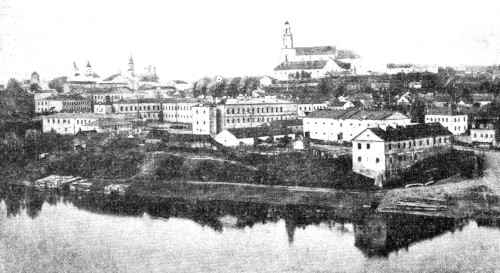
| Grodno before the Nazi Holocaust — general view |
|
|
[Columns 503-504]
Translations by Guillermo Levrio*
Polish Rule in Collapse
by D. Rabin
On the morning of September 1, 1939, an air-raid siren was sounded in Grodno. The public did not yet know that war had broken out, and the inhabitants imagined that it was merely a drill to test the sirens. But very soon several bombs were dropped on the city by Nazi aircraft, some of them in the area of the “new” market. They struck the Kolbacki house, and that family perished during the night. Confusion and panic spread through Grodno.
Meanwhile, the mobilization of the Polish reserve forces was announced, but the matter never reached the stage of actual implementation. The army stationed there began to disintegrate, the authorities collapsed, and a mood of pogroms against the Jews and looting of their property took hold among the Polish inhabitants, in most of whose hearts hatred of Jews had long been simmering, for days and for years. Thugs, among them soldiers and officers, even began to break into the homes of our people, to plunder them, and also to attack them physically.
In the “suburb,” several Jewish youths, together with a young Belorussian, tried to establish a self-defense group and to stand up to the rioters. They even succeeded in disarming a gang of thugs dressed in Polish army uniforms. But the next day the local authorities ordered the defenders to be arrested, and one of them was also killed. The rest were forced to scatter and seek shelter.
On September 17, the Soviet army began approaching Grodno. The remnants of the Polish force in the city decided to resist the advance of the Russians, and they concentrated on both sides of the Niemen, where a heavy battle took place. For three days, the masters of the place were now members of the rabble among the Polish youth, and they managed to carry out pogroms against the Jews — to kill dozens and to loot.
On September 21, 1939, Grodno was captured by the Russians, and quiet settled over it.
by D. Rabin
Relief for Some, “Purification” for Others
With the entry of the Red Army, the Jews of the city breathed more easily, for the danger of Nazi occupation, with all the evils expected from it, had been lying at their doorstep. And although the new authorities immediately confiscated the factories and all the other enterprises and businesses — most of which in Grodno belonged to Jews — the doors of employment now opened for most of our people, and for the youth there also opened countless possibilities to acquire education and knowledge.
At the same time, shortages appeared in various products — certain foods, kerosene, clothing, and the like — the cost of living rose sharply, and speculation spread. Some of the shops closed because they had no merchandise, or because the goods had been taken out and hidden in order to raise their prices. Fixed rations at convenient official prices were given to workers, but the official wages were not enough to live on. On the other hand, not a few of our Jewish brethren, and especially members of the Communist Party, also obtained authority and important positions that were entrusted to them, or succeeded in “getting themselves settled” in such a way that they lacked nothing.
A stream began to flow into Grodno, from the territories over which the Nazis had taken control: masses of Jewish refugees, bringing with them terrible tidings. Overcrowding arose in apartments and living quarters; even houses of prayer filled with fugitives from the horrors.
Now began the chapter of “purifying” the city of “counter-revolutionary” elements. Among these the Soviet authorities also included Jewish public activists, from Revisionist Zionists to members of the Bund, who were arrested and deported to distant regions of Russia, some of them “disappearing without trace” forever.
And again, not many days passed, and on one of the curfew nights many families were suddenly rushed away — thousands of souls: men, women, old people, and children — and within a few hours they were taken from their homes to railway cars intended for animals and deported from Grodno to northern Russia and to Kazakhstan, in the steppes of Central Asia.
[Columns 505-506]
Among these “enemies of the people” — as they were called in the inscription on the railway cars into which they were packed — were “bourgeois” of various kinds, members of parties who did not accept the doctrine of Communism and had not yet been exiled, together with their families; the families of activists who had previously been deported alone; and the families of officers in the Polish army who had fallen into Soviet captivity. More deportation convoys were still intended to leave Grodno.
After that night, “the face of the city darkened, and dread and fear seized the population,” writes the eyewitness, the poet Abraham Zak, in his book Knecht zenen mir geven — “We Were Slaves” — Buenos Aires, 1956, from which most of the facts in the continuation of this chapter are taken. The “refugees” began fleeing for their lives back again, in masses — out of fear of arrests and out of fear of falling into the deportation convoys — to the other side, toward Warsaw. They no longer paid attention even to the severe winter, which froze the limbs of many among these fugitives.
Jewish Life Being Liquidated
The Jewish Sabbath rest was not recognized by the authorities, and those employed in factories, workshops, and offices were required to come to work on that day as well. Nevertheless, many Jews found ways to preserve their Sabbath. Kosher cattle slaughter also no longer existed in Grodno, and those who observed kashrut made do with poultry.
Jewish public life in Grodno was completely liquidated, and the community council dissolved by itself with the entry of the Red Army into the city. “All its members,” says the witness, “each withdrew to his own tent, and they thanked God that nothing was heard and nothing was known about them.” All public activity ceased. All the institutions in the city — economic, cultural, and even charitable — were liquidated; the Jewish parties all the more so. Both the Zionist and the socialist parties all disappeared from the stage. The party archives were hidden or burned. The party activists did not appear at all in the light of day. Each of them sat hidden within his own four cubits and trembled at every knock on the door.
After the first arrests, and after the first great “purification” and the first enormous convoy, which carried thousands to the north, all the prominent party activists were certain that their own days in freedom were also numbered. Some of them changed their apartments and did not go out into the street. Whoever was able to do so left the city and moved to relatives in rural settlements, so as no longer to be seen. “Happy are those who dwell in Your house” — this became the slogan of everyone who had previously had any contact with public affairs.
The schools were at first closed. But after some time the municipal department for public education convened a general assembly of all the teachers in Grodno, Jews and non-Jews alike, and there “the head of the department, a Jew from Minsk, a shoemaker by profession, explained the methods of Soviet education that were about to be introduced in the city.” Of all those assembled, only one dared to ask whether Hebrew would be allowed to be taught in school as a subject. The reply of the lecturer was that this was the language of reaction, of Zionism, of religious clericalism, and so forth. The innocent questioner was Reuven Wigdorowicz, seventy years old, the veteran teacher of singing and Hebrew, the composer and conductor of popular choirs.
After the aforementioned meeting, schools were opened in Grodno: first and foremost, “White Russian” schools in Belorussian; in second place, Russian schools; in third, Polish schools; and last, a Yiddish school, in the building of the former “Tarbut” gymnasium. The placing of the “White Russian” schools specifically at the center was connected with Soviet policy regarding the territory, which was destined to belong to the “Belorussian Soviet Republic,” for in Grodno there were only a few “White Russian” children, and pupils had to be recruited for these schools from the villages and housed in boarding schools.
For lack of space in the Yiddish schools, Jewish parents were forced to send their children to the few Polish schools or to the more numerous Russian and Belorussian schools. Most of the teachers and pupils in the Jewish school were still those who had previously taught in the “Tarbut” educational network. But now they were forced to teach the pupils according to the spirit of the new rulers.
Yet even this single school was not destined to continue existing. One day the department for public education called a parents' meeting, and this meeting “unanimously and of its own free will,” according to a proposal that had been introduced, decided to convert the school into a Russian one. From then on, this institution was called “Russian Ten-Year School No. 7.” Little by little the teachers were transferred out, Russians were brought in to replace them, and Russian pupils were introduced into classes that had previously consisted only of Jewish children. Thus Yiddish was eliminated from the school even as a subject of study.
The authorities also appointed an inspector over the local libraries, a Jew from Minsk, who, together with several local Communists, carried out a general review of the books. These reviewers disqualified almost everything, except for books by the Polish classics and by Mendele and Sholem Aleichem. Everything found in Hebrew was declared invalid and sent to be pulped in paper factories.
The librarian of the “Tarbut” library, Shmuel Ginzburg, a graduate of the “Tarbut” teachers' seminary and the person who held the key to the library, secretly removed the books of greatest value and distributed them among the teachers and pupils of the closed “Tarbut” institutions, so that they might preserve them “until the wrath had passed.” However, as is known, after the wrath against the books, there was destined to come the great destruction upon the Jewish teachers and pupils together.
[Columns 507-508]
Regarding the attitude of the Soviet authorities toward Jewish literature and its writers, Abraham Zak relates another telling fact: the name of one of the city streets, which had once been named after the respectable Grodno Jewish poet and socialist Leib Naydus, and which even the antisemitic rulers of Poland had not dared to change, was now removed from the street.
Apart from the synagogue and the study houses, some of which remained open — though some were turned by the authorities into premises for cooperatives, technical schools, warehouses, and the like — there was now no public place left where our Jewish brethren could meet as Jews. During the period under discussion, no lectures were held in Grodno anymore, and not even any Jewish concerts.
Only one Yiddish institution remained: a theater, which also received assistance from the authorities, from the department of art, at whose head too a Jewish shoemaker from Minsk had been placed. The first play performed by the Jewish troupe, which was made up of refugee actors, was Sholem Aleichem's Tevye the Dairyman, in a “corrected” version. The performance was staged in Grodno one after another for weeks before a full theater, and it became a kind of demonstration for the Jews of the city, since they were given their only opportunity to come together with what was dear to them. The Grodno troupe continued its performances also in the surrounding towns: Slonim, Brest, Baranowicze, and others.
by Hasia Bielicka
Cells of “Hashomer Hatzair” Maintain Their Connections
With the entry of the Red Army into Grodno in September 1939, the “Hashomer Hatzair” movement in the city faced a series of serious and burning problems. We now had to look after the members of the training nucleus of our movement, whose dwelling place was in the suburb, in the Yaffe house, so that they would be able to reach the border crossing to Vilna, where the training kibbutzim of the pioneers were now gathering, in the hope of a possibility of immigrating to Eretz Israel.
First of all, however, it was necessary to remove them from their place and, in the meantime, to house them in other apartments until an opportune moment arrived to leave for Vilna. In addition, we also had to take care of members of the movement who had begun arriving in Grodno from Poland, from the territories conquered by the Nazis, to house them and also to look after their families.
Among those active in carrying out these tasks, the following comrades should be remembered: Yocheved Taub, daughter of Włocławek, an emissary of the movement, whom the outbreak of the war found in Grodno, where she was engaged in coordinating the activities of “Hashomer Hatzair” in our district; and also Eliyahu Tankus and David “Dodik” Rozovski, who had been a photographer before the war and afterward became the maker of the forged documents that we needed. Most of the members of the training kibbutz were also transferred — smuggled — across the border to Vilna, but under the conditions of those days they did not succeed in reaching the Land.
As for the young members of the movement in the Grodno branch itself, we now began to organize them into underground cells, each consisting of three or four members, who would meet from time to time. We maintained contact among ourselves so that we would be ready to act and to go up at the first opportunity. A gathering was also held in Bialystok, where lines of action were outlined. The groups of the younger age levels we dispersed.
My brother Abraham, head of the branch, was summoned several times by the NKVD — the Soviet political police — for interrogation. They tried to extract from him where the comrades who had undergone training in Grodno were located, what activities the movement was engaged in, and the like.
The entry of the Hitlerite murderers into our city found us organized within the framework I have described, and ready to serve as a nucleus for an anti-Nazi underground among the Jews of Grodno.
Despite the severe conditions, persecutions, and dangers, there also existed in Grodno a Zionist underground, which worked to transfer pioneers and other Zionists to Vilna, which had for a time been handed over to Lithuanian rule, and from where there appeared to be certain prospects of escaping for immigration to Eretz Israel. Thus several members of the “Dror-Freiheit” movement were also transferred from Grodno to Vilna by way of Marcinkance–Oran. Groups from the “Hashomer Hatzair” movement and members of Betar continued to meet and operate secretly.
On June 20, 1941, on the eve of the outbreak of war between the Soviet Union and Nazi Germany, the Soviet authorities carried out another “purification” in Grodno. Among the “elements hostile to the state” who were arrested were also Noah Bass and his wife Elka — a folk teacher of supreme grace and one of the finest of human beings, who had formerly been an activist of the Bund. They were taken to the railway station and placed in cars intended for deportation to the distant regions of Russia. But when the train carrying them reached the vicinity of Baranowicze on June 24, it was bombed by Nazi aircraft. The two tried to escape from the burning car, but they fell, holding each other by the hand in life — struck by the bullets of the German planes. They were also buried there.
by Moshe Nots
A large group of Betar members from the Grodno branch, among them Yehuda Sawicki, Simcha Zaruchs, and others, who had set out to immigrate to Eretz Israel, were forced to return home with the outbreak of the war, when it overtook them right at the border of Poland.
Many of the members were now drafted into the army, though not for long, since the Polish forces soon dispersed. The Red Army entered Grodno. A member of the Revisionist Zionist organization, Moshe Rubin, and his father, fell in the pogroms carried out by Polish nationalists against the Jews of the city before its conquest by the Soviets.
All open Zionist activity now ceased. Activists of our movement were arrested, among them David Draznin, the chairman of the Revisionist Zionists Chaim Snarski, and others. The commander of the Betar branch, Zalman Maniewicz, was also arrested and interrogated by the secret police about his activity in the movement. He was finally released on the recommendation of his work colleagues at the wine factory belonging to Shapiro, where he worked as a clerk. Maniewicz warned us to guard our lives, because we were being watched. Nevertheless, we would meet every Friday night, each time in a different place.
Meanwhile, we learned that at the close of Yom Kippur, 5700, a group of Jews had fallen on the road leading from Sopoækinie to Grodno at the hands of Polish nationalists. Among them was Yehuda Sawicki, on his way home after the Polish army had dispersed. Later I visited Sawicki's grave in the Jewish cemetery of Sopoækinie together with Eliyahu Streski, may God avenge his blood, and Leibel Sorin, may he live long. We stood in silence, and our lips whispered verses of Kaddish.
Isaac Bekenstein also did not return home. According to information that reached us, he crossed the Hungarian border together with the Polish army, and no trace of him was known.
One day we were called, in a letter that reached us from Lithuania from Natan Friedman-Yellin, who was staying there — the letter was brought by Avrashke Kulkin — to try to get there. But to our regret, we had missed the time, for the border had meanwhile been closed and was guarded with greater strictness, and those who tried to cross it were arrested.
In April–May 1941, hundreds of young men in Grodno were drafted into the Soviet army: the younger ones for regular service, and the older ones for reserve duty for forty-five days. Among them were Zalman Maniewicz, S. Zaruchs, Moshe Brawer, A. Kulkin, L. Sorin, A. Strinski, and others — almost all the comrades. I, as a professional worker needed at the factory where I had worked before the war, was kept there. Only a few later returned, among them L. Sorin — today in the United States — and Eli Strinski, who met his end in Auschwitz.
by Tuvia Ezrachi
In September 1939, at the outbreak of the Second World War and with the entry of the Red Army into the eastern regions of Poland, I was, together with several other comrades from Grodno, in a training kibbutz in Równe. From the first day of the war, contact with Grodno was cut off, and it was impossible to maintain it, neither by letters nor by telegrams. The newspapers too did not provide us with information about our city of origin.
Here, day after day, masses of refugees arrived from the territories occupied by the Nazis, and the training kibbutz residence in Równe turned into a railway station. Training kibbutzim of “Hashomer Hatzair” from the area conquered by the Nazis gathered in Równe. The main leadership also arrived here. And the fateful question — what now? — hovered in the air and gave us no rest. Stormy debates took place over the continuation of our path, and the decision fell: there was one and only one road — to Eretz Israel. And the meaning of that was: to cross borders illegally.
But the means at our disposal were very limited. After several attempts at the Romanian border, some successful and some ending in extremely severe sentences, news spread that the Soviet Union was about to transfer Vilna to Lithuania. Plans were immediately drawn up, and the flow of comrades was directed there.
But after some time the border was marked and closed, and the crossing to Vilna and its surroundings, which had been annexed to Lithuania, now involved great danger of falling into the hands of the Soviet border guard or into the hands of Lithuanians who treated border-crossers cruelly. It was necessary to establish a network of crossing points in the city of Lida and near the border itself. Peasants from the surrounding area, who knew every path in this region, were hired in order to transfer groups of our comrades to the other side of the border.
Our own people also became skilled in this task and carried it out with devotion and self-sacrifice, despite the difficult conditions, especially the severe cold that prevailed that winter. In this way about 700 members of the movement crossed to Vilna and gathered there. I was assigned to remain in Równe, which now served as a transit point on the way northward to Vilna.
Already in the first days of October, my mother and my younger brother Nachum came to visit me. From them I heard about the days that had preceded the entry of the Soviets into Grodno and also about what was happening in the city. My brother, then fourteen years old, questioned me about the decisions of the movement and about my personal plans. When he saw that I was keeping silent, he told me that he and several other children from his troop, “Bnei Midbar,” had removed many books from the branch library and hidden them.
Our place of residence at that time was in the Schweizer house near the “Khor-Shul”; and opposite the house in which the agency
[Columns 511-512]
of the “Forder” automobiles was located — inside the courtyard — was the branch of “Hashomer Hatzair.”
Nachum told me that the books were not brought into our parents' home, but to a safe place nearby. By this he meant to gladden my heart, since in earlier times I had invested much effort in arranging and expanding the library.
At the beginning of November I set out on the road in order to reach Grodno and deliver an instruction: to liquidate definitively the training kibbutz there, on Zbo¿owa Street in the suburb; to try to find a crossing route at the border in the area of Oran, near Druskininkai; and to persuade as many as possible among the older members of the branch to cross over to Vilna.
In the “Hashomer Hatzair” training kibbutz in Grodno there was still, at that time, a small group of comrades who kept the house as an address for many members of the movement arriving from the area under Nazi occupation. Here too, as in the training kibbutz in Równe, the house served as a transit point to Vilna. All the members of the kibbutz, about eighty people, had already managed to cross to Vilna, and were among the first in the “concentration” there.
The decision to liquidate the remaining kibbutz in Grodno came as a shock to those who were left there, and within a few days the comrades sold whatever could be sold and left the city. As for finding a passage to the Vilna region by way of Oran, I succeeded in making contact with a Jew who was prepared to deal with the matter, with the help of several acquaintances of his. But after further consultation with the institutions of the movement, the plan was canceled because of the excessive distances that passage by this route would have required in order to reach Vilna.
I did not succeed in my third mission. Among the dozens of older members of the Grodno branch, I managed to persuade only one to leave for Vilna. The others each presented me with his own reason. And the truth is that many horizons and opportunities had then opened for the youth. It was possible to continue one's studies without any difficulties in any institution of higher learning — also in Lwów, where there was a group of Grodno people — or in the interior of Russia. Those who indeed moved eastward mostly remained alive, and some are today in Israel.
There were also those who had “settled themselves” in good positions and deluded themselves with the illusion that they had found the royal road in life. There were those who were not prepared to part from their families and parents, and also those who did not dare to take the risk and burn all the bridges behind them. Above all, in all my meetings and conversations with my comrades, I felt that some fear and mistrust of me separated us — a kind of suspicion that I was bringing words of provocation.
The only one who responded to me was Moshel Stanchetski, whose parents had a delicatessen shop on Dominikañska Street. His parents took the matter seriously and agreed that he should cross to Vilna. We were together until the outbreak of the war between Germany and the Soviet Union, and then our paths separated because of a road accident in which I was injured. At the end of the war I learned that he had been drafted into the Red Army and had fallen at the front.
At that time another comrade from the Hashomer Hatzair branch, from the “Ha-Sneh” troop, Miriam Chartz — today Burstein, in Haifa — also arrived in Grodno to persuade the members of her troop to cross to Vilna, but she did not succeed in moving anyone to do so. I think that members of “Freiheit-Dror” also made similar attempts, but I do not know what their results were. While I was in Vilna, I heard about the yeshiva men in Grodno, who also tried to cross to Vilna.
After a stay of one week in Grodno, I left it and returned there in December 1939, on my way to Vilna, after I had completed my assignment in Równe. This time I repeated the attempts to persuade people to leave, but again without results. On the other hand, I met several comrades from the “Ha-Carmel” troop — Ilka Kantor, Miriam Popko, Eliyahu Tankus — who told me about their attempts to organize under the new conditions. From then on I maintained correspondence with Ilka Kantor, which was cut off with the outbreak of the war between Germany and the Soviet Union.
Among the pioneers who succeeded at that time in going up from Vilna by way of Moscow to Odessa was also Miriam Chartz, whom I mentioned above.
I last visited Grodno on Passover 1941. The Jews prepared for the holiday according to all the laws of the festivals. Although prices on the “black” market were much higher than in free trade, our brethren bought kosher meat, matzot, and all the other traditional products. The condition of the Jews, especially of the craftsmen among them, was immeasurably better than in the days of the Poles, but a decline was felt in Jewish cultural life. The “Tarbut” schools and the religious schools had long since ceased to exist; even those in Yiddish had had their language of instruction changed to Russian.
However, a Yiddish dramatic troupe was then active in Grodno, under the direction of Abraham Modawski, and it performed in the municipal theater the play People on the Ice Floe.
I decided to attend the performance, even though this involved a certain risk. There something happened to me that left a very painful impression. Some of my comrades who were also present there deliberately ignored me and did not approach me to exchange greetings, knowing that I had come “from another world.” The same thing happened several times as well in my encounters on the street.
On the other hand, I was deeply impressed by my meeting with the members of the branch who were active underground. They held meetings, conversations, and even seminars. I was very glad that I was able to exchange with them information from the Jewish Zionist world and about what was happening in the movement. Although they already knew some of what I told them from sources of the clandestine movement, they swallowed every word with great interest, and I felt that my words greatly encouraged them.
This nucleus, which had been forged under underground conditions, acted with even greater vigor during the days of the Nazi occupation, as I learned some time later. But my path led into the interior of Russia, far from Grodno, my native city, and from the comrades of the movement there, who remained faithful to their vision under all conditions.
[Columns 513-514]
|
|
| Grodno before the Nazi Holocaust — general view |
|
|
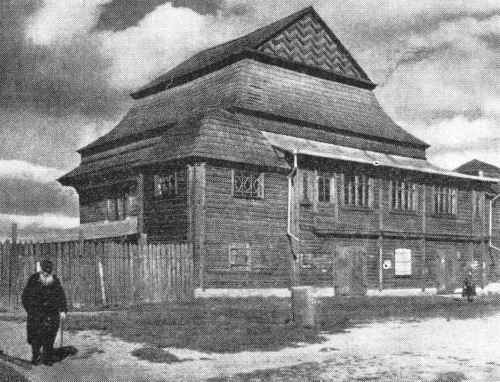
| The ancient Wooden Synagogue in the suburb |
[Columns 515-516]
|
|
JewishGen, Inc. makes no representations regarding the accuracy of
the translation. The reader may wish to refer to the original material
for verification.
JewishGen is not responsible for inaccuracies or omissions in the original work and cannot rewrite or edit the text to correct inaccuracies and/or omissions.
Our mission is to produce a translation of the original work and we cannot verify the accuracy of statements or alter facts cited.
 Hrodna, Belarus
 Yizkor Book Project
 JewishGen Home Page
Copyright © 1999-2026 by JewishGen, Inc.
Updated 16 Aug 2026 by OR