[Columns 477-478]
Hechalutz Olim Tell Their Stories
Translations by Guillermo Levrio*
The First Group of the Third Aliyah from Grodno
by Yedidya Janowski
1.
With the outbreak of the great aliyah to Eretz Israel at the beginning of the
year 1920, the Grodno group was among the first of the band of pioneers who
opened the radiant page of the regular Third Aliyah to the Land from Poland.
At the end of the First World War, Grodno and its surroundings – because
of their distinctive geopolitical position – found themselves in an
uncertain political situation. Amid the tentative moves of the covert struggle
then being waged behind the scenes among the political forces of the
surrounding nations, which had attained independence or stood on its threshold
– Poland, Lithuania, and Belorussia – Grodno and its district served
as a supposedly neutral enclave under temporary German rule between the three
countries. This exceptional situation, unprecedented in the city's history and
entirely new in the lives of its Jewish inhabitants, awakened among them
illusions and waking dreams of self-determination, as it were, and of broad
national autonomy.
Each of the existing or emerging states just named wished to acquire the city.
Lithuania began sending Jews to campaign on its behalf. The Belorussians, who
lived among their own people in the district (most of its villagers were
counted as Belorussian), began preaching the revival of their nation, which was
so intermingled with the Russians that its separate identity was scarcely
recognized. They opened a club to win supporters to their cause and took the
bold step of establishing their first military regiment in the city. The Poles,
on the other hand, trusted in their own strength. Although occupied with their
war against the Bolsheviks somewhere in Ukraine, they never ceased watching
Grodno and planning to enter it at an opportune moment under a suitable
pretext. In the end they entered the city and took control without resistance.
[Columns 479-480]
With the arrival of the Poles, the dreams and hopes evaporated. The Belorussian
regiment, which had taken part in ceremonially welcoming them, was disarmed and
disbanded a few days later. The Belorussian liberation movement faded because
it had no real foothold. Lithuania, which at that time had not yet fully
emerged as a state, claimed first and foremost Vilna, its historic capital.
Vilna mattered more to it than Grodno, whose inhabitants, in the city and its
surroundings, were mostly Jews and Belorussians, without a single Lithuanian
among them. The Poles therefore felt entitled and able to conduct themselves in
the city as they pleased and to treat it as their own, even though the entire
region had been declared a “plebiscite zone” in which a vote was to
be held under their auspices.
The Jews of Grodno beheld what was happening with great anxiety for their
safety, out of a fairly well-founded fear of pogroms and plunder. The Poles
ruled with a high hand. Actual pogroms did not, it is true, break out in the
city; only isolated incidents of robbery here and there occurred, and acts of
malice – but the poison of racial hatred, seeping through, now spread and
grew stronger. There began an episode of systematically pushing the Jews out of
their economic positions, of weighing down upon their economic foothold, and of
harassing them to an ever-increasing degree.
The prospects of a firm economic standing dwindled. To increase the suffering,
forced unemployment came to gnaw at the masses of workers who had found their
employment in the workshops of the occupiers and in their enterprises, in
sawmills and the like and around them – ever since the German war economy
began to be wound down upon its conclusion. To these were added adolescent
youths, who did not yet know the taste of work and livelihood. Where would this
generation turn, if in the region and in the city itself the Polish
administration had set for itself one clear purpose: immediate Polonization, as
far as possible? The Jews were placed in a blind alley, their eyes seeing and
failing, their feeling foreboding evil in a gloomy and grim future. The heart
therefore gnawed, and the question pecked: where was the way out – perhaps
somewhere in the distances, outside the city, beyond the borders?! Indeed, the
halo of crossing beyond the border began to shine, drawing, captivating, and
enchanting. An opening of hope appeared to many, especially to the adolescent
youth, in a radical departure from the fetters of the existing way of life, in
the transvaluation of values to which they had grown accustomed within the Pale
of Settlement. The eyes were naturally lifted to far-off places, since there
was no security in any arrangement or any real foothold in the place itself.
The youth was seized by fantasies of migration – some to vast Russia,
which enchanted with the glow of revolution; some to America or to other lands
across the sea; and some to Eretz Israel.
Ever since the Balfour Declaration and the overtures made to the Jews by
Germany and Turkey, expressed in Talaat Pasha's declaration of his country's
intentions regarding Eretz Israel, our fellow Jews in the Diaspora –
including those in Grodno – had begun to see something real and practical
in Zionist talk of returning to the Land, rebuilding its ruins, and reviving
the nation there. The young people drawn to Zionism were restless and filled
with a desire for fulfillment and action. They were an immense reservoir of
steadily accumulating energy seeking an outlet, and the restrictions and
limitations imposed on them could not hold them back much longer. Official
Zionism's decree restraining the aliyah now pressing at the gates could no
longer serve as a barrier. It seemed that all that was missing was some sudden,
extraordinary impulse capable of upsetting the apparently stable situation and
triggering an unrestrained breakthrough.
Such a push, the decisive and determining event in that very moment, was the
fall of Trumpeldor in the Galilee – news that deeply shook the Jewish
youth and truly tipped the scale in favor of immediate aliyah.
At the Zionist “Center” on Sobornaya Street (Dominikańska since
the arrival of the Poles), the undertaking took shape. Young people thirsting
for action hurried through its rooms and halls. The members of Hechalutz, young
men and women, went out to perform physical labor and prepare themselves for
work in the Land. The first aliyah group had been formed during the winter of
5680 (1920), but official Zionism ordered it to remain in place, to the
disappointment and heartache of the young people. When Trumpeldor's death
became known, spirits surged within the group, and it resolved to set out
whether or not the Zionist Organization obtained entry certificates for the
Land. To the credit of the Zionists of Grodno, it must be said that they spared
themselves neither trouble nor complications and did everything in their power
to enable the first group of pioneers to move forward.
The group, members of Tzeirei Zion (Youth of Zion) for the most part, was
organized by Hechalutz, and on the fourth of the month of May 1920 it set its
steps on the road.
2.
These were the days when the First World War had only just come to its end. The
political equilibrium that had been shaken in it had not yet returned to a calm
and orderly state. Local quarrels here and there still raged ever anew. This
was the time of the intensifying war between Poland and Bolshevist Russia, of
the frictions between Poland and Czechoslovakia over Upper Silesia, and of the
prank-like deed of D'Annunzio in the seizure of Fiume (today in the hands of
Yugoslavia). Spirits raged, and this turmoil was well felt on the roads. The
movement of trains was irregular, military movements disrupted every
arrangement, chaos reigned over everything, and into this confusion the first
Grodno group was cast on its way to the Land.
The group – eleven young men from Grodno, three young men and eight young
women from Suwa³ki – set out without knowing for certain whether it would
be legally admitted to the Land. It had no entry certificates; on the contrary,
it had been explicitly warned
[Columns 481-482]
|
|
|
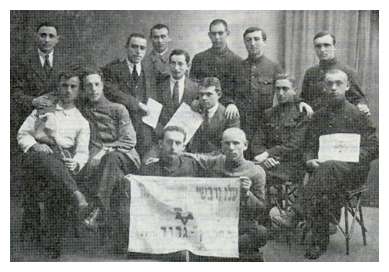
First group of “Hechalutz” – Olim from Grodno with regional
Aliyah-Committee. Grodno, May 1920 |
|
From the right, below: Arye Pis, Zecharia Kimchi; seated: Ephraim Pis, Yedidya
Janowski, Leibel Goldschmid (of the “Aliyah Committee”), Isser Kulik,
Gershon Hefner;
Standing: Tzvi Klempner, David Pis, Benjamin Dashut, Yitzchak Loewenstein
(“Aliyah Committee”), Arye Gashri-Mostowski, Dov Rabin (“Aliyah
Committee”), Chaim Pasmanik.
|
by the Hechalutz Center and the Eretz-Israel Office in Warsaw not to travel.
Those bodies strictly observed the Zionist Organization's order to halt the
aliyah. The pioneers, as noted, ignored the prohibition. The journey from
Grodno to Warsaw took two days. At that time Polish ruffians would attack
defenseless Jews they encountered on trains, pull out their beards, and abuse
them at will. A whole group of young men and women naturally attracted
attention and curiosity; but when they explained that the journey's destination
lay beyond the border – that they were emigrating from Poland – the
Poles who accosted them along the way, whether soldiers or civilians, received
the news with a kind of joy. They would immediately cry at the top of their
voices: “Jews are traveling to Palestine!” This was the antisemites'
slogan: “Jews, go to Palestine!” When the group reached Warsaw, the
same jubilation was heard there too: “Jews are traveling to
Palestine!”
The group was received in Warsaw with explicit displeasure and with words of
rebuke on the part of the people of the Hechalutz Center, for having dared to
defy the directive of the higher institutions. The members were told to return
home at once, and that elements such as they – undisciplined, harmful, and
not needed in the Land – must go back to Grodno and wait there for the
Center's instructions. The members of the group, for their part, did not stay
idle either, and replied, in unequivocal terms, that a way back no longer
existed for them; their journey in the direction of the Land would continue,
whether or not entry certificates were obtained for them, and all
responsibility for whatever might happen would fall upon the heads of the
Center and of the Eretz-Israel Office. After these blunt words, the group
turned to the Center of Tzeirei Zion on Dzika Street 11, where it was received
willingly; rooms were set aside for it for lodging, and they made the members'
days of stay in Warsaw pleasant with outings and tours in the city and its
surroundings.
The members of the group spent a week in Warsaw. Their presence influenced the
youth, who were in any case already gripped by stirrings of aliyah and a
yearning to travel, and lacked only a real push so that they too would burst
onto the road. The conversations, and the very fact of a group of young men and
women making aliyah, did their part: many began to make their reckonings –
whether to move forward too, and when. The heads of the Eretz-Israel Office,
who had become alarmed, began, against their will, to attend to obtaining entry
certificates for the group. Telegrams were flashed from Warsaw to London and
from London to Warsaw and back again, and in the end it was decided that the
group would receive its entry certificates for the Land in Vienna, with the
help of the Eretz-Israel Office there. Upon hearing this news, the group no
longer continued to tarry in the capital of Poland, and immediately continued
its way to Vienna, and from there to the Land.
The “Cherut ve-Techia” Youth Movement
by Yaakov Janowski-Yaniv
At the beginning of the German occupation during the First World War, the
schools and chadarim (traditional religious elementary schools) were closed and
studies took place in private homes. Even when some schools reopened, the
secondary schools did not. Only after the revolution in Germany, when the
restraints on public activity were eased, did secondary schools reopen; and
with the legalization of the Zionist Organization, the Tzeirei Zion
association, and the Hechalutz organization –
[Columns 483-484]
a lively ferment also arose among Jewish students. In those final days of the
German occupation and at the beginning of Polish rule, Grodno's youth comprised
three distinct groups: those who studied in yeshivot or chadarim and took
little interest in national-Zionist questions; pupils of Russian-language
secondary schools, whose spoken language was also Russian and who regarded the
Russian culture in which they were immersed as their own; and young people from
the common-folk circles, who likewise studied in Russian-language secondary and
secular schools but spoke Yiddish and had been raised in Jewish tradition.
The school of Yehoshua Sokoblanski and Reuven Wigdorowicz (later Waldman's
school) mainly attracted boys from the common-folk circles. Among the fourth-
and fifth-grade pupils, aged fourteen to fifteen, there arose a desire to
organize and do something for the development of Grodno's Jewish youth as a
whole. This awakening was strongly influenced by the general atmosphere of
freedom and national organization then prevailing in the Jewish community. The
Kerensky revolution in Russia, the revolution in Germany, and the freedom
gained by their peoples after years of oppression and reaction also stirred the
young.
And thus there was organized, at the beginning of 1918, an association by the
name of Pirchei Zion (Buds of Zion), which pupils of schools and working youths
joined, and chiefly from among those whose older brothers and sisters were
counted among the members of Tzeirei Zion. First and foremost we began to study
Hebrew literature and to speak in that language, which was indeed taught in the
schools where we studied, but not as a compulsory subject, and therefore did
not occupy its proper place in the curriculum. We would therefore gather every
Sabbath and read in Hebrew from the works of Mendele, Peretz, and others.
At first we made many efforts to obtain permission from the German occupation
authorities to open a “club for cultural activity among the Jewish
youth” – but we were unsuccessful. We were therefore compelled to
maintain a club without a license – something that in those days entailed
a severe punishment. We would therefore endeavor to reach the meeting place one
by one, and likewise to disperse quietly, so as not to arouse the attention of
detectives and policemen.
Once a week we would hold a “Hebrew evening,” and everyone who
attended was required to converse in Hebrew. Although most of our members knew
the language, they were not accustomed to speaking it, and these
“evenings” caused them no little difficulty. We also engaged in
practical Zionist work: we distributed to subscribers the Yiddish Zionist
newspaper that arrived from Warsaw, raised money for the Jewish National Fund,
and later for the Redemption Fund (which preceded Keren Hayesod). The Pirchei
Zion activists I still remember (there were no girls in our association; we did
not succeed in attracting them) were Moshe Marder, Itzkowicz, Mordechai
Tzfanat, Shtaitels, Shmuel Zayonc, the Zandman brothers – Yosef Moshe, of
blessed memory, and Moshe, may he be granted long life, the writer of these
lines – and others.
After the revolution in Germany, the public ferment grew stronger among the
Jews of Grodno; the parties began to act openly and with permission; the
struggle and the debates among them greatly influenced the youth as well, and
the Hechalutz organization set about preparing pioneers in the city toward
aliyah to the Land. Now the strength of the Pirchei Zion association and the
level of development of its activists no longer sufficed for it to be able to
act properly among the ferment-gripped ranks of the youth.
There was a need to establish an association of greater capacity. And thus, in
May 1919, the Cherut ve-Techia association was founded, on the model of the one
that had been established at that time in Vilna and that afterward set up
branches also in other settlements. Besides Pirchei Zion, additional young
people joined the new association (the Achdut ve-Techia group). We were
recognized as a Zionist youth association by the Zionist Organization and by
the Tzeirei Zion in the city, and a room was also allotted to us in the
“Center” – the club for all the Zionists. Members who were
activists of Tzeirei Zion (Yitzchak Loewenstein, of blessed memory, and –
may he be distinguished for long life – Yitzchak Izerski and Dov Rabin and
others) also devoted themselves to the work of explanation among us about
Zionism and about Eretz Israel.
Frequently they would hold literary evenings, and a dramatic circle was also
established, which would put on performances before the youth in Yiddish. The
activists in the circle were Shimon Finkel (today a member of Habima), Chaim
Yablonik (the actor Herman Yablokoff in our day), and several others.
Before long the association teemed with a multitude of boys and girls studying
in various schools, as well as working ones, and also with those frequenting
the beit midrash (study house) and the young men of the “Kibbutz” (a
yeshiva that was run by themselves), in whose circles too a national and social
awakening was felt.
In Grodno a general convention of the Cherut ve-Techia movement was also held,
on 31 December 1919, and there participated in it, besides local delegates,
also representatives from Wołkowysk, from Wasiliszki, and from other towns, as
well as from the Center in Vilna (the Novik brothers, who are the
“Chadash” brothers in Israel today). At the convention the
foundations were laid for Zionist activity among the learning Jewish youth and
for its preparation for aliyah to the Land.
The activists in Cherut ve-Techia at that time were (in alphabetical order):
Tzvi Belko, Aharon Goldschmid, Elimelech Gornitzki (Goren), Shlomo Zhukovsky,
Dov Yaffe, Moshe Marder, Adin, Yeshayahu Feinsod the late, Mordechai Tzfanat,
Kimchi, the writer of these lines, and others.
Because of their tender age, the members of Cherut ve-Techia could not belong
to Hechalutz, except for individuals who were admitted to that organization as
exceptions, and who also worked at its farm (chava) in Slobodka. These were
also the pioneers of our movement in Grodno who made aliyah to Eretz Israel,
among them the first – at the beginning of 1921 (the writer of these
lines). Not long afterward, other members too began to make aliyah. Tzvi Belko,
the secretary of Cherut ve-Techia in those days, even proposed to me, in his
letters to me, to establish an Eretz-Israel youth organization and thereby to
organize the Jewish youth throughout the whole world.
[Columns 485-486]
But from the year 1922 the activity of Cherut ve-Techia progressively weakened:
the activists were busy with their studies, and on the horizon there appeared
other nationwide organizations of Zionist youth, whose center was in Warsaw
(and not in Vilna). The scouting organization Hashomer Hatzair was founded,
which conquered the hearts of the youth, and after it other youth associations
arose.
In the Hachshara in Grodno in the Year 1920
by Yitzchak Amdurski
With a letter of recommendation in my pocket from the Hechalutz association in
my hometown of Horodok, near Bialystok, I arrived in Grodno in 1920 to join the
pioneers undergoing hachshara (pioneer training) there for aliyah to Eretz
Israel.
In those days our region, the Bialystok district, was annexed to Poland, and
young men were conscripted into the army. Because of a clerical error in my
birth certificate, I too found myself one day in 1919 standing in a line beside
a barracks and swearing allegiance to the army of the Rzeczpospolita (the
Republic). I would not accept my unlawful conscription, however, and moved to
the nearby town of Krynki in the Grodno district, which had not yet been
officially incorporated into the Polish state. With relatives' help, I obtained
a new identity document identifying me as a native of one of the surrounding
villages and exempting me from military service. Equipped with this document, I
set out on foot for Grodno, news of whose pioneer-training enterprise had
reached us.
One evening I went up to the elegant Zionist “Center,” where every
branch of the movement had made its home, with Hechalutz among the most
prominent. The great hall hummed with young people overflowing with life and
excitement. I presented myself before the Hechalutz committee with fear in my
heart and a prayer that they would not turn me away. In fluent Hebrew –
for I had attended a modernized Hebrew cheder and spoke the language among my
friends in Tzeirei Zion in our town – I explained my situation and what I
wanted. The members encouraged me wholeheartedly and promised to help.
And indeed, before long I was counted among the band of pioneers, local ones
and from the surroundings, working in the broad plot of “the field”
in Slobodka, which was sown with potatoes and vegetables of various kinds,
opposite the building of the Jewish orphanage. I remember that I and another
member by the name of Tabak were appointed to guard the garden against the
non-Jewish neighbors around it, who had begun to lay hands on the fruit of our
labor, when the first fruits of its yield ripened. For this purpose we even
received rifles from the authorities.
One night we decided to set an ambush for the rascals among the shkotzim
(Gentile youths), who would sneak in the dark into the plot and steal whatever
came to their hand. We even caught a few of them and led them with mock honor
to our hut, in order to hold them there until we handed them over to the
police. But these raised a cry and a wailing that shook the whole neighborhood.
Suddenly a policeman also appeared and began to investigate the cause of the
screams. But not only did he not detain the offenders, he even took the rifle
from my hand, sniffed at its barrel, and slapped me twice across the cheeks, on
the pretext that I had fired without need, and dragged me and my fellow guard,
Tabak, to the police station. The next morning the comrade Yaakov Sherszewski,
one of the activists of the movement, got me released, and the thefts from the
field plot largely ceased from then on.
At that time, Grodno Hechalutz set about expanding its agricultural hachshara
program for members.
|
|
|
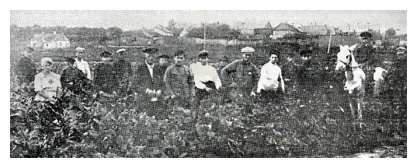
At the “Hechalutz” “Hachshara” plot – 1920 |
|
From the left: (1) Yehuda Stolarski, (2) Boyarskit, (3) Shmuel Zayonc, (4) ...,
(5) Yosef Eisenstein, (6) ..., (7) Yehoshua Shulkes, (8) ..., (9) Yaakov
Sherszewski, (10–11) ..., (12) Leib Rubinow (the gardener);
first from the right – Yehoshua Blitzki
|
For this purpose it rented an estate named “Migowa,” near the Niemen,
several kilometers from Poniemoń. Choice horses were acquired, along with
a wagon, plows, sickles, and other tools and equipment; a group of ten members,
including Tabak and Reisner, went there and settled in one of the old houses.
While we were still waiting for an instructor from the city to guide us in
agriculture, the front of the war that broke out that summer between the Soviet
Union and Poland drew near. Before long we were cut off from our
“metropolis,” Grodno, and from every Jewish settlement; one day we
sensed around us the panicked movement of retreating Polish forces.
At night, knocks were heard at our door, and we were ordered to open the house
and the stable. Our horses were requisitioned by the Polish soldiers without
any delay; they likewise carried out a search of our belongings and laid their
hands on my new boots – a parting gift from my friends in honor of my
departure for hachshara, toward the aliyah to the Land.
The next day the retreat movement of the Poles intensified. Horsemen appeared.
One of their commanders gathered us and began to interrogate us – who we
were and what we were doing in the non-Jewish area, since surely we were
vanguard troops of the Bolshevik army. Soldiers, dismounting from their horses,
provoked us by way of sport, aimed their lances at us and threatened us. The
thunder of the cannon fire drew so close to us that it could be felt that a
rearguard unit was before us.
In the afternoon an officer ordered us to go down with his horsemen to the bank
of the Niemen, where an army company was searching for a convenient river
crossing for its retreat. When the Gentile who had formerly managed the estate
pointed out a shallow ford, the officer demanded that one of us enter the water
ahead of the unit and guide it. We explained that we were new to the area, did
not know the “paths” of the Niemen, and could not even swim. He then
ordered all of us to strip and enter the river ahead of them. Our comrade
Karwiec, of blessed memory, stepped forward and volunteered to guide the
horsemen across, since he could swim a little. But Karwiec could not find the
shallow ford and slowly groped his way forward. Suddenly a barrage of gunfire
poured toward the horsemen and us; several horses were hit, and panic seized
the riders, who hurried to seek shelter. By the time we regrouped, Karwiec was
no longer with us. He had vanished.
When the battle subsided, soldiers of the Soviet Red Army appeared, who treated
us decently and helped us to find the body of our comrade. We buried him
temporarily, until it became possible to make contact with our comrades in
Grodno, and only then did we bring Karwiec to a Jewish burial with a military
ceremony, the members of Hechalutz marching after his bier while the Russian
soldiers around stood at attention as we passed before them in procession. Thus
we parted from our comrade who fell, without his having merited to reach with
us the haven of our longing.
Our Departure for Aliyah
by Dov Rabin
At the end of the month of Tammuz of the year 5680 (1920) we were already
prepared and ready, 15 members, men and women, from Grodno, to set out on our
way to Eretz Israel. We even renewed the white outfits, with the open collars
of their shirts (a “fashion” not yet known in our city at the time)
and sewn from simple linen peasant cloth – this was “the garb of the
worker in the Land,” as we imagined it.
We also appeared on the Sabbath at the head of the streets, on
Dominikańska Street, turning toward the photographer Chomol to
“immortalize” ourselves, each one separately and all of us together,
and likewise “with all the lads,” the activists of Hechalutz and
Tzeirei Zion. With the gravity befitting the “occasion,” we seated
ourselves before the immortalizing camera – especially those of our young
men who, already when we first went out to set our hand to “the work of
the soil” in the Hechalutz plot at the edge of the city, had
“sacrificed” our forelocks and shorn them off completely, in the
manner of “Hebrew workers in the Land,” whose minds are surely not
free for hairstyles and other such trifles.
And thus we were also “immortalized,” with our blue-and-white flag
spread out and displayed at our feet, upon which, in golden letters, our motto
stood out: “Hechalutz goes before the camp – go up and conquer the
Land and the labor,” with an additional inscription – “Hechalutz
Grodno, Group B.”
Our equipment and our provisions for the road and for the distant Land were
also already prepared with us, including the staple food – rusks of rye
bread baked like the peasants' and dipped in sugar-and-vinegar water, so that
it would keep for a long time. Not a little “trouble” did the bulky
wicker basket, which we had filled with these rusks, cause us by its weight in
the jolts of our journey, until we got rid of them in Eretz Israel, when the
time came, by spreading them out as an offering to the chickens in the
courtyards of the Atlit settlement.
While we were still completing our preparations properly and at ease, awaiting
our foreign passports from the capital, Warsaw – our scheme and our
planned timetable were thrown into disorder. The war front, then being waged
between the Soviet Union and Poland, suddenly drew nearer and nearer to the
gates of our city. And while we were pondering and deliberating about what to
do, the thunder of the cannons grew stronger and closer, and an atmosphere of
the evacuation of Grodno by its authorities was already taking hold in it. The
movement of the trains was thrown into confusion, and it was impossible to
press into them, for they were full of soldiers and Polish refugees retreating
and withdrawing toward the heart of the kingdom. And not only that, but it was
also a danger to be encountered and seen at the railway station, which teemed
with detectives lying in wait for deserters and for Soviet spies, and gendarmes
who accosted young people, especially if they had a Jewish appearance. For the
hatred of Israel that seeped through the soldiers was well known, especially
those of the brigades of General Haller and of Pozna–, which had already
earned a reputation even in ordinary times – for throwing Jews from train
cars in the course of their journey, for shearing off beards with bayonets
[Columns 489-490]
|
|
|
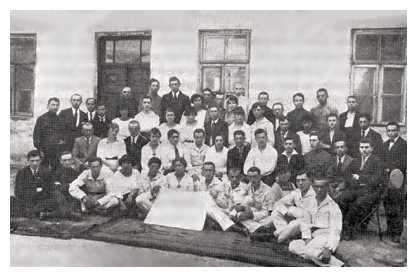
“Hechalutz” Grodno – second group of olim with their
fellow halutzim, July 1920
(The English caption printed in the original reads: Second group of
“Hechalutz” Olim from Grodno, with other Chalutzim)
|
|
From the left, below, the group making aliyah: 1) A.Tz. Kolodicki, 2) Sh. Adin,
3) Mulia Horvitz, 4) Gitel Loski-Avi-Raziel (from Sejny), 5) Moshe Buksenboim
(from Bialystok), 6) Sarah Janowski (made aliyah afterward), 7) Dov Rabin, 8)
Arye Goldschmid, 9) Yitzchak Gan, 10) Sarah Prodovski-Avi-Arye, 11) Eliyahu
Goldschmid, 12) Yechezkel Charlap (did not make aliyah, today in Canada);
Seated: 1) Leib Rubinow, 2) Sarah Kulik, 3) Yehoshua Shulkes, 4) Yocheved
Janowski, 5) Yitzchak Loewenstein, 6) Rivka Babun, 7) Yitzchak Nofech, 8) Tuvia
Zamkow, 9) David Berman-Ben-Dov, 10) Meir Belko, 11) Nachman Milishkovsky, 12)
Yehuda Stolarski; standing, row C: 1) Yosef Eisenstein, 2) Abraham Golov, 3–4)
..., 5) Reisner, 6) ..., 7) Shoshka Yilin, 8) Chaya Domblanski, 9) Dov Gofman,
10) Boyarskit, 11) Yatzevlan, 12) Yaakov Wolshtein, 13) Reisner, 14)
Shmaltzviya, 15) Leib Reisner, 16) ...;
Standing above: 1) Alnhorn, 2–3) ..., 4) Dina Bass, 5) Matus, 6) Alexander
Kasin, 7) Eisenstein, 8) Tuvia Lutenberg, 9–13) ...
|
from the faces of fearful sons of Israel, and even tearing out their hair
together with the skin and the flesh. All the more so now, when the hearts of
the military men contracted within them at the defeat decreed for them – a
Jew was easy prey in their hands to assault, a son of the people destined from
time immemorial to serve as a scapegoat for the Gentiles in the time of their
distress.
The parents and the members of the household therefore pleaded for our lives
and for their own, that we should not, God forbid, endanger ourselves by
setting out on the road into such chaos and confusion: for indeed we did not
even have proper identity documents with us, since these were to be obtained by
two of our members, who volunteered without fear that they would be suspected
of being deserters (these were the pioneer-girl Sarah Prodovski and Arye
Goldschmid, the eldest among us, his right hand maimed), and they set out
– making aliyah by stealth – amid the chaos, on one of the irregular
trains, to the capital city, to see there to the preparation of the documents
required for our aliyah.
But most of us in our group did not flinch from our long-since firm decision to
bid farewell to the Diaspora, to verbal Zionism and to the eternal debates with
our opponents – all the more so since a danger now lay in wait for us:
that a new anti-Zionist regime would, God forbid, block the road to Eretz
Israel before us entirely.
On the eve of the Sabbath, the 2nd of Av 5680 (1920), in the afternoon, a
peasant's wagon awaited us at the edge of the suburb of the city; upon it our
belongings were loaded, and our group – which had now diminished, since
there were some, especially among the girls, who flinched or were held back by
their parents at the last moment from setting out – moved forward, amid
the streaming tears of our dear ones and the “concert” of the
artillery accompanying us on our way. We turned southwest, in the direction of
Warsaw, to the nearby railway station at KoŸnica, where we were to try our luck
– and with the help of an “agent” from among the people of our
movement, who had dealings and connections with workers at the station –
to find, in the darkness of night, some hold on one of the trains coming and
passing from the front into the interior of the kingdom.
At a late hour on the night following the Sabbath we were called, after a full
day of prolonged waiting, to come out from our “lodging” in one of
the granaries of the town, where we had stayed in secret, so that no “evil
eye” would have power over us
[Columns 491-492]
and to turn to the station, where we would wait until our fate was decided. We
were sitting, then, in a dim corner of the tiny station, and the fear of the
armed soldiers passing through and searching for some prey oppressed our souls.
To avoid giving any pretext to mistreat us, we put on cheerful faces and
honored with a generous hand every one of the military men who approached us
– with sweets and with “good things” of ours meant for the
journey, and from the packages of gifts that had been entrusted to us to bring
to the Land for friends and relatives. Every hour that passed was for us like
an age of ages, and still the sign of our redemption tarried in coming.
And only at the third watch was the heralding sign given to us, with a thorn in
its honey: “There is room for only four, and without any baggage; come out
immediately – on the platform a railwayman is waiting, tickets in his
hands; pay him his fee and he will guide you.”
After a short while I found myself crammed, pressed, and squeezed to the point
of pain and suffocation, together with 3 of my comrades, inside a narrow
recess, as our train crawled forward. Now I was stunned by my decision to
effectively abandon my baggage – all my possessions, as it were, that I
had carried with me until then – but at that hour I set before my eyes the
staring looks that “the clever and the sober” among my relatives had
fixed upon me, when they tried to dissuade me at the last moment from the
“folly” that had clung to me, of “casting myself, with a clear
mind, into a sickbed” – that is, to make aliyah to a desolate land
and at the risk of life; and I still felt in my heart the mocking
“blessing” of a friend, a “true socialist” from among the
opponents of Zion, who let fall at my side, with the final handshake: “See
you soon again – here!” – and I was relieved that they would no
longer see me retracing my steps.
While we were still immersed in our thoughts and trying to endure our
half-standing position in the cramped confines of the lavatory where we had
been so “honorably” lodged for the journey, soldiers in the car,
needing to relieve themselves, began knocking on the door. Before long they
tried in vain to force it inward: our little group had become a human stopper
that could be compressed no further.
But our resistance did not save us. Somewhere along the way the locomotive lost
power and the train stopped. Dawn had begun to break; soldiers got down to see
where they were and also remembered to investigate what had become of the
nearby “convenience” compartment. This time they succeeded in opening
the door of our “dwelling” from outside, and rifle butts forcefully
“requested” that we leave it.
It was then that they began to look us over, and were astonished at the sight
of their eyes: “Little Jews! What are these doing on a military train from
the front?”
We try, with calm, as it were, and at ease, to explain that we are bound for
our “Palestine” (this was the wish of our adversaries in Poland at
the time, and their slogan); but immediately voices are heard from among those
surrounding us, who grow ever more numerous:
“What Palestine? Jews don't want to go to their Palestine; these are
swindlers, they slipped away from their units, or they are Bolshevik spies.
Come, let us show them the taste of Palestine!”
We were “saved” by the men of the military secret police, who
arrested us, brought us up “with honor” – with kicks and
accompanying curses – into their car, and proceeded to inspect the prey
that fortune had brought them.
Every attempt to open our mouths and to clarify the purpose of our journey, and
to point to the permit for it that we held from the police, bearing its stamp,
on the forms of the Zionist Organization in Grodno – all that it had been
possible to obtain in the chaos of the city's evacuation – the response to
it was a murderous rebuke:
“Shut up! Little Jews, dog's blood, deserters and agents of the Red enemy
– in a little while we will carry out your sentence there in the grove; do
not utter another sound!”
Everything we had was taken from us, and we were ordered to strip “in the
blink of an eye,” naked as on the day we were born. One comrade, unable to
pull off his shiny, tight-fitting boots, was vigorously beaten on the spot.
The hours of helplessness, hopelessness, and silence – for we were
forbidden even to speak among ourselves – dragged on. At one station,
Sokó³ka, voices suddenly reached us: “There they are, the little Jews,
beyond the water pump – those fugitives with the kettles in their
hands!”
We looked and saw several young people being chased and pursued as they slipped
away toward an open freight car on the train beside us, which was packed with
civilian refugees. Then came another surprise, this time a joyful one: one of
the fugitives turned his face back and – it was almost unbelievable –
there was our Moshe'ke (Buksenboim-Charuvi), one of the members of our group
who had remained at our departure station with the baggage to await a better
opportunity to travel. This meant that the others – Eliyahu Goldschmid,
Itzke Gan, and Shabtai Adin – were also nearby on the road, and perhaps
our baggage was with them too.
We never learned how it happened, but in any event we passed safely through
Czarna Wieœ, the station near the “grove” where, according to our
captors' threats, our end awaited us, and the train continued to crawl forward.
Hope arose in our hearts that perhaps we would reach Bialystok alive, and that
we would manage to convey some word about our fate to the Zionist Organization
and to the people of our movement there. And indeed we reached that city,
though we were also handed over to another gendarme guard at the station. They
imprisoned us, and after a long period of detention we were summoned one by one
for interrogation. “Surely you are the enemy's emissaries and you came to
spy on us, and why do you deny it?!” – thunders the secret-police
officer at me, when I was summoned
[Column 493]
first for interrogation. To overwhelm me completely, he pulled a large
switchblade from my pouch, which he held in his hands, and said triumphantly:
“Is this not your knife? And this blue-and-white ribbon with the red
emblem at its center – will you tell me that it is not a Communist
rank-insignia?!”
I explained that the knife was intended for picking oranges in Palestine. (In
fact, following the example of comrades who had made aliyah shortly before us,
we had equipped ourselves with this “weapon,” believing that such an
implement was needed for personal defense in the Land.) The ribbon bearing a
red Magen David belonged to my traveling companion, who had learned to give
first aid in case it was needed there. It did indeed belong to our Moshe'ke,
who had duly earned it in “Maccabi” first-aid courses and entrusted
it to me when we boarded the train.
In the end the interrogator accepted our explanation that we were bound for
Palestine – and, even more, the hint that a “fitting donation”
to the “Red Cross” (an ironic expression: into his own pocket)
awaited him when we parted, if he would let us continue on our way.
A short time later, the cell door suddenly opened and, with a thunderous shout,
we were driven outside: “Precz! (Be off!), dog's blood – hurry to
Palestine!”
A few days later, in Warsaw, Yehuda Berman, Mulia Horvitz, Avraham Tzadok
Kolodicki, of blessed memory, and the writer of these lines met the other
members of our group mentioned above, together with Moshe Shalman, of blessed
memory. Additional people who were not from Grodno also joined us.
Our baggage also arrived, although everything was wet – our pillows,
feather blankets, and new suits – because rain had fallen on our wicker
baskets while they were transported in open railway cars. Only the golden
letters inscribed on our group's flag had dissolved and were no longer visible.
(We later deposited the flag for safekeeping in the archive and labor museum of
the Histadrut in the Land.)
Only then did we set out on our long, hardship-filled journey – to Zion.
Personalities in Their Uniqueness
Translations by Guillermo Levrio*
Grandmother
by Rachel Adiv
Above the announcements board hung the name: “Mirele Efrat.”
That evening, at the theater, the curtain rose and I saw before me the figure I
remembered from childhood: my grandmother, Basha (Batya) Liubitsch of Grodno,
stood on the stage – tangible and close, embodied by the renowned actress
Ida Kaminski. And in the actress's mouth were Grandmother's own words, her
witty sayings, suddenly ringing through the theater in all their vitality. Her
original figure came to life before my eyes – in all the majesty of her
erect stature, dressed in rustling pure silk and fine lace, adorned with heavy
jewelry, the long gold chain across her breast, and her ever-present cane in
hand.
More than once I heard the story from neighbors who had witnessed it, residents
of Grodno's suburb: the writer and playwright Yaakov Gordin came and spent a
long time in Grandmother's company. He was seized by the desire to immortalize
this extraordinary Jewish woman – a prosperous widow, an independent
businesswoman with extensive affairs, burdened with children, distinguished by
her shrewdness, talents, and nobility of spirit, whose life so far exceeded
what was customary among the Jewish communities of her time. From then on she
was known as Mirele Efrat. For some seventy years, this woman's proud spirit
has been preserved in the unforgettable performances of the great actresses of
their generation – Esther Rachel Kaminski, Chana Rovina, and Ida Kaminski.
The figure of Mirele Efrat inspires respect and admiration in every Jewish
heart and recalls the living heroine of the era before the two world wars.
Grandmother was widowed while still relatively young and was the mother of
seven children. Basha Liubitsch took her fate into her own hands and, with a
self-respect uncommon for a woman alone in any age, developed a wide-ranging
commercial enterprise; her reputation spread throughout the region. The
authorities of the time knew her as an upright woman of valor and a defender of
Jewish honor. It is told that after the Russo-Turkish War she dressed one day
in all her finery, took a carriage to the provincial governor, and demanded
prisoners of war to build her house. Her request was granted.
To this day sharp scents rise in my nostrils – the heavy barrels of oil in
the dim, spacious warehouse in Grandmother's courtyard; the sweet fragrance of
crates of dried fruit and cinnamon. I see before me the sacks of salt and sugar
that seemed to support the high ceiling, and Grandmother seated in dignity
behind the grille of the cash desk, wearing a fine headscarf and a vest of
squirrel fur.
She disliked needless talk and recoiled from women's gossip. Household matters
and anything brought before her she would dismiss with a single sentence:
“Nu, nu, enough idle talk!”
[Columns 495-496]
She would often consult privately with her trusted Nissel, who understood her
from the slightest hint. She was a tradition-observant Jewish woman and greatly
valued Torah study and the fulfillment of every commandment, though she was
never a fanatic, and all who knew her well knew her broad-mindedness. When she
grew old, she decided it was time to marry again. She “took” for
herself a Torah scholar, considerably older than she, who would sit and study
while she managed the business; she felt she could afford this. Some time later
she was widowed again and remained alone.
I remember festivals and holidays, when my sister and I, dressed in our holiday
clothes, walked with ritual solemnity on either side of our stately
grandmother, on the way to Grodno's old “Forshtot” synagogue, where
an honored seat in the eastern section was reserved for her. People around us
would whisper: “Basha Liubitsch is going to the synagogue.” Unlike
the other townspeople, she had no nickname.
In the evenings, by candlelight alone, she removed her dark headscarf and
splendid jewelry. Then, by the light of a kerosene lamp with a blue lampshade
decorated with pink flowers (before there was electric light there), she read
us Bible stories with devotion, instilling in us the awe of the Binding of
Isaac and the ten plagues of Egypt. Over Grandmother's house hovered the
mystery of the traditional night of the Ninth of Av and the Day of Atonement,
with all their stringencies. Preparations for the festival days were carried
out in their full scope.
Grandmother used to lead the Passover Seder herself. With full authority she
sat at the head of the splendidly set table and delighted in seeing her sons,
daughters, and grandchildren, who gathered from every corner of the country for
the festival night. She disapproved of the sons' rapid enrichment in one of the
great cities, which she considered inflated, and viewed their outward glitter
with suspicion as “soulless,” as she used to say of her children who
had abandoned both tradition and their home in the suburb. She possessed
unusual courage – perhaps because she was too proud – and when
disaster came, she knew how to stand firm.
Sadly, the events of her life extended beyond the story told by the playwright
Gordin. Basha Liubitsch's house was burned and her property looted, yet she
herself stood with head held high before Polish rioters who threatened to kill
her.
Broken and very old, she remained an utterly destitute refugee in a dingy room
across the river, and she did not yield to the entreaties of her sons and
daughters to take her into their homes. To her last day she guarded the
independence that was so dear to her.
As she lay on her sickbed, she looked with faded yet compassionate eyes at the
children standing around her. A great serenity spread over her figure. And the
curtain came down.
My Father's House
by Esther Berman-Kopelovich
(R' Ze'ev Wolf and Sarah Berman)
During the First World War, Father, a native of Shchara near Slonim, lost the
forests in which he had traded and prospered from a young age; they now lay
across the Russian border. The money he held lost its value. The sole remnant
of all his property – the spacious house in Shvalona, my mother's town
– was sold, and in 1921 we moved to Grodno.
The later postwar years were good years for the Jews of Poland. My father
worked from morning until late at night, and together with my two uncles
developed a wholesale trade in sugar, flour, and salt. They established a
factory for spirits and liqueurs and began building a second factory for
leather and shoes. Business prospered, and abundance filled the house. The
daughters attended the newly founded “Tarbut” school, and the sons
studied at the Grodno yeshiva. Father followed this rule: whatever was paid for
the girls' tuition, he paid in full to the yeshiva, even though no payment was
demanded, since the yeshiva also supported the young men studying there.
Father's motto was: “Torah study ought to cost money – God forbid
that one should profit from it!”
Mother was a homemaker by whose word everything in the house was governed. She
was beautiful, educated, and noble in all her conduct, and her first concern
was the children's education.
She herself knew several languages, but preferred to read and write only in
Hebrew. In the cabinet stood the twenty-four books of the Tanakh in splendid
bindings, Father's wedding gift to her, given at her request. She knew these
books well and studied them constantly. She was displeased to see us daughters
poring over Polish books. She wished to instill good character and proper
conduct in her children, but above all to root in their hearts a love for the
Jewish people, Torah, and the Land of Israel. Although the principles of
educational theory were unfamiliar to her, she instinctively used all the
pedagogical methods of her time and strove toward their goal.
On the Sabbath eve, the house was lit and the table set with every good thing.
Father and the sons returned from the “shtibl,” and the
“guests” – regulars and newcomers – gathered around our
table. There was the ritual slaughterer (shochet) from the town of Rosh, who
only rarely traveled home to his wife and children; beside him was the elderly
R' Aharon David, who lived in the “home for the aged” but regularly
ate with us on the Sabbath; then a yeshiva student who also dined with us on
weekdays, and two other Jews, travelers passing through. These last two had
remained after prayers; Father had seen their distress and invited them to come
with him. At first Mother was alarmed by the number of guests, but Father
reassured her with a smile: “It is nothing. Pour two more cups of water
into the pot, and there will be enough for everyone.” Mother served each
person two challot for Kiddush; one after another they recited Kiddush, and the
house filled with prayer and song. The clatter of plates and the Sabbath
melodies echoed between the walls, casting sweetness and devotion over all who
sat there.
[Columns 497-498]
The doors of Mother's house were open to everyone in hardship. Every hungry
person left her satisfied, and by her kindness she relieved the loneliness of
every dejected soul. Sunday was reserved for the poor; Mother did no other work
that day. She would change several gold coins into small coins and fill a bowl
with them. On a fine day she sat outside to spare those who went from door to
door the trouble of coming in, and distributed the coins with a pleasant
expression. She would say to them simply and innocently: “One must give
generously – who knows, perhaps Elijah the Prophet is among them?”
They asked whether she would agree to host the Rebbe of Slonim and his Hasidim;
she agreed at once. For a whole week Mother labored with the special cook,
preparing to receive the guest. The children were moved out of their room,
which was made ready for the Rebbe.
On the sixth day, in the morning, the Hasidim began to arrive from the towns
near and far; afterward came the Rebbe with his escort. It is hard to describe
what was done in the house. In the spacious guest-room the Rebbe sat at the
head of the table, and around him the congregation of Hasidim. In the other
room crowded together Jews “misnagdim,” yeshiva-folk, and just plain
curious ones.
Words of Torah, Hasidic melodies, and dancing filled the house throughout all
the Sabbath. The joy reached its peak on the night following the Sabbath, after
the Havdalah. Leizer-Ayzik of Melona brought out the drum, leaped and climbed
up onto the table and began to sing and to drum; the joy gripped them all, they
sprang up and climbed onto the tables, danced and sang with great fervor. From
behind the windows there crowded together a congregation, many of the children
of the Covenant and those not of the Covenant.
After the Sabbath the Hasidim began returning to their towns, but the beggars
among them remained. Father reached into his purse and gave each one traveling
expenses for the journey home. The Rebbe remained until Thursday. Many came to
seek counsel, ask for a blessing or healing, and so on …
Grabski rose to power. All the illusions of the Jews vanished. A wave of
“quiet” antisemitism swept over Poland and undermined the economic
foundations that its Jews had laid; a wave of bankruptcies flooded the country.
The effects of the collapse also struck at the doors of our house. The
distilleries that had been in Jewish hands passed to the State as a monopoly,
and their owners received only token compensation. The file of unpaid
promissory notes continued to swell.
On the eve of Rosh Hashanah, Father put on his new silk-lapelled
“surdut” (frock coat) and tied his bow tie before the mirror. His two
uncles and business partners came with further bad news, after which the
collapse of our affairs could no longer be avoided. I remember that they burst
into tears. Father continued adjusting his bow tie, then turned to them and
said: “A new year is approaching. We do not despair of God's mercy –
may God help!”
But the collapse came; Grabski and his famous “wagon” took out the
new machines from the leather factory for public auction, on account of
exorbitant taxes that had not been paid – and so came the end of the whole
enterprise.
Father could not and did not wish to start over, but his spirit was not broken.
In times of prosperity he abstained from luxuries and always reproved us for
them; in adversity he remained firm and proud. He turned his energy into
another channel, devoting special attention to Grodno's “shtibl.”
This prayer house belonged to the Hasidim of Karlin and Stolin, but in practice
barely a minyan of assorted Hasidim gathered there, and only once a week –
on the Sabbath. In the women's gallery (ezrat nashim), R' Moshe the Hasid had
made himself a place to stay (“Mosheke Loiger”). A widower, he cooked
for himself and slept there. He earned a meager living buying and selling old
sacks. He was short, wore a simple linen kaftan, and was impeccably clean. He
walked and spoke gently; his whole being embodied Hasidism in its finest sense.
Humility and innocence, shrewdness and integrity, and a pure, simple faith
dwelt within him; all who looked at him saw the radiance of the Divine Presence
in his face.
There was also R' Avigdor the Hasid (Loinstein – Loewenstein). They said
he was one of the town's great Torah scholars. He sat over his studies day and
night. Beautifully dressed and gentle, his face radiated Torah and wisdom, and
he looked more like a “misnaged.”
R' Yosil the baker was a sharp-witted Kotzk Hasid. All week he worked in his
bakery and earned an honorable living, but on the Sabbath he put on his kaftan
and became another man. He knew how to sing and dance, to rejoice and bring joy
to others. Some said that he was also learned in Torah, but as a Hasid he did
not like to display it.
Avraham Moshe, the red-bearded Hasid of Sokolov, was poor, downtrodden, and
burdened with children, but in the joy of a commandment (mitzvah) he would
forget and set aside all his troubles. At the community's expense Father sent
him to learn the work of nikkur (the kosher removal of forbidden veins and
fats). He returned and became a menakker (a specialist in nikkur), received a
salary from the community, and from then on his lot improved. He never forgot
Father's kindness.
Father also secured a position as community shochet for the ritual slaughterer
from Rosh, and his whole family breathed a sigh of relief.
Thus a minyan was assembled, with difficulty, for the Sabbath prayer, but all
the days of the week the Hasidim's house-of-study was closed. And how could
anyone be expected to go “so far” – to the “shul-hoif”
(synagogue courtyard)? Everyone sought himself another minyan close at hand.
When Father turned away from his occupations, against his will, he did not rest
and did not grow quiet until he gathered –
[Columns 499-500]
worshippers for a fixed minyan, day by day, in the “shtibl,” and
afterward – even for the Minchah-and-Maariv prayer and for the study of
“Ein Yaakov” each evening. He would run to the “shtibl” for
the prayer, no matter how far it was, for he feared lest the tenth man of the
minyan be lacking. With love and with devotion he worried about obtaining the
wood for the heating. He even set up a women's-section corner, so that the
women of the neighborhood could pray in it on the festivals.
Mother used to call it “the minyan of the ten idlers (batlanim),”
because the morning service began late and at times another passerby had to be
sought to complete the minyan. Father would therefore return late for
breakfast, while Mother waited for him without tasting anything. She complained
about the “shtibl” only for appearance's sake.
Twice a year – at Purim and Simchat Torah – she invited its
worshippers to our home. Her “kiddushim” were renowned. Not only the
Hasidim came willingly; the children came especially eagerly, knowing that
their share would not be diminished.
After Mother set the table with every good thing, she placed round cakes,
biscuits, and candies inside a snow-white pillowcase, reached in, and
distributed them to all the children. Meanwhile the Hasidim had time to recite
Kiddush, and then sang and danced all day. At Simchat Torah they brought out
the cholent and helped themselves to it heartily.
The gratitude of these simple Jews was fully revealed when Father fell ill with
severe pneumonia. They brought a Torah scroll, and on Yom Kippur and during
Sukkot they prayed in the room next to Father's. He lay in bed wrapped in a
tallit, with R' Avigdor watching over him. On Yom Kippur, when R' Avigdor saw
Father collapse helplessly onto the pillow, he gave him milk to drink, spoonful
by spoonful. And who rejoiced more than they when Father recovered?
Especially engraved in my memory is the night of Simchat Torah – the
hakafot in the “shtibl.” The entire “shul-hoif” and the
surrounding area gathered there. Well beforehand, men, women, and children
crowded in. Even the famous “Mariah” appeared with her offspring,
always voicing her sparkling remarks aloud. Nor did the residents of the
renowned “Yorzika” miss this free performance. The Hasidim would
outwit them by gathering at our home and remaining there until ten at night;
only then did they make their way to the “shtibl,” pray Maariv in
haste, and begin the hakafot.
Like an arrow shot from a bow, the rumor spread that the Hasidim had arrived.
Those who had given up and gone home returned and filled the narrow prayer
house. It was a wonder: a handful of Jews kept everyone in suspense for a long
hour.
The Holy Ark was emptied; the congregation held the Torah scrolls and
straightened to their full height. They placed the scrolls on the table upon
the bimah, each rested a hand on another's shoulder, and all distinctions
disappeared: everyone was equal and united, their eyes closed. The melody
echoed and their feet lifted in spiritual rapture. Downtrodden and weary they
were – yet sons of the King.
A second cause to which Father devoted himself with all his heart was
“chinuch” (education). Because of economic decline and
impoverishment, every aspect of the great yeshiva's situation worsened. Its
director, R' Feivel, fell ill. The shopkeepers who rented premises in the
building in the town center – donated by the industrialist Shereshevski to
the yeshiva as a permanent income-producing fund (keren kayemet) – had
fallen on hard times and owed the yeshiva a great deal of money. R' Shimon
Shkop zt”l, the head of the yeshiva, invited Father to consult with him
and described the situation. Father came home shaken by this humiliation of
Torah: grown yeshiva students were subsisting by eating “days” (meals
provided in rotation by local families). He immediately took up the burden and
drew others into the sacred work. He went from shop to shop and from tenant to
tenant – people who had benefited from yeshiva property without paying
– collected the debts, and even accepted promissory notes in advance. He
worked tirelessly and took great satisfaction in it. He used to say: “Jews
are always children of Israel: when called upon, they give. The matter had
simply been neglected.”
The Second World War broke out. I later learned from refugees that Father
continued his work. Jewish refugees from Nazi-occupied Poland streamed without
cease into Grodno, which was under Russian control. On the Sabbath Father went
to the railway station to watch for any Jew who might arrive without knowing
where to turn.
The rescue of Jews – is there a greater commandment (mitzvah)? At first
Father brought them to our home, where Mother fed them, gave them drink, and
made up a clean bed for their rest. Even though food was not plentiful in the
house during wartime, my parents continued, as always, in their way.
It was told to me that, with the community's funds, they hired smugglers who
spirited Jews across to Vilna, and from there these went out to the Land of
Israel and to the wide world. Many, many did Father save – but not himself
and not his household.
“Danche”
by Yosef Efraimi
Jewish Grodno was known not only for great men of Torah and charity, powerful
magnates, and distinguished intellectuals, but also for simple folk –
beadles (shamashim), tailors, and shoemakers – who were accomplished Torah
scholars in both revealed and esoteric teachings. Among the beadles, for
example, was the attendant of the “Chevrat Sha's” (Society for Talmud
Study), who studied a folio of Gemara every day with Yosef Shereshevski, the
greatest of Grodno's magnates; we yeshiva students turned to this attendant
whenever we encountered a difficult sugya (Talmudic passage). There was also
the attendant of “Alshich,” a destitute Jew who lived in a cellar and
gave a shiur (lesson) in Halacha and Aggada in the Beit Midrash of Slobodka.
Among the artisans of this kind were R' Motya the righteous, a poor tailor with
a noble, Herzl-like appearance, renowned for righteousness and lovingkindness,
who discreetly supported Torah scholars and gave a shiur in “Ein
Yaakov” at “Chayei Adam” in Troitse; and R' Itzch'e the
shoemaker, poor and sickly, who also lived in a dark cellar in “Little
Troitse” and looked after the yeshiva students, arranging for all of them
to be hosted in householders' homes for the Sabbath.
[Columns 501-502]
Most unusual of all these good Jews, in his dress and bearing, was
“Danche” – “R' Daniel Ish-Chamudot” (the man of
preciousness), as those who knew him closely called him, and
“Danche-Shmayim” (Danche-the-Lashes; from halkah, a lashing, in
Hebrew), as the people called him. The original later spells the by-name
“Shmayis”; both forms are preserved here as they appear. I will
recount my childhood memories of him.
Danche was the first herald of spring for the pupils of Grodno's “Talmud
Torah” and yeshiva. Throughout the winter he was neither seen nor heard;
only when the snow began to thaw, between Purim and Pesach, did he appear in
all “his splendor,” with his two camel-like haversacks slung at his
waist, and take up a place beneath the steps of the “Chevrat Sha's.”
Among the “Eishishker” lads (students of the Eishishok yeshiva) in
the higher classes of the nearby yeshiva, Danche was the subject of whispered
speculation. They had heard that outwardly he was merely one of the beggars who
went from door to door and town to town, dressed in torn and tattered clothes;
but in truth (so said the yod'ei chen, the initiated few) he was one of the
hidden mekubalim (kabbalists) among the thirty-six righteous (lamed-vav
tzadikim), who had sentenced himself to exile and undertaken repentance for the
sins of his generation.
Yoske the Matmid (the diligent one) of Foritsch related that Danche had made a
place for himself in the “kloiz” (study house), where he slept; deep
in the night he observed “Chatzot” (the midnight lament) and prayed
“vatikin” (at dawn). Early risers would find him standing, bundled in
his worn tallit, silent and motionless. They never included him in the
“minyan” and noticed neither his arrival nor his departure.
The children of the “Talmud Torah” followed at his heels, for they
knew that Danche would distribute candies and choose two strong boys, giving
each a leather strap. He himself knelt and prostrated himself on the ground, as
at “Nefilat Korayim” on the Day of Atonement, and asked to be lashed.
The boys lashed his bare body, one from the right and one from the left, each
administering nineteen lashes, while Danche murmured a quiet prayer and
repeatedly struck his fist against the tablet of his heart. Great commotion
arose around them: people shouted, surged, and pressed forward, competing for
the commandment (mitzvah) of lashing Danche-”Shmayis.” Then Yitzchak
the beadle (shamash) would arrive, scatter the children with his staff, harshly
rebuke Danche for profaning the Name (chillul ha-Shem) and disgracing the
Torah, and drive him from the place in shame. Danche would gather up his rags
and haversacks and, one day, disappear again.
Some time later I came to Foritsch, a small town beside the railway junction on
the line to Drozgenik, and to the home of the Weiksman family. They were a
prosperous and respected family: the husband was a timber merchant and
contractor (kablan), and his wife managed the local pharmacy. Their home, where
the spirit of the times mingled with Hasidism and devotion to tradition, served
both as a meeting place for the town's intelligentsia and as a rest station for
admorim (Hasidic rebbes) and their attendants on the way to the nearby health
resort.
The family set aside a special building for distinguished guests who wished to
stay there. Behind it stood a hut (bikta) at the rear of the courtyard, locked
most of the year, to which Danche – or “R' Daniel Ish-Chamudot,”
as the household called him – would come before Pesach and after Sukkot.
When he arrived, his hosts placed in the hut an iron bedstead covered with a
sheet but no mattress, a rough wooden table, and a few benches. There the guest
made his dwelling and secluded himself. Usually he fasted until evening,
wrapped in tallit and tefillin, gazing silently through the small window at the
distant fields on the horizon, at times absorbed in the “Zohar” or
the book “Raziel.” At evening they brought him a jug of water, a
piece of dry bread, and a warm cooked dish. His hosts treated him as a holy man
and guarded him carefully so that no one would disturb him. Only on the Sabbath
eve did he break his fast, purify himself, and join the communal table. During
the meal he remained silent, sighing from time to time with a heartrending sigh.
At times strange figures would come to visit him, who came from afar to take
counsel with him and to share a secret with him; these would seclude themselves
in his room for hours, and go out without our noticing them and without a
farewell.
Suddenly Danche would vanish without saying where he was headed. Some reported
seeing him in Petersburg or Moscow, and later on the banks of the Volga among
the “Katsapim” (Russians), loading timber. There he wandered and
roamed on some hidden mission, casting off one form and assuming another,
concealing himself from ordinary people and revealing himself only to the
singular few who knew the secret (yod'ei chen).
Several years passed. One stormy night Danche appeared again in Grodno. He
reached the Beit Midrash “Chayei Adam HaGadol” and asked R' Yosi the
beadle (shamash) to let him spend that night there, for he had to prepare for a
very long journey. R' Yosi agreed; he could not bring himself to drive Danche
out while a storm raged outside. That very night R' Danche breathed his last.
The worshippers who came for “vatikin” (the dawn prayer) found him
wrapped in his tallit, stretched out on the ground, with the book
“Raziel” beside him.
Several minyanim (groups) of Jews followed his bier, having gathered from every
corner of the city and its surroundings – silent figures, not of this
world, who were never seen among people during the year. Silently and swiftly
they tended to the deceased, paid him the last honors, and allowed no stranger
to approach his bier.
Thus a righteous man departed to his eternal world.
This material is made available by JewishGen, Inc.
and the Yizkor Book Project for the purpose of
fulfilling our
mission of disseminating information about the Holocaust and
destroyed Jewish communities.
This material may not be copied,
sold or bartered without JewishGen, Inc.'s permission. Rights may be
reserved by the copyright holder.
JewishGen, Inc. makes no representations regarding the accuracy of
the translation. The reader may wish to refer to the original material
for verification.
JewishGen is not responsible for inaccuracies or omissions in the original work and cannot rewrite or edit the text to correct inaccuracies and/or omissions.
Our mission is to produce a translation of the original work and we cannot verify the accuracy of statements or alter facts cited.
 Hrodna, Belarus
 Yizkor Book Project
 JewishGen Home Page
Yizkor Book Director, Lance Ackerfeld
This web page created by Osnat Ramaty
Copyright © 1999-2026 by JewishGen, Inc.
Updated 16 Aug 2026 by OR