 |
|
[Page 33]
by Prof. Dr. Majer Bałaban (Warsaw)
When we speak about the Kościuszko Uprising and about the
“campaigns” of the legions of Napoleons armies, we always encounter
the name of Berek Joselewicz, as if other Jews did not participate in
Napoleon's military battles. However, ledger records from new investigations
bring up names of soldiers and other officers in the Polish Army.
One of the exceptional Jewish officers was Jakob Szpot, son of a poor craftsman in Będzin. This officer participated in the Spanish “Campaign”, excelling in the battle and because of this Napoleon awarded him a medal of honor. Szpot also participated in the battle of Moscow and fell in 1812.
Heronim Borowski, a citizen of the Lublin district, tells of the heroism of Szpot, in “Jutrzenka” from 1861:
In 1808 officer Jakob Szpot served with me in the army in Spain. He was a very upright person and one of the heroes of the regiment. He always went first and in the brutal battles he commanded his men with composure, as if it was a parade on the Parada (festive army ceremony) field. He did not own property but nevertheless distributed a fourth of his wages amongst the soldiers, who excelled in their heroism and behavior. There were many instances of his courage and I will note one of them. In January 1808 Szpot was dispatched by General Chłopicki to conquer the small town of Cuenca [Spain], an important military position, during our Marsch (march) on to Saragossa. Szpot conquered the town, heading 200 soldiers amongst which there were 60 Frenchmen. After a short time he was surrounded by 3,000 Spanish soldiers, to whose aid came local residents. Szpot now had to fight against a double enemy: internal and external. Nevertheless he didn't hesitate and went out towards them. The Spanish knowing that our numbers were few, attacked us with great enmity, however after three hours, they retreated, leaving 300 casualties, excluding wounded of a similar number. Szpot's soldiers also suffered badly and half of them fell or were wounded in the battle. Szpot himself was wounded by a bullet in his leg and a sword to his head. In spite of all this he fought bravely, however the Frenchmen in the regiment refused to continue fighting, since twenty of them were killed, the rest were wounded and those that remained alive were weak and their spirits were low. Szpot pleaded with them to no avail: “We will all be killed, however we must obey the General's order”.
The French surrendered and gave themselves in to the Spanish. Szpot was left with only thirty soldiers and with them he planned for a new battle, which was very bitter. They displayed extraordinary resistance. Szpot was wounded in another two places. His few soldiers asked him to rest a little, however he refused, saying: I promised the General to fight till the last drop of blood. The Spanish overtook the house, in which Szpot was barricaded, set fire to it, however Szpot did not surrender, defending without any hope of surviving. Miraculously the 11th mounted regiment appeared, having heard shots form this battle. They provided assistance, and thus Szpot was saved with nine of his soldiers who had remained alive. However all of them, to a man, were severely wounded.
In recognition for their heroism, Napoleon awarded them medals of honor, the Order of the “Honor Guard”.
I should add – writes Heronim Borowski – that Szpot was a member of the faith of Moses [Jewish], son of a craftsman in the town of Będzin and he fell in the battle field in 1812.
by Dr. Emanuel Ringelblum
Translated by Gloria Berkenstat Freund
Based on an earlier translation by Rita Ratson
One of the anomalies of Jewish economic life is the uniqueness of the Jewish
labor force. It would be hard to find Jewish people in capitalist countries
working in large- scale industries, in mining and so on. This particular phenomenon
of Jewish workers being concentrated in particular branches of small industry has
already been established by Borochov[1].
We won't be able to analyze this question because this is a theme on its own,
which has already been studied by many economists.
Here I would like to illustrate all the, simple legal restrictions with an example from Zagłębie.
|
|
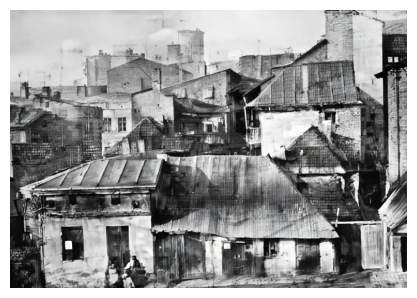
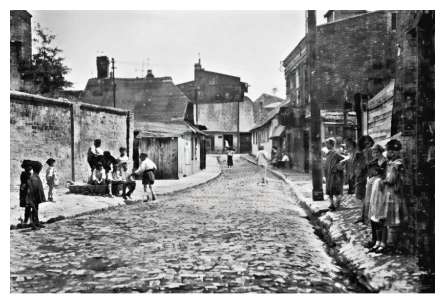
| Podwale Alleyway |
The mining administration, which evolved during the former Congress Poland[2] in 1824, was passed on to the renowned minister of finance, Prince Lubecki. This minister, wishing to become acquainted with the position of the Polish miners, and with their needs and requirements, immediately set out on the road. He held meetings wherever he went with engineers and administrators. Among the various questions he dealt with was that of Jewish workers in the Polish mines. It is a known fact that the Napoleonic Wars brought about the destruction of the Warsaw principality, which in the main became a part of Russia as Congress Poland. The Jewish masses were devastated through wars, taxes and levies for the battling armies. The poor, hungry masses tried various ways to find an alternative income. They desperately tried to obtain some land ownership, although traditionally this had not been possible, and yet others sought to find work in the evolving mining industry.
At the time, in this particular industry, manpower was lacking. They had to bring qualified craftsmen from other countries in order to build up a work force.
As mentioned, the poor Jews of Zagłębie, mainly from Będzin, were eager to work as miners and wherever the minister, Prince Lubecki, reached he was asked how he would handle this question.
Here is what we read in the book about “Mining and Glassworks in Congress Poland in the Years 1815-30” by the well-known researcher, Professor Natalia Gąsiorowska.
“The relevance of the question of Jewish workers was brought to the attention of the ([finance] minister) that a significant number of poor Jews were looking for employment in mining. Because of the lack of workers, it was decided to allow [these] workers in mining on the condition that they have to be used as day laborers – but not as permanent workers with a weekly salary – as mine workers or as glassworkers.”
In other places in the book, we read about efforts by Będzin Jews to infiltrate the mining industry. So, for example, we learn the poor in Będzin sought employment in the Ksawery coal mine, which was founded at this time.
At another meeting with Prince Lubecki, he declared: “One would be able to utilize the poor Jews as coal miners and thus we would receive many laborers for the real work in the mining and glass working industry.” As noted earlier, the decision was that Jews would only be able to be employed as day workers.
How this developed further is not known. I do not know whether Jewish workers were actually employed as mine workers in Zagłębie or [whether] all of the decisions just remained on paper. The old men in Będzin would have been able to say something about the question. And further research is needed on this very interesting subject.
The example of Będzin, where the conditions of Jewish poverty were worse than that of the Christians, for whom special apartments were built and efforts were made, such as wages, etc, to create good working conditions for them, is a distinct illustration of the sort of ruin that economic antisemitism brought on Jewish life. The crippling of the economic structure of the Jewish population is a consequence, among others, also of the economic antisemitism that was rampant at that time and is also rampant today.
Note from the editor: On further research, we found that there were few Jewish coal miners in those times. It turned out that despite the efforts of the poor Jews of Będzin to find work in the Zagłębie coal mines, and despite of the recommendations of the
[Page 35]
minister, Lubecki, to permit them to be day workers – the local
authorities did everything in their power to daunt the aspirations of
Zagłębie Jews in the mining industry.
The reason is economic antisemitism, as was clearly shown by Dr. Ringelblum.
About 60 years ago, however, we find fictitious Jewish miners in Będzin. These were young Jewish men, master craftsmen and artisans who did not have to appear for the draft [into the Russian Army]. As a law existed then according to which coal miners were exempt from military service, young Jewish men enlisted as coal miners in the Zagłębie mines, where they worked three days a week without pay, if only not to serve [in the military].
When we consider that at that time young Jewish men aged 21 were already married and sometimes even were fathers of several children and, and in addition, it was a fact that the tzarist government persecuted the Jews terribly, designated special laws for them and arranged pogroms – it is no wonder that Jews evaded serving their “protector, the Tsar Batushka [the dear tsar].”
We find several hundred Jewish coal miners in 1912 in the Upper Silesia coal mines. We learn precise facts about this from a correspondence between the Katowice Zionist leader, Arnold Wiener, and the then still young Będzin Zionist activist, A. K. Liwer.
In a letter (written in the German language), dated the 19th September 1912, Winer writes the following to Liwer:
“About your [letter] of the 17th … I inform you that I will answer you on your question in connection with the employment of Jewish coal mining workers.
“In order to create work for Jewish workers from the east who were without employment, the Katowice community created a committee that established contact both with the coal mine owners and with the Jewish kehile [organized Jewish community] in Russian- Poland and Galicia, in order that in such a manner to create employment for a few hundred of the needy.
“The lowest daily wage reached 2.80 marks. This wage was designated for those who first had to be taught how to work. After 14 days, the wages on average reached up to 3.50 marks and after four weeks, many workers even reached a wage of five marks a day.
“Over the entire time, approximately 300 works were employed.
“Finally, I still have to inform you that the entire undertaking is in danger of being liquidated because the Prussian government will not permit foreign Jews to be regularly employed in the area of the Prussian state.
“Steps were undertaken at the Interior Ministry in Berlin in order to receive permission for wider employment for Jewish workers. However, it is greatly doubtful if the efforts will be crowned with success. The Jewish workers employed in the coal mines were already forced by the police at the beginning of the week to return to their homes.”
It must be added that among the 300 workers, approximately 50 were from Będzin and its surroundings.
As we see, the Upper Silesian mines were the reason for the economic antisemitism, but this time not on the part of
|
|
|
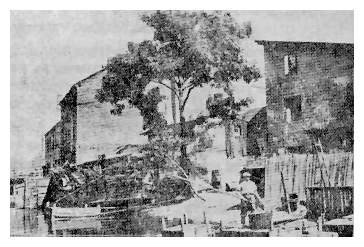
A fragment of Rybna Alleyway (the Butcher's Alleyway) |
the mine owners but on the part of the Prussian government spheres. The Jews were not persecuted as foreigners, but as Jews because the fact is that hundreds of Christian workers from Poland and Galicia worked regularly, without any interruption, in the Upper Silesia coal mines.
The Germans made an exception during the [First] World War when there was a lack of workers because almost all of the young men were on the battlefields. Thus we find at that time several hundred Jewish workers from Zagłębie who were employed in Upper Silesia and particularly in the Zagłębie mining industry.
Today, there are almost no Jews existing in this industry.
Translator's footnotes:
by M. Kantori-Mirski
Translated by Ricky Benhart (nee Schikman)
XIV-XVI centuries
In the area of Zagłębie and its surroundings, you see the appearance
and presence of Jews, here and there, as traveling merchants as early as the
10th century. At the end of the 11th century following the persecutions in
Czechia [Czechoslovakia], there is a first wave of refugees coming to
Zagłębie which becomes a safe haven for them, and where behind the
walls of the fortress they find shelter and even protection.
Another group of Jews arrives in the Zagłębie area (Zagłębie Dąbrowskie) after the year 1226, i.e. after the second round of persecutions in Czechia. Several families settle in Będzin, Czeladź, Siewierz, Koziegłówki, Żarki and Pilica. On the reliance of Kazimierz [Casimir] the Great who granted them the privilege in 1368, several families settled in Będzin, and one in Sielce[a].
In the beginning of the 15th century, Germany again began to expel the Jews by means of pogroms. In Cologne, Mainz, Augsburg, Erfurt, Würzburg and Magdeburg, they treated Jews mercilessly, expelling them from the area. Later, when other countries followed Germany's lead – such as Hungary, the Alp countries, Spain and Portugal – then larger groups of Jews began to appear in Zagłębie, mostly in Będzin, where they arrived from Czeladź, Siewierz and Koziegłówki, since they had been expelled from these last cities on the order of the Bishop of Kraków. At the same time Jews settle in Wolbrom and a bit later also in Olkusz, where they soon attained an impressive influence because even in the salt mines they had their own representative in the person of Herman Zelik, the vice-salt administrator (in the year 1437).
Będzin was the center for the Jews. Already at the end of the 15th century the Będzin Jews were strongly organized and ruled over their co-religionists who lived in the Zagłębie area, and also in Mysłowice, Bytom [Beuthen], Chorzów and Tychy [Tichau]. This is where their social, political and religious lives as well as their judicial lives were concentrated. The smaller communities and suburbs of Mysłowice, Bytom, Chorzów, Olkusz, Wolbrom and Pilica also belonged to the Będzin community.
Under the authority invested by Stefan Batory [Stephen Báthory – (1576-1586) reigned together with his wife Anna; regarded as one of the greatest kings of Poland] there was a privilege granted in the 16th century, allowing the Jews to live anywhere; the city delimitations were abolished and Jewish merchants received equal rights legally the same as the non-Jews. In Olkusz Jews were allowed to own mines and also to deal in the metal industry. Around the year 1596, the administrator of the royal tax collector of the mines in Olkusz was in the hands of the Jew Mosze Ezra.
In Będzin, the local Jews enjoyed the privileges of Batory, because in “The Będzin Archives”, called “landvoytishe” (akta landwójtowskie), we find for the first time in the year 1584, the name of “Josek the non-believing Jew” who had a house near the “Rose Square.”[b] The following year there is recorded in the above-mentioned archives a second house on the Square which belonged to the 'non-believing Jew' Jakob. In the year 1587, another Jew, Jakob Baruch, bought a house in the city from Marcin Raciborski, as did the Jewess Rojza Abramowa buy a house from Marcin Szanijawski, which had a brewery and a stable. She paid 700 Polish Guilders. At the end of 1593, we find again in the Archives, the name Marek, the 'non-believing Jew' who bought a house behind the castle, from Wawrzyniec Warmuz. From this moment on, Jews appear all over the city in different streets and also as house owners on the main square: among others, for example, Jicchak Zalman, Rojza Lewkowa, Icek Markowicz, Abram Majerowicz, Jacob and Josef Abramowicz and many others.
In Olkusz, the Jew Marek Faktor, became very influential in the mining industry, together with his sons Eliasz and Jakob; and the salt-mine books mention the name of Natan Gebler, a mine-owner and owner of a lead hut which was called “Szmidowska”.
|
|
|
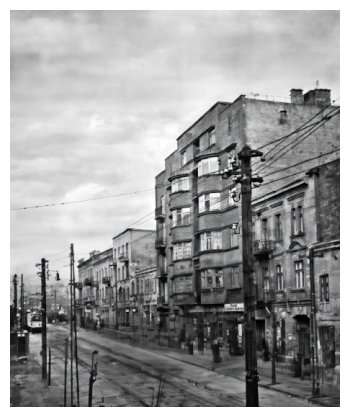
View from the fisherman's district on Sawala Street |
| The “Pinkesim”[1] of the Będzin Societies | |
| by Moisze Manela and Sh. Rotenberg | |
| Yiddish translated by
Gloria Berkenstat Freund |
Based on an earlier translation by
Rita Ratson |
| Hebrew translated by Jerrold Landau | |
The old Jewish pinkesim [record books] of the various societies contain not
only information that has a direct connection to the relevant societies and
their members but also significant historical materials that are of great
importance to the history of the Jews in the city and even to the history of
the Jews in the country.
The record books often present a picture of the cultural, economic and sometimes also of the political situation of the Jewish kehile [organized Jewish community] of the time the lists and registrations in the record books cover.
The record books of the Jewish societies of Będzin are spread out before us and from them we learn that there have been an entire series of cultural, economic and philanthropic institutions that since early times have been called khevres [societies – khevre is the singular]. Sadly, the most important historical occurrences were not always registered in these record books which could have interested the historical researcher. On the contrary, we often find records of lesser importance. It could be that even the less important events evoked a certain interest for the members of the societies who wrote [their] memories in the society record books.
For this work, we have made use of following record books: Pinkes me-Anshei Khesed shel Emet D'po b'Bendin [Record Book of the People [of] True Kindness Here in the City of Będzin] (Burial Society), Khevre Khayatim [Tailors Association], Khevre Hachnosas Kallah [Society to Help Poor Brides], Khevre haTilim [Psalm Society], Khevre Noseh haMiteh [Pallbearers Society] and Malbish Arumim [Society to Provide Clothing for the Poor].
Pinkes me-Anshei Khesed shel Emet D'po b'Bendin
(Khevre Kadishe [Burial Society])
This society is the most important and oldest source for our work.
This is a small, thick book, bound in leather, numbered 1 to 178, on old dull pages that are partially yellowed and partially greenish-grey from age. The later pages are made from satin-like, heavy and perfectly white paper. The first pages, which are numbered, are like an “old vessel filled with ancient wine” in contrast to the later, newer pages on which very little is written and look like “an old vessel that does not even contain new wine.” The format of the book of records is 14 x 18 centimeters [5.5 x to a little over seven inches] – the thickness with the leather and brown linen-bound covers – 11 centimeters [about 4.3 inches]; there is no title page. On the page before page one is the following written in a later handwriting: The record book of the Khevre Kadishe of the kehile of Będzin from ancient times. In addition to that, the following note is on the page: “In this record book there are people who were written about in the Khevre Kadishe record book of 5447 [1687] as can be seen on page 16 and 17 and also many other pages, as well as on page 5, side 2, there is an account page from the year 5440 [1680].”
On page 1 there are important historically significant entries, which are expressed in flowery Hebrew:
“With G-d's help…
“I have etched upon the tablets of testimony in this Pinkas of the Chevra Kadisha Degmulei Chasadim Tovim, the society for visiting the sick and performing acts of kindness for the living and the dead: also to establish an eternal light in the holy synagogue, an eternal flame will burn there [based on Leviticus 6:2]. And it seems that this is so, that I have written letter for letter in the ledger of the trustees of the holy community so that it will be a sign and a keepsake for generation after generation, and they will have a memento: I have affixed it with pegs and nails. The enemy, pestilence, sword, hunger, and agony that spread in our country, the country of Poland, from the day they took hold, and the horns of battle in this year, קצת״א [Katzt”a – 5591 / 1831], and the innuendo of Katzta is because katznu (we have become weary) with our lives [based on Genesis 27:46] from the troubles and afflictions that are tormenting us, and our bellies have become stuck to the ground. The kindnesses of G-d, for we have not been consumed, and His mercies have not ended [Lamentations 3:22]. Through His multitude of mercies and multitude of kindnesses He has saved us: and has given us all types of good: and I will raise up a lament and eulogy for all the dead who have perished before our eyes, for from Bein Hametzarim [the Three Week period between the fasts of 17 Tammuz and 9 Av] until the 22nd of Menachem Av more than one hundred people have perished before our eyes from the pestilence. Today we will rejoice and be happy because the devastation has ended, and the plague was stopped [Numbers 17:15, compare Numbers 25:8]. Pinchas is Elijah the Prophet, may he come to us and redeem us in particular.And with this I begin: Ah, world, wallow in dust; descend and sit upon the ground. Weep, O mortal life, and lament, for every heart has melted, and the whole land is undone. From the enormity of the calamity, the plague and the pestilence – for truly nothing like it has ever occurred in our region, across the very ends of the land: The wrath was not only upon us; it also struck the entire community. Truly, the Ravager went forth and rose up against great and wondrous holy communities: And against it He wrought destruction, and greatly turned His anger back upon us, letting all His fury blaze forth [paraphrased from the opening of the weekday Maariv service]. Both broadly and specifically, we drank our full appointed measure of the cup of reeling from the hand of G-d, and it tore at our very hands. Can a man look upon the scourge of the Most High's blows before him, and the pillars of his heart not be shaken: can a man walk upon the fiery coals of the Most High and his feet not be singed: Can a man consume the bitterness of gall and thick wormwood, mixed with the venom of serpents, and not know that they have entered his innards? Therefore, my brothers and friends, etch this upon your hearts with a pen of iron and lead. And let this be a reminder to you: So that the truth will not be lost… The many difficult troubles: and agony and sighing: from this year: Katzta by our count, for we have become weary of our lives… the cup of reeling, and we have drunk the accursed bitter waters… And the horns of battle from the state's hostility with the Czar of Russia, and plague, and the sword, and famine, and sorrow pressed upon us. Numerous tribulations passed over our heads. And day after day spoke its word [Psalms 19:3] – a day of trouble and affliction: a day of great weeping, lamenting, and mourning for the Jews. For great was the burning of His wrath, for He lifted up the horn of Israel, and His fury grew harsh; for outside the sword consumed, and within there was death-like famine, as it comes [echo of Deuteronomy 32:25, the tochacha, and of 1 Kings 8:37–38, Solomon's prayer] – plague, as it comes. Even every illness and every affliction that oppresses the soul of a person. The lily, above and below, was struck; even the Nazirite was smitten. Purer than snow, whiter than milk – before their time – the Destroyer rose upon them. The cedar of Lebanon, planted by streams of water, and the earth gave forth its yield: suddenly the wrath of G-d passed over it and flooded it, and it was cut off while still flowering. Suddenly the decree went forth, and the Destroyer came in whirlwind and storm. And His sword was drawn
[Page 38]
from the hired sheath in a sudden torrent and rebuke. And he said: thus spoke the king – go down quickly. And within six hours, and no more – from hour to hour, from one visitation to the next. And go forth to the land of the decree [a play on words: cut off land]. To a land of distress and trouble. With coughing and retching from above, and diarrhea coming from below. It bore… upon it his sins to the land of the decree. It broke apart and crumbled. And all her pursuers overtook her here, between the straits, in hardship and suffering. [based on Lamentations 1:3]. And because there were no graves in Egypt [based on Exodus 14:11] – in the old cemetery that had stood here for more than two hundred years, apart from the ancient burial-ground, worn and decayed – we were forced to bury our dead in a new cemetery. And for a full sum of money the city's overseers sold it to him [i.e. us]: three hundred gold coins as the purchase price. And besides that, a yearly levy of twenty gold coins. And in the plague, among the Jews, within two weeks, more than a hundred souls died – among them the G-d-fearing and the upright, the righteous men and the righteous women, males and females, adults and children, the elderly with youths, young men and also maidens, boys and girls. And today, indeed, the plague has been stopped. And now: may the year end with its curses, and may the new year begin with its blessings [from Achot Ketana, Erev Rosh Hashanah hymn]. And we are confident, if G-d wills, that in the coming year 5592 according to our count, the sorrow and wrath will depart, and then even the mute will break out in song [from the wedding Birkat HaMazon]. And so it shall be, as well: may the particular sorrow also pass – Elijah the Prophet will come, and the King Messiah. And death shall be swallowed up forever, and the Lord will wipe the tear from every face [Isaiah 25:8], and our sins will be atoned. It is clear that the plague has stopped fully here in the community of Będzin.Signed by the humble one, Nachum Rozanis, the local rabbi, very weak, and his strength has departed from the tribulations. G-d, turn everything into joy and gladness, and let agony and sighing disappear.
Now, O Lord, remember for us kindness and truth, in this year, if G-d wills, for the dead who died in those two weeks – for the gentiles forced us to carry them out even on the Sabbath. On the Holy Sabbath of the Torah portion of Eikev 5691, the gentiles came with swords and spears against the field – the place where the corpses were lying on the open ground, without a fence – for [the cemetery] had only just begun to be established at the start of the plague, and the graves had remained open since Friday, the eve of the holy Sabbath. Watchmen were guarding five dead: two women, one girl, and two males, whom it had been impossible to bury before the holy Sabbath because the day had already been sanctified and consecrated as the Sabbath. The gentiles tied the legs of the deceased with ropes, dragged the deceased like naked dogs without shrouds, and tossed them one atop the other, the men with the young girl together, to our dismay. They beat the Jews with deathly blows. Nevertheless, we did not violate the Sabbath. The gentiles covered them with soil, and then with sand. We opened them [the graves] discreetly, and treated them with honor as is expounded upon in Sefer Chassidim … … … and in Be'er Heitev end of section 403 in Yoreh De'ah [section of the Shulchan Aruch / Code of Jewish Law] … … … and especially during a plague because of danger to life. We kept the two Sabbaths, and certainly in this merit we will merit the redemption of the Messiah and life in the World to Come, Amen Selah.”[a]
In the above-mentioned notes there is a description of events that took place in Będzin at the time of the illnesses in the uprising year of 1831 when the liberation struggle flared up against the tsarist occupant.
The short content from the Hebrew text cited above is as follows:
“I inscribe [notes] in the record book of the Khevre Kadishe of the Gmili Khesedim [interest-free loan funds] and Bikor Khoylim [Society to Visit the Sick] that provide mercy to the living and the dead and whose task is also to take care that the eternal light in the holy synagogue will always burn and to this content I have similarly entered [notes] word for word in the record book of the gaboim [managers of an institution] of our holy community in order that it remain as a sign and a tradition for all coming generations as a keepsake. This misfortune befell us through the enemy in the difficult fight and hunger in our country, Poland, since the fight and unrest broke out in the year 5591 (1831). And the symptom is “weariness,” because our life became ugly from the distress and great suffering – until the One above helped us in His great mercy that never ends for us. I will, therefore, stop the eulogy for the deceased who fell here in our city as victims for our sins.This was between the Three Weeks (that is, from the 17th Tammuz) until the 22nd of Menakhem Av.[2] More than a hundred souls died and perished from the illnesses. And today we rejoice that the plundering has ended and the plague has ceased. And with this, I will begin: O! World, you need to wander around in the dust, lower yourself down and sit on the ground. All of humanity needs to cry and to lament because every feeling heart must thaw and the entire earth must be disturbed by the annihilation by the sword and the plague that was not yet in our land during the old times. And the rage not only came from us, but all from the entire community of many large and holy kehiles. Therefore, dear brothers, remember the hardships of the year 5591 [1831] when there was the uprising of the land against the Russian Tsar. Every day was worse than the one before. The Jews faced the greatest hardship. Externally, the sword murdered and, internally, hunger tortured to death. Then the illnesses broke out. This was in a quieter time, when suddenly, God's fury flowed and multitudes were expelled over the course of six hours according to an order…and they had to run from the country of edicts. And because of the illnesses there was a lack of graves at the local cemetery that had been founded here more than 200 years before, in addition to the very old cemetery, we were forced to bury the corpses at the new cemetery that we bought at full price from the local mieszczaninem [city residents]. We paid 300 gildn in silver, in addition to a 20 gildn annual tax. And among the Jews, more than 100 souls perished over the course of two weeks. Among them were good and bad, righteous men and women, [ordinary] men and women, young children and old people, young men, as well as young women. And today, we celebrate, because the plague ended and may the coming year 5592 [1832] be fortunate and may the old year depart with its curses and may the new year begin with blessings.
These were the words of the local Khevre Kadishe Rabbi Nakhum Rozanes, who was very weak because of the hardships. May the One above reverse everything to joy and to good.”
[Page 39]
It is further said in the note that –
“The non-Jews forced the Jews to carry the deceased who had died on the two Shabbosim [Sabbaths]. On Shabbos Parsha Eikev (20 Av] 5591 [30 July 1831]), the non-Jews came with swords and pikes to the cemetery where the corpses had been laid near open graves on Friday, at which guards had been placed. Five corpses remained then two women, a girl and two men who they had not been able to bury before the Sabbath because it was dark and the Sabbath had arrived. The non-Jews bound rope around the feet of the corpses and they dragged them naked without shrouds and threw one on the other, men with the girl. They also beat the Jewish guards mercilessly. And yet we did not want to desecrate the Sabbath. The non-Jews covered the deceased with earth. After the Sabbath, we took the corpses out in secret and gave them their proper honor, as was shown in the Jewish books. We observed the two Sabbaths and as a reward for this we will be worthy that the Moshiekh [Redeemer] will come and we will have the world to come, Amen!”
After this comes a list that enumerated 118 deceased by name or the parents' or relatives' names.
On the following pages of the record book, we find registered members of the society. Such a sort of registration content is usually the name and the father's name of a new member; also recorded is how much registration money he gave in cash and how much he owed. In addition to this, also how much he was obligated to pay weekly. At every registration, a remark is found that the relevant one also took on the duty to carry out the rules of the society and that he was a member with equal rights in all matters that have a connection to the life of the society member.
At the end, usually comes the date of entry and the signature of the one registering.
On the second side of page 18 we find the entry of a certain member, Yosef bar Meir, with the following marginal note [explaining various abbreviations]
מע”ק – maot kedima [advanced payment] חי”ג – chet yud gedolim (eighteen great sages) נתן ו”ג
עי”כ תמ”א
נמצא נ ” ח – nishar chayav [is found to remain obligated]
י”ב ג
After this comes an entire row of accounts that he paid in the following years: 5302 [1542], 5303 [1543] and so on and what he still owed Natan… gimel [i.e. 3] and remains obligated… gimel [i.e. 3]
The following note is found on side 26, dating from 5614 (1854) recorded by the then Rabbi, Chaim Dovid Langfus, of blessed memory.
Translation:
“Here was noted, in memory of their good deeds, the two members Reb Tzvi Hirsh Futerman and Reb Moshe Yosef Firszt, who in 5609 (1849) when the illnesses broke out, constantly visited the sick, placing their own lives [in danger] in order to save the sick. The mentioned Reb Moshe Yosef also was the faithfully devoted sexton of the Khevre Kadishe. Therefore it was decided that when the Khevre Kadishe came together, according to their custom, for a banquet, the above-mentioned members should eat the fruit in this world and that their capital should remain for them in the world to come.”
On page 27 we find the following notice without a signature:
Translation:
“While the above-mentioned member, at the banquet of the members on Shemini Atzeres [8th day of Sukkous – the Feast of Tabernacles] in the year 5527 (1767) allowed himself to express with words that we cannot give in writing – it was decided, in agreement with the mashgikhim [overseers], gabbim [sextons] and other members, to punish him with estrangement from the Khevre Kadishe; he is unworthy to us for eternity, in addition to other punishments, that will come to him when there will be an opportunity for them, and in order that this will be remembered, we have recorded the fact here.”
On page 24 we find the following notice:
This notice says that Khol HaMoed Pesakh [intermediate days of Passover] 5503 (1743) 16 gildn and 12 Polish groshn was received in Kiddush-gelt [money for the blessing of wine], of which eight gildn were given for cemetery tools, two gildn to the rabbi for the sermon, 18 Polish groshn for mead for the society and the arbitrators, six Polish groshn for fish and the remainder was deposited with the rabbi.
On page 54, side one, the following members registered in 5561 (1801): two brothers, one Reb Yehuda Leib bar [son of] Gershon Segal and the other, Reb Szymon Segal, who was a royfe [old-time physician without formal medical training] who visited the sick.
On page 53, side one, we find two entries of members that were made by the then religious judge, Reb Nakhum Rozanis, who signs [his name] in the later years as the rabbi of the holy community of Będzin. In the mentioned entries is the fact that this book (pinkes) of the Khevre Kadishe was lost and was [missing] for five years.
From page 61, side 1, can also be seen, that in Będzin in
[Page 40]
5451 (1691) a community record book was kept. In the same place is found an
exact copy of the agreement between the kehile and the Khevre Kadishe,
according to which the kehile – as backing of its debt of 100 gildn that
it owed the Khevre Kadishe – give it an expensive Torah scroll that was
written on deer parchment; the columns began with the vovn (the letter vov) and
the commemoration (that is, the names of the martyrs) were written with special
pen and ink.
It can be seen from the further notations on the same side that with the loan the Khevre Kadishe had done a great favor for the kehile because the money was urgently needed for an important matter and the leaders of the kehile found themselves in a difficult situation, not being able to raise the money from anywhere else.
The pages 62 and 63 contain the important records, written in the year 5406 (1686). Here was established a certain order in the conduct of the Khevre Kadishe. The access for new members in the society was standardized; the order of the banquets that the Khevre Kadishe arranged every seventh day of Passover and Shemini Azeteres was registered. It was even added according to which order the society members have to sit at the table. The gabbim had to take strict care that the members should not speak any nonsense at the table, but they should behave in a serious and dignified manner. The duties of every member were also clearly specified. The following rules were characteristic:
“Eight days before the banquet, a note must be made of how much money each one in the Khevre Kadishe must give for mead. The designated sum had to be paid to the [provider of mead] by everyone, even those who deal in mead.”
“Everyone is obligated to come to the banquet on time. If one does not come, he must give double the amount for mead than for what he had been taxed. On the other hand, if he shows that he was not at home, he only has to give half.”
“The shamas [assistant to rabbi] may not separately invite any of the members to the banquet, but after he calls out in the synagogue where the banquet will be held, all members must receive a separate invitation.”
“The members – as well as the gabbai – may not bring any strangers to the banquet.”
On page 66, side 1 is found an agreement with a shamas who wanting to enroll in the Khevre Kadishe and not having the ability to make a payment of the membership dues, the regulations of the society were overlooked – and he committed himself to serve the society for two years, from 5452-5453 (1692-1694).
On page 66, side 2 is noted that in 5454 (1694), for a certain Reb Moshe Meir bar Eliezar a silver badge that was engraved with his name was dedicated by the Khevre Kadishe.
Registrations of members and lists of elected heads of supervision, gabbaim and auditors, are found scattered without a chronological order throughout the entire pinkes. The members registered extend from the year 5441 (1681) to the present time. It is the same with the list of the gabbaim elected to the Khevre Kadishe through ballot boxes. The elections took place every year during Khol haMoed Pesakh [the intervening days of Passover]. The chief head supervisor or the head sexton was always the local rabbi who was often not mentioned by his name but only “the great rabbi of our congregation” and, therefore, it is not always possible to establish who was then the rabbi.
On page 85, side 2 was written a strict rule that prohibits the members – with the severest consequences – from playing cards. This precept was established in Khol haMoed Pesakh in 5488 (1728).
In 5628 (1868) on page 141, side 1 was written a precept that none of the supervisors or gabbaim who take part in a meeting of the council can bring someone with them, not even a member of the Khevre Kadishe. Under a strict penalty, which reached up to removing the guilty one from the society, it was forbidden to talk about the negotiations that took place at the meeting. A new member was obligated to serve the Khevre Kadishe at the banquets over the course of three holidays (the three main holidays [Passover, Shavous and Sukkos]. He could buy his way out [of serving] if he paid the society 18 silver rubles or at least 10 silver rubles according to the judgement of the gabbaim.
On page 148, side 2 we find the following notation from 5608 (1848), written by the then Rabbi, Reb Chaim Dovid Langfus, of blessed memory:
“At a meeting of the gabbaim of the Khevre Kadishe with mazhgikim [supervisors of Jewish dietary laws], the dozores [synagogue council] of the kehile as well as the Yehudi sgule [the few and chosen people], it was decided that as it was then a precept that to be on the safe side, the kehile should take two parts of the income and the Khevre Kadishe one part – now the Khevre Kadishe should take all of the income because the revenue up to that time did not cover the expenses of the Khevre Kadishe, which was overwhelmed with large debts.”
This was signed by the dozores and the gabbaim of the Khevre Kadishe.
On page 177, side 2 we find a notation, the Rabbi, Reb, of blessed memory (Graubart), who had previously been the Siedlce Rabbi, was welcomed as the Będzin rabbi in 5653 (1893).
Right on the second side, number 178, side 1, we find a notation about the appointment of the Rabbi, Reb Tzvi Chanoch haCohen, of blessed memory (Lewin), as the rabbi in Będzin, in 5681 (1931).
After this notation is found the handwritten registration of Rabbi Lewin, of blessed memory, as the rabbi of the Khevre Kadishe.
On side 2 of page 178 to side 1 of page 179 a 25-year anniversary celebration for the gabbai Mendl Ferens of the Khevre Kadishe is mentioned, which took place in 5604 (1924) in the premises of the kehile with the participation of Dr. Sh. Wajnciher, who was then the head of the kehile. At the banquet, Mendl Ferens received from his friends a silver memorial cup with an appropriate inscription.
On the further pages are found notations from recent times of deferred payments for new places that were bought for the cemetery. The last notation is dated the 7th of December 1936.
As is clear from several further notations, a new pinkes for the Khevre Kadishe was presented. From this
[Page 41]
pinkes certain precepts that had been accepted by the council and the gabbaim
were transferred to the old pinkes.
The notations in the above-described pinkes show that from the time of 1681, the time we report from the pinkes, the Będzin Jewish population carried on intensive spiritual, communal and philanthropic activities. Specific traces have been left on the usually idyllic Jewish life in Będzin; the various unrest, the uprisings and persecutions that broke out from time to time and fell gravely on the Będzin Jewish population.
Original footnote:
Translator's footnotes:
Pinkes [record book] of the Khevre Khaytin [Society of Tailors]
Yiddish translated by Gloria Berkenstat Freund
Hebrew translated by Jerrold Landau
The pinkes of the Khevre Khaytin gives us a precise glimpse into the life of
the Jewish middle class and the artisans – this pinkes has the format of
18 by 28 centimeters [seven by 11 inches], five centimeters [almost two inches]
thick and bound in simple, dark blue linen. The pinkes, therefore, gives the
impression of a religious book that belongs to a normal man of the people and
artisan.
The oldest part of the pinkes that was established in the year 5567 (1807) consisted of 98 pages through which had been pulled a cord and furnished with a signature of the Kehile Będzin [religious community of Będzin]. The subsequent pages, partially numbered and the rest without numeration, are from later, and were added in the last 30-40 years.
On the first page, the following beautiful introduction was written in 5567 (1807) by the then rabbi in Będzin, Reb Nakhum Rozanes, who explained the reasons that led to the creation of a Khevre Khaytin in our city and the purpose that the founders presented for themselves.
He writes there:
(After this comes a series of signatures of the founders.)
|
|
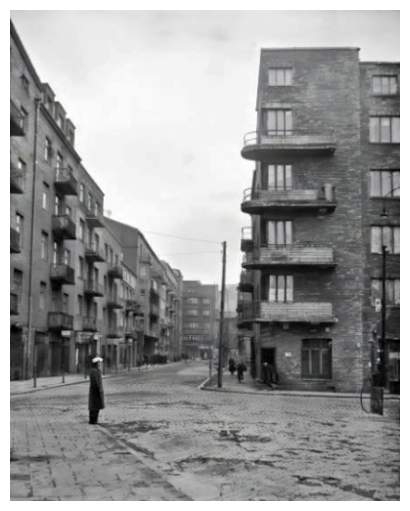
| Małachowski Street |
Translation:
“Everyone knows that throughout the Jewish diaspora societies of tailors and other artisans were created that arranged themselves in minyonim [prayer groups of 10 men] with their own Torah scrolls to read every Shabbos [Sabbath] and holiday and with this they helped each other. And when there was a religious concern, in order that they not suffer any detriment to their interests, they connected with non-Jews in the guilds (Christian artisans' unions). Further, the societies bring with them love of friends, friendship as well as things that are connected to piety and human matters. Because of this, the artisans in our city decided to create a similar society and to be united in friendship and to take a Torah scroll from the synagogue. They committed to pay to the
[Page 42]
charity (kehile treasury) 15 reichstaler (old German currency) over the course of three years, and yearly installments of five reichstaler. These payments were obligated to be paid to the kehile treasury, even in the first year when they were to buy their own Torah scroll. In addition to this, it was clearly designated that people who were not artisans could also belong to the society. Let then the leading citizens in the kehile and the rabbi give their agreement in case harm to the kehile and rabbinical court arises from this. With this, they (the society members) took upon themselves the obligation to fulfill and to hear everything about lawsuits according to Jewish law and in public affairs they obligated themselves to obey all points like every Jew. Predominantly, their striving was that it bring unity and friendship among the members so that they would not yield to temptation… because every artisan hated his trade [the artisans were suspicious of others in their own trade]. And there should be a protection of one for the other and help for everyone who would come to them because a person cannot help himself alone. Now, however, they were together in a solid bond and one would strengthen the other and they would be secure and calm about their terrible trade. All of this… the tailors and all other artisans. And this is the content to which they agreed. The further precepts that they enacted would be voted on by an overwhelming majority of the members about everything that was relevant to them and on behalf of matters that were concerning piety.
The was done today, Friday, Erev Shabbos Kodesh [on the eve of the holy Sabbath] 5561 (1807) Będzin.
Signed: Rabbi Nakhum Rozanes, rabbi of the holy kehile of Będzin.”
At the end of page 1, we find the following notation: That is, “the further good fortune of the Khevre Khaytin that they received from the supervisors (kehile dozores [elected representatives of the community]) of the year 5602 (1842) is found on page 94.”
There is found the following:
Translation:
“The supervisors in the year 5602 (1842), who signed below, ordered the Khevre Khaytin to show their privileges that were written in their pinkes. After they searched the pinkes, they found that which was certified by the ten men who signed above, who were among the seven city elders, that they (the Khevre Khaytin) should be permitted to have a minyon and to read the Torah, but on the condition that they pay three reichstaler annually. And since, until now, they had not paid in anything, the supervisors who signed here [on the document] demanded of the society that it should pay the tax that had been laid on them for such is the law according to our Torah. The representatives of the society justified themselves that since that time, no parnes [elected member of the community] and no dozores had demanded any tax from them and they had not known of it until the present day. They consequently said that they would pay for the time of their term in office as society sextons and that which was not paid in the past should be [considered as a donation] to them. After many pleas and efforts and while they saw their good will because they had also obligated themselves to give a great deal of money to build a house of prayer, as it was recorded in their pinkes, and because they took upon themselves they they would act according to Jewish law and they would not turn to the general court, only in case they could not [bring the case] to the Law of Israel – we have, the supervisors with several prominent individuals, decided to grant them the tax and they have the right to lead their society as they have but with the condition they will fulfill that which they have obligated themselves to do. Otherwise, if they do not fulfill what they have taken upon themselves, the pardon is voided and the supervisors will then have the right take from them the entire debt from 5575 (1815) until [1842].As proof, the honorable rabbi of the religious court and the supervisors, as well as several prominent individuals signed, Tuesday night, the 8th of Shvat 5602 ([19 January] 1842) Będzin.”
Concerning the economic activities of the society, we can get an idea from the following agreement that was signed by the then rabbi and the dozores in the year 5568 (1808).
The contents of the agreement that was written in the holy language [Hebrew] is as follows:
“We the undersigned have decided that because the price of wheat has greatly risen and the
[Page 43]
artisans cannot maintain the journeymen who also rely on the artisans, and the commerce in the country is ruined; one cannot enter and cannot leave. Consequently, every artisan must give the journeyman a third portion of his earnings for each piece of work, after subtracting the cost of the candles that are consumed at the work. If an artisan also had an apprentice in his work, a groshn had to be subtracted for him from each gildn. If the apprentice did not agree to these conditions, he could not accept any work in the city and also not for a half mile [about eight tenths of a kilometer] around the city. The supervisor of the society has to see that the journeyman has no grievances with the accounts. The apprentices and journeymen need to follow the decisions of the society. The supervisor has the right to take promises from those who will not obey, but with the provision that it will not be against the laws of the Torah and the precepts of the kehile.”
The rules of the society set the duties of the members with regard to religious matters as well as to matters that had a connection to their professional lives.
The most important and characteristic rules (written in the holy language in the pinkes) are the following:
| Rule 1) | Every Jew in our kehile can be accepted as a member of the Khevre Khaytin if he is admitted by a majority vote of the members. He must then bring in not less than two times chai (18) groshn and one pot of mead; he must pay the dayan [religious judge] for writing his name on the page of the pinkes. |
| Rule 2) | Every member pays three groshn weekly which is collected by the shamos [sexton], who must pay the money to the treasurer of the society at the start of each month. A journeyman needs to pay one groshn for each gildn that he earns annually. |
| — — | [There is no entry for rule 3.] |
| Rule 4) | designates the form of the election, which needs to be arranged every Khol HaMoed Pesakh [intermediate days of Passover]. |
| Rule 5) | speaks about the two banquets which the society makes every year on the second day of Shavous [holiday commemorating the giving of the Torah] and on the eighth day of Sukkous [Shminatseres], when the rabbi gives a customary sermon. |
| Rule 6) | describes the competence of the supervisor (a council petty officer), who has the right to compel the carrying out of his decisions. |
| Rule 7) | If one is competing with his comrade, when a boss gives fabric to an artisan, who cuts it and, later, a second artisan comes and takes the work – then the wronged one must immediately turn to the gabbai and to the supervisor, who decides with the rabbi that the transgressor must pay the work's wages to the first artisan. In addition, he [the transgressor] receives a penalty for the benefit of the society. |
| Rule 8) | regulates the relationship to journeymen. The journeyman may not move from one artisan to another over the course of one “allotted time.” Various punishments and sanctions are foreseen against he who violates the commitment [to an artisan]. |
| Rule 9) | No artisan can take on an apprentice before three years have passed since his marriage, in order to teach him the trade and, therefore, to be paid by him [the artisan]. The artisan is only permitted to have a journeyman. An exception is made for the member who already belong to the society. |
| Rule 10) | says that a penalty of excommunication and a fine fall on each one who tried to weaken these rules. |
| Rule 11) | Whoever brings finished clothing from elsewhere to sell and through this causes harm to the local artisans must pay to the treasury of the society an appropriate payment. |
| Rule 12) | When someone causes an argument in the society or insults and appears against a supervisor (head, elder) of the society and its members, all of the members must together try to distance him from the society in order that peace and unity always reign. |
| — — | [There is no entry for rule 13.] |
| Rule 14) | Every journeyman who buys into a guild (Christian artisans' union, which Jews are allowed to join) must pay the society a certain payment. He who receives the title Meister [master craftsman] from the guild must also bring an appropriate amount to the society treasury. |
With this rule, a comment is found that on page 9 there are supplementary directives to the rule.
There we actually find the following additions:
“As on page 5, column 2, in the rule 14, it is designated that every journeyman who pays dues to the guild has to give a certain payment to the society, we, the supervisors who have signed below, have determined a tax on this, namely, every apprentice has to pay one gildn to the society treasury, every journeyman has to pay two gildn, every meister three gildn and those who will be supervisors then need to give the gabbaim the power to carry this out.”
Further on comes an addition to point two, according to which, every journeyman must pay one groshn for each gildn of income into the society treasury.
“Consequently, we, the supervisors, have decided that each journeyman who eats at his meister has to give one groshn for each gildn wages and the journeyman who eats for his own money only has to give half a groshn from every gildn wages.
| Rule 15) | If a member of the society has artisans who are outside the society and make clothing, the member has to bring a special payment to the society treasury; otherwise, he is removed from the society. |
| Rule 16) | The members are permitted to go to pray every Shabbos in a minyon where they please, but provided that they |
[Page 44]
| must come to their own minyon according to the list made by the gabbai in order that there always be a minyon for early morning prayers (first minyon). | |
| — — | [There is no entry for rule 17.] |
| Rule 18) | A journeyman who comes from outside and does not want to make a [marriage] match in our city and then wants to settle here permanently cannot remain in the city longer than three years. All of the members must help this being carried out. |
Further come rules and decisions of the supervisors that give the Khevre Khaytin [Tailors' Society], to be on the safe side, the right to sew the clothing for the deceased. In addition, they are warned that those who are occupied with this should carry out their work with dread and awe; they should be sober and not speak any gossip.
The payment for this they must take according to the wealth of the deceased's relatives and according to the decision of the supervisors or gabbaim of the Khevre Kadishe [burial society]. A poor man is freed of payment.
On page 18 we find the following rule, which is written in the existing mix of Yiddish and the holy language:
“A verdict from the court of Jewish law was issued by us, the trustees and those in charge of the Khevra Nosei haMiteh [the society of those who carry the bier of the deceased – a subdivision of the Khevra Kadishe], that at the time of their appointments to official positions, the arbitrators from among the tailors could not have three trustees. Rather, one trustee must be a tailor and the other two must be from that organization, but they must not be tailors. The arbitrators also do not have the power to make the appointments alone, but rather, they must come with their appointments to the trustees of the Khevra Nosei haMiteh, those who are currently in office, and the Khevra Nosei haMiteh must agree with their appointees so that there will be no dispute with the Khevra Khayatin. If the Khevra Khayatim does not fulfil the charter rules and decisions that we have made with the authorization of the trustees and appointees of the Khevra Kadishe, then the Khevra Nosei haMiteh has the right to permanently dissolve the Khevra Khayatin. Members of the Khevra Khayatin are obligated to obey their trustees. If they do not want to obey their trustees, then the trustees of the tailors have the power and authority of that organization to remove them from the organization, so there will not be any chasm in the Khevra Khayatin, and there will not ever be any complaints and counter-complaints. Their pinkes must also be in the hands of their gabbai rishon [primary trustee] so that no obstacle may arise.”“All this we, the trustees and appointees of the Khevra Nosei haMiteh, have executed for the good of the Khevra Khayatin so that they will take heed and see, and no longer act treacherously. Sunday, the day following Shavous, 8 Iyar [note, this is an error in the original text, as the day following Shavous is 8 Sivan) here in Będzin.”
In additional pages of the pinkes, we find only registrations of members and lists of elections that took place every year.
It is characteristic that there is no chronological order in both the list of the elected gabbaim and the registrations of the members. The registrations are often in a very incorrect Hebrew. The reason for this is that contrary to the pinkes of the Khevre Kadishe, the pinkes of the Khevre Khaytin was presided over by ordinary men of the people, not learned men and, as a result, the language has many errors.
In addition, in general it can be noted that what was written later was done so with even more language errors.
In general, it becomes very clear from the pinkes that the founders of the Khevre Khaytin established very important economic and spiritual tasks that they only sometimes succeeded in fulfilling.
At the present time, all that remains of this is the plain form that is sometimes abided by through the present members. They do have the elections yearly and elect gabbaim, but the significance of the society and its influence on the artisans and journeymen is almost unrecognizable.
Finally, it must be mentioned that in describing the original text, both Hebrew and Yiddish, we tried to preserve the exact spelling of the words according to how it was used by the writer in the pinkes. So, for example, the word khitim (tailor) is sometimes spelled khaytim, khaytin, khiutim and khiutin, as we see the same word in various spellings in the same text.
The pinkes of the Khevre Hakhnosas Kallah
This pinkes of the Khevre Hakhnosas Kallah vaGmiles Khasadim
[society to assist poor brides and [to carry out] charitable deeds and support for
others], as the society is registered in the rules – was established in the
founding year of the society, that is, in 5502 (1842). The book is five centimeters
[almost two inches] thick, 22 by 18 centimeters [over eight and a half inches by seven
inches] and is bound in linen with a leather back. The title page is missing.
The sides 1-3 are taken up with the rules of the society in which is fully discussed the importance of the mitzvah [commandment] of providing assistance to poor brides and the duties and rights of the society members are regulated. The leaders of the society also are regulated in the same manner as in other societies, that is, through an election that is arranged every year in order to elect arbitrators who designate the gabbaim [sextons] and other officers of the society.
The text of the rules, written in Hebrew, is mostly rubbed off, almost unreadable.
On the fourth side, an agreement is found from the then Będzin Rabbi, Reb Dov Berish Herciger, of blessed memory, as well as a confirmation from the supervisors (dozores [synagogue council]).
The further sides are taken with recording the society members since the founding. Further until number 83 are registrations from a later time, mainly without dates. On sides 84 to 90, we find registrations of members that were done by the then dayan [religious judge], Reb Yehuda Leib Telner, of blessed memory (father of Reb Yehoshale Dayan, of blessed memory).
[Page 45]
The registrations of the gabbaim who were designated by the arbitrators as the
winners in eligible ballots appear from side 120.
The Rabbi, Reb Dov Berish Herciger, of blessed memory, in whose time and with complete help the society was founded, was the first honorary chairman. In addition to this, three administrators (a kind of supervisory council), three heads of supervision (executives), three auditors (revision committee) and a treasurer were designated each time.
We find the following notation on side 150:
That is, “In remembrance of what our society
|
|
| Piłsudski Street |
distributed during its existence for the benefit of the poor brides in our city.”
After this comes a long list that encompasses support for the years 5502 until 5528 (1842-1868) that was paid to various needy Jewish families to support them in marrying off their daughters.
On the further sides up to 160 is found the results of the yearly elections.
On side 161, an approval is found for the society, written in 5538 (1878) by the then Będzin Rabbi, Reb Yitzhak Kimelman, of blessed memory.
On side 187 the old part of the pinkes ends and the new part begins, which was added in 5539 (1879) and is numbered 188 to 270. The later pages are completely unnumbered.
In 5527 (1867), the society members adopted a new rule (side 188), according to which they committed to mutually help each other. If a member became ill, members had to come to him as observers to watch him all night. None of the members must refuse to go on duty as a guard when the gabbaim designated them. When one of the members died, the members who were designated by the gabbai had to establish a minyon [prayer group of at least 10 men required for prayer] in the house and pray there during the four weeks [30-day mourning period]. The gabbaim had the right to remove whoever did not accept this rule from the society.
The list of the gabbaim for each year appears on the later pages.
During the more recent years, since 5587 (1927), the lists of the gabbaim were written with ornate Hebrew letters by a scribe.
In 5587 the following rules were also entered, written in Yiddish with ornate Hebrew letters by a scribe, which we provide here in the original transcription.[1]
Then comes the signature of the Rabbi, Reb Zvi Khenokh Liwer, of blessed memory.
The actual activity of the society and the particular events among the members are, alas, not rewarded as usual in their pinkes. The writers limited themselves to recording the members and the lists of the gabbaim.
|
JewishGen, Inc. makes no representations regarding the accuracy of
the translation. The reader may wish to refer to the original material
for verification.
JewishGen is not responsible for inaccuracies or omissions in the original work and cannot rewrite or edit the text to correct inaccuracies and/or omissions.
Our mission is to produce a translation of the original work and we cannot verify the accuracy of statements or alter facts cited.
 Będzin, Poland
 Yizkor Book Project
 JewishGen Home Page
Copyright © 1999-2026 by JewishGen, Inc.
Updated 04 Oct 2026 by OR