 |
|
[Page 46]
The pinkes of the Khevre Tehilim
The pinkes of the Khevre Tehilim vaGmiles Hasidim [psalm society and [to carry
out] charitable deeds and support for others] – as this society is
recorded on the title page – was maintained in good condition. The title
page, which is colorful but primitively ornamented also was well-maintained.
The founding date of the pinkes can be found in the details of the following verse that appears – according to the old Jewish custom – on the title page:
(The letters [above] marked with apostrophes combine into the year 5589 [1829].)
The pinkes is five centimeters [almost two inches] thick. The format is 23x22 [nine by over eight and a half inches] centimeters in a good binding with a leather back.
In column B, there is a wide, pseudo-biblical-style glorification of the sanctity of the holy Sabbath and it is indicated that ba'avonoteinu harabim (because of our many sins), the Będzin young have a good time with dance and song every holy Sabbath – consequently, the members of the Będzin middle class decided to come together and adopted a proposal to found a Khevre Tehilim. The members of the society were obligated, both in the summer and in the winter, to come together in the synagogue every Shabbos [Sabbath] and spend the time reciting Psalms with song and joy.
In column C is found rule 10 with a small introduction from which we cite here the most important:
Translation:
The great (important) rules that are found here are 10 in number like the 10 Commandments; [they were] produced and finished at the time of the [celebration of the] giving of the Torah on the last day of Shavous 5589 (1829) and specifically regarding the Jewish people from now until eternity, amen and amen.
| Rule 1) | It was decided by the members of the sacred Khevre Tehilim that all members are obligated to praise and to offer thanks with the songs of King David, by reciting Psalms every Shabbos [Sabbath] and holiday and every eve of the new month, as well as on the seventh day of the month of Adar (on the yahrzeit [anniversary of the death of] Moshe Rabbeinu [Moses our teacher], namely every Shabbos and holiday, several books (parts) of Psalms have to be recited and on the eve of the new month, as on the seventh of Adar – all five books of Psalms at once. And whoever violates the rule without a reason or without coercion that would impede him to come to the synagogue, to God's house, to recite Psalms – will be penalized with a fine of six Polish groshn [in the Hebrew text, the word used is gedolim which implies a larger amount] for the benefit of the society. |
| Rule 2) | The members of the society take upon themselves the obligation that when, God forbid, one of them becomes sick and has to come for support to save his life and provide treatment for his illness – they are obliged to give it to him from the society treasury according to the decision of the supervisors (elders). And, also, when, God forbid, in an emergency, they have to plead for someone ill, both a poor man and a rich man – happy is he who has understanding for the poor man – and there is nothing like a poor man who is a patient who is called a pauper (poor man), then all members of the society must come together to plead for the sick one and to recite Psalms. And, therefore, the sick man is obligated to pay 18 groshn into the charity fund of the society, as much as amounts to the worth of chai [18] (life), to remember life. |
| — — | [There is no third rule.] |
| Rule 4) | They have to be bestowers of kindness to the living (healthy members), that is, to take care of everyone who is needy with a guarantee that should have double the worth of the loan, without any interest to be paid even in the smallest installments and when a respectable guest comes, he must be given a third of the support that he will receive from the Khevre Gemiluti Khasadim Tovim [society of good deeds of loving kindness], |
[Page 47]
| Bikur Kholim [society to aid the sick], Ner Tamid [eternal light]. The treasurer does not have the right to pay from the treasury even one coin without the signature of the gabbai for the month and the trustee. | |
| Rule 5) | When the society member marries off his child, either a son and a daughter, he must pay six groshn into the society treasury for each hundred gildn of dowry. When children are born to a society member, he must pay six groshn for a son and 12 groshn for a daughter. |
| — — | [There are no rules six, seven, eight or nine.] |
| Rule 10) | As a banquet brings satisfaction, every year on the first Shabbos after Passover they need to arrange a feast and banquet at the residence of the gabbai, who is the parnes [community leader] for the month to jointly celebrate at a sudes mitsvah [banquet for a religious event] where there would be meat, wine and fish. Every member needs to give 18 groshn for arranging the election and for our intimate celebration no strangers should take part, except a person that the elders will agree to – as it is done in all other societies. |
From the introduction of the above-cited rules it can be seen what an important task the founders of the society presented themselves. The religious moment provided the main impulse to found the society. The founders, first of all, wanted to draw the young from their dancing and gossip with which they spent the Sabbath and as a replacement they proposed to recite Psalms in the synagogue “with joy and song” as is expressed in the introduction. However, with the religious moment we also see from the rule the clear communal character of the society, which had a gmiles khesed [interest-free loan] fund that gave its members interest-free loans with [agreements for repayment]. In addition to this, the charity fund of the society distributed support to the needy members when they found themselves in a time of trouble. The same fund supported guests passing through who turned to them for help.
The society also was concerned with helping the members with support during the time of an illness. Because of this, they arranged a sort of sick fund to mutually help with medications, guards [people watching over the sick] and insure against unemployment.
As we see, the sources of income of the society were diverse. They took contributions from dowries, from the newborn children – consequently, it is characteristic that from a girl, the father had to pay a sort of contribution: instead of six groshn at the birth of a boy, he had to pay 12 groshn for a girl. More income came from fines, for example, six groshn for not coming at the designated time to recite Psalms.
In 5605 (1845), the society received permission to arrange a separate minyon [prayer group of at least 10 men required for prayer] from the then dozores (supervisors) and for the privilege, the society was obligated to pay 25 gildn every year to benefit the kehila [organized Jewish community].
The first election of the above society took place in 5589 (1829). Three gabbaim [sextons], three auditors (revision committee) were elected then.
The further pages of the pinkes are taken with the members' registrations and the results of the election that took place every year.
The pinkes continues to be overseen by the members today who are satisfied with only entering the results of the yearly election ceremony. From time to time the names of new members who join the society are also noted.
Alas, we find no trace in their pinkes about the activity of the Khevre Tehilim today.
Translator's footnote:
The pinkes of the Khevre Nos'ei haMiteh
[1]Yiddish translated by Gloria Berkenstat Freund
Hebrew translated by Jerrold Landau
The pinkes has a format of 18-by-20 centimeters [7-by-almost 8 inches], three
centimeters [a little over an inch] thick, in a leather binding that is a
little damaged because of age.
This pinkes has a title page on which is given the founding year of the society as well as a detail that confirms the date.
The inscription on the title page reiterates:
Founded in good fortune on the day after Passover 5592 [1732], In the year “May David come who went” here in Będzin. [a Biblical style year mnemonic]
On a page before the title page is the following registration in Yiddish mixed with the holy language [Hebrew]:
“From testimony and remembrance for the Khevra Nosei haMiteh and the Bikur Kholim Society concerning how the matter transpired between the Khevra HaKhayatin, regarding the dispute between the society and the people involved who had stolen from the shrouds, and the matter was clarified on the basis of trustworthy witnesses. Therefore, the court of Jewish law and the trustees of the Khevra Kadishe and overseers issued a verdict that the tailors may no longer sew – may the Merciful One save us – when there is a case of death. They must give [the deceased] over to the Khevra Nosei haMiteh. Afterward, the Khevra HaKhayatin came before the rabbi and the rabbinical court and asked that they may again perform the mitzvah [of providing shrouds for the deceased]. Since the Khevra Nosei haMiteh acted very properly, the rabbi and the court of Jewish law gave them a document, and also inscribed it in their book – Heaven save us – that when the need arises, Heaven forbid, to sew such things, they must not sew alone, but only with the Khevra Nosei haMiteh in their Beis Midrash [house of prayer]; and the trustees of the Khevra Nosei haMiteh must supervise them so that, Heaven forbid, there will not again be a mishap regarding this mitzvah matter. Therefore, this deed must serve as a reminder that the Khevra HaKhayatin must never sew alone without the permission of the trustees of the Khevra Nosei haMiteh. On the eve of the second festival of Passover [i.e., the eve of the 7th day of Passover].”
After the title page come the old pages that were numbered from 1-85. Further are pages added later without numbering, among which is found a page number 34 that slipped through from the old part. Finally, there are very new pages from the pinkes that were added in recent years.
[Page 48]
On pages one and two is found a detailed introduction, written in a
Hebraic-Aramaic pseudo-biblical language. The reason why in 5592 [1832] the
Khevre Nos'ei haMiteh was founded is given there and the tasks of the society
are also discussed there.
In short, the introduction restates thus:
“It is true that there already is a Khevre Kadishe [burial society] in the city that has existed for several hundreds of years. This society had its pinkes that shows the importance of the great, praiseworthy action of the Khevre Kadishe. Consequently, no one had a right to found other societies that would, God forbid, somehow harm the Khevre Kadishe. However, in the year 5591 [1831], a plague broke out in the city (described exactly in the pinkes of the Khevre Kadishe, which we dealt with here), and because the town dwellers did not permit further burials at the cemetery, which had existed for over 200 years – in 5591, we had to buy a new place for a cemetery for a great deal of money. However, because the cemetery is so far from the city (meaning the cemetery behind the mountain) and it is a great effort to carry the deceased, God help us, the founders of the Khevre Nos'ei haMiteh decided therefore to turn to the kehila [organized Jewish community], Beit Din Tzedek [rabbinical court] and to the Khevre Kadishe and ask that they be permitted to take on the mitzvah [commandment] [of carrying the deceased]. The founders assured that they would be obedient to the kehila and the Khevre Kadishe and they would not do anything that would, God forbid, affect the income of the synagogue, house of prayer or the tsdoke gdoyle [central charitable organization] (kehila treasury).
On the second side of page 2 we find the rule of the year 5595 (1835) that obligated all members to recite psalms in the synagogue or house of prayer when one of them, God forbid, became sick. If one of the members died, the members had to come together in his house, to pray there for the entire shloyshim [30-day mourning period] and to recite psalms every day. They were also obliged to hire two learned men who would teach Mishnius [oral Torah] for the soul of the deceased throughout the shiva [seven days of mourning] every morning and evening.
On page 3, the following registration appears in old Yiddish:
“We, the overseers who have signed below, have come to an agreement with the local Khevra Nosei haMiteh, since that society, to this day, has acted in accordance with its rules, and since they often have need of the Khevra Kadishe, and they have promised to give a sum of money from their minyon to the communal coffers every year – they have paid up to the date below. And since they have their own Torah scroll that they commissioned from their own funds – therefore we, the overseers who have signed below, have determined that they themselves should give, from today forward, to the communal coffers the sum of six Polish zlotys annually. This should be paid on the intermediate days of Passover forever. And no communal representatives, whether we the undersigned or whether communal officials who come after us, can impede their minyon. They must also pay, no later than the upcoming intermediate days of Sukkous, to the undersigned overseers fifty Polish zlotys. Indeed, if one of them does not abide by this, or if they do not give over the fifty zlotys on the intermediate days of Sukkous, or if they do not give over the six zlotys on the intermediate days of Passover every year, we the undersigned, or the communal representatives who follow us, can stop their minyon. They would then have to give over the Torah scroll to the local holy synagogue. However, if they pay when asked, then no person in the world can impede them, and no court of Jewish law can annul the words of a fellow court of Jewish law unless it is greater in wisdom and number. All this was enacted willingly, from heart and soul, by both sides. It was signed today, on Wednesday night of the fourth intermediate day of Passover 5602 [1842], here in Będzin. To add to its validity and force, the Great Luminary, the head of the local rabbinical court, has also signed.”
Then come the following signatures:
Dov Berish Herciger, head of the local rabbinical court in Będzin, Natan Mordechai Sanzir, dozor [overseer], Daniel Bugajer, David Erlich, Elyakum Getzel Sztrachan Gabbai Rishon [first trustee], Aharon Brauner Gabbai Sheini [second trustee], Yitzchak Zeev Ber”s Gabbai Shlishi [third trustee], Pinchas Szwarcberg, Natan Pozmantirer, Nachman Bres, Mordechai Pelc, Ephraim Testilirer, Eliezer Leizer Sztorchan, second accountant.
There is an acknowledgement of the kehila and the Khevre Kadishe on page 4 that permitted the founding of the Khevre Nos'ei haMiteh on the condition that it will carry out its obligations according to how it is stated in the subsequent points: (written in the holy language):
[Page 49]
May it be “He will swallow up death forever, and the Lord God will wipe away tears from all faces” [Isaiah 25:8] (that is, may there no longer be evil). In a case when there is a corpse, the supervisor of the society is obliged to ensure that he and his people who will be designated carry out everything immediately; that there will not be a delay and that it be God's will that we will live to see good and joy and the speedy coming of Moshiekh [Redeemer].
Signed: Rabbi M. Nakhum Ruzanis, rabbi in the community of Będzin.
Dated: 5592 [1732], enacted on Tuesday, 2 Nissan of that year.
On side 6, there is another addendum from the year 5511 (1851) signed by the then Rabbi, Reb Chaim Dovid (Langfus), of blessed memory, and several gabbaim, according to which new members could only be enrolled by the rabbi, to whom the gabbaim must bring the society pinkes.
On the other side of page 6, we find an acknowledgement from the Khevre Kadishe gabbaim and arbitrators written in 5595 (1835) where recognition of the members of the Khevre Nos'ei haMiteh is given for their good behavior. The recognition was expressed in that the gabbaim of the Khevre Kadishe decided to facilitate the entry of the members of the Khevre Nos'ei haMiteh into the Great Khevre Kadishe by decreasing the dues that are demanded [to do so].1.
On page 7, an acknowledgement is found from Rabbi, Reb Dov Berish (Herciger), of blessed memory, written in 5602 (1842) that the society paid in the 50 gildn that they had committed to pay the kehila accordingly as foreseen in the rule on page 3, side 2.
1. In order to distinguish itself from other societies that also have the words khevre kadishe in their names – they designated themselves as the authentic khevre kadishe with the adjective “Great” (Khevre Kadishe Gdolah).
Pages 8-10 are occupied with the actual rules of the Khevre Nos'ei haMiteh. These rules are not that different from the above-cited points. [They include] the internal relationships among the members, the members' dues, the order for handling a matter, the operating of the treasury and so on.
Rule 8, which throws light on an old Będzin custom is typical, namely, that every brit milah [bris – circumcision] took place in the synagogue or in the house of prayer and they welcomed the to- be-circumcised child with braided candles when the sandek [man holding the child during circumcision] entered the synagogue for the bris.
Rule 8 says: the members of Nos'ei haMiteh took upon themselves the obligation that when a male child, le-mazal tov [congratulations], is born to one of them, the child's father must give chai [18] gildn for the charity fund of the society. Therefore, two supervisors of the society must welcome the sandek with the newly born child with lit braided candles whey they come to the synagogue or the house of prayer for the bris.
From rule 11 can be seen that the society had the task to provide candles and an eternal light for the synagogue anteroom; in addition to this, they were required to light a lantern near the synagogue so that worshippers would have light when they went home after prayers.
Rule 12 regulated the arrangement of the banquets for the society, the payment and the order.
Rule 13 specifies that if the members of the society behave properly and they request that the rabbi give a sermon for them at their banquet like at other societies – the rabbi will be given permission to go to them, conditionally, so that it will be in honor of the rabbi.
Finally, we come to a declaration, that these 13 rules were enacted alternatively to the 13 virtues and the wish is expressed that they live to see the coming of Moshiekh [Redeemer], the building of the Temple [in Jerusalem] and for joys and great celebrations.
Rabbi Ruzanis and the gabbaim signed their names under the rules in 5592 (1832).
On page 10, column 2, is found a list of 22 members who were the founders of the society. Considered the first member is a certain Reb Ahron Badkhan[2] who is mentioned by the rabbi with great praise in the introduction.
There are comments alongside a number of the names of founders that they became estranged from the society, but right nearby, there is an addendum that those estranged were restored to their rights.
From page 11-33 are registrations of the first members of the society.
The first nomination of two gabbaim, one cashier and two bookkeepers is found on page 34, side 1, in 5593 (1833).
After this come further registrations of signatures until the year 5603 (1842) that are on page 59, side 2.
[Page 50]
On page 61 we find the following entries:
“On the date mentioned below, a verdict came from the court of Jewish law, from the gabbaim [trustees] of the Khevra Nosei haMiteh, along with the overseers of the society about Reb Moshe Sztajnhart, regarding the dispute, that he had denigrated the Khevra Nosei haMiteh, in that he said that the entire society consists of coarse young men, none of whom know a word of Hebrew, and the gabbai is unfit to be a gabbai for us, and such gabbaim should be expelled, and he has made the same dispute with us as with the Khevra Tehilim. Therefore, we the gabbaim and overseers have issued a verdict that Reb Moshe Sztajnhart, in this year 5610 [1850] is not an overseer, and his appointment is of no validity, and after this year, that is in the year 5611 [1851] he cannot hold any office, and he cannot be appointed as an arbitrator for any overseer. After two years, that is after this year 5610 and 5611, he can be appointed to an official position, and he can be made [an arbitrator] for one overseer. However, he cannot be made a gabbai for three consecutive years, that is from 5612 [1852] until 5615 [1855], for this verdict is fitting and appropriate for him. Regarding this, we the gabbaim and overseers have signed on the eve of the Sabbath of the Torah portion of Beha'alotecha [“When your rise… ”, 5610 [1850].”This is followed by the signatures of the gabbaim.
On page 68, side 2, we find an accounting from the year 5626 (1866), where the building costs of the Beis Midrash of the Khevra Nosei haMiteh are listed.
We find the following preface to the accounting ledger:
“We have produced an honest accounting with the gabbaim and treasurer of our holy society, that is Reb Avraham Daniel Winer, Reb Leibish Pik, with Reb Moshe Wojdslawki, with Reb Kalmele Kajser treasurer, regarding the building of our Beis Midrash. All the costs are detailed, with the total. That is.”
| 50 kor lime at 2.15 [Polish korzec = 128 Liters [33.8 gallons] |
125 | — | Transport | 1851 | 15 | |
| Expense for limewash with water and lime‑slurry. | 103 | 10 | Laths | 26 | 20 | |
| 12,000 bricks with labor cost | 560 | — | Masonry with brick laying | 1140 | — | |
| 3 foundation stones | 105 | — | Helpers to lay the foundation | 50 | — | |
| Sand | 73 | 10 | Blacksmith | 20 | — | |
| 2 support planks | 266 | 20 | Windows with panes and hardware | 198 | 20 | |
| Beams | 53 | 10 | Pry-bar with wedges for the roof timbers | 50 | — | |
| Rubble stones | 40 | — | Trimming of roof timbers at the walls | 69 | 10 | |
| Roof timbrels for the roof with craftsmen's labor | 40 | — | Whiskey [for the workers] 15 jugs at 8 each | 120 | — | |
| Nails | 171 | 25 | Petty expenses approximately | 50 | — | |
| Roof with framing timbers | 117 | — | ||||
| Subtotal | 1851 | 15 | Total cost | 3576 | 5 |
It must be mentioned that the account was recorded in gildn and groshn (1 gildn
= 30 groshn).
Under the account the following date is given:
Then come the following signatures: Meir Winer, Kalonymos Kalman Rus, Shmelki Wajnrib, Avraham Mordechai Jungster, Benyamin Mordechai Kriclir, Shlomo Ferszt.
On a further page come the notices and lists of later appointments, as well as new registrations. Children are often added on the page of their father; therefore, we can find two or three generations of the same family registered on the same page.
On page 83 we find the following registers:
“Since the Honorable Reb Eliyahu Nisan was present at Reb Moshe Wojdeslawa's place, and he spoke against the Khevra Nosei haMiteh with disgraceful words, and he said in this language: 'Eh, the Khevra Nosei haMiteh will be ruined – because all the members of the society will die out, and we will be forced to make use of outsiders.' Therefore we, the Khevra Nosei haMiteh, deliberated over the matter and gathered testimony from proper, trustworthy witnesses. We, the Khevra Nosei haMiteh, sent to Reb Eliyahu Nisan Wajsler, called Litwak, that he should come to the society. He responded that even if the entire society will come to him, he will also not come. Therefore we, the overseers of the Khevra Nosei haMiteh, went to the gabbaim of the Khevra Kadishe, and the gabbaim of the Khevra Kadishe sent for him once again. He responded that the Khevra Kadishe cannot do anything to him anymore. Only after he dies, can they inscribe him [in the register]. They sent for him once again. He again responded that he has no fear at all of the khevra, and does not want to go to them. He furthermore said in these words: Nei Boi [не боюсь – I am not afraid] that is in Russian, as well as in our language in these words that he has no fear at all of the Khevra. Regarding this there was one witness, Reb Yosef Hirciger, and two shamoshim [helpers] Reb Moshe Yosef Ferszt and Reb Kalmale Kajser. Therefore, we reached the opinion, with the agreement of the entire the Khevra Kadishe, that as soon as he needs to be buried – him, his wife, and his children – the khevra will respond to him in the same words: Nei boi. When he is in need – that is, when he requires a sick visit or burial involvement of the Khevra Kadishe – and the Khevra Kadishe must deal with him, then we, the members of the khevra, will answer him in turn, with the same language that he used toward us when he said Nei Boi. We will say in our language that we also have no fear of him. Regarding this, we, the trustees and overseers of the Khevra Kadishe and the Bikur Kholim Society, and the Khevra Nosei haMiteh, have signed after the conclusion of the Sabbath of the Torah portion of Tetzaveh [You shall command… ], 8 Adar 5610 [1850] in Będzin.”
[Page 51]
There follow these signatures:
Hendil Erlich, Mordechai Frenkil, Mordechai Hajde, Yehiel Michl Szpira, Arin Banberg (moshgiakh – supervisor of kashrus [Jewish dietary laws]). Bendit Fishl's [son of Fishl], Moshe Hirsh Fishl's [son of Fishl], Avraham Yosef Frenkil haLevi [Levite], Moshe Dovid Szpira, Mordechai Pelc, Kalmani Kajzer, Moshe Yosef Ferszt, Pinkhas Szwarcberg.
On the following page 84 we find the note dated, Wednesday, the 3rd day of Khol HaMoed Passover 5623 (1853) where it is said that the mentioned Reb Nisan Wajsler had placated the Khevre Kadishe, which had pardoned him with full forgiveness and accepted him as a member of the society with full rights. The members were strongly forbidden to insult or harass Wajsler.
The gabbaim signed at the bottom of the note.
After page 85 come added pages without numeration where various notes, member registrations and appointments without any order and full of errors of spelling [etc.] are scattered. The registrations continue until today.
As we have already mentioned, it is characteristic for almost all pinkesimim that the later registrations were done in the same way, they neglected both the spelling and the form and content. So, for example, we find Hebrew words with a pure phonetic spelling. Understand that this was not done with the intention of reforming the Hebrew orthography but simply because of normal ignorance; so we find the spelling of the word kalpe instead of kalpi [ballot box or election], [the name] Shahl instead of Shaul, [the name] Maier instead of Meir, [the name] Matkhah ben [son of] Moyshah instead of Mordechai ben Moshe or habakher Sheloymah Zalmmah instead of habukhor [the young man] Shlomo Zalman and so on.
On the 50th page, side two, of the unnumbered pages, we find the following writing:
“We the undersigned have reached the majority opinion that the Khevra should no longer draw lots. Rather, every year, they will elect three gabbaim [trustees] by election ballots. The three elected gabbaim can select one treasurer according to their wishes. Every year, a public balance sheet will be made for the entire khevra, with the income and expenses that were made by the khevra. The time of the voting has been designated from today as the upcoming Rosh Khodesh [start of the new month of] Tevet, and every year on Rosh Khodesh Tevet. The elections that will take place can only be validated by the majority of electors who have voting rights. The khevra members who do not wish to pay for the needs of the khevra cannot under any circumstances have voting rights, and most certainly, they cannot be elected as gabbaim by other voters.
“All this was executed with the agreement of the undersigned on Sunday of the Torah portion of Behar [On Mount Sinai… ], on the 19th of our count, of the year 5673 [1913] here in Będzin.”
Under this comes 26 signatures.
Immediately on another page is found the following note:
“Mazel Tov to the new gabbaim who were elected today through proper election procedures, and likewise to all the candidates who had received votes from the khevra electors. May the blessed G-d help all our members and all of Israel with good health and with good livelihood, and may they live in peace and contentment until the coming of the Redeemer, Amen Selah.
Reb Levi Wolhendler chief gabbai 29 votes Reb Zindil Wajzmark second gabbai 26 votes Reb Ahron Ross third gabbai18 votes Reb Shlomo Lajzerowicz 9 votes Reb Moshe Liwer 6 votes Reb Wolf Ross 6 votes Reb Shlomo Fersztenfeld 3 votes Reb Moshe Dovid Merin 1 vote
We three gabbaim chose one treasurer, with good fortune, Reb Ayzyk Fersztenfeld.”
|
|
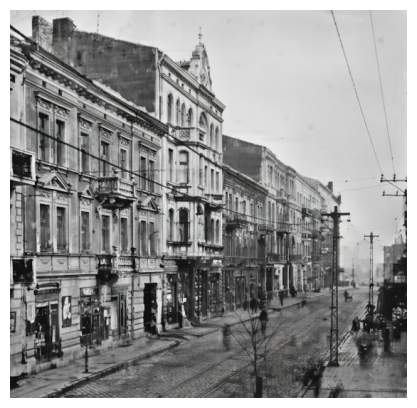
| Kołłątaja Street (in front of the gate) |
On the last written pages is found the following note:
“The Khevra Nosei haMiteh was founded in the year 5591 [1831] with various enactments. One enactment rules that every year on the intermediate days of Passover, one must draw lots, and the first three lots drawn are designated as borerim [arbitrators]. They have the authority to appoint gabbaim [trustees] as well as other appointees. And in this year, that is 5691 [1931], the borerim were Reb Shaul Nota Hercberg and Reb Shlomo Fersztenfeld. They themselves selected gabbaim, regarding whom the entire membership of the khevra did not agree. Therefore, there was a great dispute, and they had to resign in the middle of the year. There were no more lotteries, but only
[Page 52]
every year, they must determine the overseers by election. Until the intermediate days of Passover, Reb Wolf Roses and Reb Yaakov Soper were elected. And, G-d willing, on the upcoming intermediate days of Passover, we will conduct elections. Now we must point out that this year is the one hundredth year since the founding of Khevra Nosei haMiteh. We celebrated a jubilee with a large parade in the new Beis Midrash that we built in the Talmud Torah yard in the year 5688 [1928] with our own money. Furthermore, all the objects that are in the Beis Midrash, the bimah [raised Torah reading desk], the memorial stone and the memorial lamp – all were ready for the jubilee in the year 5692 [1932] – all with our own funds, which are further itemized to show how much each member paid and who the leaders were among the membership.”
Alas, we do not have a list of volunteers and the leaders in the pinkes. On the other side of the above-cited note is the list of the gabbaim and officials from 5693 [1933].
The last written side of the pinkes is taken with the list of the gabbaim and officials in 5696 [1936].
The Khevre Nos'ei haMiteh continues to exist in our city, but the above-mentioned 100-year anniversary celebration did not increase the significance of the society that over 100 years ago was founded by the respected businessmen as a result of the then extraordinarily hard circumstances.
Translator's footnotes:
The pinkes of the Khevre Malbish Arumim
This pinkes is the youngest among those pinkesimim that we have handled. It is
bound in linen; the spine is missing, it has a format of 18 by 22 centimeters
[seven inches by over eight and a half inches], two centimeters [about
three-quarters or an inch] thick and is numbered 1-179 (the numeration does not
go according to the sides, but according to the pages).
We learn about the founding date of the pinkes from the following writing that is on the second side of page 179:
“Executed and concluded with our good will on the eve of the Sabbath of the Torah portion of Balak 11th of the month of Tammuz of the year 5653 [1893] here in Będzin.”
That is, it was created and came into being according to our good will on Erev Shabbos Kodesh [on the eve of the holy Sabbath], Torah portion Balak, 16th day of the month of Tammuz, in the year 5653 ([30th of June]1893) in Będzin.
On the same side the seal of Rabbi Reb Itshele Kimelman, of blessed memory, is found, as well as the stamp of the society with the writing:
That is, the Khevre Bukhurim fun Malbish Arumim [Society of Young Men for Clothing the Naked] for the small kheder [religious elementary school] children in Będzin.
On the second unnumbered page the following first registrations are found:
Translation:
“The enlightened young people, whose names appear beneath, decided to found the Khevre Malbish Arumim, that is, annually to clothe the poor Talmud Torah [primary school for poor children] children of our city on Rosh Khodesh Kheshvan.) They acknowledged and took upon themselves – with a firm and strong covenant – all the rules that would be written in this pinkes. And in this merit, and among us may there not be any poor people and Mosheikh [Redeemer] should come immediately. Amen!”
The stamp of Rabbi Reb Yitzhak [his name is given as a diminutive above] Kimelman, of blessed memory, and of the society is found on the same page.
On the third unnumbered page – side two, the recording of the rules, of which there are 10, including an additional rule, begins.
We present here the rules that were written in Loshn Kodesh [the holy language – Hebrew] in the Yiddish translation:
| Rule 1) | Each of the society members is obligated to pay five kopekes weekly. For each new [piece of] clothing that a member makes, he must pay nine kopekes when he signs the [engagement] contract – 27 kopekes and 54 kopekes on his wedding day. |
| Rule 2) | We are obligated to clothe the Talmud Torah children once a year, and if God will help, and we will be able to, we commit ourselves to clothe the children twice a year. The start of the clothing must to be the start of the month of Khesvan of 5655 ([October 31] 1895). |
| Rule 3) | We commit ourselves to hire a melamed [religious teacher] who will study with the society members every Shabbos [Sabbath] in the morning and afternoon and every member is obligated to take part in the group instruction. |
| Rule 4) | The wages paid to the melamed must be paid from the society treasury and when there is not enough money in the treasury, then each member is obligated to help the society according to their ability. |
| Rule 5) | Every year during Khol Hamoed Pesakh [intervening days of Passover], a [drawing] is held randomly, from which are drawn the |
[Page 53]
| names of three arbitrators who are competent to bear witness. The arbitrators [choose] three gabbaim and all of the supervisors must be respectable men so that no conflicts will arise. The arbitrators may not choose more than 12 supervisors. | |
| Rule 6) | The gabbaim are obligated to send to members from the society every week to collect the payment (a small amount) and they must give the money to the treasurer every week. The members must go to collect every time they are sent by the gabbaim. |
| Rule 7) | Every society member is obligated to pay the small amount promptly every week to the two members who are sent by the gabbaim and he must not be late by more than a month. When the term passes and the member has not paid, the gabbaim and the supervisors – in agreement with all of the society members – have the right to do what they want with him. |
| Rule 8) | After the society begins to exist and someone wants to join, this must be with the knowledge of the society and in the presence of at least 10 elders, who need to record the candidate in the pinkes and the elders must sign thereof. |
| Rule 9) | The arbitrators may not remove a gabbai so as not to shame him. They also cannot create a gabbai if he was not an elder (supervisor). |
| Rule 10) | Whenever a ballot is taken, a banquet must be held after it and the money for this must not be taken from the society treasury, but everyone is obligated to give from his pocket. Also at other opportunities, when the society comes together and a banquet is held, the money may not be taken from the society treasury. |
| An additional
rule) |
If the gabbaim and the elders do something for the society, this must be in agreement of all the society members. |
On the 5th unnumbered page are written 40 names of the founders. Appearing there, among others are the following names: Chaim Wolf Sztajnhart, Avigdor Szwajcer, the brothers Elimelekh and Chaim Sztrachlic, Yosef Borzykowski, Meir Bluenfrucht, Eli Dovid Bolimowski, Chaim Leib Kerner, Nekhemia Wajczalc.
The registrations of the members are from page one to 99. On page 100, the results of the first election are recorded that took place on Thursday, the 4th day of Khol Hamoed Pesakh [intervening days of Passover, 5654 ([26 April]1894).
The pages 101-146 are taken with the results of the elections in the years 5655-5697 (1895-1937).
The pages 147-166 contain no writing. On pages 167 and 168, new members are recorded and from 169 to 179 the pages again contain no writing.
The main idea of the Khevre Malbish Arumim is observed up to today. Every year in the month of Kheshvan a few hundred poor children are clothed as well as adult men and women.
From the various observations and lists in the above-mentioned pinkesimim can be seen that at the kehila in Będzin the dozores [synagogue council] or supervisors – as they sign themselves – maintained a community pinkes in which all of the important events, agreements with the local societies, various rules and judgements in the city were recorded. This pinkes, which could have given us a lot of material for the historical research of the Jewish settlement in Będzin and the surrounding area, alas, was lost and as far as we have searched for it, it does not exist in Będzin.
Comments:
All of the supplements of the abbreviations, explanations as well as the European dates which are found in the text, were created by the author of the above work.
|
|
| A fragment of Shmuel Cigler's painting in the Great Synagogue |
|
JewishGen, Inc. makes no representations regarding the accuracy of
the translation. The reader may wish to refer to the original material
for verification.
JewishGen is not responsible for inaccuracies or omissions in the original work and cannot rewrite or edit the text to correct inaccuracies and/or omissions.
Our mission is to produce a translation of the original work and we cannot verify the accuracy of statements or alter facts cited.
 Będzin, Poland
 Yizkor Book Project
 JewishGen Home Page
Copyright © 1999-2026 by JewishGen, Inc.
Updated 04 Oct 2026 by OR